



Scandalous but scrumptious
| Page 9
By VARSHA BHARGAVA, MARY CAITLIN CRONIN and SOPHIA DASSER Sun Managing Editor, News Editor and Editor-In-Chief
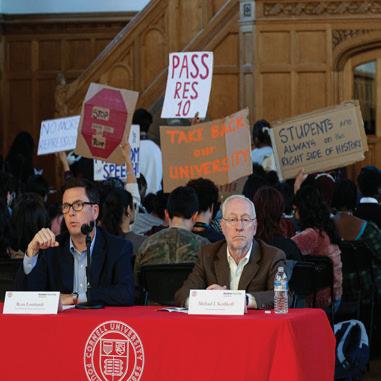
1 — President Michael Kotlikoff drove his car into a Cornell student and ran over the foot of a recent graduate following a Cornell Political Union debate on the Israel-Palestine conflict Thursday evening, accord ing to video footage obtained by The Sun.
In a Friday email to the Cornell community, Kotlikoff described being followed to his car after the debate and “accosted” by a group of students and non-students who he wrote were “shouting,” “block ing the car” and “banging on the windows” before he left the parking lot. Kotlikoff described the encounter as a “harassment and intimidation incident” and wrote that he “waited until [he] saw space behind the car.” Kotlikoff did not mention any collision between the vehicle and the individuals.
Video footage obtained by The Sun shows Students for a Democratic Cornell members Aiden Vallecillo ’26 and Hudson Athas ’27 being struck by the car and SDC member Aiden Vallecillo ’26 shouting that his foot was run over. In the video, no person can be seen touching the vehicle before it drove into Vallecillo and Athas.
The Sun spoke to Vallecillo, who said that he, Athas, SDC president Sophia Arnold ’26 and SDC member Aislyn Berg ’27 followed Kotlikoff to ask about free expression on campus after the event. After entering his car, Kotlikoff “rapidly backed into” Vallecillo and Athas and then drove off, according to Vallecillo.
The two have not been contacted by the University since the incident, Vallecillo

told The Sun. Kotlikoff’s email was released without reaching out to any students involved for a statement or to fact check, he added.
When reached for comment by The Sun on Friday afternoon regarding on the contents of the footage — including the footage that disproved Kotllikoff’s claim that students “bang[ed] on” his vehicle — a University
parking lot interactions, instead of clips to support a narrative.”
The one minute and 30 second clip shows a wide angle of the parking lot outside Day Hall, where a group of people can be seen following Kotlikoff to his car and surrounding it after he enters. After this, the group does not appear to touch the car, but continues surrounding it, with one student — Athas — standing directly behind the vehicle as it backs up. The incident occurred after CPU’s “Israel Was Not Justified in its Response to Oct. 7” debate featuring guest speaker Norman Finkelstein Thursday evening, where Kotlikoff presented an opening statement. After the event ended, four SDC members — and bystanders not recognized by Vallecillo — followed Kotlikoff from Goldwin Smith Hall to his parked car near Day Hall, Vallecillo told The Sun.
Vallecillo said that he and the three SDC members attended the debate to listen to Finkelstein speak, and were not aware that Kotlikoff would be present.
“We decided to converse with Kotlikoff after Finkelstein — as well as a number of student debaters and Kotlikoff, himself — encouraged the proliferation of free speech on
By SHUBHA GAUTAM Sun Assistant News Editor
May 3 — In many areas across its 5,490 acres of land, Cornell allows for deer hunting, aiming to improve forest health. Local hunters like Bill Enslow, however, claim that overhunting is destroying the deer population.
The Cornell Botanic Gardens website links increased deer populations to “reduced forest structure, decreased native plant populations …, increased invasive species growth, and higher rates of Lyme disease” in Cornell’s natural areas, when compared to 20-30 years prior. Deer management, or deer hunting, the site states, makes for “good stewardship” of land.
Enslow, however, believes “that nature will take care of itself.”
“I don’t believe there should be any hunting on Cornell land,” Enslow said in an interview with The Sun. “But if there [is], do what the state does with their hunting season, don’t say, ‘well, the deer are killing off the woods,’ and do a genocide right now.”
Enslow said he used to hunt deer in the University-owned Mount Pleasant area, but now claims that he does not see deer there anymore.
As a hunter in the area, Enslow shared concerns that, especially during the winter, some hunters bait and shoot deer, alleging to have knowledge of hunters using corn to lure deer on the land without repercussion.
When asked about whether Cornell uses baiting tactics to hunt deer, a University spokesperson wrote that “ all of our management programs are legal and comply with New York State Department of Environmental Conservation regulations and applicable laws.”
According to the NYSDEC big game hunting regulations, the use of bait or salt licks to hunt deer is illegal.
In 2008, the Botanic Gardens expanded their deer management and hunting programs “to include broader ecological management goals” focused on forest regeneration, part of which includes partnering with the NYSDEC in piloting New York’s first Deer Management Focus
The DMFA, which encompasses over 60,000 acres surrounding Ithaca, allows for an extended hunting period in areas of “overabundant deer populations.”
Within the DFMA, registered big game hunters can hunt up to two antlerless deer per day during the general hunting seasons — which includes the regular firearm deer hunting season from Nov. 15 - Dec. 7 and the bowhunting and muzzleloading seasons spanning from Nov. 15 to Jan. 1.
During bowhunting season, hunters with the proper permits can use vertical bows or crossbows, while during the muzzleloading season, a muzzleloading rifle or pistol loaded through a muzzle which shoots a single projectile with a bore of 0.44 inches or larger can be used.
They are also able to hunt during a special DMFA season running from the second Saturday in January to January 31, according to the NYSDEC.


Activity Fee through Resolution 66 and said much of the Assembly’s implementation work happens outside of public meetings.
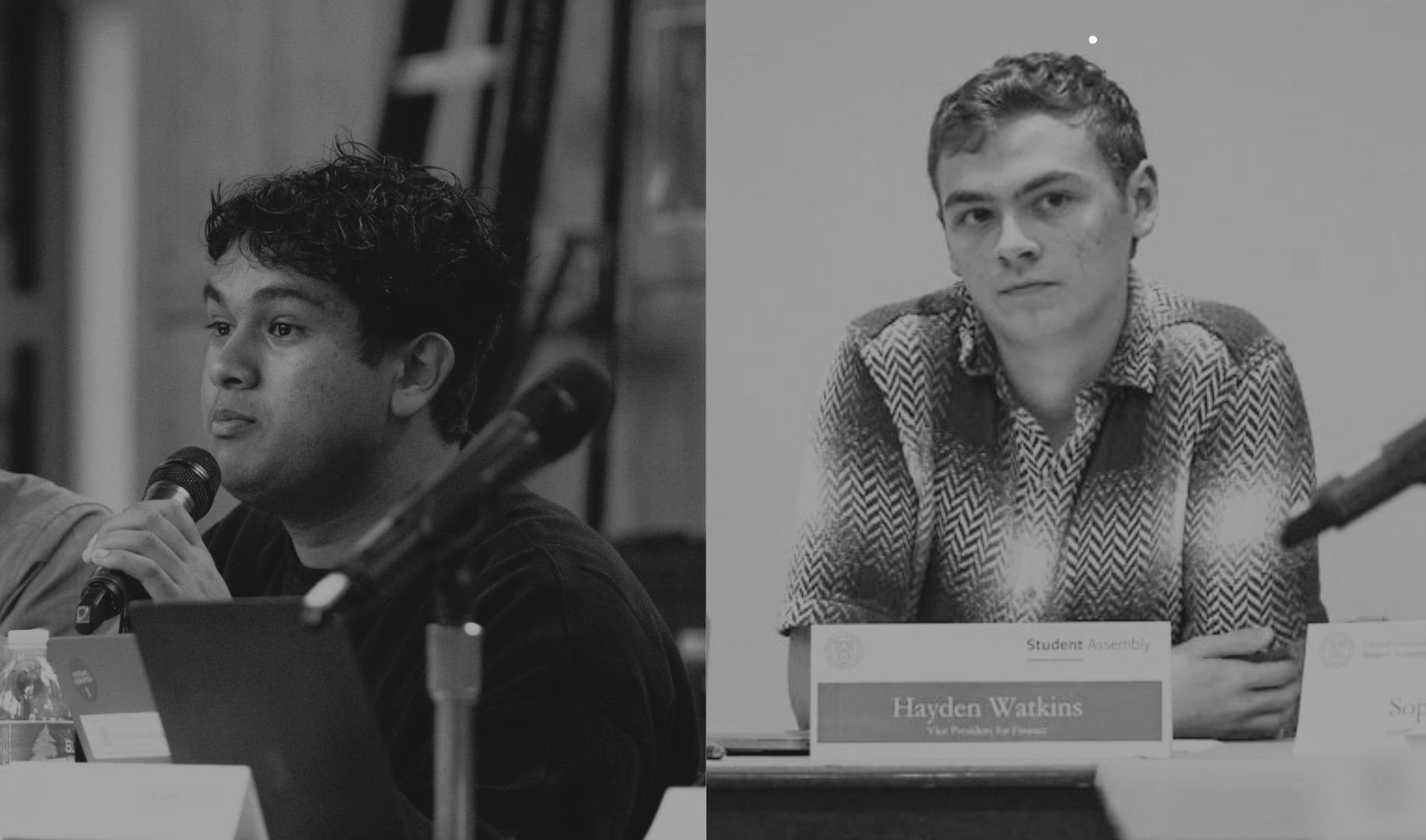
Apr. 29 — Eeshaan Chaudhuri ’27 was elected Student Assembly president and Hayden Watkins ’28 was elected executive vice president for the 2026-2027 academic year, according to election results released by the Assembly on their website at 4:15 p.m..
Chaudhuri won the presidential race against two-year incumbent Zora de Rham ’27 and Christian Flournoy ’27, while Watkins won the executive vice presidential race against Kennedy Young ’28. Voting opened at noon on April 20 and closed at noon on Monday, with undergraduate students casting ballots online through OpaVote.
Chaudhuri won the presidency with 719 votes after redistribution, defeating Flournoy (688) and deRham (279 first-choice, eliminated), with Flournoy taking Representative-at-Large as runner-up. Watkins won Executive Vice President with 643 votes over Young’s 489.
The winners of the race will take their positions on June 15 after a re-organization meeting in May, according to Director of Elections Ian Gilenson ’27.
The runner-ups in the presidential and executive vice presidential races will serve as Assembly representatives-at-large for the 2026-2027 term, according to the Office of the Assemblies website. Flournoy and Young will therefore join the Assembly as voting members despite losing their executive races.
Chaudhuri’s victory marks the first change in the Assembly presidency in two years and ends de Rham’s two-term tenure. Chaudhuri emphasized a reform-focused platform after a campaign in which he openly criticized the Assembly’s effectiveness and argued that the Assembly should prioritize policies with realistic paths to implementation.
Watkins will take charge of the Assembly’s internal operations after a campaign centered on Assembly member attendance, committee accountability and a more active Assembly presence in students’ daily lives.
The results of the other Assembly positions also reflect a shift in the Assembly’s political endorsements during campaigning. This year marked one of the first cycles in recent memory where progressive student organizations –– Progressives at Cornell, Young Democratic Socialists of America and Students for Justice in Palestine –– publicly endorsed candidates across multiple races. Every single candidate endorsed by these three organizations won their election.
Notably, the presidential and executive vice presidential races were among the few positions that did not receive coordinated progressive endorsements.
Presidential Race
All three presidential candidates –– de Rham, Chaudhuri and Flournoy –– entered the race with prior Assembly experience. de Rham has served as president for the past two terms, Flournoy serves as executive vice president and Chaudhuri serves as the undergraduate student representative to the University Assembly.
During her campaign, de Rham framed her candidacy around continuing existing initiatives and strengthening coordination between the Assembly and University administration. She pointed to her work on the Student
“A resolution is the initial germ of an idea, and many conversations have to happen behind the scenes after [it] is written and passed,” de Rham previously told The Sun.
Chaudhuri campaigned on structural reform and policy accountability, arguing that the Assembly needs to prioritize proposals that are realistic and implementable. He noted his work on Resolution 62 that calls to allocate $20,000 toward campus health vending machines stocked with items such as contraceptives, Narcan and over-the-counter medication as an example of a direct-impact policy initiative.
Chaudhuri’s campaign centered on the idea that the Assembly has passed too many resolutions without sufficient planning of follow-through.
“As a student who studies policy every single day, I could just see that we were passing policies that had no chance of working,” he previously told The Sun.
Flournoy emphasized mental health resources, equitable access to special project funds and building a more unified student body. As executive vice president, he previously identified improving University responses to student death and loss as one of his priorities.
“We need to make sure Assembly members are doing more to get out there ... [by] actively listening to communities that we’re a part of as well,” Flournoy previously told The Sun.
EVP Race
The executive vice presidential race featured Watkins and Young, both Brooks School students currently serving in Assembly leadership roles. Watkins currently serves as vice president for finance and representative-at-large, while Young serves as vice president of diversity, equity and inclusion and minority students representative.
Watkins’ campaign focused on internal accountability and operational reform. He previously told The Sun that the executive vice president is “the backbone of the Student Assembly” and said the role requires ensuring that members are actively contributing behind the scenes. He also pointed to attendance and inconsistent committee work as ongoing issues within the body.
Watkins outlined his three main priorities in an interview with The Sun: “improving function [of the Assembly], quality of life for students and building more widespread resistance [to the Trump administration].”
Young’s campaign centered on accountability, transparency and student representation. She pointed to her work on a unanimously passed resolution requesting more transparency in first-year program house placements as an example of her approach to data-driven advocacy.
Young previously wrote to The Sun that “students need to see not just what we pass, but what we actually change as a result.”
To continue reading this article, please visit www. cornellsun.com.
By
May 5 — Ujamaa Residential College, a program house founded in 1972 to serve Black students at Cornell, has seen its Black resident population decline significantly, and residents say the dorm is grappling with low funding, deteriorating conditions and a shift away from its founding purpose.
Ujamaa was created in 1972 as a result of the 36-hour Willard Straight Takeover in 1969, led by the Afro-American Society to protest racial injustice on campus.
The Africana Studies & Research Center, the Africana Library and the Africana studies program at Cornell were also results of the takeover.
“Ujamaa” translates to “cooperative economics” and “familyhood ” in Kiswahili. The dorm’s name reflects its founding purpose as a community for Black students built around shared resources and collaboration, according to Cornell Student and Campus Life.
“Ujamaa, given the history, is meant to serve or at least be a beacon for Black students,” said Amadou Agne ’27, a resident advisor at Ujamaa who has lived there since his freshman year.
“[Given] the current demographics of Ujamaa, we’re looking at [about] 30% Black residents.”
Problems in Ujamaa extend beyond demographics. Inadequate conditions have led to issues with water heating and black mold, according to Agne.
Colin Michael ’27 wrote that during his freshman year, Ujamaa looked different from Agne’s current account, estimating that approximately “2/3 of Uj was Black/African American [in 2023], with the rest largely composed of external transfer students.”
Kaelyn Stewart ’28, a current resident of Ujamaa, recalled a discussion she had with Black alumni who said that Ujaama “was basically like their own inner city communities back home.”
Stewart now finds a different atmosphere in Ujamaa. She explained that now when Black students attempt to hold events in the lounges, they often receive noise complaints.
Residents like Agne feel the lack of a Black presence living in Ujamaa makes the dorm feel like it is failing to serve its purpose.
“Being a minority student at Cornell … there aren’t very many places to connect with other Black Cornellians,” Agne said. “If Ujamaa is not serving that purpose, that’s a major loss for Black students on the Cornell campus.”
Jennifer Chen ’29 was placed into Ujamaa this year without requesting to be part of the dorm.
“There are a lot of East Asians in the dorm. Cornell just put me in that dorm,” Chen said. “I didn’t choose it, and a lot of people didn’t really choose it either.”
In response to questions about the general demographics of the dorm, the University explained
that Ujamaa is intended to be a home for students of all different backgrounds.
“Ujamaa, like all Cornell residential communities, is made up of students from a wide range of backgrounds, experiences, and identities” a University spokesperson wrote to The Sun. “Students are placed in Ujamaa by expressing interest in the community or through general housing assignment processes.”
Cornell Black Students United met with University administrators and discussed housing assignments for Ujamaa in a town hall meeting on March 10.
At the meeting, one student asked administrators how placement into Ujamaa is determined and how this placement aligns with “Ujamaa’s historic mission as a cultural and community center.”
The administrators responded that there is no formal process for program houses and that students should “respect the mission” of where they have been placed.
A speaker at the March 10 meeting mentioned that students continue to apply to live in Ujamaa, but are not placed in this dorm. She said that someone in the meeting claimed the placements were based on SDS, but the speaker explained “I know someone that applied to U that did not have SDS accommodations and still didn’t get it and was placed in JAM instead.”
Another speaker confirmed this by explaining “I applied for Uj as a transfer, and they put me in a double on West [campus].”
The influx of students placed in Ujamaa without expressing interest has led residents like Agne to believe that Cornell is treating Ujamaa as a form of “overflow housing.”
Along with concerns regarding housing placement, students at the town hall raised concerns about the facilities.
One speaker said, “It is not hard to see that the bathrooms are dirty and grimy and there are fruit flies flying around, even when I lived there my two years, and it’s uncomfortable to shower in those conditions.”
Agne also described inadequate facilities, mentioning, “issues with heating, water issues, there’s black mold issues sometimes — it’s pretty bad.”
Another concern Michael has is the decline in events and event turnout for the dorm.
“There’s a lot less events now this year held in Uj than there were in my freshman and sophomore year just because there are less people that are part of the community that are actually living in Uj,” Michael said.
Michael explained that as fewer Black students live in Ujamaa, residents have less reason for residents to want to engage in events.
To continue reading this article, please visit www.cornellsun.com.
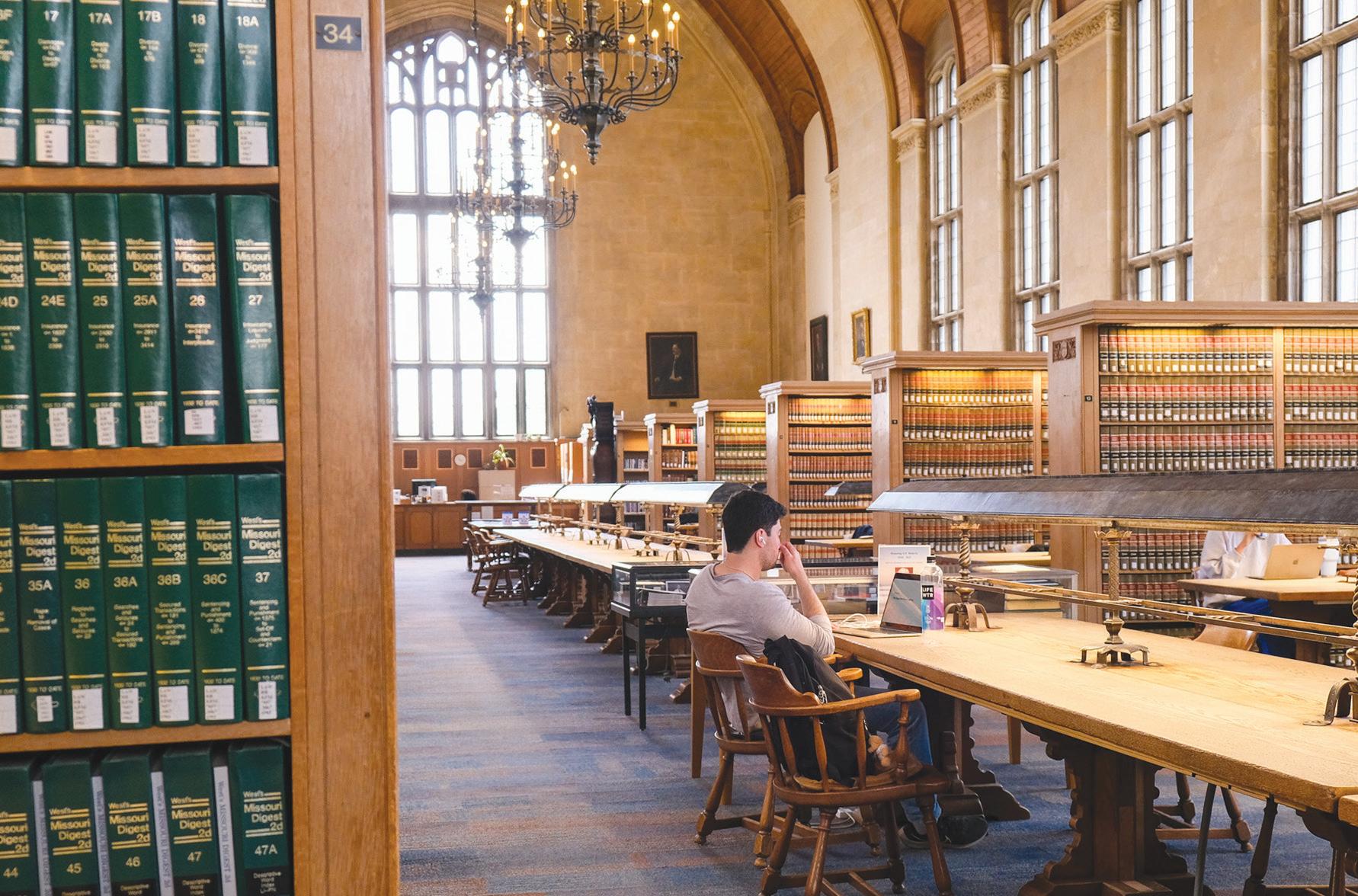
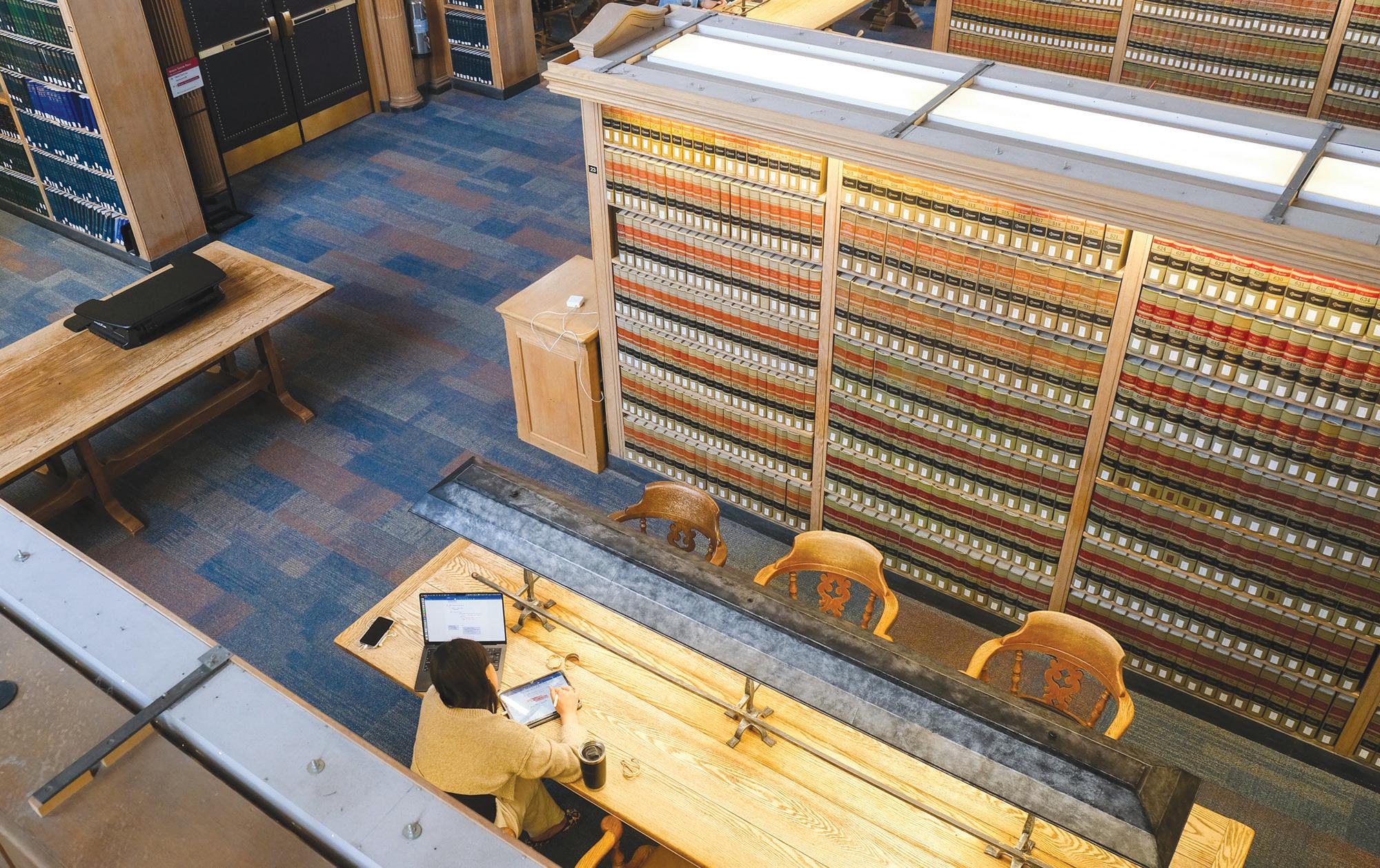
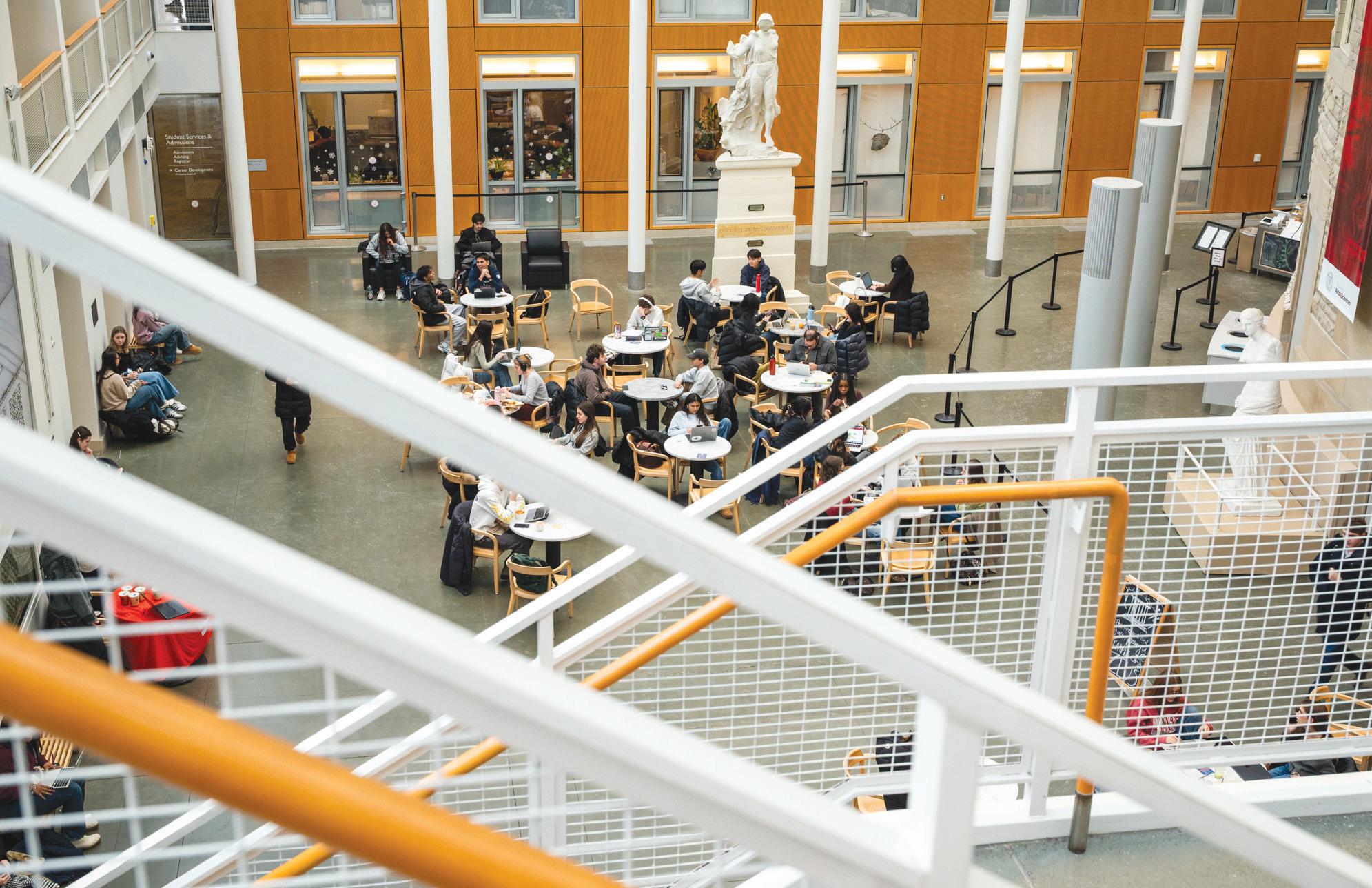
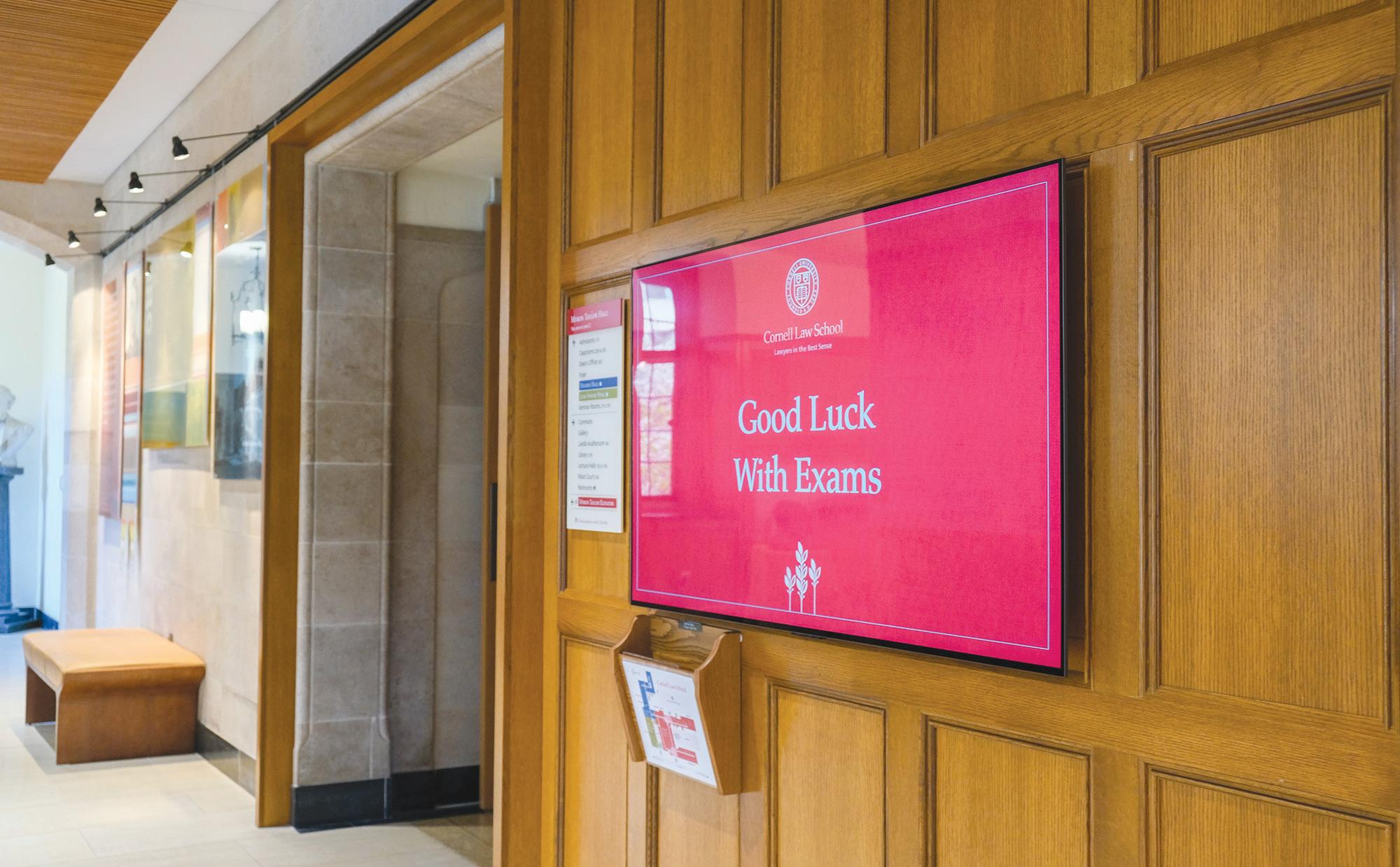
As the semester draws to close, Cornellians wearily fock to their favorite study spots to complete their last assignments and prepare for fnal exams.
By SUN PHOTOGRAPHY DEPARTMENT

ASSIGNMENTS STACKED | Students pack every seat in the Mui Ho Fine Arts Library as they clear through their Canvas to-do lists.



to adequately prepare for their
Continued from page 1
campus,” Vallecillo said.
The SDC members asked Kotlikoff about the Expressive Activity Policy, temporary suspensions on campus, the referendum and free speech during the five-minute walk to Kotlikoff’s car, Vallecillo said. In his email, Kotlikoff wrote that the individuals “loudly shouted” questions at him and refused to stop recording after he indicated that he did not want to engage further.
“We weren’t all shouting at him — it was mostly one person who was talking with him and just trying to have a conversation,” Athas told The Sun. “I feel that he violated his own proclaimed philosophy of free and open discussion, and I don’t believe it was anything that could remotely be classified as harassment.”
Vallecillo described the president as “dismissive,” “disinterested” and “disrespectful” in response to their questions.
As he approached his car, Kotlikoff said “good night” to the students and got into his car as the SDC members continued to attempt to speak with him, according to video footage obtained by The Sun.
Kotlikoff wrote that these individuals “surrounded”, “block[ed]” and “bang[ed]” on his car. According to video footage obtained by The Sun, students surrounded the car and one student blocked the rear of the vehicle by standing behind the car, but no one touched the vehicle.
SDC wrote in a statement to The Sun that “there was no attempt to intimidate Kotlikoff, physically or verbally and students consistently remained a safe distance away from him.”
Kotlikoff then “waited until [he] saw space behind the car” and used his “car’s rear pedestrian alert and automatic braking system” to “slowly maneuver” out of the parking spot, Kotlikoff wrote in his email to the Cornell community.
The footage shows 15 seconds passed between Kotlikoff entering the vehicle and backing out of the parking spot.
While leaving the parking spot, Kotlikoff backed into Athas with his car and ran over Vallecillo’s right foot after Athas asked “am I allowed to stand here?” while standing behind Kotlikoff’s car, according to video obtained by The Sun.
Kotlikoff drove away without saying anything to them while Vallecillo yelled to Kotlikoff, “You just rolled over my
f*cking foot, oh my god”, according to Vallecillo’s statement to The Sun and video footage obtained by The Sun.
Following the incident, the SDC members called the Cornell University Police Department, who responded to the call, took statements from the SDC members and called for Cornell Emergency Medical Services.
Cornell EMS were dispatched to the Day Hall parking lot at 8:31 p.m., mentioning a “college male” whose “foot was run over by a vehicle,” according to an audio recording of the Tompkins County police scanner.
Vallecillo told The Sun he was seen on site by Cornell EMS, but has not received any further medical treatment. As of Friday, he told The Sun that his right foot is “painful … to walk on.”
No charges have been pressed, and Vallecillo said he feels “fearful” and “intimidated” of pressing charges with CUPD “considering Michael Kotlikoff is the boss of CUPD” and has released a statement that includes “false information about us and our actions,” he said.
In his Friday email, Kotlikoff described the individuals involved as students and non-students who “are known to Cornell for their past conduct” and have “a long history of ongoing verbal and online abuse” towards members of Cornell’s administration and staff” and “disruptive protest.”
Vallecillo described Kotlikoff’s characterization of the individuals as a “deliberate lie” and said all four SDC members who were in the Day Hall parking lot have “no prior conduct record.”
“[On Thursday,] Michael Kotlikoff made it clear that he would rather violently attack students than engage with us,” Athas wrote in a press release sent to The Sun. “This is representative of the culture that Cornell’s administration cultivates on campus, where students are afraid to speak out against University administration for fear of repression.”
Shubha Gautam ’28 and Atticus Johnson ’28 contributed reporting.
Varsha Bhargava, Mary Caitlin Cronin and Sophia Dasser can be reached at vbhargava@cornellsun.com, mcronin@cornellsun.com and sdasser@cornellsun.com.
By CORAL PLATT Sun News Editor
May 4 — Malak Abuhashim ’24 M.Eng. ’24 discussed her activism and experiences as a Palestinian at Cornell at an Alumni Activist Panel hosted by Students for Justice in Palestine at Cornell and The Progressives at Cornell on Wednesday evening.
The event, which drew an audience of approximately 25 people, featured a panel moderated by SJP Co-President Sayuri Pfeiffer ’26 and Vice President Yasmeen Masoud ’28 and a Q&A session. The panel was sponsored by Gender Justice Advocacy Coalition and affiliated with Muslim Educational and Cultural Association and the Kashmiri Cultural Alliance.
At the talk, Abuhashim discussed her Palestinian activism at Cornell and beyond, her family in Gaza and her experience with doxxing and harassment. She also fielded questions about navigating activism after graduation and how
Cornell has shaped her.
Abuhashim first felt a “sense of activism” when she was six years old, while watching a news story of Gaza being bombed by the Israeli army, she said during the event.
“That whole feeling of identity where I have a homeland that I can never go back to, it was very hard,” Abuhashim said. “Nobody knew about [what was happening in Palestine]. I felt the need to always speak and say: ‘No, this is what’s happening, you should know about this.’”
Abuhashim currently is involved with the Palestinian Youth Movement, a “grassroots, international movement that organizes Palestinian and Arab youth to struggle for Palestinian liberation,” according to its website.
She also reflected on how the role of activism changed across her time at Cornell.
Abuhashim arrived at Cornell in 2019 to what she described as a “culture shock” in an interview with The Sun. Abuhashim attributed this to the lack of Palestinian presence on campus, especially since she grew up in a predominantly Muslim community, she said at the event.
She joined SJP at Cornell during her freshman year, which at the time, “was just four or five people sitting in Goldwin Smith every Friday talking about current events.”
“The first couple of years [of SJP] was really just educating,” Abuhashim said at the event. “After that phase, we realized that not enough people really cared.”
Abuhashim shared that they realized they could get people to care “through solidarity, by connecting
Continued from page 1
Additionally, Deer Damage Permits, a kind of animal nuisance permit, can be issued when hunting during the regular hunting seasons fails to curb impacts of deer overabundance.
Currently, Cornell land is open to nuisance deer management from Feb.1 - April 13 at McLean Bogs, Edward Lake Cliffs, Fischer Old-growth Forest, Coy Glen, Eames Memorial, Ringwood Ponds and South Hill.
White-tailed deer, the only deer allowed to be hunted on Cornell-owned land, breed from October through January and give birth in late spring — the same time frame that DDPs allow for extended hunting.
Enslow said he and other hunters he’s spoken to in the area “don’t like the ethics of shooting pregnant does and fawns after the regular hunting season.
Local hunter Mitch Sutfin, who has lived in the Ithaca area since 1959 and hunted on its land for over half a century, said he first noticed a decline in the deer population around seven or eight years ago.
Around that same time, he said he quit hunting in the Mount Pleasant area, where he said “you can sit [for] a week on [the] bordering property of Cornell, and you won’t see a deer.”
Sutfin additionally mentioned hearing about baiting tactics used by both Cornell and the City of Ithaca.
“It’s almost a genocide,” Sutfin said. “Deer will go to a food supply. They’re hungry, it’s cold, it’s a shame.”
Enslow said that he thinks the Cornell student body “should be made aware of [the hunting]” because students hike in the greater Cornell land, and he’s “sure that they’d like to see the wildlife.”
“I would really like the student body to know about [the hunting],” Enslow said. “Let them decide. I’ll go along [with] whatever they decide. You know, if they decide it’s okay — all right — it’s your deer, it’s your wildlife. I would think that people would like to see deer, watch them [and] not kill them.”
Shubha Gautam can be reached at sgautam@cornellsun.com.
our struggle to other struggles.”
Abuhashim said that awareness of Palestinian activism rose at Cornell in May 2021, after Israeli officials ordered the forceful eviction of Palestinian families living in Sheikh Jarrah, a Palestinian neighborhood of Jerusalem. Days later, Israel launched airstrikes into the Gaza Strip, killing over 200 people.
Abuhashim attributed the increase in awareness in part to social media, specifically mentioning a video filmed by one of the families as a settler was displacing them.
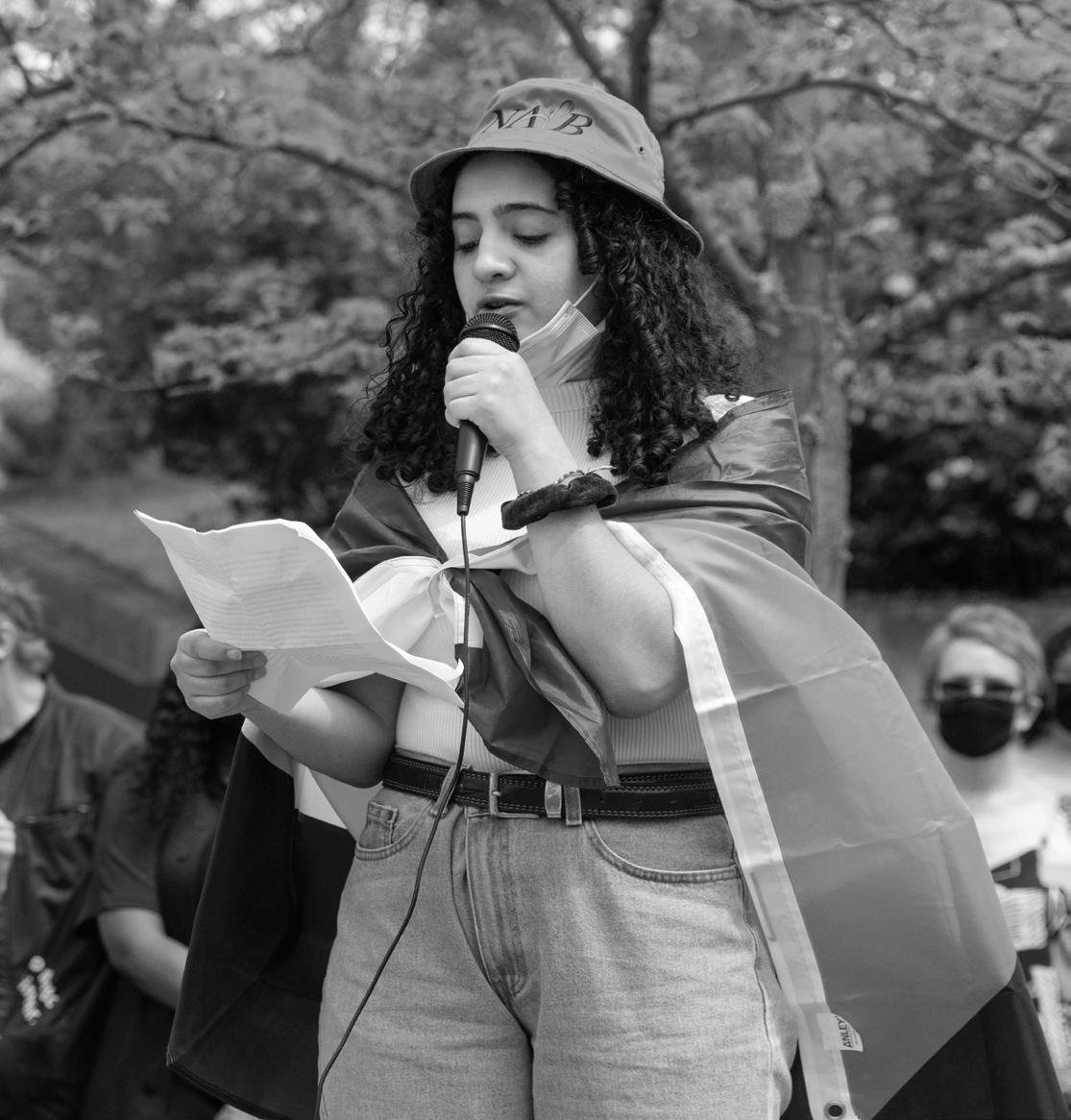
In response to the events at Sheikh Jarrah, SJP and other organizations on campus hosted a protest. At the protest, Abuhashim shared the story of the forceful displacement of her grandfather from Yibna in 1949.
“It was the first protest that I helped organize on campus,” Abuhashim told The Sun. “I had always been talking about Palestine, but it was the first time that I was talking about Palestine and people were paying attention in a way.”
During the protest, someone in the crowd took photos of Abuhashim and her friends and uploaded them to Canary Mission, Abuhashim said. Canary Mission is a database that “documents people and groups that promote hatred of the USA, Israel and Jews,” according to its website.
“I was very afraid because, to me, that was my worst fear,” Abuhashim said about getting doxxed on Canary Mission.
“There was a lot of self-censorship,” Abuhashim said about her concerns of retribution for her own activism, later adding that “being Palestinian and admitting it put[s] a target on my back, immediately, and I don’t even have to do anything.”
Abuhashim and her family have experienced several instances of doxxing, she said. About a year ago, someone found phone numbers of Abuhashim’s family members and sent them messages accusing Abuhashim of being a terrorist and threatening to report her to the FBI and get her family deported.
However, after getting doxxed for telling her grandfather’s story at the protest in 2021, Abuhashim realized, “no matter what I do or don’t do, no matter what I say or don’t say, they’re gonna use it against me. And so why am
I censoring myself and preventing myself from speaking the full truth to try to protect myself when nothing is really gonna protect me?”
She explained that “the next big thing” that occurred in Palestine was the October 7 attacks. On Oct. 7, 2023, Hamas led attacks in southern Israel that killed approximately 1,200 people, including approximately 400 people at the Supernova music festival. In response, Israel launched a large-scale invasion of the Gaza Strip that has killed approximately 75,000 Gazans as of February, according to a study published by The Lancet Global Health.
“I remember feeling so lost and so hopeless and so distraught at the images that were on my phone and the fact that we needed to do something,” Abuhashim said. “At the same time that I’m supposed to be going to class and caring about my exams and my grades, there are people — my family — who are in their houses that are scared for their lives and they don’t know if they’re gonna live tomorrow.”
In addition to discussing her activism at Cornell, Abuhashim commented on the movement’s relationship with the University’s administration.
Abuhashim told The Sun that due to the University administration’s response to what was happening in Palestine and Israel, she “never felt more uncomfortable being Palestinian anywhere in [her] life than being at Cornell.”
“[President Martha Pollack] spoke to the Jewish community and the Israeli community saying, ‘I’m sorry for what you’re going through. You guys have a lot of pain, and take it easy and carry some resources,’ which is great,” Abuhashim said at the event. “When you’re suffering, you should offer support, but at the same time, she refused to speak to the Arab and Muslim community and the Palestinians, and she refused to acknowledge our pain and our suffering.”
The University did not respond to comment regarding Abuhashim’s experiences with Cornell’s administration.
To continue reading this article, please visit www.cornellsun.com.
Coral Platt can be reached at cplatt@cornellsun.com.
SOPHIA DASSER ’28 Editor in Chief
SOPHIA ROMANOV IMBER ’28
Associate Editor
RAYEN ZHOU ’29 Opinion Editor
ZARA CHEEK ’28 Opinion Editor
JADE DUBUCHE ’27
Multimedia Editor
BENJAMIN LEYNSE ’27
Multimedia Editor
SOPHIA TORRES LUGO ’26
Business Manager
DOROTHY FRANCE-MILLER ’27
Marketing Manager
KENDALL MURPHY ’28
Advertising Manager
VICTORIA WROBLEWSKI ’28
Human Resources Manager
MELISSA MOON ’28
Arts & Culture Editor
JAMES PALM ’27
Assistant Arts & Culture Editor
MATTHEW RENTEZELAS ’28
Assistant Arts & Culture Editor
HAZEL TJADEN ’28
Assistant Arts & Culture Editor
MARC STAIANO ’27
Assistant Arts & Culture Editor
KATELYN HALVERSON ’28
Lifestyle Editor
AVA BETNAR ’29
Assistant Lifestyle Editor
SANIKA SARAF ’28
Assistant Lifestyle Editor
KATHERINE ISTOMIN ’29
Social Media Editor
JOIE JEAN-PAUL ’29
Assistant Social Media Editor
ASHLIN KWONG ’28 Graphics Editor
TAVAN BHATIA ’27
Games Editor
VARSHA BHARGAVA ’27
Managing Editor
KATE TURK ’27
Assistant Managing Editor
CORAL PLATT ’29
News Editor
ATTICUS JOHNSON ’28
News Editor
MARY CAITLIN CRONIN ’28
News Editor
EVERETT CHAMBALA ’27
Assistant News Editor
SHUBHA GAUTAM ’28
Assistant News Editor
GISELLE REDMOND ’28
Assistant News Editor
ANGELINA TANG ’28
Science & Technology Editor
TANIA HAO ’28 Science & Technology Editor
SIMRAN LABORE ’27 Weather & Climate Editor
MATTHEW LEONARD ’28
Sports Editor
GRACE REUBEN ’28
Sports Editor
JANE HAVILAND ’28
Features Editor
NATHAN ELLISON ’28
Photography Editor
NATHAN BO ’28
Assistant Photography Editor
ADELAIDE CHOW ’29
Assistant Photography Editor
MIA SOFIA ORENGO ’28
Video Editor
DEAN THAKUR ’27
Newsletter Editor
SMRITHE RAJESH ’29
Newsletter Editor
AMELIA GARCIA ’27
Data Editor
RENA GEULA ’28
Layout Editor
HUNTER PETMECKY ’28 Layout Editor
Te Cornell Daily Sun’s Editorial Board is a collaborative team composed of Editor-in-Chief Sophia Dasser ’28, Associate Editor Sophia Romanov Imber ’28 and Opinion Editors Zara Cheek ’28 and Rayen Zhou '29. Te Editorial Board’s opinions are informed by expertise, research and debate to represent Te Sun’s long-standing values. Te Sun’s editorials are independent of its news coverage, other columnists and advertisers.
On Tursday night, President Micheal Kotlikof bumped a student with his car after leaving the Cornell Political Union debate on the Israel-Palestine confict. By Friday morning, before the University had contacted the students involved, at least 16,000 members of the Cornell community received Kotlikof’s account of what happened to their inbox. Te account did not match what the footage would later show.
In the email addressed to the Cornell community, Kotlikof explained that he “was accosted by a group of several individuals” after he left the debate, claiming that students were “banging on the windows” of his car. Security footage and the student’s own camera footage do not support the claim of banging. A University spokesperson acknowledged that the student’s footage showed new information, yet the University continues to stand by the original statement. Kotlikof described, in surgical detail, the safety mechanisms of his vehicle, “rear pedestrian alert and automatic braking system,” but failed to mention that his car had made contact with a student. Neither footage, the University’s nor the students’, show that he exited the car to check on the students he hit. Prior to the Friday morning email, the administration did not contact the impacted students, Aiden Vallecillo ’26 or
Hudson Athas ’27, for a statement, or more notably, to check on their wellbeing.
Whether Kotlikof feared for his safety, whether the students should have been standing where they were, whether the contact was incidental, these are legitimate questions and they should be thoroughly investigated. But they do not change the fundamental shape of what happened that evening, or what the email very obviously left out.
Before a full investigation could be conducted, President Kotlikof used his power as president of the University to set a narrative on his terms.
We would not fault a reasonable person who came away from that email and thought, as many students did, that a mob had swarmed Kotlikof’s car and physically threatened him. Tat was the impression the email created, and most importantly it was created before the facts were in. Rather than exercise restraint and wait for a full investigation, Kotlikof used the outsized megaphone his ofce wields to represent events in a way to garner sympathy for himself and backlash against the student protesters, before any central facts were established.
He went further. In his statement, Kotlikof wrote that the individuals involved were “known to Cornell” for their disruptive history. In trying
Daniel R. Schwarz is the Frederic J. Whiton Professor of English and Stephen H. Weiss Presidential Fellow at Cornell University, where he has been a faculty member for 58 years.
The mission of a research university is to discover and create knowledge and impart knowledge to its students. As teachers, we work in partnership with our students to build a culture of excellence. Our job as professors is to transform possibility and opportunity into reality in terms of creating knowledge and giving our students the tools and confdence to take our insights further.
Our students not only explore the world but also imagine the world as it could be. Tey see the world with fresh vision, and they think about how they can broaden our understanding of our diverse world. Teir active and creative minds do not parrot the thinking of others.
If we teach our students by example to listen carefully and respectfully to the ideas of others and to appreciate the views of those who may be from diferent cultures and socio-economic backgrounds, we will have done even more as teachers and mentors. Teaching students how to respectfully partake in the give-and-take of informed discussion is to create citizens who sustain democracy and contribute to our communities.
We are living in a time when intimidation is rife, fear is endemic and some educational, political and media leaders have been cowed into silence and succumbed to threats.
We must address the crisis and peril that universities face from an authoritarian regime that threatens the independence of our major universities. We need to be fully aware of President Trump’s war on universities, which often wears the mask of concern for antisemitism, but is really an attempt to mufe academic freedom and free speech, control university admissions, ignore the interests of minorities, substitute magical thinking for science and oversee hiring and curricula.
We need to be attentive to the continuing aggressive takeover of American universities by a cynical administration serving its own interests as part of its larger program of transforming our democracy into an authoritarian state. In the latter, the president, acting more like an emperor, defes courts and Congress, ignores the Constitution and weaponizes the Department of Justice and the FBI to suppress dissent. In one fagrant example, the Trump administration, without respecting habeas corpus — a fundamental right guaranteed in Article I, Section 9 of the Constitution that allows the accused to challenge the legality of detention before a court — deports international students who have met legal requirements to study in America.
Universities are abandoning Diversity, Equity and Inclusion policies, rethinking admission policies now that afrmative action has been declared illegal by the Supreme Court and inviting speakers on the far right. Grants are rewritten, courses changed and professors are censoring themselves.
Amidst all of this, we cannot be bystanders. We must stress that our unrestricted research fnds cures for disease, creates healthier choices,
to get ahead of the narrative, his words consequentially alienates all students for their protesting, sending a clear message: To be “known to Cornell” in the president’s telling is to have a record of acting against the administration, a framing that turns protest itself into a kind of prior charge. Te charge of silencing, leveled in a mass email that preempted students’ ability to voice their own version of events, lands strangely against Kotlikof’s claim that the students’ conduct constituted harassment “with the direct motive of silencing speech.” Ironically, the impact of Kotlikof’s own statement is the impact he ascribes to the students.
Tis incident is emblematic of a deeper problem at Cornell: an administration that protects itself, not its students. An administration that has consistently moved to protect itself before it moves to understand, or even to check on, the students in its care. With such factual inaccuracies, omitted information and misuse of the president’s platform, the discrepancy between the footage and Kotlikof’s account of events is frightening. Tis disparity is demonstrative of Kotlikof’s attempts to reframe as a means to prioritize himself over the very students he is meant to serve. Words are permanent and powerful, and there is no one who understands that better than jour-
saves and enriches lives and enables us to understand our physical environment. Because of the spirit of inquiry and search for truth in every feld, American research universities have been the envy of much of the world.
We need to learn why so many people believe untruths about our universities, including the pernicious lie that our focus is on indoctrinating students. Universities need to seek public support by communicating better what we do and why we do it in our research and teaching missions.
What would resistance to those who want to dismantle the ideals and values of a university look like? I propose the following 11 suggestions for faculty, students and administrators:
1) Encourage free speech in class.
2) Insist on evidence in discussion, including why we seem to be bombing citizens of other countries daily and why the government is taking our country to war.
3) Call out those who substitute name-calling for reasoned and articulate argument.
4) Respect others whose views might not align with yours.
5) Realize that when we learn to listen and respond to evidence-based views, we are creating the groundwork for democracy.
6) Understand how democracy works, including the role of Congress and the judicial system.
7) Be cognizant of rights guaranteed in the U.S. Constitution and Bill of Rights.
8) Learn enough about American history to know how and why these are exceptional times when the rule of law is being challenged.
9) Read and listen to the most reliable news sources. Unfortunately, Jef Bezos has ravaged the Washington Post and CNN, like CBS, will soon be under the umbrella of Larry Ellison and his son, David Ellison, who are supporters of this authoritarian regime. We are unable to trust any major sources other than Te New York Times and MSNBC.
10) Value diversity. I taught a seminar last semester with students whose families originate in Sudan, Lebanon, China, the U.K., Bangladesh and Pakistan, and the Pakistani student was great friends with a Jewish-American. It brought me great joy to see this group become a strong, vital, functioning community of inquiry.
11) Take part in peaceful protests that insist on the integrity and independence of universities as well as on democracy as our chosen form of government.
In the current authoritarian environment, we must engage in protecting the spirit of intellectual inquiry. We must remember and live by the words of the American poet Wallace Stevens in “Te Well Dressed Man With A Beard”: “It can never be satisfed, the mind, never.” It is up to our future leaders — and many of our students today will become those leaders — to be sure that the United States of America prevails as a country in which minds are free to think and learn.
nalists and our editorial board. When the words belong to the president of a university and reach tens of thousands of readers, the standard for issuing them has to be much higher than it was here. Once the frst account is wrong, every subsequent ‘fact’ is suspect. Te administration has spent considerable credibility on a statement it should not have sent in its present form; the burden now falls on Cornell to explain why its word should be trusted in the next incident, and the one after that. For students, this incident is a stalwart reminder that ofcial narratives ought to be questioned and always taken with a grain of salt until our president can take accountability for his misconstrual. Te administration has undermined its own credibility by issuing this rushed statement and must prove to all Cornellians why its word can be trusted.
President Kotlikof owes the impacted students an acknowledgement of what the footage shows. He owes the rest of us a slower hand on the send button.
Editor-in-Chief Sophia Dasser ’28 recused herself from this editorial due to her involvement in Te Sun’s reporting on the incident.
Vie Villafuerte is an Opinion Columnist and a Ph.D. student in Environmental Engineering in the Department of Civil and Environmental Engineering. Her column, La Vie en Frenzy, refects on cultural identity, environmental realities and the incessant struggle to hold onto love and harmony in a world that feels increasingly divided. She can be reached at vav27@cornell.edu.
Where is the empathy? Or, like Te Black Eyed Peas would say, Where Is the Love? For years, I’ve claimed that passion is what led me to pursue a Bachelor’s and Master’s degree and now a Ph.D. in environmental engineering, and that same passion is what kept me here — away from family, from the comfort of hearing my mother tongue every day and from the warm feeling of belongingness. But now I think, was it really passion or was it a deep sense of empathy?
My soul hurts when I hear news about chemical pollution afecting wildlife or Indigenous communities fghting for their land and their rights. You can ask my CEE 6590: “Partitioning and Transformation of Organic Contaminants in Environmental Systems” professor about the day he saw tears coming down my face
Trevor Crouse '28 is an Opinion Columnist and a Mechanical Engineering student in the Dufeld College of Engineering. His column, Cockpit Conversations, examines the systems, culture and decisions of Cornell engineering from 30,000 feet in the air. He can be reached at tjc252@cornell.edu.
Since I arrived on campus, I’ve been told that I am a part of a top 15 global institution, but these rankings don’t reveal the 3 a.m. smell of burnt cofee in Carpenter Hall or the collective sigh that is heard within Baker 200 when the physics prelim median is a 48%.
Tere’s a reason why the engineering buildings are open 24/7. Every college major has its challenges, but the workload of the College of Engineering demands your time like no other college does. It is ruthless, yet over 5,000 students subject themselves to the sufering. Why? At other schools, weed-out classes
Ashlyn Saltzburg '29 is an Opinion Columnist and a Government and Sociology student in the College of Arts & Sciences. Her fortnightly column, A Grain of Salt, analyizes the impact of various policies and laws. She can be reached at abs372@cornell.edu.
In most states, a box of tampons is taxed. A box of Viagra, in many of those same states, is not. New York repealed its tampon tax in 2016, lifting a 4% state sales tax that had quietly added up over a lifetime of purchases, but more than 18 states still classify menstrual products as non-essential — the same category as decorative candles. Te tax itself is small, but what it tells you is not.
Tis is the kind of detail that should have been a bigger deal and wasn’t. It sat in the tax code for decades, written by people who decided, without ever having to say so out loud, whose biology counted as a medical necessity and whose counted as a luxury. Tat is the pattern I kept noticing in the news cycle, in policy fne print and in the gap between what gets announced and what gets enforced. Institutions tell on themselves in their paperwork. Te line item, the eligibility cutof, the clause buried on page 25 — that is where these decisions actually live. Te press release tells you what a policy is supposed to do. Te doc-
Max Troiano ’28 is an Opinion Columnist in the College of Arts and Sciences. His fortnightly column, Take a Seat, dives into the dynamics that shape our daily lives with boundless, idiosyncratic curiosity. He can be reached at mtroiano@cornellsun.com.
This spring, a ramshackle house with cigarette-stained ceilings will go on the market in Falmouth, Massachusetts, a middle-class resort town on the back shoulder of Cape Cod. Enterprising realtors will fnd it set back from the road on a steep hill rolling down to a kettlehole pond and deem it a fxer-upper. Tat is a euphemism for tearing it down and building something larger, an air-conditioned summer palace without such a convoluted foorplan. Te old house will endure, however, in my memory.
In that house, my grandparents lived the last 25 years of their lives, and in the summers when I was young, before sleepaway camp and my grandfather’s frst heart attack, I would live there too, with my mother and sister. I owned neither a phone
as he introduced his “Solid-Water Partitioning” lecture with a story on microplastics in albatrosses. While my mom warned me not to become a veterinarian for this exact reason, I have to say, I’m sorry to break it to you, Mom, but I am in engineering and I am still crying. Now, imagine how I feel on a regular weekday when the Rocksteady music I queued to subdue the perpetual Ithaca cold and gray skies gets interrupted by the constant breaking news notifcations from Te New York Times showcasing injustices and outright cruelty. It is impossible not to question if we are losing empathy as a society or whether we’ve been desensitized to the point of thinking this is a new normal. With this, I am not taking myself out of the mass. I might sound like Michael Scott listing his weaknesses: “I care too much, I work too hard.” I too read these articles, get disappointed and make a comment here and there, then I still walk to the lab and move on with my day. However, the questioning of our society, of the state of the world and of our actions remains playing in my head. Maybe it is the Mafalda in me or an unconscious Catholic guilt. Regardless of the reason, writing as an opinion columnist for Te Sun quenches the desire I have to do something with a rather instant efect.
With this column, La Vie en Frenzy, I hope to cultivate a bit more kindness towards yourself and others. Despite the grayness I just mentioned, I still see “life in pink” like Édith Piaf described
hit engineering students hard and send them packing. Here, we have a 94% graduation rate. Tis isn’t a coincidence; it’s a result of the hyper-disciplined and high pressure mentality on campus. Quitting isn’t an option and that is why there is never an empty engineering building on campus.
Cornell’s engineering program is world class. Along with our global ranking, we have a one-to-one ratio of men and women engineers and provide funding to 36 project teams — the most in the country. If you can cover the tuition, the college absolutely has its merit. Externally, we break stereotypes and seem to be building the next generation of diverse and brilliant engineers. But what about the internal reality?
My name is Trevor Crouse, I study mechanical engineering and I am a member of the Design, Build, Fly Project Team, which specializes in building small scale radio-controlled aircraft. Outside of engineering, I am involved in Greek Life and play club ice hockey as a goaltender.
Tere is quite a strange symmetry between my life in the crease and in the lab. In hockey, my job is to be the last line of defense to prevent an entire system failure. As a mechanical
ument tells you what it actually does.
I learned about this reality slowly, and then all at once. Te slow part was years of watching adults describe systems as broken when they were working exactly as designed — just not for the people who were complaining. Te all-at-once part was sitting down with the actual text of the Hyde Amendment — a budget rider that bars federal Medicaid dollars from covering abortion except in cases of rape, incest or threat to the patient’s life — and realizing it has been attached to the annual appropriations bill every year since 1976. A single sentence can determine whether or not a low-income woman on Medicaid can access abortion care. Te amendment doesn’t ban anything. It simply says the government refuses to pay. Te cost of that refusal lands on the people with the least ability to absorb it. Tat is not an accident; itis the design.
Once you start reading documents this way, you cannot stop. Te post-Dobbs patchwork of state laws, Gender-afrming care bans written to sound like child protection statutes, Title IX regulations rewritten between administrations — each version shifting who has to prove what to whom. Te childcare clif, the wage gap and the pink tax — small individually, structural to aggregate. Visa policies that treat international students as conditional guests. DEI rollbacks moving through state legislatures under the language of neutrality. Endowment decisions, donor relationships and housing policy at universities like ours, which shape student life far more than any speech given at convocation.
Gender is the thread I keep pulling up on, because gender is
nor a watch, but bathing suits and books were always close at hand. My grandfather taught me how to grill, my grandmother how to jigsaw and crossword. We spent weeks there, visited by a rotating cast of friends and relations, including my father, who came down from the city most weekends. Whoever was at the house would gather for dinner around the hewn-wood farmer’s table in the kitchen more nights than not. Te meals were simple, local and familiar: my grandmother’s meatloaf, macaroni salad, plenty of cod, corn on the cob, burgers and sausages. On special occasions, we’d wrap the table in newsprint and boil lobsters live in a cast-iron pot.
After dinner the children cleared the table while the adults poured decaf cofee and Woodbridge cabernet. Someone opened the French doors to let in the breezy chorus of the warm night, and someone, usually my grandmother, would start the conversation. A lifelong consumer of literary magazines, paperback novels and Winston cigarettes, she would hold forth on politics, culture, history, movies or books. Someone would disagree — “Go Set A Watchman wasn’t worth the paper it was written on! Sanders doesn’t stand a chance in the general election!” — and we would be of to the races. Each dinner guest was expected to chime in, and from an early age I was held to the same standard. Soon enough, “Max, what do you
in her love song, “La Vie en Rose.” Yet, realism tends to interrupt my daydreams, adding more frenzy, and it starts to sound like what Pedro Calderón de la Barca wrote: “[…] I dream I am bound with chains, And I dreamed that these present pains Were fortunate ways of old. What is life? a tale that is told; What is life? a frenzy extreme, A shadow of things that seem; And the greatest good is but small, Tat all life is a dream to all, And that dreams themselves are a dream.”
My writings will include lived experiences that you might resonate with or that will open a door to an unfamiliar reality, helping you better understand your neighbor and recognize your own biases. To cultivate more empathy, we need to be aware of our surroundings and not bat an eye to a reality that might feel far from our own. Having lived in the U.S. for almost double the years I lived in Peru, the country where I was born and raised, I have learned how important it is to be conscious of our cultural identities and upbringings.
To continue reading this article, please visit www.cornellsun. com.
engineer, I am learning to build those systems that withstand the same chaos. In both arenas, there is no room for mistakes. On the ice, if I have an ‘of night,’ we lose by 8 goals. In engineering, one overlooked mistake can be deadly — look no further than the 1907 Quebec Bridge collapse.
I spend my afternoons in Upson Lounge calculating lift coeffcients for DBF, my evenings calculating matrices and my nights defending a 4x6 goal on the ice. Being an engineering student at Cornell is often treated as a personality trait or stereotype that you cannot shake, but it shouldn’t be a cage. Engineering should involve a love for problem solving and challenges, but burnout is something that we should collectively hate.
Cornell’s administration does a lot — both good and bad — to engineering but so much goes unnoticed when you are drowning in the weekly problem sets that consume every waking hour. Te goal of this column is to shed light on the issues and debates within our college that often get buried under the workload.
To continue reading this article, please visit www.cornellsun. com.
one of the clearest ways to see how institutions function. When you ask who a policy hurts, who it protects and who was in the room when it was written, gender is always part of the answer. So is race. So is class. So is immigration status. Te categories overlap, and if you read policy documents carefully, the overlap is right there on the page.
Cornell is where I am doing this kind of document-level reading because Cornell is where I am. Tis means I am also one of the people impacted by the University's decisions, and one of the people who benefts from them. Te University is not separate from the systems I am describing — it is one of them, with its own Title IX ofce, its own donor relationships, its own quiet decisions about which survivors get formal processes and which get redirected to wellness resources. It is small enough that the documents are fndable and the people afected are reachable. Tat makes it a useful place to practice this kind of reading.
A Grain of Salt will do one thing, repeatedly. Each column I write will start with a real document — a policy, regulation, a campus memo, a line of legislation — and ask three concrete questions: What does it claim to do, what does it actually do and who was in the room to decide whose costs would absorb the diference?
To continue reading this article, please visit www.cornellsun. com.
think?” became a familiar refrain. I tried my best to follow the fast-paced conversation and vehement declarations and, most importantly, gain the understanding I needed in order to be taken seriously.
I soon found I loved learning about what was going on in the world, and I was absolutely captivated by discussing it with others. I got hooked on the power of an educated conversation to broaden and deepen my understanding of everything around me. I am a writer and I love to write, but my frst and deepest love is to converse. I never wanted those summer nights to end. Since those halcyon days, I’ve pursued any opportunity for dialogue on my favorite subjects. It starts with reading, endless reading: history books, novels, biographies, essays, culture-diagnosing Substack thinkpieces, canonical works from time immemorial. Recommendations from friends, assignments from professors. Most of all, I read magazines. I love Te Paris Review, Te New Yorker, Te Economist, County Highway, Te Atlantic, n+1, Collegetown, Esquire, Mass Transit and Car & Driver.
To continue reading this article, please visit www.cornellsun. com.

By BROOKE ANACLETO Sun Contributor
For many mechanical engineers of the Cornell College of Engineering, 125 Upson Hall is a home for academic advising. But in addition to advising resources, the room is also a space for MechE students to connect with their community and discover the magic of two small, pink, glow-in-the-dark creatures: axolotls.
From their first day in the MechE advising office, the two axolotls — named Axle and Throttle — have made it big.
“Call them the unofficial mascots of MechE,” said Ashley Blank, assistant director of undergraduate affairs in the College of Engineering.
The axolotls have built a powerful community, Blank said, made advising welcoming to all students and created a culture that makes the MechE advising office home for so many, whether for academic assistance or a good smile after a long day.
The Magic of Axle and Throttle Blank is the reason there are axolotls on campus today. She comes from a background in elementary education, which influenced her decision to bring a pet into the office.
“Even if I was stressed or worried, just seeing them with their derpy smile made me smile.”
Diya Mehta '26
“I found it pivotal that we had some sort of classroom pet during that time,” she said,
referring to her time in elementary education.
When Blank was searching for a unique pet to welcome students into the MechE advising office, she looked to her good friend in Rochester, who breeds axolotls.
Just like that, the magic of Axle and Throttle was born. Each axolotl has its own personality that it brings to the office.
“Axle follows my finger — I think she thinks it's a worm — and it was so fun to just watch her swim around,” said Diya Mehta ’26, a mechanical engineering student. “Throttle is just a silly guy who just floats up at the top most of the time, but he occasionally decides to get zoomies.”
Although the two amphibians are separated by a glass barrier to avoid competition and breeding, they like to interact with one another through the glass on occasion.
“She's [always] kind of digging at the bottom of the barrier to get to Axle,” Blank said about Throttle.
A Look Into the Office
Colorful lights, plushes of axolotls, pictures everywhere and a giant tank garner the MechE advising office.
Each year on Feb. 1, the office celebrates National Axolotl Day, Blank said. The office makes axolotl-themed goodie bags for students that highlight the importance of the axolotls to the MechE community.
Another important part of the office culture includes maintaining a weekly fun fact board about the axolotls, inspired by a student worker in the MechE office, according to Blank. It also acts as a space for students to express themselves. The discussion board has even included polls, “would you rather”

questions and student doodles of Axle and Throttle.
More than Mascots
The axolotls have drawn in many students who would otherwise not have spent time in the MechE advising office, according to Blank.
“The Mechanical Engineering community is fairly tight-knit, especially with all the classes we have together until senior year, but the axolotls have given us so much more of a community,” Mehta said. “I used to come by just to see them, and even if I was stressed or worried, just seeing them with their derpy smile made me smile.”
Axle and Throttle have not only drawn attention from MechE students, they have made an impact across campus and beyond.
Cornell Days was huge for the axolotls,
Blank said, with tour guides peeking in throughout the day, and people being really excited to go see them.
“A faculty member didn't believew they existed until he came in,” Blank recalled. “He was like, ‘Wait, really?’ Like, they're animatronic or something.”
The axolotls’ magic extends outside of the tank. There are inflatable costumes of the axolotls that have been worn all around by members of the advising center. Pictures detail their many adventures, including in MechE classrooms, to brighten students’ days.
To continue reading this article, please visit www.cornellsun.com.
By RACHEL HORN Sun Contributor
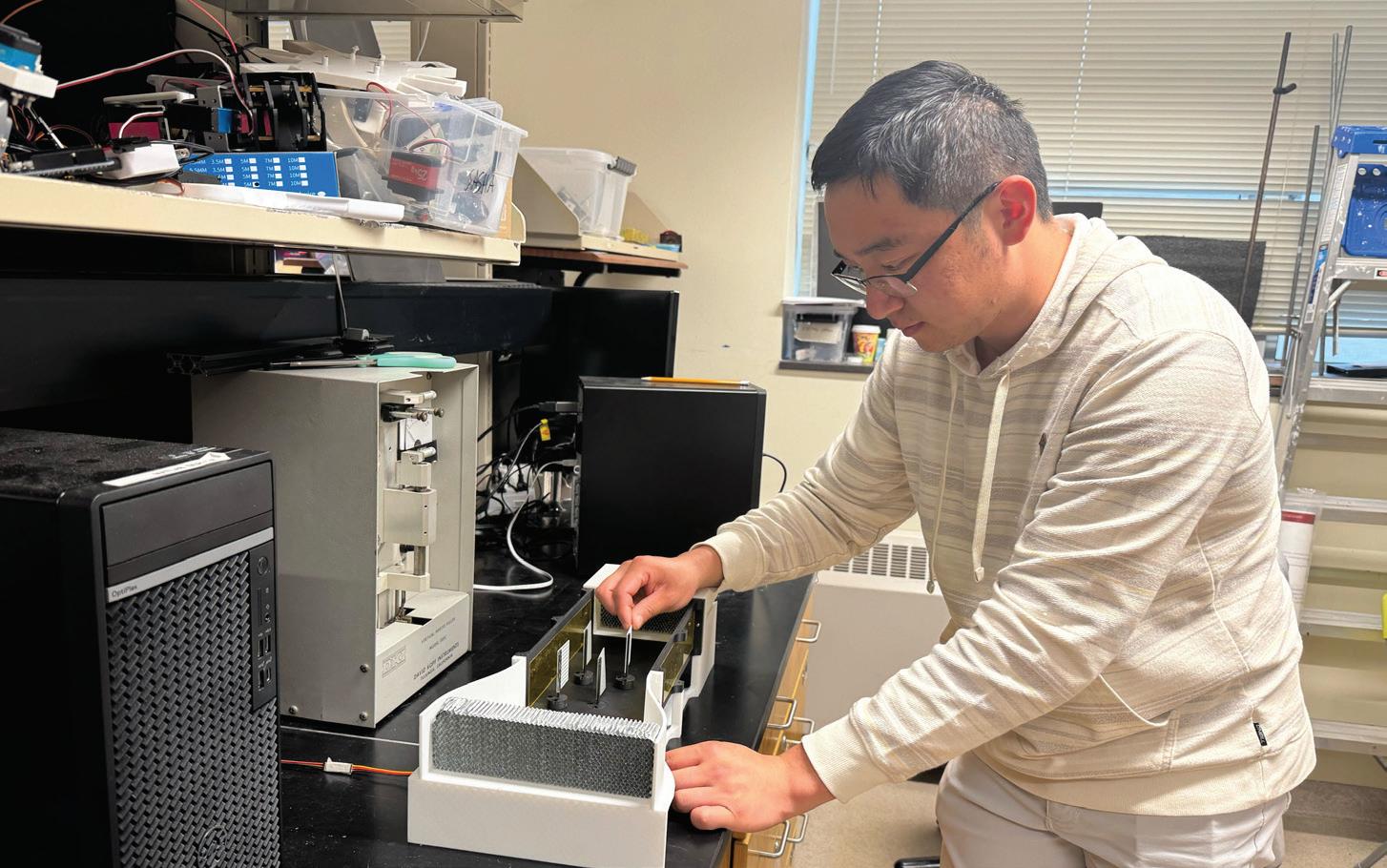
At the heart of biology and engineering, mechanical engineering doctoral student Yicong Fu brings to light the power of translating natural systems, from fish fins to human hands, into new technological innovations.
Fu, a first-year Ph.D. student, uses computational and experimental methods to understand how natural systems — fish gills, stingray fins and human hands — solve problems that continue to challenge engineers. His research has applications ranging from industrial filtration and biometric identification to the development of soft robotics.
Fu’s desire to study fluid mechanisms originated during his undergraduate studies, where he became fascinated with biology
research through the study of fish physiology. His mentor at the time, University of Virginia professor Daniel Quinn, studied how the shape and physics of fish fins influence living habits. Building on this work, Fu developed a mechanism that uses a flexible structure to generate wave-like motions, mimicking the movement of a stingray’s pectoral fin in water.
Fu explained that this idea stemmed from comparing two types of ray-like fish. Manta rays have triangular fins and tend to swim near the surface, moving their fins up and down in a flapping motion (oscillation). In contrast, stingrays have rounder bodies and live closer to the ocean floor, relying on wave-like motions along their fins (undulation). This led Quinn to question whether these different shapes and movement styles are influenced by
the environment that fish inhabit.
This early experience laid the foundation for Fu’s research trajectory, leading him to join Prof. Sungwhan Jung’s, biological and environmental engineering, lab. Jung, the principal investigator of the Bio-Inspired Fluid Lab, focuses on converting biological observations into sustainable engineering solutions.
One of Fu and Jung’s most recent publications investigated the physics of hand-clapping, using high-speed cameras and particle image velocimetry, a technique that tracks tiny particles in the air to visualize and measure airflow on millisecond timescales.
“I focus on the needs of human beings first ... What are the solutions right now, and can we improve these solutions using whatever I want to study?”
Yicong Fu, first-year Ph.D. student
Their findings revealed that clapping faster results in the sound fading more quickly. The researchers saw that faster claps cause the hands to temporarily deform upon impact more and create stronger bursts of air, which leads to more turbulence. Instead of producing sound, more of the energy is lost in the movement and bending of the hands, so the sound dissipates out faster.
Looking ahead, Fu envisions integrating the lab’s findings from this study with advancements in artificial intelligence as machine learning is further being developed to recognize and respond to human-generated sounds.
“Our hand-clapping study provides the
fundamental mechanism, so when you feed machine learning models sound data, you don’t have to rely only on data,” Fu said. “You can do more physical learning by using our model with the data together.”
Fu is committed to focusing on practical applications of his work. As a trained mechanical engineer, he approaches each problem with real-world use in mind, considering this even when first selecting a research topic to pursue.
“I focus on the needs of human beings first. Are there engineering problems that exist? What are the solutions right now, and can we improve these solutions using whatever I want to study?” Fu said.
Then, Fu determines whether it is possible to find something in nature, in order to learn from it and intertwine its function into engineering designs.
In addition to acoustics, Fu is currently exploring another fish-inspired project: translating the function of the suckermouth catfish’s mouth, which the species uses for underwater adhesion, into robotic applications.
Applying these fish-inspired movements to soft robot designs, “these robots would provide another mode of operation in aqueous environments,” Fu explained. “They could be used as underwater cleaning devices, wand if we can miniaturize them, we could use them inside the human body for biomedical purposes like drug delivery.”
Reflecting on his own path, Fu encouraged undergraduate students to “be brave,” “reach out,” and pursue projects they’re genuinely passionate about — a mindset that will continue to drive the next generation of ingenuity and innovation.

By KRYSTAL KYMN
Staff Writer
Afewweeks ago, I was scrolling on Instagram when an earthy green post caught my eye. In bold cursive was the word “Campogatto,” over a picture of a matcha latte topped with what looked like pink cold foam. Immediately, I was intrigued: What exactly was a Campogatto? A look at the caption revealed that the topping was strawberry ice cream, a twist on the classic Affogato dessert (vanilla ice cream or gelato with a shot of espresso).
The post came from CampusCares, a student organization focused on social impact within the Ithaca community through volunteering. The Campogatto was a collaboration with Collegetown Bagels as part of a fundraiser to help run CampusCares activities. Not only was I excited to try the drink in support of my friend, who is a member, but I was also eager to learn more about the process behind a club collaborating with CTB on a menu item. Other student organizations have partnered with CTB in the past as well; for instance, the PADwich partnership was led by the pre-law fraternity Phi Alpha Delta.
In order to learn more about the collaboration, I reached out to CampusCares Chief Growth Officer Ben Chen ’27. I was curious to know how they decided on the Campogatto as their menu item of choice, as well as the time frame of the entire process. Chen stated that the collaboration started as a direct conversation between CampusCares members and CTB. The goal of the fundraiser was to create a menu item that students would



enjoy and would also reflect the fun, enthusiastic energy of CampusCares.
“Our marketing lead and photography lead worked closely with CTB’s team on everything from drink design to promotional content,” Chen said. From the club’s initial conversation with the establishment to the official rollout of the drink, the process only took a couple weeks, a speed that Chen emphasized “really speaks to CTB’s commitment to supporting the student community.”
There was also an emphasis on keeping the price point accessible for students. Considering the fundraising purpose and the cost of the ingredients, the Campogatto was priced at $11, a fair sweet treat to get at the end of a long week. The best part of the drink was the strawberry ice cream, which was smooth and velvety. I suspect that the matcha would’ve had a more robust flavor if I had asked for oat milk instead of a dairy-based milk to balance out the ice cream. I also wondered how the drink would’ve tasted if the base was hot, similar to the traditional affogato.
When asked how CampusCares felt about their experience working with CTB, Chen said, “It’s shown us that local businesses genuinely want to invest in student-led service. These collaborations give our members hands-on experience in outreach, negotiation, branding and event management that you just don’t get in a classroom.” Indeed, the skills that can be gained from working with a business are invaluable. The effort that went into all aspects of the collaboration is therefore not just meaningful for students, but is also indicative of the importance of having local, smaller businesses in Collegetown.
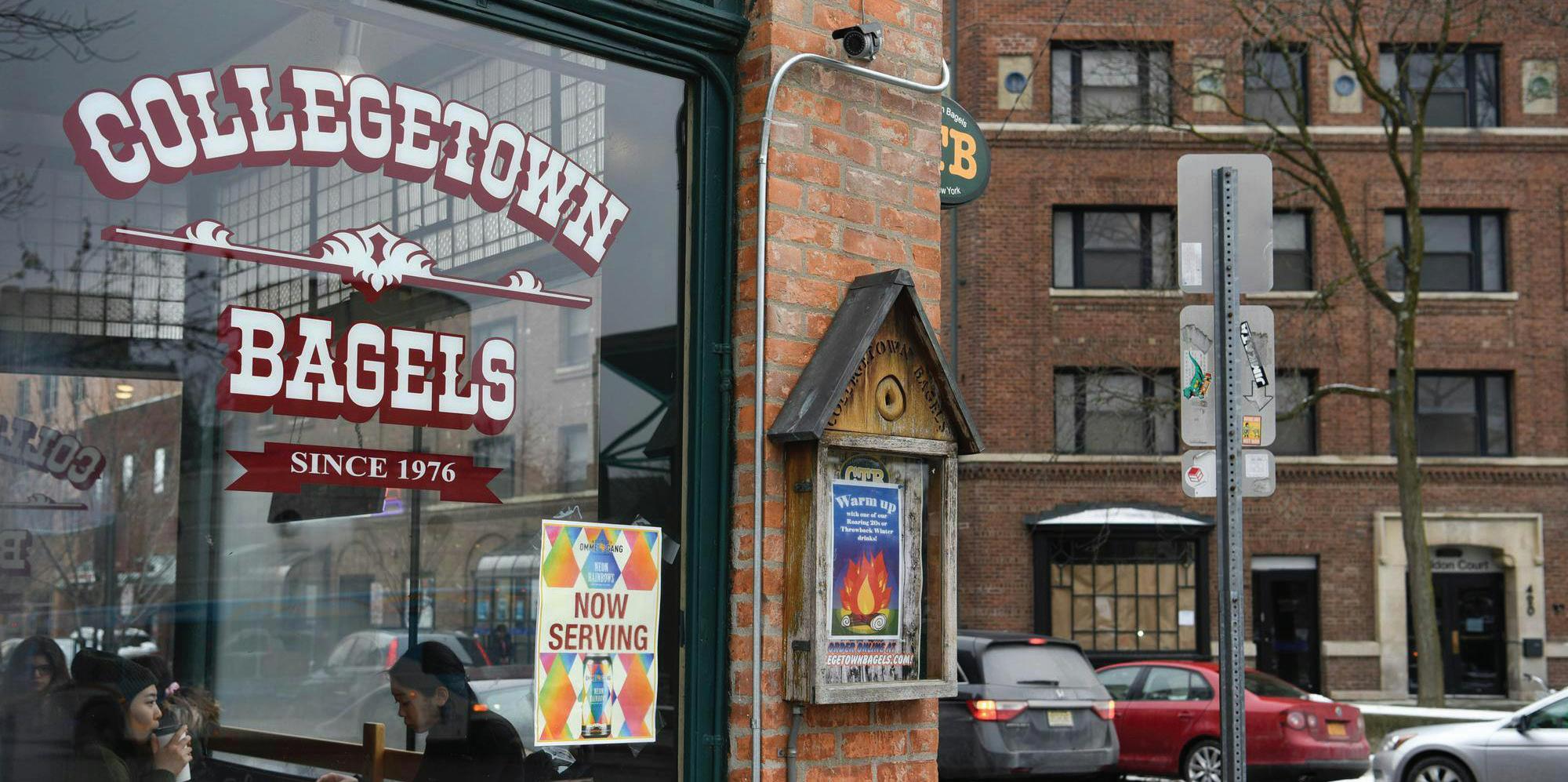
I’ve often heard students wondering why we don’t have larger establishments closer to campus. I’ve heard students longing for a Dunkin’ Donuts or a Starbucks (both of which used to have locations in Collegetown). But local businesses are the backbone of the Cornell student experience; the culture of sitting outside on the CTB patio with a lox bagel in hand, surrounded by dozens of other students, is simply something that cannot be replicated at large chains. The authenticity and charm of these businesses lead to interactions that encourage both genuine connection and a sense of loyalty in the Ithaca community.
Moreover, local businesses better understand the needs of our community. Their knowledge of the area and Ithacan culture allows them to better tailor their services to its people. CTB, for one, has been in Ithaca since 1976, fostering a unique sense of identity among Ithacans and supporting local causes ever since. The cultural understanding and distinctiveness these kinds
of businesses provide are vital to preventing homogeneity and upholding community ties.
Chen stated that in the future, CampusCares plans to “expand to more Collegetown and Ithaca establishments,” especially those that are both popular amongst students and share their commitment to making an impact within Ithaca. He highlighted that having the same values as their partnerships makes the collaboration feel “authentic, rather than transactional.” In tandem with this authenticity, I encourage students to see what different student organizations on campus are involved with and support them when possible. After all, we all actively contribute to not just the student culture at Cornell, but also the broader Ithacan community, and must do our part to preserve our connections with one another.
Krystal Kymn is a member of the Class of 2028 in the College of Arts and Sciences. She can be recached at klk239@cornell.edu.

By JARED MILLER Staff Writer
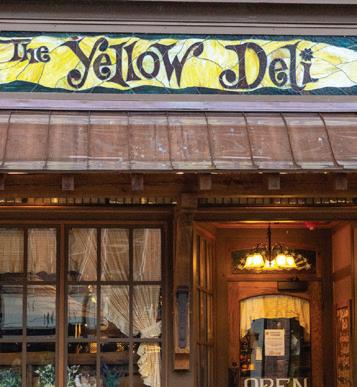
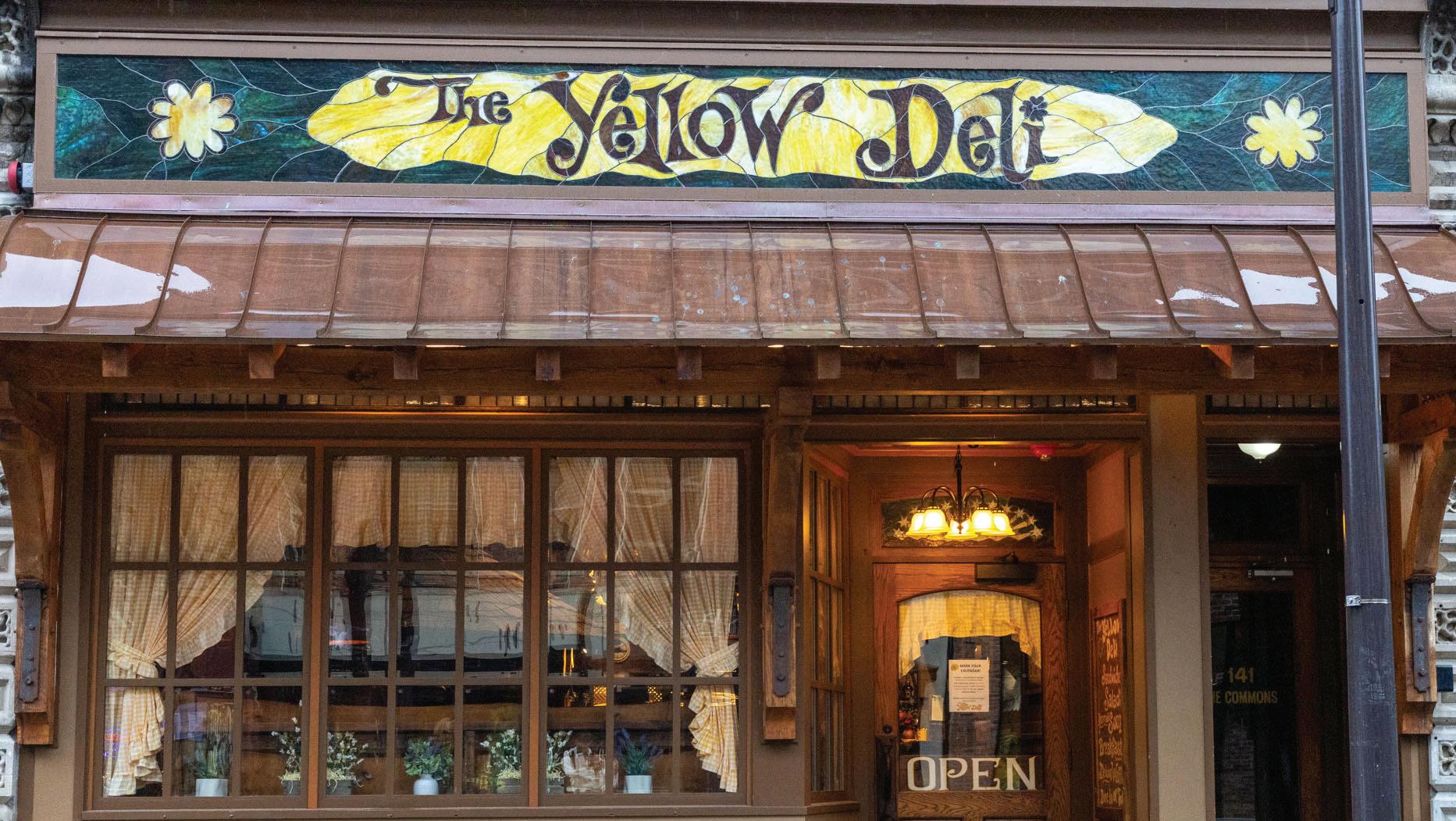
TheIthaca Commons is home to many different businesses that showcase the identity of the Tompkins County community. Local stores, restaurants, cafes, bars and shops populate the colorful streets of the Commons and emphasize the town’s culture. While I walk past these establishments, there are only so many that I can say I have truly experienced. One Ithaca Commons establishment I have always been intrigued by is the Yellow Deli.
The Yellow Deli is said to be owned by a cult named the Twelve Tribes, which operates in areas around the globe, including Ithaca. Notably, Twelve Tribes has allegations of racism from management and workers at their restaurants. Twelves Tribes has also faced child abuse allegations and openly disapprove of homosexuality.
I was warned by peers to never enter the bathroom, as there are rumors that the restaurant was established to recruit college students. Supposedly, they strike during students’ most vulnerable moments when using the facilities. These rumors have circulated throughout the Yellow Deli’s numerous years calling Ithaca home.
That being said, I also heard the food wasn’t half bad.
I would like to clarify that this article’s purpose is not to scrutinize the group’s actions, summarize the controversy or ponder the ethical concerns of being a patron at the establishment. My goal is simply to provide an impartial analysis of the food itself. I am in no way endorsing the existence or operations of the Twelve Tribes. I merely heard that they
have decent sandwiches and wanted to check it out for myself.
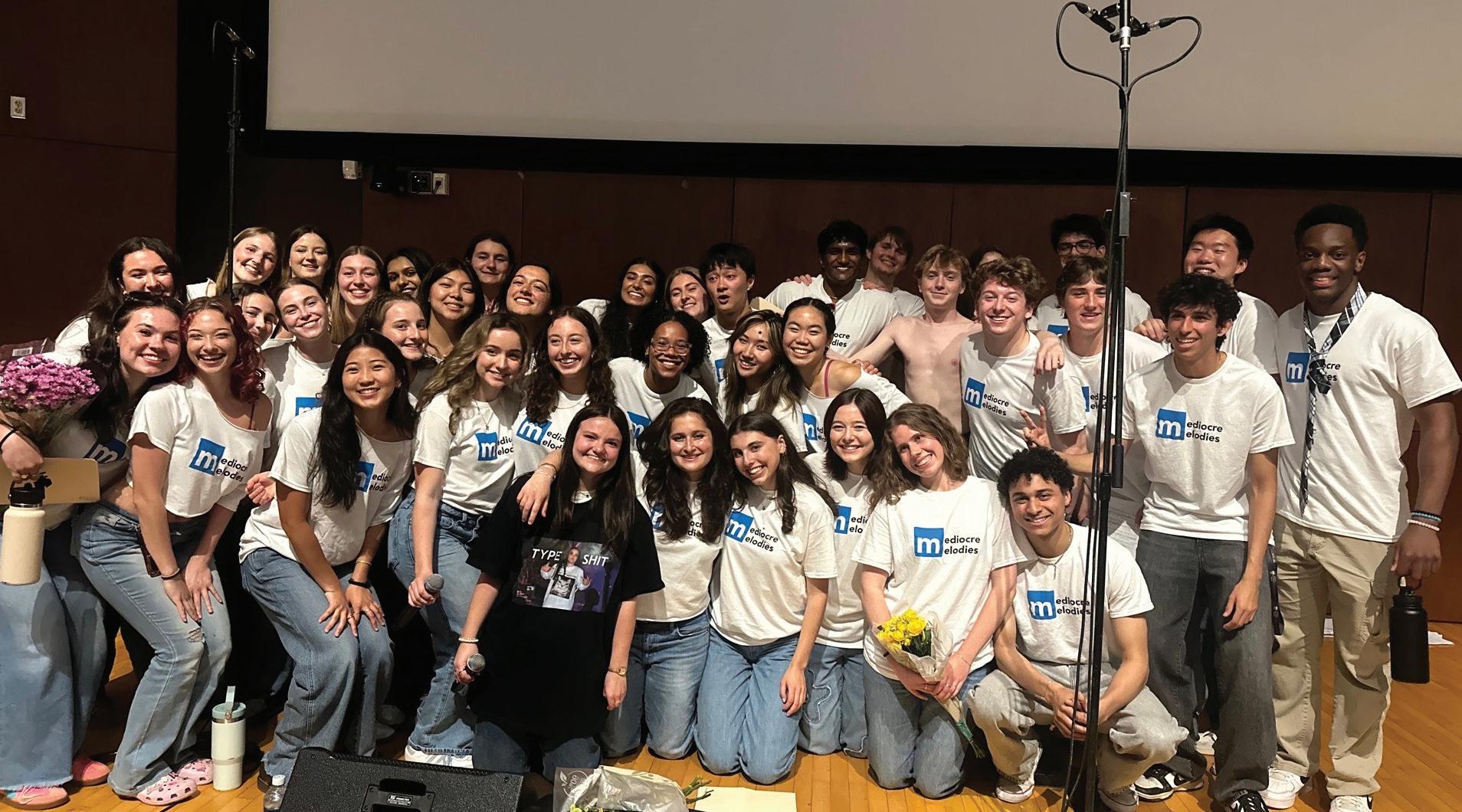
Upon entering the building, I was in shock at how beautiful the architecture of the building actually was. It was surprisingly well decorated and had a log cabin aesthetic. The design made it very easy to forget I was still in Ithaca and not in the Appalachian Mountains. There was a functional fireplace that appeared to have open access and an actual wood- burning fire, something I found to be unique. There was a large and impressively detailed mural of a rainforest sprawled across the upper wall of the establishment, obscuring the concrete and brick. The ceiling was also ornate and well-crafted with intricate woodworking patterns and impressive lighting fixtures resting above the dining room. The restaurant also had multiple bar counters, which I found unusual, but also thought complemented the space.
One thing that struck me was just how empty the place was. Sun photographer Howie Wang ’28 and I were the only customers in the restaurant, which surprised me as we went during a fairly popular dining time. At several points, the staff disappeared, leaving my table and me alone in the space. This made things like asking for the check or another drink of water pretty difficult.
The overall design of the menu was pleasantly cartoonish with doodles, drawings, fun fonts and swirly borders scattered across the pages. The waiter arrived, introduced himself and offered us some free samples of tea to try. In general, I am not a big fan of tea, but Wang seemed to enjoy it. He described it as tasting similar to the teas offered at the Temple of Zeus. While we waited for our meals to arrive, we got our drinks. The Yellow Deli had a novelty drink item that pleasantly surprised me: root beer on tap. The root beer was served in
a frosty mug. The soda had a slushy-like consistency and was very refreshing and delicious.
We also ordered a cheese melt as an appetizer, which, while tasty, was the least palatable of all the items. It was something that could have been made using a dorm room hot plate and did not warrant a TCAT trip to consume. The sandwiches, however, were absolutely delicious with high-quality tasting ingredients, perfectly toasted bread and considerable portions. In fact, the first thing I noticed while eating my meal was how far the dollar went at the Yellow Deli. Each meal came with a pretty hefty serving of a side dish and a pickle. We also ordered a tray of chips, which were home-made and had a pleasant crunch and crispiness, leaving an insatiable desire for more. The cole slaw was also fantastic, with the perfect ratio of vegetables to dressing.
Once we finished our meal, we asked a few questions to the staff on our way out and learned that the root beer is among their most
popular menu items, and that the building was a publishing press before the Yellow Deli took over the space.
Truthfully, the experience was rather nice, and I feel as though I would have enjoyed myself even more if I had no prior knowledge of the alleged ulterior motivations for why this operation serves food to college students. I think there were several aspects of the place that felt uneasy or abnormal simply because I was reading into things based on its reputation. Although I cannot deny that there was something off about the atmosphere during my time spent there.
While I cannot speak to their reputation, scandalous nature or the safety of the establishment itself, I can say that the root beer and sandwiches were off the chain.
Jared Miller is a member of the Class of 2028 in the College of Agriculture and Life Sciences. He can be reached at jmm792@cornell.edu.
By MAYA JOHANSEN
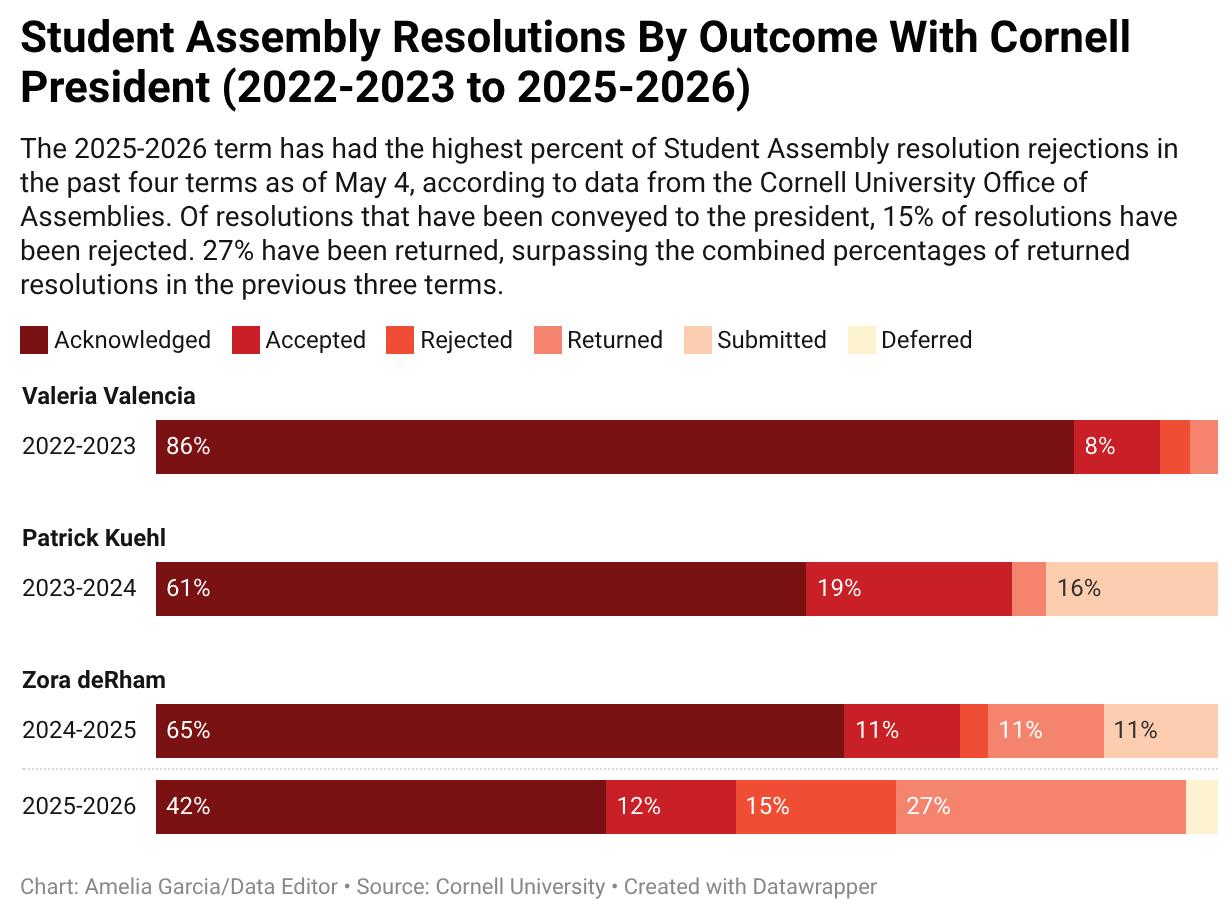
May 4 — The Student Assembly submitted 33 resolutions to the Office of the President during the 2025-2026 term. Of these, 15% have been rejected by President Michael Kotlikoff — a marked increase from previous years.
42% of submitted resolutions have been acknowledged and 27% have been returned to the Assembly. One resolution was deferred.
The Assembly represents the undergraduate student body as part of Cornell’s shared governance system. The Assembly drafts resolutions, or formal written proposals, to convey policy suggestions, criticisms and opinions to the University.
If passed within the body, a resolution is then conveyed to President Kotlikoff, who has 30 days to formally respond, according to the Student Assembly charter.
The 15% rejection rate of the current term is significantly higher than rates from recent years. In the 2022-2023 term, there was around a 2% rejection rate. In the 2023-2024 term, there were no rejections, and in 2024-2025 there was also around a 2% rejection rate.
Additionally, there has been a jump in the return rate during this term, which currently sits at 27% compared to 11% in 2024-2025 and 4% in 20232024. The president can return a resolution to the Assembly for further discussion. The Assembly must then update the resolution to incorporate feedback and resubmit it for reconsideration within 30 days.
The increased rejection and return rates “signal a disconnect between both the Student Assembly president as well as the University president,” according to Christian Flournoy ’27, executive vice president of the Student Assembly.
“There needs to be more collaboration and actual communication [between the Assembly and administration] before we’re even able to submit the resolution,” Flournoy said. “A lot of times, we’ll get [resolutions] that are returned or just rejected, and it’s either [because] there’s more that could’ve been done on our side or there’s a difference of opinion.”
Student Assembly President Zora de Rham ’27 believes the University is hesitant to accept resolutions that would lead to big changes.
“You’ll see broader, bigger statements get rejected,” de Rham said, “because this is such a time of uncertainty for the University,” de Rham said. “There just is an unwillingness to take big leaps, and that’s why we’re only getting responses on internal or mandatory business.”
Over the past four academic years, there have been zero political resolutions accepted by the University presidents.
For example, Resolution 61 — which called on Cornell to terminate its partnership with the
Technion – Israel Institute of Technology— was rejected as it “fundamentally conflicts with Cornell’s principles of academic collaboration and our core commitment to academic freedom,” Kotlikoff wrote.
Resolution 33, which sought to designate general election day as a university-wide holiday, is another rejected political resolution. “Cornell’s existing academic schedule provides multiple opportunities throughout the day for students to vote,” Kotlikoff wrote in his response.
Flournoy said that some resolutions deal “with the Assembly itself and our internal functions.” The first resolution accepted by Kotlikoff this academic term — Resolution 66, a continuation of the rejected Resolution 21 — falls under this category. This resolution approved the reassessed 2026-2028 Student Activity Fee.
“I definitely think that administrators are more confident responding with a concrete ‘yes’ when it’s something internal,” de Rham said. “[This is] because we as a student assembly have complete control over enforcing and implementing” internal resolutions.”
The three other accepted resolutions — 34, 38 and 51 — are also internal, dealing with standardizing resolution authors and endorser rules, increasing outreach requirements and updating the bylaws with a contingency plan for vacancies in the independent offices.
Student Assembly members have also raised concerns regarding response times exceeding the administration’s allotted 30-day window.
“The volume of resolutions and narrow response deadlines could make it difficult to respond quickly,” Kotlikoff explained when addressing students’ concerns regarding timeliness at the March 12 Assembly meeting.
Flournoy also spoke about delays on the Assembly’s side. “A lot of resolutions from this year necessarily haven’t been conveyed right after they’ve been passed, and I think that’s an issue that needs to really be addressed,” Flournoy said.
When asked if the administration had any comment on the higher rejection rate this term, a University spokesperson pointed to Kotlikoff’s comments at the March 12 Student Assembly meeting and the University Assembly meeting on Feb. 24.
“We seriously consider resolutions from the Assembly. This usually involves some research on the underlying issues and discussions among senior leadership, which means finding time across multiple very full schedules,” Kotlikoff said at the Feb. 24 meeting.
“[Students] have their own individual ideas and thoughts, and there’s a desire to see this acknowledged by the president, and frankly [with] the drive of Cornell students, I don’t see [the rejection rate] as being a deterrent,” Flournoy said. “If anything, it’s more of a motivator.”
Maya Johansen can be reached at mhj49@cornell.edu.
By SOPHIA KOMAN Sun Senior Writer
May 1 — With graduation nearing, Cornell’s own Batman is getting a fitting superhero sendoff. On Thursday, the Student Assembly voted unanimously to thank the anonymous Cornell student for his contributions to campus life.
Resolution 88: “Thanking The Cornell Batman for His Service to the Cornell Community,” states “the Student Assembly thanks and commends The Cornell Batman for his service to the community. The Student Assembly wishes him all the best in his future endeavors and hopes sincerely to see him back on campus in the future.”
With an Instagram account that has amassed over 3100 followers, Cornell Batman has become a familiar figure on campus whose goal is to uplift student spirits.
“He’s doing actual superhero work, which is kind of easing the stress about things,” Cornell Batman said, referring to himself.
While his identity remains undisclosed, he has revealed he is a member of the Class of 2026 and will be graduating this May.
At the Student Assembly meeting this Thursday, Cornell Batman attended in person. He said the recognition from the Assembly was emotional for him, and he expressed his gratitude to the Cornell community.
“I didn’t think it would ever reach anything of this magnitude. It’s truly remarkable,” Cornell Batman said.
Although he originally bought the costume for Halloween during his freshman year of college, he quickly found himself wearing it beyond the holiday season, spreading joy and humor throughout the community.
“It’s hilarious to see Batman running around, sitting down at the dining hall eating a burger, just like anyone else,” Batman said.
The resolution was written by Max Ehrlich ’26, the school of industrial and labor relations representative, who shared that Cornell Batman deserves this formal recognition because of his campus presence, support of fellow Cornellians at their events and his advocacy of mental health efforts.
“Personally, I hope this resolution shows Cornell Batman that we appreciate his contribution to our campus,” Ehrlich wrote in an email statement to the Sun. “He has given this campus a great deal of joy and love, even as he manages his academic and personal life.”
Spiro Yeo ’27, a close friend of Cornell Batman, said his real superpower is his ability to connect with anyone on campus and make them feel heard.
“Anybody, regardless of where they’re from, what their background was, they can go up and talk to Batman about anything, and he will sit there, and he listens, and he listens well,” Yeo said.
Cornell Batman noted the role requires a significant time commitment and that he is fortunate his schedule allows for it. Although some students have expressed interest in continuing the role after he graduates, he said there is not currently a successor.
“There’s no plans, although if someone were dedicated and motivated enough and knew the values and morals behind it and they stepped up and reached out, I would be more than happy to train them to take over,” said Cornell Batman.
After graduation, Batman plans to keep the character alive, with hopes of volunteering around his community.
“I think wherever I go, Batman’s gonna be with me,” Batman said.
As parting advice, Batman shared that staying involved at Cornell isn’t about a superhuman schedule but about knowing what to prioritize.
“If you’re motivated enough, you will absolutely find the time, no matter how busy you are ... to put yourself out there and go do what matters to you. This is my way of having fun,” he said.
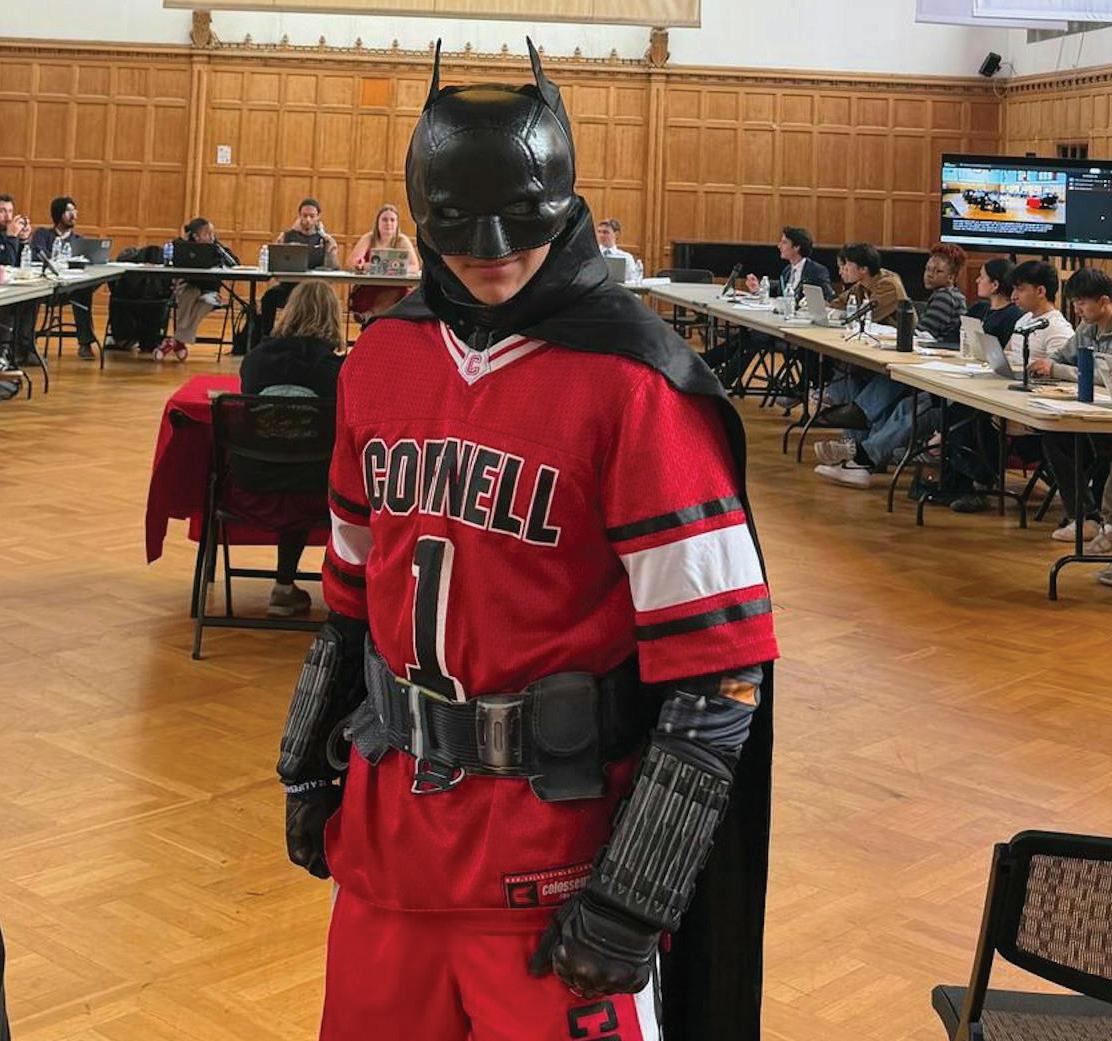
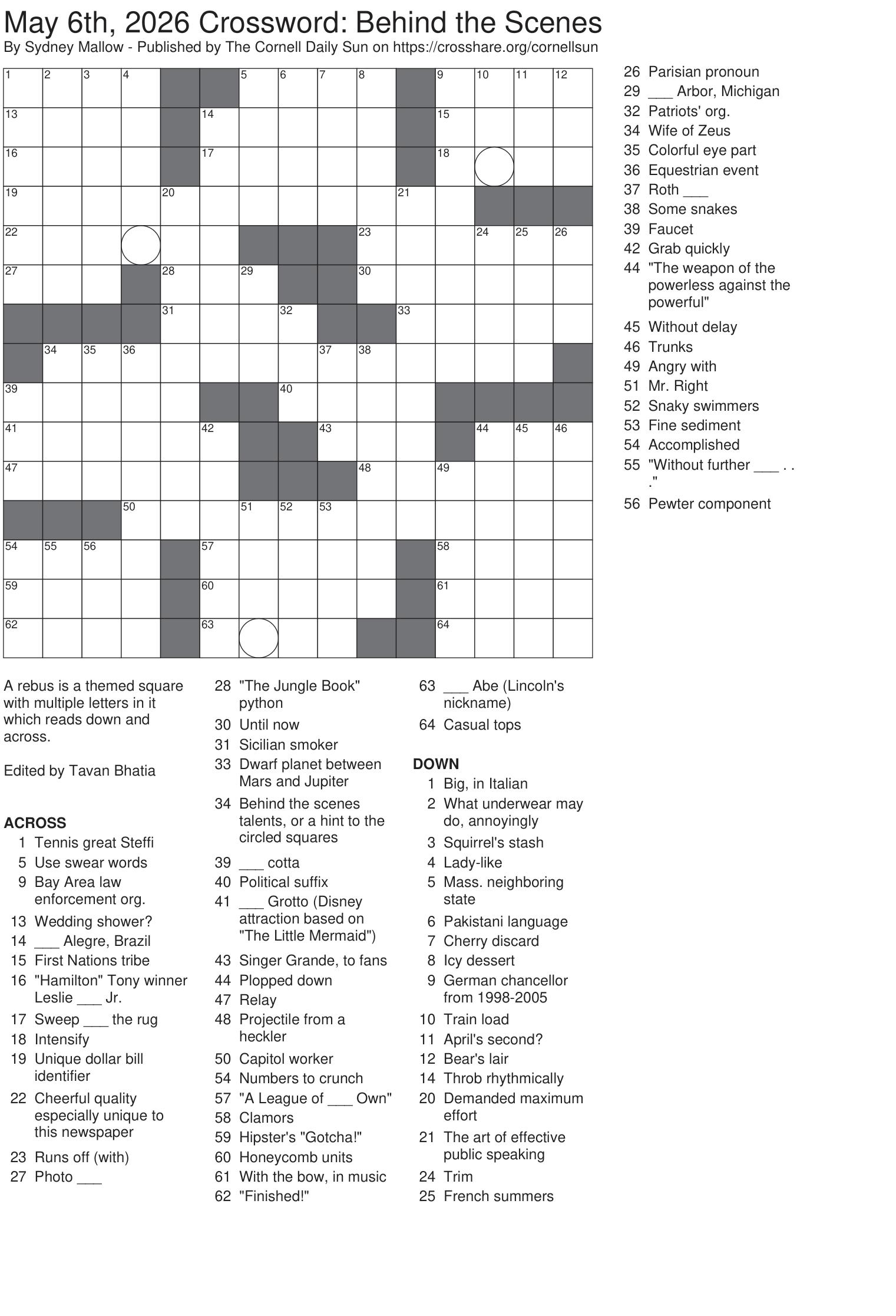
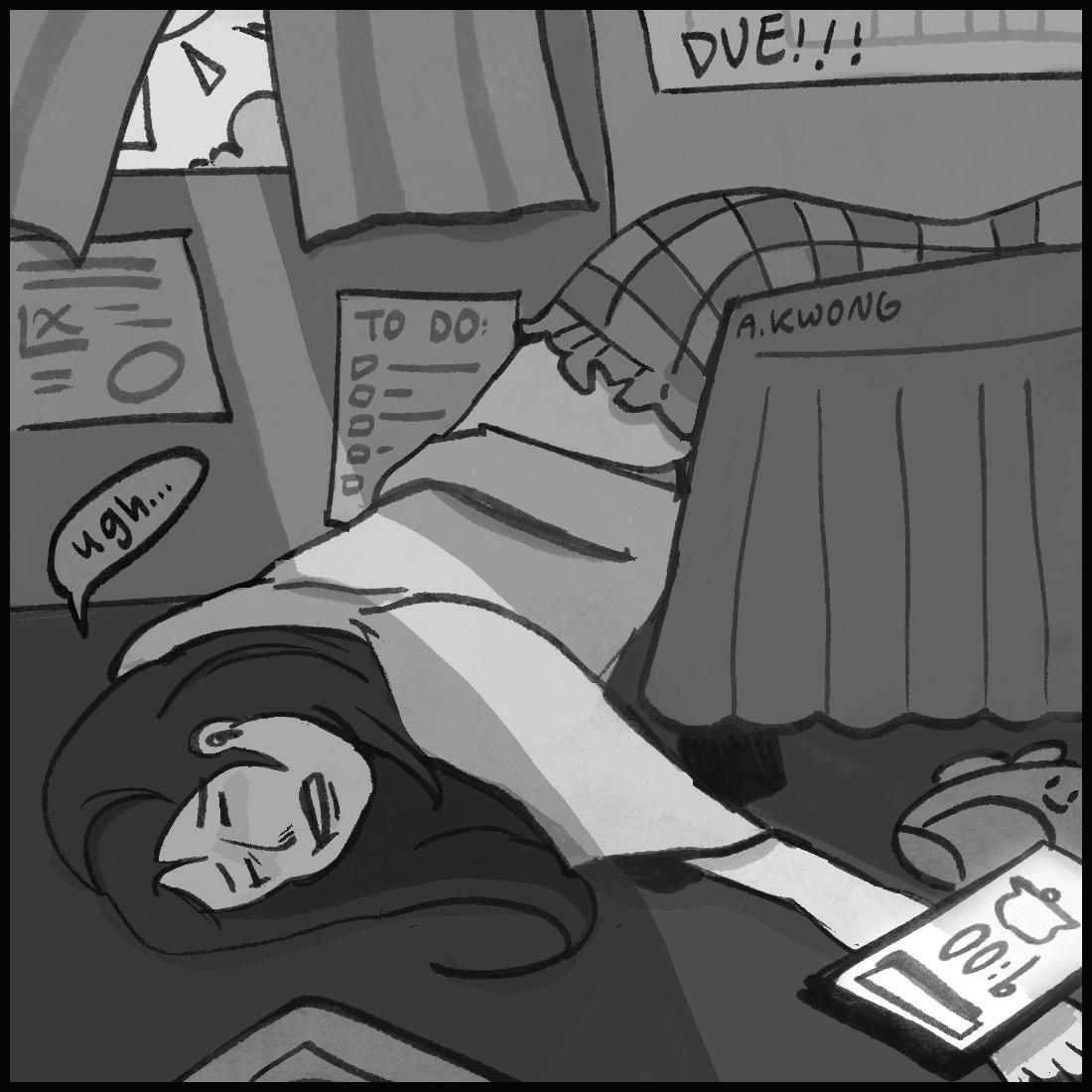


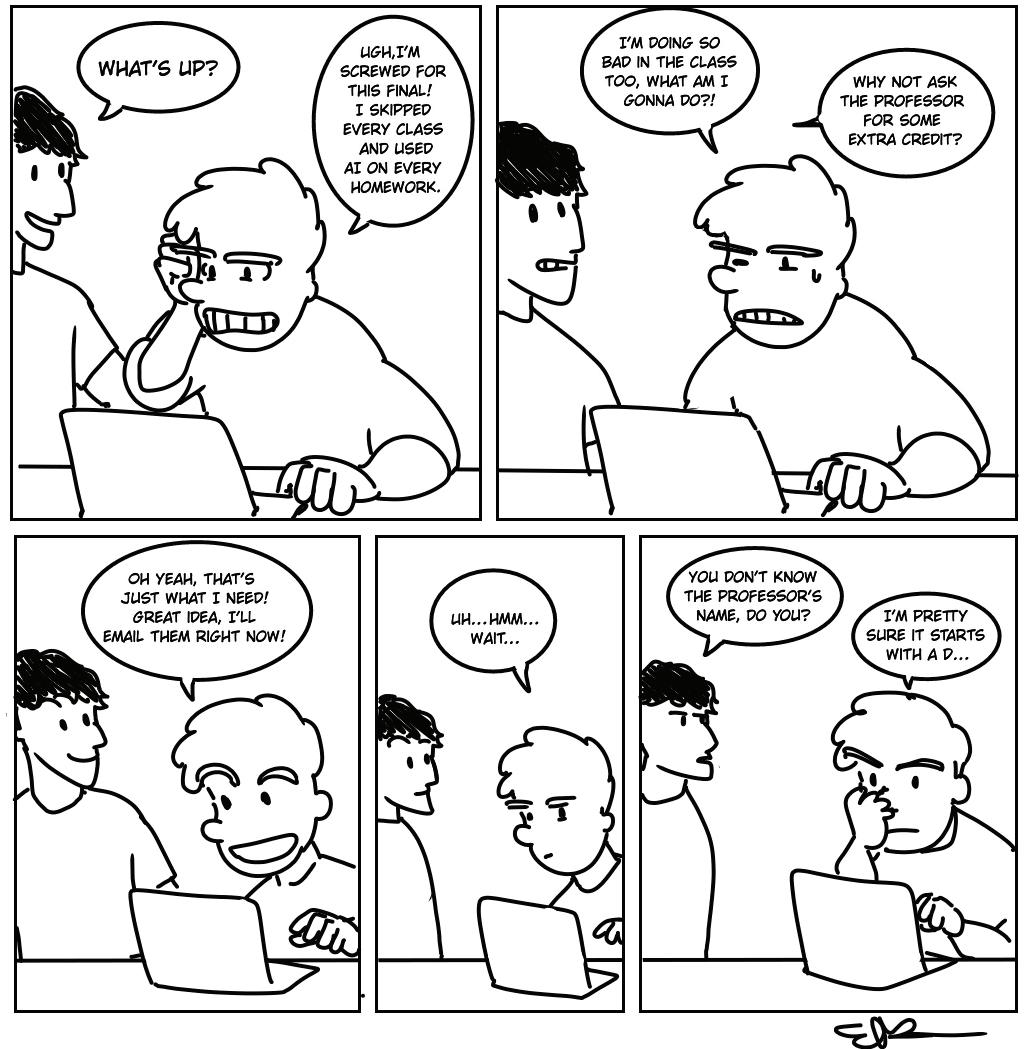
By ABIGAIL WINSETT Arts & Culture Contributor
Amid a mix of reactions, both positive and negative, to the release of this year’s Slope Day headliner, I thought it would be interesting to look back upon Slope Day performers of the past. After cherry-picking 10 different past artists and some of their most famous songs, I leave it up to you to decide if the grass is truly greener on the other side, or, in this case, in another time.
1. Snoop Dogg: “Gin and Juice”
Snoop Dogg headlined the festival in 2005, and after consulting with my parents, I’ve decided “Gin and Juice” is the most representative of what I assume the vibe would’ve been: “laid back.”
2. Kendrick Lamar: “HUMBLE.”
What do we think was more hype: Superbowl LIX or Slope Day 2013? Though Lamar’s album DAMN ., to which this song belongs, wasn’t released until 2017, I can’t help but include it. It’s just that good.
3. Drake: “Wants and Needs (feat. Lil Baby)”
It feels a little evil to put Kendrick Lamar and Drake, the 2010 headliner, right next to each other in this list, but I digress. I’m not much of a Drake girl (who is?), so I consulted my sister for this one.
4. Kanye West: “Gold Digger (feat. Jamie Foxx)”
Obviously, Kanye West is no longer the guy he was when he headlined Slope Day in 2004, so I decided on a throwback track. Singing this song out the car window with my friends when I was way too young to know what a gold digger was is
too much of a core memory.
5. Ludacris: “My Chick Bad (feat. Nicki Minaj)”
My mom might be the biggest Ludacris fan in existence (she exclusively calls him Luda), so I know she would’ve tried to find a way to be at 2014 Slope Day. I can’t say I blame her.
6. Nelly: “Hot in Herre”
Nelly, who headlined in 2011, was another one of my childhood favorites, but I really connected with this song when I saw it used in an edit of Andrew Garfield’s character in The Social Network.
7. Gym Class Heroes: “Cupid’s Chokehold / Breakfast in America”
As I say every time I play this song on the radio: Did you know the drummer went to Cornell? I’m sure he enjoyed returning to play Slope Day in 2008, and I’m sure I would’ve enjoyed being in attendance.
8. Pussy Cat Dolls: “Don’t Cha (feat. Busta Rhymes)”
Imagine if Katseye played Slope Day now. That’s probably how it felt in 2009 when the Pussy Cat Dolls headlined, except the music was actually good.
9. A Boogie with da Hoodie: “Look Back at It”
Of course, I had to include Slope Day’s only two-time headliner. A Boogie played in 2021 (virtually) and in 2024 (live). He must really love our vibe.
10. Gunna: “fukumean”
It would be a crime to make this list without mentioning 2025, the one year which constitutes the entirety of the “Controversies” section of Slope Day’s Wikipedia page. Though Gunna was not the original headliner (if you know, you know), he really pulled through, along with Louis the Child.
11. The Chainsmokers and Daya: “Don’t Let Me Down”
Finally, I have to give a shoutout to our 2026 performers, The Chainsmokers and Daya. You gotta admit, this song has a little kick to it.
After that recap, I’m still not sure what my perfect Slope Day would look like. Every year has had its ups and downs, and ultimately, everyone’s going to have different takes on the performers. Comparison is the thief of joy, or so I’m told, and listening in on conversations across campus, I find that people not only compare this year’s lineup to past Cornell lineups, but also to headliners at other schools. “Did you know Yale got Zara Larsson?” has become an oft-heard adage. Yet, to tell you the truth, when I attended Princeton’s Lawnparties this past weekend, headlined by Fetty Wap, I heard a couple disgruntled Princetonians saying, “Dude, Cornell got The Chainsmokers.” Regardless of if you’re pleased or not, here’s to hoping The Chainsmokers are gonna knock all our little Cornell socks off.
‘Solar Flare’ is a weekley playlist column where Sun contributors spotlight a slice of musical taste with the campus community. It runs every Modnay.
Abigail Winsett is a member of the Class of 2029 in the College of Arts and Sciences. She is a contributor for the Arts & Culture Department and can be reached at agw66@cornell.edu.
By CHLOE ASACK Arts & Culture Writer
“The child is there. THE CHILD’S FATHER is there. Beyond that, nothing is certain,” reads the prelude for the American premier of Monica Isakstuen’s play, originally written in Norwegian. The piece is an abstract meditation on absent motherhood, although I hesitate to pin it down in such terms — or any terms, because the events of the play are truly as uncertain as they purport to be. Isakstuen’s elusive piece was staged in Ithaca this past week by the Cherry Artists’ Collective, an arts hub that often stages newly translated works. Their production, directed by the Cherry’s executive director Samuel Buggeln, speaks to the core of the show, shrewdly actualizing the diverging realities that Isakstuen contemplates in the piece.
The play wrestles with one central question: How could a mother leave her child? It depicts five versions of the child’s mother, called “The First I Could Be,” “The Second I Could Be” and so on. Each “I Could Be” sequentially shows up to the father’s house in the middle of the night, seemingly on a quest to come to a mutual understanding about why she left, to see the child, to take the child or some combination thereof. These characters are more ideas than individuals, and these ideas about who the mother could be are all efforts to work out the play’s fundamental question. The “I Could Be”s and the father’s conversations don’t play out as typical scenes (e.g., the mother and the father fight and she leaves, or something along those lines). Rather, the pair explicitly considers and debates the possibilities of their lives as they unfold. For instance, in a moment of tension, The First I Could Be does not just tilt her head back and look at the ceiling; instead, she says, “I tilt my head back
and look at the ceiling,” as if she and the father are devising their own understanding of the mother she could be as they debate.
Some of the “I Could Be”s embody more standard archetypes than others. After The First I Could Be (Darcy Rose) tells the father that she wishes he would hit her, The Second I Could Be (Sylvie Yntema) spawns, exclaiming that “The Second I Could Be is a victim,” contrasting the First’s unrealized desire with the Second’s truth. Yntema’s portrayal of The Second I Could Be was particularly impactful. She leaned into the sanitization inherent in trying to devise a satisfactory explanation for the mother’s leaving, while still playing the character as an individual who truly believes the story she is telling the father.
The archetypes continue: The Third I Could Be (Erica Steinhagen) is an abusive mother, and the Fifth I Could Be (Elizabeth Mozer) is a dead mother. By the time the Fifth arrives, the show is explicating the ridiculousness of searching for a clean answer to the play’s central question. The Fifth I Could Be knows she represents the neatest explanation — “Death gives the mother a valid excuse for absence; death is simplest for all concerned” — and Mozer displays awareness of the silliness of portraying an already-dead creature, playing The Fifth I Could Be as more satisfied and smug than her fellow I Could Bes, who are less able to accept their own reasons for why they left.
The creative team visually materializes the increasing unreality of the father’s home as it populates with the I Could Bes. At first glance, the set appears to be a typical split stage, with contrasting wallpapers on each half of the set and furniture that seems contained to each side of the stage. But, upon closer
look, the patterns on the walls continue onto the floors, and the characters never pay any mind to the furniture split. As the I Could Bes contemplate their possibilities, neon purple and red outlines of their bodies appear on the walls behind them. When the new I Could Bes spawn, scratchy sound cues fill the space and the lighting stutters. To state the obvious, Beyond that, Nothing is Certain does not intend to be a show that is entirely understandable. Yet still, such shows run the risk of confusing an audience more than they are prepared for. In this case, through the direction, which paints these scenes as off-kilter and unreal, the creative team gives the audience permission not to make sense of the show’s events, allowing us to take the uncertainties as they are.
Beyond that, Nothing is Certain takes up an inexplicable question and wrestles with it in the only way such questions can be wrestled with: considering possibilities but leaving them unresolved. By the show’s conclusion, we do not know which of the mothers She Could Be is the actual one, if there is an actual one or why any of the I Could Bes left their child. But the show ends as it began, with The First I Could Be, who now approaches the sleeping child. She is not certain whose mother she is, or who this child is, but she is a mother who has left a child, and the child is one who has been left. In Beyond that, Nothing is Certain, Isakstuen suggests that there is little anyone can truly know about absent mothers, but, as The First I Could Be tells the child, “I just want to say I hope you’re alright,” it seems that at minimum, she hopes that a mother who leaves her child still cares.
Chloe Asack is a member of the Class of 2026 in the College of Arts and Sciences. She is a staff writer for the Arts & Culture department and can be reached at casack@cornellsun.com.
There’s nothing worse than the last slog of finals. You’re stressed, you have an insane amount of work and you somehow have to score a 98% in order to finish with a B+. Our campus practically becomes a pressure cooker. Safe to say, we need ways to relax. Now, I’m not opposed to doomscrolling; however, when I end up on TikTok for a ‘quick break,’ hours fly by, and I end up procrastinating. The nice thing about movies is their set runtime, providing a real boundary for a study break.
In my classes this year, some coursework involved watching films. I ended up watching nine movies and out of those I watched, these are the best ones for a study break or celebration of being finally done.
If you really have no time, I suggest watching Tutankhamun in Colour, a documentary about recoloring photos from the discovery of King Tut’s tomb. It’s nice and short (just under an hour) and available on YouTube, which allows you to either split-screen or rely solely on the background noise. Narrated by Elizabeth Frood, an Egyptologist and former director of the Griffith Institute, her knowledge and excitement over the subject are infectious. The colorized photos are incredible, especially when you see the untouched tomb for the first time. Interviews with other Egyptologists and the family of archaeologist Howard Carter’s patron provide ample discourse. Even if you have no interest in Ancient Egypt whatsoever, shutting your brain off for a break during finals is imperative, and the documentary provides a great outlet for stress relief.
Looking at a much longer movie, Amadeus is a wild ride, providing ample distraction from any chemistry or calculus exam. The film serves as a fictionalized biopic of Mozart from the perspective of Antonio Salieri, a previously favored musician who watches as Mozart surpasses him. Filled with jealousy, yearning
for approval and every other heated emotion that comes from making music, the film is three hours of drama. The actors are excellent, with Academy Award winner F. Murray Abraham practically descending into madness as he believes his lack of genius talent is an act of God’s abandonment. Besides the dramatic aspects, the period-style costumes and sets paint an incredible picture of 18th century Austria. Although the film is long, you can always watch it in segments of one hour at a time.
Going back to shorter runtimes, Whale Rider is an excellent movie following a young girl challenging the gender norms of her M ori tribe. After her twin brother and mother die during her birth, Pai is raised by her grandparents following her father’s relocation to Germany. Her grandfather, the chief of their tribe, grows fond of her while still blaming her for the tribe’s leadership crisis. The film showcases Pai training in secret while repeatedly being admonished by her grandfather. The film’s cinematography of New Zealand is incredible, and its exploration of culture and gender roles is well done. The actress who plays Pai, Keisha Castle-Hughes, is phenomenal, garnering an Academy Award nomination for Best Actress for her performance. The use of the ocean is also a strong point, with the diving scene remaining one of my favorites. This film is heartwarming, an emotion many of us need to feel during finals.
If none of these sound appealing, I raise you The Host . Directed by Bong Joon Ho, the film is a monster movie, striking a mix between action, horror and black comedy. The movie follows a snack vendor, Park Gang-du, and his family as they search for his daughter after she is kidnapped by the creature. Bong is always excellent, and his direction here is no different. The shots are creative, even when displaying a poorly aged CGI creature. Each character in the family gives a heartfelt performance, and you really get a sense that they deeply care about
each other. Additionally, the film explores the greater issue of U.S. forces in South Korea. The creature’s creation is a result of American scientists pouring unknown chemicals into the public water: The Host calls out the unnecessary and oppressive nature of U.S. military intervention. The action sequences are also incredibly cool, with the camera showcasing angles of the creature attacking. My favorite part, however, is the coloring. With a yellow tone, the movie looks incredibly similar to the creature’s skin.
Finals may be the worst time of year, but that doesn’t mean you don’t deserve a break. Chill in your dorm a bit, sit down and watch a movie. Then go pass your exam.

ABDURRAHMAN
ALI ARTS & CULTURE CONTRIBUTOR
Has it ever felt like no matter how well yo u slept the night before, how much coffee you drink or how much water you consume throughout the day, your concentration still fades after just 20 minutes of work? You are not alone. In addition to sleep and hydration, where you choose to study really matters. By this, I do not mean that you should be in your room, a private library carrel or a cafe. Of course those places can help, but fulfilling those conditions does not guarantee sustained focus.
There is one more factor that is usually overlooked while studying for deep work: color. The colors surrounding us that we stare at for some 20 to 40 seconds during short breaks impacts studying. These short visual breaks can actually shape how effectively we return to our study space.
According to Nancy J. Stone’s research published in the Journal of Environmental Psychology , the color of your environment does not just affect how a room looks, it shapes how well your brain does its job. In her study, students who completed a reading comprehension task in a red-colored space scored lower than students in a white-colored space. This means that red is a stimulating color that competes for your attention. This also means that when the task you are doing already demands deep concentration — like reading a dense paper or working through a problem set — red divides your attention into two directions.
Blue, on the other hand, works in your favor during demanding cognitive tasks like studying for finals. This color is mostly associated with calmness and mental clarity. Stone’s study also found that students in blue spaces reported
higher positive mood during open study settings. If you have any say over the color of your study space, whether that means your dorm room wall, a poster above your desk or even your laptop wallpaper, leaning toward cooler blues during finals is a good choice.
Green may be the most underappreciated color but the most available color in Ithaca. A study by Kate Lee and colleagues at the University of Melbourne found that students who spent just 40 seconds looking at a green roof during a break could concentrate better than students who looked at a bare concrete roof. The researchers backed their study with Attention Restoration Theory, which claims that natural environments allow the brain’s voluntary attention system to briefly recover. This could also mean a little plant on your desk or nature photo set wallpaper and screensaver which might help you a little through a long study session.
Yellow and orange also have a place in this picture, though they are better for creativity and energy than for the sustained and focused reading most of our finals demand. These two colors are probably better for your group study session than the wall behind your screen.
None of this means you need to repaint your apartment in Collegetown before your organic chemistry final. These takeaways can be implemented in moderate ways. When you take a study break, instead of scrolling through your Instagram feed, step outside or stand by a window and observe the green trees; we have a lot of them in Ithaca. Additionally, set your screensaver to something green or cool blue rather than a high-contrast image. If you are choosing between two library spots, pick the one near a window with natural light.
The research does carry an important point
worth mentioning: Individual responses to different colors vary, and no single color is universally optimal for every person or every task. A color that helps you focus during reading may do nothing during math coursework and vice versa. The broader point is that the visual environment you work in is also an active participant in how well your brain functions.
The Cornell campus, fortunately, gives us a natural green color. The Arts Quad, the Slope and surrounding landscape are not just scenic. They are, in a measurable sense, good for your brain. When you are taking a break, let your eyes rest on something green before you go back to the page or screen.
So before you get your third coffee from Libe Cafe during finals, take a look around and embrace the natural environment.

By STEFANIE CHEN Sun Lifestyle Writer
Feb. 16 — The low buzz of murmurs ripples through Bailey Hall as the lights begin to fade. Backstage, it’s a blur of quick footsteps and last-minute stretches as dancers rush into position. The music hums to life, soft echoes bouncing off the walls as the curtains break apart. The sound of movement continues until suddenly, the spotlight is on center stage. Music erupts from the speakers, and dancers flood the stage, their rhythmic steps sealing each movement and claiming the night as their own.
While Cornell has become home to countless dance groups over the years, BreakFree sets itself apart — not just as a club, but as a space where dance becomes identity, and the stage feels like home. Founded in 2006, the student-run, openstyle dance crew has become a defining presence in Cornell’s dance scene, driven by a mission to ignite passion within its community. Starting as a small initiative offering free community workshops, the club has grown into one of the University’s most dynamic and accomplished performance groups.
“Dance brings people together, and we want to make sure we connect back to our roots and host these open workshops.”
Hannah Mekky ’26
At its core, BreakFree is guided by its mission to “spread dance experience to the community at any capacity,” Hannah Mekky ’26, the club’s co-president, said. “Dance brings people together, and we want to make sure we connect back to our roots and host these open workshops.” That commitment to inclusivity still defines the group today, where they hold weekly workshops ranging from absolute beginner sessions to advanced choreography classes, welcoming dancers of all levels to their studio.
Since its establishment, BreakFree has expanded from a workshop space to a competitive force. In December 2025, the team competed at World of Dance in Rhode Island, taking home first place in the collegiate division and second place overall in
the team division. For a student-run organization balancing academics alongside rehearsals and creative production, these accolades mark the team’s strong mastery in their technical prowess and artistic direction.
Caitlin Lee ’27, BreakFree’s other co-president, said that “competing helps us further our love of dance. We’ve gone to competitions and left feeling really inspired, thinking about how we can grow from our experiences and how we can push our foundations and creativity to their limits.”
This balance between artistry and creative experimentation lies at the heart of BreakFree’s open-style dance approach. Rather than sticking to a single genre, the group draws from a wide range of dance foundations that highlight the diverse backgrounds and training of its members. “We allow each person to create their own artistic vision, and then we’ll piece it all together later. We want our members to have as much flexibility as possible to showcase their story and identity,” Lee commented.
This year alone, 31 members contributed original choreography for their 18th annual showcase, The Haunting. Set in a conceptual haunted house, the performance follows the trapped dancers as they tell the story of both breaking free from the “escape room-esque” stage and discovering what they’re breaking free from.
The showcase started strong with a high-energy, choreographed rendition of Dracula by Tame Impala, featuring
darker, more intense tones that immediately established the ‘haunting’ atmosphere. The sharpness of the dancers’ movements dominated the stage, creating a sense of tension and unease as the show progressed through different fears, each representing a unique catalog of musical genres. The “Fear of Losing Control,” inspired by the television series, Severance, explored vulnerability and introspection, using songs like Human and New Person Same Old Mistakes to show the struggle with identity in a competitive university setting. The “Fear of Starting Anew” brought in alumni united under a synchronized beat to express their future on the stage. The closing piece, “Pompeii,” served as a powerful finale, bringing together the entire dance crew across multiple choreographic styles into a large, cinematic ending as they broke free from the haunting.
To continue reading, please visit www.cornellsun. com.
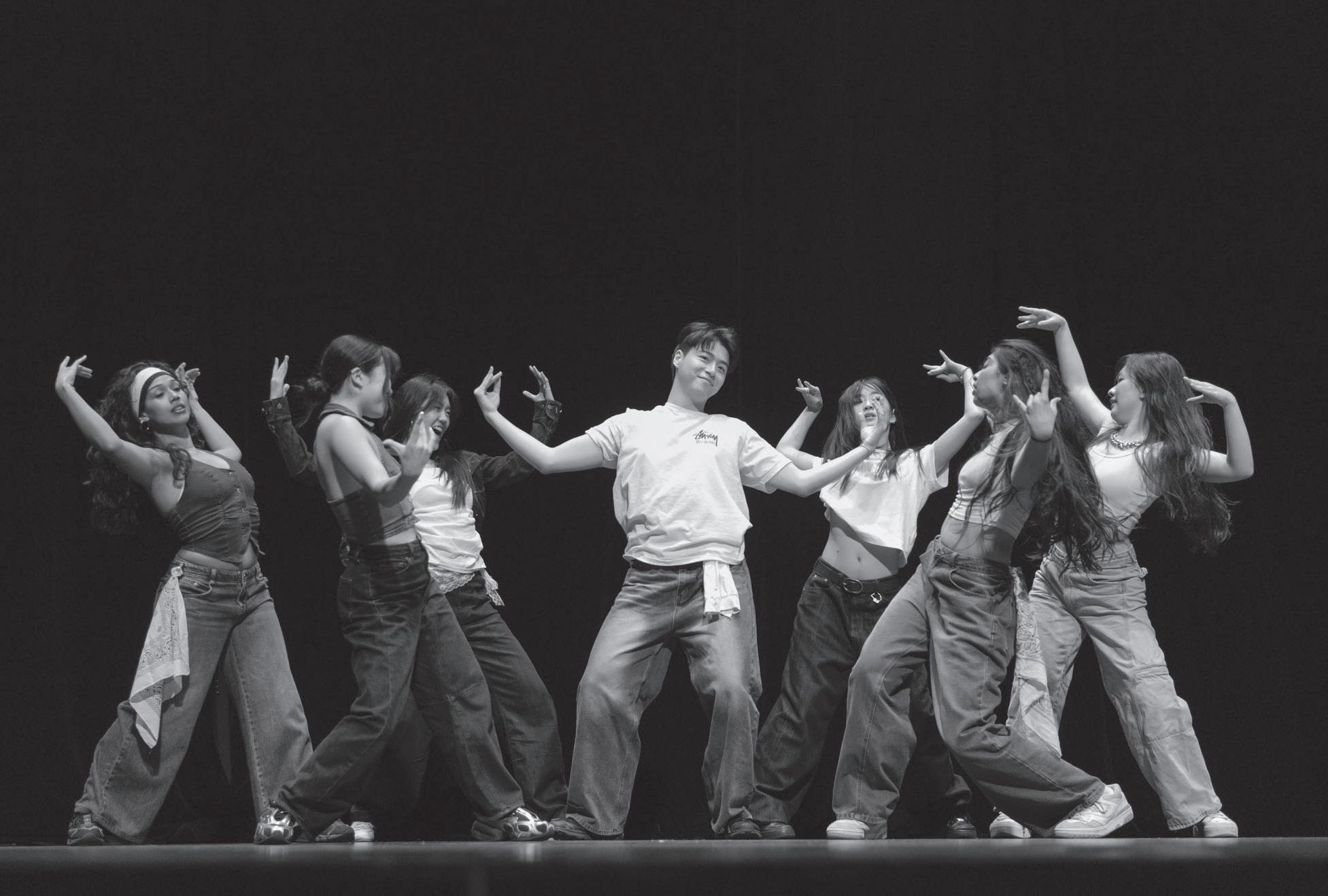
By JOSHUA COHEN Sun Contributor
May 1 — Researchers at the Cornell Jeb E. Brooks School of Public Policy launched an interactive map in January that highlights immigration policies in different regions of New York State.
The map was created by the State Policy Advocacy Clinic, a program housed in the Brooks School in which undergraduate and Master of Public Administration students work with New York State stakeholders to create “state-level policy initiatives” that “[prioritize] projects that advance rural equity and human rights,” according to the program’s webpage.
The mapping project, called “Local Approaches to Immigration Across New York State,” visualizes how local entities are currently responding and engaging with immigration policy across New York. The map provides a statewide perspective on different “policies, government officials’ statements, and community resources related to immigration,” according to Hattie Seten, a policy and advocacy fellow at the clinic.
The map seeks to present complex information about immigration policy in a manner that is interactive and straightforward, Seten wrote in a statement to The Sun. The map gives users the ability to layer different data metrics to visually gain a better understanding of immigration policies both within their community and statewide.
“There have been several significant changes in federal immigration policy recently, and the effects are felt differently in localities across New York State,” Seten wrote. This prompted the clinic to create the map.
The clinic “recognized a need for more accessible information on how local governments are engaging with immigration policy, so that communities and policymakers can make informed decisions that respect due process and human rights,” Seten added.
To gather the data, a team of 12 researchers used methods ranging from “reviewing publicly available government contracts [to] parsing through hours of government meeting minutes from localities across the state,” researcher Noah Freedman ’26 wrote in a statement to The Sun.
Freedman wrote that the clinic compiled statements from private organizations, such as chambers of commerce, and used demographic data from the American Community Survey and U.S. Census Bureau. It also analyzed bill sponsorship records for key immigration bills being considered within each New York State legislative district, according to Freedman.
In expanding the publicity of the project, the clinic has worked alongside “state and local policymakers, advocates, academics, immigration policy experts, and community members,” wrote Keten Solomon Abebe ’27, who
also worked on the project, in a statement to The Sun.
Abebe added that the map had originally been shown to Bitta Mostofi, former senior advisor to the director of the U.S. Citizenship and Immigration Services and current advisor to New York mayor Zohran Mamdani.
Since then, “[t]he map has [...] reached state and county legislators, ... immigration experts and community members, and … communities across the state with media outlets, including WRVO, Central and Northern New York’s NPR station,” Abebe wrote.
“Across these audiences, the map has been consistently recognized as a valuable resource as it consolidates the many factors that shape New York State’s evolving immigration landscape into a single, interactive tool,” Abebe wrote.
Seten wrote that upon the map’s publication, numerous stakeholders have suggested the addition of new metrics, including “adding electoral vote distribution patterns, immigration detention and deportation data by county and state legislative districts, and data on demonstrations related to immigration policy.”
Anezka Rodriguez Vigil ’26 expounded on inclusion regarding immigration labor policy in a written statement to The Sun, highlighting an interest in exploring the intersection between immigration and local labor inclusivity to these immigrants, noting quantita-
tive metrics such as the concentration of H-2A visas for temporary immigration agricultural workers by county or the availability of immigrant worker support programs.
Montán referenced the clinic’s other projects and tools, such as a comparative analysis of different proposed immigration legislation bills in New York during the 2025-2026 legislative session, as instrumental to influence the decision-making of policymakers at every level of New York State government.
Rafael Montán ’26 expressed that part of the clinic’s goal is to inspire other states to replicate the tools created by the clinic. He hopes that the clinic’s projects influence a larger movement to advocate for the rights of immigrants across the U.S. in an effort to considerably allow immigrant rights to reach the policy table.
Montán pointed to specific examples of the map’s implications in uncovering public school districts that unconstitutionally solicited information about immigrants.
“Being able to identify where the problems are at this local level makes it easier to [effect] change,” Montán wrote.
To continue reading, please visit www. cornellsun.com.
Joshua Cohen can be reached at jmc746@cornellsun.com.
By ROWAN WALLIN Sun Senior Writer
May 3 — Thirteen multicultural fraternities and sororities took the stage at Ithaca’s State Theatre Friday night for Greek Freak 2026, an annual dance competition hosted by Cornell’s Multicultural Greek and Fraternal Council.
With an action movie theme, doors opened at 6 p.m. for 355 attendees who watched organizations step, stroll and salute in choreographed performances inspired by famous films.
Step and stroll — percussive and synchronized dance traditions originating in Black Greek culture — are central to Greek Freak performances, and in order to be eligible for competition, performances must last around ten minutes long.
The Mu Gamma chapter of Delta Sigma Theta Sorority — a Black sorority — claimed first place and $750 in prize money for their set, themed after The Matrix, securing the sorority’s third consecutive Greek Freak championship win.
Omega Phi Beta — a Latina sorority — won second place and $500 with their The Purge themed performance, while Phi Beta Sigma Fraternity — a Black fraternity — earned third place and $250 for their performance, which had a The Fast and the Furious theme.
Audience members were also eligible to enter a raffle, with one event attendee taking home a set of AirPods Pro Max headphones.
Performances opened with Lambda Pi Chi Latina Sorority — the first Latina sorority founded at an Ivy League university — who performed a Mission: Impossible themed set incorporating Spanish music.
Abigail Diaz ’27, the chapter president, said the event carries significance beyond the competition itself.
“Our community is not seen as much compared to the other sororities and fraternity life [on campus],” Diaz said. “Events like this really bring awareness to who we are as multicultural Greek and fraternal organizations.”
One of the evening’s more distinctive performances came from Darwin Mordan ’26 who performed solo to represent Lambda Theta Phi, the first Latino fraternity in the U.S. Mordan performed the fraternity’s national salute.
“Instead of stepping and strolling, out of respect for the [Divine Nine] fraternities, we do something different. It’s called saluting. It just tells the stories of the brothers and their values,” he said.
Every other organization competed in teams, but Cornell’s Lambda Theta Phi chapter only consists of Mordan, who revived it in Spring 2025.
For Mordan, the evening represented something larger than his solo act.
“It really is a way for all the multicultural Greek fraternities — the [Divine Nine], the Asian fraternities and sororities, the different Latino fraternities and sororities — to come together and just have fun,” he said.
The crowd reacted most boisterously when the Alpha Kappa Alpha Sorority took the stage, an organization that returned to Cornell after nine years of dormancy, according to Saphira Augustin ’29, a member of Alpha Kappa Alpha.
The chapter, whose name “Kuzaliwa Upia” means “rebirth” in Swahili, was initiated on April 19, less than two weeks before the event, Augustin said.
“After nine years of being gone, we brought a show like no other,” said Fadekemi Falana ’26, another AKA member. “It shows that we have a community of Black women that care, and they’re willing to come out and put in the work.”
Gia Kim ’28 of Kappa Phi Lambda, an Asian sorority that performed a SpiderMan-themed set, reflected on what it means to participate in a tradition rooted in Black Greek culture.
“As an Asian [organization], we get to see our roots,” Kim said. “The Black [organizations] — the Divine Nine — they do amazing. They’re the real stars of the show here. It’s such an honor to be able to perform step, since it’s not originally ours.”
Another Asian sorority, Alpha Kappa Delta Phi, used folding fans as props in their routine to show a piece of their culture.
Diaz said she hopes events like Greek Freak signal something bigger to the wider Cornell community.
“There is a space for people who are multicultural,” she said, “and they can thrive in these spaces.”
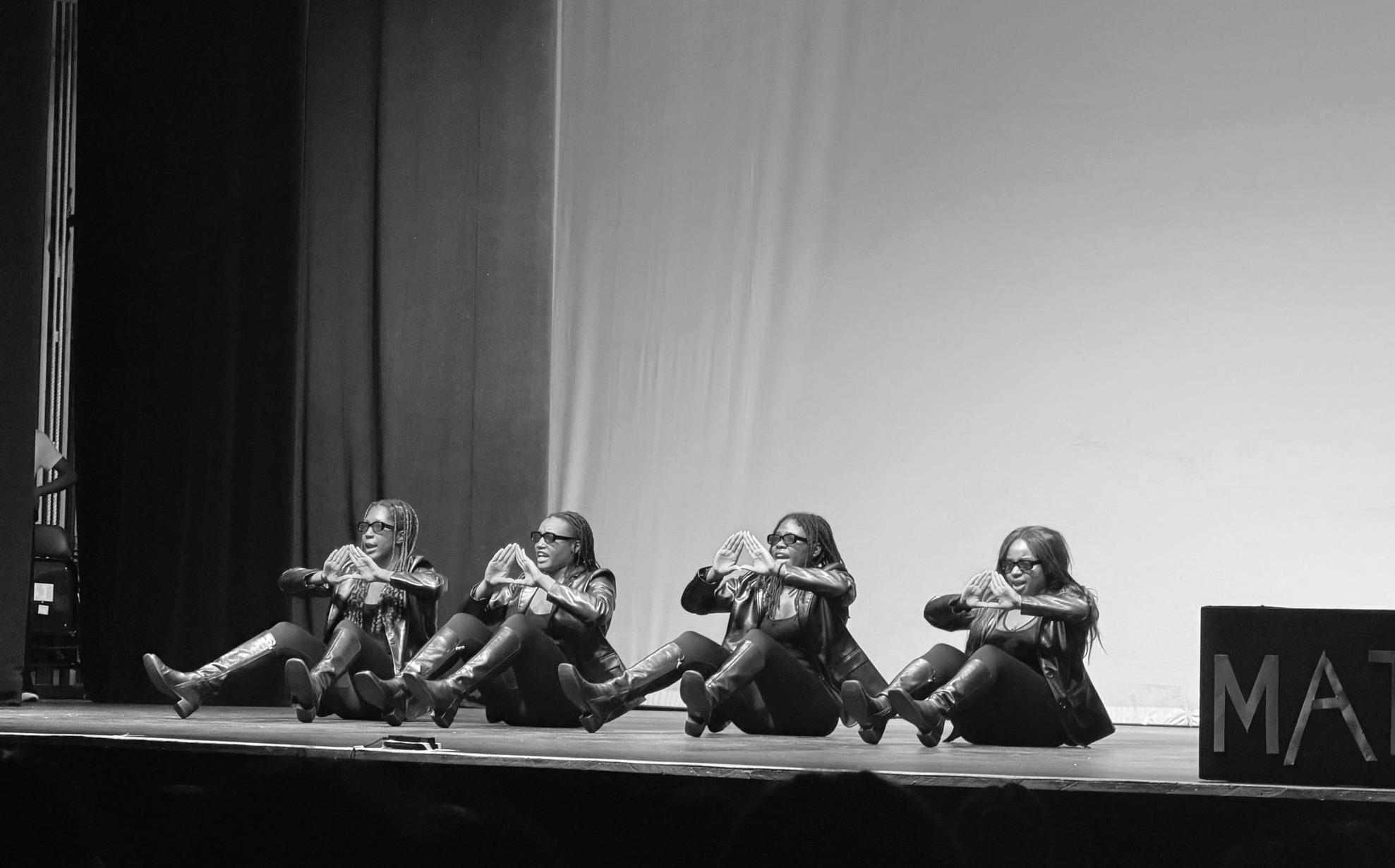
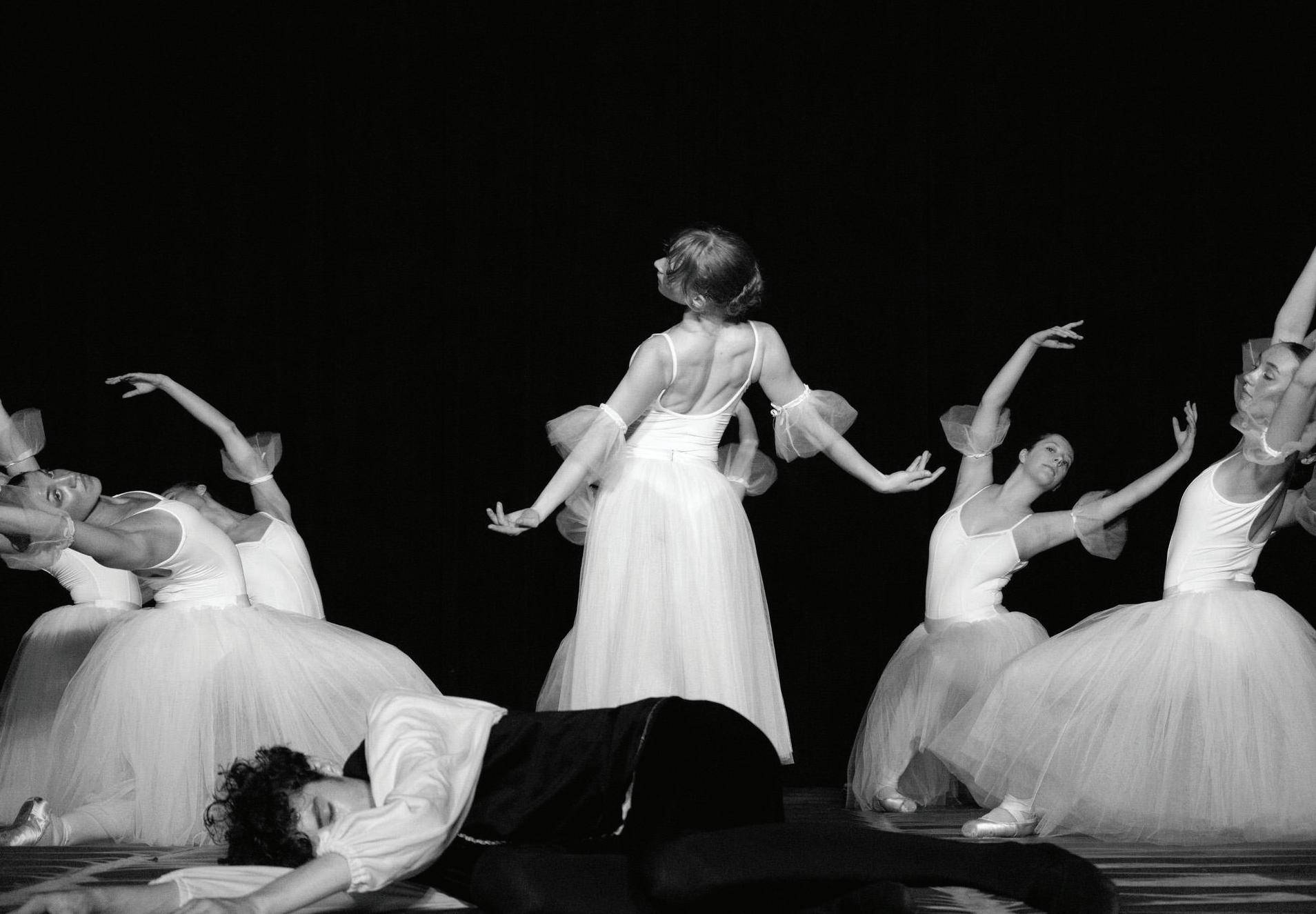
By LUKE DOLAN Sun Contributor
May 1 — I have never been a ballet aficionado, and my time in the theater has historically been limited to an annual family outing before Christmas to watch The Nutcracker in New York City. While early childhood experiences fostered a fondness for ballet, I regarded the artform as distant and formal — something that I respected but did not necessarily understand. It was for these reasons that I never considered the possibility that I could simply walk to Willard Straight Hall and watch the Cornell Ballet Club perform; and, when I heard about the chance to watch CBC’s production of Giselle, I had no idea what to expect.
CBC was founded in 2024 by six seniors who wanted to fill a missing classical ballet niche on campus. Their mission is to make classical ballet available to Cornellians who want to continue dancing through their undergraduate years. Last Friday night was their third club performance, following Swan Lake and The Nutcracker the previous two semesters. Given the lack of male ballet dancers, CBC is known for creative interpretations of famous performances.
As the lights dimmed, the excitement in the theater was palpable. Parents had flown in to see their children perform, friends filled rows with flowers in their laps and other students filed in for what has become a semesterly tradition.
Giselle is the beautiful and tragic fairytale of a young, innocent peasant girl who was masterfully played by Kylie Miller ’26. She soon falls for Albrecht, a nobleman, and the two share a fleeting romance that is ended before their wedding night by Albrecht’s infidelity. Scorned by her future husband’s treason, Giselle dies of a broken heart and descends to the spiritual realm, where she is welcomed by the Wilis, the spirits of maidens betrayed before their wedding days, now condemned to enact vengeance upon unfaithful men.
The arrival of Wilis marked a dramatic shift in the tone of the show, in stark contrast to the warmth of earlier romantic scenes. Watching seven perfectly synchronized bodies clad in white float onto the stage as if they were one
was an incredible experience, only made better by the fact I was able to sit just 20 feet away from them. Being so close to the stage changed the way I was able to experience the performance and allowed me to better appreciate the sheer athleticism put on display through this hour-long performance.
Having lost his bride-to-be, Albrecht, consumed by grief, decides to venture to the underworld in a desperate attempt to win back Giselle. This effort is met with ire by the Wilis, who punish him and force him to dance until he collapses. This moment is truly where Albrecht, played by Alec DiConza ’29, shines. Every time DiConza feigns exhaustion, the Wilis pick him up and force him to resume dancing. Watching Albrecht twirl for what seemed like minutes was captivating, and the audience went wild during the several thousand degrees of rotations. DiConza’s performance made Albrecht more than simply the villain of this story; although his disloyalty causes Giselle’s death, his grief in the second act complicates the audience’s feelings toward him, and it is almost impossible not to feel sorry for him as we watch this forlorn character desperately attempt to win back his love, all the while slowly destroying himself.
Although the original story ends with Giselle sparing Albrecht, I found CBC’s reimagination to be much more realistic, highlighting the fatalistic nature of true relationships. Whereas the original story ends with both characters forgiving each other and reuniting, CBC’s choice to kill Albrecht emphasized the irreversible consequences of betrayal and the self-destruction inherent in attempting to resurrect a failed relationship.
By the time I walked out of the theater, I realized my understanding of ballet had been far too narrow. What I had previously regarded as a beautiful but distant artform became something deeply compelling and personal. For someone who arrived as a casual observer, I left not only impressed by the technical skills of the dancers but grateful that these performances continue to exist through the dedication of such gifted Cornellians.
By ELI FASTIFF Sun Senior Editor
There’s a defining moment senior infielder Ella Harrod remembers from early on in her Cornell softball career. It happened in March 2023, as she and a fellow freshman — catcher Lauren Holt — were boarding the team bus after a disappointing road loss early in the Red’s conference schedule.
“We both got on the bus, we looked at each other and we decided right then and there that we were changing a few things with the team, and we were going to try to change the culture of a program,” Harrod said.
Changing the culture of a program. That’s a big goal for a pair of freshmen, especially a duo who at that point were still adjusting to the college game.
It wasn’t necessarily that the team had weak leadership, or even a lack of talent. But simply put: the Red did not know how to win. Cornell’s last winning season came in 2012, which is also the last time the Red made the postseason. When Holt and Harrod debuted in 2023, it had been 13 years since Cornell last won the Ivy League.
Flash forward to today, and the program has completely changed. A new head coach. A new mindset. And most importantly, new results.
The Red entered its final weekend of the regular season with a chance to finish above .500, a chance to capture 23 wins for the first time since that 2012 campaign and most importantly, the chance to make the Ivy League Tournament for the first time in program history.
While Cornell ultimately fell short of those bench-
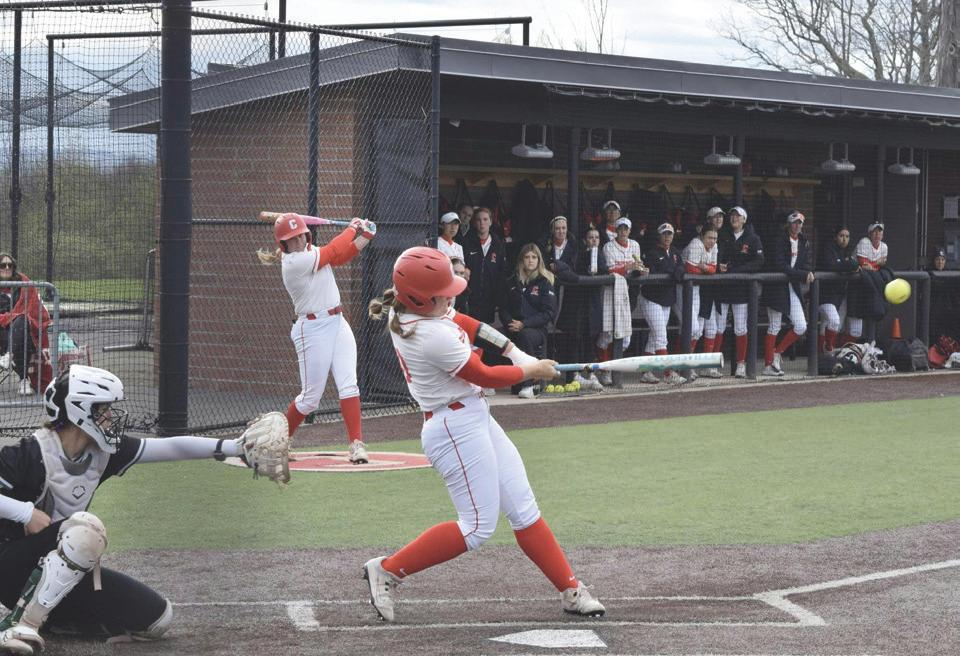
marks, falling twice in a three-game series versus Brown, the Red’s 21-22 end-of-season record is its best since 2013.
When it comes to bringing winning back into the culture of the program, Holt, Harrod and the rest of the Class of 2026 deserve a huge amount of credit.
“They single handedly elevated the standard of the program based on their actions,” said first-year head coach Tara Smith. “They took the program in one direction, and they basically said, ‘We’re going to carry people with us. You can come with us. Come with us as we climb this mountain.’”
And while that standard-lifting was spread amongst the five seniors who were honored on Sunday for senior day, on the field there’s one player who clearly has driven Cornell’s return to Ivy League prominence.
“When she stepped on the field, it was the highest level of competitive excellence that there was. She was there to compete. She was there to win. And that stood out.”
Head coach Tara Smith
“We all are here today because of the contributions she’s made,” Smith said.
When Lauren Holt came to the plate for the final time at Niemand-Robison Field on Monday afternoon, she put the finishing touch on one of the most successful softball careers in Cornell history.
With a two run lead in the bottom of the sixth inning, Holt knew this would be her last collegiate at bat. Entering the series with Brown tied for the Ivy League single-season home run record, Holt was held to just one hit (a single) in her first nine trips to the plate against the Bears.
But after taking a first pitch strike, Holt got a fastball up in the zone and out over the heart of the plate. As soon as the ball left her bat, there was no doubt where it would land. With her last swing as a member of the Red, Holt cemented her legacy as the author of the greatest individual season in the 46 year Ivy League softball history.
Holt finished the season leading the Ivy League in on base percentage, slugging percentage, runs batted in, runs, home runs, hits, walks and total bases, and tied for the lead in stolen bases. Her 1.015 SLG, 19 home runs and 137 total bases are all Ivy League single-season bests, while her 66 RBIs (second all-time),
.565 OBP (fourth), .474 batting average (fifth), 30 walks (eighth) and 48 runs (ninth) will also also live in on the conference’s record books.
Holt’s teammates celebrate after she hits a home run.
Holt’s career numbers don’t hold the same all-time Ivy dominance, but she still checks-in at second in Cornell program history — behind another Lauren, Lauren May ’05 — in most key offensive stats, including slugging percentage, on-base percentage and home runs, third in RBIs, fifth in total bases and sixth in stolen bases.
Her 48 home runs and .744 SLG trail only May in Ivy League history, while her career OBP, total bases and RBIs also finished in the top-10.
Most impressive of all, she’s done it as the clear vocal point of the Red’s offense all four of her years in Ithaca. While oftentimes getting intentionally walked, or pitched around, Holt has still managed to post historically great numbers while shattering the program’s walk record. Her 85 free-passes are the most in Cornell history, and are just four ball-fours off the all-time Ivy League record.
“She’s in everybody’s scouting report as ‘don’t let her beat you,’” Harrod said.
There are two ways to view Holt’s Cornell career. The first is as an individual.
“From the first time I saw her on the field, [I could tell] she was an absolute gamer,” Smith said. “When she stepped on the field, it was the highest level of competitive excellence that there was. She was there to compete. She was there to win. And that stood out.”
A native of Loveland, Ohio, Holt posted impressive numbers in high school, leading her conference in batting average her freshman season and earning a pair of second team all-district selections as an upperclassman. And though the pandemic disrupted the middle of her high school career, it also presented Holt the opportunity to work on a part of her game that would come to define her college career: her power at the plate.
“Once COVID happened, I started lifting a lot more because I had the time and didn’t really have anything else to do.” Holt said. “I think increasing my strength definitely helped with the power aspect of [my game].”
To continue reading this article, please visit www. cornellsun.com
Eli Fastiff can be reached at efastiff@cornellsun.com.
By MATTHEW LEONARD Sports Editor
The stage was set. It was 364 days since men’s lacrosse defeated Princeton to win the 2025 Ivy League Men’s Lacrosse Tournament. If the Red wanted to kick off its postseason campaign with the same magic as last year, it would need a mirror performance.
Unfortunately for the Red, this is not what occurred. The Tigers were seeking revenge and got exactly that, this time successfully taking down the Red by a score of 19-9 to become the champion. Throughout the course of the game, No. 2 Princeton (13-2, 5-1 Ivy) mounted

multiple offensive runs that became too significant for No. 6 Cornell (11-4, 5-1 Ivy) to overcome.
“[Princeton] executed at a really high level at all facets of the game today,” said head coach Connor Buczek ’15 MBA ’17. “Kudos to their goalie [and] their faceoff guy that really put some pressure on us. Once they started having some success there, we didn’t stop the bleeding.”
Schoellkopf was the venue of the championship for the second year in a row, once again providing Cornell with an immediate advantage over Princeton. However, it immediately became clear that the Tigers had learned a lot since the 2025 tournament.
The game began with the Tigers swarming the Red, scoring three unanswered goals to take a swift lead in the championship.
It almost seemed as if the Tigers caught Cornell off guard. Only a day prior, the Red had a dominant showing against No. 13 Harvard (9-5, 3-3 Ivy), facing little pressure throughout the course of the game.
While Princeton may have taken the Red by surprise, the Red demonstrated why it is the reigning NCAA champion.
Despite the pressure mounting from a growing Princeton lead, the Red responded with two goals of its own. Freshman attacker Rowyn Nurry kicked it off for the Red, scoring a quick goal past the Princeton defense. The large Red fanbase in the stands of Schoellkopf roared. It was clear the Red’s momentum was beginning to build.
As the first quarter was entering its final minutes, junior midfielder AJ Nikolic scored for the Red, cutting the Princeton lead down to a single goal.
The second quarter began mirroring the first. Princeton once again scored three unanswered goals, rebuilding a secure lead over the Red.
Junior attackman Willem Firth provided an answer for the Red, scoring his 50th goal of the season, setting the score at 6-3 in favor of Princeton.
While Princeton quickly responded with another goal of its own, the Red once again seemed to be building momentum.
Junior attackman Ryan Waldman scored the Red’s fourth goal, which was quickly followed by Nikolic’s second goal of the matchup. Despite the two goals, Princeton finished the first half holding a 7-5 lead over the Red.
The opening minutes of the third quarter can be described as the gritty lacrosse fans of the Red are used to. However, after Princeton scored its first goal of the half, something clicked for the Tigers. One goal became two, then three, then four, and the Tigers just kept scoring.
To continue reading this article, please visit www. cornellsun.com
By MAYA JOHANSEN Sun Contributor
May 5 — With final exams beginning on Saturday, students can look to a wide range of academic and wellness-related tools and resources offered by Cornell.
Resources range from online articles detailing effective study techniques, drop-in counseling and even animals who will listen to your presentation.
Learning Strategies Center
Many resources available to students during final exam season are provided by the Learning Strategies Center, which is “the central academic support unit for undergraduates at Cornell” according to their website.
The LSC’s resources range from tutoring, articles on effective individual and group study techniques, study plans, a customisable “Homestretch Calendar” and much more.
“For finals it’s really important to think about using [the Homestretch] Calendar for how you’re going to use the days,” said Amy Godert, the director of the LSC and executive director of academic student success programs. Students should “think about…building in time for the things that you also really need to do for your own personal wellbeing and balance.”
“The most important [factor] that students, when they’re really conscious of time, tend to put off is the sleep,” Godert added. “Everyone is a little different, but seven to eight hours is a good amount of sleep for people.”
In one article, the LSC emphasises the importance of strategies that require active engagement of the brain. “The more active the strategy is — when you’re actively recalling, actively writing, actively talking to somebody about something — it’s going to be more embedded and you’re going to remember it better,” Godert said.
One strategy which both Godert and the website promoted was “blank page testing.” This method “involves you thinking about whatever the topic
is, writing down everything you can think of and then looking back at your notes or the course materials and see[ing] what am I missing? What did I get wrong? What do I need to go back and review?” Godert said.
Another option for studying is to work in a group. To ensure a productive group studying session, students should “develop a plan and know what you’re going to do during the time that you’re working together,” Godert said. For example, she recommends “assigning a person to come up with an agenda, having someone be a time keeper during the meeting and then having someone just continue to ask questions.”
In addition to providing resources for effective study techniques, the LSC holds office hours and tutoring sessions for a variety of subjects. For example, popular courses including the general chemistry sequence and calculus have tutors available every day during both the study days as well as the exam week, offering a mix of drop-in and scheduled appointments for students.
“Our tutoring that we do is dropin group tutoring…you can learn a lot from hearing the questions,” said Godert. “That’s one of the hallmarks of the work we do.”
If you cannot make it to the office hours or tutoring sessions, the LSC also helps students find study partners for their classes.
“I would advocate that if people are thinking about what they want to do for the fall, they think about study partner matching,” Godert said. According to Godert, the matching is a process that usually occurs at the start of the semester.
“I used [LSC’s study partners] last semester, and it was really helpful for me, because I got paired with one of my friends now,” Santiago Alonso ’27 said. “It was nice to be paired with somebody to study for those classes with.”
“One of the really effective ways of studying is to explain things to other
people”, Godert said. However, if you do not have someone to present to, the LSC also has Presentation Support — aka “Practice Your Talk on a Dog.” Rosa, a Bernese Mountain Dog, is the LSC’s own public speaking tutor and will lend you an ear to soothe your presentation-induced nerves.
School-Specific Support
Individual schools and departments across Cornell also offer various tutoring programs for students involved in their subject.
The College of Engineering provides “two hours of free tutoring each week through the Tutors-on-Call program” to all Duffield Engineering undergraduate students, according to their website.
Additionally, the Cornell Math Support Center based in Malott Hall provides help for any student enrolled in an undergraduate mathematics course.
For Hotelies, The Nolan School of Hotel Administration Communication Center provides “free consulting for written and oral assignments,” according to their website.
When in need of soft skills, Cornell offers its current students, faculty and staff free access to over 11,000 online courses on LinkedIn Learning, which is an educational platform providing training videos for skills such as leadership, technology, interviewing, design, photography, etc.
The Knight Writing Center, which is free to all students, “provides support for individuals at any stage of the writing process.” The last day of the normal tutoring schedule is Tuesday and limited exam tutoring will be available from May 6 to 8 and May 11 to 13.
Outside of Cornell, Student Agencies Tutoring is a “student-run 501(c)(3) nonprofit organization completely managed by Cornell students,” according to their website. Some of their tutoring services include the Cornell Group Study and the Cornell
Course Tutoring.
Beyond academics, many programs also offer resources for health and wellbeing during the finals period. The LSC has a sensory room, described on their website as “a welcoming space for all students, especially those who identify as neurodivergent…to have a greater control over their level of sensory input.”
“It’s nice to have a place where you can step back, take a deep breath, close your mind and maybe focus on something else,” Godert said. “Making sure that you build that time into your day is important.”
“[Going] on walks or runs with friends, going to the gym and having alone time” are great ways to take a break from studying, said Makenna Devoy ’27.
“I think that finals can be a really fun time where you meet a lot of people you wouldn’t normally meet through the year,” Devoy said. “There’s no classes, so you just meet random people while you’re studying. I think it’s nice to enjoy meeting people, making connections and not making it all about studying.”
Additionally, Cornell Health provides Counseling and Psychological Services to help students “live well and learn well” at Cornell. CAPS offers drop-in consultations, workshops and individual and group counseling according to their website.
“Students need to believe in themselves and their abilities and their capacity to learn and grow when things don’t go well,” said Godert. “You’re not expected to know how to do all of the things in your classes. You are expected to ask questions and try to push yourself to learn things.”
Ultimately, “you can’t use someone else’s ruler to measure your own success. So you have to figure out what success means to you,” Godert emphasised.
Maya Johansen can be reached at mhj49@ cornell.edu.
By VAL KIM Sun Contributor
May 4 — Finals season is once again around the corner, and it’s time to start getting ready. Study techniques may help reduce the stress and maximize efficiency during this time. The Sun compiled some science-backed final exam study strategies and stories from around campus.
Mike Chen, senior lecturer at the Learning Strategies Center, has observed a few principles that he said were universally effective after working with students at Cornell for 30 years. Before anything else, a routine must be formed to prevent procrastination and poor time management. Then, the key is all in starting the study flow.
“Choose a unit of time such as 30 minutes and try to focus on a specific part that was confusing. If you end up not doing anything, shorten the unit of time and try to start the flow for studying,” Chen said. Chen’s recommended strategy is similar to the Pomodoro technique, a study strategy that separates a study period into shorter blocks of time with small breaks interspersed between each block. A comprehensive database analysis of randomized controlled trials comparing task performance between different study methods has shown that the Pomodoro technique lowered fatigue by up to 20% and improved concentration by up to 25%.
However, this is not always true. One
study conducted by researchers in the Netherlands found no overall differences in fatigue or motivation between students who were randomly assigned to use the Pomodoro technique in a two-hour study session and students who chose the timing of their breaks. Despite there being no overall differences between the conditions, they found that the Pomodoro technique led to a faster decrease in motivation. Therefore, students should try out different methods and use what fits their style the best.
Nicole Chen ’27 and Lydia Lee ’27 are teaching assistants for BIOMG 3300: “Principles of Biochemistry.” They both agree on the importance of planning ahead and crafting a balanced schedule.
“I get at least seven hours of sleep and make intentional time for socializing with my friends,” Lee said. “I didn’t have this clear plan or discipline before college. It was during freshman year when I developed discipline and strategy to study for a longer period of time.”
Lee’s plan of creating intentional social time aligns with the “brief mental break” method, where quick switches from the main goal — in this case, studying — make people better at their tasks. In one experiment supporting this theory, one group of participants had to memorize a few numbers, then spontaneously recall these numbers at points during a tedious 40-minute task. Another group simply had to complete the task.
The group that had to switch back and forth between the task and the memorization showed no decline in accuracy in the main 40-minute task, unlike the group that only did the task — providing support for the efficacy of brief switches in work. At Cornell, this strategy might look like a brief walk on the slope or a quick visit to one of the many cafes on campus after a study session.
In addition to how time is managed, study tools also make an impact.
“I try to block out my schedule prior to finals week and sleep early. I also Anki most materials because I feel more secure with repeated review and I have everything in the back of my mind,” Chen said.
Anki is a digital study program for making flashcards to improve memorization. Anki is an example of the study technique of spaced repetition. It allows for short and frequent review of material, which has been shown in science education to be more effective than fewer chunks of studying at long term retention and concept comprehension.
Over time, students discover the techniques that work best for them.
Navin Kasemtanakul ’28, who is majoring in human biology, health and society, emphasizes the importance of practice problems.
“When it comes to finals, I try to focus more on practice problems and past prelims,” Kasemtanakul said. “A lot of the prelim questions follow a very similar
style, so practicing with past exams helps me know exactly what to expect on test day.”
Solving practice questions is a form of active studying. An experiment in an advanced mathematics course found that the group that studied the learning material in an active, interactive way had a statistically significant higher score on exams than the group that studied passively. The active studying allowed more engagement and repetition for students, contributing to a higher retention rate of material.
Meanwhile, Alan Liang ’28, who studies biological sciences, believes in investing a longer time in each subject.
“Don’t be afraid to spend time to truly understand a topic because it makes the concept more robust and easier to remember in the long run,” Liang said. “I think this method is better than skimming through and then coming back multiple times.”
Ultimately, Chen believes that there is no definitive answer to which study strategy is the most successful, and that the true path to success is finding what one’s personal learning style is.
“I’ve seen students be successful in all kinds of ways. However, the important thing is to try out different methods and find the best way for you,” Chen said. “I’ve seen dramatic improvements in students after they changed the way they studied.”
Val Kim can be reached at vbk3@cornell.edu.
By KRYSTAL KYMN Lifestyle Staff Writer
If you haven’t already viewed the final exam schedule to see where you’re taking your finals, I suggest doing so soon — save yourself the surprise of finding out two days before your exam that you have to trek all the way past the Dairy Bar. After all, the experience of taking a final varies drastically from student to student, and location plays a big role in that difference. Most students would probably say that the ideal test-taking experience is comfortable and spacious, with plenty of room to write. Unfortunately, not every building on campus offers that.
Here are some of the best and worst places to take a final, ranked in tiers.
The Best Martha Van Rensselaer Hall:
You’re in luck if you’re scheduled to take a final here. The lecture halls have long rows of continuous tables, so you’ll be able to write comfortably even if someone else is sitting next to you. Additionally, the building is bright and well lit with an overall welcoming atmosphere. If you get to your final early, the ground atrium has a variety of comfortable seating areas for last-minute studying.
Warren Hall:
Although the main lecture hall, B25, is on the smaller side and has the ‘small desk problem’ that plagues many final exam locations on campus, the classrooms offer plenty of room to write if you’re scheduled to take your final there. Warren Hall is one of the more modern buildings, so I find that the temperature stays consistent without being too hot or cold. Overall, it’s a clean, bright building and one of the better locations to take a final.
Mid Statler Hall Auditorium:
The desks here are small, and the rows of seats are close together, which makes it hard to squeeze
past someone to get to a seat. It can also get quite cold. That being said, there’s nothing particularly terrible about this location, especially if you’re seated on the first floor. The auditorium itself is large and doesn’t feel too cramped. If you’re on the balcony, however, it can be incredibly hard to view how much time is remaining (which course staff usually project onto a screen). For those of you who need to check the time every five minutes, this can be frustrating.
Baker Laboratory:
If you live on North Campus, this is one of the more convenient locations to take a final. Though, Baker has many of the same issues as other buildings on this list. The desks are small, and some of the lecture halls feature a balcony, which again makes it more difficult for students seated there to keep track of time. However, the temperature generally remains at a comfortable level, and there aren’t any standout problems with this location.
Barton Hall:
After speaking to several students, I realized that this location is incredibly controversial. Of course, taking a final in Barton entails sitting across from a classmate on a long table as if you’re having an awkward dinner. Any sound will echo — meaning that a single cough (which often sets off a chain of coughs) can become quite the cacophony. Additionally, the digital clocks set on either side of the space (since there are no wall clocks) are hard to see if you’re sitting in certain spots. Although there are definitely downsides, Barton has some redeeming qualities. The location is spacious, and there’s more than enough elbow room at each table. Overall, it’s a decent location to take an exam.
To continue reading, please visit www.cornellsun.com.
Krystal Kymn can be reached at klk239@ cornell.edu.
Jan Burzlaf is an Opinion Columnist and a Postdoctoral Associate in the Program for Jewish Studies. Ofce Hours (Open Door Edition) is his weekly dispatch to the Cornell community — an associate's refections on teaching, learning and the small moments that make a campus feel human. Readers can submit thoughts and questions anonymously through the Tip Sheet here. He can also be reached at profburzlaf@cornellsun.com.
During finals, a particular kind of silence settles over campus. Thousands of students lean forward into the same posture: slightly tense, aware that something important is about to happen. From the outside, it looks like a moment of evaluation, with a clear beginning and an end. But sitting there, we all know that something more complicated is unfolding.
Final exams feel like judgment. They are designed that way: bounded in time, structured in format and weighted in consequence. For a few hours, everything narrows to a page and a set of questions that ask you to show what you know. Unsurprisingly, many students experience that moment as decisive. Having been there myself — not so long ago that I have forgotten how it feels — I want you to know: a final exam is not a verdict, but a snapshot in time. It captures your thinking under very specific conditions: under time pressure, on a particular day. To be sure, finals demand real skills — the ability to recall material quickly and to write with clarity in constrained circumstances. Done well, they can reveal discipline, preparation and, sometimes, genuine mastery.
But they do not capture everything that matters. Over the course of a semester, the strongest intellectual work I see rarely happens in a single sitting. It unfolds more slowly — in moments of hesitation and revision, in conversations that return to a problem from a different angle, in the willingness to risk an idea not yet fully formed and then rethink it. That kind of thinking — uncertain, iterative, developing over time — does not always translate cleanly into a timed exam.
At some point in my teaching here, I began to notice this gap more clearly. I realized that when
By JANE LOCKE Arts & Culture Staff Writer
Finals are never a happy time for students at Cornell University. Between cramming for impossible tests and rushing to finish end-of-year projects, we often forget that our studies have brought us much better things than pain. Especially in those courses where final papers are expected instead of multiple choice exams, we can be exposed to new ideas and wonderful language through books. These books, though required for class, can become all-time favorites. In order to shed some light during these dark times of endless studying, here are some of the best books your fellow Cornellians have found on their syllabi.
For Sanjana Vittal ’26, taking ENGL 3470: “The Victorian Novel” was an opportunity to further explore the classic novels she has always enjoyed. However, she quickly discovered Tess of the D’Ubervilles when it was assigned to her, though she “knew little about [it] before reading.” The novel, an 1891 English work by Thomas Hardy, surprised her with its relevance to today, what with its themes of gender inequality and the mistreatment of the lower class. According to Vittal, she “read it in just a few days because [she] was so interested in reading more.” Besides Tess of the D’Ubervilles, Vittal also read The Picture of Dorian Gray for ENGL 3470, which she said was a close second place.
However, Cornellians read books in more languages than just English. Margot Ehrsam ’28 read Le Misanthrope in its original language, French, for her class FREN 2310: “Introduction to French and Francophone Literature and Culture.” Le Misanthrope, translated in English as The
Misanthrope, is a comedy by Molière. For Ehrsam, the play “was a bit of a different format” from the traditional prose style she was used to, yet she still found it to be “fun to analyze.” In our courses at Cornell, we are continuously offered a chance to interact with materials that defy our typical expectations of what literature can be. Whether it be reading in another language or studying a different technique of writing, classes that assign books never fail to push our minds in directions we might not otherwise have considered.
Additionally, the analysis of texts is not limited to language courses. Allison Bray ’27 “was enveloped in the story” of Wayward Lives, Beautiful Experiments for her course HIST 4000: “Introduction to Historical Research.” Written by Saidiya Hartman, this nonfiction book takes a closer look at the lives of Black women in the early 20th century, specifically those at the center of social transformation. Bray found Hartman’s work to be “extremely narrative,” while also providing an “overall message [that] was very compelling.” Great books can even be found in classes outside of the humanities. Alina Lee ’29 recommended Electricity and Magnetism, written by Nobel laureate Edward Mills Purcell and updated by David J. Morin. Having read it for her class PHYS 2217: “Physics II: Electricity and Magnetism,” Lee found this textbook to “impressively [supplement] technical explanations with comical anecdotes.”
To continue reading, please visit www. cornellsun.com.
Jane Locke can be reached at jal562@ cornell.edu.
I designed a final exam, I was not simply assessing abstract knowledge; I was rewarding a very specific kind of intellectual performance: organized and produced on demand. That value is narrower than it appears at first glance. So I stopped assigning final exams in my courses. It was a shift in the question I wanted to ask. Instead of: What can you produce in a single, high-pressure moment? I became more interested in: How does your thinking develop over time? What happens when you have space to doubt and return?
In many courses, finals persist for good reason. They offer a kind of equality that is hard to otherwise replicate: everyone is in the same room answering the same questions. But this can also make a partial measure feel total. During your exams, it may feel as though everything is being decided at that moment. I want to reassure you that it is not. What is being measured is narrower than it feels:
goal when you sit for a final is to express yourself clearly. After all, the strongest exams are rarely the most brilliant. From where I sit, I am not looking for perfection but evidence that you engaged seriously and that you grappled with the material. Those traces are often visible even when the performance itself is uneven. That is why a final is not final.
So as you walk into those rooms, I want to offer a few simple thoughts to carry with you.
First, remember what the exam is — and what it is not. It is a snapshot, not a verdict.
Second, expect the conditions to be imperfect. If your thinking feels slower than usual, that is part of the environment you are being asked to think within.
Third, aim for clarity rather than brilliance. Write so that your reader can follow you. That matters more than trying to say everything at once. Finally, keep a sense of proportion. This