The Corne¬ Daily Sun


By SOFIA PRINCIPE Sun Staff Writer
With a timeslot of 9:20 p.m. on Wednesday, March 13, the last day of the General Room Selection process, Andrei Codreanu ’27 entered the housing portal to find no rooms available.
He was placed on a waitlist and currently awaits a housing assignment. He presumes that his ultimate placement will not be with the students he blocked with, which refers to a roommate cohort with a maximum of six students whose assigned ‘block leader’ is responsible for distributing beds to each student in their block during the online selection process.
“It made me feel disappointed, as I was looking forward to housing with the rest of my block,” Codreanu said. “I think the admin-
istration should at least let people know ahead of time that they don’t have enough housing, as I’m sure they knew this would happen.”
After rising juniors and seniors selected on-campus housing in September instead of in the spring for the first time, room availability was sparse for first-year students like Codreanu who participated in the General Room Selection process from Monday, March 11 to Wednesday, March 13.
First-year students told The Sun about undesired housing outcomes, including being separated from friends, living far away from Central Campus and being waitlisted.
Anja Minty ’27 hoped to live in a new dorm near Central Campus. However, with her 8:20 p.m. 20-minute housing time slot on March 13, she reluctantly chose a double room in Schuyler House,
while the three other students in her block chose 109 McGraw Place.
The rest of her friends will live in Ganedago Hall, a 40-minute walk from Schuyler House.
Minty said she anticipated limited room availability but did not imagine living on South Campus, which is primarily located in the Collegetown area.
“I thought there was going to be a lot more of an aspect of choice in all of this,” Minty said.
She was especially disappointed in her housing arrangements for next year because Schuyler House, which is Cornell’s southernmost dorm located near Ithaca Commons, is far from not only her classes and friends, but also general campus life.
“As a student, everything you want is on campus,” Minty said.
See HOUSING page 4
By MARISA CEFOLA
Peer reviewers identifying discrepancies in his data have accused Dr. Augustine M.K. Choi, a former Weill Cornell Medicine dean and current professor, of manipulating the results of research experiments on animals.
Now, People for the Ethical Treatment of Animals is calling for the federal government to ban him from performing future experiments on animals.
Since 2002, nine studies authored by Choi have been retracted, and one study was withdrawn from published research journals. PETA provided The Sun with a list of each retracted article.
Each journal retracted Choi’s work after finding duplicate images representing data from Choi’s previous experiments, spliced images or copied images from other publications. At least four other articles have been corrected due to inconsistent data, according to PETA.
Most of Choi’s allegedly manipulated research tested if exposure to carbon monoxide could reduce the impacts of sepsis — a life-threatening reaction to an infection — on lung functions. Choi used mice for these experiments, but PETA
is concerned that allegedly false mouse data may lead to trials on human participants that are not adequately justified, according to Katherine Roe, chief scientist in PETA’s Laboratory Investigations Department.
Medical professionals have also debated whether mice’s responses translate to those of humans in sepsis studies specifically, due to humans’ vastly different immune systems.
“That is probably why all of our attempts to find a treatment from humans based on mouse data have failed,” Roe said. “So [allegedly], [Choi’s] animals were put through cecal ligation, exposure to cigarette smoke, exposure to infectious diseases and death … for what?”
PETA believes Choi’s experiments on mice are not only ineffective but painful and traumatizing to the rodents involved, so the animal rights nonprofit is working toward preventing Choi from conducting further experiments.
PETA aims to ensure that potentially false data is not used as a foundation for human trials.
To continue reading this article, please visit www.cornellsun. com.
Marisa Cefola can be reached at mcefola@cornellsun.com.
By ANNINA BRADLEY Sun Staff Writer
Last Thursday, U.S. Poet Laureate Natasha Trethewey delivered a poetry reading in Goldwin Smith Hall, kick-starting the English Department’s Zalaznick Reading Series.
Trethewey, who won the 2007 Pulitzer Prize for her publication Native Guard, has authored five collections of poetry. On Thursday, she shared poems spanning her career including “Southern Gothic,” “Enlightenment” and a commission piece for the 100th anniversary of the Tulsa Race Massacre titled “Ground Truth.”
At the event, she began by reading “Miscegenation,” which delves into her identity as the daughter of an interracial couple in Mississippi in the 1960s, where
society was strictly segregated by race.
Across her work, Trethewey delves into questions of memory and pushes back against mainstream narratives.
“Growing up in the Deep South,” she said, “I became aware at an early age of those intersections and contingents between public history and collective memory and personal, family and community history.”
Between reading poems, Trethewey shared details about her own family’s history, situated in the greater political history of race relations in the United States. In her poem “Incident,” Trethewey questions whether the attack on the Mount Olive Baptist Church — which she and her family lived across from in the late 60s — was directed at the church itself or at its interracial community.
“At the time, the church was doing a
voter registration drive to get disenfranchised black citizens registered to vote,” Trethewey said. “Because of that we never knew if the act of terrorism was directed at the church or at us, the interracial family inside the house.”
Trethewey’s poem “Drapery Factory, Gulfport, Mississippi, 1956,” is similarly inspired by her familial history.
“Back in the 50s, my grandmother worked in a drapery factory,” Trethewey said. “And, after Emmett Till’s death, which many historians think of as the beginning to the modern Civil Rights movement, my grandmother and some of the women in the factory where she worked decided to stage their own kind of protest.”














By JULIA SENZON and DINA SHLUFMAN
Sun Managing Editor and Sun Assistant News Editor
A Muslim Cornell student was spat on while walking in Collegetown on Monday.
President Martha Pollack condemned the incident in an email sent to the Cornell community on Tuesday. The incident occurred during Ramadan, a month-long Muslim holiday characterized by reflection and prayer.
“I am horrified that someone would treat another member of our community in this manner. Hate has no place at Cornell.”
Martha Pollack
“I am horrified that someone would treat another member of our community in this manner. Hate has no place at Cornell,” Pollack said. “This would be painful anytime, but during Ramadan this must be particularly hurtful for our Muslim community.”
Because this incident occurred off campus, the investigation is being headed by the Ithaca Police Department, according to Pollack. However, the University will hold the perpetrator accountable for this “deplorable and unlawful behavior” if it is a member of the Cornell community.
Pollack emphasized Cornell’s zero tolerance for hate.
“We must be united and firm in
our rejection of Islamophobia and all other forms of hate, and we must all be diligent in our role in fostering a community of belonging, even in the most challenging of times,” Pollack said.
The condemnation of the off-campus incident follows Muslim students speaking out about the lack of an administrative response to previous instances of Islamophobia.
Several derogatory messages toward Muslim students were posted on Greekrank on Oct. 29, in addition to antisemitic threats. However, the University only addressed the antisemitic posts in an Oct. 29 press release.
Muslim students have previously expressed to The Sun concerns about online threats and intimidation on campus. The Cornell chapter of Students for Justice in Palestine received Instagram direct messages and comments calling them “baby killers” and “terrorists” and making threats of rape towards Muslims.
“As tensions on campus continue to rise, we call on the administration to safeguard all students equally,” an Oct. 29 statement from CML and other pro-Palestine and Muslim organizations read.
Members of the Cornell community may report threats to personal or community safety to CUPD by calling 607-255-1111 or 911 for emergency assistance. Instances of non-emergency bias can be reported through the bias incident form.
Julia Senzon and Dina Shlufman can be reached at jsenzon@ cornellsun.com and dshlufman@ cornellsun.com.
By BREANNA FERREIRA Sun Staff Writer
For the last several years, Ben Arinze grad has contended with an unknown illness — one that turned his life upside down. Though he has struggled to overcome the challenges he encountered, Arinze has shifted his focus to rebuilding his career and reprioritizing what he values most in life.
In January 2022, around the same time he received a finance industry job offer in Manhattan, Arinze began experiencing discomfort in his right leg and developed a limp. He had always been a relatively healthy individual, so these symptoms surprised him.
“Up until that point in my life, I had never been sick,” Arinze said. “I just always assumed that medicine was way more advanced than it was.”
However, two months later, when Arinze made the move to Manhattan in hopes of beginning his new job at a private equity investing company, his symptoms started to escalate. His limp quickly became debilitating, he had difficulty walking and using his hands to perform simple tasks such as typing and experienced memory loss and decreased cognitive abilities. Ultimately, his father had to travel to Manhattan to bring him back home due to these symptoms. After working at his new job for only a few weeks, Arinze took sick leave from work.
“[It was] very bad timing,” Arinze
said. “This was my first month on this new job — and it was my dream job to get to work in a private equity investing in New York City.”
The doctors who ran tests on Arinze did not find anything abnormal about his health. Arinze’s first electromyography, a test that measures the electrical activity of muscles, appeared to be normal.
His second EMG, conducted two months afterwards, showed only minor abnormalities. The doctor was not overly concerned with what was causing Arinze’s symptoms, but Arinze believed something was very wrong.
“He told me that a lot of [his] patients just commit suicide,” said Arinze. “That wasn’t a very encouraging thing to hear from a doctor.”
In July 2022, the doctors performed a third EMG, and Arinze learned that his symptoms were likely the result of Amyotrophic Lateral Sclerosis, more commonly known as Lou Gehrig’s disease.
“I woke up one day, and I had no idea where I was, who my girlfriend was, what was going on,” said Arinze. “I didn’t know anything.”
Dina Shlufman ’27 contributed reporting
To continue reading this article, please visit www.cornellsun.com.
“I honestly don’t know how they still call it on-campus housing because it is really not on campus — it’s basically in [Ithaca] Commons. It’s just a really incon-
venient distance, combined with the TCAT’s being a little unreliable.”
To make up for their arduous commute to campus, all Schuyler House residents receive a free bus pass, allowing students to choose between the 5-minute
ride to Central Campus or the 15to 20-minute uphill walk. Minty noted, however, that she has heard from current Schuyler residents that the TCAT is not always a dependable source of transportation.
Although Edgar Vilchez ’27 wanted a single room, he felt for-
tunate to select a double room in Morrison Hall. Even with an 8:30 p.m. time slot on the first day of room selection, Vilchez encountered a surprising lack of room availability.
“[My block] thought there would be more singles, but every-

thing was gone for the dorms we wanted,” Vilchez said. “I didn’t expect really anything to be gone on the first day, but I was one of the few lucky ones to get a dorm of my choice.”
For rising sophomores on the housing waitlist, Housing and Residential Life maintained in a statement to The Sun that “all rising sophomores who participated in General Room Selection are guaranteed on-campus housing for the 2024-25 academic year.”
“[We are] actively working with those students who were impacted by the temporary pause in the selection process to assign their accommodations,” the statement reads.
But Codreanu said he is anxious about his unclear housing situation for the next academic school year.
“It’s a little stressful, but I am trying not to worry about it too much because there is nothing I can do about it,” Codreanu said.
Minty shared a similar feeling of unease leading up to General Room Selection given her late time slot and awareness of the new upperclassmen on-campus selection timeline, explaining that the undertaking has been more stressful than her upcoming prelims.
Some students criticized the University’s decision to facilitate upperclassmen housing selection prior to letting rising sophomores choose housing.
To continue reading this article, please visit www.cornellsun.com
Sofa Principe can be reached at sprincipe@cornellsun.com

By LENA THAKOR Arts Staff Writer
I walked into Dune: Part Two with extremely high hopes. I envisioned a sequel with masterful cinematography, bubbling with conflicts and tensions and romance. Instead, I left feeling like Dune: Part Two hardly pushed the plot forward or dove deeper into characters.
This film, like the first movie, is very aesthetically appealing. Everything from the chalky coloration of Giedi Prime to the glowing blue eyes of the Fremen is artfully done. As an aesthetic film, I think Dune 2 does very well. It is not from this aspect of the film that my critiques arise. Yet, I cannot say Dune 2 amounts to the promise suggested in its visuals; in fact, I found that the film fell flat in many respects.
Firstly, I find fault with the film temporally. Some plot lines feel so rushed, leaving me wanting more; others feel exhaustive, yet somehow underdeveloped.
Dune: Part Two introduces us to many new characters, one being the Baron’s nephew, Feyd Rautha, played by Austin Butler. Everything from Rautha’s knife-licking to his grisly voice was compelling to me. Rautha had the potential to be a villain as iconic as Heath Ledger’s Joker, yet the viewer is only allowed a few glimpses of his storyline. Other than his propensity for killing slaves and slaughtering House Atreides footmen, little is known about the extent of his psychopathy. In fact, little is introduced about House Harkonnen and Giedi Prime throughout the entire movie. I didn’t learn

anything novel about the Baron—just the same old brutality and black oil baths. This is a broader trend within Dune: Part Two. Some plot lines feel so rushed, leaving me wanting more; others feel exhaustive, yet somehow underdeveloped.
For instance, who is Margot Fenring — The Bene Gesserit (played by Léa Seydoux) who comes to seduce Feyd Rautha? The viewer knows that she offers him the same mind test that the Reverend Mother offered Paul in the first movie and that Rautha gets her pregnant. Aside from this, the
viewer knows little else about this new character. It’s likely that her plot will come to life in the next movie, and perhaps the baby that she carries will become pertinent to the plot as well. An expansion of the test scene with Feyd and Margot could have given the viewer more insight into Rautha’s psyche. The brevity of Rautha’s plot line wouldn’t have been so frustrating to me if his story didn’t end in this movie. The viewer also meets Princess Irulan (Florence Pugh) in this movie, the daughter of the Imperial Emperor. We learn she is a talented Bene Gesserit — she possesses supernatural mental abilities like mind control — with a wardrobe full of intricate headdresses. Yet, Princess Irulan’s main purpose in the movie’s plot seems to be to set up the plot of the next movie. Little is garnered about her desires and intentions.
As for established characters, Lady Jessica’s transformation was given a very secondary part in this movie. The viewer knows that Lady Jessica (played by Rebecca Ferguson) drinks the “Water of Life” to solidify her transformation
to the Reverend Mother of the Fremen. Like in the first film, Rebecca Ferguson really shines in Dune 2. Her pale blue eyes are incredibly expressive, and in Dune 2 they harden to convey her metamorphosis. Lady Jessica becomes more prophetic and less maternal. She begins to see Paul less as her son, but more as the fulfillment of a prophecy. Her moments in the film spent babbling to her unborn daughter give the film an eeriness and absurdity.
Even when characters are foregrounded, however, the film fails to take full advantage. The characters given by far the most screen time are Paul (played by Timothée Chalamet) and Chani (played by Zendaya). This movie devotes a fair amount of time to developing the romance between these two characters. Despite this, I felt the romance between them fell flat. It felt abrupt, unnatural and without chemistry — which was unsatisfying as the viewer was teased by this union the whole of the original Dune. Despite all the foreshadowing of Chani, I felt like we didn’t get to learn much of anything about Chani in Dune 2 aside from her unfaltering loyalty to the Fremen and her general toughness.
Overall Dune 2 was entertaining and visually arresting, yet too much of the plot felt to be set up for the next installment. In the next movie, I would like to see more lingering on the plotlines and in various planets. I want to see characters that are as arresting as the movie’s visuals.
Lena Thakor is a Junior in the College of Arts and Sciences. She can be reached at lt476@cornell.edu.
By MAX FATTAL Associate Editor
I picked up a copy of Fear and Loathing in Las Vegas on Friday, 12 hours away from an essay deadline I desperately wanted to avoid and thinking about the book’s long-standing place on my must-read list because of the Criterion Collection’s announcement of the 4k release of the — allegedly — inferior adaptation. I convinced myself, in a further effort to stave off the inevitable essay writing and editing, that it’d help me as a journalist and an editor. I still cringe at my attribution as a journalist — put a gun to my head and maybe I’d invoke Marat as a hero — but I must admit it fits the job description. I now spend enough of my time laying out pages, emailing potential interviews or sources, and copy editing for Oxford commas to make the position undeniable. It’ll help with my journalism, I told myself; I’ve accidentally found myself as a student journalist, and I now need help with my journalism.
On Sunday I turned 21: that last fun birthday before they begin to blur together and race unfortunately and unexpectedly to the grisly end. I thought I noticed myself balding the week before, but convinced myself it was a torn-out
hair from stress over some unsent text message or unread email. I skipped the St. Patrick’s Day festivities on Saturday, telling myself that it wouldn’t feel special to drink legally for the first time if I’d done it the day before — silly since I’d already drank legally all last semester and perhaps less legally on other unspecified occasions. Instead, I migrated around campus, reading Fear and Loathing and auto-critiquing myself for my ironic relative sobriety; in the evening I watched the film, which was in fact inferior.
I read in some or other Letterboxd review for Godard’s Tout Va Bien that perhaps that revolutionary spirit of the 1960s felt farther away in 1972 (or 1971 for Thomson) than it does in 2024. With my limited historical and literary understanding, I know immediately that it’s true; I’ve had enough hangovers spent telling myself that I’d never drink again; the revolution is distant, but not as impossible as all that. And (at the risk of cribbing the genre of inopportune artistic comparison from another Sun contributor) I’m hungover myself. In the positive sense of the word, I felt older a year ago than I do now, even if I can’t fully convince myself that my hair hasn’t already begun receding — oh God I sound like Holden Caulfield. The whiplash of receding possibilities — the broken wave — can’t help but make itself
visible… one doesn’t even need ascend atop the peaks of Vegas or Ithaca. There’s something incredibly brainscratchy about Thomson’s prose. It’s what gives the book its reputation for activating the serotonin receptors of New Yorker-curious teens unwilling to do the drugs themselves, but it’s also simply true. There’s this exciting flitting between chronology and stream of consciousness, unreality and reflection, fear and loathing and euphoria. Whether there’s something more to the novel — some deeper meaning in that wave digression beyond the overwhelming hangover — remains slightly uncertain to me. Thomson allows me to be excited about his genre, feeling less icky than Capote with his surgical intrusion into a mourning community and less obnoxiously reactionary as Wolfe or even Didion. I can’t help but be attracted to the idea of a New Journalism: Having grown up after the recovery, there’s perhaps a fetishism in my obsession with the artifacts of our last national (failed) revolutionary moment.
I wonder if Hunter S. Thomson was the one who gave us all the idea that you’re more creative the less sober you are. Perhaps its true with LSD, but if you’re adhering to the law on your 21st birthday, nothing’s really gonna help you write. But I can’t help but find it beautiful — a
vestigial thought from my still infant aged mind — that premise of documentation. Document everything: the good, the bad, the exciting and boring. And don’t edit, Fear and Loathing was never supposed to be edited; Thomson ended up revising it and called it a failed experiment for that reason (according to Wikipedia at least). In a way that rings more true: some proclaimed pursuit of “true” authenticity without ever really having much interest in its implications.
So did the procrastination tactic “help with my journalism”? I don’t really know, did Thomson actually find the American Dream? It’s all a fun exercise, getting oneself more excited about the prospect of the job and more dubious about its value, even if it amounts to little more. I’ll be more careful to refrain from cutting the possible musings of a madman next time I edit. Or perhaps I’ll find myself growing more and more cynical about the whole endeavor. For now, I’ve picked up a copy of The Electric Kool-Aid Acid Test, which suggests subconscious plans either to pitch some very interesting opinion investigations or to do something else entirely. Only time will tell.
Max Fattal is a Junior in the School of Industrial Labor Relations. They can be reached at mfattal@cornellsun.com.
GABRIEL LEVIN ’26 Editor in Chief
MAX FATTAL ’25
Associate Editor
HENRY SCHECHTER ’26
Opinion Editor
MARIAN CABALLO ’26
Multimedia Editor
NINA DAVIS ’26
Photography Editor
ERIC HAN ’26
Arts & Culture Editor
SYDNEY LEVINTON ’27
Arts & Culture Editor
JADE DUBUCHE ’27
Social Media Editor
DANIELA ROJAS ’25
Dining Editor
ISABELLE JUNG ’26
Graphics Editor
JOLIN LI ’27
Layout Editor
PARIS CHAKRAVARTY ’27
Layout Editor
CYNTHIA TSENG ’27
Assistant Photography Editor
ALLISON HECHT ’26
Newsletter Editor
JULIA SENZON ’26
Managing Editor
ERIC REILLY ’25
Assistant Managing Editor
MARISA CEFOLA ’26
News Editor
MATTHEW KIVIAT ’27
News Editor
CHRISTINA MacCORKLE ’26
News Editor
KATE SANDERS ’27
News Editor
JANE McNALLY ’26
Sports Editor
GABRIEL MUÑOZ ’26
City Editor
KAITLIN CHUNG ’26
Science Editor
LAINE HAVENS ’25 Science Editor
ANUSHKA SHOREWALA ’26
Assistant News Editor
DINA SHLUFMAN ’27
Assistant News Editor
HAMNA WASEEM ’27
Assistant Sports Editor
As a fan at Lynah Rink on both Friday and Saturday nights, a special tribute should be extended to the Lynah Rink crew that did a fabulous job of clearing the ice of fish prior to the Harvard games. I’ve been watching Cornell men’s hockey since 1977, and this past weekend’s performance by the rink crew was completed before anyone noticed. Now, if we could fix the ice.
Another note about the weekend was the lack of maturity in the student section. Why our supposedly mature students think they have to use a vulgar Harvard cheer is beyond anyone’s imagination except that they haven’t reached maturity. That Harvard cheer does nothing to help the Big Red, but only upsets the more “mature” audience. It also gives Harvard a little more incentive to win the game and quiet the crowd.
Kudos to Coach Mike Schafer for his thoughts to the crowd that he expressed on the P.A. microphone between the second and third periods of Saturday night’s game. And I do have to thank the student body for taking the Coach’s remarks to heart. The Harvard cheer did not exist in the third period.
All and all, it was a fantastic night for Cornell men’s hockey. Thank you fans for a packed arena, and for most of your support.
— Dave Wohlhueter Former Cornell Sports Information Director (1977-1998)
Working on Today’s Sun
Reilly ’25 Associate Desker Henry Schechter ’26
Desker Eric Han ’27
Deskers Kate Sanders ’27
Shorewala ’27
Desker Jane McNally ’26
cience Desker Laine Havens ’25
Desker Cynthia Tseng ’27

Ilana Livshits is a first year student in the College of Arts & Sciences. Her fortnightly column Live Laugh Livshits focuses on politics, social issues and culture at Cornell. She can be reached at ilivshits@cornellsun.com.
This past International Women’s Day, it seemed we had forgotten Audre Lorde’s burning flame: “The master's tools will never dismantle the master's house.” In a prime portrayal of our failed intersectional feminist activism, despite Kimberlé Crenshaw’s ’81 definition of it and her lecture on campus earlier this semester, Cornellians had been polarized by the Israel-Hamas War and denied the dignity of reproductive freedom and livelihood to all women.
My Instagram feed — which is likely only a crude reflection of Cornell’s political climate — was filled with the Coalition for Mutual Liberation’s condemnation of Cornellians for Israel’s plans for rape theatre featuring volunteers imitating Hamas’ sexual violence against Israeli women in the Oct. 7 attack on Israel. CFI later rejected ties to a proposed Hamas sexual violence demonstration, despite a previous call for volunteers in their WhatsApp group, writing that they “have been exploring ways to honor and bear witness to the suffering of victims and survivors,” on their Instagram. Whether or not CFI was ever serious about holding the “rape theater” event, pro-Israel groups on and off campus have consistently demonstrated no moral qualms about morally reprehensible forms of activism and protest ranging from doxxing to similar proselytizing.
While I wholeheartedly condemn the (denied) proposal to CFI’s executive board of rape as a spectacle and the organization in and of itself, I further understand that there needs to be more support for the Israeli victims and survivors of rape. Acknowledging this in-between is difficult. An even more challenging distinction to maintain is that I value CFI’s tastefully restrained display of Israeli rape victims last week, but fully oppose the club and its pro-Israel agenda. Yet, I am committed to being a critic of Israel’s government and a voice against the genocide it is committing in Gaza while recognizing that the contention around Hamas’ use of sexual violence — explicitly the rape of Israeli women — is sickening. Opposing sexual violence against Israeli women is not the same as supporting a Zionist organization.
Rape has long been weaponized as a political act, such as in the 1994 genocide against the Tutsi in Rwanda, where approximately half a million women were raped by the Hutu militia to ethnically cleanse
the Tutsi minority, and in Serbian rape camps during the Bosnian War (1992-1995). In both cases, rape was a conscious decision by armed groups to torture, humiliate, instill fear and assert dominance and aggression through acts of brutality. This pattern establishes rape as the crudest form of oppression against women since they are made victims by men asserting power.
As a woman, it is impossible to dismiss such violence. The rape and subsequent murder of Israeli women is just as harrowing as the bombing of children in Gaza.
In more specific terms, rape is used both as a force of colonization and resistance. But rape is not resistance, ever. It is women bearing the brunt of war. J. M. Coetzee’s Disgrace relates this difficult dynamic of gender, race and sexual violence in the context of a bleak post-apartheid South Africa. In it, fictional David Lurie, a white South African English professor, rapes a student, Melanie Isaacs, who is suggested to be mixed race. His daughter Lucy, a post-hippie lesbian who lives on a farm, is gang-raped by three black men. Despite Lurie’s insistence that she press charges against her attackers, she refuses and offers the following explanation: “What if that is the price one has to pay for staying on? Perhaps that is how they look at it; perhaps that is how I should look at it too. They see me as owing something. They see themselves as debt collectors, tax collectors. Why should I be allowed to live here without paying? Perhaps that is what they tell themselves.” Lucy embraces her role as a representation of the shift in power dynamics in post-apartheid South Africa, viewing her attackers as agents seeking retribution for past injustices under apartheid. Her father, once a perpetrator of sexual violence becomes a victim in the aftermath of his daughter's assault. This is paralleled by the Oct. 7 Hamas attack on Israel, where women in kibbutzim and Nova music festival, were brutalized as retribution for Israel’s decades-long genocide of Palestinians. But how can we accept the evil, male-inflicted collective rape of Israeli women retribution? and condemn their rapists.
Continue reading at www.cornellsun.com.
by Patti Varol

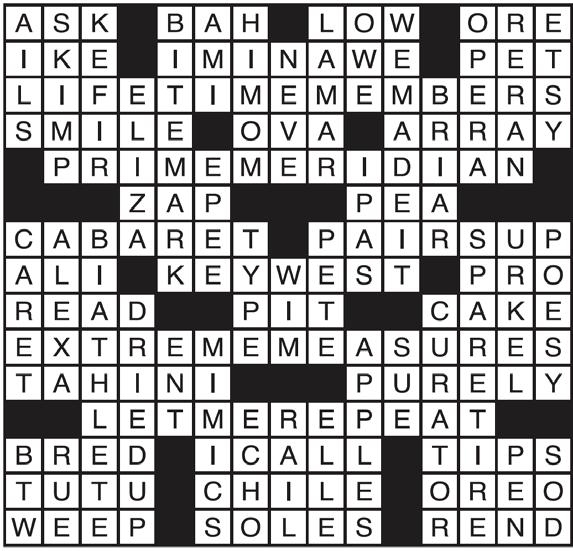
Fill in the empty cells, one number in each, so that each column, row, and region contains the numbers 1-9 exactly once. Each number in the solution therefore occurs only once in each of the three “directions,” hence the “single numbers” implied by the puzzle’s name. (Rules from wikipedia.org/wiki/ Sudoku)


By TAYLOR RIJOS Sun Contributor
Researchers at Weill Cornell Medicine and Cornell University are collaborating on a Social Engaging Restorative Virtual Environment project, which investigates virtual reality technology as a tool to address loneliness and social isolation among older adults. The fiveyear project began on Sept. 1 and is projected to end on May 31, 2028.
In the U.S., one-quarter of adults aged 65 and older are socially isolated, and over one-third of adults aged 45 and older report feelings of loneliness. Loneliness and social isolation have health consequences among older adults, including increased risk of dementia, depression, anxiety and mortality.
SERVE plans to address this loneliness epidemic based on the researchers’ previous findings that older adults responded positively to social interactions in VR. Through pilot studies, the researchers demonstrated that VR-based approaches may promote social connection.
“It’s not the case that older adults are technophobic,” said co-collaborator Prof. Walter Boot, geriatrics and palliative medicine. “For anyone to accept a piece of technology, they have to see perceived usefulness and perceived usability of that technology. Once you provide that to older adults, then there’s very high acceptance and enjoyment of these technologies.”
The SERVE project will study the

prolonged effects of social engagement through VR on older adults with mild cognitive impairment. MCI is an early stage of memory and cognitive decline that occurs when an individual’s cognition is worse than expected for a person’s age but does not severely impair functional abilities.
“We target MCI because we see it as an important point of intervention,” Boot said. “These are people who are at risk for further cognitive decline. We can [intervene] at the point where we think there’s still lots of plasticity and … maybe prevent worse cognitive decline.”
Due to changes in cognition,
older adults with MCI may be at greater risk of social isolation.
To address the heightened risk, the researchers are planning a VR intervention study. According to project leader Prof. Saleh Kalantari, human centered design, the immersive nature of VR provides a unique context for studying human behavior.
The researchers hypothesize that spatial presence in social interactions will increase meaningful engagement and connection between participants and volunteers.
To compare social interactions that lack spatial presence with VR interactions, the researchers will
conduct an initial 20-week clinical intervention. During the intervention, researchers will randomly assign participants and volunteers to the intervention or control group. In the control group, the participant and volunteer will interact with each other over Zoom, while in the intervention group, the participant and volunteer will interact with each other via VR technology.
Participants in the intervention group will do VR activities together such as seeing cities, completing wayfinding tasks in different settings and designing gardens. The proposed activities and spatial presence in the VR intervention group may enhance social and cognitive engagement. Therefore, among participants with MCI, the intervention may improve quality of life, decrease loneliness and improve cognition, according to Kalantari.
The researchers also plan to assess home-based methods for the study to evaluate the accessibility and scalability of VR intervention methods in the real world.
“There are challenges once you move into people’s homes beyond the laboratory environment that we’re all going to have to figure out as we’re moving forward,” Boot said. “These [home-based VR intervention methods] are things that we’re really excited about, but there’s a lot of work to be done.”
Taylor Rijos can be reached at tlr65@cornell.edu.
By MARISSA GAUT Sun Contributor
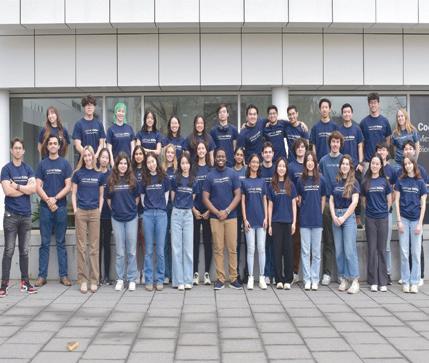
On Sunday night, the Cornell International Genetically Engineered Machine team decided on a project to compete in the 2024 iGEM Grand Jamboree. The Grand Jamboree is an annual competition in Paris hosted by the iGEM Foundation, a non-profit committed to the advancement of synthetic biology. With its sights set on another award-winning biology project, Cornell iGEM will return to the competition this fall alongside more than 300 iGEM teams from across the world.
Cornell iGEM, one of 34 project teams supported by the College of Engineering, is a group of around 40 active members dedicated to synthetic biology. Members span a variety of class years and fields of study. Each year, iGEM comes up with a new project that uses genetic engineering to develop solutions to real-world problems.
The team’s 2024 project, Oncurex, aims to improve the production of ursolic acid, a natural material with anti-cancer properties. According to Team Lead Michael Constant, the typical process to extract ursolic acid from loquat trees is environmentally taxing. To combat this issue, Cornell iGEM aims to sustainably bioengineer the compound for large-scale production.
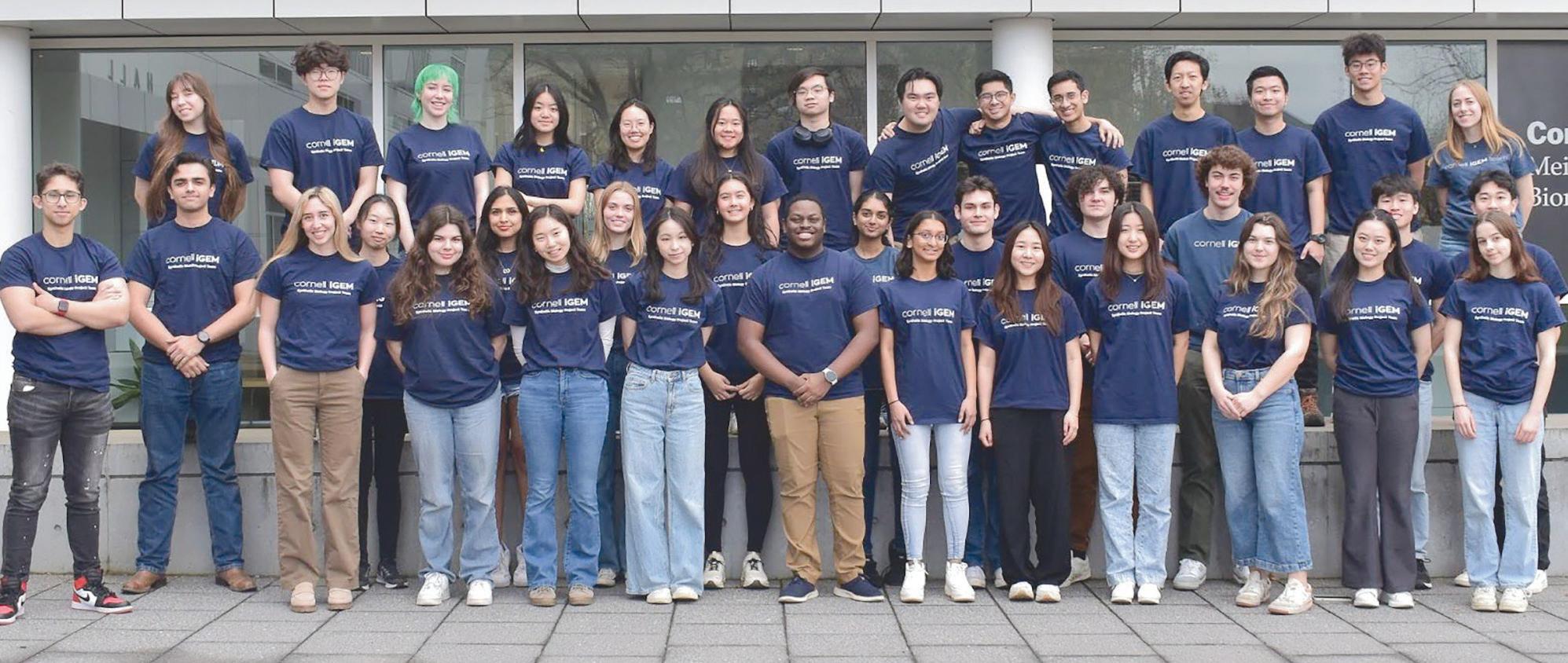
Cornell iGEM is no stranger to gold medals, having earned 10 in the past 13 years. The team’s most recent medal was one of 191 golds awarded last year. The team owes its success to each member’s passion and dedication, according to Wet Lab Co-lead Isaac Chang ’25.
“It’s a group of individuals who really want to see this project succeed, and everyone is willing to put in the work and effort. We have a great camaraderie,” Chang said.
Cornell iGEM is composed of five sub-teams — wet lab, product development, policy and practices, business and wiki — each with a unique skill set and contribution to the project. For example, the wet lab crafts biological components, while wiki designs a website to make
Cornell iGEM’s work accessible to the public.
Each spring semester, Cornell iGEM begins the design process with an eight-week brainstorming period. Constant described it as a long and detailed endeavor.
“It’s like a March Madness-style bracket,” Constant said. “Each team member creates their own project and then we narrow it down to two or three proposals.”
Once the team decides on what project to pursue, the research period begins. The bulk of product design begins in late spring and lasts throughout the summer. Many team members stay on campus during the summer, putting in about 15-20 hours of work each week. The product design period is busy but reward-
ing, according to Chang.
“Our team went into the lab together, checked in with leads and asked for help when needed,” Chang said. “But it was very independent — we knew that each of us was playing a vital role in how the project was going to be shaped.”
After the summer design period, the team uses the fall semester to tend to the small details. In October, the team finalizes the project for competition. Cornell iGEM typically sends around six members to Paris, including team leads and a few select members.
For Cornell iGEM, the legacy of gold medals and the obstacles faced during the design process go hand-inhand. According to Chang, the bioengineering technique that the team
used in its 2023 gold-medal-winning project — ENERGEM — did not work during the early development stage.
“We weren’t entirely sure why [our methodology was not working], and that’s how science sometimes works,” Chang said. “This made us adjust to focusing more on the modeling aspect of the project, which definitely helped us earn that gold medal.”
By the end of that summer, Cornell iGEM successfully used software to model the breakdown of caffeine into 7-methylxanthine — an expensive chemical often used to treat near-sightedness. The team earned a gold medal at the Grand Jamboree for its model to produce 7-methylxanthine from coffee in a relatively cheap and environmentally friendly way, according to Constant.
For both Constant and Chang, it’s the tight-knit community of driven students working for each other — not the prizes — that makes iGEM so special.
“[The students on the team] support you in any way they can, and being in that community has really allowed me to be comfortable in my ideas and let my creativity flow,” Constant said. “Being in iGEM, we grow together.”
Marissa Gaut can be reached at mlg323@cornell.edu.