The Corne¬ Daily Sun


By AVERY WANG
March 17 — A Cornell professor and two graduate students are suing the federal government, claiming that the enforcement of two of the Trump administration’s national security-related executive orders violates their First and Fifth Amendment rights.
Two of the plaintiffs — Momodou Taal, a Ph.D. candidate in Africana studies, and Sriram Parasurama, a Ph.D. student in plant sciences — are prominent pro-Palestinian protesters on campus. The third plaintiff is Prof. Mukoma Wa Ngugi literatures in English, who is affiliated with the Africana Studies and Research Center.
“Only in a dictatorship can the leader jail and banish political opponents for criticizing his administration.”
Momodou Taal, Ph.D
The three now “fear government retaliation” for engaging in “constitutionally protected expression critical of U.S. foreign policy and supportive of Palestinian human rights,” according to the lawsuit.
Along with the plaintiff’s co-counsel, the American-Arab AntiDiscrimination Committee filed a formal complaint on their behalf to the U.S. District Court for the Northern District of New York on Saturday.
Mahmoud Khalil, a pro-Palestinian demonstration leader and recent
Columbia master’s graduate, was arrested by officials from the U.S. Department of Homeland Security on March 8, despite being a lawful U.S. resident on a green card. His arrest represents the first carried out under the Trump administration in connection to college protest activity, with the president warning it is the “first arrest of many.”
The complaint alleges that the two executive orders, which target protecting Americans from foreign nationals and combating antisemitism, are unconstitutional since their enforcement has created a “chilling effect” on their right to free speech.
The complaint also alleges that both executive orders are unconstitutionally vague and the “severe” threat of deportation or criminal prosecution “based on vague, subjective, and overbroad standards that grant unfettered discretion to government officials” raises due process concerns under the Fifth Amendment.
“Because each executive order fails to provide sufficient notice of the type of speech barred, it denies Plaintiffs’ due process right to conform their speech to the orders,” the lawsuit states.
The plaintiffs have motioned for a national injunction to temporarily halt the government’s enforcement of parts of the two executive orders while their constitutionality is examined.
“Only in a dictatorship can the leader jail and banish political opponents for criticizing his administration. A nationwide injunction is therefore necessary while the Court considers the merits,” Taal stated in a press release.
‘An Amorphous and Subjective Standard’: Jan. 20 Executive Order
On Jan. 20, President Donald Trump announced an executive order titled Protecting the United States From Foreign Terrorist and Other National Security and Public Safety Threats. The order recommends the government take “any actions necessary to protect the American people from the actions of foreign nationals who have undermined or seek to undermine the fundamental constitutional rights of the American people.”
“[The Jan. 20 executive order] imposes an amorphous and subjective standard for what constitutes a ‘hostile attitude’ toward U.S. ‘government.’”
The Lawsuit
The plaintiffs claim that the government’s standards are too “vague,” allowing government officials to enforce severe penalties, such as deportation or criminal prosecution.
“[The Jan. 20 executive order] imposes an amorphous and subjective standard for what constitutes a ‘hostile attitude’ toward U.S. ‘government,’ ‘institutions,’ ‘culture,’ or ‘founding principles,’ depriving Plaintiffs of fair notice and sweeping up substantial amounts of protected speech,” the lawsuit states.
To continue reading this article, please visit www.cornellsun.com.
Avery Wang can be reached at awang@cornellsun.com.


March 17 — Cornell has cut out several mentions of race; references to diversity, equity and inclusion and resources for filing discrimination complaints from its Equal Education and Employment Opportunity Statement. The revision follows the U.S. Department of Education intensifying its scrutiny of race-conscious policies.
In a letter sent on Feb. 14, the ED directed federally funded academic institutions to eliminate racial preferences in admissions, hiring and programming within two weeks.
An EEO statement is a formal declaration of an organization’s commitment to equal employment opportunity, outlining protections under federal law and explaining how employees and applicants can file a complaint if they believe they have experienced discrimination. An EEO tagline is typically a concise statement conveying the core values expressed in the EEO statement to be used in job postings and company materials.
While the previous statement explicitly referenced discrimination on the basis of race, gender, sexual orientation, disability and 14 other legally protected statutes, the University’s revised EEO statement as of March 17 only refers to the support for individuals with disabilities and veterans.
Since May 2005, Cornell’s previous EEO statement underscored the University’s commitment to diversity and inclusion, stating, “Cornell University’s history of diversity and inclusion encourages all students, faculty, and staff to support a diverse and inclusive university in which to work, study, teach, research, and serve.”
The previous statement additionally directed employees to University resources addressing bias, discrimination and misconduct through the Office of Institutional Equity and Title IX.
The revised statement now reads: “Cornell University is an Equal Opportunity Employer and Educator supporting individuals with disabilities and veterans. Learn more at hr.cornell.edu/EEO.”
While the revised EEO tagline includes several of the omitted categories from the EEO statement, such as race and gender, both the new tagline and statement lack resources for applicants and employees to file discrimination complaints, such as contact information for the Office of
Institutional Equity and Title IX or details on accommodations for disabled students and employees. A reference to being an affirmative action employer was removed from the statement and information about “recognizing a lawful preference in employment practices for Native Americans living on or near Indian reservations” was taken out of the tagline.
When asked by The Sun why the University removed explicit references to DEI initiatives and discrimination resources from the EEO statement, Cornell Media Relations did not offer comment by time of publication.
According to the webpage, the updated language is pending review and approval by the Board of Trustees. The trustees will convene in Ithaca on March 20 and March 21. In recent job postings, Cornell has utilized its revised EEO tagline.
On Feb. 14, Craig Trainor, the ED’s acting assistant secretary for civil rights, ordered federally funded institutions, including Cornell, to eliminate racial preferences in admissions, hiring and programming, or risk investigation and loss of funding.
Trainor cited the 2023 Supreme Court case Students for Fair Admissions v. Harvard, which ruled affirmative action admissions programs unconstitutional. However, Trainor extended the case’s scope in the Feb. 14 letter to include “hiring, promotion, compensation, financial aid, scholarships, prizes, administrative support, discipline, housing, graduation ceremonies, and all other aspects of student, academic, and campus life.”
The ED released a “Frequently Asked Questions” document on Feb. 28, clarifying that not all diversity programs are banned, as long as all initiatives remain open to all students. The ED emphasized case-by-case assessments rather than blanket prohibitions of diversity initiatives in educational programs, signaling a more flexible interpretation of Title VI. Cornell has cut out several mentions of race; references to diversity, equity and inclusion and resources for filing discrimination complaints from its Equal Education and Employment Opportunity Statement. The revision follows the U.S. Department of Education intensifying its scrutiny of race-conscious policies.


Mindful Yoga for Neurodivergent People
11:30 a.m. - 12:30 p.m., Anabel Taylor Hall Founders’ Room
Applied Physics Graduate Society Coffee Hour
1 p.m. - 2 p.m., 243 Clark Hall
From Lab to Launch - The Journey of a Food Science Entrepreneur
5 p.m. - 6 p.m., 146 Stocking Hall Pepsico Auditorium
Cornell MFA in Creative Visual Arts Spring 2025 Open Studios
5 p.m. - 8 p.m., The Foundry, 940 University Avenue
Come Juggle with Juggling Club
6 p.m. - 8 p.m., Physical Sciences Building Atrium
Perfect Match-a with Cornell Asian Pacific Student Union 6:30 p.m. - 8 p.m., 414 Willard Straight Hall International Lounge
Divine Dialogues: Breaking the Patriarchy with the Office of Spirituality and MeaningMaking
7 p.m. - 8:30 p.m., 130 Anabel Taylor Hall Alternatives Library
Silent Disco with Student Neurodiversity Alliance at Cornell 8:30 p.m. - 10 p.m., Toni Morrison Multipurpose Room
Cornell Film Club Screening: “La Dolce Vita” (1960) 7:30 p.m. - 9:30 p.m., B21 Schwartz Performing Arts Center
Tomorrow
Econometrics and Public Economics Workshop with Pauline Leung
11:40 a.m. - 12:55 p.m., 165 Statler Hall
The History of 4-H Clothing Clubs in New York State: A Preamble to Sustainable Fashion Education?
4 p.m. - 5 p.m., 160 Mann Library
Flower Garland Social with Women Leaders of Color
5 p.m. - 6 p.m., 135 Emerson Hall
Queer Activism Through Art with Lavender
5 p.m. - 6 p.m., 103 Rockefeller Hall
Free ZUMBA 6:30 p.m. - 7:15 p.m., B16 Helen Newman Hall
“La Notte” Cornell Film Club Screening
7:30 p.m. - 9:30 p.m., B21
Schwartz Performing Arts Center
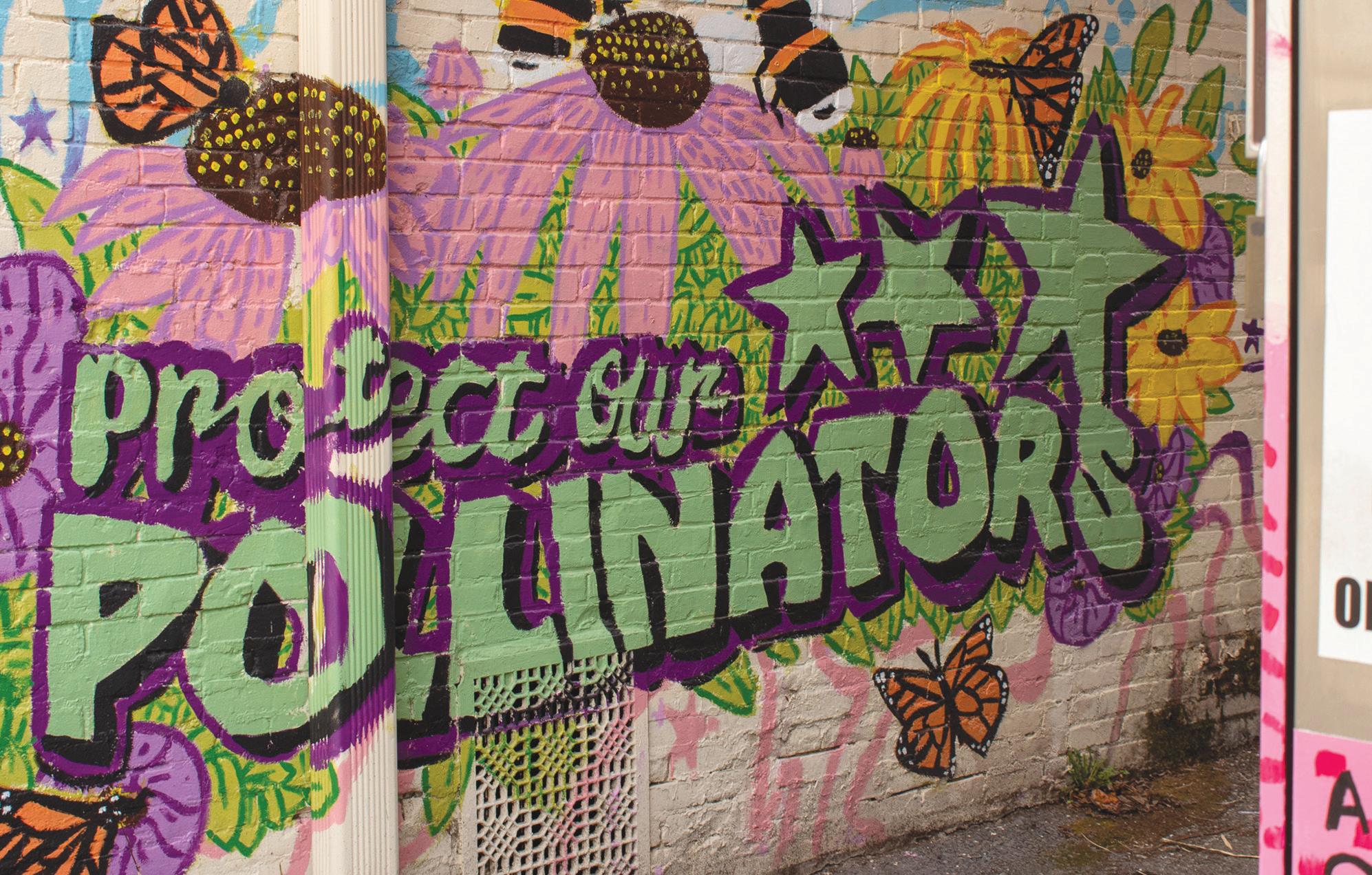
Campus came alive this week with warmer temperatures, Cornell Hockey wins and one of the biggest celebrations of the year
By SUN PHOTOGRAPHY DEPARTMENT




A new University surveillance system and recent political and fnancial challenges were subject to debate
By MICHAEL FERREIRA Sun Contributor
March 13 — Several members of the Faculty Senate raised concerns about the University’s plans to update and expand its video surveillance system across the Cornell campus at a meeting on Thursday. Interim President Michael Kotlikoff also addressed a range of issues concerning the University’s financial and political challenges at the meeting.
David Honan, associate vice president of public safety, explained in a presentation to the Faculty Senate that the changes to the policy are intended to enhance campus security. Faculty senators voiced concerns about potential privacy violations and its impact on campus free speech.
“The use of physical security systems is important in maintaining adequate controls and ensuring the safety of the University,” Honan said. “These measures are designed to support the safe and continuous operation of the University, ensuring an open, safe, and welcoming campus while minimizing risks.”
Prof. Grant Farred, Africana studies, said his lack of trust in those who have control over the surveillance system, particularly for its potential impact on marginalized groups on campus.
“As a Black man, I don’t trust you,” Farred said. “I can’t afford to trust you, because my life depends upon it.”
Farred elaborated on his distrust, expressing concern for vulnerable students on campus who may be disproportionately affected by increased surveillance.
“I have students in my department who are on the run because of the surveillance the Cornell police have been involved in,” he said. “So when I tell you I don’t want any changes that will exclude the public and increase surveillance, I don’t know if I can do anything about it. The best I can do is register my deep suspicion about how you operate.”
Farred also raised questions about the potential for the surveillance system to infringe on First Amendment rights that protect freedom of speech.
“Are you the arbiter of crossing the threshold from First Amendment speech into criminal activity?” Farred asked.
In response, Honan explained that the University is not the “arbiter” of speech — state law is. “It’s not a judgment of what the speech is or its content. If you violate what is written in New York State law or University policy, then we intervene. If you believe that officers have acted inappropriately, I would love to hear about it and work you into our process to handle complaints,” Honan said.
William Katt, a faculty member from the college of veterinary medicine, also raised concerns about accountability and oversight regarding the surveillance system, posing a question about how the University plans to ensure video and card access data security.
Honan responded, assuring the senate that Cornell’s access control system is strictly monitored.
“We purge people out of the system who don’t use [the system] regularly or don’t acknowledge our training and privacy expectations,” Honan said. “If any suspicious
By CEREESE QUSBA Sun News Editor
March 14 — The Student Assembly unanimously passed Resolution 18, adopting a new Code of Ethics for the Office of Ethics at a Thursday meeting. The new code formally outlines the responsibilities of the office, particularly with its complaint hearing process.
The Code of Ethics is the governing document for the Office of Ethics — which is the assembly’s impartial and external executive office created to handle ethical concerns. The new resolution replaces the office’s original Code of Ethics, which was written in May 2022 when the office was founded.
In the wake of the presidential succession crisis and internal misconduct allegations that caused uncertainty about the office’s responsibilities, Resolution 18 was first introduced by members of the Office of Ethics on Jan. 23 to strengthen accountability and clarify its functions.
Prior to final passage, the assembly voted on three amendments to the new code to modify its components which include an ethical conduct modification, a 180-day submission timeline and a five-day notification requirement.
Student Assembly President Zora deRham ’27 proposed an amendment to modify the ethical conduct section. deRham’s motion suggested adding a section under the ethical conduct of the director of the Office of Ethics stating, “In accordance with the rules set forth for the Office of Ethics as defined in this document, exercise impartiality and refrain from speaking on the merits of a resolution outside the scope of the office.”
During Resolution 18’s second reading on March 6, deRham noted that a section of the proposed code was removed which stated that the office should remain impartial in assembly activities. The omitted code explained that members of the Office of Ethics would not be able show their approval or disapproval of assembly resolutions. No dissents were made and the amendment was approved. deRham proposed another amendment addressing the code’s creation of a statute of limitations for when ethical violations may be filed. At the resolution’s second reading, the proposed code stated that ethical concerns or controversial violations may be filed by a Cornell community member “within a year following the term the alleged ethical violation occurred in.”
To continue reading, please visit www.cornellsun.com
Cereese Qusba can be reached at cqusba@cornellsun.com.
activity is detected, we revoke access until we have resolved the issue. We’ve acted on questionable access before, and we will continue to do so.”
Prof. Noah Tamarkin, anthropology and science & technology studies, raised a hypothetical scenario to further explore the potential risks of surveillance.
“In the event, for example, that laws in the U.S. dictated that all protest activity is criminal activity, would we be in a position to protect ourselves as a university community?” Tamarkin asked. “If the activity that we understand to be lawful is suddenly deemed unlawful, and we’re asked to hand over video
surveillance, what would that scenario look like?”
Honan responded, assuring the Senate that current policies protect First Amendment rights. “As of right now, First Amendment speech is protected, and we don’t use these systems unless there’s a violation of New York State law.”
To continue reading, please visit www. cornellsun.com.


By SHUBHA GAUTAM Sun Staff Writer
March 18 — Anisa Kurbanali manages a bustling coffee shop in the heart of Philadelphia. Each day, she wakes up at 4:30 a.m., commutes 45 minutes to the cafe and works from 7 a.m. to 2 p.m.
Kurbanali, while working fulltime, is also a junior at Saxbys Community College of Philadelphia studying Secondary Education.
Her cafe job is just another part of her studies — she earns a semester’s worth of academic credit without having to take any additional classes as a Student Cafe Executive Officer, governing all day-to-day operations of her own Saxbys cafe location. Kurbanali’s time as a SCEO will last for six months before the next student takes on the role.
Founder of Saxbys and former entrepreneur-in-residence at the Nolan School of Hotel Administration, Nick Bayer ’00, described Saxbys as “an education company disguised as a coffee company.” What started as a small Philadelphia coffee chain eventually transformed into a collection of 30 cafes across nine states — 26 of them completely run by college students.
In 2012, Bayer was asked to teach entrepreneurship at Cornell as an entrepreneur-in-residence. During his time teaching at Cornell, he noticed that “higher-[education] was really looking for experiential learning,” and on April 13, 2015, Saxbys launched its Experiential Learning Platform with
an inaugural cafe at Drexel University. “[Saxbys was] really the first business of its kind … in which students design and exclusively operate their own campus business, receive academic credit, [are] paid wages and have full profit and loss authority,” Bayer said.
As a first-generation college student who wished he had more opportunities for experiential learning in college, Bayer explained, “This is my way of giving back, in a small way, to the next generation.”
According to Bayer, Saxbys’ educational learning program provides hands-on business experience to college students through cafes that are completely run by student employees. Everything from drink-making and inventory checks to interior design is handled by students.
Bayer said that, on average, former SCEOs get their first leadership position out of college within one year of graduation.
Melody Wozunk, head of area operations of Saxbys cafes in New York and New Jersey and a former SCEO of Saxbys Rowan University, said her experience as an SCEO shaped her work ethic, drive and workplace confidence, and inspired her to join the company headquarters after graduating.
To continue reading, please visit www.cornellsun.com.
Shubha Gautam can be reached at sg2563@cornellsun.com.

By GISELLE REDMOND
Sun Staff Writer
March 14 — Local clinical social worker and Cornell SC Johnson College of Business alum G.P. Zurenda ’88 has announced his candidacy for the Fifth Ward Common Council Seat.
Zurenda’s platform is based on addressing the tax imbalance in Ithaca and increasing affordable housing.
Zurenda felt compelled to launch his campaign due to the skyrocketing tax rates in Ithaca, and the ways that they have been harming locals.
“Tax increases have really been significant enough that if they don’t stop, we’re going to have to move, and I don’t want to,” Zurenda said. Feeling the urgency of this issue, Zurenda wants to help bring costs down himself.
These tax increases have contributed to city-wide housing affordability issues, according to Zurenda. He hopes to fix this issue by making amendments to zoning and to “stop giving tax abatements to large developers, many of whom are from out of town and [establishing] tax abatements for people that own the current housing stock.”
Tax abatements are tax reductions that, for a set period of time, allow people to pay a decreased property tax. These abatements are typically used to encourage people and businesses to buy property in an area.
Zurenda also suggested that Cornell was not paying enough to Ithaca, and that this was contributing to the insufficient tax revenue that the city was generating.
“I think that that issue needs to be looked at so that basically, everybody pays a fair share, and so the students that are voting in the city of Ithaca are contributing to the tax base of the city of Ithaca,” Zurenda said.
At the same time, Zurenda acknowledged that there are challenges in the current political climate that would make it difficult for Cornell to account for this at the moment.
“With what’s going on in Washington … the situation for Cornell has really been placed in a situation of extreme uncertainty in the last couple of months,” Zurenda said. “So, I don’t think it’s time to be beating Cornell up over these issues.”
He was also concerned about how the role of the operational lead of Ithaca has shifted from the Mayor to the city manager, stating that we have not “successfully transitioned,” which has contributed to tax increases.
“Last year, they reported that they were doing a zero increase budget, but our tax bills went up anywhere between eight and like 17 percent because of costs that were contractual,” Zurdenda said. As a member of the Common Council, Zurenda believes he would be given the opportunity to better advise the city manager on how to keep costs down.
Zurenda expressed that he wants Ithaca’s neighborhoods to remain vibrant, and that the city’s middle class should be protected rather than threatened by “taxes [that] have been going up dramatically.”
“I think we need a vibrant middle class for Ithaca to remain the Ithaca that we like,” Zurenda said.
The candidate also voiced his support for Ithaca’s Green New Deal, a bill that aims to electrify buildings in Ithaca, the more environmentally friendly option to fossil fuels. The city said they would leverage different private capital, aggregated building portfolios and government incentives to reduce building electrification costs. However, according to Zurenda, there is a current lack of incentive for homeowners to convert to sustainable energy in a rental-based housing market.
“[Ithaca’s Green New Deal] doesn’t work because it doesn’t pay people that own homes to upgrade,” Zurenda said. “There’s no economic incentive for the landlord to convert because it’s the tenant that’s paying the bills.”
Zurenda suggested that tax abatements could be implemented in order to encourage both landlords and homeowners to make the switch.
Zurenda grew up in Elmira, and has loved Ithaca since high school, when he would make frequent trips. His connection to the city was solidified when he attended Cornell for his Master’s of Business Administration and decided he wanted to live in Ithaca permanently.
For the past 20 years, Zurenda has been a full-time social worker in Ithaca. Zurenda also works as a psychotherapist,
life coach and a small business consultant — providing him skills which he believes would aid him in office.
“I have a lot of history with making the tough decisions [to make] an organization successful,” Zurenda said. “I have a lot of experience dealing with people and problems, so I think that fits in really well with trying to run the city.”
Also running for the Fifth Ward Common Council seat is a sophomore in the School of Industrial and Labor Relations, Hannah Shvets ’27. Shvets is an Ithaca native who has based her campaign around workers’ and tenants’ rights.
A third candidate for the Fifth Ward seat is Deborah Fisher, a martial arts instructor running on a platform concerned with housing affordability and responding to federal actions that have been affecting Ithaca residents.
Zurenda is running to get involved in the finances of the city, and keep costs low for Ithacans.
“I’ve been following how things have been going in city government, and I’ve had some thoughts that I might be helpful to be able to control costs without cutting programs,” Zurenda said. “So I figured I’d take a shot.”
143rd Editorial Board
JULIA SENZON ’26
Editor in Chief
ERIC HAN ’26
Associate Editor
SOPHIA DASSER ’28
Opinion Editor
ILANA LIVSHITS ’27
Assistant Opinion Editor
AUDREY IM ’26
Business Manager
SOPHIA TORRES ’26
Marketing Manager
SYDNEY LEVINTON ’27
Arts & Culture Editor
JAMES PALM ’27
Assistant Arts & Culture Editor
JENNA LEDLEY ’27
Assistant Arts & Culture Editor
MELISSA MOON ’28
Assistant Arts & Culture Editor
SOPHIA ROMANOV IMBER ’28
Assistant Arts & Culture Editor
KAITLYN BELL ’28
Lifestyle Editor
MAIA MEHRING ’27
Lifestyle Editor
KARLIE MCGANN ’27
Photography Editor
MATTHEW KORNICZKY ’28
Assistant Photography Editor
STEPHAN MENASCHE ’28
Assistant Photography Editor
MIRELLA BERKOWITZ ’27
Multimedia Editor
HANNIA AREVALO ’27
Graphics Editor
JADE DUBUCHE ’27
Social Media Editor
HUNTER PETMECKY ’28
Layout Editor
RENA GEULA ’28
Layout Editor
The Sun’s View
DOROTHY FRANCE-MILLER ’27
Managing Editor
MATTHEW KIVIAT ’27
Assistant Managing Editor
VERA SUN ’27
Advertising Manager
ALEX LIEW ’27
Human Resources Manager
BENJAMIN LEYNSE ’27 News Editor
VARSHA BHARGAVA ’27 News Editor
ISABELLA HANSON ’27 News Editor
CEREESE QUSBA ’27 News Editor
REEM NASRALLAH ’28
Assistant News Editor
ANGELINA TANG ’28
Assistant News Editor
KATE TURK ’27
Assistant News Editor
GABRIEL MUÑOZ ’26
City Editor
JANE HAVILAND ’28 Features Editor
JEREMIAH JUNG ’28
Assistant News Editor
KAITLIN CHUNG ’26
Science Editor
MARISSA GAUT ’27
Science Editor
ALEXIS ROGERS ’28
Sports Editor
ZEINAB FARAJ ’28
Assistant Sports Editor
DYLAN GRAFF ’28
Assistant Sports Editor
SIMRAN LABORE ’27
Weather Editor
ALLISON HECHT ’26
Newsletter Editor
Te Sun will always stand for free expression. As an independent newspaper, we understand that neutral judgment requires an inflexible commitment to uninhibited discourse. We are weary that the University has complied with partisan demands that undermine its own freedom of expression: the quiet retraction of institutional statements on gender-affirming care and diversity, equity and inclusion principles. In the face of an egregious threat to its institutional values, the administration must hold the line against government overreach.
Federal agencies under President Donald Trump’s leadership announced last week that they would withhold $400 million in federal funding from Columbia University, citing its failure to address antisemitism on its campus. Te Department of Education later confirmed that 60 universities were under investigation for the same transgression — our school was on that list.
Trump’s message is clear: suppress opposition. In May, the Columbia administration sanctioned hundreds of arrests at the pro-Palestinian occupation of Hamilton Hall. Last month, it expelled student protestors for the first time in over 50 years. Columbia employed its most punitive measures in an effort to mitigate antisemitism — even this could not win Trump’s approval.
Te federal agenda is not to thwart bigotry, but to coerce educational institutions to align with executive priorities. Trump is concerned with the relative notoriety of an anti-fascist movement on Columbia’s campus. In effect, his federal government established a disturbing precedent that incentivizes universities to prevent oppositional protest movements from gaining public attention.
Te University finds itself in a crucial moment to reassess its surrender to Trumpian politics. On Tuesday, Interim President Michael Kotlikoff announced the formation of a task force to “examine critical questions concerning how and when Cornell should speak institutionally on matters of politics, ideology, current affairs, and world events.” If the task force is to uphold Kotlikoff’s August statement on institutional neutrality, it must ratify an exception for speaking out on political issues that “directly impact the university.” Te University must exercise that exception to defend its students’ freedoms.
In 2022, the University criticized the overrule of Roe v. Wade. In 2023, it criticized the ruling against affirmative action in college admissions. In these cases, prior to its official position on neutrality, the University spoke to reinstate its institutional values and resist the pressures that sought to undermine them. It must find its voice again now that neutrality itself is at stake.
As the loudest champion of “any person … any study,” the University must establish the standard for what any institution committed to equity must do by condemning Trump’s flagrant weaponization of the Department of Education. It must refuse to comply with the Trump administration’s censorship and make a public commitment to protect its students’ constitutional rights when federal law enforcement comes to violate them.
Tere is no such thing as neutrality under government coercion. If the administration wants to keep its silence, it must first know its voice.
With hope,
Rhona Burns is a postdoctoral associate at Cornell University’s Jewish Studies Program. She is Israeli. rb949@cornell.edu.
Some Cornellians may have noticed the two empty strollers standing at Ho Plaza with posters in the final days of February, with orange balloons and an Israeli flag. This display was in memory of the Bibas family, an Israeli mother and her infant and baby boys, who were killed while in the custody of their Palestinian captors who abducted them from their home on Oct. 7, 2023, as part of the devastating Hamas attack on Israel. Their bodies have been recently released as part of a ceasefire agreement that included the release of 33 hostages (most of them alive) kept by Hamas and other Islamist organizations in Gaza in exchange for hundreds of Palestinian prisoners and detainees (including individuals who were convicted of murder and terrorist attacks).
The day and week of their release was one of the most difficult days faced by Israelis and the Jewish community worldwide since the war began. The image of mother Shiri Bibas, holding her two redheaded children surrounded by militants while trying to protect them, became one of this ongoing tragedy’s most terrible symbols. They were taken alive and were returned in coffins. The empty strollers, candles and balloons — organized by Cornellians for Israel, or CFI — were a testimony to the significance and impact of this symbol. Some Cornellians have personal connections to these stories, and it’s moments like the week of the Bibas family’s “release” that are especially painful.
The Bibas family’s story is only one of many. Entire families were butchered in their homes, or on their way to or from a family outing. I urge you to look up the names of the Kedem family, the Kutz family and the Kapitscher family. All of them were families with infants and children, who were erased in one moment. Dozens of Israeli children were murdered, sometimes literally slaughtered, by Hamas or other Palestinian militants on Oct. 7 and in captivity. Many more children and babies were orphaned. More than 250 people — Jews, Muslims, Israelis, Thais, Americans and many others of all ages — dead and alive (most of them civilians) were abducted from Israel, and taken to Gaza on October 7th. There are still 59 hostages held by Hamas. More than 20 are believed to be alive, including one living American hostage, Edan Alexander, along with other Americans who are already dead, used as pawns in a sick game of power and fanaticism. All this does not in any way diminish the pain and anguish of Palestinians in light of the ongoing war and its horrors in Gaza, but rather offers some more information on a topic that seems to be not well enough recognized in our community. What lingers heaviest on most Israelis and many Jews today — including here at Cornell, are not the lives lost, but the lives that can still be saved: the people who are still held hostage in Gaza. That is why every week since the beginning of the crisis there has been a recurring event under the title “Run for Their Lives,” a running group, organized by members of the
From the Editor
Jewish and Israeli communities in Ithaca, that operates in all weather and that advocates the immediate release of the hostages. For whatever one believes, whether you consider yourself “pro-Palestine” or “pro-Israel,” it is difficult to argue with the observation that what had started this war was the murderous attack and abduction of the hostages and that the immediate return of all the hostages is also what can end it, and what could have ended it all along.
One of the Israelis who was released from Hamas captivity as part of the recent ceasefire deal is Eli Sharabi, 53. His story and unique message have turned him into a role model for many, and are worth conveying to the Cornell community.
Sharabi is a man who lost everything on Oct. 7, 2023. When he was released from Hamas captivity, he found out that his wife Lianne and two daughters — Yahel and Noiya — were all killed in the Hamas attack on their home and village community. The terrorists who invaded their house killed the dog in front of the entire family before kidnapping the family’s father. Just before his release, his sadistic captors lied to him and told him that he was about to meet his wife and girls.
But Eli Sharabi is not looking for revenge. Soon after his release, he asked to be interviewed. When asked why he decided to face the cameras with such urgency, he responded without hesitation: “We must not leave anyone behind. … There is a boy there … and he entered my heart. I promised I would not leave him there, that I will fight for him.” The “boy” is Alon Ohel, a 24-year-old young civilian man (he was 23 when taken to Gaza), a talented musician and a pianist, who was abducted to Gaza from the Nova music festival. He is currently wounded, and — according to eyewitnesses — shackled, held in a tunnel underground and in general bad shape.
For Sharabi, the most urgent cause was not to tell the story of his murdered family, his girls and his wife. He fights now for one living hostage, who as he described it, he “adopted” when they were held together. Sharabi survived a lynching attack by a Gazan mob, torture, starvation, assaults by his captors and more. But still, Sharabi doesn’t seek revenge. He seeks to bring back the precious lives that are still held in captivity.
According to an ancient Jewish tradition, saving one life is equivalent to saving an entire world, a saying that Sharabi repeats in his interview, a saying that is at the basis of “Run for Their Lives” and similar initiatives worldwide (of which there are many). The remaining hostages in Gaza are begging our attention. They are begging the world, and I am begging the world with them — for mercy, for compassion and for their immediate release.
Te Coalition for Mutual Liberation posted on Wednesday about a discrepancy between the online and print headlines of the article about the disruptions to the Pathways to Peace panel.
We recognize that we are covering sensitive matters that require both timeliness and scrutiny. Te print headline “17 Responsible For Disruption of Israel-Palestine Panel” was written in reference to a University statement released on Tuesday that stated that “Cornell University Police identified 17 people responsible” for this disruption. Te Sun’s editors apologize that the print headline incorrectly stated that protesters were responsible, rather than that the protesters were only identified by CUPD at the point of publication. We recognize that the number does not necessarily reflect the true amount of demonstrators responsible for the disruption, considering that cases had not yet been adjudicated by the time of publication. For full transparency, Te Sun typically utilizes different headlines for the print and web versions of articles, especially due to formatting constraints. Our print issue is submitted the day before it is distributed on campus. We apologize for the mistake in the print headline and strive to maintain credibility in all future coverage.
Please do not hesitate to reach out with any questions or concerns at editor-in-chief@ cornellsun.com.
Jan Burzlaff
Jan Burzlaff
In her recent op-ed, Opinion Columnist
Julia Poggi describes the frustration of looking around a room and seeing “a wall of silent, disengaged students.” It is a striking image — one that resonates with many who have experienced a classroom where participation feels more like an obligation than a dynamic exchange of ideas. Poggi argues that this reluctance stems from exhaustion, performance anxiety and an unspoken fear of being perceived as a “try-hard.” In her view, participation has become either performative or absent altogether, with discussions dominated by a handful of voices while others disengage behind laptop screens.
Poggi identifies real challenges, and the fact that many students share her experience must be taken seriously. However, I would like to offer a perspective from the other side of the classroom — one that might help students better understand how participation looks from a professor’s point of view. Silence does not always mean disengagement and I have not encountered the quiet classrooms she describes. This semester, for example, I teach The Past and Future of Holocaust Survivor Testimonies, a hands-on course that explores evolving forms of Holocaust survivor testimony, combining historical analysis with AI methods. Students work collaboratively on these largely untouched archives, examining how testimony and memory have been recorded, interpreted and reshaped across different historical and cultural contexts. Last week, I struggled to keep up with all the hands raised as we analyzed relationships and encounters between 1939 and 1945. I have thus found participation to be a dynamic process rather than a simple function of student motivation, social anxiety or digital distractions. Participation flourishes when students are given open-ended inquiry, collaborative interpretation and structured opportunities to connect. That process, however, does not happen automatically. Below are two ideas that can help foster meaningful engagement in the classroom.
First and foremost, one of the most effective ways to encourage participation — at least in the humanities — is to ask open-ended questions that do not seek a single “right” answer. A rigid, instructor-led model can discourage engagement, whereas a dynamic, adaptive approach draws students in. Discussions thrive when students feel their contributions actively shape the conversation rather than merely affirm what is already known. Last week, for example, we examined human behaviors in video testimonies. Instead of asking students to categorize responses as simply “hostile” or “sympathetic,” we explored how tone, pauses and omissions shaped our understanding of others’ behavior. This reframing led to a rich, layered discussion in a class attended by students from disciplines as varied as information science, economics, psychology, government, history and sociology. Because the questions had no predetermined answer, students recognized that their interpretations mattered — not only within their own field but in dialogue with others. The result was an energetic exchange that transcended disciplinary silos.
This same approach works in traditionally rigid settings as well. When I was a guest lecturer for Antisemitism in the Courts and in Jurisprudence at the Law School earlier this semester, students — once encouraged — did not hesitate to debate complex legal and historical questions. The notion that some
disciplines are inherently more silent than others often overlooks the role of classroom structure in shaping discussion. Rather than accepting silence as inevitable, instructors can thus create low-stakes opportunities for engagement — such as short reflective writing exercises, peer discussions before full-class debates, or inviting students to submit questions anonymously. In my experience, these small adjustments make participation feel less intimidating.
Therefore, equally important is fostering a collaborative atmosphere where participation feels like a shared effort rather than a performance — something Poggi rightly emphasizes. However, in my experience, Cornell is better positioned than other Ivy League institutions in this regard. At Harvard University, where I taught until last year, I saw this hesitation in full force. One day, I brought a cake to class, and nobody touched it — until a student confessed a week later that they didn’t want to be the first. This reluctance exemplifies the dynamic of classroom participation: Often, students hesitate not because they lack thoughts to share, but because they are waiting for someone else to break the silence. At Cornell, I have observed a greater ease in classroom exchanges, where students are more willing to take that first step.
To students, I would emphasize that this reluctance is completely normal. In my courses, it typically takes two to three weeks for discussion to flow naturally. One major reason is that, at our large university where isolation is common, students often do not know their classmates when a course begins. Speaking up in a room full of strangers can feel daunting. Similarly, the fear of speaking up often stems from a growing culture of competition. When students view participation as a performance — where their contributions ought to be flawless or impressive — many will opt for silence rather than risk being judged. To counter this, I have made structured group discussions a staple of my courses, allowing students to first build confidence in smaller settings before transitioning to full-class discussions. This fosters a sense of community, making participation feel less like a competition and more like a shared intellectual process.
Ultimately, participation is not just about getting students to speak more; it is about creating an environment where they feel encouraged and equipped to contribute. I teach students from across the university, including engineering, business and the agricultural college. In my courses, I make a point to emphasize that there are no stupid questions, only stupid answers — because engagement often begins in unexpected ways, opening up new avenues of discussion and revealing gaps in our assumptions. By reinforcing that all contributions have value, I encourage students to see participation not as a test of knowledge, but as a mutual process of exploration and discovery. To be sure, taking classes outside one’s comfort zone is both brave and exciting. We should take silence as an opportunity — to open up the questions, to get to know each other and to ensure that everyone, when ready, has the space to speak. The next time you hesitate to raise your hand, remember that participation is not about performing — it is about making the classroom a space where your voice, and those of your peers, truly matter.
Te following letter was signed by members of the Cornell faculty. You can find the list of signatories below. For questions addressed to a particular faculty member, please reach out to associate-editor@cornellsun.com.
We are a group of Cornell’s faculty members who support graduate student workers’ right of collective bargaining, but also want to share our unique perspective to the Cornell community about what has been presented and what’s at stake in these negotiations.
We understand the University made a comprehensive contract offer on March 11 with a two-week deadline of acceptance. To best consider whether Cornell’s graduate student workers should accept this offer, it’s instructive to look to the University of Chicago.
Graduate student workers there are represented by the United Electrical, Radio and Machine Workers of America (U.E.), the same parent union that represents Cornell’s graduate student workers. In the Chicago negotiations last year, that union fought publicly for an annual stipend of $45,000, calling it a “fight for dignified wages.” In fact, the Chicago union claimed victory when it achieved that result at the bargaining table.
Earlier this week, Cornell offered its 3,000 graduate student workers in Ithaca and Cornell Tech a contract proposal with a stipend even larger than the agreement the Chicago UE union achieved. With this offer, Ithaca students would earn a minimum first-year stipend of $47,367 that increases to $48,538 in the second year — more than their counterparts receive in a major metropolitan city.
Graduate students at Cornell Tech would be paid even more, with minimum stipends of $58,805 and $60,257 respectively.
These highly competitive financial terms are just one element of Cornell’s recent offer. We believe that once graduate students understand these fair terms, they will urge their union bargaining committee to negotiate in good faith and ultimately approve a deal — instead of striking, which could harm students’ progress and financial stability, as well as negatively impacting the Cornell community.
We were graduate students once, and now we are faculty who advise graduate student workers who are central to Cornell’s mission. We are writing because we greatly value their research and teaching contributions.
We also write because we know Cornell supports workers’ rights to bargain collectively — as reflected in the university’s numerous long-standing, productive relationships with labor unions throughout the campus, and based on the terms of the university’s recent offer, which we believe demonstrates Cornell’s commitment to graduate student workers’ success at a time of unprecedented financial uncertainty due to the changing federal landscape.
We urge all Cornellians to review the offer and learn more at the graduate student worker unionization website and on social media, where the university is providing daily updates to inform the community about this offer.
Beyond generous stipends, the proposal includes platinum health insurance, free TCAT passes, funds which can be used for dental and vision coverage and 12 days paid annual vacation.
Time is of the essence for the parties to reach a deal, so that all graduate student workers — including those graduating this May — receive a $750 ratification payment. Cornell has also offered a $750 matriculation payment for first time students to receive beginning this fall. These flexible funds
can be used for moving expenses, visa applications, family care, travel, technology needs and more. These bonus payments respect graduate student workers’ individual priorities and give them control of their money.
Choice signals respect. That’s why the Cornell offer counters the union’s insistence for a “union shop” — which would mandate all graduate student workers join the union and pay dues or risk losing their assistantships and be forced to leave Cornell. The union shop requirement violates Cornell’s core value of academic freedom, since it makes a Cornell education contingent on paying dues to a union which may engage in political activity that graduate students do not condone. Indeed, we turn again to the University of Chicago, where the Graduate Students United is being sued by a nonprofit. That case argues that forcing students to pay fees to an organization violates students’ First Amendment rights. Cornell has offered a novel proposal that preserves graduate students’ rights while ensuring payments are made for union representation. Graduate students would have three choices: (i) pay dues and join the union; (ii) pay an agency fee to cover the cost of representation without formally joining the union; or (iii) donate an equivalent sum to the United Way of Tompkins County, which offers nearly 50 local agencies for donor choice. This charitable option, successfully implemented at Caltech, empowers graduate students to commit their money to causes that align with their values and contribute to their community while still benefiting from union representation. A fair collective bargaining agreement benefits graduate student workers and the university. Graduate student workers are a fundamental part of Cornell’s intellectual life and campus community. Please read and discuss Cornell’s comprehensive offer.
Signed,
Kerik Cox, Associate Professor of PlantIntegrative Science
Brian Crane, Professor of Chemistry and Chemical Biology
Julie Goddard, Professor of Food Science
Tara Holm, Professor of Mathematics
Tristan Lambert, Professor of Chemistry
Sturt Manning, Distinguished Professor of Arts and Sciences in Classics
Bill Miller, Professor of Horticulture
Carmen Moraru, Professor of Food Science
Thomas Overton, Professor of Dairy Nutrition and Management
Olga Padilla-Zakour, Professor of Food Science
Joseph Peters, Professor of Microbiology
Karl Pillemer, Professor of Psychology and Professor of Gerontology
Marvin Pritts, Professor of Horticulture and Global Development
Gavin Sacks, Professor of Food Science
Seth Sanders, Professor of Economics
David Sherwyn, Professor of Hospitality Human Resources
Julia Thom-Levy, Professor of Physics
By AMANI AGRAWAL Sun Contributor
Cornell University is undergoing a major transition in its heating infrastructure, converting the current steam heating system to a more efficient hot water network as a part of its 2035 goal of carbon neutrality.
The conversion to hot water heating is one of six actions by the University to reach net zero emissions by 2035. Other actions include implementing Earth source heat, improving the efficiency of campus buildings, solar and hydropower projects and developing carbon sinks — such as unmowed grass.
The shift to hot water, which is already underway, aims to increase efficiency, reduce carbon emissions and enhance safety for maintenance staff.
Cornell’s current system consists of 13.4 miles of steam line that can reach up to 450 degrees, delivering heat to campus buildings. However, according to Cole Tucker, director of utilities distribution & energy management, this system experiences a 25 percent distribution loss — meaning that a quarter of the head produced is lost in the process of distributing it throughout campus. By switching to hot water, Cornell aims to significantly improve its energy efficiency.
“Once the full system is converted to hot water, we expect those losses to reduce to 5 percent,” Tucker said.
The new system will operate at a much lower temperature by utilizing hot water in place of steam, reducing thermal losses and improving insulation. According to Tucker, this transition is essential for integrating electric-based heating solutions, such as heat pumps and earth-source heat, which require a water-based distribution system.
As Cornell hopes to integrate elec-

tric-based heating production equipment by 2035, Tucker claims that this switch is a crucial step in achieving that goal.
“The steam to hot water conversion is a core enabling step in Cornell’s decarbonization work,” Tucker said. “All the preferred electric-based heating production equipment — earth source heat, ground source heat pumps, air source heat pumps [and] thermal storage — require a waterbased distribution medium.”
In addition to improving efficiency, the transition also offers significant financial benefits for the University. With the current cost of steam heating distribution sitting at $1 million annually, the $270k hot water heating cost is a 73 percent overall cost reduction.
Implementing this transition across the 740 acres of Cornell campus is not without its challenges. Tucker said that the active campus — with buildings that require heat year-round and “cannot take sustained downtimes” — poses an issue.
According to Tucker, the University is looking at a 10-year timeline, expecting the hot water system to be fully implemented with a new electrified heating source by 2035.
Tucker noted that several areas on campus have already switched to hot water, including the new North Campus Residential Expansion facilities, the North Campus High Rises and Low Rises, the newer West Campus dorm facilities, buildings along Sciences Drive, portions of East Campus, the new Atkinson Hall facility and the new CIS facility.
Though the switch from steam to hot water is beginning gradually, Sarah Carson, the Director of the Campus Sustainability Office, noted in an email to The Sun that this initiative is part of a broader agenda.
“An exciting and important aspect of approaching campus decarbonization through the district energy system is that all of the buildings connected to it, not
just our new buildings, are included in the transition,” Carson said.
However, some environmental advocates are pushing for a faster transition.
Bethany Ojalehto Mays ’08, a former assistant professor and current organizer for Cornell On Fire, a climate justice organization, emphasized the project’s benefit, calling the conversion “very much needed and beneficial on multiple analyses.”
However, Mays expressed concerns about the University’s pace, noting that at the Energy Engineering Seminar on Jan. 30, presenting officials gave vague answers about how much of the campus has already been converted.
“The people who happened to be at that talk couldn’t give an answer. They didn’t know how much of campus had been converted,” mays said.
She called for a stronger commitment to funding earth-source heat and shallow ground-source heat pumps, arguing that Cornell needs to “put their money where their mouth is” when it comes to decarbonization projects.
According to Tucker, the team is currently focused on expanding the hot water system, aiming to capitalize on the more manageable weather in the coming months while coordinating the necessary multiple trades — including site work, the construction of new Energy Transfer Stations and the completion of new building heating systems — to meet their 2035 carbon neutrality goals.
Tucker noted that the goal is for the switch to be seamless, with the main impact occurring upstream in the distribution system. While the transition continues, students and faculty are unlikely to notice any immediate changes in heating or energy use.
Amani Agrawal can be reached at aa2747@ cornell.edu.
By SHANNON LEE Sun Staff Writer
Without the $200 per month subscription to ChatGPT pro, DeepSeek’s new generative AI model performs similar OpenAI services for free. This may further increase AI usage in academic settings, where concerns about academic integrity at Cornell have already grown.
DeepSeek, a start-up owned by High-Flyer, a Chinese stock trading firm, launched a new generative AI model called DeepSeek-V3 on Jan. 10. This system performs similar functions to Google and ChatGPT but uses a fraction of the computer chips — showing heightened technological capabilities. Additionally, it’s a fraction of the price. DeepSeek only incurred a cost of $6 million raw computing power, which is around one-tenth of the cost of Meta’s latest AI technology.
Cornell professors, such as Prof. Michael Clarkson ’04 Ph.D. ’10, computer science, have noted these differences of cost and system methods. Clarkson is a member of the dean of faculty’s working group on academic integrity and the vice provost for academic innovation’s generative AI in education working group.
“The big difference [between ChatGPT and DeepSeek] is really that DeepSeek was implement-
ed using techniques that greatly reduced the cost of training and fine-tuning the knowledge built into the model,” Clarkson wrote in an email to The Sun.
These cost reductions stem from AI companies’ typical processes. Other AI chatbots like ChatGPT usually create a single neural network that learns patterns from internet data and travels between graphics processing unit chips. If there is overlap between different chips, the neural network functions to create connections between them.
Alternatively, DeepSeek split the system into multiple neural networks, splitting between “expert” systems and “generalist” systems. The “generalist” systems make connections between experts, but only when needed. Instead of transmitting large amounts of data between chips, their system reduces chip usage and lowers costs.
Another difference between DeepSeek and other generative AI models is that DeepSeek is directly controlled by the Chinese government.
Some Cornellians find this concerning, including Clarkson, who worried about the implications for Chinese international students.
“DeepSeek could find itself under pressure to gather information about the political leanings of Chinese students worldwide, or as
a tool to spy on people working at major companies,” Clarkson wrote to the Sun.
He suggests avoiding usage of DeepSeek for personal computing functions for this reason, although students are already noticing such implications perpetuating the academic landscape.
Ziga Korvacic ’26, co-president of Artificial Intelligence Undergraduate Club at Cornell University, foresees a future where DeepSeek is highly prevalent and relevant in student academic settings.
“Both ChatGPT and DeepSeek have their own strengths, but I think the fact that DeepSeek offers all of its features for free is very attractive to a lot of students,” Kovacic wrote in an email to The Sun.
These updates and concerns parallel the University’s active responses to the changing landscape following the introduction of ChatGPT, released in November 2022.
Cornell has expanded its University policies regarding confidentiality and privacy, research and accountability. These updated policies included requiring users to be held accountable for erroneous information due to usage of generative AI and prohibited the sharing of University information into public generative A.I. tools. Information that is confidential, proprietary or subject to federal or state regulations

or considered sensitive is prohibited.
Additionally, in Spring 2023, the Cornell administration assembled a committee in order to develop guidelines and recommendations for generative AI usage in the context of education at Cornell.
The committee curated a Generative Artificial Intelligence for Education and Pedagogy report that acknowledges risks such as GAI tools used to circumvent learning and pose biases, inaccuracies and ethical problems.
Following the new introduction of DeepSeek, Prof. Ken Birman, computer science, envisions the University applying similar University-wide restrictions to
DeepSeek.
“I don’t see us restricting DeepSeek in any special way compared to other generative AIs, but I think we do need to make sure our academic integrity policies are crystal clear, and if a course specifies that people shouldn’t get AI help, violations should be prosecuted under our campus academic integrity code,” Birman wrote in an email to The Sun.
To read the rest of this story, please visit www.cornellsun.com.
By Ruhi Datar
Ruhi Datar is a first-year in the College of Arts and Sciences. She can be reached at rrd56@cornell.edu.
As a first-year student, adjusting to the Cornell environment was difficult. Meeting new people, getting acquainted with dorm life, managing a new workload — all were no easy feat.
Yet — above all else — the biggest challenge for me proved to be the weather.
I have spent almost my entire life in the South, specifically in Atlanta, and while Atlanta isn’t known for its picture perfect weather, I can say one thing in absolute confidence: I will choose Atlanta winters over Ithaca winters any day of the week.
And I’ll admit, maybe I underestimated the true brutality of an Ithaca winter when it came time to pick the college of my choice, but moving to Ithaca came with a rude awakening — my home closet was no longer going to cut it.
This really upset me, especially as someone who loves to dress up and play around with different styles of clothes. I wanted to be able to show off my personal flair while still staying considerably toasty. In order to stay warm, I realized I would have to completely revamp my wardrobe.
As my first Ithaca winter comes to an end, through trials and tribulations, I have compiled a list of tips and tricks to maintain your own personal sense of style even in the blistering cold.
Layering
The word “layering” gets thrown around a lot when talking about winter fashion, but I still firmly believe that it is an undervalued trick. The reality is, layering is one of the best ways to stay warm while maintaining your style. The trick is to wear lightweight, yet warm clothing underneath your regular outfits. For example, you can wear leggings under your jeans or thermal tops under your shirts, adding warmth without the bulk. I’ve bought some of my favorite thermals from Costco and Uniqlo (both great options under $20!). The best part? You still get to wear all the clothes you love.
Warmer Fabrics
In the world of Ithaca winters, not all fabrics are created equal. Thicker fabrics such as wool and fleece are your best friends. I’ve found that investing in these materials for base layers makes a huge difference in terms of warmth and comfort. This way, you don’t have to sacrifice comfort for style when you focus on fabrics that keep you warm.
Sweaters
I have found sweaters to be the ultimate necessity during my time in ithaca. They are cute, can be dressed up and make you feel and look put together, all while staying bundled up. And you don’t have to dish out a lot of money on sweaters either — a lot, if not all, of my favorite sweaters have been thrifted or found on Depop. Plus, the vari-
ety of textures, colors and fits makes sweaters an easy way to add personality to any look. Whether you go for a chunky knit, a classic cardigan, or a sleek turtleneck, a good sweater is a winter wardrobe staple.
Scarves
Scarves serve two essential functions: they provide an extra layer of warmth and allow you to accessorize your outfit; you can use them to bundle up for a freezing walk to class while still making your look pop, making a scarf an easy and effective accessory. My personal favorite way to style a scarf is to tie it into a hood, so that it can double as a hat as well; Over time, I’ve been able to build up quite the collection by thrifting, browsing Depop and even picking up a scarf at Cornell’s annual Dump & Run program before move-in day.
Jewelry
Jewelry has always been my favorite part of any outfit. I’ve always had a fascination with how a carefully chosen piece can transform a look. Since I was little, I would watch my mom choose what earrings or necklace she would wear as complements to her outfit for the day, and I’ve carried that same sense of attention to detail with me. I’ve become an avid collector; I love hunting for unique items wherever I travel — whether it’s finding rings in the Grand Bazaar in Istanbul or vintage earrings at a flea market in Chelsea, I love bringing back a piece of fun jewelry to elevate my outfits. On days that you don’t feel like putting much effort into your outfit, you can always use your favorite necklaces, bracelets and earrings to give your look an upgrade.
Headwear
We all know that winter hats are, for lack of a better word, awful. They leave your hair looking messy, never add anything to the outfit and are often just straight up ugly. I’ve yet to find a winter hat that works for me. However, to keep my ears comfy and toasty, I’ve put my trust into earmuffs and balaclavas. Balaclavas are a knitted hood, and I’ve found that they help make any outfit more chic; you can find a lot of cute ones on Etsy, and recently, I’ve been eyeing the Bala Bonnet from Free People.
You don’t have to say goodbye to skirts just because it’s cold. I’ve found that midi and maxi skirts, when paired with thermal tights, make for a stylish, yet warm alternative to pants. Try wearing a skirt with a thicker, warmer shirt. Again, the key is choosing the right fabrics — thick cotton or wool blends — and layering effectively to keep the chill out.


By Jessica Agran
Jessica Agran is a sophomore in the College of Human Ecology. She can be reached at jba76@cornell.edu.
As a single individual, I am constantly bombarded with media picking and prodding at my insecurities. Videos of gorgeous influencers sharing tips for the “perfect” seductive lip to heels that make your legs pop fill my feed on a daily basis, and I can’t help sifting through TikTok glow-up threads contemplating how much of it is real. While I love the occasional fashion tip, I (try to) subscribe to the ideology that what I gravitate toward naturally and feel my best in is what I am meant to be wearing. I feel hot, ergo I look hot. It’s basic science. Although, who knows if this is some sort of trick my mind has concocted to convince me to stop scrolling on Instagram and TikTok at 2 a.m. Regardless, it is rough out here for your average college girl, so here I am to share my two cents on how fashion can solve all (or maybe like one) of your problems. About three weeks ago, I was reminded of the whimsical and elusive “F*ck Me” nails. While engaging in my daily procrastination ritual of doomscrolling, I fell into a deep rabbit hole on nail theory. For those who don’t know, “F*ck Me” nails are a deep shade of red that are indicative of an alluring individual. The shade is usually under the name of “Million dollar red,” “FM red” or “dark cherry red.” Surprisingly, the idea of a color being particularly enticing is not a new phenomenon. It can be traced back to Nelson DeMillie’s 1990 book The Gold Coast, where he describes a sexy “f*ck-me red” dress used to entice and manipulate others. More recently, this shade of red grew popular on Tik Tok, when creator Robyn Delmonte coined the term “red-
“Red nails seem to have a mystifying effect — one where men can’t help but drool over the tantalizing color.”
Jessica Agran ’27
nail theory,” claiming the change was staggering. Red nails seem to have a mystifying effect — one where men can’t help but drool over the tantalizing color.
On social media, OPI Nail Polish’s “Big Apple Red” shade gained traction, becoming the official color defining this trend. Although this is more of a saturated and vivid color, a deeper red is often applied when thinking of a sexy nail. Throughout history, red has often communicated danger and the invitation of a high-adrenaline environment. This idea has even been seen in ancient mythology. The connotations associated with the color ranges widely between confidence, aggression, anger and lust. Heavy breaths, dilated pupils and rash decision making… sounds a little too familiar to a onenight stand… or perhaps a murder scene. Red stands as an aphrodisiac for men through societal conditioning and biological means called the “red-sex” link (yes, this is getting scientific). Andrew Elliot and Daniela Niesta took a deep dive into red’s implications back in 2008, examining how deeply the color was intertwined with sexuality. Through a series of tests, comparing red to green, blue and white, they were able to find that red creates a higher rated sexual desire and attractiveness in the eyes of men. The male participants responded that they were more likely to ask a woman on a date and spend more money on said date if they
were wearing the color red. Red has this kind of desirable effect that draws men in. Interestingly enough, this color had no effect on how women perceived other women romantically (sorry girlies). Another fascinating conclusion is that while red enhanced a man’s desire for a woman, it did not change their assumption on how “nice” or generally “good” of a person the woman was assumed to be. I decided to look beyond science and consult my most knowledgeable sources: my friends. One of them, who is in a disgustingly cute and secure relationship, was a dead end. Unlike the rest of us, she barely gets her nails done, and prefers to wear them naturally. She associated red nails with high fashion (how PG-13), which has made my singleness woefully apparent. She also said it reminded her of mother’s nails, which brings me to Sigmund Freud (why he is always brought into these conversations I don’t know). A caveat of the red-nail theory that has been floated as a possibility is that men lust after these nails because it reminds them of their mothers. Mommy issues aside, the ideology that men want a woman who can look after them lines up. People believe that wearing red nails is a “hack” to psychologically propel their boyfriends into taking things to a new level. While I believe this is utterly insane, people report developments such as marriage proposals to and increased intimacy with their partners following just one change in their appearance — red nails. Founder of clothing company “The Bar” Bridget Bahl got engaged with red nails, and people online couldn’t help but notice the odd positive correlation between her nails and the subsequent rock on her finger. My other trusty source (a friend whose nails are always perfect) said that it was linked to confidence. She said that the color red is bold and is thus worn by someone who has a strong sense of self. If you feel powerful with these red nails, it’ll be apparent to those around you, as we become more lively and enthralling versions of ourselves when we are empowered in one way or another. She even explained that it wasn’t actually about the color itself, but instead what it represented. Those around us notice when we exude confidence, and having red nails is a common device through which we can spark that energy. So what did I learn? Something and nothing all at once. Science does technically characterize red nails as a commander of male attention, but choosing a color that enhances your own creativity and boldness is just as powerful. While manicured nails seem like a small aspect of your appearance, they can inspire confidence that is sure to attract your campus crush or inspire a little self-love. So, take these findings as you will. But me? I’ll be running to the salon ASAP.

By ALEXIS ROGERS Sun Sports Editor
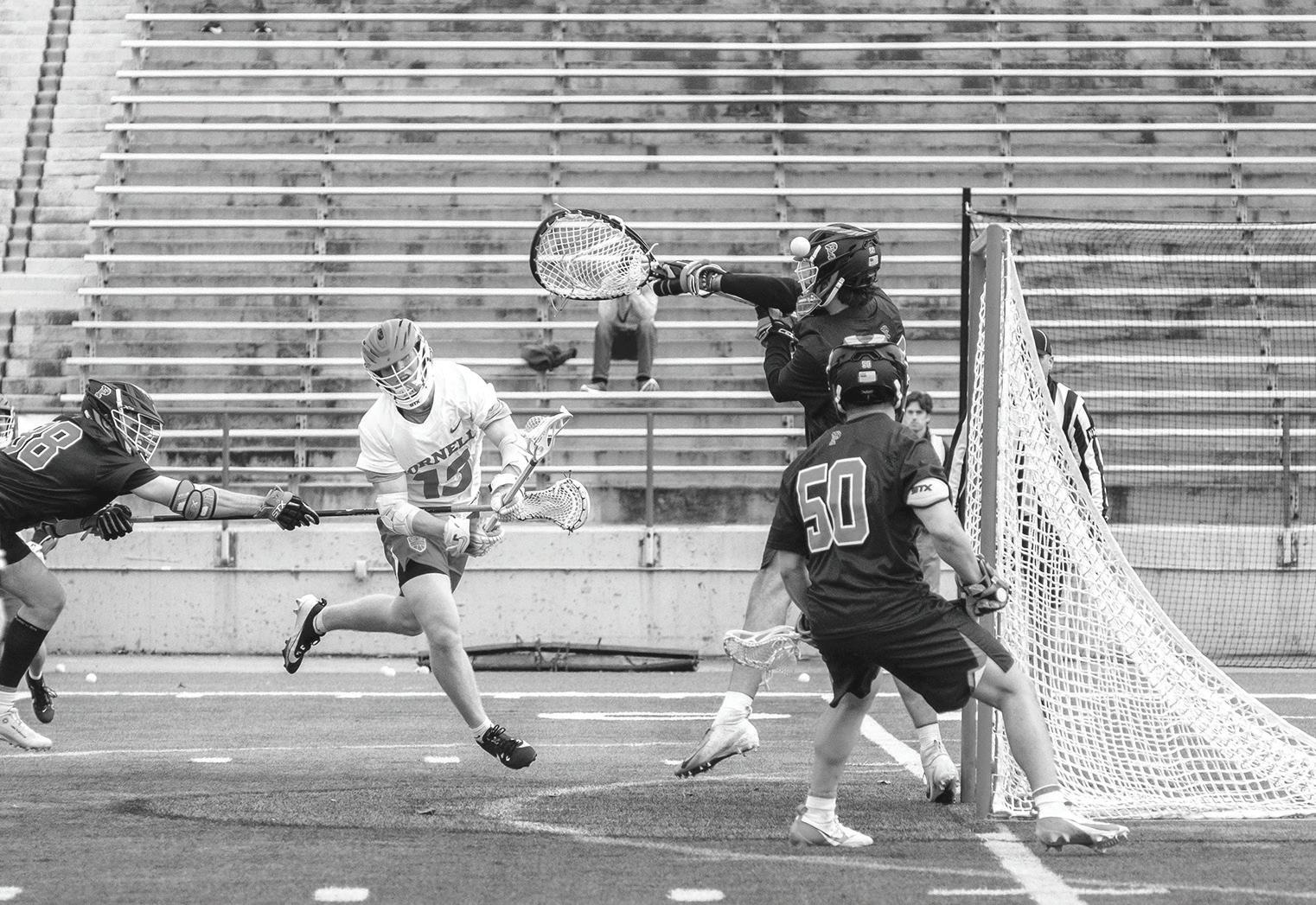
Heading into Saturday’s match with Princeton, senior attackman CJ Kirst was on the cusp of history. Two goals in a heartbreaker loss to Penn State the week before had put him three shy of the record 191 set by Mike French ’76, and the Ivy League opener against then-No. 2 Princeton was the perfect stage.
Minutes into the first period, Kirst found the back of the net for the first time. In the second, he claimed two more. His fourth goal, off an assist from sophomore attackman Ryan Goldman, sealed his spot in the record books.
A grand total of five goals and seven points made Kirst the school’s highest scorer of all time, sitting at an impressive 193 goals. To cap off the achievement, No 4/3 Cornell (5-1) took a definitive 15-10 win over No. 6 Princeton (4-2) on home turf.
Though the Tigers were first on the board, the Red fired back off the sticks of senior midfielder Ryan Sheehan and Goldstein for an early 2-1 edge. Then, the Tiger’s Tucker Wade snuck the next past senior goalkeeper Wyatt Knust.
The Red took that personally. Junior faceoff and midfield Jack Cascadden won the ensuing faceoff, carrying the ball into Tiger territory before offloading to Kirst for his first goal of the game.
Cornell scored twice more before the end of the first quarter, with both senior attackman Michael Long and sophomore attackman Willem Firth tallying their 10th goals of the season. The momentum continued after the break, with Kirst netting two in a row to tie the school record.
Princeton took over for a four-goal run, two of which came from Coulter Mackesy, who, like Kirst, tops his school’s list for all-time scoring. The Red’s lead narrowed to 7-6 before sophomore attackman Ryan Waldman eased the tension with an unassisted shot past Ryan Croddick.
Cornell couldn’t shake Princeton in the third, which echoed the rivalry’s typical closeness as the teams traded goals to enter the final quarter 11-9. The
endgame, though, has been where the Red shines.
After Kirst assisted Long in his second goal of the game, Cascadden took the next faceoff on a violation by Princeton’s Andrew McMeekin. Senior midfielder Hugh Kelleher fed the ball to Kirst for his last of the match.
A few minutes later, déjà vú: Kelleher scored, the faceoff went to Cascadden, and senior midfielder Andrew Dalton buried it. Now up 15-9, Cornell hunkered down to defend for the final eight minutes.
Just outside the final minute, Sean Cameron took advantage of a turnover to score for the Tigers, but the last-ditch effort wasn’t enough. The Red took its fifth game of the season, and first in Ivy play, by a five-goal margin.
Cornell’s characteristically brutal offense fired 51 shots opposed to Princeton’s 35, almost perfectly dis-
persed throughout the game. Kirst, named Ivy League Offensive Player of the Week in three of the last four weeks, led the team with 7 points, while Firth contributed two goals and two assists. Goldstein, Kelleher and Long each recorded three points.
Cascadden, who had struggled to remain consistent in the season’s opening matches, took 13 of 23 faceoffs as a crucial part of the attack. He also picked up a team-high five ground balls.
Despite taking 10 shots, Mackesy finished just two scoring attempts, his only points of the day.
With a conference and top-10 victory in the books, the Red next heads to New Haven to take on Yale. The game is set for 1 p.m. Saturday, and fans can catch the action live on ESPN+.
By ANIKA KOLANU Sun Staff Writer
After a season of hard-fought games, men’s basketball (18-11, 9-5 Ivy) found itself in Providence, Rhode Island, competing in the annual Ivy Madness tournament. The Red’s second-place finish in conference play had set the stage for a potential championship victory, a feat the team hadn’t achieved since its memorable Sweet Sixteen run in 2010.
Despite having momentum on their side, the Red fell short against regular-season champions Yale (22-8, 13-2 Ivy) in the championship game. This marked the Red’s first appearance in the Ivy Madness final—and its last game of the year.
Ahead of the game against the Big Green (14-14, 8-6 Ivy), Jaques, senior guard Nazir Williams and senior forward Guy Ragland Jr. took some time to answer questions during a press conference.
“We’re super grateful and excited to be here,” Jaques said. “It says a lot about the group we have.”
Despite its past experiences in the tournament, the team was determined to break its streak of not achieving the ultimate goal of making it to the NCAA March Madness tournament. As Ragland Jr. put it, “We’ve been here many times but have never been able to achieve what we want to.”
Williams, reflecting on the team’s performance, noted, “We’re finding our groove at the right time.” The team was on a winning streak, starkly contrasting to previous years when, as said by Williams, it “limped into the tournament and didn’t finish strong.”
Since the tournament’s inception in 2017, Cornell had never been seeded higher than the No. 3 spot. This year, it had a slight advantage as the higher seed in the first round of Ivy Madness.
Still, Jaques acknowledged Dartmouth’s fantastic season, saying, “Dartmouth is a really good team — there’s a reason they are here. We have a lot of respect for them. We both play fast and want to take good shots. We are both unselfish teams.”
The team faced Dartmouth in an exciting matchup on Saturday, securing an 87-71 victory and achieving its first-ever place in the championship game. Junior forward AK Okereke made program history, scoring 25 points and becoming the first Cornell player to achieve at least four steals, assists, blocks and rebounds in a single game.
To continue reading this article, please visit www.cornellsun.com.
Anika Kolanu can be reached at akolanu@cornellsun.com.


Ads are accepted at The Sun’s office at 139 W. State Street downtown, by phone or e-mail. Deadline: Noon at The Sun’s office two days preceding publication.
Standard Rate: $3.95 per day for first 15 words, 39 cents per day per word thereafter. Five or more consecutive insertions, $3.70 per day for first 15 words, 37 cents per day per word thereafter.
Commercial Rate: $5.95 per day for first 15 words, 40 cents per day per word thereafter. Five or more consecutive insertions, $5.75 per day for first 15 words, 38 cents per day per word thereafter.
The


By ROHITH TSUNDUPALLI
Contributor
March 12 — Insatiable curiosity drives Prof. Frank Rossi Ph.D. ’91, horticulture, to learn, research and teach. After nearly 30 years at Cornell, Rossi remains a curious and respected leader in horticulture and turfgrass science.
Rossi’s interest in horticulture began outside of academia. At 11 years old, he started a small lawn care business with his brother-inlaw and “became enamored with the natural world, in and amongst all the paper,” he said. As an adult, Rossi dabbled in golf course management, then returned to his academic pursuits, earning a master’s degree from the University of Rhode Island and a Ph.D. in weed science from Cornell.
“One of the things that’s really great about being an academic for a person like me is I’m tenaciously curious,” Rossi said. “I can’t stop my curiosity about things that I’ve been at [for] a really long time.”
Now, as the Richard C. Call Director of the Agricultural Sciences major and a professor in the School of Integrative Plant Science, Rossi plays a key role in Cornell’s agricultural science education and research.
“I am now at the age where I can relate to students in a way that I think, makes sense to them and to me. It brings me great joy, and I think it brings the students great satisfaction,” Rossi said. “I would like to think we are rewarded from our interactions.”
Today, Rossi focuses on researching the sustainability of turfgrass management, particularly in golf courses, sports fields and lawns.
To explore his passions further, Rossi started his podcast, “Frankly Speaking,” where he discusses topics related to turfgrass science, sustainabili -
ty and the food industry. What started as a modest endeavor with not quite 200 downloads for five to six years has evolved into a podcast with upwards of 800 listeners, sponsors and a studio presence.
“It’s a sweet spot,” Rossi said. “I make appointments with interesting people that I’m interested in talking to about topics that I find interesting.” In addition to his research and podcast, as the director of Cornell’s Agricultural Sciences major, Rossi oversees one of the top agricultural sciences programs in the country, where he works to connect academic knowledge with real-world applications.
“I am just a New York City kid, born and raised, started cutting grass as a kid and became enamored with the natural world.”
Prof. Frank Rossi
’91
Putri Srijaya ’26, a student in the Dyson School of Applied Economics and Management, remembers taking Rossi’s “Just Food” class during her freshman year. The class explored food industry management, from the rearing of livestock to distribution. It also included field trips to various agricultural sites on and around campus, including Cornell’s Dairy Farm and Rossi’s own farm.
Srijaya appreciated Rossi’s engaging teaching style and ability to blend his practical knowledge with his academic experience.
“Professor Rossi is very energetic,” Srijaya said. “Even though the time of his class was early in the morning for me, I would always look forward to it because I was always excited to see him. As a freshman, his class made me feel very welcomed to campus and
By ZEINAB FARAJ Sun Assistant Sports Editor
March 16 — With the month of Ramadan beginning the night of Feb. 28 and expected to last until March 29, billions of muslims around the world observe their holiest month through prayer, charity and most notably fasting — where they abstain from food and drink from sunrise to sunset.
The Sun met with Daanyal Agboatwalla ’25 and Muhammad-Ali Kobo ’25, who are Muslim student-athletes observing the holy month of Ramadan and taking their game to the next level.
Daanyal Agboatwalla Conquering the Squash Courts
the academic environment.”
Rossi’s ability to inspire students and colleagues alike is evident in his mentoring. Srijaya notes that Rossi’s passion for his work has had a lasting impact on her own academic journey.
“Something I took from his class was just trying to be passionate about everything I do,” she says. “His curiosity was something that I very much admired about him. I tried to take that similar curious mindset into everything I do.”
Outside of the classroom, Rossi’s research and passion for sustainability extend into his personal life — Rossi and his wife run a pig farm together.
“We got into the pig business, and lo and behold, the pig business turned out to be a great home-based business for [my wife] and myself,” Rossi said.
The farm has grown significantly over the years, especially during the pandemic, where Rossi noted a 40 percent growth rate. According to their website, the farm has around 80-120 pigs, and they supply pasture-raised pork in USDA cuts and whole hogs to local restaurants and families. Additionally, the farm has chickens and alpacas.
Beyond academia and the farming industry, “Frank has always been completely dedicated to his family more than anything else,” wrote Barbara Rossi, Frank Rossi’s wife, in an email to The Sun. “He also loves volunteering and has given years at Hospicare in Ithaca.”
A Yankee fan, deli boy turned award-winning professor and leading researcher in turfgrass science — that is who Frank Rossi is.
“I am just a New York City kid, born and raised, started cutting grass as a kid and became enamored with the natural world,” Rossi said.
Rohith Tsundupalli can be reached at rt535@cornell.edu.
Agboatwalla studies psychology in the College of Arts and Sciences. He is a part of the No. 9 squash team, which has had some historically strong seasons during his time at Cornell. He hails from Bronx, New York, and says that, for the last three years, Ramadan has always occurred after the squash season ended. Due to the changing lunar calendar, Ramadan this year began while the team was still playing matches.
“Usually Ramadan starts after our nationals competition, so we have a two to three week break and then get into some light fitness training,” Agboatwalla said. “There was never a huge conflict with fasting.”
For Agboatwalla, his priority is making sure that he makes “small adjustments” to his typical routine and prioritizes eating and hydrating properly. He detailed what his Suhr — the pre-dawn meals Muslims have before fasting commences — consists of.
“It is most important to have healthy fats, so foods that will keep me full throughout the day and slowly supply me energy,” Agboatwalla said. “Avocadoes, peanut butter, fruits and a protein shake are what I typically have.”
He also tries to schedule some of his training sessions early in the morning before Suhr, so that he is still able to drink water while training. Agboatwalla noted that Ramadan is a “mental and spiritual thing” that gets easier as time goes on.
He said that Ramadan does not stop him from “working hard to improve” his fitness but rather motivates him and instills him with “more discipline” to reach those goals.
Agboatwalla said Ramadan is his favorite time of the year and is very important to him, which he believes is something many Muslims can relate to.
“Many non-Muslims ask Muslims why Ramadan is our favorite time of the year, and that’s understandable from an outside perspective because they see us restraining ourselves from doing things that we would normally do, like eating
and drinking,” Agboatwalla said. “But for Muslims and me personally, I feel very close and connected to God. I feel connected to a greater community and overall happier.”
Muhammad-Ali Kobo Fasting and Draft Preparing Kobo is also a psychology major in the College of Arts and Sciences. He is a defensive lineman for the Red’s football team. While Kobo is not actively in season, he is training for the National Football League draft, which is slated to start April 24 and run through the 26th.
Currently, Kobo is preparing for a variety of Pro Days he plans to attend where NFL scouts will watch and evaluate him.
Throughout his four years at Cornell, Kobo said Ramadan would fall during spring football season, meaning he would have a daytime practice and a workout at night. Kobo said that it was important to make sure he was staying properly hydrated and having a Suhr meal that would “fuel him” throughout the day.
“In the morning I will have six to seven bottles of water, some gatorade and a light meal such as yogurt, dates, bagels or applesauce.
He reflected that over the last four years, the University has made it “a lot more accessible and easier” for Muslim students to get food during Ramadan. He said that during his freshman and sophomore years it was harder for him to find food while fasting.
“During my first two years at Cornell, the dining halls would close at around 8 p.m. so you would have to spend your Big Red Bucks and find somewhere that was open that would take them,” Kobo said. “What they have done now is prepare pre-dawn and Iftar meals that students can pick up.”
Those pre-dawn meals are available to students at the cost of one meal swipe at Cook House Dining Room, Morrison Dining and Okenshields. Halal meals are offered at Morrison, Okenshields, and Keeton House Dining Room. Kobo said that Cornell has done a better job of “recognizing their large Muslim population,” but he still believes there are improvements the University should continue to work towards.
“With those cold meals, we are not afforded as much as what we would usually eat, so I think that is something they can improve,” Kobo said. “But overall, I have definitely seen an upward trend in how they operate and treat their muslim students and athletes.”
To continue reading this article, please visit www.cornellsun.com.
Zeinab Faraj can be reached at zfaraj@cornellsun.com.

By ZEINAB FARAJ Sun Assistant Sports Editor
March 16 — Around 10 years ago, Becca Jeffries ’27 was told she may not be able to walk again. Now, Jeffries is the latest member of the Cornell women’s varsity rowing team.
From newbie to coach to Division I player, Jeffries has truly experienced all the aspects of the sport of rowing — her tenacity and perseverance helped her earn a spot on the varsity roster this past month.
Wanting to get involved in a sport that was outdoors and in nature, Jeffries began rowing in her freshman year of high school at Thomas Jefferson High School for Science and Technology in November 2019. She rowed for her high school for four years as a two-time captain and was also a member of Resilient Rowing in her home state of Virginia.
During the college selection process, Jeffries said she had spoken to a couple of universities about committing for rowing. However, in the end, Jeffries decided to put rowing in the back of her mind and pick a school based on her academic preferences.
“I really wanted to prioritize academics when making my college decision, and I felt like rowing was clouding my judgment a little,” Jeffries said. “I ended up choosing Cornell specifically for the academics.”
Jeffries enrolled in the College of Engineering in the fall 2023 to study electrical and computer engineering. She joined the Cornell Rowing Club that same semester. While Jeffries “enjoyed the opportunity to continue rowing,” there were some points of frustration.
“Practices were often disorganized and inefficient, which meant we would not get that much time on the water,” Jeffries said. “However, I made some of my closest friends through CRC my freshman year and have a lot of good memories associated with it.”
Her sophomore year, Jeffries took a
coaching position for CRC. As a coach, Jeffries was responsible for providing training schedules for the members of the club and managing the maintenance of equipment. She worked closely with another coach for the club, Samantha Durocher ’26, to make the practices run smoothly.
One of her biggest improvements to the club’s organization, according to Jeffries, was creating lineups and schedules before practices started to increase efficiency and maximize water time.
“Being a coach gave me a fresh perspective on the sport,” Jeffries said. “My favorite thing about coaching was working with passionate athletes like [Alex Slezak ’28, Joseph McMahon ’28, Merrick Word-Brown ’28 and Aiden Parsa ’28], and seeing their passion for the sport reignited my own passion and energy.”
One of her favorite coaching memories was working with Slezak, Word-Brown, Parsa and Peter Mueller ’28 — who were all new to rowing — and helping them place first at the Head of The Fish Regatta in Saratoga Springs, New York.
in the team.
“I got an email back asking to set up a meeting, and once I got back to campus we talked about me joining the team,” Jeffries said. “Then we kicked off the clearance process.”
Jeffries described the National Collegiate Athletics Association’s clearance process — blood work test, applying for NCAA eligibility, getting a physical examination from a medical professional, completing a baseline concussion test and meeting with the athletic trainer — as “long and tedious,” with various challenges along the way. Jeffries had to complete it in around two weeks time.
“Being a player, then becoming a coach and even my injury process were all vital parts of my development as a person and player so I am just excited to contribute however I can to this team.”
Becca Jeffries ’27
Jeffries attributed her decision to work towards walking onto the varsity team in November 2024 and her now successful efforts to Slezak, McMahon and Parsa.
“I owe it all to the guys, because it is so much more fun and motivating when you are with other people who are equally passionate about the sport and willing to push you,” Jeffries said.
Working to Walk-On and Pushing through Pain
After making it a goal to walk on to the varsity team, Jeffries started her twomonth-long training schedule to get more athletically fit for the Division I level. During winter break of 2024, Jeffries completed a 2K test to gauge her fitness and readiness for the team. Following the test, she emailed the women’s rowing coaching staff with her times and interest

On top of that, the Ivy League and Cornell athletics have their own paperwork process that Jeffries had to handle during her transition.
While working through the clearance process was challenging, Jeffries described her reaction to an offer on the team as “surreal” because of previous and ongoing medical problems.
Jeffries lives with complex regional pain syndrome — a chronic pain condition where a person feels severe and constant pain in a particular area, usually following an injury or surgical procedure, that is more intense than the initial pain.
Jeffries developed CRPS at around nine years old following an ankle injury. Her recovery process consisted of her working through “three hours of excruciating physical therapy” for several months and even then, her doctors made no guarantee she would be able to walk again.
“I never expected to be in this position, because there was a point in my life where my doctor thought I’d never walk again,” Jeffries said. “Having the chance to compete at the Division I level is something that is difficult for me to wrap my head around and something I am incredibly grateful for.”
Fortunately, Jeffries was able to make
a complete recovery, but she still remains “vigilant” as to not aggravate her chronic condition.
“CRPS is dormant in my system now, but I have to always be cautious if I get injured again to work through the pain,” Jeffries said. “I owe some of my success in rowing to that. It showed me how much pain I was capable of enduring, which is an important aspect of the sport.”
Looking forward, Jeffries hopes to get integrated with the team and adjust to her new and rigorous schedule. She said she knows one of her most difficult challenges will be “proving” herself to the team, but she is “definitely up to it” and excited to work hard.
She is also looking to maintain her connections to the club rowing team.
“I still plan to be involved in the club through the social events and coaching on some Sunday mornings when I do not have practice,” Jeffries said. “Getting dinners on West or North Campus with members of CRC is a fun tradition that I look forward to continuing.”
Jeffries hopes that her medical journey and adversity can provide hope to someone going through something similar.
“I hope that if there is anyone else going through something really challenging, medically or in any other aspect, I want them to know that things can change so much more than you realize,” Jeffries said. “Just because it’s really hard right now doesn’t mean it always will be and it doesn’t mean that you’ll be completely held back or limited by the challenge.”
Now, Jeffries is excited to make her mark on the varsity squad for the remainder of her time at Cornell.
“Reflecting on it I think I would not be where I was today if it had not been for each of those individual experiences,” Jeffries said. “Being a player, then becoming a coach and even my injury process were all vital parts of my development as a person and player so I am just excited to contribute however I can to this team.”
Zeinab Faraj can be reached at zfaraj@cornellsun.com.

By DANI MENDELL Arts & Culture Contributor
As the second semester begins to pass and desire for summer grows, the chilly campus weather is starting to get old. I continuously find myself with headphones in on the way to class, listening to music fit for a rainy day in London in an attempt to romanticize the dreary Ithaca blues. Enjoy this playlist filled with songs that scream, and sometimes whisper, for a trip abroad.
1. Blur: “Parklife”
I love this song. Yes, the frontman of this band formed Gorillaz, but this group maintains their own unique sound. A less angry sound, with less autotune.
2. Amy Winehouse: “Tears Dry on Their Own”
I know this is a well-known song, but it really is that good. Amy is an international treasure and her music always speaks to you when you least expect it.
3. The Clash: “London Calling”
I would like to say I listen to this song when I workout… if workout means walking to the laundry room in my Bala Bangles. This song has a quick tempo and a fun message.
4. The Beatles: “With a Little Help from My Friends”
A feel-good, do good anthem. A song to march, skip or, the more socially acceptable alternative, walk to.
5. Florence and the Machine: “South London Forever” Florence and the Machine isn’t just for renaissance fairs
and cult rituals. As a self prescribed member of the Florence Welch club myself, I find this song is a good intro to her music. It falls into a more mainstream vibe, while still radiating her usual eccentricity.
6. David Bowie: “Life on Mars?”
If you ever need a song to give you that kick out of bed in the morning, this is your song. “Life on Mars” is an

anthem that appeals to coming-of-age teenagers and 45-year-old Cornell professors smoking a cigarette behind Goldwin Smith alike.
7. The Cure: “Boys Don’t Cry”
As Cornell midterm season has taught me, boys do cry. But this song is still a classic and the Cure have certainly cured my seasonal depression.
8. Elton John: “Goodbye Yellow Brick Road”
A great song for walking up Cornell’s very own Yellow Brick Road, the slope. Great song for when you are feeling nostalgic.
9. Kids That Fly: “Sunday in London”
This song was made for Saturday mornings, despite the song’s title. Put some headphones in, cord headphones if you want the full experience, and actually enjoy Cornell… or the not-icy parts at least.
10. KT Tunstall: “Suddenly I See”
I know, I know… ever since The Devil Wears Prada featured this song in the soundtrack, this song has become a New York working girl anthem. However, KT Tunstall was in fact born in Edinburgh. Give it another listen and this time, when Tunstall says “this is where I want to be,” picture something other than the rat-infested NYC subway.
11. Robbie Williams: “Angels”
The response to the release of Better Man, the Robbie Williams biopic, has made me realize that not everyone knows Robbie Williams. Angels is a classic. The best way to listen to this song is while walking in a long coat, hands in pockets, wondering how you will have time to go out this week and still get all your work done.
Dani Mendell is a freshman in the College of Arts and Sciences. She can be reached at dlm357@cornell.edu.
‘Solar Flare’ is a weekly playlist column where Sun contributors spotlight a slice of musical taste with the campus community. It runs every Monday.
By JANE LOCKE Arts & Culture Writer
On Wednesday, March 12, the Trojan War began in Ithaca with the powerful cries of Emily Wilson speaking in Ancient Greek. Yet this was no ordinary recitation of the words of one of the most iconic epics in the world; this was done over a Zoom call with Cornell faculty and students. The kick-off of “The Iliad in Ithaca: Re-Reading the Trojan War” was a virtual event featuring the translator of Homer’s classic story of Achilles and Agamemnon, who answered questions ranging from her choice of poetic meter to the roles a translator must fill. Emily Wilson is a professor at the University of Pennsylvania, and she had translated The Odyssey before turning her genius towards the Iliad . Her translation and the events held at Cornell on March 12 and 13 showcased the importance of bringing classical literature and thought to new generations.
The reading of the Iliad brought together people from both Cornell’s community and the town of Ithaca. Readers were Ithaca residents or Cornell students, and all stepped onto a stage in the center of Klarman Hall to bring the revitalized words of Homer to new ears. The reading began at 9 a.m. on Thursday, March 13, with a group of Cornell faculty and students reciting the beginning of the Iliad in Ancient Greek. Their voices boomed out a language spoken by Homer almost 3,000 years ago. After the “cataclysmic wrath of great Achilles” had been announced in the original language, English became the language of “The Iliad in Ithaca,” and Emily Wilson’s fantastic translation took over the hearts and minds of listeners.
Even though it would have been incredible to hear the Iliad in the original Greek throughout, the choice to switch to English and Emily Wilson’s translation was marvelous. The melding of the two languages, from Ancient Greek to Modern English, highlighted Emily Wilson’s ultimate goal: bringing old stories to new generations. Through her beautifully crafted words, the people who packed the

Groos Family Atrium of Klarman Hall were introduced, possibly for the first time, to the wonderful tales that a classical education can reveal to us. Love, hate, war and destruction, spoken through the Iliad, were examined as what Emily Wilson called “the patterns of human behavior” that Homer’s epic brings to life. As she put wonderfully over the Zoom event, readers should come to the Iliad to experience something new or to be able to see things in a new light, not just to reinforce opinions and assumptions. This approach to listening and reading the Iliad perfectly encapsulates what a classical education can do for us: open our minds to broader understandings of humanity.
This two-day event in Ithaca wasn’t just about celebrating the new translation — though this was a definite positive. It was about celebrating the languages of ancient times and the ideas they can bring to us. As both events started with Ancient Greek, whether it was Emily Wilson or Cornellians, the focus was on the power of language and its ability to transport us. Unfortunately, this is a focus that is being lost across the country. Latin and Greek classes are being cut from high school and colleges, and that loss comes with a great price. The world of Virgil’s
Aeneid and Homer’s Iliad is disappearing in the original language for modern audiences. Classical languages connect us to philosophy, literature, religion, history, archaeology and most importantly, imagination. A literary world of fantastic heroes, terrible monsters, powerful gods and epic battles is fading before our eyes. With it, we lose a powerful tradition of wonder and creativity.
Thankfully, Cornell has a determination to keep the classical world alive. At the virtual event on Wednesday, Athena Kirk, an associate professor in the Classics department at Cornell, joined Emily Wilson in encouraging students to enroll in classical language classes. Even the spirit of “The Iliad in Ithaca” reflected a call for the reintroduction of classics to all academic levels. The reading’s location put Homer and Ancient Greek in a centralized position at the university, inviting all to sit down and open their ears to the beauty of classical thought. I feel confident that even after the last words of the Iliad are read out and “the funeral for horse-lord Hector” is held, the language of Homer will echo out across Cornell’s campus.
Jane Locke is a freshman in the College of Arts and Sciences. She can be reached at jlocke@cornellsun.com.
By ELI FASTIFF Sun Senior Editor
No. 3 women’s hockey continues to find a way to win. In front of a roaring record crowd of 3,135 fans, sophomore goaltender Annelies Bergmann stopped 28 shots en route to a shutout 1-0 win over No. 6 Minnesota Duluth in the NCAA tournament regional final. With the win, the Red will head to Minneapolis next weekend for the Frozen Four, just two games away from the program’s first national championship.
Cornell’s (25-4-5, 16-2-4 ECAC) game-winning goal, the only to pass either goaltender, came from an unlikely source. Exiting the second period tied with nothing on the board — and being outshot 18-16 — the Red did not panic. Instead of giving a fiery speech during the second intermission, head coach Doug Derraugh ’91 did what he had done all season: preached consistency and trust.
“What I found over the course of this season is that we’ve been in this situation a lot,” Derraugh said. “My message has been for them, probably boring, but consistent. It’s just reinforcing ‘hey, we’ve been here before, we’ve gotten through this before, we know what to do, let’s do what we always do.’”
Derraugh’s team did exactly that. Just a week after a triple overtime win over Clarkson, and two weeks after scoring twice in the game’s final 70 seconds against Colgate in the ECAC championship, Cornell found the goal when it needed it most.
3:24 into the final frame, senior forward Gabbie Rud skated into the offensive zone, leading a 4-3 odd-skater rush. Sensing an opportunity, junior defender Alyssa Regalado skated hard up the ice, eventually working her way behind the UMD defense. After corralling a pass from Rud next to the goal, Regalado skated behind the net before wrapping around to face Western
Collegiate Hockey Association Goaltender of the Year Éve Gascon.
“My goal was just put it in front [of the net], because I saw a player driving [to] the net. It was just a lucky bounce off her feet [that went in], but I guess that’s what happens when you get pucks to the net.” Regalado said. “It just felt unreal, especially with the atmosphere that we had today.”
The goal was just Regalado’s second on the season, an unsurprising fact considering how much Cornell has relied on its depth all year.
“Every weekend it’s been somebody different [stepping up], either a different line, a different defenseman or our goaltender,” Derraugh said. “It really has been a total team effort.”
The record crowd — the highest attendance ever for a women’s hockey game at Lynah Rink — settled in for what everyone in the building knew was coming: 16:36 of ferocious defending.
Suddenly down a goal and with its season on the line, UMD became desperate to salvage its chances of making it to the Frozen Four. While the Bulldogs struggled for the first few minutes after the goal to get set up in the offensive zone, as time wore down the chances began to increase. With 6:30 remaining in the period, Bergmann made a sprawling stop for her 22nd save of the game, prompting chants of “brick wall Bergmann” from the Lynah Faithful.
“I just play as loose as I can,” Bergmann said. “I know that my team’s gonna have my back no matter what, that’s been a huge thing this whole year.”
As the Bulldogs pressed on, it seemed the tension in Lynah Rink could not get any higher. Then, with 2:26 remaining, sophomore forward Karel Prefontaine was whistled for tripping.
For the first minute of the penalty kill, the Bulldogs fired multiple heavily screened shots at Bergmann. While the ECAC Goaltender of the Year managed to send them all away, the Cornell

skaters were quickly tiring.
Then the Bulldogs pulled Gascon for an extra skater. Now with a 6-4 advantage, UMD looked ready to strike.
It didn’t matter. For a minute and 50 seconds, the same group of Cornell penalty killers stayed on the ice and managed to turn away every Bulldog attempt. With the penalty expiring and just 25 seconds left on the game clock, it seemed as if the Red were in the clear.
Instead, Duluth’s best opportunity of the game came when an odd-man rush left a skater free in front of an out-of-position Bergmann. Cornell’s netminder gloved the puck, preserving her perfect game. After the Red took the next faceoff, the horn sounded and the celebrations began.
“I said to [senior defender Rory Guilday], this is what we play for,” Bergmann said. “I think that just shows just the resiliency of our
team and how we’re able to fight through those situations, even if it’s two minutes left and we’re two men down.”
While it took Cornell until the third period to score, the Red nearly lit the lamp on the first play of the game. After the opening faceoff, the Red just missed an opening-minute strike when senior forward Lily Delianedis’s open shot from the slot went wide.
While Cornell’s offense looked potent early, it would be UMD who earned the first power play of the game when, after a sustained period of pressure, senior forward Kaitlin Jockims headed to the box for tripping.
To continue reading thie article, please visit www.cornellsun.com
Eli Fastif can be reached at efastif@cornellsun.com.
By JANE McNALLY Sun Senior Editor
With 9:27 left in the game, Colgate senior Brett Chorske had his head held low, trying to catch his breath.
His team was down 2-0 midway through the third. It had just finished a power play stretch that spanned over three minutes.
The Raiders had even pulled its goaltender to spark any kind of offense. Multiple times over that stretch, Chorske — an All-ECAC first team selection — was kept at bay by the Cornell defense.
The Red blocked 11 shots in the third period.
That was enough to send Cornell to Lake Placid for the third consecutive season.
“All in all, just a gritty kind of win for us,” said head coach Mike Schafer ’86.
Men’s hockey defeated Colgate, 3-0, in game two of the ECAC quarterfinals, sweeping the Raiders and advancing to ECAC championship weekend. It is the Red’s third sweep in the quarterfinals in as many years.
“It’s pretty special,” said junior forward Dalton Bancroft about returning to Lake Placid. Bancroft has made the trip in each of his three seasons. “Once you get there, anything [can] happen. It’s one-game elimination.
While Friday’s game was a relatively disciplined contest on both sides, Saturday’s game produced a total of 20 minutes of minor penalties.
In addition to Cornell’s stingy shot-blockers, senior goaltender Ian Shane was perfect between the pipes, making 18 saves on 18 Raider shots. With the shutout, he passed Ken Dryden ’69 to sit all alone in fourth place for the most shutouts by any Cornell netminder with 14.
“This was a series four years in the making for the 10 of us [seniors],” Shane said. “To come out of this, obviously with a sweep, feels good with the way things went our freshman year losing to Colgate in three [games].”
With its season on the line, Colgate skated out with more vigor than it did on Friday, but it was dealt a nearly identical result.
Just over six minutes into the game, senior forward Sullivan Mack executed a highlight-reel spin-o-rama move to break into the offensive zone before forcing the puck on net. The puck just barely eked through Colgate goaltender Andrew Takacs, giving Cornell a 1-0 lead in back-to-back games.
The Red had little time to celebrate its opening tally when senior forward Kyler Kovich was nabbed for tripping just 10 seconds after Mack lit the lamp.
On Friday, Colgate scored its only goal on its first and only power play.
On Saturday, the Raiders went 0/7 on the power play, the first being on that Kovich penalty.
“They did a tremendous job,” Schafer said about the penalty kill unit.
“Ian I thought played really, really well.”
After the successful kill, Cornell regained control. With just over three
minutes left in the first period, sophomore defenseman Hoyt Stanley had a stretch of excellent play, first nearly doubling the score on a wide-open shot to the net before a Colgate skater poked it away, before recovering for a diving block in the defensive zone to preserve the lead.
The Red entered the first intermission with the slim lead. It would enter the second intermission with that same 1-0 lead.
The second period came not without its chances — three penalties were called in the middle frame, with one Colgate call sandwiched between two Cornell infractions.
Another Kovich tripping penalty sent Colgate back to the man advantage 3:54 into the period. This time around, Shane was forced to make a couple of stellar stops, mitigating second-chance opportunities by playing aggressively on rebounds.
Cornell even got a shorthanded chance on that penalty kill, with senior forward Ondrej Psenicka emerging on a two-on-one rush with sophomore forward Jonathan Castagna, but a failed pass prevented the puck from finding the net.
Nearly 10 minutes passed before the next penalty, called on Colgate’s 6’7” forward Brett Chorske for interference. Cornell was once again stymied on the power play thanks to Colgate’s aggressive penalty killers, with the Raiders even getting a shorthanded chance that was padded away by Shane.
A late penalty taken by Castagna
sent Cornell back to the penalty kill for a third time, but Colgate couldn’t find the back of the net despite some of its best chances of the night.
Though Colgate earned two power plays in period two, Cornell ultimately outshot the Raiders 10-4 in the middle frame.
Continuing the theme of penalty-ridden play, Colgate — 20 minutes away from having its season ended — had a skater in the box within two minutes of the third period’s start.
The third power play of the night would be the charm. Freshman forward Charlie Major beat Takacs to double the lead with 15:49 left and give him his fifth point against Colgate in four games.
But just a couple minutes later, chaos would ensue. First, sophomore defenseman Ben Robertson was sent off for interference, before senior defenseman Hank Kempf was nabbed for elbowing with 47 seconds left on Robertson’s penalty.
It was set up to be a five-on-three Raider advantage, but Colgate head coach Mike Harder opted to pull Takacs out of his crease for an extra attacker, making it six-on-three with almost 14 minutes still left in the game.
But despite all of the offensive zone time for Colgate, it couldn’t find an answer to Shane.
“[They were] unbelievable,” Shane said about the penalty killers in front of him. “Even the [six]-on-three, when [Colgate] pulled their goalie, the guys were unbelievable in front of me –– let me see pucks, blocked a ton of shots.
… They didn’t give Colgate much of a sniff.”
In all, Cornell killed four penalties in the third period. Colgate attempted 28 shots in the third period compared to Cornell’s eight, but nothing would be enough to beat Shane.
“We kind of got back to our identity that helped us win last year,” Bancroft said. “They didn’t get anything; six-onthree, they didn’t get anything. The boys put in a great effort in the third period and [it] showed on the scoreboard.”
Cornell would make it 3-0 on an unorthodox play in the final minute, when junior forward Dalton Bancroft had a breakaway on an empty net and Colgate took a too-many-men penalty, which automatically awarded a goal to Bancroft.
Schafer’s coaching career will continue next weekend as the Red head north to Herb Brooks Arena to defend it 2024 Whitelaw Cup title.
“We got something to defend going back there,” Shane said. “We’re just gonna try to make the most of it.”
Cornell’s opponent for the ECAC semifinals is to be determined as Clarkson and Harvard will play a third game to decide the final quarterfinal series. Quinnipiac and Dartmouth also earned sweeps and will join Cornell in Lake Placid.
“We know we have a winning team,” Bancroft said. “We’re just excited to get there.”
Jane McNally can be reached at jmcnally@cornellsun.com.