The Corne¬ Daily Sun


Ann Coulter ’84, a controversial conservative media personality, has reportedly been invited back to speak on campus by the University more than a year after protestors taunted her off stage. Multiple on-campus groups are considering whether to help host the potential event.
Nadine Strossen, a free speech advocate who formerly served as the president of the American Civil Liberties Union, told The Sun that a formal invitation has been extended to Coulter on behalf of the Cornell administration.
“She has accepted [the invitation] in principle. … She has turned it over to her speaker’s bureau to negotiate important details,” Strossen said. “I know she wants to come.”
The decision to bring Coulter back began to materialize after Strossen discussed the idea with Provost Michael Kotlikoff in January at the Board of Trustees meeting in New York.
In the meeting, Kotlikoff responded immediately by
saying, “‘Oh, that’s a great idea,’” according to Strossen. Kotlifkoff did not respond to a request for comment.
These developments come during Cornell’s free expression theme year. In an April 2023 press release announcing the theme, President Martha Pollack wrote that “learning from difference, learning to engage with difference and learning to communicate across difference are key parts of the Cornell education.”
On Nov. 10, 2022, Coulter was heckled off the stage at an event organized as a joint effort by The Leadership Institute, a conservative nonprofit, and the Network of Enlightened Women, a campus group for right-wing women, with help from members of Cornell Republicans. Students in attendance chanted, “Your words are violence!” and “We don’t want your ideas here! Leave! Leave!”
At least eight people were removed from the venue for disrupting Coulter’s speech, with police and security ushering out students yelling phrases such as “Go back to the circus, Ann” and “no KKK, no fascist USA.”
Coulter was never able to complete her speech, leaving her scheduled hour-long event just 20 minutes in.
The 2022 Coulter event was supported by the Cornell administration, who refused to cancel the event and aided security efforts.
Coulter, who helped found The Cornell Review, a conservative news source, in her time at Cornell, has a long history of making bigoted remarks against minority groups including South Asians, Jews, Muslims and immigrants.
Prof. Randy Wayne, plant science, a leader in the Cornell Heterodox Academy — an organization that aims to increase the diversity of thought in academia — said his organization is considering co-hosting this event but a decision has not yet been made.
To continue reading this story, please visit www.cornellsun. com.
Feb. 28.
After receiving extensive criticism from faculty and students, the University lessened the Interim Expressive Activity Policy restrictions, according to an email sent to the Cornell community on Monday by President Martha Pollack and Provost Michael Kotlikoff.
Reductions to regulations impact event registration, the use of open flames and postering. The University also pledged to determine the final policy through a consultative process with faculty, students and staff.
February and March are considered a period of public comment before the policies are formally taken to the Executive Policy Review Group which can approve the final expressive activity policy, according to Prof. Eve De Rosa, psychology, in a faculty forum on
The original interim policy, which was issued on Jan. 24, restricted student protest on campus through limitations on expressive activities including guidelines on the use of amplified sound and the number of people at outdoor demonstrations.
The University first referred students for disciplinary action under the interim policy at the Coalition for Mutual Liberation “Walk Out To a Die In” divestment protest held on Feb. 8.
There have been two instances since where the University referred student protestors for disciplinary action, both of which impacted pro-Palestine protestors.
The Monday statement clarified that the use of the word “expected” for registering events was replaced with stating that the University “strongly encourages prior registration of protest activities, [but]
Faust F. Rossi J.D. ’60, Samuel S. Leibowitz Professor of Trial Techniques, Emeritus, died on Wednesday, March 6 at the age of 91. Rossi was a long-time member of the Cornell Law community and an influential member of the legal world as a scholar in evidence and trial advocacy.
With a nearly 50-year tenure, Rossi is estimated to have taught more students in the Law School than any other professor. Rossi previously achieved the prestigious Roscoe Pound Jacobson Award for Excellence in Teaching Trial Advocacy.
Throughout his career, Rossi wrote Evidence for the Trial Lawyer and co-authored the Handbook of New York Evidence, a comprehensive guide to rules and principles of evidence within New York courts.
After graduating from Law School in 1960, Rossi’s legal career began in the United States Department of Justice Honors program — one of the nation’s top federal attorney recruitment programs — where he worked as a trial attorney and later became a litigation partner at a law firm in Rochester.
Rossi joined the Law School faculty in 1966 where he dedicated his career until he retired from the University in 2013. Among Rossi’s most-revered classes were civil procedure, evidence and trial advocacy.
Rossi was also a visiting professor at Central European University in Budapest and a faculty member at Cornell’s summer institute in Paris.
During Rossi’s retirement celebration in 2013, Prof. Stewart J. Schwab, law, who was the dean of the Law School from 2004 to 2014, emphasized Rossi’s distinguished career educating and inspiring law students.
registration is not required,” conceding that the prior wording was “vague.”
“By choosing to register [events], organizers enable the University to better support protest activity, address health and safety concerns and reduce the potential for unintended conflict with other scheduled activities,” the statement reads.
The updated policy opened opportunities for open flames at events, allowing for candles under six inches so as not “to prevent candlelight vigils.” The previous policy stipulated that “candles, lamps and other open flame sources'' were not permitted but could be included on a “case-by-case basis after review by health and safety personnel.”
To continue reading this story, please visit www.cornellsun.com.
“For 47 years, Cornell Law School has had one of the great treats of teachers in Faust F. Rossi,” Schwab said. “[Rossi] has helped train literally thousands of Cornell Law students and many other lawyers across the country.”
To continue reading this story, please visit www.cornellsun.com.







By MATTHEW KIVIAT and KATE SANDERS Sun News Editors
The Common Council voted 10-1 on Wednesday to pass an amended resolution demanding a ceasefire in the ongoing IsraelHamas war.
The resolution, which was originally drafted by Kayla Matos (D-First Ward) and amended several times, demands that the city support legislation that calls for a “permanent negotiated bilateral ceasefire” in Gaza.
The final resolution also calls on higher levels of government to support humanitarian aid to Gaza, an end to United States military funding to Israel, the release of Israeli hostages taken by Hamas, the release of thousands of Palestinians “indefinitely

held without charge” in Israeli military prisons, the codification of the right to self-determination for both Israeli and Palestinian people and the maintenance of strong and enduring peace in the Middle East.
Matos told The Sun that bringing forward the original resolution aligned with her commitment to fighting for racial justice in Ithaca.
“I am very big into social justice and racial justice — like what I do during my day job,” said Matos, who works as the deputy director for the Southside Community Center. “So when the community came forward and felt as if they could trust me with bringing forward the resolution as such, I of course jumped at the opportunity and fought tooth and nail for it.”
By passing this resolution, Ithaca became one of five municipalities in New York to formally support a ceasefire in Gaza.
Tensions Spark Before Resolution Discussions
By the Common Council’s 6 p.m. start time, around 60 people crowded the audience of the meeting, marking a near-capacity level, according to Mayor Robert Cantelmo’s grad remarks to the ccxrowd. Several members of the audience carried signs and flags in support of Palestine.
David Shapiro (D-Third Ward) denounced a banner in the audience that stated “From the river to the sea, Palestine will be free” — a phrase he explained was antisemitic — after the Ithaca Youth Council made an unrelated presentation
about mental health at the start of the meeting, sparking a tense confrontation.
“We would not be allowing racist signs of other ethnicities, of other religions [and] of other cultures [at Common Council meetings]. We would not be allowing other people to stand here with ‘All Lives Matter’ signs. We will not be allowing people to [carry ‘From the river to the sea, Palestine will be free’ posters] here,” Shapiro said.
To continue reading this story, please visit www.cornellsun.com.
Matthew Kiviat can be reached at mkiviat@cornellsun.com.
Kate Sanders can be reached at ksanders@cornellsun.com.
By MATTHEW KIVIAT Sun News Editor
The Student Assembly unanimously passed three resolutions in a March 7 meeting.
One resolution established a survey to remove the 18-credit limit for students in the School of Industrial and Labor Relations and another requested data on class repeating to guide student transcript reforms. A final resolution proposed a survey for students to share concerns about access to gender-neutral restrooms.
Resolution 61 addresses the challenges ILR students face regarding their 18-credit limit, especially regarding completing Cornell Law School’s 3+3 Program, which provides students the opportunity to receive both their bachelor’s and Juris Doctor degrees in just six years.
“ILR students planning to apply to Cornell Law School’s 3+3 program are disadvantaged by the 18-credit limit, as it requires students to take a full load of 18 credits in all six of their undergraduate semesters, leaving no margin for scheduling errors or other life circumstances,” the resolution states.
The 3+3 Program requires ILR students to have completed up to 108 credits by the end of their junior year, effectively requiring ILR students to consistently take exactly 18 credits each semester to remain eligible for the program.
Claire Ting ’25, S.A. executive vice president, expressed how she has felt disadvantaged by ILR credit limits.
“I have personally been affected by this 18-credit limit and [it] has also disadvantaged me for the 3+3 applications,” Ting said.
Different colleges hold varying semester credit limits. For example, the College of Human Ecology restricts students to 18 credits per semester without petitioning, while the College of Engineering maintains a 20-credit limit and the College of Arts and Sciences holds a 22-credit limit.
The resolution calls for the establishment of a survey to be included within the Spring 2024 S.A. election for ILR students, allowing for students to be heard while increasing turnout in the elections.
“The goal here is to see whether or not ILR students approve this credit limit, what their thoughts on it are and then how we can begin that conversation with the entire ILR administration,” said Suraj Parikh ’24, vice-president of external affairs and minority



student liaison at-large.
The S.A. also unanimously passed Resolution 62 which requests course statistics data from the different colleges at Cornell to see how many students are retaking classes that they have previously been enrolled in.
The resolution acknowledges that when a course is repeated, both of the grades are included in a transcript, having a potentially dramatic effect on students’ major and cumulative GPAs. Although both of the attempts in a given class will count towards a student’s GPA, only the latest grade will fulfill Cornell’s graduation requirements, the resolution states.
The resolution formally requests for each college to disclose how many students have been retaking the same classes to see if this phenomenon is a real
issue for students.
In a statement to The Sun, Niles Hite ’26, college of agriculture and life sciences representative, wrote that this resolution is just the first step to hopefully create another resolution to call for the removal of students’ grades from repeated courses in the cumulative GPA.
“I want to continue to help students thrive in an equitable environment that gives them the best chance to succeed,” Hite said.
“We as an academic institution should do what’s best to prevent any roadblocks that stand in the way of academic growth.”
To continue reading this story, please visit www.cornellsun.com.
Matthew Kiviat can be reached at mkiviat@cornellsun.com.


By Caroline Michailoff Sun Staff Writer
Madison Rosario ’26 accepted her bid to Phi Sigma Sigma at the start of the Spring 2023 semester. But a few weeks later, she was told the Panhellenic Association sorority was disbanding.
Rosario said she felt completely blindsided by the change in sorority status.
“I knew that the sisters were really trying to get a lot more new members during [continuous open bidding] but I wasn’t aware of the risk of being disbanded,” Rosario said, referring to the informal process that sororities use to recruit new members after the formal recruitment process. “Everyone was very upset and in shock when the news was released.”
In February 2023, the Beta Xi chapter of Phi Sigma Sigma learned that the sorority’s national headquarters were disbanding the chapter after the Spring 2023 semester, shortly after it welcomed its 2023 member class through formal recruitment.
Over a year after its closure, former members of Cornell’s chapter of Phi Sigma Sigma reported a lack of transparency surrounding their chapter’s closing and disappointment with Phi Sigma Sigma national headquarters.
“There was no indication from our nationals that anything like [the disbanding] would happen leading up to [the announcement], and if we did know this would happen, we wouldn’t have recruited [new members],” said Esha Pisipati ’24, a member of the 2021 member class who previously served as the sisterhood

development chair of the chapter.
Members of the chapter’s 2023 member class were allowed to join other Panhel sororities through COB that same semester.
However, initiated members could not join a different sorority.
Joining a National Panhellenic Conference sorority requires signing the Membership Recruitment Acceptance Binding Agreement, which stipulates that “if you join an NPC sorority and choose to become an initiated member of that sorority, you cannot join another NPC member organization, regardless of the circumstances,” according to the 2023 NPC Manual of Information.
For members including Pisipati, the disbanding of Phi Sigma Sigma ended their active Greek life involvement for the rest of their Cornell experience.
“I was upset [by the disbanding]. I was really involved in my chapter and it sucked to see all that hard work go away,” Pisipati said.
However, while members of the 2023 member class were disappointed about the disbanding, they said that they did not encounter as much of a social adjustment since the sorority was still a new experience.
“I was a little sad about the news because I was enjoying getting to know my pledge class and older sisters, but thankfully we were not initiated yet so I didn’t have any super strong bonds,” Rosario said.
To continue reading this article, please visit www.cornellsun.com.
at cmichailof@cornellsun.com.
Tese sisters are still asking questions






Indigenous scholar and activist Michelle Schenandoah ’99 condemned Supreme Court Justice Ruth Bader Ginsburg’s ’54 controversial majority opinion denying an Indigenous community’s sovereignty in an International Women’s Day address on Friday.
Schenandoah, a member of the Onayota’:aka (Oneida) Nation Wolf Clan of the Haudenosaunee Confederacy, centered her address titled “Rematriation and Land: Addressing RBG, Papal Bulls and the Doctrine of Discovery” around the “Doctrine of Discovery,” a papal decree from 1493 that has been used to justify European colonization of the Americas and reject land claims made by Indigenous people.
Ginsburg ’54 cited the doctrine in her 2005 majority opinion in City of Sherrill v. Oneida Indian Nation of New York, where the court denied the Oneida Nation sovereignty to land bought after being removed from their control for centuries. The opinion also cited what Ginsburg called the Oneida Nation’s “embers of sovereignty that long ago grew cold.”
Schenandoah condemned Ginsburg’s language in the opinion, rejecting the presumption that Oneida sovereignty had ever expired.
“Did our fires ever grow cold? Did they extinguish and go away? No, we’re still here,” Schenandoah said.
Schenandoah said that Ginsburg’s opinion in the Sherrill case calls into question her legacy of women’s rights advocacy.
“Everybody’s just like ‘Oh yay, women’s rights’ and ‘She’s so amazing,’ and it’s like, really? Because the way I understand the world, … women have a say over the land,” Schenandoah said. “Who was never asked if our land could be taken? Probably not our clan mothers. Probably not the women of our nations.”
Within the Haudenosaunee Nations, clan mothers are women leaders with the ability to check the power of the chiefs, a male position. Clan mothers — who are chosen for their cultural wisdom and dedication — provide guidance and advocacy for clan members and weigh potential chief appointments and chief decisions, according to the Oneida Nation website.
Schenandoah explained that women have traditionally taken on leadership roles in Haudenosaunee society, contrasting the gendered power imbalances in many non-Indigenous communities in the United States.
“A lot of people will say that Haudenosaunee women hold an equal status as men, and that’s actually incorrect, and [women] actually hold an elevated status,” Schenandoah said.
However, Schenandoah said that while Haudenosaunee women did not always experience the same structures of sexism within their immediate community as many non-Indigenous women because of the matriarchal Haudenosaunee society, their positions of power made them vulnerable to external aggression.
During European colonization, Indigenous women faced targeted violence from settlers. The U.S. Department of the Interior has reported that Native American and Alaska Native women make up a significant portion of missing and murdered individuals.
“The issue of missing and murdered Indigenous women is also tied to [sovereignty] because, again, if women have the say over the land, who is in the way of settling this country called the United States?” Schenandoah said. “Who is in the way of expansion? Native women.”
Despite centuries-long harm done to Indigenous women, Schenandoah is committed to finding a way forward through “rematriation,” which she defines as “returning the sacred to the mother and “thinking about our relationship with Mother Earth.”
“She [Mother Earth] is our ultimate life giver, and … women are life givers,” Schenandoah said in a post-event interview with The Sun. “[Rematriation] is centering our way of being to honor that. So it’s something that everyone can participate in — men included, people included, … and it’s also an Indigenous women-led movement.”
According to a 2016 study funded by the National Institute of Justice, 56.1 percent of Indigenous women have experienced sexual violence. Confronted with this alarming statistic, Schenandoah founded Rematriation, a magazine that uses the principles of women-led healing to combat cycles of intergenerational trauma and violence that have caused victims of sexual assault within the Indigenous community to be “met with silence.”
“We’re passing violence down to our children and teaching them that’s how the world is. … We can’t do anything until we resolve that first,” Schenandoah said.
As a women-led initiative, Rematriation Magazine serves as a digital storytelling platform dedicated to “heal[ing] that trauma and find[ing] the way forward.”
The magazine publishes online and social media content,
including the Indigenous Women’s Voices film series that aims to further dialogue about dismantling social injustice through an Indigenous lens.
The magazine also highlights Indigenous women leaders, including the 23rd U.S. Poet Laureate Joy Harjo, a member of the Mvskoke Nation who was interviewed on the Rematriation podcast in 2022. Schenandoah believes that Rematriation’s community-building and healing initiatives make it more than just a magazine.
“Yes, we tell stories. Yes, we make films. Yes, we do podcasts,” Schenandoah said. “But at the end of the day, it is about educating. … We’re connecting as Indigenous people. We’re creating safe spaces for our Indigenous women and relatives to come together.”
Dozens of undergraduate students attended Schenandoah’s speech, including Mads Roberston ’27, who came to the event because of their Indigenous heritage and interest in learning more about other Indigenous experiences.
To continue reading this story, please visit www.cornellsun.com.
Skylar Kleinman can be reached at shk98@cornell.edu.
Kate Sanders can be reached at ksanders@cornellsun.com.

By SOPHIE GROSS Sun Contributor
The Cornell Fashion Collective Annual Spring Fashion Show was an outstanding hit. Held in Barton Hall, the runway show had a full house as witness to the innovation and creativity of student designers and models as well as livestream access for anyone who was not present in person for the show. The show featured four “levels” of designers, corresponding to how many years they had been a member of the CFC. Level one designers each made one design under the theme of “Exposure.” Exposure, according to the CFC program, was left up to the interpretation of the designers and could take on meanings such as “the openness of a camera lens, a first hand experience, vulnerability, and quite literally the display of skin.” level two designers had two designs intended to emanate the theme of “Obscura,” taken from the Camera Obscura. “The Camera Obscura projects an image of the outside world onto a surface inside a dark room through a small hole, creating a natural, upside-down ‘photograph’ of the scene outside.” Level three and four designers each chose their own subjects, with level three designers creating four to five looks and level four designers creating anywhere from six to ten looks.
Levels one and two featured plenty of fantastic looks, and while the theme may have been the same, each designer’s voice shone through. Although most of the looks were black and white in keeping with the subject of the camera and the darkroom, some colorful outfits were thrown in as well which were most often thematically relevant as well as vivacious. As the models walked out of order and the designers were not announced during the walks, I was unable to connect each look to its owner and therefore won’t be going into detail about my top picks from those two levels.
My favorite collection from level three designers was Grace Amigh ’24’s “Mary Lou.” Inspired by her late grandmother, Amigh’s collection featured classic 1960s silhouettes and patterns with a colorful modern twist. Amigh designed and printed the motifs found on every garment, and paired them with gogo boots, hair and makeup that allowed the clothing to shine. The music selection and the energetic model walks enhanced the performance of each piece and contributed to the cohesiveness of the collection. Amigh’s theme shone clearly through her work, so much that it was not even necessary to read her description

to understand the message she tried to convey. All and all, it was fun, playful, and a success in my book.
As for one of the weaker collections, we come to Iasia Henderson ’25’s “As Beautiful as a Daisy.” Composed of upcycled fabrics and hand crocheted accessories, Henderson’s collection summed up to an array of ready-to-wear picnic dresses. The subject lacked a clear vision required of high fashion and the designs were lackluster. The accessories were the star of the collection, tying well into its title and beautifully constructed, yet unable to carry the outfits they went with through.
The star of level four and possibly of the entire show had to be Mia Bachrack ’24’s “Bound by Absolute Malformation.” The collection examines the relationship between medical braces and splints worn for “practical” reasons and our concept of fashion. It obliges the audience to ask why one type of brace is regarded as fashion (i.e the corset) and the other (the scoliosis brace) is something meant to be hidden beneath the clothes. The subject is wholly unique, and the question of whether correcting what is crooked or leaving it so is ‘in fashion’ demands critical thought on the part of the audience. The instruction to the models, who altered their walks to portray malformation as driven by the metal “braces” and “splints” was essential to the effect of the collection. Particularly interesting were the two models who walked linked together, a portrayal of dependance that was both eerie and exalting. The medical “instruments” were represented in the collection using pieces of reflective metal formed to mold to the model and found on a different body part in each look. The rest
of the designs were composed of navy blue fabric stitched together with black strings to create a corseted look. Ultimately, the collection was refreshing and equally beautiful in design and in theory.
Among my least favorites for level four was Angela Lan ’24’s “Éblouissant (Dazzling).” Her collection of evening wear had no clear voice shining through, nor anything that connected one look to the next through structure, color, fabric or subject. That said, Lan’s garments were amongst the favorites of many of my peers, who told me that they could see themselves wearing her pieces to future formals and events.
Some honorable mentions include Nancy Wang ’24’s “Mathematical Romanticism,” Ashley Lee ’24’s “Empyrean Echoes,” Raquel Coren ’25’s “Erosion” and Nina Pfcher ’24’s “I’m Still a Kid.” And a special shoutout to Vice President Ryan Lombardi for being the cheeriest looking model on the runway Saturday night!
The CFC fashion show, while enjoyable for the students and faculty to watch, is important to Cornell and the Fashion community for so many more reasons. The event serves as a space for young designers to jump onto the scene before graduating and officially joining the professional fashion world. Their voices help keep the industry on their toes and always push the boundaries of fashion. As for Cornell, often recognized for its excellence in the STEM fields, the annual CFC fashion show serves as a reminder to students and to the country that Cornell offers so much more and is also a place that hosts immense artistic and creative talent.

Henry Schechter is the Opinion Editor on the Cornell Sun’s 142nd Editorial Board. A government student in the College of Arts and Sciences, Henry frst joined the Sun as an opinion columnist, with his column “Onward.” He can be reached at hschechter@ cornellsun.com.
As early as kindergarten, kids generally learn to not talk out of turn. Republicans — especially Rep. Marjorie Taylor Greene (R-Ga.) — must’ve never taken a lesson.
How did sporting bright red campaign merch and hurling insults at the commander-in-chief during his State of the Union
address become the new normal? Republican politicians continue to break norms by trampling on tradition and the rules of common decency, but their gamble isn’t paying off.
The aging president doesn’t speak with the energy he did during his days in the Senate, but when the going got tough, the elder statesman showed that he still has it: He hurled ad-libs right back. He frequently went offscript, turning interruptions from the audience into important talking points. In the face of all the bluff and bluster from his hecklers, Biden kept his poise, sloughing off attacks and speaking directly to voters on the issues that matter, from NATO and gun control to the humanitarian crisis along the border. The State of the Union address has, in recent years, devolved into something of a circus of intense partisanship, but last night particularly veered into political mayhem for a Republican party fractured by childish infighting and unworkable egos.
On Wednesday, in preparation for a series of
GOP tantrums, House Speaker Mike Johnson (R-La.) urged his fellow lawmakers to show decorum at the State of the Union. The rationale? Republican heckles would only bolster the president’s case for himself as an alternative to insanity. The call for restraint was an unusually politically savvy example of foresight from the puppet speaker, who, as it turned out, would have little sway over his party anyway.
Since the 2016 election, the GOP has transformed from a political party into a cult that wouldn’t accept the result of a fair election. The madness on display can’t be ignored — the corruption, the internal disorganization, the loud-and-proud fascism. It needs to be called out for what it is: dangerous. It felt inspiring to see a president who can hit back at the mob rather than egg it on.
After all, it takes a leader to set an example from the top down. Biden proved that while he may be old, he shouldn’t be counted out. “I know it may not look like it,” Biden addressed the audience. “But I’ve been around a while.”


A seasoned, veteran politician, Biden isn’t shaken by a MAGA-hattoting congresswoman or a Gold Star parent removed from the chamber balcony.
It’s not that the president doesn’t have shortcomings. Old age, border chaos and an unfinished economic recovery deserve to be called out in the right forum. But Republican behavior during the State of the Union wasn’t reasoned criticism — it was childlike disruption.
Respect for the presidency is something all patriots should hold in common. Without respect among branches, the government will slip further into its tailspin of gridlock and turmoil. As President Biden stated last night, “you can’t love your country only when you win.” Unless the Republican party shores up its political gaps before the 2024 general election, they face an uphill battle in the months ahead.
Love your country. Whiffing shots at the President doesn’t help your case.

GABRIEL LEVIN ’26
Editor in Chief
MAX FATTAL ’25
Associate Editor
HENRY SCHECHTER ’26
Opinion Editor
MARIAN CABALLO ’26
Multimedia Editor
ERIC HAN ’26
Arts & Culture Editor
SYDNEY LEVINTON ’27
Arts & Culture Editor
DANIELA ROJAS ’25
Dining Editor
JADE DUBUCHE ’27
Social Media Editor
NINA DAVIS ’26
Photography Editor
ISABELLE JUNG ’26
Graphics Editor
JOLIN LI ’27
Layout Editor
PARIS CHAKRAVARTY ’27
Layout Editor
CYNTHIA TSENG ’27
Assistant Photography Editor
JULIA SENZON ’26
Managing Editor
ERIC REILLY ’25
Assistant Managing Editor
MARISA CEFOLA ’26
News Editor
MATTHEW KIVIAT ’27
News Editor
CHRISTINA MacCORKLE ’26
News Editor
KATE SANDERS ’27
News Editor
JANE McNALLY ’26
Sports Editor
KAITLIN CHUNG ’26
Science Editor
LAINE HAVENS ’25
Science Editor
ANUSHKA SHOREWALA ’26
Assistant News Editor
DINA SHLUFMAN ’27
Assistant News Editor
HAMNA WASEEM ’27
Assistant Sports Editor
ALLISON HECHT ’26 Newsletter Editor
Board
SHEILA YU ’26
Business Manager
SOFIA IANTOSCA ’26 Marketing Manager
COURTNEY HUANG ’26 Advertising Manager
AUDREY IM ’26 Human Resources Manager
Most people aren’t particularly enthusiastic about the possibility of having Ann Coulter ’84 back on campus. Provost Michael Kotlikoff, who reportedly reacted to the pitch by saying, “Oh, that’s a great idea,” clearly isn't most people.
The Sun recently broke the news that the University has apparently invited Coulter to appear on campus. One could not overstate the irony of the University pushing to host a bombastic bigot at the same time as it dictatorially cracks down on protest.
If this was a true year of free expression and not a PR scheme, there would be no problem inviting controversial speakers like Coulter to campus. But this isn’t and was never about free speech for all — this is about winning over conservative donors. President Martha Pollack, it’s not free speech when it’s bought and paid for by donors.
The University isn’t making any special effort to platform the likes of Prof. Russell Rickford, history — in fact, according to Faculty Senator Richard Bensel, there was an internal push within the administration to intimidate and at least temporarily remove Rickford for his incendiary language.
Why, then, is the administration reversing its approach when it comes to Coulter, choosing to rally behind a talking head whose laundry list of violent, racist remarks would make the Grand Dragon of the KKK blush?
Does the University hold white conservatives to a different standard than everyone else? What Rickford said is morally contemptible, certainly, but it was a one-off remark. Coulter, on the other hand, has made a career out of statements, which, if repeated by campus progressives, would be fireable offenses by the administration’s standards.
On an ideal campus, there’s a place for everyone, including inflammatory public figures. On an ideal campus, yes, even Coulter is allowed to speak, but so is everyone else, whether the University likes it or not. On an ideal campus, peaceful protesters aren’t referred to administrators for disciplinary action.
Obviously, the administration doesn’t want an ideal campus. What it wants is to pull Cornell as far away from democracy as possible. Free speech doesn’t exist here, at least for those whose opinions run up against what the University is willing to hear.
When it comes to free expression, The Sun supports viewpoint-neutral consistency: Everyone should be allowed to nonviolently say their piece and no speaker should be shut down, whether by the University or by students. Coulter’s apparent invitation is just a distraction, a way for Cornell to claim that it permits controversial speech when, in reality, it extends that guarantee only to a select few.

Aurora Weirens is a third year student in the College of Arts & Sciences. Her fortnightly column T he Northern Light illuminates student life. She can be reached at aweirens@cornellsun.com.
1a.m., Christmas Eve. I laid in bed, yawning and doom scrolling through my phone. Little did I know, my entire perception of community and place was about to be changed forever. As I watched my last Instagram clip of the evening, a motion notification from my Ithaca security camera pinged. Curious, I clicked and watched the live footage. Sadly, it wasn’t Santa.
From my bedroom in Minnesota, I watched my screen as the real-life grinch made his way through my Collegetown kitchen. A memorable Christmas ensued as I spent the night on the phone with the police, landlords and neighbors.
The man didn’t end up stealing anything (to our knowledge) besides the camera that so dutifully notified me of his presence: ironic. The house was minimally trashed. Nobody was harmed. But I had never considered how alarming it is to see someone standing in your kitchen, even if they don’t physically rob or hurt you.
The experience made me think: Is home still home even when we’re away? After all, the places we consider home are only as we imagine them when we’re present. We don’t actually have a perception of what they’re like when we’re gone.
An early return to check on my house in a deserted Collegetown at the beginning of January made me further appreciate the community that makes Ithaca home. A kind Uber driver, who also happened to serve as a military sergeant, helped me check my house for squatters or potential returning grinches before dropping me off. As someone who doesn’t even like going into my own basement with my entire family at home, what ensued was probably one of my most sphincter-clenching nights of my life. The completely empty house and desolate street was just too much. Satisfied that I didn’t find any men inside, but too creeped out to stay any longer, I made a run for the Canadian border and didn’t come back until the day before classes started.
And when I returned, it was like nothing bad had ever happened. The effect of students being everywhere, my housemates and friends bustling about, was like an oxytocin high after a marathon. The nervousness I had felt alone in deserted Collegetown
seemed unimaginable now that it was filled with my community. The previously-annoying sounds of my upstairs neighbors stomping about came as a comfort, and the living room I had once scurried about fearfully came back alive with my winterly “milk party.”
It’s a very cheesy sentiment, but this whole experience, more than anything, made me realize that home is not a place, but a people. During the semester, Cornell students make up approximately two-thirds of Ithaca’s population, so their absence over breaks causes a dramatic demographic shift that accentuates this phenomenon.
And, I believe, it’s oftentimes the smallest observations and interactions you have everyday that create this sense of place. For me, it’s seeing the steady trickle of students huffing and puffing up the hill to class as I brush my teeth. Some are alone, some are with a friend, some are with a whole group. The lucky ones drive by in cars. I don’t know all their names, but I recognize their faces and backpacks. As for myself, after procrastinating with my alarms, I usually power walk to campus each morning while shoveling yogurt into my mouth.
Even the critters are a part of our home. The same plump spotted stray cat has been stealing scraps outside my house for the past year, and our street wouldn’t feel the same without him. Not to mention the obese squirrels dragging whole bagels and slices of pizza into the crevice of our porch roof. There really is a certain safety in the familiar that cannot be replicated by anything but the community itself.
Although at Christmastime, my kitchen was a place to ransack for cash, it’s usually a place for my friends and I to gather on weekend evenings to laugh, bake, cook and socialize. The basement laundry room, a prime location for squatters over break, is now a place for my roommate and I to gossip over heaps of dirty clothes and dusty floors. It all just depends on who, not where.
And that’s why Cornell isn’t just gorges and clock towers to me. Our idea of Ithaca, Cornell University and Collegetown is completely different for each individual, even though we’re all in the same place. That’s why I will always cherish and feel at home in my Cornell community long after I’ve left Ithaca itself.
Fill in the empty cells, one number in each, so that each column, row, and region contains the numbers 1-9 exactly once. Each number in the solution therefore occurs only once in each of the three “directions,” hence the “single numbers” implied by the puzzle’s name. (Rules from wikipedia.org/wiki/ Sudoku)


By ELI FASTIFF Sun Staff Writer
After trailing by a single score for most of the game, a game-tying goal in the third period briefly gave the Red hope. But Cornell unraveled late to lose 5-1 to its Upstate New York rival, Colgate, on Friday.
The Raiders (31-6-1, 18-40 ECAC) went on to win the ECAC tournament the next day by defeating Clarkson 3-0.
Cornell (24-7-1, 17-50 ECAC) may get the chance for revenge, as it was placed in Colgate’s region for the NCAA tournament, which begins March 14.
The first game of ECAC Championship Weekend began in front of 1135 fans at the Class of 1967 Arena in Hamilton, NY. The action started quickly, and within the first minute of play, freshman goaltender and Ivy League Rookie of the Year Annelies Bergmann was called upon to stop a Raider two-on-one rush, which she did successfully.
For most of the first period, the home-team Raiders dominated play, firing 17 shot attempts total and 10 shots on goal over the first 20 minutes. The first goal of the game came after sophomore defenseman Alyssa Regalado was called for interference with 3:41 to go in the first period.
Just 19 seconds into the power play, a Danielle Serdachny shot slipped between Bergmann’s legs to give the Raiders the lead. It was
MEN’S LACROSSE
the NCAA-leading 44th power play goal for Colgate.
When the horn sounded on the first period, Cornell was behind in the score, 1-0, and was substantially outshout –– Bergmann tallied nine saves in the opening frame to Kayle Osborne’s two.
The second period began much like the first, with Colgate pressing for a second goal but Bergmann holding strong. 6:51 in, Serdachny was called for tripping and Cornell had its first skater advantage of the afternoon.
While the power play helped slow Colgate’s momentum, Cornell was unable to convert.
The shot disparity continued in the second, with Colgate totaling 19 shots on goal to the Red’s 10 over the course of the period.
The action exploded in the game’s final period. 5:01 into the frame, an Osborne pass from behind the Raider net was intercepted by freshman forward Karel Prefontaine. The puck eventually worked itself to senior forward and ECAC Player of the Year Izzy Daniel in the slot. With Osborne still returning from behind the net, most of the goal was open for Daniel, but her shot –– Cornell’s best scoring chance up to that point –– hit the left post.
Undeterred, the Red’s offense pressed on and was rewarded just over a minute after Daniel’s missed attempt. After the Red forced a turnover while forechecking, junior forward Claudia Yu’s shot was stopped by Osborne, but during the ensuing scramble

for the rebound, the puck was pushed across the line by sophomore defenseman Grace Dwyer. Though Colgate had dominated for much of the game, Cornell had tied the score and seized the game’s momentum. Under a minute after the goal, a Raider skater was called for tripping and the Red had its second power play of the game. Unfortunately for the Red, the upset would not happen ––after killing the penalty, Colgate resumed its attack. An intercepted pass from Bergmann was collected by the Raiders, and moments
later, a Dara Greig shot found the back of the net to retake the lead.
This goal kicked off a Colgate run, in which the Raiders proceeded to score three goals in five minutes with the help of two Cornell penalties committed by the worn-out Red defense. A tie game with 13:57 left in the third quickly turned into a 5-1 Colgate blowout crushing the Red’s ECAC championship hopes.
An impressive 39-save effort from Bergmann was not enough, and, for the third time this season, the Raiders had bested the Red.
However, the Red may get a fourth chance. Cornell earned an at-large bid to the NCAA tournament and will take on the Stonehill Skyhawks back in Hamilton. The winner of that matchup will face off against Colgate with a trip to the Frozen Four on the line. Thursday’s matchup against Stonehill will take place at 7 p.m. and will be streamed live on ESPN+.
Eli Fastif can be reached at efastif@cornellsun.com.
By JANE McNALLY Sun Sports Editor
Men’s lacrosse and Penn State have a deadlocked history –– entering Saturday afternoon, the overall series record was 23-23.
Penn State was the victor of its last two matchups against the Red, while Cornell had won the pair before that, but neither the Nittany Lions nor the Red had won more than two consecutive games against one another since the mid1950s.
Until Saturday.
Penn State grabbed its third consecutive win against Cornell, trouncing the Red in State College on Saturday, March 9. Cornell failed to eclipse the double-digit mark in goals –– the first time this season –– with a 20-9 loss.
Prior to Saturday’s game, head coach Connor Buczek ’15 emphasized the strength of Penn State, who entered the matinee on a four-game win streak.
“[Penn State is] a great squad. [They’re] obviously a perennial contender,” Buczek said ahead of Saturday’s game. “[They have] lots of great athletes [who] are well coached.”
The game got out of hand in the first quarter, prompting a change in net before the first frame’s end. The Nittany Lions came out roaring, posting four goals in nearly six minutes. Senior midfielder Hugh Kelleher interrupted the onslaught, but two goals by Traynor before the quarter’s
Then-No. 10 Penn State (5-1, 0-0 Big Ten) never relinquished its initial lead and was aided by a first-quarter outburst en route to its fifth victory of the season. Then-No. 8 Cornell (3-2, 0-0 Ivy) couldn’t find an answer to Penn State’s phenom in the midfield, Matt Traynor, who tallied seven goals in Saturday’s contest.
end gave the Nittany Lions a 6-1 lead after 15 minutes.
Freshman goalkeeper Matthew Tully checked in for the Red from thereon out, as junior goalkeeper Wyatt Knust finished with six goals allowed and just one save.
Penn State continued its blitz into the second quarter, finding the nylon four more times to rack an insurmountable nine-goal deficit for the Red.
Penn State lead.
With three straight tallies and looking to harness the momentum at the end of the half, Cornell ultimately surrendered a crushing goal with 15 seconds left. Penn State’s TJ Murray beat Tully to bring the score to 11-4 before the teams entered their locker rooms.
The third quarter has been Cornell’s marquee strong suit this season.
“It’s a challenging stretch. But for us, the hope is not to get too big, not to take the focus bigger than it has to be.”
Head coach Connor Buczek ’15
It took until just over two minutes left in the half for Cornell to get on the board again. Senior attackman CJ Kirst notched two unassisted goals in just seven seconds to make it 10-3, before fifth-year attackman Spencer Wirtheim found Kelleher who converted to lessen the
The Nittany Lions. though, proved to be the anomaly. The Red surrendered seven goals in the third quarter on Saturday and only managed three of its own, marking its worst performance in the third frame this season.
Traynor opened up the third quarter with
his fifth goal of the contest, followed by another Nittany Lion goal 34 seconds later. Freshman attackman Willem Firth temporarily halted the Penn State attack, but Traynor and attackman Jake Morin tallied a pair of goals to make it 13-4.
Firth added his second goal of the quarter less than a minute later, and senior midfielder Andrew Dalton added a score with 1:11 left in the quarter, but three Penn State goals between those two made it a whopping 18-7 game heading into the final frame.
The fourth quarter was the closest as both teams tallied two goals apiece, but a penalty-ridden stretch ultimately barred Cornell from its much-needed comeback. Fifth-year attackman Michael Long and junior attackman Danny Caddigan factored into the fourth-quarter scoring, but the mountainous Penn State lead
was ultimately too tall to climb as Cornell plummeted, 20-9. Cornell slips to 3-2 after the loss.
Though Penn State fared worse than the Red in the rankings entering Saturday, the Nittany Lions have been off to a strong start this year. Just a week before Cornell traveled to State College, Penn State notched 12 second-half goals in a dramatic comeback and upset of then-No. 9 Yale.
Cornell’s next test will be momentous — the Red will open up Ivy League play on the road against Princeton next Sunday, March 17. The opening faceoff is slated for 2 p.m. at Sherrerd Field.
“It’s a challenging stretch,” Buczek said. “But for us, the hope is not to get too big, not to take the focus bigger than it has to be.”
By JANE McNALLY Sun Sports Editor
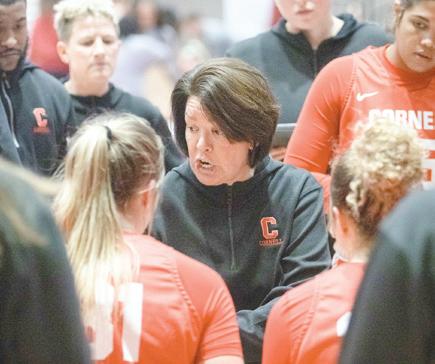
Dayna Smith was dismissed as the head coach of women’s basketball, ending her run as the longest-tenured women’s basketball coach in the Ivy League.
The “effective immediately” change in leadership was announced in a Cornell Athletics press release on Monday, March 11.
Smith “has not been retained” and was consequently “removed as head coach,” according to Senior Associate Director of Athletics for Communications, Jeremy Hartigan, in an email to The Sun.
It was unclear in the press release what specifically prompted Smith’s departure.
A national search will commence to replace Smith’s long-occupied position as head coach. Val Klopfer, associate head coach, will act as the interim head coach until the position is filled.
Smith, hired in 2002, has been at the helm of Cornell women’s basketball for 21 years. Her 224 all-time wins

lead the program, while her tenure was trademarked by a successful run to the NCAA tournament in 2008. Cornell has not achieved a winning conference record since then.
This year, the Red (7-19, 1-13 Ivy) tied for last place in the Ivy League standings. Its 1-13 Ivy League record was its worst performance in conference play since the
2004-05 season.
Cornell has additionally qualified for Ivy Madness –– the annual Ivy League basketball tournament consisting of the conference’s top-four teams –– only once in 2019 since its implementation in 2017.
Dr. Nicki Moore, the Director of Athletics and Physical Education, thanked
By HAMNA WASEEM Sun Assistant Sports Editor
Women’s lacrosse (4-1, 2-0 Ivy) clinched a commanding 13-5 victory against Columbia (2-3, 0-2 Ivy) on Saturday afternoon at Schoellkopf Field, fueled by a powerful first-quarter outburst.


The match highlighted numerous stand-out athletes who scored multiple goals for their respective teams.
Leading the charge for Cornell, senior attacker Maggie Pons showcased her prowess with two goals and two assists, while senior midfielder and captain Bridget Babcock delivered a stellar performance with two goals, one assist and five ground balls. Junior goalkeeper Ellie Horner stood firm between the pipes, tallying a season-high 14 saves and securing her
fourth win of the year for the Red.
The match began with Columbia asserting pressure early, holding Cornell shotless for the first four minutes. However, the Red wouldn’t let that slide, and sophomore midfielder Dillyn Patten netted a goal to give it an early lead.
Columbia then rallied with goals from Sophie Zachara and Cecelia Messner, briefly putting Cornell behind in the race. The Red flipped the script with a clutch save by Horner, followed by a goal from Babcock, which reignited Cornell’s offense.
The Red capitalized on this momentum, scoring five consecutive goals to end the quarter with a commanding 7-2 lead.
The Lions intensified its offensive efforts in the second quarter, but Horner’s stellar goalkeeping thwarted its attempts.
The Red maintained its lead, entering halftime with an 8-3 advantage. Babcock notched the lone Cornell goal in the frame.
The third quarter saw Horner continuing her
exceptional performance, making three crucial saves. Despite a brief scoring drought, Cornell extended its lead with goals from Pons and senior attacker Sophie Ward.
Columbia managed to narrow the deficit with a goal from Messner, but Cornell responded with junior midfielder Annie Parker’s first career goal for the Red, solidifying an 11-4 lead for Cornell heading into the final frame.
The fourth quarter saw a prolonged stalemate before Cornell capitalized on a power play opportunity, extending its lead to 12-4. Despite a late goal from Columbia, Cornell secured the victory with junior midfielder Mia DiChiara’s goal, clinching its 13th straight home win over the Lions.
Women’s lacrosse will have its first true away game this Tuesday, March 12, when it hits the road to take on Binghamton at 4 p.m. The match will be streamed live on ESPN+.
Hamna Waseem can be reached at hwaseem@cornellsun.com.
Smith for her commitment to the program in Monday’s press release.
“Dayna Smith has led the Big Red women’s basketball program for more than two decades with integrity and drive, dedicating herself to developing successful student-athletes on and off the court,” Moore wrote.
Smith also affirmed her
MEN’S BASKETBALL
appreciation for the opportunity to lead the women’s basketball program for over two decades in the press release.
“As I look back on more than 20 years of people and moments, I’m very grateful for the opportunity to have served as head basketball coach at Cornell,” Smith wrote. “I’m especially proud of all that my student-athletes have accomplished at Cornell and all that they’ll continue to do in the future.”
Moore closed the press release with her vision for new leadership.
“As we embark on a new leg of this journey, we do so with unwavering confidence in our ability to discover an exceptional leader who will embrace the ideals of the Ivy League and Cornell University, and who will cultivate, prepare and propel extraordinary student-athletes toward academic and basketball achievement as well as lifelong success and wellbeing,” Moore wrote.
Jane McNally can be reached at jmcnally@cornellsun.com.
By SAM KIMBALL Sun Staff Writer
Men’s basketball (22-6, 11-3 Ivy) entered Saturday’s regular-season finale looking for a victory before the team takes its talents to New York City for the Ivy Madness Tournament where it will face Yale.
The Red never trailed against Columbia (13-14, 4-10 Ivy) and broke away in the second half to secure the 98-76 win and cap off its best regular season since its trip to the Sweet 16 in 2010.
Senior forward Sean Hansen and senior guard Chris Manon combined to score the Red’s first eight points to open the scoring. Columbia responded with eight of its own led by guard Zavian McLean.
The Red would expand its lead after knocking down a trio of three-pointers including two from freshman guard Jake Fiegen and never looked back, continuing to grow the advantage throughout the first half.
Sophomore guard Cooper Noard’s big day started with a three-pointer midway through the first half as he finished the game with a team-leading 17 points, going 5-9 from beyond the arc. But Noard was not the only one with the hot hand from threepoint range. Cornell finished the half going 8-17 from distance while the Lions was 3-11.
While Columbia stuck around throughout most of the first half, the Red always had a response and headed into the locker room with a 49-43 lead.
The Red pulled away in the second half, opening the period on a 9-3 run to increase its lead to 10. Noard hit a jumper in the paint before Manon and senior guard Isaiah Gray tacked on points of their own.
Following the 10-minute mark in the second half, the Red would outscore the Lions 26-15, with notable performances from Noard, sophomore forward AK Okereke and junior forward Guy Ragland Jr. leading the way.
Noard’s power will be significant for the Red as it moves on to the Ivy Madness Tournament. Noard’s five successful three-pointers on Saturday bolstered his season total to 55, putting him 14 above the next-best Cornell three-point shooter while his 20.8 minutes per game averages fourth-best on the team.
The win locks Cornell as the third seed for the Ivy Madness Tournament in New York City from March 16-17. The Red will face off against Yale in its semifinal battle at 2 p.m. on March 16 from Levien Gymnasium. The semifinal game will be streamed live on ESPNews.
Sam Kimball can be reached at skimball@ cornellsun.com.