INDEPENDENT SINCE 1880
The Corne¬ Daily Sun WEDNESDAY, OCTOBER 7, 2026 n ITHACA, NEW YORK
Vol. 143, No. 7
16 Pages – Free
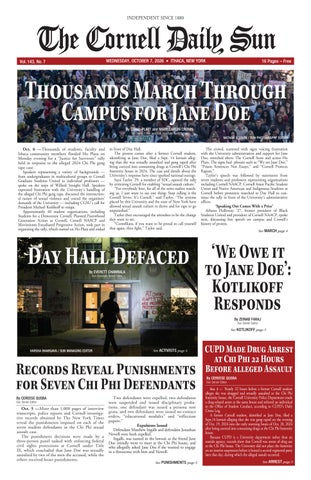
Thousands March Through Campus for Jane Doe By CORAL PLATT and MARY CAITLIN CRONIN Sun News Editor and Sun Assistant News Editor
NATHAN ELLISON / SUN PHOTOGRAPHY EDITOR
Oct. 6 —Thousands of students, faculty and Ithaca community members flooded Ho Plaza on Monday evening for a “Justice for Survivors” rally held in response to the alleged 2024 Chi Phi gang rape case. Speakers representing a variety of backgrounds — from undergraduates in multicultural groups to Cornell Graduate Students United to individual professors — spoke on the steps of Willard Straight Hall. Speakers expressed frustration with the University’s handling of the alleged Chi Phi gang rape, discussed the intersectional nature of sexual violence and voiced the organizers’ demands of the University — including CGSU’s call for President Michael Kotlikoff to resign. Approximately 40 student organizations, including Students for a Democratic Cornell, Planned Parenthood Generation Action at Cornell, Cornell NAACP and Movimiento Estudiantil Progressive Action, took part in organizing the rally, which started on Ho Plaza and ended
in front of Day Hall. The protest comes after a former Cornell student, identifying as Jane Doe, filed a Sept. 14 lawsuit alleging that she was sexually assaulted and gang raped after being coerced into consuming drugs at Cornell’s Chi Phi fraternity house in 2024. The case and details about the University’s response have since sparked national outrage. Saya Taylor ’29, a member of SDC, opened the rally by criticizing Cornell for enabling “sexual assault culture.” “For everybody here, for all of the news outlets watching us, I just want to say one thing: Stop calling it the Cornell Seven. It’s Cornell,” said Taylor. “The systems placed by this University and the state of New York have allowed sexual assault culture to thrive and for rape to go unpunished.” Taylor then encouraged the attendees to be the change they want to see. “Cornellians, if you want to be proud to call yourself that again, then fight,” Taylor said.
Day Hall Defaced By EVERETT CHAMBALA Sun Assistant News Editor
The crowd, scattered with signs voicing frustration with the University administration and support for Jane Doe, stretched above The Cornell Store and across Ho Plaza. The signs had phrases such as “We are Jane Doe,” “Prison Sentences Not Essays,” and “Cornell Protects Rapists.” Taylor’s speech was followed by statements from seven students and professors representing organizations including Cornell NAACP, Cornell Asian Pacific Student Union and Native American and Indigenous Students at Cornell before protesters marched to Day Hall to continue the rally in front of the University’s administrative offices. ‘Speaking Out Comes With a Price’ Athena Holloway ’27, former president of Black Students United and president of Cornell NAACP, spoke next, discussing free speech on campus and Cornell’s history of protest. See MARCH page 4
‘We Owe it to Jane Doe’: Kotlikoff Responds By ZEINAB FARAJ Sun Senior Editor
See KOTLIKOFF page 5
VARSHA BHARGAVA / SUN MANAGING EDITOR
See ACTIVISTS page 5
Records Reveal Punishments for Seven Chi Phi Defendants By CEREESE QUSBA Sun Senior Editor
Oct. 5 —More than 1,000 pages of interview transcripts, police reports and Cornell investigative records obtained by The New York Times reveal the punishments imposed on each of the seven student defendants in the Chi Phi sexual assault case. The punishment decisions were made by a three-person panel tasked with enforcing federal civil rights protections at Cornell under Title IX, which concluded that Jane Doe was sexually assaulted by two of the men she accused, while the others received lesser punishments.
Two defendants were expelled, two defendants were suspended and issued disciplinary probations, one defendant was issued a persona non grata, and two defendants were issued no-contact orders, “educational modules” and “reflection papers.” Expulsions Issued Defendant Matthew Ingalls and defendant Jonathan Newell were both expelled. Ingalls, was named in the lawsuit as the friend Jane Doe initially went to meet at the Chi Phi house, and who allegedly asked Jane Doe if she wanted to engage in a threesome with him and Newell. See PUNISHMENTS page 5
CUPD Made Drug Arrest at Chi Phi 22 Hours Before alleged Assault By CEREESE QUSBA Sun Senior Editor
Oct. 2 — Nearly 22 hours before a former Cornell student alleges she was drugged and sexually assaulted at the Chi Phi fraternity house, the Cornell University Police Department made a drug-related arrest at the same house and referred an individual to the Office of Student Conduct, according to CUPD’s Daily Crime Log. A former Cornell student, identified as Jane Doe, filed a Sept.14 lawsuit alleging that she was gang raped on the evening of Oct. 19, 2024 into the early morning hours of Oct. 20, 2024 after being coerced into consuming drugs at the Chi Phi fraternity house. Because CUPD is a University department rather than an outside agency, records show that Cornell was aware of drug use at the Chi Phi house. The University did not place the fraternity on an interim suspension before it hosted a second registered party later that day, during which the alleged assault occurred.
See ARREST page 5
2 The Cornell Daily Sun | Wednesday, October 7, 2026
Daybook
The Cornell Daily Sun | Wednesday, October 7, 2026 3
PHOTO
SUNBURSTS: Justice for Survivors Cornellians and Ithacans gather for a “Justice for Survivors” rally on Ho Plaza on Monday evening. Sun photographers covered the action.
By SUN PHOTOGRAPHY DEPARTMENT
Stephan Menasche / Sun Senior Photographer SOLIDARITY | Protesters march on Campus Road from Ho Plaza to Day Hall.
Sophia Romanov Imber / Sun Associate Editor SAFETY | One sign that reads “Where am I safe?” stands out among the crowd of protesters.
Adelaide Chow / Sun Assistant Photography Editor JANE DOE | Protesters wear name tags labeled “Jane Doe” in response to online attempts to doxx the plaintiff in the Sept. 14 Chi Phi lawsuit.
Nathan Ellison / Sun Photography Editor MASSES | Thousands gather on Ho Plaza to advocate for justice for sexual assualt survivors.
Nathan Ellison / Sun Photography Editor RESIGN NOW | Protesters sit atop The Cornell Store to express their dismay with University administrators.
Samantha Miculinich / Sun Staff Photographer DAY HALL | Protesters gather at Day Hall after marching from Ho Plaza.
Nathan Ellison / Sun Photography Editor FREEZE FRAME | Hand-in-hand with Spider-Man, a protester holds a sign reading “We are Jane Doe.”
Karlie McGann / Sun Senior Editor GREEK LIFE | Demonstrators hold signs with red lettering beside the crowd in front of Day Hall.
To see more photos, please visit cornellsun.com.
4 The Cornell Daily Sun | Wednesday, October 7, 2026
NEWS
Nancy Pelosi Cancels Cornell Edits FAQ Page Cornell Speaker Event The University edited a statement from its FAQ page on the 2024
The representative canceled her appearance at alleged Chi Phi sexual assault at least twice since it was published. investigated the allegations in 2024, then followed the event because of the alleged Chi Phi assault. By VARSHA BHARGAVA and KATE TURK the “established protocol” by “shar[ing] all investigaSun Managing Editor and Assistant Managing Editor
By ATTICUS JOHNSON Sun News Editor
Oct. 1 — Just one day after the Cornell Institute of Politics and Global Affairs announced a “fully-funded” New York City trip featuring Rep. Nancy Pelosi (D-Calif.), the former speaker canceled the event due to the alleged 2024 gang rape at the Chi Phi fraternity house, The Sun has learned. The cancelation of the New York City event was “related to the gang rape situation” currently occuring at the University, according to a source familiar with the matter. It comes after a former Cornell student, identified as Jane Doe, filed a lawsuit against the University, Chi Phi and others on Sept. 14, alleging that she was sexually assaulted and gang raped after being coerced into consuming drugs at Cornell’s Chi Phi house in 2024. The event, marketed as an “opportunity to hear from and engage” with Pelosi, was planned for Oct. 15 at the ILR NYC Conference Center, and was sent to students by the Cornell IOPGA on Tuesday afternoon, according to an email obtained by The Sun. On Wednesday afternoon,
MARCH
Continued from page 1 “When I first came to Cornell, I was excited … I heard ‘any person, any study,’ and I believed it,” Holloway said. “So, imagine the disappointment of discovering what can happen when that ‘any person’ needs help, when that ‘any person’ speaks out, when that ‘any person’ demands accountability.” Holloway pointed to the AfroAmerican Society Willard Straight Hall Takeover of 1969 and Latino Cornellians’ Day Hall Takeover of 1993 as times students successfully organized to demand change of the University. “Cornell has changed before, and we can change it again,” Holloway said. Jocelyn Jao ’28, a member of Cornell Asian Pacific Student Union, shared a story about one of her friends, a Korean international student, who didn’t attend the protest out of a fear of retribution, connecting her friend’s experience with broader concerns about activism on campus.
though, the RSVP form was closed and the IOPGA said the event was canceled, according to a subsequent email obtained by The Sun. Since the initial email announcing the event was sent, elected officials nationwide have slammed Cornell and law enforcement’s handling of the alleged gang rape. Sen. Kirsten Gillibrand (D-N.Y.) called the allegations “serious and horrific” and condemned a “system that is fundamentally broken,” while Sen. Chuck Schumer (D-N.Y.) said there should be an investigation that leaves “no stone unturned.” “Whether it’s my university or anyone’s university, clearly there’s been some sort of delay in accountability, and that needs to end,” Sen. Elissa Slotkin ’98 (D-Mich.) told TMZ. Pelosi, who is retiring after her current term ends in 2027, has no plans to reschedule the event, according to the source. The University did not immediately respond to a request for comment. Giselle Redmond ’28 contributed reporting. Atticus Johnson can be reached at ajohnson@cornellsun.com.
“Across this campus, students are afraid that speaking out could mean being disciplined, suspended or losing their place here,” Jao said. “International students worry about losing their visas. Students on financial aid worry about their scholarships. All of us have been taught that speaking out comes with a price.” Other speakers drew connections between activism on campus and the alleged Chi Phi gang rape. Andrea Cicirello, a fourth year Ph.D. student and CGSU financial secretary, compared the University’s response to the alleged Chi Phi gang rape with its response to a September 2024 pro-Palestinian protest at the Statler Hall career fair. The two incidents took place approximately two months apart. At least 15 students were suspended for shutting down the career fair — with some banned from campus for up to three years. “Cornell administration responded [to the career fair shutdown] swiftly and aggressively, suspending students and threatening grads with deportations,” Cicirello said. “Their reasoning was that immediate action was necessary to protect
Oct. 2 — In the two days after Cornell released an FAQ page about its handling of the alleged 2024 Chi Phi gang rape, the University made multiple changes to its statement on information shared with the district attorney’s office in 2024, The Sun found. The FAQ page, published on Tuesday, originally stated that the Cornell University Police Department shared “all investigatory information” with the Tompkins County district attorney’s office in 2024. The page no longer includes this statement. The FAQ page has been updated at least twice since its original posting, first striking the statement about the D.A. entirely on Wednesday before replacing it with a statement that specifies “the victim’s sworn statement and the Snapchat screenshot were shared” on Thursday. The Snapchat screenshot refers to an image, included in the Sept. 14 lawsuit, that pictures one defendant allegedly encouraging his fraternity brothers to join in on the alleged assault, messaging about “free pussy” in a Snapchat group chat titled “Chi Phi Actives.” In the lawsuit, a former student identified as Jane Doe alleged that she was sexually assaulted and gang raped after being coerced into consuming drugs at Cornell’s Chi Phi house in 2024. The district attorney for Tompkins County reopened a criminal investigation into the case on Monday. At the top of the FAQ page, the University acknowledged that its answers could change, noting that it would update the page “as necessary.” The updates to the FAQ page change Cornell’s response to one question. “Did Cornell Police adequately investigate the incident? Why didn’t they bring in the Ithaca Police?” the page asked. Originally, the University answered that CUPD the University community. At the exact same time, the seven men who raped Jane Doe were being protected by this University. For them, there apparently was no immediate action necessary to protect the University community.” The punishments of the seven defendants listed in Jane Doe’s lawsuit ranged from educational sanctions and no-contact orders to suspensions and expulsions, according to documents obtained by The New York Times. Three professors, Prof. Sabrina Karim, government, Prof. Julia Chang, romance studies, and Prof. Dan Hirschman, sociology, concluded the speeches at Ho Plaza. “They call it the ‘Cornell Seven,’ but we are Cornell too,” Chang said. “The decades of Jane Does are Cornell. The 58,000-plus alumni who signed the petition in support of Jane Doe, they too are Cornell. The dozens of student organizations that make this protest happen today, you are Cornell.” A petition of Cornell alumni pledging to withhold donations to the University in support of Jane Doe has surpassed over 60,000 signatures. ‘Do Not Let This Fight End Today’ The protesters then marched from Ho Plaza to Day Hall, which serves as the main administrative building on campus. Once at Day Hall, several students led a protest song called “The rapist is you,” which was created by the Chilean feminist movement Las Tesis. The call-and-response song featured lyrics in both English and Spanish connecting rape to the patriarchy. Following the song, three organizers of the protest, Marianne Levitova ’29, Izzy Margolin ’29 and Emely Gutierrez ’28, listed the organizers’ demands of the University regarding sexual assault and the handling of the alleged Chi Phi gang rape.
tory information with the Tompkins County District Attorney’s Office.” It then clarified that CUPD is a “sworn law enforcement agency and performs the same functions as municipal police.” On Wednesday, the University struck the sentence about the D.A. entirely. It also changed its description of CUPD. “The Cornell University Police Department is a unit of the university, and its officers are sworn Tompkins County deputy sheriffs whose duties include the enforcement of law and order on Cornell’s property,” the updated answer read. On Thursday, the University revised and added back a statement about its disclosure of information to the D.A.’s office, clarifying that the sworn statement and the Snapchat image were shared. The change again updated the description of CUPD to describe officers as “special deputy sheriffs pursuant to NY Educational Law 5709.” None of the updates changed a subsequent question which read “Did Cornell provide the Snapchat screenshot to the District Attorney?” “The Cornell University Police Department provided it as part of the evidence supplied to the District Attorney in November 2024,” the University answered. This statement contradicts a Monday interview in which Tompkins County District Attorney Matthew Van Houten told ABC News that his office never received this Snapchat image. The University did not immediately respond to The Sun’s request for comment on why the page was updated. Varsha Bhargava and Kate Turk can be reached at vbhargava@cornellsun.com and kturk@cornellsun.com
The organizers demanded that Cornell expel or revoke the degrees of all of the alleged assaulters, implement mandatory sexual assault trainings for all students and trauma-informed trainings for the Cornell University Police Department, initiate an external investigation into its handling of the case and return to a University-wide judicial system independent of the administration. The organizers’ demands for an external investigation were echoed by Gov. Kathy Hochul (D-N.Y.), who called for a “transparent, independent review” of the University’s response to the alleged 2024 gang rape on Sept. 29. New York State Attorney General Letitia James (D-N.Y.) launched an investigation the same day. The demands also ask Cornell to revise Policy 6.4 — which addresses sexual misconduct — to require independent hearings and minimum sanctions for sexual assault violations, and to comply with New York State’s “Enough is Enough” law, requiring universities to adopt “a set of comprehensive procedures and guidelines” regarding sexual misconduct. Some speakers at the protest announced individual demands related to the alleged Chi Phi gang rape. Cicirello called for the resignation of several top administrators, including Kotlikoff, Provost Kavita Bala, Ryan Lombardi, vice president for student and campus life, and Chirstina Liang, director of the Office of Student Conduct and Community Standards. Hirschman called for the banning of fraternities on campus in his speech, saying that fraternities are “the places where the most horrific events happen over and over again.” Several students involved in organizing and attending the protest expressed frustration with the handling of the alleged Chi Phi gang rape and shared that they attended the
protest to show solidarity and create change regarding sexual violence on campus. El Claver ’28, a safety marshall for the rally, told The Sun they chose to participate because the case has been “depressing” and left them feeling “helpless.” “When the administration that’s supposed to protect you doesn’t, you feel the need to take it into your own hands,” Claver said. Josefina Rodriguez, a graduate student at Cornell, explained that she attended the protest both to create change and engage with the community. “I chose to be here today because I’m f*cking angry,” Rodriguez said. “I need to see change and we are furious and I also cannot stand processing these types of situations alone. I feel like it’s a collective situation that we all need to face.” For Emeka Okereke ’28, attending the protest was important to him, to “show support, especially as a male on campus.” Madeline Gage ’27, a member of the American Civil Liberties Union Chapter at Cornell concluded the rally by thanking Jane Doe. “In standing up for yourself, you have inspired others to stand up for all survivors,” Gage said. “We cannot take away the failures of the past, but we can commit to preventing them in the future.… Do not let this fight end today or with Jane Doe. Dare to envision a future free from sexual violence, and continue to fight for it.” The University declined to comment. Coral Platt and Mary Caitlin Cronin can be reached at cplatt@ cornellsun.com and mcronin@ cornellsun.com
The Cornell Daily Sun | Wednesday, October 7, 2026 5
News
PUNISHMENTS
KOTLIKOFF
Continued from page 1
Continued from page 1
Newell also allegedly sent a Snapchat message in a fraternity-wide group chat inviting other fraternity members to enter the room where Jane Doe was undressed, according to discipline summaries obtained by The Times. Jane Doe claimed that the men pressured her into consuming ketamine and alcohol and eventually other defendants joined in sexual activity without her consent while she was incapacitated, according to the lawsuit. Ingalls was accused of sexual assault, as he was willing to “manipulate, exploit and endanger Jane Doe out of self-interest and for the entertainment of others,” according to The Times. The panel also found Newell responsible for sexual assault, according to the University’s files. According to the lawsuit, he struck Jane Doe with enough force during intercourse to leave bruises on her buttocks, and he had manipulated her to ingest ketamine. Ingalls and Newell did not immediately respond to a request for comment. Suspensions Issued Defendants Winston Lee and Gillio Lopes were both issued suspensions and disciplinary probation — Lee for allegedly inhaling ketamine off of Jane Doe’s body and forcing oral sex on her, and Lopes for allegedly having sex with Jane Doe without her consent. In addition to a two-year suspension, Lee was also punished with several semesters of disciplinary probation upon his return. Lee’s attorney did not immediately respond to a request for comment. Lopes was issued a three-semester suspension and two years of probation according to the discipline summaries, as reported by The Times. Both Lee and Lopes were issued no-contact orders with Jane Doe and were mandated to study sexual harassment and to write “reflection papers.” Lopes did not immediately respond to The Sun’s request for comment. Three-Year Campus Ban The Times reported that Diego Sarabia, who graduated before the disciplinary panel’s conclusion, was issued a persona non grata order — barring him from campus for three years — for allegedly forcibly kissing Jane Doe. In the lawsuit, Sarabia allegedly entered the room with multiple other fraternity men, at which point Doe allegedly “retreated under the covers of her bed to hide her naked body.” Sarabia then “grabbed her face and started kissing” Jane Doe without her consent before she “pushed him away,” the lawsuit alleges. Sarabia did not immediately respond to The Sun’s request for comment. No-Contact Orders and Educational Sanctions Defendants Scott Norris and Scott Kretzschmar were issued no-contact orders with Jane Doe and were ordered to complete “educational modules” on sexual harassment, social media use and bystander intervention. They were also ordered to write “reflection papers.” Both were accused of entering the room after Newell sent a Snapchat message to the Chi Phi groupchat, according to the lawsuit. Norris did not immediately respond to The Sun’s request for comment. A lawsuit against Cornell, which The Times claims was filed by Kretzschmar, revealed that he was found responsible for attempted sexual exploitation. In a statement to The Sun, Jeremy Saland, an attorney for Kretzschmar, stated that “Scott did not know of or observe any of this conduct, it is unfair and unjust to treat and accuse him as if he committed such a horrid crime.” While he admitted that Kretzschmar was “part of a deplorable SnapChat,” Saland maintained his client never saw Jane Doe naked and never saw her in duress. A spokesperson from the University wrote to The Sun that the “Title IX investigation resulted in a range of sanctions, which included expulsions and suspensions from Cornell.” The spokesperson reiterated to The Sun that none of the individuals charged were assigned writing essays as a “sole consequence of their involvement.”
Cornell President Michael Kotlikoff addressed national scrutiny over Cornell’s handling of the alleged 2024 Chi Phi gang rape in an eight-minute video released to the Cornell community Saturday afternoon. The statement comes after a former Cornell student filed a Sept. 14 lawsuit alleging that she was sexually assaulted and gang raped at Cornell’s Chi Phi fraternity house in 2024. This case and details about the University’s investigation have since sparked national outrage and heightened media attention on campus. Kotlikoff stated that “this has been one of the most difficult weeks” in the University’s history, amid nationwide frustration and questions raised about the University’s handling of the allegations in 2024. The University has faced backlash for a claim made in the lawsuit that defendants were allowed to “mitigate their conduct” with essays. Cornell has since denied that essays were the “sole consequence” for any defendants and confirmed that expulsions and suspensions were issued. He also expressed his support for an independent review of the case by an outside law firm, which he said the Board of Trustees will announce next week, as well as Gov. Kathy Hochul’s (D-N.Y.) decision to appoint New York State Attorney General Letitia James as special prosecutor for the criminal investiga-
Continued from page 1
When Jane Doe issued her complaint to CUPD, the Chi Phi fraternity was placed on suspension effective Nov. 8, 2024, twenty days after the drug arrest. Chi Phi was registered to host a party at its fraternity house at 107 Edgemoor Ln. — which is owned by the University — on Oct. 18, 2024 beginning at 10:30 p.m., according to a screenshot of Sorority and Fraternity Life’s registered events obtained by The Sun. According to an archived page of CUPD’s Daily Crime Log, CUPD found drugs at the Chi Phi house just hours before Jane Doe’s alleged drugging and sexual assault. On Oct. 19, 2024 at 1:05 a.m., CUPD responded to a call at the Chi Phi house. Between 1:03 a.m. and 1:41 a.m., CUPD made a drug-related arrest at the fraternity house and referred an individual to Cornell’s Office of Student Conduct. Hours later, on Oct. 19, 2024 at approximately 8:30 p.m., Jane Doe allegedly took an Uber from Alpha Beta Chapter of Tri Delta’s sorority house at 118 Triphammer Rd., arriving at Moonies Bar & Nightclub around 9 p.m., according to the lawsuit. After stopping at Lot 10 Bar and Lounge, Jane Doe claimed
Zeinab Faraj can be reached at zfaraj@cornellsun.com.
ACTIVISTS Continued from page 1
Anonymous activists smashed a glass door at the entrance of Day Hall and painted messages on the walls of the building in response to the alleged 2024 Chi Phi gang rape at approximately 3 a.m. on Monday. Both the top and bottom pane of the right hand door were smashed, leaving shards of glass littering the entryway and the floor of Day Hall. The messages, which read “SMASH THE PATRIARCHY” and “AT CORNELL RAPISTS ARE PROTECTED PROTESTORS ARE EXPELLED,” were written in red paint on the two walls surrounding the doors. The security camera above one of the graffitied messages was also painted over. This demonstration comes in response to a lawsuit filed on Sept. 14 by a former Cornell student who alleged that she was sexually assaulted and gang raped by seven members of the Chi Phi fraternity in 2024, according to a statement from the activists sent to The Sun. The actions were motivated by both the lawsuit and “in protest of the global systems of power that allowed this to happen in the first place,” the activists wrote in their statement. “We wanted to ensure that Day Hall, the center of Cornell’s administrative function, was not able to continue business as usual,”
Cereese Qusba can be reached at cqusba@cornellsun.com.
ARREST
tion. Hochul wrote in the Thursday press release that appointing James to oversee the criminal investigation “will ensure that the matter is fully and thoroughly investigated without conflict or bias.” “The young woman at the center of this case deserves to know that every fact will be examined and justice pursued,” Hochul wrote. The University does not plan to wait for the conclusion of the investigation or review to act, Kotlikoff noted. “We don’t have all the answers, but we are committed to investigating and finding the answers our community deserves,” Kotlikoff said. “I believe we as an administration and we as a community must do better.” Kotlikoff outlined several steps the University must take, including fostering an environment where sexual assault victims “feel safe coming forward,” creating systems that “are trauma-informed” and investigating allegations “rigorously and fairly” while providing survivors the resources they need. “The review should inform additional changes, not delay improvements already underway or ones we know we can make today,” Kotlikoff said. “I believe the change starts with us, the Cornell community.” The University plans to examine Greek life’s role on campus and advocate for reform to New York’s sexual assault laws, Kotlikoff added. To continue reading this story, please visit www. cornellsun.com.
that she drunkenly walked to the Chi Phi house at around 11 p.m. On Nov. 8, 2024, CUPD received a report of a sexual assault that allegedy occured at the Chi Phi house between 11 p.m. on Oct. 19, 2024 and 5:45 a.m. on Oct. 20, 2024, according to the lawsuit. Cornell University SFL Social Event Policy states that “No person may possess, use, provide, distribute, sell, and/or manufacture illegal drugs or other controlled substances while on organizational/chapter premises or at any activity or event sponsored or endorsed by the organization.” If a violation poses health and safety risks, the policy states that “the chapter may be immediately placed on interim suspension, with all chapter activities ceased pending the outcome of an organizational conduct proceeding.” The University did not directly answer who has the discretion to place a fraternity or sorority on interim suspension. The policy has been effective since 2021 and was last updated on Sept. 10, 2025. Cornell did not provide The Sun with the version of the policy effective in November 2024. The Sun could not obtain a previous version of this policy that was in effect during the time of these incidents. The Sun reached out to CUPD to clarify procedures including the timeline between an arrest and referral to the Office of
the activists wrote to The Sun. Cornell University Police Department officers arrived at Day Hall at approximately 3:50 a.m., clearing the scene and observing the vandalism. The officers declined to comment while at the scene. When asked about their goals for the demonstration, the activists wrote that they are calling for the “abolition of [Interfraternity Council] greek life on campus, resignation or termination of the named administration officials, the replacement of Cornell’s Office of Student Conduct and Community Standards with a democratic disciplinary system, and expulsion/revocation of degrees for all Chi Phi members involved in the rape,” in a statement to The Sun. The alleged rape was a product of “morally corrupt systems” at Cornell and around the world, the activists wrote. They added that these systems have “historically punished women for speaking out about sexual violence.” The Chi Phi lawsuit has sparked national outrage, inspired international media coverage and has received attention from celebrities and public figures. To continue reading this story, please visit www. cornellsun.com. Everett Chambala can be reached at echambala@cornellsun.com.
Student Conduct and when the University became aware of the arrest. CUPD did not respond to a request for comment. When asked how soon after a CUPD arrest the Office of Student Conduct is notified of a referral, a University spokesperson responded, “No comment.” A recently released hearing panel decision from Cornell’s Title IX investigation into the alleged assault noted that an individual overdosed at Chi Phi. “Ketamine was a substance used by multiple individuals in the Chi Phi house at the time, including [redacted] who had overdosed on or about Oct.18, 2024,” according to the investigation document. Multiple sources familiar with the situation verified with The Sun that there was a drug-related health concern that night. The lawsuit states that prior to the incident, Cornell knew or should have known that Xi Chapter had a history of drug-use culture, specifically ketamine. According to the lawsuit, Cornell knew, or should have known, that they did not have sufficient information about whether the fraternity house was safe and if its members posed a danger to fellow students, including Jane Doe. To continue reading this story, please visit www. cornellsun.com. Cereese Qusba can be reached at cqusba@cornellsun.com.
6 The Cornell Daily Sun | Wednesday, October 7, 2026
The Corne¬ Daily Sun Independent Since 1880 144th Editorial Board SOPHIA DASSER ’28
Editor in Chief VARSHA BHARGAVA ’27 SOPHIA ROMANOV IMBER ’28 Managing Editor Associate Editor RAYEN ZHOU ’29 Opinion Editor
KATE TURK ’27 Assistant Managing Editor
ZARA CHEEK ’28 Opinion Editor JADE DUBUCHE ’27 Multimedia Editor KENDALL MURPHY ’28 Business Manager
CORAL PLATT ’29 News Editor ATTICUS JOHNSON ’28 News Editor MARY CAITLIN CRONIN ’28 News Editor EVERETT CHAMBALA ’27 Assistant News Editor
CHARLIE CLARK ’29 Director of Revenue & Partnerships VICTORIA WROBLEWSKI ’28 Human Resources Manager MELISSA MOON ’28 Arts & Culture Editor JAMES PALM ’27 Assistant Arts & Culture Editor MATTHEW RENTEZELAS ’28 Assistant Arts & Culture Editor HAZEL TJADEN ’28 Assistant Arts & Culture Editor MARC STAIANO ’27 Assistant Arts & Culture Editor KATELYN HALVERSON ’28 Lifestyle Editor AVA BETNAR ’29 Assistant Lifestyle Editor SANIKA SARAF ’28 Assistant Lifestyle Editor KATHERINE ISTOMIN ’29 Marketing Manager JACK MCAULIFFE ’29 Assistant Social Media Editor ASHLIN KWONG ’28 Graphics Editor TAVAN BHATIA ’27 Games Editor RENA GEULA ’28 Layout Editor
SHUBHA GAUTAM ’28 Assistant News Editor GISELLE REDMOND ’28 Assistant News Editor ANGELINA TANG ’28 Science & Technology Editor TANIA HAO ’28 Science & Technology Editor SIMRAN LABORE ’27 Weather & Climate Editor MATTHEW LEONARD ’28 Sports Editor GRACE REUBEN ’28 Sports Editor JANE HAVILAND ’28 Features Editor NATHAN ELLISON ’28 Photography Editor NATHAN BO ’28 Assistant Photography Editor ADELAIDE CHOW ’29 Assistant Photography Editor MIA SOFIA ORENGO ’28 Video Editor OAKLEY DECRISTOFARO ’29 Video Editor AMELIA GARCIA ’27 Data Editor HUNTER PETMECKY ’28 Layout Editor
WORKING ON TODAY'S SUN MANAGING NEWS DESKERS
SPORTS DESKER SCIENCE DESKER OPINION DESKERS LIFESTYLE DESKERS ARTS DESKERS PHOTO DESKERS
Varsha Bhargava '27 Kate Turk '27 Sophia Romanov Imber '28 Atticus Johnson '28 Everett Chambala '27 Coral Platt '29 Mary Caitlin Cronin '28 Grace Reuben '28 Angelina Tang '28 Rayen Zhou '29 Zara Cheek '28 Katelyn Halverson '28 Ava Betnar '29 Melissa Moon '28 Matthew Rentezelas '28 Nathan Ellison '28 Stephan Menasche '28
Steven Waisbren Steven Waisbren '82 graduated from the College of Arts and Sciences. He can be reached at swaisbren@hotmail.com.
I
"What Happened?"
t has been 44 years since I graduated from Cornell and, with recent events concerning the 2024 alleged assault at Chi Phi, I have been asking myself, “What happened?” Way back in in the late 1970s, I was a founding member and later chair of the campus group entitled Community Against Rape. The focus of this grass-roots organization — which was well-supported by the Cornell administration — was twofold: Prevent sexual assault in and around the campus and remove the stigma from the victims of sexual violence. We organized many programs to achieve these goals. With funding from the University we brought in speakers to educate students on how to make themselves less vulnerable to this crime. Others worked to break down myths about sexual assault such as a woman ‘was asking for it’ because she dressed in a short skirt. We worked hand in hand with the campus police to teach self defense in the horrible scenario that one were to be attacked. As the representative from CAR, I served on the Campus Police Advisory Council to help coordinate these efforts with law enforcement. Students from the College of Engineering collaborated with the campus police to design the Blue Light Escort Service. At the time, these were volunteers, always pairs of one male and one female student, wearing recognizable wind breakers carrying walkie talkies to walk students home late at night. We thought it a great idea and it was well-received by the campus community. We liked the symbolism of both a man and woman providing the escorts. This took away the concept that men need to protect women. We also liked the fact that the students wearing the blue windbreakers carrying the walkie talkies could be seen all around campus at night. This fostered both a sense of community amongst us and served as a reminder to be aware of crime on campus. I am proud to say that my graduating class in 1982 chose this program as one of our ‘goodbye’ gifts to the University. Now, two generations later, I am learning that the administration has treated sexual assault as an educational issue — rather than criminal. All I can do is shake my head. Let’s hope that the recent publicity of these issues may help reorient the current administration back to one that recognizes sexual assault as a crime to be prevented and where the perpetrators are prosecuted to the fullest extent of the law.
Opinion Editor's Note: The following articles discuss sexual assault
Marco Fuentes
The following is an edited version of an open letter delivered by Marco Fuentes ’85 to President Michael Kotlikoff and members of Cornell University’s Board of Trustees. He can be contacted at marco_a_fuentes@hotmail.com.
An Open Letter to President Kotlikoff
Through your administrative negligence and spineless handling of the alleged ‘Cornell Seven’ sexual assault, you have single-handedly degraded the reputation of Cornell University and eroded the value of the degrees earned by tens of thousands of proud alumni. How do you intend to face alumni and request financial support after presiding over such a catastrophic failure of moral and executive leadership? Be advised that I am immediately instructing my legal counsel to amend my estate plan: the 50% bequest of my estate pledged to Cornell University is officially revoked. Furthermore, I am actively contacting fellow alumni, donor networks and class leadership to advocate for a complete, coordinated freeze on all personal and institutional contributions until leadership changes occur. A student claims she was gang-raped by individuals who remain enrolled on your campus. In what universe — scientific, legal or moral — is this tolerable? If you truly believe the University’s cowardly response under your watch was appropriate, you are dangerously unfit for university leadership. Your managerial incompetence would be better suited as an assistant manager at a Waffle House or a frontdoor crier for a Bangkok go-go bar. While you cannot police every private act of fraternity members, you possess total authority over the institution’s administrative response. In failing to act decisively, your weakness makes you de facto complicit in the violation and revictimization of this young woman.
If Cornell is to salvage any fraction of its standing, you must execute the following non-negotiable demands immediately: 1. Complete a full and compassionate settlement with the victim who was brutalized by these perpetrators and further victimized by your administration. 2. Immediately expel every remaining student involved in this crime. 3. Suspend every fraternity member who viewed the group messages and remained silent accomplices. 4. Permanently ban the fraternity from Cornell University without possibility of reinstatement. 5. Terminate every administrator and officer involved in approving this shameful response. 6. Issue a formal, public apology to all students and alumni for failing in your fundamental duty of care. Make the institutional punishment so severe that no student will ever entertain such behavior again, and prospective female students will not have to weigh the risk of sexual violence when deciding whether to apply to Cornell. Character is defined by how leadership responds to institutional failure. To date, you have failed miserably on every count. You must rectify this immediately — for the victim, for the current student body now disgraced by your leadership and for the alumni currently removing their Cornell diplomas from their walls in disgust. Copies of this letter are being transmitted directly to the Board of Trustees along with a formal demand for your immediate resignation.
Alexandra Colin Klein This letter was substantially written by Alexandra Colin Klein ’18, a former co-lead of Sexual Assault Awareness Week at Cornell University, in her personal capacity as an alumna of the University. This letter was also signed by 1,000+ alumni.
T
Decades of Jane Does
he brutal rape allegations made by Jane Doe against seven members of Chi Phi at Cornell will forever be tied to the University’s legacy. This is not just a headline, it is a moment in Cornell’s history that will never be forgotten. The question that remains is whether this will become a turning point in that history, a moment where the University takes swift and expansive action to protect its students. Will Cornell take this as an opportunity to ask difficult questions about the proliferation of sexual violence on its own campus? Or will it shy away from reform to protect its image? This is not an isolated incident. Dangerously, it appears to be a part of a pattern that is growing rather than shrinking. A 2025 University survey found that 35% of undergraduate women reported experiencing nonconsensual sexual conduct during their Cornell careers. That same study saw an increase in students experiencing nonconsensual sexual contact since entering Cornell, up from 11% in 2023 to 15% in 2025. Cornell is well-aware that sexual assault, harassment and violence are prevalent issues for its students. In fact, the term sexual harassment was coined by Lin Farley in 1975 during her time as an instructor at Cornell University. Cornell purports to be implementing the recommendations of a task force, assembled, as The Cornell Daily Sun Editorial Board noted, five months too late. In fact, Farley’s work highlights that it is 51 years too late. And the recommendations from the school’s Presidential Task Force on Campus Sexual Assault offer no clear timeline for implementation. And the report appendix itself states that admittedly critical steps such as “programming for fraternities and sororities” as well as “greek prevention strategy that moves beyond reducing risk” are concededly not in progress. Other recommendations, such as safe ride programs, are efforts students called for over 15 years ago. A report that fails to contend with administrative deficiencies is not enough. Survivors deserve better support, resources and access to justice. Reporting a campus sexual assault is an arduous and difficult process. In her memoir, Know My Name, Chanel Miller described navigating the judicial system as a mountain, where, “[m]ost victims are turned away at the base of the mountain, told they don’t have enough evidence to make the journey. Some victims sacrifice everything to make the climb, but are slain along the way, the burden of proof impossibly high.” That Jane Doe was failed by Cornell’s administration merely repeats a pattern well known to survivors at Cornell. Of the students in Cornell’s 2025 survey who said they had experienced nonconsensual sexual conduct, only 23% contacted a formal resource. Cornell should be working to make this process more accessible, rather than hiding it from students, alumni and the public. The University must publish the standard by which a suspension
in a sexual assault case is lifted, state whether an allegation of sexual assault is eligible for emergency suspension at all under the revised Student Code of Conduct, share with complainants the outcomes of their investigations and better fund and resource those departments and centers dedicated to supporting survivors in their time on campus. In a public statement released on Sept. 28, Cornell University attempted to silence public critique of those punishments levied in Jane Doe’s case. The claim that this will “make survivors feel less safe and supported, and perpetuate the underreporting of sexual assault,” is an unsubstantiated and dangerous effort to quash a necessary and vital conversation about the results of a flawed Title IX process. Jane Doe herself has claimed that consequential punishments were not imposed for those involved. The fact that one survivor’s experience mirrors those of countless individuals who attempted to navigate the University’s formal reporting process should be a warning sign to Cornell, rather than an impetus for lashing out. And silencing critiques of what many understand to be a flawed system offers no indication that the University is open or willing to contemplate changing formal resources that fail to serve the student body. As journalist Rita Omokha stated in her article, Cornell Didn’t Just Fail One Woman. It Failed Everyone Watching., “this is about a system that has decided, at every structural level, that the comfort and future of the accused matters more than the safety and survival of the survivor.” That structural framework must change. The question for the University cannot simply be asking how it failed Jane Doe. Rather, we ask the school to take action: What is Cornell doing to ensure that future Jane Does are not failed again? Cornell’s community deserves a genuine plan of action, including affirmative steps that the administration is going to take to rectify the harm it has allowed to blossom — unchecked — for decades. For too long, this work has fallen on students, rather than the administration. Ezra Cornell founded an institution “where any person can find instruction in any study.” But the campus’s commitment to inclusion cannot exist alongside a culture of sexual violence and predation. No survivor can functionally achieve their academic goals when they are forced to sit beside their assailant or live in fear of retribution and retaliation. This moment of public scrutiny is one in which the University must turn inward to seek out the roots of sexual violence within its halls. At this undeniable turning point, it is unclear how Cornell will respond. We ask our alma mater to rise to the occasion, rather than shirk its responsibilities, for the sake of both Jane Doe and every Cornellian — past, present and future.
The Cornell Daily Sun | Wednesday, October 7, 2026 7
COLUMNS
Editor's Note: The following articles discuss sexual assault
Cynthia Robinson Guest Room
Professor Cynthia Robinson is the Mary Donlon Alger Professor in the Department of History of Art & Visual Studies and an art historian. She can be contacted at cynrobin@earthlink.net.
C
ould we? Could we, as a University community, have made choices and taken actions other than the ones we did, such that the alleged gang rape of Jane Doe might never have occurred? This question is often asked in the aftermath of rape — “sexual misconduct” seems hardly adequate — such as the one allegedly perpetrated, on our campus, two years ago, on Jane Doe, now coming tardily to light. I do not ask this question rhetorically; I would not pose it if I did not believe the answer to be “yes.” I was older than Jane Doe — 26 — when it happened to me. I was in a place, and a situation, that put me at risk. According to the lawsuit, she was at a party hosted by a fraternity, a situation into which I put myself more times than I can count during my undergraduate years; when my rape happened, I was hitchhiking along the border between two European countries. Similar to Jane’s account, I had been drinking. I don’t know what Jane was wearing — I’d imagine clothes like any young woman would wear to a party. On the night I was raped, I was wearing a short skirt. And a halter top: it was July. Like Jane says, I was raped by more than one person. Two is not as horrific as seven; one is far too many. It is true that Jane and I each put ourselves into the situations, and the condition, that preceded both my own rape and her alleged one. Such observations concerning Jane have been plentiful throughout the past week. I have heard similar statements regarding myself; those who make them are usually not well informed on the issue of rape. We need to do better. Rape is a difficult topic and misconceptions abound. No one is immune: I deleted “led to” in the opening sentence of this paragraph and replaced it with “preceded” — survivors fall into linguistic traps too. The decisions and actions taken by one young woman in a past now more than three decades distant, and by another a mere two years ago, do not make us deserving of what we got, nor did they
Could We Have Prevented This? causally determine what happened to us. It is disheartening that this truth still needs stating, but it does. I believe that we as a University community might have averted Jane Doe’s alleged gang rape, via sustained, open, public and ongoing dialogue surrounding the topic of sexual assault. Not that demonstrations are not welcome and needed after the awful fact, but with intentional, thoughtful, purposeful dialogue, designed in the interest of raising awareness, educating and including (everyone, not just women, and not just students), we might have obviated the need to demonstrate. I had not yet begun to speak publicly about my own status as a survivor until a friend and colleague, Andrew Moisey, asked me to contribute an essay to his photobook, The American Fraternity. Its photographs showed me, frame by frame and in excruciating slow motion, just how a fraternal association that requires such lofty pledges and high-minded objectives of its members, can slide, and then tumble, into depraved behavior that gravely harms perpetrators as well as victims, and how such behavior becomes normalized, even institutionalized. Pictures indeed speak a thousand words. We might need to see the truth before we can fully acknowledge it and accept collective responsibility for changing it. Those images reached far back into my past; as I said, I had attended dozens of such parties during my undergraduate years and it’s fair to say I was inebriated at all of them. Only sheer, dumb luck saved me from a morning after like Jane Doe’s (my turn would come later). The images compelled me to see them, and to see my younger self in them. They compelled me to think about them — once seen, I couldn’t get them out of my mind. They compelled me to write about them, and they also met me where I was. Where I am still. For any survivors reading this, my deepest sympathy, solidarity and apologies if any part of what I have said touches a raw nerve, or even plunges you down, right back there. As all survivors know, ‘it’ never truly goes away. A sound, a face, a song, a smell … At any time, in any situation, any one of those things can do me in for the day.
Much is often said about what the publicity surrounding legal adjudication of rape does to the lives of the accused perpetrators, especially if they are university students. But what about the longue durée of the life of the survivor? As I reach retirement age, I can see, all too clearly, the terrible toll that one incident has taken on all manner of aspects of my life. The worst of all nights haunts me still; I do not expect the unwelcome visitations to stop until I do. Jane Doe’s own worst night, likewise, will almost certainly haunt her to the end of her days. Two years is an unacceptable amount of time to have transpired before this terrible incident became known to the members of the University community, to the Ithaca community and to communities beyond. Sunlight and disinfectant should have come much, much earlier. The discomfort occasioned for some by transparency, and by open, public, and sustained dialogue, seems a small, even negligible, price to pay, if that transparency and that dialogue might prevent even a single rape.
COURTESY OF ANDREW MOISEY / THE AMERICAN FRATERNITY
We Are All Complicit Adrian Belmonte Saved By The Bel
Adrian Belmonte '28 is an Opinion Columnist studying Government in the College of Arts & Sciences. Hailing from D.C. and Spain, his fortnightly column Saved By The Bel has a voice as cosmopolitan as it is candid. Belmonte takes on politics and media with clarity and a touch of wit. He can be reached at abelmonte@cornellsun.com.
I
was speaking to a close friend about the scandal that has engulfed this University, as many of us have probably been doing. He’s positioned in a place of having a platform, like me, to speak up about the failures in conduct and controversy; the word that kept littering our conversation was “complicity.” Don’t think of it literally. It’s not the complicity held in the men who allegedly gang-raped her for hours, or the complicity the other 50-plus active fraternity members at the time hold. I’m not even talking
Timur Polyakov Guest Room
Timur Polyakov '29 is a studnt in the David A. Duffield College of Engeineering. He can be reached at tp428@cornell.edu.
A
fter The Sun covered the lawsuit against the seven men from Chi Phi, many were angered by the systemic failures surrounding Jane Doe’s search for justice. Beyond the legal filings, a fundamental question remains: How does our campus culture enable sexual misconduct to persist? Cornell is a pressure cooker, and by Friday night, students need to let the steam off. Spend even a few weeks on campus, and you quickly realize how much of the weekend social scene hinges on a single question: Which frat is throwing? After New York State raised the legal drinking age to 21 in 1985, Cornell closed its on-campus pubs, like Thirsty Bear Tavern on North Campus or Noyes Pub on West Campus, to avoid liability. Today, spaces like Robert
about the complicity of the University administration or the District Attorney’s office — because the complicity these actors maintain for their lack of proper action, both in voicing concern and seeing through with their punishments, is unmistakable and well documented. The complicity is the one we all bear as students — as human beings. My friend pondered about what speaking up would look like. He wrapped his head around the formality and tone. He seemed to center his message with the reaction and not the intention, which one inevitably does when their own words hold weight. But the heavier it got, the more he realized his wish was a message embedded in empathy and emotion — maybe even outrage. One that the administration, the DA nor our campus seemingly ever gave to Jane Doe. Complicity feels heavy because “the culture of rape,” as Rep. Alexandria Ocasio-Cortez (D-N.Y.) called it at a town hall in Ithaca on Sept. 26, extends far beyond this campus and its elite companions, and into our entire system of humanity, or lack thereof. Complicity supersedes privilege, anyone that thinks otherwise is idealistic. An Instagram story isn’t absolving us of our complicity; it's a temporary bandaid to a feeling of righteous rage, and at times, a sedative to our underlying guilt. Nonetheless, it has pushed — or rather reintroduced — the conversation of sexual assault to the national stage. The feeling I’ve been sitting with, as I dwindled my
thumb over the post button to a carousel recounting horrid sexual assault statistics, is that my voice has no effect — much less my opinion. I say that as a man with a column on the most visited student newspaper site in the country this past week. I can’t begin to imagine what those who don’t share the same access to such platforms feel. Hence, I must say something productive because silence has been the single biggest obstacle and culprit to societal complicity. In the past week, Cornell has been held as the martyr to a centuries long epidemic. Rape didn’t begin here and won’t die here either. The press have flocked to our institution because they understand we represent an utmost hypocrisy — the educated and elite are capable of the most uncivilized and barbaric actions. Our privilege on this campus as an Ivy League has clouded our judgement; many will argue our privilege safeguards us from accountability, but let these events show that complicity supersedes privilege. In 2024, Jane Doe dropped out of Cornell because every single institution built to protect her along the way failed at delivering her justice; we are all complicit in allowing this to happen. She trusted the same systems of privilege we all buy into and believed they would protect her. But, in fact they did not; we did not.
To continue reading this article, please visit www.cornellsun. com.
Break the Fraternity Monopoly Purcell Community Center serve primarily as package pickup centers and late-night food counters, rather than genuine social hubs. Fraternities, owning their private houses, became the dominant places to host big events, inheriting a monopoly over campus nightlife. Fraternity members pay monetary dues for their membership and the social events that come with it. Maleidentifying students who are not members are subject to discriminatory ‘door ratios,’ entry rules requiring them to arrive with multiple women to enter. Female attendees, on the other hand, are admitted freely. This is not an act of hospitality; it is a strategy to provide a social and sexual return on investment to dues-paying members. This is a market, where women are seen as commodities. Female attendees enter the premises on hosts’ terms and are treated as ‘currency’ to encourage male recruitment and justify the fees. It is important to clarify that this is not a call for abolishment of Greek Life on campus. This is a call to take back the
power it has on the social scene. A system built in the 1980s that relies on private male clubs controlling female access to social life is completely out of step with 21st century expectations of institutional safety, Title IX accountability and social equity. Sororities offer no competitive alternative. The majority with large residential properties that can be used for parties belong to the National Panhellenic Conference, which prohibits alcohol and other substances on the premises. Meanwhile, non-NPC sororities in the Multicultural Greek & Fraternal Council mostly lack the prime real estate that traditional fraternities inherited over more than a century of campus development, leaving them without viable hosting venues. To continue reading this article, please visit www.cornellsun. com.
8 The Cornell Daily Sun | Wednesday, October 7, 2026
Science
SCIENCE & TECHNOLOGY Tompkins County Faces High Risk for Radioactive Radon By TANIA HAO
Sun Science Editor
The leading cause of lung cancer among Americans is smoking. The second-leading cause, and the first among non-smokers, is radon — a naturally-occurring, invisible, odorless gas. Tompkins County falls under the Environmental Protection Agency’s highest risk zone for radon exposure, meaning that houses have an average indoor radon level above the threshold at which the EPA recommends mitigation. Although radon testing and mitigation resources are available for county residents, health experts, local officials and housing
professionals say that persisting financial, legislative and awareness barriers pose public health concerns. Radon is naturally produced by the decay of uranium, a radioactive chemical element, in rocks and soil. Because it is released from the ground, it can travel through cracks or holes and accumulate in buildings, particularly basements and crawl spaces. This means that people who live in sub-grade residences may be especially vulnerable. “We need as much awareness about radon as possible,” said Diana Crouch, education coordinator at Tompkins County’s
CLAIRE LI / SUN FILE PHOTO
Radiation risk | Tompkins County is at high risk for radon exposure due to the geology of the Finger Lakes region.
Healthy Neighborhoods Program, which provides free home visits to test for hazards like radon and lead. “It’s [a] colorless, odorless, tasteless gas … and it can cause health problems.” Being exposed to radon over time significantly increases a person’s risk for lung cancer, and the EPA lists the healthy limit for radon at four picocuries per liter. Being exposed to this level of radon for 15 years increased the risk for lung cancer by 50% among more than 1,000 people in Iowa, one study found. In 2025, there were 1,384 radon-induced lung cancer cases in New York State, according to the Indoor Environments Association, a nonprofit that addresses radon and other indoor environmental hazards. Using data from the EPA and the Centers for Disease Control and Prevention, the organization estimates that these cases incurred more than $250 million in medical costs. Among the nine towns that make up Tompkins County, 40% of 2,056 home basements tested by the county health department since 1987 have had radon levels above the 4 pCi/L threshold. In Ithaca, 450 basements out of the 1,245 tested have fallen in this category. This doesn’t include buildings tested by private home inspectors or property owners, or buildings that haven’t been tested. High Radon Risk Due to Geology Tompkins County’s high radon risk is due in part to the underlying geology of the Finger Lakes region, which is abundant in shale and glacial deposits, according to a U.S. Geological Survey report. Shale, a type of sedimentary rock, can
accumulate and release high levels of radon due to its geochemistry, according to Prof. Louis Derry, geological sciences. Shale can contain high levels of organic carbon. When groundwater containing uranium — the precursor of radon — comes into contact with this organic carbon, the uranium precipitates out of the water due to a chemical reaction, Derry explained. Over time, uranium builds up and naturally decays, producing radon gas that can travel upwards and into buildings. The Finger Lakes region sits atop the Marcellus Shale formation, a sedimentary rock layer formed 390 million years ago, which causes high indoor radon levels Rock debris left behind by melting glaciers can also cause high radon, according to the report. The Finger Lakes region — which was carved out by glaciers millions of years ago — is also located near the Valley Heads Moraine, a large deposit of glacial debris, making it particularly at-risk. Within a region, whether a specific building has high radon is highly variable depending on the specific geology of that area, as well as factors like groundwater flow. “Two people could live not that far apart and have really different exposures,” Derry said. “You can’t just say everybody over here has it and everybody over here doesn’t. It’s a little less simple than that.” To continue reading this article, please visit www.cornellsun.com. Tania Hao can be reached at thao@cornellsun.com.
How ‘BME 4440: Science Policy Bootcamp’ Brings Research to Life Outside the Classroom By RAKIB FOYSAL Sun Contributor
What if your final class project wasn’t just a paper, but something that could actually change real-world policy? In BME 4440: “Science Policy Bootcamp: Concept to Conclusion,” learning does not always stay inside the classroom — while students study science, they also learn how to use it to shape real-world policy and decisions. Taught by Prof. Chris Schaffer, biomedical engineering, the “bootcamp” brings together a group of 15-20 undergraduate and graduate students from different STEM backgrounds to explore how science and policy connect in meaningful ways. The goal is to help students understand that science is closely connected to policy, and that both play a role in shaping the world around them. “The other side of science is science for policy,” Schaffer said. “The idea is to use the fruits of science, knowledge, data and research to help shape policy decisions around issues that affect all of us.” Schaffer explained that science policy influences many of today’s challenges, including healthcare, climate change and technologies such as artificial intelligence. Scientific research can help policy-makers make decisions about reducing carbon emissions or regulating AI systems. Unlike many traditional STEM classes, this course does not focus on heavy exams or memorization. Instead, it prioritizes a semester-long group project in which students identify a real-world issue, research both the science and the policies behind it and develop a solution that could make a real impact.
Throughout the semester, students practice real-world skills that go beyond the normal classroom structure — they write policy memos, draft op-eds, analyze stakeholders and learn how to communicate with policymakers. The class is structured as a small, collaborative environment where students regularly present their ideas, receive feedback and refine their projects over time. Schaffer believes that this learning model helps students better understand how policy decisions are actually developed and implemented. “It’s very much a project-based learning class,” Schaffer said. “The main thing that you’re spending significant time on and working on is something that you decided you care enough about to select as a project.” BME 4440 was inspired by Schaffer’s KARLIE MCGANN / SUN SENIOR PHOTOGRAPHER
“The idea is to use the fruits of science, knowledge, data and research to help shape policy decisions around issues that affect all of us.” Prof. Chris Schaffer own path through science and policy. He began his academic career studying physics and went to graduate school working on laser-based technologies. Then, his interest in applying physics to real-world problems led him to shift into biology, training as a neurobiologist and using those same tools to study strokes in the
Policy project | Students in BME 4440 developing a semester-long project drafting a solution to a real-life problem, working on policy memos, op-eds, and more.
brain, he told The Sun. After coming to Cornell, Schaffer continued his research while also developing an interest in science policy. During a sabbatical, he was selected for the Science and Technology Policy Fellowship from the American Association for the Advancement of Science, which allowed him to work as a science policy advisor for Sen. Ed Markey (D-M.A.) and gain firsthand experience in how policy decisions are made. That experience inspired Schaffer to create BME 4440 as a way to give students a similar opportunity to understand how science and policy work can come together
in the real world. “The goal, and maybe the idea behind the course, was to try to recreate elements of my experience in D.C. because I felt like I learned a lot about how policymaking really happens,” Schaffer said. For Sylvana Ross, a fourth-year Ph.D. candidate studying entomology, found that the hands-on aspect made the course feel more relevant and engaging. To continue reading, please visit www. cornellsun.com. Rakib Foysal can be reached at raf286@ cornell.edu.
The Cornell Daily Sun | Wednesday, October 7, 2026 9
Lifestyle
The Corne¬ Daily Sun
Who Has a Voice at Cornell? By AVA BETNAR and KATIE ISTOMIN Assistant Lifestyle Editor and Lifestyle Writer
O
utrage has traversed the nation in light of the alleged gang rape at Chi Phi. Students and faculty are appalled that the community they belong to could be complicit in failing to properly investigate such a horrific crime. A combination of anger, fear and deep confusion across campus has left members of our community demanding accountability and transparency from Cornell University. On Oct. 5 on Ho Plaza at 4:30 p.m., 20 student organizations will host the “Justice for Survivors” protest to ensure that these demands are heard. The upcoming protest is an opportunity for students to hold our administration accountable. To funnel frustration into action. To rally behind Jane Doe and victims of sexual violence. To condemn the deplorable behavior alleged to have circulated in the Chi Phi fraternity brothers’ group chat. To make it known that Cornell students do not align themselves with an institution that dismisses complaints and coddles the accused. Given the national attention Jane Doe’s case has received, the protest expects a significant turnout of students. Though for many international students, attending the protest creates unease as it may affect their standing in the Student and Exchange Visitor Information System. If suspended, students could be in violation of F-1 visa regulations, resulting in their student-visas being revoked and requiring them to leave the country. Last year, Momodu Taal, an international graduate student, faced deportation after his involvement in an Israel-Palestine Protest. The University’s
relations with student protesters has unjustly left international students feeling as though they must jeopardize their college education to fight for what they believe in. The University’s reprimands towards international student protesters weighs heavily on Borun Li ’29, a student from China, and his decision to attend the upcoming protest. Li states, “I think this definitely makes me very scared. I might lose my degree. I might lose my legal status to stay in the state. I might lose my right to study in Cornell.” It is shameful that international students do not share the same security that their American peers feel under the First Amendment. In moments like these, it is increasingly evident that the University’s policies and harsher consequences for international students effectively constrains the range of voices represented on campus. Ahead of the upcoming protest, there are still ways for international students to participate. Professor Joseph Margulies, government, has shared some guidance on how international students can safely protest based on the counsel of his colleagues who have aided international students through the disciplinary process for protesting. For one, students can either leave behind their devices or turn off their locations and Wi-Fi. Law enforcement possesses technology to track cellphone use, which can be used to see who attends protests. It’s also advisable to keep distance from CUPD during the actual protest. CUPD can charge protesters for unwanted touching and battery on a law enforcement officer. Additionally, under Section G of the Student Code of Conduct, CUPD may have grounds to say that student protesters are being obstructive or disruptive if entrances are blocked or students enter campus buildings.
MING DEMERS/SUN STAFF PHOTOGRAPHER
Grace Sun ’29, a student from China who is planning on attending the protest, admits that student interactions with CUPD make her “a little nervous” about participating. Reflecting on her concerns, she contemplates: “Would CUPD be trying to acting against us? Because Cornell doesn’t have a good reputation.” Though cameras are posted around campus, wearing bland clothing and omitting any identifiable accessories can make students less identifiable. Students looking to be especially cautious may choose to wear a mask or avoid speaking into any megaphones. Students can also familiarize themselves with the Expressive Activity Policy under the Student Code of Conduct to ensure that they are abiding by the University’s rules regarding protesting. None of this is to say that international students should make their presence or voices any less seen or heard. Students can and should still attend the protest. These precautions are just a way for students to feel more secure. Cornell’s previous actions against stu-
dent protesters, such as the Pathways to Peace protest and career fair arrests and their suspension of international student protesters, reflect a university whose prowess does not lie in advancing diverse perspectives, but in muzzling those who have the courage to speak out against abuse and injustice — all so they may shelter the reputation of the Ivy League name. As much as it is the responsibility of a university to protect the free expression of its student body, a university also owes it to all those who come forward with claims of sexual assault to fully investigate and punish the perpetrators if warranted. The protest on Oct. 5 is how we, as students, can demonstrate that we will not tolerate an institution that inadequately upholds this responsibility. Ava Betnar is a member of the Class of 2029 in the College of Human Ecology. She can be reached at abetnar@cornellsun.com. Katie Istomin is a member of the Class of 2029 in the College of Arts and Sciences. She can be reached kistomin@cornellsun.com.
The Kupid Dating Show: A Humiliation Ritual in Disguise By SANIKA SARAF
W
hat better way to waste my Friday evening than by going to a dating show? Or so I thought, as I entered Goldwin Smith Hall 132, jammed wall-towall with spectators buzzing with excitement. Cornell has its fair share of what I’d like to call ‘matchmaking platforms’ from the Bisexual Pop the Balloon: A Live Queer Dating Show to Big Red Missed Connections and Perfect Match, all comedic attempts to solve the loneliness epidemic on this campus. Now, enter the Kupid Dating Show. Kupid Dating Show, hosted by Evan Rama, is a live college dating show that tours universities across the country. On Sept. 25, Cornell hosted the first stop of Kupid’s third national tour co-presented with Cornell Khiladi, an all-female South Asian Fusion Dance team. The show is set to visit 40 universities in total. I entered the show unsure of what to expect. The Kupid Dating Show visited Cor-
nell’s campus last semester, and my friends who attended warned me that the show was pure “degeneracy” and “goonerism.” When I heard that, I seriously doubted them — how bad can a dating show be? I was surely mistaken. This show was a humiliation ritual. The show has two rounds, each featuring five male contestants and two female contestants, separated by a divider so neither side can see the other. Rama posed a question to each male contestant, and after the question was answered, the two female contestants deliberated and eliminated whichever contestant gave the weakest answer. At the end of the round, the winning male contestant and female contestant stand back-to-back and decide whether they want to go on a paid $100 date or steal the money for themselves. The first round set the tone for the night: Contestants were asked to do a range of unhinged things like “explain your worst hookup story,” show off their favorite dance move, enact “how you would cold approach a girl” and “talk dirty for 15 seconds.” The crowd’s
COURTESY OF CORNELL KHILADI
COURTESY OF CORNELL KHILADI
reactions were boisterous and immediate, every contestant’s answer met with either explosive cheers or heavy jeers. Contestants’ answers ranged from safe to outrageous. Jake Quan ’29 admitted he wasn’t “the hookup type” for the first question, an answer the audience found boring. The dance question was a crowd favorite. Jad Alsouss ’29, otherwise known as jad_to_10k, took his shirt off and did the worm, while others grinded, danced Raas or slow-danced. At one point, to answer the “talk dirty” question, a guitar randomly appeared from the crowd, and Aarish Talukdar ’29 serenaded the room with Vance Joy’s “Riptide.” However, the show took a turn for the worse when the first round ended with a plot twist: The winning male contestant, Talukdar, ‘fainted’ upon seeing the female contestant, Vaishnavi Sakthi ’30, for the first time, but decided to steal the money for himself. “Gotta teach these freshmen to never trust a man,” Talukdar said, after being asked by Rama about why he said no to a date. What was more striking than the actual rounds were the audience participation activi-
ties. Rama hosted brief breaks from the actual show that involved members of the audience, incentivized to participate by DoorDash gift cards, one of which was a ‘pitch yourself’ segment. Audience members could go up, introduce themselves and if anyone in the audience was interested in them, that audience member could come down to the stage to be paired up for a date. One male audience member went down to pitch himself, and a girl from the audience came down to introduce herself. However, when Rama asked the male contestant if he was interested in going on a date with her, the contestant hesitated to answer for what seemed like two minutes. Needless to say, everyone in the audience, including myself, was stunned. To continue reading this article, please visit www.cornellsun.com. Sanika Saraf is a member of the Class of 2028 in the School of Industrial and Labor Relations. She can be reached at sanikas@ cornellsun.com.
NEWS
10 The Cornell Daily Sun | Wednesday, October 7, 2026
Student Assembly Holds Public Hearing on Sexual Violence By CORAL PLATT Sun News Editor
Oct. 3 — The Student Assembly hosted a public hearing on sexual violence and unanimously passed three resolutions related to the alleged 2024 Chi Phi gang rape and sexual assault on campus at its Thursday meeting. Throughout the event — which drew approximately 100 students, faculty, parents, alumni and some administrators — attendees and Student Assembly members expressed frustration regarding a lack of transparency and accountability by the Cornell administration about the alleged Chi Phi gang rape. The meeting comes after a former Cornell student, identified as Jane Doe, filed a Sept. 14 lawsuit, alleging that she was sexually assaulted and gang raped after being coerced into consuming drugs at Cornell’s Chi Phi fraternity house in 2024. The case, and conversations of how it was handled, have led to national uproar.
“This past week, I have skipped classes because I am trying to navigate something that does not feel possible to compartmentalize.” Sophia Riley Sim ’28 Reporters from news organizations from around the world, including The New York Times, CNN and BBC, attended the meeting and interviewed students outside of the meeting room. “I think we’ve made it abundantly clear over the past couple of days that we, as a campus community, stand with victims of sexual violence,” said Student Assembly President Eeshaan Chaudhuri ’27 at the start of the meeting. “I’m incredibly ashamed by the actions that happened, but I’m also incredibly proud of the work that students have been doing here on campus to stand up against these actions as well.” Public Comment Students raised concerns about Cornell’s lack of transparency and communication and shared personal experiences with sexual assault during the public comment period. Sophia Riley Sim ’28, a Sun senior writer in the news department, and Jane Wang ’29 spoke on behalf of the American Civil Liberties Union Chapter at Cornell. “The greatest failure was Cornell not protecting Jane Doe and allowing perpetrators to remain on our campus, but Cornell has also failed our community through its lack of accountability, transparency and failure to address the state of the Cornell student body at this time,” Riley Sim said. When asked about sentiments expressed at the meeting and the resolutions passed by the Student Assembly, a University spokesperson pointed to a video statement shared by President Michael Kotlikoff on Saturday. “I also hear the frustration that Cornell has not communicated enough about what the university did after the assault was reported, which has led to distrust,” Kotlikoff said in the video. “There are real legal and privacy limits on what we can say. But we will make a greater effort to explain what we can, to provide context about the actions Cornell has taken and to be more transparent.” Riley Sim advocated for accommodations for students struggling with academics in the light of the alleged Chi Phi gang rape and heightened media attention. “This past week, I have skipped classes because I am trying to navigate something that does not feel possible to compartmentalize,” Riley Sim said. “I cannot pretend this is a normal Thursday when I am passing camera crews on my way to class. … The Cornell student body is facing a mental health crisis.” Wang, who spoke alongside Riley Sim during the public comment period,
described her experience as a survivor of sexual assault. “I’m also speaking as a fellow Jane Doe,” Wang said. “One of the biggest factors in my healing and our healing as a whole is knowing that a broader system is in place for us to be able to find support and seek justice.” Wang went on to discuss what she described as a “total lack of agency and accountability” in the Cornell Title IX Office’s response to sexual assault allegations. The office, housed under the Cornell Office of Civil Rights, handles cases of sexual violence, harassment and discrimination. “I was also met with an abundance of paperwork, very little instruction on how to navigate it and no follow-up from our Title IX Office of an outcome,” Wang said. “Clearly, this is a historical and an institutional problem where Cornell has not built a culture within our leadership or within the offices that handle misconduct.” Kotlikoff said in his video statement that the University will act on “opportunities to strengthen prevention and education, student support, mental health and substance-use resources, investigative processes or coordination among our university offices.” Another student who spoke during public comment, Mason Tavares ’30, recounted a conversation between him and one of his teachers when deciding whether to commit to Cornell. “The teacher I was closest to told me, ‘Any institution you decide to go to is lucky to have you, not the other way around,’” Tavares said. “It is the students that show up every day, work hard and fight for our community that makes Cornell so exceptional.” Following a public comment period in which attendees raised concerns regarding the Chi Phi incident, the Assembly held a hearing on sexual violence that was entirely off-the-record, meaning anything shared in the hearing was confidential and could not be recorded or photographed, Chaudhuri said. The Student Assembly decided to split the public comment period into two parts, one on-the-record and one off-the-record, as a compromise between recognizing that “this is a public event” and that it “feel[s] like a Cornell space,” Hayden Watkins ’28, executive vice president of the Student Assembly, told The Sun after the meeting.
“Clearly, this is a historical and an institutional problem where Cornell has not build a culture within our leadership or within the offices that handle misconduct.” Jane Wang ’29 A reporter with The New York Times took a photograph during the off-the-record portion of the meeting. After the photograph was taken, Chaudhuri reminded members of the press that the public hearing was off-the-record and that the reporter who took the photo should delete it. Chaudhuri wrote in a statement to The Sun that, after the meeting, an assemblymember went up to the reporter to confirm that the photograph was deleted. “While we appreciate the press for covering this issue, we are appalled by the lack of decorum some of them displayed during the hearing, and will not stand for it,” Chaudhuri wrote to The Sun. A spokesperson for The Times wrote in a statement to The Sun that the photo was not intended to be published. To continue reading this story, please visit www.cornellsun.com.
Coral Platt can be reached at cplatt@cornellsun.com.
NATHAN ELLISON / SUN PHOTOGRAPHY EDITOR
NATHAN ELLISON / SUN PHOTOGRAPHY EDITOR
NATHAN ELLISON / SUN PHOTOGRAPHY EDITOR
Sen. Schumer, Gillibrand Weigh in on Chi Phi Case By VARSHA BHARGAVA and MARY CAITLIN CRONIN Sun Managing Editor and Sun News Editor
Oct. 1 — Sen. Chuck Schumer (D-N.Y.) and Sen. Kirsten Gillibrand (D-N.Y.) spoke out on the alleged 2024 Chi Phi gang rape in a Wednesday X post and Tuesday NPR interview, respectively. Schumer called for a deeper investigation into the proceedings in 2024, while Gillibrand pushed for Congress to advance legislation prioritizing campus safety. This comes after a former Cornell student, identified as Jane Doe, filed a lawsuit against the University, Chi Phi and others on Sept. 14, alleging that she was sexually assaulted and gang raped after being coerced into consuming drugs at Cornell’s Chi Phi house in 2024. The district attorney for Tompkins County reopened a criminal investigation into the case on Monday. Schumer called for a “truly independent and exhaustive investigation” into the handling of the case. His request echoes Gov. Kathy Hochul’s (D-N.Y.) Tuesday statement, where she called for a “transparent, independent review” of the University’s response to the allegations in 2024. “Every fact must be uncovered. Every failure must be examined,” Schumer wrote. “Wherever wrongdoing occurred, there must be accountability.” Gillibrand referred to the alleged assault as “serious and horrific” and pointed to a justice system that is “fundamentally broken” in a follow-up statement released on Tuesday. The senator shared her experience working on legislation on how higher education handles sexual assault crimes, and called on Congress to advance the Campus Accountability and Safety Act, authored by Gillibrand and Sen. Chuck Grassley (R-Iowa). “[Jane Doe] had the courage to come
forward,” Schumer wrote. “No survivor should have to summon that courage — and then fight the system to make it respond.” According to Gillibrand, during her time working on this legislation, she has found a lack of training and expertise in the personnel responsible for handling sexual assault cases on college campuses. “The people who do the interviews initially or ask questions initially have to be highly trained,” Gillibrand said. “They have to be experts in this kind of trauma … and a lot of our lawyers, a lot of our district attorneys and a lot of law enforcement are not trained in that way.” She pointed to this gap in training as a policy failure. “Congress hasn’t done its part,” Gillibrand said. Originally introduced to Congress in 2014, the CASA bill would standardize how colleges handle sexual assault, including requiring colleges to publish complaint procedures and sexual misconduct statistics and making trained specialists on sexual violence available to students. The bill was reintroduced on Oct. 8, 2024 and sits in Congress as a proposed bill. The current system “does not set a campus up for safety or for success,” Gillibrand said. “You need to have a system that works, that works for everyone, that is 100% transparent.” Calling on the entire community, Schumer emphasized that it takes “elected officials, university leaders, faculty, and students” to change campus culture regarding sexual violence. He added that “silence and complicity” allows this violence to continue on college campuses, and that it “must be confronted.” Varsha Bhargava and Mary Caitlin Cronin can be reached at vbhargava@cornellsun. com and mcronin@cornellsun.com.
Comics
The Cornell Daily Sun | Wednesday, October 7, 2026 11
CLASSIFIEDS CLASSIFIED AD RATES
Ads are accepted at The Sun’s office at 139 W. State Street downtown, by phone or e-mail. Deadline: Noon at The Sun’s office two days preceding publication.
Standard Rate: $3.95 per day for first 15 words, 39 cents per day per word thereafter. Five or more consecutive insertions, $3.70 per day for first 15 words, 37 cents per day per word thereafter. Commercial Rate: $5.95 per day for first 15 words, 40 cents per day per word thereafter. Five or more consecutive insertions, $5.75 per day for first 15 words, 38 cents per day per word thereafter. The Sun is responsible for only one day makegood on ads.
607-273-3606 classifieds@cornellsun.com
FALL IN LOVE WITH THE CORNELL SUN
12 The Cornell Daily Sun | Wednesday, October 7, 2026
NEWS
Lansing to Draft Ban on Data Centers By LILA DAVIS Sun Staff Writer
The Lansing Town Board decided to draft a ban on the construction of new data centers in the town at a special meeting on Tuesday night. The meeting was packed with over 200 concerned citizens, who voiced opposition to data center development during a public comment period. The approval process for a proposed data center on Cayuga Lake was paused in July when Gov. Kathy Hochul (D-N.Y.) signed Executive Order 62, enacting a one year moratorium on state permitting for data centers exceeding a 50 megawatt capacity. The board met to navigate uncertainty with how the state moratorium applies to the town — they were met with a crowd of frustrated residents who expressed concern for the future of their hometown in the event of data center construction. The event was lively, with loud reactions from the crowd throughout the evening, met with multiple requests for quiet from the town board.
“[I do not] trust the state when it comes to deciding what happens in our town.” Judy Drake Many of the speakers and audience members wore red, signifying a “stop” to data center development and support of a data center ban. Of the over 30 people who spoke, all but one called for a data center ban in Lansing — the one dissenter being a TeraWulf employee. The draft of the ban will be presented to the public by the town’s attorney at a future meeting. If developed and passed, Lansing will join Dryden and Danby in being some of the first New York towns to ban data centers of any size. Background In August 2025, data center developer TeraWulf secured an 80 year lease to the former Milliken Station powerplant, located in Lansing, and approval for the construction of a data center with up to 400 megawatts of industrial capacity. The project, known as Lake Hawkeye Data, has been met with protest from groups such as No Data Center FLX and Cayuga Lake Environmental Action
Now!. The groups sued Lansing’s Zoning Board of Appeals and TeraWulf in January 2026, challenging the zoning board’s classification of the center as a “general processing facility” — an undefined term in the code which makes it easier for development to proceed. The lawsuit is ongoing in spite of the moratorium, the lead attorney for the environmental groups told The Sun in July, because the zoning board’s decision remains in effect. No Data Center FLX has collected almost 23,000 signatures for their petition rejecting the project and has organized protests throughout the approval process. During the moratorium, the Department of Environmental Conservation is prohibited from issuing discretionary permits, which are a necessary step in the data center approval process. The moratorium, however, “does not directly impact local reviews and approval,” according to the board’s statement to open the public comment period. Therefore, it is unclear the exact impact of the moratorium on TeraWulf’s plans for the data center. Public Comments Over 200 people filled the Lansing Middle School auditorium to voice their concerns at the special meeting. This showing came after previous board meetings about the data center did not allow an open public comment period. Commenters were widely in agreement, raising concerns around noise from the proposed data center and stress on the electrical grid, along with potential costly litigation in the event TeraWulf breaches any agreements. However, most did not directly address the state’s moratorium, instead raising concerns about the data center itself. At the midpoint, the agenda called to shift from hearing comments from Lansing residents to non-Lansing residents, which was met with boos from the crowd. The board decided to allow a mix of Lansing and non-Lansing speakers to come forward, and many of the latter abdicated their allotted two minutes of speaking time to Lansing residents. The single voice in favor of the development was Pace Ralli, TeraWulf’s vice president of project development. He said he has worked in clean energy for over 20 years and “care[s] deeply about our environment and natural resources.” Ralli sees the Lake Hawkeye project as an opportunity for economic development and repurposing old
industrial land. He described TeraWulf’s work with the town as “constructive and collaborative” and said TeraWulf has made “meaningful changes to the site plan in response” to local concerns. Ralli asks Lansing residents to keep an open mind and “evaluate the project on the facts.” Board Discussion After hearing public comments, some board members were split between a desire for economic development and opposition from the community. Council member Judy Drake, who expressed concern for Lansing’s economic development, said the town has a reputation as “not interested in business.” She said she wanted to explore the option of a “highly regulated data center” as a means to promote the economy.
“This is my happy place, don’t eff it up.” Lisa Peter Regulations on project size “make an ugly project seem not quite as ugly,” Wetmore said. He added that supporting the data center as a means of economic development may push away other businesses. Town Supervisor Ruth Groff described the prospective data center as a “fiscal nightmare” that is “open[ing] the door for more problems,” noting that allowing data centers of any size into Lansing could be risky as the only way to hold these companies accountable in the event they breach contract is expensive litigation. The board discussed a town level moratorium due to uncertainty in how Hochul’s executive order would affect local governments, and expressed hope that the state would provide further frameworks or regulation to guide the local government through the evaluation and approval process. Drake said he does not “trust the state when it comes to deciding what happens in our town.” Within the final minutes of the meeting, board members decided to draft an all-out ban. Despite the complexity of regulations and the details to weigh, the sentiment in the room was voiced by Lansing resident Lisa Peter, “this is my happy place, don’t eff it up.” Lila Davis can be reached at ldavis@cornellsun.com.
Cornell Will Become First Ivy League University to Offer Degrees in Prison By CHRISTINE SAVINO Sun Senior Writer
Cornell will become the first Ivy League university to offer a degree to incarcerated students when the Cornell Prison Education Program launches its Bachelor of Professional Studies program at Cayuga Correctional Facility in Fall 2027. The program, offered through a partnership with Cornell’s School of Continuing Education, features organizations, markets, and society as the first approved major. Its first cohort is expected to enroll 12 to 18 students, Jenna LaPietra, CPEP’s director of strategic initiatives, wrote in a statement to The Sun. The program is expected to take approximately three years to complete. Applicants must have an associate’s degree or at least 60 college credits and either reside at Cayuga Correctional Facility or qualify to transfer there. The School of Continuing Education will oversee admissions and is developing an application process adapted to the prison’s paper-based environment. The new degree expands CPEP, which was founded in 2001 by Prof. Emeritus Pete Wetherbee, literatures in English. Through its partnership with SUNY Cayuga Community College, CPEP students have earned credits toward associate’s degrees, with advanced students being able to earn Cornell’s certificate in liberal arts.
For former CPEP student Darnell Epps, the addition of a bachelor’s degree program for inmates is “especially meaningful.” When Epps participated in CPEP in 2016, inmates did not have an opportunity to earn a degree awarded by Cornell. After his release on parole in 2017, he earned a bachelor’s degree in government from Cornell University and a Juris Doctor from Yale Law School. “There are extraordinarily talented, intellectually curious and ambitious people sitting in prison classrooms who have made mistakes, sometimes very serious ones, but whose mistakes should not mark the outer boundary of what they are capable of becoming,” Epps wrote to The Sun. Jodi Anderson Jr., another former participant in CPEP and director of technological innovation at the School of Industrial and Labor Relations’ Criminal Justice and Employment Initiative, told The Sun that the new bachelor’s degree program would signal to people in prison that “your removal from society or incarceration isn’t a permanent exclusion.” Anderson said he thinks Cornell offering a bachelor’s degree in prison will help inmates obtain skills and connections that will ultimately help them reintegrate into their communities. “Over 90% of those incarcerated actually return to society,” Anderson said. “One way
to increase the odds of [them contributing to in himself. He stated that it made him believe society] is to enable individuals to get educat- that “maybe there is a world outside of what ed.” I’ve experienced that is welcoming and acceptParticipating in CPEP helped him envision ing of someone who has turned their life around and wants to contribute to society, if a future beyond incarceration. “I think that’s what really unlocked the given the opportunity.” Afterward, Anderson devoted himself to opportunity in my mind that education could actually be an avenue out of not only just the program, taking every class he could, incarceration but also to improve my life mentoring prospective students and helping classmates with their homework. socially, economically,” Anderson said. “I just made the program my entire life,” Anderson entered CPEP at Auburn Correctional Facility in 2014, shortly after he stated. “I really made it a part of my idenleaving solitary confinement. He recalled tak- tity.” ing neuroscience, statistics, and Mandarin, Anderson graduated with his associate’s with Cornell professors and teaching assistants degree from CPEP in 2016. providing additional study materials when Cornell also announced a three-year, $1.5 students wanted to keep learning. million grant in May 2026 from Ascendium Although academically demanding, the Education Group to support Cornell’s program gave him “hope in an otherwise dark Education Justice Tracker and the establishment of the Partnership for the Advancement environment,” Anderson stated. Anderson recalled watching a CPEP gradu- of Prison Education Research. The tracker ation soon after joining. Despite a snowstorm, helps programs manage their students through he said, the program’s financial backer Doris prison transfers and release, while the conBuffett arrived to celebrate roughly a dozen sortium supports research into prison higher graduates alongside professors, legislators, and education. “Cornell has long embraced the idea of ‘any other community members. “I didn’t know anybody cared about what person, any study,’” Epps stated. “Extending was going on inside of there,” Anderson said. the opportunity to earn a Cornell bachelor’s “Even myself, I didn’t see the true value that degree to people who are incarcerated gives extraordinary meaning to those words.” we could have in society.” But seeing the amount of people who believed in the program gave Anderson belief Christine Savino can be reached at csavino@ cornellsun.com.
The Cornell Daily Sun | Wednesday, October 7, 2026 13
NEWS
Letitia James Appointed Special Prosecutor in Investigation By VARSHA BHARGAVA, KATE TURK, and SHUBHA GAUTAM
Sun Managing Editor, Assistant Managing Editor, and Assistant News Editor
Oct. 2 — Gov. Kathy Hochul (D-N.Y.) issued an executive order appointing New York State Attorney General Letitia James (D-N.Y.) to lead the criminal investigation as special prosecutor in the alleged 2024 Chi Phi gang rape, according to a Thursday press release. The decision will give James oversight of the criminal investigation. This comes after Tompkins District Attorney Matthew Van Houten reopened a criminal investigation into the alleged assault on Monday. “I’ve lost faith in the Tompkins County DA’s ability to fairly oversee it,” Hochul wrote on X. A special prosecutor serves as counsel independent of the office that would typically oversee a case. A special prosecutor is appointed to a case in order “to avoid potential conflicts of interest” or provide expertise in the subject matter. Hochul stated that appointing James as the special prosecutor will ensure the case is “handled independently with the rigor that this matter demands” in a Thursday press release. Van Houten expressed support for the appointment in a Friday press release. He stated that he trusts James “will examine the facts and apply the law” and that his office will “fully comply with the Attorney General.” “Every New Yorker deserves to know that when they report a crime, it will be investigated fully and fairly,” James wrote in a Thursday statement. “The Governor has entrusted my office with this investigation, and we do not take that responsibility lightly.” The criminal investigation comes after a former Cornell student, identified as Jane Doe, filed a lawsuit against the University, Chi Phi and others on Sept. 14, alleging that she was sexually assaulted and gang raped after being coerced into consuming drugs
at Cornell’s Chi Phi fraternity house in 2024. Hochul wrote that newly released information regarding the case has “raised serious questions” about the Cornell University Police Department’s investigation and Van Houten’s decision to not pursue criminal charges against the listed defendants in 2024. The University backed James’ appointment Thursday night, according to NBC. Van Houten has come under fire for his decision to not escalate the case into a criminal investigation in November 2024. In a Monday statem e n t , Van Houten wrote that Doe’s sworn statement in 2 0 2 4 “did not allege that she w a s drugged against her will or gang raped.” Van Houten added that CUPD never provided him with an image of a Chi Phi Snapchat group chat included in the lawsuit in a Monday interview — a claim
that Cornell contradicted on
All Frat Parties Are Temporarily Canceled by IFC By ATTICUS JOHNSON and GISELLE REDMOND Sun News Editor and Assistant News Editor
Oct. 2 — The presidents of all 22 Cornell Interfraternity Council fraternities voted unanimously on Sept. 30 to cancel all social fraternity events last weekend, according to internal communications obtained by The Sun. The decision came in response to a former Cornell student’s Sept. 14 lawsuit alleging that she was sexually assaulted and gang raped after being coerced into consuming drugs at Cornell’s Chi Phi fraternity house in 2024. A criminal investigation into the incident was reopened by the Tompkins County District Attorney on Monday. IFC’s vote was confirmed to The Sun by multiple people close to the decision. The IFC also voted unanimously to cancel all social fraternity activities the weekend after the Chi Phi chapter was suspended in November 2024 for allegations of sexual violence following the incident. “We made strides in the immediate aftermath [of the incident], and efforts and initiatives continue today,” wrote the IFC executive board in a Sept. 30 email to fraternity members obtained by The Sun. The Cornell Panhellenic Council stated it unequivocally supports the decision, according to internal communications obtained by The Sun. The decision to cancel social events was shared with Panhellenic Council leadership, who shared this update with their chapter members. The announcement follows Mayor Robert Cantelmo M.A. ’20 calling for a moratorium on all student and special event permits, including permits for events hosted by Greek life, on Monday. Cantelmo stated this decision is a result of the University’s “appalling response” to the alleged gang rape. The Ithaca Common Council will vote on the resolution on Oct. 7. IFC’s email also referenced its statement from Nov. 15, 2024, which reads: “The Cornell Interfraternity Council is committed to the health and safety of all members and guests. We find all forms of sexual misconduct unacceptable and strongly condemn the use of any illegal substances. We extend our sincerest sympathies to the survivor(s).” “This statement remains true today, just as it was then,” reads the Sept. 30 email. Atticus Johnson and Giselle Redmond can be reached at ajohnson@cornellsun.com and gredmond@cornellsun.com.
Tuesday. The image shows a defendant allegedly messaging about “free pussy” in a Snapchat group chat titled “Chi Phi Actives” on the night of the alleged assault. “It has become clear that we were not provided the full picture by the University,” Van Houten wrote in the Friday press release. “The focus has been and should continue to be on the victims.” James launched an investigation into Cornell’s response to the case on Tuesday, the same day that Hochul requested an independent review of the University’s handling of the case. On Wednesday, Cornell agreed to move forward with an “independent review” of its handling of the alleged 2024 Chi Phi gang rape, according to a post from Hochul. Prior to her appointment as special prosecutor, James voiced her support for Doe in a Monday X post. She expressed solidarity with all survivors and shared her thoughts on the allegations. “What this young woman has been forced to endure is horrific and unacceptable,” James wrote. “I’m holding her in my heart and in my prayers.” Hochul wrote in the Thursday press release that appointing James to oversee the criminal investigation “will ensure that the matter is fully and thoroughly investigated without conflict or bias.” “The young woman at the center of this case deserves to know that every fact will be examined and justice pursued,” Hochul wrote. This article has been updated to include a press release sent post-publication from Tompkins County D.A. Matthew Van Houten. Varsha Bhargava, Kate Turk and Shubha Gautam can be reached at vbhargava@cornellsun.com, kturk@cornellsun.com and sgautam@cornellsun.com PHOTO COURTESY OF WIKIMEDIA COMMONS
14 | Wednesday, October 7, 2026 | The Corne¬ Daily Sun
ARTS & CULTURE
A & C
Why Should We Condemn Hasan Piker? By AARAV BAVISHI Arts & Culture Writer
On Sept. 24, Hasan Piker visited Cornell’s campus to talk to students about an array of issues: the conflict in the Middle East, the massive shift our political sphere is undergoing and most importantly, the role of young people amid these changes. Speaking to a packed Sage Chapel, Piker was invited onto campus by the Students Not Bombs campaign, a collective initiative by Cornell Young Democratic Socialists of America, Students for Justice in Palestine and Jewish Voice for Peace. Despite the controversy, Piker’s presence on campus starkly underscored the need for greater protection and empowerment of all voices. Piker began his speech with a series of jokes, a necessary evil to offset the lingering resentment demonstrated by Cornellians for Israel and Cornell Hillel, even if it only undermines the gravity of his speech. From mentioning his Cornell tie to taking easy shots at Fox News, Piker acted almost like a stand-up comedian, checking the audience to see if they were fans or strangers. Following his short set, however, Piker spoke about the palpable shift towards populism in our politics, as people have tired of establishment politicians continuing the same rhetoric. He cited New York City Mayor Zohran Mamdani as a key example, along with many other Democratic Socialists of America candidates winning primary elections across the country. With this, a chant of “DSA” erupted throughout the audience, assuring the speaker that this audience was in fact his and illustrating the organization’s growing popularity. Throughout the night, Hasan framed both Republicans and Democrats as increasingly threatened by youthled populism, declaring that “no matter how much they slander, smear and tell people we are wrong, we know we carry the moral majority on
our side.” Both an overly absolutist statement and a strong rallying cry, Piker once more demonstrated the charisma and gravitas that gave him such a platform, continuing that “history will not reflect kindly on those who have opposed us, and we will make these changes happen.” In a parallel line of thought, the streamer discussed how our country’s systems and institutions at large seem designed for inequality, spending billions on defense and weapons, destroying schools and lives in other countries rather than helping those in the United States. Though the structure of his speech seemed to fragment as he tried to tie all of his points together, it was still an idea that should resonate in the campus community. Despite the University’s immense wealth, it almost never gives back to the community it has overtaken. Rather, students often take for granted the firm grip Cornell has on Ithaca, even resenting the city for not having more of it. Ithaca suffers from a growing homelessness problem, as well as rampant issues with infrastructure, from homes to roads. Rather than providing assistance, Cornell and its largely wealthy community are allowed to isolate themselves by design, reflecting how the 1% functions within the rest of our nation. Instead, Cornell receives large swathes of money from the U.S. government to work in defense, further fueling such inequality and violence. However, it is not just faculty and staff who perpetuate this, as students often remain complicit in the wrongdoing the Cornell administration commits, or even support its actions to silence voices. For example, although Hasan was repeatedly reprimanded for his visit on campus, a former IDF soldier, Sam Fried, has been brought to campus as a guest speaker. Piker questioned whether student safety and well-being are what truly matters to the administration, a sentiment that should be gaining traction especially with the ongoing lawsuit and Chi Phi rape case finally gaining visibility. Hasan juxtaposed the pushback against him specifically with Fried, using it to exemplify the need
to protect all people and empower all voices. Under that same logic, he expounded upon his experience at University of California, Los Angeles and interacting with student encampments in 2024, detailing that in spite of their structure, discipline and inclusivity, media outlets still painted them as sloppily put together and dangerous. Though he partially seems to be relating this to himself and his portrayal in the media, it still rings true for a variety of farther-left causes, such as the Free-Palestine movement or national issues like healthcare. It especially relates to what many activist groups are facing within Cornell’s community, with many students being suspended just for protesting. With this, Piker emphasized the importance of youth-based work, from media infrastructure to local organizations like the kind that brought him to campus. Closing with Cornell still at the core of his words, Piker reminded the audience that a university is meant to be a place of learning to improve the world and develop peace. It is not a place that should do things like recruit for Immigration and Customs Enforcement, perpetuating systemic issues and cycles of violence. Stepping out beyond talking points he would deliver on Twitch, Hasan spoke to the audience as students and the next generation, not just his fans, urging them not to waste the education they are receiving. So should we condemn Hasan Piker, as many across both sides of the aisle have? Disregarding how polarizing he may be, and the fact that his role as a political influencer and commentator is to essentially deliver propaganda, his underlying message rings true. Students do not need permission to participate in causes they support, and those who attempt to silence them often have a track record of listening only after it’s too late. As Piker said, “If it didn’t work, they wouldn’t try to stop you from doing it.”
Aarav Bavishi is a member of the Class of 2029 in the Brooks School of Public Policy. He is a staff writer for the Arts & Culture department and can be reached at arb438@cornell.edu.
SOLAR FLARE | Sailing Into Yacht Rock By MICHELLE BOOKBINDER Arts & Culture Writer
Although fall has finally arrived on campus, many of us are mourning summer. We unfortunately have to wait several months before returning to blue skies, sunshine and a lack of weekly readings. However, we can mentally turn back the calendar by diving into the genre of yacht rock! Existing between the styles of soft rock, smooth jazz and a little bit of soul, yacht rock evokes memories of summer love and joy. This playlist covers many essential yacht rock tunes and some personal favorites, so give it a listen and let the (sonic) waves roll over you. 1. Little River Band: “Reminiscing” Featuring such an addictive, catchy beat, I find myself humming this track during all seasons of the year. “Reminiscing” is the paragon of an “easy-listen” with perfectly placed harmonies and strings that truly make you want to “dance across the room.” This song’s lively rhythm and closing flugelhorn solo will force you to sail away from the library and reminisce about late July. 2. Firefall: “You Are the Woman” Immediately capturing listeners with a compelling and hypnotic flute riff, “You Are the Woman” gives me the necessary pep in my step to combat an encroaching mid-semester depression. This song’s uplifting lyrics can brighten any cloudy day, while the satisfying background vocals peak through the track like sunlight. Amidst all-consuming grayness, this track offers enough light to power me through prelim season. ARTS
&
CULTURE
3. Robbie Dupree: “Steal Away” “Steal Away” is another yacht rock essential. A twinkling keyboard, complemented by the occasional melodic glissando, adds a magical quality to this track. Backing vocals ascend as the song progresses, raising the mood of any listener. Dupree certainly makes me want to steal away from the Cocktail Lounge and climb onto the nearest boat. 4. The Doobie Brothers: “What a Fool Believes” I would be completely remiss to make a yacht rock playlist without including The Doobie Brothers. “What a Fool Believes” combines the genre’s typical upbeat keyboard with a more electric beat, making for a more synthy sailing getaway. Filled with beautiful brotherly harmonies, it’s impossible not to “muster a smile” when hearing this catchy song. 5. Crossby, Stills & Nash: “Southern Cross” While initially more mellow than the other songs on this list, “Southern Cross” eventually builds into a quintessential yacht rock anthem through its well-blended harmonies and a touch of soulful electric guitar. This track inspires me to explore beneath a summer sunset, even as I’m stuck in Ithaca. As I climb the slope and overlook West Campus, I too will say “I’ve been around the world.” 6. Orleans: “Still the One” Just like many of the other songs within this
playlist, “Still the One” speaks of steadfast love and yearning. An irresistibly catchy beat accompanies these wholesome lyrics — the song simply exudes joy. While semester stress rises and the weather gets colder, this song will make you think back to a time when you were “still having fun.” 7. Toto: “Rosanna” This track leans more into the rock-and-roll facet of yacht rock, firing up listeners with powerful instrumentals. The song features two superhero-esque electric guitar solos, which help me conquer the most arduous tasks (like walking to my first class in the morning). Still maintaining the smooth layered vocals characteristic of yacht rock, “Rosanna” fuses energy with relaxation. 8. Steely Dan: “Dirty Work” As one of the most well-known yacht rock bands, it’s only right for Steely Dan to occupy the final spot on this list. “Dirty Work” deviates from the usual loving sentiments shared in the previous songs, expressing confinement within an affair. However, its slow, steady tempo and symphonic saxophone justify its standing as a yacht rock anthem. Michelle Bookbinder is a member of the Class of 2029 in the College of Arts and Sciences. She is a staff writer for the Arts & Culture department and can be reached at msb394@cornell.edu. ‘Solar Flare’ is a weekly playlist column where Sun contributors spotlight a slice of musical taste with the campus community. It runs every Monday.
A & C
The Corne¬ Daily Sun | Wednesday, October 7, 2026 | 15
&
Don’t Stop Talking About Sexual Violence, But Have Some Respect PAULINA DELGADO-UMPIERRE ARTS & CULTURE WRITER
Editor’s note: This article references sexual assault. It seems everyone has something to say about the horrifying alleged Chi Phi gang rape case from 2024. Celebrities like Florence Pugh, Rachel Zegler and Josh Gad have spoken up, posting their own opinions and reposting infographics that detail the case. It’s impossible to open Instagram or TikTok and not scroll through an avalanche of opinion after opinion on the case. Major media outlets are flooding our campus, filming students walking to class and stopping to interview them to get reactions about the incident and the administration’s response. Let me be clear: Public outrage is correct and should be the prevailing reaction to any kind of sexual violence. However, when it begins to take on a life of its own — such as it has for this case, whose alleged perpetrators are now dubbed “the Cornell 7” — is it productive? And, more importantly, is it respectful to victims of sexual violence? Media coverage is important, but it’s so easy to lose sight of what a case like this is fundamentally about — systematic, societal and institutional failure. On the morning of Sept. 29, La Asociación Latina, Cornell’s primary Latino organization, and the Puerto Rican Student Association, which I am co-president of, received
an email from reporters at Telemundo asking to you talk about the events and the victim. meet with a representative to get “perspectives I remember sitting in Risley Dining Hall and reactions of Latino students regarding the when I first heard of the alleged gang rape in sexual assault case involving the Chi Phi frater- 2024, feeling sick to my stomach and unable nity at Cornell University.” Look me dead in to finish my meal. I had been to a Chi Phi the eye and tell me what Latino students have Halloween party that same October. I rememto do with this case and what possible insight ber crying in my freshman dorm room, wonwe could offer. What hasn’t already been said? dering if I had made the right decision coming What more could there possibly be to say? It’s to Cornell. What sick twist of fate made it Jane terrifying. It’s disappointing. When criminal Doe that night and not me? This case reflects cases become social media trends, it becomes a much larger issue in our campus culture. too easy to add fuel to the fire on a big, unman- It’s heartbreaking that it had to go as far as to ageable pile of reactions. This is not an online become a trending topic before some fragment spectacle; this is a fundamental issue regarding of justice might be had. the justice, or lack thereof, given to victims of I applaud The Sun’s coverage on the case, sexual violence. for including a trigger warning before every It’s deeply unsettling to see people follow a article and being extremely respectful and pro“viral video” archetype to talk about this case. ductive in their reporting. To the influencers You don’t have to sit in your car with the cam- and reporters of the world, I promise you we era propped up or talk into a microphone to let don’t need another video of you with your people know you think sexual assault is bad. I’m camera propped up, looking sad while retelling a writer for Arts & Culture. I’m not an expert the details of the case. Talk to the men in your in law or due process, but I do know media, life about the case, hold the administration and I can tell when something has gotten out of accountable, hold the members of Chi Phi hand. Sexual assault survivors stomach their vic- accountable, support ongoing student movetimhood every day, and seeing it sprawled out ments against sexual violence, read the lawsuit, on such massive platforms with take after take read The Sun and be at Ho Plaza on Oct. 5 at — be it support or speculation — can intimi- 4:30 p.m. Thank you, Jane Doe. date other victims into not coming forward and re-open wounds that hardly ever heal. Let’s give Paulina Delgado-Umpierre is a member of the Class of 2028 in it a month and see how much everyone still the College of Arts and Sciences. She is a staff writer for the Arts & cares. Harbor this rage, feel the pain and don’t Culture department and can be reached at pdelgadoumpierre@corforget — but, please, have some respect when nellsun.com.
PHOTO BY ELENI PUZAS / SUN STAFF PHOTOGRAPHER
PHOTO BY NATHAN ELLISON / SUN PHOTO EDITOR
PHOTO BY SOPHIA ROMANOV IMBER / SUN ASSOCIATE EDITOR
PHOTO BY SOPHIA ROMANOV IMBER / SUN ASSOCIATE EDITOR
ARTS & CULTURE
16
Sports
WEDNESDAY OCTOBER 7, 2026
The Corne¬ Daily Sun
Volleyball’s Opens Ivy Play 3-0 Against Columbia By BUZMAEL JOANUS Sun Senior Writer
Saturday afternoon, volleyball returned home following back-to-back road tournaments, where it took on the Columbia Lions (6-4, 0-1 Ivy) to open Ivy League play. Cornell’s (5-5, 1-0 Ivy) continued defensive effort powered the squad to a quick sweep in front of the Newman faithful. “We really focus on blocking, and pin hitters having a wide base, and I think we did really well working off the block when we need[ed] to,” said senior outside hitter Jaida Sione about Saturday’s game. “Working off the block” seemed to be the theme of the Red’s performance as the squad outblocked its opponent 9-0 and created endless offensive opportunities from its towering presence — culminating in a 3-0 shutout. In the opening set, freshman outside hitter Kiran Rio and junior middle blocker Mackenzie Parsons led the team to a fast start, generating four of the Red’s first five
RILEY SMITH / SUN STAFF PHOTOGRAPHER
Sudden spikes | The Red dominates in offense against the Lions in Newman Arena.
points. As both squads settled in, looking to exploit each other’s weaknesses, Cornell utilized a 9-3 run to pull away mid set. Five kills from the middle blocker position and back-to-back service aces from sophomore setter Mikayla Gray gave the Red a 17-10 lead. The Lions clawed back into the set, in part due to three Cornell attack errors to force just an 18-22 deficit. However, subsequent kills from Sione and Rio, coupled with an uncharacteristically bad set by Columbia’s Elena Maynulet sealed the Lions fate. “I didn’t really come in expecting to play — I’ve just been doing my best and trying to contribute to the team wherever I can,” Rio said. Rio’s impressive start to the season has not been without adversity, but she spoke to the support of her teammates in an interview with The Sun. “When I was struggling at the beginning [of the season], just to adjust, everyone took me in and lifted me and the other freshmen up, so the culture on the team is just really amazing,” Rio said. In the second set, sophomore outside hitter Sydney Zanca soared. A lineup change in the matchups against Michigan last weekend saw Parsons return to the middle blocker position, giving Zanca more opportunities in the front row. Despite this newfound opportunity, the Red saw major success setting up Zanca from the back row, and she made the Lions pay for failing to adjust. An early tit-for-tat bout saw Cornell hold just a 16-14 lead after a vicious kill from Columbia’s Danica Nordlicht. An ensuing service error jump-started the Red’s 5-0 run. Sophomore outside hitter Sophia Ahrens delivered a beautiful kill, courtesy of Gray, and then followed it up with a duet block with Parsons. Two errors by the Lions’ Claire Mo gave the Red a 21-14 lead from which it would never look back. A final duet block featuring Zanca and defensive
menace senior middle blocker Ava Bogan, followed by an attack error from Columbia’s Alexia Cornea gave Cornell the 25-18 victory and a 2-0 match lead. Bogan’s start to the season has been nothing short of historic. Her 1.79 blocks per set ranks No. 2 in the country and her 19 solo blocks rank No. 1. “Her aggressive mentality that she consistently shows both in practice and in the weight room translates to game days when we match up against other teams,” Gray said. “She really is a player not to be messed with.” In the final set of the afternoon, both sides again traded mini-runs until the matchup was knotted at nine apiece. An ensuing kill by Bogan started the avalanche of points for the Red. An extended 13-3 run effectively put the game away, thanks to contributions from Rio, Sione, Parsons and fan favorites like freshman outside hitter Charlotte Nowak and senior middle blocker Amrit Dhaliwal. With a 24-19 lead, the Red went back to its bread and butter, utilizing Zanca on a powerful back row attack to seal the game. The Red would sweep Columbia on this final kill. “I think we’re a really strong team,” Rio said. “I think we have a really good chance of doing well in the conference this year.” With conference play in full swing now, the Red will look to establish itself as an early favorite to win the Ivy League title and receive a bid to the NCAA tournament in early December. Cornell will have a quick turnaround as the team heads on the road again this weekend for matchups against the University of Pennsylvania Quakers (8-3, 0-1 Ivy) and Princeton Tigers (3-6, 1-0 Ivy). The Red split its matchups and will be looking to seek retribution, especially against Princeton who defeated Cornell on its senior night last season. Coverage will be available on ESPN+ Buzmael Joanus can be reached at bjoanus@cornell.edu.
Men’s Soccer Enters Ivy Play with Eyes on Silverware By LYDIA LEKHAL Sun Staff Writer
Men’s soccer headed into the most important part of its season this Saturday: Ivy League play. This team has a countless number of goals they would like to reach and an overall experienced team to help them achieve those goals. This showed when it played the Harvard Crimson (1-5-1, 0-1-0 Ivy). Defense Cornell’s defense starts off strong with the new transfer, junior goalkeeper Filip Versterre. Versterre started all 35 games across his two seasons with the Gamecocks. He totaled 108 saves, a .679 save percentage, seven shutouts and 1.48 goals-against average. Versterre has already proven vital for the Red’s defense. After his debut, he won Ivy League Defensive Player of the Week for the season-opening win against Marist University where he posted his first clean sheet of the season. Head coach John Smith had the task of looking for a replacement for the center back position since Andrew Johnson ’26 graduated. Junior defenders Justin Melly and Griffin Eck have started every game so far, establishing their defensive dynamic throughout the pre-season. Melly has already established his presence on the back line, starting 18 games his freshmen year and playing in all 20 matches his sophomore year. Eck appeared in a total of 5 matches through his first two years at Cornell, making this season his first to start a game and play all 90 minutes. The Red have a diverse range of experience levels on the backline and it is something to watch out for especially as the team reaches closer to playoff season. Midfield Cornell has a strong midfield in senior captain midfielder Connor Miller. Miller is currently the Red’s highest goalscorer with 3 goals. Miller has also proven to be a clutch player so far this season. In a tied game against the University of California, Santa Barbara (4-3-
2, 0-0-0 Big West) Miller netted the go ahead goal for Cornell, giving the team their first win against a ranked team for the season. “In my opinion, [Miller’s] the best central midfielder in the country at the college level,” coach Smith said. “Two time All-American, he’s consistently extremely good, which is the hardest thing in life in general, is to be consistent.” Miller currently sits on the Hermann Trophy Watchlist, an accolade that has never been won by a Cornell player in the program’s history. Although Miller is very talented, he does not run the midfield on his own. Junior midfielder Dominik Kolbl aids in gapping the defense and midfield together in the 6 position. Kolbl has started every game thus far this season and brings more experience on the team. A new addition to the defense and midfield has been freshman defender and midfielder Lennon Harrington. Harrington has started the season at the full-back position, sometimes getting involved in the attack as well. Harrington has already recorded two goals in the opening six matches thus far. Senior midfielder Liam May has also contributed to wins for the Red, scoring twice and slotting one assist. May is also a versatile player who has moved back into a defensive position if needed by the team. Cornell’s midfield does a good job of establishing its presence defensively and offensively, truly filling in the gap between the forwards and backline. Forwards Cornell (5-2-0, 1-0-0 Ivy) has a versatile number of options in this position. Not only does Cornell have goalscorers in their front three, but playmakers as well. Sophomore forward Sergio Zapata was tied for Cornell’s highest goal scorers last year, but currently holds the record for most assists this season with 3. Zapata also scored his first of the season this past Tuesday against Binghamton. The Red also have experienced senior forward Adam Schaban. Schaban has been a balanced player in terms of goalscoring and play making, scoring 4 goals last year
with 3 assists to pair with it. The Red have options coming off the bench as well. As one of the taller members of the team, junior forward Kasper Wollstein provided four goals for Cornell last season and has seen minutes in every match thus far. Cornell is not lacking in forwards and has proven that averaging 2.0 goals per game to open the season. Ivy League Tournament Coach Smith may have the most wins in the program’s history, but he is hoping that the wins from this season will result in silverware. “The goal each year is to win it,” Smith said. “It’s been the one thing that has eluded us. We haven’t had that taste of any silverware up until this point.” Cornell tied Harvard last year in a scoreless match, ultimately scrapping any chances of being the No. 1 seed and hosting the Ivy League Tournament. “The ability to start [the journey] on Saturday is huge and is exciting,” Miller said prior to the Red’s win over the Crimson. “Especially considering the result against Harvard last year. I think it’s a chance to… overwrite a bad performance last year and really start off on the right foot.” The Red also have an opportunity to overwrite last year’s performances against No. 23 ranked Princeton (5-2-2, 0-1-0 Ivy). Princeton defeated Cornell twice by the same scoreline last season, one of the matches being the Ivy League Tournament final, something the team hopes to avenge. Besides the freshmen, everybody on this squad remembers the taste in their mouth from finishing second in the Ivy League tournament to returning champions, Princeton. “I’ve always said, it’s never really been a team that’s based on the individual,” Smith said. “So much of what makes us good is that as a group, they just have a work ethic, they have a mentality that’s fairly relentless, and I think that’s what makes the team special and different.” Lydia Lekhal can be reached at ll962@cornell.edu.