INDEPENDENT SINCE 1880
The Corne¬ Daily Sun WEDNESDAY, OCTOBER 21, 2026 n ITHACA, NEW YORK
Vol. 143, No. 9
16 Pages – Free
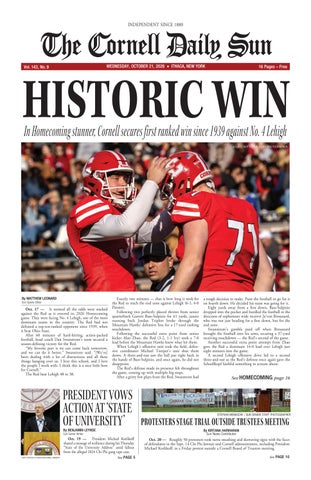
HISTORIC WIN In Homecoming stunner, Cornell secures first ranked win since 1939 against No. 4 Lehigh
JULIA LEAVITT / SUN STAFF PHOTOGRAPHER
By MATTHEW LEONARD Sun Sports Editor
Oct. 17 — It seemed all the odds were stacked against the Red as it entered its 2026 Homecoming game. They were facing No. 4 Lehigh, one of the most dominant teams in the country. The Red had not defeated a top-ten-ranked opponent since 1939, when it beat Ohio State. After 60 minutes of hard-hitting, action-packed football, head coach Dan Swanstrom’s team secured a season-defining victory for the Red. “My favorite part is we can come back tomorrow, and we can do it better,” Swanstrom said. “[We’ve] been dealing with a lot of distractions and all these things hanging over us. I love this school, and I love the people I work with. I think this is a nice little bow for Cornell.” The Red beat Lehigh 48 to 38.
Exactly two minutes — that is how long it took for the Red to reach the end zone against Lehigh (6-1, 4-0 Patriot). Following two perfectly placed throws from senior quarterback Garrett Bass-Sulpizio for 61 yards, junior running back Jordan Triplett broke through the Mountain Hawks’ defensive line for a 17-yard rushing touchdown. Following the successful extra point from senior kicker Alan Zhao, the Red (3-2, 1-1 Ivy) took a 7-0 lead before the Mountain Hawks knew what hit them. When Lehigh’s offensive unit took the field, defensive coordinator Michael Toerper’s unit shut them down. A three-and-out saw the ball put right back in the hands of Bass-Sulpizio, and once again, he did not disappoint. The Red’s defense made its presence felt throughout the game, coming up with multiple big stops. After a gritty few plays from the Red, Swanstrom had
a tough decision to make. Punt the football or go for it on fourth down. He decided his team was going for it. Eight yards away from a first down, Bass-Sulpizio dropped into the pocket and hurdled the football in the direction of sophomore wide receiver Ja’von Broussard, who was not just heading for a first down, but for the end zone. Swanstrom’s gamble paid off when Broussard brought the football into his arms, securing a 37-yard receiving touchdown — the Red’s second of the game. Another successful extra point attempt from Zhao gave the Red a dominant 14-0 lead over Lehigh just eight minutes into the game. A second Lehigh offensive drive led to a second three-and-out as the Red’s defense once again gave the Schoellkopf faithful something to scream about.
See HOMECOMING page 16
PRESIDENT VOWS ACTION AT ‘STATE OF UNIVERSITY’ PROTESTERS STAGE TRIAL OUTSIDE TRUSTEES MEETING
STEPHAN MENASCHE / SUN SENIOR STAFF PHOTOGRAPHER
By BENJAMIN LEYNSE Sun Senior Writer
PHOTO COURTESY OF JASON KOSKI/CORNELL UNIVERSITY
Oct. 19 — President Michael Kotlikoff shared a message of resilience during his Thursday “State of the University Address” amid fallout from the alleged 2024 Chi Phi gang rape case. See PAGE 5
By KIRTANA HARIHARAN Sun News Contributor
Oct. 20 — Roughly 50 protesters took turns smashing and skewering signs with the faces of defendants in the Sept. 14 Chi Phi lawsuit and Cornell administrators, including President Michael Kotlikoff, in a Friday protest outside a Cornell Board of Trustees meeting. See PAGE 10
2 The Cornell Daily Sun | Wednesday, October 21, 2026
ADS
The Cornell Daily Sun | Wednesday, October 21, 2026 3
PHOTO
SUNBURSTS: Homecoming 2026 In an electrifying couple days, the Red takes home win after win for Homecoming weekend.
By SUN PHOTOGRAPHY DEPARTMENT
Julia Leavitt / Sun Staff Photographer HEAD TAP! | Sophomore punter Will Buck celebrates with senior offensive line Timothy Bruen during the Homecoming football game against Lehigh on Saturday.
Gabriel Hankins / Sun Staff Photographer PACK THE STANDS | Crowd cheers fill Schoellkopff Field as students and alumni support the Red for the Homecoming football game against Lehigh.
Gabriel Hankins / Sun Staff Photographer ISO | Freshman wide receiver Jaxon Long carries the ball upfield to bring the team closer to putting seven more points on the board.
Julia Leavitt / Sun Staff Photographer SEEING DOUBLE | The Red pushes through Lehigh’s defense to take home the win for the Homecoming football game 48–38.
Julia Leavitt / Sun Staff Photographer SET HIKE | Cornell women’s polo competes against Montana State University, winning 18-7 on Saturday.
Camille Eckert / Sun Staff Photographer MAN ON | Women’s soccer goes head-to-head against Princeton for Homecoming.
Sophia Romanov Imber / Sun Associate Editor SET, PLAY | Men’s hockey grapples with the University of Waterloo in a 4-1 exhibition win at home.
Sloane Clarke / Sun Contributor TENSED | Men’s hockey grapples with the University of Waterloo in a 4-1 exhibition win at home.
To see more photos, please visit cornellsun.com.
4 The Cornell Daily Sun | Wednesday, October 21, 2026
Daybook
Daybook
Wednesday, October 21, 2026
A LISTING OF FREE EVENTS ON CAMPUS AND IN ITHACA
The Corne¬ Daily Sun
We have merch!
INDEPENDENT SINCE 1880 Editor in Chief
Sophia Dasser ’28
ALL DEPARTMENTS
(607) 273-3606
Business: For questions regarding advertising, classifieds, subscriptions or delivery problems, please call from 9 a.m. to 5 p.m., Monday-Friday. News: To report breaking news or story ideas, please call after 5 p.m., Sunday-Thursday.
SEND A FAX VISIT THE OFFICE THE SUN ONLINE E-MAIL
(607) 273-0746 139 W. State Street, Ithaca, N.Y. www.cornellsun.com sunmailbox@cornellsun.com
Postal Information: The Cornell Daily Sun (USPS 132680 ISSN 1095-8169) is published by the Cornell Daily Sun, a New York corporation, 139 W. State St., Ithaca, N.Y. 14850. The Sun is published Wednesdays during the academic year and every weekday online. Three special issues — one for seniors in May, one for reunion alumni in June and one for incoming first-year students in July — make for a total of 33 issues this academic year. Subscriptions are: $35.00 for fall term, $37.50 for spring term and $72.50 for both terms if paid in advance. Standard postage paid at Ithaca, New York. Postmaster: Send address changes to The Cornell Daily Sun, 139 W. State St., Ithaca, N.Y. 14850.
Stickers, shirts, sweatshirts, mugs
& more at shop.cornellsun.com
Wednesday
Thursday
Friday
Saturday
Wild Kratts Watch Party 5 - 6 p.m., Corson Mudd Hall W364
Midday Music: Linda Ruan 12:30 - 1:30 p.m., Lincoln Hall B20
Tea & Tarot 10:30 a.m. - noon, Anabel Taylor Hall 114
Ithaca Farmers Market 9 a.m. - 3 p.m., Ithaca Farmers Market
Pumpkin Carving 5 - 7 p.m., Big Red Barn
Cornell Companions Pup-Up 12:30 - 1:30 p.m., ILR Library Atrium
Insectapalooza 2026 9:00 a.m. - 3 p.m., Cornell Dairy Bar
Fabi and Kawaio1a at the South Hill Cider Community Concert Series 5:30 - 8 p.m., South Hill Cider
Saturday Botanic Gardens Highlights Tour 10 - 11 a.m., Cornell Botanic Gardens
Halloween Drag Bingo 7 - 9 p.m., Call Auditorium
Halloween at the Straight 5 - 8 p.m., Willard Straight Hall
Shakespeare’s Twelfth Night: Mad Love, Mad Music 7:30 - 9:30 p.m., Kiplinger Theatre
An Evening with Max Cohen AKA Murray Hill Boy 6:45 - 8:30 p.m., Call Auditorium
Authors in Conversation: Two Writers, Two Novels, and a Friendship for Silent Movie Month 6 p.m., Cinemapolis Trivia Night 7 - 9 p.m., Ithaca Beer Company
Free Zumba 6 - 6:45 p.m., Noyes Community Recreation Center
Haitian Folklore Night 7 - 9 p.m., Ujamaa Residential College Main Lounge
How to Produce a Feature Film 5:30 - 7:30 p.m., Tompkins County Public Library
Coletti Trumpet Studio Recital 8:15 p.m., Ithaca College Ford Hall
Fidelio Trio 7 p.m., Hockett Family Recital Hall
Sunday
Monday
Sunday Meditations 9 - 10 a.m., The Foundation of Light, 391 Turkey Hill Rd.
Sprachcafé 5 - 6 p.m., Big Red Barn
Porchfest Noon - 6 p.m., Fall Creek Area, locations vary Souls of Sithis: Tabletop & Live Action Roleplaying 1 - 2 p.m., 415 N Tioga St. Ithaca Sunday Squares 7 - 9 p.m., State of the Art Gallery
S
Grad Student Improv Club Open Jam Session 6 - 7:30 p.m., Big Red Barn Tango Lesson & Práctica 7 - 9 p.m., Willard Straight Garden Room 215 Swing Syndicate at Cornell: Weekly Social Dance 8 - 10 p.m., Big Red Barn
Keep Up With The Sun
www.cornellsun.com Every Day
The Cornell Daily Sun | Wednesday, October 21, 2026 5
News
Kotlikoff Commits to Combatting Sexual Misconduct in Semesterly Former Cornell Chi Phi State of the University Address President is Dropped
VARSHA BHARGAVA / SUN MANAGING EDITOR
Continued from PAGE 1
“While the place we’re in right now as a community is not anywhere we want to be, perhaps it is where we have to be, where we must be, in order to move forward,” Kotlikoff said during the semesterly address. Before an audience of Cornell Board of Trustees members and alumni volunteers, the president addressed broad topics surrounding the alleged Chi Phi gang rape, including the role of fraternities and a culture that allows sexual assault to go unpunished. However, Kotlikoff also pushed back at recent protests and social media responses to the University’s handling of the case. Multiple times throughout his speech, Kotlikoff referred to these responses as pushing a “simple narrative,” and emphasized that the University should respond to the incident with “time and skill, patience and expertise.” “Complex realities don’t fare well on protest posters or social media,” Kotlikoff said, later adding that “while activism and passion can change the world, they only do that when that passion is turned to purpose.” In recent weeks, protests on campus and in the broader Ithaca community have criticized the University’s handling of the case, with several speakers calling for the abolition of fraternities on campus and the resignation of administrators. Pushback to the University has also proliferated on social media platforms, drawing national attention. The uproar comes after a former Cornell student, identified as Jane Doe, filed a lawsuit against the University, Chi Phi and others on Sept. 14, alleging that she was sexually assaulted and gang raped after being coerced into consuming drugs at Cornell’s Chi Phi fraternity house in 2024. The president, who has also been criticized by several members of Faculty Senate for a lack of action, expressed commitment to solve the underlying problems of the alleged Chi Phi gang rape case during the address. “This is the beginning of what will become the defining effort of the rest of my presidency,” Kotlikoff said. Later in his speech, Kotlikoff appeared emotional when talking about his connection to the University. “I love this place,” he said. “It’s home.” Kotlikoff, who has been at Cornell since 2000, acted as the longest serving provost in University history, dean of the College of Veterinary Medicine and a professor
READ THE CORNELL Daily SUN
of molecular physiology prior to his presidency. He also introduced himself as a “Cornell husband and a Cornell dad.” During a brief period for questions after the speech, audience members pressed Kotlikoff about policy and culture related to alcohol and drug use at Cornell, and inquired about the Board of Trustees’ independent review into the University’s handling of Jane Doe’s allegations — and if results would be published.
“This is the beginning of what will become the defining effort of the rest of my presidency.” President Michael Kotlikoff In response, Kotlikoff confirmed that “key findings” of the review would be “absolutely” made public, and said regarding alcohol and drug abuse that “[the University has] to have a zero tolerance for this kind of risky behavior.” Anne Meinig Smalling ’87, chair of the Board of Trustees, also made remarks at the State of the University address. Though she acknowledged concerns regarding the Chi Phi case, Smalling pointed to the University’s progress, including the Future of the American University Committee and its austerity program Resilient Cornell. “While we must and will focus our attention this week on the emergent issues, I don’t want them to overshadow the enormous achievements of the past 12 months,” Smalling said. Kotlikoff said he had planned to share similar sentiments celebrating the work of the past year, but, given the spotlight on the alleged Chi Phi rape, could not dedicate his speech to that. He instead made a point to emphasize that he was listening to students and survivors. “I want to apologize again to Jane Doe and to the many women I have spoken to who shared with our community, and with me personally, their experiences of sexual assault at Cornell, at other universities and in other spaces.” Kotlikoff said. “I am sorry for all of the ways that you were failed.” Benjamin Leynse can be reached at bleynse@cornellsun.com.
From Original Lawsuit By VARSHA BHARGAVA Sun Managing Editor
Oct. 20 — Former president of Cornell’s Chi Phi fraternity, Orazio Petito, has been removed as a defendant in the September lawsuit alleging a 2024 gang rape at the Chi Phi house. In the original filing, Petitio was incorrectly identified as fraternity president at the time of the alleged assault, according to ABC News. Petitio was not accused of sexual assault in the lawsuit. In the Sept. 14 lawsuit, Petitio was accused of “failing to exercise reasonable care” to prevent the defendants from allegedly sexually assaulting the plaintiff — a former Cornell student identifying as Jane Doe. The accusation against Petito was discontinued on Tuesday. “The plaintiff holds Mr. PETITO, his counsel, harmless from any LIENS that are known and/ or unknown at this time,” a Tuesday court filing signed by Thomas Giuffra, an attorney for Jane Doe, reads.
“They had the wrong ... guy and justice was served as far as Mr. Petito was concerned.” Eric Bernstein, Orazio Petito’s attorney, to ABC News Petito’s attorney, Eric Bernstein, told ABC News that this was the “right outcome.” “My client deserved to be released from this case,” Bernstein told ABC News. “They had the wrong … guy and justice was served as far as Mr. Petito was concerned.” Varsha Bhargava can be reached at vbhargava@cornellsun. com.
6 The Cornell Daily Sun | Wednesday, October 21, 2026
Opinion
The Corne¬ Daily Sun Letter To the Editor Independent Since 1880 144th Editorial Board SOPHIA DASSER ’28 Editor in Chief
SOPHIA ROMANOV IMBER ’28 Associate Editor
VARSHA BHARGAVA ’27 Managing Editor
RAYEN ZHOU ’29 Opinion Editor
KATE TURK ’27 Assistant Managing Editor
ZARA CHEEK ’28 Opinion Editor JADE DUBUCHE ’27 Multimedia Editor KENDALL MURPHY ’28 Business Manager
CORAL PLATT ’29 News Editor ATTICUS JOHNSON ’28 News Editor MARY CAITLIN CRONIN ’28 News Editor EVERETT CHAMBALA ’27 Assistant News Editor
CHARLIE CLARK ’29 Director of Revenue & Partnerships VICTORIA WROBLEWSKI ’28 Human Resources Manager MELISSA MOON ’28 Arts & Culture Editor JAMES PALM ’27 Assistant Arts & Culture Editor MATTHEW RENTEZELAS ’28 Assistant Arts & Culture Editor HAZEL TJADEN ’28 Assistant Arts & Culture Editor MARC STAIANO ’27 Assistant Arts & Culture Editor KATELYN HALVERSON ’28 Lifestyle Editor AVA BETNAR ’29 Assistant Lifestyle Editor SANIKA SARAF ’28 Assistant Lifestyle Editor KATHERINE ISTOMIN ’29 Marketing Manager JACK MCAULIFFE ’29 Assistant Social Media Editor ASHLIN KWONG ’28 Graphics Editor TAVAN BHATIA ’27 Games Editor RENA GEULA ’28 Layout Editor
SHUBHA GAUTAM ’28 Assistant News Editor GISELLE REDMOND ’28 Assistant News Editor ANGELINA TANG ’28 Science & Technology Editor TANIA HAO ’28 Science & Technology Editor SIMRAN LABORE ’27 Weather & Climate Editor MATTHEW LEONARD ’28 Sports Editor GRACE REUBEN ’28 Sports Editor JANE HAVILAND ’28 Features Editor NATHAN ELLISON ’28 Photography Editor NATHAN BO ’28 Assistant Photography Editor ADELAIDE CHOW ’29 Assistant Photography Editor MIA SOFIA ORENGO ’28 Video Editor OAKLEY DECRISTOFARO ’29 Video Editor AMELIA GARCIA ’27 Data Editor HUNTER PETMECKY ’28 Layout Editor
WORKING ON TODAY'S SUN MANAGING NEWS DESKERS SPORTS DESKER SCIENCE DESKER OPINION DESKERS LIFESTYLE DESKERS ARTS DESKERS PHOTO DESKERS
Varsha Bhargava '27 Kate Turk '27 Sophia Romanov Imber '28 Everett Chambala '27 Mary Caitlin Cronin '28 Atticus Johnson '28 Matthew Leonard '28 Tania Hao '28 Rayen Zhou '29 Zara Cheek '28 Katelyn Halverson '28 Ava Betnar '29 Sanika Saraf '28 Melissa Moon '28 James Palm '27 Nathan Ellison '28 Nathan Bo '28 Adelaide Chow '29
Cornell Votes Cornell Votes is a University-wide, non-partisan registered student organization that works to increase voter registration, turnout and civic engagement on campus. They can be reached at cornellvotes@cornell.edu.
Why Are Midterms Important?
E
very four years, we tune in to the United States presidential election. It’s easy: we hear about it from friends and family, see ads on social media and witness campaign activities everywhere. Unfortunately, it’s just as easy to overlook the midterm elections. The 2026 midterm elections will take place on Nov. 3, and will shape the United States' political trajectory for the next two years. Midterm elections occur halfway through the presidential term and allow voters to choose which party controls the House of Representatives and Senate. The elections occur in every single state across the U.S. This year, there are 35 open Senate seats. All 435 House seats are open (representatives serve two-year terms). 36 states will pick their next governor. In addition, over 18,000 open school board seats and 19,000 open city council seats are up for grabs. The results of a midterm election significantly influence people’s everyday lives. Elected representatives shape legislation directly impacting their communities. For college students, this means direct impacts on our educational experiences. Representatives shape and vote on many different aspects of higher education policies. In the past several months, we have seen frequent changes in higher education, including changes to student loan policies, the process of awarding research grants and significant focus on DEI practices. This year, we vote once again for representatives who will grapple with these issues directly. Midterm elections give us the chance to elect local representatives from our community who represent our interests (whatever they may be) and act as our voice in the halls of Congress. Historically, midterms have also been seen as a measure of the current president’s success in office. In general, voters want change, so the party in power typically loses seats in the House and Senate. This has occurred in 20 of the
Professor Begüm Adalet is an associate professor in the Department of Government. She can be reached at ba375@cornell.edu. Chloe Ahmann is an associate professor in the Department of Anthropology. She can be reached at chloeahmann@cornell.edu. Catherine Appert is an associate professor in the Department of Music. She can be reached at cma249@cornell.edu. They write on behalf of the undersigned faculty members.
200+ Cornell Faculty: We Will Too
D
ear Cornell University students: Over the past two weeks, we have been reckoning with the University’s failure to prioritize your safety and well-being. We are outraged by the horrific events that transpired at the Chi Phi fraternity house, by systems that failed Jane Doe at every level, by the wider culture of sexual assault plaguing our campus and by the structural violence that allows it to continue with impunity. We are incensed by the administration’s active and ongoing role in fostering that culture, concealing its workings and protecting its perpetrators. At the same time, we apologize for not doing enough as faculty to hear you, to create spaces where you feel safe to share your experiences, or to intervene in existing campus structures. By “structural” violence, we mean that this incident is not a one-off problem, but rather indicative of an epidemic at Cornell. We also refer to the fact that Cornell administration has worked to hide — rather than confront, mitigate and make amends for — other sexual assaults, like those perpetrated by the Weill Cornell faculty member who assaulted hundreds of men and boys over the a course of 10 years, resulting in a $1 billion settlement whose details remain unknown to most of us. By “concealing its workings,” we point to a range of opaque and top-down processes through which the administration launders this violence — such as ad hoc committees, slow-moving task forces, working groups made of cherry-picked representatives and highly scripted virtual town halls with questions submitted and screened in advance instead of collective spaces of conversation for faculty, staff and students. As faculty instructors and advisors, we want to be absolutely clear: this administration does not speak for us. We will not allow the horrific sexual violence experienced by Jane Doe and others in our community to be swept under the rug. It is not lost on us that the administration has acted swiftly, and voluntarily publicized its interventions, in other disciplinary cases. And it is not lost on us that students found responsible for sexual violence have been punished far less harshly, for example, than nonviolent student protestors arrested for speaking up during panel discussions or banging pots and pans. What this double standard suggests is that Cornell’s administration is motivated by money and power, not by justice, nor even by the much lower moral standard of fidelity to its own processes. As frontline educators directly in touch with students, we have heard too many harrowing stories of abuse over the years. We need to know that if we refer you to suggested campus resources — not least the formal bodies in place to investigate assault — you will be protected. But we are all too aware that the campus mechanisms that promise to protect survivors often end up revictimizing them. We know this because of your advocacy, your journalism, your unvarnished honesty and rage. We also know that there are countless
stories of sexual assault that never come to light. For too long, survivors have been left alone to process wounds like this in silence and in shame. This has only gotten worse in recent years. Now, we hear from students across campus that speaking up about sexual assault feels dangerous — especially for international students who reasonably fear reprisal from the University. Many of us have felt the chilling effect of repressive measures designed to isolate and disempower faculty and students. This culture of silence is by design. Silence breeds unquestioned loyalty, encourages groupthink and normalizes victim-blaming. In contrast, voicing criticism of processes that are at best insufficient and at worst violent reflects a commitment to integrity and transparency in our community. Students and faculty need to know that calling out problems and bad actors will be met with accountability, not retaliation. As members of the Cornell University faculty, our allegiance is to you, our undergraduate and graduate students. You are not alone. We are committed to your safety and well-being in our classes, our research labs, our campus, our community. We are working to act quickly, and at the same time, we are invested in bringing about long-term changes to institutional structure and culture at Cornell. In the current moment, we commit to be present and provide support for student protest movements. We are here, now, to listen and to share confidential resources with students navigating current structures for reporting sexual assault, or to direct you to supportive, knowledgeable faculty and advocates who can help. While most faculty are not designated reporters, some are, which means they are legally required to report sexual assault to Cornell’s Title IX office. You should ask whether someone is a designated reporter before disclosing information you do not want shared beyond that conversation. In the long term, we commit to fostering collective spaces for conversation and dialogue at every level of University life. We commit to collaborating with student organizations on a vision for structural change and to working to ensure those changes occur. We commit to educating ourselves and our colleagues about University procedures, about campus and community resources and about support and advocacy organizations that are independent of Cornell. We commit to engaging all possible avenues of faculty governance to make Cornell safer, including thorough reforms of the Title IX process, campus discipline and Greek Life. Cornell is not a singular entity. It is a community of students, faculty and staff gathered from around the world. As a collective, we can work to reclaim our voice and use it to challenge and change what is wrong with our institution. We are proud of Jane Doe for being immensely brave, and of the student journalists who helped bring her story to public light with the courageous exposé, “Cornell Won’t. We Will.” As faculty, We Will Too.
last 22 midterm elections. If the president has a higher approval rating, their party typically experiences fewer losses. In short, midterm elections are as much a way to change the country’s political landscape as to express disapproval (or approval) of the incumbent president’s actions. Despite their power, voter turnout is typically much lower in midterm elections than in presidential elections. In 2020, the U.S. presidential election had a national voter turnout of 66.6%. Two years later, the 2022 midterms had a 46% turnout. This 15 to 20 percentage point gap in participation between presidential and midterm elections has been a trend for almost two centuries. In the last several decades, midterm voter turnout has been 50% or less. Across college campuses, voter turnout is even lower. In the 2022 midterms, only 31.3% of students voted. On Cornell’s campus, that number was even lower: only 23.3% of students showed up to the polls. This year, and in future years, we hope to see higher voter turnout. We encourage you to register to vote and to research your candidates, either in your home state or in New York. This year’s midterm elections are on Nov. 3, and we hope to see you at the polls.
The Cornell Daily Sun | Wednesday, October 21, 2026 7
COLUMNS
I Chris B. Schaffer Office (after)Hours
Chris B. Schaffer is an Opinion columnist and the Meinig Family Professor of Engineering in the Meinig School of Biomedical Engineering and the Dean of Faculty. His column, Office (after)Hours, explores campus life with affection, a critical eye and an appreciation for the absurd. It runs periodically through the semester. He can be reached at cs385@cornell.edu.
Sabrina Karim Guest Room
Sabrina Karim is an associate professor of government in the College of Arts and Sciences. She can be reached at smk349@cornell.edu.
A
t the “Justice for Survivors” rally on Oct. 6, I said that “trust is broken at Cornell. It’s broken from the top down. It’s broken peer to peer.” In the days since, I have thought a great deal about the rally and about what struck me most. It was not the thousands of people who participated. It was not even the anger expressed by protesters. It was the fear surrounding the event. Students asked to communicate with me through messaging apps rather than University email. Organizers recruited safety monitors and organized people with first-aid kits. Some faculty members who spoke with the media wanted to remain anonymous because they feared repercussions. Before the rally, I felt that there was palpable anxiety on campus about what might happen and about what participating publicly might mean afterward. That fear reinforced what I said that day that trust at Cornell is broken. My research is situated in countries that experience major trauma, usually after civil wars and political violence. A significant part of my work asks how institutions — particularly security and justice institutions — can rebuild trust after people have lost confidence in them. I wish that this research did not feel so relevant to my own university. But it does. Research on rebuilding institutional trust points to several lessons that Cornell should consider. First, rebuilding trust is relational; it requires genuine engagement between leaders, police officers and the people who no longer trust them. Trust cannot be restored behind closed doors. Cornell needs a public forum, hearing or series of facilitated conversations in which students, faculty, staff and University leaders can speak directly to one another — and in which the primary purpose is to listen. Such a process could be convened by the Faculty Senate, the Student Assembly, or another body capable of creating some independence from the University administration. The external review by the former U.S. Deputy Attorney General Sally Q. Yates is encouraging, but there should be an internal process as well. Second, rebuilding trust requires institutions to acknowledge failure. That does not mean
Rebecca McCabe Guest Room
Rebecca McCabe '26 is a graduate of Cornell’s Ph.D. program in mechanical engineering. She can be reached at rgm222@cornell.edu.
S
eptember’s lawsuit alleging that Chi Phi fraternity members gang-raped former student Jane Doe in 2024 has galvanized calls for change across campus and beyond. Examining the incident with a systems lens reveals its deeper roots in Cornell’s problematic power dynamics outside of contexts typically associated
A Faculty Perspective on Campus Life
moved to college when I was 18 years old. For a remarkable 20 years — until I took my first sabbatical as a faculty member — I never spent more than three consecutive weeks away from a college campus. I’ve been an undergraduate student (Go Gators!), a graduate student (Go Crimson!), a post-doctoral fellow (Go Tritons!) and now a professor (Go Big Red!) and the Dean of Faculty (Go … Faculty?). At Cornell, I’ve taught graduate and undergraduate students on topics ranging from physics, biology and engineering to public policy and gourmet cooking. These classes have ranged from fewer than a dozen to hundreds of students. I co-lead the SchafferNishimura lab studying neurodegenerative and cardiovascular disease, and have guided education and community outreach programs in Ithaca and surrounding communities. I’m also a long-time denizen of Cornell residence halls, having spent six years as the faculty-in-residence in Mary Donlon Hall. I now live in Barbara McClintock Hall, where I know some of you as neighbors and my dog, Dory, knows many more of you as
ear scratchers. In short, I am very familiar with campus life. Familiarity is not the same as understanding, however. Spending decades at a university does not necessarily provide insight into the experiences that students have during their years on campus. On the flipside, students are familiar with faculty as folks who give lectures, assign work and hand out grades, while the rest of our lives at Cornell is less visible. The goal of this column is to help us move from recognizing each other’s roles to understanding each other’s lives. What do faculty wish students knew about their lives and work? What do faculty repeatedly fail to understand about student life? Office (after)Hours will explore these questions as well as the joys and challenges of daily life on campus from one faculty member’s perspective, with room for affection, explanation, criticism and a bit of the ridiculous. So, reach out and tell me what you think faculty do not understand about student life at Cornell, or ask that question about faculty that’s been bugging you forever. I’m listening.
Cornell Must Rebuild Trust From the Top Down and Peer to Peer prejudging every contested fact or assigning responsibility before an investigation is complete. It means recognizing when systems have not worked as they should. In recent weeks, Cornell and the District Attorney’s Office have become involved in reports about where responsibility for different aspects of this case lay. But this does little to rebuild public trust when the larger concern is that the system itself failed. Institutions earn credibility by demonstrating that they are capable of self-examination and correction. Third, acknowledgement must be followed by reform. Cornell and the broader Ithaca community need a serious review of how sexual and gender-based violence is prevented, reported, investigated and addressed on campus, in Ithaca and in Tompkins County. I have previously made recommendations concerning trauma-in-
"Trust cannot be restored behind closed doors." Sabrina Karim formed and gender-responsive policing, but law enforcement is only one part of the system. A broader review should examine how students report sexual violence; how information moves between University offices, law enforcement, health providers and prosecutors; what support survivors receive over time; how fraternities and other student organizations are monitored and held accountable; how students are educated about consent and bystander responsibility; and whether students trust existing reporting mechanisms enough to use them. The goal should not simply be to identify whether existing policies were followed. Cornell should ask whether those policies themselves are the gold standard. At the rally, I also said that trust is broken peer to peer. This is perhaps the more difficult part of this moment to confront. Do women and other students feel safe attending parties? Do students trust their peers to intervene when someone is vulnerable? Do young men sometimes feel pressure to demonstrate masculinity, sexual experience, loyalty or belonging in ways that encourage harmful
behavior? Do students believe that their friends will support them if they disclose an assault — or fear that friendship networks will close ranks around someone accused of committing one? Those questions cannot be answered through administrative reform alone, though that is the first step. Peer-to-peer trust has to also be rebuilt at the peer level. Cornell should invest in sustained student-led programs around consent, bystander intervention, healthy relationships, masculinity and sexual violence prevention. Programs such as ConsentEd, which was created by Cornell students to educate their peers about consent but, as I understand from former students, is no longer operating, offer one model worth revisiting. The important feature of such programs is not simply that students receive another mandatory presentation about consent. It is that students themselves help create norms about what behavior their community will and will not tolerate. A one-hour orientation program cannot carry the weight of changing a social culture. The work has to happen repeatedly — in residence halls, fraternities and sororities, athletic teams, student organizations, classrooms and friendship networks. Rebuilding peer trust also requires creating spaces in which students can talk honestly about their experiences without every conversation immediately becoming punitive or adversarial. Ultimately, I do not want Cornell to become a campus characterized by fear — fear of attending a party, fear of reporting sexual violence, fear of speaking publicly, fear of disagreeing with University leadership or fear of being punished for demanding change. I care deeply about Cornell and about what this institution represents. The events of the past several weeks have been painful, and I do not want to describe them as an ‘opportunity.’ But Cornell now has a responsibility to decide what it will learn from them. Cornell should undertake the difficult work of institutional reflection, reform and rebuilding relationships within our community. In doing so, Cornell could show universities across the country what it looks like not simply to weather a crisis, but to learn from institutional failures and make meaningful changes in response.
It’s All Connected: Systems of Elitism, Power and Assault on Campus
with sexual assault. The institutional inaction and campus culture that incited the alleged assault are part of a larger pattern in which Cornell prioritizes prestige and wealth over well-being. To achieve meaningful change, our community must reject these insidious values while maintaining our humanity.
In a capitalist world, tracing the flow of money reveals the incentive structures that explain the campus administration’s negligence. Cornell receives money from government grants, student tuition and alumni donations. The University sacrificed diversity to recover federal funding, censored criticism to beguile deep-pock-
eted admittees and supported weaponmakers to serve endowment profits and safeguard its standing among wealthy pro-Israel donors. These pervasive examples reveal the University’s willingness to act immorally to pad its wallet and reputation. To continue reading this article, please visit www.cornellsun.com.
8 The Cornell Daily Sun | Wednesday, October 21, 2026
Science
SCIENCE & TECHNOLOGY
College of Veterinary Medicine’s First Female Full Prof. Katherine Houpt’s Journey as a Veterinary Behaviorist By ELSA HUELSBERGEN Sun Contributor
“I always say it took me 12 years to get into Cornell.” When Katherine Houpt applied to Cornell’s College of Veterinary Medicine in the 1950s, she was rejected. Later, she returned to Cornell as the first woman appointed to a full professorship at the vet school. The undergraduate Animal Behavior Club at Cornell hosted an interactive talk with Katherine Houpt, the James Law Professor of Behavior Medicine, Emeritus, on Sept. 30.
“I said I wanted to be a vet, and he said, ‘Be a vet, then you can be anything you want to be.’” Prof. Katherine Houpt In her talk, Houpt discussed her motivations for pursuing behavioral veterinary medicine, her research on horses and her experience navigating a then male-dominated field. She described how her early experiences with animals and interest in research influenced her decision to become a veterinary behaviorist — someone who treats medical, neurological and behavioral disorders in animals. “I have loved horses all my life,” Houpt began, explaining that her early experiences
with horseback riding were connected to her father’s military service. When the Japanese cavalry surrendered its horses to the American army after World War II, horseback riding became an important part of her childhood and contributed to her interest in veterinary medicine, she said. In addition to her love of horses, Houpt explained that she first became interested in behavioral research in her early 20s when she stumbled across an article that explored how certain stimuli could influence sexual behavior in domestic turkeys. Houpt was an undergraduate at Penn State University at the time, and the author of the paper was coincidentally a professor there. She went to see him. “I said, ‘I think this is the most interesting thing I have ever heard of. I’d like to be in this field,’” she recalled. “And he said, ‘Well, before you had this epiphany, what did you want to do? And I said I wanted to be a vet, and he said, ‘Be a vet, then you can be anything you want to be.’” Because Houpt was interested in both veterinary medicine and animal behavior, she decided to follow the professor’s advice and apply to veterinary school, which was challenging for women at the time. “Eventually I got into veterinary school, which was very hard for women in those days,” she said. “Cornell turned me down.” However, the University of Pennsylvania was beginning to admit more women into its veterinary school. “The University of Pennsylvania decided
MEGAN KIM / SUN STAFF PHOTOGRAPHER
Pioneering professor | Katherine Houpt discussed her journey to becoming the first woman appointed to full professorship at the College of Veterinary Medicine.
to take five women that year,” Houpt said. “Veterinary medicine was in decline because everyone was driving cars. They didn’t need to keep their horses sound, so they decided that instead of letting in five guys, they would let in five women.” Houpt was one of those five women. She graduated from the University of Pennsylvania School of Veterinary Medicine in 1963 and entered into a profession in which women were still underrepresented, becoming the 250th woman veterinarian in the U.S., she said. Since then, the gender composition of veterinarians has changed drastically. “Now,
of course there are more women in the profession than men,” Houpt commented, attributing the change to Title IX, which was enacted in 1972 and prohibited sex-based discrimination in education. In addition to receiving her VMD, Houpt went on to get her Ph.D. in behavioral psychology at the University of Pennsylvania in 1972.
To continue reading this story, please visit www.cornellsun.com. Elsa Huelsbergen can be reached at eh586@cornell.edu.
Cornell Unplugged: Students and Faculty Weigh in on Screentime Use By CHLOE YU Sun Staff Writer
Cornell examined different ways in which students can limit their own screentime use through their weeklong event Cornell Unplugged, which urged students, faculty and staff to “go off-line, off-screen, and off-tech.” Cornell Unplugged, which took place from Sept. 14 to Sept. 20, explored how mindful technology use supports personal well-being and meaningful face-to-face connections. Participants were encouraged to put down their devices during meal times or while engaging with other students. Cornell faculty also considered tech-free and tech-light classroom strategies during this time. The initiative was run by Prof. Steven Jackson, science and technology studies, vice provost for academic innovation and chair of the Sustainable Computing Working Group, and his graduate student Paul Vermette. According to Jackson, the event came in response to campus concerns surrounding technology use. “Faculty were expressing some concerns around technology use and sometimes AI use in their personal lives,” Jackson said. “Students also express[ed] concerns about whether they were using screens too much and whether it was detracting from their ability to be present with others at the University.” The Cornell Unplugged website offered a list of tips on how to limit screen time, along with a list of events to attend as alternatives to using technology. The weeklong series of events included activities at the Herbert F. Johnson museum and daily “Golden Hour” gatherings at sunset on Libe Slope. One of the student organizers of
Cornell Unplugged, Mikael Murphy ’28, expressed concern that technology overuse leads to phone addiction, which negatively impacts students. Excessive screentime “impacts interpersonal relationships, such as decreased time spent with other people, neglecting responsibilities, and shorter attention spans and focus, affecting student success,” Murphy said, pointing to research from the National Institutes of Health. Jackson explained that members of the community were encouraged to participate in whatever capacity they could. “We are open to whatever people want to try. If people want to step back for an evening, day or weekend, all of that is fine,” Jackson said.
“I feel really grounded and refreshed in a way I don’t get from scrolling to decompress, and I come back being able to do better work.” Pari Patel ’28 Pari Patel ’28, another student organizer of Cornell Unplugged, noted that taking breaks from technology while studying improved her wellbeing. “I feel really grounded and refreshed in a way I don’t get from scrolling to decompress, and I come back being able to do better work,” she said. Community members signed the “Unplugged Pledge,” an anonymous form when they could set a personal goal for the amount of hours they would attempt to go without a device. With a sample size of 56 individuals, the form reports that participants
committed to reducing screen time and overall technology use by 35%. On average, students pledged to unplug for 17 hours a week, staff for 19 hours and faculty for 21. The form revealed that 84% of participants’ motivation to unplug was for mental health, connection, taking a break, feeling that it’s a waste of time and to avoid becoming screen-dependent. Boubakar Diallo ’28 admitted that social media and other forms of technology make it difficult for him to engage with his peers. “There are days where I read a lot of the news [for up to] five to six hours and that affects my involvement with my friends and the community.” Additionally, 12% of participants expressed environmental concerns and 10% wanted to try new ways of teaching or see if paying attention in class was easier. Jackson pointed out that students were having difficulty paying attention in his classes. “Students were on screens in ways that were distracting to their colleagues who were trying to pay attention in class, but were sometimes drawn into whatever was on the laptop next to them.” Jackson said. Finally, 28% of participants planned to unplug by prioritizing human connection, 24% wanted to restrict technology use and spend time outside, 18% reported reading books and 16% reported finding alternatives for teaching and learning. Students found unplugging from the digital world to be beneficial for their mental health. “The biggest difference is not having to engage with a barrage of notifications [from social media],” Patel said. “A few hours without that and I feel noticeably
less overwhelmed.” This aligned with graduate student Vermette’s stance on why Cornell Unplugged was needed.
“The world would be better if we were mindful and intentional about technology use.” Prof. Steven Jackson “There are increasingly more and more issues with how much people are using social media and how that intertwines with their mental health,” Vermette said. Additionally, using less technology meant more time for other things. “I had the screen time limit on my phone, so I couldn’t use Instagram for more than an hour,” Murphy said. “I found myself spending time with my family and going outdoors more often, and generally felt content about how I was enjoying my time every single day.” Jackson and Vermette continue to encourage students to be mindful of technology, even after unplugging, and hope that this event taught participants how to be sustainable and intentional with screen time use going forward. “The world would be better if we were mindful and intentional about technology use,” Jackson said. “[It’s important] to use and lean into [technology] for a lot of the great things it can bring to us but also avoiding it when it’s affecting the relation to our own wellbeing, relationships with others, and the teaching and learning efforts at the university.” Chloe Yu can be reached at cyu@ cornellsun.com.
The Cornell Daily Sun | Wednesday, October 21, 2026 9
Lifestyle
The Corne¬ Daily Sun
Okay, You Downloaded Hinge. Now What? Now, if you’re looking to download Hinge, I’m not here to encourage you or stop you. But if you are — or you’re simply curious to see what awaits the average Hinge user — read on as I et’s be honest: either we’ve done it or college-aged tell you all the different characters you’ll know someone who has. Last summer, I sat down at a local meet on Hinge. café to catch up with an old high school The Location Fisher teacher. Over chocolate croissants and vanilla lattes, the conversation started as While it seems counterintuitive to use you’d expect: she asked me how Cornell was, I asked her how her new batch of stu- a dating app to find singles that live dents were handling Advanced Placement nowhere near you, you’d be surprised exam season and we chatted about our how often this character shows up. Over the summer, I matched with summer plans. Woman to woman, we then got into a guy who shared my love for cats and the subject of dating. I admitted to her happened to have his location set to that I tried my hand at Hinge this past a neighborhood near mine. Great! We semester, and she divulged that she’d also begin chatting. “I’m actually in germany lol im locabeen on it. She then asked me honestly: What are tion fishing.” That was his response when I asked college students doing on dating apps? We had access to a whole campus of young about meeting in-person. Ugh, unmatch. people potentially looking for love. What I’d just wasted 10 minutes of my life chatting with this guy. need did we have for an algorithm? Seriously, it’s not that hard to set If you’d asked high school me if I would ever consider online dating, my your location to where you actually are. answer would be a resolute “no.” I would Hinge’s 100-mile maximum radius for romanticize meeting someone organical- finding available singles is pretty generly, perhaps while browsing in a library ous! or under the sunset at a park. Before The IRL Find jumping into the adult world, I’d have thought online dating was just evidently You may be mindlessly scrolling your unnatural. However, amid the bustle of prelims, feed just to see a familiar face come up. In my time on Hinge, two of my old club applications, job recruitment and all high school friends have sent likes to me the other features of Cornell’s iconic hustle culture, I barely had time to slot hang- for the sole purpose of asking something outs with my friends into my Google to the effect of, “What are you doing Calendar, let alone time to meet my other here?” We have a good laugh about it, while half naturally. So, I gave Hinge a chance. After curating six of my best photos feeling a slight sense of embarrassment and answering three prompts, I began to that someone we know caught us desperfeel the dopamine rush of sending and ate enough to find love on a dating app. However, seeing your peers and old receiving likes. By KATHERINE ZHAO Lifestyle Contributor
L
JESUS GARCIA / SUN GRAPHICS STAFFERR
friends on Hinge can be somewhat validating. Like, hey, I didn’t know Sam in math class was also having some trouble on the market! No matter how unnatural online dating may feel sometimes, you know you’re not alone. You’re in a pool of thousands of young adults floating through real life, and there’s nothing to be ashamed of.
The Ghoster
The One You Still Send Reels To Scrolling on Hinge, you can ‘meet’ dozens of new people every day, and not all of them will be the love of your life. I’ve gone on lovely dates with individuals just to realize neither of us wanted to pursue anything further. But, there need not be any hard feelings or blocking involved.
This one can be pretty disappointing. To continue reading, please visit www. You go on a good date. You both express cornellsun.com. interest in seeing each other again. No follow-up text. No new plans. Messages are left on delivered for days, then weeks. We’ve probably all ghosted someone at some point, on or off Hinge, on purpose or accidentally. But seriously, if you’re Katherine Zhao is a member of the Class of not interested anymore, I’d rather you 2029 in the College of Architecture, Art and Planning. She can be reached at kyz6@corjust tell me. nell.edu
A Look Into Cornell’s Campus-to-Campus Bus By SELINA CHEN Lifestyle Staff Writer
W
ith a bag double the size of myself on my back and a suitcase large enough to travel across the country, I waited patiently at the Robert Purcell Community Center bus stop with a strange stillness in my heart. The wind was crisp, and the sun was almost painfully radiant like Mother Nature was confused about when summer ended and fall began. The incessant buzzing of the world’s most belligerent bee didn’t even faze me, though the others in line would beg to differ. Life seemed to slow in ways Cornell never allowed. Even though I had only been back in Ithaca for two weeks, I was excited to solo travel to New York City to see my beloved
friends. A few weekends ago, I tried Cornell’s very own Campus-to-Campus Bus Service for the first time. Aside from the price, I was pleasantly surprised by my experience. I’ve been a faithful OurBus rider for all my years of university, until someone told me there was an option that could meet me right outside my door. For those of you who aren’t familiar, C2C is a bus service operated by Cornell, running daily between their Ithaca and New York City campuses. Each reservation has different rates depending on time of travel, such as a busier or slower weekend. There are 32 seats available to choose from, with 10 highly coveted single seats and 22 remaining seats arranged in a double. Despite booking my ticket almost three weeks in advance, I still couldn’t snag a seat to myself.
On Cornell’s main campus, pickups run from North Campus (right outside RPCC) to Sage Hall and down to the Southeast B Lot Bus Shelter (which I had no idea existed prior). In the city, there are two dropoff options at Weill Cornell Medical College and the Cornell Club. With a kitchenette in the back, free water bottles and soda in the fridge and a (clean) bathroom off to the side, the amenities were unparalleled for a bus that takes you only a few hours from Ithaca. The Wi-Fi was a nice plus because let’s be honest: nowadays, a few hours without internet would be too long. Every seat is incredibly spacious, like the leg room of your dreams — so much so you forget there is even someone right next to you, provided your neighbor is a friendly one. Even the aisle leaves enough space for you to walk down without ac-
PHOTO COURTESY OF BILL FRASER / CORNELL UNIVERSITY
cidentally stumbling over a poor stranger when the inevitable bus earthquake hits. There’s a small trash bag tethered to the back of the seat in front of you, outlets, cup holders and a foldable tray you can use to rest your laptop on. Unfortunately, assignments don’t stop on the road, but at least you can be comfortable while doing them. However, you may argue that despite the amenities, the C2C bus is simply too expensive. My round trip on C2C came to a (tragic) total of $202, which you may choose to spend on other college student essentials, including but not limited to matchas that leave condensation rings everywhere you go, laundry cycles that eat your clothes and life savings, weekly Target runs with receipts longer than a Christmas list and the McDonald’s you delivered to your dorm with the last $15 to your name. Nevertheless, if you are able to, I highly recommend every Cornellian try C2C at least once. On my way back to Ithaca on the bus I watched the most beautiful sunset through the windows, with headphones playing “Knuckle Velvet” by Ethel Cain, as I read Shakespeare and soon after fell into the greatest slumber of my life. Did I mention I didn’t feel a single speedbump? I truly could not have asked for a better experience. When I have the funds and the time, C2C will indeed be seeing me again, maybe too soon.
Selina Chen is a member of the Class of 2028 in the College of Arts and Sciences. She can be reached at sc3543@cornell.edu.
10 The Cornell Daily Sun | Wednesday, October 21, 2026
NEWS
Demonstrators Stage Trial of Administrators, Chi Phi Defendants Outside Board of Trustees Meeting By KIRTANA HARIHARAN Sun News Contributor
. Oct. 20 — Roughly 50 protesters took turns smashing and skewering signs with the faces of defendants in the Sept. 14 Chi Phi lawsuit and Cornell administrators, including President Michael Kotlikoff, in a Friday protest outside a Cornell Board of Trustees meeting. The demonstrators opened the protest with a mock trial of the defendants, inviting the public to act as a “people’s tribunal” and “convict” both the defendants and administrators outside Myron Taylor Hall. After stabbing the signs, they marched to Barton Hall and confronted Trustees and Cornell University Council members entering a dinner. “We know that Michael Kotlikoff doesn’t listen to the community, he only listens to the trustees,” said Gabe Sekeres, vice president of Cornell Graduate Students United and a spokesperson for the protesters. “So we thought this is a good way to get to the administration and the heads of OSCCS [Office of Student Conduct and Community Standards] and all the other people who let Jane Doe down.” The protest comes amid national uproar after a former Cornell student, identified as Jane Doe, filed a Sept. 14 lawsuit alleging that she was gang raped and sexually assaulted after being coerced into consuming drugs at Cornell’s Chi Phi fraternity house in 2024. Four student organizations hosted the protest – Cornell Students for Justice in Palestine, Cornell Young Democratic Socialists of America, Cornell Graduate Students United and The Coalition for Mutual Liberation — alongside two Ithaca groups, People’s University Ithaca and Food Not Bombs Ithaca. Four protest organizers simulated a jury to hold the Office of Student Conduct and Community Standards, the seven accused students, the Cornell Interfraternity Council and multiple administrators “accountable.” The administrators they put on “trial” included Kotlikoff, Provost Kavita Bala, Ryan Lombardi, vice president for student and campus life, OSCCS Director Christina Liang, Robert Harrington, provost for medical affairs, and Brian White, vice president and general counsel.
STEPHAN MENASCHE / SUN SENIOR STAFF PHOTOGRAPHER
STEPHAN MENASCHE / SUN SENIOR STAFF PHOTOGRAPHER
To continue reading this story, please visit www. cornellsun.com. Kirtana Hariharan can be reached at kh896@cornell. edu. STEPHAN MENASCHE / SUN SENIOR STAFF PHOTOGRAPHER
STEPHAN MENASCHE / SUN SENIOR STAFF PHOTOGRAPHER
Comics
The Cornell Daily Sun | Wednesday, October 21, 2026 11
CLASSIFIEDS CLASSIFIED AD RATES
Ads are accepted at The Sun’s office at 139 W. State Street downtown, by phone or e-mail. Deadline: Noon at The Sun’s office two days preceding publication.
Standard Rate: $3.95 per day for first 15 words, 39 cents per day per word thereafter. Five or more consecutive insertions, $3.70 per day for first 15 words, 37 cents per day per word thereafter. Commercial Rate: $5.95 per day for first 15 words, 40 cents per day per word thereafter. Five or more consecutive insertions, $5.75 per day for first 15 words, 38 cents per day per word thereafter. The Sun is responsible for only one day makegood on ads.
607-273-3606 classifieds@cornellsun.com
Last week’s solution:
Booked Schedule By Alisia Wucetich ’29
Fall Is Here By Jesus Garcia ’29
12 The Cornell Daily Sun | Wednesday, October 21, 2026
NEWS
Faculty Senate Debates ‘Vote of No Confidence’
The conflicted senate voiced support and concerns over a no-confidence vote in Cornell’s administration. By BENJAMIN LEYNSE Sun Senior Writer
Oct. 19 — In a meeting lasting over two hours, a conflicted Faculty Senate considered a proposal for a “vote of no confidence” in Cornell’s administration and heard remarks from President Michael Kotlikoff during its Wednesday session. The senate ultimately did not vote on the measure and debate is scheduled to continue on Oct. 28. The one-sentence proposal, introduced on Oct. 8 in response to the University’s handling of an alleged 2024 gang rape at Cornell’s Chi Phi house, is sponsored by Prof. Paul Ortiz, industrial and labor relations, and signed by 122 supporting faculty. The proposal holds no binding consequence if passed. “The Faculty Senate has no confidence in the ability of the central administration to effectively address the ongoing crisis of sexual assault at Cornell University,” the resolution reads. Faculty senators expressed both support and concern regarding the resolution. Some cited a loss of trust in University administration and expressed frustration with its messaging. Other senators conveyed that faculty in their departments were hesitant to pass the resolution, and shared worries about the proposal being overly broad. Close to an hour of the meeting was dedicated to an appearance from Kotlikoff, who gave remarks on the University’s response to the Chi Phi case and fielded questions about his ability to lead Cornell. Kotlikoff criticized calls for his replacement as he was asked about a petition with nearly 70,000 signatures pledging for alumni to withhold donations until the removal of Cornell officials they deemed “complicit” in the “cruel passivity” with which they claim administration has handled the case. “If this university feels that they will solve this
problem by replacing a president, that itself is not good for Cornell’s reputation,” Kotlikoff said. “I don’t think it’s the right way to address situations like this.” In a lawsuit filed on Sept. 14, a former Cornell student, identifying as Jane Doe, alleged she was gang raped by multiple members of Cornell’s Chi Phi fraternity. The plaintiff, identifying as Jane Doe, accused Cornell of negligence, breach of contract and violations of state human rights and education laws.
“If this university feels that they will solve this problem by replacing a president, that itself is not good for Cornell’s reputation.” President Michael Kotlikoff In his speech, Kotlikoff explained several initiatives he introduced to the Cornell community on Tuesday, including a ban on Cornell Interfraternity Council fraternity parties and social events for the rest of the academic year, the addition of staffers at the Cornell Office of Civil Rights and a new partnership with New York State Police to create an independent and trauma-informed criminal investigation process. Kotlikoff stated that the University took these steps and spoke to staff, faculty and student leaders in order to address “the suspicion that individuals have, the feeling that they are unsafe on campus and also some suspicion about Cornell University police.” However, several faculty members criticized the
University’s Tuesday statement, claiming Cornell did not take accountability. During the meeting, Prof. Suman Seth, science and technology studies, said that he was “deeply disturbed” by the lack of “personal responsibility” taken by the president in his speech to the senators. “President Kotlikoff has been provost or president for more than a decade,” Seth said. “And over and over again in his comments, what he did was tell us about Cornell policy, as if he has not had a decade in which to change said Cornell policy.” After Kotlikoff’s appearance, Ortiz described the “vote of no confidence” proposal to the senate, calling the University’s decision to announce its initiatives the day before the faculty senate’s meeting on the no-confidence vote, “appalling.” “I mourn that it took so much trauma, so much student organizing and especially the suffering of Jane Doe” to bring the University to start making any change, Ortiz said. “Cornell will not do the right thing … unless we, the faculty, demand that it do so.” During the public comment period, 11 of the 19 faculty senators who spoke voiced support for the proposal. Among other factors, they cited a Tuesday New York Times interview in which Kotlikoff revealed he had limited knowledge about the case and did not know Jane Doe had dropped out of Cornell until the lawsuit went public. Others noted that the University’s lack of public statements regarding the incident during the two years between the alleged assault and the lawsuit has led to lessened trust among faculty. Not all faculty members in attendance expressed support for the no-confidence proposal, with seven senators and the Dean of Faculty, Chris Schaffer, voicing dissent. Prof. Yuval Grossman, physics, said that members of his department “expressed deep concern” about the alleged Chi Phi gang rape but did not feel they had enough information to make an informed
decision about the no-confidence proposal. Grossman proposed that the University Faculty Committee, which sets meeting agendas, should postpone the vote on the no-confidence proposal until former U.S. Deputy Attorney General Sally Yates finishes her independent review of the University’s handling of the case. If the committee does not postpone the vote, Grossman said he would introduce a similar motion at the Oct. 28 faculty senate meeting. Several senators representing the mathematics and economics departments voiced support for Grossman’s proposal and echoed that a majority of faculty in their departments were currently opposed to the measure. Others who voiced dissent included Schaffer, who spoke in a personal capacity, and William Katt, a senior research associate in biomedical and translational sciences. Both Schaffer and Katt called out the Faculty Senate for not taking strong enough action against sexual assault themselves. “The vote of no confidence should be in this body for refusing to do the hard work of actually fixing problems,” Katt said. “This is the same garbage we see over and over again: attack the administration rather than accept our own responsibility.” Prof. Richard Bensel M.A. ’76 Ph.D. ’78, government, supported the resolution, and said that he feels an urgency in taking a stand against the Cornell administration while the University has the “attention” of the administration, alumni and the country. “We should use [this attention] not to authorize the president to appoint yet another handpicked committee ostensibly for reform, but to claim that ground, and that right, for ourselves — and the only way to do that is to clear the brush,” Bensel said. Benjamin Leynse can be reached at bleynse@ cornellsun.com.
Student Assembly Tables Resolution to Ban IFC Frats By EMMA SPINDLER Sun Senior Writer
Oct. 16 — The Student Assembly indefinitely tabled a resolution calling for the abolition of Cornell’s Interfraternity Council and its affiliated fraternities, after more than an hour of debate on Oct. 8. The debate came five days before Cornell President Michael Kotlikoff’s Tuesday announcement that Cornell will suspend all parties and social events in IFC fraternity houses for the remainder of the 2026-27 academic year while reviewing the future of fraternity life. Kotlikoff also announced increased staffing in the Cornell Office of Civil Rights and additional measures to address sexual violence on campus. The Assembly’s debate followed weeks of national scrutiny surrounding a Sept. 14 lawsuit filed by a former Cornell student, identified as Jane Doe, who alleged that she was sexually assaulted and gang raped after being coerced into consuming drugs at Cornell’s Chi Phi fraternity house in 2024. The lawsuit and subsequent concerns over Cornell’s handling of the allegations prompted widespread protests, including an Oct. 5 rally that drew thousands of demonstrators to Ho Plaza and a Tuesday rally in Ithaca Commons. The Assembly also discussed resolutions condemning aggressive media, proposing additional preventative measures to combat sexual assault and academic flexibility. Assembly Debates Abolishing IFC Fraternities Resolution 21: Abolition of the Interfraternity Council and its Affiliated Fraternities, authored by Adam Sendelbach ’27, representative for the School of Industrial and Labor Relations, and Yasmeen Masoud ’28, vice president of diversity, equity and inclusion, calls on Cornell to abolish the Interfraternity Council and withdraw University recognition from its affiliated fraternities beginning in the 2027-28 academic year. “I truly believe, in my heart, that reform is not going to work in this situation,” Sendelbach said when presenting the resolution. To continue reading this story, please visit www.cornellsun.com. Emma Spindler can be reached at espindler@cornellsun.com.
The Cornell Daily Sun | Wednesday, October 21, 2026 13
FEATURES
Cornell Batman Returns to Campus to Celebrate Homecoming By SOPHIA ROMANOV IMBER Sun Associate Editor
Students waved goodbye to Cornell Batman when he graduated. But campus was lucky enough to see him once more this homecoming weekend. If you aren’t familiar with the Cornell Batman, let me introduce you to our informal campus mascot. During his time on the Hill, Cornell Batman often visited Robert Purcell Community Center at night and attended sports events on the weekend. At large, he supported campus pride and spirit through his presence. Upon graduating, older students felt his absence while the incoming freshmen missed his legacy, only hearing bits and pieces of his story. Last year, I interviewed him about his choice to wear the costume. Last Saturday, I ran into him at Lynah Rink while photographing the women’s hockey game against the University of Vermont. Immediately, the beloved campus superhero was embraced by students, visiting families and even Lynah Rink staff and Cornell Emergency Medical Service members. After Cornell won, we exited the rink to find an alum asking for a photo with him. Students from across the road waved and cheered while leaving Schoellkopf Field after our football team’s historic Homecoming win against Lehigh University. One sentiment from campus rang true on Homecoming: “We need you right now, Batman.” Cornell Batman explained to me that
he came back to campus for a few reasons. “Cornell is my home, and I figured that Homecoming was the most appropriate event to make my grand return back to Ithaca,” he shared. “I have friends here, still, and above all else, we needed a pick-me-up. I’ve seen how dark things have gotten here, and it pains me to see my home in such a low state. Therefore, it’s my job to get back to work and try to give us some more hope during this trying time.”
“Cornell is my home, and no one can take that away from me.” Cornell Batman Cornell Batman explained feeling helpless while watching Jane Doe’s lawsuit unfold while he was away from campus. “There’s nothing I hate more than an urge to jump in and help others and not be able to do so,” he wrote to The Sun. So, he’s decided to work remotely. Cornell Batman has partnered with the Advocacy Center in Tompkins County for sexual violence survivors to raise funding for their organization. Cornell Batman explained that this is one way he can help our community and support survivors of sexual assault and violence. This return to campus was Cornell Batman’s first as an alumnus, and it was timely. “Campus to me feels empty and even
SOPHIA ROMANOV IMBER / SUN ASSOCIATE EDITOR SOPHIA ROMANOV IMBER / SUN ASSOCIATE EDITOR
a little soulless,” he wrote to The Sun. my return, it was clear that that wouldn’t “We have lost our spirit, our energy and be enough,” he shared. “Still, I like to our pride. … I am proud to call myself a think that I’ve at least made some people Cornell alum. I want us all to be proud to feel a bit easier, a little more hopeful and call ourselves that.” reignited some of that older school spirit Cornell Batman’s desire for and pride that I was talking about. I have Homecoming spirit comes after the Sept. to believe I’ve at least done that much.” 14 civil lawsuit, in which a former Cornell With calls for institutional reform and student, identified as Jane Doe, alleged she administration changes, Cornell inevitably was sexually assaulted and gang raped by will change; President Michael Kotlikoff several members of the Chi Phi fraternity has already claimed to take more immediin 2024. The case has drawn national and ate safety measures. During this changing international scrutiny toward Cornell as time, students can still feel united in a university, its administration and also supporting each other through campus Cornell students. organizations and athletic teams. When discussing the alleged gang rape Homecoming brought three amazand defendants, Cornell Batman expressed ing victories to Cornell’s campus. A concern and sympathy for campus. historic win in football against Lehigh “They are not us,” he wrote. “They do University; a women’s hockey win against not define us, and we do not define them. the University of Vermont; and a men’s We are better than them. Their accused hockey victory against the University of actions do not diminish the overwhelming Waterloo. good we have still been able to put out “Cornell itself needed a win desperatethere, like the Cornell Batman. We made ly,” Cornell Batman wrote to The Sun. this happen, not them. Cornellians must When we walked across Schoellkopf remember to wear the Big Red emblem Field after the victory against Lehigh, that unites us all with pride.” Cornell Batman was greeted by football The question of Cornell pride looms players and students alike. We are able to over campus with new legal developments unite in Cornell Batman’s presence under in the lawsuit daily and headlines concern- the entertainment, joy and celebration of ing Cornell dominating the media. How it all. When Cornell Batman wears his could students feel pride in such a time? “Cornell #1” jersey, he is wearing it for Cornell Batman described his intention all students. during this return. “Cornell is my home, and no one can “I came back to campus under the take that away from me,” he wrote. naive impression that bringing Cornell Batman back would be enough to undo all Sophia Romanov Imber can be reached at of the damage that we’ve faced, but upon sromanovimber@cornellsun.com.
A & C
14 | Wednesday, October 21, 2026 | The Corne¬ Daily Sun
&
Coming-of-Middle-Age ZION-JOHN SLAVA ARTS & CULTURE CONTRIBUTOR
We’re all familiar with coming-of-age stories: Adolescent protagonists fall in love for the first time, rebel against their parents and discover themselves. To many of us, these stories are comforting and feel deeply familiar to our own experiences growing up. But what happens once you actually do grow up? This question is answered in a genre I call coming-of-middle-age. Always tumultuous, and sometimes depressing, these stories trade first loves for the hard realities of forever love and parental rebellion for parental responsibilities. What doesn’t change is the search for self-discovery; only now with the barriers of a full-time job and the restraints of one’s own deeply ingrained self-identity. My first experience with this genre was the 2022 dramedy Fleishman Is in Trouble, a TV series adapted from the best-selling novel of the same name by Taffy Brodesser-Akner. Fleishman is in Trouble follows the 41-year-old Toby Fleishman (Jesse Eisenberg) as his life gets turned upside down when his ex-wife, Rachel, disappears. Having only recently started exploring single life, Toby must now balance his shifting perceptions of his own life with parenting, his job as a doctor, and finding his ex-wife. Though on its surface this story may seem centered on the relationship of the Flieshmans, it delivers much deeper commentary on individual self-identity. The story is told through the eyes of Libby, one of Toby’s college friends whom he reunited with after the divorce. Held down by suburban stay-at-home motherhood and an alienating marriage, Libby can only confront her own identity crisis vicariously through the Fleishmans. At the end of the summer depicted in the
series, the outward lives of the characters are largely unchanged, though internally they will never be the same. What Fleishman is in Trouble reveals is that, unlike when it’s experienced in adolescent freedom, crisis in middle age is often dealt with quietly and alone. Some other entries into the genre employ a more comedic tone to explore similar themes. Four Seasons, originally a 1981 movie, is now a Netflix series that recently returned for a second season. The show follows the vacations of a longtime friend group of three couples, coinciding with the collapse of one of the marriages. As the newly separated husband quickly begins dating a younger woman, the story’s focus shifts from the divorce to the other couples’ confrontations with dissatisfaction in their own lives. Although Four Seasons is among the lightest, and perhaps most hopeful, of the entries into the genre, it still contemplates the challenges of trying to reignite the sparks of love after years of marriage, a task the series suggests is much more difficult than falling in love in the first place. But what happens when those sparks cannot return? This is what is explored in series like Scenes from a Marriage and films like Marriage Story. Deeply tragic, sometimes grueling, both of these examples follow the divorce of couples with young children who are driven apart by shifting life goals. They show how, as our own perceptions of self shift, so do our perceptions of others. Characters are pitted against the people they once shared a bed with, yet are forced to find some form of reconciliation not only for the sake of their children but for their love that, though now very different, never goes away. Whether they are despondent or diverting, coming-of-middle-age media all share key characteristics: they are messy and complex but, in that, beautiful — characteristics that correspond with life itself.
Unlike some of the genre’s younger counterparts, coming-of-middle-age entries are never tied up in a neat bow. Characters do not discover themselves at the end and are often more confused about love and life than at the beginning. But that is exactly what makes the genre so appealing; it’s not meant to be comforting, but complicating. The hope in these stories does not stem from a feeling of resolution but from the idea that self-discovery does not end with adolescence; it is ever-changing and lifelong. Perhaps it is this aspect of the genre that makes these stories both scary and heartening to me, a younger person. These stories are meaningful not because they show us emotions for the first time, but because they show those emotions continue growing deeper the 1,000th time.
COURTESY OF WIKIMEDIA COMMONS
Zion-John Slava is a member of the Class of 2029 in the College of Arts and Sciences. He is a contributor for the Arts & Culture department and can be reached at zds23@cornell.edu.
YORK | ‘Digger’: Making Art in a Hopeless World NICHOLAS YORK ARTS & CULTURE COLUMNIST
Digger is not what I expected. The latest from Alejandro González Iñárritu, whose recent films (notably Birdman and The Revenant) have been Oscar players, advertised itself accordingly. When the marketing campaign kicked off with a teaser that felt more like an ode to its lead actor’s filmography, it seemed obvious that this film was a Tom Cruise vehicle meant to earn him his first competitive Academy Award. I expected another film like 2021’s Don’t Look Up, which did well at the Oscars, but fell a little short for me. This false advertising was intentional: What Digger is doing is much more interesting and part of what makes the film work is its subversion of expectations. All of this makes it feel nearly impossible to review Digger, which is better experienced with no background knowledge at all, but it feels equally important to write about what might just be the most important film of the year. Digger follows Tom Cruise’s Digger Rockwell, the cartoonishly evil owner of an oil company whose rig explodes, creating an environmental disaster. As an ice shelf dislodged by the explosion hurtles towards Europe, threatening to flood Norway, Digger must work with environmental expert Dr. Nirav Ganesh (Riz Ahmed) and U.S. President Compson (John Goodman) to decide what comes next. The film isn’t really about an environmental crisis, though climate change is clearly on Iñárritu’s mind. What Digger gets at is the power of storytelling and the different ways it can be utilized. After hearing of the explosion, Digger is fairly uninterested in stopping the ice shelf from colliding. He has no control over nature, as Dr. Ganesh constantly ARTS & CULTURE
reminds him. What he can control, however, is the narrative, and in the age of modern technology, Digger finds it easy to shape the story that the public begins to tell. Some might scoff at Iñárritu’s hyper-contemporary setting: Like Ari Aster’s controversial Eddington from last year, Digger directly addresses the effects of social media, short form content and even AI chatbots on our culture. I find this extremely effective — when Digger and Compson discuss deploying a firewall to track and prevent any mention of the incoming ice shelf on social media, rather than warning Norway ahead of time, the audience becomes aware of how our own internet activity can easily be monitored and censored. Even more strikingly, when Iñárritu abruptly cuts from a 10-minute long take to an insert shot of someone’s Instagram live footage, he pulls the audience out of the massive aspect ratio to the vertical smartphone screen. This juxtaposition takes viewers out of the flow of the film, making it suddenly seem much more personal. Digger constantly reminds you that this is not something to watch from a distance, it is a story that must be taken seriously and acted upon: or else the same thing will happen in our own world. Digger is not just criticizing the rich and powerful, but forces all of us to look within ourselves. In this moment, when Iñárritu switches from VistaVision camera to phone, he also exposes how the audience uses their technology as a shield. In the scene, Digger is monologuing to an audience of politicians and representatives, turning their attacks back onto them. As they blame him for environmental collapse, Digger reminds his audience that the very phones they use to film him require the oil he digs up for energy. Still, his audience watches him only
through their screens. Throughout the film, Iñárritu constantly turns his critique back onto the audience, and even onto himself. No one is guiltless in the collapse of our planet and to watch a film like Digger, or any of its predecessors mentioned above, laugh at the antics of the out-of-touch elite, and return to our normal lives without another thought is not a neutral act. Some have said that Digger seems to hate its own existence, but I see something much more hopeful in its message. There’s a power in storytelling that can be harnessed by all, whether its by the rich and powerful, who use it to censor and control us, by satirists, who find no other choice in times such as these but to laugh, or by audiences, who find comfort in worlds far from our own that make us forget our own problems. Digger questions what it means to create art when it feels like the world is falling apart, probing at the ethics of accepting funding from corrupt corporations, the interplay between artmaking and activism and, ultimately, the communal experiences that art makes possible. Ultimately, while Digger doesn’t pretend to have any answers to the questions it presents, it makes it impossible to watch idly without thinking deeply about the film’s narrative. While some audiences may not connect with the film, I still think it’s worth seeing Digger in the theatre and letting yourself sit in the discomfort. ‘Projections’ is a column focused on reviewing recent film releases. Nicholas York is a member of the Class of 2027 in the College of Arts and Sciences. He is a columnist for the Arts & Culture department and can be reached at nyork@cornellsun.com.
A & C
The Corne¬ Daily Sun | Wednesday, October 21, 2026 | 15
&
A Muse for the Mindless ALI ALSAIF ARTS & CULTURE WRITER
Artificial intelligence has a branding problem. Apparently, the solution is to make it cute. There is something ironically touching about the decision to name a work-bot after a muse. For centuries, the muse has represented the mysterious, almost incandescent force behind human creativity: the ineffable spark that inspires a poet to write or a college student to begin an essay at 10:58 p.m. In classical antiquity, the Muses were not simply convenient sources of inspiration; they were divinities invoked at the threshold of human creation, mediating mortal intellect and the knowledge that exceeded it. The poet might petition Calliope, but he still had to compose the epic. Inspiration did not abolish the intellectual vitality required to author, instead, it rendered that labor possible. Now, in the age of artificial intelligence, Meta has given that ancient symbol a technological makeover. Enter Muse, a personal AI agent designed to help users accomplish tasks and pursue their goals: calling businesses, searching the web and writing reports. OpenAI, unwilling to let its competitor monopolize the divine, has answered with Dots: little, customizable digital agents that promise to take work off our hands. These new innovations represent more than just advanced intelligence; they also mark its aesthetic domestication. Call it the ‘cute-ification’ of cognitive surrender. The machine that once appeared as an inscrutable interface, an uncanny chatbot or some words on a screen now arrives dressed in a very appealing visual language. Dots are colorful, rounded cartoon figures, sporting accessories that make them look like collectible characters. Muse, meanwhile, trades in an adorable fuzziness. This visual language has changed the game. We are not surrendering our intellectual vitality to software anymore. We are introducing a little friend into our lives. Cuteness has long been a technology of disarmament — not because every cartoon has some deep conspiracy behind it, but because the aesthetic of harmlessness can make power easier to approach and harder to perceive. In The Power of Cute, Professor Simon May examines
cuteness as an aesthetic that entangles tenderness with uncertainty about vulnerability and control. Professor Sianne Ngai discusses the cute object’s peculiar relationship to power: It solicits affection partly through its apparent smallness, weakness and availability to our care. The observer occupies a position of mastery over an object that seems to invite handling, possession and protection. Dots offers an almost comically literal subversion of this dynamic. They appear small, soft and subordinate, yet their proposed function is to operate continuously and in complete union with our software and required tasks. We are invited to nurture the appearance of a subordinate while delegating to it the work of an increasingly capable assistant. Now, the question is what this friendliness permits us not to notice. Aristotle understood virtue as something cultivated through habituation. We become just by performing just actions, courageous by practicing courage and intellectually capable through the repeated exercise of judgement. The capacity cannot be wholly separated from its exercise. One cannot acquire practical wisdom merely by possessing a device that produces prudent-sounding recommendations, any more than one can acquire eloquence by delegating every sentence. This is why the promise of frictionless intelligence is philosophically suspect. Generative AI does not simply offer to accelerate the work of thinking. In its current formulation, it removes the need to think at all. The student need not endure the confusion necessary for an original interpretation to emerge. The employee need not cultivate the judgement required to navigate ambiguity. The individual need not remember, organize or deliberate when an AI agent can perform all these activities in the background. Every inconvenience becomes a candidate for elimination, including those inconveniences through which competence is acquired. Naturally, not all friction is formative. Administrative drudgery is not an Aristotelian virtue, and we aren’t exactly becoming morally enriched by plugging a million different links into a citation generator. AI can serve as an extraordinarily useful instrument of inquiry,
provided that its assistance enlarges rather than substitutes human understanding. I find the distinction not between the use or rejection of technology, but between technologies that extend our capacities and technologies that gradually render those capacities optional. Yet the aesthetic of the adorable agent obscures this distinction. When automation is presented as companionship, we are encouraged to understand structural dependence as an intimate relationship. We anthropomorphize an interface that strips away the agency and ingenuity that makes us human. The machine thus becomes more human in appearance, conduct and relationship while the human becomes less necessary to the task. There is an older philosophical vocabulary for this predicament: akrasia, the weakness of will by which we act against what we recognize to be good. We know that intellectual discipline requires effort, that putting the phone down helps and that creativity deteriorates when it is never exercised. We also know that convenience is extraordinarily difficult to refuse. The cleverest AI companies thus pivot; they only think that thinking can always be postponed. At least the ancient muse demanded something of the poet. This current “muse” promises to take something off his hands. Between these two conceptions of assistance lies a question that no new product announcement can resolve — whether the purpose of this technology is to relieve us of the burdens of human agency, or to make us more worthy of exercising it. Perhaps the tragedy is that we are perfecting our instruments of intelligence while gradually losing our appetite for the activity itself. I find agreement with Aristotle in that the journey matters far more than the destination; wisdom is not the possession of answers, but the slow transformation of the soul through the pursuit of them. And if we succeed in abolishing the struggle through which we become intelligent, what, precisely, will remain of the intelligence we sought to cultivate?
Ali AlSaif is a member of the Class of 2029 in the College of Industrial & Labor Relations. He is a staff writer for the Arts & Culture department and can be reached at aea252@cornell.edu.
Colleen Hoover (Whether We Like Her or Not) KATE LAGATTA ARTS & CULTURE COLUMNIST
The recent release of Verity, an Anne Hathaway-starring adaptation of Colleen Hoover’s bestselling novel of the same name, is just another Hoover adaptation that has dominated the box office. Currently having grossed $119 million worldwide, the wave of criticism against Hoover’s writing has clearly done nothing to dissuade audiences. In the past two years, Hoover’s books (of which there are plenty) have spawned four adaptations: It Ends With Us in 2024, 2025’s Regretting You, Reminders of Him earlier this year and the aforementioned Verity. Despite each film garnering middling to low critic scores, all have somehow become box office successes, nothing short of expected for an author who outsold the Bible in 2022. With swaths of devoted fans, mostly women of all ages, Colleen Hoover is a publishing force to be reckoned with. Her writing style — fast-paced, easily digestible drama that skews romantic — dominates the airplane novel scene (a genre Dakota Johnson’s character in Verity scoffs at). In her vast array of 27 books, Hoover has written romance, young adult
and thriller. And yet, despite this pillar of success, Hoover is deeply polarizing. A majority of her criticism stems from Hoover’s alleged romanticization of abuse. Within her novels, many of the male love interests are aggressive, dominating and sometimes downright cruel to the main characters. Her most popular novel, It Ends With Us, focuses on an abusive relationship with the sensitivity and tact of a slap in the face. Although Hoover does attempt to show the horror of a domestically abusive relationship, she ends up undermining any important statement by ending the novel with the abuser and victim amicably co-parenting their daughter. Worse, the traits Ryle Kincaid, the above-mentioned abuser, inhabits are not far from Hoover’s other romanticized male leads who emulate him in multiple ways, save for physically beating their partners. Clearly, none of the romanticized abuse prevented Blake Lively from choosing to produce and star in a film adaptation, a choice that would later define her in the court of public opinion. Neither would the criticism influence the box office, with the film making $351 million worldwide. Hoover has proven herself to Hollywood. She
has excelled at the only metric that matters in Tinseltown: she gets butts in seats. Verity is akin to every preceding Hoover adaptation, middling at best and annoying at worst. The charm of a so-so but addicting airplane read is lost on the silver screen; nonsensical happenings and characters slouch toward self-aggrandizement instead of embracing the campiness of it all. It doesn’t help that every Hoover adaptation seems to expect different performances out of every actor. Lively bids for an Oscar in her adaptation, while Johnson produces a performance more wooden than the pine trees on set. Part of Hoover’s magic is the absurdity of her words, an allure lost with each film. Although Hoover has undoubtedly spawned mediocre to downright bad media, her writing has managed a positive impact, mainly through getting young women to read again. No stranger to the bestseller list pre-COVID, Hoover received mass amounts of popularity when It Ends With Us went viral on TikTok in 2020. Suddenly, she was everywhere as more and more teenagers and young women became engrossed in her books. As a gateway author, thanks to her straightforward prose, many
women use her books as a launching pad into other literature. With reading for pleasure declining in this country, anything that keeps people reading is better than nothing. As of now, there are no other Hoover adaptations in production, a fact that will undoubtedly change as Verity continues to dominate the box office. Any day now, Hollywood’s top executives will start scouring Hoover’s vast catalogue for the next big profit. At least the Justin Baldoni-Lively mess has spared us from the horror of an It Ends With Us sequel. History is cyclical, increasingly so in the case of Hoover. Verity is a perfect success, undoubtedly influencing book sales, motivating Hoover to pen the next, new, big adaptation. Studios have already seen that her films, no matter how critically panned, make money. In a world where art is increasingly less valued in favor of guaranteed success, Hoover reigns supreme. She and her catalogue of romanticized bad relationships are going nowhere.
Kate LaGatta is a member of the Class of 2029 in the College of Arts and Sciences. She is a columnist for the Arts & Culture department and can be reached at klagatta@cornellsun.com.
ARTS
&
CULTURE
16 WEDNESDAY OCTOBER 21, 2026
HOMECOMING Continued from page 1 The Bass-Sulpizio spectacle continued as he marched the Red down towards the end zone again. Just when it seemed like the Red was going to take a three-score lead, the team was brought back to reality, it seemed. A Triplett receiving touchdown was called incomplete, and on the following play, Bass-Sulpizio was swarmed by the Mountain Hawks’ defensive line, who were able to punch the football out of his arms. The ensuing fumble was recovered by Lehigh, who ran it from one end zone to the other, taking away seven points from the Red to put seven points on the scoreboard for itself. Despite Lehigh striking back, the Red quickly demonstrated it was not fazed by the fumble. The last two plays of the first quarter saw Bass-Sulpizio accumulate another 59 passing yards. As the first quarter ended, Bass-Sulpizio had thrown for 203 yards while the Lehigh quarterback had thrown for zero. Bass-Sulpizio’s heroics continued throughout the game, as his final stat line saw him throw for 366 yards, secure two passing touchdowns and one rushing touchdown. “One of the best games he’s ever played, if not the best,” Swanstrom said about the quarterback. “I mean, he was just the man today.” It did not take long for the Red to carry its momentum into the second quarter. Following a 16-yard rush from sophomore running back Josiah Allen, the Red found itself on Lehigh’s one-yard line. A swing pass to senior wide receiver Brendan Lee allowed him to easily run into the end zone, once again giving the Red a 14-point lead. Following this touchdown, the Red’s 21 points were the most the Lehigh defense had given up all season — and it only took the Red 16 minutes. Lehigh had given up 20 points in their matchups against William and Mary and Dartmouth, except it took those teams an entire game. The next Lehigh offensive drive was characterized by the Red’s continued defensive dominance. The Mountain Hawks were held to a third straight three-and-out, still looking for their first pass completion. Another efficient drive from the Red gave Zhao an opportunity to further increase its lead with a field goal. The 36-yard attempt was sent straight through the uprights, placing the score at 24 to 7 in favor of the Red. Lehigh responded by demonstrating why they held an undefeated record. Mountain Hawks running back Luke Yoder finally broke through the Red defense for a 66-yard
Sports rush before he was brought down. The Red were able to recover, stopping the Lehigh drive before it could result in a touchdown. However, a successful field goal gave Lehigh another 3 points. Bass-Sulpizio and Triplett put the following drive on their back, combining for 72 yards of offense, once again putting the Red on the Lehigh 1-yard line. Unsurprisingly, it was Bass-Sulpizio who bulldozed his way into the end zone for a touchdown. The scoreboard now read as a 31-10 Red advantage. Lehigh received the football in two-minute drill territory. Lehigh finally began to find their footing with their passing game, quickly moving in on the Red’s end zone. With just under a minute left in the half, Lehigh was able to connect for a 21-yard receiving touchdown. As the half came to a close, the Red held a 14-point lead over the fourth-best team in the nation. Third-quarter play began with Lehigh utilizing their run play to quickly reach the Red’s end zone, cutting the Red’s lead down to seven points. In need of points, Swanstrom continued to make use of his 6’ 5” quarterback, having Bass-Sulpizio repeatedly hit the Mountain Hawks defensive line. After a gritty drive, the Red found itself 3 yards away from its fifth touchdown of the game. It ended up being Lee who provided the Red with more points, connecting with Bass-Sulpizio to put the Red back up to a 14-point lead. Following Zhao’s fifth successful extra point of the day, the scoreboard sat at 38-24 in favor of the Red. Yoder once again put Lehigh on his back, driving the football down the field for the Mountain Hawks. As the third quarter came to a close, Lehigh sat only 3 yards away from the Red’s end zone. This allowed Yoder to immediately begin the fourth quarter with a Lehigh touchdown, cutting the Red lead down to seven. Lehigh followed this touchdown by seemingly holding the Red to a three-and-out. However, Swanstrom put his faith in his offense, going for it on fourth down. This paid off, as Bass-Sulpizio broke through the Lehigh defense for a first down. Swanstrom’s decision not only turned into a first down, but a momentum changer. Bass-Sulpizio followed this first down with a 36-yard throw to Lee. A great throw, a better catch. Lee lunged forward, somehow securing the ball as a Mountain Hawks defender swarmed him. “I felt great, but I got to give it to my teammates,” Lee said when asked about his performance. “They step up and show up every day, keep working with me. I get 100
The Corne¬ Daily Sun
catches after every practice with Sam [Musungu]. I don’t make those plays if my teammates aren’t there before me.” The completion put the Red on Lehigh’s 3-yard line. Only yards away from the end zone, the football was placed into the hands of Triplett, who barreled his way into the Red’s sixth touchdown of the game. With under ten minutes to go, the Red was now up by 14 points. Lehigh’s offense was struggling to put anything together, and after a blown snap, it seemed like the game was officially over. On fourth-and-nineteen, it seemed like the Red had the win solidified, until Lehigh threw a 41-yard touchdown. The Mountain Hawks attempted to catch the Red off guard with an onside kick. However, the Red fended them off, securing the football. Now holding the football at Lehigh’s 49-yard line, the Red progressively ran down the clock while slowly moving the football toward the Lehigh end zone. In the most important moment of the game —the most important moment of the Red’s season thus far — Zhao stepped up for a 32-yard field goal to seal the win. The football flew through the air and through the uprights, increasing the Red’s lead to ten points and ensuring Lehigh had no feasible route to a comeback. The cherry on top came as junior cornerback Tyler Gibson intercepted a last-ditch Lehigh throw in the end zone, ending any hopes of a comeback. Schoellkopf erupted in cheering as the Red finished arguably its greatest performance of the 21st century on its terms. The Red wasted away the final seconds in victory formation, securing a 48-38 win over Lehigh. “I’m just excited. It was a complete team win,” Lee said. “Defense stepped up when it needed to. Our offense was balling all day. It was just a very complete win. Took [a win against] a team that hadn’t lost in 24 regular season games. It’s just awesome.” Despite the historic win, Swanstrom has already begun to shift his focus to next week’s matchup. “I can’t wait to get to the film, watch it, and figure out how to elevate this group and figure out what the next piece is,” Swanstrom said about his next steps following the win. The Red will hope to build on this momentum against Brown (2-3, 0-2 Ivy), at 12 p.m. on Oct. 24 in Providence, Rhode Island. The game will be streamed live on ESPN+. Matthew Leonard can be reached at mleonard@cornellsun. com.
No. 14 Women’s Hockey Beats No. 15 Vermont By TYLER GOLDBERG and ERIC JOY Sun Senior Writer and Sun Staff Writer
The Red (2-0-0, 0-0-0 ECAC) came into the game in good spirits, with the recent 3-2 victory over the Catamounts (3-3-0, 0-0-0 Hockey East) and a series sweep on its mind. Before puck drop, senior goaltender Annelies Bergmann stood at 21 career shutouts. She added another to her total as the Red stifled the Catamounts 1-0, tying the school record for shutouts in the process. Bergmann now holds the record jointly with Amanda Mazzotta ’11. “It’s a pretty cool feeling,” Bergmann said. “I look up to [Mazzotta], it’s super cool to share [the record] with her.” Junior defender Rose Dwyer described Bergmann’s presence as a calming influence. “[Bergmann] gives me and all the other defenders so much confidence back there,” Dwyer said. However, it was not always clear that the Red would emerge victorious. The first period was a tale of two halves, with Cornell dominating proceedings from the puck drop and the Catamounts providing late resistance. The Red’s offense generated some opportunities, but it could not find a way past Vermont goaltender Tara Bach. Bach was the star of the first frame, making several
key saves on attempts from senior forward Delaney Fleming, including a sprawling save on a Cornell two-on-one. “I thought we carried a lot of the play in the first period,” said head coach Doug Derraugh ’91. “[But Bach] was feeling pretty good. Credit to her, she had a really good game.” A young Cornell team showed its youth in the first period, playing with speed and energy but lacking some crispness in passing and taking an interference penalty that ran until the end of the period. An early Cornell penalty appeared to put more wind in the Catamounts’ sails, but Vermont was stifled after a strong kill. The penalty kill was the most polished Red asset in the frame, and its success paused Vermont’s building energy heading into the second period. “We got a lot of different players involved in the penalty kill,” Derraugh said. “We feel more confident that we could use more players in that situation. Especially early in the season, that’s always a tough part of the game to get down right away.” Despite the kill, the Red could not capitalize on this momentum. Bach stood tall, stopping one point-blank opportunity after another, including a grade-A stop on a slot shot by sophomore forward Nora Curtis. Penalty trouble continued to plague the Red as Curtis was nabbed for a holding call with 6:32 remaining in the second period, putting Vermont on
the power play again. Vermont peppered Bergmann on the man advantage, but it was Cornell that came away with the best opportunity when freshman forward Zahra Nauhaus broke free on a shorthanded chance; Bach flashed the leather to keep the score knotted at zero. The extra skater opportunities allowed Vermont to find its footing, and after two periods of play, only one shot on goal separated the two sides — 19-18 in favor of Cornell. With Vermont dominating faceoffs in the frame — 12 to 6 — pressure was mounting for the Red as a chippy second set up a scoreless game heading into the third period. Cornell would get its best opportunity yet when the physicality bubbled over and Vermont took two consecutive penalties, putting the Red on a 5-on-3 with 13:34 to play. 35 seconds later, Dwyer, after receiving a feed from senior defender Piper Grober, sniped the top corner of the net to put the Red ahead. “Our unit was really working together,” Dwyer said. “I just saw a lane and shot [the puck], but kudos to the unit … we were really working together there.” Dwyer’s goal proved to be the decider and ushered in a defensive conclusion to the final 12 minutes. To continue reading this story, please visit www. cornellsun.com. Tyler Goldberg can be reached at tgoldberg@cornellsun.com and Eric Joy can be reched at ewj36@cornell.edu.