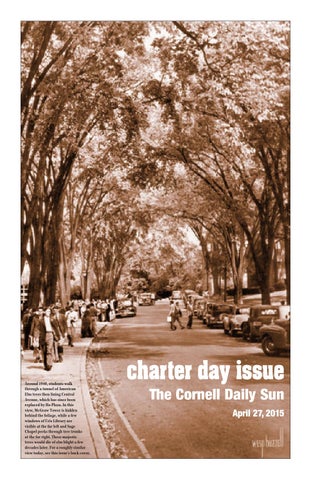
Around 1940, students walk through a tunnel of American Elm trees then lining Central Avenue, which has since been replaced by Ho Plaza. In this view, McGraw Tower is hidden behind the foliage, while a few windows of Uris Library are visible at the far left and Sage Chapel peeks through tree trunks at the far right. These majestic trees would die of elm blight a few decades later. For a roughly similar view today, see this issue’s back cover.
charter day issue
The Cornell Daily Sun April 27, 2015
CHARTER DAY SUPPLEMENT - SESQUICENTENNIAL EDITION
2
Table of Contents 3 6 7 9 10 11 12 13 15
A History of the First 150 Years The Rise and Fall of Campus Activism The Push for Equal Coeducation Cornell’s Artistic Legacy The Changing Role of Faculty Examining the Costs of Cornell Creating a More Sustainable Campus The Land Grant University to the World The Progressive Face of the MLB
Supplement Issue Staff EDITOR IN CHIEF MANAGING EDITOR
Tyler Alicea ’16 Annie Bui ’16
SUPPLEMENT EDITORS Haley Velasco ’15 Anna Fasman ’16 Noah Rankin ’16 Alex Rehberg ’16 Mike Sosnick ’16 Sloane Grinspoon ’17 Sofia Hu ’17 Troy Sherman ’18 PHOTOGRAPHY EDITORS Brittney Chew ’17 Michaela Brew ’18 DESIGN DESKERS Elizabeth Sowers ’15 Jayne Zurek ’16 Samantha Briggs ’16 Tyler Breitfeller ’16 Madeline Salinas ’16 COVER PHOTO: Wesp Buzzell / Sun Archive Photo BACK COVER PHOTO: Michelle Feldman / Sun Senior Photographer
KELLY YANG / SUN SENIOR PHOTOGRAPHER
MICHELLE FELDMAN / SUN SENIOR PHOTOGRAPHER
BRITTNEY CHEW / SUN NEWS PHOTOGRAPHY EDITOR
CAMERON POLLACK / SUN STAFF PHOTOGRAPHER
MICHAELA BREW / SUN SPORTS PHOTOGRAPHY EDITOR
KELLY YANG / SUN SENIOR PHOTOGRAPHER
CAMERON POLLACK / SUN STAFF PHOTOGRAPHER
KELLY YANG / SUN SENIOR PHOTOGRAPHER
The Cornell Daily Sun | Monday, April 27th, 2015
CHARTER DAY SUPPLEMENT - SESQUICENTENNIAL EDITION
3
CORNELL UNIVERSITY: THE FIRST 150 YEARS The first American university | Uris Library and the iconic McGraw Tower, designed by local architect William Henry Miller 1872, under construction in 1890. Cows are visible in the foreground field. SUN PHOTO ARCHIVE
By SOFIA HU Sun News Editor
This story starts with a boy. On Jan. 11, 1807, Ezra Cornell was born in Westchester Landing, New York. Raised by birthright Quaker parents and a carpenter by trade, Cornell was “essentially a man who stands alone, a nonconformist,” wrote Morris Bishop 1913 M.A. 1914 Ph.D. 1926 in his 1962 book A History of Cornell. Having made his fortune in the telegraph business, Cornell successfully ran for the New York State Senate in 1863 and, as chair of the Committee on Agriculture, introduced a bill for a public library for Tompkins County residents. The bill landed on the desk of Andrew Dickson White, fellow newly-elected senator and chair of the Committee on Literature. On Feb. 7, 1865, White introduced a Senate bill proposing to appropriate income made from the sale of public land to establish Cornell University. In July 1862, President Abraham Lincoln signed into law the Morrill Act, which allowed for the creation of land-grant colleges. Despite heavy criticism of the nonsectarian nature of the proposed university, the bill passed in the New York State Assembly and Senate. Governor Reuben E. Fenton signed the bill on April 27, 1865. And so it began. The Board of Trustees of Cornell University convened the very next day. Meanwhile, Cornell set the location of his campus at the top of East Hill, overlooking Cayuga Lake, and White busied himself looking for faculty, searching for renown scholars and fresh, determined professors alike. The nation greeted the founding of Cornell University with mixed feelings. “The Cornell idea itself, with its proclaimed need for an overturn in educational theory and practice, insulted every established college,” Bishop wrote. Cornell University opened its doors on Oct. 7, 1868. During his Inauguration Day speech, Cornell spoke what would become the university’s motto: “I would found an institution where any person can find instruction in any study.” The day prior, student candidates had sat for examinations on various subjects including spelling, grammar, mathematics and geography. Faculty spent two nights grading the exams, and on Oct. 8, 412 students were admitted into the freshman class. This was the largest entering class for a university in America at the time, according to Carl Becker in his 1943 novel Cornell University: Founders and the Founding. In September 1870, the first female stu-
dent stepped on campus. Jennie Spencer had a state scholarship, but no lodging on top of the hill. As a result, she left Cornell when winter hit, which in part spurred trustee Henry W. Sage to donate $250,000 for a women’s dormitory. The Sage College of Woman — now Sage Hall — was completed in 1875. By the fall of 1874, 37 women were enrolled at Cornell. In 1871, the College of Architecture was created. According to Bishop, this was the first of its kind. The other schools and departments, including Agriculture, took shape as well. The Panic of 1873 plunged the University in financial woes. Additionally, Ezra Cornell lost a significant portion of his wealth when the railroad business tanked. Amidst the financial trouble, Cornell died on Dec. 9, 1874. “The city was suddenly aware that it had lost its greatest citizen, the University that it had lost the cause of its existence,” Bishop wrote. White resigned from the presidency in March 1879 in order to become the American minister to Germany. William Russel, widely unpopular among faculty, replaced him until White returned in 1881. The Cornell Daily Sun, now the oldest continuously independent college daily, published its first issue on Sept. 16, 1880. Following her death in 1881, Jennie McGraw bequeathed $200,000 to Cornell University, including several thousands for a student hospital. Her father was trustee John McGraw, and their names grace the Cornell Chimes tower and Arts Quad building. The first library, now Uris Library, opened in October 1891, with 105,000
books on its shelves. Cornell Medical College began building its campus in New York City in 1898. Its first class of 278 students included 26 women. The University saw tremendous growth from 1890 to 1899, increasing its enrollment from 1,390 students to 2,047. A string of new buildings appeared on campus, including the Sibley Dome in 1902; Rockefeller Hall in 1906; Rand Hall in 1912; and the Risley women’s dormitory in 1913. In 1904, Prof. Liberty Hyde Bailey, practical and experimental horticulture, obtained public funding for the department of Agriculture, turning it into the New York State College of Agriculture. Martha Van Rensselaer 1909 and Flora Rose became the first women full professors at Cornell in 1911, teaching in the Department of Home Economics. The department became a college in 1925 and later would became the College of Human Ecology in 1969. Following the onset of World War I, the university began building the Drill Hall to train future soldiers. In just two months, 2,000 undergraduates and several young teachers enlisted. A unit of the Reserve Officers’ Training Corps was established in 1916. Two years later, the University partnered with the U.S. Department of War, establishing a program to train students to become future officers. “Thus Cornell became … military school,” with 1,696 students in the program, Bishop wrote. Andrew Dickson White died on his 84th birthday on Nov. 4, 1918, seven days before armistice. But as war ended, campus hummed again with the influx of students.
Throwing it back | Cornell’s Class of 1887 poses for its class picture.
The Cornell Daily Sun | Monday, April 27th, 2015
In total, 8,851 Cornellians had been in uniform with 5,376 in active service. More than two percent of all Army, Navy and Marine officers were Cornellians. Two hundred sixteen Cornell men died in service. The War Memorial between Lyon and MacFadden Halls commemorates the 264 who died during World War I. In 1922, Cornell offered the first hotel college course in the world. Twenty-four students enrolled. Willard Straight Hall — named for Willard Dickerman Straight 1901 — opened on Nov. 18, 1925. As an undergraduate, Straight was heavily involved on campus and helped start the Dragon Day tradition. The Straight was one of several buildings created during a burst of construction in the 1920s and 1930s, as the Plant Sciences Building, Myron Taylor Hall, Stocking Hall, Balch Hall and Martha Van Rensselaer Hall opened. The Great Depression hit the University hard. In 1924, the University ran a deficit of $435,000 that grew into $689,000 after nine years. The state colleges saw a six percent decrease in some salaries and all departments saw a 20 percent decrease in funding for instructors and assistants. During this time, Cornell continued to award scholarships, ultimately providing 600 tuition scholarships to state residents. A Student Emergency Loan Fund was also established in 1932. In 1927, Payne Whitney, the nephew of the creator of the Cornell Medical College, bequeathed millions of dollars to the New York Hospital, endowing the medical school, leading to the union of the hospital See HISTORY page 14 SUN PHOTO ARCHIVE
CHARTER DAY SUPPLEMENT - SESQUICENTENNIAL EDITION
4
The Corne¬ Daily Sun
Editorial
Independent Since 1880
Cornell University: The Future Challenges
133RD EDITORIAL BOARD
TYLER ALICEA ’16 Bethlehem, Pa. Editor in Chief
EMMA LICHTENSTEIN ’16
ANNIE BUI ’16
New York, N.Y.
West Covina, Calif.
SLOANE GRINSPOON ’17
HALEY XUE ’17
Associate Editor
Advertising Manager
AMBER CHEN ’16
ANNA FASMAN ’16
Web Editor
Sports Editor
Business Manager
Managing Editor
Weston, Mass.
Berwyn, Pa.
Rockville, Md.
Newton, Mass.
NATALIE TSAY ’18
KIKI LI ’17
Southlake, Texas
Nanjing, China
Blogs Editor
Multimedia Editor
JAYNE ZUREK ’16
BRITTNEY CHEW ’17
Design Editor
News Photography Editor
MICHAELA BREW ’18
JOEY WALTER ’17
Sports Photography Editor
Online Managing Editor
SOFIA HU ’17
GABRIELLA LEE ’16
News Editor
News Editor
Cincinnati, Ohio
Foster City, Calif.
Ithaca, N.Y.
Basking Ridge, N.J.
Braga, Portugal
Hong Kong
JAEL GOLDFINE ’17
MIKE SOSNICK ’16
Arts & Entertainment Editor
Arts & Entertainment Editor
NOAH RANKIN ’16
RACHAEL CUSICK ’16
Science Editor
Dining Editor
State College, Pa.
New Canaan, Conn.
Fredonia, N.Y.
Staten Island, N.Y.
REBECCA BLAIR ’17
MADELINE COHEN ’18
Assistant News Editor
Assistant News Editor
PAULINA GLASS ’18
PHOEBE KELLER ’18
Assistant News Editor
Assistant News Editor
TROY SHERMAN ’18
ADAM BRONFIN ’18
Assistant Arts & Entertainment Editor
Assistant Sports Editor
JOON LEE ’17
SHANE LEWIS ’18
Assistant Sports Editor
Assistant Sports Editor
Hoboken, N.J.
Nyack, N.Y.
Rye, N.Y.
Seattle, Wash.
Harwich, Mass.
Ridgewood, N.J.
Brownsville, Texas
Brookline, Mass.
ADDY PAI ’16
SAMANTHA BRIGGS ’16 Norwalk, Conn.
Basking Ridge, N.J.
ADELE GU ’17
DARA LEVY ’16
Human Resources Manager
Senior Editor
Marketing Manager
Assistant Design Editor
Westfield, N.J.
Shanghai, China
ANUSHKA MEHROTRA ’16
ALEX REHBERG ’16
Senior Editor
Senior Editor
Naperville, Ill.
Boca Raton, Fla.
MADELINE SALINAS ’16 Danville, Ky. Senior Editor
From the Editor
Examining 150 As Cornell celebrated its sesquicentennial with fanfare this weekend, the members of The Cornell Daily Sun tasked ourselves with scrutinizing the University’s past, present and future. In doing so, we’ve produced this supplement to provide historical context to many of the issues and themes facing Cornell. While the pages of this issue reflect upon many of the triumphs and challenges of our progressive institution, throughout the weekend, Cornell celebrated its “Festival of Ideas and Imagination.” To properly chronicle the breadth of academia and culture that infiltrated the Hill this weekend, The Sun launched a new website, 150.cornellsun.com. Through this website, we have provided coverage of many of the Charter Day weekend events that took place. After reading this issue, I encourage you to visit this website to read about Cornell’s pursuits, along with digital versions of the pieces included in this supplement. While Cornell’s sesquicentennial calls for Cornellians around the world to celebrate, this occasion also affords the opportunity to reflect and examine Cornell’s successes, failures and the work the must be done. Cheers to the next 150 years. To the Hill! — T.R.A.
O
NE HUNDRED FIFTY YEARS AGO TODAY, Cornell University’s charter was signed, bringing Ezra Cornell and Andrew Dickson White’s vision of a progressive institution of higher education to fruition. Since then, life on the Hill has evolved for generations of Cornellians, as our land grant institution transformed from a small, maledominated campus to one priding itself on its radical personality and diverse body. Transforming into a high-caliber research institution recognized across the globe, this University has made strides in a wide range of fields. Though some may disagree, Cornell has triumphed in working to positively change the student experience. From its state-of-the-art health services, expansive student organizations and activities and range of studies, Cornell has become a place of adaptability and accessibility for many. However, as the University finishes celebrating its sesquicentennial, Cornell must observe and react to the challenges affecting Cornellians in order to achieve its long-term goals and aspirations. The largest challenge undoubtedly facing Cornell and academic institutions across the United States is the rising costs of attending such establishments. Even as the demand for a Cornell education continues to rise, annual tuition — increasing faster than the rate of inflation — continues to place burdens on students and families. To continue funding the wide breadth of Cornell programs and divisions, finding alternative sources of resources, although likely difficult in a changing educational landscape, will remain imperative. While Cornell has succeeded in expanding financial aid benefits to students in recent years, administrators in the future must guarantee the sustainability of aid and address the increasing costs of higher education to ensure Cornell remains accessible to all able students in the future. Additionally, over Cornell’s history, the University has grappled with ensuring the campus remains both diverse and inclusive. Although Cornell has improved its level of gender and racial diversity since its founding, many students who identify with minority groups still do not feel supported or safe on the Hill. The University must also continue to tackle issues relating to safety on campus by educating students to eliminate risky behaviors and committing to continuing mental health initiatives. Moving forward, focusing on actions that provide all Cornellians with a safe and healthy campus climate will be necessary for Cornell to continue to attract a scope of minds from across cultures and to make certain those students feel as though they belong. As Cornell continues to expand in the future, the University must consider how globalization will play a role in how it delivers education and research across the world. While today’s administrators continue to stress the importance of Cornell’s Ithaca campus, future leaders should be cautioned to emphasize and maintain the principles the founders worked to instill in the Ithaca campus by guaranteeing resources are available to all Cornell’s campuses. As the role of higher education and the need for living and learning spaces adjusts, Cornell must be both honest with its intentions and bold with its ambitions. Many of the challenges facing Cornell must be addressed, while others should be taken as considerations for future generations of Cornellians of varying constituencies: administrators, students, faculty and staff. Additionally, the challenges and triumphs outlined are not the only ones facing Cornell. Like the challenges facing Cornell on its centennial 50 years ago, today’s issues, if not addressed, will continue to persist as tomorrow’s problems. As Cornell’s story continues to unfold, the University must continue to follow its spirit of progressivism and tackle trials using oftentimes unorthodox methods to further shape life on and off the Hill.
The Cornell Daily Sun | Monday, April 27th, 2015
BRITTNEY CHEW / SUN NEWS PHOTOGRAPHY EDITOR
CHARTER DAY SUPPLEMENT - SESQUICENTENNIAL EDITION
‘Perhaps Cornell’ T
oday, April 27, Cornell University celebrates the 150th anniversary of the signing of its charter, the foundational document creating what has been called “the first American university.” The University was nothing more than a piece of paper on that day in 1865 — a paper that contained the revolutionary ideas of Ezra Cornell and Andrew Dickson White and their hopes that this new institution would change the landscape of higher education. A century and a half later, Cornell University has grown into a world-class university with hundreds of thousands of alumni, tens of thousands of students, thousands of faculty and staff and campuses stretching from Ithaca to New York City to Doha, Qatar. In the years approaching
Cornell tradition as one of “freedom and responsibility.” Becker, in describing Cornell’s “peculiar character,” stated that the founding faculty were “as highly individualized, as colorful, as disconcertingly original and amiably eccentric a group of men as was ever got together for the launching of a new educational venture.” It was this eccentricity that the founders and early faculty imbued in Cornell and that still shapes our identity. To quote Bishop once more, “Should we complain because our Alma Mater has found no fixed and sure classification in the educational world? Why no, I should think not.” Cornellians should be proud of their identity, not just as hotelies or veterinarians or engineers, but as students at an institution that combines all of those
Cornell was founded to be different, and its greatest strength has always been in embracing that differentness.
Corey Earle ’07 Cornell’s 75th birthday, beloved professor and historian Morris Bishop 1913, penned an essay about an outsider’s perception of our university. A speech by a midwest college president had mentioned that the “essentially American colleges” were Harvard, Yale, Princeton “and perhaps Cornell.” Bishop opined that, “It has always been the fate of our University to be Perhaps Cornell! A part neither of the aristocratic tradition of the original colonies nor the educational democracy of the great West, half State college, half endowed institution, stoutly liberal and strangely conservative, its activity ranges from research in the noblest mysteries to broadcasting messages on disinfecting brooder houses.” Cornell is now more than twice as old as it was when Bishop wrote of the “perhaps Cornell” perception problem, but I would argue that his conclusions still ring true today. The Cornell identity crisis is at the core of our university’s foundational principles. We weren’t founded to educate a certain type of person in specific fields of study, but instead bucked tradition and flung open the doors to “any person” and “any study.” We didn’t copy Harvard and Yale or Michigan and Ohio, but instead opted to create a hybrid that combined a variety of innovations: coeducation, non-sectarianism, commitment to public engagement and equality of practical and classical fields of study, to name a few. Cornell is the radical upstart or the underdog of the Ivy League and also the elite Ivy of land-grant colleges. We’re the Big Red, the Ivy League school with a Big Ten heart and SUNY Ithaca. An early distinguished alumnus of Cornell once claimed that the only tradition of which Cornell was proud was that it had no tradition. Decades later, in an address on the 75th anniversary of Charter Day, historian Carl Becker famously described the
identities together. Building a sense of community at such a large and decentralized institution has always been a challenge, but we should relish Cornell’s historical uniqueness and unite in the fact that no two Cornellians have the same experience far above Cayuga’s waters. At his inauguration as Cornell’s ninth president in 1977, Frank H. T. Rhodes referenced Bishop’s “Perhaps Cornell” essay, saying that the words “haunt me, not as an uninformed and pompous judgment of our past, but as a hope and a challenge for our future. What distinctive character, what kind of role, may we hope for Cornell in the years that lie ahead?” As we enter the next 150 years of Cornell University, we should remember the revolutionary ideas of our founders and continue their legacy of going against convention. Ezra Cornell and Andrew Dickson White took risks that ultimately paid off and changed the world, and Cornell should continue to be on the cutting edge of innovation in higher education. The next generation of Cornell administrators and students must strive to maintain Cornell’s distinctive character and fight against pressure to emulate peer institutions and conform to shallow rankings and one-dimensional comparisons. Cornell was founded to be different, and its greatest strength has always been in embracing that differentness. Prospective students should choose Cornell not because it’s like Harvard, Yale and Princeton, but precisely because it’s not. I hope that we proudly support the “perhaps Cornell” perception for many more years to come, instead of simply blending in with the rest of the higher education landscape. Corey Ryan Earle ’07 is an associate director of student programs in the Office of Alumni Affairs and a visiting lecturer in the American studies program. He teaches American Studies 2001: The First American University, a course about Cornell University history. He can be reached at cre8@cornell.edu.
O
Cornell Is...
ne-hundred fifty years of Cornell means a 150 year legacy that I’m proud to be a part of. It means a tradition that is both brief and an eternity — it’s a beautiful, lasting memory. As a middle-class immigrant to this country, being part of Cornell’s rich history is laying a foundation for my future here, an achievement in itself and a promise for more. It’s the beginning of syncretism, of receiving an education from a historical institution and
Coming to Cornell promises an odyssey of the mind, body and soul.
Kevin Milian giving back new perspectives to a growing and learning university. It’s taking American Studies 2001, the senior-filled “The First American University” course, and seeing the history of our school, seeing one’s own place and being able to objectively examine issues throughout our century-and-a-half existence. One-hundred fifty years of Cornell means seeing similarities between Ezra Cornell and my father, both hardworking men, inventors, from humble backgrounds who wanted something more for the common person and put in 100 percent to give other that opportunity. Cornell’s sesquicentennial is about walking among the old buildings, imagining an older time, daydreaming about a decadent past as a distraction of the everyday stresses of school work. It’s 7,826 weeks of waking up from that
Y
5
daydream and realizing that things weren’t so great, that today isn’t so bad and that regardless of obstacles and successes, there’s something that remains enchanting and eternal about our institution. One-hundred fifty years of Cornell is 54,786 days of continuously finding ourselves among other universities. It’s about catching up in certain aspects among our peer institutions — like creating the West Campus house system or replicating Gothic architecture in the 1920s — but being the first among these storied schools in certain accomplishments, such as being non-sectarian, being inclusive to women and having an agriculture school. It’s about growing pains and fulfilling labor, of being within a league of elite institutions but feeling unique, being perceived as “off,” “odd,” “strange” and “sylvan,” and relishing in the indescribable but universal Cornellian experience. It’s about being complimented on the beautiful campus or questioned about the cold, but never asked about life on the Hill unless the person talking to you matriculated here or has had the pleasure of being drowned in Big Red stories. What occurs on campus is a mystery to most, and a privilege to those lucky enough to live it briefly. One-hundred fifty years of Cornell is 1,314,864 hours of allegiance and support from alumni, ensuring that there will be a radically different student body in the next 50 years, united by the same motto, on a living campus that vacillates from the slick appeal of the future to the elegance of the past. Coming to Cornell promises an odyssey of the mind, body and soul and a guarantee to return one day to share one in one million facets of a timeless place. Kevin Milian is a senior in the College of Agriculture and Life Sciences. He can be reached at kmilian@cornellsun.com.
Here in This Place
ou will fail for the first time. And the second. And the 100th. You will stay up later than ever before, doing things that feel more important than anything before. Everything feels more important at 5 a.m., though. You will learn to sometimes let it all go and just go to sleep. You will cry. In the bathroom of Rockefeller after you get back a prelim. On the sidewalk outside Dunbar’s. In Olin when you get the email telling you that you got that internship for next summer. When you feel like everything is falling apart. When you feel like everything is finally coming together. Freshman year, you will think the campus is beautiful, coated gently in the first blanket of freshly fallen snow. One week later, you will curse the heavy clouds waiting to dump slush onto your head while you trudge to class. You will forget your snow boots at home, and your feet will be drenched, and you will have one more thing, on top of everything else, to complain about as you down lattes in Libe Café.
Four years later, the snow will be just as beautiful, you’ll just have to look a little harder, a little longer. You will remember your snow boots. You will learn, and grow, just more slowly than you might have imagined. You will become less idealistic, as you study gravity, grammar, gentrification — the seemingly immutable forces that govern the world we live in. You will also become more idealistic, as you see the drive inside your peers, your
You will climb all 161 steps of the clock tower whenever you need to be reminded the particularly extraordinary, improbable nature of everything around you. That we are all here, in this place, at this time, sharing this particular slice of our personal and collective histories. Your heart will be broken, and you will feel so certain that you will never be whole again. Then your best friends will bring you a CTBLT and a bottle of wine, and you will spend
“... Life is messy and full of contradictions, and so is this place.”
Sarah Byrne teachers, yourself — the forces that will one day change the world we live in. Your life will be governed, at least for a while, by the curve — you will become perhaps a little too invested in what everyone around you is doing, and thinking, and studying. Then you will forget all of that noise and find what you are supposed to be doing.
The Cornell Daily Sun | Monday, April 27th, 2015
the whole night laughing about the jokes that are your respective lives. You will sit through the most boring lecture of your life, and then attend a lifechanging one, in the same day, because life is messy and full of contradictions, and so is this place. Sarah Byrne is a senior in the College of Arts and Sciences. She can be reached at sbyrne@cornellsun.com.
CHARTER DAY SUPPLEMENT - SESQUICENTENNIAL EDITION
6
The Rise and Fall of Campus Activism at C.U. By PHOEBE KELLER Sun Assistant News Editor
Cornell’s fifth president, Edmund Ezra Day, declared in 1940 that the Cornell tradition was an “embodiment of rebelliousness and liberation.” At the same event, Prof. Carl Becker, history, called Cornell “impudent,” “a little wild at times” and “a rebel against convention.” Professor Isaac Kramnick, government, co-author of Cornell: A History, 19402015, asserts that Cornell’s legacy of student activism is grounded in the dual concepts of “freedom and responsibility.” “These two concepts very wisely set the parameters — yes this should be a totally open campus and students should have the right to protest — but all of this has to be done responsibly,” he said. “This contrast has become the Cornell mantra.” While this struggle between freedom and responsibility has defined Cornell’s history of student protest, some of the most memorable moments of activism were the result of an imbalance of these two forces.
ed skirts.” But what he called a “conservative and conformist” campus environment did not last long into the 1960s. The 1960s
“The 60s was a unique historical moment,” Kramnick said. “It was the coming together of anti-Vietnam and civil rights and the draft — that created the kind of mobilization that I haven’t seen at any point since.” Prof. Paul Sawyer, English, recounted how protests against the war in Vietnam were sparked by the realization that faculty were working defense contracts with companies like Dow chemical and that ROTC recruitment took place at Cornell. “A very important insight [from this time] is that the University has maybe never been apolitical,” Sawyer said. RICHARD A. SHULMAN / SUN FILE PHOTO “Research is often deeply implicated with politics, so the University is already polit- All smiles | Eric D. Evans ’69, leader of the Afro-American Society, and C. David Burak ’67, ical.” chairman of Students for a Democratic Society, stand alongside President James A. Perkins, In April 1969, approximately 100 facing a nearly 10,000-strong crowd in Barton Hall following the Willard Straight Hall Takeover. black students took over Willard Straight Hall. They ejected University employees there was an overall sympathy with the After President Hunter R. Rawlings III and Parents’ Weekend visitors from the cause,” he said. “Administrators con- made the decision to use the space as a building, demanding pardons for previ- vinced themselves afterward that the parking lot despite the protests, Susan Malott Riots ous indiscretions and an autonomous University should be more impartial and Murphy ’73 Ph.D. ’94, vice president for In 1958, over 1,500 students splat- black studies center. Over a day later, the shouldn’t be swayed by the politics of stu- student and academic services, said she tered Day Hall with eggs, protesting in students marched out of the Straight with dents.” “spent a lot of time sitting in the woods” loco parentis University rules and a ruling rifles and were granted amnesty in an and negotiating compromises on bus passthat said women would no longer be per- administrative decision that became Apartheid and Divestment es and neighborhood council connections mitted to attend unchaperoned parties nationally known as “Cornell’s capitulaAfter the drama of the 1960s, with protesters. off-campus. tion.” Kramnick said the next “huge student The Great Decline Later that day, a crowd of nearly 3,000 “[The Straight takeover] was a unique activist crusade” urged Cornell’s divestHowever, rhythms of student activism students assembled in front of Sage Hall, moment that’s part of the mythology of ment from companies in South Africa. vary, with many having accused encouraging women students to stay past student activism here at Cornell,” “Over 1,000 arrests occurred, includ- Cornellians of recent years of careertheir 12:30 a.m. curfew. The protesters set Kramnick said. “Every subsequent enter- ing faculty, during the first week of sit-ins focused pragmatism and general passivity. off firecrackers and hung a burning effigy prise of student activism — whether it’s at Day Hall in 1985,” Sawyer recounted. Kramnick attested to this, saying the of President Deane W. Malott. divestment, whether it’s against the $350 “It was like yesterday is the 1980s and “performative public theatre of protest” has They then marched from campus to [mandatory health fee] charge — every today is the 1960s.” declined sharply in recent years. He said Malott’s private residence, invading his time that hapStudents also that rather than attending rallies in front of lawn and smashing windows. Albert pens in the back c o n s t r u c t e d Cornell’s famous stump, many have turned Podell ’58 recalled participating in the of protesters’ s h a n t y t o w n s to social media instead to establish their riot and throwing smoke bombs to minds is the behind Day “political identities.” protest the socially restrictive policies. 1960s at He also said identity politics have Hall and on the “You could only have a woman visit Cornell.” Arts Quad, become campus-oriented rather than your dorm room two days a year, and you Kramnick where many nation focused, and progressive groups had to have three feet on the floor at all said that while have split into concerns for their own parwere arrested Prof. Paul Sawyer times,” he said. “It’s really hard to have the takeover of and then ticular issues rather than making alliances. kids these days understand how repressive the Straight is released. “On social issues like gay marriage, it was here.” glorified in hindsight, a deep resentment “There was a sense that part of civil dis- trans politics, abortion rights, today stuAfter four student leaders were sus- still exists among many alumni over the obedience was in fact accepting the pun- dents are socially liberal. But on political pended for their involvement in the administration’s acquiescence to the ishment that comes with it,” he said. issues — war and peace, redistributive taxprotest, 1,860 Cornellians signed a peti- demands of armed students. He also said Even after the divestment crisis, which ation, that kind of socio-economic radicaltion and held a sit-in supporting them. many conservative faculty members were was ultimately unsuccessful, the student ism — students are more apathetic,” he Eventually, Malott and the administra- unhappy with the decision and left the body continued to demand administrative said. “Students also are worried about jobs tion acquiesced, putting the in loco paren- University in protest. — they know a video of them in a protest change. tis rules to bed by the fall of 1958. “I think [that] in the 1960s, adminisdoing something overly radical will be in Podell recalled a campus where “every trators were personally sympathetic to the Redbud Woods their backpack for the rest of their lives.” guy had a crew cut and wore a British causes of students. They were personally In 2005, students and faculty joined sports jacket, if you could afford it, and opposed to Vietnam and they were per- forces in support of the Redbud Woods Looking Forward the women wore penny loafers and pleat- sonally in favor of racial integration, so movement — an effort to save the last “I do hope that this and the new woods on Central Campus that contained Cornell administrations will change their “huge, very old trees and a canopy of wal- way of making decisions, and take advannuts, below which bloomed many red- tage of the great knowledge, energy, and buds,” according to Prof. Elizabeth idealism embodied in this university,” Sanders, government. The small rural area Sanders said. had been designated the site of a new West In spite of the recent decline in quantity Campus parking lot by the administra- and quality of protests, many have not lost tion. hope for the ability of the Cornell student “Four hundred faculty, the Student body to unite as a collective voice. Assembly, the City of Ithaca and many “I would like to see activism continue other people tried mightily to talk the to come from an informed place, and be administration out of destroying the critical of not only to the Cornell campus woods,” she said. “Much was learned, by but the greater world community,” said all of us, from each other.” Juliana Batista ’16, executive vice president Sawyer said he discovered the Redbud of the Student Assembly. Woods movement after one of his stuSawyer urged students to recapture the dents was arrested for participating in a solidarity that grows through protest sit-in in the woods, finding himself among students who can feel disempowimpressed by the diverse backgrounds of ered in many other ways, and that faculty and students who supported the although the 1960s have been elevated and SUN FILE PHOTO movement. glorified as a “golden age of activism,” “The faculty members who were most meaningful protests are not constrained to The ‘Quiet Generation’ roars | Members of a crowd of 3,000 enthusiastic demonstrapersuasive on redbud woods were biolo- any particular decade. tors cheer and wave a torch in front of Sage Hall, then a women’s dorm, on the evening of gists, so the University was really going “The ’60s could happen again tomorMay 23, 1958, protesting the University’s attempt to impose rules that would prohibit against the advice of its own experts in row morning,” he said. female students’ from attending unchaperoned off-campus ‘apartment parties.’ On the that field,” he said. “That made me realize same evening, women stayed out after their dorm curfew as an act of civil disobediance. that natural science can be a social science Phoebe Keller can be reached at today, a moral science.” pkeller@cornellsun.com. The rally culminated with the burning of an effigy of then Cornell President Deane Malott.
“The ’60s could happen again tomorrow morning.”
The Cornell Daily Sun | Monday, April 27th, 2015
CHARTER DAY SUPPLEMENT - SESQUICENTENNIAL EDITION
7
The Push for Equal Coeducation and the Rise of Women By MADELINE COHEN Sun Assistant News Editor
Sun Sports Editor Anna Fasman contributed reporting to this piece. Against widespread disapproval of Cornell enrolling both men and women, the 19th century founders of the University believed in the value of coeducation, as its first President Andrew Dickson White attested. “As the bodies of men and women are built up by the same food, whether vegetable or animal, so it would seem that their minds and hearts and souls are to be built and beautified by the same moral, mental, and aesthetical food,” White said in a report to the Board of Trustees on Feb. 13, 1872, to convince them of the merits of coeducation. But as Cornell historian Charlotte Conable noted in Women at Cornell, published in 1977, White’s sentiments were not universal among faculty. Professor of history Goldwin Smith — whose name is memorialized on the arts college building — worried that if women were admitted, Cornell would “sink at once from the ranking of a University to that of an Oberlin or a high school” and all their hopes of future greatness “lost.”
tive health care. According to Cornell: A History, 19402015, authored by Prof. Isaac Kramnick, government, and Prof. Glenn Altschuler Ph.D. ’76, American studies, sit-ins by the newly-formed chapter of the National Organization of Women demanded sex-related medical care, leading to the providing of contraceptives by Cornell Health Services. Women’s activism also led to the formation of a woman-centered curriculum. Sheila Tobias, then a Cornell administrator, proved instrumental in the creation of the women’s studies program, bringing prominent feminists to campus in 1968. “We had never been exposed to an analysis of society and culture that revealed how male scholars had misrepresented women in every field,” Tobias said in an interview with The Sun. Tobias said she believes this conference put “Cornell on the feminist map.” The program Tobias founded, now known as feminist, gender and sexuality studies,
$77,000 dollars on updated athletic facilities and expanded coaching staff by 1979, in addition to travel and equipment for women’s athletics. Within the next 15 years, according to Kramnick and Altschuler, many teams saw the expansion of their coaching staffs, and the soccer and softball teams both earned varsity status after representing Cornell as club teams. Still, all of these changes did not come without some pushing and protesting by students and faculty alike. On Oct. 30, 1971, before Title IX was passed and officially implemented, nine women stormed and occupied the Teagle Hall steam room, then an all-male athletics facility. Students staged what became known as the “steam-in” to “protest what participants believe are insufficient athletic facilities for University women,” according to a 1971 Sun article. At the time, Helen Newman Hall was the primary space designated for women’s athletics; however, men were still able to use Helen Newman. Frustrated, women protesters believed they should share the same rights to Teagle. The Late 1900s And the Millenium
In spite of the warnings of the 19th century educator Goldwin Smith, Cornell has not fallen from greatness, even as women have gained more prominence among the adminisGracious Living And Early Challenges tration and in the student Trustee Henry Sage body. gifted $250,000 in 1872 Altschuler cites the to provide a home for increased number of female female students on camleaders on campus as evipus as a compromise for dence of progress in gender those who opposed parity. ROBERT W. BOLLENBACH / SUN FILE PHOTO coeducation. For “We now have two decades, women exclu- Raise your flag | Men and women demand that the Gannett Clinic introduce “competent contraceptive and women as deans of the two sively lived in Sage Hall, gynecological care” at a feminist march beginning at Willard Straight Hall on March 13, 1970. largest colleges at Cornell: other single sex dorms the College of Arts and or in University-approved sororities, where house teaches scores of courses each semester to hundreds of Sciences and the College of Agriculture and Life mothers presided over “gracious living:” proper man- students. Sciences,” Altschuler said. “We have several women as ners, approved dress and behavior and stringent curfews Feminists on campus also coined the term “sexual critically important vice presidential positions including set at 10 p.m. for weeknights and weekends. With lim- harassment” in 1975 to defend a woman named Mary Opperman, Susan Murphy and Joanne ited housing available, the number of female students Carmita Wood, seeking restitution for abuse on campus DeStefano, who is chief financial officer.” remained low, at no more than 25 percent of the stu- that forced her to quit her job. Although Wood lost her Susan Murphy ’73 Ph.D. ’94, vice president of student body until the 1960s. appeal to receive her unemployment insurance, the dent and academic services, was one of the first women A traditional bias against women in science and in phrase coined by her campus advocates to would on campus to become a vice president since she classical studies established quotas in the colleges, con- describe sexual problems in work environments in assumed her position in 1994. fining most to the domestic arts — which was under- future legal settings, according to Kramnick and “Yet, a tremendous amount of evolution has stood as preparation for their careers as wives and moth- Altschuler. occurred since then, because I think that at one point in ers. Until 1940, according to Conable, women comMary [Opperman] and my careers, we had more prised only one-third of students in the College of Arts women sitting around the senior table than men,” she Women in Athletics and Sciences, and until the 1960s, women made up less The passing of Title IX of the Education said. than one percent of the College of Engineering. When Murphy first enrolled at Cornell as an underAmendments in 1972, which guaranteed no individual would be barred from participating in opportunities graduate, three and a half men attended Cornell for Rise of Feminism on Campus afforded by any education program, arguably had its every woman on campus. Nearly 40 years later, the Feminist advocacy on campus, which developed in greatest impact in the world of collegiate athletics. incoming Class of 2019 comprises of 51 percent the wake of civil rights protests of the 1960s and the After the passage of Title IX, Cornell Athletics close- women. federal government’s subsequent promotion of gender ly examined and changed the inner-workings of its proWhile most undergraduate colleges have reached or equality, helped create a more equal learning environ- grams. According to Kramnick and Altschuler, the surpassed gender parity in their enrollments, the ment by ending unequal curfews, advocating for repro- Department of Physical Education and Athletics spent College of Engineering and the School of Industrial ductive health care and creating a women’s studies proand Labor Relations still have not, according to the Game on | The 1919 women’s basketball team. gram. University. In the Class of 2018, women comprise 41.6 One of the earliest forms of resistance to in loco parpercent of students in the engineering college and 45.9 entis — universities taking on the function and responpercent in ILR. sibilities of a parent — surfaced during the Malott riot “There has been a concerted and somewhat sucof 1958. Protesting prohibitions on women attending cessful effort to ensure that more women come to parties in male student apartments downtown, Cornell to take classes in [science, technology, engiapproximately 3,000 Cornellians — both men and neering and math] fields,” Altschuler said. women — marched around campus chanting, Elizabeth Garrett, who was named “We’re here to protest the social code.” One Cornell’s 13th president on Sept. 30, thousand of these students then arrived at 2014, will become the first female presPresident Deane Waldo Malott’s home in ident of the University in July 2015. Cayuga Heights, destroying landscaping and Although Cornell has prided itself breaking windows. because of its accessibility to Over the next decade, women advocatwomen since its founding, this ing an end to in loco parentis gained sigacts as a new reminder that nificant concessions. Vulnerable to diswomen at Cornell can have any crimination charges after the passage of role of prominence. the 1964 Civil Rights Act, Cornell reformed the uneven application Madeline Cohen can be of parietal rules. By the end of reached at the 1960s, virtually all curfews mcohen@cornellsun.com. were abolished. Anna Fasman can be A new frontier in advocacy reached at was formed around reproducCORNELL RARE AND MANUSCRIPT DIVISION sports@cornellsun.com.
The Cornell Daily Sun | Monday, April 27th, 2015
CHARTER DAY SUPPLEMENT - SESQUICENTENNIAL EDITION
8
A History of C.U. Scientific Breakthroughs 1885
Theobald Smith 1881 discovers the first Salmonella bacterium. Hypothesizing it to be the cause of common hog cholera, Smith named the microbe after Daniel Elmer Salmon DVM 1872, who led the research team under the United States Department of Agriculture (Salmon was also the first recipient of a D\VM degree in the United States). Though Smith’s theory was later proven incorrect, the Salmonella genus was found to be responsible for several infectious illnesses, such as typhoid fever and food poisoning.
1939
1910
1940
William J. Wilgus, a correspondence student at Cornell between 1883 and 1885, designs and oversees the construction of New York City’s Grand Central Terminal. Chief Engineer of the New York Central Railroad, Wilgus was responsible for the introduction of electric trains into the terminal as well as the idea for bi-level stations below ground.
1953 Prof. Hans Bethe, physics, participates in the preliminary design meetings for the atomic bomb. A major player in the Manhattan Project, Bethe also participated in the development team for the hydrogen bomb, though he hoped to prove the weapon impossible to create and serve as a force for disarmament.
1960
1958
The first successful implantable pacemaker — invented by Wilson Greatbatch BEE ’50 to regulate beating of the heart — enters use after extensive animal testing. Greatbatch’s pacemaker used a mercury battery as an energy source, different from earlier designs.
Henry Heimlich ’41 M.D. ’43 publishes an article promoting an anti-choking technique consisting of repeated abdominal thrusts, now commonly advertised as the “Heimlich maneuver.”
TONY CENICOLA / THE NEW YORK TIMES
1942
William F. Friedman 1914, leads the research division of the U.S. Army’s Signals Intelligence Service to break the difficult Japanese PURPLE cipher, providing Japanese diplomatic secrets to the United States government before World War II.
1974
Stephen Moulton Babcock master’s degree 1875 develops the Babcock Test, an inexpensive method of measuring the fat content in milk that allowed farmers to produce milk of consistent quality. From 1907 to 1911, Babcock led a series of single-grain experiments to measure relative nutritional value among grains for cattle, leading to the establishment of nutrition as a science.
1902 Florence Kimball DVM 1910 graduates from Cornell to become the first certified female veterinarian.
Philip Levine M.D. ’23, discovers the Rh factor in blood, having observed hemolytic disease in infants. Levine found that a “negative” pregnant mother’s antibodies can destroy the red blood cells of her child if the child’s blood was “positive,” or contains the Rh antigen. Today, an infant’s afflicted blood can undergo immediate treatment and prevent major repercussions.
1890
1978
The cyanoacrylate commonly known as Super Glue hits shelves, having been developed as an adhesive called “Eastman 910” by Harry Coover M.S. ’43 Ph.D. ’44. Able to bond solid objects as well as human tissues, the glue is also known for its forensic ability to capture fingerprints.
Gregory Goodwin Pincus ’24 begins testing the combined oral contraceptive pill after studying the ability of progesterone to inhibit fertility. The pills — approved by the Food and Drug Administration in 1960 — are now used by over 100 million women worldwide as a form of birth control.
1983 Walter McCrone ’38 Ph.D. ’42, performs several days of forensic testing on the Shroud of Turin, a linen cloth that appears to bear the image of a bearded man who had undergone crucifixion. McCrone concluded that the Shroud had been painted, due to the presence of red pigment that others had deemed blood.
2001
Barbara McClintock ’23 M.A. ’25 Ph.D. ’27 becomes the first and currently only woman to win an unshared Nobel Prize in Physiology or Medicine for her discovery of genetic transposition — that genes determine how certain traits are turned “on” or “off.”
1992
Jon Rubinstein ’78 M.Eng ’79 leads the eight-month development of the iPod, Apple’s first portable music player. Rubinstein later became senior vice president of Apple’s newlycreated iPod division in 2004.
1985 Prof. Mae Jemison M.D. ’81 becomes the first African-American woman to travel into space, serving as the science mission specialist on the Space Shuttle Endeavor’s second spaceflight. Jemison went on to start The Jemison Group, a company that focuses on integrating technologies into developing countries.
2003
2013
Prof. Steve Squyres ’78 Ph.D. ’81, astronomy, leads the Mars Exploration Rover Mission as a principal investigator. The mission, via the rovers Curiosity and Opportunity, returned significant findings about Mars, including evidence that water once flowed on the planet’s surface. THE NEW YORK TIMES
Prof. Kenneth G. Wilson, physics, directs the establishment of the Cornell Theory Center (now the Cornell University Center for Advanced Computing in Rhodes Hall), one of five original supercomputer centers created to provide high-speed computing resources within the United States.
MICHELLE FELDMAN / SUN SENIOR PHOTOGRAPHER
The Cornell Daily Sun | Monday, April 27th, 2015
Cornell researchers, including Prof. Lawrence Bonassar, biomedical engineering, and Dr. Jason Spector, director of the Laboratory for Bioregenerative Medicine and Surgery and associate professor of plastic surgery at Weill Cornell, successfully create a fully-functioning synthetic human ear using 3D printing. A collagen mold was printed based on a high-resolution 3D image of an existing ear, then injected with living cells to grow cartilage over a 3-month period.
INDEPENDENT SINCE 1880
The Corne¬ Daily Sun Vol. 131, No. 133
MONDAY, APRIL 27, 2015 ! ITHACA, NEW YORK
16 Pages – Free
News
Arts
Sports
Weather
Robot Heart
First Notes
Ivy Rivals
Cloudy HIGH: 52º LOW: 40º
Cornell professors discuss and show off their robot projects, including the most-energy efficient walking robot. | Page 7
Stephen Meisel ’18 says the Electric Buffalo Showcase Saturday is the start of a burgeoning music scene. | Page 8
The men’s lacross team comes back from a first quarter shutout to clinch the Ivy title against Princeton. | Page 16
University Presidents Speculate on Future Of Higher Education By GABRIELLA LEE Sun News Editor
Past, present and future presidents of Cornell as well as Drew Gilpin Faust, the current president of Harvard University, gathered in Bailey Hall Sunday afternoon to tackle questions about the importance of liberal arts, university funding models and internationalization in higher education. The discussion — titled “Presidential Panel: The Future of Higher Education” — which was led by Cornell’s ninth president Prof. Emeritus See HIGHER EDUCATION page 4
JASON BEN NATHAN / SUN STAFF PHOTOGRAPHER
Smiles all around | Cornell’s 11th president Jeffrey S. Lehman ’77 shares a joke with the current president David Skorton while on stage in Bailey Hall following a Sunday panel on the future of higher education.
Students Declare Independent Union By ZOE FERGUSON Sun Senior Writer
CAMERON POLLACK / SUN STAFF PHOTOGRAPHER
Approximately 60 students gathered on Bailey Plaza Sunday afternoon to declare the creation of the Cornell Independent Students’ Union, a student organization separate from the University. Student activists formed CISU as an outlet to air their grievances about the administration and collaborate to protest fees. Students welcomed one another to stand up and speak to the crowd over a loudspeaker. The event began with several students who read from typed
speeches, while others spoke without a script. Silvia Treviño ’17 opened the event, stating the purpose of the rally. “We have assembled outside Bailey Hall because President Skorton and President-Elect Garrett are inside discussing the future of higher education,” Treviño said. “We stand in protest of the exclusion of student voices from their so-called constructive dialogue.” Treviño said the growing distance between administration and students spurred the need for a new See UNION page 4
Big reveal | President David Skorton and City of Ithaca Mayor Svante
Skorton, Mayor Myrick ’09 Nye’77, Squyres Ph.D.’81 Dedicate Downtown Plaque Dive Into Joys of Exploration Myrick ’09 reveal the plaque honoring the Cornell-Ithaca relationship.
Dedication launches Charter Day celebrations By DAVID TICZON Sun Staff Writer
Cornell officially kicked off Charter Day Weekend with speeches at the Tompkins County Public Library and a plaque dedication by Mayor Svante Myrick ’09 and President David Skorton in the Ithaca Commons Friday. Members of the Ithaca and Cornell community listened to speeches honoring Cornell’s 150-year long relationship with the Ithaca community.
Myrick opened his speech by highlighting an exhibit at the library, which spotlights Cornellians who have affected the local community over the past 15 decades. Myrick said that he is the most recent honoree — an honor given only six years after graduating. “What took you so long?” Myrick said, receiving laughter from the crowd. “With all sincerity, the University’s commitment to making this See PLAQUE page 5
By OLIVIA LUTWAK
Sun Staff Writer
Professor Steven Squyres ’78 Ph.D. ’81 and Bill Nye ’77 spoke about adventures on earth and in space, NASA, sundials, shadows and the spirit of exploration at Cornell in the first lecture of Charter Day weekend Friday night. Squyres has been involved with NASA since his undergraduate days and was a lead scientist on the Mars Rover missions, while Nye is a frequent visitor to campus and has become a spokesperson
for science literacy for the public, according to Prof. Joseph Burns Ph.D. ’66, astronomy, who introduced the lecture. “This is an intellectual smorgasbord,” Burns said. Squyres discussed space exploration and Carl Sagan, who he said “was a hell of a good scientist [and] one of the driving forces behind one of NASA’s finest missions ever.” Squyres said Sagan’s mission involved sending the Viking Landers to Mars. He See DISCOVERY page 5
MICHAELA BREW / SUN SPORTS PHOTOGRAPHY EDITOR
The science guy | Bill Nye ’77 wows the Bailey Hall audience at a lecture Friday.
2 THE CORNELL DAILY SUN | Monday, April 27, 2015
Today
DAYBOOK
Monday, April 27, 2015
weather FORECAST
Daybook
Today
Hi: 52° F Lo: 40° F Few Showers
Cornell Chimes Charter Day Concert 9:15 - 9:45 a.m., McGraw Tower
This week, we will leave the wintery weather behind, with temperatures reaching in the 60s. Unfortunately, the sun will only shine sparingly this week, so soak up the sun when you have the chance.
Charter Day Ceremony 10 a.m. - Noon, Barton Hall The Hieroglyphic of the World Economy Justin Rosenberg, University of Sussex 3 - 4:30 p.m., B73 Warren Hall
Enjoy today, because it’s one of the only rainless days of the week. There seems to be an overabundance of cloudy Ithaca days.
Conventions and Critiques of Citation 3:30 - 5 p.m., 374 Rockefeller Hall Why Are Weight Loss Drugs so Difficult to Develop? 4 -5 p.m., 100 Savage Hall
Tomorrow
With rain showers expected tonight, be sure to bring an umbrella.
GFI Luncheon With Masanori Tanabe 11 a.m. - 1:15 p.m., 153 Uris Hall Domestic Dog Reproduction A to Z Noon - 1 p.m., Thaw Lecture Hall, Baker Institute LGBTQ Awareness Month: Where Does Our Movement Go Next? 1 - 2 p.m., 102 Mann Library
Cecilia Vicuña
Lecturers & Performances
“The Poem is the Animal” Tuesday, April 28, 2015 4:45 p.m. Schwartz Performing Arts Center Film Forum The Public is Invited
The Corne¬ Daily Sun INDEPENDENT SINCE 1880
ALL DEPARTMENTS
Business Manager
Emma Lichtenstein ’16
(607) 273-3606
Business: For questions regarding advertising, classifieds, subscriptions or delivery problems, please call from 9 a.m. to 5 p.m., Monday-Friday. News: To report breaking news or story ideas, please call after 5 p.m., SundayThursday.
SEND A FAX VISIT THE OFFICE THE SUN ONLINE E-MAIL
Hi: 63° Lo: 41° PM Showers
Today is another rainy day, but we can remain positive by hoping that these April showers will bring May flowers. Hi: 61° Lo: 43° Showers
Free French Fry Tasting 4 - 6 p.m., Robert Purcell Community Center
Editor in Chief
As the warmest and sunniest day of the week, spend time outside to embrace the beautiful weather! Hi: 65° Lo: 40° Mostly Sunny
Sharing Your Data Workshop 10 - 11:30 a.m., 160 Mann Library
Tyler Alicea ’16
Hi: 61° Lo: 40° Partly Cloudy
(607) 273-0746 139 W. State Street, Ithaca, N.Y. www.cornellsun.com sunmailbox@cornellsun.com
Postal Information: The Cornell Daily Sun (USPS 132680 ISSN 1095-8169) is published by THE CORNELL DAILY SUN, a New York corporation, 139 W. State St., Ithaca, N.Y. 14850. The Sun is published Monday through Friday during the Cornell University academic year, with three special issues: one for seniors in May, one for alumni in June and one for incoming freshmen in July, for a total of 143 issues per year. Subscription rates are: $137.00 for fall term, $143.00 for spring term and $280.00 for both terms if paid in advance. First-class postage paid at Ithaca, New York. Postmaster: Send address changes to The Cornell Daily Sun, 139 W. State St., Ithaca, N.Y. 14850.
TUE WED THU FRI
— Compiled by Madeline Cohen
THE CORNELL DAILY SUN | Monday, April 27, 2015 3
NEWS
Alumna Donates $10 Million for Disability Institute By MADELINE COHEN Sun Assistant News Editor
Lisa Yang ’74 gave $10 million — the largest donation in the history of the School of Industrial and Labor Relations — to the Employment and Disability Institute, the University announced Friday. The EDI seeks to advance policies and knowledge to enhance the opportunities of people with disabilities, according to the University. Yang said she gave the donation because she believes it is imperative to “unequivocally recognize that a diverse workforce is critical to success.” “We need to bring forth a paradigm shift in the corporate world that helps it integrate disability as a form of diversity,” she said in a University release. Yang is a retired investment banker, who now devotes the majority of her time to mental health advocacy. She has established undergraduate international scholarships for Cornell students, according to the University, and her support has helped EDI grow its involvement in disabilities studies education and its global service-learning pro-
gram. Yang said she hopes that EDI’s partnership with companies will help them to realize the asset of a diverse workforce. “People are a company’s most valuable resource, and EDI is focused on an important pool of individuals that is already large and growing larger,” Yang said. “By marginalizing a major part of the population because of this ‘label’ called disability, companies short-change themselves. According to Yang, the advancement of diversity in the workplace is economically advantageous. “It is not charity when you can generate a positive return on investment by having a labor force that capitalizes on diversity and neurodiversity,” she said. Prof. Susanne Bruyere, disability studies and Director of the Employment and Disability Institute, said the gift is significant to the work of the institute, because while it is currently mainly “self-supporting,” with much of the funding through federal and state grants and contracts, with the help of these donations, the institute will be able to vastly expand its projects. “These gift funds made available through our benefac-
Music to my ears
tors allow us to do cutting edge innovation that we would not otherwise be able to do, as well as initiate student coursework and field projects that will related to these activities,” Bruyere said. According to Bruyere, thienew funding will allow the institute to perform studies to identify “which workplace policies and practices” minimize disability discrimination, and will also allow the institute to expand its disability education programs on campus. “With this information, we hope to design new distance learning and online informational tools that will make this information available nationally and globally to corporate leaders, HR professionals and managers, as well as persons with disabilities and their family members,” Bruyer said. “In addition this gift support will also enable us to create engaged learning and research student field experiences and related coursework to raise awareness of disability issues across the wide array of future professionals represented among our Cornell University student body.” Madeline Cohen can be reached at mcohen@cornellsun.com.
Skorton Calls on Cornellians To Help Earthquake Victims By REBECCA BLAIR
Citing the University’s “personal and professional ties to the region,” Skorton assured the community Amidst the Charter Day celebra- that no Cornell students were tions, President David Skorton harmed in the quake. He added issued a sobering statement Sunday that the University has “started expressing sympathy with those establishing ways to provide them affected by yesterday’s earthquake with continuing support.” in Nepal. Skorton The earthquake encouraged “The earthquake and its the Cornell — which has devastated Nepal’s capimany aftershocks have community tal, Kathmandu — caused destruction and to support killed more than the region in loss of life well beyond its time of 2,400 people and injured roughly the country’s borders.” need. 5,900, according to “I encourPresident David Skorton The New York age all Times. The streets Cornellians of Kathmandu have to consider been made impassible by destroyed ways we can participate in relief homes and buildings, and residents efforts through donations and other cannot re-enter due to fear of after- kinds of humanitarian aid or shocks, The Times reported. While through specific expertise,” Skorton 16 rescue shelters have been set up said. “Let us offer our thoughts and in Nepal, reports from the region hearts now, and our caring assisdepict authorities as ill-equipped to tance going forward, to contribute handle such sudden devastation. to rebuilding in Nepal.” “The earthquake and its many aftershocks have caused destruction Rebecca Blair can be and loss of life well beyond the reached at rblair country’s borders,” Skorton said. @cornellsun.com. Sun Assistant News Editor
CAMERON POLLACK / SUN STAFF PHOTOGRAPHER
President David Skorton plays the flute in the middle of the Cornell Symphony Orchestra at the “My Cornell — A Celebration in Worlds and Music” concert hosted Saturday in Bailey Hall.
Bash Celebrates C.U.’s 150th Birthday By SAMANTHA ACRICHE Sun Staff Writer
Thousands of students, alumni, faculty and Ithaca residents gathered in Barton Hall Friday night to celebrate Cornell’s 150th birthday at the ‘Big Red Birthday Bash.’ The celebration brought together Cornellians from all walks of life in commemoration of the University’s rich history. The Big Red Marching Band launched the event, playing outside of Barton Hall. Bill Nye ’77 made a guest appearance alongside them. “It was really exciting playing for such a big crowd,” said marching band member Amanda Williams ’17. “They really get into it.” The band and guests soon flooded through the doors of Barton and walked into what looked more like a Hollywood event than a gymnasium, with a red carpet and photography station with a red backdrop. As guests walked in, they were handed pendants featuring the Cornell logo. The pendants lit up, creating a dramatic effect in the dimmed light of Barton Hall. The athletic facility was completely transformed: large paneled screens surrounded a performance area at the center of the building. The panels flashed images that are a part of an exhibit called “Illuminating Images of Science: Joy of Discovery,” which showcases a variety of images taken and developed by Cornellians. The photos included a moth’s wing, sturgeon head, jellyfish model, cytoskeleton in a living cell and countless more. Along the outskirts of the arena, local vendors and businesses set up tables and handed guests with food and drinks. Throughout the night, servers also walked around with an assortment of foods.
“The event is very cool,” Neal Kapse ’18 said. “I am very impressed and wasn’t expecting it to be so fancy.” The performances featured both student and Ithaca resident dance and music groups — such as Cornell Bhangra and Yamatai, as well as a showcase of pieces from the Cornell Fashion Collective, a student-run organization. “The event is amazing, I have to admit,” Cindy Green ’79 said. “Never in my life did I think I would graduate let alone come back to celebrate Cornell’s 150th birthday party with one graduated daughter and one baby freshman. … I am so happy to have the chance to come back here and run into new friends and old friends.” By 9 p.m., everyone came together to sing “Happy Birthday.” Both President David Skorton and Ithaca Mayor Svante Myrick ’09 took the stage to speak on the Cornell and the Ithaca community, and danced to the popular tune “We Are Family” alongside local Ithaca musicians. “The celebration is more than for just the University itself,” Myrick said. “It’s about all those who live in Tompkins County.” The On Tap Dance Troupe followed, performing as servers presented large displays of cupcakes and the sesquicentennial Sweet Cornell ice cream. Alexa Bernardini ’18, a member of the dance troupe, said performing tonight was like nothing she has experienced before. “It was very surreal… and great to be part of something everyone can celebrate together,” Bernardini said. Samantha Acriche can be reached at sacriche@cornellsun.com.
Pineapple Appears Atop Arts Quad Sculpture Over 17 years since pranksters first put a pumpkin first appeared atop the McGraw Tower, a pineapple appeared on Friday at the peak of another tall Cornell structure: the 46-foot space needle sculpture on the Arts Quad. Who did it — and how — remains unknown. The pineapple, however, disappeared hours afterwards, most likely having fallen from its 46-foot peak. The University installed the sculpture — named “A Needle Woman: Galaxy was a Memory, Earth is a Souvenir” — on campus in September. The structure will be featured in a PBS documentary called “Art in the 21st Century” later this spring. On Oct. 7 or 8 in 1997, someone placed a pumpkin atop the clock tower. The prank received
national attention and coverage from news outlets including The New York Times. The pumpkin stayed there until March 1998, when a crane that was supposed to bring Provost Don Randel up to the peak to retrieve the pumpkin bumped into the tower. The pumpkin fell 20 feet, though it remained intact and was put on display on Day Hall. Today, it sits on a shelf in the office of Prof. Barbara Finlay, psychology. — Compiled by Sofia Hu
4 THE CORNELL DAILY SUN | Monday, April 27, 2015
NEWS
Presidents Discuss Failings, Progress of Higher Education HIGHER EDUCATION Continued from page 1
Frank H. T. Rhodes, geological studies, was structured around four or five “fundamental” questions to the present and future success of higher education, Rhodes said. Before getting to the questions, though, Rhodes began with a joke, setting the tone of the panel — which fluctuated between serious contemplation on difficult and challenging issues and many moments of levity. “University presidents are known for many qualities, but brevity is not one of them,” Rhodes said. “We have a long list of questions and a limited amount of time, so we’ll be brief, however long that may take.” The first question Rhodes posed to the panelists was whether traditional models of education involving a “four year residential, baccalaureate degree begun at age 18” were still effective. “How will online learning and [Massive Open Online Courses] and other similar educational offerings influence the outcome? Can we usefully combine those traditional methods of learning with newer methods of learning?” Rhodes asked. Cornell’s 11th president Jeffrey S. Lehman ’77 answered that while technology could effectively teach some subjects — such as science and computer programming — to students, a residential university environment still offered many virtues. “There are certain virtues of authenticity, humility, integrity, of the ability to interact effectively with people of different cultures that you can’t learn online,” he said. President David Skorton added that while he agreed with Lehman’s points, he thought there were some failings in higher education that made it more difficult to support Lehman’s ideas. “I still don’t think we precisely and accurately enough evaluate student outcomes,” Skorton said. “We tend to take the attitude that we know what’s best and we use important but gross measures like graduation rates, completion rates, which at these type of schools are astronomical so that they’re not good differentiators.” Skorton suggested that professors and departments could instead generate more accurate measures of student learning outcomes that could be used to determine what methods of learning were most effective. For several of Rhodes’s next questions, Skorton continued with the theme of focusing on the specific areas that Cornell and American universities as a whole needed to improve. When Rhodes asked about the topic of international-
ization at universities, Skorton said he did not believe “We can keep returning to the same set of data … and Cornell has taken full advantage of diversity on campus. see new things through the lens of our own experience, and “I believe we need to do a better job throughout this is the process of ideation,” he said. American higher education in urging or maybe insisting Similarly, Faust said she was worried about the shift that our students have meaningful international experi- away from liberal arts education due to the increasing anxences and preparing them for those experiences,” he said. ieties of parents and students who are looking to translate Similarly, Skorton said Cornell needed to improve its a university degree directly into a vocational outcome postability to provide financial aid for international students, graduation. She added that she believed higher education saying “we have lack of funds to deal with a need inherent should not be measured by salary of first job after graduain the international population.” tion. Several of the presidents at the panel also expressed Lehman echoed Faust’s sentiment, saying that students common worries about the future of higher education, needed to shift away from the belief that “one’s life course especially relating to the funding models of universities should be measured by what happens the moment one graduates” and that money was and the waning emphasis on “I still don’t think we precisely and not the “be all and end all.” a liberal arts education. “I think it’s important for us to “Is the present funding accurately enough evaluate student keep reminding our students and model for universities viable over the long term?” Rhodes outcomes. We tend to take the attitude their parents that we are educating them for a full life course,” asked. “Are the changes that that we know what’s best.” Lehman said. “We’re preparing we’re seeing in state, federal President David Skorton [students] for lives of satisfaction and private funding going and contribution.” to need rethinking. Do you Following the main portion of the panel discussion, see a changing balance between public and private univerPresident-Elect Elizabeth Garrett then walked onstage to sities, between online and for-profit providers?” Cornell’s tenth president Hunter R. Rawlings III and receive advice from the current and former presidents, Faust both expressed worry in their answers to this ques- advice that she was jokingly advised to “ignore” by Rhodes. Skorton, Faust, Rawling and Lehman all gave their own tion. “I don’t think actually it is viable for the longer term,” pieces of advice to Garrett, which included staying true to Rawlings said. “We’ve pretty much reached the limit for her principles, getting to know the faculty and sometimes not obeying the Board of Trustees. this approach.” At the end of the talk, there was a short question and He added that the sticker price for tuition nowadays is so high that it had become difficult to listen to arguments answer period for audience members to address the panelists. While audience members posed questions about the justifying the cost. At Harvard, university funding is structured similarly to University policy on undocumented students, how to that of Cornell and primarily originates from three sources encourage dialogue across diverse communities and how to — tuition, endowment income and federal funding for sci- best tackle increasing national income inequality, there entific research, according to Faust. However, growth in all were a number that the panelists did not have answers for. However, Faust ventured to say that simply choosing to three areas are predicted or have already begun to drop, she ask and focus on such difficult questions was the best said. The major challenge for the future, Faust said was to answer. Skorton thanked the panelists, guests and attendees of think of new ways of addressing the impossible current the Charter Day Weekend at the end of the discussion. funding model. While the presidents had discussed the importance of On the issue of funding, Skorton added that beyond the difficulties of securing grants for scientific research, higher education inside Bailey Hall, approximately 60 prothere is an even greater lack of availability of federal fund- testers had gathered outside for the declaration of the ing putting non-science disciplines at risk, resulting in the Cornell Independent Students Union. Skorton suggested country being too focused on science, technology, engi- that audience members who might be uncomfortable with the scene should take a separate route out the building. neering and mathematics. Lehman also agreed with Skorton, saying the strength Gabriella Lee can be reached at glee@cornellsun.com. of humanities is its ability to teach ideation.
Dozens of Students Establish Independent Union, Air Grievances Against Univ. UNION
Continued from page 1
Students’ Union. “Over the last few months, it has become more apparent than ever before that the
administration has no need to listen to students when they make decisions whose effects make it harder to attend this university,” she said. “We are that need, that impetus that shakes the administration out of its complacency.”
Dancing queen
BRITTNEY CHEW / SUN NEWS PHOTOGRAPHY EDITOR
A member of the Impact Dance Troupe takes the stage during the EzRoots Performance Festival on Ho Plaza Saturday.
“We started the union because the administration and board of trustees do not represent students workers and faculty,” said Keanu Stryker ’16, who helped organize CISU. Yliana Velazquez ’17 read from the CISU “points of unity,” describing the establishing principles on which the Union was founded. “Education is the foundation of a free society. If people are not given high quality education, they cannot think freely,” Velazquez said. “They cannot meaningfully engage in broader society and they will never achieve complete liberation.” Velazquez emphasized CISU’s goals to eliminate excessive fees and student debt. “CISU fights for the reduction and eventual eradication of fees and tuition,” she said. “We believe that this includes the mission to abolish all current student debt as part of a broader struggle to end all forms of oppression and discrimination of any kind.” Michael Alter ’16 cited his recent trip to Scotland and the British mandate against high university tuition prices as a point of comparison against Cornell’s annual tuition hikes. “The maximum that you’re allowed to be charged under British law is the equivalent of $13,700 dollars a year,” Alter said. “They asked me where I went to school and how much it cost. When I told them how much it cost me, they were shocked that that number existed because it just doesn’t make sense from their perspective. Their society doesn’t have that kind of cost.” Wyatt Nelson ’16 spoke to the crowd about his grievances with University administration, specifically citing issues of transparency. “I’m tired of the administration telling students that they’re not smart enough to
make decisions about the way the University is run. I’m here today because I’m tired of needing to pay more and more money every year to get the same education,” Nelson said. “I’m here today because I think that students, when we unite, can liberate our education.” Juliana Batista ’16, president-elect of the Student Assembly, said CISU has the “potential” to be an effective union. “The CISU has potential to be a formidable, intelligent coalition of students that aims to be constructive with the action that they take,” Batista said. “I look forward to having more bodies at Cornell that work to make campus and student life better for all of us.” Conor Hodges ’18 said CISU was poised to be a more representative group for students than the S.A. “When the administration refused to listen and the trustees barred their doors, our ostensible representatives on the Student Assembly turned their backs on the students and supported the imposition of their health fee through their inaction,” Hodges said. “We realized that even when the conduct of the administration diverges from the best interest of the students, the S.A. will close ranks with that administration,” he added. Hodges said he was unwilling to disclose the extent to which he was involved in the organization, but he said there is “a need for an alternative forum for student collaboration and advocacy.” “Right now, it is CISU and not the S.A. that is the most promising organization on campus seeking to meet that need,” Hodges said. Zoe Ferguson can be reached at zferguson@cornellsun.com.
THE CORNELL DAILY SUN | Monday, April 27, 2015 5
NEWS
Commemorative Plaque Placed on Ithaca Commons
Bust a move
PLAQUE
Continued from page 1
celebration a community-wide celebration and really including the town, not just the gown, speaks to the commitment President Skorton has made during his entire tenure as university president.” Skorton agreed, saying there is no “more appropriate place to start” the four-day long Charter Day celebration than the Public Library. Susan Currie, director of the Tompkins County Public Library, said Ezra Cornell chartered the library a year prior to the founding of Cornell, and that the library subsequently served as home to many early Cornell events. The events included the first inauguration, commencements and trustee meetings, according to Currie. Ezra Cornell, a descendant of Cornell’s founder, discussed the first Ezra Cornell’s ascent from rags to riches. The source of his wealth and success came from establishing the telegraph business and creating Western Union, Cornell said. “Why didn’t he keep his money, build an empire and enrich a family dynasty?” Cornell asked. “He had different priorities. He placed a higher value on the original American dream to live in freedom with liberty and pass the opportunity down to others.” A brief history of “town gown” relations was given by University historian Prof. Isaac Kramnick, government. Kramnick quoted former Ithaca Mayor Hunna Johns, who said in an 1964 interview with the Today Show that, “without Cornell, Ithaca would practically be nothing.” The NBC correspondent noted that Ithaca was overwhelmed “by the great university that dominates it,” according to Kramnick. F o u r “[Cornell] is itself now months later, downtown and very much Hunna Johns part of this bustling made Ithaca’s first request for town.” a voluntary contribution Prof. Isaac Kramnick from Cornell. This began the “political ballet” of mayors asking the University for voluntary contributions, Kramnick said. Kramnick emphasized that town gown relations have not always been confrontational, but are often cooperative. “With offices downtown and Seneca Place, and with the large number of staff working there, the University is no longer [described by] the second verse of the Alma Mater, [which says it is] ‘far above the busy humming of the bustling town,’” Kramnick said. “It is itself now downtown and very much part of that bustling town.” However, Kramnick said that Johns was wrong to give Cornell credit for all of Ithaca’s success. “Without Cornell, Ithaca would not be practically nothing, it would be and it is bustling and beautiful,” Kramnick said. “It would be and is gorges.” Prof. Glenn Altschuler Ph.D. ’76, American studies, added that many of Ithaca’s residents are both “townies and gownies,” which creates a symbiotic relationship between Ithaca and Cornell. “We cherish an opportunity to celebrate our 150th because this city, this town, is an indispensable part of what Cornell has been, is, and will be,” he said. Later at the Commons, Gary Ferguson, executive director of the Downtown Ithaca Alliance, welcomed the public to see the first part of the soon-to-be-completed Commons. Myrick mentioned the many challenges of the Commons project before revealing the plaque hidden behind a red cloth. “This has not been easy, but it has been worth it,” Myrick said. “It has been worth it because this place [is] the geographic and cultural center of our community.” Skorton read the description of the gold plaque after red cloth was lifted. “Thank you, Ithaca From Cornell University On Charter Day Weekend, April 24-27, 2015, celebrating 150 years of a shared community and campus, for the common good.” David Ticzon can be reached at dticzon@cornellsun.com.
HAEWON HWANG / SUN STAFF PHOTOGRAPHER
Dance group Breakfree performs at the EzRoots event in Ho Plaza on Saturday as part of the Charter Day weekend celebration.
Nye ’77, Squyres Ph.D ’81 Talk Exploration Alumnus, professor speak about feeling ‘the joy of discovery’ DISCOVERY
as they are intrinsically linked to sundials. “Next time you’re on the moon — I hope you’re dressed properly — look at your shadow, and you’ll see it’s just black added that the first mission to orbit and land on an asteroid … but on Earth, on a sunny day, the shadow is filled in with was also led by Cornell scientists. a bluish light,” Nye said, saying this was due to the blue sky. “All of these activities, I would contend, were driven by Thanks to Nye, there are now three sundials on Mars, the spirit of exploration, and that’s a good thing … but I inscribed with the motto: “Two planets, one sun.” The color would also suggest that they were driven by what I would of Mars’s sky can be seen in the sundials’ shadows, Nye said, call the spirit of adventure, and that’s a somewhat different showing a blurry photograph. thing,” Squyres said. “Adventures … happen when you don’t “Nothing at NASA is out of focus, that would be a misknow what you’re doing.” take. This is defocused,” Nye said jokingly. Squyres also said he worked to build two robot explorers, Nye also said that someone once sent him an picture of Rover Spirit and Rover Opportunity. his broken sundial on Mars as an April Fool’s joke. “The job we took on was to build these rovers, get them “You crazy kids with your Photoshop,” Nye said. to Mars, read the story written in the rocks, and understand Nye said that during his frequent trips to campus, he what Mars was like in the past. It was difficult,” he said. worked to put a clock on Rhodes Hall in a circular indent “The average temperature [of Mars] is 60 degrees below 0: on the building’s surface in the exact shape of a clock. colder than Ithaca in April.” “I, as grateful alumnus, took 13 years working with the In building these rovers, Squyres said he faced many dif- Cornell administration,” Nye said sarcastically, which was ficulties, from having test parachutes burst into flames to met with laughter and applause from the audience. having the rover itself get stuck The clock is the only one in in the sand on Mars. the world where, at solar noon “All of these activities, I would “We didn’t know what we — when the sun is highest in were doing. We had to figure it contend, were driven by the spirit of the sky — a feature under the out,” he said, before announc“12” on the clock lights up with ing that it has been 4000 days exploration, and that’s a good thing.” the sunlight. Nye said he added since Opportunity Rover landthis as a tribute to his parents Prof. Steve Squyres ed, which was greeted by a for giving him the opportunity round of applause from the to go to school. audience. “The reason I did this, everybody, is because astronomy Squyres added that the spirit of adventure he sees at has enabled so much of what we know … and in the hopes Cornell is very important. that future Cornellians will take a second — pun intended “One would also argue a spirit of adventure is good for a — to think about our place in space,” Nye said. university,” Squyres said. “What a glorious adventure it has Nye said he took Astronomy 102 with Carl Sagan at been to strive for that goal for 150 years.” Cornell, a man who he said “changed my life.” He said Nye began his portion of the lecture by talking about his Sagan pushed to inscribe a message on Voyager, an interstelparents’ history together. His mother was recruited to work lar spacecraft launched to explore beyond our solar system. on the enigma code in World War II, while his father was “Nobody’s going to find these things. The vastness of captured on Wake Island and held as a prisoner of war for space is unimaginable for us humans,” Nye said. “So when four years. During this time, Nye’s father became fascinated you do that, when you put a message onto a spacecraft … with sundials. you’re doing that for yourself.” After his release, Nye’s father wrote articles for The Nye concluded by mentioning that around the edge of all Washington Post and wrote a book about sundials, he said. three sundials on Mars is a message to the future that reads: One of his father’s ideas was to turn the Washington “To those who visit here, we wish a safe journey and the joy Monument into a sundial so “people would come from all of discovery.” over the world to see what time it is.” “And that my friend, is the essence of this business,” Nye “Everything that sticks up should be made into a sundi- said. “It’s why we do it: to feel the joy of discovery … when al,” Nye said, before rethinking his statement as the audi- you explore, two things are going to happen: you’re going to ence laughed. “Okay, maybe not everything. College audi- make discoveries, and you’re going to have an adventure.” ence.” Nye said he has continued his father’s fascination with Olivia Lutwak can be reached sundials. He went on to discuss the properties of shadows, at olutwak@cornellsun.com. Continued from page 1
6 THE CORNELL DAILY SUN | Monday, April 27, 2015
NEWS
Imaging Key to Understanding Science,Profs Say
By RYAN HUMPHREY Sun Staff Writer
Attendees of Saturday’s panel discussion “Illuminating Images of Science: Joy of Discovery” gathered in Barton Hall Saturday to learn about Cornell’s contributions to scientific discovery. “Humans have always been curious about how things work and for many of us seeing is believing,” said Prof. Ronald Hoy, neurology and behavior, host of the panel. “Over its 150 year history, Cornellians have made fundamental contributions to the science of imaging that have advanced knowledge in both basic and applied physical and life sciences.” The event’s first speaker, Prof. Drew Harvell, ecology and evolutionary biology, spoke about imaging the ocean’s biodiversity and more specifically, her project of restoring Cornell’s collection of oceanic glass sculptures. Before underwater photography or videography could capture ocean organisms, the animals were captured as glass figurines, according to Harvell. In the 1960s, Prof. Thomas Eisner, chemical ecology, discovered a collection nearly in ruins and sent it to the Corning Museum of Glass for safekeeping. Harvell said she has since been working to restore Eisner’s discovery, leading Cornell to have the world’s largest collection of oceanic glass sculptures, which is “unsurpassed in revealing a stunning diversity of rare and fragile marine animals.” Harvell said she hopes her project will make her field more broadly accessible. “The whole reason for our project is that art helps us translate the natural world into something we can experi-
ence more directly,” she said. Moving from the earth’s oceans to planets in outer space, Prof. Joseph Burns Ph.D. ’66, astronomy, spoke about how pictures of planets and Galileo Galilei’s planetary observations have shaped developments in planetary science. “[Galileo’s] initial observations, [which] took over a period of just a few weeks, revolutionized humanity’s view of the universe and our place in it,” Burns said. “Galileo’s observing laws showed him that ... four celestial objects orbited Jupiter. ‘Impossible, it’s supposed to orbit the Earth,’ is what the conventional wisdom said, but images showed that this was wrong.” Just as it has at the planetary level, imaging has played a crucial role at the atomic level, said Prof. Lena Kourkoutis, applied and engineering physics. Saturday’s event was perfect timing, Kourkoutis told the audience, as a new Titan Transmission Electron Microscope had just arrived in her lab one week ago. “Unfortunately it’s not fully hooked up ... but we hope that maybe with this new microscope we can reach to the moon and see smaller structures and understand the physics of materials and biological processes that we have not been able to reach before,” Kourkoutis said. The event’s final two speakers were awarded the 2014 Nobel Prize in Chemistry for their work in super-resolution microscopy. The two Nobel laureates — Prof. William E. Moerner M.S. ’78 Ph.D. ’82, Stanford, chemistry, and Eric Betzig M.S. ’85 Ph.D. ’88 — described their work in improving cellular imagine. “I was honored to receive the Nobel Prize in Chemistry last fall ... along with my fellow Cornellian Eric Betzig and my colleague Stefan Hell,” Moerner said. “We found ways to use molecules to go beyond the limits imposed by the
BRITTNEY CHEW / SUN NEWS PHOTOGRAPHY EDITOR
Whale of a tale | Prof. Drew Harvell speaks about her experience imaging the oceans at a panel discussion Saturday.
limits of wavelengths of light to see into cells with unprecedented resolution.” Betzig — who conducts research at the Janelia Farm Research Campus — finished the event by speaking on his own research. “At my research campus [...] we have two primary goals,” Betzig said. “First, to understand neural circuits and their role in behavior and second, to develop new imaging tools to continue that tradition of enabling future biological discovery.” Throughout the discussion, the speakers congratulated Cornell on its sesquicentennial anniversary. Moerner embodied the celebratory mood with his rendition of a line from Cornell’s alma mater. “Hail, all hail Cornell,” he sang. He then reflected with a smile, “It still gives me goosebumps.” Ryan Humphrey can be reached at rhumphrey@cornellsun.com.
Professor Discusses Rewards, Challenges of Virtual Reality By STEPHANIE YAN Sun Staff Writer
Students, faculty and alumni gathered to hear Prof. Kavita Bala, computing and information science, speak about the sale of Oculus Rift, a startup that created a virtual reality headset, to Facebook for $2 billion last year. “You may have thought, ‘For
$2 billion, I want to know the meaning of life,’” Bala said. Bala’s discussion of Oculus Rift introduced the theme of her talk, “Virtual Realism and Computer Graphics,” which gave a history of Cornell’s pioneering research in creating realistic computer-generated images and delved into her own work on the subject. Bala began by speaking about
some of the applications of simulated reality, which range from educating crash responders to rendering building plans to creating the image of a black hole in the film Interstellar. “Computer graphics is the core technology that is enabling these applications,” she said. “Computer graphics connects the virtual to the real.” Creating virtual images is a task that involves working with the four different aspects of the image — three-dimensional shape, materials, interaction with light and motion. According to Bala, limits in our understanding of human perception have been a major challenge in making realistic images. “It is that human being [looking at the virtual image] who’s making the decision, ‘Is this virtual or is this real?’” she said. “We have
to include knowledge of human perception at every stage.” Bala discussed how computer scientists — including many Cornell professors — have tackled the various aspects of virtual image modeling. She talked about the Cornell Box, a virtual room designed by Cornell researchers that allows scientists to compare their renderings to actual pictures. “One of [these] is a virtual image, and one of them is a photograph of the Cornell Box. Which one is which?” she said, showing two nearly identical images on the screen. “Even at that time, they were able to produce results that matched reality.” Bala also discussed challenges posed by particular materials with unique textures and refraction of light. After studying white jade with lasers and silk and velvet by
scanning thin slices of the fabric, she said she was able to create realistic images. “There is no way it’s ready for virtual reality in time now, but it at least gives us a promise that we might get to that level of realism at some point,” Bala said. Bala said limited computing power is only one of the obstacles that virtual realism needs to overcome before it can be used as ubiquitously as it is seen in science fiction. However, she said she is optimistic about the future. “There’s a lot of people, smart people, working on this,” she said. “I tell my students this in class, ‘This is the best time to be alive, bar none. Every day, somebody solves a new hard problem.’” Stephanie Yan can be reached at syan@cornellsun.com.
THE CORNELL DAILY SUN | Monday, April 20, 2015 7
NEWS
Cornell Profs Show Off Robots,Discuss Future Uses
By DIVYANSHA SEHGAL Sun Staff Writer
Imagine a world where autonomous, selfbreeding robots walk, play soccer and perform surgery. This idea was discussed by a panel Sunday morning as part of the University’s Charter Day weekend celebration. Prof. Emeritus Francis Moon, mechanical and aerospace engineering, began the event by introducing the history of robotics research at Cornell. The 1960s were an important time for the field on campus, according to Moon, when Prof. Frank Rosenblatt, psychology, created the Marc 1 perceptron. The perceptron, now at the Smithsonian, was one of the first machines that could recognize patterns using electric circuits. Meanwhile, Prof. David Black, theoretical and applied mechanics, created the first program in robotics at Cornell and possibly the country, Moon said. Since then, Cornell has been involved in the creation of Box 2D — the software that powers applications like Angry Birds — and contributed to the Mars Exploration Rover Mission. Prof. Andy Ruina, mechanical and aerospace engineering, took the stage to discuss the challenges in making a functional walking robot, explaining how his Cornell Ranger is the “most energy-efficient robot.” Despite this, the robot has several faults, Ruina said. “What’s wrong with this is that it’s a boring robot,” Ruina said. “It does not look human-like, doesn’t have an upper body. All it can do is walk in a straight line and it’s not that robust.” To improve the robot, Ruina said he plans to utilize more computer optimization and add better motors and transmission. The Cornell Ranger, however, is not the
only robot the University boasts. Cornell has won five out of the seven times it has competed in RoboCup, according to Prof. Mark Campbell, mechanical and aerospace engineering. Campbell has worked on the Defense Advanced Research Projects Agency’s Urban challenge, which asks student teams to build a working, autonomous car. Such a project, however, is fraught with
roundings, according to Prof. Hadas KressGazit, mechanical and aerospace engineering. She pointed out that coding errors can take place and this can result in safety issues for the people around them. “We want to create systems that interact with us in our environment in a way that we have some notion of whether it can behave as I expect, safely, and at some point, efficient-
CAMERON POLLACK / SUN STAFF PHOTOGRAPHER
Robust robots | Robots are on display and demonstrated as part of the “Robotics: Today’s Intertwining of Engineering and Computer Science” panel Sunday in Rockefeller Hall.
several challenges. “[The car must understand] environmental complexity — what happens when you have people, construction?” Campbell said. “And intelligent reasoning. Is it able to predict the direction the cars are going? Then safety and learning. How can you learn and do it in a safe way?” Autonomous robots must also be able to complicated tasks in response to their sur-
ly,” she said. The answer to the problem may lie in sending feedback to the robot, Kress-Gazit said. The robot must also be able tell the people if it can do something or not and what the probability of its success of a particular operation is, allowing people to make decisions about how to trust the robot. Robots must be made safe before inserting them into the home setting, said Prof.
Ross Knepper, computer science. Though robots can be taught to do complicated tasks, they need an organised environment to work in. “It can be a challenge for human interaction because you cannot expect the human to vacate the home while the robot is working. They need to work together,” Ross Knepper said. “So, not only do the robots need to be functionally competent, they need to be socially competent.” Beyond the home, introducing robots into the workplace can have social consequences, but there are several reasons to do so, according to Prof. Eli Friedman, industrial and labor relations. “A recent study conducted says that up to 47 percent of the jobs in the United States are threatened from new technology. It is, hence, not surprising that the development of new technology creates anxiety for workers,” Friedman said. “However, I do believe that we can make new technology work for us, as a society. It would require some sort of re-alignment of the decision making process in terms of what technologies are being developed and how they are being deployed in the workplace.” Despite the possible social consequences, Prof. Hod Lipson, mechanical and aerospace engineering, said there are many roboticsrelated questions to explore, including what if robots could make other robots. “We take ideas inspired from biology … and we let the evolutionary process put the robots together in lots of random ways and see what works,” Lipson said. “In the end, we got some interesting designs [that] were very different looking, more organic, a whole parade of machines the A.I. designed on the behavior of materials.” Divyansha Sehgal can be reached at dsehgal@cornellsun.com.
A&E
8 | The Corne¬ Daily Sun | Monday, April 27, 2015
ARTS & ENTERTAINMENT Electric Buffalo Records: A Cornell Scene BY STEPHEN MEISEL Sun Staff Writer
A great thing about music is its dynamism. There are, of course, the obvious examples of this: all the different genres, artists, performances and sounds. But something especially interesting happens when music becomes a part of a community, or rather when a community of musicians starts to take shape. We see local fame, local styles and local identities emerge, all of which, one can point to as a unique culture of that particular group of people. For a while, our very humble University didn’t possess a “scene” like this, so to speak. I’m not saying there are no distinct styles or artists here at Cornell. There are. I’ve seen them and they’re fantastic. What I’m saying is that since my time here I haven’t seen a broad and unified community of musicians who are all learning from each other in interesting and dynamic ways. I’ve known musicians, but those musicians don’t know each other; this is a shame. Some great things can come about when musicians chalCOURTESY OF MICHAELA DELASANTA
lenge and propel more than just their own work. And it’s especially great when I can watch it happen and my stockpile of underappreciated music can reap the benefits. Electric Buffalo Records had its first showcase at the Bear’s Den this Saturday night, and through it I witnessed an attempt to firmly establish such a scene. This is certainly a good move. The atmosphere at Cornell is too broad for a local music culture to emerge spontaneously, and so a center is needed. It also helps when that center will record and publish your work, as founders of Electric Buffalo, Mike Sosnick ’16, Arts & Entertainment Editor and Jacob Grossfield ’17 are planning to do. The acts themselves were a hodgepodge of styles and genres, each with their own different takes on performance. Some artists arrived on stage with a sense of subtlety, playing out the peacefulness or the sensitivity of their music in an earnest way. Opening acts Raymond Xu ’18 and Jess Coleman ’17, for example, presented themselves as solo guitarists and early crowd-pleasers, with Coleman also functioning as his own songwriter and Xu, as a technically skilled, classical guitarist. On the other hand, some Cornell musicians held our attentions with fascinating personas which ranged anywhere from the sci-fi to the playfully rambunctious. The last three closing acts — Kurt Riley, Jahbless and M3W, in that respective order — had the audience off of their chairs and in front of the stage, dancing to either the electro of M3W, the hip-hop of Jahbless or the neo-glam rock of Kurt Riley. The acts in between like Julian Gallo ’16, Pizza Pack and Bailey Block ’18 gave us various offerings of coffee house jazz, slow metal grooves and absurdist tunes about getting naked and playing with
COURTESY OF MICHAELA DELASANTA
guns. This collection of performances may sound disorganized, but it was completely purposeful. Variety is one of Electric Buffalo’s primary goals. They also want to give Cornell musicians the means to public, artistic expression, while at the same time providing experience and free reign for everyone. All of this is an act of loyalty to the creativity and talent we have here at Cornell and the broader Ithaca community, and Saturday’s showcase was a testament to the fact that Electric Buffalo is determined to bring this talent to the foreground. As a fan of a lot of local acts, I have to say I’m on board with them. Few things are as exciting for a music fan as realizing that innovative or exciting acts exist in your own backyard. And so I left the Electric Buffalo Showcase feeling hopeful. Not only for the future work of the artists themselves, but for the humble beginnings of a potentially burgeoning Cornell music scene. Stephen Meisel is a freshman in the College of Arts and Sciences. He can be reached at smeisel@cornellsun.com.
Richard Price ’71: A.R. Ammons and the Temple of Zeus BY JOSEPH DIGIROLAMO Sun Staff Writer
Cornell maintains a long-standing tradition of producing many of the world’s most talented and influential writers. What is most remarkable about Cornell’s literary heritage, though, is the diversity of these writers’ backgrounds and perspectives. From E.B. White to Vladimir Nabokov to Toni Morrison to Junot Díaz, Cornell’s National Book Award and Nobel Prize winning novelists and poets transcend not only national boundaries, but also socioeconomic, ethnic and racial lines. Richard Price ’71 has added to this extraordinary history by creating novels, television productions and films that provide valuable insights into America’s inner-city life. His narratives run through settings like the Bronx housing projects where he grew up, in The Wanderers and inner-city Baltimore in The Wire. He is perhaps most famous, however, for writing Martin Scorsese’s The Color of Money (1986), for which Paul Newman won his only Oscar, playing a down-and-out pool hustler. Before Price took to the podium to discuss the late Prof. A. R. Archie Ammons’ influence on his life and career, English & Creative Writing Prof. Ernesto Quiñonez gave a very personal and poetic introduction. Showing the audience his high school copy of Price’s novel Clockers, Quiñonez recounted how the novel included characters whom he recognized from growing up in Spanish Harlem, and said it left him with the conviction that, if he worked hard enough, he could become just as skilled a writer as Price. Over the course of the following hour, Price told insightful and often funny stories about his time at Cornell, his life and his career as well as read the prologue from his first published novel, The Wanderers. He began by saying how it was a “culture shock” for him to come to Cornell’s ILR School in 1967 because of his background as a “conservative” working-class kid from the Bronx who was the first person in his family to attend college. Price remembers how Temple of Zeus was always filled
ARTS & ENTERTAINMENT
with a cast of characters that included “bedraggled Vikings,” girls with flowing skirts and “elegant old geezers.” As an ILR student, Price’s English education at Cornell was limited to a few creative writing classes (he fondly remembers being awestruck at Prof. Ronald Sukenick’s typical attire of a t-shirt, boots and vest), and his most important educational writing experience came from performing readings of his own work in Temple of Zeus. Prof. A.R. Archie Ammons, English winner of two national book awards for poetry, was a fixture at these readings; Price recalls how the tall, thin and gentlemanly Ammons would often laugh out loud during his readings, telling the audience that Ammons’ enthusiasm had encouraged him to continue writing. At the end of Price’s time as an undergraduate, he had applied and been accepted to a number of law schools and his two best friends were attending Harvard Business School in the fall. However, Price realized that what he really wanted was to become a writer, something that was completely foreign to both himself and his working-class parents. As Price noted, the expectation was that he went to college with the goal of getting a good job and the insecurity of an artist’s life understandably “freaked [his parents] out.” Before graduating, however, Price met with Ammons to ask if he had the potential to become a writer and Price understood from Ammons’ response that he needed to make the decision for himself. Price then applied to a number of MFA programs, and although he was rejected from Cornell’s, he was accepted to Columbia’s. Three years later at the age of 24, Price published his first novel, The Wanderers. Ammons’ supportive role in Price’s life was not restricted to Price’s time at Cornell; Price related two more stories that demonstrated not only Prof. Ammons’ influence, but also his enormous generosity. After Price finished his first novel, he sent a draft to Ammons, who wrote what Price described as the kindest, most gracious blurb for The Wanderers. Price then told the audience that when he brought his 13-year-old daughter to meet Ammons in 2000 (he passed away in 2001), Prof. Ammons spent almost an hour talking to her about writing
MICHELLE FELDMAN / SUN SENIOR PHOTOGRAPHER
even though he was suffering from brain cancer. Visibly moved by the memory, Price also said that when he asked Ammons if he could still write poetry, Ammons responded gently, “Alas, regrettably not.” Throughout his talk, Richard Price proved as kind and gracious as the professor who had such a positive effect on his life, and he stayed to answer a number of the audience’s questions. During the question and answer session, Price spoke on a wide range of topics, including the importance of his ILR education and his philosophy as a writer. Price said that because it is imperative for a writer to come to a fuller, more nuanced understanding of their world, his experience at ILR learning about everything from psychology, to government, to economics was perhaps a better education for a novelist than an English major; he noted that because he never studied any of the “greats” he did not feel pressured to conform to any particular style or tradition. This statement not only helps to explain Price’s success as a writer, but also illustrates the incredible range of opportunities that have been open to Cornellians of all disciplines for 150 years. Joseph Digirolamo is a sophomore in the College of Arts and Sciences. He can be reached at jdigirolamo@cornellsun.com.
A&E
Monday, April 27, 2015 | The Corne¬ Daily Sun | 9
An Organ-ic Celebration at Anabel Taylor BY TYRAN GRILLO Sun Staff Writer
In paying overt tribute to the 150th anniversary of Cornell’s establishment last Saturday morning, University organists Annette Richards and David Yearsley also paid covert tribute to the 330th anniversary of Johann Sebastian Bach’s birth. One number is as good as any and the music on tap was as richly varied as the weather in Ithaca has been over the past week. Thankfully, the Charter Day Weekend performance was blessed by amenable temperatures and even more amenable sounds. Bathed in stained-glass glow of Anabel Taylor Hall, Ms. Richards told a packed audience about the history of Cornell’s handcrafted Baroque organ, installed in 2011. This organ, she explained, was made to be as close as possible to the north German organs of Bach’s time and stressed the privilege of hearing it with that in mind. She also shared anecdotes about our very own Andrew Dickson White and his loving knowledge of the organ as both machine and creative instrument. Like the video screen set up on the floor so that we could see what was happening in the organ loft, such historical figures, though ghostly, were made known to us by the presence of technology. The all-Bach concert showed not only the versatility of his music, but also its democratic appeal. The program’s mélange of French, Italian and German styles gave further indication of Bach’s encyclopedic knowledge of the musical forms of his time. And what
I
more appropriate place to begin than the famous Toccata and Fugue in D Minor? Though typically associated with Halloween, The Phantom of the Opera and other creeping things, at Mr. Yearsley’s fingertips it was nothing short of thrilling. Thus, shed of its shadows, it came across as magisterial and celebratory. It was a superb way to start the day so close to home. The lighter-footed Trio Sonata No. 6 in G Major sandwiched an impressionistic middle movement (which employed the organ’s bucolic recorder stops) between two stately yet playful jigsaw puzzles of melody. The two musicians then joined forces for a four-handed selection from The Art of Fugue. This brief, cerebral morsel of harmony fit the ear like a hand to glove. Ms. Richards finished off with two lengthier pieces. The first, a haunting chorale prelude adapted by Bach from his cantata Schmücke dich, O liebe Seele, felt like pastels silver-leafed with brighter tones in the upper keyboard. A certain processional quality made it an ideal segue into the final “Pièce d’Orgue.” This distinctly French triptych went from ornamental to cinematic, ending in a flourish of pulsing pedals and vertiginous arpeggios. Mr. Yearsley gave a surprise encore: his own arrangement of the Cornell alma mater in the manner of a 19th-century opera medley overture. Equal parts calliope and virtuosic tour de force, it was an uplifting crowd-pleaser. Mr. White would surely have approved.
MICHAELA BREW/ SUN SPORTS PHOTOGRAPHY EDITOR
Tyran Grillo is a graduate student at Cornell University. He can be reached at tgrillo@cornellsun.edu.
The Coolest Stuff I Know
t’s charter day weekend, as you all know, if you are Breaking Bad years. This section ran, I COURTESY OF ROADFOOD.COM reading this monstrous 30-plus page issue of the don’t know, 50, articles, that are better Sun. Many alumni are back on campus reliving old called odes to the show that is possibly the memories, going to lectures and getting aggressively best show of all time. Most of these articles asked for donations to their beloved alma mater. It is were written by our resident movie colummind blowing that I will soon be one of them. The nist Zach Zahos ’15, who was the arts whole weekend has been a mix of nostalgia and anxiety editor before me about a million years ago. about the future, and this column is going to reflect He and Sean Doolittle ’16 could talk that, since it is my last one ever. Here is your five- about movies for hours on end. Not just minute warning. If you don’t like the sappy, get out any movies either, the obscure stuff. Zach now. taught me and my co-editor everything we I’m going to start with a confession that would make knew, and some more things that we my mother and most of the Cornell donation brigade promptly forgot. His perfectionism made pretty unhappy: I don’t love Cornell. I’ve been here for us a little less lazy and his passion made all four years, I’ve read all of the brochures, I’ve done work of us want to be better. Like Walt, kind of. on the arts quad, I’ve had ice cream at the dairy bar, I’ve But instead of being really good at cooking meth, he’s of a desert. But you can’t deny, his showmanship is pretty impressive. I saw him perform in New York gone to concerts, I have a favorite spot in the library. I really really good at watching movies. with Sam Bromer ’16, my co-editor back when we took the wines class. I’ve done all of the things you’re supposed to do; I drank the kool aid. I still don’t love Cupcakes: Excuse me for a moment while I describe ran Arts. During that time we pulled all nighters this school. There, I said it. cupcakes as an art form. They are an amazing food, together, drove to and from Cornell together, and Don’t get me wrong. I have no regrets about coming delicious, comforting as hell and usually really pretty to talked about everything from papers to grandmothers to Cornell. I’ve had a pretty great four years and if I had look at. But like all art, there are good cupcakes and to relationships. I broke six years of vegetarianism to, I would probably do it all over again. But the best bad cupcakes, and some of the best cupcakes I have ever with meatballs and this weirdo, and our car rides part of this experience has been the things I’ve done eaten I ate with Daveen Koh ’13, another Arts editor never fail to be therapeutic. . outside of school, like writing for this illustrious paper before me, and one of the coolest, smartest mentors a Gilmore Girls: I could and have watched this show and the people I have met who have forced me to grow girl can have. Daveen is quiet in person, but when she up — the Monicas to my Rachel (well, if I had better puts her words to the page the result is always beautiful over and over again. Coming back to it always feels like hair and was in any way fashionable). And these people and heart wrenching. She made the Arts section feel a coming back to center. Growing up I always wanted to weren’t easy to find. No one tells you that a lot of your little more welcoming, and the world a little less scary. be like Lorelei. Now most days I want to be like Kaitlyn Tiffany ’15. And me, her and Bromer want to first year of college, maybe first two, is lonely. Going Unbreakable Kimmy collectively be Gina Cargas ’14, who really just too to class and the dining hall Schmidt: This show is new, but cool for her own good. Kaitlyn manages to run the doesn’t really help the kind great. One that I didn’t, but eas- world, also known as magazines and newspaper secof lonely I’m talking ily could’ve, watched with Julia tions, with what appears like no effort. Seriously, the Moser ’15, my fellow Arts girl is a magician. And somehow a year and a half ago, about. The kind where you don’t have on-site best columnist, and woman whose my girl crush on her resulted in an actual friendship. Death Before friend for a while. Think passion for watching TV helmed She’s my partner in crime and together we’ve done by powerful ladies rivals my things “all adventurous women do.” I can’t imagine eatRory’s first year at Chilton, Decaf own. Talking, and arguing, with ing goldfish in bed or pizza on a random stoop with Veronica Mars after Lily’s her and Tajwar Mazhar ’13 about anyone else. I wouldn’t want to. death but before she met Wallace and Lindsay Weir of Freaks and Geeks for pretty much the whole show. television and who Veronica Mars should’ve ended up Janelle Monae: Her album Electric Lady is one of But like Veronica, I met a Wallace, and a Mac, got with in the end are some of my favorite pastimes. the best C.D.s played down at he Daily Sun office on a myself a couple of hobbies, and basically, I’m just grateBon Iver: His music is pretty great, and his concert regular basis. Jael Goldfine ’17, Mike Sosnick ’16 ful that everything worked out. The Daily Sun was how at Brewery Ommegang a couple of years ago was damn and Troy Sherman ’18, the current arts and entertainI met some of the best people at Cornell. In order to make the rest of this a little more arts- near transcendental. The bus to the concert was orga- ment team will likely listen to it a lot next year as they themed — this is the Arts section after all, the rest of nized by James Rainis ’14, another ancient Arts editor make this section happen, and try to keep the rest of us this column will be a list — some of the art and enter- and columnist. Without him, none of us would have up with what the cool kids are doing. They are the cool kids. Good luck. tainment, and Arts & Entertainment writers, that have known what music is cool. Seriously. had the biggest impact, at least in my life, over the past Father John Misty: This man’s music is pretty Arielle Cruz is a senior in the College of Arts and Sciences. She four years. Basically the coolest stuff I know. weird, which makes sense because he claims he wrote can be reached at acruz@cornellsun.com. Death Before Decaf Breaking Bad: Our college years were the peak most of it high on mushrooms or acid in the middle runs alternate Mondays this semester.
Arielle Cruz
ARTS & ENTERTAINMENT
OPINION
The Corne¬ Daily Sun
Rachel Gerber | Words With Gerbs
Independent Since 1880 133RD EDITORIAL BOARD TYLER ALICEA ’16 Editor in Chief
EMMA LICHTENSTEIN ’16
ANNIE BUI ’16
SLOANE GRINSPOON ’17
HALEY XUE ’17
Business Manager
Managing Editor
Associate Editor
Advertising Manager
AMBER CHEN ’16
ANNA FASMAN ’16
NATALIE TSAY ’18
KIKI LI ’17
Web Editor
Sports Editor
Blogs Editor
Multimedia Editor
JAYNE ZUREK ’16
BRITTNEY CHEW ’17
Design Editor
News Photography Editor
MICHAELA BREW ’18
JOEY WALTER ’17
Sports Photography Editor
Online Managing Editor
SOFIA HU ’17
GABRIELLA LEE ’16
JAEL GOLDFINE ’17
MIKE SOSNICK ’16
News Editor
News Editor
Arts & Entertainment Editor
Arts & Entertainment Editor
NOAH RANKIN ’16
RACHAEL CUSICK ’17
REBECCA BLAIR ’17
MADELINE COHEN ’18
PAULINA GLASS ’18
PHOEBE KELLER ’18
TROY SHERMAN ’18
ADAM BRONFIN ’18
Science Editor
Dining Editor
Assistant News Editor
Assistant News Editor
Assistant News Editor
Assistant News Editor
Assistant Arts & Entertainment Editor
Assistant Sports Editor
JOON LEE ’17
SHANE LEWIS ’18
Assistant Sports Editor
Assistant Sports Editor
ADDY PAI ’16
SAMANTHA BRIGGS ’16 Assistant Design Editor
Marketing Manager
ADELE GU ’17
DARA LEVY ’16
Human Resources Manager
Senior Editor
ALEX REHBERG ’16
ANUSHKA MEHROTRA ’16
Senior Editor
Senior Editor
MADELINE SALINAS ’16 Senior Editor
WORKING ON TODAY’S SUN DESIGN DESKERS PHOTO NIGHT EDITOR NEWS DESKERS SPORTS DESKER ARTS DESKER
Jayne Zurek ’16 Elizabeth Sowers ’15 Brittany Chew ’17 Paulina Glass ’18 Sofia Hu ’17 Adam Bronfin ’18 Jael Goldfine ’17
Tom the Dancing Bug
By Ruben Bolling
A
To Cornell!
t the end of my very first column classmates. I asked you to take what you will There are certain characteristics of from this column, and this whole our campus that’s hard to describe. As series of my so-called advice. At the very a community and campus we take ourleast, join me on this self-reflective and selves, and the world around us very introspective journey and humor me in seriously — from courses to class my abundance of newly found free work, extracurricular activities to real time. If you’ve been reading all my world issues. The atmosphere here dricolumns (Hi Mom and Dad!), you’ve ves us to our most stressful and probably caught on to the fact that I intensely overwhelming moments in really love it here at Cornell. I think this the stack of Olin or third all-nighter in place has an incredible amount to offer Uris, but it simultaneously provides us each and everyone of us, and all in all with the environment to thrive and I’ve loved my time here. You can proba- grow here. bly assume that I’m not really ready to As Cornellians, we have a spirit leave yet. within each of us that sets us apart The imminent reality of graduation from our peers at similar institutions. grows each day. Friends and classmates It’s a difficult thing to articulate and from around the country and world something we can all now recognize have come together, created lifelong within each other. It’s our devotion to relationships and memories that we’ll impacting our surroundings, to pursueach carry with us, but will soon dis- ing our own hopes and dreams (all perse into different careers, graduate while having a good time) and to conschools and life paths across the coun- necting with people, creating real relatry and world. There are people and tionships along the way. It’s the serfriends we know we’ll likely talk to vice, leadership and character within every day, and then there are those each of us that make us innately other kids from Cornellians. It’s classes or clubs something that’s we may never within each and Thank you to Cornell for speak to or see everyone one of again. Our us the first introducing me to the people timefrom paths all crossed we step on here at Cornell, who have made this place my campus, and and we’ll soon something that home ... [and] thank you for the Cornell depart from the Hill. What we experience making me prouder than I each take with brings out withever imagined to call Cornell in each of us. us from our four years here I’ve had my Alma Mater. is up to us to opportunities decide. here that I never In my could have dreamed of when I first columns, I’ve talked about how there’s stepped foot on this campus. I knew I not one way to do Cornell, the wanted to pursue certain academic unyielding sense of pride each of us paths, but never dreamed I’d find carry as Cornellians, how we each have myself doing some of the things I’ve the chance to shape Cornell history done over the last four years — and and the countless reasons that will while my time here has certainly had bring us back to Hill in years to come. its ups and downs, I wouldn’t change a Now, on Charter Day, with less than thing. four weeks to go until graduation, I Thank you Cornell for introducing have about five hundred words left in me to the people who have made this my allotted space to say farewell, and place my home; for providing me with thank you to the people and place that solace on the second floor of Mann at made my college experience more than 8 a.m. most days of the week, for sumI ever imagined it would be and could mers of hiking gorges and discovering be. Ithaca’s wonders, for teaching me to Cornell, you’ve surprised me in function on little sleep, for dozens of more ways than I thought possible. CTB medium iced coffees, for some of When I began as a freshman, I the silliest moments with the brightest never knew how inspired I would be minds in the world and for making the by the people around me. I knew 45 minutes down Route 79 well-worth Cornell had an outstanding faculty the single lane drive each time. and staff, but I didn’t quite understand Most of all Cornell, thank you for how outstanding the student body making me prouder than I ever imagwould be. I’ve made not only lifelong ined to call Cornell my alma mater. friends, but those friends truly have the power to the change the world. I Rachel Gerber graduated in December from the graduate inspired by not only my men- College of Agriculture and Life Sciences. Responses tors and professors, but by peers and can be sent to associate-editor@cornellsun.com.
If you would like to submit an Op-Ed column, guest submissions may be sent to associate-editor @cornellsun.com.
THE CORNELL DAILY SUN | Monday, April 27, 2015 11
OPINION
Conna Walsh | Words With Walsh
Reflections of a Cornell Senior
D
Web
Comment of the day
isclaimer: The following column was written by a senior who just realized that she has less than one month until she graduates. Additionally, she just experienced a weekend of last crush parties and last formals and is highly emotional. Extreme amounts of sappiness and nostalgia to follow in the author’s final column for The Sun. I came to Cornell for the first time in November of 2010. It was a dreary, rainy and grey day — the type of day that exemplifies the lessthan-charming side of Ithaca’s weather. As a prospective student from Syracuse, I looked around the cloudy campus and swore to myself that I would escape upstate New York for college and never attend somewhere so close to home. Despite my preference for other schools, I gave in to my mother’s insistence and applied to Cornell anyway. On March 30, 2011, I found out that I had been accepted to Cornell. After a hard week of rejections from other colleges, I couldn’t believe it. Despite my reservations about Cornell’s location, rigor and size, I felt so honored to have been chosen by the admissions committee. As move-in day drew closer and closer throughout the following months, my excitement and anticipation grew every day. In the past four years, I have changed more dramatically and in more ways than in the first 18 years of my life combined. Driving onto North Campus for move-in day, I never could have expected what Cornell would end up giving to me. Sure, I expected college to be an amazing and unforgettable experience, but there is no way I could have understood the
“My wife and I saw “Wild Party” Saturday afternoon, and we are still in a state of amazement that such an impressive, polished musical production could take place in a small theater. Everything about it was terrific, the orchestra, the set and lighting, the singing and the acting.”
In the past four years, I have changed more dramatically and in more ways than in the first 18 years of my life combined.
ou’re selfish.” Such was event appeared (in my opinion) the accusation of a moti- less organized, shorter and less vational speaker address- engaging than I would have liked. ing me and others at the Opening There are many reasons, not all of Ceremony for Scholars Working which I could have controlled, for Ambitiously to Graduate, a men- why this was the case. However, of torship program for black men. He the reasons I can control, one in claimed that I had failed to hold particular stands out to me. It is an my brothers accountable and make idea, so simplistic as to be almost laughable: The micro. sure they too would succeed. Everyone who attended the Hearing his words, I didn’t search desperately for a counterar- Closing Ceremony — and in fact gument. Instead, I allowed the crit- everyone who had shown consisical lens to turn, ungracefully, back tent engagement with SWAG all towards my own unremarkable year — was someone with whom I reflection. I saw that I had been or another leader within the orgabeen naïve and complacent since nization had a close relationship. being accepted to Cornell. I had Someone with whom I or another been lazy (and, to some extent, still had regularly shared conversations, am.) Worst of all, I had concerned interactions and contact with outmyself with only myself. But as I side of SWAG’s infrastructure and sat in Goldwin Smith’s auditorium official events. For those people, I on that September day in 2013, I had invested just as much into the accepted the veracity of the speaker’s words. And I felt quite selfish. Over a year and a half No matter what, your later, I have become a leader success will be continin SWAG, yet I am disap- gent upon your ability pointed. I should clarify: I am not disappointed in the to pay attention to organization. Rather, I am the micro. disappointed in myself. Thank goodness for the invention of writing and for Sun micro work — the little things that column catharsis. Thank goodness allow people to perceive you as more than just the face of a group. for this medium. The micro work makes you a Consider this: During Charter Day Weekend, SWAG was blessed person. Micro work includes small with the opportunity participate in talk, finding shared interests, an event called Student Innovators laughing, casual chilling, expressin Action. A couple of SWAG’s ing gratitude, genuinely praising accomplishments were celebrated, someone and making a concerted a couple presentations were well effort to interact with them someexecuted, a couple promising con- what regularly. For the people at nections were established. All the Closing Ceremony, I had paid things considered, I should have just as much attention to the micro work as the macro work — things no complaints. Now rewind to a week earlier, like event planning and email when SWAG held it’s annual sending. Unfortunately, I haven’t Closing Ceremony, in which we celebrate the organization’s mem- demonstrated this level of personal bers and accomplishments. commitment to every single memThough the event wasn’t nearly as ber of the organization. Why? successful as we had hoped, we Perhaps because of my self-proreceived generally positive feed- claimed “extreme introversion,” a back. Whether the positivity was case so ridiculous that I go out of out of pity or kindness, I do not my way to minimize the amount know. Still, I appreciate people of times I have to leave my room or telling me that I and my fellow E- interact with people. Or maybe it’s Board members have done a good because of my other commitments job. And I do think we have weath- on campus. Or because of my ered the storm of transitioning inherent laziness. The list of potenleadership, gotten some cool things tial answers could go on forever, done and seen some success along but the fact of the matter is I can do better and will do better. the way. Moreover, we all can do better. But I cannot deny a simple truth: The Closing Ceremony was Micro interactions remain perenpoorly attended. As a result, the nially relevant, regardless of con-
sheer transformative power held by attending such an incredible university. The people, the classes, the clubs, the sunny hours on the slope and wandering around Collegetown. The cultural richness, the myriad backgrounds, the endless possibilities. The nights spent celebrating our victories in the company of friends, the days spent crying over failures in the library. The first hint of green grass in April, the chimes of the clocktower and the rush of the gorges under your feet as you walk across a bridge on your way to class. These tiny individual aspects of Cornell are part of what makes this place so wonderfully special. This amazing collective experience is something that will eternally link all of us together as graduates from Cornell. It all sounds so terribly cliche, but it's true. These unique experiences have shaped us into who we will be for the rest of our lives. But the best and worst part is that there is no other place like Cornell, and we will never experience anything remotely similar for as long as we live. Coming to terms with this realization has been one of the hardest things I have ever done. I thought I knew what to expect as a college senior since I had similar feelings when graduating high school, but I could not have been more naive. This is different; this hurts so much more. The only way I can describe how I feel about graduating is that it feels eerily similar to grief. However, although it will be so immeasurably difficult to leave all of these beautiful aspects of Cornell life behind, I will be able to leave knowing that I have done everything that I can to make this University even better. I have had so many moments in the past few weeks when I’ve realized that I have truly given everything I possibly have to this institution over past four years. I have poured my heart and soul (as well as my blood, sweat and tears) into helping to build this place into something even better for the next generation of students. Amidst my pangs of sadness, I have found solace in the fact that I am leaving this campus in good hands. Seeing all of my freshmen friends coming into their own and being ready to take on what Cornell has in store for them has reassured me so much that they, and this amazing place, are going to be just fine without me. And now, it’s time for them to step up to the plate and start building new traditions, having new experiences and telling new stories. I am so grateful to this institution. I am grateful for my lovely and magnificent friends. I am grateful for the Greek system and all of my beautiful sisters. I am grateful for the opportunity to spend semesters in both Washington, D.C. and Beijing, China. I am grateful for my amazing work experiences at the Cornell Store and the Knight Institute Writing Walk-In Service. I am grateful for the Olin Periodicals room, the Ivy Room and the love-hate relationship that I have developed with Rockefeller Hall. I am grateful for Slope Days, the Ithaca Commons, and the Finger Lakes Wine Region. I am grateful for Cornell Model United Nations Conference, the Arts Quad on sunny days, and the countless hours spent with friends doing absolutely nothing. Thank you, Cornell, for my beautiful life here. Despite my grief about graduating, I am also excited for my “real” life to begin. Fellow seniors — this isn’t the end of our story. As the sesquicentennial class of Cornell University, we have accomplished some amazing things, but there is still so much more left to do. I am so honored to have been your classmate, and I wish you all the very best of luck in whatever direction your life takes you after May 24, 2015. Be proud — we survived something inconceivably difficult and are better people for it. Conna Walsh is a senior in the College of Arts and Sciences. She can be reached at cwalsh@cornellsun.com. Words with Walsh appears alternate Mondays this semester.
Stan Marcus Re: “Risley Gets Wild with Wild Party,’” Arts & Entertainment published April 23, 2015
Amiri Banks | Honest A.B.
“Y
Focusing on the Micro text. You might not be trying to get someone to show up to an event, but maybe you’re trying to get someone to care about an issue of social justice. Maybe you’re trying to get someone to engage with a difficult piece of literary content in a discussion class. Maybe you’re trying to earn the affection of someone you love. Maybe you’re trying to secure that competitive internship position. No matter what, your success will be contingent upon your ability to pay attention to the micro. Otherwise, you will have a hard time accomplishing anything at all. The STEM major in me would like to write human beings off as nothing more than the product of laws: Laws of randomness, laws of physics, laws of chemistry and laws of energy, among others. He might say that we are merely collections of particles, recycled from the universe, and molded by evolution into complex forms that describe themselves as possessing sentience. He might say that we are the result of some truly unlikely, sublime circumstances, circumstances that the universe may never again replicate. And, of course, he might say that luck has facilitated our existence almost as much as science. However, human beings are not just atoms, and we’re not just machines. Numbers, like test scores and grades, do not completely define us. Sending out emails over listservs or nonchalantly handing out quarter cards does not completely inspire us. Human beings are alive. They have emotions and they use their words and they grow and they learn. They seek pleasure and surprises and, perhaps most importantly, candor. So if ever you want to have any kind of impact on anyone, don’t start with your goals and agendas in mind. Start with a conversation, a smile, an action that shows you care. Start with the micro, and branch out from there.
Amiri Banks is a sophomore in the College of Agriculture and Life Sciences. He may be reached at abanks@cornellsun.com. Honest A.B. appears alternate Mondays this semester.
12 THE CORNELL DAILY SUN | Monday, April 27, 2015
Los Angeles Times Daily Crossword Puzzle Edited by Rich Norris and Joyce Nichols Lewis
ACROSS 1 Flat-topped hill 5 Bash thrower 9 Arctic or Antarctic 14 “Are you asleep yet?” response 15 Not tricked by 16 Modeler’s wood 17 Color named for a fruit 19 Like a mosquito bite 20 “Ah-oo-gah” horn 21 __ rally 23 Howls at the moon 24 “Hold on a __” 25 Seek the affections of 27 Stop producing opportunities, as a financial market 29 Prefix with red 31 What a musty room needs 34 Ancient invader of Rome 37 Legendary Lady Godiva watcher 39 Converse competitor 40 Gets rid of, as weight 41 Park path 42 Stiff from horseback riding 44 Soon, quaintly 45 Set aside a day for 46 Word before house or plant 48 Oafs 50 Tyke 51 Eric Stonestreet’s “Modern Family” role 54 New Zealand fruit 56 Affirmative vote 58 Pepsi competitor 60 Slip past 62 Clumsy ... or what the ends of 17-, 37- and 42Across are? 64 Judge’s hammer 65 Jacob’s first wife 66 Lewd material 67 Go on tiptoe 68 Like centerfolds 69 Glazed Easter meats
DOWN 1 Does a farm job 2 Author Zola 3 “Poison” plant 4 Peak 5 Cornucopia 6 “__ Life to Live” 7 Dance move 8 Got into shape, with “up” 9 __-Wan Kenobi 10 Agile thief 11 Yosemite monolith popular with rock climbers 12 Pale as a ghost 13 Negative votes 18 Red-carpet garment 22 Commendable 26 Black-and-white cookies 28 Yang counterpart 29 “That never occurred to me” 30 Ancient storyteller 32 Forbidden act 33 Fed. agents 34 Quick inhalation 35 Running track shape
36 Seaside disaster cause 38 1995 Reform Party founder 43 Singer Reed 47 Engrave on glass, say 49 Makes watertight 51 Punctuation mark in large numbers 52 Scrapbook
COMICS AND PUZZLES
Sun Sudoku
Puzzle #2016
Meow
53 Supports for sails 54 Tapped beer holders 55 Tennis great Lendl 57 Out of the wind 59 Like an easy job, slangily 61 Moose relative 63 Southern Cal. airport
CLASSIFIED AD RATES Ads are accepted at The Sun’s office at 139 W. State Street downtown, by phone or e-mail. Deadline: 2:30 p.m. at The Sun’s office on the day preceding publication. Monday’s deadline: Friday, 2:30 p.m. at The Sun’s office.
Standard Rate: $3.40 per day for first 15
words, 32 cents per day per word thereafter. Five or more consecutive insertions, $3.15 per day for first 15 words, 30 cents per day per word thereafter.
ANSWER TO PREVIOUS PUZZLE:
Commercial Rate: $5.20 per day for first 15 words, 33 cents per day per word thereafter. Five or more consecutive insertions, $5.00 per day for first 15 words, 31 cents per day per word thereafter. The Sun is responsible for only one day makegood on ads.
273-3606 classifieds@cornelldailysun.com
11 F OR S ALE xwordeditor@aol.com
By Mark Bickham ©2015 Tribune Content Agency, LLC
Classic Doonesbury (1981)
Double Wide Manufactured Home in Hillside Acres. 603 Keith St. $32,900. Call 607-753-0170 for details.
04/27/15
04/27/15
19 B USINESS O PPORTUNITIES
Fill in the empty cells, one number in each, so that each column, row, and region contains the numbers 1-9 exactly once. Each number in the solution therefore occurs only once in each of the three “directions,” hence the “single numbers” implied by the puzzle’s name. (Rules from wikipedia.org/wiki /Sudoku)
Rare Opportunity Ithaca, NY Pepperidge Farm Cookie Route $330,600. Financing Available. Estimated 35K Down. Currently grossing $452,400 in sales. Net $83,460. Same owner for 27 years. Serious inquiries only. Call 607-592-2969
23 PARKING Parking Collegetown College Ave., Dryden Rd., Linden Ave., Cook St. 607-330-2442, 607-273-9414
by Garry Trudeau
COLLEGETOWN PARKING College Avenue Dryden Road Buffalo Street
607-272-3000 www.ithacarenting.com Parking Collegetown Available Now 607-277-1234 ’15 Spring Parking Oak Ave Odd/Even got you? Great price up from CTB avail Spring Semester
607-256-3778 nick@lambrourealestate.com
25 ROOMS FOR RENT
Mr. Gnu
by Travis Dandro
Collegetown Rooms!!! 118 Cook Street All Utilities Included 607.277.1234 ithacastudentapartments.com
26 A PARTMENT FOR R ENT TRAVIS HYDE PROPERTIES “The Rental Company of Choice” Westview/Westview Terrace Lakeland/Edgecliff Gateway Commons/Cayuga Fall Haven/Westminster Center Ithaca/Lake Street 1, 2 and 3 bedroom apartments www.travishyde.com 607 273-1654
American Affairs Desk
by Mark Kaufman
COLLEGE AVENUE STUDIOS AND 1 BEDROOMS FURNISHED, INCLUDES HEAT 607-272-3389 BEFORE 7PM www.avramisrentals@aol.com RIGHT BY CORNELL 1, 2, 3 & 4 BR APTS. BEST PRICES 10 & 12 MONTH LEASES 607-592-7694 312 College Ave Collegetown’s Best Address Beautifully Furnished Studio, 1 Bedroom, 2 Bedroom & 3 Bedroom units. Office Open M-F 9-9; Sat 10-5; Sun 11-4. 273-9777 or 312collegeave.com
THE CORNELL DAILY SUN | Monday, April 27, 2015 13
26 A PARTMENT FOR R ENT
26 A PARTMENT FOR R ENT
26 A PARTMENT FOR R ENT
Three Bedroom Apartment Lower Collegetown
Modern Four Bedroom Apt. Upper Collegetown
Walk to Campus or the Commons. On bus route. Large bedrooms, hardwood floors. Balcony/porch. Available 8-5-15.
Large rooms, lots of light, access to washer/dryer. Parking. Fully furnished. Available 6-5-15. $520 per person.
Certified Properties of TC Inc. 273-1669 certifiedpropertiesinc.com
5 BEDROOM Opposite Cascadilla Dorms All included. $895 per person.
607-229-5116 www.pjapts.com
NOW renting. Apartments without hassle. Hudson Heights Apartments are located on South Hill, 8 minutes from Cornell. Prices start at $680/month. Rent includes: all utilities, parking, garbage and recycling. There are two laundry facilities on the premises and the bus route is on the block. Contact ILS for an appointment: 607-280-7660 or email renting@ithacaLS.com.
PJ APARTMENTS COLLEGETOWN STUDIOS TO 18 BEDROOM MANSION 607-229-5116 WWW.PJAPTS.COM PJAPARTMENTS@GMAIL.COM MANY NEW BEAUTIFUL RENOVATIONS COMPLETED. TOURS AVAILABLE M-F, NOON-6PM OR BY APPOINTMENT. AVAILABLE FOR 2015-2016
Apartments, Parking Central Collegetown Collegetown Plaza Collegetown Center Collegetown Court Other Collegetown Locations For 2015-16: Studios, 1 Bedrooms, 2 Bedrooms, Rooms, Parking
2015-2016 WESTBOURNE APARTMENTS We are located within a beautiful 10 minute walk to campus in the historical district of Cornell Heights and are managed by concerned Cornelians with 42 yrs. experience in caring for the residential needs of Ithacans. Our apts. have all the features you would expect in the very best area residences. Some of the units have fireplaces and two bathrooms. We provide free Roadrunner internet and standard cable service. Resident parking available.
RATES BEGIN AT $575-$700/person plus electric 257-0313 www.kimballrentals.com QUALITY, AFFORDABLE, CONVENIENT 1–3 Bedroom Apartments & Houses In Collegetown PARKING, LAUNDRY, UTILITIES (607) 273-7368
www.IthacaApartmentRental.com
Beautiful New Renovation 1 Bedroom on Williams St. www.pjapts.com 607-229-5116 Lakeland North Campus 1, 2 and 3 bedrooms Fully furnished Heat, hot water and HSIA Included Pets Welcome Parking available www.travishyde.com 607 273-1654
1 to 3 Bedroom Collegetown - College Ave, Linden Ave, Dryden Rd, Bryant Ave, Cook St 607-330-2442 Office at 307 College Ave. info@urbanithaca.com www.urbanithaca.com
Are You Still Looking for Housing for 2015-2016
27 H OUSE FOR R ENT RENT REDUCED 201 Stewart Ave. 4 Bedrooms 2 baths, on City bus route. Available June 2015 - May 2016 607-227-3771
Rent Smart. Live Well.
607-272-3000 Visit our office at: 119 Dryden Road
Ithaca Renting Company www.ithacarenting.com
North Campus Apartments Near your Sorority/Fraternity. Stay close! 3,4 and 5 bedrooms available with free roadrunner internet, cable, water, furniture and TV. Some apartments have 2 baths, dishwashers and fireplaces. Call or email for a viewing. Checkout 110 Heights court and Westbourne Apts. at www.kimballrentals.com Kimball Real Estate 257-0313
Houses, Apts, Parking
North Campus Furnished 2 bedroom available Christopher George Real Estate 607-272-8213 or email: tracy01@christophergeorgerealestate.com
Superb Panoramic Views Collegetown Terrace Apartments 1 and 2 Bedroom / 2 Bath Apartments Available now and for Spring Semester! 2 bedroom apartments also available to share. Heat, hot water and high speed wireless internet included. Stackable washer and dryer in apartments. Novarr-Mackesey Property Management www.collegetownterraceithaca.com office@ithacastudentapartments.com Free State of the Art Fitness Center Covered parking available for a fee. 607.277.1234
Certified Properties of TC Inc. 273-1669 certifiedpropertiesinc.com
Newly Renovated Apartments 1, 2 & 4 Bedroom 100 Ft. from main gates of Cornell Starting at $595 includes all utilities. 592-9482
2 BEDROOM All included. $850. Free parking. Laundry. Big beautiful bedrooms.
607-229-5116 www.pjapts.com Westview Terrace Grad students Welcome Washer/dryer, dishwasher, A/C
Westview
Parquet hardwood floors Fireplace, storage www.travishyde.com 607 273-1654
RENT REDUCED!! 118 Cook St 12 BR House 607-277-1234 www.ithacastudentapartments.com Eight Bedroom House Lower Collegetown Large living areas, W/D, off street parking. Fully furnished. Available 6-5-15. $550 per person
Certified Properties of TC Inc. 273-1669 certifiedpropertiesinc.com Four Bedroom House Upper Collegetown Hardwood floors, large living room, private screened in porch, off street parking, washer/dryer. Available 6-5-15. $615 per person.
Certified Properties of TC Inc. 273-1669 certifiedpropertiesinc.com
Available for 2015-2016
Graduate Housing Available
Christopher George Real Estate 607-272-8213 or email: tracy01@christophergeorgerealestate.com
Rural yet minutes to Cornell 3 Bedroom House w/ attached 2 car garage Tracy Lynn Real Estate 607-379-2776
North Campus Furnished 4 Bedroom
www. cornellsun.com
14 THE CORNELL DAILY SUN | Monday, April 27, 2015
SPORTS
Down 5-0,Red Pours in Nine Goals in Second Period M. LAX
Continued from page 16
time scoring as he was pushed into the crease. He sprung up and the crowd roared. Silenced by Princeton’s early lead, the Red once again had the home crowd’s support. With the regular season over, Saturday’s game could have been the last at Schoellkopf for the season. For the first time since 2011, Cornell finished undefeated at home. “We hope to get a seventh game out here,” Buczek
said. “But in front of a great crowd, you couldn’t ask for a better day. It’s exciting. [We would] love to earn another home game, but if this is it, this is a good way to go out.” Buczek assisted on Edmonds’ first goal, then scored two of his own, giving Cornell the lead midway through the second period. “We believe in ourselves, as our top six on offense are as good as anybody in the country,” Buczek said. “We knew if we got them spinning a little bit, [if ] we moved the ball, [if ] we’re unselfish and buried our opportunities, we knew that we’d have some success.”
MICHELLE FELDMAN / SUN SENIOR PHOTOGRAPHER
Super senior | On Senior Day at Schoellkopf, senior midfielder Connor Buczek notched four goals and an assist.
A focus for the team all season has been getting good shots and finishing them. By connecting on its highest percentage of shots all season, Cornell may have finally figured it out. “When we get our shots, obviously we want to bury them,” said senior attackman Matt Donovan. “Today I think we did a pretty good job of [scoring] when we had [good shots], and we were pretty patient with it. We liked our matchup. We knew we could generate a lot of shots, and it’s always good to see them go in.” Donovan totaled two goals and an assist on the day. Lintner, his fellow captain, scored once more in the fourth to earn his seventh hat trick of the season. Edmonds also scored again later in the game, giving him his third hat trick this year. The Tigers outscored the Red 4-2 in the third to cut the lead to two, but Cornell kept control and avoided giving away the lead. Both of Edmonds’ assists came in the fourth quarter. A minute into the period, he set up senior midfielder John Hogan for an outside shot and three minutes later he found Lintner on the crease to extend the lead to four. Buczek tacked on two more with five minutes left to play to effectively put the Tigers away. The victory gives the Red a share of the Ivy League title, its 12th in the past 13 years and 29th overall. “I’m extremely proud of this senior group,” Kerwick said. “They’ve done so much for our program over the past four years, and to earn a share of the Ivy League championship yet again, it’s a big deal to us.” The game sets the stage for a rematch between Cornell and Princeton on Friday at 5 p.m. in Providence, R.I. in the semifinals of the Ivy tournament. “I’m happy for these seniors,” Kerwick said. “Now we get another chance to play again together, and thats what its all about, to have the opportunity to play another 60 minutes together with this group. It’s exciting for us.” Adam Bronfin can be reached at abronfin@cornellsun.com.
Cornell Sends Off Seniors With HOCKEY! Meet Against Alumni,Family FENCING
Continued from page 16
We’ll keep you covered.
The Corne¬ Daily Sun Sports
tournament is like Nationals. Everyone is at such a high level. It is really tough but I have amazing teammates to help me workout and to help me get there. They are doing a great job so far.” Despite her individual success, Sera also paid tribute to the graduating seniors on the Cornell team, who have put in an incredible amount of work in order to leave the team in a stronger position than when they arrived. “Our graduating seniors are absolutely amazing. They have accomplished so much this year, the team has had such amazing results,” Sera said. “They have also led the team in so many ways, this year our team
was much closer. Everybody was a cohesive unit and that’s a lot due to the graduating class. We are all going to miss them because they were the rock of the team for this year.” However, the Red can expect a strong season next year with many returners including Sera, Wines and Gangemi along with a new class of freshmen that will look to add more to Cornell fencing. “As a team, we’ve learned a lot this season,” Gangemi said. “Every year brings new experiences and it’s important to build off of the lessons we take away from each tournament. We are so excited to get back next season and continue to improve as a team.” Joel Cooper can be reached at jcooper@cornellsun.com.
Cavs Win Series, Lose Love to Injury BOSTON (AP) — LeBron James dribbled out the final 20 seconds while players embraced as the Cavaliers completed a sweep of the Celtics. It may have been the calmest, most congenial 20 seconds of a physical game that left two players with potentially serious injuries and Cleveland wondering if Kevin Love would be ready for the next round. One thing is certain: Love was angry after Cleveland beat Boston 101-93, a game he left midway through the first quarter Sunday with a dislocated left shoulder. Kelly Olynyk had his right arm entangled with Love’s left arm — a move Love called “Bush league” and intentional — as both went for a loose ball. Love grabbed his left shoulder and ran immediately to his locker room. Boston coach Brad Stevens said deliberately
hurting a player is not in Olynyk’s personality. James, who led Cleveland with 27 points, said he’s “seen a lot of tie-ups in my day, but that one looked different.” Later, Boston's Jae Crowder was involved in two physical plays. First, he was shoved by Kendrick Perkins and both drew technical fouls. Then he left the game with a sprained left knee when he was knocked down as J.R. Smith swung his arm backward while jostling for a rebound early in the third quarter. Smith was ejected and faces possible suspension to start the second round. He was suspended a game in the 2013 playoffs while playing for the Knicks after elbowing Jason Terry during a victory over the Celtics. “Things got a little chippy,” Cleveland’s Kyrie Irving said.
“Game 4 was the most physical game I have ever played in.” But Boston’s Isaiah Thomas didn’t think it was anything to complain about. “We are all men here. We don’t need to cry,” the 5-foot-9 Thomas said. “It’s playoff basketball. You need to move forward.” That’s just what the Cavaliers are doing after winning their first playoff series since 2010, before James left for Miami. Next up is the winner of the ChicagoMilwaukee series. The Bulls lead 3-1. Irving had 24 points for Cleveland and Iman Shumpert added 15. Thomas and Jared Sullinger had 21 points apiece for Boston. The Cavaliers led 57-36 at halftime even though James missed eight of 12 shots and Love missed most of the half.
THE CORNELL DAILY SUN | Monday, April 27, 2015 15
SPORTS
C
ornell’s victory over Princeton sets up a rematch between the Tigers and the Red next week at Brown in the semifinals in the Ivy League Tournament. On Saturday, the Bears soundly defeated Dartmouth 17-8, giving them four Ivy League victories on the season. Despite having the same in-conference record as Cornell and Princeton, Brown hosts the tournament by virtue of tiebreakers, holding head-to-head victories over both the Tigers and the Red. Those three teams each have a share of the Ivy League regular season title. The title is Cornell’s 29th, Princeton’s 27th and Brown’s ninth. Yale’s 10-9 loss to Harvard over the weekend was the Bulldogs’ third Ivy defeat, not good enough to win a share of the title, but strong enough to earn a spot in the Ivy League tournament as a fourth seed. The Bulldogs will go up against the Bears in a rematch of Yale’s complete victory against Brown three weeks ago. Penn was the lone Ivy team to play a non-conference game over the weekend, losing to Virginia. This year marks the sixth time the tournament has been held. Yale has won the postseason title twice, while Princeton, Penn and Cornell have each won it once. The Ivy League now has three teams ranked in the Top-20 in the nation, led by Yale, who ranks eighth in the country. The NCAA Division I selection show takes place next Sunday. 18 teams will be selected based on a combination of several factors including strength of schedule, a computer ranking, head-to-head games and a coaches poll.
Men: Brown to Host Tourney
CONNOR ARCHARD / SUN SENIOR PHOTOGRAPHER
Top seed | Brown earned the right to host the
— Compiled by Adam Bronfin
Ivy League tournament by securing a victory over Dartmouth. The Bears will take on Yale.
Women: Princeton Goes Undefeated in Ivy Play
T
he women’s lacrosse team lost to Penn over the weekend. The loss puts the Red in a tie for third in the Ivy League with Harvard. Cornell will take on Penn next weekend in the Ivy League tournament held at
Princeton. The Tigers were victorius over Brown to remain undefeated in the conference. Princeton also won the Ivy League regular season title for the 11th time, tying Dartmouth and Harvard for the most in Ivy histo-
ry. The Tigers will take on Harvard in the tournament as the No. 1 seed. Columbia fell to Dartmouth in overtime, while Harvard blew out Yale, giving the Crimson a spot in the tournament.
Nationally, the Ivy League has two teams ranked in the Top-15, led by No. 10 Princeton. — Compiled by Adam Bronfin
BRITTNEY CHEW / SUN NEWS PHOTOGRAPHY EDITOR
Perfect Princeton | The Tigers, shown here taking on Cornell, beat Brown to complete an undefeated Ivy League season.
MEN’S 2014-15 IVY STANDINGS Brown CORNELL Princeton Yale Penn Harvard Dartmouth
W
L
4
2
4
2
4
2
3
3
3
3
2
4
1
5
Looking Back (Men’s)
Looking Back (Women’s)
Saturday, April 25
Saturday, April 25
Harvard CORNELL Brown Virginia
10 Yale 15 Princeton 17 Dartmouth 12 Penn
9 10
15
Harvard Princeton
14
Yale Brown
4 8
8 6
Looking Back (Women’s) Sunday, April 26
Penn
10
CORNELL
9
WOMEN’S 2014-15 IVY STANDINGS Princeton Penn CORNELL Harvard Dartmouth Yale Brown Columbia
W
L
7
0
6
1
4
3
4
3
3
4
2
5
1
6
1
6
The Corne¬ Daily Sun
Sports
MONDAY APRIL 27, 2015
16
MEN’S LACROSSE
Cornell Storms Back, Wins Ivy League Title By ADAM BRONFIN Sun Assistant Sports Editor
In front of a crowd 7,500 strong and underneath bright blue skies, No. 14 Princeton seemed poised to ruin a perfect day at Schoellkopf. The Tigers dominated No. 12 Cornell in the first period, setting the table for what could have been the Red’s second blow-out loss in a week. But Cornell wouldn’t go away so easily. Behind senior midfielder Connor Buczek’s four goals and one assist, the Red (10-4, 4-2 Ivy) came all the way back to win, 15-10, to earn a share of the Ivy League title and the second seed in this weekend’s Ivy tournament. Following a pregame ceremony honoring Cornell’s seniors, the Tigers (8-5, 4-2) pounced on the Red early in
the game, outscoring the Red 5-0 in the first quarter. Scoring four times in a span of just over three minutes, Princeton controlled the ball for the majority of the first period and looked ready to issue Cornell its third Ivy loss. A once lively crowd had lost its energy as the Tigers outshot Cornell 14-4 across the first 15 minutes of play. Despite the deficit, head coach Matt Kerwick said his team remained calm under pressure. “We knew that if we could get the ball to our offense, we’re going to have good looks,” he said. “There was no panic from these guys, no panic from our coaching staff.” Junior midfielder John Edmonds led the charge early in the second quarter, scoring the first two goals of the game for the Red to get the comeback started. His goal two minutes into the period broke a 38 minute scoring drought for
MICHELLE FELDMAN / SUN SENIOR PHOTOGRAPHER
Red dominance | After falling behind early, junior midfielder John Edmonds and Cornell came all the way back to take down Ivy League-leading Princeton to earn a share of the Ivy League title.
MEN’S ROWING
Men’s Lightweight Crew Sweeps Geiger Cup Races In yet another strong performance, the men’s lightweight rowing team was victorious over No. 2 Columbia and No. 5 MIT over the weekend to take the Geiger Cup for the second year in a row. The Red won all four of its races to take the cup in dominant fashion for the 10th time in the past 13 season. Cornell has arguably been the best team in the country throughout the season, winning all six of its head-to-head matchups including several nationally ranked opponents. Looking forward, Cornell hosts Dartmouth in the Baggaley Bowl. Dartmouth will pose a test for the Red, as the Green is yet another Top-10 challenger for Cornell. The heavyweight rowing team posted victories in three of five races on Saturday on the Cayuga Lake Inlet. Going up against No. 3 Princeton and No. 4 Yale, the victories came in third, fourth and sixth varsity 8s. Cornell, the No. 10 team in the country came up short in the first two races of the day, including taking third in the first varsity 8. Yale placed first, winning the Carnegie Cup for the second consecutive year. While not quite as successful as the lightweight squad, heavyweight crew still has had a strong season so far, winning the Goes Cup against No. 12 Navy and No. Syracuse last weekend. Up next for the Red is the Maderia Cup in Philadelphia against Penn and Dartmouth. — Compiled by Adam Bronfin
the Red, dating back to last weekend’s loss to Brown. “That really kickstarts it,” Buczek said of Edmonds’ first goal. “From then on we got a couple goals where they were literally how we drew them up all week in practice and that really sparked some confidence and we just started rolling.” And after Edmonds’ two goals, Cornell couldn’t have been rolling faster. Following a first quarter where nothing went right, everything looked easy for the Red in the second period. Cornell could seemingly do no wrong. “You can maybe PRINCETON @ CORNELL start second guessing, 10 15 and our guys did not 1ST 2ND 3RD 4TH Final do that,” Kerwick said Game: of the first quarter Cornell 0 9 2 4 15 deficit. “They kept Princeton 5 0 4 1 10 fighting, scratching and clawing their way back into the game in that second quarter. It was one of the best quarters I’ve seen us play.” The Red poured in nine goals off of 25 shots, while holding the Tigers scoreless. After losing the groundball battle in the loss to the Bears, Cornell had 14 more groundballs than the Tigers in the second period alone. Strong faceoff performances from sophomore Domenic Massimillian and junior Matt Schattner fueled the streak. By winning nine of 10 faceoffs in the quarter, Cornell kept control of the ball throughout almost the entirety of the quarter. In the rare instance when Princeton was able to get the ball on offense, the Red did an excellent job of shutting down the Tigers, limiting them to just four shots, none of which were on goal. In just the second period, the Red forced three turnovers. “That was Cornell lacrosse at its best,” Kerwick said. “Our guys were running really hard, sharing the ball, earning the groundball play, and that really changed the game for us.” Following Edmonds’ pair of goals, senior attackman Dan Lintner scored on a behind the back shot. On the next possession, Lintner again found the back of the net, this See M. LAX page 14
FENCING
Fencers End Season in Friendly Meet BY JOEL COOPER
taking bronze in the epee division at the NCAA championship and overall team wins against Yale and Brown in Cornell’s fencing team rounded the Ivy League Championship. out its 2014-15 season with its annu“This season, fencing saw a lot of al Alumni, Parents and Friends tour- success, both as a team and among nament. After a successful year, the individuals,” said junior Angelica Red used this meet as an opportunity Gangemi. “We won some really to welcome back former players, tough matches over the course of the while saying goodbye to this year’s year and challenged the top fencing graduating seniors. The tournament programs in the country. We had the presented the chance for the current maximum number of girls qualify for fencers to bout against siblings, par- Regionals and fought hard, as three ents and alumni, with matches vary- moved on to Nationals. We are so ing from deadly proud of Vicki serious to much Wines for becommore lighthearted, “Fencing saw a lot of ing All-Ivy and Allaccording to freshthis success both as a team American man Lyubov year.” and among individuals.” Kiriakidi. The team will “I think we had spend its off-season Angelica Gangemi a great turnout this focusing on indiyear, the biggest vidual perforalumni gathering people have seen in mances, trying to work on strengths a while,” Kiriakidi said. “It was excit- and weaknesses, according to junior ing to meet all the alumni and get Ediona Sera. words of encouragement from them. “We just finished our postseason I loved seeing current teammates workouts so now its up to each fencer fence with parents, siblings, alumni to do their own thing,” Sera said. and friends. There was plenty of both “Right now going into the summer, silly and intense bouting.” people will be doing their own workThe Red was celebrating an outs and that’s really it until our preimmensely successful season, ending season training begins in September” 16-8. Some of Cornell’s highlights Sera, who posted a 51-16 record include sophomore Victoria Wines this year, still has plenty of tough Sun Staff Writer
fencing ahead of her this summer as she has recently been selected to represent Albania at the U23 European Championship. “It is exciting and a little nerve racking as the European circuit is very different to the American circuit,” Sera said. “It is kinda like every See FENCING page 14
OLIVER KLIEWE / SUN SENIOR PHOTOGRAPHER
Friendly fencers | The fencing team took on friends and family in its final tournament of the season.
CHARTER DAY SUPPLEMENT - SESQUICENTENNIAL EDITION LAURENS HAMMOND 1916
After receiving his B.S. in mechanical engineering in 1916, Hammond would go on to create the electric Hammond organ, which proved to be an important milestone in electronic music’s evolution and influential to the genres of jazz and progressive rock.
THOMAS PYNCHON ’59
Honing his literary chops under the likes of Vladimir Nabokov at Cornell, Pynchon would go on to define the postmodernist tradition, winning the National Book Award for 1973’s Gravity’s Rainbow.
ARTHUR LAURENTS ’37
Buck used the skills she honed at Cornell to craft some of the 1930s’ best-selling and most acclaimed historical fiction. She would go on to win a Pulitzer Prize for The Good Earth in 1932 and a Nobel Prize in 1938.
Laurents penned and directed a number of seminal Broadway musicals, including West Side Story, Hallelujah, Baby! and La Cage Aux Folles, in addition to writing a number of well-received films.
PEARL S. BUCK ’25
Years after leaving Ithaca with a degree in English, Seidler took the stage to accept the Academy Award for Best Original Screenplay for The King’s Speech in 2011.
9
Prior to leaving Cornell to fight in the second World War, Vonnegut pursued a degree in chemistry and served as the Associate Editor of The Sun. Throughout the ’60s and beyond, he established himself as one of counterculture’s most notable novelists with the satirical black humor of books like Slaughterhouse-Five and Cat’s Cradle.
TONI MORRISON M.A. ’55
The acclaimed author has won a Pulitzer Prize, the Nobel Prize in Literature and the Presidential Medal of Freedom for her prolific, vivid novels, including Beloved.
KURT VONNEGUT, JR. ’44
Cornell’s Artistic Legacy
DAVID SEIDLER ’59 JANE LYNCH MFA ’84
ROBERT MOOG Ph.D. ’65
If the origins of popular electronic music can be traced to one person, it would be Robert Moog. While at Cornell studying engineering, he grew interested in and began developing electronic instruments. His Moog Synthesizer would go on to be the tool of choice for everyone from Beaver & Krause to Donna Summer.
CHRISTOPHER REEVE ’74
Before the world knew him as Superman and a philanthropist, Reeve starred in numerous Cornell theater productions.
Following a few notable featurelength comedy roles in films such as The 40-Year-Old Virgin and Role Models, Lynch raked in the awards with her regular role on the hit show Glee.
After revitalizing the Southern California punk scene, the lead singer of Bad Religion turned his focus to doctoral biology work and continues to lecture courses on evolution at Cornell.
GREG GRAFFIN Ph.D. ’91
Through the Years: Concerts at Cornell For 150 years, Cornellians have come together for live music. From harps to hip-hop, Barton to Bailey and Spring Day to Slope Day, concerts have been a cornerstone of the student experience. Over the years, our campus has been host to violin virtuoso Yehudi Menuhin, the second-mostdownloaded Grateful Dead show, Kanye West in support of The College Dropout and everything in between.
The Cornell Daily Sun | Monday, April 27th, 2015
CHARTER DAY SUPPLEMENT - SESQUICENTENNIAL EDITION
10
The Changing Role of Faculty at Cornell
CORNELL RARE AND MANUSCRIPT DIVISION
Educating the brightest | The 189 members of Cornell’s faculty in 1916 pose for a group photo.
Kramnick, however, said that faculty prioritization of off campus activities had led to a loss of face-to-face interaction that was detrimental to students. “If you’re spending more time off campus traveling, then you have less time on campus for non teaching obligations,” Kramnick said. “The involvement of faculty in running the campus, the involvement of faculty in running the University has tended to decline.” In particular, faculty members have increasingly expressed the sentiment of a distance between faculty and administrators. “I think there’s a greater separation between faculty members and administrators,” Altschuler said. “These are difficult times and when you have an era in which resources are scarce and administrators have some power and discretion over those resources.” Separation between faculty and students have occurred as well. In particular, Kramnick said he lamented the advent of electronic course enrollment, which resulted in the elimination of mandatory faculty-student advising meetings for many colleges. In response to the sense of growing distance between faculty and students, Kramnick recommended the idea of an upper level undergraduate housing system that would recommit faculty members to actively engaging with students in 1983. The idea and plan were developed in the mid-1990s and implemented in the 2000s and ultimately became the West Campus House System, according to Brann. “The idea emerged that one way we could reorient the faculty to campus concerns, especially with respect to undergraduates was by developing the house system on the West Campus,” Kramnick said. “We now have five houses, each house has 20 to 25 faculty fellows who come by at least once a week to meet new students.” Brann, former house professor and dean of Alice Cook House, said he saw the West Campus House System as indicative of the University “recommitting itself to student faculty engagement. Other examples Brann gave of the new phase of engagement included the increased numbers of undergraduates working in research laboratories, engineering students working in project teams under faculty leadership, undergraduates working as class teaching assistants and working closely with faculty on senior honors theses and independent studies. Altschuler added that Cornell’s unique “centrally-isolated” position aided in engagement, as faculty and students were confined to the Ithaca campus location and would more likely interact with each other. Still with only so many hours in the day, faculty members will continue to face the challenge of defining their roles and priorities as teachers, researchers and active community members. “We have to ask and trust and ask that the University respect both [the off campus demands and on campus work and] reward both because a delicate balance of the two is desirable,” Brann said. “They are equally important.” As the University celebrates its sesquicentennial, faculty members maintain that they are committed to the founding principles of the University. “For me the relationship between students and faculty is the most important element of the educational mission of Cornell,” Brann said. “I see it as the central human relationship at the very core of life of the University. We should nurture, invest more in and protect and encourage the relationship between faculty and students, all while expecting faculty to achieve excellence in their fields of research.”
Health and the National Science Foundation. “Early in my career that system of federal support was actually just getting going and if you had good things you The definition of a professor has evolved dramatically wanted to do, you had a quite decent chance to get the over the course of the University’s first 150 years. Faculty necessary money to do it,” Meinwald said. “Now its members now inhabit a multiplicity of roles far beyond a much harder. The support has not grown with the lecturer in a classroom, aiming to lead their field, be effec- demand.” The lack of funds, which Meinwald says is due to tive in the classroom and engaged on campus. As the teaching and research demands of the professor continue Congress depleting resources to research investments due to increase, universities and faculty members themselves to federal budget crises, ends up being very “demoralizing must grapple with how best to prioritize their resources for young faculty.” Competition and challenges with funding exist in the and time. The most perceptible change in the responsibilities humanities as well. According to Prof. Ross Brann, Near and interests of the faculty is the increased demands of Eastern studies, professors of humanities must establish research and maintaining public recognition, often draw- themselves by publishing books through academic pressing professors outside of the classroom and increasingly es, something that has increased in difficulty as presses increasingly worry about marketability. off the Cornell campus. All of this has placed a greater emphasis on young proAccording to Prof. Isaac Kramnick, government, who co-authored Cornell: A History, 1940-2015, the last 50 fessors to focus on building their reputation and accomplishing research achievements years have seen a “dramatic shift” in “faculty priorities and “I think there’s a greater separation through off campus activity. “Assistant professors at faculty interests … from being between faculty members and research universities face extracampus focused to being off ordinary pressures these days,” campus focused.” administrators.” Ehrenberg said. “I think that Whereas faculty would prethe funding challenges are viously find their duties of extreme, and I think the teaching, advising and mentorProf. Glenn Altschuler University has to rethink the ing confined mostly to the Ithaca campus, “today, as a result of a shift over time in nature of what faculty do and what the balance is between the ’60s, ’70s and ’80s, a good deal of faculty time and research and teaching.” At the same time, while professors continue to meet energy and concern is spent off campus,” Kramnick the increasing demands external to the Cornell campus, explained. Faculty, who have increasingly specialized in disci- their responsibilities on campus have changed and plines, now desire to work with colleagues of the same evolved as well. Teaching is still a main function of a prospecializations on other campuses, according to Prof. fessor’s job, although there is a shift to becoming a more Glenn Altschuler Ph.D. ’76, American studies, who co- engaged member of community and student life. Some professors say that greater emphasis on research wrote Cornell: A History, 1940-2015. “People go to conferences,” said Altschuler, who is also has led to direct benefits for students. “I would say that focus and being involved externally the dean of the School of Continuing Education and Summer Sessions. “They’re interested in their reputation in more research dramatically enhances the undergraduand standing with the discipline and if you’re interested in ate teaching experience, because I have so much more to that it’s important that you engage with colleagues who offer my students now because I know so much from all the research that I’m doing,” Ehrenberg said. do work similar to yours who are not on this campus.” Meinwald also said maintaining ties with outside instiAs a result, faculty members feel less of a tie to their home institutions, said Prof. Joseph Burns Ph.D. ’66, tutions and keeping abreast of the latest developments helped faculty members become better advisors, allowing dean of the faculty. “People feel their loyalty is to their academic disci- them to guide students to research opportunities and pline, to their professional societies more than it is to the helping students build connections. Gabriella Lee can be reached at glee@cornellsun.com. institutions and to the department,” Burns said. The shift is owed to an influx of government money following the World War II, according to Kramnick. This money saw the rise of the research institution that Cornell is today, as well as an increased emphasis on research for professors. Prof. Ronald Ehrenberg, industrial and labor relations, explained that research conducted by university scientists was deemed instrumental in winning the war, prompting the government to channel more money into research and development. Today, research remains perhaps an even more integral part of a professor’s duties and reputation, but the money to fund it has not kept pace with demand and assistant professors looking to establish themselves in their field face fierce competition for scarce resources. Prof. Jerrold Meinwald, chemistry, who began teachCORNELL RARE AND MANUSCRIPT DIVISION ing at Cornell in 1952, explained that in the field of chemistry, research funding primarily originates from fed- Feed the professors | Students march during the University’s first major general gift campaign in 1919, urging an eral grants from institutions like the National Institutes of increase in faculty salaries. By GABRIELLA LEE Sun News Editor
The Cornell Daily Sun | Monday, April 27th, 2015
CHARTER DAY SUPPLEMENT - SESQUICENTENNIAL EDITION
11
Examining the Costs of a Cornell Education By REBECCA BLAIR Sun Assistant News Editor
When Cornell celebrated its centennial anniversary in 1965, annual tuition was $1,800. Adjusted for inflation, that amounts to approximately $13,412, which is roughly 28 percent of the current sticker-price of the endowed colleges. With yearly tuition increases that show no sign of stopping, the exploding costs of higher education are poised to dramatically shape Cornell as it launches into its next 50 years. Prof. Ronald Ehrenberg, industrial and labor relations, said such rapid tuition increases are the byproduct of a race to the top between American universities. “Selective private universities only have one desire, and that is to be the very best they can on every dimension,” Ehrenberg said. “We want to have the best facilities, we want to have the best students … we want to have the best faculty … you can go on and on. And all of these things put pressure on the universities to attract more resources.” Thus, an intense competition has been ignited in the American university system, which can only be fueled through increased funding. However, in a typical marketplace, pressure from consumers counters the incentive to raise prices. When firms have to price a typical commodity, they know that the more they charge, the fewer goods they will be able to sell, which assists in curbing excessive costs. However, Ehrenberg explained, elite universities face very little market pressure because there exists a virtually infinite demand for an elite education. “Why is it that we are able to raise the tuition?” Ehrenberg said. “Because the line of people who want to come here keeps getting longer each year — because people instinctively understand that where you go to college matters almost as much as whether you go — so as a result there is almost no market pressure to hold down tuition.” At Cornell, tuition has risen steadily for several decades. While the rate of increase has slowed down over the past few years, it still outpaces inflation. Since 1972 — the first year for which the University readily provides tuition data — the percentage of each year’s tuition increase, relative to the prior year, has ranged from four percent in 2009 to 19.5 percent in 1981. In the past decade, the annual rate of tuition increase has averaged 4.6 percent, whereas inflation has averaged 2.3 percent. Many argue that such tuition increases are necessary for Cornell to stay competitive among the the lineup of American universities vying for the most impressive applicants. Ehrenberg explained that, considering the culture of higher education, if Cornell were to cut tuition and simply stop pursuing greater facilities, research capabilities and faculty credentials, it would lose out on many talented students. “If we stopped enhancing what we’re doing, and other universities kept enhancing what they’re doing, we would become a much less attractive place for students,” he said. During a campus town hall held on March 16, 2015, President David Skorton explained that, during the 2014 fiscal year, tuition accounted for
Endowed Colleges
MICHELLE FELDMAN / SUN SENIOR PHOTOGRAPHER
Striving for transparency | President David Skorton speaks at a town hall meeting on University finances on March 16, 2015.
41 percent of the University’s total revenue. It was portion of the listed price, than they have in a long then dispersed to fund a diverse array of expendi- time,” Skorton said. “In inflation adjusted dollars … those students who qualify for need-based tures, he said. The wages and benefits owed to faculty and staff financial aid are paying less in actual, inflation account for the largest percentage — 52 percent — adjusted dollars … than they did at the beginning of total expenditures, according to Skorton. of the [2008] recession.” Indeed, the data show that, while Cornell is not Financial aid makes up 17 percent of the completely affordable for University’s budget, folfamilies, the University lowed closely by space“Selective private universities only have all consistently outpaces the related expenses at 15 perone desire, and that is to be the very typical private institution cent. in term of financial aid. However, according to best they can on every dimension.” Forty-four percent of University records, even as Cornell students graduated tuition has risen, faculty with debt last year, comand staff numbers have Prof. Ronald Ehrenberg pared to 69 percent nationshrunk. Cornell has 105 ally, according to Skorton. fewer academic employees While low-income students may have difficulty and 107 fewer non-academic employees than it did a decade ago. Still, as Skorton pointed out, con- affording tuition, Cornell’s entering classes continstruction of new space, combined with lofty acade- ue to become more socioeconomically diverse each mic aspirations, has strained the University budget year even as tuition rises. However, there are many significantly, resulting in a deficit in audited students from middle-income families who do not qualify for need-based aid but cannot easily afford accounting statements. Whether or not they are ultimately beneficial, the full cost of University tuition. These students everyone seems to agree that extensive tuition hikes may be the ones most affected by tuition increases. “I worry that there are a set of private institumust be accompanied by a robust financial aid system. Thus, Skorton emphasized during his presen- tions that are a little bit less selective than we are tation that students who qualify for financial aid but provide merit aid, and that there are a set of have paid the University a smaller percentage of the public institutions that are a lot cheaper, and that total costs of attendance each successive year for many families might find that it is not worth it to come to Cornell,” Ehrenberg said. “I worry that the past several years. “In all quintiles of the U.S. population, Cornell the middle might start to melt away.” students who qualify for need-based financial aid ... are paying less for tuition [at Cornell], as a pro- Rebecca Blair can be reached at rblair@cornellsun.com.
Statutory Colleges (in-state residents)
CORNELL UNIVERSITY FACTBOOK
Tutition on the rise | The cost of annual tuition and percent increase of tuition from the prior year is depicted, from 1972 to 2014, for endowed colleges and statutory colleges for instate residents.
The Cornell Daily Sun | Monday, April 27th, 2015
CHARTER DAY SUPPLEMENT - SESQUICENTENNIAL EDITION
12
Creating a More Sustainable Campus By PAULINA GLASS Sun Assistant News Editor
As the University moves into its 150th year and beyond, orienting itself as a 21st century leader in sustainability will become of paramount importance. President David Skorton — who first pledged for the University to become carbon neutral by 2050 nearly eight years ago — emphasized in a Jan. 29, 2015 announcement of the University’s Climate Action Plan Acceleration Working Group the process towards the goal of accelerated and complete carbon neutrality by 2035.
MICHAELA BREW / SUN SPORTS PHOTOGRAPHY EDITOR
Top of its class | In 2012, the Human Ecology Building became the first on campus to receive LEED Platinum certification for environmentally-friendly design.
Skorton said the “aggressive reduction” of fossil stant,” he said. fuel use and better management of resources would However, Bland said that work is far from over, help the University reach the goal in the coming 20 and that he and his colleagues are analyzing current years. He acknowledged that this world require col- energy use to try to come up with creative ways to laboration, cooperation, “creativity” and “active further “green” the campus. engagement” in the Cornell community. “Even though our carbon footprint is reduced, Prof. Francis DiSalvo, we want to move beyond chemistry, director of the natural gas to all renewable Atkinson Center for a “The campus has grown about 20 energy in the future,” Sustainable Future, said a percent since 2000, and yet we’ve Bland said. “Half our ener“number of arenas where sus- kept our energy demand constant.” gy goes into electricity on campus and half goes into tainability is front and center heating, [and] we’re explorat Cornell” exists, including ing a way to heat the camresearch, the sustainable campus renewably with Earth pus, education and public Robert Bland source heat.” engagement. In fact, one of the key contributions and strides DiSalvo named the collaboration between various on-campus organizations, institutes and depart- Cornell has made recently is the establishment of ments as key aspects of the work towards sustain- the Cornell Snyder Road Solar Farm, a 10 acre plant near the Ithaca Tompkins Regional Airport that was ability. “Cornell is almost uniquely situated to be able to completed in September 2014. Bland said he also hopes to explore other methtackle this problem,” DiSalvo said. “We look at sustainability as the intimately interconnected and ods of renewably powering campus beyond the interdependent themes of energy, environment and Leadership in Energy and Environmental Design Platinum certified buildings on campus — the economic development.” DiSalvo said he also believes that Cornell’s sus- Human Ecology Building and Law School addition tainability efforts extend far beyond physical cam- — and lake water chilling systems. “We’re also enabling developers to build wind pus boundaries. “We also realize that if we’re going to have an farms,” Bland said. “We’re committed to buying impact on the world, which is the whole point, it energy so Black Oak Wind Farm can build a seven takes not only collaborating with people inside turbine 16 megawatt community wind farm.” In the next 50 years, as Cornell comes upon its Cornell, but collaborating with people outside bicentennial, DiSalvo and Bland said they hope Cornell,” he said. Robert Bland, associate vice president of energy Cornell will continue to be a leader in sustainability. and sustainability and senior director of Facilities Additionally, DiSalvo said he hopes to see Cornell Services, said the University is “aggressively working and the rest of the world moving to a widespread use of solar energy due to its minimal impact on the on reducing energy demand on campus.” “Since 2007, when President Skorton first signed environment and its infinite capacity. “The ultimate source of all the energy of the the commitment, we’ve reduced our carbon emissions by about 30 percent by moving away from coal planet, and this will be dominant in 50 or fewer and burning natural gas in an efficient combined years from now, is the sun,” DiSalvo said. “You can imagine all sorts of possibilities of a worldwide netheat and power system,” he said. Bland said that despite the growth of Cornell’s work … because the sun is always shining somephysical campus, it has been curbing its need for where. That’s a possible future.” energy. “The campus has grown about 20 percent since Paulina Glass can be reached 2000, and yet we’ve kept our energy demand con- at pglass@cornellsun.com.
Far Above Cayuga’s Waters: Cornell Then and Now
BRITTNEY CHEW / SUN NEWS PHOTOGRAPHY EDITOR
Glorious to view | Left: An aerial view of Cornell looking east, circa late 1950s, shows the landscape of Cornell’s campus. At the bottom of Libe Slope stand the Gothics, as well as the unpopular University Halls, which have since been demolished for the West Campus House System dormitories. Below: A view looking southeast shows the campus in 1936. Above: A different view looking northeast in 2014 shows new buildings constructed on the Hill since the 1950s.
COURTESY OF CORNELL UNIVERSITY
The Cornell Daily Sun | Monday, April 27th, 2015
CORNELL RARE AND MANUSCRIPT DIVISION
CHARTER DAY SUPPLEMENT - SESQUICENTENNIAL EDITION
13
The Land Grant University to theWorld Study abroad programs, internationalization of curricula, partnerships contribute to global C.U. By ANNIE BUI Sun Managing Editor
Since its founding in 1865, Cornell University has remained a truly international institution, reaching beyond the borders of its idyllic campus situated in upstate New York. “The very first class had international students, and many of [our] first faculty had been trained overseas or were in other ways deeply cosmopolitan individuals,” said Fredrik Logevall, vice provost for international affairs. Cornell’s first students included individuals from Canada, England, Russia and Brazil, according to a 2012 presidential white paper penned by President David Skorton titled “Bringing Cornell to the World and the World to Cornell.” By the time the 1900s rolled around, students from China held a “significant presence” on campus. The University’s first major international project — 1920’s CornellNanjing Crop Improvement Program — helped improve Chinese crop production, feeding hundreds of millions in the country before the United States and China solidified relations, according to Dan Huttenlocher, dean and vice provost of Cornell Tech, the University’s New York City applied sciences campus. During World War II, the University remained on the forefront of area studies and in the training of foreign languages, according to Logevall, who is also director of the Mario Einaudi Center for International Studies and a professor in the Department of History. And as Cornell reaches its sesquicentennial, it seems as if its global reach is only growing larger. The Class of 2019 stands as the most diverse freshman class yet, with students hailing from 79 countries outside of the United States. And as of the fall 2014 semester, approximately 10 percent of undergraduate, 46 percent of graduate and one-quarter of professional students were from abroad, according to the University. New study abroad programs in India, launched in spring 2015, and Cuba, planned to begin in fall 2015, have further pushed Cornell’s global boundaries. The University also pledged in March 2014 that it would have half of all undergraduates study abroad by 2020. Furthermore, administrators, including Logevall, say they are seeking to “internationalize the student experience” through a number of initiatives such as integrating global study into curricula, boosting participation rates in study abroad programs and “facilitating robust interactions between domestic and international students.” “Build we must, for the world is growing steadily smaller and more interconnected, even as the competition in global higher education is heating up,” Logevall said. Off Ithaca’s East Hill, however, two of Cornell’s other campuses — Weill Cornell Medical College in Qatar and Cornell Tech in New York City — are redefining what it means to receive a global education. As part of a joint partnership between Cornell and the Qatar Foundation, a private, non-profit organization that supports programs in edu-
MAP COURTESY OF CORNELL UNIVERSITY
On the map | Pictured above are some of the University’s global outposts, from to Cornell in Rome to Weill Cornell Medical College in Qatar. cation, science and research, the Jacobs ’54, co-founder and former chair University established Weill Cornell of semiconductor company Qualcomm, and his wife Joan Klein Jacobs ’54. Medical College in Qatar in 2001. The Jacobs Institute represents a The medical college, the first in Qatar and the first institution to offer an partnership between the University and American medical degree outside of the the Technion-Israel Institute of States, graduated its first class of 16 stu- Technology and offers interdisciplinary dents in May 2008, with class sizes master’s programs focused on technoloreaching to 53 medical students for the gy and innovation, according to Huttenlocher. graduating Class of 2015. “[The Jacobs Institute is] probably Cornell Tech — established after Cornell won a competition sponsored the place where the most sort of global by New York City in 2011 to build a aspect of things are,” he said. Huttenlocher said officials believed new applied sciences campus — brings a new sort of global partnership to the having “a more global viewpoint than forefront. The currently under-con- just Cornell” was critical for the tech struction campus, which will be located campus, given the growing impact of on Roosevelt Island when it opens in digital technology on globalization of 2017, expects its full buildout to be the world. “When Cornell was putting out this completed by 2037. “When you think of globalization in proposal for the City of New York, we most U.S. universities, it means that believed firmly and still do believe that those universities are opening overseas digital technology in particular is inherently global,” he campuses or educating students over- “I envision a university that is said. “It’s bringing different seas,” Huttenlocher said. “[But] our deeply and broadly global in its societies face-toconcerns and its reach.” face with each view of globalizaother.” tion is exactly the However, this opposite. We’re global partneropening right here Prof. Fredrik Logevall ship has drawn in New York City, and bringing foreign institutions over to negative criticism from certain groups partner with us. It’s a very different that have questioned the Technion’s political and military ties. The Sun model.” Huttenlocher is referring to the reported in March 2013 that members Jacobs Technion-Cornell Innovation of the New Yorkers Against the CornellInstitute, a portion of the Cornell Tech Technion Partnership — “created in campus established in 2013 with a $133 response to an appeal created by the million dollar gift from Irwin Mark Palestinian Campaign for the Academic COURTESY OF CORNELL TECH
High tech hub | A rendering depicts a portion of Cornell Tech, the applied sciences campus set to be completed in 2037, south of the Ed Koch Queensboro Bridge on Roosevelt Island.
The Cornell Daily Sun | Monday, April 27th, 2015
and Cultural Boycott of Israel in March 2012” — were holding bi-monthly protests outside of Cornell Tech’s temporary campus in Google’s Chelsea headquarters. Additionally, at an April 2013 panel held at the Ithaca campus that featured key players at Cornell Tech, Ithacabased Jewish Voice for Peace distributed flyers decrying the University’s partnership with Technion was political because of “Technion’s key role in Israel’s militarism.” Despite these criticisms, Huttenlocher maintains that the University has a long history of partnerships with institutions “in all kinds of places,” where the government “may or may not be one that we agree with.” “I’m very proud of that long history of Cornell viewing academic partnerships as being transcending and being above the political views of what a particular government may have,” he said. ‘Internationalization Begins at Home’
Though Logevall said “little inclination” currently exists to establish more campuses outside of the United States, he said the University is currently exploring the possibility of setting up “consulates” in select cities around the world. “If, as I believe, major cities are going to be even more important in the coming decades than they are currently as conduits of information, ideas and people, it behooves Cornell to have a presence in at least some of these urban centers,” he said. However, he was also of the mindset that internationalization efforts made “right here in Ithaca” are equally as important as those made cross-borders. “Internationalization begins at home, and in addition to internationalizing the curriculum we should endeavor to bring the best students and scholars from around the world to the Ithaca campus, whether as visitors or as full-time students and researchers,” he said. Looking into the future — five, ten or fifty years from now — Logevall shared his vision for this global university: “I envision a university that is deeply and broadly global in its concerns and its reach, an institution in which an internationalist ethos permeates almost everything that is done.”
Annie Bui can be reached at managing-editor@cornellsun.com.
CHARTER DAY SUPPLEMENT - SESQUICENTENNIAL EDITION
14
The First 150 Years of Triumphs and Challenges HISTORY
vened later that night in front of Sage Hall, where they hung a burning effigy of Malott. Over and college. Their joint campus 100 women did not obey their opened on Sept. 1, 1923. The 12:30 a.m. curfew rule, and as medical school on the Ithaca anger swelled, the protesters campus was judged redundant headed towards Malott’s private and stopped in June 1938. residence. Chanting “Go back to The University busied itself in Kansas,” they invaded the lawn, contributing to wartime efforts throwing eggs and smoke bombs. following the Pearl Harbor In the fall of 1958, then Vice bombing. Campus population President of Student Affairs John swelled in 1941 as more than Summerskill brought together 30,000 servicepeople enrolled in the faculty, which accepted a war training programs. report by the deans of the underIn the midst of the Cold War, graduate colleges that argued the the New York World-Telegram University should not maintain targeted the University’s Russian in loco parentis. By 1959, those courses, claiming in a Nov. 19, policies ended on this campus. 1943 headline “So Cornell’s The Malott riots were the beginGoing Bolshevist.” President ning of a period of student disEdmund Ezra Day defended the ruption and anxiety. courses in an essay arguing for In 1964 and 1965, the academic freedom. University created two cross-colThe School of Industrial and lege departments, the Division of Labor Relations opened on Nov. Biology and the Department of SUN FILE PHOTO 1, 1945. The opening of the Computer Science. Both School of Hotel Administration received millions of dollars of Soaking it up | In a picture dating back to circa the 1980s, students attend Fun in the Sun — a festival at followed in 1954. fundings from groups including the beginning of the school year — on the Arts Quad. In 1953, in the midst of the National Institutes of Health forces which has been set in Transgender Resource Center — McCarthyism, a Senate commit- and the National Science jurisdiction. The University created the motion in the history of was created. tee called in Prof. Philip Foundation. Additionally in Several hundred students Morrison, physics. Morrison, a 1967, the Wilson Synchrotron Afro-American Studies Program Cornell.” On May 2, the Barton Hall stormed Day Hall for four days in 1968, funded by a $1 million member of the Communist opened belowground. party, argued for nuclear nonpro“Research flourished in this gift from Robert Purcell ’32 LLB community established the in November 1993 after artwork liferation. In response to period,” where the University ’35. Several students of the Afro- Constituent Assembly, whose in a Hispanic art exhibit on camPresident Deane Malott’s request, expanded academically and American Society, however, were members included faculty, stu- pus was vandalized. Led by Morrison stopped his activism bureaucratically, wrote Prof. displeased with the program and dents, employees and administra- Eduardo Penalver ’93, the outside of the academic field in Glenn Altschuler Ph.D. ’76, demanded that the administra- tive appointees. The Constituent activists demanded the creation 1954. American studies, and Prof. Isaac tion create a College of Afro- Assembly, which became the of a Latino Living Center, which The House Un-American Kramnick, government, in American Studies. Perkins University Senate months after- the Board of Trustees eventually refused. The Center for Afro- wards, is the precursor to the cur- approved in March. Activities Committee cited Prof. Cornell, A History, 1940-2015. The Trustees approved the Marcus Singer, zoology, for conIn 1965, President James American Students — later rent shared governance system. Following the May 4, 1970 construction of two freshman tempt on April 30, 1954. Perkins created the Committee renamed the Africana Studies Though the College of Arts and on Special Educational Projects and Research Center — opened shootings at Kent State residences in 1998, following University, approximately President Hunter R. Rawlings Sciences faculty voted unani- in order to recruit and one-half of the student III’s mandate that all freshmen be mously in support of Singer, enroll more minority stuOn Sept. 30, 2014, the Board of body participated in an housed on North Campus. The Malott decided to place Singer dents. By 1967, 67 black Trustees elected Elizabeth Garrett antiwar strike. project to unite all freshmen on on salaried leave rather than with students enrolled a year, Cornell held the first North, completed in 2001, ultia paid leave of absence when he compared to an average of as the 13th president of the accredited women’s stud- mately cost $65 million. was indicted by a federal grand four prior to the program. University. The West Campus housing ies course in 1969 and jury that November. Singer was The chief of the Safety created a female studies system was completed in August initially found guilty on one of Division banned the sale 2009 when Flora Rose House program in 1972. 22 charges, and this too was later of the student literary The Herbert F. Johnson opened. The University launched overturned in 1957. magazine Trojan Horse on Jan. on Oct. 2, 1969, following the Museum of Art opened in 1973, the project of transforming West More than 1,000 students 17, 1967, citing obscene texts in Willard Straight Hall Takeover. In the morning of April 18, honoring a $4 million donation Campus in 2000, under its revigathered on the morning of May its issue. Students held a free sioning of residential life. 23, 1958, to protest Malott’s speech rally, where Tompkins 1969 at 2:35 a.m., a six-foot cross from Herbert Johnson ’22. Cornell’s endowment Beating out competitor unwavering stance on stringent, County District Attorney was found burning in front of the University rules. Among many Richard B. Thaler ’53 LLB ’56 black woman’s co-op, the Wari decreased by 22 percent amid Stanford University, Cornell stock market woes in 1975, and and its partner Technion-Israel things, the rules specified that arrested five students. In reaction House. The next morning, Afro- the University underwent three Institute of Technology won the from 3 to 7 a.m. on Saturday and to Thaler’s actions, the Faculty 4 to 8 a.m. on Sunday, there Council created a commission American Society students occu- years of cuts totalling $10 mil- bid to establish an applied scicould not be a member of the that ultimately recommended pied Willard Straight Hall. Their lion. Tuition increased 10 percent ences and technology campus on Roosevelt Island in opposite sex present in any room that all but the most extreme of demands included that the repri- between 1974 and 1975. On Sept. 28, 1980, Prof. Carl Manhattan on Dec. 19, 2011. during house parties on or off violations of university codes be mands against three students campus. The protesters recon- entirely within the University’s involved in an earlier incident be Sagan, astronomy, appeared in Classes for the Cornell NYC dropped and that the University the first of 13 episodes of PBS Tech school began in 2013 in series Cosmos: A Personal Journey, the donated space in Google’s investigate the cross-burning. After coming to an agreement which he co-wrote and hosted. Manhattan offices. Protesters calling for the with administrators and 33 hours On Sept. 30, 2014, the Board into the occupation, the students divestment from companies ben- of Trustees elected Elizabeth efiting from apartheid in South Garrett as the 13th president of left the building, guns in hand. That agreement was undone Africa filled Day Hall on April the University. Garrett, the when a Faculty Senate motion, 18, 1985. Students constructed provost of the University of passed 726-281 the day after the shanty-towns around Day Hall Southern California, is Cornell’s occupation and supported by which lasted until May, refusing first female president. Perkins, condemned the occupa- to move despite administrative Cornell launched a $150 miltion and declared the faculty’s pressure. lion, 10-year initiative on Oct. 6, In 1986, the Board of Trustees 2014. Under the Engaged refusal to undo the reprimands of the three students. Following relented, partially divesting from Cornell program, all undergradustrong student backlash, the companies conducting business ate students will participate in Senate met again, nullified the in South Africa. Ultimately, over community-engaged coursework reprimands and called for the 1,000 students and faculty were by 2025. addition for student voice in the arrested and full divestment was On April 27, 2015, Cornell never reached. University governance. University celebrated its sesquiIn 1991, the Public Service centennial. Addressing nearly 10,000 individuals in Barton Hall, Center opened. Three years later, And the story continues. SUN PHOTO ARCHIVE Perkins said he believed “the the Lesbian, Gay and Bisexual Top of the line | Hundreds of encampments line the Arts Quad during Barton Hall community is one of Resource Office — later renamed Sofia Hu can be reached at the most constructive positive the Lesbian, Gay, Bisexual and shu@cornellsun.com. World War I. Continued from page 3
The Cornell Daily Sun | Monday, April 27th, 2015
CHARTER DAY SUPPLEMENT - SESQUICENTENNIAL EDITION
15
The Progressive Face of Major League Baseball How ILR prepared the new Commissioner of Baseball to change America’s pastime By JOON LEE Sun Assistant Sports Editor
“Do you know why you love baseball?” he was asked. There was a tangible sense of urgency for Rob Manfred ’80. Elected as the Commissioner of Baseball in August 2014, Manfred was making one of his first visits to Cornell since taking helm of one of the most powerful positions in sports. There were classes to visit, faculty to speak to, hands to shake and calls to make; business in the offices of Major League Baseball did
sioner had come to an unplanned stop. “I'll tell you something,” said Manfred as he took out his iPhone. “You look at these video clips, and you tell me how cannot love the game of baseball.” Manfred quickly scrolled through his email to find a clip from an Aug. 10, 1968 New York Yankees-Minnesota Twins game, which happened to be the first time Manfred ever attended a baseball game. The video clip showed Mickey Mantle, who Manfred said was his favorite player growing up, at the plate. “He goes opposite field the first time,”
“I was interested in excellence, and I think Cornell taught me how to achieve excellence.”
Rob Manfred ’80
JOON LEE / SUN ASSISTANT SPORTS EDITOR
Loving the game | Major League Baseball Commissioner Rob Manfred ’80 said he has “the greatest job in the world,” adding that Cornell prepared him for the post.
not stop just because Manfred was not sitting at his desk in New York City. The day flew by as Manfred, accompanied by various University officials, briskly walked to his next appointment in his tightly-scheduled day on campus. His attention was focused and forward on the goal at hand. He broke his time down into five-minute intervals to maximize every fleeting second he had. But the question caught his attention and, suddenly, Manfred screeched to a halt. The officials, trotting along, were 10 feet ahead before they noticed that the commis-
Manfred said, laughing while pointing at Mantle on his screen hitting a home run. His signature gap-toothed smile stretched across his face, reminiscent to that of a kid in a candy store. His eyes twinkled as he watched the highlights of Mantle during that day in 1968. “[Mantle] can barely walk at that point. It was so late in his career. Look at that!” Manfred exclaimed. “Talk about a time warp, right?” Manfred, a lawyer by trade, looked up; the commissioner, whose focus could not be broken just a minute earlier, had been
turned into a reminiscing, laughing man by the clip of Mantle. That infectious enthusiasm — along with guidance from his degree from the School of Industrial and Labor Relations — brought Manfred to where he is now in MLB. “I was interested in excellence, and I think Cornell taught me how to achieve excellence and, frankly, open doors that led to everything that I’ve accomplished professionally,” Manfred said. “I wouldn’t have gone to Harvard Law School had I not gone here, and I wouldn’t have practiced where I practiced had I not gone to Harvard and probably would not have the job that I have today.” Manfred transferred to Cornell as a junior from Le Moyne College. Once on the Hill, he said he learned how to collectively bargain, a skill he later utilized while working as outside counsel for MLB during the 1994-95 player’s strike. Manfred’s work during the strike eventually led to him joining the league on a full-time basis in 1998. Former commissioner Bud Selig promoted Manfred to chief operating officer of the MLB at the end of 2013, and Manfred became one of the finalists to fulfill the position of commissioner when Selig announced his retirement. When the owners elected him to succeed Selig, Manfred said he did not process the lifechanging news immediately. “The day after the election, they came and asked me to sign index cards for my name to be on the baseball,” he said. “When I saw that first baseball with my name on it, it truly did hit me that this had happened.” As commissioner, Manfred said he intends to make drastic, progressive changes to a sport that some believe — like the pace of play in games — has stayed stagnant for far too long. Manfred came out of the gates swinging during the first weeks of his tenure, instituting new rules addressing the pace of game issues that have plagued baseball for years. Manfred cited his Cornell education among the reasons he felt prepared to institute major changes to the sport. “I think about most business problems
in terms of preparations and alternatives,” Manfred said. “When you spend as much time thinking about the negotiation process and how people react to that process as I did when I was an undergraduate, you learn that preparation is the key to success with respect to any deal situation or most business problems.” “The breadth of education that I received here, I still use in my job every single day,” he added. Manfred’s schedule varies on a neardaily basis. During half of his time, he communicates with clubs about issues in their local market from New York City. The other half of his time, he spends traveling to various ballparks, meeting with players to discuss his views on the future of the game. This experience, Manfred said, is one of his favorite perks of the job. “One of the greatest feelings in the world remains when you walk into a stadium and you get your first view of the inside of the ballpark,” Manfred said. “Baseball is different than other sports. It’s an everyday game. Its relationship to our culture is different. We have the greatest room at Major League Baseball where we’ve got these pictures of presidents throwing out pitches on Opening Day. Have you ever seen a president do the coin flip at a football game?” Manfred put away his phone, still visibly enthused by the Mantle highlights. He looked me in the eyes but appeared to be thinking about something else, as if trying to remember how he felt at 10 years old when he saw Mantle’s blast leave Yankee Stadium in person. “This is the greatest job in the world.” Manfred said. “Literally, if you asked me what I would rather be other than this, there is nothing. There’s not a job I can think of.” Manfred’s job, after all, is to ensure that for generations to come, kids feel like he did in 1968 when he saw Mickey Mantle hit home runs into the upper deck of Yankee Stadium. Joon Lee can be reached at joonlee@cornellsun.com.
Give My Regards, Raise a Glass and Sing By ANNA FASMAN Sun Sports Editor
Anyone who has been to a Cornell sporting event or who has encountered the Big Red Marching Band journeying across campus with instruments blaring has likely lent their ears to the Cornell fight song, perhaps unknowingly. While some may think that the Lynah Faithful just really like George M. Cohan’s “Give My Regards to Broadway,” the Cornell fight song, set to the tune of one of Cohan’s most famous melodies, is a humorous tale of a Cornell student getting suspended for drinking. The song was created in 1905 by three Beta Theta Pi fraternity brothers — Charles E. Tourison 1905, W. L. Umstad 1906 and Bill Forbes 1906. What used to be a drinking song and currently the University’s primary (but not only) fight song, “Give My Regards to Davy” has stood the test of time and is still played by the Big Red Marching Band after each touchdown and goal scored by the Red.
The Story
The People
“Give My Regards to Davy” DAVID “DAVY” HOY 1891: tells the story of an unnamed David Fletcher Hoy, for whom Cornell freshman being disci- Cornell’s Hoy Field is named plined by David Hoy 1891 after, was a Cornell student who (Davy) and Thomas Frederick went on to become a registrar for Crane (Tee Fee), the University and who were both the Secretary of the administrators at Committee of the time the piece Student Conduct. was written. The While Hoy anonymous piker, worked for Cornell another word for for approximately freshman, gleeful40 years, he had a ly spouts these somewhat mixed lyrics to his peers, reputation dealing whom he will see with students facback on the ing disciplinary Cornell campus action. in the fall after T H O M A S the end of his susFREDERICK “TEE pension. While FEE” CRANE: Althis story is of a though Crane fictional ennever attended counter, it pokes Cornell as a stufun at David Hoy dent (he graduated and T. F. Crane, from Princeton in SUN FILE PHOTO the two major dis1866), he became ciplinarians at the The bar | Zinck’s “tap a German instructime who dealt room” is seen along tor after the then with problems on Aurora Street prior to its German teacher spring 1967 closing. campus. did not return to
Cornell to teach in 1868. After traveling the world pursuing his love of languages, Crane returned to Cornell and in the proceeding years taught French, Spanish and Italian. After heading the French department, he became the first dean of the College of Arts and Sciences and was acting president of the University in 1899. The Place
While students in 2015 will still understand the fight song’s reference to “the Hill,” Theodore Zinck’s may be a somewhat less familiar place to this more recent generation of Cornellians. There was a time when popular Collegetown hotspots like Pixel, Rulloff’s and Dunbars, unfamiliar to generations of Cornellians, did not exist. Instead, Cornell students gathered together in the barroom of the Hotel Brunswick, later called Zinck’s, which reopened after prohibition in Oct. 12, 1934. Theodore Zinck himself committed suicide in Cayuga Lake in 1903 after his daughter fell ill and passed away, the reason the bar
The Cornell Daily Sun | Monday, April 27th, 2015
CORNELL RARE AND MANUSCRIPT DIVISION
The people | T.F. Crane, left, and David Hoy, right, are the two main figures in the Cornell fight song.
remained closed for two decades before its 1934 reopening. However, the popular watering hole saw renewed success in 1940s and is still immortalized today through The International Spirit of Zinck’s Night, events held across the world for Cornell alumni to get together. While Davy and Tee Fee no longer roam the Arts Quad, they will forever be remembered every time Cornellians score a goal. Anna Fasman can be reached at sports-editor@cornellsun.com.
The Corne¬ Daily Sun charter day issue
“We have not invited you to see a university finished, but to see one begun.” — Ezra Cornell, Sept. 7, 1868
150.cornellsun.com