BRIEFS
example, users can now search Title 21 using brand names for drugs (such as Tylenol), and receive the generic name for the drug (acetaminophen) as a suggested term. Other near-term enhancements will include searches by United Nations product code, the identification and linking of relevant agency guidance information for each Part and Section, and a wide variety of Linked Data offerings.
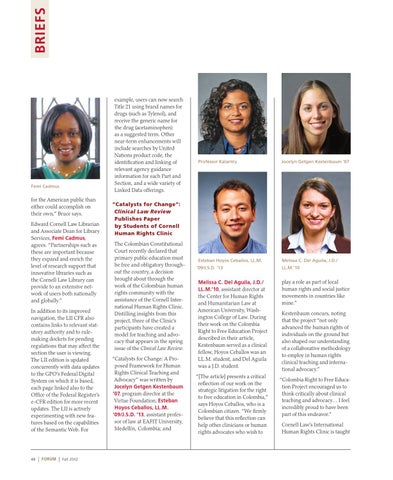
Femi Cadmus
for the American public than either could accomplish on their own,” Bruce says. Edward Cornell Law Librarian and Associate Dean for Library Services, Femi Cadmus, agrees. “Partnerships such as these are important because they expand and enrich the level of research support that innovative libraries such as the Cornell Law Library can provide to an extensive network of users both nationally and globally.” In addition to its improved navigation, the LII CFR also contains links to relevant statutory authority and to rulemaking dockets for pending regulations that may affect the section the user is viewing. The LII edition is updated concurrently with data updates to the GPO’s Federal Digital System on which it is based, each page linked also to the Office of the Federal Register’s e-CFR edition for more recent updates. The LII is actively experimenting with new features based on the capabilities of the Semantic Web. For
48
|
FORUM
|
Fall 2012
Professor Kalantry
Jocelyn Getgen Kestenbaum ’07
Esteban Hoyos Ceballos, LL.M.
Melissa C. Del Aguila, J.D./
“Catalysts for Change”: Clinical Law Review Publishes Paper by Students of Cornell Human Rights Clinic The Colombian Constitutional Court recently declared that primary public education must be free and obligatory throughout the country, a decision brought about through the work of the Colombian human rights community with the assistance of the Cornell International Human Rights Clinic. Distilling insights from this project, three of the Clinic’s participants have created a model for teaching and advocacy that appears in the spring issue of the Clinical Law Review. “Catalysts for Change: A Proposed Framework for Human Rights Clinical Teaching and Advocacy” was written by Jocelyn Getgen Kestenbaum ’07, program director at the Virtue Foundation; Esteban Hoyos Ceballos, LL.M. ‘09/J.S.D. ’13, assistant professor of law at EAFIT University, Medellín, Colombia; and
‘09/J.S.D. ’13
LL.M.’10
Melissa C. Del Aguila, J.D./ LL.M.’10, assistant director at the Center for Human Rights and Humanitarian Law at American University, Washington College of Law. During their work on the Colombia Right to Free Education Project described in their article, Kestenbaum served as a clinical fellow, Hoyos Ceballos was an LL.M. student, and Del Aguila was a J.D. student.
play a role as part of local human rights and social justice movements in countries like mine.”
“[The article] presents a critical reflection of our work on the strategic litigation for the right to free education in Colombia,” says Hoyos Ceballos, who is a Colombian citizen. “We firmly believe that this reflection can help other clinicians or human rights advocates who wish to
Kestenbaum concurs, noting that the project “not only advanced the human rights of individuals on the ground but also shaped our understanding of a collaborative methodology to employ in human rights clinical teaching and international advocacy.” “Colombia Right to Free Education Project encouraged us to think critically about clinical teaching and advocacy… I feel incredibly proud to have been part of this endeavor.” Cornell Law’s International Human Rights Clinic is taught