Dogan, Expert in Sustainable Design, Joins Architecture Faculty p hoto / provided
The Department of Architecture appointed Timur Dogan as an assistant professor, starting in July. Dogan investigates the intersections of architecture, sustainability, building performance simulation, and computational design. Dogan’s research focuses on daylighting, energy modeling, passive climate control strategies, and performance-driven design workflows in both urban and architectural scales. He has published articles in the Journal of Building Performance Simulation, and is the lead developer for Archsim Energy Modeling; UMI, a Rhinobased urban modeling interface; and Urban Daylight simulation software for Rhino and Grasshopper. Dogan is teaching required and elective environmental systems courses at AAP. Prior to joining the faculty at Cornell, Dogan was a member of the Sustainable Design Lab at MIT and Harvard GSD, where his research was supported by a MIT Presidential Fellowship, a Transsolar Energietechnik GmbH fellowship, and the German Academic Exchange Service (DAAD). Dogan holds a degree from the Master in Design Studies program at Harvard GSD; a Diplom-Ingenieur in architecture with distinction from the Technical University of Darmstadt in Germany, where he was a fellow of the German National Academic Foundation; and a Ph.D. from MIT. Dogan has worked for KSP Architekten, Wandel Hoefer Lorch Architekten, and the climate engineering firm Transsolar.AAP
Charles Joins CRP and Baker Program in Real Estate p hoto / provided
Suzanne Lanyi Charles joined the department of City and Regional Planning and the Baker Program in Real Estate as an assistant professor on July 1. Charles’s current scholarly research examines physical, social, and economic changes in postwar suburban neighborhoods. Her research has received grants from the U.S. Department of Housing and Urban Development, and from the Real Estate Academic Initiative at Harvard University. “Suzanne Charles brings an unusual combination of knowledge and experience to CRP and the Baker Program,” says Susan Christopherson, chair of CRP. “Her Ph.D. in planning has given her a broad view of urban development that can help students gain perspective on emerging trends, such as suburban transformation and inner-city densification. And as an architect with experience in the real estate industry, she can convey the value that good design brings to real estate development.” Prior to coming to AAP, Charles was an assistant professor of architecture at Northeastern University in Boston, and an assistant professor of urban planning at the Taubman College of Architecture and Urban Planning at the University of Michigan. She has worked as an architect at the Renzo Piano Building Workshop in Paris, and at Booth Hansen in Chicago; and also as a real estate consultant at the Weitzman Group in New York City. She holds undergraduate and graduate degrees in architecture, and received her doctorate in urban planning from Harvard University. Charles’s spouse, Patrick Charles, has been hired as a visiting associate professor of architecture, with teaching responsibilities in the Department of Architecture and the Baker Program in Real Estate.AAP
2
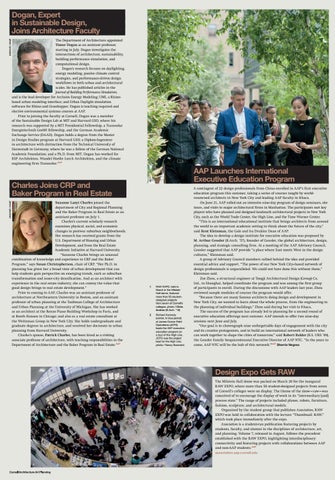
1 RAW EXPO, held in March in the Milstein Hall dome, featured more than 50 studentdesigned projects from seven of Cornell’s colleges. photo / Chris Andras (B.Arch. ’18) 2 Richard Kennedy (center, in blue jacket) of James Corner Field Operations (JCFO) leads the AAP executive education program on a tour of the High Line. JCFO was the project lead for the High Line. photo / Nancy Borowick
AAP Launches International Executive Education Program A contingent of 22 design professionals from China enrolled in AAP’s first executive education program this summer, taking a series of courses taught by worldrenowned architects in New York City and leading AAP faculty in Ithaca. On June 21, AAP rolled out an intensive nine-day program of design seminars, site tours, and visits to major architectural firms in Manhattan. The participants met key players who have planned and designed landmark architectural projects in New York City, such as the World Trade Center, the High Line, and the Time Warner Center. “This is an international educational institute that brings architects from around the world to an important academic setting to think about the future of the city,” said Kent Kleinman, the Gale and Ira Drukier Dean of AAP. The idea to develop a design institute for executive education was proposed by M. Arthur Gensler (B.Arch. ’57), founder of Gensler, the global architecture, design, planning, and strategic consulting firm. At a meeting of the AAP Advisory Council, Gensler suggested that AAP provide “a place where East meets West in the design cultures,” Kleinman said. A group of Advisory Council members rallied behind the idea and provided essential advice and support. “The power of our New York City–based network of design professionals is unparalleled. We could not have done this without them,” Kleinman said. Zoe Zhou, a structural engineer at Tongji Architectural Design (Group) Co. Ltd., in Shanghai, helped coordinate the program and was among the first group of participants to enroll. During the discussions with AAP leaders last year, Zhou reviewed sample modules of courses the program would offer. “Because there are many famous architects doing design and development in New York City, we wanted to learn about the whole process, from the engineering to the planning of individual buildings,” Zhou said during her visit to Ithaca. The success of the program has already led to planning for a second round of executive education offerings next summer. AAP intends to offer two nine-day sessions next June and July. “Our goal is to choreograph nine unforgettable days of engagement with the city and its creative protagonists, and to build an international network of leaders who can work together to shape the cities of tomorrow,” said Robert Balder (B.S. URS ’89), the Gensler Family Sesquicentennial Executive Director of AAP NYC. “In the years to come, AAP NYC will be the hub of this network.”AAP Sherrie Negrea
Design Expo Gets RAW The Milstein Hall dome was packed on March 20 for the inaugural RAW EXPO, where more than 50 student-designed projects from seven of Cornell’s colleges were on display. The theme of the show—raw—was conceived of to encourage the display of work in its “intermediary [and] process state.” The range of projects included planes, robots, furniture, fashion, sculpture, and architectural models. Organized by the student group that publishes Association, RAW EXPO was held in collaboration with the lecture “Thumbnail: RAW,” which took place immediately after the expo. Association is a student-run publication featuring projects by students, faculty, and alumni in the disciplines of architecture, art, and planning. Volume 7, released in August, follows the precedent established with the RAW EXPO, highlighting interdisciplinary connectivity and featuring projects with collaborations between AAP and non-AAP students.AAP association.aap.cornell.edu
1