DIRECTIONAL DRILLING
Wedging in Diamond Drilling by Jeff Dagg, Fordia Technical Field Support
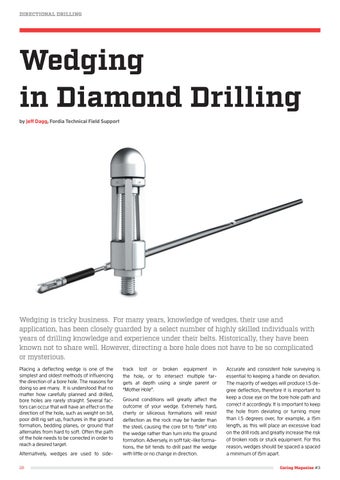
Wedging is tricky business. For many years, knowledge of wedges, their use and application, has been closely guarded by a select number of highly skilled individuals with years of drilling knowledge and experience under their belts. Historically, they have been known not to share well. However, directing a bore hole does not have to be so complicated or mysterious. Placing a deflecting wedge is one of the simplest and oldest methods of influencing the direction of a bore hole. The reasons for doing so are many. It is understood that no matter how carefully planned and drilled, bore holes are rarely straight. Several factors can occur that will have an effect on the direction of the hole, such as weight on bit, poor drill rig set up, fractures in the ground formation, bedding planes, or ground that alternates from hard to soft. Often the path of the hole needs to be corrected in order to reach a desired target. Alternatively, wedges are used to side28
track lost or broken equipment in the hole, or to intersect multiple targets at depth using a single parent or “Mother Hole”. Ground conditions will greatly affect the outcome of your wedge. Extremely hard, cherty or siliceous formations will resist deflection as the rock may be harder than the steel, causing the core bit to “bite” into the wedge rather than turn into the ground formation. Adversely, in soft talc-like formations, the bit tends to drill past the wedge with little or no change in direction.
Accurate and consistent hole surveying is essential to keeping a handle on deviation. The majority of wedges will produce 1.5 degree deflection, therefore it is important to keep a close eye on the bore hole path and correct it accordingly. It is important to keep the hole from deviating or turning more than 1.5 degrees over, for example, a 15m length, as this will place an excessive load on the drill rods and greatly increase the risk of broken rods or stuck equipment. For this reason, wedges should be spaced a spaced a minimum of 15m apart. Coring Magazine #3