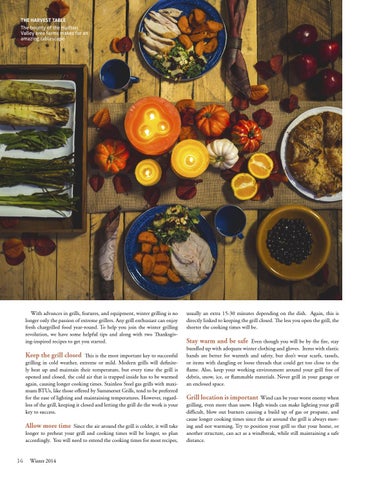
THE HARVEST TABLE The bounty of the Hudson Valley area farms makes for an amazing tablescape.
With advances in grills, features, and equipment, winter grilling is no longer only the passion of extreme grillers. Any grill enthusiast can enjoy fresh chargrilled food year-round. To help you join the winter grilling revolution, we have some helpful tips and along with two Thanksgiving-inspired recipes to get you started.
Keep the grill closed This is the most important key to successful
grilling in cold weather, extreme or mild. Modern grills will definitely heat up and maintain their temperature, but every time the grill is opened and closed, the cold air that is trapped inside has to be warmed again, causing longer cooking times. Stainless Steel gas grills with maximum BTUs, like those offered by Summerset Grills, tend to be preferred for the ease of lighting and maintaining temperatures. However, regardless of the grill, keeping it closed and letting the grill do the work is your key to success.
Allow more time Since the air around the grill is colder, it will take longer to preheat your grill and cooking times will be longer, so plan accordingly. You will need to extend the cooking times for most recipes, 14
Winter 2014
usually an extra 15-30 minutes depending on the dish. Again, this is directly linked to keeping the grill closed. The less you open the grill, the shorter the cooking times will be.
Stay warm and be safe Even though you will be by the fire, stay
bundled up with adequate winter clothing and gloves. Items with elastic bands are better for warmth and safety, but don’t wear scarfs, tassels, or items with dangling or loose threads that could get too close to the flame. Also, keep your working environment around your grill free of debris, snow, ice, or flammable materials. Never grill in your garage or an enclosed space.
Grill location is important Wind can be your worst enemy when grilling, even more than snow. High winds can make lighting your grill difficult, blow out burners causing a build up of gas or propane, and cause longer cooking times since the air around the grill is always moving and not warming. Try to position your grill so that your home, or another structure, can act as a windbreak, while still maintaining a safe distance.