campo de ourique & estrela in loco
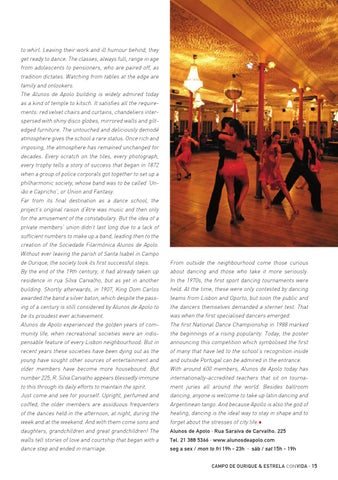
to whirl. Leaving their work and ill humour behind, they get ready to dance. The classes, always full, range in age from adolescents to pensioners, who are paired off, as tradition dictates. Watching from tables at the edge are family and onlookers. The Alunos de Apolo building is widely admired today as a kind of temple to kitsch. It satisfies all the requirements: red velvet chairs and curtains, chandeliers interspersed with shiny disco globes, mirrored walls and giltedged furniture. The untouched and deliciously demodé atmosphere gives the school a rare status. Once rich and imposing, the atmosphere has remained unchanged for decades. Every scratch on the tiles, every photograph, every trophy tells a story of success that began in 1872 when a group of police corporals got together to set up a philharmonic society, whose band was to be called ‘União e Capricho’, or Union and Fantasy. Far from its final destination as a dance school, the project’s original raison d’être was music and then only for the amusement of the constabulary. But the idea of a private members’ union didn’t last long due to a lack of sufficient numbers to make up a band, leading then to the creation of the Sociedade Filarmónica Alunos de Apolo. Without ever leaving the parish of Santa Isabel in Campo de Ourique, the society took its first successful steps.
From outside the neighbourhood come those curious
By the end of the 19th century, it had already taken up
about dancing and those who take it more seriously.
residence in rua Silva Carvalho, but as yet in another
In the 1970s, the first sport dancing tournaments were
building. Shortly afterwards, in 1907, King Dom Carlos
held. At the time, these were only contested by dancing
awarded the band a silver baton, which despite the pass-
teams from Lisbon and Oporto, but soon the public and
ing of a century is still considered by Alunos de Apolo to
the dancers themselves demanded a sterner test. That
be its proudest ever achievement.
was when the first specialised dancers emerged.
Alunos de Apolo experienced the golden years of com-
The first National Dance Championship in 1988 marked
munity life, when recreational societies were an indis-
the beginnings of a rising popularity. Today, the poster
pensable feature of every Lisbon neighbourhood. But in
announcing this competition which symbolised the first
recent years these societies have been dying out as the
of many that have led to the school’s recognition inside
young have sought other sources of entertainment and
and outside Portugal can be admired in the entrance.
older members have become more housebound. But
With around 600 members, Alunos de Apolo today has
number 225, R. Silva Carvalho appears blessedly immune
internationally-accredited teachers that sit on tourna-
to this through its daily efforts to maintain the spirit.
ment juries all around the world. Besides ballroom
Just come and see for yourself. Upright, perfumed and
dancing, anyone is welcome to take up latin dancing and
coiffed, the older members are assiduous frequenters
Argentinean tango. And because Apollo is also the god of
of the dances held in the afternoon, at night, during the
healing, dancing is the ideal way to stay in shape and to
week and at the weekend. And with them come sons and
forget about the stresses of city life.•
daughters, grandchildren and great grandchildren! The
Alunos de Apolo · Rua Saraiva de Carvalho, 225
walls tell stories of love and courtship that began with a
Tel. 21 388 5366 · www.alunosdeapolo.com
dance step and ended in marriage.
seg a sex / mon to fri 19h - 23h · sáb / sat 15h - 19h campo de Ourique & estrela con vida · 15