A different view of Lisbon El e va d o r d e S a n ta J usta In the middle of Rua do Ouro stands the city’s last vertical elevator. Built from iron and designed in Art Nouveau style, the Elevador de Santa Justa not only transports you up to Largo do Carmo, but also on a fantastic journey back to the beginning of the 20th century. Opened in 1902, this feat of engineering provides one of the most stunning views over the city of Lisbon.
W
hen it was opened, at the very turn of
No Lisbon local was oblivious to its public inauguration
the century, the fare varied depending
on 10th July 1902. Neither rain or thunder could deter the
on whether you were going up or com-
first three thousand thrilled and curious passengers. But
ing down. No longer the case today, now any simple
how many locals have never used it or have forgotten if
bus ticket or public transport (Carris) pass will do, up or
they have or not? Because this is a trip not to be missed.
down. And bearing in mind the steep streets and steps
In mere minutes, the wooden elevator surrounded by an
the trip would otherwise involve, it is well worth the trip.
intricate iron structure transports you up to one of the
But there’s more to the experience than just saving
most stunning views over the city. The lift operator sells
your legs. Listed as a national monument in 2002, the
the tickets, operates the lever that moves the lift up and
Elevador de Santa Justa is an obligatory item on any itin-
down and controls the number of passengers. Only 20
erary of the city.
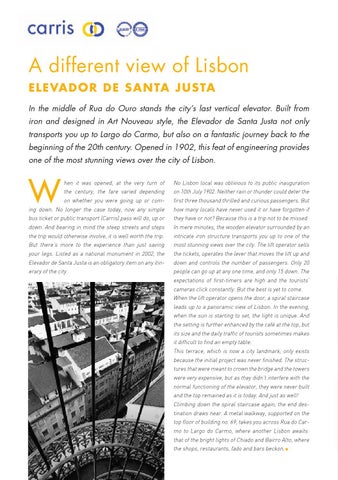
people can go up at any one time, and only 15 down. The expectations of first-timers are high and the tourists’ cameras click constantly. But the best is yet to come. When the lift operator opens the door, a spiral staircase leads up to a panoramic view of Lisbon. In the evening, when the sun is starting to set, the light is unique. And the setting is further enhanced by the café at the top, but its size and the daily traffic of tourists sometimes makes it difficult to find an empty table. This terrace, which is now a city landmark, only exists because the initial project was never finished. The structures that were meant to crown the bridge and the towers were very expensive, but as they didn’t interfere with the normal functioning of the elevator, they were never built and the top remained as it is today. And just as well! Climbing down the spiral staircase again, the end destination draws near. A metal walkway, supported on the top floor of building no. 69, takes you across Rua do Carmo to Largo do Carmo, where another Lisbon awaits: that of the bright lights of Chiado and Bairro Alto, where the shops, restaurants, fado and bars beckon.•