
FOCUS ON:
DIVERSITY, Equity, inclusion
THE DEI LANDSCAPE IN ENGINEERING AND STEM DISCIPLINES AT UCSB
Space tales
Experiments on the ISS, and a Net ix lm about a CoE alumnus astronaut
Photons & Quantum computing
Using light to generate qubits
The first 3d-printable elastomer
A soft, exible new material that feels like human tissue
Champions of Engineering
The vision and the philanthropy of Duncan and Suzanne Mellichamp

SPRING 2021
The magazine of engineering and the sciences at UC Santa Barbara
Message from the Deans

ROD ALFERNESS
Richard A. Auhll Professor and Dean, College of Engineering PIERRE WILTZIUS
Susan & Bruce Worster Dean of Science, College of Letters & Science
PIERRE WILTZIUS
Susan & Bruce Worster Dean of Science, College of Letters & Science
Now, this feels much more like spring. Last year at this time, we were heading into a protracted period of COVID-induced isolation, but as this issue goes to press, the future is looking decidedly brighter. The vaccinated population is rapidly increasing, and case numbers in Santa Barbara have fallen, with the prospect that in-person classes might resume at UCSB for fall quarter.
We look forward to seeing students again hurrying along campus walkways and lounging at the UCEN, to seeing faculty speaking in front of classrooms full of learners, to seeing labs operating at capacity, and to convening with staff in actual meeting rooms rather than the virtual ones with which we have become so familiar. We are all longing for the easy interaction that becomes available when our UCSB neighbors are nearby.
While we celebrate the rapid development of COVID vaccines — an accomplishment made possible only by interdisciplinary research advances in engineering and the sciences — we remain keenly aware that many other nations continue to struggle with the pandemic while facing a shortage of vaccines. We hope that in the months ahead, corporations and governments can effectively combine their efforts to ensure that everyone in our interconnected world can be protected.
Research at UCSB has, of course, continued during the pandemic, and in this issue, we highlight some notable accomplishments in the areas of space-based science (page 13), new approaches to plastics recycling (page 20), quantum photonics (page 22), the first 3D-printable elastomer (page 38), and an impressive array of new faculty awards (page 8). We also visit with UCSB benefactors and Champions of Engineering Duncan and Suzanne Mellichamp (page 40), tracking Duncan’s fifty-year career at UCSB as well as the couple’s extraordinary, visionary, and diverse philanthropy.
Racial justice has also been much in the news over the past year, and much on the minds of those at every level of every kind of institution. Following the spring and summer protests that swept the nation in the wake of George Floyd’s death, UCSB entered what will be an extended period of self-examination and action on the diversity, equity, and inclusion (DEI) front. In this issue, we turn the lens of the regular “FOCUS ON:” section to the DEI landscape at UCSB, and especially in engineering and other STEM fields. What are the challenges? What are some of the things being done to address them? Who are some of the people on the front lines?
Thankfully, after a year unlike any other, we see much to stir hope and promise this spring.
Be well, and keep in touch.
Rod Alferness2
Pierre Wiltzius


4 News Briefs
8 Faculty Awards
Important recognition for numerous engineering faculty who are leaders in their fields.
13 Space Tales
We tell you about experiments aboard the International Space Station, and a Netflix film project about the inspiring journey of UCSB alumnus astronaut José Hernández.
20 Plastics: A Source of Recycled Carbon
UCSB researchers seek to “close the loop” on a major source of pollution.
22 Photons and Quantum Computing
A new grant supports the pursuit of a photonic platform for quantum computing.
25 FOCUS ON: Diversity, Equity and Inclusion
The DEI landscape in the CoE and STEM disciplines across campus.
38 The First 3D-printable Elastomer
The labs of Michael Chabinyc and Christopher Bates develop a new soft, flexible material that feels like human tissue.
40 Champions of Engineering
Duncan and Suzanne Mellichamp’s visionary philanthropy.
The Magazine of Engineering and the Sciences at UC Santa Barbara Issue 27, Spring 2021
Director of Marketing: Andrew Masuda
Editor: James Badham
Art Director: Brian Long
Graphic Designer: Lilli McKinney
UCSB Public Affairs Contributors: Harrison Tasoff, Sonia Fernandez
Cover Illustration: Diversity’s fingerprint on research in engineering and the sciences, by Brian Long
Photography Contributors: James Badham, Lilli McKinney, Matt Perko
College of Engineering
CONTENTS
13 4 38 22 25 40 20 8 3
NEWS BRIEFS
ECE ALUMNA APPOINTED CHIEF OF STAFF In BIDEN’S OFFICE OF SCIENCE
Tanya Das, who received her PhD in electrical and computer engineering from UC Santa Barbara in 2017, has been appointed to a senior position in the Department of Energy (DOE) by President Joe Biden’s administration. She is the new chief of staff to the Office of Science.
“This position is a dream job,” said Das, who was a member of associate professor Jon Schuller’s research group at UCSB, where she studied the effects of light engineering on multipolar resonances in nanoparticles. “It is an incredible honor to be appointed to advance climate change and racial-equity policies for an administration led by one of the politicians I most respect, President Joe Biden, and the first Black and South Asian and first female vice president, Kamala Harris.”
With a $7 billion budget, the Office of Science supports research in the physical sciences, stewards ten of DOE’s seventeen national laboratories, and supports workforce development and training programs for teachers and students in the science, technology, engineering, and mathematics (STEM) fields.
“My job is to implement the priorities of the Biden-Harris administration at the Office of Science,” said Das. “I hope to support the phenomenal staff at the office by rebuilding its focus on climate science, climate adaptation and mitigation, and clean energy, while strengthening partnerships with the frontline communities who have experienced the worst effects of climate change. I also hope to advance programs that instill the principles of diversity, equity, and inclusion in STEM programs and the national labs that the Office of Science supports.”
Since earning her doctorate from UCSB, Das has been applying her training as a scientist to evaluate and improve policy in Washington, D.C. She was named a 2017-18 Arthur H. Guenther Congressional Fellow by the Society of Photo-Optical Instrumentation Engineers and The Optical Society of America (SPIE/OSA), serving a one-year term as a special assistant on the staff of U.S. Senator Chris Coons, of Delaware. The fellowship provided Das with the opportunity to gain substantial insight into the inner workings of government while supporting the senator’s economic policy team and professional training opportunities offered by the American Association for the Advancement of Science (AAAS). After the fellowship, she joined the U.S. House of Representatives Committee on Science, Space and Technology as a professional staff member, where she worked on a range of issues in clean energy and manufacturing policy until her appointment to the Office of Science.
Das says that it was both inside and outside of the research

lab at UCSB where she developed the skills necessary to succeed in Washington. She worked with Professor Schuller in the field of metamaterials, exploring new ways of using nanoparticles to manipulate light. For two years, she also was a program evaluator at UCSB’s Center for Science and Engineering Partnerships (CSEP), which focuses on improving the educational and career outcomes of current and future scientists and engineers.
She worked at CSEP on the American Institute for Manufacturing Integrated Photonics (AIM Photonics) initiative, to assess the needs of the photonics industry in California, as well as on various other projects at UCSB and the University of Washington to evaluate the effectiveness of STEM diversity programs and to assess learning in STEM courses. Das said that her work beyond the lab helped her understand the broader context of her research and how it fit into the nation’s scientific goals.
“The work I did with CSEP helped me realize how I could apply my scientific skills to policy,” said Das. “CSEP programs and staff are underappreciated jewels of the university that have helped countless UCSB graduates, like myself, develop the skills they need to be successful professionals — essential skills that can’t be learned from just doing research. Without the experience and mentoring that I gained with CSEP, I would not be on the career path I’m on today.”
Tanya Das (PhD ‘17), chief of staff, Office of Science4
FACEBOOK, IEE PARTNER TO PURSUE DATA CENTER EFFICIENCY
Facebook has provided the Institute for Energy Efficiency (IEE) in UC Santa Barbara’s College of Engineering with a three-year, $1.5 million grant to support research aimed at enhancing energy efficiency in data centers and in artificial intelligence (AI).
Researchers at the IEE and Facebook will partner to investigate advanced energy-efficient data-center infrastructure, including lowpower optical (ligh-based) interconnects for compute networks and machine learning (ML), in the interest of reducing Facebook’s carbon footprint. The company has committed to reaching net zero emissions across its value chain by 2030.
”We are deeply grateful to Facebook for their generosity and support of the university and the Institute for Energy Efficiency,” said Rod Alferness, dean of the College of Engineering. “This gift will drive collaborative discoveries of potentially world-changing solutions to substantially reduce the energy required to drive vital nextgeneration data centers and applications of machine learning.”
“For more than ten years, Facebook has been focused on designing, building, and operating some of the most efficient datacenter facilities in the world,” said Rachel Peterson, VP of Data Center Strategy at Facebook. “We are thrilled that our research team will partner with UCSB’s Institute for Energy Efficiency to help drive innovation and bring energy efficiency to the next level.”
Facebook will also help develop research projects and provide IEE researchers with insight gained from their prior experience designing and operating data centers. The tech leader currently has eight operational data-center sites in the U.S., with five more announced but not yet operating.
“Facebook is a world leader in data-center efficiency, and we are happy to partner with them to drive the next generation of technologies to deliver efficiency gains,” said IEE Director John Bowers, a distinguished professor of materials and electrical and computer engineering, and an internationally renowned authority on silicon photonics and optoelectronics.
Data centers have become much more energy efficient in recent years, but new technologies are still urgently needed to offset the growing demand being driven by ML, AI, and video. With the

partnership powering its research endeavors, IEE expects to make significant headway on two grand challenges: achieving multiple orders-of-magnitude improvement in the efficiency of data centers and doing the same in terms of AI/ML workloads.
To that end, IEE researchers are targeting efficiency improvements in multiple areas. Computer science professor Timothy Sherwood is leading efforts to develop new hardware and architecture to improve the efficiency of servers and processes and reduce power used for cooling. Computer science assistant professor William Wang is working with colleagues to improve algorithmic efficiency, which is expected to yield significant reductions in the data-center power footprint associated with AI and ML applications. Further, IEE’s worldclass photonics faculty are focused on unlocking the next wave of efficiency breakthroughs associated with interconnects, the essential technologies that provide high-bandwidth connections among compute nodes and to users.
“Last summer, we collaborated with the Facebook AI Group to build an inference engine for Natural Language Processing that achieved ten times the energy efficiency of the current model,” said Wang. “It further demonstrates the importance and potential impact of working with industrial partners to understand real-world problems and connect scientific research and engineering.”
In recognition of Facebook’s gift, the university will name one of the experimental data-center laboratories in Henley Hall the “Facebook Data Center Energy Efficiency Lab.” A dedication and recognition ceremony will be scheduled at a later date, once state and county public health restrictions related to the coronavirus are lifted.
CHEMICAL ENGINEERING DEDICATES
ROBERT G. RINKER TEACHING LAB
A decade-long effort to modernize the UC Santa Barbara Chemical Engineering Department’s undergraduate laboratory facilities culminated with a virtual celebration last fall. Scores of alumni and department supporters participated in a virtual dedication of the Robert G. Rinker Chemical Engineering Teaching Laboratory, which was made possible by the completion of a $1 million endowment fund named after Rinker, the first chemical engineering faculty member hired by UCSB.
“I am truly humbled and honored to have my name attached to this generous gift and to the education of our future chemical engineers,” said Rinker, a professor emeritus of the department, during the event. “Thank you to all of the alumni who have contributed to the endowment, for their generosity, foresight, and persistence in creating this $1 million endowment for the UCSB undergraduate teaching laboratory. The undergraduate lab must evolve as our discipline evolves, and that takes funding.”
Thanks to the endowment, overseen by the university’s Office of Development for Engineering, assistant teaching professor Joseph Chada will have the opportunity to create a unique and continuously modernized lab for students, ensuring that they receive the hands-on learning experience they need to succeed.
“The endowment makes the lab even more special,” said Rachel
A $1.5 million grant from Facebook will support research at Henley Hall, the new home of the Institute for Energy Efficiency, which opened last summer.5

Segalman, chair of the Chemical Engineering Department. “We’re one of the only campuses that now has a dedicated ability to modernize the lab via endowment, to look at it through new developments of the world and new problems in the world and think about what laboratory experience students will need to address them.”
Rinker came to UCSB in 1965 as the university’s first chemical engineering faculty member. The department officially began in 1966 with two faculty members, Rinker and his first hire, John E. Myers, and six undergraduate students. They then recruited an entire faculty, with whom they developed undergraduate and graduate curricula, established the master’s and PhD programs, and designed and built laboratories, laying a foundation for the department being recognized today as one of the top ranked programs in the nation.
The event included a video tour to give guests a glimpse of the updated laboratory. A commemorative plaque, unveiled outside the facility, included words of gratitude, as well as the names of the companies and families who contributed to the endowment, which was started in 2006 by then department chair, Michael Doherty
THE CRAFT OF COMPUTING
Jennifer Jacobs, assistant professor in the Media Arts and Technology program at UC Santa Barbara, and two professors at the University of New Mexico have received a $1.4 million grant from the National Science Foundation to examine ways of integrating computational design and fabrication techniques into the production of traditional crafts. Their focus will be on traditional ceramics, with an eye to ensuring that the findings can be generalized to other domains.
Jacobs researches ways to support expressive computer-aided “making” by developing technologies that integrate computational design and digital fabrication with traditional materials and practices. Her collaborators are UNM associate professors Leah Buechley, who runs the Hand and Machine lab there and is a pioneer in paper and fabric-based electronics, and Manuel Montoya, who has worked with rural communities and is leading aspects of the project that investigate craft business practice.
“There’s a strong connection between computation and many forms of craft that involve some series of procedures,” Jacobs explains. “Textiles, knitting, weaving, and embroidery all map very clearly onto the process of defining a design as a series of instructions and then producing different variations by changing variables in them.”
Further, she adds, “Many forms of craft involve the creation of algorithmic patterns or aesthetics. For example, certain forms of Acoma Pueblo ceramics have decorative tessellations and geometric elements that can also be understood through formal mathematic representation.”
Ready to experiment: the renovated Robert G. Rinker Chemical Engineering Teaching Laboratory, located in Engineering II.
She is especially interested in the area of computational design and digital fabrication, in which computer programming is used to design and control machines that make, physical objects. “You have the opportunity, quite literally, to write a program that produces a vase from a 3D printer, or a sweater from a computer-controlled knitting machine,” she says.
During craft-residencies to be hosted (post-pandemic) at UCSB and UNM, researchers and artisans will collaborate to identify opportunities for, and barriers to, integrating traditional ceramics craft and computational fabrication, and develop new computational fabrication technologies inspired by traditional ceramic craft practice. Business-development workshops will be aimed at further understanding and supporting rural craft businesses, which is Montoya’s focus.
“A big part of what I do is to think about how one develops value propositions around creative work, particularly craft work, the benefits of it; how one thinks about its connection to community, and the greater implications of that,” he says. “I’m interested in how this project avoids the false dichotomy asserting that people who are craft workers are backward or tradition-oriented at best, and that technology is always progress-oriented. I like that our aim is to understand how technology and craft intersect while attending to the populations for which both of those points are extremely important.”
By hand and machine: this handcrafted cup has a computationally generated surface pattern.
Photograph courtesy of Leah Buechley.

“As a technology developer,” says Buechley, “I think that many people think of technology as synonymous with fast production —
6
A SECOND LOOK AT SUNLIGHT
A team of researchers from UC Santa Barbara, Oregon State University, the University of Manchester, and ETH Zurich are urging a closer examination of the SARS-CoV-2 virus’s vulnerability to sunlight. The researchers wrote a letter in the Journal of Infectious Diseases, asserting that it might be more than UV-B rays that explain sunlight’s ability to inactivate the virus.

The idea that an additional mechanism might be in play arose when the team compared data from a July 2020 study that reported rapid sunlight inactivation of SARS-CoV-2 in a lab setting with a theory of coronavirus inactivation by solar radiation that had been published just a month earlier.
“The theory assumes that inactivation works by having UV-B hit the RNA of the virus, damaging it,” said UCSB mechanical engineering assistant professor and lead author Paolo Luzzatto-Fegiz. Judging from the discrepancies between the experimental results and the predictions of the theoretical model that preceded it, however, the research team felt that RNA inactivation by UV-B might not be the whole story.
According to the letter, the experiments demonstrated virus inactivation times of about ten to twenty minutes — much faster than predicted by the theory.
“The theory predicts that inactivation should happen an order of magnitude slower,” Luzzatto-Fegiz said. In the experiments, viruses in simulated saliva exposed to UV-B lamps were inactivated more than eight times faster than the theory would predict, while those cultured in a complete growth medium before exposure to UV-B were inactivated more than three times faster than expected. To make the math of the theory fit the data, according to the letter, SARS-CoV-2 would have to exceed the highest UV-B sensitivity of any currently known virus.
Or, Luzzato-Fegiz and his colleagues reasoned, there could be another mechanism at play in addition to the inactivation of RNA by UV-B rays. For instance, UV-A, another, less energetic component of sunlight, might be playing a more active role than anyone had thought previously.
“People think of UV-A as not having much of an effect, but it might be interacting with some of the molecules in the medium,” he said. Those reactive intermediate molecules could, in turn, be interacting with the virus, hastening inactivation. It’s a concept familiar to those who work in wastewater treatment and other environmental science fields.
“So, scientists don’t yet know what’s going on,” Luzzatto-Fegiz said. “Our analysis points to the need for additional experiments to separately test the effects of
specific light wavelengths and medium composition.”
Results of such experiments might provide clues into new ways of managing the virus with widely available and accessible UV-A and UV-B radiation. While UV-C radiation has proved effective against SARS-CoV-2, that wavelength does not reach the Earth’s surface and must be manufactured. Although UV-C is presently used in air filtration and other technologies, its short wavelengths and high energy also make it the most damaging form of UV radiation, limiting its practical application and raising other safety concerns.
Co-author and UCSB mechanical engineering assistant professor Yangying Zhu added that it could be very advantageous if UV-A turns out to be capable of inactivating the virus, because inexpensive LED bulbs that are many times stronger than natural sunlight are now widely available and could be used to accelerate inactivation times. UV-A could potentially be used far more broadly to augment air filtration systems at relatively low risk to human health, especially in highrisk settings such as hospitals and public transportation, but the specifics of each setting warrant consideration.


7
The coronoravirus’s vulnerability to sunlight suggests more research is needed to find out why.
FACULTY AWARDS
AT THE FRONTIER OF RESEARCH
Materials and chemistry professor Craig Hawker, and Rachel Segalman, chair of the Chemical Engineering Department, were among the 129 new members elected to the National Academy of Engineering (NAE) for 2021. Election to the academy is among the highest professional distinctions accorded to an engineer.
With particular interests in energy, efficiency, sustainability, and materials and interfaces, Segalman focuses her research on controlling self-assembly, structure, and properties of functional polymers. Structural control over soft matter at microscopic length scales is an essential tool to optimize properties for applications ranging from solar and thermal energy to biomaterials. Her work paves the way for the development of sophisticated materials for such energy applications as photovoltaics, fuel cells, and thermoelectrics. Segalman, the Edward Noble Kramer Chair in Materials, was recognized “for contributions to semiconducting block polymers, polymeric ionic liquids, and hybrid thermoelectric materials.”
“The perception is that this is an individual honor, but I see it as a recognition for the university and the wonderful people whom I’ve been able to work with for decades,” said Segalman, a recipient of multiple honors throughout her career, including election as a fellow of the American Academy of Arts and Sciences (AAAS) and the American Physical Society (APS). “I also believe our selection is a testament to UCSB’s collaborative culture, for creating an environment that allows scientists and students to be inspired together and pursue research in new directions.”
Hawker’s research activities are focused on synthetic polymer chemistry, integrating cross-disciplinary studies to develop nanostructured materials having unique physical


and mechanical properties for applications in biomaterials and energy research. Hawker, the Alan and Ruth Heeger Chair in Interdisciplinary Science and the Peter J. Clarke Chair for the Director of the NanoSystems Institute (CNSI), who also serves as director of the Dow Materials Institute, was cited for “contributions to polymer chemistry through synthetic organic chemistry concepts and the advancement of molecular engineering principles.”
“I am thrilled by this honor, especially when I think about all of the people over the years who made this happen, including Ed Kramer, who was Rachel’s graduate advisor at UCSB and a huge reason why I joined the faculty at UCSB,” said Hawker, who is also an elected fellow of the Royal Society, the National Academy of Inventors, and the American Academy of Arts and Sciences. “Our election reflects the university’s status as a leader in materials and polymer science. It also shows UCSB’s unique collaborative culture, in which great science and engineering are built on a tradition of working across boundaries. The sum is certainly greater than any individual research success.”
Hawker’s groundbreaking work has formed the basis for more than eighty U.S. patents and ten start-up companies. A number of these companies have developed drugs to improve the quality of life for people who suffer from chronic kidney disease (CKD). Hawker received the American Chemical Society’s 2021 Kathryn C. Hach Award for Entrepreneurial Success in recognition of his “innovative leadership in creating, developing, and commercializing revolutionary polymer-based therapeutics and personal-care products through multiple successful start-up companies.”
The newly elected class will be inducted during the NAE’s annual meeting, to be held in this coming October.
A sampling of honors received by College of Engineering faculty from April 2020 – April 2021: Chris Bates (MAT): Camille Dreyfus TeacherScholar Award, Camille and Henry Dreyfus Foundation * Matt Beane (TM): Best Paper Award, Organizational Communication Information Systems * Irene Beyerlein (MAT/ ME): Elected Fellow, Materials Research Society * John Bowers (ECE/MAT): Highly Cited Researchers List, Web of Science * Michael Chabinyc (MAT): Elected Fellow, American Association for the Advancement of Science * Phillip Christopher (ChE): Young Investigator Award, American Institute of Chemical Engineers’ Division of Catalysis and Reaction Engineering * Xi Dai (MAT): Highly Cited Researchers List, Web of Science * Yufei Ding (CS): Early CAREER Award, National Science Foundation * Michael Doherty (ChE): John M. Prausnitz Institute Lecture, American Institute of Chemical Engineers * Emilie Dressaire (ME): Regents’ Junior Faculty Fellowship Award * Yu Feng (CS): Research Scholar Award,
Rachel Segalman8
Craig Hawker
RECOGNIZING INNOVATION
Nine assistant professors in the UC Santa Barbara College of Engineering have received prestigious Early CAREER awards from the National Science Foundation (NSF) since April 2020. An NSF CAREER award includes up to $500,000 in funding over five years to support the pioneering research conducted by junior faculty and to
advance excellence in education.
“We are tremendously proud of the nine assistant professors for receiving this highly esteemed award,” said Rod Alferness, dean of the College of Engineering. “They are shining examples of the high-quality junior faculty we have in the College of Engineering, whose
Yufei Ding Computer Science
Ding has developed an innovative plan to improve the efficiency and accuracy of quantum applications in the next generation of quantum devices. In the project funded through her NSF Early CAREER award, Ding seeks to design state-of-the-art architecture to improve the stability of quantum computing by focusing on compilation and optimization. Compilation is the process by which a computer program takes a source code written in one program language and translates it into a second language to create an executable file or outcome. Presently, the longer a quantum algorithm runs, or compiles, the more its performance degrades because of noise or environmental disturbances, such as vibration or temperature changes. As part of the project, Ding will create a new high-level programming language to optimize algorithms and develop advanced testing and debug support.
“Our work has the potential to benefit major quantum computing applications, such as quantum chemistry, and to expand to materials, finance, and stochastic/numerical mathematics,” said Ding. “The success of our agenda will enable a more complete and efficient hardware stack and support quantum applications on near-term devices.”

Elliot Hawkes
Mechanical Engineering
With colleagues at Stanford University, Hawkes developed a new robot, characterized by tip extension. Called vine robots, referring to their similar growth-based movement from only the tip, they are well suited for navigation and exploration in cluttered environments. Hawkes received his CAREER award to design new robots by better understanding the factors that govern their movements. He is interested in two particular
cutting-edge research in emerging fields, ranging from quantum computing to vine robots, will push the boundaries of scientific discovery in ways that will benefit society.”
Brief summaries of each recipient’s research projects that led to their NSF CAREER awards are included below.
designs: A burrowing vine robot that would emit water or air from its tip, creating a path to enable subterranean navigation; and a medical vine robot that could be used by surgeons to safely access a point inside the body for diagnosis and therapy delivery. Because of their durability and adaptability, Hawkes says, the robots could prove transformative in numerous fields of study.
“Burrowing vine robots could help geologists to investigate soil layers, archaeologists to explore buried ruins, environmentalists to study pollution in soil, biologists to navigate underground burrows, crews to route cables under roads or buildings, and emergency personnel to locate survivors after natural disasters,”said Hawkes, whose soft robot was named one of the “Ten Robotics Technologies of the Year” by Science Robotics in 2019. “The medical vine robot could transform minimally invasive procedures in fields such as urology and neurology, be used during endovascular surgeries, and even grow into the lungs to revolutionize emergency tracheal intubation.”

Paolo Luzzatto-Fegiz Mechanical Engineering
Taking a three-pronged approach that includes simulations, experiments, and theory, Luzzatto-Fegiz will use his CAREER award to pursue research in the rapidly emerging area of superhydrophobic surfaces (SHS). SHS are meant to reduce the resistance that results from water or other fluids moving along a surface, like the hull of a ship. In the ship’s case, the drag causes it to move more slowly than it would if the fluid friction were reduced.
One way to achieve a “slippier” hull is to coat it with an SHS, which contains tiny air pockets that separate the hull from the water. Because air is much less viscous than water, when less water comes into contact with the hull, there is less drag. But SHS often don’t work as models suggest they should, and in previous research, Luzzatto-Fegiz and colleagues figured out why. The culprit is surfactant, a compound, such as soap or algae (or, in the ocean, many things), which, even in
Google * Glenn Fredrickson (ChE): Elected Member, National Academy of Sciences * Songi Han (ChE/CHEM): EAS Award for Outstanding Achievements in Magnetic Resonance, Eastern Analytical Symposium * Craig Hawker (MAT/CHEM): Elected Fellow, National Academy of Engineering; Kathryn C. Hach Award, American Chemical Society * Elliot Hawkes (ME): Early CAREER Award, National Science Foundation; Packard Fellow for Science and Engineering, Packard Foundation; Early Career Award, NASA * Alan Heeger (MAT): Highly Cited Researchers List, Web of Science * Yogananda Isukapalli (ECE): Distinguished Teaching Award, UCSB Academic Senate* Jonathan Klamkin (ECE): Director’s Fellowship, Defense Advanced Research Projects Agency * Paolo Luzzatto-Fegiz (ME): Early CAREER Award, National Science Foundation * Igor Mezíc (ME): J. D. Crawford Prize, Society for Industrial and Applied Mathematics Activity Group on Dynamical Systems * Diba Mirza (CS): Mentoring Award for Undergraduate Research, National Center for Women &
9
RECOGNIZING INNOVATION
trace amounts, can reduce surface tension along the hull and diminish the SHS’s drag-reducing effect. In this new project, Luzzatto-Fegiz and colleagues at the University of Cambridge and the University of Manchester will study the precise impact of surfactants on SHS in order to identify practical mitigation strategies to unlock their drag-reducing potential for real-world applications. They will then take a multidisciplinary approach to adjusting the geometry of surface particles to address the macroscopic effect of the coating and the microscopic chemical effects of surfactants.
“Most people who looked at this problem did so from more of a classical mechanical engineering perspective, so they didn’t know anything about surfactants or contaminants until we started this work,” said Luzzatto-Fegiz, who hopes the research will lead to SHS that have the optimal texture and microscopic particles of the correct geometry to make ships more slippery.

Galan Moody
Electrical and Computer Engineering
The key to the speed of quantum computers lies in qubits, the basic units of information that can exist in multiple states, a phenomenon that provides far more processing power than the binary bits of classical computers. Qubits, however, are easily affected by environmental disturbance, referred to as noise, such as temperature fluctuations and vibrations. Most qubits also need to be cooled to absolute zero (-273 degrees Celsius) to be usable. One potential way around those obstacles being explored by UCSB researchers involves integrated photonics, a field in which on-campus researchers have established themselves as world leaders. Integrated photonics refers to the design and fabrication of photonic devices in which all of the components, from lasers to optical interconnects, are contained on one chip. Moody, an assistant professor of electrical and computer engineering, will work to develop a quantum photonics platform that allows for chip-scale quantum information processing with light. He plans to replace the silicon waveguides that direct light around a photonic chip with the III-V semiconductor alloy aluminum gallium arsenide (AlGaAs).
“We expect several new important capabilities and better performance than we get from silicon, including more efficient quantum light sources, a reduced need for laser power to pump the sources, better electrical efficiency, and significantly less optical loss in order to preserve the photon’s quantum state,” said Moody, who also received the Defense University
Research Instrumentation Program (DURIP) award from the Department of Defense (see page 22) to build the instrumentation needed to test the quantum photonic chips his group will design and fabricate as part of the CAREER award.

Angela Pitenis
Materials
Numerous soft biomedical devices, such as silicone implants and contact lenses, are placed in direct contact with living cells and tissues. They are designed to adjust their form or appearance, or to improve their function through interactions with tissues and cells. However, soft implant surfaces may induce inflammation by unintentionally increasing friction when the outer surface of the device slides against living cells and tissues. Pitenis, an assistant professor in the Materials Department, received a CAREER award to study the dynamics of fragile interfaces, with a long-term goal of creating low-friction interfaces for soft biomedical devices. The project is guided by her hypothesis that sliding surfaces in nature reduce friction through a delicate balance of fracturing and rapidly rehealing crosslinks between macromolecules in aqueous solutions.
“This work responds to the critical need to develop biocompatible surface engineering approaches involving lubricious gels on implants to improve interactions during frictional sliding motions against cells and tissues,” said Pitenis. “Our approach may prove transformative for several engineering challenges in healthcare.”

Alban Sauret
Mechanical Engineering
Sauret, an assistant professor in mechanical engineering, works to further the knowledge of multiphase flows involved in environmental science, industrial applications, and sustainable processes. A particular focus of his research involves understanding the complex dynamics at play when applying liquid coatings to a surface, such as by dipping a probe or a sheet of material into a captured liquid. Particles are commonly suspended in the liquid, whether deposited directly or sprayed to improve the coating’s performance. However, the processes are often challenging and poorly controlled, which leads to product rejection and waste. In his project, Sauret is investigating interfacial dynamics in the presence of particles. “The dynamics of the system, in which the thickness of a
Information Technology * Galan Moody (ECE): Early CAREER Award, National Science Foundation * Shuji Nakamura (ECE/MAT): Queen Elizabeth Prize for Engineering, QEPrize Foundation * Michelle O’Malley (ChE): Early Career Award, American Institute of Chemical Engineers, Division of Food, Pharmaceutical and Bioengineering * Sumita Pennathur (ME): Fellow, American Institute for Medical and Biological Engineering * Linda Petzold (ME/CS): Fellow, American Institute for Medical and Biological Engineering; Elected Member, National Academy of Sciences * Angela Pintenis (MAT): Early CAREER Award, National Science Foundation * Beth Pruitt (ME): Fellow, Biomedical Engineering Society * Alban Sauret (ME): Early CAREER Award, National Science Foundation * Rachel Segalman (ChE/MAT): Elected Member, National Academy of Engineering * Timothy Sherwood (CS): Award for Inclusion Research, Google; Outstanding Graduate Mentor Award, UCSB Academic Senate * Misha Sra (CS): Research Scholar Award, Google; Best Dissertation
10
liquid film reflects the size of the particle, challenges our understanding, because the surface gives rise to capillary effects that affect the system,” said Sauret, referencing the ability of a liquid to flow in narrow spaces without external forces like gravity. “Because of the great complexity of multiphase flows, it is impossible to represent the phenomena numerically. We hope to develop new approaches to describe how particles affect the overall process.”

William Wang Computer Science
As we rely more on natural language processing to help us navigate our world, it’s more important than ever that these artificial intelligence (AI) models — used increasingly in applications such as caption generation for the visually impaired — remain accurate and truthful. However, in the many iterations required for a model to learn how to describe or predict what a scene depicts, elements can creep in that cause errors in data-to-text translation or object hallucinations, in which the caption contains an object or an action that doesn’t exist in the image. Wang, an assistant professor of computer science, received a CAREER award to create more robust deep learning-based natural language generation models. In his project, he will investigate the complex relationship between uncertainty and faithfulness, two important and sometimes opposing elements in the realm of deep learning.
“We believe that the AI model has to maintain a certain level of uncertainty in order to explore difference solutions, but it also has to be balanced and constrained at the same time,” said Wang, the Duncan and Suzanne Mellichamp Professor of Artificial Intelligence and Designs and director of UCSB’s Center for Responsible Machine Learning. “The current research in machine learning and AI primarily focuses on independently and identically distributed data — each image is independent of one another. But how can we work with AI agents to enable dynamic decision making? This would be very practical for building AI agents that can interact more effectively with humans in the real world.”

Yu-Xiang Wang
Computer Science
In Wang’s CAREER project, he will take an innovative approach to maximizing the potential impact of artificial intelligence and big data technologies. Wang, the Eugene Aas Chair in Computer Science, seeks to advance the theory and applications of differential privacy (DP), a mathematical
definition of privacy that provides provable guarantees against identifications of individuals in a dataset, while still allowing the dataset, as a whole, to be useful. Wang plans to use numerical algorithms and computations to automate some of the complex mathematical derivations, and to provide new algorithms that publish comprehensive, private data-dependent reports to address existing challenges related to the design and analysis of DP.
“The combination of computing and math is especially powerful, because computing will allow for the practical implementation of mathematical equations that are precise but not simple, rather than resorting to simple approximations,” said Wang, whose group is collaborating to apply DP to clinical research studies and the collection of person-generated health data. “DP is at a pivotal moment, transitioning from a theoretical construct into a practical technology. Our research paves the way for DP to be used and deployed in a wider array of applications.”

Yangying Zhu Mechanical Engineering
Zhu will study phase change, or the process by which matter transitions from one state (solid, liquid, or gas) to another. A phase change takes place because of heat transfer, the exchange of thermal energy between physical systems. The mechanical engineering assistant professor says that understanding phase change and heat transfer at the microscale will unlock secrets that can lead to next-generation technologies and increased energy efficiency at the very large scale. She has proposed a project to develop a temperature-measurement technique that can directly probe the three-phase region, something that has been very difficult to realize before. The three-phase region refers to the location where liquid, vapor, and solid meet during the phase change, such as the base of a bubble on a solid surface during boiling.
“The data from this experiment will help us to better understand phase-change processes and identify factors that limit efficient heat transfer,” said Zhu, who plans to apply her findings to the transmission of respiratory diseases from the perspective of heat and mass transfer. Further, she says, “The insights gained through this work will potentially lead to highly effective and improved phase-change devices that can enable energy savings and reduce freshwater withdrawals for power plants, provide energy-efficient thermally driven desalination, effective heat dissipation for high-power-density electronic devices, and more energy-efficient thermal control of buildings.”
Zhu is also lead investigator on a project with mechanical engineering professor Paolo Luzzatto-Fegiz and Javier Read de Alaniz to study phase changes aboard the International Space Station two years from now. (See article on page 18.)
Award, Institute of Electrical and Electronics Engineering, Visualization and Graphics Technical Committee * Ryan Stowers (ME): Young Investigator Award, Cells Tissues Organs Journal; Regents’ Junior Faculty Fellowship Award * Megan Valentine (ME): Fellow, American Institute for Medical and Biological Engineering * Anton Van der Ven (MAT): William Hume-Rothery Award, The Minerals, Metals & Materials Society * Chris Van de Walle (MAT): Highly Cited Researchers List, Web of Science Group * William Wang (CS): Early CAREER Award, National Science Foundation; AI’s 10 to Watch, Institute of Electrical and Electronics Engineers, Intelligent Systems Journal * Yu-Xiang Wang (CS): Early CAREER Award, National Science Foundation; Research Scholar Award, Google * Enoch Yeung (ME): Young Investigator Award, U.S. Army Research Office * Yangying Zhu (ME): Early CAREER Award, National Science Foundation; Regents’ Junior Faculty Fellowship Award * Frank Zok (MAT): Outstanding Graduate Mentor Award, UCSB Academic Senate
11
OYAL ECOGNITION

Shuji Nakamura, a professor of materials and electrical and computer engineering at UC Santa Barbara, was one of five recipients of the 2021 Queen Elizabeth Prize for Engineering, or QEPrize.
The winners are all pioneers in the field of light-emitting diodes, or LED lighting. Nakamura began developing LED technology while a researcher in Japan in the 1980s and won a Nobel Prize in Physics for his work in 2014.
“I am so honored to receive the Queen Elizabeth Prize for my contributions to solid-state lighting, which provides tremendous benefits for humanity by providing energy-efficient lighting and displays,” said Nakamura, the Cree Endowed Chair in Solid State Lighting and Displays.
The prestigious QEPrize comes with one million pounds and is awarded every two years by the Queen Elizabeth Prize for Engineering Foundation. The QEPrize celebrates engineering’s visionaries, encouraging them to extend the boundaries of what is possible across all disciplines and applications. In its statement announcing the prize, the Queen Elizabeth Prize for Engineering Foundation said that the development of LED lighting “forms the basis of all solid-state lighting and technology.” The winners, the foundation said, are being recognized “not only for the global impact of LED and solid-state lighting but also for the tremendous contribution the technology has made, and will continue to make, to reducing energy consumption and addressing climate change.”
With his flawless gallium nitride (GaN) crystals, Nakamura not only developed the bright-blue LED, but also helped pave the way for the white LED, a technology that has revolutionized lighting and displays, which have been the main force behind a huge reduction in energy consumed by lighting. The U.S. Department of Energy estimates that by 2030 our energy consumption for lighting will have decreased by more than forty percent, equivalent to the output of more than fifty power plants.
SCIENTIFIC ACHIEVEMENT


Two professors in the UC Santa Barbara College of Engineering, Linda Petzold and Glenn Fredrickson, were elected to the National Academy of Sciences in recognition of their distinguished and continuing achievements in original research. Membership in the NAS is one of the highest honors given to a scientist or engineer in the United States. This year, the Class of 2021 includes 150 people, including 30 international members.
Petzold, the Mehrabian Endowed Chair in the College of Engineering and Distinguished Professor of Mechanical Engineering and Computer Science, was honored by the NAS for her contributions to theoretical numerical analysis. A member of the prestigious National Academy of Engineering (NAE), she is also an elected fellow of the American Institute for Medical and Biological Engineering (AIMBE), the Society for Industrial and Applied Mathematics (SIAM), the Association for Computing Machinery (ACM), and the American Association for
the Advancement of Science (AAAS).
“I am deeply honored that my work has been recognized by my colleagues in the NAS,” said Petzold. “Up to this point, my work has been recognized mostly for its contributions to computer science and engineering. It is gratifying to be recognized for my contributions in mathematics and the sciences.”
Petzold’s breakthrough 1982 paper “Differential-Algebraic Equations (DAEs) are not ODEs [ordinary differential equations]” opened up a new subfield in computational mathematics, and her public-domain software DASSL has enabled the simulation of countless systems in engineering and science. Her LSODA software has been used extensively and remains in widespread use, particularly in the chemical and pharmaceutical industries. Current collaborations range from biology (jet lag and cell polarization), to medicine (trauma and chronic pain), to ecology (ant behavior), to neuroscience (learning, neuronal networks, and migraines).
Fredrickson, the Mitsubishi Chemical Corporation Chair in Functional Materials, was honored by the NAS for his contributions to soft-matter theory. He pioneered computational field theory techniques that revolutionized the study of soft materials and complex fluids, most notably in self-assembling polymers and block copolymers. Known as field-theoretic simulations (FTS), his techniques are important not only to molecular thermodynamics, but also for their engineering impact on directed self-assembly, an important technology for manufacturing semiconductor devices.
“Election to the NAS is the highest recognition for scientists in the U.S., so I am thrilled and humbled that my research has been honored in this manner,” said Fredrickson, who was previously elected a member of the NAE, and is a fellow of the American Institute of Chemical Engineers (AIChE), the American Academy of Arts and Sciences, the American Physical Society, and the AAAS. “While my applied research has been previously honored by election to the NAE and awards from the AIChE, it is extremely satisfying to be recognized for my fundamental accomplishments by peers in the scientific community.”
Linda Petzold Glenn Fredrickson12

Space Tales
A boom in space-based science is under way. Private companies ferry people and cargo to and from the International Space Station, where astronauts run increasingly automated experiments. While one UCSB team reviews data from a recent mission, another prepares for one ahead. Meanwhile, Netflix plans a movie about UCSB College of Engineering graduate and NASA astronaut José Hernández.
Photograph courtesy of NASA The SpaceX Crew Dragon Endeavour is pictured high above Earth during its approach to the International Space Station.13

Net ix Movie to Tell the Story of UCSB
Alumnus Astronaut’s Path to Space
The inspirational story of former NASA astronaut José Hernández, a graduate of UC Santa Barbara’s Electrical and Computer Engineering Department who went from California’s migrant farmworker community to orbiting the Earth, will be the subject of a Netflix original movie set to begin production this summer. The working title of the film is “A Million Miles Away.”
Hernández spent fourteen days in space in 2009 as a flight engineer on board STS-128, a NASA Space Shuttle mission to the International Space Station (ISS). But his flight path to space, where he became the first person to send a tweet in Spanish from space, was not easy.
“The film shows my life as a migrant farmer who went from working in the fields with his parents to becoming an astronaut,” said Hernández, who described his nomadic childhood of moving each year with his family to various locations throughout California and Mexico. “I think this film is going to inspire a lot of people, not just kids, to believe that anything is possible if you put your mind to it.”
Hernández said that a few years ago he was approached
Former astronaut José Hernández has shared his inspirational story with students across the country, including (shown) at a community event in Santa Maria in 2017.14
Photograph courtesy of Allan Hancock College

case is not a person; it’s the self-doubt and inner struggle of believing in myself,” said Hernández. “A lot of minority children suffer from impostor syndrome (see article on page 30), feeling they don’t belong and aren’t as competent as they should be while they start to succeed. The film addresses this head on, so hopefully people will see it and be able to better deal with their own struggles and rejection.”
Hernández knows all about rejection. He was turned down eleven times by NASA’s astronaut program, finally getting accepted on his twelfth attempt, in May 2004.
“I would always convince myself it’s not a bad consolation prize to be where I am, and I’d think about all the things I had accomplished. It helped me realize that I belonged,” recalled Hernández. “My dream of becoming an astronaut motivated me to get an engineering degree from Pacific and a graduate degree from UCSB. It motivated me to work at a premier research facility like the Lawrence Livermore National Laboratory, get a job that I love that paid me well, become a pilot and a scuba diver, and learn a third language, Russian.”
Hernández hopes the film will feature a few scenes shot on the UCSB campus, where he earned a master’s degree in electrical and computer engineering in 1986. He describes his time at UCSB as pivotal.
“Because I had received a Graduate Engineering Minority Fellowship, for the first time, I didn’t have to work. I could focus solely on my studies and work with the great professors, like Sanjit Mitra in digital signal processing,” said Hernández, whose daughter, Marisol, graduated from UCSB last June with a BA in statistics and data. “UCSB prepared me very well for my job at the Lawrence Livermore National Laboratory. I am certain that without that training from UCSB, there is no way I would have become an astronaut.”
by Select Films, a production company that had produced such hit films as Secretariat, The Rookie, and McFarland, USA, the last of which highlights a high school cross-country team that won a state championship.
“I had been approached by film companies before, but Select Films had a proven track record of telling feel-good motivational stories,” said Hernández, adding that he and Select Films pitched their idea to six studios in a two-day period. “Four of the studios wanted to pick it up. We went with Netflix, because we felt it would be viewed by a larger audience.”
The company hired Bettina Gilois, an Emmy-nominated writer who wrote the script for McFarland, USA, to write the screenplay, and Alejandra Márquez Abella to direct the film. Márquez Abella’s breakout film, “Las Ninas Bien,” received fourteen nominations and won four awards at the Ariels, Mexico’s Oscar-equivalent, .
The movie will tell the story of how his second-grade teacher convinced his parents to stay in one place to provide stability for their children. It continues by depicting his life as a teenager growing up in Stockton, including the pivotal moment in 1976 when he was inspired to become an astronaut, watching Gene Cernan walk on the moon during the Apollo 17 mission. The film will also portray his struggles while majoring in engineering at the University of the Pacific.
“A movie always has to have a villain. The villain in this
While working at the Lawrence Livermore National Laboratory, Hernández co-developed the first full-field digital mammography imaging system for early detection of breast cancer. He left in 2004, when he was selected for astronaut training.
 Discovery crew members gather on the 225-foot level of Launch Pad39A (from left): commander Rick Sturckow, mission specialists Danny Olivas and Christer Fuglesang, pilot Kevin Ford, and mission specialists Nicole Stott, Patrick Forrester, and José Hernández.
José Hernández takes a break from prepping for Space Shuttle mission STS128, which launched in 2009.
Discovery crew members gather on the 225-foot level of Launch Pad39A (from left): commander Rick Sturckow, mission specialists Danny Olivas and Christer Fuglesang, pilot Kevin Ford, and mission specialists Nicole Stott, Patrick Forrester, and José Hernández.
José Hernández takes a break from prepping for Space Shuttle mission STS128, which launched in 2009.
15
Photographs on this page courtesy of NASA
More than a decade after his mission to the ISS, Hernández is still involved with NASA, primarily performing educational outreach. He runs his own aerospace company, Tierra Luna Engineering, which has worked with Boeing to provide communication satellites to Mexico, and has launched satellites for Lockheed Martin. He also runs the Reaching for the Stars Foundation, a non-profit in Stockton aimed at inspiring youth to follow their dreams and find passion in STEM fields. Through the foundation, he has told his story of defying the odds to students across the nation, including stops at UCSB, where he was the commencement speaker in 2014, and at Allan Hancock College in Santa Maria, a major UCSB feeder school for minority students.
“Students see someone who looks and talks like them, and they see how I defied the odds to become an astronaut. I want them to know that if I
“I think this lm is going to inspire a lot of people, not just kids, to believe that anything is possible if you put your mind to it.”
can do it, so can they,” said Hernández, who also wrote a book, Reaching for the Stars. “You can only reach so many people in person or in a book. A movie, I think, is the ultimate medium for reaching millions of people. Hopefully, we can inspire lots of children and adults.”
Hernández said that the production team has not selected a cast yet, but he would like to see his role played by Michael Peña. “He looks short and stocky, and is not particularly good-looking, just like me,” Hernández laughed. “He plays down-to-earth characters, and even played an astronaut before in The Martian. He makes the most sense to me.”
The Heart of Space

SAsked if he will make a cameo appearance, Hernández, who will be a technical consultant on the film, said he planted the seed with this production company. “I even told them the scene,” he joked, “but it will be up to the director, so we will see. At least I’ll be on location during the film, so I will be ready to go.”
Netflix plans to release the movie in 2022. Hernández hopes to return to UCSB to host a screening and a question-and-answer session at that time.
The International Astronomical Union named Asteroid (122554), Joséhernández, in honor of the UCSB graduate this spring. It was one of twentyseven asteroids recently discovered in a belt between Mars and Jupiter that were named in honor of African American, Hispanic, and Native American astronauts who inspire the next generation.

pace travel has interesting effects on the human body. For instance, the microgravity environment causes the heart to undergo morphological changes similar to those seen in many cardiac diseases. The molecular mechanism behind these changes is unknown. In order to understand the phenomenon, a team of biologists, bioengineers, and aerospace engineers shipped biological samples aboard a SpaceX Falcon 9 rocket to the International Space Station (ISS).
Beth Pruitt, a UC Santa Barbara mechanical engineer and director of the Center for BioEngineering, collaborated with Joseph Wu from Stanford University and Bioserve Space Technologies on a project to send live engineered heart tissues (EHTs) to space. At the ISS, astronaut Kathleen Rubins maintained the EHTs and performed experiments intended to shed more light on how microgravity affects heart tissues.
“This project started three years ago as part of the Chips in Space program [funded by the National Institute of Health’s National Center for Advancing Translation Sciences Tissue], which is aimed at enabling scientists to learn more about the effects of space flight on human physiology,” says Pruitt. A tissue chip, also referred to as “organs on chips,” is a small device about the size of a thumb drive that contains human cells in a 3D matrix. First used in 2018, the system represents a giant leap in scientists’ ability to test how cells respond
16
Photographs courtesy of NASA


to stresses, drugs, and genetic changes.
“Hopefully,” Pruitt adds, “this will not only make it possible for astronauts to spend longer periods of time in space, but will also lead to fundamental knowledge about mechanobiology in the heart.”
The scientific payload contained live EHTs comprising the three major cell types found in human heart tissue — cardiomyocytes, cardiac fibroblasts, and endothelial cells — which were derived from human induced pluripotent stem cells (IPSC) and embedded in an extracellular fibrinogen matrix. Some of those tissues returned to Earth on Jan. 14 and are currently being examined at UCSB and Stanford to determine the molecular changes that may have occurred as a result of the space flight.
“We are hoping not only to understand the effects of microgravity on these tissues, but also to use these functional and morphological changes to model known cardiovascular diseases here on Earth,” says Orlando Chirikian, a third-year graduate student in the Pruitt lab who attended the Dec. 6 launch at NASA’s Kennedy Space Center in Florida.
The researchers are especially interested
in characterizing cardiac atrophy, a phenomenon observed in microgravity. Many experts believe that it is induced by mechanical unloading of the ventricles and a number of metabolic changes within the cells of the heart, but the mechanism behind the process has not been identified.
In previous space-flight studies, Wu, director of the Stanford Cardiovascular Institute, began investigating this phenomenon by using conventional cell-culturing platforms. This study builds upon that work by using a three-dimensional platform, in the form of the EHTs, complete with the three major cell types of the heart to better represent the multicellular environment.
“These tissues resemble cardiac tissue, making it possible for us to better assess changes that result from exposure to the microgravity of space,” Chirikian notes. “The experiments are intended to characterize alterations in tissue morphology [size and weight], contractile function [force production], calcium-handling, cellular metabolism, and the transcriptome [the sum total of all the messenger RNA molecules expressed from the genes of an organism].”
17
Unweighted heart: Carefully packaged synthesized heart tissues (below) were sent to the International Space Station, where astronaut Kathleen Rubins (left) performed experiments intended to shed light on how they are affeced by microgravity.
Bubbling up Experiments for the International Space Station

Boiling water for tea or coffee is among the simplest of all kitchen tasks. In the microgravity of space, however, it is beyond difficult.
It is, in fact, impossible.
Boiling is a gravity-dependent phenomenon. As water boils on Earth, vapor bubbles form, which are less dense than water. This density difference generates buoyancy, which causes the bubbles to rise to the top surface and dissipate into the air. Bubble departure is important as it allows the substrate to generate new bubbles for continuous boiling heat transfer.
In space, none of that happens. A bubble formed in a liquid boiling in microgravity would simply expand continuously, because gravity-dependent buoyancy does not exist.
A group of UC Santa Barbara researchers is currently planning a series of experiments to be conducted two years from now aboard the International Space Station (ISS). They intend to study ways of enabling boiling, and the closely related process of condensation, under conditions of microgravity.
“It’s an intriguing question,” says Yangying Zhu, assistant professor of mechanical engineering and a principal investigator on the project, along with mechanical engineering assistant professor Paolo Luzzatto-Fegiz and chemistry professor Javier Read de Alaniz. They have received National Science Foundation funding in collaboration with the Center for the Advancemnt of Science in Space (CASIS), aka the ISS National Lab, to study phase changes in space.
“The question has applications both in space and here on Earth, where boiling is used to generate electrical power and condensation is used to harvest water,” says Zhu. “On Earth, you can use a condenser to
collect water droplets. The droplets are then shed as a a result of gravity, and you can collect them. In microgravity, however, the droplets will just stay on the surface, making it very hard to collect them.”
For this project, the researchers are investigating how to manipulate droplets (condensation) and bubbles (boiling) in space. Specifically, Zhu explains, “If we can come up with a method to remove a bubble from a boiling surface or remove a droplet from a condensation surface, we will be able to achieve very high boiling and condensation heat transfer rates in microgravity. That would be valuable in space for using boiling to cool electronics, and for thermal management in general, but also for such Earth-bound applications as power generation, water desalination, and HVAC in buildings. The key idea is how do you generate a buoyancy-like force on a bubble in a liquid in microgravity? That’s where Javier and Paolo come in. Their expertise made it possible.”
Read de Alaniz’s lab synthesizes unique surfactants — surfaceactive agents that can be added to a liquid to reduce surface tension — that are stable and soluble and have reversible responses to different wavelengths of light. The idea is to dissolve the surfactants in water and then hit them with light of a precise wavelength, which causes the surfactants to change form. Since surfactants like to stay at the interface of the bubble and the liquid, changing their form can in turn change the surface tension of the bubble.
“And if you can apply light to only one side of the bubble, surface tension will change on that side but remain unchanged on the other side,” says Zhu. “This asymmetric surface tension distribution creates a force, called a Marangoni flow, in the liquid around the bubble, and
18
Photographs courtesy of Space Tango

this liquid flow creates a net force on the bubble that can push it away from the surface.”
Luzzatto-Fegiz is an expert in Marangoni effects and recently received an National Science Foundation CAREER award (see page 9) to study and model them in the context of super-hydrophobic surfaces, such as paints that might be used to reduce drag on ships. “From a fluid dynamics perspective, this is a really interesting question where everything affects everything else in complicated ways,” he says. “We often work on these problems where, if you don’t have a model, it’s very hard to know if something will work or how fast a process will occur. We have expertise on the theory and on doing simulations for surfactant problems, which makes it exciting to be able to establish a framework for many of these processes.”
The team hopes to be able to move a bubble away from the surface in microgravity, and to discover its maximum velocity. They also want to use light-enabled surfactants to realize complex fluid behavior, such as having two bubbles merge or having one bubble split into two and then four.
“We really get the benefit of the ISS in observing complex merging and splitting fluid behaviors,” says Zhu, who has expertise in relating bubble dynamics to heat transfer. “On Earth, there is buoyancy and gravity in everything, and if we make bubbles, they reach only two to three millimeters in diameter before buoyancy causes them to detach from the surface. That limits the size of bubbles we can observe before that moment when buoyancy dominates everything.
“But in microgravity,” she continues, “we have no buoyancy and no convection, which is a density-driven flow, so we can focus only
on the effect of the photo surfactant. We know that any behavior we observe will be due to the Marangoni effect [made possible by the presence of the surfactants] and not buoyancy. That will allow us to build a very nice model to understand them.”
For Read de Alaniz, the project has twofold benefits. “This helps us to understand fundamental properties of these new materials that we’ve been developing, while trying to accomplish something in space,” he says. “It is an elegant way for us to enhance our fundamental understanding of changes in surface tension, and to use what we find to design new photo surfactants that have a bigger light-induced change, so that we can get the bubble departure to occur on a time scale that’s relevant.”
The project is occurring at a time when it is becoming easier and cheaper to conduct experiments aboard the ISS. Multiple private companies contracted by CASIS offer services to make experiments space ready. Automated experiments are placed inside modular, stackable cubes that measure four inches on a side. “You design your cube, and they plug it in on the ISS, and it will run the experiment,” says Zhu.
The UCSB team’s six cubes of cargo will include sealed containers that hold liquid and micro-heaters, which the team will engineer to generate bubbles and also to serve as temperature sensors; an array of small LEDs to transform the photo surfactants and activate the Marangoni effect; and a camera to record the activity.
Currently, astronauts aboard the ISS can make tea and espresso in an exotic made-for-space device called ISSpresso. Who knows, though, maybe soon they’ll be able to do it the old-fashioned way, by boiling some water.
NASA Astronaut Drew Feustel prepares to install CubeLabs aboard the International Space Station.19
A standardized Space Tango CubeLab, containing all the components for one or more automated “plug and play” experiments, floats aboard the ISS.
PLASTICS: A Source of RECYCLED CARBON
UCSB researchers delve into new ways to “close the loop” on a major source of pollution
Last October, an article in SCIENCE by
UC Santa Barbararesearchers
Susannah Scott and Mahdi AbuOmar described a one-pot, low-temperature catalytic method that upcycles polyethylene into high-value alkylaromatic molecules. Polyethylene represents about a third of all plastics, which have a global value of about $200 billion annually.
Scott described the findings as “a demonstration of what can be done, one of an increasing number of possible measures that can be taken to turn the wasteful, linear plastic economy into a more sustainable, circular one.”
The paper found widespread interest around the world, and Scott and AbuOmar, both of whom have appointments in chemistry and chemical engineering, are in the process of proposing to industry the idea of using the alkylaromatic molecules to make biodegradable anionic surfactants, which are used in laundry detergents, soaps, shampoos, toothpaste, dishwashing liquid, and spray cleaners. “You can imagine a company saying, ‘We can sell you a bottle of shampoo in which both the bottle and its contents are made from recycled carbon,’” Scott says. “This is feeding into a larger idea of a circular carbon economy.”
While the more conventional approach to addressing the increasing problem of plastic waste was “circular plastics” — making new plastics out of used plastics, including the mechanical recycling that is practiced currently — Scott, who holds UCSB’s Mellichamp Chair in Sustainable Catalytic Processing,
and Abu-Omar, who specializes in energy catalysis and holds the Mellichamp Chair in Green Chemistry, are thinking of how to turn used plastics into new forms of carbon by disassembling the macromolecules they comprise.
“The idea of circular plastics falls short on a number of levels,” Scott says. “It’s very desirable when it does work, but it works only rarely. When the plastics are mechanically recycled, the properties of the recycled material are almost always inferior to those of the original polymers. And they’re much more expensive, so you get the same or worse properties for a much higher price, and there’s just no way to easily make that a broad strategy for dealing with the plastics problem.”
Their approach has a broader goal. “We’re trying to keep carbon in use, to preserve the value of that reduced carbon for as long as possible, because that has energy implications,” Scott explains. “In the future, we’ll be turning CO2 into carbon-based products, but that is an energy-intensive process, one you certainly do not want to do with every carbon atom every time you use it.”
In as yet unpublished work, Scott and Abu-Omar are examining uses for other molecules obtained directly from polyethylene, in addition to alkylaromatics. They describe what they’ve done so far as a small-scale proof-of-concept demonstration. “The question then is, how do you turn that into something that you can scale up to deal with the magnitude of the plastic waste problem? It’s not at all straightforward,” Scott notes.
“We’ve seen that with the biomass

20
“We can make useful molecules and chemicals from a renewable carbon feedstock that completes the cycle. That is a very new realization.”
industry, which was supposed to be the solution to everything — providing renewable carbon — but so far has turned out to be the solution to very little,” she adds. “The problems are many, and some are similar to the plastics problems. One is that you’re dealing with a highly dispersed, highly heterogeneous material that you have to collect, separate, refine, and purify, and you have to get this solid into your reactor so that you can process it. If you want to use it for anything more than simply burning it for energy, just the handling of the solids starts to get pretty tricky.”
Another challenge associated with biomass conversion is selectivity. “You might have a mixture of a hundred individually valuable compounds that have no value — because they are a mixture,” Scott says. “Making molecules selectively from biomass is a big challenge. We have the same issues with plastics: how do we collect this highly dispersed, highly heterogeneous material and make molecules selectively from it?”
several times before it returns to the environment,” she adds, “The idea of a perfect cycle in which carbon is recycled an infinite number of times defies thermodynamics. You can’t actually do that. But it’s a legitimate question to ask how many times it is desirable to recycle before you are better off just starting again. When things get so contaminated and dispersed, it takes more energy to collect and purify them than it does to let them decompose and start the chemical transformations again.
“While turning petroleum into ethylene to make polymers is a highly energy-intensive process,” Scott says, “there is, thermodynamically, potentially a way to turn a polymer into another polymer — another form of carbon — without investing a lot of energy. That’s why I think this circular-carbon idea is a really cool one.”


Abu-Omar sees hope for biomass in the fact that some companies, including Dow Chemical, have demonstrated an ability to make polyolefins (polymerized olefins, such as polyethylene) from renewable ethylene that comes from nonfood biomass. “The price difference between that and using fossil fuels is a factor of two, not ten,” he says. “That allows you, in the future, when we have renewable sources, to make it so that these carbons and plastics that are important for modern life have a more perfect cycle. You have a renewable carbon source that becomes waste but is not treated as waste, but rather as a new type of feedstock. We can make useful molecules and chemicals from a renewable carbon feedstock that completes the cycle. That is a very new realization.
“All these plastics are a problem, for society and for the environment,” he continues. “We’re saying, think about this plastic as a feedstock instead of digging a hole in the ground and harvesting petroleum and using that to make all the different things we use in modern life.”
While, according to Scott, “It is desirable to make sure that the carbon used to make plastic is reused
At some point, when the carbon that is used to make the plastics comes from a renewable source, that will close the cycle, even if the end use of the molecules obtained from waste plastics ends up being biodegradable detergents or jet fuels that we end up burning. They become CO2 and that CO2 will be used to make the plastics again.
“It’s really about getting into those plastics,” says Abu-Omar, “because the other choice is, we stop using plastic. That might have some benefits, but there will also be a lot of harms, because plastics have made things we use in the medical field, in safety, in hygiene much more accessible. But we’re heading toward a colossal problem with the waste, and we want to find a solution to that, and mining the plastic waste as a feedstock for chemicals, fuels, etc. I think, is the solution. That’s what we’re advocating for in the work we’re doing.”
“Traditionally, people who are passionate about sustainability talk about creating new regulations or new economic incentives,” says Scott. “And, of course, those are all part of the strategy, but they’re not enough. It’s clear that they’re not enough. Technology is needed. New ways of looking at the material basis of the things we use are needed. It has to be a combination of those things.”
Palming converted polymers: Yu-Hsuan “Ariel” Lee, a third-year PhD student in Abu-Omar’s group, holds a volumetric flask containing the hydrocarbon products resulting from catalytic conversion of a long-chain alkane. Susannah Scott21
Mahdi Abu-Omar
Photons and Quantum Computing

Galan Moody receives a new grant to pursue a photonic-based platform for quantum processing
CPieces of the puzzle (above): photonic chips in Galan Moody’s lab, produced in John Bowers’s lab, with microring resonators for generating entangled photon pairs visible on the top surface.
lassical computing is built upon the power of the bit, which is, in essence, a microtransistor on a chip that can either be on or off, representing a 1 or a 0 in binary code. The quantum computing equivalent is the qubit. Unlike bits, qubits can be in more than one “state” at a time, enabling quantum computers to perform computational functions exponentially faster than classical computers can.
To date, most efforts to build quantum computers have relied on qubits created in superconducting wires chilled to near absolute zero or trapped ions held in place by lasers. But those approaches face certain challenges, most notably that the qubits are highly sensitive to environmental factors. As the number of qubits increases, those factors are more likely to compound and interrupt the entanglement of qubits required for a quantum computer to work.
Another approach that has been developed more recently is to use a photon as an optical qubit to encode quantum information and to integrate the components
22
necessary for that process onto a photonic integrated circuit (PIC). Recently, Galan Moody, an assistant professor in the UC Santa Barbara College of Engineering’s Department of Electrical and Computer Engineering, received a Defense University Research Instrumentation Program (DURIP) Award from the U.S. Department of Defense and the Air Force Office of Scientific Research. The grant will allow him to build a quantum photonic computing testbed, conducting his research in a lab set aside for such activity in recently completed Henley Hall, the new home of the CoE’s Institute for Energy Efficiency.
The grant supports the development or acquisition of new instrumentation to be used in fundamental and applied research across all areas of science and engineering. “In my field, it’s quantum photonics, so we’re working to develop new types of quantum light sources and ways to manipulate and detect quantum states of light for use in such applications as quantum photonic computing and quantum communications,” Moody says.
“At the high level,” he explains, the concept of quantum photonic computing is “exactly the same as what Google is doing with superconducting qubits or what other companies are doing with trapped ions. There are a lot of different platforms, and one of them is to use photonic integrated circuits to generate entangled photons, entanglement being the foundation for multiple quantum applications.”
To place an entire quantum photonics system onto a chip measuring about one square centimeter would be a tremendous achievement. Fortunately, the well-developed photonics infrastructure — including AIM Photonics, which has a center at UCSB led by professor and photonics pioneer John Bowers lends itself to that pursuit and to scaling up whatever quantum photonics platform is most promising. Photonics for classical applications is a mature technology industry that, Moody says, “has basically mastered large-scale and wafer-scale processing and fabrication of devices.” It is reliable, so whatever Moody and his team design, they can fabricate themselves or even order from foundries, knowing that they will get exactly what they want.
The Photonic Edge
The process of creating photonic qubits begins with generating high-quality single photons or pairs of entangled photons. A qubit can then be defined in several different ways, most often in the spatial path that the
photons travel. For example, a PIC might have two waveguides that confine photons and determine the path they travel on the chip. If a photon is traveling in the “lower” waveguide, this can be defined as state 0. Likewise, the “upper” waveguide can be defined as state 1. Moody and his team can create PICs that control whether photons travel in the upper path, the lower path, or in both simultaneously. These path-encoded photonic qubits become the carriers of quantum information and can be manipulated to perform logic operations.
The approach has several advantages over other methods that have been used to generate qubits. For instance, the aforementioned environmental effects that can cause qubits to lose their coherence do not affect coherence in photons, which, Moody says, “can maintain that entanglement for a very long time compared to the other quantum systems. The challenge is not coherence but, rather, getting the photons to become entangled in the first place.”

They showed that their new quantum light source is nearly a thousand times more e cient than any other on-chip light source.
“That,” Moody notes, “is because photons don’t naturally interact but, rather, pass right through each other and go their separate ways. But they have to interact in some way to create an entangled state. We’re working on how to create PIC-based quantum light sources that produce high-quality photons as efficiently as possible and then how to get all the photons to interact in a way that allows us to build a scalable quantum processor or new devices to be used in long-distance quantum communications.”
Quantum computers are super-efficient, and the photonics approach to quantum technologies is even more so. When Google “demonstrated quantum supremacy” in fall 2019 using the quantum computer built in its Goleta laboratory under the leadership of UCSB physics professor John Martinis, the company claimed that its machine, named Sycamore, could do a series of test calculations in two hundred seconds that a super-computer would need closer to ten thousand years to complete. Recently, a Chinese team using a laboratory-scale table-top experiment claimed that, with a photon-based quantum computer, “You could do in two hundred seconds what would take a super-computer more like 2.5 billion years to accomplish,” Moody says.
Another advantage is that photonics is naturally scalable to thousands and, eventually, millions of components, which can be done by leveraging the wafer-scale fabrication technologies developed for classical photonics. Today, the most advanced PICs comprise nearly five thousand components and could be expanded by a factor of two or four with existing fabrication technologies, which is at a comparable stage of development that digital electronics were in the 1960s and 1970s.
“But even a few hundred components is enough to perform important quantum computing operations with light, at least on a small scale between a few qubits,” says Moody. “With further development, quantum photonic chips can be scaled to tens or hundreds of qubits using the existing photonics infrastructure.”
23
Theodore Morin, a PhD student in John Bowers’s group, in the lab.
Platform & Process
For its work, Moody’s team is developing a new materials platform, based on gallium arsenide and silicon dioxide, to generate single and entangled photons, and it promises to be much more efficient than comparable systems. In fact, they recently had a paper published in the March 4 issue of the journal PRX Quantum showing that their new quantum light source is nearly a thousand times more efficient than any other on-chip light source.
In terms of the process, Moody says, “At the macro level, we work on making better light sources and integrating many of them onto a chip. Then, we combine these with on-chip programmable processors, analogous to electronic transistors used for classical logic operations, to try to control photonic interactions as efficiently as possible. For more accessible applications, like communications, no computing needs to occur.
“The DURIP award enables exactly this: developing the instrumentation to be able to test large-scale quantum photonic chips from cryogenic temperatures all the way up to room temperature.”
“The process involves taking a high-quality light source and manipulating the photon states to have some sort of property, then sending those off to some other chip that’s up in a satellite or in some other part of the world, and then that chip can do some kind of measurement and send a signal back that you can collect.”
The researchers take great pains to create high-quality quantum light. At one end of a PIC, they inject laser light into a waveguide. Some light will couple into a microring and start circulating around. As it does, some of that “pump” light is converted into two new photons through nonlinear interactions of the laser light with the waveguide material. “The goal is to design the microrings in a way that makes this process as efficient and as high-speed as possible without introducing undesirable optical noise into the waveguide,” says Moody.
Engineering interactions between photons is tricky. In the middle of the circuit, photons generated from the sources can be injected into a series of waveguides. Two of the waveguides are coupled by being brought close to each other. The light in one of them has some probability of continuing on in the waveguide along which it is traveling and some probability of switching to the adjacent one. An optical quantum processor consists of a number of these waveguides, couplers, and tunable elements that affect these probabilities.
At the output side of the circuit, light from a subset of the waveguides is collected off-chip and sent to detectors
to determine whether a photon reached the end of the waveguide. “If we get a click on two of the detectors, we’ll know that the photons in the other channels interacted in the way we wanted them to,” Moody notes. “So, for instance, if detector five and six clicked within a specified time window, we would know that the photons remaining on the chip interacted as we wanted them to and are now prepared into a specific quantum state that can be used in the rest of the photonic circuit.
“Making an analogy to digital electronics, this is the quantum version of a NOT gate based on transistors, which is an important logic operation for computers. If the state of a bit input into a NOT gate is 0, the gate flips this to a 1,” he adds. The quantum NOT gate operates in a similar way, with the caveat that the flip of one photonic qubit depends on the state of another adjacent qubit. Detection of photons on the two channels verifies that this process occurred and the two adjacent qubits have become entangled.
One catch for now is that the detectors, which indicate whether entangled photons have been created, work with very high efficiency when they are on the chip; however, some of them work only if the chip is cooled to cryogenic temperatures. “If we want to integrate everything on chip and put detectors on chip as well, then we’re going to need to cool the whole thing down. We’re going to build a setup to be able to do that and test the various quantum photonic components designed and fabricated for this,” Moody says. “The DURIP award enables exactly this: developing the instrumentation to be able to test large-scale quantum photonic chips from cryogenic temperatures all the way up to room temperature.”
There are also challenges associated with cooling the chip to cryogenic temperatures, he explains. “It’s getting this whole platform up and running, interfacing the instrumentation, and making all the custom parts we need to be able to look at large foundry-scale custom photonic chips for quantum applications at cryogenic temperatures.”
 Lin Chang, a postdoctoral researcher in Galan Moody’s group, makes adjustments while observing an illuminated wave guide.
24

The social-justice protests that swept the nation in the spring and summer of 2020 sparked a sense of urgency around matters of racial justice, including questions of diversity, equity, and inclusion (DEI) in institutions of all sizes and kinds. Over the past year, thousands of entities, including the University of California, UC Santa Barbara, the College of Engineering (CoE), and its departments have discussed, studied, reflected, and initiated action to address DEI challenges and shortcomings and increase representation. It is an ongoing process that will, perhaps, never be “complete.”
“DEI issues are critically important, and diverse perspectives are essential,” says CoE dean, Rod Alferness. “We’re a public university, and we should certainly be representing the population as it exists in California. We have a long way to go to do that.”
As suggested by M. Ofelia Aguirre Paden, director of the Center for Science and Engineering Partnerships (CSEP), which currently operates fifteen programs having a focus on workforce development and broadening participation in STEM, “Increasing diversity in STEM fields is critical for the economic prosperity of both individuals and the state.” With a future shortage of STEM workers looming in industry, she notes, “More diversity in the workforce will not only address the shortage, but also seed innovation and creativity that can lead to new ideas. To do this, however, we must address the inequities in STEM at all levels, starting with including the voices of those who have been historically excluded from the scientific enterprise.”
In this special “FOCUS ON: DEI” section, we look at what has emerged as a key challenge of our time, as well as some important existing and new programs, key processes, and people who are working hard to make UCSB a more inclusive and diverse place to work, study, and perform research that, like DEI itself, can move society forward.
Moving the Needle: Expanding e orts to enhance diversity
DEI issues for students in STEM disciplines tend to fall under the heading of either “pipeline” issues (who gets to attend a top engineering program) or “retention” issues (who stays in school and earns an undergraduate or graduate degree here). For students from underrepresented groups, both of these areas come with challenges that more privileged students are less likely to encounter.
Engineering programs across the country, and programs in STEM disciplines more broadly, suffer from a persistent lack of diversity, with women and people of color attending in numbers that are disproportionately small
compared to their numbers in the broader university population and in the population beyond the university.
As this issue went to press, computer science professor Elizabeth Belding, Associate Dean for Diversity, Equity and Inclusion in the CoE, was combing through a massive data set containing the aggregated academic records of every undergraduate engineering student from 2010-’20. The data is disaggregated by gender and ethnicity, and the specific metrics include acceptance rates and yield rates (the latter indicating the percentage of accepted applicants who actually enroll), year-one
academic-probation rates, and graduation rates. The goal is to identify the causes that lead to students leaving CoE majors so that the college can take action to address them. She expects to have a strategic action plan for addressing undergraduate DEI issues in place later this year.
“The assessment has been done, and we’ve pinpointed some problems, so the next step is getting to the bottom of those problems, and saying ‘OK, this is happening but why, and what can we do about it so that it’s not happening anymore?’” Belding reports.
She began with undergraduate students,
25
QA
with Belinda
Robnett, UC Santa Barbara’s rst Vice Chancellor for Diversity, Equity and Inclusion

Convergence: You have been at UCSB since last September. What is your sense of where we are as a university, and what are some of your higher-level plans for moving forward in terms of DEI issues?
BR: There are many impressive and commendable DEI efforts across the UCSB campus. To build on the existing efforts, the DEI Office is working to coordinate these efforts, to encourage collaborations, and to provide resources, educational workshops, and assessment tools.
C: The College of Engineering has a number of programs that support women and other underrepresented undergraduate students. What additionally do you think the college should do?
BR: These programs are essential, but engineering as a field, and at UCSB, struggles to increase the numbers of underrepresented minority faculty and students, and has difficulty retaining them. I would like to see greater partnership between UCSB’s College of Engineering and school districts serving underrepresented populations. It is crucial to develop relationships with students from middle and high schools to promote interest and support success. Additionally, building upon the existing programs, it is important to lengthen summer immersion programs and to provide structured and ongoing support for pre-majors and for first-year and sophomore students in the major. Retention of pre-majors and majors is crucial. Also, there are fewer programs for underrepresented minority graduate students. I hope to work with the College of Engineering to increase support for these students.
C: You have met with some engineering faculty and provided some input and suggestions for the diversity plans they have been developing. What are some of the most important things you shared?
BR: We must establish and consistently implement best practices in the hiring and admissions process. The DEI Office offers workshops to assist units with the formation and implementation of DEI strategic plans. Importantly, we need metrics. While there are a number of DEI programs and goals, at the end of the day, outcomes matter. Our continuing efforts must be data-driven.
C: Do you have lists of “short-term” and “longer-term” priorities?
BR: Short-term priorities include building the DEI office, so that we can support campus-wide DEI efforts and launch initiatives. Currently, there is one full-time staff person, so, adding staff is important. We are poised to disseminate a campus-wide 2021 UCSB
because they represent by far the largest proportion of the CoE population. From there, Belding will do the same with the graduate student population and faculty. In parallel with the assessments, she says, “We’ve already started instituting some changes. It’s all happening a bit in parallel: we’re strategizing toward addressing some deficiencies even though the plan isn’t yet finalized.”
Attending university is not a onesize-fits-all experience. People arrive at UCSB from across the country and around the world, from an array of cultures and ethnic groups having equally disparate abilities, religions, gender and sexual identities, and socio-economic status. Their experience and perspectives are uniquely theirs, and for diverse students not only to survive, but thrive, it is essential to identify, understand, and address those individual challenges
During the past year, a great deal of effort has been expended in STEM disciplines across UCSB with the goal of enhancing support for underrepresented students once they are here, so that they feel comfortable, want to stay, and can succeed. DEI advisors and faculty members are looking at ways to build upon successful STEM programs that do this well by providing faculty and peer mentoring and monitoring, and presenting pathways to research experiences and graduate school, supporting community building, providing professional networking, maintaining communication, and educating faculty on how best to offer inclusive pedagogy.
During that time, the college created a formal diversity statement (found on the About page of the CoE website) laying out its commitment to inclusivity and to fair and equal treatment for all people. Further, the mission statement was revised, both to more accurately reflect the scope of the college and to echo the commitment to DEI. And every department in the college was charged with forming a DEI committee and developing a diversity plan to translate good intentions into meaningful actions. They are in progress now.
Perhaps most importantly, last September, after a year-long national
search, Dr. Belinda Robnett, a longtime sociology professor at UC Irvine and its Inaugural Associate Dean for Faculty Development and Diversity in the School of Social Sciences, was hired as UCSB’s first Vice Chancellor for Diversity, Equity and Inclusion. (See sidebar at left for an interview with her.) Since being hired, she has been putting in place an organizational structure that will, for the first time, bring the university’s many well-intended but historically fragmented diversity efforts under the umbrella of one coordinating office.
“Having a new vice chancellor for DEI gives us an opportunity to coordinate our DEI efforts, to collect good data and information, and to create synergy among all these programs,” said chemical engineering professor and Academic Senate Chair Susannah Scott.
Several months after Robnett arrived, the Office of Diversity, Equity and Inclusion hired a new team of DEI experts, Rebecca Ritarita Refuerzo and Ben Refuerzo, to provide DEI-related workshops, trainings, and consultations across campus.
Yasamin Mostofi, professor in the Electrical and Computer Engineering Department, sees such activities as keys to enhancing the climate within the CoE. “We need to have more seminars, workshops, and talks for the students to show them the proper code of behavior, to cultivate inclusiveness, and to bring awareness to how the world might look from the perspective of a minority student,” she says.
“I feel that right now, maybe something can really happen,” says mechanical engineering (ME) professor and vice chair Jeff Moehlis, a member of his department’s DEI committee. “We have a new vice chancellor. Every department has its own DEI committee and is creating a strategic plan. There will be growing pains, no doubt about it, but we’re talking with each other.”
“The future is diversity. It should be, and it’s about time,” says mechanical engineering professor Irene Beyerlein, who serves with Moehlis on the department’s DEI committee. “It’s the right thing to do.”
Belinda Robnett& FOCUS ON: Diversity, Equity, Inclusion 26
The Student Pipeline: Access opens the door to everything
The pipeline to STEM education and careers gets narrowed when circumstances that people do not control — such as their ethnicity, socio-economic status, ability, or whether they are the first member of their family to attend college — prevent them from gaining access to STEM educations and professions, or even to imagine such a pathway for their lives. Addressing this lack of equal access requires identifying and understanding the many, often subtle, obstacles that can prevent diverse students from having a chance at rewarding and lucrative STEM careers.


“This is a process that requires some introspection, and for our department, I’ll frame it around the question, Who gets to be a chemical engineer, whether as an undergraduate or graduate student, or a faculty member?” says Chemical Engineering Department chair, Rachel Segalman. Few high schools have a class called ‘engineering,’ and even when it is offered, it tends to focus on engineering that is not chemical, which is something of a niche field. So, it is already a sign of privilege if a high school student knows what chemical engineering is in order to choose it as a major. A lot of our community colleges also lack anything called ‘chemical engineering,’ so, one of my goals here is for us to work hard on that problem.”
Segalman
would like to see a class for non-majors that students who are interested in chemistry, math, or related subjects could take early in the curriculum, affording them an opportunity to see what chemical engineering is “in a low-stakes kind of way.” She believes that a similar approach, perhaps with an online component, could serve to increase visibility of the discipline at community colleges, and she imagines a related approach to expand the pipeline for graduate students.
“There’s no reason that a student who has an undergraduate degree in one of the sciences or a different engineering focus couldn’t be a chemical engineering grad student, but that’s not normally how we’ve thought of it,” Segalman says.
Marcus Condarcure, a first-generation sophomore in chemical engineering who is an officer in the Society for Advancement of Chicanos/Hispanics and Native Americans in Science (SACNAS), reflects that gap in awareness of the discipline. Chemistry was his favorite science at his public high school, where he took several Advanced Placement courses, but he received only a broad career evaluation, which correlated such elements as skills, personality, and general fields of interest (i.e. STEM, social services, etc.) but “didn’t show students what those careers involved,” he says. “I arrived at UC Santa Barbara with little, if any, knowledge about chemical engineering. I kind of lacked the foundation.”
This year, the department began holding a series of faculty Zoom meetings with students at UC Riverside, Cal Poly Pomona, and Cal State Long Beach. The goal was to broaden outreach to institutions that have significant populations of students from underrepresented groups (URGs) and encourage top students in STEM disciplines to consider whether they might be interested in a graduate program in chemical engineering. “The idea is to target students who have never thought about a chemical engineering degree and to get them thinking about it early,” says chemical engineering professor and
Campus Climate Survey. The survey results and the input from the soon-to-be-formed DEI Office Status Advisory Boards will inform the UCSB Campus Diversity Strategic Plan, which will be released in the fall. The DEI Office is also adding additional Diversity Officers. Currently, we have 42 DEI Graduate Student Officers. We anticipate adding undergraduate student, staff, and faculty DEI Officers to support unit efforts in implementing DEI plans and to support the important Associate Dean/Faculty Equity Advisors [FEA] work that is underway. Teamwork is the cornerstone of my approach.
Long term, we expect to see an increase in the representation of underrepresented minority faculty, postdocs, staff, graduate and undergraduate students. Our efforts must also focus on the campus climate. The DEI Office seeks to work with units to enhance feelings of belonging for all members of their communities. Retention of underrepresented groups is a concern, and creating a hospitable campus climate supports our goal to attract, increase, and retain members of these communities.
C: Has your office, working in collaboration with other UCSB administrative units, established any specific goals regarding DEI that you would care to describe?
BR: The DEI Office is launching a Thriving in the Academy through Reform, Together Initiative. In collaboration with the Graduate Division, the DEI office is initiating a campus-wide Thriving in the Academy Program for Graduate Students, with a focus on underrepresented minority students. Similarly, a Thriving in the Academy Program for faculty will also commence this fall. Our DEI Office will similarly collaborate with other offices to jump-start Thriving programs for undergraduate students and staff. The goals of these programs are to create sources of support, to impart institutional knowledge, and to establish a sense of community.
C: In the wake of last year’s nationwide racial-justice protests, the university and its major divisions and departments have taken steps, conducted (ongoing) reviews, established initiatives, and the like. Is what’s happening enough, and if not, what is needed? Also, how does your office ensure that strategic plans lead to meaningful action?
BR: How we proceed, together, will determine the success of our plans. Knowledge is power. For decades, scholars have conducted research on institutional change. The literature can inform our efforts, and the DEI office wants to arm the campus with this knowledge. Relying on research results and proven techniques can help us to move the needle. Diversity work is not easy because it calls upon us to question taken-for-granted assumptions and to establish new approaches. Engineering has a quite diverse population, thanks to many international students, especially from India and China, but there are very few Black and Native American students, and despite the university being recognized as a Hispanic Serving Institution, we have few Latinx students relative to the general UCSB population.
C: What message do you want to give to current and prospective engineering students, faculty, and staff when it comes to DEI?
BR: I appreciate all of your hard work and commitment to diversity, equity, inclusion, and social justice efforts. There has been overwhelming support for the DEI Office. Thank you! I also offer a message to all research-intensive universities: We must do better. We must hold ourselves accountable.
Top Members of the Society for Advancement of Chicanos/Hispanics and Native Americans in Science (SACNAS) gather; Bottom (from right): Josue Morales-Santiago (BS ‘19) and Anastasia Patterson (PhD ‘19) at work in Rachel Segalman’s lab.FOCUS ON: Diversity, Equity, Inclusion 27
department vice chair, M. Scott Shell.
Chemical engineering is one of four departments on campus that participate in an NSF project called the California Consortium for Inclusive Doctoral Education, which offers workshops and trainings, Shell says, “to help us think about how we can revamp our admission practices to make them more inclusive.”
One thing the department did as a result was to drop the GRE requirement, which, Shell notes, “has been shown to be biased against underrepresented groups and to have little value in predicting success for our graduate students. It’s a test you can study for, but research requires a very different skillset geared toward solving open-ended problems.”
“It falls under the heightened mindfulness of DEI issues.... There is an awareness that we need to be proactive, and a willingness to do what we can.”
Mechanical Engineering (ME) professor Irene Beyerlein reports that her department’s DEI committee, on which she serves, has developed a rubric for graduate admissions “with the intention to mitigate the implicit bias one might have when reading an application. Our thinking is that, despite our best intentions, we may have an unconscious bias against a female candidate or a candidate from another URG, and we want to address that. To me, it falls under the heightened mindfulness we all have of DEI issues now. There is an awareness that we need to be proactive, and a willingness to do what we can.”
Chemical engineering has also created an admissions rubric that, Shell says, “is less accomplishment-focused and more skillfocused” and resulted in roughly double the number of students from URGs being admit-

ted relative to the previous year.
Black Studies professor Sharon Tettegah, who has an appointment in computer science and directs the Black Studies Research Center, leads several projects designed to increase diversity in STEM. In one, called Students Engagement and Enrichment in Data Science (SEEDS), she and her UCSB faculty and staff colleagues will mentor twenty to thirty students from URGs, who will arrive in fall 2021 and reside in student housing, which Tettegah envisions as a “living and learning community,” while learning data science in what she describes as an “informal space,” because the students will be exposed to data science without taking a formal course.
She has an agreement with the library to offer the students introductions to the R and Python programming languages. Students, who will be paid an honorarium to participate, will be placed in internships — some at the UCSB library and others at Institutional Research — to develop skills and start applying what they’re learning.
“The goal is to develop skills in data science and computing in people who are interested in various fields and have a perspective that aligns with helping their community, so that when they go out into the workforce, they have skills,” Tettegah says. “It’s about providing professional development applicable to many disciplines.”
“Community is explicitly part of the program,” Tettegah notes. “It’s about bringing in diverse epistemologies so that people don’t have to conform to a particular way of being or a certain way of expression or learning. That’s why we’re doing it in an informal way, why we’re building a cohort, and why we will have the Black Hall and La Familia to house students. They’ll feel safe and comfortable and have unlimited learning days of data science and diverse fields at the convergence of STEM, social sciences, and the humanities.”

Because data science applies to so many fields, there might be a SEEDS program in almost any discipline. One new SEEDS program is Black Researchers Advancing Intelligence in Neurocomputation (BRAIN), which Tettegah formed in partnership with UCSB professor of neuroscience Kenneth Kosik and a diverse group of PhD student and professional researchers from several institutions.
For roughly the past decade, materials faculty have collaborated with faculty at two Minority Serving Institutions: Jackson State University in Mississippi and the University of Texas, El Paso, in the NSF-funded Partnerships for Research and Education in Materials (PREM). The partnership-and-exchange program is aimed at fostering next-generation materials research by having a team of faculty work with engineering and science students from diverse backgrounds who will, hopefully, go on to earn advanced degrees.
Now in the third round of funding with JSU and the second round with UTEP, PREM is currently being overseen by materials and chemistry professor and Materials Research Lab (MRL) director, Ram Seshadri, chemistry professor Javier Read de Alaniz, MRL education director, Dotti Pak, and other faculty.
“This partnership has played a critical role in our sustained effort to increase diversity in STEM at UCSB, as well as at the national level,” says Read de Alaniz. “ Such programs play an important role in expanding the pipeline that can lead to increasing minority representation in STEM faculty positions.”
In addition to the promise that a more diverse engineering field will yield solutions that are more broadly considered and more comprehensive, inclusion and diversity are also becoming increasingly important criteria for funding agencies, Seshadri says, “Diversity is simply the right thing to do. There are huge populations that we must not ignore.”
Computer Science Department chair,
 M. Scott Shell
Sharon Tettegah
Arica Lubin
M. Scott Shell
Sharon Tettegah
Arica Lubin
28
FOCUS ON: Diversity, Equity, Inclusion


campus. The current group represents eleven different departments. Each student receives two years of funding from NSF, with additional funding from Executive Vice Chancellor David Marshall and campus deans.
“The goal is to support them for five years,” Read de Alaniz says. “We track their progress. We meet monthly with them and work toward creating a family away from home. Our goal is for all twelve of the fellows who come into the cohort to leave with a PhD.”
you realize that you’re all in this together, in this new frontier that your parents really have no idea about.”
The BD program, hosted at CSEP, has been a big success, with eighty-five percent of students in the first cohort of thirteen completing their PhD and and one hundred percent of the current twelve students on track to complete a PhD, says CSEP director, M. Ofelia Aguirre Paden
Read de Alaniz sees an opportunity to expand the pipeline into graduate school by including people like Pak and Lubin on graduate admissions committees, because they can advocate for graduate students from URGs.
“I think graduate programs would benefit from listening to the people who are running these undergraduate research programs and bringing underrepresented minorities to campus,” he says. “Many of them have advanced degrees themselves, so they know what it takes. It would allow for a more holistic approach to making such decisions. ”
Tevfik Bultan would like to see greater diversity in the CS field not only in terms of underrepresented groups, but in terms of fresh perspectives they and others might bring. “We need a range of people with broad interests, because CS has a big impact on every aspect of life,” he says. “You can pick any important topic in the news, from the spread of misinformation in social media to how we have survived the pandemic by working remotely; CS has an important role to play in solving almost all of the problems our society is facing. I think that is not understood by many high school students. If you want to have an impact in any area, computing is a great area to be in, and there is no single type of person who should be working in this field.”
Read de Alaniz also leads the NSF-funded Bridges to the Doctorate (BD), a pipeline program that includes strong retention components. The program enables him and Dr. Arica Lubin, associate director of the Center for Science and Engineering Partnerships (CSEP), to recruit a cohort of twelve minority graduate students from STEM departments around
Among the current cohort is Emmanuel Kayede, a third-year PhD student in the BD program who moved from Ghana to the U.S. during middle school. He conducts his research in the lab of ECE professor Umesh Mishra.
“I was lucky to get into the BD program,” Kayede says. “Funding was going to be an issue for me, and without Umesh’s grant and the BD fellowship, I would have had to TA a lot, which takes a lot of time from your research. The BD program eases all of that stress.”
“The mutual support that students provide for each other within that family or community model helps retain them and expands the pipeline,” says Lubin. “Since representation is still limited in each of these departments, it is important for students who are underrepresented to have a supportive peer network. This model can encourage prospective students to see that they can engage with both the community in their department as well as across other STEM departments. This will eventually help expand the pipeline.”
“As a first-generation student,” Kayede says, “Community is vital to me. Through the BD program, I got to meet all these fellow grad students in other departments. It makes
Another hurdle in terms of inclusive graduate student admission is that many dedicated faculty mentors in pipeline programs are located at undergraduate institutions that don’t have the same resources as UCSB has, Lubin explains. “When their students apply to R1 institutions, like UCSB, our faculty are unfamiliar with the faculty directors who are mentoring these students. As a result, there is a level of knowledge about the students that is not being leveraged at all.”
Lubin would like to see faculty at R1 institutions interact more with faculty at institutions that enroll large numbers of underrepresented students. “Often, faculty who are from underrepresented groups themselves serve as role models for UCSB students who might like to follow a similar career path. There are many mutually beneficial ways that our campus could work with faculty from those institutions.”
Pipeline issues can have multiple components. For instance, in terms of choosing graduate students to admit, it’s easy to select those who went to elite schools, because experience indicates that they will be ready when they arrive. “But not everyone, such as first-generation college students, had a path or even a genuine possibility to go to one of those schools,” Lubin says. “We have seen through the BD program, and in working with grad students in general, that incredible students come from all kinds of universities. You have to be selecting from a variety of institutions. There are many ways of doing that.”
Top (front row, from left): Bridge to the Doctorate cohort members Emmanuel Kayede, Guillermo Najarro, Roman Aguilera, Xochitl Clare, Marcela Areyano, Lourdes Velazquez; (back row from left): Roberto Abril Valenzuela, Tobias Mazal, Nicholas Pfau, Alec Vallota-Eastman, Marcos Reyes, and Eliovardo Gonzalez-Correa.FOCUS ON: Diversity, Equity, Inclusion 29
Bottom (from left): Dotti Pak, Javier Read de Alaniz, and Ram Seshadri collaborate with two historically Black colleges to increase diversity in STEM faculty.
Do I Belong Here? Impostor syndrome is the invisible challenge for many non-traditional students. With the right support, they overcome it.
The question in the headline above plagues many students from underrepresented groups. The simple goal is to make them believe the truth: Yes, I do.
“It’s hard to feel like you belong when there are few people in the room that look like you. Yet, that’s the everyday experience of students who are traditionally underrepresented in Computer Science and Engineering,” says Diba Mirza, an associate teaching professor in the Computer Science Department who leads the Early Research Scholars Program (ERSP), which is aimed at helping to put underrepresented students on the path to high-paying jobs or graduate school. “A first step to addressing those feelings is to make students feel welcomed in this environment.”

The university setting and experience can induce a kind of culture shock in students from URGs who have had to overcome tremendous odds to get into college but have made it, perhaps with little support. Finding themselves suddenly in a university setting, where everything is new and foreign and their classmates may seem to have it all under control, can make them wonder, Do I belong here? Can I make it here?
The phenomenon, known as impostor syndrome, is widely recognized and is experienced by even highly accomplished people. Arica Lubin, associate director of the Center for Science and Engineering Partnerships (CSEP) at UCSB, refers to it as “impostor fear,” explaining, “It’s that universal fear everyone experiences, because on some level, everyone feels they don’t measure up. It’s the fear of someone finding out you’re not as good as your CV makes you look.”
Impostor syndrome can be especially debilitating for students from URGs and first-generation students, particularly in their first year, before they have settled into their new surroundings, routine, and workload. It can be just as hard for transfer students, who are more likely to be from URGs, which is why programs such as ESRP are so valuable.
Course work at UCSB is harder than at community colleges, and transfer students enter the engineering program just when the workload is ramping up with a full slate of demanding upper-division courses, all while adjusting to the accelerated timeline of the quarter system. And while their classmates have friends and study groups from two years in the program, transfers arrive knowing no one and having to orient themselves quickly.
Without support, these students can find themselves feeling alone and overwhelmed. Their grades may slip. They may face financial problems and fall behind in their course work. And if they have to work to earn money, it is easy for them to wind up in freefall.
“Impostor syndrome is very real,” says Mirza. “I talk about it in my intro classes, because it helps students recognize a strange and troubling feeling. I speak about the growth mindset and thinking about whether you have innate skills or can develop them. It’s an important issue that we need to address head-on and early.”
Nor is impostor syndrome limited to undergraduates, says Lubin, who addresses the topic with the graduate students in the programs she leads.
Emmanuel Kayede is a first-generation student and a third-year PhD student who moved from Ghana to the United States in his last year of middle school. His research in the lab of electrical and computer engineering professor Umesh Mishra involves seeking ways to improve wet etching of gallium nitride in order to make devices. Kayede earned his bachelor’s at UC Santa Cruz but was intimidated at first by the coursework he faced in the UCSB graduate program, and also felt a bit out of place.
“Since high school, I’ve been in a situation where there weren’t many Black students around,” he says, “Maybe that makes me want to prove myself more, to show that I do belong here, but at the beginning I was always second-guessing myself and wondering if I was ready. I’m not one hundred percent cured of my impostor syndrome, but I trust myself more now.”
“I think it’s helpful for students early on to be forced to talk about it, to know that that their peers are feeling the same way, the peers who they compare themselves to,” says Lubin. “It’s important for them to appreciate that a peer who they think is doing everything perfectly and is really a superstar actually has the same fears that that they feel. Then, we can face it and discuss it. It’s also important for them to hear from faculty that they, too, felt it when they were graduates and can still feel it now. It’s important to say to them, ‘Look, you’re not alone. This is common; this is part of being human.’”
Female students have their own set of challenges, more so if they are from a URG, says Mirza: “There are all these challenges women face early on because of the stereotypes we have in society that tell them they don’t belong in STEM fields, and then they come along and see so few women in their classes, and some of them say, ‘Maybe I don’t belong here; what am I doing here?’ It puts enormous pressure on them to prove themselves, not knowing if they will measure up. It’s impostor syndrome, it’s real, and we see it all the time.”
“I didn’t even understand what imposter syndrome was,” says April Sanchez, a first-generation college student who participated in ERSP and will graduate in June with a BS and MS in computer science. “All I knew was that it was some unnamed feeling that I struggled with being a woman in computer science.”
FOCUS ON: Diversity, Equity, Inclusion 30
Future vision: undergraduates (from left) Cynthia Zhang and April Sanchez demonstrate their project to fellow undergraduates Maggie Lim and Dawit Aboye at the Computer Science Department’s Spring Research Showcase.
“Without proper support and mentoring, it is easy for students who experience setbacks to give up, particularly those who feel like they don’t belong in the mainstream community of computer science,” Mirza notes. “That effect perpetuates existing inequities in our discipline. My main goal is to reverse this effect by mentoring students, building a sense of community, and normalizing the challenges students face in their academic careers.”
M. Ofelia Aguirre Paden, director of CSEP, which hosts fifteen programs, all of which, she says, “include integrated diversity components,” echoes Mirza’s view.
“Students from URGs may have limited access to critical resources,” she says. “During high school, they may not have access to a home computer. If they have a computer, they may not have a reliable internet connection or any connection at all. They may have to work to contribute toward family housing and food expenses or care for their siblings, both of which limit the
time they can dedicate to their studies or to taking advantage of enriching academic opportunities. None of this has anything to do with their ability, but it can prevent them from reaching their potential.”
Well-funded high schools may offer Advanced Placement (AP) courses in computer science, taught by knowledgeable teachers and supplemented by the latest technology. Such courses — a big plus on college applications — are not offered at under-resourced schools, which are often found in areas that have a lower tax base and enroll high numbers of low-income students and others who are the first in their family to attend college.
The pipeline for those students to enter the field is often very narrow or even invisible. Scalable programs like those offered through CSEP do an excellent job of expanding the pathways available for students to achieve success and find their way to successful and rewarding STEM careers.


Retaining Talent: Diverse students require diverse forms of support to ensure that they succeed and graduate
Attracting faculty, staff, and students from diverse groups into the UCSB College of Engineering and other disciplines in the broad area of science, technology, engineering and mathematics (STEM) is a big part of the DEI equation. But just as important is retention — ensuring that anyone who comes to the campus wants to stay because they feel at home here: welcome, comfortable, and supported.
Rod Alferness, dean of the College of Engineering, addresses the circular nature of the pipeline-retention dynamic when he says, “Students from underrepresented groups are looking for a place where they see people like themselves, but once we successfully recruit those students, we have to be able to retain them. Our efforts to build up that popu-
lation will only be as good as our retention effectiveness.”
Inclusive pedagogy is an especially important component of retention. It refers to an array of best practices intended to address the fact that how instructors teach — the language and techniques they use, the tone of their presentations, the degree to which those fit students from different backgrounds — can be as important as what they teach. Such practices are based in “having a broader perspective that goes beyond your own experience; it’s having an appreciation for the personal experience your students bring to the classroom and overcoming basic hidden assumptions that we don’t think of,” says computer science professor and CoE Associate
Dean for DEI Elizabeth Belding.
Recently, she attended a seminar called “The Syllabus as Equity Practice,” on how to make a syllabus equitable. She learned a great deal, she says, about things “I had not thought about previously. For example, a student who comes from an under-resourced high school or is a first-generation college student might not know that you actually mean it when you write in the syllabus, ‘If you are having a problem, come see me.’ They might view a professor as an authority figure who is intimidating or who should not be bothered. To be inclusive, you have to be really explicit. The syllabus should list specific resources that students can use if they are struggling. Evidence-based research shows that
Three years into his PhD program in electrical and computer engineering, first-generation student Emmanuel Kayede says, “I trust myself more now.”FOCUS ON: Diversity, Equity, Inclusion 31
explicit statements in the syllabus are more effective than just saying it on the first day of class.”
Inclusive pedagogy is at the heart of a collaboration linking Black Studies professor Sharon Tettegah, who has an appointment in Computer Science and is the director of the Center for Black Studies Research, and computer science professor Timothy Sherwood. They received a one-year, $60,000 grant from Google aimed at bringing the power of computational science to underserved Black and Latinx student populations. Their proposal was one of sixteen chosen from more than one hundred that were submitted for the grants from universities around the world.
Tettegah and Sherwood proposed
student-driven foundation for understanding issues of personal significance through a diverse lens.
Elsewhere, Tettegah is focused on STEM content, which, she says, is “one relatively little-studied area of research. We have been examining structure and some elements of pedagogy, but we’ve never looked at the content itself.”
One of her NSF-funded projects involves studying ways that people learn best and the material that interests them. She begins with the question: “Could it be that some groups who are underrepresented in STEM are turned off by the curricula?”
She is working to develop a set of curriculum guidelines and models that may increase the alignment between
Their “ ipped research” model is intended “to put student scholars in the position of identifying and re ning topics in computing research that connect directly to their lived experiences, and then proposing those ideas as topics of research by the broader community.”
a “flipped research” model intended “to put student scholars in the position of identifying and refining topics in computing research that connect directly to their lived experiences, and then proposing those ideas as topics of research by the broader community.”
The novel approach empowers students of color, as the drivers of research, to impact the research process by identifying topics that matter to them. Student teams will work through an iterative design process with faculty and graduate student mentors to refine their broader research questions into a form similar to a traditional call for proposals (CFP). Those CFPs can then be shared publicly or presented in person to interested program managers and industry leaders to inform their future research investment.”
This innovation in interdisciplinary research would create a new

engineering curricula and students’ expectations and preferences for learning. These results, she says, have the potential to broaden participation of women and students of color.
Computer science associate teaching professor Diba Mirza received a five-year, $400,000 grant from NSF to launch the Early Research Scholars Program (ERSP) at UCSB, which she has been leading since 2018. “The goal of ERSP is to help undergraduates develop their identity as computer scientists and researchers early in their careers. ERSP students learn the skills they need to succeed in research by engaging in a year-long team-based research experience that comes with structure and support from multiple mentors. “If we want to retain students at the graduate level, we need to prepare them better at the undergraduate level,” she says.
Mirza says that a key element in retaining students is building structures to identify those who are struggling, before they drop out. “We don’t get to hear much from the students who don’t succeed,” she explains. “They just fall through the cracks and disappear. We have to pay attention to that. One concrete way of doing so is by getting early feedback from students and providing them with regular formative feedback.”
 Diba Mirza
Striving to ensure that students succeed in the short term enables them to envision a promising future, which keeps them in the game. Chemistry professor Javier Read de Alaniz and Dr. Arica Lubin (CSEP) run the NSF Bridges to the Doctorate program, which supports and mentors twelve STEM graduate students, referred to as fellows in the program, from departments across campus to earn their PhD. Meetings with fellows occur every two weeks, fellows meet separately among themselves, and Read de Alaniz and Lubin make sure that students have access to the right kinds of resources and mentoring for five years, or until they complete their degree.
“That consistent mentoring, networking, and resource scaffolding that is provided over the entire course of their PhD — not just one or two years — is, I think what really helps to retain our graduate
FOCUS ON: Diversity, Equity, Inclusion 32
students,” Lubin says.
Mirza has had a similar realization running ERSP. “One thing this program has taught me is that regular mentoring makes a big difference, because it helps us to develop a shared understanding of the challenges students face and to come up with ways to address those challenges in a proactive way,” she explains, adding “Peer-mentoring is another powerful tool, because students find near-peers more relatable. The Computer Science Department now has undergraduate students come into courses to help out as tutors, who are referred to as “learning assistants,” so that students who might be challenged have role models and are able to engage more deeply with course materials.
“That kind of messaging to a student is so important,” Mirza notes. “It’s saying, ‘I expect you to find this difficult at first, but here are some concrete ways you can master the material.”
First-generation students and other students from underserved high school districts often need extra time to acclimatize to the university to fully appreciate that there are resources, and that they are not only entitled to use them, but expected to.
CSEP undergraduate research programs coordinator, Dr. Samantha Davis, says that she is sometimes taken aback by what students say while she is recruiting for training programs. “I’m going to classes and saying, ‘We want you to be in these training programs, especially if you have no experience.’”
But students who come from underfunded high schools or are, for other


reasons, unaccustomed to receiving support, don’t necessarily believe her. “I can’t tell you how often a freshman student will say to me, ‘I’m really worried that I don’t have any experience yet; I don’t have much on my CV,’” Davis says. “Trying to communicate this to students has been eye-opening. A lot of them are taking themselves out of the running based on the exact things that would make me want to choose them.”
Davis, who has a PhD in ocean ecology and lectures in the Department of Ecology, Evolution and Marine Biology, says she has found “that you can’t assume anything.” As a TA in grad school,
she thought that students who didn’t come to office hours didn’t care. Since then, she says, “I’ve found that’s just not true. There are many more things going on than I knew that might preclude someone from coming to office hours. So, changing our mindset, addressing blind spots, and trying to address our biases is so important.”
For all of the pipeline issues, says Belding, “There is much that we can do to ensure that we have a welcoming and inclusive campus climate. For instance, we need to make sure that a Black student who arrives in engineering is socially and emotionally supported and
Top: At a science communication workshop, Samantha Davis (far left) interacts with UCSB students Celeste Parra Bravo (center) and Roy Garcia, both alumni of the Maximizing Access to Research Careers program who are now in graduate school. Bottom: Students and mentors in the Early Research Scholars Program (ERSP) gather at the Computer Science Department’s Annual Research Showcase (from left): PhD student Deeksha Dangwal, Professor Tim Sherwood, undergraduates Maggie Lim and Dylan Kupsh, and ERSP director, Diba Mirza.FOCUS ON: Diversity, Equity, Inclusion 33
Samantha Davis
well connected with the Black-student organizations on campus, so that he or she can be part of a community,” she says. “Building community is critical, because when you feel like you’re going it alone, all the problems and challenges feel much bigger. We need to provide the right support structure for students based on their individual life experiences.”
Chemistry and chemical engineering professor Susannah Scott, who is also chair of the UCSB Academic Senate, works closely with underrepresented students, and especially first-generation students, in the NSF-funded Enhancing Success in Transfer Education for Engineering Majors (ESTEEM) program. Started in 2011, it shares elements that make it successful with other programs on campus.
“Our original goal was to target first-generation students,” Scott recalls.
“That is particularly important in engineering, because students in the K-12 system generally don’t encounter engineering unless they have a family member who is an engineer. So, there is a pretty strong correlation between coming from an engineering family and studying engineering. That’s one reason it has taken so long to increase diversity in engineering as a whole.”
“We then add all kinds of academic support and networking and cohorts,” Scott says.
The program was renewed by NSF in 2016, and expanded to target transfer students from some of UCSB’s feeder community colleges. “A lot of transfer students are intimidated by the big difference in cost between a community college and university,” Scott says. “We’ve had some tremendous successes helping them be more comfortable making that transition.”
Another retention challenge for first-gen-
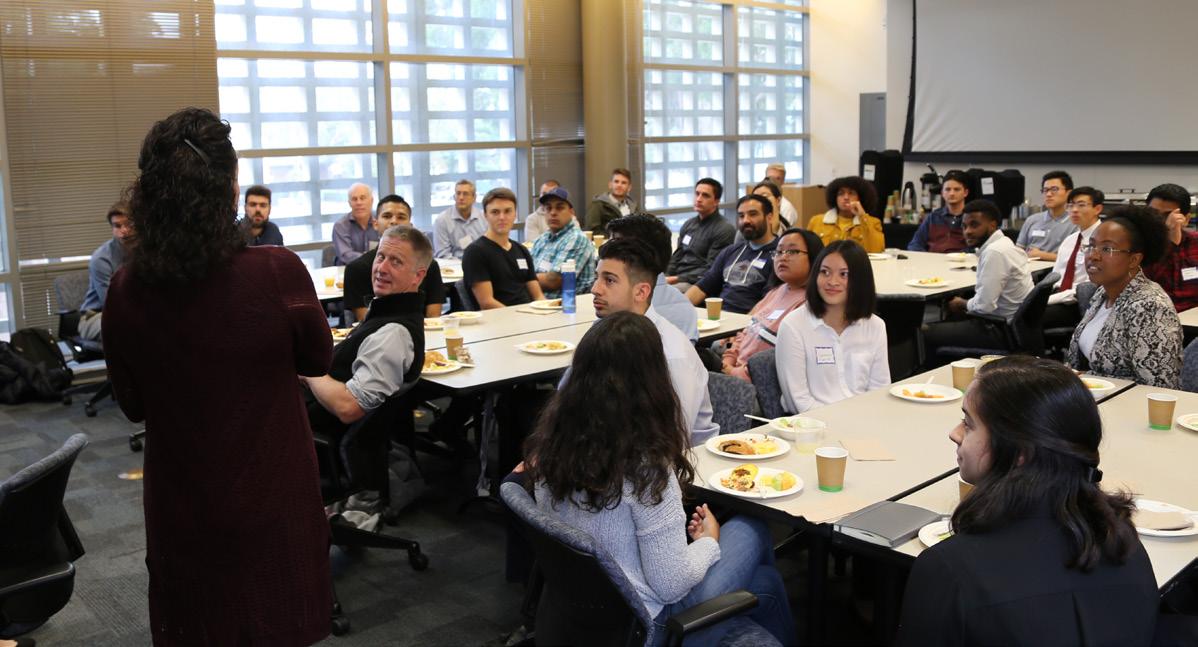
lot outside of school and those who have the luxury of not having to work. We want all of our students to achieve as much as they can while they are here.”
Transfer students have another unique set of challenges, based on where they are in their educational journey when they arrive at UCSB. “They come during junior year, precisely when the engineering curriculum ramps up with up to five hardcore engineering courses. They also have to adjust to our fast-paced quarter system, so everything is accelerated,” Scott
“Programs like ESTEEM... provide not just funding, but an environment where students can ourish and achieve their personal goals....Together, we form a community in which we all care for each other professionally and personally, and that makes a real di erence.”
ESTEEM, which is funded by the NSF’s Division of Undergraduate Education through its Scholarships in Science, Technology, Engineering and Mathematics (S-STEM) program, serves academically talented students who have high financial need and who often have no expected family contribution to their college expenses.
“The university normally gives students like these a number of grants, which cover a certain portion of their college expenses, but they are expected to do work study or take out loans to cover the rest of their costs,” Scott says. “We’re talking about students who are wary of borrowing large sums of money and find it particularly hard to do a significant amount of work study at the same time they are trying to keep up with a very demanding curriculum and succeed in engineering.”
ESTEEM provides up to ten thousand dollars of financial support per student per year.
eration students is that they tend to feel strongly connected to their families, who are very supportive but, typically, not highly knowledgeable about the university experience. “We hear about students who are having a tough time, who maybe didn’t get to study enough because they had to work and didn’t do very well on a midterm. Their family will say, ‘We understand, and we love you, and if you want to come home, you can.’ That’s great moral support, but is not necessarily the right message for a student [in terms of retention], because it may lead him or her to make decisions that are not in their long-term best interests.”
The UC Office of the President has statistics showing that, just six years after graduation, the median income of first-generation students surpasses that of their families. “The value to their families of the students’ finishing and graduating is huge,” Scott says. “At the same time, those students are under tremendous pressure to support their families. It is really important, therefore, that we keep them, support them, and make sure they finish strong. We don’t want to see this achievement gap between the students who have to work a
says. “All the students in their cohort have already formed study groups, they know how to do things, they know who to ask. Transfer students have to figure it all out on the fly. It’s a culture shock.”
To support the students, Scott and her colleagues provide tutors to fill in any academic gaps they may encounter. The students also have a key to a quiet room in a trailer next to her office, where they can study anytime or work together on projects. The program also offers occasional events and, during normal times, twice-yearly breakfasts with industry leaders affiliated with UCSB.
“Students love it,” Scott says. “They get to talk with people who are working in industry right now, and who are willing to share their own stories. We’ve had students get internships and jobs this way. It provides professional networking that they otherwise don’t have access to, because no one in their family is in engineering.”
“ESTEEM was one of the best resources that I had at UCSB,” recalls James Cruz (ME ’20), who transferred to UCSB from Moorpark College and now works as a mechanical engineer for the Naval Surface Warfare Center
FOCUS ON: Diversity, Equity, Inclusion 34
Students gather with recruiters from engineering firms at the ESTEEM Scholarships Breakfast with Industry event.
(NAVSEA). The support and the stipend he received, he says, “relieve some of the financial stress college can bring. As an engineering student, a supportive cohort is the key to success. ESTEEM provides just that.”
Students, and especially those who come from less privileged backgrounds or have less experience with universities, thrive on personal attention. Sometimes, says Scott, “All it takes for a struggling student, especially one who might not feel like he or she belongs, is to hear someone say, ‘You do belong here. If

you were good enough to get in here, and it’s hard to get in here, then you belong.’
“Just sending a short e-mail to a student who didn’t do well on a test can make a big difference, to let them know that you see them, you’re paying attention, you care about them, and their success matters to you,” Scott adds. “I think we owe that to all of our students. We will miss a lot of good engineers if we label them as not belonging or not cut out for university education or for this major, because they didn’t do well on a particular midterm. We can lose them simply because they don’t believe in themselves.”
Programs like ESTEEM and BD provide the students in them not just funding but also, says Lubin, “an environment where students can flourish and achieve their personal goals. You’re building this community where they are
supported by peer, faculty, and staff mentors; where they engage with professional networks and resources that open doors; and where they exchange strategies for successfully navigating their degree programs. Together, we form a community in which we all care for each other professionally and personally, and that makes a real difference.”
Those graduate students who become so good at supporting each other can also be valuable contributors to the ongoing DEI discussion. Mechanical engineering (ME) professor and vice chair, Jeff Moehlis, who is on the department’s diversity committee, says that graduate students are contributing to the department’s DEI strategy and climate survey. “We have three graduate students on our committee, and we are very much listening to them,” he says.
“Graduate students have good ideas. They know what’s going on, and we can learn a lot from them,” says ME professor Irene Beyerlein, who is also on the committee. “They’ve helped us to identify a few problems we weren’t aware of until we heard from them in our committee discussions.”
CSEP’s Davis, who works with students from URGs in various programs designed to ensure that they thrive and graduate or pursue advanced degrees, was a key contact for Black STEM students last spring and summer in the wake of George Floyd’s death and the ensuing nationwide racial-justice protests. She says she saw a lot of positive things from the university and from students during that time.
“Everyone had their own process to deal with what was happening,” she recalls. “A lot of the grad students are friends and peers. I was really impressed by how they worked with each other to initiate dialog with departments, and how campus administration and departments reached out to students to try to
understand the short- and long-term actions we can take, and to come up with lists of what we want to do.”
Several staff members who work with graduate students from URGs — such as those in the Black Graduate Student Association; Graduate Students for Diversity in Science; the Queer and Trans Graduate Student Union; Women in Science and Engineering; and Mathematics, Engineering, Science Achievement — note the importance of recognizing that every hour those students spend working for causes that they care about is an hour not spent on research. And that, Davis says, “puts them at a disadvantage from their peers who are not doing such free work.”
That is why she supports a balanced approach to addressing DEI issues, combining professional DEI training with “a decentralized approach, where different departments can focus on different things depending on what has been identified as necessary. I like, too, that there are grassroots conversations, that we hear from the people who are in these situations, so we can make sure the training is effective and covers the things that people want to discuss.”
“We need to be more proactive about building cultures of inclusivity, where every student is supported regardless of their gender, ethnic identity, or any other condition,” Belding says. “That requires maintaining awareness of the topic, attending workshops and training, having discussions about the importance of inclusivity, watching our climate, and doing regular climate surveys. I’m so glad that the vice chancellor’s office will do a campus climate survey this year and every two years after that. That way, when challenges are found, when we see that something needs attention, we can do something about it by taking appropriate and meaningful action.”
 For UCSB alumnus James Cruz (ME ‘20) the supportive cohort he encountered in the ESTEEM program proved “the key to success.”
FOCUS ON: Diversity, Equity, Inclusion 35
Members of Los Ingenieros, a student organization dedicated to empowering Hispanic students in STEM.
Engineering Department vice chair, M. Scott Shell, interacts with participants during a virtual workshop hosted by the department for undergraduates across the U.S. to learn about the PhD experience, the value of the degree, and how to apply and get into graduate school.
The Faculty Pipeline: Challenges and approaches to overcoming barriers that limit representation
Students are inspired by the people who present lectures to full classrooms and lead laboratories that conduct groundbreaking research. They are especially inspired if they can see themselves in those instructors. On the other hand, students who do not see themselves in those holding leadership positions can have a harder time envisioning their own success. Further, diverse faculty leading diverse labs and teaching to diverse groups of students enhance the engineering professions, and all STEM professions, by bringing a wider range of perspectives to problem-solving processes and the solutions that result.
As the College of Engineering and UCSB work to expand student diversity, parallel efforts are under way aimed at generating faculty applications and hires in the college and in STEM disciplines across campus that reflect the diversity of the university at large and California as a whole.

Double bind: Postdoctoral researcher Aide Macias-Muñoz normally publishes two to three journal papers per year. With day care for her daughter closed during COVID and her husband working as an ER doctor, she was unable to publish any in 2020. One prospective employer told her that to be a stronger candidate for a faculty position, she would have to publish more.
“We all need representation, someone who looks like us,” observes Ram Seshadri, director of the NSF-funded Materials Research Science and Engineering Center (MRSEC) at UCSB, also known as the Materials Research Lab (MRL).
Black Studies professor Sharon Tettegah is director of the Black Studies Research Center and has a long track record of working to diversify STEM fields. In one current project, she and Belinda Robnett, UCSB’s Executive Vice Chancellor for Diversity, Equity and Inclusion, will co-lead Aspire: The National Alliance for Inclusive & Diverse STEM Faculty, a three-year effort linking UCSB with eighteen other universities across the nation to develop inclusive faculty recruitment, hiring, and retention practices. The program, led by the Association of Public and Land-grant Universities (APLU) and funded in part by the National Science Foundation, is intended to ensure implementation of inclusive teaching practices in STEM disciplines and increased diversity in the STEM faculty at the participating institutions.
“UCSB is committed to anti-racism and to creating a community of students, faculty, and staff that embraces the rich cultural, racial, geographic, economic, and social diversity of the state of California,” Tettegah says. “We are excited and honored to join these eighteen institutions that are taking on the important work of addressing these issues.”
Cluster hires, in which a number of faculty are hired together, either in a single discipline or in complementary disciplines, are one way to accelerate progress in achieving greater faculty diversity. A letter distributed across campus in April and signed by Chancellor Henry T. Yang, Robnett, and other top

UCSB administrators and faculty, announced that the next Mellichamp research cluster, funded by longtime UCSB benefactors Duncan and Suzanne Mellichamp (see article on page 40) will focus on scholarly areas of social justice and equity issues.
“The intention is certainly that the people who are hired for the cluster will enhance campus diversity,” says Rod Alferness, dean of the College of Engineering.
Female STEM faculty continue to encounter obstacles ranging from overt instances of disrespect in the classroom to finding themselves assuming the role of caretakers for troubled students to a greater extent than might be true for their male peers.
An April 15 article in the Houston Chronicle website, chron.com, (and published originally on the website The Lily,) explains how several female academics have been disproportionately impacted by the COVID pandemic.
One of them is Aide Macias-Muñoz, a UCSB postdoctoral fellow who studies the evolution of eyes in jellyfish. She said that, with day care for her daughter being closed during the pandemic and her husband working as a hospital emergency-room physician, she decided to start applying for jobs in the fall, a year earlier than she had planned, rather than continue to bolster her resume with new research. Why? She knew she would have little time for research in the foreseeable future and wanted to avoid competing with colleagues who had been able to do more work than usual during the pandemic. While balancing work and parenting, her productivity dropped dramatically, and she went from publishing two to three peer-reviewed scientific papers per year prior to 2020 to none in 2020.
In the article, Macias-Muñoz reported having applied for eight tenure-track assistant professor positions. As of mid-April, she had received no offers but was waiting to hear from several schools. After one rejection, she asked for feedback and was told, according to the article, that “to be a stronger candi-
ON: Diversity, Equity, Inclusion 36
Chemical
FOCUS
date, she needed to publish more articles.”
Even cluster hiring is a relatively slow process for enhancing diversity, simply because few faculty positions are available in a given year. It takes even longer if good candidates are not seen, something on the mind of chemistry professor Javier Read de Alaniz.
He explains that a great many highly qualified candidates go unseen by major universities, simply because they earn their PhDs or do postdoctoral work at schools other than the top five — often, because no pathway existed for them to get to those schools — which makes them invisible during faculty searches at top research institutions.
“I don’t think I realized until recently how
groups and others who have less privilege lack access to those networks and connections that keep them in the pipeline long enough to get into a faculty position.”
One fairly easy first step to take in expanding visibility of scholars from URGs, he says, is, “If you have seminars, bring in seminar speakers who are not from those top five schools. We often hear the assumption that ‘there’s not enough talent out there,’ but I don’t think that’s true. I think we need to widen our scope to uncover the talent from diverse places.”
Chemical Engineering Department chair, Rachel Segalman, is answering that call for broader minority representation in seminars.
“On one hand, we lose students from the pipeline, and on the other, we don’t know who’s in the pipeline nationally, so we can’t address the problem. A national seminar series is a great place to start. We can provide some positive feedback as a broader community to a student who is considering a faculty job search in the future.”
much is taught informally as you go through the system to get your PhD,” Read de Alaniz says. “So much information gets passed on that is not written down or learned in a class. You end up having a series of missed learning opportunities, and that leads to talented candidates being overlooked based on what institutions people attended and on which schools faculty on hiring committees are familiar with. It’s unintentional; when you’re busy, it’s so easy to fall back on what you know.”
But it has the effect of perpetuating the cycle of invisibility and the resulting underrepresentation, of minorities in faculty searches, he says: “The number of STEM faculty who did not come through Berkeley, MIT, Harvard, CalTech, those kinds of institutions, is extremely small. If you don’t make it to one of those as an undergrad, a graduate student, or a postdoc, getting a faculty position becomes extremely challenging.
“People call it a pipeline issue, but I think of it more as a network issue, and it limits hiring,” he adds.” For better or worse, privilege allows some people to get into networks and institutions, which puts them on their way, whereas people from underrepresented
Last summer, she and colleagues at the Massachusetts Institute of Technology, UC Berkeley, and the University of Florida launched a National Chemical Engineering seminar series on Zoom focused on the diversity of the discipline and future faculty. Segalman says that the series reflects a goal shared broadly by universities nationwide, which is “to have our faculty look more like our current and future students and the broader society. It’s important to have that representation, but right now, the pipeline isn’t there to support it.”
Because of that, she says, “On one hand, we lose students from the pipeline, and on the other, we don’t know who’s in the pipeline nationally, so we can’t address the problem. A national seminar series is a great place to start. We can provide some positive feedback as a broader community to a student who is considering a faculty job search in the future.”
Segalman and her colleagues advertised the series widely, inviting graduate students and postdoctoral researchers to give a presentation to a Zoom viewing community of both faculty and students across the country. “That representation is important,” she says. “The audience sees the speaker, and the speaker
gets seen by the community.”
After every seminar, each of which has had between 50 and 150 viewers, with more than 600 unique registrants, a small rotating cohort of department and search committee chairs stays on the line with the speaker for a half-hour, providing mentorship, encouragement, and information about how to apply for faculty positions.
The organizers began advertising for applicants in summer 2020 and received more than 120 applications, with space for 50 speakers through the year. “We were trying to attract people who might have gone for a job search this year but are delaying because so few faculty searches are occurring during the pandemic, but who, without some encouragement, might drop out of the pipeline and get an industrial job,” Segalman says.
Applicants were asked for a resume and an optional letter of recommendation. They were informed that one of the organizers’ goals was to improve the visibility of diversity in the discipline and were asked, “How are you going to help us attain that goal?”
“We got responses from a large group of graduate students and postdocs who are active in the community and doing important things, and you want to reward that,” Segalman explains. “We received answers from students with all sorts of backgrounds who have come to this point via really interesting and unusual ways. Some were people we as Americans would consider underrepresented minorities, first-generation college students, and non-traditional students. Others came from countries that have a strong caste system, so someone who might be an underrepresented minority in their own culture.”
“We’ve had speakers from parts of the world that have educational systems very different from those in the U.S. We’ve had speakers who were from indigenous groups in various regions of the world, and from minority groups in a variety of places. We’ve had people from LGBTQ backgrounds, who are well represented in some parts of the world and not in others. So, the question, How are you going to help us increase diversity in the field? means different things to different people and broadens the field.”
Segalman reports that the seminars were watched by search-committee chairs from many schools that were running searches, noting, “We made the seminar list public, and they’ve actually been recruiting from it, so, in that sense, it’s serving that purpose.”
FOCUS ON: Diversity, Equity, Inclusion 37

The labs of Michael Chabinyc and Christopher Bates develop a material that is soft and elastic and feels like human tissue
Researchers in the labs of UC Santa Barbara materials assistant professor Chris Bates and professor and department chair, Michael Chabinyc, have teamed up to develop the first 3D-printable “bottlebrush” elastomer. The new material results in printed objects that have unusual softness and elasticity — mechanical properties that closely resemble those of human tissue.
38
While working on a process to increase the charge that can be stored by an
Conventional elastomers, i.e. rubbers, are stiffer than many biological tissues. The reason is related to the size and shape of their constituent polymers, which are long, linear molecules that easily entangle, like a bowl of cooked spaghetti. In contrast, bottlebrush polymers have additional polymers, analagous to bristles, attached to the linear backbone, leading to a structure that is more akin to a bottle brush you might find in your kitchen. The bottlebrush polymer structure imparts the ability to form extremely soft elastomers.
The ability to 3D-print bottlebrush elastomers makes it possible to leverage these unique mechanical properties in applications that require careful control over the dimensions of objects, ranging from biomimetic tissue to high-sensitivity electronic devices, such as touch pads, sensors, and actuators.
Two postdoctoral researchers — Renxuan Xie and Sanjoy Mukherjee — played key roles in developing the new material. Their findings were published in the Nov. 13 issue of the journal Science Advances.
Xie and Mukherjee’s key discovery involves the self-assembly of bottlebrush polymers at the nanometer length scale, which causes a solid-to-liquid transition in response to applied pressure. This material is categorized as a yield-stress fluid, meaning it begins as a semi-soft solid that holds its shape, like butter or toothpaste, but when sufficient pressure is applied, it liquefies and can be squeezed through a syringe. The team exploits this property to create inks in a 3D-printing process called direct ink writing (DIW).
The researchers can tune the material to flow under various amounts of pressure to match the desired processing conditions. “For instance, maybe you want the polymer to hold its shape under a different level of stress, such as when vibration is present,” says Xie. “Our material can hold its shape for hours. That’s important, because if the material sags during printing, the printed part will have poor structural stability.”
Once the object is printed, UV light is shined onto it to activate crosslinkers that Mukherjee synthesized and included as a part of the ink formulation. The crosslinkers can link up nearby bottlebrush polymers, resulting in a super-soft elastomer. At that point, the mate-
rial becomes a permanent solid — it will no longer liquefy under pressure — and exhibits extraordinary properties.
“We start with long polymers that are not crosslinked,” says Xie. “That allows them to flow like a fluid. But, after you shine the light on them, the small molecules between the polymer chains react and are linked together into a network, so you have a solid, an elastomer that, when stretched, will return to its original shape.”
The softness of a material is measured in terms of its modulus, and most elastomers have a rather high modulus, meaning their stiffness and elasticity are similar to those of a rubber band. “The modulus of our material is a thousand times smaller than that of a rubber band,” Xie notes. “It is super-soft — it feels very much like human tissue — and very stretchy. It can stretch about three to four times its length.”
“The field has exploded in the past ten years thanks to advances in synthetic chemistry that provide exquisite control over the size and shape of these unique molecules.
“These super-soft elastomers might be applicable as implants,” he adds. “You might be able to reduce inflammation and rejection by the body if the mechanical properties of an implant match native tissue.”
Another notable element of the new material is that it is pure polymer, Chabinyc notes. “There’s no water or other solvent in them to artificially make them softer.”
To understand the importance of having no water in the polymer, it’s helpful to think of Jell-O, which is mostly water and can hold its shape, but only as long as the water remains inside. “If the water went away, then you’d just have a shapeless pile of material,” Chabinyc explains. “With a conventional polymer, you must figure out how to keep the right amount
“The modulus of our material is a thousand times smaller than that of a rubber band. It is super-soft — it feels very much like human tissue — and very stretchy. It can stretch about three to four times its length.”
An Accidental Ink
Mukherjee discovered the material by accident while trying to develop a material for a different project, one that would increase the amount of charge that can be stored by an actuator. When the elastomer came to Xie for characterization, he knew immediately that it was special. “I could see right away that it was different, because it could hold its shape so well,” he recalls.
“When we saw this really well-defined yield stress, it dawned on everyone collectively that we could 3D-print it,” Bates says, “and that would be cool, because none of the 3D-printable materials we know of have this super-soft property.”
Bottlebrush polymers have been around for more than twenty years, but, Bates notes,
of water inside of it to maintain its structure, but this new material is entirely solid, with no water, so it will never change.”
Moreover, the new material can be 3D-printed and processed without solvent, which is also unusual. “People often add solvent to liquify a solid so that it can be squeezed out of a nozzle,” says Xie, “but if you add solvent, it has to evaporate after printing, which can cause the object to change its shape or crack.”
Mukherjee adds, “We wanted the material and the printing process to be as clean and as easy as possible, so we played a chemistry trick with solubility and self-assembly, which enabled the solvent-free process. The fact that we don’t use solvent is a tremendous advantage with this material.”
39
actuator, the researchers discovered a novel material that can be 3D-printed to produce objects having unique softness and flexibility.

Champions of ENGINEERING Institution Builders
Duncan and Suzanne Mellichamp exemplify commitment, vision, and generosity. UC Santa Barbara — and the entire UC system — are far better for their e orts. Here, we retrace Duncan’s long UCSB career and the philanthropy that has made the Mellichamps Champions of Engineering.
During a visit to a cousin in Dubuque, Iowa, in 1965, Duncan Mellichamp, then a new PhD student at Purdue University, went on a blind date with a young elementary-school teacher named Suzanne Carlton. They hit it off. Seven dates, seven months, and well over one hundred handwritten letters later, they were married. That was sixty years ago this September. Four years later, Mellichamp was working at the DuPont Company in North Carolina, and was asked to do some PhD recruiting at his former school. He and Suzanne traveled to Purdue, where Professor J. E. Myers, Duncan’s former TA advisor, asked him if he’d be interested in helping to establish a new chemical engineering program at UC Santa Barbara, which Myers was joining as the first department chair.
With a promising career ahead of him — having already filed a patent for a new technique to make polyester polymer without catalyst — Duncan declined. But Myers had approached Suzanne as well, and she accepted his invitation for the two of them to visit Santa Barbara the following summer: Duncan would only have to give a seminar on his PhD work to enjoy a free vacation. They came, he spoke, and they signed on. Suzanne joined her fifth school district; she would later earn her MA in education at UCSB.
When they arrived in Santa Barbara, the university had nothing like its current stature, and Duncan recalls a pointed remark to that effect from someone at an early UC committee meeting he attended. Rather than be defensive, he recalls “resolving to help make the campus great.” Several decades later, he says, “We’ve been successful,
and I’ve been a part of that, which gives me tremendous satisfaction.”
One reason for that success, he notes, has been a shared dedication to bringing the best people to UCSB. “Faculty here understand that you want to hire those who are likely to become stars or superstars and also attract similarly talented students. We’ve done that, by and large, and all of us have benefitted,” he says.
During his 37-year career as an active faculty member, and his longer association with UC more broadly, Mellichamp’s activities spanned a dizzying range of areas. He designed and built two laboratories, one for teaching undergraduate process control in the Chemical Engineering Department and a real-time computing lab. He collaborated with colleagues to develop the new BS, MS, and PhD programs. He published more than one hundred papers on process modeling plant-wide economic analysis, and computer control.
Even before earning tenure, he achieved many “firsts” in the new CoE. He advised the college’s first PhD student, and he mentored both the first PhD in chemical engineering, who conducted research derived from Mellichamp’s own experience at DuPont, and the first woman to receive her PhD in the college. He also teamed with a nationwide group of experts to edit the first book on computer applications to data acquisition and control (Van Nostrand, 1985), using as examples working experiments from the real-time computing laboratory he had modified to teach UCSB undergraduates. He co-authored — with then fellow UCSB chemical engineer Dale E. Seborg, University of
40
Texas chemical engineer Thomas Edgar, and Frank Doyle (now dean of Harvard University’s John A. Paulson School of Engineering and Applied Sciences), the award-winning undergraduate textbook Process Dynamics and Control (Wiley), now in its fourth edition and translated into multiple languages.
He has received numerous awards and professional honors. He was elected to the Georgia Tech Engineering Hall of Fame in 2004 and received the Purdue University Department of Chemical Engineering’s Outstanding Chemical Engineer Award in 2007, and a 2010 CACHE (Computers in Chemical Engineering) Award for his many contributions to computing in the discipline.
Mellichamp served as elected Chair of the UCSB Academic Senate from 1990-‘92 and was elected Chair of the UC Academic Senate’s UC Academic Council, and Faculty Representative on the UC Board of Regents in 1995. He was elected a trustee of the UC Santa Barbara Foundation in 2003. In 2014, he came out of retirement to chair the highly influential Trustees Advisory Committee on Isla Vista Strategies and received the 2018 Oliver Johnson Award for Distinguished Leadership in the UC Academic Senate.
A popular teacher at all levels, Mellichamp mentored fifty graduate students, which he describes as “the most rewarding thing a professor does. You’re working with people, bringing them
“The fteen years was intentional. I wanted people to know that they had time to get everything in place and attract the funding to be world-class in that discipline.”
to your level and above. You tell them, ‘When you finish, you will be the world expert on your dissertation topic.’ It’s a great feeling to help someone accomplish that.”
Now busily retired, the Mellichamps occupy a place among UC Santa Barbara’s most recognized and respected benefactors, as demonstrated by their receiving the UCSB Medal, the university’s highest honor for philanthropy, in 2006. Their contributions have had a special resonance within the College of Engineering.
They have focused their gifts on funding clusters of four endowed chairs, who are provided resources for fifteen years, enough to allow them to bring UCSB to prominence in an emerging or promising field of research selected by the university. “The fifteen years was intentional,” Mellichamp says. “I wanted people to know that they had time to get everything in place and attract the funding to be world-class in that discipline, or at least on their way. I wanted to put a fire into people, just like I felt one under me when I came here.”
The first cluster, in the area of systems biology, was established in 2003. At the time, Chancellor Henry T. Yang said, “Professor Mellichamp already has given so much to UCSB through his teaching, research, and leadership, and providing such an extremely generous gift to carry out this vision is just extraordinary.” At the time, the gift to fund what have come to be known as “Mellichamp clusters” was the largest ever given by a UCSB faculty member.
A second cluster, in 2008, focused on the dynamics of globalization, and five years later came the cluster on sustainability. (See a related article on page 20.) A fourth cluster, “Mind & Machine

Better together: During nearly sixty years of marriage, Duncan and Suzanne Mellichamp have found it easy to reach agreement in their shared mission to support people, causes, and institutions they care about.
41
Intelligence,” now in its third year, replaced the first cluster as its cycle ended; and a fifth cluster, scheduled to begin in 2023, will focus on social and racial justice. “I truly hope UCSB can develop a national program to deal with the overwhelming issue of racial justice,” Mellichamp says.
In all, the Mellichamps have endowed fourteen chairs, and Duncan says that experience led to the idea of clusters. He had seen individual endowed chairs remain in place long after a faculty member whose research had inspired the gift had retired or the area of research had lost impact or disappeared altogether. He thought a better way to build major programs would be to endow multiple chairs under a uniting focus. The two exceptions have been single endowed chairs that went to biochemical engineer Frank Doyle (2003), and chemical engineer Michael Doherty (2019). Both have been elected into the National Academy of Engineering — Doherty in 2016 and Doyle in 2021. The Mellichamps also joined others to fund separate Founder’s Chairs awarded to chemical engineers M. Scott Shell and Michael Gordon in 2019.
The Mellichamps have been able to achieve what they have thanks to their solid partnership, Duncan’s career, and some wise investments along the way. They also owe much to his willingness to embrace challenges as opportunities. In fact, it is hard to find an instance when this autodidactic emeritus professor either turned down the chance to pursue something entirely new and foreign to him, or took it on and did not succeed at it.
“I’ve always enjoyed working really hard,” he says. “I also like seeing what I can do. And I like to be in the lead.”
Born in Georgia but raised early on in New York City, where his father was a textile engineer, Mellichamp earned his BS in chemical engineering, with highest honors, from Georgia Tech in 1959. As an 18-year-old, he entered a co-op program at DuPont, during which he alternated between attending university for a quarter and working at the company for a quarter. During one of his seven quarters at DuPont, it acquired a “mini-computer,” about the size of a refrigerator. “It didn’t have the computational horsepower of a cheap digital watch, and it used paper tape — before cards were used for programming — but you could do computational work on it,” Mellichamp recalls, with only the slightest trace of his nearly lost Georgia accent.
When he returned to Georgia Tech the following quarter, it had a new mainframe
UNIVAC computer. “They were eager to get anyone to use it, even undergraduates, because nobody knew computers. I just signed up and used it to do my class heat exchanger design,” Mellichamp recalls.
At Georgia Tech, he also befriended a German exchange student who suggested that he apply for a reciprocal year abroad, so he did, was awarded the fellowship, learned German, and attended the Universität Stuttgart, where he took courses in computer design and programming and nuclear engineer-
His rst major e ort was to link up UCSB and the County of Santa Barbara to work on a master plan for Isla Vista. That led to a project to build UCSB faculty housing and to save the Ellwood-Devereux blu s.
from running an opera company. But after spending twelve years on Opera Santa Barbara’s Board of Directors, Duncan, the newly elected vice president, stepped in as president when the company encountered financial difficulties. Under his leadership, nine months later, the opera was back on solid financial footing, though he credits his fellow Board members with the turnaround.
In 1997, Mellichamp began an instrumental role as Chancellor Yang’s special assistant for external developments; his first major effort was to connect UCSB and the County of Santa Barbara to work on a master plan for Isla Vista. That led to a project to build UCSB faculty housing and to save the Ellwood-Devereux bluffs, a process that included two land swaps and, later, the purchase by the California Trust for Public Land of 64 acres of what had been the Ocean Meadows golf course. The Trust then gifted the property to The Regents of the University of California as the longterm steward of the new North Campus Open Space (NCOS).
ing. “Having the co-op work experience plus this life abroad was really useful,” he recalls. “I went to Purdue when chemical engineering was just exploding into the modern era with mathematical models that required knowledge of computers. I have so often been in the right place at the right time.”
His German friend also offered Mellichamp another important invitation. He and several other European exchange students had arranged to meet with students at Morehouse College, the historically Black men’s university in Atlanta. “He asked me if I’d like to go with him, and I said ‘sure,’” Mellichamp recalls. “Georgia Tech was still segregated at that time, and had just begun admitting women two years before. We went to the meeting in the Morehouse president’s living room and talked about our student experiences. That was eye-opening. I’d say that if I’m a progressive — and I surely have been from the beginning — that experience is probably one reason. Who got that kind of opportunity in the South in the 1950s?”
In 1970s Santa Barbara, the Mellichamps bought a duplex to live in, and Duncan taught himself about real estate investment. Some sound investments would later provide the capital for their philanthropy. After retiring, Mellichamp took a new tack into finance, writing journal papers on modeling financial risk versus return in designing chemical plants.
In another realm, the Mellichamps both enjoy opera, which is, of course, very different
In one of the couple’s recent activities, they combined Suzanne’s lifelong interest in the environment, nature, and animals with Duncan’s organization and communications acumen to participate in the NCOS Restoration Project. This collaboration of multiple environmentally focused partners is managed by UCSB’s Cheadle Center for Biodiversity and Ecological Restoration, with the goal of returning the golf course to its natural state. Suzanne financially supported the construction of a key facility, the Carlton-Duncan Visitor Plaza, which carries her name and that of several of her family members, honoring a family commitment.
On the cusp of their 55th year in Santa Barbara, their 60th wedding anniversary, and his 65th year as a professional chemical engineer, the Mellichamps report that they continue to arrive at agreement easily, particularly when it comes to supporting the university. “It’s special to me,” Suzanne says, “but, of course, Duncan’s whole career has been here in California, and we’ve appreciated getting to know so many people through the university. It’s our second home, and it means a lot to both of us.”
“We’re just trying to make a difference in areas that are of interest to us,” says Duncan, to which Suzanne adds, “We’ve wanted to provide scholars who can contribute to the university, incentive to come here to teach and do research. We’ve attracted quite a few great people that way, so it must be a good thing.”
42

You Make the Difference

The philanthropy of individuals like you helps to ensure that breakthroughs in science and engineering remain the order of the day across our beautiful UC Santa Barbara campus. Large gifts, small gifts, estate gifts — they all matter, because each advances academic excellence and leadingedge research that, together, help pave the way to a better tomorrow. Please consider making a difference by making your gift today!
To learn more about opportunities for the College of Engineering and the Division of Math, Life and Physical Sciences, please contact Lynn Hawks, Senior Assistant Dean of Development. 805-893-5132 / lynn.hawks@ucsb.edu
This spring, ground was broken on the rst classroom building to be constructed at UC Santa Barbara since 1967. The four-story state-of-the-art structure is expected to open in spring 2023.

Nonprofit Organization U.S. Postage PAID Santa Barbara, CA Permit No. 104
University of California Santa Barbara Santa Barbara, CA 93106-5130
University of California, in accordance with applicable Federal and State law and University policy, does not discriminate on the basis of race, color, national origin, religion, sex, gender, expression, gender identity, pregnancy, physical or mental disability, medical condition (cancer related or genetic characteristics), ancestry, marital status, age, sexual orientation, citizenship, or service in the uniformed service. The University prohibits sexual harassment. This nondiscrimination policy covers admission, access, and treatment in University programs and activities. Inquiries regarding the University's student-related nondiscrimination policies may be directed to the Office of Equal Opportunity & Sexual Harrassment/ Title IX Compliance, Telephone: (805) 893-2701.
College of Engineering The