“They castrate, and then they steal the body for themselves. It is now theirs to drive. I like to call them body-snatchers.” Ryan Hechinger, UCSB
Invasion of the body-snatchers: Castes of castrators Lurking among the showy egrets and glimmering fish that inhabit Carpinteria Salt Marsh are armies of tiny worms aiming for a takeover—parasites with a sophisticated social order that helps them pull off their nefarious plans. These flatworms invade the California horn snails that abound in the mudflats, co-opting the snails’ bodies for their own parasitic purposes. “I like to call them body-snatchers,” Hechinger says. The worms begin their takeover by destroying their host’s gonads—parasitic castration is also practiced by barnacles that colonize crabs, protozoans that invade sea stars and fungi that infect plants. Having robbed the snail of the ability to reproduce, the worms then divert their host’s energies to their own growth—unlike most parasites, which are typically tiny relative to their hosts, these worms can constitute up to 40 percent of the weight of the snail—and then pump out multitudes of free-swimming larvae that seek out fish and other hosts.
Kevin Lafferty
“They castrate, and then they steal the body for themselves,” Hechinger says. “It is now theirs to drive.”
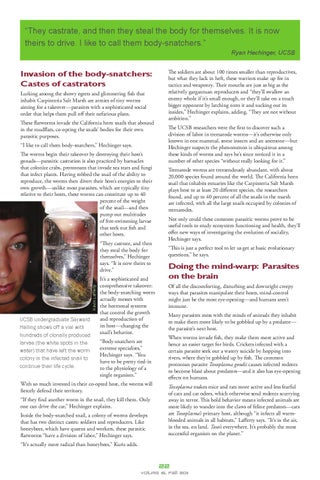
UCSB undergraduate Sayward Halling shows off a vial with hundreds of clonally produced larvae (the white spots in the water) that have left the worm colony in the infected snail to continue their life cycle.
It’s a sophisticated and comprehensive takeover: the body-snatching worm actually messes with the hormonal systems that control the growth and reproduction of its host—changing the snail’s behavior. “Body-snatchers are extreme specialists,” Hechinger says. “You have to be pretty tied-in to the physiology of a single organism.”
With so much invested in their co-opted host, the worms will fiercely defend their territory. “If they find another worm in the snail, they kill them. Only one can drive the car,” Hechinger explains. Inside the body-snatched snail, a colony of worms develops that has two distinct castes: soldiers and reproducers. Like honeybees, which have queens and workers, these parasitic flatworms “have a division of labor,” Hechinger says.
The soldiers are about 100 times smaller than reproductives, but what they lack in heft, these warriors make up for in tactics and weaponry. Their mouths are just as big as the relatively gargantuan reproducers and “they’ll swallow an enemy whole if it’s small enough, or they’ll take on a much bigger opponent by latching onto it and sucking out its insides,” Hechinger explains, adding, “They are not without ambition.” The UCSB researchers were the first to discover such a division of labor in trematode worms—it’s otherwise only known in one mammal, some insects and an anemone—but Hechinger suspects the phenomenon is ubiquitous among these kinds of worms and says he’s since noticed it in a number of other species “without really looking for it.” Trematode worms are tremendously abundant, with about 20,000 species found around the world. The California horn snail that inhabits estuaries like the Carpinteria Salt Marsh plays host to at least 20 different species, the researchers found, and up to 40 percent of all the snails in the marsh are infected, with all the large snails occupied by colonies of trematodes. Not only could these common parasitic worms prove to be useful tools to study ecosystem functioning and health, they’ll offer new ways of investigating the evolution of sociality, Hechinger says. “This is just a perfect tool to let us get at basic evolutionary questions,” he says.
Doing the mind-warp: Parasites on the brain Of all the discomforting, disturbing and downright creepy ways that parasites manipulate their hosts, mind-control might just be the most eye-opening—and humans aren’t immune. Many parasites mess with the minds of animals they inhabit to make them more likely to be gobbled up by a predator— the parasite’s next host. When worms invade fish, they make them more active and hence an easier target for birds. Crickets infected with a certain parasite seek out a watery suicide by hopping into rivers, where they’re gobbled up by fish. The common protozoan parasite Toxoplasma gondii causes infected rodents to become blasé about predators—and it also has eye-opening effects on humans. Toxoplasma makes mice and rats more active and less fearful of cats and cat odors, which otherwise send rodents scurrying away in terror. This bold behavior means infected animals are more likely to wander into the claws of feline predators—cats are Toxoplasma’s primary host, although “it infects all warmblooded animals in all habitats,” Lafferty says. “It’s in the air, in the sea, on land. Toxo’s everywhere. It’s probably the most successful organism on the planet.”
“It’s actually more radical than honeybees,” Kuris adds.
22 VOLUME 16, FALL 2011