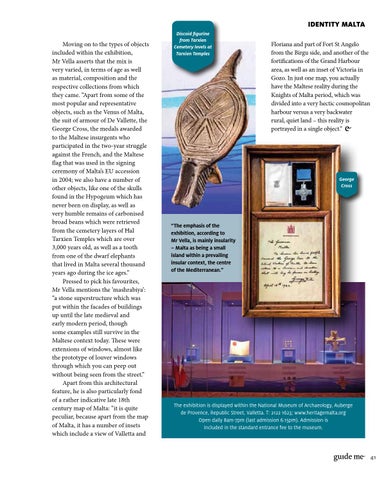
IDENTITY MALTA Moving on to the types of objects included within the exhibition, Mr Vella asserts that the mix is very varied, in terms of age as well as material, composition and the respective collections from which they came. “Apart from some of the most popular and representative objects, such as the Venus of Malta, the suit of armour of De Vallette, the George Cross, the medals awarded to the Maltese insurgents who participated in the two-year struggle against the French, and the Maltese flag that was used in the signing ceremony of Malta’s EU accession in 2004; we also have a number of other objects, like one of the skulls found in the Hypogeum which has never been on display, as well as very humble remains of carbonised broad beans which were retrieved from the cemetery layers of Ħal Tarxien Temples which are over 3,000 years old, as well as a tooth from one of the dwarf elephants that lived in Malta several thousand years ago during the ice ages.” Pressed to pick his favourites, Mr Vella mentions the ‘mashrabiya’: “a stone superstructure which was put within the facades of buildings up until the late medieval and early modern period, though some examples still survive in the Maltese context today. These were extensions of windows, almost like the prototype of louver windows through which you can peep out without being seen from the street.” Apart from this architectural feature, he is also particularly fond of a rather indicative late 18th century map of Malta: “it is quite peculiar, because apart from the map of Malta, it has a number of insets which include a view of Valletta and
Discoid figurine from Tarxien Cemetery levels at Tarxien Temples
Floriana and part of Fort St Angelo from the Birgu side, and another of the fortifications of the Grand Harbour area, as well as an inset of Victoria in Gozo. In just one map, you actually have the Maltese reality during the Knights of Malta period, which was divided into a very hectic cosmopolitan harbour versus a very backwater rural, quiet land – this reality is portrayed in a single object.”
George Cross
“The emphasis of the exhibition, according to Mr Vella, is mainly insularity – Malta as being a small island within a prevailing insular context, the centre of the Mediterranean.”
The exhibition is displayed within the National Museum of Archaeology, Auberge de Provence, Republic Street, Valletta. T: 2122 1623; www.heritagemalta.org Open daily 8am-7pm (last admission 6.15pm). Admission is included in the standard entrance fee to the museum.
41