CC CASE STUDY
The art of reinvention One of the successes of a business is marked by how quickly and well it can adapt to an ever-changing environment, and Gio. Batta Delia is a perfect example of this. Martina Said chats with Patrick Delia, the fourth generation running the business, to find out how the business is still around after 116 years.
L
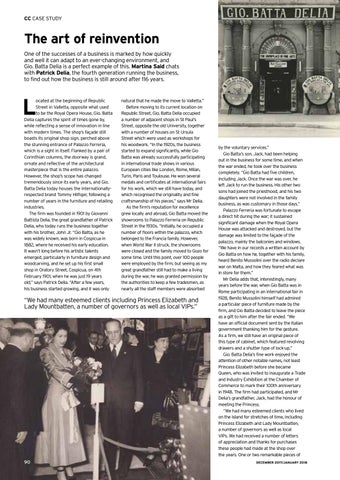
ocated at the beginning of Republic Street in Valletta, opposite what used to be the Royal Opera House, Gio. Batta Delia captures the spirit of times gone by, while reflecting a sense of innovation in line with modern times. The shop’s façade still boasts its original shop sign, perched above the stunning entrance of Palazzo Ferreria, which is a sight in itself. Flanked by a pair of Corinthian columns, the doorway is grand, ornate and reflective of the architectural masterpiece that is the entire palazzo. However, the shop’s scope has changed tremendously since its early years, and Gio. Batta Delia today houses the internationallyrespected brand Tommy Hilfiger, following a number of years in the furniture and retailing industries. The firm was founded in 1901 by Giovanni Battista Delia, the great grandfather of Patrick Delia, who today runs the business together with his brother, John Jr. “Gio Batta, as he was widely known, was born in Cospicua in 1882, where he received his early education. It wasn’t long before his artistic talents emerged, particularly in furniture design and woodcarving, and he set up his first small shop in Oratory Street, Cospicua, on 4th February 1901, when he was just 19 years old,” says Patrick Delia. “After a few years, his business started growing, and it was only
natural that he made the move to Valletta.” Before moving to its current location on Republic Street, Gio. Batta Delia occupied a number of adjacent shops in St Paul’s Street, opposite the old University, together with a number of houses on St Ursula Street which were used as workshops for his woodwork. “In the 1920s, the business started to expand significantly, while Gio Batta was already successfully participating in international trade shows in various European cities like London, Rome, Milan, Turin, Paris and Toulouse. He won several medals and certificates at international fairs for his work, which we still have today, and which recognised the originality and fine craftsmanship of his pieces,” says Mr Delia. As the firm’s reputation for excellence grew locally and abroad, Gio Batta moved the showrooms to Palazzo Ferreria on Republic Street in the 1930s. “Initially, he occupied a number of floors within the palazzo, which belonged to the Francia family. However, when World War II struck, the showrooms were closed and the family moved to Gozo for some time. Until this point, over 100 people were employed by the firm, but seeing as my great grandfather still had to make a living during the war, he was granted permission by the authorities to keep a few tradesmen, as nearly all the staff members were absorbed
“We had many esteemed clients including Princess Elizabeth and Lady Mountbatten, a number of governors as well as local VIPs.”
90
by the voluntary services.” Gio Batta’s son, Jack, had been helping out in the business for some time, and when the war ended, he took over the business completely. “Gio Batta had five children, including Jack. Once the war was over, he left Jack to run the business. His other two sons had joined the priesthood, and his two daughters were not involved in the family business, as was customary in those days.” Palazzo Ferreria was fortunate to escape a direct hit during the war; it sustained significant damage when the Royal Opera House was attacked and destroyed, but the damage was limited to the façade of the palazzo, mainly the balconies and windows. “We have in our records a written account by Gio Batta on how he, together with his family, heard Benito Mussolini over the radio declare war on Malta, and how they feared what was in store for them.” Mr Delia adds that, interestingly, many years before the war, when Gio Batta was in Rome participating in an international fair in 1928, Benito Mussolini himself had admired a particular piece of furniture made by the firm, and Gio Batta decided to leave the piece as a gift to him after the fair ended. “We have an official document sent by the Italian government thanking him for the gesture. As a firm, we still have an original piece of this type of cabinet, which featured revolving drawers and a shutter type of lock-up.” Gio. Batta Delia’s fine work enjoyed the attention of other notable names, not least Princess Elizabeth before she became Queen, who was invited to inaugurate a Trade and Industry Exhibition at the Chamber of Commerce to mark their 100th anniversary in 1948. The firm had participated, and Mr Delia’s grandfather, Jack, had the honour of meeting the Princess. “We had many esteemed clients who lived on the island for stretches of time, including Princess Elizabeth and Lady Mountbatten, a number of governors as well as local VIPs. We had received a number of letters of appreciation and thanks for purchases these people had made at the shop over the years. One or two remarkable pieces of DECEMBER 2017/JANUARY 2018