NICKEL ENERGIZING BATTERIES
Concern over climate change, the drive towards energy efficiency and the adoption of carbon dioxide emissions targets by governments are all helping to increase interest in renewable energy technologies involving batteries and energy storage. While nickel is not always in the name, its presence in many battery technologies is helping to reduce greenhouse gas emissions - enabling clean energy solutions to be a central part of our effort to tackle global warming.
LI-ION BATTERIES
TODAY’S BATTERY OPTIONS
Nickel plays a crucial role in lithium-ion battery chemistries used to power electric vehicles, medical devices and cordless power tools as well as store renewable energy.
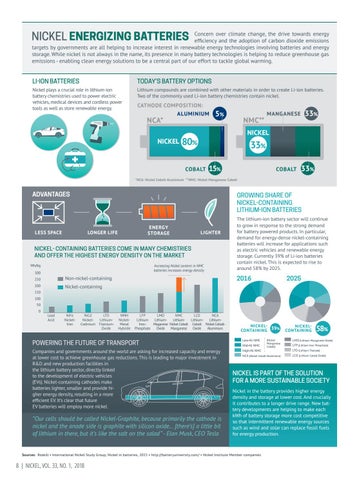
Lithium compounds are combined with other materials in order to create Li-ion batteries. Two of the commonly used Li-ion battery chemistries contain nickel.
CATHODE COMPOSITION:
NCA*
ALUMINIUM
NICKEL
5%
NMC**
33%
MANGANESE
NICKEL
80%
33%
COBALT
15%
COBALT
33%
*NCA: Nickel Cobalt Aluminium **NMC: Nickel Manganese Cobalt
ADVANTAGES
GROWING SHARE OF NICKEL-CONTAINING LITHIUM-ION BATTERIES
LESS SPACE
ENERGY STORAGE
LONGER LIFE
LIGHTER
NICKEL- CONTAINING BATTERIES COME IN MANY CHEMISTRIES AND OFFER THE HIGHEST ENERGY DENSITY ON THE MARKET Wh/kg
Increasing Nickel content in NMC batteries increases energy density
300 250
Non-nickel-containing
200
Nickel-containing
The lithium-ion battery sector will continue to grow in response to the strong demand for battery powered products. In particular, demand for energy-dense nickel-containing batteries will increase for applications such as electric vehicles and renewable energy storage. Currently 39% of Li-ion batteries contain nickel. This is expected to rise to around 58% by 2025.
2016
2025
150 100 50 0
Lead Acid
NiFe NickelIron
NiCd LTO NickelLithiumCadmium TitaniumOxide
NMH NickelMetal Hybride
LFP LMO NMC LCO NCA Lithium LithiumLithiumLithiumLithiumIronMaganese Nickel Cobalt Cobalt Nickel CobaltPhosphate Oxide Manganese Oxide Aluminium
NICKELCONTAINING 39%
POWERING THE FUTURE OF TRANSPORT
Low-Ni NMC
Companies and governments around the world are asking for increased capacity and energy at lower cost to achieve greenhouse gas reductions. This is leading to major investment in R&D and new production facilities in the lithium battery sector, directly linked to the development of electric vehicles (EVs). Nickel-containing cathodes make batteries lighter, smaller and provide higher energy density, resulting in a more efficient EV. It’s clear that future EV batteries will employ more nickel.
High-Ni NMC
“ Our cells should be called Nickel-Graphite, because primarily the cathode is nickel and the anode side is graphite with silicon oxide… [there’s] a little bit of lithium in there, but it’s like the salt on the salad ” - Elon Musk, CEO Tesla
Mid-Ni NMC
NCA (Nickel Cobalt Aluminium)
58%
LMO (Lithium Manganese Oxide) LFP (Lithium Iron Phosphate) LTO (Lithium Titanate) LCO (Lithium Cobalt Oxide)
NICKEL IS PART OF THE SOLUTION FOR A MORE SUSTAINABLE SOCIETY Nickel in the battery provides higher energy density and storage at lower cost. And crucially it contributes to a longer drive range. New battery developments are helping to make each kWh of battery storage more cost competitive so that intermittent renewable energy sources such as wind and solar can replace fossil fuels for energy production.
Sources: Roskill • International Nickel Study Group, Nickel in batteries, 2015 • http://batteryuniversity.com/ • Nickel Institute Member companies
8 | NICKEL, VOL. 33, NO. 1, 2018
(Nickel Manganese Cobalt)
NICKELCONTAINING