SHELL’S QUEST PROJECT HOW NICKEL-CONTAINING STAINLESS STEEL CONTRIBUTES TO BETTER AIR QUALITY
CNW GROUP/SHELL CANADA LIMITED
The International Energy Agency (IEA) considers carbon capture and storage (CCS) to be an important climate mitigation technology in its Blue Map strategy for reducing carbon dioxide emissions. CCS is needed to successfully transition to a low-carbon economy and achieve the Paris ‘below 2 degree’ international climate change target.
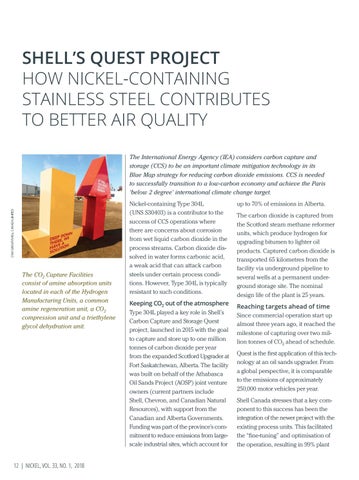
The CO2 Capture Facilities consist of amine absorption units located in each of the Hydrogen Manufacturing Units, a common amine regeneration unit, a CO2 compression unit and a triethylene glycol dehydration unit.
12 | NICKEL, VOL. 33, NO. 1, 2018
Nickel-containing Type 304L (UNS S30403) is a contributor to the success of CCS operations where there are concerns about corrosion from wet liquid carbon dioxide in the process streams. Carbon dioxide dissolved in water forms carbonic acid, a weak acid that can attack carbon steels under certain process conditions. However, Type 304L is typically resistant to such conditions.
up to 70% of emissions in Alberta.
Keeping CO2 out of the atmosphere Type 304L played a key role in Shell’s Carbon Capture and Storage Quest project, launched in 2015 with the goal to capture and store up to one million tonnes of carbon dioxide per year from the expanded Scotford Upgrader at Fort Saskatchewan, Alberta. The facility was built on behalf of the Athabasca Oil Sands Project (AOSP) joint venture owners (current partners include Shell, Chevron, and Canadian Natural Resources), with support from the Canadian and Alberta Governments. Funding was part of the province’s commitment to reduce emissions from largescale industrial sites, which account for
Reaching targets ahead of time Since commercial operation start up almost three years ago, it reached the milestone of capturing over two million tonnes of CO2 ahead of schedule.
The carbon dioxide is captured from the Scotford steam methane reformer units, which produce hydrogen for upgrading bitumen to lighter oil products. Captured carbon dioxide is transported 65 kilometres from the facility via underground pipeline to several wells at a permanent underground storage site. The nominal design life of the plant is 25 years.
Quest is the first application of this technology at an oil sands upgrader. From a global perspective, it is comparable to the emissions of approximately 250,000 motor vehicles per year. Shell Canada stresses that a key component to this success has been the integration of the newer project with the existing process units. This facilitated the “fine-tuning” and optimisation of the operation, resulting in 99% plant