BUILDING SERVICES
constructionmanagermagazine.com
1m plug in – and you can still use it to help provide hot water,” he explains. Ground and air source heat pumps If an energy generation technology could ever be described as being ‘in vogue’ in 2020, ground source and air source heat pumps would be the most likely candidate. Heavily backed by government funding for part of the upfront costs (see box, p31), both were covered by the Renewable Heat Incentive (RHI) scheme, are currently covered by the Green Homes Grant, and are thought likely to be included in a future Clean Heat Grant scheme. While heat pumps require power, they generate heat using much less primary energy than other technology, such as gas boilers. Through extracting heat from outdoor air (air source heat pumps) or under ground (ground source heat pumps) and transferring it through a refrigerant, the heat is then released to the home’s central heating system. Air source heat pumps are applicable to more buildings, as ground source heat pumps require more space, particularly if installed on an existing building. Osborne
“Current Building Regulations use energy ratings based on historic data, which are not realistic anymore” Luke Osborne, ECA
thinks that once Building Regulations change, air source heat pumps will become the default option. He says: “The current Building Regulations are using old assessments for energy ratings of dwellings which are based on historic data, which are not realistic any more.” This data categorised grid electricity usage as producing higher emissions than it does today, largely thanks to the decarbonisation of the national grid. The updated methodology for calculating energy use in new residential developments will come into effect when the revised Building Regulation part L is published. Once this is updated, low carbon heating options will be more attractive. The Clean Heat Grant, which is currently in consultation, will support their installation. Says Osborne: “The government intends on installing 600,000 a year by 2030, but the Committee for Climate Change are recommending 1,000,000.” Ultimately the UK’s net zero carbon target of 2050 will not be met unless new buildings are designed and constructed with this goal at their heart. The sprawling existing stock
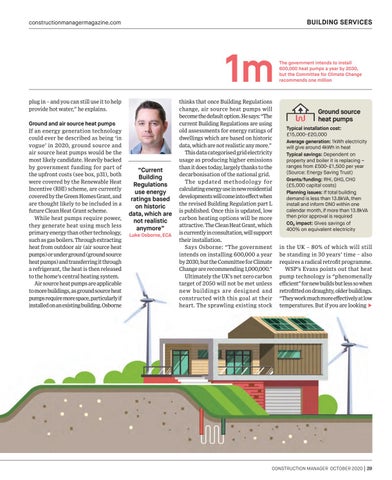
The government intends to install 600,000 heat pumps a year by 2030, but the Committee for Climate Change recommends one million
Ground source heat pumps Typical installation cost: £15,000-£20,000 Average generation: 1kWh electricity will give around 4kWh in heat Typical savings: Dependent on property and boiler it is replacing – ranges from £500-£1,500 per year (Source: Energy Saving Trust) Grants/funding: RHI, GHG, CHG (£5,000 capital costs) Planning issues: If total building demand is less than 13.8kVA, then install and inform DNO within one calendar month, if more than 13.8kVA then prior approval is required CO₂ impact: Gives savings of 400% on equivalent electricity
in the UK – 80% of which will still be standing in 30 years’ time – also requires a radical retrofit programme. WSP’s Evans points out that heat pump technology is “phenomenally efficient” for new builds but less so when retrofitted on draughty, older buildings. “They work much more effectively at low temperatures. But if you are looking
CONSTRUCTION MANAGER OCTOBER 2020 | 29
28_31.CMOct20.buildserviceseco_scWH.indd 29
15/09/2020 11:27