PRELIMS MAY 2017 | CONSTRUCTION MANAGER
04-21
Prelims
CCS CHAIRMAN FARMER ON QUALITY CM EDITORIAL BOARD VOX POP CHRIS BLYTHE
DANIEL GRAVES
PAM CAMPBELL
THE LATEST NEWS, PEOPLE AND COMMENT
06 09 12 13 16
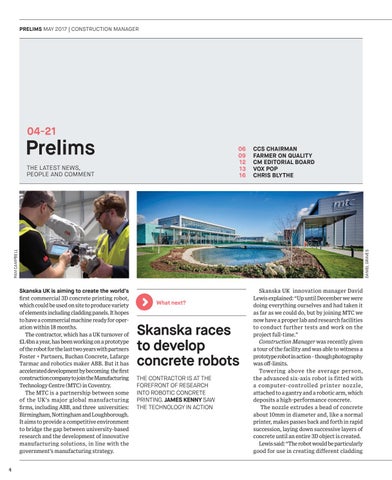
Skanska UK is aiming to create the world’s first commercial 3D concrete printing robot, which could be used on site to produce variety of elements including cladding panels. It hopes to have a commercial machine ready for operation within 18 months. The contractor, which has a UK turnover of £1.4bn a year, has been working on a prototype of the robot for the last two years with partners Foster + Partners, Buchan Concrete, Lafarge Tarmac and robotics maker ABB. But it has accelerated development by becoming the first construction company to join the Manufacturing Technology Centre (MTC) in Coventry. The MTC is a partnership between some of the UK’s major global manufacturing firms, including ABB, and three universities: Birmingham, Nottingham and Loughborough. It aims to provide a competitive environment to bridge the gap between university-based research and the development of innovative manufacturing solutions, in line with the government’s manufacturing strategy.
What next?
Skanska races to develop concrete robots THE CONTRACTOR IS AT THE FOREFRONT OF RESEARCH INTO ROBOTIC CONCRETE PRINTING. JAMES KENNY SAW THE TECHNOLOGY IN ACTION
Skanska UK innovation manager David Lewis explained: “Up until December we were doing everything ourselves and had taken it as far as we could do, but by joining MTC we now have a proper lab and research facilities to conduct further tests and work on the project full-time.” Construction Manager was recently given a tour of the facility and was able to witness a prototype robot in action – though photography was off-limits. Towering above the average person, the advanced six-axis robot is fitted with a computer-controlled printer nozzle, attached to a gantry and a robotic arm, which deposits a high-performance concrete. The nozzle extrudes a bead of concrete about 10mm in diameter and, like a normal printer, makes passes back and forth in rapid succession, laying down successive layers of concrete until an entire 3D object is created. Lewis said: “The robot would be particularly good for use in creating different cladding
4 04_05.MAY17.prelimssc.indd 4
19/04/2017 15:36