1
SCAD ATLANTA’S STUDENT MAGAZINE WINTER 2020 | VOL. 12 NO. 1
SCAN MAGAZINE WINTER 2020
TABLE OF CONTENTS Student Showcase Check out the ever-evolving works of Celeste Nelson and Ethan Ho.
Filling Your Soul: Meaning Behind Meals From Home How cuisine defines who you are.
From All Over: International Students of SCAD ATL A showcase of our worldwide demographic.
Pay Loans With Limbs Discover the unnerving reality behind student debt in the U.S.
‘Joker’ vs. ‘Taxi Driver’: The Art of the Isolated Archetype An analysis and progression of loner cinema.
A Misfit’s Odyssey Placing the spotlight on the odd-one-out and celebrating what it means to be unique.
Outside Looking In Eccentric fashion designs narrate the story of a facade for two outsiders.
The Path Less Traveled Get to know the alternative professions to explore after graduation.
Student Spotlight Rediscover the art of photography with Cristina Mora’s unique methods.
Arts Corner Think outside the box.
2 6 8 10 12 17 18 26 28 30
1
OUR STAFF 1.
katherine diaz villegas
2.
tyler judson
3.
roberta nicastro
10
9
8 6 5
13
11
12
Editor-in-Chief
Creative Director
Art Director
4.
leslie ginter
5.
mikael trench
6.
rachael ramchand
7.
josiah persad
8.
sandra kennedy
9.
helena aidoo-morrison
10.
7
4
3
1 2
Public Relations Director
Arts and Entertainment Editor
News Editor
Photo Editor
Multimedia Editor
Managing Editor manav chordia
Features Editor
11.
julie tran
12.
rachita vasandani
13.
valeria brugueras
Opinions Editor
Copy Editor
Style Editor
Letter From The Editor SCAN is the quarterly print student magazine of the Savannah College of Art and Design in Atlanta. All editorial content is determined by the student editors. Opinions expressed in SCAN are not necessarily those of the college. Š2020 SCAN Magazine. All rights reserved. No part of this magazine may be reproduced in any form without permission from the publisher. Visit us at scadscan.com for all previous issues and more. Cover illustrated by Kire Torres SCAD Atlanta Radio ad designed by Iara Faria Staff illustrated by Sandra Kennedy
Katherine Diaz Villegas For a world so saturated, it’s interesting how common the word outsider is used negatively to describe someone that is considered to be different, unique or alone. For the Outsider Issue we wanted to celebrate and bring awareness to those going out of their way to be, create or represent the uncommon. From alternative career choices to impossible photographs developed on mirrors, we hope you’ll take away inspiration to find your passion and push forward to be an outsider.
SCAN MAGAZINE WINTER 2020
Is your art representational? My work explores the relationship between comfort and dysfunction. By using found objects I can create personal and complex soft sculptures that sparks a mix of emotions. My dream project at the moment is to create a monstrously large stuffed animal, one that’s at least 10 feet tall whether that be with found objects or from scratch. Interviewed by Rachael Ramchand Portrait by Jazmin Saunders
What sparked your interest in printmaking and multimedia? During my first year at SCAD, I wanted to major in animation. One fateful day though, a drawing professor of mine brought our class to check out the printmaking studio. At the time, I didn’t even know what printmaking was, but I was incredibly intrigued by it all so I ended up taking an introductory elective to learn more about it. By the time I was done with the class, I had fallen in love with all the different techniques that come with the craft and switched my major to printmaking.
Who are your biggest influences? Kasie Campbell, a Canadian-based artist, works with fibers to make these amazing sculptures and has been a recent influence. I’m also really into Kit Davey who makes artist books by collaging found imagery from flea markets and thrift stores. Other than them, I am constantly impressed and inspired by my classmates who are always making incredible things. I always enjoy Open Studio Night where I’m able to discover other artists as well.
What’s the biggest thing you’ve taken away from SCAD? You’ll only get out what you put in. You have to work hard to grow and coasting along will only get you so far. Putting in the hours, outside and inside of class, is what’s going to make you stand out. The best advice I’ve gotten is from my printmaking professor, Robert Brown. He introduced me to the saying that “it takes 10,000 hours of practice to master something.” I learned from the process even if a project I spent hours on didn’t come out how I wanted.
What is your process when creating your art? When I’m creating one of my collaged sculptures, it starts with a thrift store and picking out the strangest stuffed animals. At home, I rip them apart and put different legs and heads onto bodies. Within that process, the vision for what I want presents itself; in the end, it’s all just about creating intuitively. I really enjoy sewing and working with fabric because it’s all very forgiving. If it doesn’t look how I want it to, I can just rip it off and try something else. Recently, I’ve bridged the gap between my sculpture and printmaking projects by printing onto fabric and creating something from scratch.
CELESTE NELSON
Third-year, B.F.A. Printmaking
3
SCAN MAGAZINE WINTER 2020
What’s the most valuable thing you’ve learned since being at SCAD?
Interviewed by Helena Aidoo-Morrison Portrait by Jazmin Saunders
What drives your passion for sculpture? A lot of the time that we see sculptures in a film involving characters or props they are usually computer-generated. I believe digital artwork is amazing but the wow factor is not matched to when something is physically in front of you. It’s important that people don’t forget about how extraordinary something like practical effects is and what we can accomplish with it.
Tell us about your artistic process. I always begin by sculpting multiple maquettes for my next project and try to make sure that I am making the most creative work possible. Then I look at what is realistic or possible and decide on what materials would be best suited for the project that I have in mind. Afterward, I create a schedule and make sure I have enough time to create my work. I also have critiques so something that I may have missed or not thought about can be brought up. This way I know I created my best possible work and can be proud of what I accomplished.
The most valuable thing I have learned from SCAD is time management. SCAD quarters are already intense but if you add on to the idea of sculpture you’re taking on a whole new level. Most sculptural processes can take weeks to complete and a majority of time is spent troubleshooting ideas on how to make it work before you create the final piece. On top of that our studio space is not open 24/7 like other buildings at SCAD due to the power tools we have in there. So if you don’t manage your time properly, you can fall behind pretty quickly — which is how the industry is like so I am thankful for the preparation.
What are your short- and long-term career goals? For now, I plan to try and gather as much knowledge and experience as I can from multiple sources. This could be from either special effects shops or even scenic shops for theme parks. Afterward, in my long term plan, I want to make my mark in the industry and hopefully run my own shop once I have learned enough to pass on.
What advice would you give to aspiring artists? Don’t wait to be discovered or recognized. We are taking a chance that not many people are willing to take so we have to work as hard as we can and differentiate ourselves from others. My work was recognized at the Rooster Teeth Expo in Austin, Texas in 2018 during a cosplay competition. To be acknowledged by professionals in my field was amazing and the reaction of the audience was unforgettable. It is still a reminder of why I pursue this kind of work.
ETHAN HO
Fourth-year, B.F.A. Sculpture
5
SCAN MAGAZINE WINTER 2020
Filling
Your Soul meaning behind meals from home
Written by Manav Chordia Illustrated by Samuel Ditmars
The comfort foods we love are often those that define us. Relocating to Atlanta, whether you’re from the United States or an international student, often means leaving behind that piece of home. I don’t usually think much about the food I eat, except for my favorite, dal makhani, an Indian lentil dish. To me, it embodies home and I hunt down the most authentic version of it whenever I can just to reminisce the India I remember. Food makes us unique and sometimes feel like outsiders, especially when your favorite dish isn’t something easily found at a mall food court. It holds treasured
memories and often evokes the nostalgia of home. The SCAN team is made up of very diverse individuals from all over the world. The following are shared thoughts on our favorite dishes, each as different as we all are. Our editor-in-chief and fourth-year fashion and writing student Katherine Diaz Villegas retains her connection to her heritage through food. “Bandeja paisa, a signature Colombian dish, originates from the region I’m from and has everything you could want on it.” Roberta Nicastro, a fourth-year graphic design student and SCAN’s very own art director said, “Brazilian food is a culmination of a different cultures and is what makes it feel familiar to me. It’s the most accessible connection I have to my family — it’s the only means I have of feeling like I’m home.” Tyler Judson, our creative director and a third-year photography student added, “Being able to have my grandmother’s spicy pork bulgogi among other dishes helped me maintain a connection with my culture.” Public relations director and fourth-year fashion marketing and management student Leslie Ginter said, “I’m from the South, so southern cooking will always be my comfort food: hash brown casserole, biscuits and gravy.”
7
Mikael Trench, our arts and entertainment editor and fourth-year animation student, uses food to reminisce. “Whenever it got cold or I got sick, my mother would make homemade meat stew. I always associate this with those times of year when I’d be close to my loved ones.” Valeria Brugueras, our style editor and a second-year fashion marketing and management student, associates arroz con gandules, a Puerto Rican holiday dish with the same ideal. Multimedia editor and second-year illustration student, Sandra Kennedy, favors her mother’s snowflake-shaped butter cookies — a treat they’d bake every Christmas. “Trinidad and Tobago has hundreds of different foods you may never have the opportunity to eat unless you
pay a visit,” said photo editor and second-year film and television student, Josiah Persad. “The amicable diversity amongst the country is remarkable and as a result of this, we have a plethora of food to choose from,” added fellow Trinidadian Rachael Ramchand, our news editor and second-year visual communications student. Managing editor, Helena Aidoo-Morrison, a graduate luxury and fashion management student from Ghana loves Milo, a malt chocolate drink that she customizes with crushed Ritz crackers. “I cherish this to its core. I’d always devour a glass before bed.” Third-year graphic design student and the opinions editor, Julie Tran said, “People think Vietnamese food is phò and bánh mì, but what we actually eat is much richer than that. Vietnamese cuisine is part traditional Vietnamese, part Chinese and part French.” “A lot of people like to discount people’s culture because of what they eat,” said Rachita Vasandani, our copy editor and a fourth-year writing student. “I’ve been made fun of for eating comfort foods like chicken feet or animal intestines, but these foods are my home.” At the end of the day, food is far beyond a physical necessity and extends itself to being an emotional one as well. As they say, dal makhani for the soul.
SCAN MAGAZINE WINTER 2020
international students of scad atl Photographed by Josiah Persad
Ernesto Sanz, Animation: Spain | Chandana Ramesh, Animation: India | Lautaro Monardo, Visual Effects: Argentina | Giuli Hull, Graphic Design: Costa Rica | Sjonnie Verheugt, Illustration: Netherlands | Antony Forcellini, Motion Media Design: Co lo mbi a | S hengy u Li, Animation: Chi na | N adia Br u n zlow, Industrial Design: Poland | Nathan McPhee, Branded Entertainment: Bahamas | Charmaine Nziradzemhuka, Fashion: Zimbabwe | Lisbeth Lora, Advertising and Branding: Dominican Republic | Makumbi John Muleba, Advertising: Zambia | Dhiksha Sajnani, Graphic Design: India | Maria T. Ramirez, Interior D es i g n : E l S a lvador | Xiran Zhang, Fas hion: Ch in a | N athan Alfie, Industrial D esign: Mexi co | Ma rina S a ad ia , Fashion Ma rketing a n d M an ag e m e nt: B ra z i l | As h l ey Tra w i n s k i , P h oto g ra p hy : Po l a n d | M a r t h a S a n c h ez M e j o ra d a , V i s u a l Ef fe c t s : M ex i c o | Ra n i a h A l - O b a i d i , G ra p h i c D e s i g n : J o rd a n | Alejandro Bastidas, Writing: Colombia | Atharva Ekbote, Animation: Singapore | Iman Gadalla, Illustration: Egypt | Ania Sharipzhan, Illustration: Czech Republic | Alan Toleu, User Experience Design: Kazakhstan | Ta neesha Iya nga r, Grap hic Design: Indi a | S ukrit y Nigam, Illustration: I nd ia | Devanshi Chitalia, Illustration: India | Rhea Sheth, Fashion Marketing and Management: India | Muskan Dharani, Photography: India.
9
B en Z i eta ra , F i l m a n d Te l ev is ion: United U n ited Kingdo Kin gdom | As hton For bes, V isua l Ef fects: Bahamas | J ad a S a unders, Fa shion Marketing and Manage m e nt: B a ha m a s | C a t h e r i n e L i n , I nte r ior D es ign: Ta i w an | She lly X iao, Interior D esign: Chi na | Bla nca Alvarez Rojas, Interior Design: Spain | Eugene K i m , Inter i o r Design: D es i g n : South S o ut h Korea Ko re a | |Wenyi We ny iGu, Gu,Interior D e s i g n : Ch in a | Mingxin D eng, Illustration: Chi na | Rochelle Br yan, Gra phic D esign: Tri ni dad a nd Tobago o b a g o | |HHelena e l e n a AAi iddoooo--M Morrison, o rrison,Luxury Luxuryand and Fas F h io n M a n a g e m e n t : G h a n a | J u l i e Tra n , G ra p h i c D e s i g n : V i et n a m | Ra c h i ta Va s a n d a n i , W r i t i n g : P hi l i p p i nes | M a n a v Ch o rdia, Wr Writing: iting: In India dia | Ra Rachael Ramchand, V isual C ommunication: Tri ni dad and To bago | Youwon S him, Illustra tion: S out h Korea Ko rea | D a n i el e l a G a rc i a , I n d u st r i a l D e s i g n : C o l o m b i a | A l y s s a I n n i s s - G i t t e n s , I n t e r i o r D e s i g n : B a r b a d o s | A n d re s C h a v e s , F i l m a n d Te l e v i s i o n : C o l om l ombia b | Ra ia p| Ra hae p lh B a ea lhB i nahindwa, dwa, Painting: Painting: Congo | Deanna Labas h , Interior D esign: Syria | Regina Vera, Animation: Mexico | Danil Per vukhin, Film and a Tel n devi Tel s iev o ni :sU i oknra : Uine k ra| ine B r i a| nB rian Kiplagat Kiplagat , Film, Fand il Te Tel ev i s i o n : Ke n ya | V i o l a S u g u t , F i l m a n d Te l ev i s i o n : Ke nya | Lu c a s Ta m , P h oto g ra p hy : H o n g Ko n g | Ka t u l i fe M u a d i n o h a m b a , Graphic G raphic Design: D es ign:Namib N a m ia | D anie lla A lmona , Ad ver tising a nd Branding: Ni geri a | Fa yo Adenuga , Ad ver tising and Bra n din g : Ni g ger er i a | N a o m i S h i n ka i ye, Fas hion: Niger ia | M Migue l N ame, I ndustrial D esign: Mexi co | Clara Cacace, Film and Television: Paraguay | V italy Ku c e ba, G ra p h i c D es i g n : La t v ia | M iche lle Xu , G ra raphic p h i c D es ign: Ch in a | Tia Na gara j, Illustration: Indi a | Ya smen Ma nsour, Interior D esign: Egypt .
Pay Loa
SCAN MAGAZINE WINTER 2020
57%
of georgia residents are in debt because of student loans
lendedu.com
$171,480 worth of student debt is acquired every minute
$32,731 average student loan debt per borrower
debt.org/students
$1 42 trillion
outstanding student loan debt in the u.s.
debt.org/students
Infographic by Roberta Nicastro
=
17 58
thousand family trips to the moon
or
billion large papa john’s pizzas
ans With Limbs a satirical expression of the facts
Written by Tyler Spinosa Illustrated by Krista Knudtsen In an unprecedented development, the Office of Government Aid initiated a program three days ago that allows students to pay for their loans with actual limbs.
The prosthetics industry is, quite literally, skyrocketing because of the new policy and are selling discounted replacement limbs at somewhat reasonable prices.
In lieu of money, the youth of America can trade at least one arm and one leg in exchange for complete compensation of the borrowed amounts used to fund tuition and other college expenses such as housing, sustenance and materials.
“What can I say? Given the circumstances, paying an arm and a leg for a completely free college education at one of the most prestigious universities in the country sounded like a pretty good deal to me.” Chestnut added, “I’m almost half a robot at this point, which is pretty cool!”
The total student debt in the United States right now is $1.42 trillion with almost $171,480 acquired every minute — that’s about $2,858 every second. With improvements in cyborg prosthetics and technology, the trade is a completely viable option for those who want to avoid loan payments. Thousands of students across the U.S. have begun expressing interest in this new deal and many are taking it. Phillip Chestnut, who received a doctorate in theoretical collegiate majors from The University of Blah-Blah-Blah, etc. has been dealing with the detrimental financial consequences of his student loans ever since graduating. As one of the first people to participate in the Office of Government Aid’s new program, Mr. Chestnut’s life has changed irrevocably. “Letting the government hack off my arm and leg instead of paying for my loans was one of my best decisions. I mean s***; if I didn’t get my arm and leg chopped off I would’ve just been financially crippled for the rest of my life anyway,” Chestnut said while adjusting the settings on his cyborg prosthetics.
The Office of Government Aid says they aren’t even totally sure what they prepare to do with their new influx of limbs. When asked for a statement their spokesperson said, “I think we might try to make some kind of weird meat chair out of them — make it look like the chair from ‘Game of Thrones’ or whatever. The sky’s the limit, really. Soon, we’ll expand the scope of the program and accept organs or indentured servitude and other weird stuff like that too.” We tracked down Chestnut’s alma mater but were not able to receive a comment from anyone at the school regarding the subject at this time. If one thing is clear, it’s that if you’re suffering from the financial stress of student debt, you might want to consider exchanging an arm and a leg to the government for the loan payments since it really isn’t that bad of a trade. Or, the government forgives all debt and the money owed gets us 58 billion pizzas — talk about feeding the world.
11
SCAN MAGAZINE WINTER 2020
13
‘JOKER’ VS. ‘TAXI DRIVER’ the art of the isolated archetype Written by Mikael Trench Illustrated by Tia Nagaraj
SCAN MAGAZINE WINTER 2020
Like many creatives, filmmakers can relate to the idea of loneliness. Countless of the industry’s most acclaimed directors, from Peter Jackson to Quentin Tarantino, grew up as oddball kids who struggled to connect with others. Of course, this is likely because their many obsessions are different from the norm, obsessions that would later benefit them in their creative careers. Having these backgrounds, it’s no wonder some of the most popular films tell stories about societal outsiders. In 1976, one such film that took the world by storm was Martin Scorsese’s acclaimed character study, “Taxi Driver.” The story focuses on an insomniac Vietnam War vet who takes a job as a nighttime New York taxi driver only to use his new point of view to deliver justice in his own twisted manner. The film was a hot topic at the time for its unprecedented levels of brutal violence but is now seen as one of the greatest films of all time, influencing future filmmakers in the process. Director Todd Phillips took direct inspiration from Scorsese when crafting his 2019 film “Joker,” a similar character study that goes into the backstory of the iconic Batman villain. The film received similar backlash due to its shocking use of violence while getting critical praise thanks to its gritty direction and a masterful performance by lead actor Joaquin Phoenix. Both films have found their place, managing to receive massive box office success — a clear sign that audiences are drawn into these darker narratives for a reason. With “Taxi Driver” and “Joker” sharing so much in common
despite the more than 40-year gap in their release, what about them has defined the loner archetype? “Taxi Driver” came out during a change in time for both society and film. With the dark shades of American society coming to the forefront of households, cinema began reflecting this shift. Gone were the days of the glamorous Hollywood studio productions and in came the more down-to-earth, rough-around-the-edges storytelling the world needed. Often referred to as New Hollywood, this period starting in the late ‘60s saw many of the most acclaimed directors of all time start their careers with defining works. From Arthur Penn’s horrifically violent 1967 crime thriller “Bonnie and Clyde” to Ralph Bakshi’s 1975 attack on racial stereotypes “Coonskin,” the world was proving to the industry that cinema could tell stories that had more to say under the hood. “Taxi Driver” was one of the many influential films from this time. Taking a far grungier approach to its storytelling and following an everyday man who is frustrated with the corruption and hostility he experiences each day. From intense domestic abuse to sickening racism, “Taxi Driver” shows it all in a brutally honest manner that connected with audiences at the time. “Joker,” while taking place in the early ‘80s, still manages to bring up imagery that audiences in 2019 can identify with one
15
way or another. It deals with the frustration caused by societal pressures and issues. How the film goes about this, however, is more exaggerated, with Gotham City reacting to the dirty words of politicians in big ways. The film also comments on how the media finds ways to capitalize on individuals for the sake of entertainment. While the idea is not pushed as far, there is enough to chew on for audiences to see the real-world parallels.
Phillips brought a different flavor to his interpretation of the clown prince of crime. He uses his fictional environment to express Arthur Fleck’s loner state, bringing an everyman feel to Gotham City that has never been committed to film prior. This grimier feel, coupled with cinematography that expresses Fleck’s debilitating mental state, helped convey the idea of isolation in a hauntingly effective manner.
The actual filmmaking craft of both films equally aided in their connection towards audiences. Despite being at the helm of a few features before, “Taxi Driver” was the show stealer that made Scorsese a household name amongst the industry. Categorized as a neo-noir, the film’s use of heavy contrast, shadows and expressive cinematography communicate the down and dirty atmosphere. It pushes the aesthetic further, with its use of colors not only creating contrast, but also embracing Travis Bickle’s emotional state. Similarly, the musical score by Bernard Herrmann aids in the experience. Using an uneven range of instruments, the musical score represents the backdrop for the unpredictable nature of city life.
Of course, character studies wouldn’t work without intriguing characters and these films have them in spades. Robert De Niro’s portrayal as Bickle remains as one of the actor’s most acclaimed performances. To prepare for the role, De Niro famously took a job as a taxi driver and lost 35 pounds to appear as an outsider. His style of acting also made room for some iconic improvised moments, most notably the “You talking to me?” sequence. Bickle began as a grayscale look at the typical film protagonist, where the question of whether he is good or bad for his deeds is up to the interpretation of the audience. The film never takes the idea to any nuanced place, as it is implied that his actions are ultimately heroic, possibly as a way for the loner in all of us to see that we can make a difference. Whether you prefer more over-the-top portrayals of the Joker character such as Cesar Romero from the 1966 “Batman” TV series or the grittier approaches such as Heath Ledger in “The Dark Knight” (2008), going about recreating
SCAN MAGAZINE WINTER 2020
the clown is no small task. The character himself was a different approach for a comic book villain. Especially when you consider he never took on Batman in any physical fight, yet he still managed to push him to the limit and became a grand nemesis. Portraying this and giving the character an origin story proved to be a challenge, but Phoenix and Phillips were up to the task. Both throw out what we are accustomed to the character, crafting their own interpretation of the villain while keeping enough of the characteristics that give the character an identity. In this way, the film crafts Fleck’s origin to be surprisingly sympathetic in the beginning, taking the time to have the audience feel for Fleck’s struggles given his mental condition — it is largely due to Phoenix’s harrowing performance. He
made numerous physical changes to prep for the role, including losing 50 pounds to appear disfigured. As the film goes on, Phoenix’s actions become more sickening and it is up to the audience to ask themselves whether they sympathize with Fleck by the end. With the lack of a moral compass to draw the line between good or bad, the film can add a level of ambiguity to itself that helps it stand out. Why do we find loner cinema so engrossing? Both “Taxi Driver” and “Joker” show loners as sadistic individuals who end up doing horrendous things to shake off their personas. Is it commentary for something more or just senseless violence? Is this how all loners will end up? Whatever the answer may be, there is an undeniable draw towards these kinds of stories. While cinema can be a place of escapism, films such as these can have an equally powerful effect, letting us sit down and take a hard look at the way society has shaped outcasts. While the journey these characters take may not be entirely identifiable, the hardships they experience on the way certainly are. The frustrations of loneliness are problems countless moviegoers relate to, and seeing those frustrations expressed on the film screen is quite comforting and almost therapeutic. And for some of those viewers, this experience proved to be more than that, inspiring creativity and motivation to tell their stories in manners that would be anything but forgotten. Sure, it takes a bit of exaggeration to get the message across, but hey, without that extra hint of fantasy, it just wouldn’t be a monumental film now would it?
17
A MISFIT’S ODYSSEY Written by and collage by Julie Tran
The quiet one at the table. The smart one in class. The kid with unusual hobbies. While the rest of humanity seems to hang out in one big warm bubble, you live at the edge of it, an outsider. The puzzled glances and blank stares make you feel isolated and for a moment you mistake your uniqueness for incorrectness and other’s curiosity as animosity. But the truth is, there is nothing wrong with being an outsider to the general mass, for you are never on the outside. You are never isolated. As social creatures, we are naturally wired to desire inclusion. The evolutionary forces within us seek a sense of belonging, but they don’t always tell us how to find what we seek. Instead, we draw our clues from the world turning to the rom-com films, songs and images from social media. But as it turns out, they don’t offer instructions as much as ridiculous amounts of pressure to look pretty and dissolve our personality into cliques. We chase perfection and homogeneity, not getting it and chasing it again furiously until we see the world as an impenetrable huddle of bullies and ourselves as failures. But that is just not true. The general mass is different from you, and you from them. You stand out from the crowd, you dream of things most do not and you can do things
others can’t. These attributes mean you’re meant for something different than others. What they don’t mean is that you’re alone. Because, honestly, who is ever alone? Who is ever truly solitary in this world of seven billion people? The world is large enough to guarantee you that there’s someone out there who talks the way you talk and likes the things you like, and the world is small enough to offer you the chance to find them. Ironically, the best way to take this chance is not by going out and looking for people, but by going out and looking for yourself. Plow through the anxiety of standing out, move out of the general crowd and go where ever your hobbies and passions take you. As horrifying the prospect is, you must do it regardless because happiness comes with courage. Greatness is reserved for the few who stand out and dare to make the most out of it. Where you are different, make yourself unique. Where you find repetitiveness, dare to introduce difference. Your freshness will be most welcomed. Lastly, if you ever feel misunderstood and alone, take a leap of faith to where you can be yourself, and wherever that is, there will be people like you. Wherever that is, you will not be an outsider.
SCAN MAGAZINE WINTER 2020
outside looking in. photography NATHON RUEHL | creative direction TYLER JUDSON models SHEA EDINGTON and BOBBY BURTON makeup NATALIA TRIMARCHI | dresser VALERIA BRUGUERAS
19
Asymmetrical Button-up Blouse ADAM WEN Embellished High-waisted Shorts MARIA NAVA Button-up Shirt and Trousers DEVARSHI JOSHI
SCAN MAGAZINE WINTER 2020
Left: Screenprinted Overcoat KULA PANG Pant and Painted Boots DIRECTOR’S OWN Right: Tulle Trapeze Dress YIMING WANG
21
SCAN MAGAZINE WINTER 2020
23
Button-up Blouse, Illustrated Bustier Dress, Hat and Tights APRIL SUN Striped Shirt and Shorts TIANYU CHENG
SCAN MAGAZINE WINTER 2020
25
SCAN MAGAZINE WINTER 2020
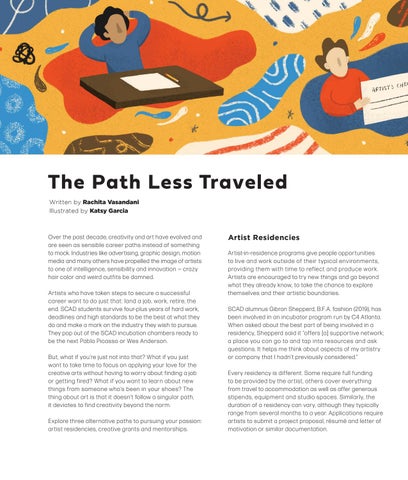
The Path Less Traveled Written by Rachita Vasandani Illustrated by Katsy Garcia
Over the past decade, creativity and art have evolved and are seen as sensible career paths instead of something to mock. Industries like advertising, graphic design, motion media and many others have propelled the image of artists to one of intelligence, sensibility and innovation — crazy hair color and weird outfits be damned. Artists who have taken steps to secure a successful career want to do just that: land a job, work, retire, the end. SCAD students survive four-plus years of hard work, deadlines and high standards to be the best at what they do and make a mark on the industry they wish to pursue. They pop out of the SCAD incubation chambers ready to be the next Pablo Picasso or Wes Anderson. But, what if you’re just not into that? What if you just want to take time to focus on applying your love for the creative arts without having to worry about finding a job or getting fired? What if you want to learn about new things from someone who’s been in your shoes? The thing about art is that it doesn’t follow a singular path, it deviates to find creativity beyond the norm. Explore three alternative paths to pursuing your passion: artist residencies, creative grants and mentorships.
Artist Residencies Artist-in-residence programs give people opportunities to live and work outside of their typical environments, providing them with time to reflect and produce work. Artists are encouraged to try new things and go beyond what they already know, to take the chance to explore themselves and their artistic boundaries. SCAD alumnus Gibron Shepperd, B.F.A. fashion (2019), has been involved in an incubator program run by C4 Atlanta. When asked about the best part of being involved in a residency, Shepperd said it “offers [a] supportive network; a place you can go to and tap into resources and ask questions. It helps me think about aspects of my artistry or company that I hadn’t previously considered.” Every residency is different. Some require full funding to be provided by the artist, others cover everything from travel to accommodation as well as offer generous stipends, equipment and studio spaces. Similarly, the duration of a residency can vary, although they typically range from several months to a year. Applications require artists to submit a project proposal, résumé and letter of motivation or similar documentation.
27
Creative Grants
Mentorships
Creative and envisioning art can be expensive. Not only are supplies often hard to find and priced ridiculously, but trying to follow your dreams while jobless is financially taxing. It’s often a burden to pursue your work, but many patrons of the art hold these choices in high regards.
Mentors are hardly anything new — throughout history, young artists have worked as apprentices to the masters of their crafts. SCAD alumnus and renowned painter Daniel Byrd, B.F.A. painting (2018), looked back to his jackof-all-trades mentor in high school. “She didn’t necessarily mentor me on how to literally paint but she translated an energy that turned me into a go-getter,” he explained.
Essentially free money, grants are a great opportunity to supplement their income with as they often do not come with restrictions. They can be used to pay for materials, studio space or rent, allowing artists to create without the pressure of bills. This provides the freedom to work in an unrestricted manner and dedicate time to being fully creative. Much like a residency, there is an application process for grants. Typically, grant committees will want to see your work and an artist statement about why you need a grant, what you will use it for and your plans toward the future. Ensure that yours is as clear and concise as possible and up-to-date with all the information about your practice. You want to show exactly why your work is worth investing in. Therefore, pay attention to portfolio courses because they’ll come in handy with this opportunity!
Nowadays, mentors are like interdisciplinary advisors from diverse backgrounds who serve as valuable guides for creatives and young artists. They help mentorees adapt and succeed in rapidly changing economies by providing insight into their own mistakes and accomplishments. They’re able to cut out some of the obstacles one may run into when first starting out. “When looking for mentors you don’t need to be too literal, find someone with a drive that inspires you,” advises Byrd. “When I talk about my work and who inspires me, I always say it’s not other artists. What inspires me the most is watching how other people go about completing any task — whether it’s a scientist, salesman or even janitor. We all have our own mark, it’s how people utilize it.”
SCAN MAGAZINE WINTER 2020
Cristina Mora
Through self-portraits, “Back in My Body” gathers the leftover overwhelming inner feelings that come with the ending of a romantic relationship and analyzes them. During the development of this series, I searched for peace through faith, music, introspection and remote landscapes. Elements of nature within this series showcase a passage of time and fragments of memories left from my relationship. The past two years have included many transitions into young adulthood, the ending of relationships and the emotional toll that comes with them. My previous work consisted of human interactions with identity and mental health and I use mirrors in several projects as a way to invite the viewer to experience the work and concepts. The use of a reflective surface as the base for my images in this series became literal and quite fitting. I had several people tell me that printing on a mirror is impossible, which only fueled me to make my idea a reality. Printing on a mirror wasn’t the same as printing on paper. I used cyanotype, the historical photographic printing process, because not only do I love the rich, blue color but because it communicated how I felt at the time. Through trial and error, I ended up using gelatin to make an adhesive layer so the cyanotype chemistry would stick to the smooth surface. The process was tedious on its own and takes over 24 hours to achieve one to two perfect prints. Through writing, photography and music I found a way to combine my ideas of identity, life and love into this series so I could truly feel like I am “Back in My Body.”
B.F.A. Photography (2019)
29
SCAN MAGAZINE WINTER 2020
Arts
CORNER
THINK OUTSIDE THE BOX A big part of SCAN Magazine, which has been continual since its initial release, is Comics Corner. For the Outsider Issue, we wanted to open up the reoccurring corner to represent a broader range of media that are often overlooked hence the new name, Arts Corner.
— tyler judson, Creative Director
Kat Ash, Painting Graduate student, Illustration
Justin Benford, Digital Illustration Fourth-year, Illustration
Dax Willette, Comic Third-year, Sequential Art
31
Zach Edds, Digital Illustration Fourth-year, Graphic Design
Madie Homan, Scratchboard Third-year, Illustration
Kate Lowe, Comic Graduate student, Illustration
SCAN MAGAZINE WINTER 2020
Listen at scadatlantaradio.org or download the RadioFX app to tune in.
33
WA R M COOK IES , B A KE D-TO-ORD ER, DELIV E R E D TO YOU R DO O R. cookiedelivery.com®
SCAN MAGAZINE WINTER 2020