SCAD ATLANTA’S STUDENT MAGAZINE FALL 2018 | VOL. 10 NO. 3
cookiedelivery.com
Warm cookies, baked-to-order, and delivered right to your door.
cookiedelivery.com
33
From the same people who bring you
SCAD Atlanta’s student-run, award-winning online source for entertainment, art, fashion, lifestyle, student interests and more
Want to get involved? Join us Fridays at 11 a.m. in the Spring House Computer Lab.
THE DUALITY ISSUE
13 21 06 14 10 16 Makeup, Masks and Misconceptions
Student Showcases
Gain insights from talented students Adorr Reynolds and Danny O’Hailey
The community of cosplay
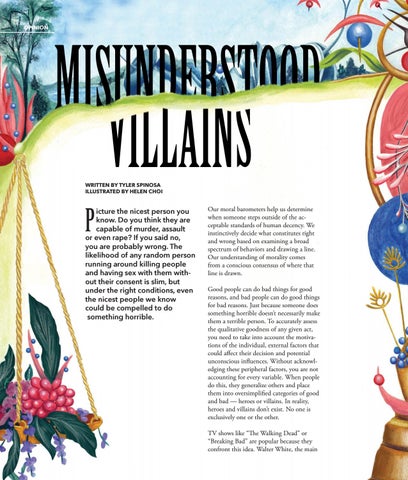
Misunderstood Villains
Are you defined by the worst thing you’ve ever done?
COVER PHOTOGRAPHED BY GABRIELLE ARDUINI CONCEPT BY ANYA HABER AND GABRIELLE ARDUINI GARMENT AND ACCESSORY DESIGN BY ANYA HABER MODELED BY JASMINE SMITH MAKEUP BY MADELINE LENAHAN
Dawn of the Digital Renaissance
Dividing Infinity
The SCAN team’s journey through time and space
Expectation vs. Reality
Preparing for inevitable failure — and coming out stronger because of it
The collaboration between art and science marks the future of innovation
30 36 32 40 24 34 Torn Identity
A personal essay on growing up in-between cultures, searching for a sense of belonging
Alternate Reality
A fantasy, nightmare or parallel universe?
Unsung Heroes
Literature vs. Cinema
Meet the real faces of SCAD Atlanta
A dual debate about which is the superior art form
Comics Corner: Then and Now
The Butterfly Effect A tale of how one small decision can change everything
Stunning transformations of skill that only time and practice can achieve
SCAN is the quarterly student magazine of the Savannah College of Art and Design in Atlanta. All editorial content is determined by the student editors. Opinions expressed in SCAN are not necessarily those of the college. Š2018 SCAN Magazine. All rights reserved. No parts of this magazine may be reproduced in any form without written permission from the publisher.
MEET OUR STAFF Anya Haber Editor-in-Chief Logan Hughes Executive Editor
Mackenzie Lachey Creative Director
Austin Klubenspies Art Director
Katherine Diaz Villegas Copy Editor
Rebecca Williams Photo Editor
Masha Zhadanova Comics Editor
Jeanie Lo News Editor
Tyler Spinosa Opinions Editor
Caitlin Havens Features Editor
Mikael Trench Arts and Entertainment Editor
Allison Bolt Managing Editor
Malcom Patridge Video Editor
CONTRIBUTORS Marian Hill Third-Year, Photography “Dawn of the Digital Renaissance”
Gabrielle Arduini B.F.A. Photography, 2018 Cover
Dana SanMar Graduate Student, Illustration “Literature vs. Cinema” and “The Butterfly Effect”
Hengguang Li Fourth-Year, Illustration “Expectation vs. Reality”
LETTER FROM THE EDITOR For our Fall 2018 issue, we decided to explore the concept of duality — in the human experience, in the choices we make, in our identities and in fantasy. Society tends to put us in boxes: good, evil, intelligent, artistic. Labels aren’t bad. They allow us to define ourselves in a matter of sentences. However, these labels are limiting, only describing the superficial aspects of a person’s identity. Every decision, every painful or positive experience enables us to grow even more complex. This issue aims to tackle the preconceived notions of these stereotypes. The age-old distinctions between the artist and the scientist, the villain and the hero, success and failure — these don’t exist, except in poorly written movies, nationalist propaganda and inside our own minds.
– Anya Haber, Editor-in-Chief
Defying Physics WRITTEN BY AUSTIN KLUBENSPIES ANIMATIONS BY BAILEY SULCER
Balloons pop, ice-cream melts and basketballs bounce. While these concepts of objective physicality are all extremely apparent to us — taken for granted, if you will — we often find ourselves imagining a world in which these simple physical aspects of life are nonexistent. What would it look like if a chair was made of water, or an ocean of metal? How would these newly defined objects break away from reality? Even though we can’t recreate these imaginative characteristics in real life, motion media artists around the globe are twisting the physics of everyday objects for our comedic pleasure. Social media is exploding with high-contrast and hyper-realistic digital creations that bring our dreams to life. World-renowned animation studio Mainframe embraced this concept with a short one-minute video compilation comprised of everyday objects redefined by new physical properties. “For Approval,” posted on Mainframe’s Vimeo account, includes lightbulbs squishing together as if they are made of plastic, a towel rushing out of a faucet like water and pencils blowing in the wind. While the animation only includes minimal detail and simplistic audio, it engages the audience in a humorous manner by playing with everyone’s minds. What you expect isn’t quite what you get. Thus, we thought we would give this concept a shot. Bailey Sulcer, a fourthyear motion media design student, created her own versions of this abnormal reality. We could tell you all about it, but we don’t want to spoil the surprise. Want to watch the video above in augmented reality? Simply download the Roar augmented reality app and scan the video frame above. You can also scan the QR code in the corner of the frame to watch it on scadscan.com. Welcome to a world of duality — where fantasy is the new reality.
SHOWCASE
ADORR REYNOLDS
INTERVIEWED BY ANYA HABER PORTRAIT BY MARIAN HILL
When did you become interested in pursuing fashion design? Honestly, I always credit fashion for finding me. I was a toddler, trying to copy fashion sketches my dad would do. I was fascinated by it all. It truly became my pursuit when my dad bought me my first sketchbook. My imagination ran wild and I would go through several books a year. I loved sketching because it was second nature to me. When I was 12 or 13. My dad bought me a sewing machine and I was sewing all my dolls’ clothes. I loved it so much that I would cut up old clothes of mine just to have more fabric options for my dolls. I knew then I was destined to design. Who are your biggest inspirations? My mother is a hairstylist so beauty and style have always been greatly valued. I grew up understanding the importance of presentation and how that translates into self-confidence. My dad credits my grandmother for instilling a sense of great style and an eye for quality into his sartorial aesthetic. In high school, I would shop her closet and wear her vintage pieces. Honestly, about 70 percent of my closet are vintage pieces that I’ve taken from her. I’m also greatly influenced by my brother — his style changes by season. He has a great eye for coordination. I’m always excited to pick his brain because he such a trendsetter. I’m heavily influenced by my customer, as well. She’s a strong, conSCAN MAGAZINE // FALL 2018
fident, daring and exuberant woman. She is a great accumulation of all the people that inspire me. Depending on the season or collection, my customer can be either Solange Knowles, Kahlana Barfield, Tracee Ellis Ross or Blake Lively. These women truly inspire my design aesthetics. What have been your proudest achievements thus far? First and foremost, my biggest accomplishment is graduating from SCAD. I am very proud of that. My past two years have been an amazing whirlwind of accomplishments. In 2016, I showcased a capsule collection in an art exhibition that I had created during my second year. Those same pieces were worn in singer/songwriter Anthony David’s music video, “I Don’t Mind.” During my fourth year, I won The National Black Arts Festival Fine Art + Fashion Design Scholarship. I was also selected as one of three students at the SCAD Atlanta location to participate in LVMH design competition. Since I’ve graduated, my senior collection has been sought after by celebrity stylists and requested for editorial photo shoots. I’ve had so many things happen. It’s great validation.
B.F.A. FASHION Are there particular themes you’re inspired by when designing? I’m usually inspired by an era or fabric. I love referencing classic styles while adding a new-age twist. Being innovative doesn’t necessarily mean having to sacrifice practicality. I’m very melodramatic when it comes to my silhouettes. I accentuate the waist while adding gathers, volume and structure in unexpected areas. Although I like drama, I still find a balance of wearability and high fashion. What are the biggest challenges associated with being a fashion designer? My biggest challenges are mostly self inflicted. I’m extremely hard on myself. I always want to outdo my previous work. The other challenge is that most don’t understand the amount of work that goes into being a designer or creative. People expect your authentic work for less or they disregard the process. Quality is rarely appreciated in this business because many want more for less. What’s next for you now that you’ve graduated? I’m currently interning at luxury menswear brand Hideoki Bespoke. I am so grateful to be there. I’m applying for positions at the top five fashion labels I want to work for. I’m also refining my portfolio, creating my website and exploring my abilities — making sure my
work is detailed and polished. My ultimate goal is to head my own fashion house. As of now, the sky’s the limit. What advice do you have for aspiring fashion designers? If you are passionate about designing, that alone will help propel you. You must be in love with it because there will always be times when you feel like you can’t handle the stress of it all. It’s not easy, but the payoff will keep you driven. Be very stern about your art. Only you know who you are —no one else can tell you that information. Know your customer and attach someone to that ideal. Use celebrities, neighbors and peers that inspire you and want to wear your creations. That will help you hone in on your aesthetic and better serve your customer. Be proud of all of the obstacles that teach you something. Never be comfortable with your level of craftsmanship. Always leave room to learn more and grow. Most of your battle is in your head, so take a breath and learn to see things from different perspectives. Lastly, enjoy the process! It goes by quickly when you’re making deadlines.
7
DANNY O’HAILEY
INTERVIEWED BY ALLISON BOLT PORTRAIT BY MARIAN HILL
When was the first time you experienced art and what impact did it have on you? The first time I experienced art that impacted me was on a trip I took to Italy when I was 16. I purchased an $80 point-and-shoot camera from a vending machine just before the flight took off. From that moment to the moment we returned home a week and a half later, I took around 4,000 photos — of which maybe 20 were worth keeping. Having the camera forced me to really pay attention to the world, and to use my personal perspective to frame what I saw. It also helped to be surrounded by one of the most artistically influential countries of all time. Everywhere we went masterful artwork flooded the view. I found that I enjoyed this act of framing and capturing so much that I continued to photograph even after I returned. What made you want to pursue visual effects? During my high school career, I was dead set on becoming an engineer. However, as the time approached to solidify my plans, I found myself lost. I wasn’t excited about where that path was leading me. I began to self-evaluate and discovered that I was just doing it because I didn’t think anything else was viable. Truth be told, the only reason I saw engineering as a possibility for me was because it was the SCAN MAGAZINE // FALL 2018
first class in public school that required a genuine sense of critical thinking and problem-solving. I concluded that I loved these things — but that didn’t necessarily mean that I wanted to be an engineer. What I did love was art. Movies, games, music, all of it. I felt within myself a calling toward these professions but I didn’t quite know where I’d fit in — someone with little to no artistic experience whatsoever. Armed with this new insight, I talked to my parents about what else there was and found the visual effects program. I did my research and saw many of those same qualities that I loved from my high school engineering classes. Plus, it didn’t require drawing expertise — a huge bonus for me. I took the leap of faith and joined. What challenges have you faced so far as you pursue visual effects? For me, the biggest thing is mindset. I used to be very insecure and unwilling to practice or take leaps because of how much I hated being bad at something. This fear led to me not getting better. Eventually, I just had to change my perspective on failure and learn to see it in a more positive and constructive light.
B.F.A. VISUAL EFFECTS What is your creative process like?
What are your career goals?
The most important initial step is preparation. Really discovering, iterating on and fleshing out a raw idea is paramount. I try to take as much into account as possible and cover as many bases as I can think to. This allows for a greater amount of control. If I know exactly what it is I’m going into the lab to make, then I have a lot less nasty and time-killing surprises. They’re still there — the nasty surprises — but there are far less if you plan. I also keep in mind the time to explore — if I can afford it. Some of the best artistic decisions I’ve made have been from allowing myself a couple of hours to try something new.
I think the biggest thing is to stay in practice and continue to learn and grow. To fail to do so would assure stagnation. Besides that, I think I’d love to be involved with director of photography work. Cinematography is a great love of mine and will continue to be, so getting to participate on an official level would be an honor.
You have a focus in lighting. What drew you to this? I have a love of photography and cinematography. A crucial element to this equation is lighting. Without light, there isn’t an image and thus it is very important to be aware of light’s impact within the image — whether conceptual or aesthetic. In my initial VFX classes, I noticed that I really liked experimenting with the lighting in my projects. I then began to focus on that as something that I could possibly pursue professionally.
What advice would you give incoming visual effects majors? Try to elevate yourself from the self-defeatist mindset. It’s so easy to fall into the circular trap that is being too scared of failing to even try. Failures will come, but it is up to you to view those failures with a healthy and constructive mindset and strive to be better. Also, learn independently. The classes really require students to go above and beyond the laid-out expectations should they want to excel, so it became very natural for me to continue to learn in my free time. It’s something that once I picked it up, I really couldn’t go back.
9
OPINION
WRITTEN BY TYLER SPINOSA ILLUSTRATED BY HELEN CHOI
P
icture the nicest person you know. Do you think they are capable of murder, assault or even rape? If you said no, you are probably wrong. The likelihood of any random person running around killing people and having sex with them without their consent is slim, but under the right conditions, even the nicest people we know could be compelled to do something horrible.
Our moral barometers help us determine when someone steps outside of the acceptable standards of human decency. We instinctively decide what constitutes right and wrong based on examining a broad spectrum of behaviors and drawing a line. Our understanding of morality comes from a conscious consensus of where that line is drawn. Good people can do bad things for good reasons, and bad people can do good things for bad reasons. Just because someone does something horrible doesn’t necessarily make them a terrible person. To accurately assess the qualitative goodness of any given act, you need to take into account the motivations of the individual, external factors that could affect their decision and potential unconscious influences. Without acknowledging these peripheral factors, you are not accounting for every variable. When people do this, they generalize others and place them into oversimplified categories of good and bad — heroes or villains. In reality, heroes and villains don’t exist. No one is exclusively one or the other. TV shows like “The Walking Dead” or “Breaking Bad” are popular because they confront this idea. Walter White, the main
character of “Breaking Bad,” is an under appreciated high school chemistry teacher with a terminal illness and money problems who decides to sell meth to provide for his family. He becomes a villain, but does so because of a multitude of mounting traumas that force his hand and push him over the edge. The audience accepts that he does bad things under reasonable circumstances. In “The Walking Dead,”ordinary folks commit morbid atrocities in the name of survival. Viewers are forced to contemplate whether they might behave that way in a similar situation.
Real-life tragedies are also subject to these black and white oversimplifications. In the wake of a mass shooting, people condemn the shooter as nothing more than a coward and a monster — but that ignores all the external forces that motivated the shooter to do it. Is what they did wrong? Yes. Even so, we can’t close the book on these particular cases without examining why they snapped. Anyone who walks into a public place and guns down unarmed civilians is clearly disturbed. They didn’t just decide to wreak havoc on a whim. And, if they did, that illustrates the severity of their mental illness.
Good guys and bad In Doug Stanhope’s guys only exist in latest book, “This is Morality is not black lousy writing. The suNot Fame: A ‘From perhero genre makes What I Reand white — everything this mistake more Memoir,’” he deis just shades of gray often than others. scribed an instance The worst cases center when he received on a continually around a completely a fan letter from a shifting spectrum. altruistic savior who man in his early 20s faces off against the who planned to kill zenith of absolute himself. He was evil. These stories are hollow and lacking caught looking at child pornography and because there is nothing relatable about sentenced to several years in prison, so them. A good story will make a character he decided to commit suicide on the with good intentions question their motiva- day of his trial. Clearly pedophilia is tions and why they want to even be good wrong, but the situation became more in the first place. complicated when he revealed that he was abused as a child himself and no one was The idea that heroes and villains don’t held accountable when it happened to him. exist speaks to the complexity and relative Once again, this doesn’t excuse his actions, nature of morality. Morality is not black but it complicates the assessment of the and white — everything is just shades of situation. In this case, he was just as much gray on a continually shifting spectrum. a victim as he was a perpetrator. Human beings are inherently full of contradictions — this is part of what makes us The easy thing to do is to call him a monso interesting. Those contradictions are the ster. Some people might say that he should core of the moral gray area that characters have been put to death, or that they are in shows like “Breaking Bad” confront. glad he is dead. But, he didn’t choose to be 11
that way any more than anyone else chooses their sexuality. With these things in mind, it becomes less clear where the moral line is. Can you write him off as evil, beyond redemption, and undeserving of empathy when he is really just mentally ill? To do so is to place yourself on a moral high ground.
The trick here is that the secondary subject wasn’t really being shocked. They were actors, instructed by the administrators to show increasing signs of distress as the experiment continued. Eventually, the actor would plead for their life and beg the test subject to stop administering shocks.
What we see during times of crisis is a compulsion to label those Most individuals tested continued to shock the actors, even after who have made mistakes and caused harm as evil instead of acceptthey begged them to stop. Anytime someone showed hesitation or ing that there are complicated reasons behind why people do what concern, the administrators assured them that everything was fine they do. Those reasons don’t excuse their and urged them to continue. Even though actions, but they inform them in a way that the people involved could have chosen to is too important to dismiss. People are not leave at any time, they stayed because they Can you write him off as were encouraged by the administrators. This only capable of doing good and bad things, but they can even do both at the same time. evil, beyond redemption, proves that, despite the fact we assume we are above certain actions, we can be influand undeserving of The larger issue is that people look at the enced into doing something terrible with worst examples of human behavior — enough encouragement. empathy when he is murder, rape assault and abuse — and try to really just mentally ill? separate the perpetrators from themselves as People tend to consider themselves above if they are not capable of doing something it all. They reject the idea that they could similar, given the right circumstances. It is a ever stoop so low. This is self-aggrandizing reactionary defense mechanism that shelters and wrong. We are all fallible and capable them from having to confront the reality of their own capacity of evil. Anyone who denies that is trying to hide from their own for malevolence. inner demons. The Milgram Experiment, a behavioral study of obedience conducted at Yale University in 1963, tested the notion that people can be influenced to commit atrocities. The test subject was placed in front of a switchboard with a range of buttons corresponding to a device that administered electric shocks. Overseen by an administrator, the test subject was instructed to ask the secondary subject, who was hooked up to the device, questions. Each time they get one wrong the test subject was told to shock them with greater intensity.
Are you defined by the worst thing you have ever done? You might be inclined to give yourself the benefit of the doubt when it comes to that question, but not other people. Instead of condemning those who do bad deeds, we should recognize the relative nature of morality and how that reflects upon ourselves. Examine why people do what they do and accept that human beings are full of contradictions. Don’t oversimplify the world by reducing it to black-and-white categories. Confront the gray area of morality by acknowledging your own capacity for malevolence.
CULTURE
Makeup, Masks and Misconceptions WRITTEN AND PHOTOGRAPHED BY ELIZABETH HENRY
Clark Kent removes his glasses, puts on an S-emblazoned spandex suit and becomes Superman. Harry Potter picks up a wand, a set of robes and defeats a great evil. Princess Leia, wearing her trademark double buns and white dress, grabs a blaster and helps lead the rebellion. And in conventions around the world, countless individuals with no superpowers, magic or futuristic technological weapons can save the world — or at least pretend to. For some, Halloween is the only time they allow themselves to be something they aren’t. For others, they take every chance they can get. Through cosplay, people find connection, confidence and freedom. However, the much-loved art — and those who partake in it — are still misunderstood. Cosplaying is more than donning a costume and walking around a convention. Cosplay allows the wearer to become something else, something more — something other than themselves. “When you do any kind of costuming — but particularly cosplay — on the one hand, it gives you permission to step outside yourself, but on the other hand, it can summon something in you that doesn’t usually come out,” said clinical psychologist Robin S. Rosenberg in the 2016 Live Science article, “Getting in Character: The Psychology Behind Cosplay.” The stereotype that there is something “off” is a misguided perspective. People who are introverts in their everyday lives find freedom in donning a mask and a cape while interacting with hundreds of strangers in a single weekend. Individuals who only see one another once a year can connect as if no time has passed. A child can meet their hero without their parents taking out a second mortgage to make a dream come true. Cosplayers often become the subject of wonder and confusion to
spectators wondering why anyone might wear 50 pounds of fake armor for three full days at a convention. The simple solution would be to go look in a mirror. Or take a long look at your mailman, the woman stopped next to you at the red light or the teenager handing you your Starbucks order. That is what a cosplayer looks like. There is no one look or demographic to cosplayers. Fourth-year sculpture student Sarah-Jane May said, “I remember thinking how amazing it would be if Halloween could happen more than once a year. A friend in middle school introduced me to anime, and then told me about this entire community that dressed as the characters at conventions. We started going to them, and I remember thinking this was exactly what I wanted. I kept doing it and I just fell in love with the art form.” Consuming so much time, money and effort, cosplayers often face questions of “Why continue?” or “If it takes so much why do it?” The answer? Cosplay is about connection. Connection to characters. Connection to themselves. Connection to a fandom. Communities of people, some who have never felt accepted in their everyday lives, can don a costume and make lifelong friends — a tribe of their own. Whatever the background or interest, there is a home in cosplay for everyone. Anyone looking to express themselves, make friends or interact with beloved characters can feel they belong. Cosplay allows us to gain the strength to deal with traumatic experiences like Batman would, to find the confidence to fight the patriarchy like Wonder Woman and to discover the dance moves to party like the inflatable T-rex. 13
Dividing Infinity DESIGNED BY AUSTIN KLUBENSPIES WRITTEN BY ANYA HABER
SCAN MAGAZINE // FALL 2018
Sleep doesn’t come after death — at least not for the SCAN team. For 14 days, 24 hours a day, they tracked their activity in five-minute intervals in the following categories: time spent doing homework, hanging out with friends, eating, sleeping, commuting to school, watching TV and outside work. Multi-tasking was encour-
aged, allowing the staff to record two activities at once. Sleep and outside work accounted for almost 60 percent of time spent. Decipher the futuristic infographic to see what the SCAN team does with their time.
15
FEATURE
Expectation vs. Reality WRITTEN BY JEANIE LO ILLUSTRATED BY HENGGUANG LI
Y
ou enrolled at SCAD expecting a summer internship at Pixar or DreamWorks, not working as a barista in your local Starbucks. You think you’ll score a part-time job with your 4.0 GPA, but the company gave the position to your best friend. You produce your best work in class, but the teacher gives you a C when you expect an A. Welcome to reality, where dreams are dashed and hearts are broken. This is the reality — not our expectations. There are several layers to expectations. We expect ourselves to be incredibly talented and highly qualified, but reality proves otherwise. We hope the world will reward us for our hard work, but it responds with rejections. We think the translation of expectations into reality will make us happy — except when it doesn’t. Let’s unpack this starting from our expectations of ourselves. More often than not, our perceptions of ourselves don’t match up with who we are in reality. We believe we are gifted in unusual ways — that we are different, unique and special. We think we are excellent draftsmen and that our concepts are profound. Yet, although we might be talented, we just aren’t as great as we think.
SCAN MAGAZINE // FALL 2018
In school, if our peers or professors don’t give us the appreciation we think we deserve, we turn sour, bitter and angry at the world. SCAD Savannah student counselor Cathy Trainer said, “Most of us, generally speaking, don’t want to perceive ourselves in a bad light.” Our instinctual response to criticisms is usually defensive. We tend to vilify people when they cannot give us what we want. Trainer concluded, “It can take quite a lot for us to admit that we are less than perfect — or less than nice in certain situations.” Not only does our tight grip on our incomplete assessment of ourselves affect our mood and self-esteem, but it also hinders our career and creative process as we indulge in self-pity and pit ourselves against the world.
accept our limitations and weaknesses, we can improve a situation by controlling our responsibilities, responses and actions. There are cruel realities we must also come to terms with when we realize our expectations will never come true — sometimes because we lack the ability. SCAD photography B.F.A. alumnus and freelance photographer Foon Fu’s dream in high school was to become a professional athlete. As he reached college, “it hit me, and I came to realize my expectation of becoming an elite, professional athlete was not going to happen. I had failed miserably,” he said. His experience led him to “realize how mortal I am, how it takes multiple pieces at the right place to make a masterpiece, and the life of a professional athlete was not going to be the puzzle I could make into a masterpiece.” The realization was hard to process, but the acceptance of a spoiled dream was how he learned how to keep moving on in life without giving up. It was his lesson of learning to accept “failure, rejection and not always getting everything you wanted.”
Welcome to reality, where dreams are dashed and hearts are broken.
Introspection helps us dismantle this troubled mindset. Trainer explained with the example of getting a bad grade from class, “Let’s say the students have a horrible color theory professor and they just couldn’t work it out. They don’t just think the professor is wrong. Instead, they think about if they did something that contributes to that. They think about ‘what I could have done better.’” Introspection is the ability to see how our negative emotions cloud our objective assessment of ourselves. It helps us effectively separate our feelings from judgment. As we
Entitlement is a cousin of expectations. In our culture, we are encouraged to think we are entitled to certain rewards once we have
done the right things — that we can achieve whatever we believe we can do. Yet, it’s a hard fact that the world does not owe us anything. We can’t always get what we want. Beyond the self is society. How about when we already have a realistic assessment of our abilities, we gave our best, we evaluate our performances and we adjust — yet our environment does not reward us with what we think we deserve. SCAD alumnus Mark Ziemer graduated college to his dream job as a graphic designer and then, art director for Atlanta magazine’s Custom Media Division. For a couple of years, his career was on the rise and his goals were clear — until problems with resources surfaced and destabilized Ziemer’s life. “Even when you land that ‘dream’ job, life throws you curveballs,” Ziemer said, but he didn’t retreat into despair, “you have to adapt. It’s like if a project isn’t working out and your professor wants you to redo it a week before finals.” He endured seasons of challenges until he started working at the Atlanta Department of City Planning. “Don’t sulk. Hustle, learn new skills. Raw talent is great, but it’s only half the battle,” he advised, “and don’t be discouraged.”
It’s crucial to analyze circumstances objectively and acknowledge uncontrollable factors that lead to rejections. Like Ziemer, there are situations where we have all the credential a job requires, yet we still get rejected. SCAD Atlanta career adviser Dinh Nguyen shared his observations about students’ unrealistic expectations. “A lot of students that come and see me expect to go directly into their dream job after graduation right away,” Nguyen said. He understood that as students paid a good amount of money to come to SCAD, “they expect with their perfect GPA they will have great offers and near six figures salary thrown at them.” But the world doesn’t operate accordingly to our logic — you don’t always get to reap what you sow. Nguyen said, “you could do all the right things, and the right opportunity might not come up for you.”
Raw talent is great, but it’s only half the battle.
Jen Schwartz, former Editor-in-Chief of SCAN Magazine and current senior content writer at HeadsUp Marketing, expected to land a job with her leadership experience. When she adjusted her mindset and learned to accept opportunities that were not part of her goals; she started from the bottom and applied to an internship that led to her current job. Schwartz’s advice? “Apply to anything
and everything, even if it’s not as glamorous or high up as you would have imagined yourself being post-college.” The reality is companies don’t only hire people based on merits. Employers also look at your personal qualities and your personality fits into their working culture. Even hobbies matter — chemist Jonathan Yip works in a marine biology lab and observed that all his colleagues have diving certifications. Many experience rejection after a great interview yet score the position after a horrible one. It’s hard to predict or control success. Finally, here’s what I call the real reality — expectations that become true do not always make you the happiest.
Nat Ware concluded that people are terrible at predicting what makes them happy. Just like how we can overestimate ourselves, we are prone to faulty judgments of thinking only by getting what we want will make us satisfied — the job, the salary, the person we want to meet. This faulty judgment applies not just to our careers but to all areas of our lives. It could be the person of our dreams we want to date, but we end up realizing they are not as wonderful as we fantasized. It could be that movie we were dying to watch, but discovered the experience was not as incredible as we thought it would be.
You could do all the right things, and the right opportunity might not come up for you.
In his TED Talk, “Why we’re unhappy — the expectation gap,” founder and CEO of 180 Degrees Consulting and Rhodes scholar
To close this expectation gap, we must be open to seeing each undesirable incident as an opportunity — not only for growth but also training lessons that prepare us for a set of destinations that suits us better in our journey. Many SCAD students took a detour before coming to art school, studying engineering or politics before realizing their potential is better suited toward the creative field. Those initial experiences that we had do not go to waste — they are additional facets we bring to the table. I studied art history at my first university for before transferring to SCAD. Though I am a writing student, my background in art history helped me score my first internship at The Metropolitan Museum of Art. My writing skills aided my work in their social media and communications department. Expectations are not bad — they are expressions of our desires and aspirations. Whether realistic or not, we should always respect our dreams because they represent a part of our personality and character. We need to be open-minded and flexible when our reality checks come in and adapt to circumstances when they require us to. What’s most important is that we understand a fulfilling life means overcoming rejections and struggles. Happiness is not a destination — it’s a byproduct of our journey. Lowering expectations is not the only way to happiness. Having an open mind and welcoming new possibilities will bring us the fulfillment and meaning we crave in our lives.
CULTURE
WRITTEN BY MARIAN HILL ILLUSTRATED BY KIRE TORRES
D
uring the course of human history lurching forward to the present, there was a separation of the artist and the scientist. They were placed at opposite ends of a spectrum. At one end stands the scientist, a figure in a white lab coat, rounded glasses and a tube of smoking green liquid. At the other end stands the artist, a figure in a paint-stained smock, tangled hair and charcoalcovered fingertips. We imagine them as total opposites, and somewhere along the lines of time these two were put in different boxes. This departure from each other can be seen as one of the major setbacks in humankind’s progress. The initial separation of art from science made the subjects, and those who work in each, bitter rivals. However, there is a point in the life of an artist and of a scientist when each will realize how incredibly homogenous their lines of work are. Strip away all the titles and technicalities of both, the only differentiating quality is this: an artist creates and a scientist discovers.
At the very core of science, discovery is based on action and reaction. The discovery of fire, marking the beginning of humanity’s scientific journey, was founded in lightning striking a tree, then rubbing sticks to make friction and then burning coal into heat. The first moment a human created a fire was the first instance of a scientist using their own discovery for their benefit. Their observations of interactions within natural worlds became a means of survival and later, of expression and representation. The very first art was, in fact, a recollection of observation. What those older than ancient people saw day-by-day was captured on rocky interiors. Their lives were observed by each other and used to decorate their homes. It was observation that inspired humanity’s first calendar made by the Mesolithic people, it was observation that inspired the paintings of cavemen and it was observation that inspired the first man-made fire. That element of seeing, noticing and acknowledging the importance of the world brought to life the two major ways to interpret existence: art and science. From the beginning, art and science were barreling towards each other at high speed, preparing for a head-on collision. An early clue of this was Arab mathematician Ibn al-Haytham of the Islamic Golden Age. He is credited with the first properly built camera obscura (English translation: “obscured space” or “dark room”). This 21
invention, found in Ibn al-Haytham’s “Book of Optics,” is the basic theory of photography and the science behind any working camera. See how easily we started down the trail of science and found ourselves in art? Both are too deeply interwoven in concept. A quick search online reveals that even in their own definitions they do not stray far from each other, for the word “art” is a synonym of “science.” Finding one in the other becomes unavoidable. Every prominent mind of the Renaissance embraced the wonderful notion that the power of both art and science would propel human ingenuity forward. Take Leonardo da Vinci; his name rings respect in every textbook known to mankind on a vast number of subjects. “The Vitruvian Man” contributes to both worlds of art and science by showing how the human body can fit proportionally into a square and a circle based on the studies of ancient architecture. Another man of the Renaissance who studied structures like Leonardo, Filippo Brunelleschi, left Rome and returned to Florence after his loss in the competition to design the Paradise Gates with a mind full of engineering. According to the Public Broadcasting Service, he was “especially interested in Roman engineering and the use of fixed proportion and Roman vaults.” He was one of the first to apply safety regulations when building the dome in the Piazza del Duomo. Brunelleschi, who started off as a goldsmith, built the “greatest architectural feat in the Western world,” according to PBS, with no professional training in architecture.
a way to elevate their work. Dancing upon the line between art and science, they intend to wash away the stereotypes. While the inspiration of using art and science in innovative processes comes from the works of Renaissance men, the future of the two subjects in the modern world holds a respectable spot for female polymaths. American-Israeli Massachusetts Institute of Technology Professor Neri Oxman produces works that many consider both incredible art and ground-breaking science. Oxman invented the study of material ecology — a field of biologically and digitally engineering designs through the study of material types. Her model of a breathable skin known as “Cartesian Wax,” once on display in the Museum of Modern Art, is “inspired by the Cartesian Wax thesis as elucidated by Descartes in the 1640s” and also relative to “the construction of material perception and effect in our experience of the physical world,” according to Oxman’s official webpage. This breathable skin’s main purpose is to be used in architecture as a way to produce, “dynamic buildings that adapt to changing environmental conditions and levels of occupancy,” according to MoMA.
Blurring the lines between art and science will, without fail, produce a thing of revolutionary nature.
Chemistry and art changed the face of painting forever during the Renaissance. In Giorgio Vasari’s “Lives of the Artists,” Giovanni da Bruggia experimented with modifying oil paint to make a varnish that could “dry in the shade without putting [the] paintings in the sun.” A simple chemical revision of the most popular medium of art at the time impacted not only the colors artists could use, but also allowed the colors and shadows to be even more so diuturnal. Blurring the lines between art and science will, without fail, produce a thing of revolutionary nature. It is more apparent now in the modern age — art and science are coalescing once again. Scientists and artists alike are realizing how compatible their passions and ways of thinking are and how to use this new found relationship as
SCAN MAGAZINE // FALL 2018
Zaha Hadid claims one of the top spots in revolutionary contemporary architecture as the first woman to ever win the Pritzker Architecture Prize, according to Michael
Kimmelman of The New York Times. One of her most immaculate designs is known as the “Zaha Hadid Chandelier,” which she and Swarovski Crystal Palace worked on together. This grand lighting fixture was constructed with micro-printed LED lights that illuminate 2,700 crystals. The visual motion of the design finds its inspiration in “self-organizing systems and nanotechnology,” according to Hadid’s official webpage. Micro-printing is most commonly used for currency and, according to a guide on currency provided by the U.S. Currency Education Program, “microprinting is featured in several locations on denominations $5 and higher.” By taking advantage of technology primarily used on currency and checks, an artist was able to bring in refinement and shape control to her work to elevate the sensation of viewing her piece. The bettering of an experience drives art and science to satisfy the senses. Much like how da Bruggia experimented with oil paintings to enhance the visual beauty of paintings, the modern world has continuously advanced technologies that lend aid to the world of entertainment. In 2015, Europe established its first IMAX theater that incorporated a laser digital projection system, according to Sebastian Anthony of Arstechnica. Laser technology improved the movie viewing experience with the enhancement of “brightness, contrast or color space”
in projectors. The technology in these projectors is a modified version of Texas Instruments DLP chip that is typically used for display devices. Anthony explained that “thermal stability of invar (a nickel-iron alloy)” replaces the standard prism inside the device and “increases image sharpness and provides blacker blacks.” The use of virtual reality headsets in galleries has radically changed the traditional method and experience of viewing art. According to Robert Elder and Kevin Gallagher of Business Insider, “Google-owned Tilt Brush, [is] a platform for artists to digitally sketch and create 3D content in a virtual reality environment, is launching its first art gallery.” In 2017, Tilt Brush launched a virtual gallery featuring 3D art content and has been placed in physical gallery settings. Embracing VR headsets in the gallery experience embraces the future of art and technology without forgetting the past of traditional artistry.
But the truth is this: the scientist is covered in paint, and the artist holds a tube of smoking green liquid.
Artists have shown a definite fear of the tech world invading the art world. The Pew Research Center conducted a large survey in an attempt to see how those in the art organization and presentation circles view the impact of technology on art and experiences. One quote from the study reads as follows: “Some ideas cannot be condensed into 140 characters or less. I hope technologies do not negatively affect the playwright. I hope the playwright does not write solely for a Twitter generation.”
Forever it has been necessary for art and science to connect, but the fear of them doing so has grown immense. It is that fear that humanity holds fast to. It speaks to the notion that art and science should be kept far apart. But the truth is this: the scientist is covered in paint, and the artist holds a tube of smoking green liquid. The two minds realize, as they look at one another, that nothing is different, nothing is separate. No matter how hard people try to drive a wedge between these two things, the gap closes up again with the actions, words and thoughts of those who need to create and discover. Finding out more about ourselves as human beings, as things that live and breathe by way of art and science, is not an option. It is the road we are heading down regardless. For art is creation and science is discovery, but in the end, everything else is simply life.
23
Alternate Reality
Anya Haber: Photo Manipulations and Production Creative Direction: Anya Haber and Mackenzie Lachey Designs: Kelly Whaley, Faith Mallory, Shuting Dong, Bradleigh Johnson, Sarah Baker and Ronitta Whipple Models: Stephanie Crombie, Alexandra Tippins and Brooke Garnett Behind-the-Scenes Photography: Gabrielle Arduini SCAN MAGAZINE // FALL 2018
Prop Master: Gabi Madrid Set Design: Gabi Madrid, Emily Schott and Anya Haber Makeup: Madeline Lenahan and Marian Hill Hair: Lauren Anderson Body Painters: Nupur Sachdeva, Gabbi Watkins and Santiago Bejarano Assistants: Katherine Diaz Villegas and Logan Hughes
25
SCAN MAGAZINE // FALL 2018
27
SCAN MAGAZINE // FALL 2018
29
STUDENT LIFE
WRITTEN AND ILLUSTRATED BY MASHA ZHDANOVA
omething about valuing my heritage and culture feels backward and wrong, while at the same time forgetting that heritage feels shameful and worse. I was born in Moscow, Russia. My family moved to the United States when I was 2 years old. I think in English, but at home, I speak Russian. The majority of my relatives still live in Russia. When I was a child, we would visit every summer vacation.
S
SCAN MAGAZINE // FALL 2018
I’d always rather fit in than stand out. I want to belong to a group, but I will always be too Russian to be fully American. Yet, I am too American to be fully Russian. I want to be normal and feel part of a community, but as someone who grew up with influences and values from two very different cultures, I don’t really fit into either. When I was a child, my mother would seriously talk about sending me back to Russia for a few years to go to school. “They’re stricter in Russia, you’ll learn
better discipline,” she’d say, “and get better at math.” The knowledge that my place in this country is not and never will be permanently assured is terrifying. Particularly now, as new immigration laws could mean naturalized citizens like me are at risk of losing citizenship status. My last trip to Russia was for two weeks when I was 16. The overwhelming feeling then was that I was too American to be able to live comfortably in Russia ever again. I’d lived in the same suburban New Jersey
town since I was 6 years old. When I think of “home” now, I think of bubble tea, wandering deer and the bookstore my friends and I meet up at when we go to Princeton. The places I stayed at when I visited Russia felt like what “home” could have been, had my mom not decided to get her M.B.A. in the U.S., had she not decided to stay here afterward, had I gone back to Russia with my dad when they divorced. I don’t always hate it. I’m fluent in two languages — enough to listen to music, read books and watch shows in Russian and English without subtitles. My Russian’s better than most kids raised in the U.S., so I can talk to my grandparents who don’t speak English without any problems. I don’t really get modern Russian slang, and my vocabulary is approximately equivalent to that of a 12 year old, but I don’t have an accent and can quote enough classics that older Russians visiting the country will compliment my family on raising me well. I do have positive memories of Russia from my childhood, before I was old enough to feel affected by politics — fresh fruits and vegetables from my grandmother’s garden, huge shiny churches and museums older than the U.S. itself, the beautiful, deep Moscow metro. I’ve also found common ground with immigrant children from other countries like China and India. Growing up, we’d bond over the work ethic our parents drilled into us, prioritizing education, weird food and even weirder family dynamics. I still remember an advanced math class in eighth grade when our whole class of 18 students, none of which had parents born in the U.S., discussed the different multiplication table charts our parents made us memorize in kindergarten. Mine had cute forest animals on it and said, “ТАБЛИЦА УМНОЖЕНИЯ” (multiplication table) in glossy red letters at the top. “Did your mom make you do exercises from Russian math workbooks?” the boy sitting
next to me asked. “Because mine made me do Chinese math workbooks.” “God, yeah,” I replied with a laugh. “Maybe that’s why we’re all in this class now.” When I was older, my mom invited me to come with her to a music festival. There were a few performers I liked, so I was interested. But, as I explained to my internet friends, it was a Russian-American music festival, and I was worried about it being “too Russian.” “What do you mean by ‘too Russian’?” one of my friends asked. “idk,” I typed. “I feel like if I go, it’ll signify that I’m not a fully assimilated American
I want to belong to a group, but I will always be too Russian to be fully American. Yet, I am too American to be fully Russian. young adult. I also often worry that I’m forgetting my cultural heritage because my Russian isn’t quite as good as it would’ve been if I’d grown up in Russia.” I tacked on a “lmao” to lighten my words and hit send. There weren’t a whole lot of RussianAmerican kids in my town — maybe five or six I’d spend time with. We’d speak English amongst ourselves, unless we wanted to quote something specific our parents said. We talked mostly about school and our interests and lives, and rarely about Russian things.
immigrated to the U.S. when she was 2 years old and went back every summer vacation. I played her some music by the ‘90s Russian rock band Nol’, the frontman of which was the headliner at the festival I’d gone to the week before. “This song’s really famous,” I told her when the intro to Lenin Street started. “So at the festival, he stopped singing on the last chorus and just had the audience sing it for him — it was awesome.” “How I hate, how I love my motherland,” Fedor Chistyakov sang in Russian. “She’s blind and deaf and ugly, but there’s nothing else for me to love.” “Do you get it?” I asked my friend, in English. “Yeah,” she said after a moment. “I do.” I still feel not quite part of any country. I’ve joined some Facebook groups for Russian-American immigrants, but most of the people in those groups are closer to my mother’s age than my own, which is weird. I’ve found groups in which I feel like I belong based on my interests, but those friends don’t understand the cultural identity stuff. When I make comics or posts that draw on the immigrant experience — or the Russian-American experience — and put them online, I always get a few people commenting that it strikes a chord with them. That it means something to them, to see their specific and personal life experiences reflected by someone else’s work. So maybe I’ll never really belong, but maybe that’s not necessarily a bad thing. Green isn’t just the average of blue and yellow, it’s a distinct color of its own. So, maybe the in-between space I occupy in society isn’t in between two countries or nationalities, but a distinct place in itself.
I visited one of those friends recently, bringing her a box of my favorite Russian desserts from the Net Cost Market in Philadelphia. Her family had, like mine, 31
OPINION
VS WRITTEN BY KATHERINE DIAZ VILLEGAS
I
don’t remember my beginning with books, but that may have been because they’ve simply just always been a part of me. I do, however, remember my many trips to the library where I would run around pulling out any and every book that peaked my interest until the stacks threatened to fall over. It wasn’t a need to escape that lead me to books, but my curiosity.
prized possessions one could own. Books have always had the responsibility to pass on information and ideas. With them, human beings have been able to learn, grow and create.
ILLUSTRATED BY
A book’s limits go as far as the reader’s imagination. No matter the genre, books awaken the brain in a way that pushes us to understand and imagine for ourselves. As the protagonist and characters grow, so does the reader.
BOOKS ARE SO SPECIAL BECAUSE THROUGH WORDS, AN AUTHOR CAN PAINT ANY REALM, PERSON OR THING INTO EXISTENCE.
Storytelling has been the traditional method of passing down history and legends since the beginning, through cave drawings to sharing tales around a fire to hieroglyphics. Once stories left by word-of-mouth and were officially transcribed, they soon became one of the most
Film enthusiasts may argue that human beings need visualization to understand a story, but I disagree. The bond a reader has with a book is one of the most transcendent relationships one could ever have. No matter how words and phrases are written and arranged, not everyone will interpret them the same way. Though the story is written the same, each reader is different and will be affected by that story in an unparalleled way. Just because the author writes the sky is blue or that the valley was vast, how a reader visualizes or connects with that small bit of context creates a world of its own. Understanding the thoughts of a character and their reasoning behind it creates a genuine bond — one that is responsible for bringing so many beloved characters to life.
In films, which are only possible with the effort of countless people and departments, the story only lasts an hour or two. Even in series, there’s still a certain type of limitation regarding time. Whenever films are adapted from books, more likely than not, you’ll enjoy reading the book even more than seeing the film. This is because there are more details and context in books. There’s no budget or post-production, producers or actors — there’s only the author, the story and the reader. Stripping away rules and opinions leads to the possibility to dream and create. I’ve read well over a 1,000 books and never thought I would have a favorite until I stumbled upon “The Night Circus” by Erin Morgenstern. To me, this book was the puzzle that I never knew I needed to solve. It pushed what I had expected from novels and stories to a rich dream, interlacing past and present with a parade of characters each too extraordinary to not be known. Books today are not a tool of the past, they’re ever evolving. They will forever be a sort of dependency we’ll have. Like history, books are survivors that will live another day to tell their tale.
S. DANA SANMAR
WRITTEN BY MIKAEL TRENCH
F
ilms, historically speaking, are still very young forms of storytelling, with the first films ever made released during the 19th century. It’s easy to see why this art form is looked down upon by so many compared to books. Growing up, older generations warned us about the dangers of too much screen time. Equally likely is the chance your elders recommend to read instead. While literature has its perks, filmmaking is the superior storytelling medium. Books can tell any story featuring any ideas the author can imagine. While this gives books a distinct sense of escapism, films must be more inventive. Since films create fantastic scenes with budgetary limitations, filmmakers must find ways to balance these elements. From “Mary Poppins”(1964) to “Avatar” (2009), there’s bound to be a few films you admire for their ability to create mesmerizing illusions. The ability for filmmakers to work through these difficulties allows for an even greater appreciation of this craft.
an element of disconnect that can leave some feeling underwhelmed. From the birth of cinema, silent films always found ways to incorporate traditional literary storytelling techniques in a visual manner that allowed the audience to become far more engrossed in the experience than simply reading words. This not only offered for more enthralling moments to be made, but also for filmmaking to transcend the storytelling mold and become something far more universal. Storytelling in film must be inventive to be effective.
Films can achieve greater legacies than the books they are based on. Countless films from “The Shawshank Redemption”(1994) to “It’s a Wonderful Life” (1946) have surpassed their literary counterparts. These films differ heavily from their books, but no one seems to care. They were crafted with such ingenuity that audiences are more inspired by the big screen adaptations. Films and books are two different works of art. Both have the power to allow us to escape into worlds we can only imagine. But filmmaking took the essence of storytelling and brought it to new heights before our very eyes. Whether they make us laugh, cry, scream or think, you can bet that a dedicated team is working their hardest to make those scenes last a lifetime.
WHAT MAKES THE ART OF FILMMAKING MORE ADMIRABLE IS THE ACT OF RESTRAINT.
Films can throw whatever visuals they want at us, but if the storytelling itself is no good, then there’s little to care about. What makes films stronger in this area is the variety of ways they tell their stories. Books allow little room for how they present their worlds other than blatantly putting it on the page for the reader to imagine. While that interpretation does add to the experience, there is still
The now legendary montage from the first 10 minutes of “Up” (2009) is a breathtaking piece of filmmaking. The animation and musical score visualize the couple’s story better than any words could. Regardless of culture or background, anyone could watch this sequence and comprehend the story while also getting wrapped up in the emotional context. It’s a testament to the craft put into every frame that makes up a film.
COMICS CORNER: THEN AND NOW
COMICS
AHMARA SMITH, NOVEMBER 2014
JULIA HAGERTY, MAY 2011
JENNIFER OBER, DECEMBER 2010
CONNIE HERNANDEZ, 2015 SCAN MAGAZINE // FALL 2018
AHMARA SMITH FOURTH-YEAR, SEQUENTIAL ART
JULIA HAGERTY B.F.A. SEQUENTIAL ART, 2018
CONNIE HERNANDEZ THIRD-YEAR, SEQUENTIAL ART
JENNIFER OBER GRADUATE STUDENT, ILLUSTRATION
35
PHOTO ESSAY
UNSUNG HEROES INTERVIEWED AND PHOTOGRAPHED BY REBECCA WILLIAMS
he staff and faculty are undoubtedly the backbone of SCAD. It’s easy to take for granted the jobs they do as we trudge along to our 8 a.m. classes with our first-year kits. Countless people work behind-the-scenes everyday to ensure our school runs smoothly. They mostly go undetected, yet still, their presence is greatly felt and appreciated. Security guards, shuttle bus drivers, chefs and so many more provide a leg up that we need to get through the our days.
T
DEBORAH DAVIS
I spoke to the men and women who keep the school at full operation to find out more about them and their time at SCAD. I wanted to hear their views on the student body and the overall work environment. What do they think of the students? What can we learn from these dedicated workers and what have they learned from us?
SCAN MAGAZINE // FALL 2018
MIKE VARIN
Ms. Cece has been a barista at the coffee counter in the Hub for six years. However, she is more than that to many students. Ms. Cece is known for her warm greetings and her inviting personality. How would you describe yourself outside of work? I am a people person like I am at work. It’s the same baby, the same. What have you learned about others since working at SCAD? Different personalities, different cultures, different lifestyles — I love it. As a people person, I just love people. Power to the people!
MS. CECE
Doris Cross is a cashier and server in the Hub. How would you describe yourself outside of work? Outside of work I am actually an actress. I’m from Chicago, I came here to pursue my acting career and have more opportunities. I got introduced to SCAD through a temp agency. I worked with them and they kept me. I really like working here at SCAD. What have you learned about others since working at SCAD? Since I’ve been here, I have really bonded with a lot of the students. You guys have great personalities and are so talented. You can spot the talent in others — that “it” thing. A lot of them have it.
DORIS CROSS
Sarah Cruz is a catalog librarian who enjoys being outdoors. What’s a regular workday like for you? I work behind-the-scenes in the library. My job is to make sure the library gets all the books that it needs and that they’re findable on the shelves. How would you describe yourself outside of work? Outside of work I love to explore and go outdoors. I love seeing what’s what in Atlanta —music, talking to people, being out and about. Even though I’m bit introverted at work, I think outside I like to meet new people and try to be as outgoing as I can.
SARAH CRUZ
CATHERINE MANCI
Catherine Manci is a research and instruction librarian who has been with SCAD for over a year and a half. What’s a regular workday like for you? At the beginning of the quarter, I usually come in and work at the desk for a little bit, then I’ll prepare and go teach for an hour. After teaching a couple of classes, I’ll occasionally do workshops and one-on-one research consultations. Then I’ll come back and work at the desk. My days are really irregular. How would you describe yourself outside of work? Outgoing, really active and involved in the community.
AMANDA HUDSON
PRESTON MCNEIL
Amanda Hudson is an adventurous security guard stationed at Spring House.
Preston McNeil is one of the sous chefs behind our favorite meals in the Hub.
What have you learned about others since working at SCAD? I learned that people are very kind-hearted and loving, especially the kids that go to this school. You know they’re very outgoing, that’s what draws me to the people.
What have you learned about others since working at SCAD? I’ve learned a lot from the students, getting their input on recipes, talking to them and seeing what they like. Especially when they come from other countries, I’ve learned a lot about different foods.
How would you describe yourself outside of work? I’m very outgoing, energetic and very adventurous. I like to rollerblade, I do long distance running and I also bungee jump — stuff like that.
How would you describe yourself outside of work? Outside of work I’m pretty laid back. I don’t really do too much. I like to cook a little, go out to eat a lot, watch sports and hang out with my wife.
Melissa White works in the deli and considers herself a “deli mom.”
Deborah Davis Jones is a shuttle bus driver with a passion for motivational speaking.
What’s a regular workday like for you? It’s funny, hectic, interesting and I think I consider myself a “deli-mom.” Everyone comes to the deli and talks to me. What have you learned about others since working at SCAD? I learned that you have to be extremely patient with some people. Some are easy to talk to, others are not. Overall though, everybody’s artistic!
MELISSA WHITE
During the interviews, I couldn’t help but notice how the faculty spoke about the students. So many speak about how the individuality of the students inspire them in their own lives. I found it to be such a positive take away, that the boldness of SCAD students could help others find their own boldness.
Mike Varin is the longest serving faculty member I got to the pleasure to speak to, having worked at SCAD for 11 years. What’s a regular workday like for you? Everyday is pretty different. I spend a lot of time working on projects like replacing books that are popular but kind of worn out — you know, purchasing new copies.
How would you describe yourself outside of work? Well I’m a woman of faith No. 1. I love people, I’m a people person and I’m a motivational speaker. I try my best to put my game face on at all times.
KIANGA JONES
How would you describe yourself outside of work? I tend to keep to myself. Most of my time is spent with my wife and kids. I live at the pool, so I live for summers. LORENZO PRITCHARD
Over the course of two weeks, I realized something that some SCAD students may take for granted — the power of diversity and individuality. I noticed the faculty at SCAD had nothing but positive things to say about the student body in their own ways. I also learned about how each profession sees different sides of the student body, and they know more about us than we think. Whether they prefer social gatherings, outdoor adventures or just staying at home, the faculty at SCAD are just as diverse as we are. 39
ESSAY
The Butterfly Effect WRITTEN BY CAITLIN HAVENS ILLUSTRATED BY DANA SANMAR
The sun was setting and the park seemed to clear out quicker than usual. As I was walking out, it was the peak of traffic, so I had two options to get to Mom’s. The way with many traffic lights, or the way with very few. The Path Least Traveled Very few seemed like the best option, less likely to have green lights and red hands. Down the walk, I saw Mom’s favorite flower — the lily. As I went to pick it up, a butterfly landed on its petals, almost as if he didn’t want me to steal the flower. Nonetheless, I did and went on my way. After 45 minutes, I was at the steps of Mom’s building. Mrs. Grunsteen, the landlady, asked about my day as she offered me a cookie. Chewing and talking, I excused myself as Don Hardwick, Mom’s neighbor, walked up the steps. Every Friday night the two played checkers and drank hot tea. Hardwick let me in and we went our separate ways at the end of the hall. I walked into her apartment and on the creaky wooden floor was Mom. I went to her side. It was hard not to think she was just sleeping, that she was so tired that another few steps to her bed would’ve been impossible. It’s a side effect of the medicine — drowsiness that is. My knees pressed against the floorboards, close to her still body. She didn’t move. But, she wasn’t sleeping and she wasn’t trying to scare me. My fingers against the skin of her wrist gave no response. She was gone.
The Path Most Traveled An LED man lit up on the sign across the street. I decided to take the way with many lights as the man seemed like a sign of good luck. There were only a few red hands and I was at Mom’s within 15 minutes. I buzzed Mom’s apartment — there was no answer. The landlady, Mrs. Grunsteen, was walking out and held the door for me. She tried to offer me a cookie from the plate in her hand, but I declined as the struggle to get the clinging wrap off seemed like a burden. As the door shut, I heard the sound of metal hitting concrete. A butterfly flew in moments after. I knocked on the door to Mom’s as I was walking in, just to let her know it was me. She was on the floor, wooden boards creaking as she struggled to get up. Her eyes locked with mine and I couldn’t help but stand motionless in fear, not knowing what to do. Paramedics arrived shortly after, but not soon enough. She passed away while holding my hand. The last sight I have of my mother is the zipper closing on the black body bag. There wasn’t time for condolences or kind words, just business. They shut the door behind them, and I was alone.
I left the next day with a single box from her apartment. There wasn’t much to take, just the fondest memories. A photo of us sat on the side table by the entrance. I placed it at the top of my box and reached for the door. Something flew by me, and through the sliver of space between the door and wall, there was another butterfly. Or, perhaps it was the one from yesterday. He replaced the frame and sat on the side table, flapping his wings as I left.