scad atlanta’s student magazine
FALL 2009 | VOL. 2, NO. 1 $4.00
gpb.org
WATCH.
LEARN.
LISTEN.
GPB
GEORGIA’S HOME
FOR GREAT PROGAMMING
CHANNEL
ATLANTA
20 12
CONTENTS Beauty in Simplicity: Mondrian and After
Student & Alumni Showcase
Interior designers find beauty in simplicity
SCAD Atlanta’s artistic visionaries Peili Wang Yunah Ko Elizabeth Beall Teresa Suddeth
6
Books Worth the Time Five fabulous reads sure to spark your creativity
8
Urban Delights Take a tour through New York’s Lower West Side
9
Return to Realism Artists breathe new life into representational art
6
10
20
World Trends Art and architecture: Israel style
26
The Debut Up close and personal with Michael Fink
32
On The Cut: Spiral Fashion Unraveled Fashion, interior design students merge style and space
12
10 FA L L 2 0 0 9 | S C A N
1
20% to 50% off* the items you need now piedmont peachtree crossing 3330 piedmont road suite 18 mon-Fri 9-8 sat 10-7 sUn 11-6
404.237.6331 www.bindersart.com Shop with us and support the BINDERS Art Supply Scholarship Fund, which is awarded to a SCAD student.
*DISCOUNTS ARE OFF MSRP AND RANGE FROM 10% TO 50% OFF.
Artist Work Space Tucked Away in West Midtown Atlanta Housed In Old Cotton Gin Factory - 10 Historic Buildings On 12 Acres
• Unpaved Village Streets Scaled For the Horse and Buggy • Sizes from 250 sq. ft. – 25,000 sq. ft. • Heavy Timber Interiors • Some with Kitchen and Bathrooms
• On-Site Urban Farm / Market • On-Site Community Coffee Joint (Imported and Roasted Inside Shop) • On-Site Community Outdoor Movie Theater • On-Site Community Library
Contact: (404) 441-9187 or (404) 234-0985 More Photos and Information at www.myspace.com/thegoatfarm1 2
S C A N | FA L L 2 0 0 9
ABOUT THE COVER Photography Omar Richardson Assistant Photographer Eric Mason Model Mariel Childs Make-up and Hair Olamma Oparah Fashion Designer Andrea Lake Cover Concept Maken Imcha Composition John Nguyen Venue Serigraphy Studio
Throughout history, textiles and interior spaces were used to proclaim cultural identity. People used colors, patterns and other decorative elements to honor their heritage. Somewhere along the way, though, this artistic essence was displaced. Now, we live in an era where we are surrounded by clean walls, mass-produced furnitures and plain clothes produced in sweatshops. Art and design have never been so needed. At SCAN, we believe that it is time to reclaim artistic expression that is not limited to functionality alone. It is time to bring back the colors, the stories, cultural identities and let them be our protection in this time of cultural insensibility.
FA L L 2 0 0 9 | S C A N
3
STAFF MARK ZIEMER
SARIA CANADY MAKEN IMCHA
EDITOR IN CHIEF
JOHN NGUYEN ART DIRECTOR
4
S C A N | FA L L 2 0 0 9
COPY EDITOR
JANISHA WILSON
RACHEL CHAIKOF
PRODUCTION DIRECTOR
BRITTANY KRON
LIFESTYLE EDITOR
LUIZ COELHO
FEATURES EDITOR
PHOTO EDITOR
PUBLIC RELATIONS DIRECTOR
SEAN WRIGHT
VANESSA ALLEYNE
ASSISTANT PHOTO EDITOR
ALLYSSA LEWIS
ILLUSTRATIONS EDITOR
MARIA AH
EDITORIAL ASSISTANT
WEB DIRECTOR
Leah Watson Illustration, On The Cut
Nnebuchi Nwankwo
Georgia Kloss Illustration, On The Cut
CONTRIBUTORS
Makeup Artist, Fashion Showcase
Mike Cooke Photography, Fashion Showcase
Amy Troche-Walsh Urban Delights
Yan Pan Model, On The Cut
Goran Jovanovic
Omar Richardson
Photography, On The Cut
Photography, Cover
Andrea Lake
Kate Awtrey
Fashion Designer, Cover
Photo Editor, On The Cut
Olamma Oparah
Kalen Curtis
Makeup Artist, Cover
Photography, Fashion Marketing Showcase
Mariel Childs Model, Cover
Jack Huang Writer, Beauty in Simplicity
Tavia Lawrence Illustration, Beauty in Simplicity
Rita Watson Recho Omondi
Headpiece Designer, Fashion Marketing Showcase
Eric Mason Assistant Photographer, Cover
Model, Fashion Showcase
FA L L 2 0 0 9 | S C A N
5
BEAUTY IN SIMPLICITY: MONDRIAN AND AFTER BY JACK HUANG ILLUSTRATIONS BY TAVIA LAWRENCE
Interior design has always been about the creative use of space. Creativity and function must work hand-in-hand to the satisfaction of the client. Interior designers and interior decorators keep this in mind when they work to layout a new building. At the dawn of the 20th century, a groundbreaking building philosophy came along to challenge the ornamental Victorian design ideals of the 19th century. This philosophy, known as Modernism, demanded that buildings and interior spaces be utilitarian in looks and function, establishing a trend that is still around. One of the most famous early skyscrapers in the world, the Wainwright Building in St. Louis, epitomizes this design philosophy of “form follows function.” A bleak and minimally adorned structure designed by Louise Sullivan, the building set a standard that other commercial skyscrapers of the era followed. The interior spaces of the building are simple, identical cubes. In recent years, there have been architectural shifts in the design of some skyscrapers, such as the Burj Dubai building, the Burj Al Arab building, the future Shanghai Tower and Federation East Tower of Moscow. These buildings stress the fluid, elongated form instead. Despite the movement of new architectural schemes, it will still take some time before these avante-garde design opportunities, like the
6
S C A N | FA L L 2 0 0 9
Bionic Tower in Shanghai, fully replace the cubic designs. So for now, the simple, confining cube is what most of the entry-level interior designers have to work with. SIMPLICITY IS GOLDEN
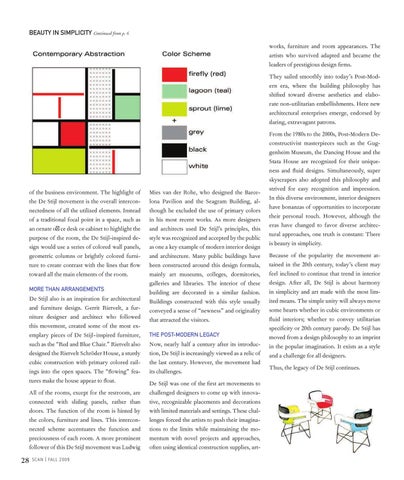
In the Modernist age, interior designers applied Piet Mondrian’s art philosophy of De Stijl to their work. De Stijl, the Dutch term for “the style,” was an art movement pioneered by Mondrian and fellow Dutch artist Theo van Doesburg. The movement emphasized simplicity, minimal use of colors and cubic composition. Mondrian, who held a spiritual view of his artwork, expressed his conviction to stability and simplicity within his works: “I construct lines and color combinations on a flat surface, in order to express general beauty with the utmost awareness… but I want to come as close as possible to the truth and abstract everything from that, until I reach the foundation of things. … ” In his view, the elements used are minimal, but the designs express spiritual order. While keen on imitating life’s inspiring beauty, followers implement the most fundamental elements to create an aura that is appropriate for the setting. Although this movement focused on minimalism, it was still a tough task process to bring a location-specific aura of art to an otherwise bleak monotonous environment. Designs of this philosophy fit perfectly with the fast-paced and no-nonsense mentality Continued on p. 28
FAL L 2009 | S CAN
B OOKS WO RTH T H E T I ME
DESIGN YOUR LIFE: THE PLEASURES AND PERILS OF EVERYDAY THINGS By Ellen and Julia Lupton This book is the answer to a relatively common question that most creative people encounter on a daily basis: “Why did they design it like that?” A good break from textbooks and all things academic, “Design Your Life” answers that question in a playful and fun, yet engaging way. It covers everything wrong (and right) with bras, toasters, procrastination, blogging and the “green-onomics of American hotels.” It brings fresh, indispensable humor to the issues of design in general, while remaining light enough to pick up occasionally as a treat.
S C AN | FA L L 2 0 0 9
By Brittany Kron Inspiration is everywhere, if you know where to look. But it never hurts to have some at your fingertips, and these four books are guaranteed to stir your imagination.
LIVING IN JAPAN
A YEAR IN FASHION
AMERICA
By Alex Kerr and Kathy Arlyn Sokol
By Pascal Morche
By Zoe Strauss
Filled to the brim with striking fashion images, “A Year in Fashion” is as rich in content as it is in style. It shows off a variety of figures from classic and modern times, from film stars to fashion designers. This is truly an indulgent resource for all things beautiful — celebrities, clothes and captured moments — and the range of eye-candy is sure to inspire. Not to be misled by the title, the shots in the book span several decades, offering ample sources for brainstorming. When it comes to resources in a personal library, “A Year in Fashion” is a must-have, packed from cover to cover with stunning imagery.
Flipping through Zoe Strauss’s collection of photos of life around the country, “America,” is a bittersweet experience. The imagery is compelling and beautiful, yet painful. The sad faces and unspoken stories in the book give way to something more tender and raw. But don’t let this turn you off — “America” demands that we don’t respond by looking away. It exposes the reality of many lives that often goes unacknowledged and unrecorded. The images reflect an unprejudiced, sobering look at varying groups of people across the U.S., offering less-than-popular definitions on what it means to be American.
Casually leafing through this book is the perfect thing for unwinding after a busy day. It is ripe with a variety of idyllic shots featuring Japanese homes and apartments and is sure to light a creative spark. “Living in Japan” is more a reference book than a oneshot read, highlighting both modern and minimalist homes and more conventional structural design. The book is filled with full-color images from swanky penthouses to time-honored, traditional homes. Delight in the work of architects and interior designers who collaborate to create a unique sense of space and style.
NEW YORK’S URBAN DELIGHTS
LOWER WEST SIDE PHOTOGRAPHY AND TEXT BY AMY TROCHE-WALSH
On the corner of Greenwich and 7th Avenue stands New York City’s last makeshift 9/11 memorial. As a quiet token to the thousands of fallen heroes, the tiles, produced by students at local elementary school, tell us stories of love and hope and define the courage found in us all.
That Flows Both Ways,” a new installation in New York City’s new High Line Park. Finch then assembled color swatches to create this evening mosaic of plums, lavenders and blues creating a Technicolor explosion.
Patience is a key component to artist Spencer Finch’s visions and he demonstrated this in spades with the execution of “The River
FAL L 2009 | S CAN
R ETURN T O THE RESURGENCE OF REPRESENTATIONAL ART
By Luiz Coelho
The halls of SCAD Atlanta are often flooded by groups of curious and puzzled high school students. They explore the college facilities and listen to the student ambassador tour guide rattle off bits of information about the different art and design programs offered at SCAD. As the visitors wander through the corridors and classrooms they get to see the high quality work produced by professors and students — artworks in display cases and hanging the walls, ranging from abstract to Realism. The paintings on the fifth floor draw curious reactions from some of the visitors who, at first, think they are photographs.
“Meditation,” by foundation studies professor Chin-Cheng Hung, is a classically rendered pastel painting that surprises the viewer with its impressive amount of detail. The piece, a portrait of Hung’s wife created years ago for a competition, may change some visitors’ preconception that Realism, and possibly representational art altogether, was lost in the past. That notion is not true. In the last few years, there has been a wave of new interest in representational art. This interest is reflected in the popularity of classes at SCAD that tackle traditional drawing and painting techniques. Hung teaches classical rendering, a drawing course he proposed years ago to address student demand. “It has become a very popular advanced drawing class ever since,” said Hung, noting how the class has helped students improve their drawing skills. Student work from this course has been exhibited every year. Jennifer McHugh, The Feast Oil, 52" x 35"
10
S C A N | FA L L 2 0 0 9
Some current students echo Hung’s sentiments. Third-year painting student Jennifer McHugh said representational art is about bringing ideas to people. “I would never venture to say that abstract paintings are unreadable to the untrained viewer, but as far as the general public goes, people pay more attention to and better understand things that are relatable to them, and that draws me to representation,” McHugh said. She also takes a spiritual approach to her work. Her paintings “deal with issues that all of us face, so it is important … that people connect with them,” she said. Third-year painting student Tijana Graham is also fascinated with Realism. Her work, which was featured in the inaugural spring issue of SCAN, often deals with simple arrangements of objects or figures rendered in extreme detail against simple backgrounds. “Painting Realism is a way to glorify the simple beauty of what we see with our human eyes. It is a form of fruitful meditation,” Graham said. Monica Ellis, a painting and animation double major, is more eclectic than Continued on p. 31
REAL I S M
TOP TO BOTTOM Chin-Cheng Hung, Riding the Waves Pastel, 23" x 72" Chin-Cheng Hung, Betrayal Pastel, 31" x 72" Chin-Cheng Hung, Besiege Pastel, 28" x 72" FA L L 2 0 0 9 | S C A N
11
The Challenge: To create a space based on a garment design. This photo feature was a collaboration between the fashion and interior design departments of SCAD Atlanta.
Photography: Goran Jovanovic Assistant Photographer: Malwine Schmidt Photo Editor: Kate Awtrey Models: Yan Pan and Kristina Guede Makeup: Andi B Hairstyling: Paul Mitchell The School - Atlanta
12
S C A N | FA L L 2 0 0 9
s
s
ON
THE CUT: UNRAVELED
PIRAL FASHIO
FA L L 2 0 0 9 | S C A N
13
“
GEORGIA KLOSS INTERIOR DESIGN
GARMENT DESIGNED BY SUN YAN PARK
As an elaboration on the dress’s circular shape, I based my concept on a spiraling staircase that has been turned on its side. Suspended in a shadowy concrete tunnel, the glowing glass walkway extends through what would typically be the vertical shaft of a stair. A series of round and rectangular elements twist around club-goers as they follow the walkway to the club beyond. With an eye toward the sheen and textural quality of the dress’s fabric, I additionally emphasized an articulation of form through light. Fluorescent bulbs form bright lines that dart back into the space while concealed lights illuminate the walkway’s edges. Overall, the entrance’s form, lighting and materials generate dynamism and a sense of mystery as expressed on the model’s face.
”
“ LEAH WATSON
INTERIOR DESIGN DRESS AND BELT DESIGNED BY ALICIA RENEE BALLS METALLIC OVERALL DESIGNED BY KEVIN FOGLE
The conceptual space was created in response to an outfit that is futuristic and unique. The idea was executed by interpreting principles from the garment into the design of the interior space. The garment sets a mysterious mood, so an element of surprise was integrated into the space by the creation of metal pods. Once entered, the pods serve as seating areas for lounging, eating and drinking. Shapes, materials and fixtures were designed directly in response to the outfit’s form and futuristic style. The repeating grid treatment on the wall reflects the re-occurring scrunching on the garment. Additionally, the space is made flexible, like the garment, with options to move around pillows and ottomans. Lastly, the strong sense of form and threedimensionality in the garment is also achieved in the interior by the changing levels and materials.
”
18
S C A N | FA L L 2 0 0 9
SCENES
THE
BEHIND
FA L L 2 0 0 9 | S C A N
19
S H OWCASE
P E I L I WA N G ALUMNUS
|
INTERIOR DESIGN
Peili Wang received his Master of Fine Arts in interior design from SCAD. Since 2004, he has been a professor in the interior design department at SCAD. Wang is well-trained in the field of architectural rendering and he understands its importance. His experience in media ranges from watercolor, acrylic and marker to computer-based designs.
20
S C A N | FA L L 2 0 0 9
He received the Award of Excellence from the American Society of Architectural Illustrators in 2009. Wang is often called upon to produce architectural illustrations for SCAD. He experiments with ways in which different media to enhance architectural perspectives. As a professor, he shares his enthusiasm for space, color, form and light.
FA L L 2 0 0 9 | S C A N
21
S H OWCASE
Photography: Mike Cooke Model: Recho Omondi Makeup: Nnebuchi Nwankwo Styling: Janisha Wilson
22
S C A N | FA L L 2 0 0 9
Y U N A H KO A L UMNA
|
FASHION
Yunah Ko currently works as a design trainee for JCPenney in Plano, Texas.
The inspiration for this collection was sculptures with abnormal growth aspects. I was particularly interested in this theme, since I wanted the final collection to have unusual silhouettes with structured components, because I tend to stay in my comfort zone of designing collections with soft, flowy silhouettes. The theme of abnormal overgrowth has been experimented with some runway designers as well, such as Alexander McQueen, John Galliano and Ellie Saab. The sculptors that inspired me with the theme were Tony Cragg, Joel Morrison and Andy Goldsworth. The sculptures done by these artists are structured, yet organic, unpredictable. I enjoyed mixing all
components from these designers and artists. Combining exaggerated volume on unexpected areas of the garment to bring out feminine silhouettes was a success. My inspiration became evident through my designs. The overgrowth elements accentuated the beauty of the garment with the contrasting body consciousness of the silhouette. The structured, yet feminine, pieces with metallic components built into each garment are very appropriate for my target customer, and it will make her feel beautiful and confident. As a designer, it is my goal to deliver aesthetic beauty combined with high quality construction to create the perfect garment for my target customer.
FA L L 2 0 0 9 | S C A N
23
S HOWC A SE
ELIZABETH BEALL & TERESA SUDDETH FOU RTH -Y E A R
S C AN | FA L L 2 0 0 9
|
FA S HION M A R K E T I NG
Photography: Kalen Curtis Illustration: Elizabeth Beall Headpiece Designer: Rita Watson
M AR K E T I N G PL AN CHI E F CHAL L E NGE S
Our challenges are primarily staying within our budget, reaching out to new potential customers, and keeping our current customers satisfied with new headpieces that come out every season. BI G O PPO RTUNI TI E S W I THI N O UR MAR K E T
We want to emphasize the idea of a unique one-ofa-kind product that cannot be bought just anywhere. The designer carefully constructs the product with the customer in mind considering the personality and style of the individual. We want our products to remain somewhat exclusive, never commercial. ADV E RTI SI NG
Since word-of-mouth will be a chief advertising tool, business cards and an occasional lookbook every season will be essential. The actual headpiece may be the best advertising tool. The designer will lend friends, family and coworkers headpieces to wear around. We will give away ads at various places around the city like boutiques, coffee houses, etc. This launch campaign will last three to four months with a review and recommendation at the end of every campaign. Any changes or corrections can be made in preparation for the next cycle of ads.
Our budget will be geared toward the ads and trunk shows where customers and their friends will be invited to come and view the upcoming collection before they go on sale in boutiques and online. Purchases can be made through specialty boutiques like Bill Hallman, or online at ritawatson.com, which will carry headpieces. There is also the option of scheduling an appointment with the designer and getting a custom-made headpiece. T HE C US T OM ER: AGES 15-30
Our customers come from a range of ages and backgrounds, including young women in high school, women in college, or college graduates. All have an exceeding interest in style, culture, art and innovation more than the average young woman does. S IN GLE WOM EN / WOM EN IN RELAT ION S HIPS
Our customer has a certain way of carrying herself and seeing the world through a creative standpoint. Despite what her age may be, she exhibits impeccable taste and boldness in her style decisions and fashion choices. She is mature and poised, yet whimsical and experimental. She has no problem in knowing what looks good on her. FAL L 2009 | S CAN
NO SWEAT In a world where fashion is increasingly becoming synonymous with cheaply made clothing produced in sweatshops around the world, any company that offers affordable fair trade apparel sounds too good to be true. But at least one company takes that criteria seriously. No Sweat, a small company headed by CEO Adam Neiman sells only 100 percent union-made apparel. No Sweat also is committed to the economic relief and social reconciliation in Palestine and recently started a partnership with a factory in the West Bank. Its organic Bethlehem line includes innovative T-shirts. No Sweat is the real deal. For more information, visit the company’s Web site at www.nosweatapparel.com.
HOOKAHS Water pipes used for smoking are common in the Middle East, widely used by Mizrahi Jewish families, who immigrated to Israel from Turkey, Iraq, Iran and Yemen. Nowadays, the popularity of hookahs has increased among youth and tourists, and hookah shops can be found throughout the country. But beware. Recent studies by organizations like the Mayo Clinic have warned that smoking hookahs can cause cancer, and Israeli officials are now warning the public against the dangers. With that in mind, they can always be used as nice decorative objects, can’t they?
WORLD TRE DROR HEYMANN Israeli jewelry designer and sculptor Dror Heymann, merges both art forms to create intricate designs with organic influences. His latest collection incorporates orchid shapes into necklaces, earrings and larger decor pieces. The simplicity and elegance of his work has already dominated the New York art circle. Find examples of Heymann’s work at www.drorheymann.com.
Photography: Rachel Chaikof
26
S C A N | FA L L 2 0 0 9
ABEL PANN It is likely that no other artist has been more involved in the Zionist movement than Abel Pann. The Zionist movement set the stage for the development and protection of the Jewish nation. Born Abel Pfeffermann, the son of a rabbi in Eastern Europe, Pann was first exposed to art in Odessa, where he studied at the local fine arts academy. Later, he went to Paris, where he continued his studies and became a notable force on the Parisian art scene. Eventually, he immigrated to Palestine, where he taught at the Bezalel Academy of Art, Jerusalem. His work ranged from depictions of the Holocaust to daily events in Jewish life. Although Pann died in Jerusalem in 1963 at the age of 80, his works are still displayed in several galleries, including the Israel Museum in Jerusalem; the Engel Galleries in Jerusalem and Tel Aviv; and the Mayanot Gallery in Jerusalem.
DOME OF THE ROCK The Dome of the Rock is the oldest extant Islamic building in the world. It was built on the Temple Mount in Jerusalem and encapsulates the Foundation Stone, which is considered by many Jews to be its holiest spot. The same site once was the location of the Second Temple of Jerusalem, which was destroyed by the Romans in 70 A.D. The Byzantine-inspired structure was built shortly after Islamic armies conquered the city. Centuries later, it was enriched with shiny tiles and pure gold. Today, it is open to non-Muslims who wish to contemplate its transcendent beauty.
: NDS ISRAEL
By Luiz Coelho
ARCHITECTURAL STYLE The International Style was considered the main architecture style in the 1920s and '30s. Its historic significance is recognized in Tel Aviv, which houses the largest concentration of buildings in this Modern style. A large influx of critical thinkers from Europe and an urgent need to expand a growing city fueled this architectural movement.
FA L L 2 0 0 9 | S C A N
27
BEAUTY IN SIMPLICITY Continued from p. 6 works, furniture and room appearances. The artists who survived adapted and became the leaders of prestigious design firms. They sailed smoothly into today’s Post-Modern era, where the building philosophy has shifted toward diverse aesthetics and elaborate non-utilitarian embellishments. Here new architectural enterprises emerge, endorsed by daring, extravagant patrons.
of the business environment. The highlight of the De Stijl movement is the overall interconnectedness of all the utilized elements. Instead of a traditional focal point in a space, such as an ornate office desk or cabinet to highlight the purpose of the room, the De Stijl-inspired design would use a series of colored wall panels, geometric columns or brightly colored furniture to create contrast with the lines that flow toward all the main elements of the room. MORE THAN ARRANGEMENTS
De Stijl also is an inspiration for architectural and furniture design. Gerrit Rietvelt, a furniture designer and architect who followed this movement, created some of the most exemplary pieces of De Stijl-inspired furniture, such as the “Red and Blue Chair.” Rietvelt also designed the Rietvelt Schröder House, a sturdy cubic construction with primary colored railings into the open spaces. The “flowing” features make the house appear to float. All of the rooms, except for the restroom, are connected with sliding panels, rather than doors. The function of the room is hinted by the colors, furniture and lines. This interconnected scheme accentuates the function and preciousness of each room. A more prominent follower of this De Stijl movement was Ludwig
28
S C A N | FA L L 2 0 0 9
Mies van der Rohe, who designed the Barcelona Pavilion and the Seagram Building, although he excluded the use of primary colors in his most recent works. As more designers and architects used De Stijl’s principles, this style was recognized and accepted by the public as one a key example of modern interior design and architecture. Many public buildings have been constructed around this design formula, mainly art museums, colleges, dormitories, galleries and libraries. The interior of these building are decorated in a similar fashion. Buildings constructed with this style usually conveyed a sense of “newness” and originality that attracted the visitors. THE POST-MODERN LEGACY
Now, nearly half a century after its introduction, De Stijl is increasingly viewed as a relic of the last century. However, the movement had its challenges. De Stijl was one of the first art movements to challenged designers to come up with innovative, recognizable placements and decorations with limited materials and settings. These challenges forced the artists to push their imaginations to the limits while maintaining the momentum with novel projects and approaches, often using identical construction supplies, art-
From the 1980s to the 2000s, Post-Modern Deconstructivist masterpieces such as the Guggenheim Museum, the Dancing House and the Stata House are recognized for their uniqueness and fluid designs. Simultaneously, super skyscrapers also adopted this philosophy and strived for easy recognition and impression. In this diverse environment, interior designers have bonanzas of opportunities to incorporate their personal touch. However, although the eras have changed to favor diverse architectural approaches, one truth is constant: There is beauty in simplicity. Because of the popularity the movement attained in the 20th century, today’s client may feel inclined to continue that trend in interior design. After all, De Stijl is about harmony in simplicity and art made with the most limited means. The simple unity will always move some hearts whether in cubic environments or fluid interiors; whether to convey utilitarian specificity or 20th century parody. De Stijl has moved from a design philosophy to an imprint in the popular imagination. It exists as a style and a challenge for all designers. Thus, the legacy of De Stijl continues.
Keep your money in check. It’s easy with the Student Package from Bank of America® Stop by any local banking center or visit
bankofamerica.com/oncampus Midtown Center | 1088 Peachtree Street NE | 678.686.9080 Ansley Mall | 1674 Monroe Dr. NE | 404.870.3030 Howell Mill | 1775 Howell Mill Rd. | 404.350.2040
Bank of America, N.A. Member FDIC. © 2009 Bank of America Corporation. Bank of America and the Bank of America logo are registered trademarks of Bank of America Corporation.
SCAD ATLANTA’S STUDENT NEWS SOURCE
Your online destination for
Visit
• news • information • entertainment • opinions and more...
www.scadconnector.com
today!
MUSIC DESIGNED FOR YOUR RIGHT BRAIN
LISTEN ONLINE! www.scadatlantaradio.org Follow us on Twitter! www.twitter.com/scadatlradio Find us on Facebook, too. FAL L 2009 | S CAN
Bring Juki’s Industrial Strength Sewing to Your Workroom. TL-98QE MSRP: $1,499
MO-623 MSRP: $837
High speed overlock with auto rolled hemming
Portable high speed lockstitch
Both machines for $999!
228 Ottley Drive Atlanta, GA 30324 (800) 426-2246 (404) 261-4240 sales@sewingmachine.com
Special offer available while supplies last.
Please visit our Atlanta showroom for all of your sewing, embroidery, sublimation and direct to garment printing equipment and supplies.
30
S C A N | FA L L 2 0 0 9
RETURN TO REALISM Continued from p. 10 McHugh and Graham in her styles of choice. Ellis said she has been trying to “explore different outlets and less strict, direct ways of showing ideas.” In that regard, she has produced artworks that could fit within many categories and styles. Realism, however, is the style she said she gravitates to most. She also understands that Realist paintings are not like photographs. “The handmade quality of an image will always have something that a photograph will not. A painting has elements, such as process and time, that attract the viewer to understand it on a different level than a photograph,” Ellis said. “This is in no way to say that painting is better than photography — just different.” Painting from life is another feature that attracts students to representation. To McHugh, it is important to be able to reproduce the sense of depth obtained when light falls on objects, as well as the gradations of colors and details. Professor Hung emphasizes how classical techniques make a difference in the quality of former students’ artwork, although he recognizes that not all students will embrace Realism or representational art. However, he said many of
his students have contacted him to express how much they appreciated learning the old master techniques in painting and drawing classes. “They all appreciate the notion of one needs to learn the rule first before one can break the rule,” Hung said. Others enjoy using photography as a model for their paintings and as a tool for mixed media projects. Ellis, who practices it professionally and recreationally, finds herself mixing media. Her piece “God Said 97 Church Folk Out of Every 100 Will Burn in Hell” is based on a photo of a street preacher she took on Peachtree Street. After computer editing, the original image was layered with people who crossed the street at different moments. Ellis used a the final picture as a reference for her painting. “By placing the viewer in between the crowd and the preacher, I hoped to also re-create that feeling in the viewer,” she said. Her intention was to “force the viewer to come to terms with how he or she feels about that situation, possibly reminding him or her of a situation like that they have experienced.” Besides teaching traditional painting and drawing classes, Hung also has developed artwork
with specific content and style. His new series, “Wu Xia,” is inspired by Chinese martial art novels and movies, which Hung said he has been watching and reading since childhood. More recently, such movies have incorporated many advanced cinematographic techniques. Hung has been able to capture the feeling of movie stills by appropriating photographs and images from already made movies. “With cinematic composition, blurry effect and realistic rendering approaches, I would like the viewers to see my paintings as movie stills.” Like traditional novels that are now enhanced by advanced computer techniques, Hung merges the traditional and the contemporary in his artwork. He uses his classical art background and rendering techniques to create paintings that rely on computer movie stills as an inspirational source. This merger of ancient and modern emerges from an environment where it is possible to have a little bit of both. “While not so many art institutions still carry traditional art training, SCAD provides an optional environment of fundamental training for students, and [it] prepares them to have a better chance of becoming a successful artist,” Hung said.
LEFT TO RIGHT Jennifer McHugh, Bondage Acrylic, 12" x 16" Chin-Cheng Hung, Animosity Pastel, 36" x 63" Monica Ellis, God Said 97 Church Folk Out of Every 100 Will Burn in Hell Acrylic and Oil, approx. 3' across on jigsawed MDF FA L L 2 0 0 9 | S C A N
31
How true is the depiction of the fashion industry in the movie “Devil Wears Prada?” It doesn’t even come close! Multiply the shenanigans by one thousand percent and you might start to get a better understanding of the fashion biz. It’s crazy, but I love it.
What is your least favorite trend from the Fall/ Winter 2009 season? Neon fur.
the debut
As a buyer, you’ve had the opportunity to travel and discover raw talents. Can you describe the memory of the first time you knew you had the “It” designer? I was at Christopher Kane’s debut show in London. Out came these neon colored corset dresses, laced ingeniously, witty, complex and happy. There were only about twentysome looks, but each one a gem. I went running backstage after the show, and there
was Christopher, with his sister, standing all alone. No throngs or well wishers gathered around. They were completely exhausted and yet so gracious to allow me to say hello and congratulate them on their incredible work. I tried to buy the collection and had all of my management meet with them. In the end, Christopher could only make a handful of dresses, and they went to Browns of London. He was very smart to admit he couldn’t produce the collection, and has managed his business very cautiously to this day. He taught me to be patient!
Do you think the future of fashion is in consignment? No. The future of fashion is designers delivering relevant, interesting ideas to today’s modern thinking men and women. If customers don’t want the clothes, it doesn’t matter how the clothes are sold.
Is there one book that you refer to over and over again for inspiration? I read “Alice in Wonderland” a lot. Very trippy.
If you had to choose one destination in the world to dine, where would it be? My own dining room, filled with good friends, enjoying my Thanksgiving dinner, and discussing important things like the current contestants on “Dancing With the Stars.”
Who’s in Michael Fink’s closet?
SCAD's new dean of fashion Michael Fink gives SCAN a glimpse of the man behind the clothes.
32
S C A N | FA L L 2 0 0 9
Photography: Ben Dashwood
That’s funny! I run the gamut from designer to thrift store. Comme des Garcons and Yohji have a lot of space devoted to them. There’s also a stack of vintage Harley Davidson T-shirts that I collect.
I cannot live without my... Nightly chocolate fix! It’s the easiest way to bribe me.
Savor a moment between classes at The Hub’s
ESPRESSO BAR
NOW FEATURING
NEW HOURS
Italian and French sodas
Monday - Thursday: 9 a.m. to 5 p.m.
Flavored coffees SCADpuccino
Friday and Saturday: 9 a.m. to 1 p.m.
Fresh-baked cookies
Closed Sunday
Pastries FA L L 2 0 0 9 | S C A N
33