SCAD ATLA N TA’ S S T U DEN T M AGA Z I N E FA LL 2 011/W IN TER 20 12
»
VO L . 4 , N O . 1
20
4 8 12 14
24
table of contents 4
SCAD SPEAK Students describe how their creative lives changed after moving to the South.
8
DIRT DON’T HURT
Hand-fed muscadines and red clay allow this writer to shed a few northern neuroses.
12 barT
A tale of losing more than just a friend in the waters of the Weiss.
14
the new south
Sometimes our preconceived notions do not match what we discover.
20
Below the AveNUE
Explore three Atlanta urban villages residing south of Ponce de Leon Avenue.
24
NON-COUNTRY CADENCE
Four albums that put a new spin on music from the Southern states.
26
38 34
44
46
30
26
sweet-n-low
The traits that make this writer’s Yankee-born father a southern transplant.
30 the other southern comic
[adult swim] tackles the “git-er-done” southern comedy stereotype.
34
THE MODERN FAMILY
An illustration of how the old South traditions are evolving.
38
STUDENT SHOWCASE
Highlighting student work and the regional influences on their creative processes.
44
BUFORD HIGHWAY: ATLANTA’S ETHNIC EPICENTER
Buford Highway offers a diverse take on food in the South.
46
YOU ARE HERE
Here you are, wherever you’re from.
about the issue Whether you are born and raised in the South or a transplant, living in this region can impact who you are as an artist. In Atlanta, we are surrounded by cultural diversity as well as “Old South” traditions. In this issue, we focus on the unique moments, places and experiences that we as artists reflect on and use for inspiration in our work.
F A LL/ W I N T E R 2 012
»
S CAN MAG AZI NE 1
staff
ERIN WHITE editor-in-chief
OSAYI ENDOLYN contributing editor
BRITTANY KRON creative director
Major: Writing
Major: Writing
Major: Graphic Design
DYLAN FAGAN photo editor
NYASHA MANDIVEYI news editor
ALEXIS BLAUDEAU a&e editor
Major: Photography
Major: Television Producing
Major: Printmaking
seth crowe
winston fulbright
dylan moore and taylor francis
Writer, Bart
Writer, Non-Country Cadence
Illustrators, The Modern Family
julie sharpe and monica phillips
colleen cameron
amie brink
Photographers, Below the Boulevard
Writer, Sweet-N-Low
Photographer, Buford Highway and The Other Southern Comic
contributors
2
S CA N MAGAZINE
Âť FA LL / W IN TER
2 012
JACOB VAN WINKLE art director
CAROLINE HUFTALEN copy editor
ALANA ADAMS p.r. director
Major: Graphic Design
Major: Writing
Major: Writing
BARRY LEE illustrations editor
ERIC BEATTY web director
BRITANY PONVELLE asst. art director
Major: Illustration
Major: Graphic Design
Major: Graphic Design
about SCAN SCAN is the quarterly student magazine of the Atlanta location of the Savannah College of Art and Design. All editorial content is determined by student editors. Opinions expressed in SCAN are not necessarily those of the college. ©2012 SCAN Magazine. All rights reserved. No part of this magazine may be reproduced in any form without written permission from the publisher.
SCAN Magazine Spring House Computer Lab Fridays at 10 a.m.
Office » 404.253.2738 Fax » 404.897.4888
» scan@scadconnector.com » scadconnector.com/scan
F A LL/ W I N T E R 2 012
»
S CAN MAG AZI NE 3
» SCAD SPEAK
south when in the
Sara Quarta Interior Design Sara Quarta, an international student from Italy, spent parts of her life in multiple places; Milan, Italy, Brindisi, Italy, and Fayetteville, N.C. In Quarta’s senior year of high school she was moved from her hometown of Brindisi to Fayetteville. “I was devastated when I found out I was moving my senior year of high school, and I was more devastated when I came to Fayetteville. I didn’t speak to my parents for at least two weeks,” she said. Although her first time living in America was not what she had hoped for she still wanted to give living here a try. She came to SCAD as an interior design major in fall of 2009. “Atlanta was the first American city that I visited, and comparing it to Fayetteville it is like a slice of heaven,” Quarta said. She was finally able to see the bright lights of a city. “All of my friends from Italy were asking me if Atlanta is like what you see in pictures and movies.” For the first time she was able to take a ride on a train or walk down the street to get a bite to eat. Now that she has lived here, the initial excitement she once had about the city has faded away. “[Atlanta] has gotten a lot slower than when I first came here, and though I still love it, it is not as intriguing as it was.”
4
S C A N MAGAZINE
» FALL/ WIN TER
2 012
These students embraced the adage “when in Rome” and used a change of location as an opportunity to adopt a different way of life that added to their creative journey.
writers Nyasha Mandiveyi Alana Adams photographer Dylan Fagan
Gheri Thomas Illustration Third-year illustration major Gheri Thomas moved from one part of the South to another. Living in Alabama was a completely different experience. Her creative style is seen as awkwardness in Alabama, proving to her description of a lack of appreciation for art in her home town. Her first day in Atlanta was what she calls a breath of fresh air: “Atlanta has a lot to do with art, everywhere you look, even MARTA, each station has a different theme, I love Atlanta.” Moving to Atlanta finally gave her the freedom to express herself. Her sense of style is appreciated and seen more as creative genius. Sporting what she calls her brave leap from straight to “nappy” hair, she’s begun to take creative risks with her style. “Everyone here is unique in some type of way,” Thomas says. “So in a way, I belong for the first time.” Her experience at SCAD is a far cry from her rural, racially divided, “Stepford wives” background. She realizes that sometimes a sense of belonging isn’t always about finding yourself but about always knowing who you are, and finding that special place that embraces your unique self.
F A L L / W I N T E R 2 012
»
S CAN MAG AZI NE
5
» SCAD SPEAK
Sujin Park Fashion At face value, Sujin Park, second-year fashion major, could be typecast as the warm and friendly student who greets everyone with a smile. As an international student, the move from South Korea to Atlanta was her biggest challenge; she couldn’t speak any English and hadn’t been exposed to ethnic groups other than South Koreans, but what helped her when she first arrived was the kindness she experienced from strangers in the South. Other than her evolving style, Atlanta has allowed Park to socialize with a wider variety of people who are more open-minded and who lead different lifestyles. Back home, she says the amount of respect one needs to have toward older people creates a barrier in relationships, “there’s a way you speak and greet people even if there’s a one year age difference.” Although adapting to the culture wasn’t easy, Atlanta has made subliminal changes to Park’s sense of fashion. Far from the restrictions of her own culture, she wears clothes she feels good in. “People here don’t really care about how we dress up; I can wear anything I want. In Korea I cared a lot about people’s opinions so I didn’t wear skirts,” she says.
Herman Miller® Eames Lounge Chair
visit us at our new location at 1745 Peachtree St. NW Atlanta, GA 30309 404.352.7200
www.samflaxsouth.com 6
S CA N MAGAZINE
» FA LL / W IN TER
2 012
Maja Plavsic Interior Design Moving to Atlanta was an easy choice for Maja Plavsic, a third-year interior design major. Her previous school in Oklahoma had limited opportunities and she felt out of place. “I went to a very Christian school where rules were strictly enforced so I felt constrained, but luckily I had tennis,” Plavsic said. She played on the Oklahoma Christian University tennis team, and now plays for our tennis team. “Tennis was one of my only outlets there,” she says. Transferring to SCAD was a cherished moment; a big city like Atlanta was the change she needed. She finally enjoyed what America is known for in other countries, a big city filled with tall buildings and diverse people. “In Croatia, we see movies that are filmed in or portray New York and that is what we think America is like.” Plavsic has grown to love Atlanta for its own pace and culture, seeing and experiencing more than she ever has in America. “I love that I am so close to such good restaurants, and even the High Museum, that is something I did not have in Oklahoma,” she said. Plavsic is happy to have ended up in Atlanta, a southern city that has exceeded her expectations.
For all your art supply needs, pick Blick. ROSWELL
1165 WOODSTOCK RD. (NEAR SUPER TARGET) 770-993-0240
SCAN THIS WITH YOUR MOBILE DEVICE TO VISIT OUR FACEBOOK PAGE
25% OFF
ENTIRE PURCHASE OF NON-SALE, IN-STOCK ITEMS
VALID 1/3/12 TO 3/31/12
Blick Art Materials, Retail Inc., coupon must be surrendered at time of purchase; no copies will be honored. Limit one coupon per visit. Valid only on non-sale, in-stock items. Not valid with any other discounts or promotion, phone/mail/internet orders, custom framing and printing and purchases of gift cards.
*Ao06065*
Roswell
F A LL/ W I N T E R 2 012
»
S CAN MAG AZI NE 7
8
S CA N MAGAZINE
» FA LL / W IN TER
2 012
hurt dirt don’t
writer Caroline Huftalen illustrator Barry Lee
the small, obscure sign read “BEWARE BABY RATTLES” over a wooden crate that was casually covered in wire mesh. I knew that laws were different in the South and there seemed to be a lot more leeway when it came to certain things like guns and what people considered food, but I was certain that rattlesnakes could not be considered retail items or pets. I had just walked through the barbed wired entrance to a produce stand located in Rockdale County, a suburb outside of Atlanta. This area felt like the old South, with single lane roads flanked by red clay, fields and barbecue shacks. I noticed a Confederate flag. It was as if the Yankees had never invaded and restructured the South’s customs and beliefs. I’d been disappointed with the lack of local produce in grocery stores, so I was on a mission to find a farmer who only sold what was grown in the stiff, red Georgia dirt. If I was going to live in the South, I wanted the full experience, and that meant tasting it. I had found this stand after a long drive. I almost passed it by thinking it was a junkyard
due to the barbed wire security system. On closer glance, I realized it was exactly what I was craving. The stand looked like it was made from a trash heap. Pieces of old wood and metal were slapped together forming a ramshackle general store. Large metal cages sat beneath a covered patio. Inside these cages were rabbits that had obviously reproduced very quickly. “That’s odd. Why would you sell pet bunnies at a place where you buy food?” I asked my mom who was my shopping companion, and what I consider to be our family’s resident hillbilly since she was born and raised in Tennessee. She knew the answer, but hesitated in telling an animal-lover the truth. She said simply, “They aren’t for petting.”
I tore my eyes away from the poor, but plump fuzzy rabbits that would end up in someone’s pot of stew and moved on to the supposed rattlesnake spawn. The cages didn’t seem secure, but there was no way to avoid walking by them — they shielded the only entrance into the open-air store. After a few moments of wondering if one had already gotten out and if rattlesnakes could jump, I stirred up enough nerve to peek over the crate’s edge. I realized that this produce stand was not run by a farmer, but a comedian. The sign was a clever play on words to undoubtedly catch fools, like myself, off guard. The crate held exactly what it said it did, baby rattles. Not
F A LL/ W I N T E R 2 012
»
S CAN MAG AZI NE 9
the kind that drips venom from fangs, but the kind you place in your child’s playpen. Once over the threshold, I noticed that the interior matched the exterior. Makeshift shelves made from junk yard scraps and old, broken furniture held okra, snap beans and sweet corn — all the usual Southern vegetables that would soon be smothered in butter, mixed with bacon or fried in a cornbread batter. We filled our bags, grabbed a jar of local honey and headed over to the cashier whose only tool of monetary measurement was a pencil and paper. The interesting thing wasn’t the lack of even a calculator, it was the man behind the counter. He looked exactly as I had imagined him after falling for his rattle joke and witnessing the death row bunnies. He was jovial: a dirt-caked, Southern Santa Claus complete with beard and belly. Just like his fruits and vegetables, he looked fresh from the farm in a pair of blue jeans and he smelled of earth and sweat. As we handed over the contents of our bags, I noticed something I’d never seen before on the wooden counter. What looked like tiny plums, or large grapes off the vine sat in large cardboard fruit boxes. I asked my mom what these were. My voice was low in an attempt to conceal my Yankee roots from the straight-from-the-South man. But just like the real Santa, he knew all. He told me that the green fruit were called scuppernongs and the purple variety next to them were muscadines. They were essentially Southern grapes, like a concord grape with thicker skin and a juicy inside. Mom shared an anecdotal moment with Mr. Muscadine and me about how she used to sit in the back of a pick-up truck with her friend and a bag of these Southern grapes. They’d suck the juice out and then see how far they could spit the skin. The man seemed to share the same upbringing as my mom. He looked reminiscent as she told her tale of Tennessee country life and the mild entertainments, soon resting his elbows on the counter and indulging in
10
S CA N MAGAZINE
» FA LL / W IN TER
2 012
her memory. As she neared the end, he began thumbing the grapes with his large sausagelike fingers. Before I could contemplate how much of a redneck my mother was as a child, I saw something in my peripheral vision. In slowmotion, I watched Mr. Muscadine’s claystained hand pluck a large scuppernong out of the cardboard container and head towards my mouth. I tried to politely say no thank you to the hand feeding. But it was too late. He had found his moment and popped the never-washed fruit straight into my partially open mouth. I hate to admit a flaw, but I have a few neurotic tendencies when it comes to food, like profusely washing my hands and food before consumption. I blame my parents for allowing me to watch the news. Any child raised in that frightening nightly news atmosphere would grow up to be a compulsive produce washer. Nothing is scarier than half-understood segments on E. coli outbreaks and foreign spiders traveling to America in bundles of bananas. With the fruit lodged between the back of my teeth and my tongue, my face turned from shock, to terror, to surprised enjoyment. After resisting the urge to immediately spit out the scuppernong, I gave in, bit down and enjoyed the gooey, sweet meat of the fruit. It tasted like a grape, but like iced tea in the South, it seemed infused with loads of sugar. I politely removed the inedible skin from my mouth and hid it in my hand as he simultaneously spit his own fruity remnants on the floor like you would chewing tobacco. He thrust his dirty fingers towards my mouth once again. I bobbed and weaved away from being twice hand-fed from a man I barely knew, a man whose hands had whereabouts unknown to me, like if they’d ever met antibacterial soap. I took the fruit from him. Tried to rub off as much residual earth as possible. Then tried
to squeeze the inner contents into my mouth without touching the skin to any orifice that could transfer germs to my blood stream. The charming farmer and my mother, who had already demonstrated her below-theMason-Dixon fruit eating skills, watched my failed attempt that turned into a sticky mess. My mom found the need to explain my behavior. “She’s weird about dirt and food.” He took one look at me, must have noticed that, yes, perhaps I was wound a little too tight and could use a little mess in my life, and proclaimed, “Honey, dirt don’t hurt.” Catching me off guard with his eye-twinkling proclamation, I contemplated telling him about the possible E-coli viruses and other foodborne illnesses found on fruit, he popped another one in my mouth. I decided to enjoy these last moments before food poisoning set in and ate the muscadine, dirt and all. As he hand-weighed our produce and filled out the homemade receipt, he looked at me and said, “Since you’re so pretty, these are for free.” He combined two containers of the fruit he had been feeding me, one muscadine, one scuppernong, and told me it would help me become a real Southern girl. I had left New York and its pressure cooker atmosphere behind, but maybe New York hadn’t been ready to leave me. My heart was ready for all the Southern stereotypes: rocking chairs on front porches, the smell of magnolia’s and truly slowing down. But my mind hadn’t made the transition yet, not until a dirty old man stuck his fingers in my mouth and forced me to taste what the South really had to offer. I still rinse my scuppernongs and check for stow-away bugs. But I step away from my structured schedule and Yankee mentality to enjoy a little bit of dirt on my hands. Mainly to build up my immune system for the next time I visit Mr. Muscadine.
H I G H
COLLEGE NIGHT AN EVENING WITH KIKI SMITH JAN
19
7 p.m., Rich Theatre
Join artist Kiki Smith; collaborator and friend Valerie Hammond; Robert Brown, Printmaking Chair, SCAD Atlanta; David Brenneman, the High’s Director of Collections and Exhibitions; and Michael Rooks, the High’s curator of modern and contemporary art, for a rare public discussion.
JAN
28
KAWS LECTURE
7 p.m. to 12 midnight
Strike a pose in a Factory photo booth, drip paint like Jackson Pollock, curate a show in our readymade gallery, and make Calder-inspired jewelry! Plus, check out indie cool kids the Carnivores, neo-soul tastemakers Sweet Relief, and join Dance Truck’s dance party with DJ Santiago Páramo!
FEB
16
7 p.m.
Join us for a talk with artist/designer KAWS.
Members $10 | Students $5 | General public $15 Ticket includes entry to the KAWS: DOWN TIME Opening Party.
$7 with student ID | Free for members College Night is made possible by Presenting Sponsor
Members $10 | Young Patrons $5 | General public $15 This program is made possible by the Gudmund Vigtel Works on Paper Fund.
DEAN AND BRITTA 13 MOST BEAUTIFUL . . .
Ticket includes admission to Kiki Smith: Rituals and Picasso to Warhol.
Songs for Andy Warhol’s Screen Tests
MAR
31
KAWS: DOWN TIME OPENING PARTY FEB
16
ON VIEW: PICASSO TO WARHOL: FOURTEEN MODERN MASTERS
8–11 p.m.
Join us for the DOWN TIME opening party with DJ Hurricane (formerly of the Beastie Boys), drinks for purchase, and artist Brian Donnelly, a.k.a. KAWS. Members $10 | Students $5 | General public $15
8 p.m. Atlanta Symphony Hall Museum galleries open until 12 midnight
Dean Wareham and Britta Phillips’s original score accompanies Warhol’s silent, black-and-white film portraits of Factory regulars. After the performance, visit Picasso to Warhol and enjoy cocktails for purchase and music in the Museum.
Featuring more than 100 of the world’s greatest works of modern art, Picasso to Warhol is assembled exclusively for the High from The Museum of Modern Art, New York.
Culture Shock is made possible by Presenting Sponsor
KAWS: DOWN TIME
HIGH MUSEUM OF ART ATLANTA | TICKETS: HIGH.ORG OR 404-733-5000
Considered a “subculture hero,” Brooklyn-based artist Brian Donnelly, widely known as KAWS, enlists Pop art, toy-making, graffiti, product design, and sculpture. This is the first exhibition for KAWS in Atlanta.
Members $10 | Students $5 | General public $15 Culture Shock is made possible by Presenting Sponsor
Ticket includes admission to Picasso to Warhol. Ticket includes admission to Picasso to Warhol.
KAWS: DOWN TIME is made possible by generous support from
Presenting Sponsor
Lead Sponsors The Gary W. and Ruth M. Rollins Foundation
Additional support is provided by The Rich Foundation, the Modern Masters Circle of the High Museum of Art, and an indemnity from the Federal Council on the Arts and the Humanities. This exhibition is part of the MoMA Series, a collaboration between The Museum of Modern Art, New York, and the High Museum of Art, Atlanta. Andy Warhol (American, 1928–1987), Campbell's Soup Cans, 1962, Synthetic polymer paint on thirty-two canvases, each canvas 20 x 16 inches. Partial gift of Irving Blum. Additional funding provided by Nelson A. Rockefeller Bequest, gift of Mr. and Mrs. William A. M. Burden, Abby Aldrich Rockefeller Fund, gift of Nina and Gordon Bunshaft in honor of Henry Moore, Lillie P. Bliss Bequest, Philip Johnson Fund, Frances R. Keech Bequest, gift of Mrs. Bliss Parkinson, and Florence B. Wesley Bequest (all by exchange). © 2011 Andy Warhol Foundation / ARS, NY / TM Licensed by Campbell's Soup Co. All rights reserved.
F A LL/ W I N T E R 2 012
»
S CAN MAG AZI NE 11
12
S CA N MAGAZINE
» FA LL / W IN TER
2 012
Bart writer Seth Crowe illustrator Barry Lee Natural Light leaked from my father’s mouth as he pushed me across the murky waters of Lake Weiss. I counted the ripples collecting at my toes. Heavy summer humidity drenched the air as droplets amassed at the edges of my father’s whiskers; I held his beer can as he adjusted my lifevest. The sun glared as Dad’s crows feet began to wrinkle, his dark leathery skin soaked in the rays. I was 4. I couldn’t swim. My inflatable alligator Bartholomew was my closest friend. I sat on Bart’s back as he whispered delusions of grandeur and told me sad fairy tales about his past life. Cursed by nature and forsaken for his crimes, Bart’s guts turned to air and his mouth was sewn shut. I could barely make out the words dripping from his reptilian tongue. Dad began to play chicken fight with my cousins, a game that has little to do with chickens. I watched as he lifted my youngest cousin, Stephanie, onto his shoulders. A teetering tower of mustache and child, they moved closer into shore. They lost track of me and I was set adrift by my father’s inattentive hand. And anyway, Bart told me there was no cause for concern. He hissed and groaned about his noble birthright; the son of the rightful king. He was hexed in a bloody coup and stripped of his title to live out his days amongst the ordinary and unimaginative — with a boy and his hapless yearnings. I couldn’t be sure, but his accent sounded British. I suddenly felt safe as I drifted down the jetty. Bart held my confidences and made me feel tall. If my arms had been longer, I could’ve paddled my way to shore, but only my fingers could reach the water. I began to
fear that we would capsize, but Bart’s muffled voice restored my poise. “Don’t lose faith, young comrade.” A warmth crept down my spine as Bart’s strength became my own, now that I was three docks away. It was now or never — I was right up next to the platform when I lunged for it, grabbing hold of an old bumper tire. I rolled myself up. Triumph. I scanned the gloomy waters looking for validation, but there was none to be found. I watched as my father pulled another beer from the ice chest resting upon the dock. My 4-year-old body began to tremble, shaking in a hazy, nervous stupor. Look at me, I thought. Look at me. Then suddenly, Bart was floating down river. Reaching for him in panic, I leaned out for his tail and lost my balance. Although, submersed for only 10 to 15 seconds, as I drifted with eyes wide to the murky abyss, I could only think of my father. Perhaps, if I stayed beneath the hot, wet blanket of water and never took another breath of fresh air, felt the prick of Dad’s gruff, or heard the sound of his truck door slamming when he returned from a trip, then his life would be simpler. Maybe triumph was just defeat dressed in king’s clothes. They pulled me out cursing me for jumping off the dock. I tried to tell them what happened, but they were too angry to hear my explanation. I shrieked for Bart to be rescued. Dad didn’t understand; he ordered me to sit on the dock, which I did, watching as Bart’s reality became fiction. Upon losing Bart that day, dying became real — drowning no longer my fiction. Blinded by ignorance and apathy, my eyes no longer longed for waterlogged validation. I lost a friend; my father lost me. F A LL/ W I N T E R 2 012
»
S CAN MAG AZI NE 13
w e N T he
h t u o S ATL
14
S CA N MAGAZINE
» FA LL / W IN TER
2 012
agan lan F y D her allum grap o t o McC n ph w a el Sh mod
Modern Atlanta is not so much a place of straw hats and banjos as it is of skyscrapers and graffiti. As the traditional Southern man explores the city, he finds his surroundings contrast familiar images of the South: dirt roads, picket fences and farms. Wandering the city, he wonders if he no longer fits in.
F A LL/ W I N T E R 2 012
Âť
S CAN MAG AZI NE 15
16
S CA N MAGAZINE
» FA LL / W IN TER
2 012
(DYLAN) PHOTO SPREAD PG. 4
F A LL/ W I N T E R 2 012
»
S CAN MAG AZI NE 17
18
S CA N MAGAZINE
» FA LL / W IN TER
2 012
F A LL/ W I N T E R 2 012
»
S CAN MAG AZI NE 19
BELOW THE
AVENUE
A casual discourse on three urban villages
writer Osayi Endolyn photographers Julie Sharpe Dylan Fagan Monica Phillips
20
S CA N MAGAZINE
» FA LL / W IN TER
Residents of Downtown Decatur, East Atlanta Village and Little Five Points are a diverse bunch, but most share one common belief: Don’t Pass Ponce. It’s an unspoken maxim of sorts; this understanding that life begins and ends south of Ponce de Leon Boulevard. This mindset generally exists among those who’ve been called urbanites, urban dwellers, hipsters, bohemians and artistes, among other terms once considered complimentary but have since been manipulated to sound downright offensive. These are the tattoobaring, yoga mat-toting, co-op-shopping young men and women who like their beer craft, their coffee local and will still buy vintage vinyl records while the illegal torrent is downloading at home.
2 012
But the belief isn’t so much a rule or restriction as it is a challenge. Why bother? Why go north of Ponce unless you had to — isn’t it obvious that everyone else seems to come down here? The contemporary lifestyle found in these neighborhoods has an allure. It’s what smalltown southerners think of when they imagine city life. Ranging from bourgeois to gritty, all have unique identities. They offer bars, parlors, nightclubs and shops. Depending on the time of day, biker clubs or greyhounds leashed to strollers roam the street. Each in their own way, these urban villages do their part to make life below the Boulevard worth the rent — or a visit.
DECATUR Decatur could easily have another name — charming. Entering the small city via on Ponce, you can almost hear the original “Winnie the Pooh” theme song as you glide past green parks with aged, lush trees bowing towards the asphalt. If you’ve been to Decatur, you love Decatur. Perhaps that has something to do with its namesake, Commodore Stephen Decatur, a popular Yankee-born 19th century naval hero. He battled pirates, the British and then more pirates before meeting his demise in a duel. Mourning for the commodore’s sudden death spread throughout the country, and when the disparate DeKalb County European settlers decided to incorporate into a city, they named it after the beloved veteran. The National Register of Historic Places lists several Decatur districts and buildings, like the almost 90-yearold Pythagoras Masonic Temple. Throughout the city, historic districts show off exposed brick, arched entries and faux period balconies. Historic Oakhurst is also full of cool places to dine and be leisurely, tucked away in the residential bungalows of southwest Decatur. But the city’s heartbeat pumps in the square. One of a handful of interesting places MARTA goes, the square offers an assortment of mom and pop accessory shops, restaurants and bars like the famed Brick Store Pub and Leon’s Full Service. Delightfully designed with stellar menus, they specialize in craft brews and finely tuned cocktails, with an aim towards good conversation and full bellies. Off the square and up a ways, you’ll find Twain’s, a friendly beer joint that is currently undergoing an inhouse brewing makeover. Frequently do young, local jazz musicians perform at the open jam sessions there, and SCAD students can branch out to mingle with the Agnes Scott and Emory crowds. If you’re looking for la vida loca, you probably won’t find it in this city, an “urban oasis,” that’s “cozy,” and “quaint” by most outsider reviews. But that doesn’t mean you can’t have a good time. Let not the pretty architecture, clean sidewalks and frozen yogurt fool you. Zucca Pizzeria shares a sidewalk patio with Brick Store, and the Italian F A LL/ W I N T E R 2 012
»
S CAN MAG AZI NE 21
eatery stays open and loud ’til 4 a.m. during the week, 3 a.m. on weekends. South of the square by a half a mile, The Marlay House brings Irish pub flavor with some occasional club action. Inside it might be dark and damp, but step outdoors and you just might see Mr. Rogers walk by.
LITTLE FIVE POINTS It can be said that if you haven’t been to Little Five Points (or Little Five, or as printed on bumper stickers L5P), then you haven’t really seen Atlanta. Little Five is essentially an independent commercial center connecting the Inman Park and Candler Park residential neighborhoods. Running down Moreland Avenue north-to-south, and east-to-west across Euclid and McClendon, it’s the junior reference to downtown’s Five Points district and has become the go-to center for all things alternative. Graffiti. Street art. Singing homeless men. The scent of cheap incense. Three types of people frequent the area: people who don’t mind weirdoes, people who want to play weirdo for the weekend
and of course, los weirdoes themselves. But the strange ones can’t exist without the right blend of businesses and events to patronize, so in perfect symbiotic fashion, they both need and fuel each other. A Cappella Books has been selling new, used and out-of-print books since “The Cosby Show” was on. This is not your sprawling big-box chain with a PA system. Usually only one or two people work the small space and boy, do they know their titles. If you haven’t experienced the requisite university-inspired Beat literature rite of passage, it’s a stop you’ll want to make before you graduate. They’re known for offerings on progressive political topics, a host of counterculture perspectives and they collaborate with other book-loving organizations (SCAD Atlanta, The Carter Center) to bring well-known writers to the city. Across the street, the community co-op Sevananda is open everyday to fulfill your green, vegan and vegetarian needs. In a show of bittersweet love, community residents unofficially awarded the natural foods store
with the honor of Slowest Checkout Line in the Southeastern region. Employees are friendly, helpful and chatty — especially with old customers, of which there are many. One evening towards closing time, a pale elderly man with Magoo glasses burst into a blues tune before rolling out in his wheelchair. Movement stopped during his performance, and when he finished, all activity resumed without comment. It’s normal. It’s Little Five. Most businesses are independently-run: grungy venues like the Star Bar and Variety Playhouse; Kolo, a reliable, professional spot for serious contenders to get pierced (not tatted, don’t friggin’ ask); The Porter Beer Bar, where if Willy Wonka had been into beer, that’s where he would live; The Vortex Bar and Grill where you pay for your awesome burger with a side of gothic attitude. The presence of American Apparel is almost an aberration, but forgiven. Record bins, freshly juiced drinks, and vintage clothing shops await. Don’t mind the sidewalks. If they weren’t as dirty as they looked, you’d question if anyone really had fun down there.
EAST ATLANTA VILLAGE Maybe, possibly, East Atlanta Village is too cool for you. About a mile south of Little Five, another independently driven business district caters to residents and passersby. This one has more edge — it’s a bit older and somewhat less tolerant of wide-eyed looky-loos. That doesn’t mean you’re not welcome, however. Rising up from the land where the Battle of Atlanta was fought, the intersection at Flat Shoals Road and Glenwood Avenue marks the center of a culture that even during the light of day, seems destined for night. The bustling mini hub was initially set up by 19th century businessmen to cater to a growing population in then-unincorporated Atlanta. During the 1960s, the Fair Housing Act was passed requiring the desegregation 22
S CA N MAGAZINE
» FA LL / W IN TER
2 012
of residential neighborhoods. As with many intown predominantly white neighborhoods of the era, white families often indignantly fled their homes rather than live next to people of color. Sometimes they sold their homes for a fraction of their worth, plummeting residential values. Businesses shuttered, insanely cheap prices welcomed uncaring elements, and in the following years EAV fell into disrepair. Redeemably, in the past twenty years the village has increased its status and visibility, receiving national press for its reinvigorated energy, a result of the community association made up of new and old residents. The community supports a variety of annual events that welcome partiers and families (dogs included) alike. The East Atlanta Strut happens every September beginning with a 5K run and the streets open up to local and
regional arts vendors. There’s the Corndogarama with a corn dog eating competition and music concert, the MondoHomo festival celebrating Queer-centric activities and of course the annual beer festival where drinking ensues on the sidewalk. But when the festivals die down, East Atlanta Village is known for its nightly dose of entertainment. The Earl has good pub food with a back room for band shows with a performance space separate from the dining room. Guests can eat before the show, drink after and during, or ignore the concert entirely. Across the street the Eastside Lounge offers a two-story smoky haze of dancing in the dark. Further down on Glenwood, you’ll find the G-spots located side-by-side: The Glenwood, Gravity Pub, and Graveyard Tavern — you’ll know it by the black hearse parked outside.
Up the street, Holy Taco will make you say just that, but prepare for lazy service. Maybe stop into the Flatiron at the corner on Flat Shoals, appropriately named after the old household device and located in a former bakery. If you’re into wieners, the owners of The Porter Beer Bar opened Delia’s Chicken Sausage Stand off of Moreland at Glenwood. They open early and close late — skip the strip of fast food chains to get your clucker on a bun, hoagie or tortilla.
F A LL/ W I N T E R 2 012
»
S CAN MAG AZI NE 23
non-country
cadence: the new music of the South
writer Winston Fulbright illustrators Dylan Fagan Barry Lee photographer Julie Sharpe
camp Childish Gambino Donald Glover is a modern-day Renaissance man, comedian, writer, actor and rapper. He has a hand in all of these pots and is doing them all well. Coming from Stone Mountain, Ga. with flow and references that hit you hard with lyrics that reference ’90s television cartoons and nostalgia. His latest full-length album comes across deeper and a little more heartfelt than his last EP. Many blogs have called him a bad version of Kanye West, but he comes out hard with great beats and flow. Still full of his now signature punch lines and the over the top lyrics that fans have come to love.The album often finds him singling himself out as being the only rapper around like him, and this may not be factual, but he brings enough to the table to over look this. Listen if you like: kanye west, lil’ wayne, ofwgkta, waka flocka.
future fears ep Ocean Is Theory
This band, from Woodstock, Ga. has evolved over the years. They started out as a post hardcore five piece band then turned to a more indie rock sound. Now, scaled to a four-piece indie rock band on the label Razor and Tie, they have developed a more pop music sound. Leading with the single, Best intentions, this band is filled with great songwriting and catchy lyrics that just get stuck in your head. Another EP that makes you want more. Current fans and new listeners alike will be excited to see what they bring in 2012. Listen if you like: as cities burn, between the trees, hawkboy.
24
S CA N MAGAZINE
» FA LL / W IN TER
2 012
624602_03054 2.38x8.95 4c
Managing college expenses doesn’t have to be difficult
humorous to bees Little Tybee Normally you would think of a band that features an eight string guitar as a metal outfit, but Atlanta natives, Little Tybee, are more of a folk pop variety. They have a head turning, beautifully unique take on the typical indie/folk pop with a large orchestrated sound that is lush and layered. This is a delightful, vibrant album that leaves you unable to resist feeling really, really happy. Listen if you like: fleet foxes, grizzly bear, vampire weekend.
underneath the pine Toro Y Moi South Carolina native Chazwick Bundick (aka Toro Y Moi) came out in 2009 as part of the beginning of the Chillwave movement. Chillwave, sometimes referred to as glo-fi, chillwave is characterized by the heavy use of effects, heavily filtered vocals synthesizers, looping and sampling with simple melodic lines. This band continues the current trend of using retro disco music and use of ambient sound, with a taste of modern pop. Creating a accessible sound that is a delight, dancey and yet very chill; entertaining to listen to in all situations. Expanding from the synthesizer heavy sound to adding some more audible progressive rock influences and shoegaze sound that is typified by significant use of guitar effects, and indistinguishable vocal melodies that blend into the creative noise of the guitars. It’s a excellent album that pushes him to step out on his own path as a large lush mix with brilliant arrangements.
Let us help you find ways to lighten your financial load When it comes to managing your college finances, Wells Fargo has all kinds of tools to help you make smart decisions. And it starts with College Combo.® Check it out online at wellsfargo.com/ backstage Atlantic Station Store 171 17th St., Atlanta 404-214-6120
Listen if you like: washed out, neon indian. © 2011 Wells Fargo Bank, N.A. All rights reserved. Member FDIC. (624602_03054) F A LL/ W I N T E R 2 012
»
624602_03054 2.38x8.95 4c.indd 1
S CAN MAG AZI NE 25
2011-09-09 16:34:5
sweet-nlow writer Colleen Cameron photographer Dylan Fagan
It’s 6 a.m. on a Saturday. My father sits quietly at the kitchen counter clutching his blue and white speckled stoneware mug. It’s been a long night. He was out until 3 a.m. He blows the steam off of his hot Lipton tea and sips it gingerly to make sure it’s cool enough to drink. He reads over the latest issue of The New Yorker through his tortoise shell bi-focals, and laughs to himself periodically as he comes across a particularly clever line or illustration. Other than those occasional outbursts, he’s pretty quiet. It’s a busy weekend for him, he’s tired, but he has been doing this for so long that he has a routine. He might go see a movie, or mow the lawn, but he has to get a nap in before he goes out tonight and does it all over again. My father has been performing with the Chicago-style blues band Slow Blind Hill as the lead singer and guitarist for just under two decades. Fitting, since he grew up just outside of the city in Libertyville, Ill. Knoxville, Tenn. isn’t a blues town the way Chicago is. Last night he played at a traditional English gastropub, an anomaly in a town filled with smoky clubs, dive bars and honky tonks. During football season the pub gets a good crowd and people enjoy the music. Yeah, it’s an English pub, but the restaurants request 26
S CA N MAGAZINE
» FA LL / W IN TER
2 012
for British invasion artists takes inspiration from the genre that he is so familiar with. In a region of country singin’, line dancin’ and tobacco spittin’ he’ll take what he can get. He has only been up for a few hours now. He wakes up at 5 a.m. regardless of what time he goes to bed, but he is already planning his day around when he will get a chance to take a nap. My dad has always enjoyed a good nap. Perhaps it’s because he has been playing weekends in various bars and restaurants, or maybe since leaving the big city he has adapted to that slow southern mentality of which napping is just one of the South’s many side effects. He’s also thinking about what to have for dinner, another side effect of the South. Coming back to Tennessee on the weekends is like a scene from a movie or a novel or the Andy Griffith Show. For as long as I can remember we’ve been going to a restaurant called Rankin’s. It used to sit next to a dilapidated refrigerator parts store, but that has since been torn down. Now, the newly renovated 30-person restaurant stands alone on the street corner, with its six car parking lot and new vinyl siding. It opens at 5 a.m. and closes at 11 a.m., Monday through Saturday, and it really is the kind of place where everybody knows everybody. It’s the kind of place where, if you aren’t wearing overalls or
F A LL/ W I N T E R 2 012
»
S CAN MAG AZI NE 27
the color orange, you get a sideways glance. The waitresses at Rankin’s have been the same since I was 5, they call you sweetheart, darlin’ and suguh — in the authentic way, not the Cracker Barrel way where it’s part of the “atmosphere.” They know my father’s face, not really his name, he used to go there all the time when he worked on that part of town, but now he really only goes there on the weekend when I’m in town. Once we’re done there we head back to the house. My mother, an avid reader, sits in the shade of the patio umbrella reading just about anything she can find, although she has a certain affinity for Clive Cussler novels. While my father sits on the front porch swing picking on his guitar, his tea close by. Weekends are nice here. There isn’t the hustle and bustle of the big city, it’s a true southern town. For those that don’t know him, you would think he was a southerner born and raised. He’s not your typical fast-talkin’ northerner. In fact, he’s quite the opposite. He prefers to take his time going from place to place and
“
28
keeps a loose schedule that requires him to do so. He got out of the north because he never quite adjusted to the fight-or-flight way of life. “I worked every summer in the city (Chicago), and everyone seemed real driven to get ahead. Not quite my cup of tea.” I laughed a little when he told me that, because another very southern attribute to my northern father. He doesn’t take coffee; instead, it’s always tea with two Sweet-N-Lows. In some respects he still has that northerner in him. Despite living in the South for the last 40 years he never quite picked up on that Tennessee twang. Every once in a while I’ll hear him say something with just a bit of a southern drawl, but it never sticks. Even before he had even come to the South he seemed like he would fit right in. In his freshman year of high school he picked up the banjo, not every young mans first choice, as banjo is significantly more difficult than the guitar. Once I asked him to play a little for me, he thought for a moment and agreed. I followed him into the music room and sat in one of the rocking
After you live with six band mates in half of a Quonset hut in between the abandoned landfill and the topless go-go bar in Arizona you know you can make it through anything.
S CA N MAGAZINE
» FA LL / W IN TER
2 012
”
chairs that faced a portrait of him holding his beloved Gibson 335. He put the picks on his fingers and began picking. He admitted to being a bit rusty, it had been a few years. I couldn’t tell. When it came time to choose colleges my dad decided on Spring Hill in Mobile, Ala. His older sister went there and he’d never been to the South before. My father recalls the taxi cab he took from the Mobile airport to the college: “The cabbie took us down the two lane Old Shell Road which has lots of rustic little houses, shacks, that looked like they hadn’t seen a coat of paint since the ’50s.” he went on to describe it as “very rural.” My mother came from an all-girls boarding school where she was part of the largest graduating class in the school’s history — 24. On the day he moved into his dorm he sat down and began playing his guitar. The hall monitor, who was a sophomore liked his music and went to get his brother, who was a senior. That night they took him to an open
mic night at a downtown coffeehouse. At the end of the night, the owner of the coffeehouse slipped him $25 and asked him to come back and play. From then on, he was known both on campus and off as a folk singer and songwriter. A year later he organized his first band, “Push.” Since then, he’s played in a variety of groups. He even went on tour once, but was dropped when the tour ran out of money in Arizona. My mother went out to get them, but she ran out of money, too, and they had to live there for a few months before they had enough money to come back to Tennessee. My mother and father got married when they finally made it back to Tennessee. After you live with six band-mates in half of a Quonset hut
in between the abandoned landfill and the topless go-go bar in Arizona you know you can make it through anything. He was 24 when he married my mother, a southern belle born and raised in the hills of Tennessee. My mother recalled seeing him for the first time, and her voice got high and dreamy as she said, “I looked out onto the courtyard through the double doors. He was wearing a black leather jacket, blue jeans and a gray newsboy cap and he was walking with his hands in his pockets.” A real city slicker, all right.
He finishes his New Yorker magazine and the last bit of his now-cold tea. He thumbs through a guitar catalogue and makes a few sarcastic comments about the $15,000 guitar he always dreamed of. He stands up, stretches a bit and walks over to the living room where his guitar case sits propped up against the hearth. He unlocks it, removes his Martin and takes it out to the front porch. I can hear him playing “Sweet Home Chicago” by Robert Johnson from the kitchen. He’ll be going back to bed in a few hours.
Today they live an hour away from where my mother grew up in a brick house, complete with rocking chairs and a porch swing big enough for three. In warmer months, they sit and wave to the neighbors as they pass.
F A LL/ W I N T E R 2 012
»
S CAN MAG AZI NE 29
the other
southern comic writer Erin White
photographers Amie Brink
30
S CA N MAGAZINE
Âť FA LL / W IN TER
2 012
Dylan Fagan
When contemplating the niche that is Southern comedy I am immediately forced to mentally conjure a host of redneck comedians. I visualize Larry the Cable Guy with one of his trademark sleeveless plaid shirts and a worn camo hat on. He is hunched over and shouting “Git-r-done” in his thoroughly irritating southern slur. I really don’t like when people try to make multiple words into one. And I especially don’t like it in an incoherent southern accent. Writer/voice actor/producer Dave Willis and I have that in common. “What comes to mind when I think of southern comedy? Unfortunately nothing positive,” says Willis. “When you think comedy in the South you automatically start thinking of Larry the Cable Guy and Jeff Dunham and those guys.” Willis is one of the creators, writers and actors of [adult swim] show Aqua Teen Hunger Force (ATHF), later renamed Aqua Unit Patrol Squad 1, is a 15-minute animated series that stars a milkshake, an order of french fries, a meatball and a hairy New Jersey native named Carl. These anthropomorphic elements come together with nonsensical story lines to form an absurdly funny animated
comedy show. Willis has also worked on Space Ghost Coast to Coast, The Brak Show and Family Guy. He is also a voice actor on the animated assassin funny show, Archer. In addition to being one of the driving creative forces behind ATHF, Willis also co-created Squidbillies, a show done in a similar vein, but located in the backwoods of North Georgia. “I know it’s specifically southern, and has some of the same stupid humor, but I think we present it in a different way,” said Willis. While Squidbillies features a host of borderline mentally handicapped characters with deep Southern drawls, the show manages to make satire of what other comics glorify. F A LL/ W I N T E R 2 012
»
S CAN MAG AZI NE 31
want an intership? Working at Turner Broadcasting as an intern for [adult swim] and Cartoon Network isn’t all what it’s cracked up to be. Actually, that’s totally a lie; execs in the corner offices blare Lady Gaga, employees play guitar in ridiculously-decorated cubicles, and people zoom down the hallways on motorized beverage coolers. And you get to watch cartoons all day, since everyone has a TV in their cube. Really. But the best part is working with professional creatives in a decidedly fun environment: coordinating promotional campaigns that you’ve only dreamed about for the advertising department, assisting graphic designers with projects you’d never get a chance to do in class, and working on making online distractions even more entertaining in the game design department.
Despite the unflattering, overworked stereotypes of the South seen on the Blue Collar Comedy Tour, the South actually houses headquarters to a few prominent authentically funny factories; one of them being [adult swim], a division of Cartoon Network (and part of Turner Broadcasting.) To avoid getting tangled in cliches, Willis uses his memories from his high school hometown of Conyers, Ga. along with co-writer/creator of Squidbillies, Jim Fortier for inspiration for the show. “It
Turner offers a range of internships with [adult swim], Cartoon Network and other areas of the company. Want to score an internship? Apply at www.turner.com/careers. –brittany kron
32
S C A N MAGAZINE
» FA LL / W IN TER
2 012
was great because we could use very specific things from our high school and hometown and from growing up in the South in our show.” The method of presentation plays a big role in separating Willis’ approach to making people laugh and Bill Engvall. “We can do crazier things with animation — be broader,” says Willis. By using his experiences that are only indigenous to the south combined with the freedom of animations Willis is branding his own South-Eastern comedy.
ATTENTION
SCAD STUDENTS! Shop at Utrecht
SAVE UP TO 40% OFF List/Compare Prices
Everyday!
Lowest prices in town... guaranteed! Utrecht Art Supplies 878 Peachtree St. NE Atlanta, GA 30309 (404) 347-9119
F A LL/ W I N T E R 2 012
»
S CAN MAG AZI NE 33
THE MODERN FAMILY Stereotypical images of the South commonly portray family get-togethers and days working out on the farm, but with today’s technology, things look a bit different. Three illustrators twist the image of Southern gatherings and the effects modern technology has on communication.
34
S CA N MAGAZINE
Âť FA LL / W IN TER
2 012
illustrator Dylan Moore F A LL/ W I N T E R 2 012
Âť
S CAN MAG AZI NE 35
illustrator Taylor Francis 36
S C A N MAGAZINE
Âť FA LL / W IN TER
2 012
illustrator Barry Lee F A LL/ W I N T E R 2 012
Âť
S CAN MAG AZI NE 37
student showcase
» INTERIOR DESIGN
how do you identify yourself as an artist? I would not refer to myself very often as an artist. I am a designer. I provide a service for people to enhance the way they live from day to day, in their home, office, on vacation or out to dinner in a nice restaurant. I provide atmospheres that are pleasing and stimulating, visually and mentally.
emily begley what are you trying to convey with your work? My work is always about conveying the client. The client’s mission, values, interests and branding all play an important role in the way I choose to design aninterior environment. For example, in the Kashi Cereals Headquarters, project photos shown in this article, the client is Kashi Cereals. The company has a specific target market and a particular mood associated with them. This must be conveyed in their headquarters; in the way it looks, the function of each space, how open or closedoff rooms are, where rooms are located and how employees and guests are encouraged to interact with each other from day to day.
38
S C A N MAGAZINE
» FA LL / W IN TER
2 012
what motivates you to produce your highest quality of work? The most motivated I feel when working on a project is when I know that the idea is going to have a significant impact on a particular group of people. For example, I did a proposal for a non-profit health and wellness center for teens with type 1 diabetes. This project is the kind that makes an impact on people’s lives in a new way. It is an attempt to fill a gap in the social world for teens with type-1 diabetes — a disease that has no cure, only treatment. The center is determined to make an impact the user of the space based on the location, services provided and sponsorship and funding recieved. These are all serious considerations to make based on research before continuing with an idea proposal.
what work inspires you? I am inspired by innovation. Especially by iconic designers in the past who were the “firsts” of particular movements. I admire architects and furniture designers such as Mies van der Rohe, Charles and Ray Eames and Frank Lloyd Wright. They did not simply design with what they knew already existed. They solved problems. They discovered problems. Every idea they implemented had a purposeful function and an explanation. These designers persevered through public questioning and doubt to design some of the most influential pieces of architecture and interiors throughout the world.
does living in the south influence your work? I can say that living in Atlanta has influenced my motivation and style. I see Atlanta as a hub for interior designers, filled with thousands of design firms and company showrooms to visit, network and collaborate with. So much of what we do depends on up-todate information and innovative technology. Learning from other’s experiences and ideas is a vital part of becoming a well-rounded interior designer. It is important to continue learning throughout my entire career, well beyond being a student in college. Living in Atlanta, I’m provided with the information necessary to continue my education and achieve on-going design knowledge.
F A LL/ W I N T E R 2 012
»
S CAN MAG AZI NE 39
student showcase
» GRAPHIC DESIGN/FASHION
how do you identify yourself as an artist? I would say that I’m a very practical, adaptable designer. I enjoy creative problem solving and functional design, but I also think that I have a distinct style and aesthetic — clean, striking and sophisticated and describe my best pieces.
sarah butler what are you trying to convey with your work? Each piece of work I create is different, with a different statement. Because I’m either working on fashion or graphic design (at least for school), I’m trying to say something different with each project. With fashion, I want to produce clothes that are functional, flattering and wearable for women of all ages, shapes and sizes. Clothes make you feel either really good or not-sogood about yourself, and can transform your confidence. It’s incredibly rewarding to me to produce garments that women strive to wear and that will last a long time. I want to produce items that someone has an emotional reaction to, and that goes for both fashion and graphic design. Good design can always improve a brand or company. I love when graphic design can do that.
40
S CA N MAGAZINE
» FA LL / W IN TER
2 012
what motivates you to produce your highest quality of work? I’m a very goal-oriented person. To me, the greater the challenge, the greater the success. I strive to always improve myself, improve my work and improve my skill, which subsequently leads to producing higher quality of work each time. My drive and motivation is all internal and very rarely external. You could categorize me as a perfectionist.
what work inspires you? I’m really drawn to clever design solutions and innovative technique. There’s nothing more inspiring to me than seeing a design solution that really comes together through innovative thinking. I enjoy seeing concepts that are taken to the next level, but also matched with a unique illustrative style and
look. I think balance and harmony is key, as well as knowing your audience. I love checking out photography for inspiration and also branding/identity blogs.
does living in the south influence your work? I think living in the South has influenced my design sensibilities. I come from a traditional background so I never really considered going miles and miles outside of the box. Part of the reason for this is also the need to make a living, and therefore producing garments or design solutions that can be practical, desirable and — of course — sellable. I lived in New York City, where people push the envelope more, I might have a different outlook on how to experiment and what the “need” is for design.
F A LL/ W I N T E R 2 012
»
S CAN MAG AZI NE 41
Buford Highway: Atlanta’s Ethnic Epicenter
writer Erin White photographer Amie Brink
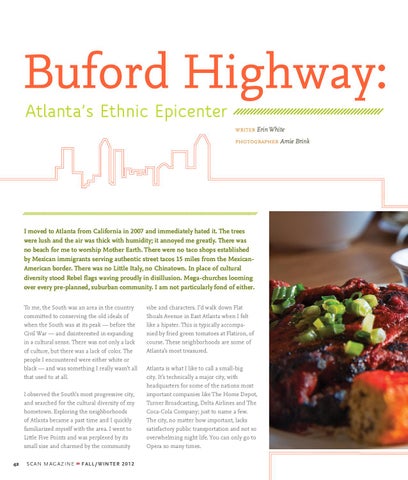
I moved to Atlanta from California in 2007 and immediately hated it. The trees were lush and the air was thick with humidity; it annoyed me greatly. There was no beach for me to worship Mother Earth. There were no taco shops established by Mexican immigrants serving authentic street tacos 15 miles from the MexicanAmerican border. There was no Little Italy, no Chinatown. In place of cultural diversity stood Rebel flags waving proudly in disillusion. Mega-churches looming over every pre-planned, suburban community. I am not particularly fond of either. To me, the South was an area in the country committed to conserving the old ideals of when the South was at its peak — before the Civil War — and disinterested in expanding in a cultural sense. There was not only a lack of culture, but there was a lack of color. The people I encountered were either white or black — and was something I really wasn’t all that used to at all. I observed the South’s most progressive city, and searched for the cultural diversity of my hometown. Exploring the neighborhoods of Atlanta became a past time and I quickly familiarized myself with the area. I went to Little Five Points and was perplexed by its small size and charmed by the community 42
S CA N MAGAZINE
» FA LL / W IN TER
2 012
vibe and characters. I’d walk down Flat Shoals Avenue in East Atlanta when I felt like a hipster. This is typically accompanied by fried green tomatoes at Flatiron, of course. These neighborhoods are some of Atlanta’s most treasured. Atlanta is what I like to call a small-big city. It’s technically a major city, with headquarters for some of the nations most important companies like The Home Depot, Turner Broadcasting, Delta Airlines and The Coca-Cola Company; just to name a few. The city, no matter how important, lacks satisfactory public transportation and not so overwhelming night life. You can only go to Opera so many times.
I continued to doubt cultural development present in Atlanta until I took my first drive down Buford Highway. The strip of highway begins north of Midtown and continues through Chamblee and Doraville, ending just outside the I-285 perimeter. It isn’t exactly a neighborhood because it is more commercial than residential, and lined with slightly run-down strip malls that contain authentic multi-cultural restaurants. And tons of them. The highway is a dream come true for the culturally deprived. Buford features more than 1,000 immigrant-owned restaurants and businesses and they are all delicious. What’s amazing is that you can eat all of
this authentic cuisine for very reasonable prices. The multi-cultural restaurants are run by immigrants from countries all over the world — Mexico, Vietnam, China, Ethiopia, India and other South Asian countries — and cooking up traditional eats is their specialty. I was stunned and pleased to see business signs written in different languages that were impossible to decipher. The long stretch is punctuated by brightly painted buildings that reminded me of downtown Tijuana. The highway is a getaway for the culturally deprived in search of something a little more ethnic. For everyone else, it’s an oasis for ridiculously delicious and cheap food.
F A LL/ W I N T E R 2 012
»
S CAN MAG AZI NE 43
you are here
44
S CA N MAGAZINE
Âť FA LL / W IN TER
2 012
illustrator Dylan Fagan
NS, MEA E H T VE U HA O Y F I IC. MUS E H T AVE WE H
SCADATLANTARADIO.ORG