A January Solidarity Walk in downtown Pendleton drew participants from all backgrounds. Willa Wallace led the Walk. See more on Page 5A
Tyasin Burns, a sophomore at Nixyaawii Community School, drives against two Kittitas defenders in a January ball game. For more about the 20-2 Golden Eagles check out Sports in Section B.
Board of Trustees Chair Gary Burke and Kelly Fitzpatrick from the Oregon Department of Veterans Affairs signed an MOU authorizing a Veterans Service Officer on the Umatilla Indian Reservation. More on Page 4A.
Confederated Umatilla Journal
2 Sections, 48 pages / Publish date Jan. 3, 2019
The monthly newspaper of the Confederated Tribes of the Umatilla Indian Reservation ~ Pendleton, Oregon February 2019
Section
A
Volume 27, Issue 2
Yakama decision halts Celilo art project Maya Lin installation part of six-site Confluence Project By Wil Phinney of the CUJ
THE DALLES – The Confluence Project’s sixth and final art installation planned at Celilo Park is on hold because of opposition from the Yakama Nation. The Yakamas oppose any development that encourages public access and would like to see the park decommissioned. Confluence, in collaboration with the Columbia River tribes and the celebrated artist Maya Lin, has created five projects that stretch from the Nez Perce homeland to the Chinook Coast. Each art installation was created at a site along the Columbia River deemed to be historically significant to tribes. Those tend to be at the confluence waterways. The other installations are at Cape Disappointment at Ilwaco on the Washington Coast, Fort Vancouver (Vancouver, Washington), Sandy River Delta (Troutdale, Oregon), Sacajawea State Park in Pasco, Confluence Project on page 20
Halfway to school
Members of the Board of Trustees and staff from the Confederated Tribes of the Umatilla Indian Reservation in mid-January toured the new Education Facility, which is about halfway complete. It is supposed to open in time for the start of school in the fall. For more, turn to Page 10A.
Hi-def cameras to watch CTUIR Housing By the CUJ
MISSION – Eight high-definition cameras, capable of recognizing faces and license plates, will be installed in mid-February in sections of tribal housing where traffic is the greatest. Marcus Luke, Housing Department Director for the Confederated Tribes of
the Umatilla Indian Reservation, said residents are eager to see the 360-degree cameras installed. Ray Denny, Public Safety Department Director, said cameras should help Tribal Police identify individuals suspected of committing crimes and causing trouble in the housing area. “Especially at night,” Denny said,
“cameras will help police see where individuals run to hide and locate them.” Luke said tenants want to see a halt to graffiti, vandalism, trespassing and parties, but the emphasis will be on violence, particularly shooting in the projects. Luke said there have been two relatively recent shooting incidents in which ‘Cameras in the Projects’ on page 25A
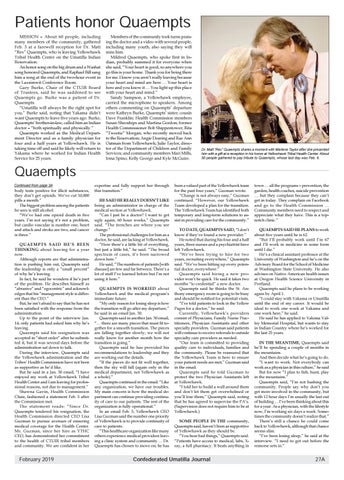
Honored as he leaves Dr. Matt “Rex” Quaempts watches a video made for his Farewell Reception Feb. 5 at Yellowhawk Tribal Health Center. For more about Quaempts’ departure turn to Page 3A.
Confederated Tribes of the Umatilla Indian Reservation 46411 Timine Way Pendleton, OR 97801
Presorted Standard U.S. Postage PAID Pendleton, OR Permit #100
CUJ News Meeting to discuss research on youth drug abuse By the CUJ
MISSION – A “community-sharing” event is planned Feb. 28 to disseminate new research concerning youth substance abuse on the Umatilla Indian Reservation. Confederated Tribes members and guests are invited. No special background is needed and lunch will be provided. The Center for Indigenous Research Collaboration Learning & Excellence (CIRCLE) has been working with the CTUIR to understand how to help tribal youth recovering from addiction, according to Sharon Randle at the Healing Lodge in Spokane. In 2013, the Healing Lodge of the Seven Nations and Harvard Medical School faculty collaborated on research for tribal youth who struggle with addiction. As CIRCLE, a grant was received to promote cultures
of recovery in tribal communities. Research is focused on how tribal communities can support their youth who return home from in-patient substance use treatment, Randle said in an email. “In particular we were looking at the social structures that can support the youth when they return home, such as behavioral health, youth court, school, TANF (Temporary Assistance for Needy Families), etc.,” Randle said. The research, Randle said was a full day strengthsand-needs assessment facilitated in each of the seven tribes served by the Healing Lodge. The research team went to six of the seven tribal communities, one time, to facilitate the assessment. The CTUIR will be the seventh tribe to receive the information. Since 2014, a Native American Research Centers for
Health (NARCH) grant from the National Institutes of Health has supported CIRCLE research with Umatilla Tribal members. “We want the Tribes to know what we learned from this research,” Randle said on a CIRCLE event flyer. “The tribal youth are our future and they need our help to live healthy lives.” The research belongs to the CTUIR. “We want you to know about the research we have been doing in collaboration for your tribe… We look forward to reconnecting with the community and sharing what we have learned,” Randle said. The event will take place at 11 a.m. in the Laxsimwit Yellowhawk Large Conference Room. Randle asks that participants RSVP to sharonr@healinglodge.org or by calling 509-795-8346.
Minthorn delivers inspiring message at inauguration Governor chooses CTUIR Longhouse leader to give benediction By the CUJ
SALEM – Longhouse leader Armand Minthorn delivered a “profound” and “inspiring” benediction at the end of the inauguration Jan. 14 of Oregon Gov. Kate Brown. Minthorn made his blessing, which included remarks and a Washat song with the bell, in front of joint session of the Oregon House of Representatives, Senate, the Oregon Supreme Court of Appeals, former governors, and tribal leaders from Oregon. Gov. Kate Brown invited Minthorn to participate in the ceremony, which also included words from Oregon Supreme Court Chief Justice Martha Walters. “I was deeply honored to have Armand Minthorn deliver the benediction at my inauguration,” Gov. Brown said in an email. “His profound words moved and inspired everyone in attendance. The benediction, and attendance by representatives of several Oregon tribes, made
theme that reminded Oregon leaders to be “selfless.” “All of us here are with one heart and one mind,” Minthorn said. “Our faith, our prayers, the examples of the old people before us can help guide our life. We all need direction in our life. “Every one of us, we’re all going in the same direction with one another. We are. This is how we take care of one another. This is how we take care of our faith.” After singing one Front row, from left, the pictured people include Labor Commissioner Val Hoyle, Attorney General Ellen Rosenblum, s o n g , M i n t h o r n t o l d State Treasurer Tobias Read, Court of Appeals Chief Judge James Egan, and Judge Rex Armstrong. And back row, the gathering: “There’s Armand Minthorn, Rabbi Rachel Joseph of Congregation Beth Israel (delivered invocation), Senate President Peter never a wrong time to Courtney, Governor Kate Brown, House Speaker Tina Kotek, and Supreme Court Chief Justice Martha Walters. sing and there’s never a Contributed photo wrong time to do right. the ceremony all the more meaningful.” dom. I am proud to call him my friend.” It’s true … Every one of you bring Senator Bill Hansell, who represents Kat Brigham, Secretary for the CTUIR medicine here today ... The most wonthe district that includes the Umatilla Board of Trustees, attended the ceremony derful thing we can do is pray with one Indian Reservation, said he, too, was with BOT Chair Gary Burke. “It was emotional for a lot of people,” another. That’s the most wonderful thing. impressed by Minthorn’s message. “My friend Armand Minthorn sure did Brigham said. “It was a good way to end It’s true.” Minthorn asked people to pray in their a great job,” Hansell said in an email. “I the inauguration. His words fit in with own way “so that we can be one heart, was sitting in the front row in the House Gov. Brown’s message that “we all need one mind. To strengthen the direction Chambers with my fellow Senators. Ar- to step up.” we’re going with one another, you and I.” Minthorn’s speech was wrapped a mand prayed with compassion and wis-
Confederated Umatilla Journal
46411 Timine Way Pendleton, OR 97801 Phone 541-429-7005
2A
Fax 541-429-7005 Email cuj@ctuir.org www.ctuir.org
... The monthly newspaper for the Confederated Tribes of the Umatilla Indian Reservation Publish date
Ad deadline
News deadline
March 7
Feb. 19
Feb. 26
April 4
March 19
March 26
May 2
April 16
April 23
June 4
May 21
May 28
July 3
June 18
June 25
Confederated Umatilla Journal
February 2019
CUJ News Dr. Quaempts leaving for ‘professional reasons’ By Wil Phinney of the CUJ MISSION – There are plenty of reasons why Dr. Matt “Rex” Quaempts is leaving Yellowhawk. But people should know, he said, that the Tribal Health Center is clicking on all cylinders. At this moment, however, the medical department doesn’t have a doctor and that is his biggest concern. In a two-hour interview with the CUJ Jan. 14, Quaempts talked about many positive aspects of his four years at Yellowhawk, as well as things that need to change. Quaempts wants to be a doctor, not the medical department administrator.
He said there isn’t enough “professional volume” and there isn’t enough “complexity and variety” in the cases he deals with. He also thinks the community complains too much about a good medical facility. But Quaempts said there is a chance – maybe 10 percent – that he would come back to Yellowhawk. The other 90 percent? He’d go back to Yakama where he worked for two decades. “Something is just not fitting in the keyhole here,” Quaempts said The community should recognize that Yellowhawk is a good clinic “owned by the people,” Quaempts said, calling Yellowhawk “top notch.” Quaempts is a big proponent of inte-
Sara Patrick elected to Cascade Locks City Council
February 2019
Quaempts on page 27A
By Wil Phinney of the CUJ
Contributed photo
CASCADE LOCKS – Sara Patrick wants to bring more tribal activity to Cascade Locks where she has been elected to the City Council. Patrick, a member of the Confederated Tribes of the Umatilla Indian Reservation, was one of three elected in a field of six candidates. It was Patrick’s first foray into politics. “I’ve been thinking about it since the beginning of last year. I talked to different people and then thought what the heck, I’ll throw my hat in the ring and see if I can make a difference.” As part of a tourism effort, Patrick wants to recruit CTUIR members to take part in different activities. “A lot of people have approached me about bringing more tribal activities,” she said. “At one point there was a little gathering in the community of different cultures,” said Patrick, adding that she wants the CTUIR members to join Warm Springs and Yakama tribal participants. Patrick’s priority is to open a line of communication between the City Council and the people of Cascade Locks. She’s been named to the Council’s Economic Development Committee and plans to work with the Port of Cascade Locks.
QUAEMPTS SAID HIS biggest accomplishment is cleaning up opioid use. He reduced the amount of patient use from 15,000 five-milligram Norco (hydrocodone) pills a month down to under 5,000. “It’s been exhausting,” Quaempts said. “But we don’t give it out as much. If some-
CUJ photo/Phinney
Dr. Matt “Rex” Quaempts talks with Andrea Hall during a reception honoring him on Feb. 5 at Yellowhawk Tribal Health Center.
NCS petitions to play in Class 2A
Sara Patrick is sworn in as a new Cascade Locks city councilwoman Jan. 15. Patrick is a member of the Confederated Tribes of the Umatilla Indian Reservation. She has lived “off and on” in Cascade Locks since 1967.
By the CUJ
grated-patient care, a program he helped shepherd as the medical department administrator. Integrated care offers patients a range of medical options with the attention of all of Yellowhawk’s care providers. “Across the country, Yellowhawk is ahead of the curve with patient care,” he said.
“I’m hoping to be involved in bringing more jobs and business to the industrial park,” she said. Patrick, 58, is the daughter of Harold W. Jones Sr., enrolled Grand Ronde, and Naomi Elsie Kash Kash, enrolled Umatilla. Her grandparents are Sam Kash Kash and Katheryn Harrison. Harrison is a Tribal Elder and and past chairwoman at Grande Ronde. She is the sister of Kat Brigham, Secretary of the CTUIR Board of Trustees; Dorothy Jones, Leo Stewart and Ralph Jones. Patrick has three daughters – Reannon Jones Morris, who works at the steel mill across the river in Stevenson; Juanita Patrick Hussey, a “military wife” living in Indiana; and Katheryn Patrick, who works at Brigham Fish Market in Cascade Locks. Patrick, a bartender at local taverns for the last 30 years, has lived on and off in Cascade Locks since 1967. She came back to the reservation a couple of times but “found this is the place I want to be.” Patrick is excited about starting her role as a city leader. “I have a lot to learn. In my campaign I told people I was green, wet behind the ears, willing to listen and willing to learn. It’s the first time I’ve actually been involved. Step up or shut up I guess,” Patrick said.
MISSION – Nixyaawii Community School (NCS) basketball and volleyball teams could be playing in the Class 2A Blue Mountain Conference if the Oregon School Athletic Association (OSAA) approves the new classification at a meeting Feb. 11. NCS petitioned OSAA to move up mostly because of the safety, cost and time to cross Cabbage Hill for games in the Class 1A Old Oregon League. As an added consequence, NCS would have tougher competition playing against Enterprise, Union, Stanfield, Great Union in John Day, Pilot Rock, Weston-McEwen in Athena, and Heppner. “We travel over Cabbage Hill nine times a year,” said NCS Principal Ryan Heinrich. “There’s the potential for us to travel to Baker City five times this year for the state tournament in Baker City.” In his petition to the OSAA, Heinrch wrote: The reasoning behind the request is straightforward; travel and future growth ... The travel in the Old Oregon League for basketball alone, on an average year is 1,648 miles compared to the lue Mountain Conference at 956 miles. Our biggest concern is traveling over Cabbage Hill during December, January and February ... The safety of the studentathletes and coaches is another concern; time and cost were also considered into the decision.” If the boys’ basketball team gets to the Class 1A state tournament in early March, which is expected, there would be two trips over the infamously dangerous Cabbage Hill, and if the girls qualify at district there could be three more trips to the state tournament in Baker City. Heinrich estimates saving about 700 miles in travel if NCS moves into the Blue Mountain League. The longest Old Oregon trip is the 286 round-trip miles to Pine Eagle. The longest Blue Mountain
Confederated Umatilla Journal
League would be nearly as long – a 274 mile drive to John Day. But there would be only one trip over Cabbage Hill in the 2A Blue Mountain League. That would be the overnight trip in which the teams would play Enterprise one night and Union the next. Also, the Blue Mountain League plays its district tournament in Pendleton. Both district and state tournaments for the Old Oregon League takes place in Baker City. That’s a lot of time on the road. “It’s a four-hour drive to Pine Eagle,” said Heinrich. “If there are JV games we could have 24 to 35 kids (in three vans). We leave after lunch and don’t get back before 1 a.m.” Fortunately, there is no school on Friday when the teams get back. NCS is expected to grow - Heinrich thinks the year will start with at least 100 students – when the new Education Facility opens in September. Currently, the school enrollment is 80, which falls within the 89-or-less classification for 1A. “I hear the eighth grade class if big,” Heinrich said. “I think the new facility will bring a few more students that are on the fence.” The Class 2A enrollment range is 90205, which would make NCS one of the smallest schools in the league. OSAA reclassified teams last year, starting a four-year cycle. “OSAA doesn’t like to change leagues in the first year of the cycle,” Heinrich said. “They don’t like to do it after one year. We’ll find out Feb. 11 when they vote.” At a recent Class 2A meeting of athletic directors Heinrich received letters of support from two teams. If NCS moves, it would make eight teams in each league. Wayne Miller, athletic director at Helix, said “I think they’re ready to go. They proved they can play at that level. They’ve got the kids and their looking to grow. I think it would be worthwhile.”
3A
CUJ News George St. Denis Post plans 100th birthday bash March 16 event will include Pa’xam, Gourd dances By the CUJ
MISSION – The George St. Denis Post 140 will celebrate the 100th year anniversary of the American Legion with a revival of the Pa’xam War Dance during a day-long celebration March 16. Although the agenda is not yet firm, the event will likely include a horse parade and gourd dance, and will recognize charter members of the American Legion Post that was established in 1927. Most of the celebration, which will also honor all veterans and Tribal leaders, will take place at the Nixyaawii Longhouse on the Umatilla Indian Reservation. The event will be hosted by Post 140 and the American Legion Auxiliary, which intends to record the celebration to preserve the history of the Unit.
Although the Pa’xam is no longer practiced here, it was performed in 1994 when the George St. Denis Post honored World War II veterans. The Pa’xam marked the end of the Bannock War in 1878 when Cayuse soldier helped the U.S. Army and militia defeat the Tribe that now resides on the Fort Hall Reservation in Idaho, according to Antone Minthorn, Commander of Post 140. Those three tribes were traditional enemies of the Cayuse, which fought in several battles with the U.S. Army and militia in the 1800s before CTUIR soldiers enlisted in World War I. Among those battles in the 1840s-1870s, were the Cayuse War in the Walla Walla Valley; the Walla Walla Tribe War;
the Yakima, Coeur d’Alene and Palouse wars; the Coeur d’Alene War; the Nez Perce War; the Bannock War; and the Sheep-eater (Shoshone) War. The event will begin at the Nix-Ya-Wii Warriors Memorial with gathering at the East end. It is hoped that along with an Eagle Staff, American flag and the CTUIR flag, other banners will be carried to represent all the armed services. The event at the Warriors Memorial will include a Washat song and prayer, statement from George St. Denis Post Commander Antone Minthorn, and close with a rifle volley and bugle taps. At the Longhouse, veterans will assemble to post the colors before an entry honor song. Also planned are the Nixyaawii Tehey (flag) song, a circle dance, and introduction of guest speakers. The Gourd Dance will be hosted by the Nez Perce Warrior Gourd Clan Society. The American Legion birthday lunch will include a Legion Auxiliary cake-cutting ceremony before final speakers and closing around 1 p.m.
Tribes, Oregon VA establish veteran service office SALEM - The Oregon Department of Veterans’ Affairs (ODVA) and Confederated Tribes of Umatilla Indian Reservation signed a memorandum of understanding (MOU) at the Oregon State Capitol Jan. 15 that will enable the tribal government to establish its first-ever tribal veteran service office. The tribal veteran service will operate just like a county veteran service office, providing direct services to tribal veterans under ODVA’s power of attorney. Like all county veteran service officers, the tribal veteran representatives (TVRs) will be trained and certified through ODVA. Sam Spino is the Veterans Service Representative for the CTUIR. Spino will be able to assist in the VA disability claims process and filing of claims. The CTUIR has 330 enrolled members that are Veterans of the armed forces. Several other people have been involved with the MOU included past veterans coordinators Toni Cordell and Bob Derocher, and veterans like Chuck Sams, Woodrow Star, Alan Crawford, Leo Stewart and Les Minthorn. CTUIR programs involved in the process include the Department of Children and Family Services, and the Office of Legal Counsel. Terry Bentley and Mitch Sparks worked on the MOU with the ODVA. Following a CTUIR Board of Trustees decision last year, the Veterans Service Representative works with only CTUIR members. Non-Indians who, in the past, received services now must go through Umatilla County’s Veteran Service representative. Oregon Gov. Kate Brown is the daughter of a veteran. “I know firsthand how critical the needs are for our service men and women and their families,” Gov. Brown said in a news release. “I am thrilled about this new partnership, which ensures the veterans of the Confederated Tribes of Umatilla will be able to access the services and benefits they have earned while serving their fellow Americans.” ODVA Director Kelly Fitzpatrick, who signed the MOU with CTUIR Board of Trustees Chair Gary Burke, said Veterans Affairs supports tribal veteran service offices that best serve veterans in their own communities. “Our veterans deserve the chance to work with service officers who understand their unique challenges, resources and cultural identity,” Fitzpatrick said in the news release. “This is the vision behind our network of county veteran service offices, and the same is true, if not even more so, for our tribal veterans.”
4A
Sam Spino, Veterans Service Representative for the CTUIR looks on as Board of Trustees Chair Gary Burke shakes hands with Kelly Fitzpatrick, Director of the Oregon Department of Veterans Affairs, who signed a Memorandum of Understanding (MOU). Fitzpatrick said the Dept. of Veterans Affairs supports tribal veteran service offices that best serve veterans in their own communities. Contributed photo
Burke signed the agreement with ODVA on behalf of the Confederate Tribes of Umatilla Indian Reservation. “Our tribes, men and women, served in World War I, World War II, Korea, Vietnam, and the wars that are happening today,” Burke said. “American Indians still believe that this is their country. And they are willing to put their lives on the line for this country. Thanks to these new services, more of our people than ever will have access to physical and mental healthcare and other benefits they have earned.” The MOU will allow ODVA to legally assist TVRs in their pursuit of claims for disability compensation and pension benefits to the U.S. Department of Veterans’ Affairs. ODVA will also be able to assist TVRs in filing appeals on any adverse rulings. The agreement helps ensure more tribal veterans are receiving the highest level of physical, mental and behavioral health care, with the support and assistance of the federal VA’s Office of Tribal Government Relations.
Confederated Umatilla Journal
“This partnership is a win-win for veterans,” said Stephanie Birdwell, Director of the Office of Tribal Government Relations. “We are optimistic that collaborative partnerships such as the MOU between ODVA and Confederated Tribes of the Umatilla Indian Reservation will inspire similar agreements elsewhere. Veterans will be able to work with a local, trusted TVR, and will not miss out on the benefits and services they earned through their service to America.” This is the second tribal veteran service office to be established in the state of Oregon. The first was created through an MOU signed with the Confederated Tribes of Warm Springs in August of 2018. For more information, visit Spino’s office in the Nixyaawii Governance Center or call him at 541-429-7389. Non-CTUIR can contact Spino as well. “I can help point you in the right direction to get the resources that you may need in the future,” Spino said.
February 2019
CUJ News
Many of the handmade signs carried messages of equality and solidarity between all groups regardless of gender, race or social class. Above a marcher carries a sign in the rainy and cold conditions during the Solidarity Walk Jan. 13. CUJ photos/Jill-Marie Gavin
Willa Wallace, above, takes a video of the walk that she organized and spoke at in Pendleton Jan. 13. The weather was in the 30’s but it didn’t stop participants from coming out in force to show their solidarity with their fellow marchers.
Solidarity walkers brave the cold, rain
Weyekin Wildbill carries a sign in the Solidarity Walk in downtown Pendleton Jan. 13. Wildbill said his girlfriend was a big reason he participated but over the past few years he’s witnessed his mother and sisters participate in the march and was never able to join. Wildbill’s sisters and mother weren’t able to make it out this year which encouraged him to participate on their behalf. He said, “Growing up with three sisters and having a caring mother helped me not only see the hardships that women go through but the special powers they possess. This year’s Solidarity Walk I wanted to not only stand for my mother, sisters or girlfriend but with the women in my community that had a big influence on me.”
February 2019
PENDLETON – Shivering allies huddled under a crowded tent on a cold and rainy Sunday morning in downtown Pendleton Jan. 13. As congregants rushed out of the cold into a nearby church on Main Street, men and women from both sides of the Umatilla Indian Reservation boundaries prepared to walk in solidarity. Many causes were represented among the group, messages on signs drew awareness to the Missing and Murdered Indigenous Women movement, called for equality for women’s reproductive rights, demanding justice for the impoverished were a few of the issues raised during the walk. No matter the individual purpose of each walker, event organizer Willa Wallace made it clear in her opening remarks that the end goal was unity among locals and citizens across the country. Participants travelled from Brownfield Park down Main Street to the Pendleton Chamber of Commerce and back. The group garnered several honks of support as they toted their signs in the 30-something degree weather.
Mildred Quaempts, above, joined by her daughter Annie Kirk (not pictured) opened the walk with a song and prayer. Quaempts has been a proponent of the the Missing and Murdered Indigenous Women (MMIW)awareness movement. She carried a ceder branch along with a sign. Quaempts, Kirk and Wallace all wore red to signify their support of the MMIW movement.
Confederated Umatilla Journal
5A
CUJ Editorials Snowy flight A bald eagle flies through a gap in the snow-covered trees up the Umatilla River in late January.
CUJ photo/Dallas Dick
T
The federal shutdown: A failure to govern
he recent partial Federal government shutdown is a clear demonstration of the Executive and Legislative branch’s failure to govern. The shutdown and reopening of Federal departments and agencies will have a long lasting, rippling effect across Indian Country. These branches of government failed to uphold their treaty obligations to more than 400 Tribes across the United States and to those nearly 170 Tribes where the United States has obligations to their establishment by executive order. As we all know, we ceded lands to the Federal government in return for guarantees such as health care, education, housing, and economic development. The portions of the Federal government that were shutdown, in particular the Departments of Interior, Agriculture, Justice and Housing and Urban Development have significant and direct responsibilities to Tribes. Interior houses the Bureaus of Indian Affairs (BIA), Land Management, Ocean Energy Management, Reclamation, Safety and Environmental Enforcement, plus National Park Service, Fish and Wildlife Service and the Office of Mining Reclamation and Enforcement. All of these agencies have direct financial and regulatory relations and commitments to Tribes. While Health and Human Services was operating during the shutdown they rely on Interior for funding of Indian Health Services. The funding was held up
CUJ Confederated Umatilla Journal
6A
causing Tribal clinics to deny services such as specialist referrals and drug prescriptions for Tribal members. Funding for BIA schools was held up for Native students. Tribal Housing programs were unable to draw down first quarter funding, Section 184 homeownership loans were placed in limbo, and the BIA could not work on lease agreements. Because Interior and several Federal agencies have review obligations, development plans, permits, and contracting documents for economic development came to a standstill for Tribal enterprises. Fortunately for us, here in Nixyaawii, the Board of Trustees and staff placed safety catches in our financial planning to ensure funding of our Tribal government operations in the event the Federal government fails to govern appropriately. By adopting a retrobudgeting process we only spend the funds we have earned in the previous year or have secured through grants and contracts. When the Federal government shutdown, the Board of Trustees activated a plan that allowed access to reserve capital and Tribal funds to cover the gap in Federal funds due to the Tribe. Successful governing. The brinksmanship game the Executive and Legislative branches played out over Christmas and the beginning of the New Year placed way too many people at risk - Indian and non-Indian alike. President Trump held all of us hostage over a campaign
46411 Timine Way Pendleton, OR 97801 541-429-7005 FAX 541-429-7005 e-mail: cuj@ctuir.org www.ctuir.org
Publisher:
Chuck Sams CUJ staff: Wil Phinney, Editor Jill-Marie Gavin, Reporter/Photographer Casey Brown, Reporter/Photographer Dallas Dick, Freelance Photographer
Confederated Umatilla Journal
promise to have Mexico build a wall that now must be the responsibility of the American taxpayer. Congress, the Senate in particular, refused to move a bill to reopen the Federal government for fear of a veto. A veto that they could have overridden for the sake of the American people. U.S. Senator Tom Udall (D-NM), vice chairman of the Senate Committee on Indian Affairs, has introduced a bill called the Indian Programs Advance Appropriations Act of 2019. This bill would protect essential Federal and Tribal programs from the significant impacts of budget uncertainty caused by Federal government shutdowns and short-term funding packages found in continuing resolutions. This bill would authorize advance appropriations for Indian Health Services, BIA and contract support costs for Tribes that run their programs, as we do here at home. The Board of Trustees supports the bill moving forward. The Trust responsibility of the United States is failing when they can’t pay their dues for the lands we have ceded. We cannot trust anyone who will not live up to their obligations. We must protect the health and welfare of our Tribal members so they are not placed in jeopardy at the whim of any branch of the Federal government. ~ CFS III
Display advertising rate $5 per column inch. Full page: $270 Half page: $135+ Quarter page: $65 Business Card: $27 Full color available Mail Subscriptions:
20 awards in 2018, including first places for best news story, feature photo, & health coverage.
Next CUJ: March 7 Ad deadline: Feb. 19 News deadline:Feb. 26
$15 per year or $28 for two years.
February 2019
CUJ Op-Ed/Columns Steep hill no problem A young Rocky Mountain bull elk climbs a hill before snow covered the Blues in mid-January. With the new snow, elk may be moving down into the flatlands to find food.
CUJ photo/Dallas Dick
CUJ Letters to the Editor Sampsons urge Tribes to oppose nuclear reactor legislation To the editor, We strongly urge our Tribal Board of Trustees-General Council and our people of the Umatilla, Cayuse and Walla Walla homelands, join our allies in opposition of Oregon Senate Bill 444. We cannot be swayed by those in Oregon who support Small Modular Nuclear Reactors as a “green energy” solution to solve climate change. We took bold action more than 30 years ago to shut down The Trojan Nuclear Plant. We may ask ourselves “does this ever end?” The answer is no. We must stay vigilant on the “no more nukes” pledge we took so many years ago. In fact, now more than ever we see billionaires and esteemed scientists such as Bill Gates, Jeff Bezos and Jim Hansen, backing nuclear power as a clean energy solution. But they all continue to skirt the issues of contamination to our sacred foods and medicines, homelands, waterways and the air we all breathe. Thirty years ago Lloyd Marbet came to our homelands to speak on Trojan, the dangers of nuclear waste, and our parents agreed to join him and his allies at the Richland, Wash., rally. While Trojan was closed, its nuclear waste remains stored on the shores of the great Columbia River. Decades later, SB 444 attempts to sound reasonable, but it’s an end run around Oregon’s long-standing protections against nuclear waste created from nuclear power plants. The bill would create a special exemption from Oregon’s moratorium on nuclear power plants, no longer requiring that an actual repository be established for the nuclear waste that would be generated. And SB 444 would eliminate the requirement for a statewide vote on new nuclear power plants, instead allowing a vote in only the city or county where the reactor is proposed.
February 2019
Make no mistake: small modular reactors still use nuclear fuel, and they still produce nuclear waste. And SB 444 makes it easier for nukes to make a return to Oregon. The call to rally is here again. Read the bill, research the websites and the work of allies we’ve joined in the environmental-social justice-green energy call to action. A special thank you to Lloyd Marbet, Conservancy Foundation; Dan Serres, Columbia River Keepers; and Damon Motz-Storey, Oregon Physicians for Social Responsibility, for research and edits to our letter. For more information check out www.oregonspr.org or www.columbiariverkeeper.org. Also, you can obtain the pdf file of SB44 from the Oregon Legislature by going to https://olis.leg.state.or.us/liz/2019R1/Measures/Overview/ SB0444 and click the word “text” at the top of the page. Join us in opposition of Oregon Senate Bill 444. Chawna Mun Naatma (We shall never fade) Peo-Peo-Mox-Mox - Don Sampson, Chief of the Walla Wallas We-ow’sux - Cathy Sampson-Kruse Sandra Sampson Linda Sampson
Cayuse Holdings ‘takes advantage’ of tribal government, membership The lengthy CUJ articles on Cayuse Holdings and Cayuse Technologies definitely deserves a factual and real-world response to all the great, but unrealized, claims set forth in the article. So far, after 13 years in business, Cayuse Technologies, now expanding into Cayuse Holdings, has never contributed to the annual CTUIR operating budget. The mere $15,000 that CT puts in is actually an honorarium paid to the BOT delegate to the Cayuse Tech Board of Directors, but the BOT delegate cannot accept it because this would obviously be double-dipping, a conflict of interest. Thus, the $15,000 goes into the budget. There are two significant ways that Cayuse Holdings LLC takes advantage of the CTUIR and its people. First, a major reason Cayuse Technologies set up business
Confederated Umatilla Journal
on our sovereign tribal lands is so they could avoid paying state business taxes to the State of Oregon. This is no different than other U.S. companies taking their business overseas. Second, Cayuse obtained the status of being a minority-owned business by the federal government because CTUIR tribal members own the business. This status guarantees Cayuse a certain percentage of federal work and labor contracts. However, so far tribal members, the shareholders, do not benefit in any way because Cayuse does not contribute to the tribal budget to support tribal programs, such as education, languages, elders, etc. Not too long ago there was a previous CUJ article on Cayuse also doing big things down in Utah. However, nothing ever really came out of that venture as Cayuse still does not contribute to the tribe. Thus, there is nothing to really support the idea that this Hawaii and/or Cayuse Holdings ventures will come to fruition. Board of Directors. In 13 years, I have not once heard or read of a member of the BOD advocate for the interests of the owners of Cayuse Tech; by owners I obviously am referring to the tribal membership. The BOD members are obviously just concerned that they receive their annual $15,000 honorariums for merely attending four quarterly meetings. Also, this will probably not change as the new BOD is virtually the same as the former BOD. Employment. The percentage of CTUIR enrolled employees at Cayuse Tech is about five percent. Could anyone define this to be successful? Of course not. Like I stated before, if when Cayuse Tech, now Cayuse Holdings, starts making meaningful contributions to the tribal budget, and employs a reasonable amount of CTUIR tribal members, I will be the first to acknowledge it. Bob Shippentower (Editor’s note: Cayuse Technologies did not expand into Cayuse Holdings LLC. Rather, Cayuse Technologies is now a business under the umbrella of Cayuse Holdings LLC. The Hawaii firm that the writer references, Native Hawaiin Veterans, is also a business under Cayuse Holdings LLC. Members of the Cayuse Holdings Board of Directors actually meet monthly, not quarterly.)
7A
CUJ Almanac CUJ hires new reporter Man arrested after shots MISSION – The Confederated Umatilla Journal has hired a new reporter to join their full time staff of two. Casey Brown, 32, is an enrolled member of the Delaware Nation of Oklahoma. She started her new position with the Confederated Tribes of the Umatilla Indian ReservaCasey Brown tion Feb. 1 and was most recently employed as Special Project Coordinator for the Pendleton Parks and Recreation Dept. Brown was born in Sante Fe New Mexico but lived in the Pendleton area since 1999. After graduating from Westen-McEwen High School she attended Cameron University in Lawton, Ok. Brown majored in English at Law-
ton and had a concentration in Creative and Professional Writing. After receiving her Bachelor’s Degree she worked there for the university as an institutional grant writer. During her studies she worked for the student newspaper, The Cameron Collegian, first as a staff reporter and then as an editor for the student life section and the arts and entertainment section. Brown also worked as a copy editor for the weekly paper. In December of 2016 Brown decided it was time to return to Oregon to be closer to family in the area. Her first job was on the Umatilla Indian Reservation as a poker dealer at the Wildhorse Resort & Casino. Brown said she wanted to use her degree more in her career. “I missed being away from journalism and writing. I love everything about journalism’” Brown said. Brown will work under CUJ Editor Wil Phinney and alongside Public Affairs Technician Jill-Marie Gavin.
fired into house Dec. 30
MISSION – One man was arrested in connection with shots fired into a house on Willow Drive on Dec. 30, according to a statement released by the Confederated Tribes of the Umatilla Indian Reservation. Umatilla Tribal Police received a call from Umatilla County dispatch a little after 6:30 a.m. Dec. 30 and officers were on the scene within one minute, according to the release. Suspects had fled prior to the officers’ arrival. Bullet holes were visible in the structure but there were no injuries. Not long after an off-duty Tribal officer (going home after his shift) observed three subjects leaving the area on foot toward Walla Walla Court. Officers responded to a residence on Walla Walla Court and, ultimately, the three subjects were contacted and detained, and two handguns were seized. Detectives and off-duty Tribal Police officers were called on-duty to assist in the investigation, the statement says.
Other investigative resources who assisted include the Umatilla Tribal Prosecutor, the FBI, the U.S. Attorney’s Office, and the Oregon State Police Crime Lab. Numerous witnesses were interviewed as part of the investigation conducted by Tribal Police. As a result, Francisco Antonio Arizaga Corona, a non-Indian, was arrested and lodged in the Umatilla County Jail on federal charges. Oregon State Police Crime Lab personnel processed the crime scene for evidence. Umatilla Tribal Police and the FBI processed evidence for forensic analysis and conducted follow-up interviews. On Jan. 1, Tribal Police learned that the U.S. Attorney’s Office had released Corona from custody pending the results of further case developments, according to the Communications statement. Because Corona is not a Native American, the U.S. Attorney’s Office has prosecution authority in this case.
Community Forum Senior Center February 26, 2019
6:00 PM
5:30 PM Potluck Kit Morgan, Oregon Legal Services “Consumer Remedies”
Pendleton Pioneer Chapel received three prestigious awards in 2009
The Oregon Funeral Directors Association Award of Funeral Service Excellence The Best Of Eastern Oregon Award as voted by the readers of the East Oregonian Pendleton Chamber of Commerce 2009 Business of the Year
Our experienced family provides caring, compassionate care including:
Burial Services ~ Military Services Cremation ~ Monuments
8A
Confederated Umatilla Journal
February 2019
Weather CTUIR Weather Report January 2018 Weather information summarized data taken at the Pendleton Weather Station from January 1 to January 31. The average daily temperature was 36.7 degrees with a high of 56 degrees on January 10 and a low of 22 degrees on January 1. With a departure from normal of 1.4 degrees Total precipitation to date in January was 2inches with greatest 24hr average .62 inches Jan. 22. 10 days out of the month had precipitation level greater than .01 inches with 6 days greater than .1 inches and with 1 day greater than .5 inches. There was a departure of +.64 inches from average for the month of January. The average wind speed was 6.1 mph with a sustained max speed of 33 mph from the West on Jan. 30. A peak speed of 41 mph occurred from the South West on Jan. 6. The dominant wind direction was from the north. There were 0 Thunder storms, 10 rain days, 3 haze events/days, 19 Fog/Mist events. Air Quality Index values remained good thru January with intermittent inversion interference bringing the air quality to MODERATE temporarily.
Correction A January CUJ story incorrectly stated that Board of Trustees member Sally Kosey voted to approve a $200 request from the Celebration Committee. Kosey wasn’t at the meeting; she was on approved travel with the Education Committee. However, Treasurer Doris Wheeler, who wasn’t listed in the story, was at the meeting and voted in favor of the request. General Council Chair William Sigo IV and BOT member Rosenda Shippentower voted against the Celebration Committee’s request, which passed 4-2.
Jobs Career Opportunitites
1. Archaeologist (2 positions) 2. Re-Education/Intervention Facilitator 3. Victim & Witness Assistant 4. Program Manager, First Food Policy Program 5. Police Officer 6. Child/Youth Advocate (Family Violence Services Program) 7. Public Transit Bus Driver Hermiston (part time) 8. Education Specialist: Special Education Facilitator 9. Equipment Operator I (2 positions) 10. Workforce Development Coordinator 11. Indian Lake Caretaker Seasonal 12. Secretary/Receptionist 13. Indian Child Welfare (ICWA) Caseworker 14. Technician I - Hatchery (Facility Watch Operator) 15. Office Assistant For more information visit: Confederated Tribes of the Umatilla Indian Reservation Att: Office of Human Resources Online 46411 Timine Way Pendleton, OR 97801 http://ctuir.org
CTUIR Board of Trustees Chair Gary Burke
General Council Chair Willie Sigo, IV
Vice Chair Jeremy Wolf
Vice Chair Michael Ray Johnson
Treasurer Doris Wheeler
Secretary Shawna Gavin
Secretary Kathryn Brigham
Interpreter Thomas Morning Owl
At-large BOT Members: Aaron Ashley General Council contact Info Sally Kosey Office: 541-429-7378 Rosenda Shippentower Email: GeneralCouncil@ctuir.org Meeting updates and information on: Woodrow Star
www.ctuir.org/government/general-council
CTUIR Office of the Executive Director :
Executive Director Ted Wright
General Council Meeting Nixyaawii Governance Center, Feb. 28, 2 p.m. Draft agenda: Healing Lodge of Seven Nations CTUIR Year End Financial Report Community Development Financial Institution Tamastslikt Trust Board Annual Report
CTUIR Express Phone Directory
February 2019
Tribal Court 541-276-2046
Human Resources 541-429-7180
Department of Children and Family Services 541-429-7300
Science & Engineering/Air Quality Burnline 541-429-7080
Enrollment Office 541-429-7035
Senior Center 541-276-0296
Finance Office 541-429-7150
TERF 541-276-4040
Finance – Credit Program 541-429-7155
Confederated Umatilla Journal 541-429-7399
Confederated Umatilla Journal
9A
BOT gets tour of Education Facility By Wil Phinney of the CUJ
MISSION – Construction is 50 percent complete on the new Education Facility being built on the Umatilla Indian Reservation. Work is on schedule with classes expected to start Aug. 27, according to Education Department Director Modesta Minthorn, who led a Jan. 22 tour with the Board of Trustees (BOT) for the Confederated Tribes of the Umatilla Reservation (CTUIR). The 63.000 square-foot building features two classroom wings on the south and north sides. “Education will be under one roof so we can collaborate on students in transition from daycare to Head Start,” said Minthorn. “We’ll be able to track students.” The old Education Center at the July Grounds will be demolished. The south wing of the new facility will accommodate children in Early Child Education, including daycare and the Head Start program. The CTUIR Language Program also will be in the south wing. The north wing will be the new home of Nixyaawii Community School (NCS), the public charter high school for grades 9 through 12. In between is a huge high-ceilinged commons with a mostly-glass entry wall that faces east, the direction of the rising sun. A commercial kitchen where staff
Workers move through the Education Facility as a tour takes place Jan. 22. Board of Trustees member Aaron Ashley (red shirt) talks with CTUIR Planning Director J.D. Tovey, as others, including from left, Kevin Kiniry with Chervenell Construction, Alaina Mildenburger from Public Works and Zack Brandsen, a teacher from Nixyaawii Community School, move through a wide hallway between the south and north wings.
will produce meals for all the students is also located between the two classroom wings. Planning is underway to figure out how best to meet the dietary needs of the children while also meeting federal nutritional requirements for NCS students who receive free-and-reduced meals. And, of course, there is a gymnasium, which currently is a huge concrete box that will look much different
when a basketball floor and hoops are installed. Minthorn told the BOT that new furniture, which is estimated to cost $400,000, will help fill empty rooms in early August with staff moving in midAugust. Minthorn said plenty of eyes are on the progress. Weekly meetings include representatives of the contractor (Chevrenell Construction from Pasco), the Education
Department (Minthorn), the Department of Economic and Community Development (Bill Tovey), Tribal Employment Rights Office (TERO), Public Works and the Information Technology (IT) Department. Another monthly meeting includes the project team as well as BOT Treasurer Doris Wheeler. A sub-committee for technology meets bi-monthly, Minthorn said. The overall construction budget is $16 million, which includes Tribal costs of $200,000 for TERO, $65,000 to the CTUIR Cultural Resources Program for excavation monitoring, and $123,000 for planning permits. There have been three major change orders, the first that saves the Tribes $97,000 because construction costs have decreased. Others will add about $165,000. Those additions will benefit the project, said Tovey, DECD Director. They include making side baskets in the gym with backboards made of glass instead of wood; placing fiber and utilities between the Nixyaawii Governance Center and the Education Facility; and adding offsite sewer between the school and Yellowhawk Tribal Health Center. The Recreation Program will remain under the Education Department, but won’t immediately move to the new building. The scope will be “narrowed” for the summer Recreation program and likely won’t include language classes, Minthorn said.
July Grounds plans updated
Sally Kosey, a member of the Board of Trustees for the Confederated Tribes of the Umatilla Indian Reservation, at the end of a hallway in the Early Childhood Education wing of the new Education Facility. Kosey is the BOT’s representative on the Nixyaawii Community School Board of Directors. CUJ photo/Phinney
10A
Confederated Umatilla Journal
MISSION – The Cay-Uma-Wa Education Center will be demolished and other buildings will be moved this summer in the July Grounds, which still will be home to the Longhouse, the Recreation Center with the gymnasium, and the unoccupied former Yellowhawk Tribal Health Center. Bill Tovey, Director of the Department of Economic and Community Development, on Jan. 22 updated the Board of Trustees for the Confederated Tribes of the Umatilla Indian Reservation (CTUIR). A budget of $5.5 million has been developed – but not yet approved - to repurpose the old Yellowhawk building. Tovey said the building is in good condition structurally with new windows and a heating-and-cooling system that was upgraded five years ago. Several potential occupants have shown interest, although the logistics and costs of operation-andmaintenance have not yet been part of the discussions. Among those that have indicated an interest are veterans and elders, the Tribes’ Housing Department, the CTUIR Workforce Development program, and the newly established Community Development Financial Institution (CDFI). The building also has been suggested as a community center. Last year remodeling and updating at the Rec Center was completed at a cost of $920,000 ($155,000 less than anticipated). Another row of bleachers and renovated restrooms were part of that upgrade. The 2017 budget also included $431,000 for demolition and landscaping costs, which will be completed after programs and staff move to the new Education Facility under construction just west of the new Yellowhawk Tribal Health Center.
February 2019
A group of Tribal leaders and staff walk into the commons area that separates the south wing for the Early Childhood Education and the north wing for the Nixyaawii Community School.
CUJ photo/Phinney
BOT members comment on new building Members of the Board of Trustees for the Confederated Tribes of the Umatilla Indian Reservation toured the new Education Facility, which is under construction west of the Yellowhawk Tribal Health Center. The BOT, on Jan. 22, walked through a building that was almost 50 percent complete. Concrete and steel studs mapped out classrooms, a dedicated language department, a commons and kitchen. Touring the building were BOT Chair Gary Burke and members Aaron Ashley, Woodrow Star and Sally Kosey, plus General Council Chair William Sigo IV, as well as staff from the Education Department and the Department of Economic and Community Development. BOT members were asked for their impressions of the new facility. Here are those comments: Burke, a former CTUIR building inspector, looked closely at the materials being used in the construction. While standing on the roof looking at the HVAC system components, Burke said simply, “It’s nice, very nice.” “I’m impressed,” the Chair said. “It’s more than what I thought … from the road is doesn’t look like this.” Burke said he was pleased to see Indians working on the construction and he said everyone is eager to see the building ready for the new school year.
Board Chair Gary Burke, left, and Bill Tovey, Director of the Department of Economic and Development Department, land Modesta Minthorn, Education Department Director, look up as Kevin Shafer from BBT Architects explains work in the gymnasium.
“I can’t wait to see the students, teachers and parents who send their children here,” Burke said. Sigo said the building was a long time
coming. “It’s functional,” Sigo said. “And obviously there’s been a need for 20 years.” Sigo was interested in safety for stu-
dents. “This building has security to keep our kids safe. That was non-negotiable,” Sigo said. Looking through the steel slats into an empty classroom, Sigo said, “I wish I’d had this opportunity when I was in high school or even at Cay-Uma-Wa (Head Start).” Kosey liked the magnitude of the building. “I’m impressed with the room size and look at these hallways, the kids can walk through without bumping armto-arm,” she said. “I like the layout of the school.” Kosey said the new building is “going to be perfect for our high schoolers.” She said, too, that students will be proud of their new school. “I think they will take ownership and show pride in this building,” Kosey said. “They’ll say ‘That’s our school now’ and they’ll take care of it.” Ashley said the Education Facility “was just an idea” when the Board zeroed in on plans during his first term in 2015. “It’s nice to finally see it coming to fruition,” he said. Ashley was somewhat overwhelmed, admitting that his chin was quivering when he stepped out of the mud through the doors of the new high school. “I got kind of emotional when I walked in,” Ashley said. “It’s a good day. I feel good. I’m happy.”
‘I got kind of emotional when I walked in ... It’s a good day. I feel good. I’m happy.’ BOT member Aaron Ashley
February 2019
Confederated Umatilla Journal
11A
Linda Jones retires after 45 years with CTUIR By Wil Phinney of the CUJ
S
ophie, Mazie, Rusty and Mr. Tibbs will be seeing more of Linda Jones now that she has retired after some 45 years of employment on the Umatilla Indian Reservation. Jones is retiring after 17 years in the Department of Natural Resources, a job she began in 2001 after working 25 years at Yellowhawk Tribal Health Center and three years in between at Wildhorse Resort & Casino. Her last day was Jan. 31. She’ll likely be just as busy, she said, with projects at home and in the community. And she’ll continue to share her house with three indoor Daschunds and Mr. Tibbs, a border colliehusky mix, who stays outside. Jones, 74, will maintain her role in the community, which includes root gathering and berry picking that go hand-in-hand with her responsibilities in the Longhouse kitchen, where she has been lead cook for years. Now she wants to find a lady to take over her role in the kitchen. And she wants to teach the young people how to carry on the traditional ways that she and her siblings learned from their mother and grandmother. Jones was one of 14 children with seven sisters and six brothers. Two sisters and a brother have passed, but the Jones family is still large. “I have lots of relatives; it’s a big family and the extended family makes us bigger,” Jones said.
A
t the Longhouse, Jones has led cooks in preparing food for all sorts of events, from memorials to feasts to the Sunday Washat Service dinner. She wants to teach all the younger cooks the “system” she learned as a child. “My mother would tell me to cook this first and that one last… she would get on us about how to prepare the foods. Who likes mushy potatoes?” she laughed. She’ll let the cooks know during remarks at the Sunday Wash. “I told them I’m getting older. One of you ladies has to step up and make the decisions. My goal is to find somebody to do that, let somebody else take over.”
J
ones began work with IHS in 1970 and then left for jobs in Northern Idaho and Western Washington. She returned to the Reservation and began work at Yellowhawk in 1972 - first as a dental assistant before she moved into a support-staff secretary position. After Yellowahwk she went to Wildhorse, then was hired in 2001 as a DNR administrative manager in the former Environmental Protection Rights Program, which is now known as the First Foods Policy Program. Over the course of her career, she was only unemployed for six months. At Yellowhawk and then in DNR’s Jones worked with the budget to address professional services, contract agreements, purchasing and the like. She enjoyed her work and the opportunities she had to learn on the job. “I liked my work. I was always busy, no down time,” Jones said. “I was always learning. All those DNR programs are not just a name. When I started I
CUJ photo/Phinney
Linda Jones holds two of her dachshunds - Rusty, left, and Sophie - at her home north of Mission along the Umatilla River. Jones is retiring from her position in the Department of Natural Resources. She also worked at Yellowhawk for 25 years.
didn’t know what they did. All that stuff was a gray area before I sat down with program managers who told me ‘This is what we do.’”
L
ast month, when her older sister turned 75, Jones “decided it was time.” “It was a big relief when I finally decided,” Jones said. “My family is all happy. They’ve been asking me for the last five years when I was going to retire.” Now she’ll have more time to do the things that have been “on the back burner” while she worked a full-time job. “I’m not going away. I’ll still be involved,” she said, mindful that she will still be coming to the Nixyaawii Governance Center making fish requests and reserving the Longhouse. She plans to take on the stacks of material she’ll use to sew for memorials. Jones said she hasn’t always felt like she does enough. She’ll concentrate more on making ribbon shirts, wing dresses, vests and shawls – “whatever we think anybody would like.”
F
or many young people, Jones said, the Longhouse activities are not familiar because parents haven’t been involved, but events like Culture Night on Wednesdays are exposing more children to their customs.
“We [Culture Night] started back in October with a whole new group,” Jones said. “It’s just nice and wonderful that they do come. We try to encourage parents to stay, too, and not just drop their kids off.” It’s important to Jones to pass on the knowledge she received when she was growing up. “I want to try to share the information with the young people that was taught to me. I don’t know if they listen or if it is absorbed in the memory bank,” Jones said. “I’ve been encouraging the kids because I think some want to learn.”
A
t home, Jones will be watching over 14-year-old Sadie, Mazie, 5, and Rusty, going on 3. Sadie has the queen’s spot on Jones’ lap, but Rusty likes it there, too. Mazie is a bit aloof when it comes to visitors, but she’s a barker that keeps Jones informed when a vehicle pulls up to her house north of Mission along the Umatilla River. Sadie is the adoptive mother to Mazie and Rusty, a fact that doesn’t get lost on Jones. “I told her (Sadie) that I need to get one more puppy for her to train,” Jones said. And Jones wants to complete a similar task – to train one lady to take over in the Longhouse. “It’s time for the young people to be moving up and do the work we’re doing,” Jones said.
CUJ briefs Cowapoo resigns from Celebration Committee MISSION – As promised in December, Babbette Cowapoo has resigned from the Celebration Committee. The Board of Trustees appoints a chair, but the rest of the committee is made up of volunteers. The Celebration Committee organizes community events, but also has expanded its reach to Wednesday’s Culture Nights at the Longhouse. The BOT plans to appoint a new chair on Feb. 22.
Cowapoo announced her resignation after the BOT struggled with the approval of a $200 request from the Celebration Committee to pay for food at its Dec. 21 Christmas pow-wow. The request passed by a vote of 4-2, but much discussion ensued. The Board talked about a process for addressing such requests, which was outside the Celebration Committee’s annual budget.
Convictions expunged under code amendments MISSION – Misdemeanor and some felony convictions can be expunged from criminal records following a Criminal Code amendment passed Jan. 28 by the Board of Trustees for the Confederated Tribes of the Umatilla Indian Reservation. The BOT voted 4-1 to approve the amendment, which will allow expungement of misdemeanors after five years and certain felonies after 10 years. The issue was approved by the Law and Order Committee and was heard in General Council in January of 2018. It was the third year this issue has been discussed. The expungement does not cover major crimes, such as murder, assault and/or sex offenses.
$7,700 in housing debts to be written off MISSION – A request from the Housing Department to eliminate $82,000 in renter debt was not approved Jan. 28 by the Board of Trustees for the Confederated Tribes of the Umatilla Indian Reservation. The Board did eliminate $7,784 from rent owners who have died. But the BOT did not approve a motion on the larger amount, which would
have eliminated debt for diseased, for those where the statute of limitations had expired, or because of a lack of documentation. The first motion was denied by a vote of 3-2 with BOT members Woodrow Star, Aaron Ashley and Rosenda Shippentower voting no. The second motion passed unanimously.
State releases area school’s graduation rates By the CUJ
MISSION – Nixyaawii Community School’s graduation rate increased by 16 percent in 2018, according to a report released Jan. 24 by the Oregon Department of Education. NCS Principal Ryan Heinrich told the School Board on Jan. 28 that the graduation rate jumped from 42 percent to 58 percent, but is still well below the state average of 78.1 percent. It s also lower than Pendleton High School’s graduation rate of 89.7 percent, which is above the state average but below the 94.7 percent mark from the 2016-2017 graduating class. Pendleton School District Superintendent Chris Fritsch said many factors occurred last year that could have affected the PHS rate, including staffing reductions due to budget constraints that impacted the operation of Hawthorne High School and PHS. “In short, we were trying to maintain the same program delivery system with fewer staff,” Fritsch said in a news release. Among just native students, the graduation rate at NCS, a public charter school in the Umatilla Indian Reservation, was up by 22 percent from 35 percent to 57 percent. Heinrich said the freshmen ontrack rate was up 23 percent. Because freshmen last year completed at least one-fourth of their credit require-
ment, NCS now has 77 percent of ninth graders (now earning credits as sophomores) with 6.5 credits or more. At PHS, that number was up 8.6 percent to 87.1 percent. The dropout rate at NCS dropped by 8 percent, the principal said. Heinrich attributed the improvements to a stable staff with the “continuity of teachers” and the school’s addition of elective classes, which provides “more options for kids to come here.” Last year NCS increased student opportunities to attend an additional Friday School, and added electives like carpentry and drama, and more online classes. The Pendleton School District’s graduation for 2017-2018 was 81 percent, compared to 83 percent the year before. This number includes NCS, PHS and Hawthorne High School. Superintendent Fritsch said that although the school district’s numbers for 2017-2018 are short of district goals and expectations, the number exceeds the state average and is 10 points above the graduation rate five years ago (71.6 percent in 2013-2014). “Although our graduation rate is lower, one year is not a trend. We don’t want our community to think something is wrong. We are working to improve and grow at all levels in our schools and remain committed to every student, every day,” Fritsch said in the news release.
46314 Timine Way Pendleton, Oregon 97801 541- 966-9830 www.yellowhawk.org
14A
Confederated Umatilla Journal
February 2019
Empower our Tribal Community with opportunities to learn and experience healthy lifestyles.
February 2019
Confederated Umatilla Journal
15A
As if they were made of wax McKay Elementary School in Pendleton was the scene of the annual wax museum Feb. 4. Gracin Bearchum played astronaut John Herrington. a Chickasaw who was a member of the 16th Shuttle mission to visit the International Space Station in 2002. Meadow TahlealEdsall chose Raenita Sue Jones. Two other youngsters, Ezekiel Woods and Miles Minthorn, were Chief Joseph and Martin Luther King Jr., respectively. CUJ photos/Dallas Dick
16A
Confederated Umatilla Journal
February 2019
Yellowhawk begins optometry services M-F doctor to work one day a week at clinic
By Wil Phinney of the CUJ
MISSION – A new optometric facility providing vision and medical eyecare services, including diabetic and pediatric exams, opened with a brief ribboncutting ceremony Feb. 1 at Yellowhawk Tribal Health Center on the Umatilla Indian Reservation. The ceremony featured a song led by Aaron Hines, a member of the CTUIR Health Commission plus remarks from Woodrow Star, a member of the Board of Trustees for the Confederated Tribes (CTUIR); Shawna Gavin, Health Commission Chair; Lisa Guzman, Yellowhawk CEO; and Ben Winters, a MiltonFreewater optometrist who will provide eyecare services one day a week at the clinic. Winters, who consulted on the equipment and floor plans, looks forward to the chance to work Fridays in a “new clinic with a new culture, new connections of professionals and peers, and a new challenge. It sounds like a lot of fun.” Even though he helped design it, Winters is still impressed with the finished product, which community members toured after the ribbon cutting. “There’s top of the line equipment with fashionable optical. It has wide hallways with exams rooms on one side and special testing rooms on the other side,” Winters said. The facility features a selection of some 800 frames, including brand names like Ray-Ban, Harley Davidson, Guess and Sketchers. It also includes a number of frames that can be paid for with Medicaid and another section that will be available at no cost to “PRC” clients. Three tiers of more expensive frames, including the brand names, will likely require some out-of-pocket costs. Winters said he wants the community to consider the facility the place to receive
Ben Winters from Milton-Freewater will provide optometry services on Fridays at Yellowhawk Tribal Health Center. Yellowhawk pattients will be able to purchase glass and frame at the new optometry center. CUJ photo/Phinney
all eyecare services, including treatment of acute eye conditions such as injuries or infections; management of chronic eye disease such as glaucoma, macular degeneration or cataracts; diabetes eye exams; pediatric eye exams; exam and prescriptions for eye glasses; and fitting and repair of eye glasses. At this time, Yellowhawk will not offer contact lenses, but Winters said that could be a future option. “Optometry is often labeled as glasses people, but an optometrist is the primary provider of eye healthcare. We will manage all eye issues up to the point where surgery is needed,” said Winters, noting he sees 80 patients a week at his MiltonFreewater office and all of last year he sent only one person to Tri-Cities for emergency eye surgery. Winters said that diabetes will be a heavy focus. “If blood sugar is poorly managed the fine vessels of the eye can be damaged,” the optometrist said. “That can lead to bleeding and damage to the retina.” Native Americans also have a high prevalence of astigmatism, Winter said, noting the three most frequent issues of
eyecare are near sightedness, far sightedness and astigmatism. Cataracts show up in many people after the age of 60 with the average age for cataract surgery age 67. Winters is an advocate of refraction surgery such as Lasik. “As often as I’m asked, I will refer patients to one of two surgery centers in Tri-Cities,” he said. Winters’ Milton-Freewater practice – Visual Eyes, which he purchased in 2014 from retiring Dr. Michael Garton, operates four days a week and sees many Yellowhawk patients. He said he will be “adding a commute and an extra day of work.” Lately, when he’s seen Yellowhawk patients at Visual Eyes he’s told them the next time they would see him at the CTUIR health center. “We’ll be one day a week until the word gets out,” Winters predicted. “If we’re booked out weeks in advance it’s possible we could add a second day.” The facility will also be staffed Wednesdays and Thursdays for scheduling, disbursement of new glasses, plus adjustments and repairs. Meg Carlson, a
para-optometric technician, will be working with Winters as a pre-tester before the doctor takes over. She also will be dispensing glasses during the week. Winters said he thinks Carlson’s work here could last a year, but plans call for hiring a full-time tribal member. Winters, 35, and his wife, Kate, have five boys ages 10, 8, 6, 4 and 1. Winters, a member of the Church of Latter-Day Saints, is an Eastern Oregon native who grew up in Vale. Unsure of his future, Winters attended Brigham Young University for one term, then volunteered for a two-year mission with the Mormon Church in Honduras where he decided he wanted to pursue optometry as his career. One afternoon while walking the streets of San Pedro Sulu, Winters encountered a large gathering of people waiting in lines to receive free eye exams and glasses. He later talked to a friend who said he couldn’t afford the eye exam or glasses on his own. “His new glasses allowed him to resume some of his work and thereby provide better for his family. That’s when I decided I wanted to be an eye doctor,” Winters said. Winters resumed undergraduate studies at BYU and Southern College of Optometry in Memphis, Tennessee. “Seeing my first patient was one of the most exhilarating and frightening experiences of my life,” Winters said. “Each exam was and continues to be a humbling encounter knowing that each patient is entrusting the health of their eyes and there precious eyesight into my hands.” Winters also is an adjunct assistant clinical professor at Pacific University in Forest Grove, Oregon. In that role, Winters hosts PU students in their fourth year of college for training. Outside optometry, Winters spends time with his family, his church congregation and actively participates in service groups like Rotary and Lions. His hobbies include family activities, rifle shooting, woodworking, hiking, downhill skiing, and Memphis-style barbecue. Yellowhawk Optometry will be open from 7:30-5 p.m. on Fridays. To schedule an appointment call 541-240-8661.
Cay-Uma-Wa Education Center will be demolished Several entities interested in old Yellowhawk building MISSION – The Cay-Uma-Wa Education Center will be demolished and other buildings will be moved this summer in the July Grounds, which will still be home to the Longhouse, the Recreation Center with the gymnasium and the unoccupied former Yellowhawk Tribal Health Center. Bill Tovey, Director of the Department of Economic and Community Development, on Jan. 22 updated the Board of Trustees for the Confederated Tribes of the Umatilla Indian Reservation (CTUIR). A budget of $5.5 million has been developed – but not yet approved - to repurpose the old Yellowhawk building.
February 2019
Tovey said the building is in good condition structurally with new windows and a heating-and-cooling system that was upgraded five years ago. Several potential occupants have shown interest, although the logistics and costs of operation-and-maintenance have not yet been part of the discussions. Among those that have indicated an interest are veterans and elders, the Tribes’ Housing Department, the CTUIR Workforce Development program, and the newly established Community Development Financial Institution (CDFI). The building also has been suggested as a community center. Last year remodeling and updating at the Rec Center was completed at a cost of $920,000 ($155,000 less than anticipated). Another row of bleachers and renovated restrooms were part of that upgrade.
The Cay-Uma-Wa Education Center building will be demolished after the staff moves to the new Education Facility. Other buildings also will be razed or moved at the July Grounds. CUJ photo/Casey Brown
The 2017 budget also included $431,000 for demolition and landscaping costs, which will be completed after programs
Confederated Umatilla Journal
and staff move to the new Education Facility under construction just west of the new Yellowhawk Tribal Health Center.
17A
Looking for a new you?
Call me Kimberly Weathers
Head 2 Toes Full Service Salon & Spa
221 South Main St. Suite 2 Pendleton, OR 541-379-0010
18A
No snow day today Public Works employees, including James “Jum� Wildbill, showed up before 6 a.m. to make sure the Nixyaawii Governance Center (NGC) was safe for the beginning of the business day Feb. 6. The NGC opened at 10 a.m. on Feb. 5 when local schools closed for the day; administration opted to open on time the next day.
Confederated Umatilla Journal
February 2019
Lake Hiyuumtipin (Indian Lake) in the winter. Snow pack at high elevations may see a reduction as a result of climate change while mid-elevations are expected to experience a large decrease in snow in coming years. Photo by Craig Kvern, CTUIR DNR Water Resources. Used with permission.
Climate celebrations and confrontations By Colleen Sanders, CTUIR Climate Adaptation Planner
C
limate change presents us (“us” being the global collective of humanity) with a unique opportunity to celebrate what is working within our societies, and the motivation to confront that which isn’t working. The word “opportunity” is where all the spin is concentrated in the previous sentence, and there is a reason why those who work with climate justice frame it in this positive tone. Talking with folks about climate change can quickly devolve into a gothic nightmare if you let it. The feelings that the problem is too overwhelming, too distant in time and space and too abstract to really wrap one’s mind around are all issues that every person who confronts our ongoing climate catastrophe must work through. And it is quite true: our global system of imports and exports, extraction and reconfiguration, is almost entirely built on the burning Colleen Sanders of fossil fuels. To address that means to radically reshape how we interact with the world. But despite the immensity of the problem, there are bright points in which we can find comfort. CELEBRATE: Renewable Energy IS the future! No matter what the declining coal and oil industry can do to prop itself up, the truth is the main force driving the obsolescence of fossil fuels is not environmentalism, but the precious “Free Hand of the Market” that the capitalist religion preaches. Innovations in wind, solar, geothermal, micro-hydro and many other technologies are creating products that are increasingly cheaper to produce, easier to use, and capable of producing sufficient energy for many typical building energy demands.
February 2019
CELEBRATE: Tribes are being recognized as leaders in this fight. Around the world, people with the closest connection to the land are the first to be impacted by climate change, and know best how to mitigate and adapt to its effects. Indigenous knowledge is being vindicated as equally as essential as “Western” science in the fight for survival, and Pacific Northwest tribes are driving policy action to have carbon treated as the pollutant that it is. CTUIR is engaged in the current discussion over CONFRONT: The world’s wealthy one percent carbon-reduction legislation in Salem, which is likely are learning that they will not be spared from change. to be the central issue for the 2019 Legislative session. For approximately the last 150 years, the rich have too CTUIR is also using indigenous knowledge, braided with trained scientific and technical often made their fortunes by expertise, to prepare our natural churning out carbon dioxresources for climate change. We’re ide and dumping economic People with the closest using preventative prescribed burns “externalities” on those who connection to the land are in our forests, and restoring river have less access, including floodplain functions on Meacham low income families and the first to be impacted by Creek, guided by the DNR’s River communities of color. The State of Texas is conVision and its First Foods Mission. climate change and know Increasingly, the world is realsidering investing $12 bilbest how to mitigate and izing the immense challenges that lion to armor the Gulf Coast climate change is creating and the shoreline against sea level adapt to its effects. extraordinary threats it poses. rise, with an initial $3.9 bilMuch of the knowledge of how lion dollars set aside for projwe can prepare for these changes ects to specifically protect oil facilities (US News & World Report, Aug. 22, 2018). is already here, in the culture, wisdom and spirit of Banks and insurance companies are awakening to the the CTUIR community. All we need is to refuse to skyrocketing costs to them from damages and claims be paralyzed by fear, doubt, or the enormity of the resulting from climate change impacts, forcing them problem. to raise their voices in support of climate action (Wall We must view it as an opportunity to right the wrongs Street Journal, Oct. 2, 2018). of the past and celebrate the amazing contributions that Via lawsuits and other avenues, evidence continues indigenous communities make to our planet! to mount that the fossil fuel industry has known for deIf you are interested in talking more about climate cades of the existence of climate change, yet deliberately change and adaptation, Colleen Sanders is the Climate concealed and lied about that evidence to preserve its Adaptation Planner for the First Foods Policy Program status quo and maximize shareholder profit. Now is the in the Department of Natural Resources. You can contime to hold them accountable for their part in causing tact her at ColleenSanders@ctuir.org or by phone at and directly benefiting from climate change. 541-429-7247. CTUIR has been a leader in the renewable energy sector, with the renewable energy generation at Tamastslikt Cultural Institute, participation in the Rattlesnake Road Wind Farm in Arlington, and the construction of the Ántukš-Tińqapapt (Sun Trap) Solar Panel Array at the Energy and Environmental Science field station (which will generate an estimated CO2 savings of 24.7 tons annually and will pay for itself in roughly 4.5 years).
Confederated Umatilla Journal
19A
Five of the six Confluence projects have been completed. The only one left is the artwork at Celilo Park on the Columbia River.
Confluence project at Celilo
Continued from page 1A
and Chief Timothy Park at Clarkston. The final Confluence project would celebrate Celilo Falls as a natural wonder in the Columbia River and historic center of fishing, commerce and spiritual life. The Dalles Dam flooded Celilo Falls in 1957. The three artistic elements of the Celilo project designed by Maya Lin are an interpretive pavilion, sculpture of the Columbia River and an elevated walkway inspired by traditional fishing platforms (see architectural rendering on page 21A). The project also includes repairs to the parking lot and facilities at Celilo Park. The Celilo Park project continues to have support from the three other Columbia River Tribes – the Confederated Tribes of the Umatilla Indian Reservation (CTUIR), the Confederated Tribes of Warm Springs, and the Nez Perce Tribe. They see a redeveloped Celilo Park as an opportunity to educate people about Celilo Falls, honor the indigenous people of the Columbia River and strengthen the tribal presence in the public place along the river, according to Colin Fogarty, Confluence Executive Director, who met with the CUJ in Boardman in mid-January. The CTUIR, which has supported the project since 2010, reiterated its support in April of 2018 and again in December.
20A
In a letter from Gary Burke, chair of the here today. [It] is exactly the kind of ‘eduCTUIR Board of Trustees (BOT), said, cation’ LCIS knows is vitally importance “The BOT wishes to express its appre- if we are going to have an informed and ciation and support to Maya Lin and respectful citizenry.” Confluence for undertraining the effort Further, three river chiefs – Wilbur to construct a fitting and appropriate Slockish, John Jackson and Olsen Meanus park redevelop– all support the ment project to conproject, according nect people with to Fogarty. ‘We have taken this as the history of Celilo But the Yakaan opportunity to reflect Falls and remind ma Nation, which visitors of the onsupported the and listen respectfully. going presence of project in 2011, Our guiding principles native people along has told the U.S. for moving forward are the Columbia River Army Corps of and its tributaries.” to listen first to our tribal Engineers (Corps), In addition to which manages partners and respect the three tribes, the Celilo Park that Legislative Comit no longer apall voices along the mission on Indian proves of the deColumbia River.’ Services (LCIS), velopment. which represents The Corps has Colin Fogarty, Confluence Executive Director nine Oregon tribes, indicated they are has given its blesswilling to proceed ing to the Celilo only with the project. unanimous supCheryl Kennedy, the LCIS Chair from port of all four Columbia River tribes the Confederated Tribes of Grand Ronde, with cultural ties to Celilo Falls. said the project “intends to connect JoDe L. Goudy, Yakama Nation Tribal people to place, to educate Oregonians Council Chairman, in an Oct. 11, 2018 letand visitors through the world on the ter to the Corps, formally pulled support past, present and future importance of from the project. The letter was written a Celilo Falls as a place of importance to day after a meeting between the Yakama Tribes and tribal people who have been Nation Tribal Council’s Cultural Comhere since time immemorial and still are mittee with staff and representatives of
Confederated Umatilla Journal
the Confluence Project. Goudy wrote: “… The Yakama Nation does not support this proposal, any of its component phases, or related art installations … Celilo Park is located at the site of a traditional Yakama village and fishing site. Continued use of this location by the public risks further destruction of the Yakama Nation’s cultural resources. The Yakama Nation does not support any development, disturbance or public attraction of any kind at this location.” In an April 2015 letter to the Corps, Goudy wrote: “The greater Celilo Falls was an immense resource constantly sought after by other tribes. Our ancestors protected this extremely important fishing village with their lives and many have been laid to rest here. Since time immemorial we have protected this area and resource. This fishing epicenter remains a focal element in our culture today … Yakama Nation members still fish, conduct ceremonial activities and live at Celilo. The monumental sites, legendary stories, traditional use areas, and spiritual and ceremonial sites are still part of our cultural practices … As Yakama people we have an obligation to the Creator to protect the resources inherent upon these lands. There are consequences if we do not honor these principles.” After a series of meetings in November and December with tribal councils, partConfluence Project on page 21
February 2019
Confluence project at Celilo ‘All the children are the next policy makers so they need to know what happened on the river.’ Antone Minthorn, Chair of the Confluence Board of Directors Continued from page 20A
ners and advisors, Confluence decided to redirect its energies toward ongoing education initiatives, including Confluence in the Classroom, Confluence in the Community, and Confluence Online, to provide information for students and citizens as well as professional development for teachers. The Online project will be a digital resource for educators, visitors and “anyone curious about a more inclusive understanding” of the Columbia River. Confluence, which is governed by a 12-person Board of Directors, is chaired by CTUIR elder and language instructor Antone Minthorn. A group that included Minthorn met with the Yakama Cultural Committee in October, met with the Warm Springs Tribal Council in November, and with the Umatilla BOT and the Council of Celilo advisors in December. “Throughout these discussions, we heard frustration at the Yakama Nation Culture Committee, but also thoughtful reflection,” Fogarty said. “We heard a diversity of opinions but the consensus of our tribal partners is that we should not give up on the Celilo Park project and that we should wait until the time is right … Our tribal partners remain confident that our project will move forward at some point, though none of us can say when.” Fogarty said, “We have taken this as an opportunity to reflect and listen respectfully. Our guiding principles for moving forward are to listen first to our tribal partners and respect all voices along the Columbia River. We also remember our commitments. At this point, it is more important to do this right than it is to do it right now.”
This artist’s rendering shows Maya Liins proposal for the Confluence proposal at Celilo Park. Lin is the artist who designed the Vietnam Memorial Wall in Washington, D.C.
Fogarty said Confluence representatives “This is Celilo Falls, the most signifieven told the Yakamas the artwork could cant place on the Columbia River, with a be set aside until later and money could dilapidated rest stop. We want the park first be used to improve the parking lot and to reflect the significance of the place fishing site access. respectfully.” But, Fogarty said, Minthorn said he the Yakamas fourremains optimistic ‘ In my dream, a member Cultural that there will be student that we bring Committee doesn’t a “win-win” resofeel it is respectful to to a rehabilitated Celilo lution to the issue. have any non-tribal Park to remember what Right now, howmember visit that ever, the decision happened will one place. by the Yakamas has “… They said they created a “lose-lose” day be the judge that don’t want anything. situation for the fiorders The Dalles Dam We went back to the nal Confluence into be removed. other tribes and they stallment. Colin Fogarty, said to be patient,” The Yakama Confluence Executive Director Fogarty said. Cultural ResourcFogarty said the es Committee has project will do nothbeen invited to ing to interfere with fishing, but the cul- visit the other five sites to better untural education about Celilo Falls would derstand why the major art pieces have be a benefit for generations. been installed and the message they
bring to visitors. Fogarty said in the end the Confluence projects – the art installations and the education component - elevate the tribal voice and the understanding of the Columbia River system. It’s hoped that the Celilo Park project will one day be among them. Minthorn said the Confluence projects would provide cultural and education opportunities into the future. “All the children,” Minthorn said, “are the next policy makers so they need to know what happened on the river.” Fogarty said the Celilo project will not be a memorial, because Celilo Falls still exists. “It will be a respectful space to remember. In my dream, a student that we bring to a rehabilitated Celilo Park to remember what happened will one day be the judge that orders The Dalles Dam to be removed,” Fogarty said.
AN OUTGROWTH OF THE LEWIS & CLARK EXPEDITION BICENTENNIAL, the Confluence began with discussion in 1999. In 2001, Minthorn and others went to New York to visit with Maya Lin, the artist who designed the Vietnam Memorial. A year later in 2002 Confluence was formally established. The Confluence evolved into Confluence in the Classroom, which connects students to place through art and education by introducing them to native artists and tradition keepers from the Umatilla Reservation, the Nez Perce Tribe, the Warm Springs, Chinook Nation, Grand Rondes and Yakamas. Confluence in the Classroom has grown, too, from an art program to include history lessons, social studies, ecology and traditional ecological knowledge. Students from Nixyaawii Community School and Pendleton High School have learned from Confluence in the Classroom. THE DECISION BY THE YAKAMAS has been characterized as “befuddling.” Other tribal leaders, Fogarty said, have told him they want people to visit Celilo Park so that they can learn.
February 2019
Confederated Umatilla Journal
21A
DEANA’S Auto Biz
541-969-9296 541-276-1406
22A
600 SE Court Pendleton
NO CREDIT?
541-969-9296 541-276-1406
600 SE Court Pendleton
BAD CREDIT? NO PROBLEM!
Confederated Umatilla Journal
February 2019
BOT to look at hemp info MISSION – By consensus, the Board of Trustees for the Confederated Tribes of the Umatilla Indian Reservation approved a request by Executive Director Ted Wright to gather information about a potential hemp crop. Wright said the BOT should keep hemp production on their “radar screens” now that the federal Farm Bill allows it. Hemp is part of the cannabis family but does not contain THC, the psychoactive ingredient found in marijuana. Hemp can be used for a variety of things, including food and nutrition, body care, paper, fiber, fuel, building materials, and as an alternative to plastic. BOT member Rosenda Shippentower opposed the plan, saying she was surprised as this issue “fell out of the sky.” She said hemp production is not listed as part of any BOT priority or in any departmental work plans. Shippentower asked Wright, “Don’t you have enough on your plate? There’s so much going on right now. We need to be cleaning up some of the stuff we’ve already started.” “I don’t want to hear about hemp, not today and not tomorrow. Maybe the next board will fall in love with it,” Shippentower said. The other BOT members were willing to hear about the issue after Wright gathers the information. Jeremy Wolf, BOT vice-chair, said the Farm Committee is willing to consider any opportunity as long as it is legal. He said hemp can get lost because politics and economic development do not always agree.
February 2019
CUJ photo/Jill-Marie Gavin
Gas flowing at Mission Market Fuel pumps are (finally) open for business at Mission Market. The goal of offering gasoline at the rural market has not been a simple or quick process, but it was good news for all involved when construction started on the project in November. The prospect of pumps in Mission was first mentioned in summer of 2017 but several hold-ups kept pushing the project out farther and farther until finally all the permits were issued. Above Wildhorse Hotel Manager Cal Tyer, right, and General Manager for Arrowhead Travel Plaza and Mission Market Tom Fine, left, test out the new pumps with a cash “pay-inside” purchase. Tyer and Mission Market Manager Shirley Warnock, not pictured, were the first to use the new pumps. Warnock got emotional while pumping her gas. Through tears she said that being able to sell fuel will really change the way the community sees Mission Market. Another employee at the market, Audrey Shippentower, said she looks forward to the convenience the pumps offer. Mission residents will no longer have to head up the hill to get their gas at the busy travel plaza, Shippentower noted.
Confederated Umatilla Journal
23A
Happy Valentine’s Day
BUY YOUR CAR WITH CONFIDENCE My Own Auto Sales will now have a 30 DAY, 1000 MILE DRIVE TRAIN WARRANTY on most vehicles. See us for details
30 Day, 1000 Mile Drive Train Warranty
2010 LINCOLN MKS AWD, 80K, Certified
$3,999
2006 FORD FUSION 154K
$4,999
2003 TOYOTA COROLLA
WHY PAY MORE? $3,999
wow - $4,999
2005 CHRYSLER PT CRUISER 125K
2005 FORD EXPLORER XLT SPORT V6, 4.0L Automatic 4WD
$3,999
2001 DODGE RAM 1500 2WD, 130K
Factory Warranty
$18,800
2017 KIA FORTE
13K
98k
2013 CHEVY EQUINOX LT AWD, Extra Clean!
Factory Warranty
30 Day, 1000 Mile Drive Train Warranty
2017 BUICK VERANO
2012 CHEVY 1500 EXT CAB
18K, WOW!
90K
So check out our variety here at
MY OWN AUTO SALES 4314 Westgate • Pendleton, OR 97801 • 541-276-4946
MAKE AN APPOINTMENT ANYTIME
IF YOU CAN’T COME TO US, WE WILL COME TO YOU! 24A
Confederated Umatilla Journal
February 2019
Cameras in the Projects Continued from page 1A
houses have been hit. Camera footage may be used by the Tribal prosecutor in criminal cases if the criminal action happens in the eye of the camera, Denny added. The motion-activated cameras will be monitored by Tribal Police and the Tribes’ Information Technology (IT) department. “Police will be able to roll the tape back, so to speak, and the information will be kept for at least a month,” Luke said. Some tenants are upset that it’s taken so long, said Luke, explaining that fiber optic lines had to be installed from the CTUIR Fire Department to Confederated Way and then to sites on power poles and, in some instances, on rental units. Luke said the facial-recognition cameras will be located on Mission Road and Shortmile Road, along with areas around Chokecherry, Willow, and Walla Walla Court. Cameras are not planned at this time in the Mission Creek subdivision.
Shots fired in projects in 2018 A review of 2018 incidents by the Umatilla Tribal Police and Tribal Prosecutor identified four reports of shots fired, according to Ray Denny, Public Safety Director for the Confederate Tribes of the Umatilla Indian Reservation. Only one of those incidents resulted in injury. Umatilla Tribal Police responded to a gunshot to a non-Indian in the River Road area. Suspicious circumstances are suspected and the case is still under investigation, Denny said in an email. Tribal Police responded to three other incidents in 2018 involving shots fired with individuals. However, there were no gun shot injuries, Denny said. An incident in late December 2018 near Willow Drive involved shots fire into a house; no injuries. In November 2018, shots were fired into an empty parked car near Walla Walla Court; no injuries. In July 2018, shots were fired into the air during a confrontation near Alder Street. Denny said a check with Tribal Fire Chief Rob Burnside indicated no one with a gunshot injury was transported by ambulance in 2018. “If there were other injuries by gunshot those injuries were not reported to the Umatilla Tribal Police or Umatilla Tribal Fire and Ambulance,” Denny said in an email.
Report: Cameras not alwaysreliable with dark subjects From the New York Times Facial recognition technology is improving by leaps and bounds. Some commercial software can now tell the gender of a person in a photograph. When the person in the photo is a white man, the software is right 99 percent of the time. But the darker the skin, the more errors arise — up to nearly 35 percent for images of darker skinned women, according to a new study that breaks fresh ground by measuring how the technology works on people of different races and gender. These disparate results, calculated by Joy Buolamwini, a researcher at the M.I.T. Media Lab, show how some of the biases in the real world can seep into artificial intelligence, the computer systems that inform facial recognition.
Happy Birthday 15th Birthday KCUW CTUIR’s Tribal Radio Station February 2019
Confederated Umatilla Journal
25A
EASTERN OREGON CENTER FOR
INDEPENDENT LIVING A Global Disability Resource and Advocacy Center EOCIL is a proud supporter of the CTUIR community and other communities and programs that promote and value inclusion, equality and opportunities for people with disabilities. EOCIL is a global disability resource and advocacy center that provides an array of services for people with disabilities. EOCIL is operated by people with disabilities.
Services Available:
- Informational and Referral - Independent Living Skills Training (budgeting and financial management, cooking, application assistance, etc.) - Peer Counseling - Individual Advocacy - Life Transitions (school to employment, home to home, corrections to community, etc.) - LGBTQ and two spirit resources
- Support Groups - Youth Mentoring Project - Representative Payee Project - Emergency Financial Assistance - Accessibility Assistance - HIV/AIDS Independent Living Project - And many other services
Locations: EOCIL has three locations: 322 SW 3rd St., Pendleton, Ore. webpage: www.eocil.org Email: eocil@eocil.org 541-276-1037 711 Relay Toll free: 1-877-711-1037 1021 SW 5th Avenue, Ontario, Ore. 541-889-3119 Voice 711 Relay Toll free 1-844-489-3119
The Dalles Office 400 East Scenic Drive Building 2, Third Floor, Suite 2 The Dalles, Oregon 541-370-2810 Toll free: 1-844-370-2810 Providing services in Harney, Malheur, Baker, Union, Grant, Wallowa, Umatilla, Morrow, Wheeler and Gilliam, Wasco, Sherman and Hood River counties.
EOCIL is a supporter of:
aocil.org • endhivoregon.org • adrcoforegon.org
The Shop We do tires, alignments, full automotive repairs, and more! Need an oil change? We recommend Pendleton Quicky Lube 238 SW Court Ave Pendleton Phone:
Main 541-276-8949 Fax 541-276-0581 Email:
theshop1.biz@gmail.com Ron Dirkes Owner
26A
Chamber elects officers
MISSION – Three new officers were elected by the Nixyaawii Chamber of Commerce Board of Directors (BOD) at their first monthly meeting Jan. 14. Chamber BOD member Aaron Hines was elected as the president in the last year of his three-year term. Before Hines Chamber BOD member Preston Eagleheart served as president. He will continue as past president. Hines, who previously served as the treasurer, is currently the Tribal Employment Rights Office Program Manager for the Confederated Tribes of the Umatilla Indian Reservation. Mary Liberty-Traughber, elected to the Board this year, was elected to the vice president position. Liberty-Traughber also serves as administrator for the Wildhorse Foundation and is the Public Relations Manager for the Wildhorse Resort & Casino. This is her first time serving on the NCC Board of Directors. During the meeting Chad Milten-
berger was elected as the 2019 treasurer. Miltenberger is an owner and operator of a family-owned Eastern Oregon sign shop, Sign Men, and is currently in his second year of his first term on the Board. Melissa Nathan was re-elected as secretary for the second year in a row. Nathan is the Marketing Director for Cayuse Technologies and is currently in her second year of her first term on the Board. Hines said of his election, “I am honored that my fellow directors selected me to serve as president this year. We will continue to build on the chamber’s mission of promoting and assisting native and locally owned businesses to grow our economy in the area.” Past President Preston Eagleheart, Chief of Staff at Cayuse Technologies, will continue on as a member of the Board. Other Board members include Dale Jenner, Jiselle Halfmoon, Lindsey Watchman and Jill-Marie Gavin.
Athena Chamber banquet Feb. 18 ATHENA - The Athena Chamber of Commerce Citizens and Business of the Year Banquet will be at 6 p.m. on Monday, Feb. 18 at Athena Christian Church. Tickets can be purchased at the door for $15. The event includes a silent auction and musical entertainment. Dinner and dessert will be prepared and served
by members of the church. The main focus of the banquet is fundraising. Donations for centerpieces are being accepted. Donations will pay for floral bouquets or donors can make their own centerpieces. For more information, contact April McKenna at 541-310-9557.
New NCF resolution approved
MISSION – A new resolution, necessary because of an error in the inadvertent appointment of a non-tribal member to the new Nixyaawii Community Financial (NCF), was adopted Feb. 4 by the Board of Trustees for the Confederated Tribes of the Umatilla Indian Reservation (CTUIR). NCF is a Community Development Financial Institution (CDFI) that is being organized here. Dave Tovey is the executive director for NCF, which eventually is expected to take over the CTUIR Credit Program and Education Foundation scholarship program. In addition to being a money lender, NCF will provide a financial instruction for tribal members. The Housing Department’s Financial Literacy classes likely will be part of that program. NCF has appointed a board, but does not yet have a site and has not developed specific plans. Tovey is scheduled to make a presentation to the General Council on Feb. 28.
In other business, the BOT: - Discussed how best to distribute tickets to events sponsored by Wildhorse Resort & Casino. In the past, the tickets for events like the Portland Trail Blazers, the Umatilla County Fair, and the Pendleton Round-Up, have been given to the Elders’ Group and Youth Council, as well as to members of the Board of Trustees. The tickets also have been raffled as employee performance incentive gifts. General Council (GC) Chair Willie Sigo said he would like to have the tickets to use as incentive to get tribal members to GC meetings. Other BOT members said GC could get some of the tickets, but not all of them. - Heard from Executive Director Ted White that his organizational structure will request a CEO or Deputy Executive Director. The BOT eliminated the position of Executive Director in 2017. A work session was to be scheduled to discuss the issue further. - Discussed how best to run the Feb. 6 and 7 BOT Retreat, which will be at Wildhorse Resort & Casino. White told the BOT that he will “map out” timelines and provide “clarity” on tracking aspects of projects and programs. BOT member Rosenda Shippentower said she wanted to hear from department directors and program managers about priorities set by the Board last year.
CTUIR Higher Education Program SPRING TERM SCHOLARSHIP DEADLINE 2018 Final Deadline February 28, 2018 Application Available Online http://ctuir.org/2017-18-ctuir-scholarship-and-avt-application Contact Brandie Weaskus at brandieweaskus@ctuir.org or (541) 429-7825
Confederated Umatilla Journal
February 2019
Patients honor Quaempts MISSION – About 60 people, including many members of the community, gathered Feb. 5 at a farewell reception for Dr. Matt “Rex” Quaempts, who is leaving Yellowhawk Tribal Health Center on the Umatilla Indian Reservation. An honor song on the big drum and a Washat song honored Quaempts, and Raphael Bill sang him a song at the end of the two-hour event in the Laxsimwit Conference Room. Gary Burke, Chair of the CTUIR Board of Trustees, said he was saddened to see Quaempts go. Burke was a patient of Dr. Quaempts. “Umatilla will always be the right spot for you,” Burke said, noting that Yakama didn’t want Quaempts to leave five years ago. Burke, Quaempts’ brother-in-law, called him an Indian doctor – “both spiritually and physically.” Quaempts worked as the Medical Department Director and as a family physician for four and a half years at Yellowhawk. He is taking time off and said he likely will return to Yakama where he worked for Indian Health Service for 25 years.
Members of the community took turns praising the doctor and a video with several people, including many youth, also saying they will miss him. Mildred Quaempts, who spoke first in Indian, probably summed it for everyone when she said, “Your heart is good, so anywhere you go this is your home. Thank you for being there for me. I know you aren’t really leaving because your heart and mind are here … Your heart is here and you know it … You light up this place with your heart and mind.” Sandy Sampson, a Yellowhawk employee, carried the microphone to speakers. Among others commenting on Quaempts’ departure were Kathryn Burke, Quaempts’ sister; cousin Dave Franklin; Health Commission members Susan Sheoships and Martina Gordon; former Health Commissioner Bob Shippentower; Rita “Tweetie” Morgan, who recently moved back to the Reservation; Angie Dearing and Rae Ann Oatman from Yellowhawk; Julie Taylor, director of the Department of Children and Family Services; and community members Mari Mills, Irma Spino, Kelly George and Kyle McGuire.
Dr. Matt “Rex” Quaempts shares a moment with Marlene Taylor after she presented him with a gift at a reception in his honor at Yellowhawk Tribal Health Center. About 50 people gathered to pay tribute to Quaempts, whose last day was Feb. 6.
Quaempts Continued from page 3A
body tests positive for illicit substances, they don’t get opioids. We’ve cut 10,000 pills a month.” The biggest problem among the patients he sees is still alcohol. “We’ve had one opioid death in five years. I’m not saying it’s not a problem, but cardio vascular is number one, heart and attack and stroke are two, and cancer is three.” QUAEMPTS SAID HE’S BEEN THINKING about leaving for a year now. Although reports are that administration is pushing him out, Quaempts said the leadership is only a “small percent” of why he’s leaving. In fact, he said he wonders if he’s part of the problem. He describes himself as “abrasive” and “egocentric” and acknowledges that his “management style is different than the CEO.” But, he isn’t afraid to say that he has not been satisfied with the response from the administration. Up to the point of the interview Jan. 14, only patients had asked him why he’s leaving. Quaempts said his resignation was accepted in “short order” after he submitted it, but it was several days before the administration sat down to talk. During the interview, Quaempts said the Yellowhawk administration and the Tribes’ Health Commission have not been as supportive as he’d like. But he said in a Jan. 30 email, “I have enjoyed my work at Yellowhawk Tribal Health Center and I am leaving for professional reasons, not due to management.” Shawna Gavin, Health Commission Chair, fashioned a statement Feb. 5 after the Commission met. The statement reads: “Since Dr. Quaempts tendered his resignation, the Health Commission directed CEO Lisa Guzman to pursue avenues of ensuring medical coverage for the Health Center. Ms. Guzman, since her hire as YTHC CEO, has demonstrated her commitment to the health of CTUIR tribal members and community. We are confident in her
February 2019
expertise and fully support her through this transition.” HE SAID HE REALLY DOESN’T LIKE being an administrator in charge of the medical section at Yellowhawk. “Can I just be a doctor? I want to get ugly again, 60 hour weeks,” Quaempts said. “The trenches are where you see change.” The professional challenges for him as a doctor, he said, are lacking at Yellowhawk. “Here there’s a little bit of everything, but just a little bit,” he said. “The broad spectrum of cases, it’s been narrowed down here.” He said, “The numbers of patients [with disease] are few and far between. There’s a lot of stuff I’ve learned before but I’m not using it here.” QUAEMPTS IS WORRIED about Yellowhawk and the medical program’s immediate future. “My only reason for losing sleep is how the transition will go after my departure,” he said in an email Jan. 30. Quaempts said in another Jan. 30 email, “… there are many pieces that must fit together for a smooth transition. The pieces are falling together slowly; we will not really know for another month how the transition is going.” Quaempts said he has provided his recommendations to leadership and they are working out the details. “If the pieces do not fit well together, then the sky will fall (again only in the medical department, not Yellowhawk as a whole).” Quaempts continued in the email: “Like any organization, we have our troubles. My main concern is how the medical department can continue providing continuity of care to our patients. The rest of the organization is fully operational.” In an email Feb. 5, Yellowhawk CEO Lisa Guzman said the number one priority of Yellowhawk is to provide continuity of care to patients. “This healthcare organization like many others experience medical providers leaving a clinic system and community … Dr. Quaempts has chosen to move on; he has
been a valued part of the Yellowhawk team for the past four years,” Guzman wrote. “Change is not always easy,” Guzman continued. “However, our Yellowhawk Team developed a plan for the transition. The Yellowhawk Team has identified both temporary and long-term solutions to assist in providing care for the community.”
town … all the programs – prevention, the garden, health coaches, suicide prevention … but they complain because they can’t get in today. They complain on Facebook and go to the Health Commission … Community members need to respect and appreciate what they have. This is a topnotch clinic.”
TO DATE, QUAEMPTS SAID, “I don’t know if they’ve found a new provider.” He noted that during his four and a half years, three nurses and a psychiatrist have left Yellowhawk. “We’ve been trying to hire for two years, recruiting everywhere,” Quaempts said. “We’ve been hitting up every potential doctor, everywhere.” Quaempts said hiring a new provider won’t be quick. He said it takes two months “to credential” a new doctor. Quaempts said he thinks the St. Anthony emergency room is going to be busy and should be notified for potential visits. “I’ve told patients to look in the Yellow Pages for a doctor,” he said. Currently, Yellowhawk’s providers consist of Physicians, Family Nurse Practitioners, Physician Assistants and other specialty providers. Guzman said patients will continue to receive referrals to outside specialty care providers as needed. “Our team is committed to providing quality care to individuals, families and the community. Please be reassured that the Yellowhawk Team is here to ensure your patient needs are met,” Guzman said in the email. Quaempts said he told Guzman to protect the two Physician Assistants left at Yellowhawk. “I told her to build a wall around them and don’t let them get overwhelmed or you’ll lose them,” Quaempts said, noting that he has agreed to supervise the PA’s. (Supervision does not require him to be at Yellowhawk.)
QUAEMPTS SAID HE PLANS to work about five years until he is 62. “But I’ll probably work until I’m 67 and I’ll work in medicine in some form until I die.” He’s a clinical assistant professor at the University of Washington and he’s on the Advisory Board for the School of Medicine at Washington State University. He also advises on Native American health issues at Oregon Health Science University in Portland. Quaempts said he plans to be working again by April 1. “I could stay with Yakama or Umatilla until the end of my career. It would be ideal to work one week at Yakama and one week here,” he said. He said he has applied to Yakima Valley Memorial Hospital, but wants to stay in Indian Country where he’s worked for the last 25 years.
SOME PEOPLE IN THE community, Quaempts said, haven’t been as supportive of Yellowhawk as they should be. “You hear bad things,” Quaempts said. “Patients have access to medical, labs, Xray, a full pharmacy. It beats anything in
Confederated Umatilla Journal
IN THE MEANTIME, Quaempts said he’ll be spending a couple of months in the mountains. And then decide what he’s going to do. “I want to work. Not everybody can work as a physician in this culture,” he said But for now “I plan to fish, hunt, play in the mountains.” Quaempts said, “I’m not bashing the community. People say why don’t you get more involved in the community, but with 12 hour days I’m usually the last out of building … I’ve been thinking about this for a year. As a physician, with the lifestyle now, I’m working six days a week. Sometimes the community doesn’t realize that.” There’s still a chance he could come back to Yellowhawk, although that chance seems slim. “I’ve been losing sleep,” he said at the interview. “I need to get out before the remorse sets in.”
27A
28A
Confederated Umatilla Journal
February 2019
News & Sports
Section
The monthly newspaper of the Confederated Tribes of the Umatilla Indian Reservation ~ Pendleton, Oregon
B
February 2019
Cortney Herrera dances with the Rhythmic Mode dance team in January. See more page 15B.
Deven Barkley and Dazon Sigo have led the Nixyaawii Community School basketball team to a 20-2 record. Players and coaches say the seniors also CUJ photos/Phinney lead the team off the court. Ermia Butler, left, and Tyanna Van Pelt battle for the basketball. More on 5B.
Barkley, Sigo lead NCS on and off the court By Wil Phinney of the CUJ
Seth Cantu outside the Mission Seventh Day Seventh-day Adventist Church where he now works. Read more page 11B.
Sistine Moses joins in an ice breaker during a Youth Council trip in February. See more page 17B.
February 2019
MISSION – Players and coaches agree: seniors Deven Barkley and Dazon Sigo “set the bar” as leaders on and off the court for Nixyaawii Community School. “They are the glue for sure. I’ve had seniors before but those two are leaders you really want. They are the kind of captains, the kind of kids, that coaches want to have ‘They’re honor around,” said NCS basketball society kids and I Coach Shane Rivera. Both are “quiet leaders,” guarantee both will according to NCS Principal be in college next Ryan Heinrich. “Dazon and year. They’re not just Deven piggyback in the leadsports guys, they’re ership role.” Barkley heads up the well-rounded kids.’ advanced drum group and - NCS Coach Shane Rivera Sigo is class president. Sigo and Barkley have the second and third highest grade point averages, respectively, and both are members of the Honor Society. Teammates agree. Juniors Mick Schimmel and Quanah Picard, who have been playing for years with Barkley and Sigo, both used the phrase “set the bar” in describing the two seniors. “They are both great leaders. They set the bar in how we
Confederated Umatilla Journal
act in practice and how we act in games,” said Schimmel. “Dazon is quiet off the court, but on the court he’ll tell you to listen up and take practice seriously. Deven is one of those leaders that whenever something needs to be done he’ll do it. If we need a bucket he’ll find a way to make a bucket.” Picard is equally complimentary. “Deven welcomed me and Dazon when we trans‘It’s his team. Deven ferred (as sophomores from has been a leader Pendleton High School). It’s his team. Deven has been a since we were little leader since we were little kids. He was always kids. He was always older and more mature. He knew older and more the right thing to say to put mature. He knew somebody in check.” the right thing to say Picard said the seniors “lead on my behalf more to put somebody in off the court than on. They check.’ remind me to get my school work done and to be to class - Quanah Picard, teammate on on time.” the NCS basketball team Nobody goes harder than Barkley. “He more than hustles,” Picard said. “He pushes himself until he’s standing in the corner over a garbage can. I’ve Barkley, Sigo lead on and off the court on page 2B
1B
Deven Barkley, left, and Dazon Sigo, below, play hard against Imbler in an Old Oregon League game Feb. 2. The two seniors are leaders at Nixyaawii Community School, both as basketball players and as students. CUJ photos/Phinney
Sigo, Barkley lead on and off court Continued from page 1B
seen him in practice and in games. He encourages you to be better and pushes to the limit every night.” As for Sigo, Picard said he talks on defense and lets everyone know where they need to be. Not only that, Sigo has “taught us not to give up” as he battles chronic injuries. “He pushes through,” Picard said. Barkley was a lineman for the Pilot Rock-Nixyaawii football team that made it to the playoffs. Sigo worked at McDonalds during the fall sports season. “But we think about basketball year
round,” Sigo said. The only two seniors on the team explained what a leader means to them. “A leader is the one who takes you on a path toward a good future,” Barkley said. “It’s about communication. We always high five each other. That supports good chemistry.” Said Sigo, “A leader is someone everyone looks up to for anything. You pick up people around you and if they’re down you ask them why.” This is Barkley’s fourth year as a Golden Eagle. When he was a freshman, he was surrounded by a state play-off team that included Hunter
pendletonartandframe.com See us on Facebook and Instagram
2B
Melton, Ira Ashley, Rico McKay, Fredy Campos, and Damon Kipp. They didn’t always get along, according to Barkley. “I learned to like my teammates. Don’t worry about what’s happening off the court when you’re in the game,” he said. Sigo played junior varsity at PHS then transferred to NCS. “I came to play with all my friends. Quanah, Mike Deven, we all grew up together. I wanted to be closer to home,” Sigo said. Both know their roles on the basketball court for this year’s Old Oregon League champions. “Deven could lead in any statistical category,” said Coach Rivera. “He’s been playing so long he can do it all. And not a single player goes harder than Deven.” Barkley likes the fast break best because it gives him options. “I like to figure out where and how to get it there,” he said. “Do I drive and go left (he’s right handed) and take it myself or do I drive and kick it out?” But he knows he doesn’t have to score for NCS to win. “It’s a team sport with four other guys that are just as good as you are. On our team anyone on the floor can score in double figures,” he said. Sigo is the team’s leader on defense and leads the team in rebounding. “He sacrifices on the offensive end because so many people can score. He’s unselfish but he’s more than capable of scoring,” Rivera said, noting that Sigo hit three three-pointers in a row and scored the team’s first 11 points in one game. “He’s 6-1, but he plays like he’s 6-3. He’s stronger than most players. He anchors our defense verbally and physically,” Rivera said. Sigo can score but he likes defense best. “I like yelling. I like steals and blocks and rebounds that set up the fast
Confederated Umatilla Journal
break,” he said, saying earlier: “I don’t need to score, but I can score if I need to.” Rivera said, “They’re honor society kids and I guarantee both will be in college next year. They’re not just sports guys, they’re well-rounded kids.” Barkley, the son of Stephanie and Jeremy Barkley (grandparents Ramona and Mike Yeager, John and Mel Sue Barkley, Teresa and David Clough, and John Bevis and Katie Black Wolf), plans to attend either Portland Community College or Western Oregon University. He plans to study exercise science and wants to be a physical therapist. He “may walk on” to see if he can make a basketball team. Sigo is the son of Doris Sigo (grandparents Bill and Cemmey Sigo, and Garrell and Kevin Moore) and wants to attend either Portland State University or the University of Idaho to study biology. He hasn’t decided on a career path. Before that, though, there are two tournaments. Expect NCS to win the OOL District Tournament Feb. 14-16 since they’ve breezed through the competition during conference play. That will put them among the top eight teams in the Class 1A State Tournament in Baker City in late February. “Let’s just say it. We’re going to take it all,” Barkley said. It won’t be easy. “We have to adjust to the big crowd,” Sigo said. (He got some exposure to big crowds when PHS’s Warberg Court was packed in the game against Kittitas.) “We’ve gotta want it more than everyone else,” Sigo said. “We have to play as a team.” As he searched for it on his phone, Sigo said he heard a quote from U.S. Senator Cory Booker that sums up how he sees his team: “If you want to go fast go alone. If you want to go far go together.”
February 2019
CUJ Sports NCS boys bound for Baker City tourneys Golden Eagles expected to win District Tourney and reach State By the CUJ
MISSION – Nixyaawii Community School’s boys’ basketball team won their 20th game of the year Feb. 2, whipping Imbler by 34 points, to build their record to 20-2 with two games left in the Old Oregon League before the district and state tournaments in Baker City. The squad also lost its second game of the year, falling to Kittitas, Washington, which is ranked number one in the Class 2B league (comparable to Class 2A in Oregon). Kittitas is the two-time defending champions in Washington. Kittitas, led by Brock Rivet, who has signed a letter of intent to play at Division 1 Gonzaga next year, put the hurt on NCS, 92-53 at Pendleton High School’s Warberg Court where the stands were full. Rivet, said NCS Coach Shane Rivera, is the best high school basketball player he’s seen. The 6-1 senior guard scored 36 points. He had the complete game – quick release on his 3-ball, smart passes, dribble with left and right hand, and he had the hops going to the basket. Plus he had a good team – three other seniors – on the floor who could catch his passes and score as well. The loss didn’t hurt the Golden Eagles, Rivera said. “I think it helps us focus. It’s certainly the level we need to get to if we want to compete at state,” the coach said. District is Feb. 14-16. Sub-state games start the next week with the tournament in Baker City Feb. 28 through March 2. Because they won the Old Oregon League, the Golden Eagles won’t have
to play on the first day of the district tournament. Against Imbler, a 71-37 blowout, Nixyaawii took a 19-6 lead and held a 39-14 lead at halftime. NCS would have held Imbler to 11 in the first half if not for a half-court buzzer beater. “It’s hard to stay focused in a game like that,” Rivera said. NCS was hot from three-point land, but took the ball to the rack as well. That’s an emphasis for Rivera. “We’re a good shooting team, but I’d love to see us go to the basket hard,” he said. Rivera left his starters in throughout the game because it’s hard to simulate the intensity of game situations in practice. “We need to stay in game shape for four quarters. I didn’t keep them in there to beat somebody bad. They need to work four quarters,” Rivera said. Mick Schimmel, who led Nixyaawii with 21 and remains the team’s leading scorer, was pleased with the team effort. “We have good chemistry, something we’ll need at state,” he said. Nixyaawii 83, Powder Valley 52 (Jan. 4) MISSION - Sophomore point guard Tyasin Burns scored 33 points, including 18 in the third quarter, to lead NCS over rival Powder Valley. Nixyaawii held a slim two-point lead after a quarter and stretched it to eight at the half. Then Burns led a 31-point third quarter that put the game out of reach. At the end of the third period Nixyaawii led 65-41. Mick Schimmel scored 16, Dazon Sigo had 10, Deven Barkley 9, Magi Moses 8 and Moses Moses 7. R. Bingham led the Badgers with 14, while R. Dixon added 13 and D. Grande scored 12.
Quanah Picard drives against an Imbler defender. As the scoreboard shows, the Golden Eagles were already ahead by 30 in the game. CUJ photos/Phinney
Nixyaawii 66, Wallowa 35 (Jan. 5) MISSION - Quanah Picard scored 18 points and led the Golden Eagles to victory over Wallowa. Picard, a junior wing, scored all but two of his points in the first half. Three others scored in double figures – Schimmel had 12 while Burns and Moses Moses each scored 11. Barkley scored 8, Sigo 3 and Magi Moses 2. The boys raced to an 18-8 first period lead and then outscored Wallowa by 21 points in the second quarter to build a 43-12 halftime lead. Christopher Nobles led Wallowa with 16 points. Nixyaawii 68, Cove 18 (Jan. 11) COVE - This one was way lop-sided. NCS took a 16-3 first period lead and had a commanding 34-5 lead at halftime. Eight Golden Eagles scored, led by Burns with 16, Sigo 11, Picard 10. Barkley, Schimmel and Magi Moses had 8 apiece. Witten scored 10 for Cove.
Junior Mick Schimmel continued to lead the Nixyaawii Community School Golden Eagles in scoring.
February 2019
Nixyaawii 85, Helix 40 (Jan. 12) HELIX - Five boys scored in double figures and the Nixyaawii Golden Eagles more than doubled the Helix Grizzlies in an Old Oregon League game. Barkley led the charge with 20, followed by Moses Moses with 14, Sigo and Schimmel with 13 each and Burns added 11. Magi Moses scored 8. Sprenger scored 19 for Helix with six field Nixyaawii boys’ basketball on page 4B
Sophomore guard Tyasin Burns drives to the hoop in Nixyaawii’s non-conference game against Kittitas, the number one Class 2B team in Washington. Kittitas, led by Division 1-bound playmaker Brock Rivet, gave the Golden Eagles their second loss of the season. As of Feb. 2, Nixyaawii had a 20-2 record with only two league games left before the Old Oregon League tournament in Baker City. The Class 1A state tournament at the end of February and first of March will also be played in Baker City.
Confederated Umatilla Journal
3B
Nixyaawii boys’ basketball Continued from page 1A goals and five-for-five free throw shooting. Nixyaawii 106, Helix 34 (Jan. 18) MISSION - Nixyaawii led by 31 points after the first eight minutes of the game and went on to score 21 in the second quarter, 28 in the third and 20 in the fourth. Barkley, who hit three from long range, scored 18 of his game-high 34 points in the first quarter. Picard, with 18 points, scored 11 points in the second quarter. Schimmel, with 14 points, scored 10 in the third quarter. Other scorers included Sigo 13, Moses Moses 11, Magi Moses 6, Burns 5, Luis Ortega 3 and DeAndre Rodriguez 2. I. Adams scored 9 for Helix and K. McKire had 8. Nixyaawii 52, Joseph 35 (Jan. 19) JOSEPH – NCS led by only a point after the first quarter and by three at halftime, but outscored Joseph 17-7 in the third period to stretch their lead to 39-26. Schimmel and Picard each had 12 points with Moses Moses and Barkley adding 9 apiece. Magi Moses had 6, Burns 4 and Sigo 2. Fene led Joseph with 15. Kittitas 92, Nixyaawii 53 (Jan. 25) PENDLETON – A packed house at Pendleton High School watched a senior-laden Kittitas, the defending Washington Class B state champions, put it to Nixyaawii, handing the Golden Eagles their second loss of the year. Led by B. Ravet, who is heading to Division 1 Gonzaga, canned just about everything he put up, including seven 3-pointers to finish with 36 points. When he wasn’t shooting the long ball, Ravet, son of the animated Coach Tim Ravet, was
driving to the hoop with either hand or dishing it off to teammates, three of whom were in double figures. Kittitas was just as strong on defense and NCS found themselves in unfamiliar territory – trailing by 11 after the first period and by 26 at halftime with the lead at 47-21. Moses Moses, coming off the bench, led NCS with 14, Schimmel had 12 and Magi Moses had 10. Barkley and Picard each scored 6, Sigo had 4 and Burns 1. Nixyaawii 48, Wallowa 38 (Jan. 26) WALLOWA – Nixyaawii came out flat, perhaps because of their loss the night before but rode a six-point first period lead through the game. The Golden Eagles never trailed. C. Hart led all scorers with 26 for Wallowa. For NCS, Picard scored 18, all but two in the first half. Magi Moses scored 8, Barkley and Schimmel each had 7, Burns scored 6 and Moses Moses added 4. Nixyaawii 82, Pine Eagle 23 (Jan. 31) PINE EAGLE – The Golden Eagles, playing their third game in three nights, traveled for more than three hours for a win with all 10 Nixyaawii players scoring. The squad led 22-4 after one quarter and 41-10 at half. They scored another 41 in the second half. Schimmel led NCS with 17, followed by Moses Moses with 15, Sigo 13, Reuben Bronson 10, Barkley 9, Burns 6, Picard and Magi Moses 4 each, and Jace Ashley and Rodriguez with 2 apiece. T. Gulich led Pine Eagle with 9. Nixyaawii 79, Helix 44 (Feb. 1) MISSION – It was 47-14 at halftime with Nixyaawii in control from the first jump ball. Schimmel and Burns led with the NCS scoring
It was a packed house at Warberg Court at Pendleton High School when the Nixyaawii boys played Kittitas, the number one Class 2B (same as Oregon’s 2A) team in Washington. Here Mick Schimmel CUJ photo/Phinney drives past Martin Arreola. with 21 and 19, respectively. Picard scored 15, Magi Moses 10, Barkley 6, Moses Moses and Sigo 3 each, and Ashley 2. Sprenger led Helix with 15 while D. Carlson added 9 and G. Newtson 8. Nixyaawii 71, Imbler 37 (Feb. 2) MISSION – The Golden Eagles won their 20th game of the season with the destruction
of Imbler, racing out to a 19-6 first quarter lead before building a 39-14 halftime edge. J. Burnett, who scored 25, was the only Panther comfortable shooting. Schimmel led NCS with 21 scoring 11 in the first quarter. After that, Moses Moses had 14, Picard 12, Barkley and Magi Moses 6 each, and Sigo 2.
A career/trade fair will be held on February 22, 2019 from 9am-3pm @ Wildhorse Resort & Casino For more information, please contact the TERO staff at 541-4297193 or by email at terostaff@ctuir.org 4B
Confederated Umatilla Journal
February 2019
CUJ Sports
Tyanna “TT” Van Pelt eyes the basket against a pair of Imbler defenders in the girls 53-37 win Feb. 2. Van Pelt scored four points.
Senior post Ermia Butler grabs the ball away in a win over Powder Valley on Jan. 4. CUJ photo/Dallas Dick
Nixyaawii girls fighting for chance to play at District By the CUJ
MISSION – The Nixyaawii Community School girls’ basketball team made their run at an Old Oregon League district tournament berth with six wins in a 10-game stretch, improving their league record to 13-6. However, since all the losses have been in league play the girls were fighting to make a playoff spot at the district tournament in Baker City Feb. 14-16. As the CUJ went to press, NCS was
in a precarious position. The girls had to beat Elgin on the road Feb. 8, knowing it would be a tough chore to defeat Number 1 Joseph on Saturday. If they whipped Elgin, a team they beat by four points, 38-34 on Jan. 19, the girls would qualify in the third and final spot for district play. That’s even with two losses to Helix. NCS beat Helix 56-28 on Jan. 12, but had to forfeit the game because one girl played six quarters – one more than allowed. (Players can play in both junior
varsity and varsity games, but only for a combined five quarters.) The second loss to Helix was a bummer. The girls gave up 19 points in the third quarter and lost by five, 49-44. It was too many turnovers and not enough rebounds. “We had a breakdown,” Coach Jeremy Maddern said. “The girls are young, they make young mistakes. There’s stuff we’re still trying to learn and we’re getting better every game.” The next day, Feb. 9, Nixyaawii
whipped Imbler, 53-37. “The girls responded after a tough loss, a bad loss to Helix,” Maddern said after the game. “I think we’ve made big strides in terms of execution and defense. Our record doesn’t show it but we’ve been competitive all season. The only blowout was against Joseph (51-34) and they’re number one.” Powder Valley 40, Nixyaawii 32 (Jan. 4) MISSION – A slow six-point first half spelled Nixyaawii girls’ basketball on page 6B
Lark Moses, above, readies to square up for a three-pointer against Imbler Feb. 1. Moses led the team with 11 points, including three 3-pointers. Watching from the sidelines are Coach Jeremy Maddern, Alyssa Tonasket and Pierce Watchman. At right, Watchman looks for a shot in a game Nixyaawii won, 53-37. CUJ photos/Phinney
February 2019
Confederated Umatilla Journal
5B
CUJ photos/Phinney
Adilia Hart dribbles up the floor with a fast break against Imbler, a game the girls won, 53-37, on Feb. 2. Trailing the play is Tyanna Van Pelt.
Nixyaawii girls’ basketball Continued from page 5B doom for the Golden Eagles, who outscored the Badgers, 26-24, in the second half. Senior post Ermia Butler led NCS with 14 with Lark Moses and Mackenzie Kiona with six each, and Ashyln Looney and Trista Melton with three apiece. M. Bingham scored 15 for Powder Valley. Wallowa 49, Nixyaawii 45 (Jan. 5) MISSION – Nixyaawii made a run in the fourth quarter, outscoring Wallowa by five points, but the Eagles held on for the Old Oregon League win. The Golden Eagles trailed by two, 24-22, at halftime after scoring just 4 points in the first quarter. In the second half, NCS started slow and Wallowa built a 37-28 lead heading into the final stanza. Lark Moses, who led Nixyaawii with 13, scored 7 in the fourth quarter. Other NCS scorers were Butler with 9, Kiona 7, Melton 6, Kylie Mountainchief 4, with Adilia Hart, Looney and TT Van Pelt with 2 each. Jamie Johnson scored 14 to lead Wallowa. Nixyaawii 48, Cove 35 (Jan. 16) COVE – Moses scored 19 and Kiona added 17 to lead Nixyaawii over Cove. The Golden Eagles trailed by one, 8-7, after the first period, but Moses had 8 in the second period and NCS held a 25-18 halftime lead. After Moses and Kiona, Van Pelt and Melton each had 4, with Looney and Mountainchief adding 2 each. Duby and Kendall each had 9 for Cove. Nixyaawii 56, Helix 28 (Jan. 12) HELIX – The girls dominated this game, taking a 21-8 lead after Moses canned four 3-pointers. Moses finished with 17 – all scored in the first half. After that Kiona scored 12, Butler 11, Melton and Mountainchief 5 each, Van Pelt 4 and Hart 2. Krol led Helix with 8. Nixyaawii 38, Elgin 34 (Jan. 19) MISSION – NCS trailed by six in the first half, but outscored Elgin 24-14 in the second half and hung on for the win. Moses hit five 3-pointers and finished with 17, followed by Kiona with 11, Butler and Melton with 4 each and Looney with 2. T. Anderson scored 11 for Elgin. Joseph 51, Nixyaawii 34 (Jan. 19) JOSEPH – The girls scored just four points in the first half and trailed 30-4 at the intermission. NCS outscored Joseph 30-21 in the second half but it was too little too late. Looney led Nixyaawii with 8, while Moses, Kiona and Butler with 6 each. Pierce Watchman and Melton scored 4 each and Alyssa Tonasket added two. H. Miller scored 14 for Joseph. Wallowa 47, Nixyaawii 41 (Jan. 26) WALLOWA – A close game from start to finish, the score was knotted at 19 at the half. Wallowa’s J. Johnston scored 15 points in the second half and led all scorers with 17.
6B
Confederated Umatilla Journal
Ashlynn Looney looks for the basket between two Imbler defenders in game Feb. 2. For Nixyaawii, Moses and Butler each had 13 followed by Watchman with 8, then Van Pelt, Kiona and Melton with 2 each, and Allyson Maddern with 1. Nixyaawii 46, Pine Eagle 31 (Jan. 31) PINE EAGLE – Lark Moses hit five 3-pointers to lead Nixyaawii with 15 points. The girls held a one-point lead after the first quarter, but scored 30 points in the second and third periods to take a 37-25 lead. After Moses, Butler scored 8, Melton had 7, with Maddern, Van Pelt and Watchman adding 4 each. Lillian Star scored 2 and Mountainchief and Tonasket each scored 1. C. Chitwood scored 9 for Pine Eagle. Helix 49, Nixyaawii 44 (Feb. 1) MISSION – After beating the Grizzlies by 28 at Helix, the Nixyaawii squad gave up 19 points in the third and trailed by 33-24 heading into the final period. Moses hit four 3-pointers in a fourth-quarter comeback, but the Golden Eagles catch up. Moses and Butler shared high point honors with 17 each. Three other girls scored – Melton had 5, Star 4 and Watchman 1 Kiona was left off the roster because of grades. Krol and A. Ward scored 13 each, R. Stanczyk had 11 and K. Cope 10. Nixyaawii 53, Imbler 37 (Feb. 2) MISSION – NCS led by nine at halftime, but Imbler mounted a third quarter comeback and pulled within two heading into the fourth period. Moses scored 11 with three 3-pointers to lead NCS. Every time Imbler pulled to within one or two, Moses hit a 3 and Nixyaawii never trailed. C. Migrimmas hit five 3-pointers and led all scorers with 26. After Moses, Butler had 13, Melton 10, Van Pelt and Mountainchief 4 each, Hart and Watchman 2 apiece and Star scored 1.
February 2019
TigerScots hoops teams keep at it At left, Stockton Hoffman (white uniform) releases the ball from his fingertips for a bucket against Union in a Blue Mountain Conference game. Hoffman is the leading scorer for the Weston-McEwen TigerScots boys’ team, which had a record of 5-20 overall and 3-9 in the Blue Mountain Conference. Weston-McEwen’s last three games, as of press time, were losses to Grant Union 54-48 on Feb. 2; Pilot Rock 70-64 on Feb. 1; and 7-55 against Enterprise Jan. 25. Below right, Auralia Heay, dribbles down the floor in a recent game for Weston-McEwen High School. The TigerScot girls’ basketball team was 5-18 as of press time with losses posted most recently against Grant Union, 62-33, on Feb. 2.; Pilot Rock 58-47 on Feb. 1; and Enterprise 53-42 Jan. 25. The girls were 0-11 in the Class 2A Blue Mountain Conference. In the photo, below center, Kyella Picard, playing for Weston-McEwen Middle School, drives around a Helix defender. The Weston A team, which also includes Taylor Quaempts, defeated Helix, 40-21.
CUJ photos/Dallas Dick
Hunter Education course set MISSION – A Hunter Education course, which will include participation in a last-day firing range, will be offered in April by the Umatilla Tribal Police. Participants of any age must attend all the classes – April 4 and April 8-13 – to receive certification and a Hunter Safety card. The Confederated Tribes of the Umatilla Indian Reservation, and the state of Oregon require a Hunter Education course for all new hunters age 17 and younger, unless hunting on land owned by parent or legal guardian, or unless participating in the Mentored Youth Hunter Program. The course here will be taught by officers Richard Bobbitt, Tommy Thompson and Bob Fossek.
February 2019
The course provides a thorough introduction to the skills hunters need, such as firearm safety, hunter ethics, wildlife identification and hunt preparation. There is no age restriction and adults new to hunting, or those needing a refresher, are encouraged to take the course. Bobbitt said as long as a youth is able to read and write and pass the test they will be certified. He said children as young as six or seven are expected to attend. The conventional classroom setting includes 14-16 hours of instruction plus a field day that involves a live-fire exercise and hands-on evaluation of safefirearms handling. The course costs $10 per student. For more information, call 541-429-7644 and leave a message for Officer Bobbitt.
Tribes ‘investigating’ purchase of Pendleton Country Club MISSION – Wildhorse Resort & Casino CEO Gary George said he’s been directed to “look into” the purchase of Pendleton Country Club, the 18-hole golf course situated along Birch Creek between Pendleton and Pilot Rock. “I’ve been asked by the Board (Board of Trustees for the Confederated Tribes of the Umatilla Indian Reservation) to investigate,” George said. George said it’s up to Tribal government to determine what would be done with Pendleton Country Club should Wildhorse buy it. However, George said, “With over 22 years’ experience with golf course we’d like to see it stay open.” Features at Pendleton Country Club include the 18-hole golf course, practice facilities, a 1,000-square foot indoor fitness center, swimming pool, restaurant, bar, and banquet room.
Special fishers meeting set for Feb. 12 MISSION - The Fish and Wildlife Commission is hosting a special fishing meeting at 1:30 p.m. on Feb. 12. at the Nixyaawii Governance Center, 46411 Timine Way. The meeting will be held in the Winahah and Qapqapa Conference roomL201A- on the northeast corner of the second floor. Fishers who would like more information about the annual boat safety certificate can contact Officer Richard Bobbit at 541-429-0550. For more information about the fishers meeting contact Preston Bronson at 541-429-7277 or Jeremy Wolf at 541-429-7382.
Confederated Umatilla Journal
7B
CUJ Sports
Pendleton High School was sporting a record of 14-5 as of Feb. 6 with a 3-1 mark and was sitting second behind Hood River Valley in the Class 5A Intermountain Conference. The boys defeated Redmond, 56-53 on Feb. 1, on a long threepointer at the buzzer by Dakota Sams. It was the fifth win in a row for the Buckaroos, who had earlier beaten La Grande 67-49 Jan. 29; The Dalles 81-60 Jan. 25; Crook County 5843 on Jan. 18; and Baker 82-48 on Jan. 15. In a game against league leading Hood River, the Bucks lost by 10 points, 77-67, on Jan. 11. Pictured at right is Kason Broncheau in a game against La Grande. Also on the team is Chauncey Sams.
Muriel Hoisington, left, a 5-8 freshman starting for Pendleton High School girls’ basketball team, passes the ball to a teammate in a game against La Grande in early January. Pendleton girls were 7-12 overall and 3-1 in the Intermountain Conference, sitting second behind Redmond. PHS had won three of their last four games, which included a loss to Redmond, 56-45, on Feb. 1. The team defeated La Grande 53-47 on Jan. 29; The Dalles 40-34 Jan. 25; and Crook County 76-30 on Jan. 18. The Buckaroo girls’ squad also includes Uliyana Guerrero, a 5-3 senior.
CUJ photos/Dallas Dick
Nixyaawii approves co-ops with Pilot Rock
MISSION – The Nixyaawii Community School Board approved a cooperative (co-op) to allow NCS track team members to compete with Pilot Rock in the spring. Principal Ryan Heinrich said Helix was not interested in a track or tennis co-op because it would put them over the Class 1A threshold if they had to count NCS’s enrollment with their own. Heinrich intends to contact Pendleton High School and Weston-McEwen High School in Athena to see if they are interested in co-op agreements for tennis. NCS already has agreements in place with Pilot Rock for baseball and softball. At the same meeting, the Board decided to advertise for an NCS golf coach. Heinrich served as golf coach last year. NCS has a co-op with Pilot Rock for golf; practice and matches are often played at Wildhorse Resort Golf Course.
8B
Confederated Umatilla Journal
February 2019
Oregon Trail Gallery & Trading Post
621 Sixth St. in downtown Umatilla
Closed on Mondays Open Tuesday-Sunday 10 a.m. to 5 p.m. On call 24 hours a day 541-922-5123 Evenings 541-922-5567
FEBRUARY SALE STOREWIDE Buckskin sale - Deer, elk and moose hides Plus smoked brain-tanned deer hides Three buckskin dresses Come in and see a beautiful old-style dentalia shell tradecloth dress Large stock of moccasins - all sizes
Stop by and see Jim. Check out a full range of items, including Beaded antique old and new shawls Tule mats Men’s, women’s & children’s hard-sole fully beaded mocassins Roaches, shell dresses for women and children White buckskin dresses for women and children Old style trade cloth dresses for children White 3X large deer hides Otter hair wraps Wing and jingle dresses for women and girls Large stock commercial and brain-tanned hides
Broncheau point guard for BMCC Ammarae Broncheau, a Weston-McEwen High School graduate, is the starting point guard for Blue Mountain Community College. Here she drives against a defender from Treasure Valley Community College in a conference game Jan. 30. BMCC, which had a record of 3-17 at the time, lost to the Ontario college, 71-51, on Jan. 30. CUJ photo/Dallas Dick
General Council Feb. 28, 2 p.m. Nixyaawii Governance Center
Make your voice heard. Express your opinion. Let the community know what you think. Write a letter to the editor. Send it to CUJ@ctuir.org.
CUJ
February 2019
Confederated Umatilla Journal
9B
Birthdays: 6th: Roger Harrison 7th: Jim Marsh, Deana Crane and Aaron Quaempts 8th: Norma McKenzie 9th: Emily Oatman 10th: Eli Azure 12th: Desire Askins 15th: Phyllis Simmons 21st: JoAnn Stewart 23rd: Dolores “Lola” Rodriguez 27th: Jackie James Anniversaries: 11th: Tom & Michelle Brigham 14th: Marcy & Tony Hoptowit
CTUIR college internship and scholarship deadlines approach MISSION – College students looking for help with tuition and cost of living have upcoming deadlines for scholarship and internship programs. The programs are for Tribal Members of the Confederated Tribes of the Umatilla Indian Reservation (CTUIR). The deadline for spring college internship applications is Feb 15 and the deadline for spring scholarships applications is Feb. 28. The scholarship application is available on the CTUIR website at http://ctuir.org/2017-18-ctuir-scholarshipand-avt-application. For more information, call Brandie Weaskus with Education at 541-429-7825 or email her at brandieweaskus@ctuir. org.
Legal workshop for businesses set for April MISSION – The Wildhorse Business Development Services office will hold a training for entrepreneurs April 16. The “Minding Your Own Business: Legal basics and issues faced by entrepreneurs and small business” workshop will begin at 5:30 p.m. at the Business Development Services Center behind Wildhorse Resort & Casino. The speakers include Julieanna Elegant, executive director at the Small Business Legal Clinic at Lewis and Clark Law School, and Susan Felstiner, who is a clinical law professor at Lewis and Clark. The pair will discuss common legal obstacles and situations faced by entrepreneurs. To register or for more information call Raven Manta at 541-966-1920 or email her at raven.manta@wildhorseresort.com.
Pendleton Altrusa fundraiser set Feb. 9
sir christopher
Happy 2nd Birthday Novalee Kerwin
We Love You!
PENDLETON - Pendleton Altrusa is hosting the “Love Keeps Us Warm” fundraiser from 7-11 p.m. on Saturday, Feb. 9 at Hamley’s Slickfork Saloon. The fundraiser will benefit Altrusa’s Kids At Risk Empowered (KARE) project, which provides essentials to Pendleton School District (PSD) homeless students.
PSD has identified 100 homeless students. Tickets are $25 and include hors d’oeuvres, desserts from Cheesecake Factory and Willamette Valley Pie Company, and raffle drawings. Seattle’s Blue Wave Band will play live music throughout the evening to listen or dance to.
Last year, Altrusa spent more than $20,000 to purchase clothing, coats, shoes, personal hygiene supplies, tents, towels, and other needed items for homeless students. Tickets can be purchased at the Pendleton Chamber or by contacting Debbie Mcbee at Debbie.Mcbee@pendleton.k12. or.us.
DID YOU KNOW? Until the early 1900s, the culture of the Cayuse, Umatilla and Walla Walla Indians was based on a yearly cycle of travel from hunting camps to fishing spots to celebration and trading camps and so on. The three tribes spent most of their time in the area which is now northeastern Oregon and southeastern Washington. They had lived in the Columbia River Region for more than 10,000 years. There were no buffalo in this area. The most plentiful foods were salmon, roots, berries, deer and elk. Each of these foods could be found in different places and each was available in different seasons. This meant that the Indian people had to move from place to place from season to season to their food and prepare it to be eaten and to be saved for the winter. They followed the same course from year to year in a large circle from the lowlands along the Columbia River to the highlands in the Blue Mountains.
Gathered from Ctuir.org
March CUJ
ad deadline Feb. 19 news deadline Feb. 26
Happy Birthday Ellen Taylor We Love You Mother + The Family
10B
Confederated Umatilla Journal
February 2019
CUJ Community News Open House at Mission Indian Seventh-day Adventist Church Feb. 9
Church’s Outreach Coordinator wants to revive native pride
Native American Outreach Coordinator Seth Cantu has been preparing for a Feb. 9 Open House at the Mission Indian Seventh-day Adventist Church. The church has been closed since November and congregants have been attending the Blue Mountain Valley Church in Athena during renovation work. Cantu, 39, has worked in similar positions on the Navajo Reservation in Page, Arizona, and at the Pomo Indians’ Robinson Rancheria in northern California. CUJ photo/Phinney
By Wil Phinney of the CUJ
A
n open house is planned Saturday, Feb. 9, at the Mission Indian Seventh-day Adventist Church, which has been closed since November for renovations. Members of the congregation have been attending services at Blue Mountain Valley Church in Athena. The event, which starts at 3 p.m., will include tours of the facility and a discussion of short- and long-term plans at the church, which is led by Pastor Nancy Canwell. The open house will also be an opportunity for the community to meet Seth Cantu, the church’s new Native American Outreach Coordinator. Cantu, who describes himself as enthusiastic and ambitious, is developing a program with an overall goal of reviving native pride by teaching young people – and adults – ways to reconnect with the tribal community. Cantu said his ideas are shaped around a simple theme: Respect for elders. Cantu said there is a “disconnect” between modern Western society and Native society. He said he missed out on the chance to speak and possibly record the words of his grandmother, a herbologist. His grandfather was the last pureblood in the family, Cantu said. “I missed that opportunity and I don’t want others to miss out on the knowledge, education and wisdom of elders,” Cantu said. But he also wants young people, from small children to adults, to learn skills and how to use them to benefit the community. For example, Cantu envisions building things like wheelchair ramps and greenhouses for people in the community. “I want to start with kids and I’m not worried about ages,” Cantu said. “Start with the kids who go to church, the ones that used to go to school there and their parents. We’ll find out what they’re interested in and go from there. If nobody is interested in welding then we’ll change. It’s going to be fluid.” A White Mountain Apache, Cantu has worked in similar positions on the Navajo Reservation in Page, Arizona, and at the Pomo Indians’ Robinson Rancheria in northern California. The 39-year-old husband and father of two young girls grew up in Sacramento, Calif. and worked as an independent contractor as an “idea man” before he went to work for the church. But the family spent summers on the White Mountain Reservation near White River,
February 2019
‘There’s nothing more inspiring than to show someone how to weld an ultra-light frame and take it flying. It’s inspiring for a kid to know he built something with his own two hands that will defy gravity.’ Seth Cantu, Native American Outreach Coordinator at Mission Indian Seventh-day Adventist Church
Arizona, where life was hard. “I didn’t have ice cream until I was 14 because there was no refrigeration,” he said. “You’d see cars up on blocks running so the alternator would charge batteries in the houses.” Cantu’s plans will start with a Saturday afternoon (3 p.m.) story hour that will include crafts, games, singing and snacks. “We want to rebuild relationships. We want to reinstate what we had with Vera Clay,” Cantu said, noting that Clay started the church in the 1960’s with her adopted native daughter. With hopes that the story time will pick up steam, Cantu hopes to stretch activities to include practical skills for anyone interested in learning. Cantu wants to share what he knows, which includes welding and engine repair, constructing greenhouses and sweat lodges, building go-carts and even ultra-light flying machines. “There’s nothing more inspiring than to show someone how to weld an ultra-light frame and take it flying,” he said. “It’s inspiring for a kid to know he built something with his own two hands that will defy gravity.” He also plans to teach survival skills, which he refers to as “field craft.” Cantu said he taught field craft to the U.S. military that touched on, among other things, identifying medicinal, edible and poisonous plants, building shelters, even tracking. “I can teach you how to start a fire with snow,” he said. “The old school people know what I’m talking about. I can light wood with snow. You tell a young kid that and he wants to know how.”
Confederated Umatilla Journal
Cantu said he wants to help teach young people to do things that will keep them here. “The casino is great but people need practical skills,” he said. Toward that goal Cantu brought with him a 1968 Austin Healy Sprite automobile. “I want to teach them how to identify a car’s value, how to restore it and how to sell it,” he said. Cantu said the Church’s efforts will compliment what others are already doing on the reservation. He plans to meet with the Board of Trustees (BOT) and some committees for the Confederated Tribes of the Umatilla Indian Reservation (CTUIR). “We want to make sure we’re not clashing with other activities. If someone else is beading, we want to do history or some other cultural components. If someone else is doing dancing, then maybe we’ll do the field craft,” he said. Cantu said there will be no rush. “We want to make sure we’re welcoming first,” he said. The new outreach coordinator hopes people in the community will be willing to share their skills and abilities. He said he plans to ask permission from the BOT to implement the programs being proposed. “We want to work hand-in-hand,” Cantu said, noting he plans to work with tribal government, including some committees and commissions. A “Bible worker,” Cantu said he may work himself out of job. “There are just so many hours in a day, but if I teach others to do what I do then it will exponentially help the community. The downside is once we’re to that point, they won’t need me anymore. I’ll be the fun guy that started, but then moved on to where I’m needed next.” However, Cantu said, he’d like to “find a place where I belong and stay there. Until then I’ll teach, help as much as I can, and create places where young people can go ‘that’s a safe place to go.’ We want to create places that are safe for kids to be kids, teens to be teens and adults to be adults.” Cantu is being realistic and doesn’t expect to see immediate results. “We just want to be consistent. Maybe we’ll have one or two to start but once they see we’re doing fun, exciting things, hopefully it will grow,” he said. Cantu lives in College Place while he attends Walla Walla University to get his theology degree. He and his wife, Aishah, have daughters Gigi, 6, and Lili, 4.
11B
@yellowhawkgarden
12B
Confederated Umatilla Journal
February 2019
February 2019
Confederated Umatilla Journal
13B
TERO ramps up training opportunities for workers By The CUJ
MISSION – The Tribal Employment Rights Office for the Confederated Tribes of the Umatilla Indian Reservation has been pushing for relevant and frequent trainings over the past two years. Each training and certification graduation ceremony has been attended and celebrated by Board of Trustee members and TERO Commission members. The program is offering the trainings in part to ensure fulflillment of the TERO code but also to adhere to and satisfy BOT priorities. The most recent training to take place for TERO workers was the four-day OSHA training, but before that a graduation ceremony was held for Heavy Machinery Training certificate recipients. At the ceremony, for the seven who completed the four-week training, Board of Trustees Chair Gary Burke spoke about the necessity of having a skilled and well-trained workforce. This was the second time the training has been offered to CTUIR TERO workers, both trainings were orchestrated by the Baker Technical Institute (BTI). Doug Dalton, president of BTI, spoke highly of the group of students who endured cold and rainy conditions. When Dalton arrived many mornings in the dark, he said, the students were already at work cleaning mud off the equipment. TERO Commission members and BOT members all congratulated the group of graduates.
CUJ photos/Jill-Marie Gavin
Event attendees line up to shake hands with graduates. At left facing the line is graduate Marcus Conner, in line to shake hands with TERO Commission Secretary Joann Malumaleumu, right, and BOT Member Aaron Ashley, left.
The TERO Program and Commission held a graduation ceremony for the Heavy Machinery Graduates Jan. 8 at the Nixyaawii Governance Center. From left is Chair Gary Burke and training graduates, Marcus Conner, Joseph Burns, JD Gone, Frank Ball Jr. and Daniel Red Elk. Not pictured is Leanna Lewis who also received a certificate.
EMPLOYEES OF THE MONTH!
Handmade by us, Home baked by you It’s Pizza Perfection - Love at 425 degrees
Front Line Joseph Adams, Custodial Joseph is always courteous and friendly to everyone. He is hard working and goes out of his way to help you if he can. For a young man he has a very good work ethic. I believe that Joseph is a tremendous asset to WRC and should be recognized for his hard work.
Support Chris Cortez, MarketingHire Date: 8/31/2015 Chris is an employee of many talents and much experience, to our great advantage. Chris helps and puts in extra time for events, concerts and promotions, to get pictures and help celebrate the excitement we generate. No matter the task or time frame, he is continually upbeat and positive, making him a huge plus point on our team.
Supervisor Tyler Robbins, Cineplex Supervisor- Hire Date: 4/8/2010 Tyler helps his fellow coworkers with daily problems and develops solutions that break common ground with all of us. He is open to listening to any suggestions and ideas that we have that will overall better the work place. He genuinely cares about the well-being of his workers when it comes to hardships and personal conflicts that arise within the workplace.
Large Cowboy Pizza $12 Valentine’s Day Special Large HEART BAKER $9
541-276-7272 613 Sw Emigrant
Open Daily 10 a.m.- 9 p.m. Casino • Hotel • Golf • Cineplex • RV • Museum • Dining • Travel Plaza
We gladly accept EBT.
800.654.9453 \\ Pendleton, OR \\ I-84, Exit 216 \\ wildhorseresort.com
14B
Confederated Umatilla Journal
February 2019
Rhythmic moves
CTUIR Higher Education Program
Pendleton High School student and Rhythmic Mode Dance team member Cortney Hererra performs in Pendleton. Herrera, 16, is the daughter of enrolled CTUIR Tribal Member. Herrera is the daughter of Crystal Pleninger and Cort Herrera.
INTERNSHIP DEADLINE JANUARY 31, February 15,2018 2019
Requirements: CTUIR Tribal member currently attending college full-time full-time or part-time, full part-time, part willing to work at the CTUIR tribal government, $12.50/hour, up to 600 hours year round Contact Brandie Weaskus for an CUJ photos/Dallas Dick
application at brandieweaskus@ctuir.org or (541) 4297825
C-Bears Revivals
Fridays 11 a.m. - 1 p.m. / KCUW
Native Jams
Thursdays 6-8 p.m. / KCUW
104.3 FM
104.3 FM
Rhythmic Mode, Pendleton High School’s dance team, performs their dance routine in Pendleton in February. Rhythmic Mode has won the Oregon state high school dance team competition in Portland five consecutive times. Herrera joined Rhythmic Mode, which competes in the 5A/6A category at the Memorial Colliseum each year, as a freshman but has been dancing since she was three years old.
Maddern makes President’s list at Umpqua Community ROSEBURG, Oregon – Desiree Maddern made the President’s academic list at Umpqua Community College in Roseburg. The daughter of Jeremy and Janet Maddern, Desiree is juggling classes and basketball for the RiverHawks. Maddern is a 2016 graduate of Nixyaawii Community School.
Nixyaawii Governance Center closed Feb. 18 in observance of President’s Day February 2019
Looking for a new you?
Call me Kimberly Weathers
Head 2 Toes Full Service Salon & Spa
221 South Main St. Suite 2 Pendleton, OR 541-379-0010 Confederated Umatilla Journal
15B
Long, Tyer head honors for Wildhorse employees
Don’t call an expensive plumber or pay national franchise fees when all you need is a professional Sewer and Drain Cleaner!
Locally-owned with fair pricing and integrity. • Sewer and Drain Cleaning • Septic Tank Pumping • Drain Field Restoration • High Pressure Sewer Line Jetting
541-276-6595 Pendleton
• Sewer Line Video Inspection Service • Portable Toilets •Backhoe and Dump Truck Service
has been with Wildhorse for nine years. Next, the title of Manager of the Year was handed to Cal Tyer, Hotel Manager. Tyer came to Wildhorse in 2006. Recipients of the Supervisor and Employee of the Year awards are chosen from the monthly title holders named throughout the year. The monthly nominations in these categories are made by peers. Supervisor of the Year went to Robin Hauck, Slot Shift Manager, who has served at Wildhorse since 1999. Employee of the Year in a support position went to Chris Cortez, Multi Media Specialist. Cortez began working for Wildhorse in 2015. Angelina Hernandez was named Employee of the Year in a front-line position. Hernandez, who works in Custodial Maintenance, has been a familiar face with the organization for nearly 13 years. In addition to blankets and monetary awards, each winner will be professionally photographed and their portraits will hang in the Administration hallway for the entire year.
Toastmasters open house Feb. 13 at Wildhorse 541-567-1015 Hermiston
Fast Service Day or Night! Never an overtime charge. 53091
MISSION - An enthusiastic crowd, dressed to impress, filled the Rivers Event Center at Wildhorse Resort & Casino Jan. 22 night to celebrate the successes of the business and its workforce. More than 500 employees and guests settled into their seats at tables that were creatively decorated by staff from each department. Wildhorse CEO Gary George highlighted year-after-year growth and expressed gratitude to all employees for their participation in achieving annual goals. George then spoke of the upcoming expansion and possibilities for future development. Though punctuated with numerous prize giveaways, the evening was all about recognizing outstanding employees for performance and tenure. Long-time employees were recognized for significant anniversaries. They were bestowed with luggage sets, Pendleton blankets and embroidered jackets. The first performance award was presented to Diane Long for Director of the Year. Long is the Marketing Director and
CCB: 197219 • DEQ: 38882 • Licensed-Bonded-Insured
MISSION – Cay-Uma-Wa Toastmasters will host an open house to meet members from noon to 1 p.m. Feb. 13. The event, with a Valentine’s theme, will include snacks, drinks, and prizes provided by current club members. “Cay-Uma-Wa Toastmasters provides a supportive and positive environment where members have the opportunity to develop their communication and leadership skills,” said Leigh PinkhamJohnston, Sergeant of Arms and open house organizer. Members and guests will observe a regular Toastmasters meeting that will include prepared speeches, Table Topics (impromptu speeches) and evaluations. The open house will take place at Wildhorse Towers Hotel Birch Room in the Wildhorse Resort on the Umatilla Indian Reservation. For more information, email Pinkham-
Johnson at leighpinkham-Johnston@ctuir. org or phone 541-215-2724. Cay-Uma-Wa Toastmasters meets Wednesdays at noon at the Wildhorse Towers Hotel. More information about the event and the club at h�p://1086523. toastmasters.org. Cay-Uma-Wa Toastmasters is part of District 9, which is comprised of more than 68 corporate and community clubs in Eastern Washington, Northeastern Oregon and the Idaho panhandle from Lewiston to the Canadian border. Toastmasters International is a nonprofit educational organization that teaches public speaking and leadership skills through a worldwide network of clubs. Headquartered in Englewood, California, the organization’s membership exceeds 357,000 in more than 16,600 clubs in 134 countries. For more information, visit toastmasters.org.
CTUIR to host Language Knowledge Bowl May 15 MISSION – The 10th annual Language Knowledge Bowl is scheduled to take place at Wildhorse Resort & Casino May 15. Each year hundreds of Native language speakers from Eastern Oregon and Washington travel to participate in the competition. Teams receive their tutoring sheets weeks in advance to learn phrases and words in their language of choice. Languages in the Bowl will include Umatilla, Weyiiletpuu, Walla Walla, Ichishkiin,
16B
Confederated Umatilla Journal
Kiksht, Wanapum, Numu, Nimiipuu, Wenatchapam and more. The first place team will win the Eagle Trophy and second through fourth will walk away with plaques. On-site registration will begin at 7:30 a.m. with the opening ceremony following at 8:30 a.m. To download team registration forms and volunteer applications visit ctuir. org/tribal-services/education/events. For more information contact the CTUIR Language Program at 541-276-8120.
February 2019
CUJ photos/Jill-Marie Gavin
Juliannah Matamoros, left, and Jae Dean Looney, right compete in an icebreaker in Portland.
Youth wow tribal leaders at ATNI By Jill-Marie Gavin of the CUJ
PORTLAND – After a weekend of travelling and attending workshops, the Youth Leadership Council for the Confederated Tribes of the Umatilla Indian Reservation presented a moving climate change video Walla Walla Chief Donald Sampson, right, gives the Youth Council a pep-talk after their presentation at the ATNI General Assembly Jan. 28. in front of hundreds of Tribal leaders at the Affiliated Tribes of the Northwest Indians (ATNI) General Assembly in Portland Jan. 28. Youth Council members introduced themselves, many in Umatilla language, before showing a three-minute video aimed at spreading awareness of the dangers of climate change. The video, narrated by Youth Council Advisor Cor Sams, who, along with Julie Taylor in the Department of Children and Family Services and KCUW Operations Manager Jiselle Halfmoon put the video together. After the video came to a close, Youth Council Treasurer Juliannah Matamoros spoke to the crowd about the importance of tackling tough issues that affect Indian Country. After Matamoros spoke, Bryson Red Crane, Cultural Ambassador for the Council, gave a blessing with the bell before lunch was served. Board of Trustees Chair Gary Burke stood with Red Crane and expressed how proud the CTUIR community and Board are of the youth who have dedicated their time to making a difference in the community. Burke said, “We are all so proud of this Youth Council. Everyone always talks about the future, but here with these young ones we can see the future has arrived.” He also said, about climate change, that current leaders needed to be mindful of correcting issues today rather than leaving them behind for Youth Council Members stand with DCFS Director and Advisor, Julie Taylor during their video presentation. younger generations to solve. From left is Taylor, Gorgie Hoisington, Malaya Stanger, Grace Moses, Sistine Moses, Alaina Bevis, Izabelle Sigo, Jae Dean Looney and Eva Oatman. Not pictured behind the group of girls is Bear Moses and Bryson The Youth Council identified their priorities at their last trainRed Crane. Matamoros spoke before the General Assembly Jan. 28 in Portland. ing in January. Their priorities are suicide prevention, alcohol and drug-abuse prevention, and cultural and language revitalization. Before their time in front of the General Assembly they spent their day at Native American Youth Association (NAYA) at a training facilitated by the Native Youth Leadership Alliance (NYLA). NYLA Co-Founder Johnny Buck, Wanapum, had the youth open with a Washat service. CTUIR, Warm Springs and Yakama youth all participated. Public speaking, positive reinforcement, goal setting and achievement, and one-on-one coaching were all covered by speakers invited by NYLA. Tribal Leaders lined up to shake the Youth Council’s hands after their presentation. Among leaders filming the youth is BOT Treasurer Doris Wheeler.
February 2019
Confederated Umatilla Journal
17B
Native artist to present at Oregon East Symphony
Happy Birthday Emilio “Spiky” We love you Brooklyn, Emilee + Family
18B
Congratulations Jada Bug! Making Deans List @ Chemeketa College! Keep Shining Brightly Little Star. Love Mom & Family!
PENDLETON – The world premiere of a new work by Navajo composer/artist Raven Chacon will be the centerpiece of the Winter Chamber Music Festival for the Oregon East Symphony (OES) on Feb. 16 in Pendleton. Chacon is the first 2019 artist-in-residence at Crow’s Shadow Institute of the Arts on the Umatilla Indian Reservation. Funded by the Oregon Community Foundation’s Creative Heights Grant, and in collaboration with the OES, Crow’s Shadow will host Chacon for
Confederated Umatilla Journal
almost three weeks with his residency stint ending Feb. 17. While in studio, Chacon will work with Crow’s Shadow Master Printer Judith Baumann to produce a series of fine art prints based on his unique compositional notations. The lithographs will be on display at the Vert Auditorium during the premier of the new chamber orchestral work commissioned by OES. An artist’s reception and a reprisal performance will take place at 1 p.m. Raven Chacon the following day, Feb. 17, at Crow’s Shadow, 48004 St. Andrews Road, about five miles southeast of Mission. The commissioned work will feature a chamber ensemble comprised of musicians from the OES and student percussionists from Nixyaawii Community School, the charter school on the Umatilla Reservation. Chacon has an extensive resume as an artist, composer and performer. In his solo compositional work he has collaborated with a diverse range of performance based groups, including Kronos Quartet, the Arizona Opera and the San Francisco Electronic Music Festival. From 2007-2018 he was a member of Postcommodity, a collaborative arts group known for large scale, multi-media arts installations and performances. Together they produced works such as “Repellent Fence” and “A Very Long Line,” exhibiting the results of these projects in venues such as the Whitney Biennial, documenta 14, the Denver Art Museum, The Center for Contemporary Art in Santa Fe, New Mexico and The Kennedy Center. Chacon has an MFA degree from the California Institute of the Arts and has served on the Music and Native American studies faculties at the University of New Mexico. Every year he teaches 20 students to write string quartets for the Native American Composer Apprenticeship Project. He is the recipient of the United States Artists Fellowship in Music, The Creative Capital award in Visual Arts, The Native Arts and Cultures Foundation Artist Fellowship and the American Academy’s Berlin Prize for Music Composition. Additional performances for the Feb. 16 evening include Brahm’s “Piano Quintet, Op 34” featuring pianist James Cooke, the Donizetti aria “Oh Mio Fernando!” sung by mezzo-soprano Alexis McCarthy, Devienne’s “Suite No. 1 in G Major” featuring Symphony principal flutist Cathy Muller, and an appearance by the Pendleton Brass Quintet. Seating is limited. Advance tickets ($25 per person) for the Winter Chamber Music concert are available at the Symphony office, 345 SW Fourth St., Pendleton; Pendleton Art and Frame, 28 SW Court Avenue, Pendleton; and online at www.OregonEastSymphony.org. Wine and hearty hors d’oeuvres prepared by the Symphony Board of Directors will be served between performances.
February 2019
NCS releases honor, attendance rolls MISSION - Nixyaawii Community School released attendance and honor roll information for the first two quarters of the school year. To achieve recognition for attendance, students must attend 97 percent of school days or better with 10 or fewer tardies. Receiving recognition for attendance were seniors Austin Ancheta, Deven Barkley, Alyssa Tonaskete and Carissa Yallup; juniors Chistina Kaltsukis, Cloe McMichael, Susie Patrick, D’Andre Rodriguez, Mick Schimmel and Tyanna VanPelt; sophomores Joycelene Denny, Mackenzie Kiona and Jared Wildbill; and freshmen Kylie Jones, Healyne Mahoney, Eva Oatman and Anjelilca Robledo.
To receive high honors, students must achieve a 4.0 GPA. During second quarter, the following students earned this distinction: seniors Austin Acheta, Deven Barkley, Ermia Butler and Dazon Sigo; and juniors Cloe McMichael, Mick Schimmel and Tyanna Van Pelt. To receive honors, students must achieve a 3.50-3.99 GPA. The following students earned this distinction: seniors Deontae Johnson and Keala Van Horn; junior Kylie Mountainchief; sophomores Joycelene Denny and Allyson Maddern; and freshmen Latis Nowland, Ada Samayoa, Kylie Jones, Keyen Singer, Isabelle LeCornu and Elsie McKay.
Cay-Uma-Wa selling donuts to raise funds MISSION - The Cay-Uma-Wa Head Start Parent Committee has planned a fund raiser to help pay for the 2019 graduation ceremony. They will take orders for Krispy Kreme doughnuts up until Feb. 11. They are accepting orders as well as donations. For more information contact Catherine Barkley at catherinebarkley@ctuir.org or 541-379-0669.
TERO to hold a career and trade fair Feb. 22
Cay-Uma-Wa Head Start OPEN ENROLLMENT
Looking for Children ages 3-5 CUW Head Start Offers: + Comprehensive preschool program with school readiness + Curriculum that encourages children to develop good personal and health habits + Cultural activities that promote self-esteem and social development
MISSION - The Tribal Employments Rights Office for the Confederated Tribes of the Umatilla Indian Reservation will host a career and trade fair at the Wildhorse Resort & Casino Feb. 22. The event will begin at 9 a.m. and go until 3 p.m. Building trade representatives will be present to discuss career opportunities with TERO workers. For more call the TERO office at 541-429-7193.
February 2019
Confederated Umatilla Journal
For more information: Please call CUW Head Start at 541-429-7834
19B
CTUIR Board of Trustees minutes DATE: December 3, 2018 BOT Present: Gary Burke, BOT Chairman; Jeremy Wolf, Vice Chairman; Doris Wheeler, Treasurer; Rosenda Shippentower, Member; Aaron Ashley, Member; Woodrow Star, Member; Sally Kosey, Member and William Sigo IV, General Council Chairman. Kathryn Brigham, Secretary on personal leave. Quorum present. Old Business. Ratify Polled Resolution 18-091: Wheelhouse Real Estate Contract of Sale. RESOLVED, that the Board of Trustees does hereby approve the Real Estate Contract of Sale between the Confederated Tribes and Jay L. Wheelhouse, attached to this Resolution as Exhibit 1; AND BE IT FURTHER RESOLVED, that the Board of Trustees hereby acknowledges receipt of the Preliminary Report for Title Insurance attached to this Resolution as Exhibit 2, and, except for exceptions no. 6, which must be removed from the Title Report prior to closing, accepts the encumbrances on the Wheelhouse Property; AND BE IT FURTHER RESOLVED, that the Board of Trustees does hereby authorize its Chairman, or his designee, to execute the above referenced Real Estate Contract of Sale, or a contract containing substantially similar terms; AND BE IT FURTHER RESOLVED, that upon the Confederated Tribes taking possession of the Wheelhouse Property, Department of Economic & Community Development (DECD) will be responsible for payment of property taxes; AND BE IT FURTHER RESOLVED, that the Board of Trustees hereby authorizes its Chairman, or his designee, to execute the above referenced Real Estate Contract of Sale, or a contract containing substantially similar terms; AND BE IT FURTHER RESOLVED, that the Board of Trustees hereby authorizes the use of revenues generated from other property owned by the Confederated Tribes deposited in the Land Acquisition Fund to pay the purchase price for the Wheelhouse Property on the payment schedule as set forth in the attached Real Estate Contract of Sale; AND BE IT FINALLY RESOLVED, that upon receipt of title to the Wheelhouse Property, the Land Program Manager shall expeditiously pursue the conversion of the Wheelhouse Property from fee to trust status; AND, that said Resolution has not been modified amended or repealed and is still in full force and effect. DATED this 27th day of November, 2018. MOTION: Aaron Ashley moves to ratify Resolution 18-091. Woodrow Star seconds. Motion carries 6 for (Aaron Ashley, Woodrow Star, William Sigo, Jeremy Wolf, Sally Kosey and Doris Wheeler) – 0 against – 1 abstaining (Rosenda Shippentower). Ratify Polled Resolution 18-092: Willis Real Estate Contract of Sale. After resolution was read it was noted the resolution was not the correct one. MOTION: Rosenda Shippentower moves to defer Resolution 18-092 until corrected. Sally Kosey seconds. Motion carries 5 for (Rosenda Shippentower, Sally Kosey, Aaron Ashley, Jeremy Wolf and Doris Wheeler) – 0 against – 1 abstaining (Woodrow Star) DATE: December 10, 2018 BOT Present: Jeremy Wolf, Vice Chairman; Doris Wheeler, Treasurer; Kathryn Brigham, Secretary; Rosenda Shippentower, Member; Aaron Ashley, Member; Woodrow Star, Member; Sally Kosey, Member and William Sigo IV, General Council Chairman. Gary Burke, BOT Chairman on travel. Quorum present. Old Business. None.Next Resolution 18093: None. Other Board Action: Commission/Committee appointment by William Sigo, General Council Chair. During the November General Council meeting Roberta Kipp was reappointed to the Election Commission as position 1 for staggered term from Jan. 1 to Dec. 31 2022. Kat Brigham, BOT Secretary let the BOT know that a letter has been sent to Roberta Kipp letting her know her appointment be sworn is scheduled for Jan. 7, 2019. BOT Travel Reports. 1) Verbal reportWilliam Sigo and General Council officers went to Oregon City to visit Oregon Corrections Division regarding possession of eagle feathers. 2) Verbal report-Jeremy Wolf travel to Walla Walla Community College on Wed. Dec. 5. MOTION: Rosenda Shippentower moves to approve verbal trip reports. Woodrow Star seconds. Motion
20B
carries 6-0-0. BOT Leave and Travel Requests. 1) Kat Brigham, Polled Travel to Walla Walla, Dec. 13 at 11:30 AM with WA Representatives Newly and Rude. Polled Travel to Walla Walla for 3 PM for Mill Creek Coalition meeting. Birthday leave on Dec. 11 from 7:30 to 10 AM. 2) Jeremy Wolf, personal leave Dec. 27-28. 3) Rosenda Shippentower, personal leave Dec. 14 from 1 to 4 PM. MOTION: William Sigo moves to approve leave requests. Rosenda Shippentower seconds. Motion carries 6-0-0. DATE: December 10, 2018 BOT Present: Jeremy Wolf, Vice Chairman; Doris Wheeler, Treasurer; Kathryn Brigham, Secretary; Rosenda Shippentower, Member; Aaron Ashley, Member; Woodrow Star, Member; Sally Kosey, Member and William Sigo IV, General Council Chairman. Gary Burke, BOT Chairman on travel. Quorum present. Old Business. None.Next Resolution 18093: None. Other Board Action: Commission/Committee appointment by William Sigo, General Council Chair. During the November General Council meeting Roberta Kipp was reappointed to the Election Commission as position 1 for staggered term from Jan. 1 to Dec. 31 2022. Kat Brigham, BOT Secretary let the BOT know that a letter has been sent to Roberta Kipp letting her know her appointment be sworn is scheduled for Jan. 7, 2019. BOT Travel Reports. 1) Verbal reportWilliam Sigo and General Council officers went to Oregon City to visit Oregon Corrections Division regarding possession of eagle feathers. 2) Verbal report-Jeremy Wolf travel to Walla Walla Community College on Wed. Dec. 5. MOTION: Rosenda Shippentower moves to approve verbal trip reports. Woodrow Star seconds. Motion carries 6-0-0. BOT Leave and Travel Requests. 1) Kat Brigham, Polled Travel to Walla Walla, Dec. 13 at 11:30 AM with WA Representatives Newly and Rude. Polled Travel to Walla Walla for 3 PM for Mill Creek Coalition meeting. Birthday leave on Dec. 11 from 7:30 to 10 AM. 2) Jeremy Wolf, personal leave Dec. 27-28. 3) Rosenda Shippentower, personal leave Dec. 14 from 1 to 4 PM. MOTION: William Sigo moves to approve leave requests. Rosenda Shippentower seconds. Motion carries 6-0-0.
DATE: December 17, 2018 BOT Present: Gary Burke, BOT Chairman; Doris Wheeler, Treasurer; Kathryn Brigham, Secretary; Rosenda Shippentower, Member; Aaron Ashley, Member; Woodrow Star, Member; and William Sigo IV, General Council Chairman. Sally Kosey, Member on travel. Jeremy Wolf, Vice Chairman on personal leave. Quorum present. Old Business. None. Resolution 18-093: Topic: Columbia River Housing Authority. RESOLVED, that the Confederated Tribes of the Umatilla Indian Reservation does hereby support and authorize the following: The creation of a new Columbia River intertribal housing entity as a charitable non-profit organization to support and provide housing and social services to the Columbia River tribal community, that will be named “N’chi Wana Housing”, or another name to be identified later should the new entity decide; and The board membership of N’chi Wana Housing will include, at a minimum, representation from those who lost housing or descendants that lost housing as a result of the construction and operation of the federal hydropower system in the area now known as Zone 6 on the Columbia River, and that the Board of Trustees shall have the option of holding one seat on the N’chi Wana Housing Board of Directors with the authority to delegate that seat to a person the Board of Trustees sees fit to act as their representative; and N’chi Wana Housing can accept funds from federal agencies, state agencies, private foundations or other sources, when not in conflict with funding efforts of Columbia River tribes; and N’chi Wana Housing will not rely solely on financial resources from any of the tribal housing authorities’ Indian Housing Block Grant, or other types of tribal funds; and
N’chi Wana Housing will adopt a comprehensive housing plan based on a community needs assessment that also supports the CTUIR Housing Department; and N’chi Wana Housing will provide a broad range of housing services, including but not limited to, affordable housing, improvements for health and safety concerns, immediate emergency housing needs of families living in unsafe and unsanitary conditions, new homeownership, down payment assistance, economic and community development activities that benefit of the tribal community along the Columbia River, drug and alcohol abatement, and long-term operation and maintenance of replacement housing as a result of federal dam construction; and N’chi Wana Housing will assist in the development of a long-term strategic plan to improve economic conditions for Tribal communities along the Columbia River; and The Tribes and tribal community will establish a Steering Committee comprised of tribal housing professionals, experts and tribal community representatives to guide the formation of N’chi Wana Housing, including but not limited to, appointing an interim Executive Director, establishing a fiscal sponsor relationship with an appropriate 501(c)3 charitable organization, securing funding for expenses, and establishing N’chi Wana Housing as a charitable non-profit; AND BE IT FINALLY RESOLVED, the Confederated Tribes of the Umatilla Indian Reservation is in strong support of additional federal replacement housing, a long-standing obligation as a result of construction and operation of the federal hydropower system, throughout all reservoirs created by Bonneville, The Dalles, John Day and McNary dams, and that offering only one village development project does not satisfy the full federal obligation; AND, that said Resolution has not been modified amended or repealed and is still in full force and effect. DATED this 17th day of December, 2018. MOTION: Woodrow Star moves to adopt Resolution 18-093. William Sigo seconds. Discussion. Question. Motion carries 6-0-0. Resolution 18-094: Topic: New Market Tax Credit Agreements. RESOLVED, that the Board of Trustees hereby approves the (1) Fund Loan Agreement, (2) Fund Loan Security and Pledge Agreement, (3) Amended and Restated Turnkey Development and Construction Management Agreement, (4) Amended and Restated Ground Lease, (5) Amended and Restated Sublease, (6) Subordination, Non-disturbance and Attornment Agreement and Estoppel Certificate, (7) Amended and Restated Investment Fund Put and Call Agreement, (8) NMTC Compliance and Reporting Agreement, (9) Amended and Restated QALICB Indemnity Agreement, (10) Environmental and Hazardous Substances Indemnity Agreement, (11) Completion and Limited Payment Guarantee, (12) Amended and Restated Contribution Agreement, (13) Assignment of Construction Documents, and (14) Sponsor Debarment Certificate, attached to this Resolution as Exhibits 1 – 14 (collectively referred to as Transaction Documents), all of which have been either Amended and Restated or duplicated for purposes of the Chickasaw Loan, or documents containing substantially similar terms; AND BE IT FURTHER RESOLVED, that the Board of Trustees hereby authorizes its Chairman to execute and deliver each of the Transaction Documents attached as Exhibits 1-14 to this Resolution or documents containing substantially similar terms, as appropriate; AND RESOLVED, that the Board of Trustees hereby authorizes and approves the Dispute Resolution Provisions set forth in each of the Transaction Documents, and independently, by and through this Resolution, expressly, unequivocally, and irrevocably grants a limited waiver of its sovereign immunity, if any, in favor of the grantees named in each of the Transaction Documents to which the Confederated Tribes are a party, including but not limited to the Investor, Investment Fund, Lender, and their successors and assigns, to suit and legal process as set forth in the Transaction Documents to which the Confederated Tribes are a party, consents to the jurisdiction of the Federal and State courts specified in the Transaction Documents to which the Confederated Tribes are a party, consents to the application of the State and Federal laws as specified in the Transaction Documents to which
Confederated Umatilla Journal
the Confederated Tribes are a party, waives the exhaustion of tribal remedies as specified in the Transaction Documents to which the Confederated Tribes are a party, and incorporates such waivers and consents fully herein; AND RESOLVED, that the Board of Trustees hereby authorizes and directs that all necessary acts and further steps and actions, including but not limited to the execution of documents or agreements that may be required of the Confederated Tribes or that the Chairman of the Board of Trustees or Executive Director deem necessary or appropriate to carry out the purposes of this Resolution, to facilitate the New Markets Tax Credit Financing (NMTC Financing) of the Education Project; and that this Resolution be construed as including any form of specific authorization required to enable the Confederated Tribes to do or cause to be done all other acts and to take or cause to be taken all further steps and actions necessary or appropriate, and to execute and deliver all agreements, documents and instruments that the Chairman of the Board of Trustees, on behalf of the Confederated Tribes, deems necessary and appropriate, to consummate the transactions contemplated herein and to facilitate the NMTC Financing of the Education Project; AND RESOLVED, that all acts previously taken by the Confederated Tribes, or by any officer, director or employee of the Confederated Tribes to effect and carry out the intent of this Resolution is approved, ratified, and confirmed in all respects; AND BE IT FINALLY RESOLVED, that this Resolution shall become effective as of the date and time of its passage by the Board of Trustees. AND, that said Resolution has not been modified amended or repealed and is still in full force and effect. DATED this 17th day of December, 2018. MOTION: Kat Brigham moves to adopt Resolution 18-094. Woodrow Star seconds. Discussion. Question. Motion carries 6-0-0. Other Board Action: Celebration Committee donation request. The Committee requests donation to purchase food and items for the community lunch on December 22, 2018. MOTION: Kat Brigham moves to approve Purchase Requisition to Cash and Carry in amount of $200 from BOT Reserve for Celebration Committee’s Annual Christmas dinner. Woodrow Star seconds. Motion carries 4 for (Kat Brigham, Woodrow Star, William Sigo, Doris Wheeler) – 2 against (Aaron Ashley and Rosenda Shippentower) – 0 abstaining. BOT Travel Reports. 1) Gary Burke and Dan Hester, Dec. 10-11 to Washington, DC to attend DOI Roundtable with 12 Tribal Chairs from around the country. 2) Kat Brigham, Walla Walla Watershed Basin Council meeting on Dec. 14. Walla Walla, Dec. 13 to meet two WA representatives. 3) Rosenda Shippentower, Dec. 4-7 to Las Vegas to attend 2018 Legal Update Conference – TERO. Dec. 11-12 to Salem to attend Senate Rules Committee hearing on Gov. appointments. Rosenda gave a brief personal statement and reasons for wanting to serve on the Health Policy Advisory Board. MOTION: William Sigo moves to approve reports. Woodrow Star seconds. Motion carries 6-0-0. BOT Leave and Travel Requests. 1) Gary Burke, personal leave Dec. 20 and 21. 2) Kat Brigham, past two polled local travel first one to Walla Walla 3 PM Mill Creek Coalition meeting on Dec. 12th which she didn’t attend and second one to a Partnership meeting on Dec. 13th at the WWCC. MOTION: Kat Brigham moves to approve leave request. Aaron Ashley seconds. Motion carries 5-0-0. Next resolution number is 18-093: None. Other Board Action: None. BOT Travel Reports. 1) Aaron Ashley, Nov. 26-28 to Grand Ronde to attend Tribal-State Summit. 2) Jeremy Wolf, Nov. 13-16 to Portland to attend CRITFC meetings (regular and special). Nov. 27-29 to Bozeman, MT to tend IBMP winter operations meeting. 3) Kat Brigham, Nov. 13 to Walla Walla to attend Mill Creek Coalition meeting. 4) Rosenda Shippentower, Nov. 15-16 to Spokane to attend Healing Lodge meeting. MOTION: Aaron Ashley moves to approve reports. Sally Kosey seconds. Motion carries 7-0-0. Minutes on page 21B
February 2019
CTUIR Board of Trustees minutes BOT Leave and Travel Requests. 1) Aaron Ashley, personal leave for Dec. 13. 2) Gary Burke, travel Jan. 27-31 to attend ATNI at Portland. Travel to Washington DC on Dec. 1112. 3) Jeremy Wolf, travel Dec. 4-5 to Spokane to attend Columbia River Treaty meeting. 4) Rosenda Shippentower, personal leave, Dec. 18 from 7:30 to 11:30 am. Personal leave on Dec. 21. Personal leave, Jan. 2 from 1-4 PM. 5) William Sigo, personal leave Dec. 14. DATE: December 31, 2018 BOT Present: Gary Burke, BOT Chairman; Jeremy Wolf, Vice Chairman; Kathryn Brigham, Secretary; Rosenda Shippentower, Member; Aaron Ashley, Member; Woodrow Star, Member; and William Sigo IV, General Council Chairman. Sally Kosey, Member on personal leave. Doris Wheeler, Treasurer; on personal leave. Quorum present. Old Business. Ratify BOT Support for Confluence Project. MOTION: Kat Brigham moves to ratify BOT continued support for the Confluence Project. Woodrow Star seconds. Motion carries 6-0-0. Ratify Polled Resolution 18-096. Topic: TERO MOU. RESOLVED, that the Chairman of the Board of Trustees is approved to sign the Oregon Department of Transportation/Tribal Employment Rights Office (TERO) Memorandum of Understanding (attached as exhibit 1) as soon as possible to ensure it is in place for 2019 through 2024 and to prevent gaps in application to early 2019 TERO projects; AND, that said Resolution has not been modified amended or repealed and is still in full force and effect. DATED this 27th day of December, 2018. MOTION: Rosenda Shippentower moves to ratify polled resolution 18-096 TERO MOU with Oregon Department of Transportation. Aaron Ashley seconds. Motion carries 6-0-0 DATE: January 7, 2019 BOT Present: Gary Burke, BOT Chairman said he will be leaving to attend an 11 am swearing in at City Courthouse; Jeremy Wolf, Vice Chairman; Kathryn Brigham, Secretary; Rosenda Shippentower, Member; Aaron Ashley, Member; Woodrow Star, Member; Sally Kosey, Member and William Sigo IV, General Council Chairman. Doris Wheeler, Treasurer on personal leave. Quorum present. Old Business. None. Resolution 19-002: Topic: Oregon Dept. of Veterans Affairs MOU. RESOVLED, that the Board of Trustees authorizes the Chairman to execute the attached Memorandum of Understanding with the Oregon Department of Veterans Affairs (Exhibit 1), which outlines the policies and procedures for Tribal Veterans Service Representatives to be federally accredited to provide tribal member veterans with preparation, presentation, and claim prosecution services before the United States Veterans Affairs claims process; AND, that said Resolution has not been modified amended or repealed and is still in full force and effect. DATED this 7th day of January, 2019. MOTION: Kat Brigham moves to adopt Resolution 19-001. Woodrow Star seconds. Motion carries 7-0-0. Other Board Action: Election Commission letter from Shana Radford. Shana stated in her letter that she will not be able to serve on Election Commission and withdraws her application. Kat Brigham reported Michelle Thompson’s application has been cleared by Finance. BOT asked Joe Pitt, OLC for clarification on whether applications can be removed if applicant has a debt to the tribe. He explained there are no requirements in Bylaws regarding applicant’s debt to the tribe. MOTION: Aaron Ashley moves to accept letter of declination from Shana Radford. Woodrow Star seconds. Motion carries 7-0-0. MOTION: Sally Kosey moves to reappoint Michelle Thompson to the BOT position 4 on Election Commission for staggered 4 year term. Kat Brigham seconds. Motion carries 6 for (Sally Kosey, Kat Brigham, Woodrow Star, Aaron Ashley, William Sigo, and Jeremy Wolf) – 1 against (Rosenda Shippentower) – 0 abstaining. BOT Travel Reports. None. BOT Leave and Travel Requests. 1) Aaron Ashley, travel from Jan. 14-15 travel to Salem to attend Gov. Inauguration and G2G meeting. 2)
February 2019
Doris Wheeler, birthday leave Fri. Jan. 11. 3) Jeremy Wolf, personal leave Jan. 9-11. Travel, Jan. 14-16 to attend Gov. Inauguration and G2G meeting at Salem. Travel, Jan. 22-25 to attend CRITFC meeting at Portland. 4) Kat Brigham, personal leave Jan. 18. Travel, Jan. 15-17 to meet with WA Legislator in Olympia, WA. Travel, Match 7 to attend Columbia River Policy Advisory Group quarterly meeting from 9:30 AM to 1 PM. Other two regularly scheduled meetings with location to be determined are June 20 and Sept. 25. 5) Rosenda Shippentower, travel request Jan. 17-18 to attend OHPB orientation at Portland. 6) Sally Kosey, personal leave, Jan. 10 from 1:30 to 4 PM. Personal leave Jan. 15 from 3 to 4 PM. 7) Woodrow Star, travel request April 1-5 to attend OTGA at San Diego, CA. Resolution 18-097: Topic: Authorization for Cayuse Holdings Sovereign Immunity Waiver. RESOLVED, that the Board of Trustees hereby authorizes a limited waiver of Cayuse Holdings, LLC’s sovereign immunity in order to allow the Sellers to enforce the Membership Interest Purchase Agreement, attached hereto as Exhibit 1C, or substantially in the form as the document attached as Exhibit 1C; AND BE IT FURTHER RESOLVED, that the limited wavier of sovereign immunity for Cayuse Holdings, LLC, as set forth in this Resolution is in accordance with Tribal law, as required by Section 1.17 of the Operating Agreement and Section 19.16 of the Membership Interest Purchase Agreement; AND BE IT FURTHER RESOLVED, that the sovereign immunity waiver is further limited by the Membership Interest Purchase Agreement provisions under Governing Law (Section 19.14), Venue (Section 19.15), and Waiver (Section 19.16); AND BE IT FURTHER RESOLVED, that the Board of Trustees further authorizes that only the assets acquired from Native Hawaiian Veterans, LLC (“NHV”) pursuant to the Membership Interest Purchase Agreement by Cayuse Holdings, LLC, including NHV assets that are subsequently transferred to an affiliate or subsidiary of Cayuse Holdings, LLC, by Sellers, AND BE IT FURTHER RESOVLED, NHV assets that have been transferred to an affiliate or subsidiary of Cayuse Holdings, LLC, may be used in satisfaction of a judgment against Cayuse Holdings, LLC, by Sellers, notwithstanding any sovereign immunity that might be possessed or claimed by such affiliates or subsidiaries; AND BE IT FURHTER RESOLVED, that no trust lands or assets of the Confederated Tribes, including but not limited to the assets of the other enterprises of the Confederated Tribes, shall be pledged to secure the repayment of any obligation of, or to satisfy a judgment against, Cayuse Holdings, LLC or its subsidiaries or affiliates; AND BE IT FURTHER RESOLVED, that the Board of Trustees finds all provisions of the Operating Agreement relating to the acquisition of NHV have been fully satisfied, including without limitation Section 4.4 and 5.2; AND BE IT FURTHER RESOLVED, that the Board of Trustees finds that all of the necessary prerequisites for Cayuse Holdings, LLC, to begin its business activities described in Sections 1.14 and 1.15 of the Operating Agreement have been complied with; AND BE IT FURTHER RESOLVED, that the Board of Trustees finds that Cayuse Holdings, LLC, has paid all necessary taxes, made any necessary reports, obtained any required licenses, and otherwise is in good standing as of the date of this Resolution; AND BE IT FURTHER RESOLVED, the acquisition of NHV by Cayuse Holdings, LLC, and related financing, are deemed to be in compliance with the LLC Governance Policy described in Section 4.2( c ) of the Operating Agreement; AND BE IT FINALLY RESOLVED, that the Board of Directors of Cayuse Holdings, LLC; as approved by the Board of Trustees by Resolution 18-086 complies with the requirements of Section 4.8 of the Operating Agreement, and such Board of Directors has been duly appointed by the Confederated Tribes and has authority to carry out the terms of this Resolution; AND, that said Resolution has not been modified amended or repealed and is still in full force and effect. DATED this 31st day of December, 2018. MOTION: Rosenda Shippentower moves to defer until resolution with revised changes are made from the BOT work session. William Sigo seconds. Motion carries 6-0-0. Resolution 18-098: Topic: Cayuse Holdings Governance Policy. RESOLVED, that the Board of Trustees approves the Cayuse Holdings LLC Governance Policy attached as Exhibit 1. AND,
that said Resolution has not been modified, amended or repealed and is still in full force and effect. DATED this 31st day of December, 2018. MOTION: Kat Brigham moves to adopt Resolution 18-098. Aaron Ashley seconds. Motion failed 3 for (Kat Brigham, Jeremy Wolf, Aaron Ashley) – 3 against (Rosenda Shippentower, William Sigo, Woodrow Star) – 0 abstaining, Gary Burke, BOT Chair voted no. Woodrow Star asked to vote on corrected resolution 18-097 before voting on 18-098. The corrected resolution was submitted and reviewed. MOTION: Kat Brigham moves to adopt Resolution 18-097. Jeremy Wolf seconds. Motion carries 4 for (Kat Brigham, Jeremy Wolf, Woodrow Star, Aaron Ashley) – 2 against (Rosenda Shippentower and William Sigo) – 0 abstaining. MOTION: Kat Brigham moves to adopt Resolution 18-098. Woodrow Star seconds. Motion carries 4 for (Kat Brigham, Woodrow Star, Aaron Ashley, Jeremy Wolf) – 2 against (Rosenda Shippentower and William Sigo) – 0 abstaining. Resolution 18-099: Topic: 2019 Wildhorse Resort & Casino Handbook. RESOLVED, that the Board of Trustees does hereby approve the Wildhorse Resort & Casino Handbook, AND BE IT FINALLY RESOLVED, that said Resolution has not been modified amended or repealed and is still in full force and effect. DATED this 31st day of December, 2018. MOTION: Kat Brigham moves to adopt Resolution 18-099 as corrected. Rosenda Shippentower seconds. Motion carries 6-0-0. Resolution 18-100: Topic: BIA Invasive Species Proposal. RESOLVED, that the Board of Trustees requests that the Bureau of Indian Affairs fund its 2019 proposal in its entirety. AND, that said Resolution has not been modified amended or repealed and is still in full force and effect. DATED this 31st day of December, 2018. MOTION: Jeremy Wolf moves to adopt Resolution 18-100. Kat Brigham seconds. Motion carries 6-0-0. Other Board Action: Retention of Tax and Bond Legal Counsel for CTUIR Loans. MOTION: Kat Brigham moves to approve the retention of Kutak Rock LLC to provide tax and bond legal counsel services to the Confederated Tribes in connection with the Wildhorse Expansion and Yellowhawk Tribal Health Center loans and the Nixyaawii Governance Center bond refinancing, which services will be provided pursuant to terms set forth in the attached confidential Engagement Letter, and authorizes its Chairman to execute any further documents needed to carry out the purposes of this Motion. Woodrow Star seconds. Motion carries 6-0-0. Commission/Committee Update by Kat Brigham, BOT Secretary. Kat Brigham let the BOT know that she had received two emails from the two applicants that they were current on their loans. Rosenda Shippentower asked if Finance Department verified. Kat Brigham stated one was and that she was not asked to get verification from Finance and will send an email on second one now to confirm. Credit Board, 1 vacancy, 1 application from Kyle McGuire. MOTION: Jeremy Wolf moves to appoint Kyle McGuire by acclimation to the Credit Board for a two year term. Aaron Ashley seconds. Motion carries 6-0-0. Culture Resource Committee, 1 vacancy, 2 applications from David Wolf, Jr. and Marjorie J. Williams-Waheneka. ACTION: by secret ballot David Wolf was appointed to the Culture Resource Committee for a two year term. Economic & Community Development Committee, 1 vacancy, 2 applications from Shana Radford and Donald Williams. ACTION: by secret ballot Donald Williams was appointed to the Economic & Community Development for a two year term. Election Commission, 1 BOT appointed vacancy for position 4, two applications from Michelle Thompson and Shana Radford. BOT did not wait for verification from Finance for Michelle Thompson that her debt to tribe was current, therefore her application was tabled. MOTION: Rosenda Shippentower moves to nominate Shana Radford to Election Commission. William Sigo seconds. Motion carries 6-0-0. Law & Order Committee, 1 vacancy, 2 applications from Wenona Scott and Shana Radford. ACTION: by secret ballot Wenona Scott was appointed to the Law & Order Committee for a
Confederated Umatilla Journal
two year term. Land Protection Planning Commission vacancy due to resignation by default. MOTION: Woodrow Star moves to accept resignation by default for David Thompson, Jr. and move Raymond Huesties into the vacant position which term expires Dec. 4, 2020. Advertise for vacant alternate position that will expire April 3, 2020. Rosenda Shippentower seconds. Motion carries 6-0-0. Cayuse Technology/Holdings. BOT Secretary is currently working with staff preparing material for a BOT work session to review the history and determine if any changes should be made. ACTION: schedule a BOT work session in January or February. Tribal Commission, Committee and Board training will be scheduled in February 2019 and the draft information will be presented to the BOT at the January 25th C/C Update work session. Terms Expiring: Robert Shippentower, Health Commission, term expires Feb. 2, 2019. Roberta Conner, Land Acquisition Committee, term expires Feb. 6, 2019. Robin Bitrick, Science & Technology Committee, term expires Feb. 6, 2019. MOTION: Kat Brigham moves to send letters notifying member of expiration of terms and advertise for the three positions. Woodrow Star seconds. Motion carries 6-0-0. Will continue to advertise for; 1 position CTUIR Culture Coalition, term ending May 7, 2020 meets as needed (No Stipends). All applications will be due Monday, January 22, 2019 by 4:00 PM. A BOT work session will be scheduled Friday, January 25, 2019 at 8:30 AM to review applications and will take action on the application appointments on Monday, January 28, 2019. Rosenda Shippentower asked for an update on status of Tiicham Conservation Board. There was supposed to be meetings on whether to continue or discontinue the Board. Kat Brigham reported there are meetings scheduled and she will report to the BOT in February after the meetings. BOT Travel Reports. 1) Doris Wheeler to Portland to attend Tribal/Interior Budget Council NW Regional budget meeting from Dec. 17-19. 2) Sally Kosey, Dec. 16-18 to Portland to attend HB13 Sate of Oregon Work on Essential Understanding’s for the State meeting. Dec. 10-11 to Portland to attend OIEA meeting. MOTION: Kat Brigham moves to approve trip reports. Rosenda Shippentower seconds. Motion carries 5-0-0. BOT Leave and Travel Requests. 1) Kat Brigham, personal leave Jan. 3 from 3-4 PM. Travel, Jan. 14, to Salem to attend Gov. Inauguration travel Jan 15, to Salem for G2G. 3) Rosenda Shippentower, Jan. 7-8 to Portland to attend OHPB meeting. 4) Gary Burke, to Salem on Jan. 14-15. Verbal Request: Jeremy Wolf and Aaron Ashley will turn in written travel requests to attend the Jan. 14 Gov. Inauguration and Jan. 15, G2G in Salem. MOTION: Rosenda Shippentower moves to approve leave requests. Aaron Ashley seconds. Motion carries 5-0-0.
Happy Birthday Jeremiah McIntosh 2-9-16
Happy Birthday Abigayle McIntosh 2-27-12
21B
Approximately 40 stranded seals recently have been living among the Roddickton-Bide Arm, a Canadian town of 999 people.
A tiny town has been overrun with ‘cute’ but confused seals By Joel Shannon, USA Today
The small Canadian town of Roddickton-Bide Arm is teeming with dozens of seals that have wandered inland after winter weather cut off their access to the ocean. The town’s mayor told USA TODAY in January that approximately 40 stranded seals recently have been living among the town’s 999 people. Sheila Fitzgerald said she has sought help from Canadian authorities to help the animals find their way back to the sea. “They’re so cute,” she said, noting that the story had “stolen the hearts of so many people.” But for many residents, the experience is also heartbreaking, she said. To her, it’s obvious the animals are struggling Seals are common enough in the town that residents are likely to encounter one when they and suffering. Fitzgerald said that two seals had died leave for a walk or a drive. in what she believes is a traffic accident. The animals blend in with sand and snow disoriented. Living with the animals has proven to covered roads she said. She said that the town has seen seals be a challenge for the town, where most before - it’s relatively common for a hand- people are on a first-name basis, according to Fitzgerald. ful of seals to get disoriented after The animals are protected a local cove freezes over, disori‘You don’t by law and should not be enting the seals and temporarily approached. And their lowant this causing them wander into the cal food sources are limited, nearby town. to go on making it imperative they But having this many seals too long find their way back to the get lost for this long is unprecocean. ... they’re edented, she said. “You don’t want this to The (Newfoundland and Lab- not going go on too long ... they’re not rador) Telegram reported that to last going to last all winter here,” the seals began showing up in she said. the town, located on the island of all winter Fitzgerald said the town is Newfoundland, in early January. here.’ working with Canadian auThe publication, citing a Canathorities to relocate the seals. dian Department of Fisheries and She says that the seals are common Oceans spokesperson, says the harp seals enough in the town that residents likely were likely confused and searching for to encounter one when they leave for a the ocean after strong winds or a freeze cut off their access to water and left them walk or a drive.
22B
Confederated Umatilla Journal
February 2019
Crowning the royal court The King and Queen of the Court was crowned after games in Mission Feb. 9. Pictured from left are Junior Prince Quanah Picard and Princess Kylie Mountainchief; Senior prince and princess Deven Barkley, Alyssa Tonasket, Queen Ermia Butler and King Dazon Sigo; Sophomore Princess Ally Maddern and Prince Tyasin Burns; Freshman Ada Samayoa and her father Toby Patrick.
Thank you letters It is with a grateful heart we wish to express our greatest appreciation to all those that helped our family in our recent loss and passing of brother Alfred. To Chuck and Carroll the biggest “THANK YOU” for opening your hearts and home to him, as it gave him comfort to know his final moments would be at home surrounded by his family and loved ones. To all the drummers with those beautiful songs, the cooks with those wonderful meals and traditional breakfast, and those hunters and fisherman who contributed to the meals, the family wishes the creator to provide you with a good harvest in the future to repay the generosity you’ve shown us. It was so rewarding to see the sisters come together to make his buckskins as he looked just fine in them. A special thank you to the “bell ringer” Mr. Goudy, who was very good at his job, and performed with dignity and respect, and some patience. To all those pool-shooters who came to pay their respect at the Monday night services, we counted 22 of you. Walter and Wenix and family, take care as you are in our hearts and prayers To all who took the time out of their day to come and give your support to the family, we ask the creator to bless you and yours with good fortune To our Uncles Earl, Casey and Arnold who traveled from Yakama, a special thank you to Arnold Eyle and family. On behalf of Alfred L Wolfe’s family, we say thank you and God bless, The Wolfe and Blackwolf families of Yakama, Pendleton, and Warm Spring
care of the families that he grew up with. We had our very own Tribal doctor coming to work in our Tribal clinic. How cool. I also learned that he had worked with special-needs kids so I was looking forward to see how he would do with my son. My son is a big guy with Autism. He is very afraid of getting shots so therefore I have a hard time getting him to see the Doctors. I got him in to see Dr. Quaempts and just our luck he needed shots. With Dr. Quaempts holding his arms down and me holding his legs down Shana was able to give him the shots he needed. First we had to block him in the room and get him to sit on the table, but he threw himself on the floor. That was the perfect time for us to move into
action. We let him up and when he realized he was free he bolted for the door and out into the parking lot to the car. The whole time this was happening Dr. Quaempts was talking to my son very calmly and being very patient with him. Not making any judgements of him for being so scared. I thought, will that be the last time I will be able to get him to go back to Yellowhawk? I was afraid that my son would never want to see Dr. Quaempts or Shana again. Once Dr. Quaempts said that if my son would not go back into Yellowhawk that he would come to the car and have a look at him out there. There were other visits and as long as he
didn’t see any needles or see anyone make a sudden move toward the cupboards he would sit in the room for a little while. When Dr. Quaempts came into the room he would talk to my son and ask him questions, but got us in and out in a short amount of time. It takes special people to know how to take care of our special-needs kids and adults and Dr. Quaempts is that kind of person. I hope the next doctor Yellowhawk hires is as understanding, patient and cares about our special need kids like they were their own children. Many blessings to you. Melinda Alexander Stanley Alexander
Happy Birthday Syd
I would like to say thank you to Dr. Quaempts for all that he has done for my son. I was very excited to hear that one of our hometown folks was coming home to take
AA Meetings on Umatilla Indian Reservation 46770 “B” St. (Next to Legion Hall)
7-9 p.m. Sunday - Friendship Circle Wednesday- Many Trails Friday- Friendship Circle
ALL WELCOME
Happy 18th birthday Mari! Love, your Short Mile family!
February 2019
Confederated Umatilla Journal
23B
24B
Confederated Umatilla Journal
February 2019