4
@music_concrete
www.concrete-online.co.uk
MUSIC
concrete.music@uea.ac.uk 22.01.2013
sci-fi and fantasy SCIENCE FICTION IN ROCK MUSIC From Jeff Wayne to Elton John, rock music owes much to science fiction, Melissa Taylor writes.
Since Apollo Eleven’s moon landing in the historic summer of 1969, Science Fiction themes have invaded their way into popular music. Unsurprisingly, the years following Neil Armstrong’s giant leap were saturated with songs concerning space exploration. Perhaps the most prolific of Sci-Fi loving musicians is the epic David Bowie. Released just a few days before the moon landing, Space Oddity pokes around the headspace of lonely astronaut, Major Tom. Despite Tom’s early promise, he sadly meets his demise whilst floating round his tin can: “Ground control to Major Tom, your circuit’s dead, there’s something wrong, can you hear me, Major Tom?” However, Bowie revives the character again in the classic Ashes to Ashes and lesser known Hallo Spaceboy. David Bowie’s love affair with Sci-Fi
continues on his 1972 concept album, The Rise and Fall of Ziggy Stardust. With just five years until the end of the world, decadent glam-rocker, Ziggy Stardust tries to instil society’s faith into an alien Star Man who will save them all. Sadly the aliens tear Ziggy apart during the emotive Rock and Roll Suicide, but it was a valiant effort. Arguably the most epic of Sci-Fi inspired music is Jeff Wayne’s 1978 concept album, The War of the Worlds. The album retells H. G. Wells’ novel of the same title; written in the late nineteenth century, it is considered one of the earliest examples of Science Fiction literature. The winning combination of 70s obsessions with concept albums and Science Fiction helped Wayne’s masterpiece become the 38th bestselling
album of all time. The album’s prologue features Richard Burton reading the opening of H. G. Wells’ masterpiece before the iconic violin phrase takes over. Undeniably, the best part of this album is the electric guitar solos which play the part of the heat ray; visualising the alien destruction is effortless. Clearly, something would have been amiss if 70s pop darling, Sir Elton John, had not jumped on the musical, SciFi bandwagon. 1972 saw the release of Rocket Man, a track similar in tone and theme to Bowie’s Space Oddity. Like Major Tom, Elton’s astronaut is just a lonely, average man who misses his better half: “And all this science I don’t understand, it’s just my job five days a week”. Although the cultural interest surrounding space travel makes sense
in the Cold War context of the mid to late twentieth century, the influence of Science Fiction in popular music is still present. The Killer’s Spaceman offers up another possible insight into the psyche of astronauts; though not as memorable as Bowie’s or Elton’s classics, it’s sufficient for bopping along too. Muse do much better; Supermassive Black Hole is almost always played at any indie night. Katy Perry, however, has a lot to answer for. Not even the presence of the super-cool Kanye West can redeem the shockingly awful E.T.: “Wanna be a victim, ready for abduction, boy, you’re an alien”. Not only are the lyrics poorly worded to a cringe-worthy degree, it goes against everything Science Fiction has tried to teach us. Did you not watch Signs, Katy?
THE SCIENCE FICTION AND FANTASY SOUNDTRACK Ayoola Solarin takes a look at the importance of music in science fiction and fantasy film and television
Scores or soundtracks are not thought about much by the average film goer, but it is the music that fundamentally holds the movie or show together. This is especially the case when it comes to the Sci-Fi and Fantasy genres, as the score gives the feeling of being in endless Outer Space, in the dystopian world of 3013 or more generally, just straightforward, imminent danger. Though soundtracks go somewhat underappreciated, many people forget how important, iconic and epic theme songs and scores can be. Let’s face it, if you were watching The Matrix without any of Don Davis’ music in the background to accompany those highspeed chases and slow motion fight sequences, you would be wishing Neo had taken the blue pill and the film had ended an hour earlier. Sometimes after watching a film or a TV show, you don’t even realise that a certain song has stayed with you. Occasionally you will find yourself playing air-guitar to Remy-Zero’s track Save Me, the theme song for Smallville and when you switch to BBC One and hear that familiar Doo-Wee-Ooooh, you
know that The Doctor is off in his blue box to save another world. Most Sci-Fi and Fantasy films bring back memories of childhood and it is the familiar songs that make the most poignant scenes recognisable. John Williams’ Flying Theme for E.T: The Extra Terrestrial will forever bring to mind the image of a silhouetted E.T. and Elliott flying on a bike across a giant, shining moon, a thought that never fails to bring a tear to even the most cynical of eyes. Much in the same way, Alan Silvestri’s famous Back to the Future Overture allows for a
subconscious sigh of relief as once again Marty McFly has travelled safely back to the future with the crazy Doc in tow. Although better described as Fantasy than Science Fiction, The Lord of the Rings trilogy is another example of how soundtracks set the atmosphere for a film, as Howard Shore’s perfectly-toned score takes you through a glorious range of emotions that can’t quite be put into words. If you do
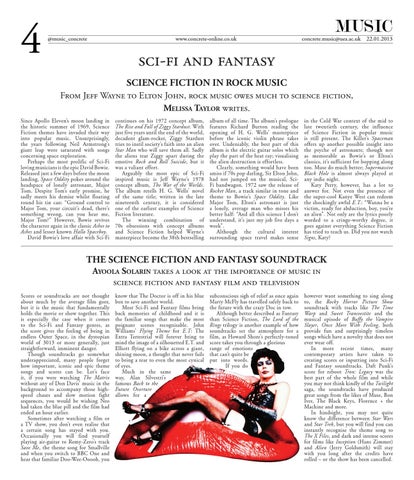
however want something to sing along to, the Rocky Horror Picture Show soundtrack with tracks like The Time Warp and Sweet Transvestite and the musical episode of Buffy the Vampire Slayer, Once More With Feeling, both provide fun and surprisingly timeless songs which have a novelty that does not ever wear off. In more recent times, many contemporary artists have taken to creating scores or inputting into Sci-Fi and Fantasy soundtracks. Daft Punk’s score for reboot Tron: Legacy was the best part of the whole film and while you may not think kindly of the Twilight saga, the soundtracks have produced great songs from the likes of Muse, Bon Iver, The Black Keys, Florence + the Machine and more. In hindsight, you may not quite know the difference between Star Wars and Star Trek, but you will find you can instantly recognise the theme song to The X Files, and dark and intense scores for films like Inception (Hans Zimmer) and Alien (Jerry Goldsmith) will stay with you long after the credits have rolled – or the show has been cancelled.