12th January 2016
3
Smoking Do you smoke, either regularly, socially or infrequently?
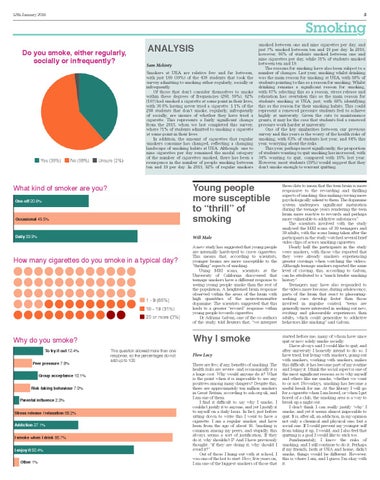
ANALYSIS Sam Mckinty Smokers at UEA are relative few and far between, with just 169 (39%) of the 439 students that took the survey admitting to smoking either regularly, socially or infrequently. Of those that don’t consider themselves to smoke within these degrees of frequencies (260, 59%), 62% (167) had smoked a cigarette at some point in their lives, with 36.6% having never tried a cigarette. 1.1% of the 268 students that don’t smoke, regularly, infrequently of socially, are unsure of whether they have tried a cigarette. This represents a fairly significant change from the 2015, when we last completed this survey, where 71% of students admitted to smoking a cigarette at some point in their lives. In addition, the amount of cigarettes that regular smokers consume has changed, reflecting a changing landscape of smoking habits at UEA. Although one to nine cigarettes per day remained the modal category of the number of cigarettes smoked, there has been a resurgence in the number of people smoking between ten and 19 per day. In 2015, 92% of regular smokers
Young people more susceptible to “thrill” of smoking
What kind of smoker are you? One-off 20.6%
Occasional 45.5%
Daily 33.9%
Will Male
How many cigarettes do you smoke in a typical day?
To try it out 12.4% Peer pressure 7.8% Group acceptance 10.1% Risk-taking behaviour 7.0% Parental influence 2.3% Stress release / relaxation 68.2% Addiction 27.1% I smoke when I drink 66.7% I enjoy it 50.4%
A new study has suggested that young people are internally hardwired to crave cigarettes. This means that, according to scientists, younger brains are more susceptible to the “thrilling” aspects of smoking. Using MRI scans, scientists at the University of California discovered that teenage smokers have a different response to seeing young people smoke than the rest of the population; A heightened brain response observed within the areas of the brain with high quantities of the neurotransmitter dopamine. The scientists suggested that this leads to a greater “reward” response within young people towards cigarettes. Dr Adriana Galvan, one of the co-authors of the study, told Reuters that, “we interpret
Why I smoke
Why do you smoke?
Other 1%
smoked between one and nine cigarettes per day, and just 7% smoked between ten and 19 per day. In 2016, however, 66% of students smoked between one and nine cigarettes per day, while 31% of students smoked between ten and 19. The reasons for smoking have also been subject to a number of changes. Last year, smoking whilst drinking was the main reason for smoking at UEA, with 58% of students pointing to this as a reason for smoking. Whilst drinking remains a significant reason for smoking, with 67% selecting this as a reason, stress release and relaxation has overtaken this as the main reason for students smoking at UEA, just, with 68% identifying this as the reason for their smoking habits. This could represent a renewed pressure students feel to achieve highly at university. Given the cuts to maintenance grants, it may be the case that students feel a renewed pressure work harder at university. One of the key similarities between our previous survey and this years is the worry of the health risks of smoking, with 63% of students last year, and 64% this year, worrying about the risks. This year, perhaps most significantly, the proportion of students wanting to quit smoking has increased, with 34% wanting to quit, compared with 16% last year. However, most students (39%) would suggest that they don’t smoke enough to warrant quitting.
This question allowed more than one response, so the percentages do not add up to 100
Flow Lacy There are few, if any, benefits of smoking. The health risks are severe -and economically it is a huge cost. Why would anyone do it? What is the point when it is impossible to see any positives among many dangers? Despite this, there are approximately ten million smokers in Great Britain, according to ash.org.uk, and I am one of them. I find it difficult to say why I smoke, I couldn’t justify it to anyone, and yet I justify it to myself on a daily basis. In fact, just before sitting down to write this I went to have a cigarette. I am a regular smoker, and have been from the age of about 16. Smoking is common among my peers, and stupidly, this always seems a sort of justification. If they do it, why shouldn’t I? And I have previously thought: “if they are doing it, why should I avoid it?” Out of those I hung out with at school, I was one of the last to start. Now, five years on, I am one of the biggest smokers of those that
these data to mean that the teen brain is more responsive to the rewarding and thrilling aspects of smoking, thus making craving more psychologically salient to them. The dopamine system undergoes significant maturation during the teenage years rendering the teen brain more reactive to rewards and perhaps more vulnerable to addictive substances”. The scientists involved with the study analysed the MRI scans of 39 teenagers and 39 adults, with the scans being taken after the participants in the study watched several brief video clips of actors smoking cigarettes. Nearly half the participants in the study were smokers, with those who reported that they were already smokers experiencing greater cravings when watching the videos. Although teenage smokers reported the same level of craving, this, according to Galvan, can be attributed to a “much briefer smoking history”. Teenagers may have also responded to the videos more because, during adolescence, parts of the brain that react to pleasuringseeking cues develop faster than those involved in impulse control; “teens are generally more interested in seeking out new, exciting and pleasurable experiences than adults, which could generalize to addictive behaviors like smoking” said Galvan. started before me, many of whom have since quit or now solely smoke socially. I have always said I would like to quit, and after university I honestly intend to do so. I have tried, but living with smokers, going out with smokers, working with smokers, makes this difficult; it has become part of my routine and I enjoy it. I think the social aspect is one of the most significant reasons as to why myself and others like me smoke, whether we want to or not. Nowadays, smoking has become a useful break for me. At the library I will go for a cigarette when I am bored, or when I get bored of a club, the smoking area is a way to break up a night out. I don’t think I can really justify ‘why’ I smoke, and yet it seems almost impossible to quit. It is, after all, an addiction, in my opinion not only a chemical and physical one, but a social one. If I could prevent my younger self from taking it up, I would, and I also feel that quitting is a goal I would like to stick too. Fundamentaly, I know the risks of smoking, and I still continue to do it. Perhaps if my friends, both at UEA and home, didn’t smoke, things would be different. However, this is where I am, and I guess I’m okay with it.