Issue 256 10th May 2011
£9,000
Lecturer discontent revealed Danny Collins Editor
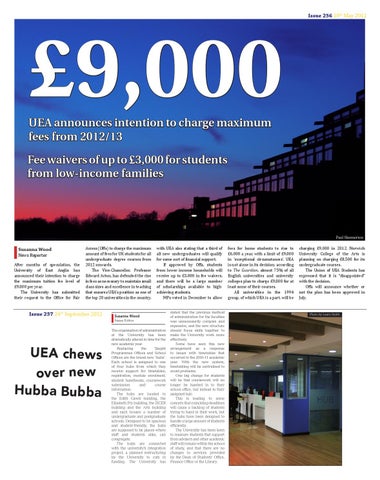
UEA announces intention to charge maximum fees from 2012/13 Fee waivers of up to £3,000 for students from low-income families
Paul Skennerton
Susanna Wood News Reporter After months of speculation, the University of East Anglia has announced their intention to charge the maximum tuition fee level of £9,000 per year. The University has submitted
Access (Offa) to charge the maximum amount of fees for UK students for all undergraduate degree courses from 2012 onwards. The Vice-Chancellor, Professor Edward Acton, has defended the rise in fees as necessary to maintain small class sizes and excellence in teaching that ensures UEA’s position as one of the top 20 universities in the country,
Issue 257 24th September 2011
with UEA also stating that a third of all new undergraduates will qualify If approved by Offa, students from lower income households will receive up to £3,000 in fee waivers, and there will be a large number of scholarships available to highachieving students. MPs voted in December to allow
Susanna Wood News Editor
The organisation of administration at the University has been dramatically altered in time for the new academic year. Replacing the Taught Programmes Offices and School Offices are the brand new ‘hubs’. Each school is assigned to one stated that theofprev four hubs from ious meth od which they receive support for timetables, registration, module enrolment, student handbooks, coursework submission and course information. The hubs are located in the Edith Cavell building, the Elizabeth Fry building, the ZICER building and the Arts building and each houses a number of undergraduate and postgraduate schools. Designed to be spacious and student-friendly, the hubs are supposed to be places where staff and students alike, can congregate. The hubs are connected with the university’s integration project, a planned restructuring by the University to cuts in funding. The University has
stated that the previous method of administration for the faculties was unnecessarily complex and expensive, and the new structure should focus skills together to make the University work more effectively. Some have seen this new arrangement as a response to issues with timetables that occurred in the 2010-11 academic year. With the new system, timetabling will be centralised to avoid problems. One big change for students will be that coursework will no longer be handed in to their school office, but instead to their assigned hub. This is leading to some concern that coinciding deadlines will cause a backlog of students trying to hand in their work, but the hubs have been designed to handle a large amount of students efficiently. The University has been keen to reassure students that support from advisers and other academic staff will remain within the school of study, and that there are no changes to services provided by the Dean of Students’ Office, Finance Office or the Library.
fees for home students to rise to £6,000 a year, with a limit of £9,000 in ‘exceptional circumstances’. UEA is not alone in its decision; according to The Guardian, almost 75% of all English universities and university colleges plan to charge £9,000 for at least some of their courses. All universities in the 1994 group, of which UEA is a part, will be
UEA chews over new Hubba B ubba hews over new Hubba Bubba w Hubba Bubba stated that the previous method
charging £9,000 in 2012. Norwich University College of the Arts is planning on charging £8,500 for its undergraduate courses. The Union of UEA Students has expressed that it is “disappointed” with the decision. Offa will announce whether or not the plan has been approved in July.
Photo by Laura Smith