Sadie Rain Hope-Gund
ARTS
Catherine Gund ’83 is an award-winning documentary maker and founder of Aubin Pictures, a New York based, not-for-profit company that produces films focusing on issues of social justice. Gund’s documentaries include Motherland Afghanistan; Making Grace; On Hostile Ground; Hallelujah! Ron Athey: A Story of Deliverance; When Democracy Works; Positive: Life with HIV; Sacred Lies, Civil Truths; Not Just Passing Through; the Emmy-nominated A Touch of Greatness; and her current work, What’s On Your Plate? She lives in New York City with her partner Bruce Morrow and children Sadie, 12, Kofi and Rio, 9, and Tenzin, 4. Gund answered questions by email. She had more to say than space allows. Check out her full interview at concordacademy.org/gund. And learn more about What’s On Your Plate? at whatsonyourplateproject.org.
Q&A
CONCORD ACADEMY MAGAZINE WINTER 2009
Catherine Gund ’83 46
With so many moving stories and worthy causes in the world, how do you choose your projects? Each project has grown from a conversation, a bit of footage, or a great proposal that really sparked something in me. There are so many vital issues and subjects that concern me, but finding a charismatic character to tell the story is hard. My documentaries are driven by characters, not issues; by a person or people who are so compelling that they could be talking about almost anything and I would listen. My most recent project picked me. For the first time, I was actually casting about for an idea, asking friends what subjects they felt were underrepresented, asking people about folks in their lives who fascinate them. Then, when my daughter Sadie became a vegetarian at nine years old, we talked about her choice and what it would mean for her diet. I told her that vegetarians can’t just eat pasta and pizza, and she told me that some
of her friends do just that. I explained why it wasn’t healthy for anyone to eat such an unbalanced diet. Sadie suggested we make a film about vegetarians gone bad. Although I could instantly picture the pulp fiction–style poster, we never made that movie. Instead, we started to work together on What’s On Your Plate?, a documentary about kids and food politics. That was about two years ago. And that’s the project I’m still working on. How do you maintain a sense of objectivity? Is that necessary? I find it amusing when people claim to be “objective” since the filmmaker is an inevitable filter. I definitely choose to represent people I believe in. One of my first feature documentaries, On Hostile Ground, was about abortion providers, and while we were filming, I recall being asked (often) whether we were going to “balance” the story or “show both sides,” and I kept wondering what was the other “side” to a doctor doing her job. We did however include protesters at abortion clinics. I do find it valuable to present material in an accessible and calm way so that viewers aren’t turned off by strident, dogmatic, or didactic material — which isn’t to say I don’t feel opinionated. Challenging as it is, I want the broadest possible audience to benefit from engaging with the people, stories, and issues raised in my films. Have you made films in which you did not consider yourself an advocate for the cause portrayed? If so, please describe some differences between filming as an advocate versus as more of an observer? Advocate is too strong a word because I prefer to present a situation
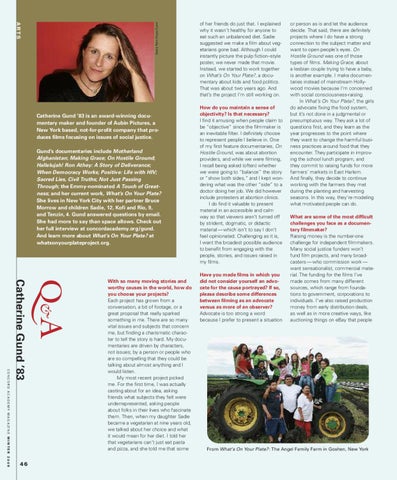
or person as is and let the audience decide. That said, there are definitely projects where I do have a strong connection to the subject matter and want to open people’s eyes. On Hostile Ground was one of those types of films. Making Grace, about a lesbian couple trying to have a baby, is another example. I make documentaries instead of mainstream Hollywood movies because I’m concerned with social consciousness-raising. In What’s On Your Plate?, the girls do advocate fixing the food system, but it’s not done in a judgmental or presumptuous way. They ask a lot of questions first, and they learn as the year progresses to the point where they want to change the harmful business practices around food that they encounter. They participate in improving the school lunch program, and they commit to raising funds for more farmers’ markets in East Harlem. And finally, they decide to continue working with the farmers they met during the planting and harvesting seasons. In this way, they’re modeling what motivated people can do. What are some of the most difficult challenges you face as a documentary filmmaker? Raising money is the number-one challenge for independent filmmakers. Many social justice funders won’t fund film projects, and many broadcasters — who commission work — want sensationalist, commercial material. The funding for the films I’ve made comes from many different sources, which range from foundations to government, corporations to individuals. I’ve also raised production money from early distribution deals, as well as in more creative ways, like auctioning things on eBay that people
From What's On Your Plate? : The Angel Family Farm in Goshen, New York