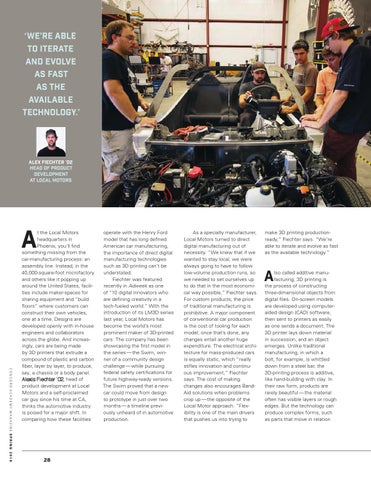
‘WE’RE ABLE TO ITERATE AND EVOLVE AS FAST AS THE AVAILABLE TECHNOLOGY.’
Alex Fiechter ’02 head of product development at Local Motors
A
CONCORD AC A DEM Y M AG A ZINE SPRING 2016
t the Local Motors headquarters in Phoenix, you’ll find something missing from the car-manufacturing process: an assembly line. Instead, in the 40,000-square-foot microfactory and others like it popping up around the United States, facilities include maker-spaces for sharing equipment and “build floors” where customers can construct their own vehicles, one at a time. Designs are developed openly with in-house engineers and collaborators across the globe. And increasingly, cars are being made by 3D printers that extrude a compound of plastic and carbon fiber, layer by layer, to produce, say, a chassis or a body panel. Alexis Fiechter ’02, head of product development at Local Motors and a self-proclaimed car guy since his time at CA, thinks the automotive industry is poised for a major shift. In comparing how these facilities
28
operate with the Henry Ford model that has long defined American car manufacturing, the importance of direct digital manufacturing technologies such as 3D printing can’t be understated. Fiechter was featured recently in Adweek as one of “10 digital innovators who are defining creativity in a tech-fueled world.” With the introduction of its LM3D series last year, Local Motors has become the world’s most prominent maker of 3D-printed cars. The company has been showcasing the first model in the series — the Swim, winner of a community design challenge — while pursuing federal safety certifications for future highway-ready versions. The Swim proved that a new car could move from design to prototype in just over two months — a timeline previously unheard of in automotive production.
As a specialty manufacturer, Local Motors turned to direct digital manufacturing out of necessity. “We knew that if we wanted to stay local, we were always going to have to follow low-volume production runs, so we needed to set ourselves up to do that in the most economical way possible,” Fiechter says. For custom products, the price of traditional manufacturing is prohibitive. A major component of conventional car production is the cost of tooling for each model; once that’s done, any changes entail another huge expenditure. The electrical architecture for mass-produced cars is equally static, which “really stifles innovation and continuous improvement,” Fiechter says. The cost of making changes also encourages BandAid solutions when problems crop up — the opposite of the Local Motor approach. “Flexibility is one of the main drivers that pushes us into trying to
make 3D printing productionready,” Fiechter says. “We’re able to iterate and evolve as fast as the available technology.”
A
lso called additive manufacturing, 3D printing is the process of constructing three-dimensional objects from digital files. On-screen models are developed using computeraided design (CAD) software, then sent to printers as easily as one sends a document. The 3D printer lays down material in succession, and an object emerges. Unlike traditional manufacturing, in which a bolt, for example, is whittled down from a steel bar, the 3D-printing process is additive, like hand-building with clay. In their raw form, products are rarely beautiful — the material often has visible layers or rough edges. But the technology can produce complex forms, such as parts that move in relation