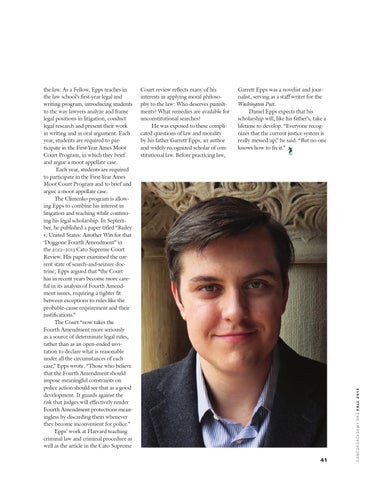
Court review reflects many of his interests in applying moral philosophy to the law: Who deserves punishments? What remedies are available for unconstitutional searches? He was exposed to these complicated questions of law and morality by his father Garrett Epps, an author and widely recognized scholar of constitutional law. Before practicing law,
Garrett Epps was a novelist and journalist, serving as a staff writer for the Washington Post. Daniel Epps expects that his scholarship will, like his father’s, take a lifetime to develop. “Everyone recognizes that the current justice system is really messed up,” he said. “But no one knows how to fix it.”
41
C O N C O R D A C A D E M Y. O R G FA L L 2 013
the law. As a Fellow, Epps teaches in the law school’s first-year legal and writing program, introducing students to the way lawyers analyze and frame legal positions in litigation, conduct legal research and present their work in writing and in oral argument. Each year, students are required to participate in the First-Year Ames Moot Court Program, in which they brief and argue a moot appellate case. Each year, students are required to participate in the First-Year Ames Moot Court Program and to brief and argue a moot appellate case. The Climenko program is allowing Epps to combine his interest in litigation and teaching while continuing his legal scholarship. In September, he published a paper titled “Bailey v. United States: Another Win for that ‘Doggone Fourth Amendment” in the 2012–2013 Cato Supreme Court Review. His paper examined the current state of search-and-seizure doctrine; Epps argued that “the Court has in recent years become more careful in its analysis of Fourth Amendment issues, requiring a tighter fit between exceptions to rules like the probable-cause requirement and their justifications.” The Court “now takes the Fourth Amendment more seriously as a source of determinate legal rules, rather than as an open-ended invitation to declare what is reasonable under all the circumstances of each case,” Epps wrote. “Those who believe that the Fourth Amendment should impose meaningful constraints on police action should see that as a good development. It guards against the risk that judges will effectively render Fourth Amendment protections meaningless by discarding them whenever they become inconvenient for police.” Epps’ work at Harvard teaching criminal law and criminal procedure as well as the article in the Cato Supreme