The Great Wall by Isaac Levine ’14
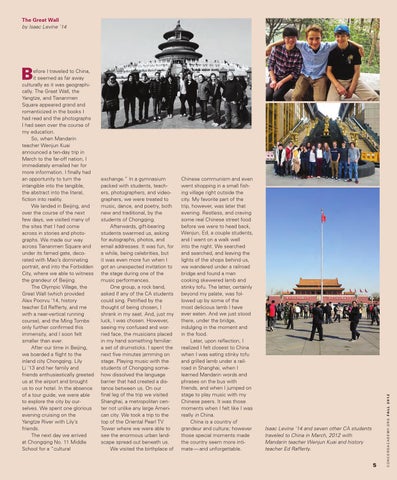
efore I traveled to China, it seemed as far away culturally as it was geographically. The Great Wall, the Yangtze, and Tiananmen Square appeared grand and romanticized in the books I had read and the photographs I had seen over the course of my education. So, when Mandarin teacher Wenjun Kuai announced a ten-day trip in March to the far-off nation, I immediately emailed her for more information. I finally had an opportunity to turn the intangible into the tangible, the abstract into the literal, fiction into reality. We landed in Beijing, and over the course of the next few days, we visited many of the sites that I had come across in stories and photographs. We made our way across Tiananmen Square and under its famed gate, decorated with Mao’s dominating portrait, and into the Forbidden City, where we able to witness the grandeur of Beijing. The Olympic Village, the Great Wall (which provided Alex Poorvu ’14, history teacher Ed Rafferty, and me with a near-vertical running course), and the Ming Tombs only further confirmed this immensity, and I soon felt smaller than ever. After our time in Beijing, we boarded a flight to the inland city Chongqing. Lily Li ‘13 and her family and friends enthusiastically greeted us at the airport and brought us to our hotel. In the absence of a tour guide, we were able to explore the city by ourselves. We spent one glorious evening cruising on the Yangtze River with Lily’s friends. The next day we arrived at Chongqing No. 11 Middle School for a “cultural
exchange.” In a gymnasium packed with students, teachers, photographers, and videographers, we were treated to music, dance, and poetry, both new and traditional, by the students of Chongqing. Afterwards, gift-bearing students swarmed us, asking for autographs, photos, and email addresses. It was fun, for a while, being celebrities, but it was even more fun when I got an unexpected invitation to the stage during one of the music performances. One group, a rock band, asked if any of the CA students could sing. Petrified by the thought of being chosen, I shrank in my seat. And, just my luck, I was chosen. However, seeing my confused and worried face, the musicians placed in my hand something familiar: a set of drumsticks. I spent the next five minutes jamming on stage. Playing music with the students of Chongqing somehow dissolved the language barrier that had created a distance between us. On our final leg of the trip we visited Shanghai, a metropolitan center not unlike any large American city. We took a trip to the top of the Oriental Pearl TV Tower where we were able to see the enormous urban landscape spread out beneath us. We visited the birthplace of
Chinese communism and even went shopping in a small fishing village right outside the city. My favorite part of the trip, however, was later that evening. Restless, and craving some real Chinese street food before we were to head back, Wenjun, Ed, a couple students, and I went on a walk well into the night. We searched and searched, and leaving the lights of the shops behind us, we wandered under a railroad bridge and found a man cooking skewered lamb and stinky tofu. The latter, certainly beyond my palate, was followed up by some of the most delicious lamb I have ever eaten. And we just stood there, under the bridge, indulging in the moment and in the food. Later, upon reflection, I realized I felt closest to China when I was eating stinky tofu and grilled lamb under a railroad in Shanghai, when I learned Mandarin words and phrases on the bus with friends, and when I jumped on stage to play music with my Chinese peers. It was those moments when I felt like I was really in China. China is a country of grandeur and culture; however those special moments made the country seem more intimate — and unforgettable.
Isaac Levine '14 and seven other CA students traveled to China in March, 2012 with Mandarin teacher Wenjun Kuai and history teacher Ed Rafferty. 5
C O N C O R D A C A D E M Y. O R G F A L L 2 0 1 2
B