COLUMN Glesni Holland
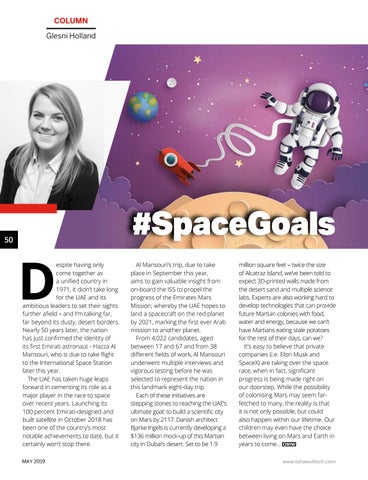
#SpaceGoals
50
D
espite having only come together as a unified country in 1971, it didn’t take long for the UAE and its ambitious leaders to set their sights further afield – and I’m talking far, far beyond its dusty, desert borders. Nearly 50 years later, the nation has just confirmed the identity of its first Emirati astronaut - Hazza Al Mansouri, who is due to take flight to the International Space Station later this year. The UAE has taken huge leaps forward in cementing its role as a major player in the race to space over recent years. Launching its 100 percent Emirati-designed and built satellite in October 2018 has been one of the country’s most notable achievements to date, but it certainly won’t stop there.
MAY 2019
Al Mansouri’s trip, due to take place in September this year, aims to gain valuable insight from on-board the ISS to propel the progress of the Emirates Mars Mission; whereby the UAE hopes to land a spacecraft on the red planet by 2021, marking the first ever Arab mission to another planet. From 4,022 candidates, aged between 17 and 67 and from 38 different fields of work, Al Mansouri underwent multiple interviews and vigorous testing before he was selected to represent the nation in this landmark eight-day trip. Each of these initiatives are stepping stones to reaching the UAE’s ultimate goal: to build a scientific city on Mars by 2117. Danish architect Bjarke Ingels is currently developing a $136 million mock-up of this Martian city in Dubai’s desert. Set to be 1.9
million square feet – twice the size of Alcatraz Island, we’ve been told to expect 3D-printed walls made from the desert sand and multiple science labs. Experts are also working hard to develop technologies that can provide future Martian colonies with food, water and energy, because we can’t have Martians eating stale potatoes for the rest of their days, can we? It’s easy to believe that private companies (i.e. Elon Musk and SpaceX) are taking over the space race, when in fact, significant progress is being made right on our doorstep. While the possibility of colonising Mars may seem farfetched to many, the reality is that it is not only possible, but could also happen within our lifetime. Our children may even have the choice between living on Mars and Earth in years to come… www.tahawultech.com