a comprehensive understanding of the ship and systems capabilities enabling the crew to execute tasks for all facets of operations. For more than ten years, the crew design effort involved various fleet stakeholders and Navy technical teams focused determining which tasks each crewmember should perform and the time necessary to do the task, down to six-minute increments. The result of this top-down, functionalanalysis effort was a comprehensive database of more than 25,000 tasks that supports a detailed view for crew/ billet workload distribution. Starting from “zero-manning,” the DDG 1000 operationally manned crew concept was supported by a meticulous design process that developed the crew one billet at a time by accounting for tasks from the simplest, such as taking out trash, to the some of the most complex, including weapons release. Crew design analysis in conjunction with ship design produced a threesection underway watchbill, with 19 personnel per section, to meet the design reference-mission: 120-day underway scenarios, equivalent to
Winter 2012
wartime operations. Crew manning is at 120 personnel – 16 officers and 104 enlisted. When the ship deploys, the crew will be augmented by a 28-person aviation detachment, bringing the total to 148 personnel. Like all Navy ships, DDG 1000’s crew will be busy. The workload has been modeled extensively for each crewmember to ensure that all shipboard tasks can be completed without any crewmember exceeding the Navy standard 70-hour work week. That formulation doesn’t include training, however, and all crewmembers need to be well trained in the critical skills required to operate equipment, qualify in individual watchstations, and perform required maintenance tasks. Each new crewmember will attend Navy training schools for Navy enlisted classifications or Navy officer billet classifications, and fleet-level schools such as firefighting and anti-terrorism/ force protection courses. Additionally, the Navy is developing more than 1,800 instruction-hours worth of curriculum to provide focused training on DDG 1000-specific watchstanding duties, operational requirements,
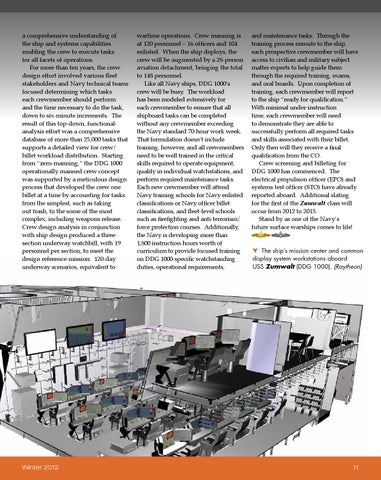
and maintenance tasks. Through the training process enroute to the ship, each prospective crewmember will have access to civilian and military subject matter experts to help guide them through the required training, exams, and oral boards. Upon completion of training, each crewmember will report to the ship “ready for qualification.” With minimal under-instruction time, each crewmember will need to demonstrate they are able to successfully perform all required tasks and skills associated with their billet. Only then will they receive a final qualification from the CO. Crew screening and billeting for DDG 1000 has commenced. The electrical propulsion officer (EPO) and systems test officer (STO) have already reported aboard. Additional slating for the first of the Zumwalt class will occur from 2012 to 2015. Stand by as one of the Navy’s future surface warships comes to life! The ship’s mission center and common display system workstations aboard USS Zumwalt (DDG 1000). (Raytheon)
11