habits. everyday excellence
Issue March
2
2022
CULTURE OF ERROR "LET'S NOT FORGET THAT IT'S NOT JUST STUDENTS WHOSE ERRORS MATTER."
ROUTINES
"IT IS WHO WE ARE; IT IS WHAT WE DO."
TO SLANT OR NOT TO SLANT? IS IT EVEN A QUESTION?
HABITS // CONTENTS
Contents 03 Expertise by Simon Elliott, Community
Schools Trust 05 Live Coaching by Thahmina Begum,
Forest Gate Community School 08 Maths EDI Superstars by Zara Kanwal,
Highlights
03
Forest Gate Community School
Expertise CEO, Simon Elliott explores domain specific knowledge theory and tells us exactly why expertise matters.
09 Rowing together at CST by Francis Bray,
Forest Gate Community School 11 Routines by Salim Foughali, Waterside
Academy 13 Culture of Error by Mahamed Osman,
Forest Gate Community School 15 Reviving Dead Time by Joynab Sultana,
Waterside Academy
11
Routines Salim Foughali reflects on the power of marginal refinement and its impact on fundamental behavioural routines.
17 Effective Cover Teaching by Jonathon
Denny, Forest Gate Community School 20 Practical Feedback by Sophie Morelle,
Cumberland Community School 21 Marking for Impact by Emma Palik,
University Technical College Norfolk 23 To SLANT or not to SLANT by Samantha
Bolger, Cumberland Community School 24 Collaboration by Mehak Yusuf,
21
Cumberland Community School
Marking for Impact: Implementing live marking at UTCN Emma Palik shares the challenges and highlights of implementing live marking for the first time at UTCN.
25 Lucid Learning by Eve Willet, Forest Gate
Community School 27 Effective SLOP Practice by Louise Mace,
Cumberland Community School 29 Pastoral x EDI by Georgia France, Forest
Gate Community School
GET INTERACTIVE
27
Effective SLOP Practice Read this nuanced piece by Louise Mace on the conditions for 'shed loads of practise', no matter the subject.
Check out our videos of great practice whenever you see a QR code, grab your phone and have a watch!
01 // HABITS // MARCH 2022
@CST_LONDON
HABITS // CONTRIBUTORS
CONTRIBUTORS everyday excellence
Simon Elliott CEO Community Schools Trust
Thahmina Begum Headteacher Forest Gate Community School
Francis Bray Deputy Headteacher Forest Gate Community School
Mahamed Osman Trainee Maths Teacher Forest Gate Community School
Jonathon Denny Cover Supervisor Forest Gate Community School
Sophie Morelle Assistant Headteacher Cumberland Community School
Salim Foughali Deputy Headteacher Waterside Academy
Joynab Sultana Assistant Headteacher Waterside Academy
Mehak Yusuf Head of Literacy Cumberland Community School
Zara Kanwal 2ic Maths Forest Gate Community School
Samantha Bolger Head of KS4 English Cumberland Community School
Louise Mace Emma Palik Head of History Deputy Headteacher Cumberland Community School University Technical College Norfolk
Eve Willet PE Teacher Forest Gate Community School
Georgia France Head of Learning Forest Gate Community School
02
HABITS // SIMON SAYS
Expertise How do we get ourselves and our students to become experts in something? Simon Elliott
It’s something that is actually somewhat contested in the literature on learning. Some argue that we generate an interlinked system whereby skills and knowledge are built up together across many areas, making us more competent when we encounter something new. On the other hand, domain specific knowledge theory has it that knowledge in one area doesn’t necessarily transfer to another.
Desmond Douglas at play
03 // HABITS // MARCH 2022
@CST_LONDON
HABITS // SIMON SAYS
Matthew Syed, in Bounce, recounts the story of the great table tennis player Desmond Douglas, famous for playing really close to the table with lightning reactions. Despite his amazing table tennis prowess, Douglas’ apparent reaction skills did not transfer to other sports. They developed out of hours of practice in a confined space but were good for ping pong only. It seems like a good bet from the literature that to get children to become experts in a subject, we need to teach them domain-specific and context-specific knowledge and skills, and to test them regularly so as to know how to make them improve. Thus, at CST, we carefully sequence our curriculum to do just this, knowing that children need to be taught by subject matter experts in each discipline. All of this might explain why we should not be so judgemental of the stressed-out parent who came into one of our schools and demanded of the receptionist: “Where does my wife work? Please ask my daughter!” Said gentleman may have been an astrophysicist, successful social worker or top-rated mental health nurse for all we know; for family matters, he might have needed to spend a bit more time on the curriculum.
04
HABITS // TB BLOGS
LIVE COACHING STRATEGIES TO ‘SPOT THE SPINACH’ AND STEP IN Thahmina Begum
It’s been 2 years since we ramped up our efforts to transform the quality of our feedback. I came across the concept of ‘live coaching’ in Paul Bambrick-Santoyo’s books ‘Get Better Faster’ and ‘Leadership Leverage’ and found the parallels he drew between hospital residency and the teaching profession fascinating.
Bambrick-Santoyo poses a fascinating question: what would happen if in teaching, we had to honour the same two premises of residency?
In hospital residency, when performing their first surgeries, a doctor’s real time feedback was based upon two fundamental premises:
Well, it would look something like this:
Premise #1: a patient’s life is of the utmost importance in medical care A teaching doctor can keep that sacred – whilst also training residents – by simply stepping in when needed Premise #2: Accelerated development By stepping in and coaching in the moment, the experienced doctors deliver more feedback to the residents – the residents get better, faster. They fix their mistakes and become experts quickly. This is not a luxury but a necessity.
05 // HABITS // MARCH 2022
Premise #1: a student’s learning is of the utmost importance We can keep that sacred – whilst also coaching the teacher – by simply stepping in when needed Premise #2: Accelerated development By stepping in and coaching in the moment, they can deliver more feedback to the teacher – the teacher gets better, faster. They fix their mistakes and become experts quickly. This is not a luxury but a necessity.
right at the centre of it all, the two premises listed above: students’ learning being of the utmost importance and our own accelerated development.
SIMILAR TO THE PREMISES OF HOSPITAL RESIDENCY, WE BELIEVE THAT THE STUDENT’S LEARNING IS OF THE UTMOST IMPORTANCE AND WE ARE INVESTED IN OUR OWN ‘ACCELERATED’ DEVELOPMENT: IT IS NOT A LUXURY BUT A NECESSITY.
Central to doing this well is an open door, trusting culture, ongoing quality training, and
@CST_LONDON
HABITS // TB BLOGS
Throwback to last year: Covid, FOMO and a virtual learning visit Aside from the usual covid symptoms, I was suffering from acute FOMO (fear of missing out). So it was our deputy headteacher, Michelle Smiley, who took pity on me and allowed me to virtually accompany her on one of her learning walks. I loved it. Surreal though it was, I got to see how expertly Michelle went about ‘spotting the spinach and stepping in’. I have broken down what I observed into 5 strategies Michelle used to effectively live coach: Establish warmth upon entry Feign emotion Model the reward Model the follow through Model the position Bamrick-Santoyo defines the most effective feedback as fulfilling the following criteria: Is it observable and ‘practiseable’? Is it the highest leverage action you could ask the teacher to perform? Is it bite-sized enough that the teacher could accomplish it in one week? Enter Michelle (and me on Whatsapp video call…): 1. Establish warmth upon entry Michelle carries me (her phone) into the first classroom. It is a ‘tricky’ science class. As she walks in, she calls out a cheery, ‘Good morning Miss!’ immediately establishing a warmth with her presence. I can hear an equally cheery reply from the teacher. A couple of students wave from the back and continue working. We all know the feeling of someone walking in, straight faced, stony eyed, usually donning a clipboard, ignoring everyone around them. The teacher is on edge. The students sense something is not right. There is an ‘us and them’ suddenly created: ‘us’ – the teacher and their class and ‘them’ – the deadpan observer. Or worse, the ‘us’ becomes the observer with the students and ‘them’ becomes the teacher! You know you’ve done it right when you are able to create the impression of a team – the teacher with the observer. 2. Feign emotion: Oh no, Miss, shall we try that again? Next, we walk into a year 7 English lesson. ‘Good morning!’ she says as she slips to the back of the classroom. Students have just completed a task. ‘3-2-1-SLANT’ calls the teacher. The class
sleepily put their pens down. As the teacher is about to continue, Michelle jumps in on a pause.
4. Model the follow through: merit on the board Michelle then discreetly makes her way to the front of the class and asks the teacher for permission to add something to her merit board.
‘Oh no, Miss, shall we try that again?’ she says, facing the class, voice of disapproval clearly aimed at the students. Michelle’s choice of ‘we’ ‘D’you mind Miss?’ When granted permission, means she’s obviously on Miss’s team – the students know that and the teacher knows that.
THE TEACHER IS ON EDGE. THE STUDENTS SENSE SOMETHING IS NOT RIGHT. THERE IS AN ‘US AND THEM’ SUDDENLY CREATED: ‘US’ – THE TEACHER AND THEIR CLASS AND ‘THEM’ – THE DEADPAN OBSERVER.
The teacher takes the cue immediately and takes control.
she adds the name of the student on the merit board.
‘Yes Miss, I think we can try that again year 7! 32-1-SLANT… much better, thank you.’ She uses Be Seen Looking (a Doug Lemov technique of obviously showing the students you are looking at them) and proceeds with her next instruction.
‘He’s doing really well Miss! See you later!’ she says, in a loud whisper. She is casual about it. No big deal. Merits are normal. Merits are important.
‘Really well done here – look at that!’ She points at something I can’t see but it is obvious she is making sure her praise is specific and therefore worthy.
Michelle knows the answer. I watch as she deliberately moves towards the front and centre of the room: the swivel position. The teacher immediately realises her intention and follows suit. When he was sat at his desk, the students could not see their teacher. Out of sight really is out of mind for students – they easily begin to switch off.
How had Michelle spotted the spinach and stepped in here? Very subtly. She knew this The expectation for a quick transition has been teacher needed reminding to reward her reinforced. The teacher has been reminded not students regularly and so by modelling exactly to accept a slow response from the whole class how she would do it, it served as a real-time – afterall, SLANT should ensure no wasted demonstration and reminder of this crucial seconds (as well as encourage pro social aspect of building relationships in the behaviours). In responding to Michelle’s classroom. coaching, she has felt the impact of a better transition in the moment and will now 5. Model the position remember this every time she calls for SLANT. Finally, a year 10 class. Maths. The teacher is peering around his computer screen, in the 3. Model the reward: targeted quiet but loud middle of an explanation. He has stopped the praise class to address a common misconception. Next up, a year 9 science lesson. Michelle knows Although his explanation is excellent, we can a few of the students in the class. see some students have begun to look around. Some have their pens in their hands. We watch from the side for a few moments – the class is silent and beautifully working away. What is the highest leverage feedback to give Suddenly we move towards a student Michelle at this point? Call for SLANT again? The knows might get off track quickly. teacher has evidently called for it as half of them are doing it. But half are not anymore. She quietly (but loudly enough for his closest Or perhaps he needs to pause and wait for peers to hear) praises his work. the students to correct themselves?
His friend notices and pauses to listen for a moment before quickly resuming his writing. The teacher notices from the front and smiles approvingly. With the large cognitive load we are always juggling, it is easy to sometimes In a matter of seconds, their teacher’s pause forget to notice efforts early on – the small and deliberate movement to the front of his antecedents that will serve to make our lessons classroom cause the class to correct successful. themselves. It is fascinating to watch: pens
06
HABITS // TB BLOGS
come out of hands, all are tracking the teacher and though it was silent before, the silence is now purposeful. All are listening to the expert words of their teacher. The teacher feels this success. He will now use the swivel position every time he needs to address his class. Michelle quietly slips out.
Live coaching at Community Schools Trust At CST, we want to ‘get better faster’. We provide ‘live coaching’ to each other, focusing on the highest leverage ‘action steps’ or feedback. We make sure action steps are small and precise so that they are most effective. In our live coaching, we aim to model the action step, to help the teacher see why the action is so powerful, and we aim for it to be ‘bite sized’ and concrete enough to be achieved within a week. The preparation and the quality of practice is crucial. This is why every professional development session is pegged to our defined framework of excellence (our explicit direct instruction framework) and includes the opportunity for ‘deliberate practice’ and goal setting. Just like every performance profession, we recognise the importance of ‘rehearsal’ and getting it right before we go ‘live’. Why? Because, similar to the premises of hospital residency, we believe that the student’s learning is of the utmost importance and we are invested in our own ‘accelerated’ development: it is not a luxury but a necessity.
AT CST, WE WANT TO ‘GET BETTER FASTER’ 07 // HABITS // MARCH 2022
@CST_LONDON
HABITS // MATHS EDI SUPERSTARS
MATHS EDI SUPERSTARS Zarah Kanwal
With EDI and the deliberate practice of it being the foundations of outstanding teaching practice at the CST, I began exploring and sharing maths specific examples of best practice taking place in classrooms. Through the creation of the Maths EDI Superstars Board, we have been able to showcase mathematicians who are not only at the top of their game in terms of subject knowledge but also experts in specific EDI phases. Don’t just take my word for it, scan the QR code at the bottom of this page to see some teachers in action! An ever-improving team
A top priority for the team has been to welcome new staff into the culture of our department and showcase the hype around our teachers’ toolbox that is the EDI framework. Naturally, with all the hype comes a bit of healthy competition, fuelled by the creation of mini math teacher teams. Each team is responsible for developing its members through live coaching, joint learning walks, target setting and then, ultimately, updating the Math EDI Superstars board. This form of live feedback has been extremely effective and is synonymous with the live feedback we provide to our students on a daily basis. The EDI Superstars Board also allows teachers to instantly access a visual representation of the success criteria for any targets they may be working towards. This is done through either the bank of math specific videos available for each phase or from observing a math teacher listed as an expert.
A moment of self-reflection
As teachers, regardless of our experience, we owe it to the profession and, more importantly, to students that we keep self reflecting and have an ongoing focus on professional development. Through handpicking EDI experts and with regular updating of this list, the Math team have been able to regularly self-reflect and work on their own development outside of designated professional development sessions. This has allowed for the embedding of the core teaching principles at the CST. The EDI framework within the Math department has reinforced a culture of team effort built on individuals who are passionate about getting better faster.
08
HABITS // ROWING TOGETHER AT CST
Rowing together at CST Francis Bray
Lessons learnt from high performance rowing and coaching
went out on the water, sat on an ergo, completed circuit training or lifted weights, we were live coached. That live coaching was
Between 2002 and 2013 I was fortunate to row
positively and negatively framed depending on
and coach at a very high level. During this time I
what message the coach wanted to get across.
competed in national and international
The thought process behind it was, we all had
competitions such as the British Championships
slightly different ingrained poor technical
and Henley Royal Regatta. To row at this level
habits. The only way to get us out of these
took a significant amount of time and effort; on
habits was to focus on them for a significant
average between 22 and 25 hours per week on
amount of time - between 3 to 6 months - to
top of a full time job as a middle leader.
learn a new habit!
The ultimate team sport
The CST Playbook is our rowing stroke
Rowing in my eyes is the ultimate team sport.
With its evidence informed instructional
This is because when rowing as a crew, each
practices, the CST Playbook is our sequence for
member of the team has to do the same thing
quality teaching and learning, just like the
at the same time. The moment a crew member
perfect rowing stroke. Like rowers, teachers
does something slightly different, the balance
come into a school with different habits formed.
will go or the boat will slow down. The difficult
The difficult part is getting all teachers to
part of this is consistency and being able to
develop the refined habits listed in the EDI
repeat this every single stroke. The only way we
playbook; achieving consistency and being able
improved individually and as a crew was
to repeat the best form of our ‘stroke’ or
through constant live coaching. Everytime we
practice, every single lesson.
09 // HABITS // MARCH 2022
@CST_LONDON
HABITS // ROWING TOGETHER AT CST
This is why I love our model of learning walks and live coaching. Learning walks give us the opportunity to see teachers delivering lessons in their truest form, not a showpiece of one off lesson observations. Using a highest leverage
"The whole is greater than the sum of its parts"
‘action step’ or target, we are able to live coach when we see teachers’ ingrained habits. Our live coaching enables us to develop new and better habits in line with the EDI playbook. We know that it takes a significant amount of time and persistence to disrupt ineffective habits and replace them with better habits and so live coaching and our pursuit for better is an ongoing endeavour. Developing this consistency across a whole school ensures that "the whole is greater than the sum of its parts" (Aristotle).
Pairs Head Of The River 2007 - Winners Seniors 3 Coxless Pairs. Bow: Mr Francis Bray
10
HABITS // ROUTINES
Routines How we have used the student council to improve behavioural routines
Salim Foughali Our students always have ideas and suggestions to improve the student experience in school. Do not underestimate them! Routines are crucial to the day to day running of a school and you would be surprised how many ideas our student council have. Establishing clear routines deploy attention. They enable students to spend less time thinking about the process of their learning and more time thinking about the content of their learning. Routines can be both behavioural and/or instructional.
According to Nicholas, students should be able to visualise where to line up faster. To do so, he suggested that members of the council hold boards with the lesson subjects and the names of the teachers on them so they could see prior to lining up where to go and no longer search for their classes during the line up. ‘BRILLIANT,’ I said. We started trialling it the following Monday with mini-white boards to see how efficient that would be. It was an absolute success! The line up was so much faster and yes, less messy indeed. Thank you Nicholas!
Behavioural routines (eg. classroom entry) create more time and space for learning. Instructional routines (eg. cold call) make learning more efficient. Both types bring a range of benefits: Reduction in behaviour management burden Increased student motivation, confidence and safety Freeing up of teacher mental capacity to monitor learning and be more responsive
Behavioural routines can sometimes be overlooked or underestimated.
When you get students used to certain routines, there is always room for improvement and one of our student leaders, Nicholas, found that marginal gain to ensure a slicker line up in the morning! I will always remember that meeting with all members of the student council where Nicholas approached me and said: ‘Sir, I have a suggestion for line ups. I know how to make them less messy.’ I asked him what he meant by ‘messy’ and he replied that he thought (with such confidence) they were a bit messy and that he knew why.
11 // HABITS // MARCH 2022
@CST_LONDON
HABITS // ROUTINES
Since its inception, I am very proud to say that it has become a standard practice at Waterside. Seeing the student council getting ready by 8am in the playground like mini professionals is the biggest reward! To give you an idea of how a simple suggestion became an embedded routine, one that exemplifies the culture of high expectations, discipline and care we have at Waterside.
07:30
08:00
08:10
08:22
08:25
Students come in the playground from enjoying free breakfast, attending interventions or simply catching up with friends
I cannot wait to implement other ideas (secret for now!) and see how students make these routines theirs and how they continue to contribute to the culture of the school. Behavioural routines can sometimes be overlooked or underestimated. But with the right refinements, the impact on a school's culture can be significant. It is who we are; it is what we do. We are aspirational. We want to achieve great things. We don’t give up.
Teachers are already in the playground finishing their coffees and mingling with the students The student council led by Nicholas, start getting ready with the ‘boards’ and their hi vis I raise my hand as a cue that the line up is about to start. Students raise their hands too, meaning they are ready and listening. This cue makes it obvious that line up is about to begin and I greet everyone and ask them to be ready in a standing SLANT to “brighten the lines.” Everyone is in the playground waiting for the boards to be up and to line up. A signal is given to the student council to raise their boards. All students are checking where their class is and the front loaded ‘go’ signal is given for students to line up with a countdown of 10 seconds. The student council has contributed to a culture of normal behaviour. All doing the correct things makes it normal. The recital of poetry starts!
12
HABITS // CULTURE OF ERROR
Culture of
Error
Mahamed Osman
“To consistently identify misunderstandings, champion teachers create a classroom culture that embraces error”.
DOUG LEMOV
Being a trainee teacher at FGCS has offered me the best opportunity to be deliberate and reflective in my practice and where I have been refining and perfecting my EDI. I have found one of the most helpful elements in my practice is building a culture of error. In my classroom, we make mistakes, and we think of “wrong” as a first, positive and often critical step towards getting it “right”. I’ve worked hard to create a culture where it’s safe to be wrong. Let's not forget that it's not just students whose errors matter. You will of course make a mistake at some point in class, too. That much is inevitable. Most likely, your mistake will be public, with thirty or so students watching you make it. They will note whether you dismiss, deny, minimise, embrace, acknowledge, or even study it. How you communicate and depict mistakes - both students' and your own - in the classroom is very important.
13 // HABITS // MARCH 2022
@CST_LONDON
HABITS // CULTURE OF ERROR
Culture of Error has four key parts: expecting error, withholding the answer, managing your tell and praising risk-taking.
Expect Error I stopped my maths class after observing a consistent error amongst my students. “ 3-2-1 SLANT. I’ve noticed that a lot of us have forgotten how to combine like terms; "I'm so glad you made that mistake, it's going to help me to help you.” Mistakes are normal and valuable in many ways, and a source of insight. I then began to remodel and reteach combining like terms.
Withhold the Answer One of the simplest and easiest things you can do to begin building a Culture of Error is to delay revealing whether an answer is right or wrong. Rosie Noor, my mentor, always withholds the answer until after students have discussed the question; the suspense in her statistics class is real and keeps the students productively engaged and even myself whenever I pop into her lesson to observe! Withholding the answer avoids the distraction of “Did I get it right?” for a few seconds which causes students to spend less energy evaluating their work and more energy thinking about the underlying ideas. “Oh, I hadn't thought of doing it that way.”
Managing your tell One of my tells, when I first started teaching was “Hmmm. Interesting.” “At which point, a student said quite clearly, “Uh oh. Try again, Riyadh!” “She knew what “interesting” meant: “Well, that was disappointing.” Riyadh and all my students knew that too. So much for making it safe to be wrong Mr Osman... Be alert to your tells and manage them—replacing them as often as possible with a consistent and balanced expression.
Praise Risk-Taking The final aspect of creating a Culture of Error is to praise students for taking risks. I watched Iman Mahamud demonstrate this brilliantly when students were discussing a difficult passage in a book. “This is a question that people have debated for centuries; I love how you're really attacking this.” In a Culture of Error, students should feel good about stepping out on a limb, whether they're right or wrong. A classroom culture that respects error, normalises it, and values learning from it is one of the characteristics of a high performing classroom and quite frankly is a class I would love to be in, wouldn’t you?
14
HABITS // REVIVING DEAD TIME
Reviving Dead Time Joynab Sultana
Think about your average lesson. An average 50 minute
Trust we are almost somewhat allergic to the concept
lesson does not and cannot entail a complete 50
of ‘dead time’.
minutes of learning (as may be commonly understood). It must include time to deliver instructions, time for
Dead time refers to moments within a lesson where
teacher talk, time for students to think, time for
students are inactive and committed to nothing
students to practise. Note my deliberate emphasis on,
productive or worthwhile.
yes, time. When we consider the various segments of a lesson, it becomes alarming how much of that time is
Let me offer a few scenarios we’ve all been acquainted
actually granted to students to just ‘learn’. Dissecting a
with at some point:
lesson this way can be alarming, however, the goal is
1. The one where we apologise to our captivated
to maximise the time we have with our students to
audience as we continue to battle with SIMS
allow for as much learning as possible. For the sake of
because it has, of course, decided not to load in
agreeing on terms, there is learning, which has a multitude of contributing factors and there’s the
time. 2. We take the register and the class waits for their
application of learning, which is one of its distinct
names to be heard so they can confirm their
components. In other words, learning must happen
presence. Note: students use this opportunity to
before, during and after application.
perform their ‘low level disruptions’. 3. This further unfolds when you also appoint your
Our time in the classroom is actually something quite
usual trusted student to distribute their books, and
special. We invest in it because it’s where concepts are
again, if you have round two with worksheets
demystified. It’s where minds develop and we see
further reducing ‘engaged time’ or ‘time on task’.
students conquer what was previously uncharted territory. It’s incumbent upon us therefore to use that
So that our students get the best deal from us, what
time wisely which is why at the Community Schools
we have to actively consider and endeavour to reduce
15 // HABITS // MARCH 2022
@CST_LONDON
HABITS // REVIVING DEAD TIME
is this dead time. Anything that allows students to
time that is spent on speaking whilst reminding
become inactive and unproductive is a disruption.
students that their time has a purpose and ensures that
Disruptions, argues Matthew A Kraft, can ‘result in the
they make it meaningful. Incidentally, it also
loss of 10 to 20 days of instructional time.’
encourages students to be precise and concise.
Let’s make this research a little more familiar:
10 second countdown End of class routines are also accompanied by a 10
REGISTER: If recording attendance takes up to 2
second countdown by teachers. It may seem like an
minutes of the lesson, and this is repeated in the
impossible feat, but practice really does make perfect
following four lessons that week, we've rendered a
Students are given ten seconds to put away their
total of 10 minutes to be dead time with this class.
equipment and collect in books from each row before
BOOKS: In an average lesson, it may take 2 minutes
standing behind their chairs. We raised the bar and
to hand out books at the start of each lesson, using
they rose to the challenge. We inculcate this sense of
the same equation as the above, that’s another 10
urgency in our students which maximises learning time
minutes of dead time accumulated.
and minimises dead time.
You can see the scale at which dead time can
A recent study found that a strong indicator of a high-
accumulate and the significant detriment on the
performing school is that students spend ‘an additional
learning of pupils this can have.
480 hours engaged in learning’ and the above strategies facilitate the movement of our students into
Due to our aforementioned allergy, at The Community
that bracket.
School’s Trust we have considered where dead time has a tendency to appear and actively sought to
Consequently, I no longer think of the top left corner of
eliminate it. Here are some strategies we’ve
my keyboard when I see the acronym ESC at The
established:
Community School’s Trust. ESC is a reminder of something far more important that will impact the life
Lesson Prep
chances and opportunities our students have once they
Our lesson prep begins before the students arrive.
leave us; that’s why we have to make Every Second
Students’ exercise books, including any additional
Count.
worksheets or textbooks, are distributed according to the seating plan thus avoiding the chaos of settling in students, giving instructions and providing resources simultaneously.
Do Now Upon entrance, students will always find a Do Now activity that is already displayed on the board as they enter. We generally take the register here whilst students complete the task. This is in the form of a memory recall quiz, which requires no teacher input as they are activating prior learning.
Timer We all know that time can be elusive. To avoid our planned 3 minute discussion evolving into a 10min diatribe, every classroom includes a timer that is also visible to students. This allows teachers to manage
the
16
HABITS // EFFECTIVE COVER TEACHING
How habits lead to effective cover teaching Jonathon Denny
Very early on in my career I was introduced to the work of Doug Lemov and his seminal text ‘Teach like a Champion.’ I have to admit that it was ‘Teach like a Champion 1.0’ that I first read and we are now on version 3.0 which gives you an idea of how long I have been a teacher! It is testament to how useful and impactful his strategies are that over a decade after I first encountered Lemov’s work, his ideas are being used in conjunction with Rosenshine’s principles as the foundation for the EDI principles used across the CST. In this article I will share a few habits that have formed the bedrock of my practice and that I have found particularly effective in my role as a cover teacher. The First SLANT As I’m sure most teachers in the CST would agree, SLANT, SHAPE and STEPS are all vitally important tools in our teaching toolkit. As a cover teacher, these acronyms make working with classes we have never met or do not know very well much easier. Using SLANT effectively at the start of the lesson can set the tone for the whole period and create a calm and quiet atmosphere. It is important to use this first SLANT to narrate the positive and even give out merits for those students who are demonstrating behaviours we want to see. This is possible even with students you do not
17 // HABITS // MARCH 2022
know as you can keep your narrative general and focused on the class as a whole and we avoid naming and shaming any individual(s). Don’t take it personally! It is natural for some students to be unsettled when their regular teacher is not present as this is a disruption to their normal routines. With this in mind, it is important to be ready to exercise your professional judgement when managing behaviour. If a student is not behaving as we would expect, do not take it personally. Children are creatures of habit and your presence rather than their regular teacher can lead students to behave uncharacteristically. This does not mean you should accept poor behaviour; maintaining high expectations is essential. Positive framing is important here. Rather than focus on the negative ‘ I’m going to tell Ms…. when she gets back…’ a phrase like ‘ I am really looking forward to telling Mr ... how excellent your focus and effort has been this lesson and I know he’ll be pleased with the …. students who have achieved merits.’
"We are what we repeatedly do. Excellence, then, is not an act, but a habit" Will Durant (often misattributed to Aristotle)
@CST_LONDON
HABITS // EFFECTIVE COVER TEACHING
This might be followed by something like, ‘If you haven’t got a merit yet, you still have time… / the Golden Ticket is still up for grabs, I’m looking for ….’ By framing the absence of the teacher positively and creating the sense that it is an opportunity rather than a problem, we can maintain the focus on the learning that is taking place and ensure the minimum of disruption. It is also worth noting here that your students miss you when you are not there, even if they don’t say so! Apply the sanctions ladder and your professional judgement Our students are familiar with the behaviour policy and the expectations in the school. Use the sanctions ladder and be seen using it. Reminder Warning - Behaviour Improvement Room are there for a reason. Again this can be a chance for positive framing: ‘I don’t want to have to use the R or W side of this board unless I absolutely have to. I’m really looking forward to seeing how many merits I can put up! Don’t be dogmatic and use your professional judgement. Sometimes repeating your expectations to the whole class rather than singling out an individual can be powerful (plus you may not know their name which can make addressing an individual tricky). ‘Can I say again how important that it is that we are all working on Task 2. We are not talking,
we are working silently. Thank you Michael for your focus and attention, excellent listening Hafiza!’ Non verbal cues can also be very powerful when addressing sloppy SLANTS or students who are unfocused and off task. A well deployed non verbal cue for a student who has come out of SLANT can prove a useful step before an official reminder or warning is issued. The End of Lesson Routine It is particularly important to ensure a calm and orderly end to the lesson. As well as having all of the students in SLANT behind their chairs in preparation for dismissal, I take this opportunity to say ‘Good morning/Afternoon’ to the class and invite them to respond as a group with ‘Good Morning/Afternoon Mr Denny.’ This choral response helps to promote our STEPS policy by promoting politeness and togetherness and it also helps build rapport with each class which is essential as a cover teacher. A countdown for the students as they pack up can help them organise themselves quickly and quietly and once they are all in SLANT behind their chairs it is a fantastic opportunity to deliver the plenary and check understanding, issue merits and Golden tickets as well as update DPR.
18
HABITS // PRACTICAL FEEDBACK
19 // HABITS // MARCH 2022
@CST_LONDON
HABITS // PRACTICAL FEEDBACK
PRACTICAL FEEDBACK Sophie Morelle One of the cornerstones of our EDI framework at Cumberland Community School is that we provide pupils with “timely, specific and differentiated” feedback. In most subjects this takes the form of live marking during phase 4 of our EDI framework, marking pupils' books in the lesson and getting them to correct their work there and then. This not only eliminates the endless piles of books to be marked from days of yore, but also means that our feedback is more meaningful and has an instant impact on the quality of the pupils’ work. But how does this work in subjects with no books? Well, the principle remains exactly the same, it’s just the medium of the feedback that changes. The most useful way to receive feedback is in the same format as the work you produce; if you have completed a piece of written work then written feedback is the best option as you can then ask the student to rewrite their work with your suggestions. The “fix it” time is essential. For practical tasks we want to offer that same opportunity for pupils to ‘fix’ their work, but if that work is a particular gymnastics move, scene from a play or a dish they have prepared then the best option is for them to be given feedback in that same practical medium. This approach is similar to coaching, where the teacher can demonstrate what improvement can be made and ask the pupil to immediately put that advice into action. In my Music classroom, if I am teaching a child to play a particular piece of music, I will listen, making a mental note of what corrections they may need
to make. Instead of writing down my feedback, I will show them how to improve (what notes they need to play, what the what the correct rhythm is) and immediately ask them to try it, making other adjustments as suggestions as we go. The effect is the same: pupils are given clear direction and an immediate opportunity to improve their work. What makes this even more effective is that through the DPR voice recorder, this interaction can be recorded and sent to the pupil. This means that not only will they be able to listen back to the feedback, they will also be able to hear themselves working through the problem and learning how to improve. Because the voice feedback will be pegged to a particular KO, the students will understand exactly what to improve on in their learning. In years gone by, practical subjects often found themselves at odds with school policy, having to give written feedback and mark books to keep up appearances. However our EDI framework means that practical subjects can give the most relevant feedback to our pupils in the most appropriate format, making it all the more meaningful.
20
HABITS // IMPLEMENTING LIVE MARKING
The countdown is on. 2022 summer examinations are taking place.
IMPLEMENTING
LIVE MARKING
As our staff returned to school after the second national lockdown, I recall running a Friday CPD session on marking in the classroom. I briefly discussed the benefits of marking students' work as soon as they had completed it, in the lesson. Several staff slightly glazed over; some stated that they already mark in lessons on occasion. The idea of live marking stopped there. Until I saw live marking in action at CST. I could see that this was a strategy worth the investment. However, introducing live marking to UTCN staff needed an implementation plan. Implementation
Emma Palik
Thahmina Begum launched live marking at a whole school CPD session. She explained the benefits of the strategy and explained how T codes worked in action. Staff were given time to discuss and select a range of T codes suitable for their course that could be used for a live marking trial period. Alongside this, I created an implementation plan to monitor the progress and identify further areas for training that may be needed before we fully launched live marking in September 2022.
NOMADIC 21 // HABITS // MARCH 2022
|
24
@CST_LONDON
HABITS // IMPLEMENTING LIVE MARKING
Selling the vision One of the stages of the implementation plan was to make the reasons for adopting live marking fully transparent to teaching staff. As teachers, we can agree that we have a duty to ensure our students are thoroughly prepared for their examinations. Live marking allows us to provide instant, effective feedback that improves student progress quickly.
I found the students were also using the targets to improve their work independently. The students were not in complete silence but it did make me smile when one student lent over to another and said “You need to add T3”.
The Education Endowment Foundation’s 2021 guidance report on teacher feedback highlights key principles that underpin our live marking approach: lay the foundations for effective feedback, with high-quality initial teaching that includes careful formative assessment deliver appropriately timed feedback, which focuses on moving learning forward plan for how pupils will receive and use feedback using strategies to ensure that pupils will act on the feedback offered. Teachers quickly came on board when they realised that live marking would provide the impact needed to support all our students in preparing for their examinations and beyond. Challenges faced Whilst many staff were on board by this point, they were unaccustomed to live marking and our independent practice time needed further development.
What next? We continue to trial this strategy with the aim of full implementation by September 2022. It is clear that live marking has an immediate impact on student progress and we want to ensure live marking becomes embedded in teaching and learning to improve the outcomes for our students. Watch this space.
We know that effective live marking depends on sufficient ‘independent practice’ time. This phase of our lesson should be a routine - a regular and almost automated aspect of our lessons. Laura Leverton, an Engineering teacher, stated: “I introduced live marking to my Y10 engineers during a design lesson. As they were already used to me providing them with instant feedback during a lesson, the transition to written targets on the board was seamless.
22
HABITS //TO SLANT OR NOT TO SLANT
TO SLANT OR NOT TO SLANT: IT’S NOT EVEN A QUESTION Samantha Bolger
Stepping out of what we know and into something seemingly so new will always have its challenges. When we think of our school setting, the one thing that we rely on for statibility is our systems. Systems that provide a sense of security for both staff and students, systems that we appreciate because they’ve always been around, systems that we trust because we know them so well. What if these systems were introduced to a new system - a system called SLANT? Then what? We ask ourselves: Friend or foe? To SLANT, or not to SLANT? When the CST first adopted Doug Lemov’s strategy, I was definitely sceptical. Some might even say resistant. As teachers, we like to believe that we have good behaviour management and have built positive working relationships with our students so sometimes behaviour systems feel like a direct challenge to our capabilities. I recall thinking that the system raised many concerns for me. Would the students even engage? Well if my expectations were clear, then yes. How many would I have to send to the BIR? Well if I, and they could see the benefits of mutual respect for one another and ourselves, then yes. Would my ADHD students cope with a system that limits their movement? Well if SLANT was called
23 // HABITS // DECEMBER 2021
when required to gain their attention to push their learning forward then yes. As a middle leader, it was my responsibility to help implement the changes so I gave it my best go and decided: SLANT, you are a friend, not foe. In the first week of the trialling period, there were a lot of reminders. My whiteboard was full and I was getting bored of repeating the same instructions. By week three, I noticed a change. The reminders had reduced. The students were still. I hadn’t had to call home or set detentions. In the last year, I have noticed that the students actually focus exceptionally well with a clear and simple system. Students are self-aware and like knowing what to expect and this actually supports their need for structure and consistency. A few years later, we are facing another challenge as we up the ante for our behaviour expectations. However, I honestly cannot see how I would want to go back to working in a school that doesn’t use consistent systems and has ambiguity in how to respond to student behaviour. As someone who has witnessed the transformation over the last 3 years, I can tell you that our students are incredible and have made such good progress because our systems support them. So… to SLANT, or not to SLANT? It’s a rhetorical question. @CST_LONDON
HABITS // COLLABORATION
COLLABORATION MEHAK YUSUF
At the CST, we use DPR to collaborate and intervene with students focusing on a key skill and supporting the student to demystify the misconceptions. In the article, Principles of Instruction, Rosenshine found that the most successful teachers were those that provided more time to guided practice as they were able to check students' understanding and limit the development of misconceptions. How can we as practitioners in our subjects provide the best opportunities to our students? Marginal gains When collaborating with our targeted SAF students, we want to be using our live judgments from DPR and cross-correlate this to their assessments, creating a QLA focussing on specific areas. Provide students with resources that will support them to access key skills for their Pathways Zoom into an element of a skill they will require when answering the high tariff questions Provide students short tasks to address parts of the questions Last lesson, last week, last term Collaborating can also be used to revisit
previously taught Key Objectives and assess how understanding can consistently be secured. As subject specialists, we are regularly demystifying common misconceptions for our students. Using the memory Key Objectives, revisit previously taught content and sequence it to the starters Provide quizzes as accessible resources Continuously revisit common misconceptions surrounding the skill or content to secure understanding. Stretch and Challenge When delivering new materials, collaboration could also be used to pre-teach new content or to deepen the understanding of a new topic. Provide pre-reading tasks for new materials Provide additional material from the year above to support students in sustaining the secure judgment of the same Pathway. Explore grade 9 models through flipped learning. At the CST, collaboration offers our students the opportunity to build on independent practices, actively demystify misconceptions outside the classroom and take ownership of their learning.
24
HABITS // LUCID LEARNING
Lucid Learning Pre-empting high frequency errors Eve Willet
H
aving spent my four qualified years teaching in a way that had not been particularly refreshed or interrupted prior to joining the CST, I had mixed feelings about being instructed on how to do so. I was afraid that it might remove my flare and that we would be teaching as carbon copies of one another. I was a novice to the Explicit Direct Instruction (EDI) framework until September 2021 having taught in various schools, but none of them followed any sort of revered framework from which to base your teaching. I see now that this lack of structure contributed to a feeling of ‘putting out the fires’ as opposed to having my students engage in their actual learning. Designed to maximise learning, minimise wasted minutes, reduce common misconceptions and tackling them head on is invaluable. We as teachers need methods in our back pocket to draw upon in any live teaching environment. Below are some methods to help tackle this. Check for understanding This one might seem obvious but it is common to revert to bad habits with a phatic ‘any questions?’ In order to tick that box. The truth is, young people don’t
25 // HABITS // MARCH 2022
always like to speak up or appear to misunderstand. They are more often than not, self conscious and the developing mind is fragile. I target my questions, cold calling on students and try to make them as winnable as possible. For example ‘do we dribble the basketball using one or two hands?’ ‘I need to ensure the Lacrosse stick is level with the ground when performing the scoop or the cradle?’ And more able students can answer open-ended questions such as ‘why would you use the bounce pass in this situation instead of the chest pass?’ which involves more lateral thinking. Pay attention to more of what you want to see This is something I use as a behaviour management tool, but it also encourages correct responses from your students. When faced with the response of ‘I’m not sure’ try firstly to persist by rewording the question and pitching it back to them. Ask another student with the correct answer to say it loudly and SHAPED before bouncing it back to the original student to repeat the correct response. Increase your students’ chance of success by using good economy of language, pre-planning questions and optimising the thinking ratio.
@CST_LONDON
HABITS // LUCID LEARNING
Chunk when presenting new materials In core PE, we use a teaching method called ‘whole-part-whole’ which in simple terms means showing a whole skill before breaking it down into its’ parts and then putting it back into the whole skill. In less practical terms, chunking of information to maximise knowledge retention is something used by most teachers. They are the building blocks to introduce new information and help to reduce cognitive overload and avoid overwhelming your students. One method I often use is ‘I do we do you do’. This has worked well when breaking
down BTEC Sport exam questions and when asking students to create their own learning objectives. Firstly, I would write down my example on the board. We then break it down with coloured pens and discuss it along the way, checking for understanding and asking for input. The you part is where they can have a go themselves. What may seem like common sense now is actually underpinned by a vast range of scientific research. I can confidently say that I am now a more effective teacher than I have ever been!
26
HABITS / EFFECTIVE SLOP
Effective SLOP Practice Louise Mace Extended practice is nothing new, especially for history teachers whose subject so heavily relies on students completing high quantities of extended writing across their exams so they are able to apply their knowledge to a variety of different question types. Regular exam style practice in lessons is something that we have been doing for a long time, so I was certainly happy to see this play such a key part in the EDI framework. However, when looking at my own practice and practice across the school, I began to reflect on how we can make sure this time is valuable. What do we mean by SLOP? SLOP is simply shed loads of practice. This is practising the subject/topic that you have been taught, applying what you have learnt. In history or English this might mean writing an essay, in maths it could be solving a series of equations, in art it might be completing a piece of artwork. Whatever your subject, the old adage 'practice makes perfect’ seems to be universally true. This is the same for students as it is for adults, your first lesson you teach as a PGCE student is not likely to be their best lesson, just as the first 12 mark question the the student completes is not likely to be their best. So if we all agree that practice is important, then it follows that we ensure when we get students to practise, we need to ensure that it is effective, to do this we need to follow some simple rules.
27 // HABITS // MARCH 2022
@CST_LONDON
HABITS // EFFECTIVE SLOP
The Golden SLOP rules Make sure that the students are able to complete the SLOP task they are given. They need to have been taught the requisite knowledge and or skills that they need to apply to the question. This links heavily to our phase 3 - Guided Practice - the more effectively we have modelled the more effective our SLOP phase will be. Students need to know what to do in order to do it well. Give students the appropriate amount of time to complete the task effectively. Keep to the time in the lesson and ensure students are able to complete the task to the best of their ability. If they are completing a 16 mark question and you give them 5 minutes, this will not be reflective of their ability and will likely make them feel they have failed. Ensure the conditions are as they would be in the ‘real thing’ if they are practising for an independent exam that they will be completing in silence, then the practice should be in complete silence. The conditions may be different for subjects like drama and P.E. but there would still be strict parameters for how they should conduct themselves and these should be adhered to. This means that the practice they complete will support them in the future helping them to understand exactly what they are practising for. If we ensure that our SLOP is effective, students will build confidence in themselves and their ability to be successful in your subject moving forward.
28
HABITS // PASTORAL X EDI
Pastoral x EDI Georgia France
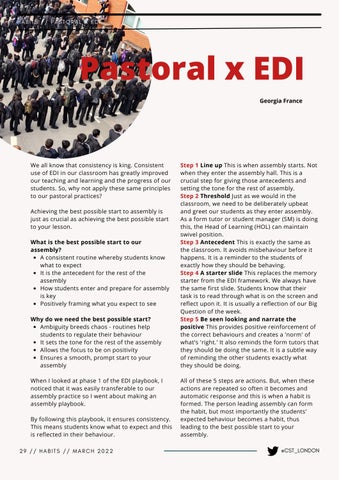
We all know that consistency is king. Consistent use of EDI in our classroom has greatly improved our teaching and learning and the progress of our students. So, why not apply these same principles to our pastoral practices? Achieving the best possible start to assembly is just as crucial as achieving the best possible start to your lesson. What is the best possible start to our assembly? A consistent routine whereby students know what to expect It is the antecedent for the rest of the assembly How students enter and prepare for assembly is key Positively framing what you expect to see Why do we need the best possible start? Ambiguity breeds chaos - routines help students to regulate their behaviour It sets the tone for the rest of the assembly Allows the focus to be on positivity Ensures a smooth, prompt start to your assembly When I looked at phase 1 of the EDI playbook, I noticed that it was easily transferable to our assembly practice so I went about making an assembly playbook. By following this playbook, it ensures consistency. This means students know what to expect and this is reflected in their behaviour. 29 // HABITS // MARCH 2022
Step 1 Line up This is when assembly starts. Not when they enter the assembly hall. This is a crucial step for giving those antecedents and setting the tone for the rest of assembly. Step 2 Threshold Just as we would in the classroom, we need to be deliberately upbeat and greet our students as they enter assembly. As a form tutor or student manager (SM) is doing this, the Head of Learning (HOL) can maintain swivel position. Step 3 Antecedent This is exactly the same as the classroom. It avoids misbehaviour before it happens. It is a reminder to the students of exactly how they should be behaving. Step 4 A starter slide This replaces the memory starter from the EDI framework. We always have the same first slide. Students know that their task is to read through what is on the screen and reflect upon it. It is usually a reflection of our Big Question of the week. Step 5 Be seen looking and narrate the positive This provides positive reinforcement of the correct behaviours and creates a 'norm' of what's 'right.' It also reminds the form tutors that they should be doing the same. It is a subtle way of reminding the other students exactly what they should be doing. All of these 5 steps are actions. But, when these actions are repeated so often it becomes and automatic response and this is when a habit is formed. The person leading assembly can form the habit, but most importantly the students' expected behaviour becomes a habit, thus leading to the best possible start to your assembly. @CST_LONDON
habits. everyday excellence