News for Durham University Staff & Students
RESEARCH INSIGHTS Dr Kayleigh Garthwaite is a Leverhulme Trust funded researcher at the Centre for Health and Inequalities Research. She spent eighteen months volunteering at a foodbank as part of her field work, resulting in her book Hunger Pains - she explains more here.
Nov | Dec 2016
THE WESTERN ART COLLECTION Durham's outstanding Western Art Collection has recently been brought under the care of Culture Durham.
BIG FRIENDLY LIBRARY
Contribute to your magazine.
/durhamuniversity
welcome
Welcome to a new issue of Dialogue magazine. The content of this issue reflects some of the many things that have been happening across the University at the start of the new academic year. We have announced the appointments of Owen Adams, OBE, as the new ProVice-Chancellor (Student Experience), Professor Alan Houston as the new Pro-Vice-Chancellor (Education) and Professor Antony Long as the new Deputy Vice-Chancellor and Provost. Owen and Alan will join the Executive in January 2017, while Antony took up his post on 1 November 2016. I’m sure you will join me in welcoming these new members of the senior management team.
As you might be aware, we commissioned BiGGAR Economics to carry out a regional impact study earlier this year, looking at the University’s cultural, social, and economic contribution across the UK and in our own region. I am proud to say that the report and the findings have confirmed just how important the University is to the North East. The Report is being launched in Durham on 9 November.
2
One important role we play is in supporting Durham’s cultural heritage through our collections and exhibitions (see page 12). The strong partnerships we are forming, such as our recent agreement with the Auckland Castle Trust to establish The Zurbarán Centre for Spanish and Latin American Art (pages 6 and 7), will also have positive impacts on our region. A vital contribution to the life of the University and the region as a whole is of course made by our students, and, with that in mind, I close by inviting you to join me in celebrating the successes of our students at the Winter Congregation ceremonies taking place in January. I look forward to seeing you there.
Professor Stuart Corbridge Vice-Chancellor and Warden
@Durham_Uni
DurhamUniversity
DurhamUniversity
Tell your story. Please continue to send your contributions and feedback to dialogue@durham.ac.uk News for Durham University Staff & Students
7
5 18
22
10
Editor Ulrike Klaerig-Jackson Communications Coordinator Assistant Editor Mark Tallentire Communications Coordinator Contributors Harriet Williamson, HR&OD; Jordan Christie, CIS; Steph Dawson, Library; Yvonne Flynn, Greenspace; Daryl Dowding, Event Durham; Melinda Polidario-Maddock, Karen Frost & Nicky Sawicki, Marketing & Communications; Linda Martin, Procurement; Professor Keith Lindsey, Department of Biosciences; Leighton Kitson, Marketing & Communications; Dr Kayleigh Garthwaite, Department of Geography; St Chad’s College; Alix Collingwood-Swinburn & Chloe Wong, Art Curators; Tim Broadwell, Student Immigration Office Cover image The Twelve Tribes of Israel, Jonathan Parker (b.1968), Trevelyan College, Durham University. CUR/11/16/025
Nov | Dec 2016
4
GET SOCIAL
14 HR & OD NEWS
5
A NEW NAME FOR A NEW ERA
16 CIS NEWS
6
RESEARCHING SPANISH AND LATIN AMERICAN ART
8
UNIVERSITY STRATEGY DEVELOPMENT UPDATE
9
LIBRARY NEWS
10 RESEARCH INSIGHTS – INSIDE FOODBANK BRITAIN
17 GREENSPACE 18 ST CHAD'S COLLEGE 20 SPOTLIGHT ON… 21 CELEBRATING OUR SUPPLIERS 22 THE WESTERN ART COLLECTION
12 MUSEUMS AND ATTRACTIONS
23 AN INSIGHT INTO
13 SO MUCH MORE
24 WHAT’S ON
Durham University and Durham University logo are registered Trade Marks of the University of Durham. Unless otherwise stated, all material in this publication is copyright of the University of Durham. The University makes every effort to ensure that the information contained here is accurate. Please note that the University’s website is the most up to date source of information and we strongly recommend that you always visit the website before making any commitments.
3
social
YOUR VIEW
Our favourite posts, tweets and videos over the past 2 months to show you what has been happening around the University!
TOP
5 TWEETS
Durham climbs to 4th in the UK in the @thetimes Good University Guide bit. ly/2cWyKR2 #DUmakeithappen pic.twitter.com/ZAkDyk9wLI
A warm welcome to international students arriving @durham_uni today.#DUmakeithappen #DuInduction pic. twitter.com/XXPtBYlOQ8
Day 4 #durhamdays photo comp theme 'arrival'. You know you've arrived in Durham when u see this view. Share photos #durhamdays pic.twitter.com/WzZwLIO11J
Take part in the #DurhamDays photo-challenge. Share your photos to win £25! #DUmakeithappen #DUInduction bit.ly/2dgDrWr pic.twitter.com/3A5o0tmRTc
Our new #Zurbarán Research Centre for #Spanish & #LatinAmerican #Art announced in partnership with @aucklandcastle bit.ly/2cDAZoL pic. twitter.com/601OfROwEp
PROBLEM SOLVING
VIDEO OF THE MONTH
Scientists at Durham University, UK, have “taught” materials to form electrical pathways in order to solve a simple problem, which could eventually lead to new electronic devices. To watch the video go to https://www.youtube.com/watch?v=dj0KJ_ a3uBM
PHOTO OF THE MONTH
SUMMER SUNSHINE Day 12 of #durhamdays start of term photo challenge had lazy Sunday as its theme. This image shows Durham in all its beauty, enjoying the last few days of summer sunshine before the change of season.
4
/durhamuniversity
@Durham_Uni
DurhamUniversity
DurhamUniversity
News for Durham University Staff & Students
NEW ERA
The Department of Biosciences
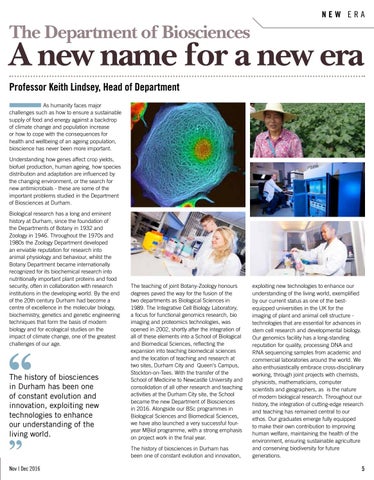
A new name for a new era Professor Keith Lindsey, Head of Department As humanity faces major challenges such as how to ensure a sustainable supply of food and energy against a backdrop of climate change and population increase or how to cope with the consequences for health and wellbeing of an ageing population, bioscience has never been more important. Understanding how genes affect crop yields, biofuel production, human ageing, how species distribution and adaptation are influenced by the changing environment, or the search for new antimicrobials - these are some of the important problems studied in the Department of Biosciences at Durham. Biological research has a long and eminent history at Durham, since the foundation of the Departments of Botany in 1932 and Zoology in 1946. Throughout the 1970s and 1980s the Zoology Department developed an enviable reputation for research into animal physiology and behaviour, whilst the Botany Department became internationally recognized for its biochemical research into nutritionally important plant proteins and food security, often in collaboration with research institutions in the developing world. By the end of the 20th century Durham had become a centre of excellence in the molecular biology, biochemistry, genetics and genetic engineering techniques that form the basis of modern biology and for ecological studies on the impact of climate change, one of the greatest challenges of our age.
The history of biosciences in Durham has been one of constant evolution and innovation, exploiting new technologies to enhance our understanding of the living world.
The teaching of joint Botany-Zoology honours degrees paved the way for the fusion of the two departments as Biological Sciences in 1989. The Integrative Cell Biology Laboratory, a focus for functional genomics research, bio imaging and proteomics technologies, was opened in 2002, shortly after the integration of all of these elements into a School of Biological and Biomedical Sciences, reflecting the expansion into teaching biomedical sciences and the location of teaching and research at two sites, Durham City and Queen's Campus, Stockton-on-Tees. With the transfer of the School of Medicine to Newcastle University and consolidation of all other research and teaching activities at the Durham City site, the School became the new Department of Biosciences in 2016. Alongside our BSc programmes in Biological Sciences and Biomedical Sciences, we have also launched a very successful fouryear MBiol programme, with a strong emphasis on project work in the final year. The history of biosciences in Durham has been one of constant evolution and innovation,
Nov | Dec 2016
exploiting new technologies to enhance our understanding of the living world, exemplified by our current status as one of the bestequipped universities in the UK for the imaging of plant and animal cell structure technologies that are essential for advances in stem cell research and developmental biology. Our genomics facility has a long-standing reputation for quality, processing DNA and RNA sequencing samples from academic and commercial laboratories around the world. We also enthusiastically embrace cross-disciplinary working, through joint projects with chemists, physicists, mathematicians, computer scientists and geographers, as is the nature of modern biological research. Throughout our history, the integration of cutting-edge research and teaching has remained central to our ethos. Our graduates emerge fully equipped to make their own contribution to improving human welfare, maintaining the health of the environment, ensuring sustainable agriculture and conserving biodiversity for future generations.
5
ART
Researching Spanish and Latin American art The University is helping to establish North East England as an international centre for research into and study of Spanish and Latin American art and culture. The Zurbarán Centre for Spanish and Latin American Art will open in nearby Bishop Auckland in 2017, providing opportunities for research, postgraduate study, public outreach and regional regeneration. The Centre will complement the work of our Centre for Visual Arts and Culture, the research of Spanish and Latin American specialists in the School of Modern Languages and Cultures, and additional work in Spanish and Latin American art across a number of other Departments. The announcement about the new Centre follows the signing of a partnership agreement between the University and Auckland Castle Trust. There will be a direct link between the Zurbarán Centre’s research and exhibition programming at Auckland Castle’s planned
6
Spanish Gallery, due to open in 2019. This will create opportunities for student projects and allow visitors to benefit from the input of worldclass researchers. It is envisaged that the Zurbarán Centre, which will also host major conferences and workshops, will raise the public profile and
This new research centre and partnership with Auckland Castle, with its access to extensive collections of Spanish art, allows us to enhance this work further.
understanding of Spanish and Latin American art, both in the UK and globally. The Centre is being part funded by a threeyear £600,000 donation from Santander – the largest single award made by Santander to a UK university. The University will contribute an additional £1m over the next five years. The project forms part of a wider £70m investment by Auckland Castle Trust, designed to stimulate economic regeneration in Bishop Auckland, which is 12 miles from Durham City. County Durham is home to the UK’s largest collection of Spanish art outside London, including the paintings of Jacob and his Twelve Sons by the Spanish master Francisco de Zurbarán, currently housed at Auckland Castle.
News for Durham University Staff & Students
ART
Far left: The Adoration of the Magi Luca Giordano (Naples 1634 – 1705) 1687–89 Oil on canvas 112 x 210 cm Private Collection Left: Art and material culture among Guna indigenous people in Panama. Credit Paolo Fortis, Durham University. Below: St Bartholomew Unknown SeventeenthCentury Spanish Artist, Durham Castle. Below left: Jacob and his 12 sons Francisco de Zurbarán (1598-1664) 1640-1645 Oil on Canvas Courtesy Auckland Castle / The Zurbaran Trust
Vice-Chancellor Professor Stuart Corbridge said: “The University is ranked in the world top 50 for Arts and Humanities and is also establishing itself as a leading international centre for the study of visual culture. “This new research centre and partnership with Auckland Castle, with its access to extensive collections of Spanish art, allows us to enhance this work further. “Not only will it offer our students the chance to study some of the world’s most important artworks, it is also a way of connecting the wider public with our research expertise and demonstrates our commitment to cultural regeneration in the region.” The partnership between the University and Auckland Castle Trust formalises a number of other joint projects including archaeological work at Auckland Castle, as well as student placements and joint research projects across a number of our subject areas. For more about our research in Spanish and Latin American arts and cultures visit: www.durham.ac.uk/cvac/research/zurbaran/ spanishart
Nov | Dec 2016
7
STRATEGY UPDATE
University Strategy development update Since the last issue of Dialogue, work across many workstreams of the new University Strategy has moved from the planning phase to implementation, University Council having approvingly reviewed the Academic Strategy in July. By the end of 2016, work will be completed on the Enabling Strategies – People, Operations (Durham DOES), Finances and the Estate – and the full University Strategy will be presented to Senate and Council, along with business cases for some specific elements. From January 2017 it is anticipated that the Strategy will move from development into implementation and further information on the Strategy launch will be provided in due course. Estate Masterplan One of the key enabling strategies under development to support our Academic Strategy is the Accommodation and Estate Strategy. Major investment in our estate is required to accommodate growth, improve the collegiate experience, and bring the condition of some of our existing estate up to the right standard. In the early part of this term we consulted internally and externally on our Estate Masterplan, which provides a guide to how we could develop the estate over the long term. The Masterplan identifies three early/priority investments to provide additional residential accommodation, teaching and sports facilities as student numbers in the City begin to increase. Subject to internal and statutory approval, these will be at Mount Oswald, St Mary’s Field and at Maiden Castle. The Masterplan and the Accommodation and Estate Strategy will provide the framework against which to assess business cases for future developments and there will be consultation on all individual projects as business cases are prepared.
8
There will be further opportunities to hear more about and engage in the work of the Accommodation and Estates Strategy in the coming months as we move towards Strategy implementation. Delivering Operational Excellence Strategy - Durham DOES Durham DOES is the name for the emerging service excellence programme, led by Jane Robinson, Chief Operating Officer. The programme aims to increase the efficiency and effectiveness of operations across all parts of the University, including University-wide teams as well as Faculties, Departments and Colleges. This will be done by empowering teams and individuals to deliver service excellence with confidence and creating a ‘right first time’ culture. Durham DOES is essential to increase the resilience and effectiveness of the University. Like all universities, we are operating within a rapidly changing landscape, including an increasingly competitive funding and regulatory environment. Change is required to ensure that the University is sustainable into the future. The next phase of work will focus on engagement with all parts of the University community, underpinned by the principles of co-design and partnership working. Marketing and Communications has been selected as a pathfinder project to test out the proposed methodology and approach. To find out more about Durham DOES and its key principles, as well as information on upcoming workshops and Town Hall meetings, go to: www.durham.ac.uk/about/local/unistrategy/durhamdoes Further information on the Strategy development and how to get involved or provide feedback can be found at: www.durham.ac.uk/about/local/unistrategy
News for Durham University Staff & Students
LIBRARY NEWS
Big Friendly Library Durham University Library has a wide range of services and facilities. How many are you aware of? There are generous opening hours, varied study spaces, course-specific resources and staff available to help – so there are lots of reasons to visit the “Big Friendly Library”. If you are new to the Library, be sure to take a look at our new student web pages: www.durham.ac.uk/library/newstudents Keep in touch and find out more by visiting: www.durham.ac.uk/library
Library overnight chat service DO YOU EVER HAVE QUESTIONS OR ENQUIRIES WHEN THE LIBRARY IS CLOSED? Durham University Library offers an overnight chat service, operating during the hours when the library is closed. This overnight service is operated by librarians in the USA. They help with enquiries or pass on your information to Durham library staff. The service operates from 8pm to 8am. You can find and use the overnight chat service at: www.durham.ac.uk/library
Nov | Dec 2016
9
RESEARCH INSIGHTS
Dr Kayleigh Garthwaite is a Leverhulme Trust funded researcher at the Centre for Health and Inequalities Research. She spent eighteen months volunteering at a foodbank as part of her field work, resulting in her book Hunger Pains - she explains more here.
Inside foodbank Britain I am part of a project to investigate the experiences of people whose lives have been affected by poor health and welfare cuts in Stockton-On-Tees. When I first started working on the project I discovered that a number of organisations offered emergency food provision in the area, and I decided to volunteer with the Trussell Trust foodbank. I volunteered once a week (sometimes twice) from November 2013 to April 2015 and the role was incredibly varied. I did everything from preparing food parcels to liaising with agencies such as Citizen’s Advice Launch event in Westminster - from left to right: Niall Cooper, Director of Church Action on Poverty; Patrick Butler, editor of Society, Health and Education Policy for the Guardian; Dr Kayleigh Garthwaite and Jack Monroe, author and activis
10
News for Durham University Staff & Students
RESEARCH INSIGHTS
The “Local Health Inequalities in an Age of Austerity” is a five year project funded by the Leverhulme Trust. Led by Professor Clare Bambra (Geography) it was set up in 2013 to study health inequalities in Stockton-onTees where there is a 17 year difference in life expectancy at birth for men, and 11 years for women, between the most and least deprived areas (Public Health England, 2015). The project is part of the work of the Centre for Health and Inequalities Research www.durham.ac.uk/chir Dr Kayleigh Garthwaite
Trussell Trust The trust is the UK’s largest foodbank franchise and runs over 400 foodbanks across the country, each providing three days’ emergency food to people experiencing crisis. In 2015/16, over 1 million three day emergency food supplies were given out. Of this number, 415,866 went to children. Whilst volunteering I got the chance to hear directly from the people who came in for a food parcel about why they were there. As I listened to people’s stories, I made it clear that I was also carrying out a research project at Durham University looking at health inequalities in the area.
Bureau and local GPs. I administered the vouchers required for people to access emergency food; made tea and toast; did the washing up (sometimes!), and bought bottles of juice or bags of sugar when stocks were running low. I also participated in the twice yearly neighbourhood collections at Tesco’s, asking people to buy an extra item on their shopping for the foodbank.
I remain close to the people I met at the foodbank and they have been very supportive of me. They are always keen to hear about any media attention the book has received and are really proud of the responses. Nov | Dec 2016
When I set out, I had no plans to write a book. However, when I started writing an academic paper in 2015 I realised that 8,000 words did not do justice to the personal stories that people had shared with me. I wanted people outside of academia to hear the stories of the people using the foodbank and I felt that writing a more mainstream book would reach a wider audience. I remain close to the people I met at the foodbank and they have been very supportive of me. They are always keen to hear about any media attention the book has received and are really proud of the responses to my research which included a launch event in the Houses of Parliament. They helped me organise the launch inside the foodbank in Stockton and both events were attended by representatives from Child Poverty Action Group, Citizens Advice Bureau, Joseph Rowntree Foundation, MPs, and journalists, as well as the volunteers and people who have used the foodbank. Overwhelmingly, people told me they feel angry that what the book describes is happening in society today, and they hope that policy makers and politicians will not only read the book, but will actually listen and act upon it.
11
MUSEUMS AND ATTRACTIONS
Palace Green Library HEARING VOICES: SUFFERING, INSPIRATION AND THE EVERYDAY 5 November 2016 – 26 February 2017 From the revelatory and inspirational voices of medieval mystics to those of imaginary friends in childhood, and from the inner voices of writers as they craft their characters to the stories of people from the international Hearing Voices Movement, the exhibition will explore the complexity and diversity of the experience and interpretation of voice-hearing.
SANDFORD AWARD FOR EXCELLENCE IN HERITAGE EDUCATION The University’s Library Learning Team is celebrating being awarded the prestigious Sandford Award for Excellence in Heritage Education for their schools programme at both Palace Green Library and the Oriental Museum. The Sandford Award is given only to organisations who meet rigorously applied criteria relating to the quality of the content of their workshops and the service they provide to teachers and students. The learning programme is one of the most successful in the region with the team using the historic collections of the University to deliver sessions for well over 20,000 children and young people each year.
DRESSED TO IMPRESS: NETSUKE AND JAPANESE MEN’S FASHION This British Museum exhibition will take place at the Oriental Museum from 9 December 2016 until 21 May 2017. Originally a practical piece of dress, during the Edo Period (1615-1868) netsuke carving evolved into an important art form in Japan. Museums often display netsuke as works of art, acknowledging the great skill used in their creation. Featured alongside the British Museum objects will be a selection of netsuke and other accessories from the Oriental Museum’s own collection. Entry to the exhibtion is free with a valid campus card.
‘THE BEST WORDS IN THE BEST ORDER’ – POETRY IN DURHAM AND THE NORTH EAST 19 November 2016 – 26 February 2017 Contemplating the story of poetry in the north east, this exhibition takes an inspired look at the connections between poetry and life. Originally shown at Woodhorn, this exhibition is influenced by the Northern Poetry Library and Palace Green Library collections.
To find out more about Palace Green Library, please visit: www.durham.ac.uk/palace.green
12
News for Durham University Staff & Students
CAMPAIGN
We are So Much More than the sum of our parts Anyone who works for, studies at or visits our great University already knows something of the positive contribution we make to the North East – but now it’s official. A major study undertaken by BiGGAR Economics has revealed just how important the University is to our region, through our contribution to the region’s economy, culture and society and through our world-leading research.
The evidence The independent report found the University is worth more than £600 million a year to the North East economy – and supports 10,330 jobs in the region. For every £1 the University receives in funding, it generates £3.21 for the UK economy – and we have launched 25 spin out companies since 1997, supporting nearly 1,000 jobs. In the culture sector, the University plays a crucial role in tourism – attracting 231,270 people to our visitor attractions in 2014-15 and generating nearly £8 million for the region’s economy. We also hosted 602 events, which were attended by more than 40,000 people.
to volunteering every year and, since 2010, 750 staff have taken advantage of our Employer Supported Volunteer (ESV) scheme, which allows staff to volunteer for up to five days a year in work time. This adds up to more than 3,000 hours of staff volunteering every year. Our world-leading and world-changing research also has significant benefits for the North East, through our pioneering Durham Energy Institute or acclaimed Scottish Soldiers project, for example. In fact, Research and Knowledge Transfer activities here at the University were worth £139.3m to the UK economy in 2014-15 – and supported 2,700 jobs.
Celebrating our achievements
Durham University students undertake over 14,000 hours of volunteering each year
All these contributions – and many more – were celebrated at a regional engagement event held at Durham University Business School in November. The ‘Durham University – So Much More’ event brought together political, business, cultural and community leaders to explore our joint achievements to date and discuss possible future collaborations.
We’re making a real difference to the society we live in too: our students give 14,000 hours
For more information on how the University is So Much More than the sum of its parts, visit www.durham.ac.uk/about/ somuchmore or follow us via #DUsomuchmore Nov | Dec 2016
Boosts the UK economy by £1.1 billion a year and supports nearly 14,000 jobs – including almost £650 million and more than 10,000 jobs here in the North East
231,270 people visited University attractions Unless stated otherwise, data and quotes are from BiGGAR Economics’ report ‘Economic Impact of Durham University’, of 24 March 2016, and are based on 2014/15
13
HR & OD NEWS
Collaborative working, realising potential… We are delighted to announce that University Catering were winners in the Leadership in Recruitment, Retention & Development category at the hospitality employers’ industry event of the year the 2016 Caterer.com People Awards. This is recognition of 12 months of collaborative work to improve recruitment, induction and retention processes. In line with the industry skills shortage and difficulties in filling some vacancies in recent years, Durham University Catering conducted a full departmental review and in collaboration with Human Resources developed a new integrated recruitment, induction and development process which complements the Realising Your Potential Approach. There is now a single recruitment process for all 24 Cafes/Colleges, which is more efficient and enables the department to use its marketing budget more effectively. With a greater focus on positive behavioural indicators and the written application shortlisting process completely removed for entry level vacancies, the calibre of candidates has improved and over 90% of the vacancies have been filled. An interactive induction delivered by the department’s senior management team ensures that team members are appropriately welcomed to the University. The induction further enables new starters to understand the University’s and department’s strategic objectives and feel empowered to make decisions, as well as being valued and recognised as important contributors to the University’s ongoing success. Effective training and development processes have been reinvigorated with team members able to complete annual refresher training at their convenience. Further personal development is more creative and pioneering, e.g. by facilitating secondments for Chefs in Michelin Star and award-winning restaurants, and international food exploration trips
We believe this is a really positive message of two departments working collaboratively to improve processes, which ultimately enhance the student experience.
Praise for staff development work Durham University has become the first institution in the country to receive the Association of University Administrators’ Mark of Excellence.
framework called the Realising Your Potential Approach, based on AUA‘s continuing professional development framework.
This prestigious national award recognises the University’s commitment to the continuing development of staff in professional support services. Members of the team will receive the Mark of Excellence from HEFCE Chief Executive Madeleine Atkins at the AUA Annual Lecture at the Royal Society in December.
Over 1500 members of professional support services have used this framework across recruitment, induction, annual staff reviews, development plans and via valuing contribution events. These activities demonstrate the significant impact that professional support services staff have on this world-class institution – impact that is also embedded in the core values of our People Strategy.
As many of you will know, over the past two years we have developed a behaviours
14
To find out more about how you could benefit from using the Realising Your Potential Approach, please call Sophie Sowerby in the CAROD team on 0191 3341640.
News for Durham University Staff & Students
HR & OD NEWS
Academic Recruitment campaign The University has launched a new recruitment campaign for academic vacancies, with the aim of appointing 45 new colleagues to join us for the start of the 2016/17 academic year. The vacancies are being advertised in the Times Higher and Chronicle of Higher Education, in print, online and via social media. We are working with colleagues from the Marketing and Communications Office on this campaign; and the campaign is supported by a microsite, at www.durham.ac.uk/ academictalent, which promotes our University, Faculties and Departments, as well as offering an insight into living and working in Durham. Any additional academic vacancies will be added to this microsite in future; and we aim to run such recruitment campaigns annually to fill vacant academic positions across the University.
Long-serving colleagues honoured Colleagues who have given 25 years’ service to the University were honoured with a celebratory dinner at Durham Castle in November. In all, 26 were invited. The colleagues and their guests enjoyed a tour of the Castle and drinks in the Tunstall Gallery before sitting down to dinner in the Great Hall. The celebratory dinner was also attended by members of University Executive Committee and the Vice –Chancellor, Professor Stuart Corbridge. Director of Human Resources & Organisation Development, Clare Curran said: ‘This is my third year hosting the University’s long service Dinner, and the opportunity to come together to celebrate with our long serving staff, their guests, their managers and members of UEC in the wonderful surroundings of the castle continues to be a highlight of my year. We all greatly enjoyed an excellent meal and exceptional performances from the student choir throughout the evening. For me, it’s a truly special evening and I look forward to the event in 2017.’
2016 Buckingham Palace to Durham Cathedral pedometer Challenge On 8 November we celebrated the end of the 2016 Buckingham Palace to Durham Cathedral pedometer Challenge with a closing ceremony, and the awarding of prizes. The aim of the challenge was for teams of five to walk the equivalent amount of steps from Buckingham Palace to Durham Cathedral 1,400,000 steps in just 27 days. We had 248 members of staff actively taking part in the challenge and ten teams managed to achieve this target. This challenge was facilitated by Workplace Challenge, who runs similar challenges for different workplaces across the UK. At the closing event Workplace Challenge awarded Durham University the most active workplace in County Durham! With an amazing 260 active loggers, 8,697 activities logged and a 2,043Kg CO2 saving made! You can see final results and photos from the closing ceremony on the Challenge webpages www.durham.ac.uk/hr/tenkchallenge
The student choir entertained guests with songs several times throughout the evening, before joining them for dinner.
Nov | Dec 2016
15
CIS NEWS
One step closer to a more flexible future The rollout of an all new desktop to over 2,000 student and teaching computers this summer was no mean feat, and while our work doesn’t stop there, it’s a good time to take stock of this major achievement delivered as part of the University’s New World Programme. When you log onto a University managed computer, the way it looks, feels and works is all part of a managed desktop service. If you visit any of the University’s computer classrooms, open access areas, lecture theatres or teaching rooms, you can now make use of a sophisticated and modernised desktop experience. We’re one of the first universities to roll out the latest operating system Windows 10 across the board, and you’ll also find Office 2016 at your fingertips. Perhaps the biggest benefit this change brings though, is academic applications streamed to the computer as you need them. This gives academic staff and students added flexibility as you no longer need to visit a particular computer room or building to access subjectspecific software. And we’re not stopping there. The New World Programme's Access Project will also introduce 'flexible remote access'. Not only will you be able to access the applications you need anywhere within the University – you’ll also be able to use the tools you need from any device, anywhere, even outside of the University (subject to licensing restrictions). We’ll be piloting our flexible remote access solution towards the end of 2016, with a view to launching it before the end of the academic year. The new desktop will also roll out to staff computers (those that currently use MDS) during this academic year. We’ll work closely with departments to plan the rollout, once our comprehensive testing programme is complete.
academic applications
Paul Featherstone, our Chief Information Officer, said: “The roll out of the new managed desktop is one of our most visible achievements to date. The programme is well into its delivery phase and it’s great to see the anticipated benefits becoming a reality. While any change on this scale brings inevitable teething issues, early results show that the service is being adopted well by students and staff. “The new infrastructure and services we’re delivering will underpin the University’s ambitious new strategy, giving us increased flexibility, integrity and capacity for future growth.”
16
News for Durham University Staff & Students
GREENSPACE
Cyclists - Be Safe, Be Seen – use your lights! Well done for continuing to cycle around Durham through an increasingly damp autumn, you are all awesome! With the long nights now upon us, remember it is the law for all cyclists to have appropriate lighting on their bikes at night. Make sure motorists can see you - use lights and consider wearing bright or reflective clothing, especially in towns, at night and in bad weather. Take your lights with you when you leave your residence, it may be light when you leave in the morning, but come 4.30pm it will be dark! The Road Vehicles Lighting Regulations 1989 state that at night your cycle MUST have white front and red rear lights lit and be fitted with a red rear reflector (and amber pedal reflectors, if manufactured after 1/10/85). Flashing lights are permitted but it is recommended that cyclists who are riding in areas without street lighting use a steady front lamp. Additional information on the Highway Code for cyclists can be found here: www.gov.uk/rules-for-cyclists-59-to-82
University Environment Schedule The University’s Environment Schedule for 2016/17 is designed to address a wide range of environmental issues in order to support environmental sustainability at Durham University. Further details of events and activities as part of the schedule, as well as additional activities occurring throughout the year can be found at www.durham.ac.uk/resources/greenspace/ EnvironmentSchedule16-17.pdf
Watch out for Greenspace Fortnight Greenspace Fortnight runs from 27 February to 12 March. This incorporates our annual Environment Week, a celebration of the fantastic local produce available to us in the North East and the national Fairtrade Fortnight. Further details will be announced in the New Year.
Further winter cycling tips to keep you going through the cold months of the year can be found on the Greenspace Travel website.
Christmas E-Card Competition
Water Awareness Campaign Water Awareness Week will run from 21 November to 28 November. This campaign encourages everyone to reduce water consumption from taking shorter showers to reporting dripping taps. Read some water saving tips, along with other environment tips at www.durham.ac.uk/greenspace/energy/watersave/ wateraware
Nov | Dec 2016
Did you know that there were over 2300 e-cards sent from the Greenspace website during December 2015? Sending a Christmas e-card saves both the production and travel associated with sending paper cards. We would now like to increase the number of e-cards available and encourage you all to take part in the Christmas e-card competition. Please send your images to greenspace.staff@durham.ac.uk by 24 February 2017. Please note we cannot accept any photos containing people or private dwellings due to privacy laws. As well as Christmas e-cards we also have a selection of e-cards which can be used for any occasion throughout the year. Why not take a look www.durham.ac.uk/greenspace/ecard
17
COLLEGE NEWS
St Chad’s College may be the smallest of all the Durham University colleges, but we’re firm believers that good things come in small packages… Just as our green front door opens into the surprisingly capacious – even tardis-like – main college building on the historic Bailey, just fifty metres from the magnificent Norman Cathedral, our relatively small student body of just over 500 members includes representatives of over 40 different nationalities studying for undergraduate and postgraduate degrees in all departments of the University.
A multigenerational community of learning… Our commitment to creating and maintaining a diverse and balanced college community is helped by the fact that we have a high ratio of resident postgraduates and undergraduate returners (undergraduates who move back into college accommodation in their final year). Coupled with the fact that we are one of the few colleges with its own academic staff – our fellows, who engage primarily in research – this means that on a daily basis, our new students are able to mix with older undergraduates, postgraduates, and academics without even leaving the college buildings! Our strong Tutor system for all students and the College Parenting system within the Junior Common Room mean that Chad’s is a community which offers both accessible pastoral support and real opportunities to grow, flourish, and make your mark within the wider Durham University community.
endocrinology of depression, medieval Castilian hagiography, and the effects of decreasing homophobia in Western cultures. Our Honorary Fellows regularly dine in college and participate in our programme of scholarly and social events.
Asking the difficult questions… As the Vice-Chancellor explained in his address to our matriculating students in early October, part of our job as a University, whether in academic departments or in colleges, is to make our students’ lives difficult – in the best possible sense of the word! We are committed to asking the difficult questions and to recognising that there are no ‘simple’ solutions to global concerns like climate change, the depletion of natural resources, or continuing racial or gender discrimination. The perturbing tenor of debate during the recent UK referendum on the UK’s membership of the EU, and the emergence of an apparent distrust of academic ‘experts’ confirmed our belief that one of the most valuable things we can do for our students is to give them regular opportunities to engage with ‘experts’ and consider challenging issues from various new angles by engaging with others of different disciplinary, national, political, and cultural backgrounds as well as different points of view.
In the 2016/17 academic year we have for the first time invited our students to nominate for Honorary College Fellowships those academics and researchers in their departments who most engage and inspire them. We now have fifteen Honorary College Fellows from across the three faculties working in such diverse areas as robotics and AI, the
18
News for Durham University Staff & Students
COLLEGE NEWS
A fresh perspective…
One new undergraduate student commented: The evening was a great success; what struck me the most was that in true Chad’s style everyone gave each other a fair hearing, everyone was respectful, and there was no bitterness or acrimony whatsoever. I’ve only been at Chad’s for two weeks, but Monday made me proud to be a Chadsian; I look forward to attending more Perspectives talks in the future.
The new college module, Perspectives, does just that, encouraging members of St Chad’s College – whether JCR, MCR, or SCR – to develop their multi-disciplinary intellectual curiosity; their skills of critical and innovative thinking; and their self-identity as responsible, informed, and effective global citizens. At each session three Honorary Fellows and other academics explain how their particular disciplinary background informs their take on a global or topical issue before students form ‘break out’ groups to formulate or reconsider their own views, finally reconvening for a large group discussion. The sessions are run ‘salon-style’ with light refreshments provided for all participants. We believe that ‘Perspectives’ is a fitting title for an initiative that aims to foster multi-disciplinary intellectual curiosity, and a respect for difference and diversity. The module’s branding makes use of the famous ‘nine dots puzzle’, the solution to which requires lateral thinking. The familiar (even clichéd) phrase ‘thinking outside the box’ is thought to derive from management consultants in the 1970s and 1980s challenging their clients to solve this ‘nine dots’ puzzle. Our first session, Safe Spaces drew an audience of over 120 Chadsians from all three common rooms (to put this in perspective, that’s over a quarter of our total college membership). Two of our Honorary Fellows, Dr Mark McCormack (SASS) and Dr Sara L. Uckelman (Philosophy) were joined by Dr Benedict Douglas (Law School) as they offered their disciplinary take on the topics of free speech, the right to offend, trigger warnings, and how to disagree well.
Nov | Dec 2016
At our second session we asked the question, ‘Are we living in a post-gender age?’, and were joined by an Honorary Fellow, Dr Gillian Campling (Biosciences), our own PhD student and Mars One candidate, Hannah Earnshaw, and Professor Robert Song (Theology). Students explored the relationship between biological sex, gender identity, and self-expression, and questioned whether the traditional gender binary can encompass our broad range of experiences and identities. Our next session will ask ‘Can we trust technology’ as students hear from academics working in the areas of AI, cybercrime, and the use of drones in warfare and surveillance. Whilst the topics for the Michaelmas Term session have been selected by College staff in collaboration with student representatives, students will be invited to participate in an online poll to choose the topics for our sessions in the Epiphany Terms. The Principal of St Chad’s College, Dr Margaret Masson believes that the new Perspectives series goes to the heart of what a college community can and should be: ‘I am delighted to see such a large proportion of the College community engaging with these difficult, important issues. It’s what colleges are for – robust debate, respectful listening, intellectual buzz, and richly varied perspectives’.
19
SPOTLIGHT ON...
Do you want people to know about your department/college/research group/centre… then our ‘Spotlight on’ feature is the place for it.
Get in touch with dialogue@durham.ac.uk to tell us about you.
/durhamuniversity 20
@Durham_Uni
DurhamUniversity
DurhamUniversity News for Durham University Staff & Students
Buy in
Celebrating our suppliers
PROCUREMENT SERVICE
Outstanding Corporate Social Environmental Responsibility (CSER) HIGHLY COMMENDED Waterstons for their engagement with the local community and charities both at home and overseas. WINNER J.R. Holland for their continued investment in local producers, enabling suppliers to grow and re-invest in the local economy.
Outstanding Customer Service: WINNER Alphagraphics for their friendly, proactive customer service and responding to tight timescales. WINNER Ashbank Laundry Centre for being flexible, accommodating and efficient in their approach.
Our annual celebration of excellence amongst our suppliers, the Supplier Recognition Awards, was held at the University’s Lindisfarne Centre in September.
Outstanding Account Management and Support: HIGHLY COMMENDED Iron Mountain for their professional and enthusiastic attitude and reliability. HIGHLY COMMENDED Saville Audio Visual for their quick response to queries to ensure installations are correct and on time. WINNER Bidvest for professional and timely communication, helping source new products within budget constraints.
Outstanding Communication: WINNER Gem Partnership for their innovative approach and implementing a bespoke communication strategy.
Outstanding One-off Contribution: WINNER Tiffin Sandwiches for supporting open days and graduation to ensure these one-off events were a success.
Most Innovative Solution or Proposal: WINNER Studio MB for their innovative, creative approach to exhibition design coming up with ideas that the University would not have considered. There were a number of award categories, covering all aspects of supply and service. Twelve suppliers collected awards and the Above and Beyond the Call of Duty honour was won by Alphagraphics. The event was a great success and the John Turner Outstanding Customer award, named in honour of our late colleague, was presented to Phil Redmond, from the Estates and Buildings Department, and Lynsey Tibbett, from Durham University Business School. The full list of the award categories and winners was as follows:
Outstanding Contribution to Student Experience HIGHLY COMMENDED Upnorth Group for a first class responsive service, being flexible in their approach and providing a quick to response to any disruption. WINNER Gray & Sons Robemakers for their calm and professional approach. They swiftly find a solution, guiding our students through arguably one of the most important days of their University experience.
Nov | Dec 2016
Above and Beyond the Call of Duty: WINNER Alphagraphics who always seem to know what is required without having to be asked. Last minute amendments are handled calmly and efficiently and deliver exactly when and where needed with no request being too difficult.
The John Turner Outstanding Customer Award WINNER Phil Redmond, Estates and Buildings, who is both conscientious and knowledgeable, and has made himself available to assist in contract matters concerning gas safety and engineer issues. His correspondence and supporting documentation is clear, concise and always accurate which has proved vital in reaching resolutions. WINNER Lynsey Tibbett, Durham University Business School, who has consistently and successfully managed the supplier and supported both Procurement and CIS to ensure that the University overall benefits from the agreement in place. Lynsey is open, honest, proactive and always dependable ensuring the needs of the Business School and its academics, staff and students are at the forefront of all IT engagements.
21
ART
The Western Art Collection Durham’s outstanding Western Art Collection has recently been brought under the care of Culture Durham. Curator Alix CollingwoodSwinburn, formerly of Middlesbrough Institute of Modern Art, and Assistant Curator Chloe Wong, who recently completed the MA in Museum and Artefact Studies at Durham, have been appointed to enhance access to this collection. Dialogue asked Alix and Chloe to tell us a bit more about the Western Art Collection. What is the Western Art Collection? It’s a rich and diverse resource which we want to develop not only as an aid to teaching and research but also as a source of inspiration for local and academic communities.
What do you want to achieve? What are the main challenges? The new Western Art team has been created in order to develop museum-grade standards of care and access for these artworks. Our first priority is the completion of a University-wide audit of the Collection. This involves us visiting all University buildings which currently contain art from the Collection, so you will probably see us around! In the longer term we plan to make the art database available to everyone through Discover – our online catalogue. In 2016 we also curated our first exhibition, Opening the Door at the Oriental Museum, as part of the International Print Biennale. We received a very positive response from visitors and we are keen to organise more exhibitions in future.
How can people engage with your work? We are currently developing our plans to make the most of this fantastic resource. Opportunities include teaching, research, exhibitions, public programming and schools’ packages. If you have any further ideas or feedback, we would love to hear from you. To get in touch, email us at: artcollection@durham.ac.uk
What should people know about the Western Art Collection? Durham University’s Western Art Collection is one of the UK’s most important university collections of 20th and 21st century art. The majority of the art which you see in and around University buildings – including prints, paintings and sculpture – is part of the Western Art Collection. Artist prints form a large proportion of the Collection. Most of the prints in the Collection have been created under the supervision of the artist, using specialist techniques such as lithography.
22
Chloe Wong and right, Alix Collingwood-Swinburn
News for Durham University Staff & Students
Have you got any pets? No. What are you reading at the moment? I don’t have much patience and struggle to sit down for longer than 30 minutes and, as such, haven’t read a book in a very long time. The last thing I read was most likely a Gateshead FC football programme. What was the first record you bought? With my own money…first 7” single was Kirsty MacColl’s ‘A New England’ in 1984 and first LP ‘Duke’ by Genesis in 1985.
NAME: Tim Broadwell JOB TITLE: Immigration Compliance Officer DEPARTMENT: Student Immigration Office
What achievement are you most proud of? The first time I ran over 20 miles. Coping with the pain, going back for more and realising I had some will power.
When was the last time you laughed and why? This morning when my phone mistyped Okey Do(n)key.
Where will you be going for your next holiday? No idea. Hopefully somewhere drier and (a good 10 degrees) warmer than the Lake District was. What skill or talent would you most like to acquire? To play a brass instrument. Not fussy which one as long as I don’t need a car to carry it around. Give me a picture of your ideal day: Not get woken up at 4am by either of the children. Spend some time with them, late
@Durham_Uni
What’s your greatest vice? Chocolate, squash and running, but the greatest of these is Chocolate (capital C). What’s your favourite film? ‘Brassed Off’ or ‘Slade in Flame’. Any nicknames? Timbers. What’s the worst job you’ve ever done? Hanging children’s clothes on hangers in Next while listening to Shania Twain on loop for two and a half weeks. Not so much a job as a sentence. What’s your favourite place in the world? Italy. Or Hull. Probably Italy.
What was your best subject? Music. Best at and laziest at.
What did you want to be when you were a child? Grown up, so that I could leave school at the earliest possible opportunity.
/durhamuniversity
breakfast, go for run / play squash, go to the park with kids, have tea together, sit down, eat Chocolate, go to bed.
DurhamUniversity
Tell me a secret: Not so much of a secret but I hate wearing socks.
What luxury item would you take to a desert island? A banjo. And Chocolate. Pass the buck: Finally, who would you like to see in the hot-seat? Adam Rennison, Student Recruitment Manager, Durham University Business School
DurhamUniversity
Contribute to your magazine. Tell your story. Please continue to send your contributions and feedback to dialogue@durham.ac.uk Nov | Dec 2016
23
what’s on at the University
november
/durhamuniversity
@Durham_Uni
DurhamUniversity
DurhamUniversity
december
HEARING THE VOICES: SUFFERING, INSPIRATION AND THE EVERYDAY
MUSIC DURHAM CHRISTMAS CONCERT: DUOS, CHAMBER CHOIR AND NORTHERN LIGHTS
DATE: 5 November 2016 – 26 February 2017
DATE: 13 December
TIME: 10am – 5pm
TIME: 7.30pm - 10pm
VENUE: Palace Green Library
VENUE: Durham Town Hall
This exhibition draws on the work of Hearing the Voice, a large interdisciplinary study of voice-hearing based at Durham University and funded by the Wellcome Trust.
Following the huge success of Durham Actually, the first joint Christmas concert, the Chamber Choir, Orchestral Society and Northern Lights come together again in Durham’s beautiful Town Hall.
A FORGOTTEN CAMPAIGN DATE: 11 November 2016 – 30 March 2017 TIME: 10am – 5pm VENUE: Oriental Museum An exhibition on the Anglo-Egyptian Conquest of Darfur in World War I.
DURHAM’S ANNUAL CHRISTMAS FESTIVAL DATE: 2 – 4 December
A CHRISTMAS CAROL
TIME: Daily
DATE: 15 – 17 December
VENUE: Durham City
TIME: t.b.c.
Durham's Award-Winning Traditional Christmas Festival returns with a wide range of festive entertainment for all the family in and around the World Heritage Site of the Cathedral, Castle and throughout the City Centre.
VENUE: Assembly Rooms Theatre DUCT (Durham University Classical Theatre Company) presents Dickens’ seasonal classic. This show is sure to be a festive treat for all the family!
For more information on University events go to www.durham.ac.uk/whatson