WINTER 2020 • ISSUE 135
COMMUNITIES IN LOCKDOWN +PLUS REPLACING BENEFITS WITH BASIC INCOME
REMEMBERING JACK MUNDEY
INVESTING IN SOCIAL HOUSING CONSTRUCTION
ABUSED AND ISOLATED IN LOCKDOWN
NEW PLANNING PROPOSALS FOR WATERLOO
MOBILISING COMMUNITY IN A CRISIS
KEEPING OLDER AUSTRALIANS CONNECTED
AUSTRALIA’S MENTAL MELTDOWN
AFFORDABLE HOUSING FOR ABORIGINAL PEOPLE
TH E J O U R NAL O F TH E I N N ER SY D N E Y R EG I O NAL CO U N CI L FO R S O CIAL D E V ELO PM ENT I N C
Contents 16
“[Since lockdown], life is simpler, it’s quieter. It seems nature is more noticeable to my eyes. I’ve got a vegetable patch in a community garden and that’s become just a bit more vivid than before.” p30
22 4 Noticeboard 5
Editorial
6
News
9
New planning proposals for Waterloo Following extensive community and stakeholder consultation, plans for the redevelopment of the Waterloo Estate have been amended. Geoff Turnbull walks us through the new bid.
10
Falling through the net COVID-19 has exposed the need for people to be guaranteed economic security should another disaster occur. As Christopher Kelly reports, perhaps now is the time Australia embraced a universal basic income.
12
Self-determination vital to beat coronavirus Indigenous people are no strangers to disease. As Aileen Marwung Walsh and Laura Rademaker report, it is crucial that their authority is respected as they face this latest health threat.
14
Abused and isolated in lockdown
16
A housing scheme with community benefits As a WA housing policy to combat the GFC showed, investing in social housing construction could be a key postpandemic economic strategy that would also benefit a great number of low-income Australians into the bargain.
18
Australia’s mental meltdown Almost overnight, the coronavirus caused upheaval to our daily lives. As Christopher Kelly reports, as people began to feel imprisoned in their own homes, the mental health of many began to fray.
20
Mobilising the community in a crisis As a paper developed by the Sydney Policy Lab explains, community action is fundamental to a successful move toward a post-COVID future.
21
Keeping older people cared for and connected We hear that the future of aged care in Australia is in the home. But, as Tim Horton reports, that future is already here, in the form of the Commonwealth Home Support Program.
22
A journey through the valley A project to help social-housing tenants in the HawkesburyNepean Valley become resilient to emergencies has been beset by them. As Tracy Hamilton reports, first bushfires, then floods — now COVID-19.
As Christopher Kelly reports, when Australians were instructed to stay in their homes victims of domestic violence suddenly found themselves trapped indoors with their abusers.
23
Priced out of home Community groups are advocating for the Waterloo redevelopment to include affordable housing for Aboriginal people. As Pam Jackson reports, without it, the population will be displaced, and the area’s ancestry destroyed.
2
Inner Sydney Voice • Winter 2020 • www.innersydneyvoice.org.au
18
12
23
24
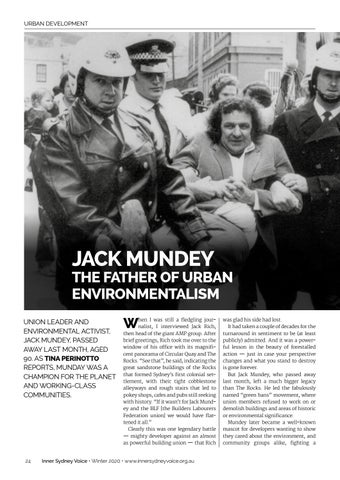
26 24 Jack Mundey — the father of urban environmentalism Union leader and environmental activist, Jack Mundey, passed away last month, aged 90. As Tina Perinotto reports, Mundey was a champion for the planet and for working-class communities.
26 The Kindness Pandemic In March, a Facebook forum was established to help unite Australians whose lives had been impacted by COVID-19. As well as providing a platform for people to post words of support and encouragement, the forum also recorded the little acts of kindness that took place across Australian communities during lockdown.
29 A new normal Author Malorie Blackman discusses what the COVID-19 crisis has revealed about us — and what kind of a world we might hope for when we come through the other side.
30 Life under lockdown In a new regular feature — Community Voices, we ask inner Sydney residents to share their thoughts on the big issue of the day. Here, five people talk about how they coped in iso.
www.innersydneyvoice.org.au • Winter 2020 • Inner Sydney Voice
3
NOTICEBOARD
OPPORTUNITY TO JOIN THE COMMUNITY DRUG ACTION TEAM
THE REDFERN/WATERLOO COMMUNITY DRUG ACTION TEAM (CDAT) IS SEEKING TO BOOST ITS MEMBERSHIP AND WANTS TO HEAR FROM LOCALS WHO ARE PASSIONATE ABOUT BUILDING A STRONG, HEALTHY, AND CONNECTED COMMUNITY.
T
he CDAT Community Committee is wanting to recruit people who are willing to share their ideas and thoughts about how to support harm-minimisation programs, and help the community in Redfern and Waterloo. The committee is currently focused on supporting local residents who may be experiencing substance use issues and need assistance, or families that are living with someone who is experiencing substance use issues. We know that during the COVID-19 pandemic there has been an increase in the use of alcohol across Australia and that social isolation can cause spikes in drug use.
“Whether you’d like to become a Community Drug Action Team member or can offer a small amount of time to assist with one-off events, we’d love to hear from you,” committee chair, Claire Mennie said. “Community Drug Action Teams are led by passionate volunteers wanting to make a difference in their own neighbourhoods. If more people get involved, we are likely to have a bigger impact,” Mennie explained. Interested community members can call 0402 281 943 or email eo@innersydneyvoice.org.au. The Alcohol and Drug Foundation — which manages the NSW Government-funded Community Drug Action
Teams — commended CDAT for its efforts in reducing and preventing alcohol and other drug-related harms at a grass-roots level. “The dedication of the Community Drug Action Team to strengthen its neighbourhood is inspirational,” said the Alcohol and Drug Foundation’s NSW state manager, Lorenzo Woodford. The NSW Government’s Community Engagement Action Program is administered by the Alcohol and Drug Foundation. The program oversees the coordination and operation of Community Drug Action Teams, which have been helping to strengthen communities across the state for 20 years.
LEND A HAND: THE CENTRE FOR VOLUNTEERING In times of crisis, Australians love to help. Volunteering can provide crucial support to vulnerable people in the community who are impacted by COVID-19. That’s why the Centre for Volunteering is calling on people who can lend a hand to register their details to become a volunteer. How it works: firstly, you register your details at
4
Inner Sydney Voice • Winter 2020 • www.innersydneyvoice.org.au
emergency.volunteer.org.au. That information is then passed on to organisations in your area who will contact you directly to offer a volunteer opportunity. This could be asking you to deliver urgent supplies, provide essential transport (for GP appointments etc), provide maintenance work, or conduct welfare checks on the elderly.
ABOUT Inner Sydney Voice Magazine is the journal of the Inner Sydney Regional Council for Social Development Inc trading as Inner Sydney Voice. We are a non-profit organisation committed to the idea of information as a tool for community development. The organisation defines Inner Sydney as being the local government areas of Botany Bay, Leichhardt, Randwick, City of Sydney, Waverley and Woollahra. ACKNOWLEDGEMENT OF COUNTRY We acknowledge and pay our respects to the traditional custodians of the lands across the areas we service, particularly the Gadigal people of the Eora Nation, traditional custodians of the land on which our office is located. We pay our respects to Elders, past and present. Editor Christopher Kelly Contributors Malorie Blackman Tracy Hamilton Tim Horton Pam Jackson Tina Perinotto Laura Rademaker Geoff Turnbull Aileen Marwung Walsh Design and Cover Alys Martin Membership and Subscription Coordinator Saskia Cheney Printing Goliath Website www.innersydneyvoice.org.au Publisher Inner Sydney Regional Council for Social Development Inc trading as Inner Sydney Voice Rear 770 Elizabeth Street Waterloo NSW 2017 ABN 86 770 127 254 Phone 9698 7690 Email admin@innersydneyvoice.org.au Facebook www.facebook.com/innersydneyrcsd Twitter @innersydneyrcsd Website www.innersydneyvoice.org.au Disclaimer and Copyright The opinions expressed in Inner Sydney Voice Magazine do not necessarily represent the views of the publisher, the publication nor our funders. Unless stated otherwise, opinions belong to contributors, not the organisation or group with which they work. While every effort has been made to ensure the accuracy of the information, no responsibility can be accepted by the publisher for any contributions. Copyright belongs to the contributors. Join and Subscribe Please see back cover Winter 2020 • Issue 135 additional images © istockphoto.com
Editorial W
ell, it’s been a long time between drinks; 19 months to be exact. That’s when the last issue of Inner Sydney Voice magazine appeared — spring 2018. Remember 2018? When all there was to preoccupy us was Sandpapergate and Malcolm Turnbull’s leadership shafting. Oh, and Barnaby’s baby. From where we are now, the world of 2018 looks a very different place indeed. Come to think of it, the world of a mere three months ago seems a land far, far away. Since the social-distancing measures were implemented mid-March and our lives were upended by lockdown, we have all had to adapt to a new world. A world where “iso” is firmly entrenched in the Australian vernacular, where the daily commute consists of a log-in to Zoom, and “quarantinis” are an actual thing. A world in which Aussies are wrestling in supermarkets over 12-packs of 3-ply. A world where we find ourselves dancing around one another, like we’re doing the do-si-do. A world where elbow bumps have replaced handshakes and face masks are as ubiquitous as tattoos. A world that — for many people — simply imploded. Almost a million Aussies lost their jobs as entire industries shut down overnight. While many Australians have been supported by the JobKeeper scheme, 2.17 million people — including international students and refugees — have fallen through the safety net, left to fend for themselves (page 10). And millions more, already experiencing hardship, have found themselves facing food stress, financial insecurity, and digital exclusion (page 7). All this at a time when charities and community orgs are also doing it tough. Not only have many reported severe funding shortfalls, they’ve seen a sharp decline in staff numbers as volunteers have been instructed to stay indoors (page 6). But despite the disruption and in spite of the challenges, Australia’s community spirit has somehow won through. Whether it be everyday individual acts of kindness (page 26) or communities mobilising to ensure those most at need are not left behind, Australians have strived to pull through these skewed times together. As one. Many people have opined that perhaps this new world will lead to a better kind of being. That, beyond COVID, the “me, me, me” mindset will be replaced by a realisation that we are “one large human community sharing the same planet” (page 29). Instead of selfies, there’ll be selflessness. Individualism will make way for collectivism. It will become a world in which humanity is valued more than commodity. You can only hope and dare to dream. Or perhaps I’ve gone stir crazy in lockdown. Or had one too many quarantinis…
“Almost a million Aussies lost their jobs as entire industries shut down overnight.”
Christopher Kelly comms@innersydneyvoice.org.au
www.innersydneyvoice.org.au • Winter 2020 • Inner Sydney Voice
5
NEWS l COMMUNITY FUNDING
Community orgs fight to survive The devastating impact COVID-19 has had on community organisations has been laid bare in findings from a national survey that show the sector fighting for cash, volunteers and, in many cases, survival. The survey — conducted by the Institute of Community Directors Australia — found that 70 percent of not-for-profit orgs felt their existence “threatened” by the coronavirus. The community sector spans services including health and mental wellbeing, housing and homelessness, Indigenous support, social justice, education, and the environment. As with commercial businesses, community orgs have had their work severely disrupted by the social-distancing measures implemented by government to slow the spread of COVID-19. A total of 88 percent of respondents said their services had been affected by the rules. While some orgs have had to curtail their
work, others have adapted and continued providing services in a different format. Some have closed. Other key findings include: a 67 percent drop in fundraising, with 39 percent of respondents believing they have not received adequate government support. And 35 percent of respondents have had to reduce staff numbers, with 40 percent unsure if there will be further staff reductions. In response to the findings, Community Council for Australia chair, Tim Costello, said: “There’s no way to sugar coat this — the COVID-19 pandemic is seismic. Community groups are the social infrastructure of our economy; they need to be fast-tracked investment from government, philanthropy and individuals before it’s too late.” Costello added: “Community groups have always had to innovate to thrive, now it goes to their ability to survive.” Meanwhile, a survey commis-
sioned by Volunteering Australia and conducted by researchers at the Australian National University (ANU), has found that between February and April there was a 66 percent decline in the number of community volunteers. That translates to 12.2 million hours of lost volunteer work per week. “The findings reinforce the power of the volunteer workforce and its contribution to the economic and social wellbeing of Australia,” said ANU researchers. Hopefully, as iso restrictions ease, it won’t be too long before volunteers feel safe to return. Already, say the researchers, community organisations that have had to cease services because of COVID-19 restrictions are seeking guidance on how to restart programs safely and to support volunteers in their transition back. “The nation needs these volunteers back supporting their communities.”
l HOMELESSNESS
Call to help those left behind In a bid to reduce homelessness and to boost job numbers, the Australian Council of Social Service (ACOSS) has called on the Federal Government to initiate a bold public housing program. Included in its report “Build Back Better”, ACOSS is advocating for $7 billion to be spent on social housing for 30,000 families and individuals in need. “We can create thousands of jobs and reduce homelessness through a public infrastructure program,” said ACOSS CEO Dr Cassandra Goldie. In its report, ACOSS said the COVID19 lockdown had “exposed the scale of homelessness and rough sleeping in Australia, both as a social problem and as a health risk”. “Now more than ever,” said Goldie, “the virus and bushfires have shown us we must work together to help each other recover and
6
get us on a path to building a better future, with positive ideas that create jobs, and quickly, while strengthening communities.” ACOSS is also calling on the government to extend the JobKeeper scheme to temporary migrants, including international students and asylum seekers. “We are all in this together, but some people are being left to face severe economic hardship without any
Inner Sydney Voice • Winter 2020 • www.innersydneyvoice.org.au
support, without even access to Medicare,” said ACOSS’s Jacqueline Phillips. “Everyone deserves to be able to put food on the table and have a roof over their head.” In response to the hardship being faced by temporary visa holders, the Australian Red Cross is providing support with a small one-off emergency relief payment. Emergency relief is provided to help people with basic needs like food, medicine, or shelter. The support can only be offered to people who are not Australian citizens or permanent residents; who are not eligible for state funds; have no income or savings; and no access to any other support. If you need help and think you may be eligible, you can apply for emergency relief at redcross.org.au.
NEWS l ACCESS TO TECHNOLOGY
Bridging the digital divide
During the COVID lockdown, many support organisations have been forced to deliver their services online. This has exposed an acute accessibility gap within public housing communities. Prompted into action by the digital divide, Counterpoint Community Services and REDWatch have approached the technology hub at South Eveleigh to work with government to pilot potential solutions. Writing in The South Sydney Herald, Counterpoint Executive Officer, Michael Shreenan, said: “Tenants need access to free wifi; equipment such as tablets, laptops and smart phones;
personal monitoring and medical assistance equipment; duress alarms and free access to training so they can embrace the opportunities technology can offer. For this to happen we need urgent investment from both government and the private sector.” Counterpoint is pursuing grants to provide families with computers and data packs and, with REDWatch, is currently lobbying for free wifi in public housing. Australia’s response to containing COVID-19 relied on citizens to be more digitally connected than ever. Yet, more than 2.5 million Australians are
not online, while 1.25 million households have no internet — according to the Australian Bureau of Statistics. And many of those who do have internet lack the skills to benefit fully from the connectivity. Affordable access to the internet also remains a key concern, particularly for low-income households. “For the digitally excluded, people lacking effective and affordable internet access and digital skills, the transition is deepening social inequality,” said Professor Jo Barraket from the Centre for Social Impact. “Given the loss of income suffered by those who have lost work as a result of the crisis, the number of digitally excluded may rise, widening the divide itself.” Those Australians most likely to be among the digitally excluded include people with lower levels of income, education, and employment; people over 65; Indigenous Australians; and people with disability. “We believe,” said Barraket, “that there is a fundamental and immediate need for a coordinated effort from government, telecommunication providers and not-for-profits to assist these Australians to get online and gain the confidence and basic skills they need to remain socially connected.”
l PUBLIC TRANSPORT
Redfern station upgrade to start later this year An environmental report for the $100-million Redfern train station revamp has been released. It shows construction of the upgrade will start late this year or early 2021 and is due to be completed by mid-2022. The project involves major changes to the southern concourse including the construction of a six-metre wide walkway linking the east and west sides of the station. To ensure Redfern station — one of Sydney’s busiest — meets accessibility requirements, new lifts and stairs will be built so that passengers will have easy access to platforms one to 10. As
well, a new entrance will be constructed at Little Eveleigh Street and the Marian Street entrance will be upgraded. The aim of the project is to ensure Redfern station will be able to cope with a growing number of commuters in the coming years. Around 70,000 people currently use the station each day. But with the nearby TNT building being converted into residential units and a 24-storey tower earmarked for student accommodation being built at The Block, government forecasts suggest station foot traffic will increase to about 100,000 by 2036.
According to Transport NSW, the project “aims to provide a station precinct that is accessible to those with a disability, limited mobility, parents/ carers with prams, and customers with luggage”. The upgrade will also “improve connections between the station and key destinations in the area”. However, the plans for the southern concourse have drawn criticism from residents who fear Little Eveleigh and Marian streets will become choked with commuters. The exhibition for the southern concourse is activated and will run until 24 June.
www.innersydneyvoice.org.au • Winter 2020• Inner Sydney Voice
7
NEWS l PUBLIC SPACES
Planning in an era of COVID-19 The COVID-19 outbreak has cemented the importance of ample, high quality public space. People who may have taken open space and green space for granted previously are now acutely aware of its influence on their health and wellbeing. Speaking to The Fifth Estate, John Brockhoff, National Policy Manager at the Planning Institute of Australia, said that COVID-19 had served as a “pressure test” for urban planning trends, and highlighted deficiencies. Up the top is high-density development that doesn’t have enough open space for everyone to enjoy safely and comfortably. Brockhoff would like community infrastructure
to secure a spot further up the value chain. “We should look at community infrastructure like we look at pipes and roads, and not something that’s second class for when there’s a bit of money and space leftover.” Brockhoff is especially concerned about people who are most likely to end up in
high-density areas without enough parks and open space. “We have an obligation to see that amenity is there for those people. It’s so important if you live in high-density areas that you have access to a whole range of benefits beyond your own four walls.” A report from the Austral-
ian Housing and Urban Research Institute echoes that view. Its authors call for an increase in local government funding so that adequate public space can be built to improve the lives of low-income earners living in high-rise apartment buildings. “Having access to local facilities and spaces, such as libraries, community centres and parks, is essential for apartment residents on lower incomes as they are less likely to be able to afford to use other commercial spaces such as cafes,” said lead author Associate Professor Hazel Easthope. “What COVID-19 has done is given a taste of what it’s like to not have access to those facilities for everyone.”
l TRANSPORT
New cycleways in inner Sydney Six new pop-up cycleways have been created to provide safe commuter routes for people as they begin to return to their workplaces. The cycleways are part of several transport initiatives across inner Sydney to offer people alternative journey options. The cycleways can be found to the west, east and south of the CBD on Bridge Road/Pyrmont Bridge Road in Pyrmont; Pitt Street North in the CBD; Moore Park Road in Paddington/ Moore Park; Dunning Avenue in Rosebery; Sydney Park Road in Alexandria/ Erskineville; and Henderson Road in Eveleigh. “When someone rides to work, they take a car off the road or free up space on public transport,” said Sydney Lord Mayor, Clover Moore. Around $600
8
million will be invested into the city’s walking and cycling infrastructure over the next four years, bringing the NSW Government’s total investment to around $1 billion — the largest commitment in the state’s history. Meanwhile, the Committee for Sydney is urging the NSW Government to fast-track a scheme to upgrade the city’s cycling network. The thinktank is lobbying for the network — covering more than 5,000 kilometres of cycling infrastructure — to be completed in three years rather than the planned 40 years. “There is an immediate need during the COVID-19 transition period, while physical distancing requirements are still in place, to transport large numbers of people. For many reasons,
Inner Sydney Voice • Winter 2020 • www.innersydneyvoice.org.au
including parking capacity in CBDs, this cannot only happen in cars — we will need much greater cycling capacity to cater to this,” said Committee for Sydney CEO, Gabriel Metcalf. If the scheme were to take place, Sydney would join other cities — such as Berlin, Vancouver, and Budapest — that are taking advantage of the lockdown period to expand urban cycle lanes. Construction, said Metcalf, would help support and create jobs in the infrastructure and transport sectors, aiding Sydney’s economic recovery. “Investing in cycling infrastructure would involve a broad program of lots of little projects in every area” said Metcalf. “Every community would benefit from it.”
WATERLOO REDEVELOPMENT
NEWS FEATURE
NEW PLANNING PROPOSAL FOR WATERLOO
F
or planning purposes, the NSW Land and Housing Corporation (LAHC) has divided the Waterloo Estate into three precincts: Waterloo North — this area includes Marton, Turanga, Matavi and Solander; Waterloo Central — which includes Banks, Cook and shops; and Waterloo South — all the walk-ups and the mid-rise within the redevelopment area. LAHC has now lodged a rezoning plan for Waterloo South with the City of Sydney. Nothing has been lodged for the north and central precincts as they are not being developed for another 13-18 years. The lodged proposal covers 12.32 hectares, or 65 percent of the total site. This area includes 749 existing public housing units, consisting of all the walk-ups and the mid-rises within the estate. The area covered by the rezoning application also includes 125 privately owned dwellings and commercial properties. The key feature of Waterloo South is the delivery of two promised parks, including a central park adjacent to the new metro station. Open space has increased by 4,000m2 over the earlier plan to 2.57ha. This amended proposal also includes wider treelined streets and expanded bike paths. Altogether, the lodged plan delivers 3,000 dwellings in Waterloo South plus the park, space for businesses, shops, and community facilities. Social housing will make up 30 percent (or 900 units) of the redevelopment; 70 percent is private
and affordable housing, but no information about how many affordable housing units might be provided is revealed. LAHC says it has cut the maximum building heights from 40 to 32 storeys. This compares with council’s suggested 13 storeys. Where the earlier preferred master plan aimed for 6,800 dwellings across the entire estate, according to a report in The Sunday Telegraph, the new plan is for 6,200. In a media release, Water, Property and Housing Minister Melinda Pavey said, “The proposal will include an additional 100 new social housing dwellings in the area.” However, it is not clear if this refers to only the southern area where there will be an increase of 151 social housing units or if this sets an estate-wide target increase to 2,112. An artist impression of the new park shows the existing high-rises in the background. Before any redevelopment of the towers, there would be 2,163 social
housing units — the 900 in Waterloo South and 1,263 in the existing highrises. Thirty percent of the proposed 6,200 would only deliver 1,860 social housing units. What happens with the towers is still to be determined, so we really don’t know the final number of social, affordable or private units that the estate might deliver or when we might have all the Waterloo jigsaw pieces in front of us so that we are able to see the whole picture. So what happens next? The LAHC Waterloo South application is being assessed by council to determine if it has planning merit or if any other changes are needed. Following assessment, City of Sydney staff will prepare a planning proposal for consideration by council and the Central Sydney Planning Committee. The community will only see the detail of the proposal — with its rumoured 10,000 pages of reports — when it is presented to a council committee in several months’ time. If supported, council will seek a gateway determination from the NSW Government for public consultation. That is when the Waterloo community can have its say. According to material posted on its website, the City of Sydney will lead the community engagement during the public consultation period for the Waterloo South planning proposal and will continue to work collaboratively with the Department of Communities and Justice to support social housing tenants.
www.innersydneyvoice.org.au • Winter 2020• Inner Sydney Voice
9
Image source: communitiesplus.com.au
FOLLOWING EXTENSIVE COMMUNITY AND STAKEHOLDER CONSULTATION, PLANS FOR THE REDEVELOPMENT OF THE WATERLOO ESTATE HAVE BEEN AMENDED. GEOFF TURNBULL WALKS US THROUGH THE NEW BID.
UNIVERSAL BASIC INCOME
FALLING THROUGH THE NET COVID-19 HAS EXPOSED THE NEED FOR GUARANTEED INCOME SECURITY SHOULD ANOTHER DISASTER OCCUR. AS CHRISTOPHER KELLY REPORTS, PERHAPS NOW IS THE TIME AUSTRALIA EMBRACED A UNIVERSAL BASIC INCOME.
10
W
ith industries tumbling like dominos overnight, the country’s social security system quickly cracked under the strain as hundreds of thousands of newly unemployed Aussies made benefit claims. Cumbersome and complex at the best of times, Australia’s welfare bureaucracy proved barely fit for purpose as the coronavirus hit. What with all the hoop jumping, form filling, and means testing — not to mention the Centrelink website crashing — claimants, many in urgent need of financial assistance, found themselves left hanging. Particularly 2.17 million temporary visa holders, including students and refugees, who were informed that they were entitled to nothing. Since the Centrelink meltdown, the idea of a universal basic income (UBI) has emerged from the fringes and gained political traction. And it’s not just a pursuit of progressives: “The idea of a UBI has acquired a highly disparate group of supporters,” said Professor John Quiggin of the University of Queensland, a long-time advocate of the scheme. Unlike the current welfare system, a UBI is simple and comprehensible. The idea is that every adult Australian citizen would receive an unconditional guaranteed income — no strings attached, no questions asked.
Inner Sydney Voice • Winter 2020 • www.innersydneyvoice.org.au
UBI is a hand up, rather than a handout. Limited trials of variations of the scheme have been conducted around the world in Scotland, Kenya, Canada, the US, the Netherlands, India, Namibia and, most recently, in Finland where 2,000 citizens received a monthly tax-free income of €560 for two years, with no requirement to be working or looking for employment. The results of the trial echoed findings from previous studies that showed that a secure income in times of need greatly improves a person’s quality of life. When financially stable, people find themselves free to return to more purposeful pursuits and creative activities denied them under the daily grind of nine-to-five. It also allows people to get more involved with their communities by volunteering, for example. This, the Finnish researchers found, led to better mental health outcomes with participants adopting an optimistic outlook on the future. “The basic income recipients were more satisfied with their lives and experienced less mental strain than the control group. They also had a more positive perception of their economic welfare,” the researchers concluded. Meanwhile, a similar guaranteed income scheme conducted in California undermined a common criticism of
UNIVERSAL BASIC INCOME
the UBI: that recipients would squander the “free money” on frivolous items. However, when the 290,000 residents of Stockton were given US$500 a month for a year, analysis showed they spent 40 percent of the cash on food, 25 percent on home goods and clothes, and around 12 percent on utilities. Ahead of the 2019 federal election, the Greens released a policy initiative to launch Australia’s first-ever UBI trial in Nowra NSW. The Greens argued that a UBI would help “promote the idea that a person’s worth is not dependant on their economic productivity”. A UBI would also help “redefine the worth placed on traditionally unpaid labour like caring and childrearing and help break down the labour divide between genders”. Such a proposal has often been dismissed as far-out and utopian, but during the pandemic lockdowns many developed countries have introduced something similar to a UBI. Such as Spain. With 900,000 jobs lost within the first two weeks of lockdown, Spain’s social security minister — Joes Luís Escriva — was quick to announce that a “minimum vital income” would be provided to more than a million vulnerable households, with at least 10 percent allocated to single-parent families. Importantly, the government pledged that the scheme would be perennial. “It is going to be structural, permanent — it’s here to stay,” said Escriva. “It will be something new that social security has not offered so far and that we are trying to accelerate to the maximum.” As for Australia: “The Federal Government’s response to the pandemic has moved us much closer to a liveable income guarantee,” said Professor Quiggin. Although slated to end on September 27, the $70bn JobKeeper wage subsidy scheme may well be extended beyond that date. “This is supposed to be temporary, but temporary will turn out to be a long time.” If the JobKeeper scheme were to become something more permanent, it would need amending. As it stands, JobKeeper has its limitations.
“A basic income is much more sensible economically and socially than the alternative being implemented by some countries, namely providing substantial wage subsidies.” In an economy that champions casual employment and gig contracts, a “job” is difficult to define. And while JobKeeper allows workers to cling on to existing employment, it does nothing to assist the unemployed, nor people who resign. And, of course, a wage subsidy is not the same as a guaranteed income. Perhaps the Federal Government will shift more favourably toward the idea of a UBI once the Australian economy tanks, as it is forecast to do. The International Monetary Fund expects Australia’s GDP to diminish by at least 6.8 percent throughout 2020. To find a deeper depression you’d have to go back to the 1930s. And it will be the disadvantaged that suffer the most such as people in less-protected and lower-paid jobs, particularly younger and older workers, as well as women and migrants. “That is where basic income comes into the equation, moving from the desirable to essential,” said Professor Guy Standing of the World Economic Forum. “After years of intellectual loneliness, basic income is today finding converts and open advocates from across the political spectrum. We must hope that will result in more politicians showing more backbone in this debate. A basic income is much more sensible economically and socially than the alternative being implemented by some countries, namely providing substantial wage subsidies.” As the coronavirus shakes economies around the globe, people are beginning to question neoliberal economic models. “The pandemic has really thrown up the existing levels of both injustice and inequality worldwide. So bolder ideas are needed, including some, that previously, were pushed aside,” said Kanni Wignaraja,
Director of the United Nations bureau for Asia and the Pacific. “At the UN, we’re saying that, if there isn’t a minimum income floor to fall back on when this kind of massive shock hits, people literally have no options.” Speaking to UN News, Wignaraja argues that the cash needed to ensure people have a reliable safety net is much cheaper than the huge investments currently being made to bail out entire economies. “This is why it is so essential to bring back a conversation about UBI. And to make it a central part of the fiscal stimulus packages that countries are planning for,” she said. Opponents of a UBI will say that the scheme would be impossible to implement as no country could regularly afford to dish out cash to every eligible citizen. But Wignaraja believes that by not investing in a UBI, the costs to communities would be far dearer. “If a large part of an entire generation loses its livelihood with no safety net to catch it, the social costs will be unbearably high. To put it bluntly: the question should no longer be whether resources for effective social protection can be found — but how they can be found.” And, in Australia at least, the resources are there. “We have more than enough in this country to ensure that no one lives in chronic poverty and everyone has enough to eat and a safe home,” said Greens MP, David Shoebridge. “It’s politics not economics that punishes people for being poor. Government should be about solutions, about lifting up the most vulnerable and driving us towards a fairer society. We need to find innovative ways to more fairly share wealth in this country and when we look around for answers, a UBI is pretty much top of the list.”
www.innersydneyvoice.org.au • Winter 2020• Inner Sydney Voice
11
COVID19 SPECIAL REPORT: INDIGENOUS SELF-DETERMINATION
INDIGENOUS SELFDETERMINATION VITAL TO BEAT CORONAVIRUS
INDIGENOUS PEOPLE ARE NO STRANGERS TO DISEASE. AS AILEEN MARWUNG WALSH AND LAURA RADEMAKER REPORT, IT IS VITAL THAT THEIR AUTHORITY IS RESPECTED AS THEY FACE THIS LATEST HEALTH THREAT.
A
boriginal and Torres Strait Islander people know very well the challenges of dealing with infectious diseases introduced from overseas to which the people have no immunity. Historically, epidemics have brought a double threat: first to Indigenous health, then to Indigenous self-determination. Compared to the past, this time Indigenous people have been more able to take measures to protect their communities from disease. Nevertheless, history shows community-controlled responses must remain a priority. To beat COVID-19, Indigenous self-determination is vital.
THE BEGINNING At the beginning of European invasion, in 1788-89, Indigenous communities had to deal with a devastating smallpox epidemic. Since then, Aboriginal people have endured wave after wave of introduced diseases. The European invaders brought with them venereal diseases, colds and influenza, tuberculosis, measles — and more. In the 19th century, mass deaths in Aboriginal communities were reported whenever Europeans came into contact with them. Unfortunately, the fact so many died of disease has been used to minimise or deny that many were also killed in massacres. Aboriginal communities faced both massacre and disease, and disease became a tool of colonialism. In February 1913, nearly a third of the population of the Tiwi Islands died in just two weeks. The epidemic began around Christmas 1912. A government medical inspector found that, of a population of 650 people, 187 had died. The
12
disease remained unidentified, but its symptoms resembled measles. A Tiwi elder sang a song describing the typical progression of the disease: “[It] starts with feeling like snake walking up legs, the stomach and bloody diarrhoea, when reaches heart, no more eat, die.” In 1930, a white couple arrived at Gunbalanya, bringing their young daughter and whooping cough. The ensuing epidemic coincided with an outbreak of influenza and malaria and caused “several deaths” — the precise number is unknown as many died “in the bush”. The school was closed and, according to one missionary, the Aboriginal community was at fault, supposedly for their bad attitude: “The fault generally was their own ideas about sickness & some said our medicines were poisonous, & refused to come for them […] Some of the dormitory girls were very sick with malaria & other troubles, they were most difficult to help & not a smile only whine all the time, & did not seem to care if they lived or died, they were deep down in the valley of the shadow. [One woman] who was married last year had a bonny baby just before she took whooping cough, the baby died.” A whooping cough and measles “double-punch” epidemic later hit the Angurugu on Groote Eylandt in January 1950. Families fled to their homelands, hoping to escape the disease. The government put the community into lockdown, cutting off people from family and country. Those who had to remain had little healthcare. The rudimentary “hospital” had a single missionary nurse tending 50 critically ill people.
Inner Sydney Voice • Winter 2020 • www.innersydneyvoice.org.au
COVID19 SPECIAL REPORT: INDIGENOUS SELF-DETERMINATION
Of 240 community members, 175 were infected, and 19 babies died between Christmas and mid-January. These waves of diseases could have been prevented or minimised through properly funded housing, sanitation, and healthcare. As late as the 1960s at Wurrumiyanga, dysentery was causing devastating child mortality. As government officials noted: “The problem of hygiene at Bathurst Island Mission has virtually reached a state of emergency […] There are far too few lavatories for the number of people […] There have been 20 deaths of children at Bathurst Island since January last.”
EXCUSES FOR EXCLUSION? Often the “cure” imposed on Aboriginal communities was worse than the disease. In Queensland, when Aboriginal people were suspected of having a venereal disease, they were exiled to Fantome Island, north-east of Townsville. In Western Australia, they were sent to punitive lock hospitals or isolated islands such as Dorre and Bernier. Relationships between Aboriginal women and white or Asian men were criminalised in the name of preventing the spread of disease in the Northern Territory in 1918. Although leprosy is often thought of as an ancient disease, until recently it had devastating effects on Indigenous communities. Much of the horror was due to the heavy-handed government restrictions on Aboriginal people. Those found to be infected were forcibly removed to leper colonies such as Channel Island in the Northern Territory until they died. Naturally, people did all they could to evade detection, meaning disease was untreated and spread further. Many Aboriginal people today still remember their parents and grandparents who were taken away, never to return. The policy survived even after effective treatment for leprosy was discovered. The last leprosarium, Bungarum at Derby, did not close until 1986.
“Aboriginal people know concerns about infection have been used to control even the most intimate details of their lives. Restrictions of movement, removal of family members and regulation of relationships and marriages have all been justified many times under the label of infection control.” As governments tackle coronavirus today, there is already evidence that Indigenous people have been disproportionately bearing the brunt of punitive measures and excessive restrictions to control its spread. Aboriginal people know concerns about infection have been used to control even the most intimate details of their lives. Restrictions of movement, removal of family members and regulation of relationships and marriages have all been justified many times under the label of infection control. At the same time, Aboriginal people have lacked the resources, especially housing and sanitation, and decision-making power to control diseases on their own terms.
INDIGENOUS COMMUNITIES’ SUCCESS IN MANAGING COVID-19 Facing the threat of COVID-19, Indigenous communities rose to the challenge early, decisively and of their own initiative. Anangu Pitjantjatjara Yankunytjatjara (APY) Lands Traditional Owners restricted access to their region in early March (when the prime minister still planned to attend football matches). On March 19, the Combined Aboriginal Organisations of Alice Springs demanded a special control area for the Northern Territory. On March 20, the Chief Executive of the National Aboriginal Community Controlled Health Organisation, Pat Turner, called for better health resourcing with community control to face the virus. On March 24, Mapoon Aboriginal Shire implemented its own travel ban, again before
governments acted (Australia’s international travel ban began on March 25). Numerous land councils stopped issuing permits for visitors, again before government action on lockdowns. Tangentyre Council and Larrakia Nation implemented “Return to Country” programs to cover the cost of people wishing to return to their communities. Communities have produced their own educational material in multiple formats in their own languages. (These are arguably sometimes more informative and direct than government communications.) The Northern Land Council produced YouTube videos in 17 languages. Language centres released COVID-19 information in Kunwinjku, Anindilyakwa and more, and Aboriginal Medical Services has released other resources. We cannot let the response to COVID19 erode the self-determination of Indigenous people as occurred with past epidemics. Indigenous communities have dealt with disease before. Not only are Indigenous communities taking COVID-19 seriously, they have been leading the way. By respecting Indigenous authority and resourcing Indigenous communities, we stand a better chance of beating this disease. About the authors: Aileen Marwung Walsh is Senior Lecturer Indigenous Knowledges at Deakin University; Laura Rademaker is Postdoctoral Research Associate, at the Centre for Indigenous History, Australian National University. This article first appeared on The Conversation Australia
www.innersydneyvoice.org.au • Winter 2020• Inner Sydney Voice
13
COVID19 SPECIAL REPORT: DOMESTIC VIOLENCE
ABUSED AND ISOLATED IN LOCKDOWN
WHEN AUSTRALIANS WERE INSTRUCTED TO STAY IN THEIR HOMES, VICTIMS OF DOMESTIC VIOLENCE SUDDENLY FOUND THEMSELVES TRAPPED INDOORS WITH THEIR ABUSERS.
O
n average, one woman a week is murdered by her current or former partner. Australian police deal with a domestic violence case every two minutes. Most survivors of intimate partner violence are women. Indeed, women are more likely than men to experience violence by a partner — 17 percent or 1.6 million women, compared to 6.1 percent or 547,600 of men. Women are also most likely to experience physical assault in their home. Sobering statistics. Statistics that have only worsened during the COVID lockdown. As the coronavirus spread and Australians were ordered to stay in their homes, women found themselves trapped indoors with their abuser. “We were asking these people to isolate themselves with their perpetrator, which cuts them off from any support system they have,” said Rachael Natoli — founder of the Lokahi Foundation, an Australian charity that provides support to domestic violence victims. “If you are locked up with your perpetrator, you are at more risk. There is no break.” Results from a survey conducted by Women’s Safety NSW backs this up by clearly showing that COVID-19 has caused a spike in cases of domestic violence against women. “We know that women and children are at increased risk of violence and abuse because of COVID-19, and that they are having greater difficulty in accessing safety and supports,” said Hayley Foster, Chief Executive Officer of Women’s Safety NSW. The organisation reports an
14
increase in client numbers; an increasing complexity of client needs; escalating or worsening violence; a sharp increase in violence being reported for the first time; and violence specifically relating to COVID-19. “What we are observing is a ramping up on each indicator,” said Foster. “Not only are we seeing increased client numbers in more locations, we’re also seeing instances where the COVID-19 pandemic is contributing to more extreme violence and abuse, as well as cases where violence is erupting in relationships for the first time.” The triple whammy of a national lockdown, an economic meltdown plus mass unemployment provided the perfect storm for domestic and family violence (DFV). Once the lockdown kicked in, Google recorded a marked increase in the number of domestic violence-related searches — up by a whopping 75 percent. “What that says to us,” said CEO of Women’s Community Shelters, Annabelle Daniel, “is people are very scared for the potential for lockdown increasing the intensity of domestic or family abuse they might already be experiencing.” Speaking to SBS News, Daniel added: “One thing we do know about domestic and family abuse is that controlling behaviours can be absolutely amplified in an isolation setting.” To give due credit, the NSW Government was quick to respond to the upward trend of DFV. As far back as March, the Department of Communities and Justice (DCJ) freed up
Inner Sydney Voice • Winter 2020 • www.innersydneyvoice.org.au
temporary accommodation so that service providers could ensure their clients could self-isolate in safety. Not only that, the DCJ suspended time-limit restrictions on stays in temporary accommodation. “It means women and children fleeing violent and abusive homes at this time still have a viable option, even in the face of women’s refuges reaching capacity,” said Foster, adding: “We’ve been really impressed with the level of consultation and engagement by the NSW Government with the women’s safety and domestic violence sectors throughout this period. It’s been reassuring to know that the Government has real-time information available to them from the frontline in order to inform their decision making.” Renata Field is a project coordinator at Domestic Violence NSW, a
COVID19 SPECIAL REPORT: DOMESTIC VIOLENCE
Redfern-based body representing 60 DFV organisations across the state. She, too, praises the NSW Government for its rapid response. “It’s fantastic to see that — when they want to — they can implement drastic reforms quickly, such as free childcare or increases to welfare. We’d like to see a similar swiftness of action in terms of preventing domestic family violence and providing funding for services.” Foster agrees: “We must ensure the services that [DFV victims] rely upon for their safety and support are adequately resourced for the task.” Since the COVID outbreak, “The urgency has stepped up a notch,” said Foster. And while the urgency has upped a notch, the shortages and shortcomings in the DFV support sector have become ever-more apparent. Another casualty of the COVID crisis, say DFV advocates, is the NSW justice system. Under the COVID-19 Legislation Amendment (Emergency Measures Act) 2020, some courts have been conducting legal proceedings remotely, while others have closed completely. This happened at a time when the Family Court reported a 39 percent increase in urgent applications relating to parenting orders during the lockdown; the Federal Circuit Court saw a 23 percent increase. Indeed, both the Family Court and the Federal Circuit Court found themselves deluged with so many urgent applications that they were forced to fasttrack cases in which there was deemed to be an increased risk of family violence as a result of COVID restrictions. Meanwhile, the NSW Government passed emergency legislation allowing the Corrections Commissioner to release some of the state’s 14,000 prisoners in a bid to curb the spread of coronavirus within the prison system. The move was duly slammed by Women’s Safety NSW. “Victims of domestic violence are calling our services terrified that their abuser is going to be released without them knowing,” said Foster. “This is not the time to be causing additional fear and apprehension for women and their children who have been traumatised by domestic and family violence.” In such cases where DFV offenders were released, Foster called on Corrective Services to work closely with frontline domestic violence organisations “to ensure all relevant information is shared for the purpose of managing the ongoing safety of victims”. Foster sought assurances, too, from NSW Police that women and children’s safety would continue to be prioritised during the lockdown period. Upon hearing anecdotal evidence that abusive partners were weaponising the coronavirus to coerce and threaten women, Foster also requested that exclusion orders be used to eject domestic violence offenders from the home. Such concerns led NSW Attorney-General, Mark Speakman, to assure the sector that the laws currently in place to protect abuse victims would be rigorously upheld during the COVID outbreak. “If an alleged perpetrator is out on bail the police can make a provisional apprehended domestic violence order,” said Speakman during a press conference. “You don’t have to wait for the court to make that order.” Speakman also later announced a $21 million funding package to be directed toward frontline domestic violence services.
“One thing we do know about domestic and family abuse is that controlling behaviours can be absolutely amplified in an isolation setting.” The rise in cases of DFV during the COVID outbreak have by no means been confined to NSW nor, for that matter, Australia. Authorities in Greenland were forced to ban the sale of alcohol following a surge of violent incidences in homes. In Tunisia, just days after people were ordered to stay in and lockdown, the number of calls to a DFV helpline increased fivefold. In Russia, domestic violence cases more than doubled under lockdown. In Brazil, a DFV refuge saw the demand for its services increase by up to 50 percent. Meanwhile, in the UK, domestic abuse killings more than doubled amid the COVID lockdown. However, speaking to The Guardian, Karen Ingala Smith, founder of Counting Dead Women — a pioneering project that records the killing of women by men in the UK — was quick to point out that, while COVID-19 may “exacerbate triggers”, the virus was no excuse for violence against women. “I don’t believe coronavirus creates violent men. What we’re seeing is a window into the levels of abuse that women live with all the time.” The global spike in cases of DFV became so widespread that the United Nations Secretary-General, Antonio Guterres, had to appeal for “peace at home” out of concern domestic violence was rising rapidly as the social and financial toll of the COVID pandemic deepened. Describing the trend as “a horrifying global surge in domestic violence”, Guterres said in a statement: “For many women and girls, the threat looms largest where they should be safest — in their own homes. I urge all the governments to make the prevention and redress of violence against women a key part of their national response plans for COVID-19.” Back in Redfern, Field is unsurprised that there’s been a global spike in DFV cases. “Unfortunately, domestic violence is across all races, nationalities and classes, and it’s something that we as a community really need to get on top of. Most domestic violence occurs in the home so it makes sense that women would be experiencing less safety during lockdown.” As for the future, Field believes that the full extent of domestic violence in Australia during the lockdown won’t be known for at least 12 months after the COVID crisis ends. “So I think that we need to be long-term about what people will need.” And, says Field, the number of Australian women reporting domestic violence is only likely to increase now that lockdown restrictions have loosened. “That’s when women will be safe to reach out for help.” If you need help and support call the NSW Domestic Violence Line on 1800 656 463; the Women’s and Girl’s Emergency Centre in Redfern can be contacted on 9319 4088.
www.innersydneyvoice.org.au • Winter 2020• Inner Sydney Voice
15
COVID19 SPECIAL REPORT: SOCIAL HOUSING
A HOUSING STRATEGY WITH COMMUNITY BENEFITS AS A WA HOUSING POLICY SHOWED, INVESTING IN SOCIAL HOUSING CONSTRUCTION COULD BE A KEY POST-PANDEMIC ECONOMIC STRATEGY THAT WOULD ALSO BENEFIT A GREAT NUMBER OF LOW-INCOME AUSTRALIANS INTO THE BARGAIN.
W
ell before the impacts of the 2020 pandemic, large numbers of lower-income Australian households were struggling to find affordable housing and there were long wait lists for social housing. Australian Housing and Urban Research Institute (AHURI) research estimated that in 2016, there was a shortfall of around 431,000 social housing dwellings, and that this deficit would grow to 727,300 dwellings by 2036. The research concluded that 36,000 new social housing dwellings per year were required to meet this need. With high unemployment and increased incidence of homelessness a likely outcome of the economic downturn, new social housing will be essential to ensure housing outcomes do not worsen. Industry and community organisations and peak bodies are calling for a social housing building program as part of the economic stimulus response. For example, the Australian Council of Social Service in a recent report proposes building 30,000 social housing dwellings as a way to reduce homelessness and to boost employment. AHURI research modelling identifies a capital grant model as the most effec-
16
tive long-term funding mechanism for affordable rental housing for low and very low-income households. This approach combines a larger upfront government grant with some borrowings from the bond market obtained through the National Housing Finance Investment Corporation, and savings to the government through not using any Commonwealth Rent Assistance payments. Of the five scenarios modelled for the costs of developing and operating required social housing dwellings across a 20-year timeframe, this was the most cost-effective in the long-term. An up-front investment provided by the Australian Government provides immediate economic stimulus to get the construction industry operating at full capacity as quickly as possible. Lack of available capital during economic downturns may leave private development projects to languish. Indeed, the construction industry associations, the union (the CFMEU) and the Master Builders Australia are predicting that investment in residential and business construction will fall by 40 to 50 percent due to the pandemic. As a consequence, the
Inner Sydney Voice • Winter 2020 • www.innersydneyvoice.org.au
COVID19 SPECIAL REPORT: SOCIAL HOUSING
“... Construction industry associations ... the CFMEU ... and the Master Builders Australia are predicting that investment in residential and business construction will fall by 40 to 50 percent due to the pandemic.” construction workforce — who are usually in high demand for private construction projects — now become available at reduced cost to government-backed construction projects. This counter cyclical investment has proven to be an effective way to increase housing supply and to maintain workforce incomes and skills. For example, the Western Australia Government’s Affordable Housing Strategy benefited from both the reduced private investment availability and the economic stimuli offered as a response to the Global Financial Crisis. AHURI research identified that at the time of strategy development and launch, the Housing Authority was able to take advantage of weak housing market conditions, securing good deals with developers and builders which maximised public investment outcomes. The strategy provided a range of affordable housing options — including social rental — to discounted private rental and a shared equity scheme for low-income homeowners. Of the new affordable homes, around two thirds (66.4 percent) were shared equity and low-deposit home loans made available to lower- to mid-income households. Shared equity schemes — whereby the homebuyer shares the capital cost of purchasing a home with an equity partner — allow lower income homebuyers to buy sooner as they need a lower initial deposit and have lower ongoing housing costs. It may be that once these homeowners have rebuilt levels of capital through their employment in the future, they can be encouraged to buy out government shared-equity investment, thereby reducing government debt at some point. Such loans (such as Keystart loans)
require householders to be in paid employment for at least six months — a timeframe that may need to be reconsidered if governments were to implement such a strategy as part of a post COVID19 stimulus. The WA Affordable Housing Strategy exceeded its initial target of 20,000 new homes by 2020. By 2015 it had delivered 5,400 social housing rentals, 2,700 discounted private rental homes for people on low incomes and 11,900 home loans and shared equity loans for homebuyers on modest incomes. The strategy was expanded to achieve 30,000 affordable homes, and then 35,000 homes by 2020. The WA example shows that by working across the continuum of housing need, a large volume of new supply can be delivered quickly, and draw on a range of finance sources. AHURI research analysis supports the case for targeting public subsidy to not-for-profit developers (government or non-government) to ensure that a long-term social benefit is retained. Investing in affordable housing held over the longer term provides a continuing basis for the retention of the social dividend of affordable housing into the future. Comparable subsidies are not preserved when allocated to private owners who will seek to trade out at some stage, capitalising the subsidy into privatised capital gain. The long-term benefit of supporting public and social housing construction is that the housing remains accessible to very low-income householders well into the future. This aligns an infrastructure investment pathway to construct and operate assets and services to deliver ongoing social and economic benefits to broader society. Source: Australian Housing and Urban Research Institute
www.innersydneyvoice.org.au • Winter 2020• Inner Sydney Voice
17
COVID19 SPECIAL REPORT: MENTAL HEALTH
AUSTRALIA’S MENTAL MELTDOWN
ALMOST OVERNIGHT, THE CORONAVIRUS CAUSED UPHEAVAL TO OUR DAILY LIVES. AS PEOPLE BEGAN TO FEEL IMPRISONED IN THEIR OWN HOMES, THE MENTAL HEALTH OF MANY BEGAN TO FRAY. CHRISTOPHER KELLY REPORTS.
S
ome of us were better able to cope at self-isolating than others. If you were a homebody before the lockdown, someone perfectly comfortable in their own company, chances are you adapted fine. If, however, you’re normally a social butterfly, flitting from pillar to post, you wouldn’t have responded as well to having your wings clipped. Australians were not alone in their self-isolation. In April, half of the world’s population had their movements curtailed to some degree or another. Tens of millions of lives changed beyond the realm of normalcy. As well as the confinement, people have had to cope with financial insecurity, family separation, and feelings of bereavement. To cap it all, we’ve had legitimate health fears to endure. In March, crisis support and suicide prevention service, Lifeline, recorded the highest volume of calls the organisation has ever had to deal with in a single month — 90,000, or one every 30 seconds. By Easter, the COVID lockdown had caused widespread mental meltdown. According to Lifeline CEO Brent McCracken, Good Friday was “the biggest day” in the organisation’s 57-year history. Speaking to reporters, McCracken said: “We saw people struggling with loneliness, and the isolation, exacerbating the circumstances they’re in.” When asked who was reaching out to the support service, he simply answered “everybody” — “[People] losing their business, losing their job, finding themselves without other people around them, having a lack of
18
social contact,” he said. “Many are facing circumstances they could never have envisaged they would be in. Many are feeling their life is becoming worthless.” While a lot of the callers to Lifeline included people with chronic mental health issues aggravated by the crisis, the numbers also included a new category: people who’d never reached out for mental health support before. Meanwhile, data from Kids Helpline showed that an Australian child was calling the counselling service every 69 seconds. “They are worrying about and struggling with the impact this is having on their daily lives — whether that is school or university closing, not being able to do team sport or go to the gym, travel and holiday, as well as not being able to see their friends or boyfriend or girlfriend,” said Kids Helpline CEO Tracy Adams. To help people cope with the COVID crisis, mental health non-profit, Beyond Blue, launched a 24/7 Coronavirus Mental Wellbeing Support Service. Beyond Blue CEO Georgie Harman said the move was in response to the organisation recording a 30 percent spike in contacts since the crisis began — on some days, as many as one in three calls were COVID-related. “People are telling us they’re feeling overwhelmed, worried, lonely, concerned about their physical health and the health of friends and loved ones, and anxious about money, job security and the economy,” said Harman. During the lockdown, researchers at Monash University launched a study to better understand COVID-19’s impact
Inner Sydney Voice • Winter 2020 • www.innersydneyvoice.org.au
on Australians’ mental health. When surveying 1,200 people about how they were coping during the crisis, results showed that most participants recorded mild levels of anxiety and depression, while 30 percent registered moderate to high levels. “In normal times,” said senior research fellow, Caroline Gurvich, “the majority of people fall in the normal range, so we are seeing elevated levels of depression and anxiety.” A YouGov poll conducted over Easter found more than half of Australians (57 percent) were feeling stress because of the COVID crisis. More than three-quarters of respondents (77 percent) said they were anxious about not being able to see their families; 71 percent were unhappy about not being able to hang out with friends; while 60 percent were worried about financial insecurity. Professor Ian Hickie is Co-Director of the Brain and Mind Centre at the University of Sydney. Appearing on a university podcast — Sydney Ideas — Hickie said the coronavirus had threatened two of the “fundamental pillars of mental health”. “One’s personal autonomy. Being in control of your life by knowing what the risks are and taking appropriate actions to minimise the risk. The other is social connection. Humans are social animals. If we have strong social connection, we thrive.” Both pillars came swiftly tumbling down when the coronavirus reached Australian shores. For mental health expert, Professor Jane Fisher, the overriding theme during the COVID lockdown was one
COVID19 SPECIAL REPORT: MENTAL HEALTH
of loss. Writing in an essay — Coronavirus: recognising disenfranchised grief amid COVID-19 — Fisher says Australians lost their liberty, their autonomy and their agency as everyday activities became restricted, even precluded. Privacy was lost as people became scrutinised increasingly closely for adherence to health advice. At the same time, social participation was lost through isolation and seclusion. Many people’s occupational identities were also lost and, with them, a sense of purpose and meaning. “Losses such as these are profound,” said Fisher, “and associated directly with demoralisation and depression.” Also lost — trust in others. “Everyone is suspected of being infected, with the potential to put others at risk of contracting the illness.” Trusted relationships — which are the glue to psychological wellness — became diminished. “With so much loss going on, it can be hard to see the positives in such a situation,” said Fisher. While some of the losses experienced during the crisis are readily understood — such as being prevented from visiting vulnerable family members, or the death of a loved one — other losses can go unrecognised, perhaps because they seem trivial, or because they can’t be discussed because of stigma and shame. “The process,” said Fisher, “is more difficult because unrecognised losses tend not to attract increased social support or rituals. They can be isolating and induce powerlessness, rather than the problem solving that is needed to reduce the psychological pain.” The stress levels, according to a research paper published in The Lancet Psychiatry, will likely have a long-lasting impact on people’s mental health. Prompting a response, say the researchers, that must “extend beyond general mental health policies and practices”. The researchers continued: “The mental health consequences are likely to be present for longer and peak later than the actual pandemic.”
Professor Richard Bryant of UNSW Sydney agrees: “Prior pandemics such as SARS have shown that mental health issues spike during outbreak and, more worryingly, can lead to longer-term problems well beyond the pandemic itself.” To cope with an increase in cases, mental health services will need to embrace new processes and treatment plans. “These services need to adopt innovative treatment formats to the potentially large numbers of people requiring help and targeting people who traditionally do not seek mental health assistance,” said Bryant. People’s mental health will be further strained by what one economist has described as “a very sharp, strong recession” forecast to head our way. And, as we’ve witnessed during previous economic depressions, it will be the marginalised in the community that will suffer the most. Professor Hickie believes that up to 30 percent of Australia’s population could become “immediately impacted” by an economic collapse. “We’ve seen from previous economic downturns that the impact on the young, the impact on the disadvantaged, the impact of those with mental illness, the impact on the homeless, is profound,” he said. Despite the tough road ahead, Professor Hickie remains hopeful that this exceptional period in Australia’s history could very well be a turning point in the right direction. While the coronavirus pandemic remains a major threat to our physical and mental health, it may yet save Australia’s social fabric. “Our social fabric historically has been very strong. Many of us worry in recent years that it may have been seriously undermined by divisive politics and international anti-globalisation, anti-community separatism,” said Professor Hickie. “This is a test. It’s also an opportunity, in fact, to put that social fabric back together.” Read Coronavirus: recognising disenfranchised grief amid COVID-19 in full on the Monash University’s online magazine, Lens.
MANAGING YOUR MENTAL HEALTH With the evolving tensions surrounding COVID-19, the Mental Health Foundation Australia issued the following advice to help people cope with anxiety and stress. Mental Health Foundation Australia believes that this is the time to show solidarity as a community. Reactions of concern, anxiety, fear, sadness, anger and denial are completely normal. It’s important to remain calm and practical and continue with your usual regime as much as you can. If you are in a position of self-isolation, this may be the time to finally watch that TV show you’ve been wanting to see or read a book you’ve been meaning to get around to. It is in times like this that we must take care of ourselves and those around us to recover from this crisis. Remind yourself that this is a temporary period of isolation which will be over soon. Acknowledge that stress can impact anyone during and after such adversity and it is understandable to be stressed right now. While you might feel uncertain right now, it is important you have faith in the competency of the scientific community to give you the best advice and care for you and your family’s heath. Connecting
more with your cultural identity and having faith in your own ability to get through this tough time will help boost your resilience. Maintain a realistic and practical perspective. Don’t expect yourself to be excelling in work or study right now or staying at your normal standard of productivity. Knowing you will overcome the crisis and giving yourself time to relax and recover in this time period is vital. This is an opportunity to slow down and reflect on what makes you happy in life. If you are able to help others and provide them with comfort, do so. Empathy and compassion strengthen our sense of community. If you need mental health support call the Mental Health Foundation on 1300 643 287. Beyond Blue can be contacted on 1800 512 348. The Lifeline number is 13 11 14. Kids Helpline can be reached on 1800 55 1800.
www.innersydneyvoice.org.au • Winter 2020• Inner Sydney Voice
19
COVID19 SPECIAL REPORT: COMMUNITY ACTION
MOBILISING THE COMMUNITY
DURING A CRISIS T
he initial debate around the COVID-19 pandemic focused primarily on the response of government decision-makers and technical experts. Debate raged as to the extent of social distancing and lockdown restrictions, and the scale of governing authorities’ response to the economic perils of the ongoing crisis. It is equally important, however, to recognise that government action by itself cannot control a pandemic. The attitudes, behaviour and expectations of individual citizens and communities are fundamental to the move to a stable future. But if community mobilisation is so important, what does it look like in practice? The Sydney Policy Lab asked a series of internationally respected experts in public health and citizen science what actions citizens themselves can take, and what government and other institutions have to do in order to support citizens to play their part in the future. They suggested five dimensions of citizen action. 1. Real agency: One of the gravest dangers during a pandemic — beyond infection itself — is the widespread sense of hopelessness and helplessness it can induce as people confront a challenge far newer and larger than those to which they are accustomed. Hopelessness erodes self-esteem, wellbeing and mental health, and makes it psychologically harder for people to continue to comply with strong social distancing requirements, and to recover once it ends. The antidote to despair is action. Providing people with the space to make meaningful individual contributions to the overall collective task of tackling the virus can take a variety of forms. These can include: individual action — where people monitor and report their own symptoms and provide feedback on the lived experience of ongoing policy interventions; neighbourhood-based engagement in appropriately designed mutual aid efforts to support community
20
AS A PAPER DEVELOPED BY THE SYDNEY POLICY LAB EXPLAINS, COMMUNITY ACTION IS FUNDAMENTAL TO A SUCCESSFUL MOVE TOWARD A POST-COVID FUTURE.
members — especially those who are older and more vulnerable to infection; and maintained and expanded participation in civil society organisations, for the purpose of connection. 2. Utilising technology: Technology, especially smartphone apps and social media programs, make the participation required to provide agency and control far more efficient than in previous generations. To be truly effective, however, such technology needs a connective quality — enabling a two-way flow of information and ideas, not just encouraging passive citizens to receive information from officials. Significant efforts must also be made to tackle the digital divide in most established democracies, including Australia, where at present more affluent and more socially connected individuals and families access new technologies straightforwardly, while others have much poorer connectivity. 3. Radical openness: To be effective in building community support for action, the data and synthesised information that is gathered both by governing authorities and by citizens should be made widely and easily available to all. Access to such data enables citizens to understand the nature of where the virus hits, the extent of community transmission and other core factors in the virus’s trajectory. It enables us to understand how different communities are affected by the virus, and by its associated consequences, such as detrimental mental health outcomes. It also enables the more theoretical models on which much government decision-making has been based to be compared with concrete empirical data, allowing an informed public debate to follow. Such debate may be uncomfortable for governing authorities in individual instances, but in the mediumto-longer run the widespread sharing of and analysis of data and information enables citizens to develop a deeper trust and engagement with the complex
Inner Sydney Voice • Winter 2020 • www.innersydneyvoice.org.au
and difficult decisions made by health authorities. 4. Effectiveness in communications: Even with the greatest level of citizen engagement in debate and discussion, instruction from governing agencies always remains a fundamental part of pandemic control. As the pandemic ages and its social and economic consequences become more intense, extremely subtle instructions may be required, reopening some areas and sections of society and economy while continuing to restrict others. When communities are not consulted in a sensitive way about the severe restrictions being put in place, civil unrest can result as already seen in India and Israel. Citizens can aid these efforts by avoiding click-bait and being responsible in disseminating only trusted information amongst their networks. 5. Building social solidarity: One of the distinctive challenges in shaping a citizen-led response to COVID-19 is the sharp differential in mortality rates between age groups, with older people being far more likely than younger people to experience severe, potentially fatal, symptoms. In some parts of the world this led to some younger people failing to adhere to social distancing restrictions or otherwise to take the situation as seriously as required. This underlined the fundamental importance of inculcating a broad and deep sense of social solidarity and responsibility during the time of a pandemic. Citizens need to be able to restrict their own behaviours even when they are unconvinced of the direct, personal benefit of doing so. Such solidarity is unlikely to result from the hectoring or scolding rhetorical style adopted by some political leaders, but rather from celebrating the better elements of national stories, by celebrations and rituals that enable people to display their social connection and by leadership that directly embodies the attitudes and behaviours required.
AGED CARE
KEEPING OLDER PEOPLE CARED FOR AND CONNECTED WE HEAR THAT THE FUTURE OF AGED CARE IN AUSTRALIA IS IN THE HOME. BUT, AS TIM HORTON REPORTS, THAT FUTURE IS ALREADY HERE, IN THE FORM OF THE COMMONWEALTH HOME SUPPORT PROGRAM.
A
round 850,000 people across Australia are supported by the Commonwealth Home Support Program (CHSP) — that’s 600,000 more people than are in residential care. At a cost of $2,800 per person (compared to $50,000 for someone in residential care), CHSP is the most cost-efficient aged-care program in the country. And it’s popular, too. Older people say that it transforms and saves their lives by helping them stay connected with their families, their communities, and their cultures. Aged care continues to change, however. Along the way there have been government reforms, the Royal Commission into Aged Care Quality and Safety, as well as changing demographics and expectations. In this fluid environment, the question on everyone’s lips has been: what’s the future of CHSP? A group of New South Wales CHSP support and development workers thought it was time for CHSP itself to explore the answers to that question. So what better way than to organise a conference so that the sector could take a deep dive into the future of the program. And it was immediately clear there was
a real hunger for this. Indeed, delegate numbers had to be tripled to meet demand, with ultimately more than 300 people from around Australia attending the conference in Sydney in March. The goal of the conference was to showcase both the ever-evolving way in which home support keeps people connected, as well as consider the challenges the sector is facing — whether it’s retaining and increasing the workforce, meeting the needs of diverse older people, or energising different generations to maintain social connection. More than 40 speakers and presenters were selected for the conference program — and a number of key messages emerged. None more significant than the assurance from guest speaker — the Minister for Aged Care and Senior Australians, the Hon Richard Colbeck — that the Australian Government saw the value in maintaining the flexibility afforded by block funding CHSP. There was also a clear reminder from the keynote speaker — Robert Fitzgerald, NSW Ageing and Disability Commissioner — that CHSP services play a key role in upholding older Australians’
rights, and preventing and looking out for actions that take away those rights. Across the conference themes — future, connection, and quality — there was a clear need for a stronger focus on the qualifications of paid and unpaid staff, management support for staff, and collaborative workforce strategies. Research has shown that, to improve support for older people and to provide more meaningful work for employees, staff themselves are keen to see attention move away from the bottom line and toward greater quality care. There was also a clear message that clients and workers alike are looking for collaborative ways of connecting. One project, for instance, is linking volunteers with a background of homelessness to help improve the housing security of older clients. This collaborative approach was echoed in the use of technology to improve virtual connections for older people. Breaking assumptions about their lack of digital knowledge, an innovative project on the NSW mid-north coast approached older people themselves to find out what they used and needed to reach out online. A number of presentations demonstrated the need to shift preconceptions of ageing, and of older people’s attitudes to ageing. This reminded delegates that older people cannot be easily pigeonholed; they come from a diverse range of backgrounds and experiences. This message came loud and clear in a presentation from the National LGBTI Health Alliance. The presentation showed the importance of staff understanding the lived experience of LGBTI people, including recognising past traumas they may have suffered — such as homophobic abuse or surviving HIV through the horrors of the ’80s and ’90s. The conference wrapped up with a panel discussion that neatly reflected the message of the CHSP program itself — and, more recently, of government: that keeping older people well and connected means ensuring that services coordinate with one another through personal collaboration and a shared understanding of the needs of their clients. The member organisations of the conference committee were: Aged & Community Services Australia; Canterbury City Community Centre; Ethnic Community Services Cooperative; Inner Sydney Voice; The Junction Neighbourhood Centre; and The Multicultural Network.
www.innersydneyvoice.org.au • Winter 2020• Inner Sydney Voice
21
COMMUNITY RESILIENCE
A JOURNEY THROUGH THE VALLEY
A PROJECT TO HELP SOCIAL-HOUSING TENANTS IN THE HAWKESBURY-NEPEAN VALLEY BECOME RESILIENT TO EMERGENCIES HAS BEEN BESET BY THEM. AS TRACY HAMILTON REPORTS, FIRST BUSHFIRES, THEN FLOODS — NOW COVID-19.
W
ith its picturesque river and mountain views, the Hawkesbury-Nepean Valley is ideally located well away from the hustle and bustle of Sydney. The appeal of the region is reflected by the presence of a rapidly growing population. What is largely unknown about the area, however, is the presence of a very high flood risk. According to the Insurance Council of Australia, the Hawkesbury-Nepean Valley holds the highest flood risk in New South Wales — perhaps even Australia. This is due to a combination of the unique landscape of the valley and the size of the population that resides there. There are five major river systems flowing into the valley, as well as a narrow gorge that sits between it and the ocean. This topography traps the floodwaters and causes them to pool when sustained heavy rain impacts the region.
THE ORIGINAL PLAN A priority of the Hawkesbury-Nepean Flood Strategy — led by Infrastructure NSW — is to identify and work with communities deemed vulnerable to the flood risk. One group identified as “highly vulnerable” are social-housing communities. Much of the valley’s social-housing stock is built in areas that are exposed to flooding. Along with this, many tenants have complex health needs, are from low socio-economic backgrounds, and would struggle to self-evacuate. In response, Inner Sydney Voice received funding from Infrastructure NSW to implement the Get Ready for Flood Social Housing Sector project.
22
The core aims were to strengthen the social-housing sector’s resilience to flooding in the valley and to increase the resilience of the region’s tenant population.
LEARNING THROUGH THE PROJECT Phase one of the project, occurring in 2019, focused on establishing the Social Housing Community Resilience Network (SHCRN). The network brought together representatives from a range of stakeholders including the tenant population, housing providers, emergency services, community sector, and local council. Its aim was to strengthen coordination between key stakeholders in highlighting capacities, vulnerabilities, opportunities, and challenges. SHCRN met monthly and every meeting highlighted the key issues that needed to be addressed before solid ground could be made on the aims the project set out to achieve. When the end of the year came, it seemed as if little progress had been made. What was clear, however, was that we were much more aware of the reality of the context we were working in.
THE CURRENT CONTEXT We are now in phase two of the project, and 2020 has certainly been a year of the unexpected. It began with devastating bushfires, followed by massive floods. Then came COVID-19. These events have caused widespread disruption, put everyday life on hold, and changed the way business is conducted for those services still operating. The project’s focus through all this
Inner Sydney Voice • Winter 2020 • www.innersydneyvoice.org.au
has been to better understand the constantly changing environment; to identify ways to make progress on the project’s aims; and to adapt to the opportunities and the challenges that arise. What has been highlighted is the need to think about community resilience to disasters in a holistic way. A concept of shared responsibility encapsulates the most important work that needs to be done moving forward. There are many stakeholders with diverse strengths, capabilities, networks, and knowledge. The key is to figure out how each stakeholder can work together in a coordinated way to contribute to community resilience.
A WAY FORWARD Reflecting on this project to date, things have consistently not gone to plan. What we assumed was in place, was not. We overestimated the existing capacity of different networks; external factors have disrupted planning and implementation. However, we are all learning through this process and that is valuable in and of itself. To quote T.S. Eliot: “The journey, not the destination, matters”. This can be applied to strengthening community resilience in the Hawkesbury-Nepean Valley. There has been a strong focus on reaching the end goal, but perhaps what is more important are the lessons that are learned along the way. And, this year more than most, there has been an awful lot to learn. For more information on the Get Ready for Flood Project please contact the Project Officer, Tracy Hamilton, at resilience@innersydneyvoice.org.au or 0411 747 194. Tracy works Tuesdays, Wednesdays, and Thursdays.
AFFORDABLE HOUSING
PRICED OUT OF HOME F
rom an Aboriginal cultural perspective, Redfern/Waterloo is the land of the Gadigal people of the Eora nation who live by the motto of, “Aboriginal land: always was, always will be.” However, with the arrival of Captain Cook on April 29, 1770, this turned out, sadly, not to be the case. Eighteen years later, the British settlement was established in Sydney, and the Aboriginal population found itself displaced. And, as evidenced by the ongoing campaign for the planned Waterloo redevelopment to include affordable housing for Aboriginal people, displacement of our mob is still very much a live issue. Carbon dating of Aboriginal artworks strongly suggests that Aboriginal people have lived in Australia for well over 65,000 years — far exceeding that of the British who arrived on our shores a mere 250 years ago. Anthropological evidence has recognised that during the pre-colonial times, Aboriginal tribes established and maintained a metre-wide track from Blackwattle Creek to La Perouse on which they regularly trekked a distance of 20km for cultural, ceremonial and trade purposes. This track is now known as Botany Road — the main artery from Redfern to the eastern suburbs. Redfern was settled by Governor Lachlan Macquarie in 1817 who granted 100
COMMUNITY GROUPS ARE ADVOCATING FOR THE WATERLOO REDEVELOPMENT TO INCLUDE AFFORDABLE HOUSING FOR ABORIGINAL PEOPLE. AS PAM JACKSON REPORTS, WITHOUT IT, THE POPULATION WILL BE DISPLACED, AND THE AREA’S ANCESTRY DESTROYED. acres of land to Dr William Redfern. Dr Redfern subsequently had a large country house built, complete with flower and vegetable gardens. The neighbours were equally affluent and today there are still fine examples of Victorian-terraced architecture and hints of Redfern’s gentrified past. But the affluent population eventually moved to other suburbs and boarders who worked in the industrial factories in existence at the time moved into the neighbourhood. Thus, Redfern/Waterloo became working-class suburbs. This saw the Gadigal Aboriginal people relegated to the outskirts of society. A watercolour drawing by colonial artist, John Rae — titled 1850 Turning the first turf of the first railway in the Australasian colonies at Redfern, Sydney, NSW — clearly depicts this. It features Aboriginal people gathered on the fringes of a 10,000-crowd of white people attending the opening ceremony of Redfern railway station. Around the 1920s, Aboriginal people were attracted to the Eveleigh railyards as it was one of the first workplaces in Sydney to adopt equal employment rights. The many factories that emerged within the neighbourhood also encouraged Aboriginal people to leave their rural communities and come to live and work in the Redfern/Waterloo area.
In the 1970s, essential services specifically developed by Aboriginal people for Aboriginal people — such as housing support, legal aid, medical centres etc — were established in the region, creating, in the process, cultural self-determination for the local Aboriginal population. When taking all the above history into consideration, it is vital that the Redfern/ Waterloo area remains affordable for the Aboriginal population to live in. If they are uprooted, Aboriginal people will no longer have access to the important services that the various community organisations provide. For that reason, community advocates are currently lobbying the NSW Government to designate six percent of the Waterloo redevelopment to Aboriginal affordable housing. The destruction of the physical and social fabric of the local Aboriginal community will forever be destroyed if genuine action is not taken by the those responsible for the allocation of affordable housing. It is a given fact that the Aboriginal locals cannot afford to pay the exorbitant rents or purchase prices that are now being asked for in Redfern/Waterloo. Consequently, they will have no choice but to live in the outer suburbs, far from the area where they grew up and have spent their lives in the hope that their land “will always be”.
www.innersydneyvoice.org.au • Winter 2020• Inner Sydney Voice
23
URBAN DEVELOPMENT
JACK MUNDEY
THE FATHER OF URBAN ENVIRONMENTALISM UNION LEADER AND ENVIRONMENTAL ACTIVIST, JACK MUNDEY, PASSED AWAY LAST MONTH, AGED 90. AS TINA PERINOTTO REPORTS, MUNDAY WAS A CHAMPION FOR THE PLANET AND WORKING-CLASS COMMUNITIES.
24
W
hen I was still a fledgling journalist, I interviewed Jack Rich, then head of the giant AMP group. After brief greetings, Rich took me over to the window of his office with its magnificent panorama of Circular Quay and The Rocks. “See that”, he said, indicating the great sandstone buildings of the Rocks that formed Sydney’s first colonial settlement, with their tight cobblestone alleyways and rough stairs that led to pokey shops, cafes and pubs still reeking with history. “If it wasn’t for Jack Mundey and the BLF [the Builders Labourers Federation union] we would have flattened it all.” Clearly this was one legendary battle — mighty developer against an almost as powerful building union — that Rich
Inner Sydney Voice • Winter 2020 • www.innersydneyvoice.org.au
was glad his side had lost. It had taken a couple of decades for the turnaround in sentiment to be (at least publicly) admitted. And it was a powerful lesson in the beauty of forestalled action — just in case your perspective changes and what you stand to destroy is gone forever. But Jack Mundey, who passed away last month, left a much bigger legacy than The Rocks. He led the fabulously named “green bans” movement, where union members refused to work on or demolish buildings and areas of historic or environmental significance. Mundey later became a well-known mascot for developers wanting to show they cared about the environment, and community groups alike, fighting a
URBAN DEVELOPMENT
“Thanks to Mundey and the Builders Labourers Federation that he led, and the countless citizens who supported their principled stand, many priceless jewels of Sydney’s built heritage and foreshore bushland were saved from the developer’s wrecking ball and preserved for future generations.”
Above: Jack Mundey, arrested during ‘The Battle for the Rocks’, 23 October 1973.
Right: Joe Owens, and Norm Gallagher lead a protest outside the Industrial Court in ‘74. Images courtesy of greenbans.net.au
number of modern battles right up to the recent campaign to save the Sirius building demolition, which was successful — though the social housing residents whose homes Mundey also wanted to save, were moved out. Mundey’s best legacy, though, was that he showed that strong humane, social and environmental causes could unite people across political and social boundaries. Nature Conservation Council Chief Executive Officer Chris Gambian said, “Mundey was a visionary who understood that the struggles for social justice and environmental justice are part of the same broader project — to preserve human dignity in the face of unconstrained development. “Thanks to Mundey and the Builders Labourers Federation that he led, and the countless citizens who supported their principled stand, many priceless jewels of Sydney’s built heritage and foreshore bushland were saved from the developer’s wrecking ball and preserved for future generations.” Jeff Angel, Director of the Total Environment Centre (TEC) and the Boomerang Alliance, said: “Jack was a world-leading pioneer of the green bans that saved so much of our historic and natural heritage and, as importantly, paved the way for unions joining with the grass roots in suburbs and cities. Through his actions over many decades after the tumultuous 1970s, he elevated the environment protection message across the political and community spectrum — jobs and environment do go together in the pursuit of sustainability and equity.”
Courtesy of The Fifth Estate
HOW THE GREEN BANS SHAPED OUR CITY Green bans were synonymous with the 1970s in Sydney. The movement was initiated by construction workers employed to build a burgeoning number of high-rise offices, shopping malls and luxury apartments. Many became concerned that these developments were encroaching upon the city’s green spaces and heritage buildings. In response, the construction workers refused to work on environmentally or socially undesirable projects. And so, the green bans movement was born — the first of its kind in the world. There were three principals underpinning the green ban movement: to defend open spaces from urban development; to protect existing housing stock from being replaced by freeways or skyscrapers; and to prevent older-style buildings from being turned into office-blocks or shopping precincts. Sydney’s construction workers were led by the Builders Labourers Federation (BLF). By 1970, the organisation — under the leadership of Jack Mundey, Joe Owens and Bob Pringle — advanced a “new concept of unionism”, one that advocated for the construction of socially useful and environmentally friendly developments. The union worked in conjunction with environmental organisations, as well as resident action groups, to protect against over-development and in defence of open spaces. Highrise residential developments planned for Waterloo, Earlwood, Bankstown, Mascot, and Matraville all received green bans as public housing authorities began to emulate CBD developers and build ever upwards. Importantly, there was also an emphasis on preserving working-class residential areas from attempts by developers to “gentrify” communities. In one case, the BLF not only defended the rights of the urban poor, but — notably — brought about the first successful Aboriginal land rights claim in Australia when, in December 1972, the union placed a ban on the demolition of “empty” houses occupied by Indigenous Australians in Redfern. In total, more than 50 green bans were imposed in NSW, most in Sydney. About half of these saved individual buildings or green spaces from disappearing; the other half thwarted mass development projects, saving Sydney from much cultural and environmental destruction. As The Sydney Morning Herald reported following Mundey’s death: “It is not exaggerating to say that the BLF is responsible for the shape of Sydney as we now know it.”
www.innersydneyvoice.org.au • Winter 2020• Inner Sydney Voice
25
COMMUNITY ACTION
THE KINDNESS PANDEMIC IN MARCH, A FACEBOOK FORUM WAS ESTABLISHED TO HELP UNITE AUSTRALIANS WHOSE LIVES HAD BEEN IMPACTED BY COVID-19. AS WELL AS PROVIDING A PLATFORM FOR PEOPLE TO POST WORDS OF SUPPORT AND ENCOURAGEMENT, THE FORUM ALSO RECORDED THE LITTLE ACTS OF KINDNESS THAT TOOK PLACE ACROSS AUSTRALIAN COMMUNITIES DURING LOCKDOWN. I met an elderly lady in the parking lot at the grocery store when this all just started. Everyone was not knowing what to do. I hadn’t got a mask yet. I did my grocery shopping and was using paper towel to touch things. As I went to put my shopping in my car, the older lady started talking to me. She explained she made hand sanitisers and she had a box of plastic gloves. I offered to pay her as she didn’t look like she had much. But she wouldn’t hear of it. God bless her, and I’m still using the sanitiser in my car! — Jilayne I got a phone call from my daughter and she was crying; my first thought was that she had been in a car accident. But once she calmed down enough that she could talk, she told me she had stopped at the traffic lights while driving, pulled down her sun visor and this massive Huntsman spider the size of a hand jumped on her. She pulled over into a side street and kept telling
me she couldn’t get back in the car. Next minute — and much to her relief — a lovely couple came out of their house and helped remove this spider. When she got home, I told her she should drop some chockies into their letter box and she replied she already had. Thank-you to that couple who helped my daughter — and on a side note — I think the spider was sick of being in iso and just wanted to go for a drive, too. — Megan As a wheelchair user, I really notice and remember random acts of kindness that happen to me. I was out buying a coffee, intending to drink it in the sun at the park nearby, but I reversed into a pole that I didn’t see, and dropped my coffee on the ground. A guy who was also in the queue behind me saw what happened and came up to me and handed me the coffee he had just bought himself and said, “Here, take this coffee and go and sit in the sun.” I was stunned by his generosity. — Elana
Earlier today, there was a knock on my door. The lady at the door introduced herself, said she moved into the apartment across the hall about six weeks ago and had been busy baking to keep herself occupied during iso. She told me that she wanted to introduce herself to her new neighbours and share the baked goods she had made. This virus is terrible, the economy is in real trouble and people are hurting. But it is also bringing out the very best in many people. So thank you lovely, new neighbour. Your kindness means the world to me right now. — Felicity
26
Inner Sydney Voice • Winter 2020 • www.innersydneyvoice.org.au
Today was my little fella’s seventh birthday. No birthday party this year. But when we went out the front this morning to wave dad off to work, we found our front fence decorated with seven balloons and a beautiful “Happy Birthday” sign. Our beautiful neighbour, who is 72, snuck over last night and decorated the fence without managing to somehow disturb a single crazy dog in the street! It absolutely made my son’s face light up — and me cry! Feel so thankful and loved. — Rebecca Today is week three of home-schooling my grade oner (he needs me there one-on-one or nothing gets done). I have an eightweek-old with terrible colic and a four-year-old to keep happy, too. Anyways, I was speaking with my best friend on the phone because it had all become so overwhelming and I wasn’t coping well. Everything just became too much, and I started crying hysterically. I told my friend I’d call her back because I was so upset that I couldn’t speak properly. Fifteen-minutes later, my friend calls back and says for me to open my front door. I did and this angel had my favourite iced coffee from McDonald’s delivered to my door. I know it doesn’t seem like much, but it really made my day. I am so thankful to have such an amazing friend. — Stephanie
COMMUNITY ACTION
Someone put $40 in my letterbox overnight — no note, no explanation, nothing. I’ve been out of work since March. The events industry shut down and I lost all my freelance contracts. Forty dollars might not seem like much, but it goes a decent way on groceries. So thank-you kind stranger — whoever you are! — Matt
Our 16-year-old son played The Last Post for all the neighbourhood this Anzac Day. It brought tears from one of the neighbours, who has never missed a march. Afterwards, he came over to express how much it meant to hear it being played live right near his home on this special day. We had never met him before today — Leesa
Our boys (10 and nine) noticed the local Girl Guides hall hadn’t been mowed for a while (usually done by volunteers). So, after mowing our half acre block of land they popped across the road to mow their block as well. Incredibly proud of our hard-working and selfless young boys. — Tracey
My mum is the absolute sweetest (and she’d hate that I’ve posted this, as she didn’t do it for recognition). Today, she told me about an elderly resident with dementia that she looks after at work, on night duty, who happened to comment on mum’s perm and how she liked her curls, and how awful she was feeling about her own hair. Because of the current restrictions, the hairdressers haven’t been able to come out to the aged-care facility. So, last night, mum decided to take this lady to the salon they have there. She found some curlers to put in her hair, pulled the dryer out and put her under it. She said the smile on this woman’s face after it was done was priceless, and that the woman felt so much happier. Sometimes, it’s the smallest things you do for someone that mean the absolute world. — Emma I’m a primary school teacher. I was also diagnosed with stage four cancer at the time this pandemic started. When a family of one of my four-year-old students found out, they surprised me with a gift of $10,000! They were saving for a family vacation but wanted me to have it instead. It was such a beautiful act of generosity and kindness. — Dawn
I work very much on the COVID19 frontline in healthcare and my beautiful friend Hazel is going to make me some pretty scrub caps for work so I don’t have to wear the disposable shower caps that I’ve been wearing the last few weeks. So today I called into Spotlight in full scrubs to buy my cap fabric on the way to work. I was chatting to a lady, Bronwyn, in line behind me who had asked what the fabric was for. As I went to pay, she came up beside me, tapped her card on the machine, and thanked me for all the work I do. One lovely deed from a friend. One lovely deed from a stranger. My heart is filled with gratitude. — Jenny
I thought I would share my story of meeting this beautiful lady. Yvonne is 93 and lives independently. I was visiting one of her neighbours just before the isolation and her son and daughter in-law were just leaving. I said hello and we started to chat. They said they were from out of town so I offered my phone number in case I could assist Yvonne if needed. Yvonne called me a few weeks later and now I visit once a week to do her shopping and pay her bills. She is the most beautiful, funny lady and it brings me so much joy seeing her each week. I’m the winner here and I can’t wait until we can spend more time together when things settle. — Kim
Had to go to the store today to get my daughter’s meds refilled. I had my fiveyear-old son with me rocking one of his Spider-Man masks his grandma had made him. While standing in line, a man came up and asked where we had gotten it. His son, also five, loves Spider-Man and the only mask they had for him were adult sizes that didn’t fit. After explaining where the mask had come from, the man looked sad. My baby boy then took off his mask and handed it to him. He told him he had two others at home and his son needed to be safe too! I stood there tearing up and so proud of my little man. — Leah
www.innersydneyvoice.org.au • Winter 2020• Inner Sydney Voice
27
COMMUNITY ACTION
CONTINUED ...
My husband and I both tested positive to COVID-19. He stayed positive for 42 days and was therefore in quarantine for a whole six weeks. On our first day of freedom, we went for a walk and on the way home a neighbour gifted me a beautiful rose in a pot. It’s now planted next to our front door as a reminder that there is kindness all around us. — Dianne Today I was forced to use a public toilet — ahhh!! After I went to wash my hands, I found there was no soap — AHHH!!! I let out a groan of frustration. There was another woman in there and she promptly whipped out sanitiser from her handbag and poured a big blob on my hand. I thanked her for giving up some of her scarce and precious sanitiser for a stranger. She then explained she is germ-phobic (even before the pandemic hit) and her daughter had dragged her out as she finds it difficult to leave her home. What kindness from a person obviously going through her own very difficult time. — El Today I chose to have a bed-rest day and do what I do best: Facebook, nap, watch trashy TV, nap, watch the world through the double-
I was so proud of my husband tonight. A man at the supermarket was struggling to pay the last $6 of his shopping. He didn’t have much except some baked beans, a loaf of bread and two-minute noodles. He went to put the baked beans and the bread back. My husband then said to him: “Mate, is this all you have to eat — for how long?” The man replied that the food needed to last him a fortnight. My husband paid the outstanding $6 — then gave him the food in our trolley. I nearly cried because after 27 years of knowing him, hubby still surprises me. — Michelle
28
We live in a beautiful village in the Clare Valley, South Australia, and are very fortunate to have an award-winning restaurant in the town. Whilst the owners are going through a challenging time personally — they’ve had to close the restaurant — the husband and wife team have been generously cooking up over 120 restaurant quality, free meals for the community once a week using their kitchen garden produce. This has also encouraged others locally to donate produce to them and has inspired a wonderful community spirit. Such special people — how blessed we are to have you in our lives! — Angela
glazed windows, nap … and repeat. I have a very kind and available maxitaxi driver, Salim, who is currently observing Ramadan. But today, as he knew I was having a bed day, he dropped by my house with a large latte and a warm Middle-Eastern cheese pastie, even though he’s fasting for the day. How’s that for an act of kindness? — Alex I was sitting in my loungeroom tonight when I noticed someone walking down to the side door of our house, then running away. I was perplexed, so I go to check the steps and some kind and lovely soul dropped off a tub full of food. Later, a neighbour came walking past with her dog asking if we got the parcel okay. Such a beautiful person to do that! Especially knowing we’ve got a full house with seven people living here. Made our day! — Grace Like so many others lately I recently lost my job, so I’m hanging on to every dollar and haven’t visited my local shops for nearly a month. I’ve planned ahead — so I’m not starving. But I was deeply touched when a box of beautiful veggies was delivered to me this morning — anonymously — from a friend. I know who she is, and I’m beyond grateful for her thoughtfulness. — Katie
Inner Sydney Voice • Winter 2020 • www.innersydneyvoice.org.au
After my gorgeous 12-year-old daughter realised how sad people were about missing Anzac Day she decided to make some poppies out of egg cartons. She left them on our front porch for her grandparents to collect and hand out to their friends. Oh, my heart! — Marni I had a lovely thing happen to me yesterday. I went out to my small local corner store and I realised I left my EFTPOS card at home. I noticed the store had toilet paper! I got a bit excited as I hadn’t seen any toilet paper anywhere for ages. I said to the lady who was waiting with me. “Oh, they have toilet paper, but I haven’t got my card with me. I’ll have to come back.” She said: “I want to buy it for you.” And she did! A 12-pack of double-length rolls. Thank you, lovely lady. Bless you. — Raelene My father was buying some seedlings and an avocado tree at a hardware store. He was almost in tears as he told me that, when he approached the counter to pay, the staff member informed him the lady before him had paid for his plants — including the avocado tree. He apparently had made a comment about hoping he had enough cash on him to pay for everything. This wonderful lady obviously heard him. Dad said this act of kindness made his week. — Miriam
Our daughter turned seven today and our beautiful neighbour balloon-bombed our tree as a special iso birthday surprise. Kindness and joy everywhere you look. — Stacey
OPINION
A NEW NORMAL AUTHOR MALORIE BLACKMAN DISCUSSES WHAT THE COVID-19 CRISIS HAS REVEALED ABOUT US — AND WHAT KIND OF A WORLD WE MIGHT HOPE FOR WHEN WE COME THROUGH THE OTHER SIDE.
A
ll crises bring out the best and the worst in us. During the COVID-19 pandemic, we have witnessed compassion and sacrifice, friendship and humour. We have also witnessed shameless profiteering, blatant selfishness and some of those with a lot calling on those with a lot less to shoulder more than their fair share of the financial burden. What this pandemic has revealed more than anything else is how interconnected we all are. How the fate of people on the other side of the world — or indeed, the other side of the street — may have an impact on all our lives and our sense of wellbeing. No country is an island. No island is an island. No person is an island. We are one large human community sharing the same planet. We need to look out for and look after each other because if one hurts, then we all hurt. The COVID-19 virus has revealed those who serve others and those who seek to serve only themselves. We can now fully appreciate the true worth of doctors, nurses, refuse collectors, cleaners, teachers, supermarket shelf stackers, food pickers, farmers, fire-
fighters, care home workers, transport workers, delivery drivers and all public service workers. They are the ones who have been asked to step up and look after the rest of us. They are the ones risking not just themselves but potentially their loved ones to see to the care of others. It has become starkly apparent who society cannot do without in times of crisis. It seems to me that after this pandemic is well and truly over, we all have a choice. Do we go back to the system we had before, where individualism and “pulling up the ladder” were applauded and lauded, or do we try to adopt a more caring, communal attitude, understanding that the fate of our neighbours is inexorably linked to our own? The COVID-19 crisis has proved that the latter is not just possible, not just desirable, but necessary for our mutual long-term societal survival. My hope is that we continue to view our neighbours as potential friends and allies, rather than probable enemies. My hope is that we as a society no longer listen to those who wish to spread hatred and division to
suit their own political and economic ends. My hope is that we no longer accept that the challenges of tackling homelessness, poverty and lack of opportunity are to be filed under the heading “insurmountable”. We’ve seen in recent weeks that where there is a societal will which works for the good of the many, there is always a way. My fervent hope is that the appreciation we currently feel for public sector workers continues once this current pandemic crisis is over. Let’s hope that all strata of society appreciate the need for public sector workers to be adequately remunerated for the work they do, rather than having their pay increase voted down in parliament to the cheers of too many politicians. We need a new way of thinking and being. The old normal wasn’t working for everyone. In fact, it only worked for a select few. It’s time to create and embrace a new normal. A New Normal is one of a series of essays from Penguin authors offering their response to the COVID-19 crisis.
My hope is that we no longer accept that the challenges of tackling homelessness, poverty and lack of opportunity are to be filed under the heading “insurmountable”. We’ve seen in recent weeks that where there is a societal will which works for the good of the many, there is always a way.
www.innersydneyvoice.org.au • Winter 2020• Inner Sydney Voice
29
COMMUNITY VOICES
LIFE UNDER LOCKDOWN
NORRIE
IN A NEW REGULAR FEATURE, WE ASK INNER-SYDNEY RESIDENTS TO SHARE THEIR THOUGHTS ON THE BIG ISSUE OF THE DAY. HERE, FIVE PEOPLE TALK ABOUT HOW THEY’VE COPED IN ISO.
JAKE It’s crazy, no good at all — for a lot of people. The self-isolation, it’s not good to be alone. I’m by myself in public housing. Being lonely affects you upstairs. You’ve got to change your routine. I used to go to the library and use the free wifi. Right now, I can’t do that — the library isn’t open yet. Before lockdown, I was going to the soup kitchens and the charities for help. But after COVID hit, finding food became a big headache. I’m on a pension, I don’t have the money. I’ve got to worry about where the next meal is going to come from. After the lockdown, there’s less food available. Restaurants are closed, so there’s less food for the OzHarvest people to recycle. Also, the volunteers are elderly. They don’t want to get COVID, so they stay home. So no-one’s serving at the charities. Right now, things are bad. A lot of people are out of work. People are desperate, they are seeking more assistance. But there’s less available. Before, they use to give you a kilo bag of rice, now it’s a 200gm box of rice. The St. Vinnies food stamp use to be $60, now it’s $30. Does that affect me? Yes, it does, because I didn’t have the money in the first place; now you’re telling me there’s less services available, less food available. If you don’t have mincemeat, if you don’t have the vegetables — what are you going to do? I have to make ends meet somehow. You just eat less if you don’t have the food. Or you become inventive, like putting Milo with rice. It’s an acquired taste.
30
I live on my own, so I’m not trapped here with people I don’t want to be with 24/7. On the other hand, how do I socialise when I can’t go for a swim at the pool because it’s closed; I can’t even go to church. And I can’t go to the shops as often. I used to like browsing — that was part of my life. Now you have to know exactly what you’re going to get from the shops while walking down the aisle making sure you don’t bang into anyone else. And you have to make sure you’ve got your credit card ready because cash is dirty. Which means things are a little bit more expensive because often there is a surcharge when you’re paying with a card. It’s tough when you have to fork out a little bit more when the quality of life has been so reduced. So I’m glad we’re getting the next $750 bonus in July — but how do we pay for things between now and then? I’ve got wifi here, it’s medium level. I’ve shared my password with a dozen of my neighbours who are without. All public housing ought to have wifi. A situation like this makes it obvious. Luckily, they’ve kept the television antennas working, so that stops us from rioting.
“At the moment, it is very hard to make any plans, and it’s hard to know what’s going to happen. I really hope that all of this finishes very soon.”
Inner Sydney Voice • Winter 2020 • www.innersydneyvoice.org.au
COMMUNITY VOICES
FELIPE I’ve been studying business for the past three years. Things were going well until the beginning of March when, unfortunately, I lost my job without notice due to COVID-19. I understand the government expects [international students] to afford all our costs, which we pretty much do. But we also rely on working 20 hours a week to cover some other basic expenses, especially in Sydney which is a very expensive city. So, I’ve been struggling financially since I lost my job. Luckily, I was able to negotiate and get a rent reduction because I have had no income so far. Now I’ve been living with some savings and also through the help of amazing friends. I also have a lot of friends who have left the country because they didn’t have a way to support themselves, so they had to go back home. I also have so many friends here who are struggling: some are couch surfing; some of them had to move to cheaper accommodation; some of them are doing Deliveroo or Uber Eats. They’ve had to change their routines completely in order to survive. At the moment, it is very hard to make any plans, and it’s hard to know what’s going to happen. I really hope that all of this finishes very soon.
ANNA Just lately, more people than usual have said to me — and I would agree — that there’s a feeling that this really is the end of something. We are all feeling it and we all feel each other’s angst. There’s a feeling of entrapment and not knowing what’s going to happen next. It’s building. There’s a corrective energy that I’m tuning in to. I’m feeling more philosophical than at the beginning of the lockdown. Then, it was all practicalities like, “God, what am I going to do? Where are my friends; when will I see them?” I feel my life is actually useless right now. I miss being able to go where I want to go and visit who I want to visit. I’m a member of the Indigenous gym and that’s shut down — I really miss that. I wake up every morning thinking: “I don’t know what I’m going to do today. Does it matter? Did it ever matter?” I think we are sensitive to each other in a way that seems more profound right now than I’ve ever experienced. Life is simpler; it’s quieter. [The pandemic] is changing the pattern of the days and our thoughts. It seems nature is more noticeable to my eyes. I’ve got a vegetable patch in a community garden and that’s become just a bit more vivid than before.
VICTORIA I was dealing with it OK, but with lockdown I was having lots of microseconds when I wanted to have a drink. I’m an alcoholic — sober for eight years. When I could go down to the beach, it was OK because I could exercise down there and have a swim. Then they shut the beach down and it was quite hard. I really wanted a drink. And I find people are quite abusive out on the streets. You’re three metres away from someone and they’re shouting at you to keep your distance — if people are so paranoid, they shouldn’t go out! It’s just a combination of everything. It’s been difficult. But it’s the isolation that’s the worst. When you’re only supposed to go to the shop and come back. Just to be able to go for a walk or a swim or something, but you weren’t allowed to do it. That was a real killer. And I miss contact with people. We’re social animals. I’m trying to make conversation at the checkout, just to be able to talk to someone. I’m legally blind so I can’t use a computer. I know a lot of people are keeping in touch with one another on their computers — but I can’t. I can only put up with myself for so long. I’m an only child so I’m used to amusing myself, but you do get over yourself after a while.
www.innersydneyvoice.org.au • Winter 2020• Inner Sydney Voice
31
WANT TO HAVE YOUR VOICE HEARD? A publication of:
We are always looking for new voices — opinion pieces, investigative articles, profiles of community organisations, interviews and more. If you have an idea or suggestion then contact us and discuss it with the editor. Contributions are welcome from individuals, community organisations and others about the inner Sydney, eastern suburbs or broader political and social landscapes. Email: isv@innersydneyvoice.org.au
Phone: (02) 9698 7690
BECOME AN ISV MEMBER
OR SUBSCRIBE TO ISV MAGAZINE
Annual membership offers you or your organisation information via brochures and e-newsletters as well as support, advocacy and access to forums and training. Annual Membership also includes a mailed copy of Inner Sydney Voice Magazine.
To keep informed about social issues impacting the Inner Sydney region and have four issues of Inner Sydney Voice mailed to you.
• $40.00 for organisations
• $11.00 for waged individuals
• $20.00 for waged individuals
• $5.50 for unwaged individuals
• $5.50 for unwaged individuals
To subscribe send your name and postal address:
If you would like to become a member of our organisation, please contact our office on (02) 9698 7690 or by email to admin@innersydneyvoice.org.au for an application form.
BY EMAIL TO: admin@innersydneyvoice.org.au
• $22.00 for organisations
BY POST TO: Inner Sydney Voice PO Box 3277 Redfern NSW 2016