PLANNING FOR CLIMATE CHANGE AND RAPID URBANISATION SURVEY OF THE BUILT ENVIRONMENT PROFESSIONS IN THE COMMONWEALTH SURVEY RESULTS
COMMONWEALTH COMMONWEALTH COMMONWEALTH COMMONWEALTH
ASSOCIATION OF ARCHITECTS ASSOCIATION OF PLANNERS ASSOCIATION OF SURVEYING AND LAND ECONOMY ENGINEERS COUNCIL
Publisher: Commonwealth Association of Architects Publication date: June 2020 ISBN: 978-1-5272-6714-5 Authors: Peter Oborn, Joseph Walters Website: www.comarchitect.org Please direct all enquiries to the author Survey conducted jointly by the Commonwealth Association of Architects, the Commonwealth Association of Planners, the Commonwealth Association of Surveying and Land Economy and the Commonwealth Engineers Council Design by Allies and Morrison, Architects and Urban Planners, London, UK With grateful thanks for the financial support received from The Prince of Wales’s Charitable Fund and the Commonwealth Secretariat, and to all contributors and participating organisations.
PLANNING FOR CLIMATE CHANGE AND RAPID URBANISATION SURVEY OF THE BUILT ENVIRONMENT PROFESSIONS IN THE COMMONWEALTH
FOREWORD BY HRH THE PRINCE OF WALES 1 INTRODUCTION
14
2 KEY FINDINGS
16
7
2.1 Critical lack of capacity among built environment professionals
16
2.2 Critical lack of educational capacity
29
2.3 Weakness in built environment policy
34
2.4 Challenges facing the built environment
38
2.5 Impact of the findings on the ground
42
2.6 Significance of the findings
46
3 SURVEY RESULTS
50
4 THE ASSOCIATION/CHAMBER/INSTITUTE
54
4.1 Details of the National Association/Chamber/Institute
54
4.2 Organisation of the National Association/Chamber/Institute
56
4.3 Membership numbers and growth rates
58
4.4 Membership numbers by category of membership
61
4.5 Membership fees by category of membership
64
4.6 Membership of international and regional associations
70
4.7 Use of student competitions
73
5 THE PROFESSION
76
5.1 Regulation of the profession
76
5.2 Licensing requirements
78
5.3 Regulation governing supplanting and advertising
80
5.4 Number of registered professionals and graduates in each country
82
5.5 Mutual recognition agreements
90
5.6 Legal forms of association permitted in each country
92
5.7 Average annual salaries
94
5.8 Professional indemnity insurance requirements
96
5.9 Building permit requirements
98
5.10 Use of mandatory fee scales
100
5.11 Types of fee agreement permitted
102
5.12 Employment by sector
104
5.13 Full-time v part-time employment
108
5.14 Gender balance
111
5.15 Overseas working
115
6 EDUCATION AND TRAINING
118
6.1 Training required to become a professional
118
6.2 Number and types of education establishments
120
6.3 Reciprocal education agreements
125
6.4 National validation authority
127
6.5 Continuing professional development (CPD) requirements
129
7 THE MARKET
132
7.1 Construction market size
132
7.2 Change in the market for professional services
132
7.3 Recent events affecting the local market for professional services
134
8 GOVERNMENT CONTEXT
136
8.1 Government engagement
136
8.2 Professional advice to government
138
8.3 Public sector procurement
141
8.4 Design competitions
142
8.5 Planning legislation
144
8.6 Building codes
145
8.7 Health and safety
148
8.8 Sustainable development goals
150
8.9 Renewable energy
151
8.10 Other government policies
152
8.11 COP21 climate change
154
8.12 New urban agenda
155
9 CHALLENGES & OPPORTUNITIES
156
9.1 Summary responses
156
9.2 Associated comments
157
10 APPENDIX
169
appendix i. Built environment professions in the Commonwealth
170
appendix ii. The Commonwealth in numbers
172
appendix iii. Projected urban population growth in the Commonwealth
175
appendix iv. Small island states, land and population below 5m
176
appendix v. Status of building energy codes in the Commonwealth, 2019
177
appendix vi. Sustainable development goals index
178
[Type here]
Many of you reading this survey will not be surprised to know that the pace of urbanization in many countries far outstrips the capacity within the built environment professions to plan effectively and sustainably for that growth. Yet the pressing need for well-planned towns and cities could not be greater in the context of the two other most critical and inter-related issues of our time – climate change and accelerating loss of bio-diversity. Rapid urbanization is especially concerning for the Commonwealth, where nearly half of the projected growth in the world’s urban population over the next thirty years is expected to take place. A large proportion of this growth will be concentrated on secondary cities and towns, where the lack of resources to deal with the intense pressures they face is even more acute. In this context, the detail and analysis provided by this survey, the first of its kind in the Commonwealth, could not be more crucial and timely. The seriousness and scale of the issues revealed – a critical shortfall in professional capacity compared to demand, insufficient provision of relevant education and a weakness in built environment policy – will require urgent action. However, the strong collaboration involved in creating this survey – particularly in sharing information, experience and solutions between associations of architects, engineers, planners and surveyors across the diverse regions and contexts of the Commonwealth – lays a platform for positive action. Access to this data and analysis will help to pin-point where, and how, to prioritise responses to these immense challenges, in which built environment professionals across the Commonwealth will collectively play such a vital role. Therefore, I can only congratulate the four Commonwealth associations for the leadership they have shown in collaborating to survey these issues. I am proud and delighted that my own Foundation has been able to support, in some small way, a growing and connected partnership of Commonwealth organisations – which, importantly, also includes the Commonwealth Local Government Forum and the Association of Commonwealth Universities – to focus efforts on ensuring genuinely sustainable urbanization that will directly help communities across the Commonwealth. I need hardly say that I look forward with great anticipation to the ground-breaking actions that will flow from this collaboration.
credit: Johnny Miller, https://unequalscenes.com/
List of Tables
Table 1
List of Commonwealth countries projected to more than double their urban population by 2050
15
Table 2
List of Commonwealth countries projected to add more than 1m urban residents per annum to 2050
15
Table 3
Numbers of Town Planners and Architects required to achieve OECD averages
16
Table 4
Commonwealth countries lacking one or more key built environment institute
18
Table 5
Number of Commonwealth Cities, grouped by population size
19
Table 6
Ratio of Architects per thousand head of population v rates of urban growth
21
Table 7
Ratio of Town Planners per thousand head of population v rates of urban growth
23
Table 8
Ratio of Engineers per thousand population v rates of urban growth
24
Table 9
Ratio of Surveyors per thousand head of population v rate of urban growth
25
Table 10 Ratio of Architecture Schools /1m population
29
Table 11 Ratio of Town Planning Schools/1m population
30
Table 12 Ratio of Engineering Schools/1m population
31
Table 13 Ratio of Surveying Schools/1m population
31
Table 14 Survey Respondents
50
Table 15 Details of the National Architectural Association/Chamber/Institute
52
Table 16 Details of the National Town Planning Association/Chamber/Institute
53
Table 17 Details of the National Engineering Association/Chamber/Institute
53
Table 18 Details of the National Surveying Association/Chamber/Institute
53
Table 19 Organisation of the National Architectural Association/Chamber/Institute
54
Table 20 Organisation of the National Town Planning Association/Chamber/Institute
54
Table 21 Organisation of the National Engineering Association/Chamber/Institute
55
Table 22 Organisation of the National Surveying Association/Chamber/Institute
55
Table 23 Membership numbers and growth rates (Architects)
56
Table 24 Membership numbers and growth rates (Town Planners)
57
Table 25 Membership numbers and growth rates (Engineers)
57
Table 26 Membership numbers and growth rates (Surveyors)
58
Table 27 Membership numbers by category of Membership (Architects)
59
Table 28 Membership numbers by category of Membership (Town Planners)
60
Table 29 Membership numbers by category of Membership (Engineers)
60
Table 30 Membership numbers by category of Membership (Surveyors)
61
Table 31 Membership fees by category of membership (Architects)
62
Table 32 Membership fees by category of membership (Town Planners)
63
Table 33 Membership fees by category of membership (Engineers)
63
Table 34 Membership fees by category of membership (Surveyors)
64
Table 35 Membership Fees, (Purchasing Power Parity (PPP) in GBP)59, (Architects)
66
Table 36 Membership Fees, (Purchasing Power Parity (PPP) in GBP), (Town Planners)
67
Table 37 Membership Fees, (Purchasing Power Parity (PPP) in GBP), (Engineers)
67
Table 38 Membership Fees, (Purchasing Power Parity (PPP) in GBP), (Surveyors)
67
Table 39 Membership of international and regional Architectural associations
68
Table 40 Membership of international and regional Town Planning associations
69
Table 41 Membership of international and regional Engineering associations
69
Table 42 Membership of international and regional Surveying associations
70
Table 43 Use of Student Competitions, (Architecture)
71
Table 44 Use of Student Competitions, (Town Planning)
72
Table 45 Use of Student Competitions, (Engineering)
73
Table 46 Use of Student Competitions, (Surveying)
73
Table 47 Regulation of the Architectural Profession
74
Table 48 Regulation of the Town Planning Profession
75
Table 49 Regulation of the Engineering Profession
75
Table 50 Regulation of the Surveying Profession
75
Table 51 Licensing requirements, (Architecture)61
76
Table 52 Licensing requirements, (Town Planning)
77
Table 53 Licensing requirements, (Engineering)
77
Table 54 Licensing requirements, (Surveying)
77
Table 55 Regulation governing supplanting and advertising, (Architecture)
78
Table 56 Regulation governing supplanting and advertising, (Town Planning)
79
Table 57 Regulation governing supplanting and advertising, (Engineering)
79
Table 58 Regulation governing supplanting and advertising, (Surveying)
79
Table 59 Number of registered professionals and graduates in each country, (Architecture)
80
Table 60 Number of registered professionals and gradates in each country, (Town Planning)
84
Table 61 Number of registered professionals and gradates in each country, (Engineering)
87
Table 62 Number of registered professionals and gradates in each country, (Surveying)
87
Table 63 Mutual recognition agreements, (Architecture)
88
Table 64 Mutual recognition agreements, (Town Planning)
89
Table 65 Mutual recognition agreements, (Engineering)
89
Table 66 Mutual recognition agreements, (Surveying)
89
Table 67 Legal forms of association permitted in each country, (Architecture)
90
Table 68 Legal forms of association permitted in each country, (Town Planning)
91
Table 69 Legal forms of association permitted in each country, (Engineering)
91
Table 70 Legal forms of association permitted in each country, (Surveying)
91
Table 71 Average annual salaries, grouped by country, (GBP, PPP), Architects
92
Table 72 Professional indemnity insurance requirements for Architects
94
Table 73 Professional indemnity insurance requirements for Town Planners
95
Table 74 Professional indemnity insurance requirements for Engineers
95
Table 75 Professional indemnity insurance requirements for Surveyors
95
Table 76 Building permit requirements (Combined response)
68
96
Table 77 Use of mandatory fee scales by Architects
98
Table 78 Use of mandatory fee scales by Town Planners
99
Table 79 Use of mandatory fee scales by Engineers
99
Table 80 Use of mandatory fee scales by Surveyors
99
Table 81 Types of fee agreement permitted for Architects
100
Table 82 Types of fee agreement permitted for Town Planners
101
Table 83 Types of fee agreement permitted for Engineers
101
Table 84 Types of fee agreement permitted for Surveyors
101
Table 85 Employment by sector, Architecture
102
Table 86 Employment by sector, Town Planning
104
69
Table 87 Employment by sector, Engineering
105
Table 88 Employment by sector, Surveying
105
Table 89 Full-time v Part-time Employment, (Architects)
106
Table 90 Full-time v Part-time Employment, (Town Planners)
107
Table 91 Full-time v Part-time Employment, (Engineers)
108
Table 92 Full-time v Part-time Employment, (Surveyors)
108
Table 93 Gender balance, (Architecture)
109
Table 94 Gender balance, (Town Planning)
111
Table 95 Gender balance, (Engineering)
112
Table 96 Gender balance, (Surveying)
112
Table 97 Overseas working, (Architecture)
113
Table 98 Overseas working, (Town Planning)
114
Table 99 Overseas working, (Engineering)
114
Table 100 Overseas working, (Surveying)
114
Table 101 Training required to become an Architect
116
Table 102 Training required to become a Town Planner
117
Table 103 Training required to become an Engineer
117
Table 104 Training required to become a Surveyor
117
Table 105 Number of Schools of Architecture
118
Table 106 Number of Town Planning Schools
120
Table 107 Number of Engineering Schools
122
Table 108 Number of Surveying Schools
122
Table 109 Reciprocal education agreements for Architects
123
Table 110 Reciprocal education agreements for Town Planners
124
Table 111 Reciprocal education agreements for Engineers
124
Table 112 Reciprocal education agreements for Surveyors
124
Table 113 National validation authority for Architecture
125
Table 114 National validation authority for Town Planning
126
Table 115 National validation authority for Engineering
126
Table 116 National validation authority for Surveying
126
Table 117 CPD requirements for Architects
127
Table 118 CPD requirements for Town Planners
128
Table 119 CPD requirements for Engineers
129
Table 120 CPD requirements for Surveyors
129
Table 121 Change in the market for professional services
130
Table 122 Recent events affecting the local market for professional services
132
Table 123 Government engagement with the Architectural profession
134
Table 124 Government engagement with the Town Planning profession
135
Table 125 Government engagement with the Engineering profession
135
Table 126 Government engagement with the Surveying profession
135
Table 127 Extent of engagement between Government and the Architectural profession
136
Table 128 Extent of engagement between Government and the Town Planning profession
137
Table 129 Extent of engagement between Government and the Engineering profession
138
Table 130 Extent of engagement between Government and the Surveying profession
138
Table 131 How are Government projects procured?
139
Table 132 Use of public sector design competitions, (Architects)
140
Table 133 Use of public sector design competitions, (Town Planners)
141
Table 134 Use of public sector design competitions, (Engineers)
141
Table 135 Use of public sector design competitions, (Surveyors)
141
Table 136 Is Planning Legislation fit for purpose and implemented effectively?
142
Table 137 Is Building Code legislation fit for purpose and implemented effectively? (Architects)
143
Table 138 Is Building Code legislation fit for purpose and implemented effectively? (Town Planning)
144
Table 139 Is Building Code legislation fit for purpose and implemented effectively? (Engineers)
145
Table 140 Is Building Code legislation fit for purpose and implemented effectively? (Surveyors)
145
Table 141 Has your government developed and implemented effective health and safety standards?
146
Table 142 Has your government developed SDG targets together with an effective implementation plan?
148
Table 143 Has your government developed an effective renewable energy policy?
149
Table 144 What is the status of other relevant national policies?
150
Table 145 Has your government developed climate change targets together with an effective implementation plan?
152
Table 146 Has your government embraced the New Urban Agenda and developed an effective implementation plan? 153 Table 147 Challenges and opportunities
154
Table 148 What are the five most important challenges facing the built environment in your country today?
155
Table 149 What are the five most important challenges facing the profession in your country today?
156
Table 150 What are the five most important challenges facing the training of built environment professionals in your country today?
157
List of Figures
Figure 1 Projected increase in the worlds urban population 2020-2050, (numbers in ‘000)
8
Figure 2 Emissions and expected warming based on pledges and current policies 9 5
Figure 3 Projected floor area additions to 206011
13
Figure 4 Location of cities most at risk from climate change impacts11
13
Figure 5 Number of Commonwealth cities, grouped by population size
19
15
Figure 6 Ratio of Architects per thousand population v rates of urban growth
16
Figure 7 Ratio of Town Planners per thousand population v rate of urban growth
18
Figure 8 Ratio of Engineers per thousand population v rate of urban growth
20
Figure 9 Ratio of Surveyors per thousand population v rate of urban growth
21
Figure 10 Proportion of professional associations requiring mandatory continuing professional development
23
Figure 11 Ratio of Architects/1,000 population v ratio of Schools of Architecture/1m population
24
Figure 12 Ratio of Town Planners/1,000 population v ratio of Planning Schools/1m population
26
Figure 13 Ratio of Engineers/1,000 population v ratio of Engineering Schools/1m population
27
Figure 14 Ratio of Surveyors/1,000 population v ratio of Surveying Schools/1m population
27
Figure 15 Effectiveness of planning legislation and building code
28
Figure 16 National built environment strategies 29 Figure 17 National built environment policies
29
Figure 19 Map of building energy codes by jurisdiction, 2018-19
31
30
Figure 18 CO2 per capita v rates of urbanisation
30
Figure 20 Chartered Membership Fees v GNI per Capita (Architects)58
60
Figure 21 Chartered Membership Fees v GNI per Capita (Planners)
61
Figure 22 Chartered Membership Fees v GNI per Capita (All professions)
61
Figure 23 Registered Professionals per thousand head of population (Architects)64
77
Figure 25 Registered Professionals and Total members (Architects, <10,000 members)
78
Figure 24 Registered Professionals and Total members (Architects, >10,000 members)
78
Figure 26 Professional and Membership Growth (>10%)
79
Figure 27 Professional and Membership Growth (<10%)
79
Figure 28 Registered Professional per thousand head of population (Planners)
81
Figure 29 Registered Professionals and Total members (Planners, >3,000 members)
81
Figure 30 Registered Professionals and Total members (Planners, <3,000 members)
82
Figure 31 Average annual salaries, grouped by country, (GBP, PPP) Architects
89
Figure 32 Average annual salaries, grouped by employment type, (GBP, PPP), Architects
89
Figure 33 Employment by Sector, Architecture
99
Figure 34 Employment by Sector, Town Planning
100
Figure 35 Full-time v Part-time Employment, (Architects)
103
Figure 36 Full-time v Part-time Employment, (Town Planners)
104
Figure 37 Gender balance, (Architecture)
106
Figure 38 Gender balance, (Town Planning)
107
Figure 39 Total Number of Architecture Schools 115 Figure 40 Number of Architecture Schools per 1 Million Population
116
Figure 41 Total Number of Town Planning Schools 117 Figure 42 Number of Town Planning per 1 Million Population
117
Figure 43 Is Planning Policy and Building Code fit for purpose and implemented effectively?
141
1 1
INTRODUCTION
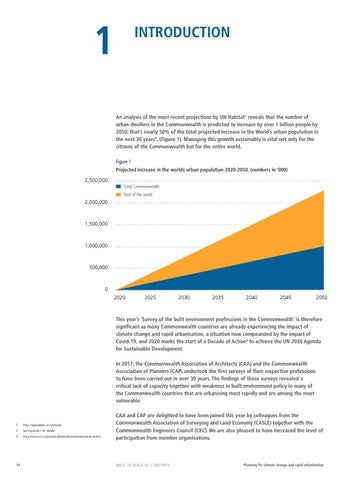
An analysis of the most recent projections by UN Habitat1 reveals that the number of urban dwellers in the Commonwealth is predicted to increase by over 1 billion people by 2050; that’s nearly 50% of the total projected increase in the World’s urban population in the next 30 years2, (Figure 1). Managing this growth sustainably is vital not only for the citizens of the Commonwealth but for the entire world. Figure 1 Projected increase in the worlds urban population 2020-2050, (numbers in ‘000) 2,500,000 Total Commonwealth Rest of the world
2,000,000
1,500,000
1,000,000
500,000
0 2020
2025
2030
2035
2040
2045
2050
This year’s ‘Survey of the built environment professions in the Commonwealth’ is therefore significant as many Commonwealth countries are already experiencing the impact of climate change and rapid urbanisation, a situation now compounded by the impact of Covid-19, and 2020 marks the start of a Decade of Action3 to achieve the UN 2030 Agenda for Sustainable Development. In 2017, the Commonwealth Association of Architects (CAA) and the Commonwealth Association of Planners (CAP) undertook the first surveys of their respective professions to have been carried out in over 30 years. The findings of those surveys revealed a critical lack of capacity together with weakness in built environment policy in many of the Commonwealth countries that are urbanising most rapidly and are among the most vulnerable.
1
https://population.un.org/wup/
2
See Appendix I for details
3
https://www.un.org/sustainabledevelopment/decade-of-action/
14
CAA and CAP are delighted to have been joined this year by colleagues from the Commonwealth Association of Surveying and Land Economy (CASLE) together with the Commonwealth Engineers Council (CEC). We are also pleased to have increased the level of participation from member organisations.
BACK TO TABLE OF CONTENTS
Planning for climate change and rapid urbanisation
The findings of this year’s survey reveal that the issues first identified in 2017 have become more challenging and are even more widespread. Moreover, while the capacity gap continues to grow, rates of urbanisation are on the rise and levels of atmospheric carbon dioxide have reached record highs, (Figure 2), requiring increasingly more urgent action in order to avoid catastrophic climate change4. The need to develop an effective response to these inter-related challenges has become even more urgent and the built environment professions have therefore been advocating for a ‘Call to Action’ on sustainable urbanisation in the Commonwealth. In an effort to help tackle the underlying issues, CAA, CAP, CASLE and CEC are also collaborating with the Commonwealth Local Government Forum (CLGF) and the Association of Commonwealth Universities (ACU) to develop a programme of engagement based on inter-disciplinary, cross sector collaboration, working together with city leaders, built environment professionals and academia.
Figure 2
200
150
100
Global greenhouse gas emissions GtCO2e / year
Emissions and expected warming based on pledges and current policies5 Dec 2019 update Warming projected by 2100
Baseline 4.1 - 4.8°C
Current policies 2.8 - 3.2°C
50
Optimistic policies 2.8°C Pledges & Targets 2.5 - 2.8°C 0 2°C consitent 1.6 - 1.7°C 1.5°C consitent 1.3 °C -50 1990
2000
2010
2020
2030
2040
2050
2060
2070
2080
2090
2100
The Commonwealth of nations provides the perfect platform from which to engage with these issues, providing advocacy, sharing knowledge and resources, building capacity and capability, and the built environment professions represented here are fully committed to this important work6.
4
https://www.unenvironment.org/resources/emissions-gapreport-2019
5
Source: Climate Action Tracker, https://climateactiontracker.org/
6
https://wuf.unhabitat.org/sites/default/files/2020-02/WUF10_final_
Mr Kalim Siddiqui President Commonwealth Association of Architects Ms Dyan Currie AM President Commonwealth Association of Planners Mr Joseph Ajanlekoko President Commonwealth Association of Surveying and Land Economy Prof Paul Jowitt CBE President Commonwealth Engineers Council
declared_actions.pdf (see page 6)
Survey of the Built Environment Professions in the Commonwealth
15
2 2
KEY FINDINGS
2.1 CRITICAL LACK OF CAPACITY AMONG BUILT ENVIRONMENT PROFESSIONALS
There is a continuing critical lack of capacity in many of the Commonwealth countries which are rapidly urbanising and are among the most vulnerable. While it is acknowledged that there is no specific target regarding the number of built environment professionals required in each country and that numbers alone are only one measure of capacity, it will be seen from the results of this survey that there is an acute imbalance between the number of built environment professionals in each country when compared with the rate of urban growth; a situation which is further aggravated when the results are correlated with levels of prosperity and vulnerability7. By way of example, the average ratio of architects per thousand head of population in Commonwealth countries which are members of the Organisation for Economic Cooperation and Development (OECD), ie Australia, Canada, New Zealand and the United Kingdom, is 0.455 whereas in Uganda it is 0.005. Similarly, in the case of town planners, the average ratio of planners per thousand head of population in OECD countries is 0.215 whereas in Tanzania it is also 0.005. These figures are particularly concerning when one considers that the rate of urban growth in OECD countries is, on average, 1.55% whereas in Tanzania it is currently 5.1% and in Uganda 6.2%. The survey results also need to be considered in relation to the cumulative impact of continuous high rates of urban growth, eg Uganda’s urban population is projected to quadruple by 2050, adding an additional 35million urban dwellers while Tanzania is expect to add a further 54 million urban dwellers in the same period (Table 1 and Table 2)8. 7
See Appendix II for further detail
8
See Appendix III for further detail
16
BACK TO TABLE OF CONTENTS
Planning for climate change and rapid urbanisation
Table 1 List of Commonwealth countries projected to more than double their urban population by 2050 Country
Projected urban population (‘000) 2020
2050
Projected urban population growth 2020-2050 ‘000
as %
Uganda
11,775
46,664
34,889
396%
Malawi
3,535
13,360
9,825
378%
Tanzania
22,113
76,542
54,429
346%
Mozambique
11,978
37,473
25,494
313%
Zambia
8,336
25,577
17,240
307%
Kenya
14,975
44,185
29,210
295%
Papua New Guinea
1,168
3,326
2,157
285%
Rwanda
2,281
6,483
4,202
284%
Nigeria
107,113
287,130
180,018
268%
Gambia
1,435
3,523
2,088
245%
14,942
36,415
21,474
244%
160
385
226
241%
Sierra Leone
3,454
7,725
4,271
224%
Namibia
1,403
3,116
1,713
222%
Lesotho
674
1,485
811
220%
Vanuatu
75
163
88
217%
Cameroon Solomon Islands
Ghana
17,626
37,518
19,893
213%
Pakistan
77,438
160,228
82,790
207%
Eswatini
348
703
355
202%
Table 2 List of Commonwealth countries projected to add more than 1m urban residents per annum to 2050 Country
Projected urban population (‘000) 2020
2050
Projected urban population growth 2020-2050 ‘000
as %
India
483,099
876,613
393,514
181%
Nigeria
107,113
287,130
180,018
268%
Pakistan
77,438
160,228
82,790
207%
Tanzania
22,113
76,542
54,429
346%
Bangladesh
64,815
117,837
53,022
182%
Uganda
11,775
46,664
34,889
396%
Kenya
14,975
44,185
29,210
295%
Mozambique
11,978
37,473
25,494
313%
Cameroon
14,942
36,415
21,474
244%
Ghana
17,626
37,518
19,893
213%
South Africa
39,551
58,057
18,506
147%
8,336
25,577
17,240
307%
United Kingdom
56,495
68,008
11,512
120%
Malaysia
25,362
36,440
11,078
144%
Zambia
Similar challenges exist in the three Commonwealth countries which are projected to experience the largest increase in their urban populations by 2050, namely India, Nigeria and Pakistan. Table 3 provides an illustration of the shortfall in architects and planners when compared with OECD averages.
Survey of the Built Environment Professions in the Commonwealth
17
Table 3 Numbers of Town Planners and Architects required to achieve OECD averages Country
Total Population 2018
Profession
India
1,352,617,330
Town Planners
5,0009
0.004
285,813
Architects
87,674
0.065
527,767
Town Planners
1,608
0.008
40,505
Architects
7,468
0.038
81,655
Town Planners
1,388
0.007
44,238
Architects
6,028
0.028
90,530
Nigeria Pakistan
195,874,740 212,215,030
Number of professionals
Ratio of professionals per 1,000 population
Indicative shortfall compared with OECD averages
While it is clearly both impractical and unrealistic to suggest that such ratios should or could be achieved, these figures clearly indicate a critical lack of capacity in many of the Commonwealth countries which are rapidly urbanising. Unless this issue can be effectively addressed then it is likely we will continue to experience an increasing number of unplanned or poorly planned settlements with correspondingly serious consequences in terms of social, economic and environmental well-being. Indeed, this is already being reflected in the results of the annual survey undertaken by the UN Sustainable Development Solutions Network10, and a comparison between their findings in 2017 and 2019 reveals that progress towards achievement of SDG11 is: · unchanged in 23 countries · improving in only 2 countries · worsening in 10 countries Furthermore, a comparison with the 2017 survey reveals that rates of urban growth are generally increasing while the number of built environment professionals are relatively static; eg the number of architects in Uganda has increased from 178 to 221 whereas the rate of urban growth has leapt from 5.3% to 6.2% per annum. These figures become even more significant when considered in the context of projected floor area additions and climate change vulnerability, as illustrated in Figures 3 and 4. In addition to their exposure to extreme weather events such as hurricanes, many small island states are also particularly vulnerable to sea level rises. In some cases, 100% of the population is located on land below 5m elevation (see Appendix V).
9
Based on anecdotal evidence: https://timesofindia.indiatimes.com/ home/education/news/india-needs-3-lakh-town-planners-by-2031know-how-you-can-be-one/articleshow/67431428.cms
10 For further information, see Appendix IV 11 Source: IEZ (2017), Energy Technology Perspectives 2017, IEZ/OECD,
Paris, www.iea.org/etp. 12 Source: Verisk Maplecroft, https://www.maplecroft.com/insights/
analysis/84-of-worlds-fastest-growing-cities-face-extreme-climatechange-risks/
18
BACK TO TABLE OF CONTENTS
Planning for climate change and rapid urbanisation
Figure 3 Projected floor area additions to 206011 Africa China India North America Europe ASEAN Latin America Other Asia
Current floor area Floor area additions
Middle East
2017-2030
OECO Pacific
2030-2040
Russia & Caspian region
2040-2050
billion m2
2050-2060
90
60
30
0
30
60
90
Notes: OECD Pacific includes Australia, New Zealand, Japan and Korea; ASEAN= Association of Southeast Asian Nations
Figure 4 Location of cities most at risk from climate change impacts11
2.5
0
Low risk Medium risk
1 million 10 million
High risk
5
Size of population
Extreme risk
7.5
Climate Change Vulnerability Index 2018-Q4
10
Average annual % change in population, 2018-2035 0
-1 Europe
1
2
Americas
3 Asia
4 Africa
5
6 Oceania
Among the Commonwealth cities most at risk of climate change impacts are Kampala in Uganda, Dar-es-Salaam in Tanzania, Abuja and Lagos in Nigeria12.
Survey of the Built Environment Professions in the Commonwealth
19
It should be noted that the survey only accounts for respondent countries in which professional institutes exist and that no architectural institute could be found in 9 Commonwealth countries, no town planning association could be found in 22 Commonwealth countries, no civil engineering association could be found in 7 Commonwealth countries and no quantity surveying association could be found in 25 Commonwealth countries. No built environment associations of any kind could be found in 5 Commonwealth countries; Kiribati, Nauru, Seychelles, Solomon Islands and Tuvalu; all of which are small island states and many of which are among the most vulnerable to climate change impacts.Â
Table 4 Commonwealth countries lacking one or more key built environment institute
Income Country (LMIC) 16 CRI: Climate Resilience Index; a measure of vulnerability to
climate change impacts 17 Anecdotal evidence suggests there is no recognised planning
profession in Sierra Leone, but that there are 19 Development Planning Officers (eg: Haja) in each of the councils. Haja is
Projected urban population growth 20202050
Surveying Institute?
15 ODA Status: Least Developed Country (LDC), Lower Middle-
ODA CRI16 status15
Planning Institute?
14 https://data.worldbank.org/region/small/states
Small states14
Engineering Institute?
13 https://sustainabledevelopment.un.org/topics/sids/list
SIDS13
Architectural institute?
Country
Seychelles
Y
Y
-
116
12
122%
N
N
N
N
Kiribati
Y
Y
LDC
116
168
132%
N
N
N
N
Nauru
Y
Y
UMIC
-
58
185%
N
N
N
N
Solomon Islands
Y
Y
LDC
75
226
241%
N
N
N
N
Tuvalu
Y
Y
LDC
116
4
154%
N
N
N
N
Gambia, The
-
Y
LDC
101
2,088
245%
Y
N
N
N
Mozambique
-
-
LDC
37
25,494
313%
N
Y
N
N
St Vincent & Gren.
Y
Y
UMIC
116
14
142%
Y
N
N
N
Samoa
Y
Y
UMIC
116
7
146%
N
Y
N
N
Tonga
Y
Y
UMIC
116
16
162%
N
Y
N
N
Vanuatu
Y
Y
LDC
90
88
217%
N
Y
N
N
Cameroon
-
-
LMIC
97
21,474
244%
Y
Y
N
N
Eswatini
-
Y
LMIC
116
355
202%
Y
Y
N
N
Lesotho
-
Y
LDC
116
811
220%
Y
Y
N
N
Antigua & Barbuda
Y
Y
UMIC
20
2,629
167%
Y
Y
N
N
Grenada
Y
Y
IUMIC
116
8
115%
Y
Y
N
N
Guyana
Y
Y
UMIC
116
12
130%
Y
Y
N
N
Saint Kitts & Nevis
Y
Y
-
64
264
116%
Y
Y
N
N
Bahamas
Y
Y
-
-
81
124%
Y
Y
N
Y
Papua New Guinea
Y
-
LMIC
78
2,157
285%
Y
Y
N
Y
Sierra Leone17
-
-
LDC
15
4,271
224%
Y
Y
N17
Y
Bangladesh
-
-
LDC
16
53,022
1825
Y
Y
Y
N
Belize
Y
Y
UMIC
116
155
185%
Y
Y
Y
N
Brunei Darussalam
-
Y
-
116
112
132%
Y
Y
Y
N
Cyprus
-
Y
-
84
223
128%
Y
Y
Y
N
Dominica
Y
Y
UMIC
9
8
115%
Y
Y
Y
N
Mauritius
Y
Y
UMIC
116
85
116%
Y
Y
Y
N
Namibia
-
Y
UMIC
116
1,713
222%
Y
Y
Y
N
'000
as %
not a Town Planner per se and has no planning qualification, but their role does include spatial planning
20
BACK TO TABLE OF CONTENTS
Planning for climate change and rapid urbanisation
Another aspect of the findings which needs to be considered in relation to professional capacity, is the fact that most built environment professionals tend to be located in capital cities and in the main metropolitan areas18 whereas urban growth is being experienced by cities of all sizes, including secondary cities, which constitute the majority (Table 5 and Figure 5), and where most of the Commonwealth’s urban population actually live.
Table 5 Number of Commonwealth Cities, grouped by population size Category
No. of cities per Category
Sum of Population 2010
as %
Cumulative %
Over 4m
16
146,027,069
22%
100%
Between 1m and 4m
76
139,692,792
21%
78%
Between 500k to 1m
93
64,658,956
10%
57%
Between 200k and 500k
280
83,865,680
13%
47%
Between 100k and 200k
525
73,393,194
11%
34%
Between 50k and 100k
996
69,045,549
11%
23%
Between 20k and 50k
2,585
80,145,216
12%
12%
Grand Total
4,571
656,828,457
100%
Figure 5 Number of Commonwealth cities, grouped by population size19 Grater than 4 million
16 76
Between 1- 4 million Between 500k-1million
92 281
Between 200k-500k
525
Between 100k-200k
996
Between 50k-100k Between 20k-50k
2,585
The following figures (Figures 6-9) and tables (Tables 6-9) illustrate the capacity gap which exists for each of the principal built environment disciplines.
18 According to the Uganda Society of Architects, nearly all of its 221
members are located in Kampala. 19 Source: Nicolas Galarza, Visiting Scholar, NYU Marron Institute of
Urban Management, with Ana Camelo and Maria Bernal.
Survey of the Built Environment Professions in the Commonwealth
21
Figure 6 Ratio of Architects per thousand population v rates of urban growth Professionals per thousand population 0
0.1
United Kingdom
0.2
0.6
0.7 0.619
0.543 0.500
0.8%
New Zealand
0.392
2.0%
Canada
0.274
1.5% 0.5%
0.228 0.218
0.4%
Mauritius
0.167
Botswana
0.110
3.3%
Dominica
0.7%
Malaysia
0.073
2.1%
South Africa
0.072
2.1%
Trinidad & Tobago
0.5
1.7%
Hong Kong
Antigua & Barbuda
0.4
1.0%
Australia
Singapore
0.3
0.084
0.069
0.4%
Sri Lanka
0.065
India
0.065
2.3%
Nigeria
0.038
Pakistan
0.033
Fiji
0.033
Bangladesh
0.021
Belize
0.016
Zambia
0.015
Rwanda
0.014
Kenya
0.012
Ghana
0.011
Uganda
0.005
Gambia, The
0.005
4.2% 2.7% 1.6% 3.2% 2.2% 4.2% 3.1% 4.1% 3.4% 6.2% 4.0%
Urban growth 0.0%
22
1.0%
2.0%
BACK TO TABLE OF CONTENTS
3.0%
4.0%
5.0%
6.0%
7.0%
Planning for climate change and rapid urbanisation
Table 6 Ratio of Architects per thousand head of population v rates of urban growth Country
Total Population 2018
Africa
Registered Professionals 2018
Architects per thousand population
Urban Growth (%)
412,981,910
13,708
0.033
3.5%
Botswana
2,254,130
249
0.110
3.3%
Gambia, The
2,280,100
11
0.005
4.0%
Ghana
29,767,110
333
0.011
3.4%
Kenya
51,393,010
618
0.012
4.1%
1,256,300
210
0.167
-0.1%
Nigeria
195,874,740
7,468
0.038
4.2%
Rwanda
12,301,940
178
0.014
3.1%
South Africa
57,779,620
4,153
0.072
2.1%
Uganda
42,723,140
221
0.005
6.2%
Zambia
17,351,820
267
0.015
4.2%
1,785,025,660
102,039
0.058
2.1%
161,356,040
3,350
0.021
3.2%
1,352,617,330
87,674
0.065
2.3%
Malaysia
31,528,580
2,291
0.073
2.1%
Pakistan
212,215,030
6,028
0.033
2.7%
Singapore
5,638,680
1,284
0.228
0.5%
Sri Lanka
21,670,000
1,412
0.065
1.5%
38,999,710
10,265
0.263
1.0%
96,290
21
0.218
0.4%
383,070
6
0.016
2.2%
37,058,860
10,136
0.274
1.5%
71,630
6
0.084
0.7%
1,389,860
96
0.069
0.4%
68,161,790
44,585
0.654
1.7%
1,189,270
2,389
2.009
0.8%
483,530
1,026
2.122
3.3%
United Kingdom
66,488,990
41,170
0.619
1.0%
Other
7,451,000
3,723
0.500
0.8%
7,451,000
3,723
0.500
0.8%
30,761,350
15,510
0.504
1.8%
24,992,370
13,567
0.543
1.7%
883,480
29
0.033
1.6%
4,885,500
1,914
0.392
2.0%
Mauritius
Asia Bangladesh India
Caribbean and Americas Antigua and Barbuda Belize Canada Dominica Trinidad & Tobago Europe Cyprus
20
Malta
Hong Kong
21
Pacific Australia22 Fiji New Zealand
20 Cyprus (ratio: 2.01) and Malta (ratio: 2.12) have been omitted
from the chart for clarity as their members are also defined as engineers, which prevents a like-for-like comparison 21 While Hong Kong SAR is no longer a member of the
Commonwealth, the HKIA remains a member of the CAA 22 Australia only provided numbers of registered professional
numbers for 2017
Survey of the Built Environment Professions in the Commonwealth
23
Figure 7 Ratio of Town Planners per thousand population v rate of urban growth Professionals per thousand population 0
0.1
United Kingdom
0.2
New Zealand
2.0%
Australia
1.7%
Canada
1.5%
Trinidad & Tobago
0.4%
Fiji
0.028
Ghana
0.022
24
0.7
0.183 0.167 3.3%
0.034 0.033 1.6% 3.4%
Mauritius
0.018
Malaysia
0.017
2.1%
South Africa
0.011
2.1%
Nigeria
0.008
Pakistan
0.006
Tanzania
0.006
Barbados
0.000
Sri Lanka
0.000
0.0%
0.6
0.184
0.084 0.5%
0.5
3.3%
0.186
Botswana
0.4 0.330
1.0%
Malta
Singapore
0.3
4.2% 2.7% 5.1%
1.5%
1.0%
Urban growth 2.0%
BACK TO TABLE OF CONTENTS
3.0%
4.0%
5.0%
6.0%
7.0%
Planning for climate change and rapid urbanisation
Table 7 Ratio of Town Planners per thousand head of population v rates of urban growth Country
Africa23
Total Population 2018
Registered Professionals 2018
Town Planners per thousand population
Urban Growth (%)
343,250,250
3,411
0.010
3.0%
2,254,130
190
0.084
3.3%
29,767,110
644
0.022
3.4%
1,256,300
22
0.018
-0.1%
195,874,740
1,608
0.008
4.2%
South Africa
57,779,620
630
0.011
2.1%
Tanzania
56,318,350
317
0.006
5.1%
Botswana Ghana
24
Mauritius Nigeria
Asia
249,382,290
2,005
0.013
1.4%
Malaysia
31,528,580
549
0.017
2.1%
25
Pakistan
212,215,030
1,266
0.006
2.7%
Singapore
5,638,680
190
0.034
0.5%
Sri Lanka
38,448,720
0
0.000
1.5%
286,640
6,246
0.161
0.7%
37,058,860
6,200
0.167
1.5%
1,389,860
46
0.033
0.4%
Europe
66,972,520
22,009
0.327
2.2%
Malta26
483,530
90
0.186
3.3%
66,488,990
21,919
0.330
1.0%
Pacific
30,761,350
5,501
0.179
1.8%
Australia
24,992,370
4,579
0.183
1.7%
883,480
25
0.028
1.6%
4,885,500
897
0.184
2.0%
Caribbean & Am. Canada Trinidad & Tobago
United Kingdom
Fiji New Zealand
23 Although not a survey respondent, the Uganda
Institute of Physical Planners (UIPP) appeares to comprise 30 corporate, 67 graduate, 1 associate and 1 student member in 2017. Source: https://www. zaddockassociates.com/digitalpublications/UPG/ august-2017/mobile/index.html#p=83 24 Ghana, Mauritius, UK, Australia and Fiji did not provide
the number of registered professionals, so the numbers used here refer to members of the institute. 25 Number of registered professionals provided by the
Pakistan Council of Architects and Town Planners (PCATP), February 2020. 26 Town Planning is not a legally recognised profession
in Malta, but it is understood that there are 90 Professionally qualified town planners in the country. Malta did not provide the number of registered professionals, so the numbers used here refer to members of the institute.
Survey of the Built Environment Professions in the Commonwealth
Workshop in Bo credit: The Prince’s Foundation
25
Figure 8 Ratio of Engineers per thousand population v rate of urban growth Professionals per thousand population 0 Mauritius
0.1
0.2
0.3
0.4
0.5
0.6
0.7
0.8
0.9
-0.1% 4.2% 0.8%
United Kingdom
1.0%
0.76 0.73 0.63
Botswana
3.3%
Belize
2.2%
Ghana
0.22
Mozambique
0.08
Malaysia
0.06
Malta
0.06
Uganda
0.05
1.1 1.00
Zambia Grenada
1
0.53
0.27 3.4% 4.4%
2.1% 3.3% 6.2%
0.0% 1.0% 2.0% 3.0%
4.0% 5.0%
6.0% 7.0%
Urban growth 8.0% 9.0% 10.0% 11.0%
Table 8 Ratio of Engineers per thousand population v rates of urban growth Country
Total Population 2018
Africa
Registered Professionals 2018
Engineers per thousand population
Urban Growth (%)
122,849,460
24,480
0.217
3.6%
2,254,130
1,200
0.532
3.3%
29,767,110
6,502
0.218
3.4%
1,256,300
1,258
1.001
-0.1%
Mozambique
29,496,960
2,320
0.079
4.4%
Uganda27
42,723,140
2,176
0.051
6.2%
Zambia
17,351,820
13,200
0.761
4.2%
31,528,580
2,019
0.064
2.1%
Botswana Ghana Mauritius
Asia Malaysia
31,528,580
2,019
0.064
2.1%
Caribbean & Am.
494,520
186
0.376
1.5%
Belize
383,070
105
0.274
2.2%
Grenada
111,450
81
0.727
0.8%
Europe
66,972,520
42,141
0.630
2.2%
483,530
30
0.062
3.3%
66,488,990
42,141
0.634
1.0%
Malta
27
United Kingdom 27 Uganda and Malta did not provide the number of
registered professionals, so the numbers used here refer to members of the institute.
26
BACK TO TABLE OF CONTENTS
Planning for climate change and rapid urbanisation
Figure 9 Ratio of Surveyors per thousand population v rate of urban growth Professionals per thousand population 0.00
0.05
0.10
0.15
Malaysia
0.20
0.25
0.4%
Nigeria
0.02
Rwanda
0.01
0.35
0.40
0.45
0.25
2.1%
Trinidad and Tobago
0.30
0.07 4.2% 3.1%
Urban growth 0.0%
0.5%
1.0%
1.5%
2.0%
2.5%
3.0%
3.5%
4.0%
4.5%
Table 9 Ratio of Surveyors per thousand head of population v rate of urban growth Country
Total Population 2018
Registered Professionals 2018
Engineers per thousand population
Africa
208,176,680
4,268
Nigeria
195,874,740
Rwanda
12,301,940
Urban Growth (%)
0.016
4.1%
4,126
0.021
4.2%
142
0.012
3.1%
31,528,580
8,000
0.254
2.1%
Malaysia
31,528,580
8,000
0.254
2.1%
Caribbean and Americas
1,389,860
101
0.073
0.4%
1,389,860
101
0.073
0.4%
Asia
Trinidad and Tobago
Site visit for workshop in Bo credit: The Prince’s Foundation
Survey of the Built Environment Professions in the Commonwealth
27
credit: Johnny Miller, https://unequalscenes.com/
2.2 CRITICAL LACK OF EDUCATIONAL CAPACITY
There is a lack of educational and institutional capacity to grow the professions fast enough in many Commonwealth countries. The findings of the 2017 survey revealed that, while lack of capacity among built environment professionals is a serious issue in a number of Commonwealth countries, the rate at which the profession is growing in these countries is also insufficient to achieve the sort of ratios found in OECD countries owing to the relatively small number of undergraduate places available for built environment professionals. The findings of the 2019 survey reveal that lack of educational capacity remains a concern and that this is affecting each of the principal built environment professions to a greater or lesser extent. By way of example, the ratio of schools of architecture per million head of population in Commonwealth countries which are members of the Organisation for Economic Co-operation and Development (OECD), ie Australia, Canada, New Zealand and the United Kingdom, is 0.587, whereas in Nigeria it is 0.362. Lack of planning schools is an even greater concern. In OECD countries, the ratio of planning schools per million head of population is 0.729 whereas in Nigeria it is only 0.179, a fourfold difference. These figures are particularly concerning when one considers that Nigeria is forecast to add a further 180million urban dwellers in the next 30 years. Figure 10 Proportion of professional associations requiring mandatory continuing professional development Architects, Mandatory CPD?
37%
While the training of undergraduates is a concern, so too is the need to ensure existing members of the profession are equipped with appropriate up-to-date knowledge to deal with the range of challenges being faced in a rapidly changing world. Figure 10 illustrates the fact that the provision of mandatory continuing professional development remains a challenge for many respondents owing to lack of resources and/or institutional capacity.
63%
The following figures (Figures 11-14) and tables (Tables 10-13) illustrate the capacity gap which exists for each of the principle built environment disciplines.
Planners, Mandatory CPD?
44%
Respondents were also invited to comment on some of the key challenges facing the education of built environment professions. These are covered in Chapter 2.4 and include poorly skilled and unqualified teaching staff together with outdated curriculum, ie it is not simply the number of graduates which is an issue but also the quality of the education they are receiving. Indeed, the need for curriculum review to better reflect the challenges of climate change and sustainable urbanisation is widely recognised in many parts of the Commonwealth28.
28 See p13, Chapter 5.0 Knowledge and competence’, ‘RIBA Ethics and
56%
Sustainable Development Commission’: https://www.architecture.
Yes No
Survey of the Built Environment Professions in the Commonwealth
com/‐/media/GatherContent/Work‐with‐Us/Additional‐Documents/ Ethics‐and‐Sustainable‐ Development‐Commission‐‐Full‐ findingspdf.pdf
29
Figure 11 Ratio of Architects/1,000 population v ratio of Schools of Architecture/1m population United Kingdom Australia
0.543
Hong Kong
0.72
0.500
New Zealand
0.81
0.392
Canada
0.274
Singapore
0.61
0.32
0.228
Antigua & Barbuda
0.35
0.218
Mauritius
0.167
Botswana
0.80
0.110
Malaysia
0.44
0.106
South Africa
0.072
Trinidad & Tobago
0.069
0.76 0.17
0.065
Sri Lanka
0.09
0.065
India Nigeria
0.038
Pakistan
0.033
0.33 0.36 0.16
0.033
Fiji
0.021
Bangladesh
0.15
0.015
Zambia Rwanda
0.014
Kenya
0.012
Ghana
0.011
Uganda
0.005
0
30
0.69
0.619
0.08 0.14 0.37
Schools per million population Professionals per thousand population
0.09
0.1
0.2
0.3
BACK TO TABLE OF CONTENTS
0.4
0.5
0.6
0.7
0.8
0.9
Planning for climate change and rapid urbanisation
Table 10 Ratio of Architecture Schools /1m population Country
Total Population 2018
Africa
Total schools of Architecture
Schools per million population
413,150,070
108
0.26
2,254,130
1
0.44
Ghana
29,767,110
11
0.37
Kenya
51,393,010
7
0.14
Mauritius
1,256,300
1
0.80
Namibia
2,448,260
1
0.41
Nigeria
195,874,740
71
0.36
Rwanda
12,301,940
1
0.08
South Africa
57,779,620
10
0.17
Uganda
42,723,140
4
0.09
Zambia
17,351,820
1
0.06
1,785,025,660
510
0.29
161,356,040
25
0.15
1,352,617,330
448
0.33
Malaysia
31,528,580
24
0.76
Pakistan
212,215,030
33
0.16
Singapore
5,638,680
2
0.35
Sri Lanka
21,670,000
2
0.09
38,616,640
13
0.33
96,290
0
0.00
37,058,860
12
0.32
71,630
1
13.96
1,389,860
0
0.00
68,161,790
51
0.75
1,189,270
4
3.36
483,530
1
2.07
United Kingdom
66,488,990
46
0.69
Other
7,451,000
6
0.81
7,451,000
6
0.81
Pacific
30,761,350
21
0.68
Australia
24,992,370
18
0.72
883,480
0
0.00
4,885,500
3
0.61
Botswana
Asia Bangladesh India
Caribbean and Americas Antigua and Barbuda Canada Dominica
29
Trinidad and Tobago Europe Cyprus Malta
Hong Kong SAR
Fiji New Zealand
29 Dominica, Cyprus and Malta have a relatively high number of
schools/1m population and have not been shown
Survey of the Built Environment Professions in the Commonwealth
31
Figure 12 Ratio of Town Planners/1,000 population v ratio of Planning Schools/1m population United Kingdom
0.330
New Zealand
0.184
Australia
0.183
Canada Botswana
0.42 1.02 0.96 0.51
0.167 0.44
0.084
Trinidad and Tobago
0.033
Ghana
0.022
Mauritius
0.018
Malaysia
0.017
South Africa
0.011
Nigeria
0.008
0.72 0.10 0.80 0.16 0.19 0.18
Pakistan
0.006
0.02
Tanzania
0.006
0.02
Barbados
0.000
Sri Lanka
0.000
Schools per million population 0.05
0
Professionals per thousand population
0.2
0.4
0.6
0.8
1
1.2
Table 11 Ratio of Town Planning Schools/1m population Country
Total Population 2018
Africa Botswana Ghana Mauritius
0.15
2,254,130
1
0.44
29,767,110
3
0.10
1
0.80
35
0.18
South Africa
57,779,620
11
0.19
Tanzania
56,318,350
1
0.02
265,413,610
11
0.04
Malaysia
31,528,580
5
0.16
Pakistan
212,215,030
5
0.02
Sri Lanka
21,670,000
1
0.05
38,735,360
20
0.52
Caribbean & Am. Barbados
286,640
0
0.00
37,058,860
19
0.51
1,389,860
1
0.72
68,161,790
29
0.43
483,530
1
2.07
66,488,990
28
0.42
Pacific
29,877,870
29
0.94
Australia
24,992,370
24
0.96
4,885,500
5
1.02
Canada Trinidad and Tobago Europe Malta
30
United Kingdom
New Zealand
32
52
1,256,300
Asia
omitted from the chart for clarity
343,250,250
195,874,740
Nigeria
30 Malta has a high number of schools/ 1m population and has been
Total schools of Planning Schools per million population
BACK TO TABLE OF CONTENTS
Planning for climate change and rapid urbanisation
Figure 13 Ratio of Engineers/1,000 population v ratio of Engineering Schools/1m population Grenada
0.73
0.00
United Kingdom Belize
0.63 0.00
0.27 0.22
Ghana Mozambique Uganda
0.90
0.67 0.64
0.08 0.05
Schools per million population
0.23
Professionals per thousand population
0
0.1
0.2
0.3
0.4
0.5
0.6
0.7
0.8
0.9
1
Table 12 Ratio of Engineering Schools/1m population Country
Total Population 2018
Total schools of Engineering
Schools per million population
Africa
119,339,030
79
0.64
Ghana
29,767,110
20
0.67
Mozambique
29,496,960
19
0.64
Uganda
42,723,140
10
0.23
Zambia
17,351,820
30
1.73
Caribbean and Americas
494,520
0
0.00
Belize
383,070
0
0.00
Grenada
111,450
0
0.00
Europe
66,488,990
60
0.90
66,488,990
60
0.90
United Kingdom
Figure 14 Ratio of Surveyors/1,000 population v ratio of Surveying Schools/1m population Malaysia
0.25
Trinidad & Tobago
0.35
0.25
0.07
Nigeria
0.72
0.02
Rwanda
0.33
0.01
0
Schools per million population
0.08
0.1
Professionals per thousand population
0.2
0.3
0.4
0.5
0.6
0.7
0.8
0.9
1
Table 13 Ratio of Surveying Schools/1m population Country
Total Population 2018
Total schools of Surveying
Schools per million population
Africa
208, 176,680
65
0.25
Nigeria
195,874,740
64
0.33
Rwanda
12,301,940
1
0.08
Asia
31,528,580
11
0.35
Malaysia
31,528,580
11
0.35
C. & Americas
1,389,860
1
0.72
1,389,860
1
0.72
Trinidad & Tobago
Survey of the Built Environment Professions in the Commonwealth
33
2.3 WEAKNESS IN BUILT ENVIRONMENT POLICY
There is an increasing recognition of weakness in built environment policy in many Commonwealth countries in terms of standards, implementation and enforcement. Survey respondents were invited to confirm the existence of national strategies and policies in a wide range of areas. Figures 16 and 17 illustrate the range of responses received from which it will be seen that there is considerable scope for strengthening built environment policy in a number of Commonwealth countries. Survey respondents were also invited to comment on whether their national planning legislation and building code was fit-for-purpose and whether it was being implemented effectively. While responses varied considerably from one profession to another, the combined responses (Figure 15) reveal that circa 30% of respondents consider their national planning policy is not fit for purpose while nearly 60% do not believe it is being implemented effectively. Survey respondents were even more critical of building code, with nearly 50% expressing the view that it is not fit for purpose (25% in 2017) and almost 75% that it is not being implemented effectively (60% in 2017). A comparison with the 2017 results suggests that this policy weakness is being experienced and recognised more widely. Figure 15 Effectiveness of planning legislation and building code Planning Legislation
Implemented effectively
42%
Fit for purpose
71%
34
BACK TO TABLE OF CONTENTS
Building Codes
Implemented effectively
27%
Fit for purpose
54%
Yes No
Planning for climate change and rapid urbanisation
Figure 16 National built environment strategies Has your government developed effective...? Renewable energy policy
NO
YES
Disaster management plans City resilience strategies Smart Cities strategy National BIM strategy National housing strategy National construction strategy Sustainable design & construction standards Anti-bribery and corruption legislation Inclusive design standards 0%
10%
20%
30%
40%
50%
60%
70%
80%
90%
100%
Figure 17 National built environment policies Has your government developed effective...? Effective NUA implementation plan
NO
YES
N/A
NUA embraced by government Effective COP21 implementation plan COP21 targets Effective SDG implementation plan SDG targets developed Health & safety standards adequately regulated Effective health and safety standards 0%
Survey of the Built Environment Professions in the Commonwealth
10%
20%
30%
40%
50%
60%
70%
80%
90%
100%
35
The weakness of planning legislation and building code is particularly concerning in the context of climate change and resilience especially when considered in terms of risk and vulnerability (Figure 4), and the lack of mandatory energy codes in many parts of the Commonwealth (Figure 18). Data from the International Energy Agency reveals the fact that 69% of Commonwealth countries have no mandatory energy codes for non-residential buildings while 81% have no such codes for residential buildings (see Appendix VI). Figure 18 Map of building energy codes by jurisdiction, 2018-1931
Mandatory for entire sector Mandatory for part of sector Mandatory for part of sector in major city Voluntary for part of sector Code in development No known code
The latter is particularly concerning when one considers the urgent need for industrialised countries to dramatically reduce their carbon emissions and for those countries which are rapidly urbanising to do so in a sustainable manner. Figure 19 illustrates the scale of the challenge being faced, with countries such as Australia (86% urbanised) currently producing 15.4 tonnes of CO2 per capita per annum and urbanising at 1.7% per annum compared with Uganda (24% urbanised) currently producing 0.1 tonnes of CO2 per capita per annum and urbanising at 6.2% per annum. The scale of the challenge becomes even more apparent when one considers that the 20 countries responsible for producing circa half of the Commonwealths total CO2 emissions comprise approximately 250 million people while the remaining 50% of the Commonwealth, which is rapidly urbanising, comprises 2.3 billion people. It is for this reason that the Commonweath Association of Architects has recently become a member of the Global Alliance for Building and Construction32, to help advocate for more appropriate regulation combined with effective implementation and enforcement.
31 Image taken from IEA (2019c), Energy efficiency policies: Buildings,
Figure 19
www.iea.org/topics/energyefficiency/policies/buildings. 32 https://globalabc.org/
36
CO2 per capita v rates of urbanisation
BACK TO TABLE OF CONTENTS
Planning for climate change and rapid urbanisation
0.00
2.00
4.00
6.00
8.00
10.00
12.00
14.00
16.00
18.00
Australia Canada Singapore South Africa Malaysia New Zealand Bahamas United Kingdom Hong Kong Antigua & Barbados Malta
250m people 2.3bn tonnes CO2
Seychelles Cyprus St Kitts and Nevis Barbados Botswana Jamaica Guyana St Lucia Grenada St Vincent Dominica Namibia India Belize Fiji Lesotho Tonga Eswatini Tuvalu Pakistan Sri Lanka Zimbabwe Papua New Guinea Vanuatu Kiribati
2.27bn people 2.7bn tonnes CO2
Nigeria Ghana Bangladesh Solomon Island Mozambique Zambia Kenya Gambia Cameroon Tanzania Sierra Leone Uganda Malawi
Co2 per capita (metric tonnes)
Rwanda
Urban growth (%)
0.0%
1.0%
Survey of the Built Environment Professions in the Commonwealth
2.0%
3.0%
4.0%
5.0%
6.0%
7.0%
37
2.4 CHALLENGES FACING THE BUILT ENVIRONMENT
Respondents from all four disciplines were invited to offer their opinion on the biggest challenges facing the Built Environment, the Profession and Education. The following comprises a summary of the main issues of common concern. The overall findings of this year’s survey confirm that the issues previously identified in 2017 are even more pervasive than first imagined, affect more countries and are being experienced to a greater or lesser extent by each of the principle built-environment professions; architecture, town planning, engineering and surveying.
Biggest challenges facing the Built Environment: • • • • • • • • • • • • •
38
Climate change Resilience to disaster and the need for adaptation Rapid urbanisation Urban sprawl Affordable housing Traffic congestion Lack of public transport Outdated planning policy and building code Lack of enforcement of existing regulations Lack of local building materials Skills shortage Economic uncertainty Corruption and uncontrolled development
BACK TO TABLE OF CONTENTS
Planning for climate change and rapid urbanisation
Biggest challenges facing the Profession: • • • • • • • • • • • • •
Failure to develop and implement local plans Failure to enforce regulations Procurement methods and forms of contract Increasing use of Design & Build, loss of control Impact of foreign consultants and contractors Competition from unqualified persons Digitisation and advances in technology Declining fees v increasing risk and liability Need for continuing professional development Lack of resources to develop knowledge and skills Lack of government support and patronage Economic uncertainty Lack of respect for the professions
Biggest challenges facing the Education of Built Environment Professionals: • • • • • • • • • • •
Survey of the Built Environment Professions in the Commonwealth
Insufficient universities, places of learning Poorly skilled and unqualified teaching staff Outdated curriculum Need to align education with the Sustainable Development Goals and industry needs Inadequate teaching material and lack of facilities, especially digital tools Low standards compared with best practice Lack of practical training opportunities for students Low levels of funding combined with high fees/low pay Failure to attract the best students Lack of access to research facilities Lack of diversity in terms of gender and ethnicity
39
CLIMATE CHANGE, RAPID URBANISATION AND THE COMMONWEALTH Half of the top 20 global emerging cities are in the Commonwealth: New Delhi, Mumbai, Nairobi, Kuala Lumpur, Bangalore, Johannesburg, Kolkata, Cape Town, Chennai and Dhaka. According to the Economist Intelligence Unit33, the Commonwealth includes 6 of the 10 Most Liveable Cities in the World and 5 of the 10 Least Liveable Cities in the World.
83% URBAN The United Kingdom has a population of 66 million is 83% urbanised with a population density of 36 people/sqkm
81% URBAN Canada is 81% urbanised with a population density of 4 people/sqkm
4.2%
URBAN GROWTH RATE
15.2
TONNES
Bahamas
Canada produces 15.2 tonnes CO2/ capita/annum
Belize
Antigua & Barbuda Dominica St Kitts & Nevis St Vincent St Lucia Barbados Grenada Trinidad & Tobago
Jamaica
Nigeria has a population of 195,874,740 which is growing at a rate of 2.6% with an urban growth rate of 4.2%. Its urban population is projected to increase by 180,018,000 by 2050.
Guyana Samoa
Rwanda’s population density is one of the highest in Africa, at 499 people/sqkm
32
SMALL STATES 32 Commonwealth countries are Small States, 25 of which are Small Island Developing States (SIDS). In the Caribbean, over 50% of the population lives within 1.5km of the sea, rendering them particularly vulnerable to storm surges and rising sea levels.
33
40
6.2%
URBAN GROWTH RATE Uganda has a population of 42,723,140 which is growing at a rate of 3.7%, with an urban growth rate of 6.2%. Its urban population is projected to increase by 396% by 2050.
https://www.eiu.com/public/topical_report aspx?campaignid=Liveability2018
BACK TO TABLE OF CONTENTS
Planning for climate change and rapid urbanisation
Nearly 50% of the projected urban growth to 2050 will be in the Commonwealth; that’s an additional 1 billion urban dwellers in the next 30 years.
6.5
TONNES The United Kingdom produces 6.5 tonnes CO2/capita/annum
2.3%
URBAN GROWTH RATE India has a population of 1.35 billion which is growing at a rate of 1.0% with an urban growth rate of 2.3%. Its urban population is projected to increase by 393,514,000 by 2050.
37% URBAN Pakistan’s urban population is forecast to double within the next 30 years, adding a further 60m urban dwellers.
100% URBAN Singapore is 100% urbanised with a population density of 7,953 people/sqkm. The citystate also has the highest GNI per capita at $94,500 Singapore
Maldives
Nauru
Kiribati
Papua New Guinea Seychelles
Mauritius
Tuvalu
94% of the population of the Commonwealth live in Africa and Asia
Solomon Islands Vanuatu Fiji
0.1
TONNES
Malawi, Rwanda, and Uganda each produce 0.1 tonnes CO2/capita/annum
15.4
TONNES
Rate of urbanisation ≥ 5.00+%
4.00 - 4.99%
3.00 - 3.99%
2.00 - 2.99%
1.00 - 1.99%
0.00 - 0.99%
Survey of the Built Environment Professions in the Commonwealth
Australia is 86% urbanised with a population density of 3 people/sqkm
< 0.00%
Australia produces 15.4 tonnes CO2/ capita/annum
86% URBAN
41
2.5 IMPACT OF THE FINDINGS ON THE GROUND While the findings of the survey have evidenced the range of challenges being faced, the consequences are being experienced in difference ways in different Commonwealth countries as illustrated below:
2.5.1 AUSTRALIA
Professor Barbara Norman, University of Canberra, Australia Australia is one of the most urbanised nations in the world. Over 85% of the population live in the coastal zone and most live in the urban areas of the coastal zone. Australia is therefore predominantly a coastal urban nation. Urban growth continues particularly in the capital cities and regional coastal towns. As a nation, our urban population is expected to grow from 20 to 40 million by 2050. Australia is also identified as a country that will experience significant impacts from climate change; fire, flood drought and storms. The Australian fires of 2020 are a prime example of stretched resources with small urban coastal communities being in some cases nearly wiped out. Australia is also a very large and diverse country with tropical environments in the north, arid environments in the centre to cold climates in the south. The challenges for built environment professionals are indeed large. Given the above context and the survey findings, the built environment professionals face the following three challenges in Australia: · Supporting the training and development of professionals in coastal regional Australia that are experiencing both the pressures of urban growth and climate risks. · Ongoing professional development for built environment professional across a large and very diverse nation. · Upskilling of the current and future professional on planning for climate change i.e. actions we can take in the built environment that will both reduce emissions and adapt to the impacts of climate change. The built environment professions in Australia have played a critical role in recent years in the process of recovery and rebuilding from disasters. In particular, the professionals have argued strongly to ‘build back better’ to be more resilient in the future. To do this better in the future, we need strong investment in strategic and scenario planning as highlighted by the Planning Institute of Australia’s recent national statement: ‘Through the lens: the tipping point’34, calling for a national planning framework.
2.5.2 BANGLADESH
Mr Jalal Ahmed, President, Institute of Architects Bangladesh & Dr Farida Nilufar, Secretary, Environment and Urbanisation, Institute of Architects Bangladesh In the absence of critical lack of capacity of professionals, the cities and towns of Bangladesh are becoming unliveable mainly due to lack of proper development controls, poor management of waste, unbridled expansion of industries emitting toxic gases and effluents.
34 https://www.planning.org.au/policy/national-settlement-strategy
42
Myopic and blinkered policies of the past have created this frightening condition. Situations are further aggravated due to poor enforcement of policy. The towns and cities are rapidly losing their natural resources like water bodies, greeneries and open spaces. The rivers, lakes and wetlands in and around the cities are being encroached upon and filled up for expansion of habitats, due to lack of strict enforcements.
BACK TO TABLE OF CONTENTS
Planning for climate change and rapid urbanisation
Factories are throwing toxic waste in the open rivers and the surface water has become extremely polluted. Consequently, 85% of the water demand in the capital city is met through extracting water from the underground water table and the underground water level is depleting at a rapid rate of 3 to 4 meters every year. Brick kilns, mostly coal fired, around the urban areas are also major causes of air pollution. There are only around 4,000 registered architects in the country for a population of about 165 million. But there are more than 800 local government bodies in the country and only a handful of them have urban planners and few have architects for development controls and enforcement of building regulations. The negative impact of this absence of built environment professionals in the local government and planning authorities are visible in the unplanned development of most to the cities and towns. Currently, around 30 universities in the country are producing architects, of which only 11 are accredited by the Institute of Architects Bangladesh (IAB). Most of the non-accredited academic programs lack adequate number of qualified teaching professionals.
2.5.3 BOTSWANA
Ms Sithabile Mathe, Chairperson, Architects Registration Council of Botswana The Architectural Association of Botswana participated in the first survey of the architectural profession undertaken by the CAA in 2017 and was shocked to discover the issues that were revealed. While the lack of capacity and policy weakness exposed by the survey was deeply concerning, having access to real data has enabled us to establish a more meaningful dialogue with policy makers and was empowering. At the time of writing, a new government has just been elected in Botswana and policy makers have started talking about ‘Eco and Smart Cities’ but there is little evidence to demonstrate any real understanding of sustainable urbanisation or the multi-disciplinary, multi-sector approach required to achieve this and tackle the challenges we face. While our government believes its policies reflect a vision underpinned by sustainability, the findings of the survey have highlighted that our progress towards the achievement of SDG 11 is slipping. As built environment professionals, it is important for us to work together with policymakers to help achieve the Sustainable Development Goals. In and amongst the talk about ‘Eco and Smart Cities’, we need to develop meaningful targets that are relevant for us here in Botswana and use these to help inform everything we do. While technology is no substitute for good urban planning and design, we also need to consider the use of technology and the way in which it can help deliver innovative solutions which deliver real value for our communities. The results of the current survey will help us in our work with policymakers, to focus on the areas where we need to strengthen and build capacity.
2.5.4 PAKISTAN
Mr Kalim Siddiqui, Chairman, Pakistan Council of Architects and Town Planners Pakistan has seen an increase in the number of Architectural schools (from 10 to 35) during the last 10 years both in public as well as private sector. This growth of Architectural programs in the country has caused a serious dearth of quality teachers. To fulfil the accreditation criteria fresh architectural graduates or architects with few years professional experience are being hired by the universities on low salaries and contract terms without any benefits. Most of the Architectural schools lack qualified teaching professionals.
Survey of the Built Environment Professions in the Commonwealth
43
The country lacks quality architectural education and training opportunities for professional development in academia as well as in professional practice. The institutions are not producing competent built environment professionals with desired technical skills for addressing country’s growing urban/rural problems. The country has not yet developed strong professional institutions. There is an Institute of Architects and Institute of Planners, but both are under resourced and run by professional Architects and Planners on voluntary basis. Architects are concentrated in four provincial capitals of Pakistan hence leaving rural areas unattended and at mercy of the nonprofessionals. Mostly architects are working for elite class in Pakistan. The middle and lower middle class are unable to afford the services of an architect and most of the time contractors/builders are filling this gap. The survey findings clearly show a need for Pakistan to be supported in strengthening its built environment institutions and professionals to play their role in the country’s urban/ rural development and being able to increase their outreach to the entire country as well as to compete internationally. Pakistan Council of Architects and Town Planners (PCATP) has initiated its own survey of the profession in the country, the findings of which will be published in due course. We are confident that these initiatives, that are being taken for the first time, will help ensure the regulation of academia and the profession, as we work towards strategic planning to deal with all aspects of the built environment.
2.5.5 SIERRA LEONE35
Mr Sulaiman F Kamara, Research and Community Officer at the Sierra Leone Urban Research Centre & Mr Charles Wright, Associate, Architecture Sans Frontieres-UK Sierra Leone’s cities are growing at an inexorable rate each year. Freetown, the capital city, has grown in population by roughly 2.87% annually since 201536. This rapid urbanisation is now presenting Freetown and other cities with severe growing problems, including increased exposure to extreme environmental events, increased poverty, and decreasing public health. Like many Commonwealth countries, Sierra Leone has not developed strong professional institutions or a pool of qualified built environment professionals with the technical skills to address the country’s growing urban problems. There is an institute of architects and institute of engineers, but both are under resourced. There is also a lack of well-paid job opportunities for Sierra Leoneans in the built environment sector to attract prospective students. Currently there is an overreliance on short-term built environment professionals from more developed countries. Sierra Leone has not embraced the potential for built environment professions to unlock national improvement in the long-term. There are questions regarding accountability and transparency in government institutions, furthermore, Sierra Leone has not had the capacity to effectively legislate, regulate and thereby enforce procedures to ensure safe and equitable urban development. Lack of capacity in local authorities has meant that devolving planning powers from the central government has also not been prioritised resulting in development which is reactive over pragmatic.
35 Anecdotal evidence suggests that there is no planning institute Sierra
Leone (pop >7.5m, >3% urban growth), and only 16 architects. 36 UN Department of Economic and Social Affairs Population Dynamics
There is also a lack of educational options, further training and continued professional development. There have been attempts to establish a School of Architecture in the past and recently, there have been some strong initiatives including the establishment of the
(2018) ‘World Urbanization Prospects 2018’, [03/01/2020], https:// population.un.org/wup/Country-Profiles/
44
BACK TO TABLE OF CONTENTS
Planning for climate change and rapid urbanisation
Sierra Leone Urban Research Centre, new built environment courses in higher education institutions, technical support for councils, and the Transform Freetown Agenda. These initiatives have brought renewed energy to the built environment professions, but more is needed. The findings in this survey highlight a need for Sierra Leone to be supported in strengthening its built environment institutions and professionals to avoid unmitigated and uncontrolled, therefore potentially damaging urban development.
The observations contained in this chapter illustrate that while the challenges being experienced in different countries always need to be understood in their local context, they share a number of similarities thereby offering the potential for cross-learning and mutual support.
Survey of the Built Environment Professions in the Commonwealth
45
2.6 SIGNIFICANCE OF THE FINDINGS It is widely acknowledged that well designed cities contribute to social, economic and environmental well-being and that SDG 11 is central to delivery of all the other Sustainable Development Goals. What might the consequences be if we fail to address the findings of this survey? We invited contributors from a variety of backgrounds to share their thoughts with us:
2.6.1 ECONOMIC IMPACT
Astrid Haas, Senior Country Economist (Cities) International Growth Centre Urbanisation and economic development are uniquely tied.37 Urban areas can be the engine of economic growth38 with well-managed cities bringing firms closer to their labour39, their inputs, their markets40 as well as fostering innovation within and between them. Efficient and effective firms, in turn, are the foundation for economic growth overall. Underpinning cities’ connectivity is the built environment. This can encourage denser land use, which in turn can promote more efficient delivery of shared infrastructure and services. Beyond the economic benefits, denser land use can also lead to lower energy use and emissions per resident.41 Thus well-managed proximity can lead to productivity and prosperity.42 However, in many developing countries in the Commonwealth, cities are failing to unlock this urban miracle. As the 2019 survey findings highlight, the considerable gaps in capacity, have resulted in poorly planned and built cities. Rather than fostering prosperity, they exacerbate the downsides of density, including contagion, crime and congestion43. Furthermore, inadequate forward-looking planning has led many of these cities to sprawl. Without the commensurate investments in housing and transportation, sprawl reduces connectivity and thus the potential prosperity. Investments in built environment capacity will not only have positive outcomes on the Commonwealth’s current cities, but perhaps more importantly it can change the urban landscape overall, as the majority of urbanisation in many Commonwealth countries is still to come. Now is the opportunity to make these investments in capacity to unlock the miracle of urbanisation that will underpin economic growth for the whole Commonwealth.
2.6.2 ENVIRONMENTAL IMPACT
Professor Tadj Oreszczyn and Mike Davies, University College London, Energy Institute, While the impacts of climate change are increasing, carbon emissions continue to rise and the UN Emissions Gap Report44 has highlighted that time is running out to achieve a below 20C world, and so individuals, countries and regions are declaring a climate emergency.
37 Collier, P., Glaeser, E., and Venables, T. (Forthcoming). Policies for
prosperity in middle income countries. IGC Policy Paper 38 Glaeser, E. (2012). Triumph of the City. Penguin Press 39 Combes, P,. and Gobillon, L. (2015) The empirics of agglomeration
economies. In Handbook of regional and urban economics. Elsevier 40 Storper, M., and Venables, A. (2004). Buzz: face-to-face contact and
the urban economy, Journal of Economic Geography. 41 Glaeser, E., (2012). The Benefits of Density. The Urban Age – LSE
Cities 42 Combes, P.-P., Duranton, G., Gobillon, L., Puga, D. and Roux, S.
(2012), The Productivity Advantages of Large Cities: Distinguishing Agglomeration From Firm Selection. Econometrica, 43 Glaeser, E., and Sims, H. (2015). Contagion, crime, and congestion:
In an emergency, we need to radically change our behaviour, this requires bold leadership to clearly articulate what must be delivered in a limited time scale and with limited resources. It probably requires increased dependency on regulation which have been shown to deliver urban change quicker than other policy and market instruments. Yet this survey highlights that in many parts of the Commonwealth which are rapidly urbanising, eg Africa, there are no regulations to develop the near to zero carbon emitting buildings required. Nor, are many of the developed countries, such as the UK, that have the capacity and resources leading the way by developing regulations that clearly show new buildings can be very low energy consuming despite demonstration buildings having been developed over the last 50 years.
overcoming the downsides of density. IGC Growth Brief 44 https://www.unep-wcmc.org/news/2019-emissions-gap-report
46
BACK TO TABLE OF CONTENTS
Planning for climate change and rapid urbanisation
This report very clearly demonstrates the important role that buildings and urbanisation in Commonwealth countries need to play both in terms of mitigating and adapting to climate change, plus the massive gap in capacity which exists to tackle the climate emergency that we are facing.
2.6.3 HEALTH AND WELL-BEING
Dr David Howard, Associate Professor in Sustainable Urban Development, University of Oxford. Co-Director, Global Centre on Healthcare and Urbanisation, Kellogg College, Oxford Developing and building better cities is essential to achieve sustainable levels of health and well- being at local and global levels. The physical built environment is critical to urban living conditions, where access to safe drinking water, sanitation and drainage are vital for the health of concentrated human populations: one third of the world’s population does not have access to improved sanitation, and 775,000 or 1.4% of global deaths were due to unsafe urban sanitation in 2017. There is a continuing lack of professional capacity to maintain and generate appropriate built environments and urban infrastructure in many of the Commonwealth countries, which are rapidly urbanising. With significant urban floorspace and demographic growth expected over the next sixty years, Commonwealth countries remain highly vulnerable not only to the challenges of urbanisation, but to the extreme risks of climate change impact on health issues. Four main chronic, non-communicable diseases account for 60% of global morbidity and mortality: diabetes, respiratory disease, cardiovascular diseases and cancer. These diseases are a global crisis and still require a global response, despite affordable and cost-effective preventive measures being readily available. These measures can most effectively and most rapidly be applied in urban areas, a core component being to create a healthy built environment. Effective urban planning and design improves living conditions together with access to health and welfare services while moderating exposure to unhealthy environments. The density of the urban environment, in terms of buildings and people, continues to raise both positive and negative consequences for everyday city living. High densities have historically been seen as the cause of poor health, whereas increased density, when combined with mixed land use urban neighbourhoods, are regarded as a core component of sustainable urbanism, countering decades of urban sprawl. Urban density matters and will play an increasingly central role in the future economic, social, political and biophysical state of Commonwealth cities and their populations. Enhancing the capacity and capability of built environment professionals is key to addressing the relationships between health, well-being and the urban environment.
2.6.4 LOCAL GOVERNMENT
Lucy Slack, Deputy Secretary General, Commonwealth Local Government Forum This report provides sober reading for the public sector. Rapid urbanization coupled with the impacts of climate change and economic uncertainty means that many cities in the Commonwealth are not benefitting from the urbanization dividend which we have seen in the past. This is particularly marked in secondary cities (75% of the cities in the Commonwealth), where growth is happening faster, the infrastructure challenge is often greater, and the potential resource base is more limited. We know that built environment professionals are important partners in ensuring sustainable urbanization, and this survey highlights the worrying trend that there is often a corresponding lack of built environment professionals in countries where urbanization is happening fastest. Training professionals and encouraging more people into the sector is of course essential, but more strategically we must make sure that the policy, financing, and regulatory frameworks are in place too.
Survey of the Built Environment Professions in the Commonwealth
47
We must work to make cities places where built environment professionals, and others, want to work and can see a career path. Professionalizing local government will be an important step in ensuring that we can continue to build inclusive, safe, resilient and sustainable cities and human settlements – where the 2.4million citizens of the Commonwealth live, work and innovate. The challenge is now; and the Commonwealth is well placed to respond quickly by mobilizing its unique network of governments, local governments, professionals, civil society and experts to help deliver a more sustainable urban future.
2.6.5 ACCESS TO SERVICES
Erik Harvey, Programme Support Unit Director, and Hannah Crichton-Smith, Sustainable WASH Advisor Critical to human health, well-being and socio-economic development, water, sanitation and hygiene (WASH) services are central features of any built environment around the world. WASH is the foundation of health services and central to the reduction of child and maternal mortality, as well as ensuring people are resilient to climate-induced hazards. Water and waste management are also critical for economic activities. However, weak sector capacity, coupled with poor sector governance, threatens the achievement of inclusive and sustainable WASH access for all (SDG 6) and will have knockon effects for the achievement of all other related SDGs. This is despite capacity being well-recognised as a need in the WASH sector globally45, and prioritised under target 6.a of the Sustainable Development Goals (SDG)46. The preliminary findings of the 2019 Built Environment Professions in the Commonwealth Survey reflect WaterAid’s own understanding and experience of supporting improvements in the delivery of inclusive and sustainable WASH in developing countries. The findings also reflect those of the 2014 International Water Association’s assessment of capacity gaps in the WASH sector in 15 developing countries47. For example, weak capacity to implement WASH policies at local levels; limited ability to enforce WASH regulation and standards to ensure quality; insufficient resources and skills to monitor, budget and plan for inclusive and sustainable WASH service provision; limited skills to design financially viable and sustainable management models; and limited opportunities and resources to maintain knowledge and continue professional development. Achieving sustainable and thriving built environments is critically dependent on welldesigned and managed WASH services that reach everyone. This in turn requires strong governance and capacity across a wide range of disciplines including engineering, urban/ town planning, economics, architecture, social science, water resource management, behavioural science, data analysis, to name but a few.
45 https://iwa-network.org/wp-content/uploads/2016/03/1422745887-
an-avoidable-crisis-wash-gaps.pdf 46 “By 2030, expand international cooperation and capacity-building
support to developing countries in water- and sanitation-related activities and programmes, including water harvesting, desalination, water efficiency, wastewater treatment, recycling and reuse technologies.” 47 https://iwa-network.org/wp-content/uploads/2016/03/1422745887-
an-avoidable-crisis-wash-gaps.pdf
48
BACK TO TABLE OF CONTENTS
Planning for climate change and rapid urbanisation
It is clear from these contributions that there is a pressing need to address the findings of this survey if the consequences of poorly planned cities are to be avoided and to ensure we are able to capitalise on the opportunities presented by continuing urbanisation to create prosperous and healthy cities, and communities which are ‘inclusive, safe, resilient and sustainable’48.
48 https://www.undp.org/content/undp/en/home/sustainable-
development-goals/goal-11-sustainable-cities-and-communities.html
Survey of the Built Environment Professions in the Commonwealth
49
3 3
SURVEY RESULTS
The 2019 Survey of the Built Environment Professions in the Commonwealth has been undertaken jointly by the Commonwealth Association of Architects (CAA), the Commonwealth Association of Planners (CAP), the Commonwealth Association of Surveyors and Land Economists (CASLE) and the Commonwealth Engineers Council (CEC). The survey was conducted online and was issued to all known national architectural, town planning, civil engineering and quantity surveying associations in the 53 countries of the Commonwealth whether or not they are currently members of their respective Commonwealth body (ie CAA, CAP, CEC and CASLE). The survey itself comprised 7 principal subject areas and a total of 75 separate questions. The main subject areas were: 1. 2. 3. 4. 5. 6. 7.
The Chamber/Institute/Association The Profession Professional Practice Education and Training The Market Government Context Challenges and Opportunities
A total of 61 questionnaires were returned across the 4 disciplines from a total of 33 Commonwealth countries including 26 from Africa, 10 from Asia, 11 from the Caribbean and the Americas, 7 from Europe and 6 from the Pacific, representing a broad cross section of countries across all 5 regions of the Commonwealth. The quality of responses received was somewhat inconsistent and it would appear than several respondents were simply not able to answer some of the questions due to lack of data, others perhaps due to lack of resource. With regard to the responses received from the Engineering and Surveying professions, in some countries, the associations include members from related disciplines (eg some engineering associations include members from a range of structural, civil, electrical and mechanical backgrounds, while some surveying institutes include members from a range of cost, building and land surveying backgrounds). The survey results do not account for these differences and the membership numbers quoted for these disciplines may not therefore always provide a like-for-like comparison. Irrespective of this, and despite the relatively low response rates, it is evident that these disciplines face similar capacity issues.
50
BACK TO TABLE OF CONTENTS
Planning for climate change and rapid urbanisation
Survey respondents included: 路 29 x architectural associations. Up from 16 in 2017 and representing a 66% response rate. 路 18 x town planning associations. Up from 15 in 2017 and representing a 53% response rate. 路 11 x civil engineering associations. The first such survey to have been undertaken in many years and representing a 22% response rate. 路 5 x quantity surveying associations. The first such survey to have been undertaken in many years and representing an 18% response rate. Anecdotal evidence also points to the fact that, in some countries, town planning functions are undertaken by other disciplines, including architects, engineers and surveyors, who may lack formal training for such a role. A list of respondents is shown in table 14 and a full list of all known national institutes representing architects, civil engineers, town planners and quantity surveyors in the Commonwealth, is contained in Appendix I.
Number of Survey Responses 0 1 2 3 4 all other values
Survey of the Built Environment Professions in the Commonwealth
51
Table 14
Country
Planning
Engineering
Surveying
Totals
Region
Architecture
Survey Respondents
Botswana
Y
Y
Y
N
3
Gambia, The
Y
None
None
None
1
Ghana
Y
Y
Y
N
3
Kenya
Y
N
N
N
1
Mauritius
Y
Y
Y
None
3
None
None
Y
None
1
Namibia
Y
N
N
None
1
Nigeria
Y
Y
N
Y
3
Rwanda
Y
N
N
Y
2
South Africa
Y
Y
N
N
2
Tanzania
N
Y
N
Y
2
Uganda
Y
N
Y
N
2
Zambia
Y
N
Y
N
2
Sub-total
11
6
6
3
26
Bangladesh
Y
N
N
None
1
India
Y
N
N
N
1
Malaysia
Y
Y
Y
Y
4
Pakistan
Y
Y
N
N
2
Singapore
Y
Y
N
N
2
Sri Lanka
Y
Y
N
N
2
Sub-total
6
3
0
1
12
Antigua and Barbuda
Y
None
N
None
1
Barbados
N
Y
N
N
1
Belize
Y
N
Y
None
2
Canada
Y
Y
N
N
2
Dominica
Y
N
N
None
1
Grenada
N
None
Y
None
1
Trinidad and Tobago
Y
Y
N
Y
3
Sub-total
5
3
2
1
11
Cyprus
Y
N
N
None
1
Malta
Y
Y
Y
N
3
United Kingdom
Y
Y
Y
N
3
Sub-total
3
2
2
0
7
Hong Kong SAR50
Y
None
None
None
1
Sub-total
1
0
0
0
1
Australia
Y
Y
N
N
2
Fiji
Y
Y
N
N
2
New Zealand
Y
Y
N
N
2
Sub-total
3
3
0
0
6
29
18
11
5
63
Mozambique Africa
Asia
Caribbean and Americas
Europe
Other (non-CW)
49 No response from the IPP but some information received from the
Pacific
Pakistan Council for Architects and Town Planners 50 While Hong Kong SAR is no longer a member of the Commonwealth,
the HKIA remains a member of the CAA
52
Grand Total
BACK TO TABLE OF CONTENTS
49
Planning for climate change and rapid urbanisation
Survey of the Built Environment Professions in the Commonwealth
53
4 4
THE ASSOCIATION/CHAMBER/ INSTITUTE
4.1 DETAILS OF THE NATIONAL ASSOCIATION/CHAMBER/INSTITUTE Table 15 Details of the National Architectural Association/Chamber/Institute Region
Africa
Country
Name of Organisation
Acronym
Website
Est
Botswana
Architects Association of Botswana
AAB
www.aab-bw.org
1995
Ghana
Ghana Institute of Architects
GIA
www.gia.com.gh
1998
Kenya
Architectural Association of Kenya
AAK
www.aak.or.ke
1967
Mauritius
Mauritius Association of Architects
MAA
None
1970
Namibia
Namibia Institute of Architects
NIA
www.nia.org.na
1952
Nigeria
Nigerian Institute of Architects
NIA
www.nia.ng
1960
Rwanda
Asia
Caribbean and Americas
Europe
Pacific
Rwanda Institute of Architects
RIA
www.riarchitects.rw
2012
South Africa
South African Institute of Architects
SAIA
www.saia.org.za
1927
Gambia, The
Association of Gambian Architects
AGA
None
1987
Uganda
Uganda Society of Architects
USA
www.architects.ug
1996
51
Zambia
Zambia Institute of Architects
ZIA
www.zia.org.zm
1971
Bangladesh
Institute of Architects Bangladesh
IAB
www.iab.com.bd
1972
Hong Kong SAR
Hong Kong Institute of Architects
HKIA
www.hkia.net
1956
India
Indian Institute of Architects
IIA
www.indianinstituteofarchitects.com
1917
Malaysia
Pertubuhan Akitek Malaysia
PAM
www.pam.org.my
1920
Pakistan
Institute of Architects, Pakistan
IAP
www.iap.com.pk
1957
Singapore
Singapore Institute of Architects
SIA
www.sia.org.sg
1963
Sri Lanka
Sri Lanka Institute of Architects
SLIA
www.slia.lk
1976
Antigua & Barbuda
Antigua & Barbuda Institute of Architects
ABIA
www.instituteofarchitectsab.com
1986
Belize
Belize Green Construction Organization
BGCO
Canada
Royal Architectural Institute of Canada
RAIC
www.raic.org
1907
Dominica
Dominica Society of Architects
DSA
www.Architectsdominica.org
1997
2015
Trinidad and Tobago Trinidad and Tobago Institute of Architects
TTIA
www.ttia-architects.org
1954
Cyprus
Cyprus Architects Association
CAA
www.architecture.org.cy
1981
Malta
Kamra tal-Periti (Chamber of Architects and Civil Engineers)
KTP
www.kamratalperiti.org
1920
United Kingdom
Royal Institute of British Architects
RIBA
www.architecture.com
1834
Australia
Royal Australian Institute of Architects
RAIA
www.architecture.com.au
1930
Fiji
Fiji Association of Architects
FAA
None
1970
New Zealand
New Zealand Institute of Architects
NZIA
www.nzia.co.nz
1905
51 The Rwanda Urban Planning Institute (RUPI) has recently emerged as an offshoot of the Rwanda
Institute of Architects and is understood to be currently in formation.
54
BACK TO TABLE OF CONTENTS
Planning for climate change and rapid urbanisation
Table 16 Details of the National Town Planning Association/Chamber/Institute Region
Africa
Asia
Caribbean and Americas Europe
Pacific
Country
Name of Organisation
Acronym
Website
Est
Botswana
Pula Institute of Town Planners
PITP
None
2005
Ghana
Ghana Institute of Planners
GIP
www.ghanainstituteofplanners.com
1969
Mauritius
Town Planning Association of Mauritius
TPAM
www.facebook.com/townplanningmauritius
2006
Nigeria
Nigerian Institute of Town Planners
NITP
www.nitpng.com
1966
South Africa
South Africa Planning Institute
SAPI
www.sapi.org.za
1996
Tanzania
Tanzania Association of Planners
TAP
1985
Malaysia
Malaysian Institute of Planners
MIP
www.mip.org.my
1972
Pakistan
Institute of Planners Pakistan52
IPP
www.ipp.org.pk
1980
Singapore
Singapore Institute of Planners
SIP
www.sip.org.sg
1968
Sri Lanka
Institute of Town Planners Sri Lanka
ITPSL
www.itpsl.lk
1986
Barbados
Barbados Town Planning Society
BTPS
www.barbadosplanningsociety.org
1968
Canada
Canadian Institute of Planners
CIP
www.cip-icu.ca
1919
Trinidad and Tobago Trinidad and Tobago Society of Planners
TTSP
www.ttplanners.org
1975
Malta
Kamra Maltija ghal-Ippjanar (Malta Chamber of Planners)
KMaP (MACP)
www.kmap.org.mt
1997
United Kingdom
Royal Town Planning Institute
RTPI
www.rtpi.org.uk
1914
Australia
Planning Institute of Australia
PIA
www.planning.org.au
1951
Fiji
Fiji Planners Association
FiPA
None
2019
New Zealand
New Zealand Planning Institute
NZPI
www.planning.org.nz
1949
Table 17 Details of the National Engineering Association/Chamber/Institute Region
Country
Name of Organisation
Acronym
Website
Est
Botswana
Botswana Institution of Engineers
BIE
www.bie.org.bw
1983
Ghana
Ghana Institution of Engineering
GhIE
www.ghie.org.gh
1968
Mauritius
Institution of Engineers Mauritius
IEM
www.iemauritius.com
Mozambique
Ordem dos Engenhereiros de Mocambique
OrdEM
www.ordeng.org.mz
2002
Uganda
Uganda Institution of Professional Engineers
UIPE
www.uipe.co.ug
1972
Zambia
Engineering Institution of Zambia
EIZ
www.eiz.org.zm
1955
Asia
Malaysia
The Institution of Engineers, Malaysia
IEM
www.myiem.org.my
1959
Caribbean and Americas
Belize
Association of Professional Engineers of Belize
APEB
www.apebbelize.org
2001
Grenada
Grenada Institute of Professional Engineers
GIPE
None
1969
Malta
Malta Group of Professional Engineering Institutions (Institution of Civil Engineers)
MGPEI & ICE
www.maltagpei.org.mt
1960
United Kingdom
Institution of Civil Engineers
ICE
www.ice.org.uk
1818
Africa
Europe
Table 18 Details of the National Surveying Association/Chamber/Institute Region
Country
Name of Organisation
Acronym
Website
Est
Nigeria
Nigerian Institute of Quantity Surveyors
NIQS
www.niqs.org.ng
1969
Rwanda
Institute of Real Property Valuers in Rwanda
IRPV
www.irpv.rw
2010
Tanzania
Association of Real Estate Professionals of Tanzania
AREPTA
www.arepta.go tz
Asia
Malaysia
Royal Institution of Surveyors Malaysia
RISM
www.rism.org.my
1961
Caribbean & A.
Trinidad and Tobago The Institute of Surveyors of Trinidad and Tobago
ISTT
www.instituteofsurveyors.com
1996
Africa
52 Limited information provided by the Pakistan Council for Architects and Town Planners (PCATP).
Survey of the Built Environment Professions in the Commonwealth
55
4.2 ORGANISATION OF THE NATIONAL ASSOCIATION/CHAMBER/ INSTITUTE Table 19 Organisation of the National Architectural Association/Chamber/Institute Region
Africa
Asia
Caribbean and Americas
Country
Basis of organisation
Botswana
National only
Ghana
Regional only
Kenya
National only
Mauritius
National only
Namibia
National and Regional basis
Nigeria
National only
Rwanda
National and Regional basis
Rwanda Institute of Architects is a member of East Africa Institute of Architects, which is a regional umbrella corporation that brings together all architects’ fraternity across the region
South Africa
National and Regional basis
The National and Regional Constitutions are aligned with regard to aims and management structure. The Regions are represented on the Board of SAIA.
Gambia, The
National only
Uganda
National and Regional basis
Zambia
National only
Bangladesh
National only
India
National and Regional basis
Malaysia
National only
Pakistan
National and Regional basis
Singapore
National only
Sri Lanka
National and Regional basis
Antigua & Barbuda
National only
Belize
National only
Canada
National and Regional basis
Dominica
National only
Regional Structure
Not Applicable Through Chapters of the IAP National Council
Regional chapters being developed
Trinidad and Tobago National only Cyprus
National only
Europe
Malta
National only
United Kingdom
National and Regional basis
Others
Hong Kong SAR
Regional only
Australia
National and Regional basis
Fiji
National only
New Zealand
National AND Regional basis
Pacific
1 head office in London 11 regional offices in the UK We are a national organisation with chapters in each state and territory and 1 international chapter 8 branches across New Zealand
Table 20 Organisation of the National Town Planning Association/Chamber/Institute Region
Africa
56
Country
Basis of organisation
Botswana
National only
Ghana
National and Regional basis
Mauritius
National only
Nigeria
National and Regional basis
Regional Structure
BACK TO TABLE OF CONTENTS
Planning for climate change and rapid urbanisation
Region
Africa
Asia
Caribbean and Americas
Europe
Pacific
Country
Basis of organisation
Regional Structure
South Africa
National and Regional basis
SAPI is a unitary structure. The Regions and Regional Committees function as semi‐autonomous, non‐ independent local bodies that engage with members in an interactive and dynamic manner; with the National Board being the co‐ordinating structure with regard to general policy, representation of the Institute nationally and internationally, financial and membership management and other matters set out in the Constitution and Bylaws.
Tanzania
National only
Malaysia
National and Regional basis
Pakistan
National and Regional basis
Singapore
National only
Sri Lanka
National only
Barbados
National only
Canada
National only
Trinidad and Tobago
National only
Malta
National only
United Kingdom
National and Regional basis
Australia
National only
Fiji
National only
New Zealand
National and Regional basis
MIP have the National Office that consists of Exco Members, Ordinary Council Members. Under this, MIP have other several branches namely Northern Branch, Southern Branch and Sarawak & Sabah Chapter. There will be one representative from these branches to be part of Council.
The RTPI has 5 constituent nations England Wales Scotland Northern Ireland and Ireland. England and Scotland are also organised regionally.
Central national office with 10 branches manned by volunteers across the country
Table 21 Organisation of the National Engineering Association/Chamber/Institute Region
Africa
Country
Basis of organisation
Regional Structure
Botswana
National and Regional basis
There is North and South Region
Ghana
National and Regional basis
Branches closely mapped to political regions for now
Mozambique
National and Regional basis
N/A
Uganda
National only
Zambia
National and Regional basis
Asia
Malaysia
National only
Caribbean and Americas
Belize
National only
Grenada
National only
Malta
National only
United Kingdom
National and Regional basis
Europe
UK: East Midlands, East of England, London, North East, North West, Northern Ireland, Scotland, South East England, South West, Wales, West Midlands, Yorkshire and Humber International: Europe, Americas, MENA, Africa, Australasia, East Asia, South Asia, South East Asia
Table 22 Organisation of the National Surveying Association/Chamber/Institute Region
Country
Basis of organisation
Nigeria
National and Regional basis
Africa
Rwanda
National only
Tanzania
National only
Asia
Malaysia
National and Regional basis
Caribbean and Americas
Trinidad and Tobago National only
Survey of the Built Environment Professions in the Commonwealth
Regional Structure
Sabah, Sarawak, Northern, Eastern, and Southern
57
4.3 MEMBERSHIP NUMBERS AND GROWTH RATES Table 23 Membership numbers and growth rates (Architects) Country
Membership Type
Africa
2016
2017
2018
2017-18 Growth Rate
Average Annual Growth Rate
4,338
5,707
5,965
4.5%
18.0%
Voluntary
90
93
98
5.4%
4.4%
Compulsory
11
11
11
0.0%
0.0%
Ghana
Voluntary
-
-
-
-
-
Kenya
Voluntary
-
1,073
1,645
53.3%
-
Botswana Gambia, The
Voluntary
100
100
100
0.0%
0.0%
Namibia
Compulsory
-
-
-
-
-
Nigeria
Compulsory
1,118
1,400
962
- 31.3%
- 3.0%
Rwanda
Compulsory
93
135
178
31.9%
38.5%
South Africa
Voluntary
2,372
2,310
2,284
- 1.1%
- 1.9%
Uganda
Voluntary
308
336
420
25.0%
17.0%
Zambia
Voluntary
246
249
267
7.2%
4.2%
29,560
31,070
31,733
2.1%
3.6%
Mauritius
Asia Bangladesh
Compulsory
3,020
3,350
3,350
0.0%
5.5%
India53 54
Voluntary
19,375
20,355
20,672
1.6%
3.3%
Malaysia
Voluntary
3,301
3,366
3,355
- 0.3%
0.8%
55
Pakistan
Voluntary
1,477
1,559
1,660
6.5%
6.0%
Singapore
Voluntary
1,232
1,242
1,284
3.4%
2.1%
Sri Lanka
Voluntary
1,155
1,198
1,412
17.9%
10.8%
4,958
4,903
4,974
1.4%
0.2%
Antigua and Barbuda
Voluntary
11
12
16
33.3%
21.2%
Belize
Voluntary
5
6
6
0.0%
10.0%
Canada
Voluntary
4925
4,868
4,937
1.4%
0.1%
Dominica
Voluntary
17
17
15
- 11.8%
- 5.9%
Trinidad and Tobago
Voluntary
-
-
-
-
-
Caribbean & A.
30,982
31,575
32,095
1.6%
1.8%
Cyprus
Voluntary
952
965
972
0.7%
1.0%
Malta
Voluntary
976
1,004
1,034
3.0%
2.9%
United Kingdom
Voluntary
29,054
29,606
30,089
1.6%
1.8%
4,385
4,456
4,559
2.3%
2.0%
4385
4456
4559
2.3%
2.0%
12811
13146
13498
2.7%
2.6%
Europe
Other Hong Kong SAR
Voluntary
Pacific Australia
Voluntary
9868
10133
10565
4.3%
3.5%
Fiji
Voluntary
-
-
20
-
-
New Zealand
Voluntary
2943
3013
2913
-3.3%
-0.5%
53 Additional (unverified) analysis available here courtesy of
‘Architecture ideas’: https://architectureideas.info/2008/08/statisticsof-architects-in-india/#number-of-architects 54 See also https://www.coa.gov.in/ 55 See also Pakistan Council of Architects and Town Planners: https://
www.pcatp.org.pk/
58
BACK TO TABLE OF CONTENTS
Planning for climate change and rapid urbanisation
Table 24 Membership numbers and growth rates (Town Planners) Country
Membership Type
2016
Africa
2017
2018
2017-18 Growth Rate
Average Annual Growth Rate
2493
2874
3041
-5.8%
10.5%
Compulsory
204
200
190
5.0%
-3.5%
Ghana
Voluntary
460
566
644
13.8%
18.4%
Mauritius
Voluntary
22
22
22
0.0%
0.0%
Nigeria
Voluntary
1285
1499
1629
8.7%
12.7%
South Africa
Voluntary
422
487
456
-6.4%
4.5%
Tanzania
Voluntary
100
100
100
0.0%
0.0%
1772
1866
2010
7.7%
6.5%
Botswana
Asia Malaysia
Voluntary
1220
1236
1341
8.5%
4.9%
Pakistan
Voluntary
1,016
1,136
1,266
11.4%
11.6%
Singapore
Voluntary
141
182
200
9.9%
19.5%
Sri Lanka
Voluntary
411
448
469
4.7%
6.8%
6146
6175
7202
16.6%
8.6%
Barbados
Voluntary
13
13
16
23.1%
11.5%
Canada
Voluntary
6077
6106
7116
16.5%
8.5%
Trinidad and Tobago
Voluntary
56
56
70
25.0%
12.5%
Caribbean and Americas
Europe
22012
21999
21930
-0.3%
-0.2%
Malta
Voluntary
11
11
11
0.0%
0.0%
United Kingdom
Voluntary
22001
21988
21919
-0.3%
-0.2%
6837
6971
7240
3.9%
2.9%
Pacific Australia
Voluntary
4515
4521
4579
1.3%
0.7%
Fiji
Voluntary
-
-
25
-
-
New Zealand
Voluntary
2322
2450
2636
7.6%
6.6%
Table 25 Membership numbers and growth rates (Engineers) Country
Membership Type
2016
Africa
2017
2018
2017-18 Growth Rate
Average Annual Growth Rate
46932
54385
62364
14.7%
15.3%
Voluntary
700
900
1200
33.3%
31.0%
Ghana
Compulsory
7600
8955
10575
18.1%
18.0%
Mozambique
Compulsory
2350
2620
3190
21.8%
16.6%
Uganda
Voluntary
1721
1923
2176
13.2%
12.4%
Zambia
Compulsory
Botswana
34561
39987
45223
13.1%
14.4%
21,683
21,037
21,643
0.00
0.00%
Voluntary
21,683
21,037
21,643
0.00
0.00%
156
175
186
6.3%
9.2%
Compulsory
95
100
105
5.0%
5.1%
Voluntary
61
75
81
8.0%
15.5%
67376
67874
68835
1.4%
1.1%
Asia Malaysia Caribbean and Americas
Belize Grenada Europe Malta
Voluntary
-
-
30
-
-
United Kingdom
Voluntary
67376
67874
68805
1.4%
1.1%
Survey of the Built Environment Professions in the Commonwealth
59
Table 26 Membership numbers and growth rates (Surveyors) Country
Membership Type
Africa Nigeria Rwanda
Caribbean and Americas
Trinidad and Tobago
60
2017
2018
2017-18 Growth Rate
Average Annual Growth Rate
3824
4009
4268
6.5%
5.6%
Voluntary
3728
3897
4126
5.9%
5.2%
Compulsory
96
112
142
26.8%
21.7%
8000
9000
10000
11.1%
11.8%
Voluntary
8000
9000
10000
11.1%
11.8%
160
160
185
15.6%
7.8%
Voluntary
160
160
185
15.6%
Asia Malaysia
2016
BACK TO TABLE OF CONTENTS
7.8%
Planning for climate change and rapid urbanisation
4.4 MEMBERSHIP NUMBERS BY CATEGORY OF MEMBERSHIP56 Table 27 Membership numbers by category of Membership (Architects) Country Africa
Chartered
Associate
6921
Botswana
Student
3954
Retired 2674
Fellow 185
Affiliate 575
Total Practicing
Total Members
46
11450
14355
98
32
4
0
0
0
130
134
Gambia, The
no data
no data
no data
no data
no data
no data
0
0
Ghana
no data
no data
no data
no data
no data
no data
0
0
Kenya
582
318
471
no data
45
no data
945
1416
Mauritius Namibia Nigeria
100
no data
no data
no data
no data
no data
100
100
no data
no data
no data
no data
no data
no data
0
0
3541
3447
2010
0
480
12
7468
9490
69
18
35
6
17
33
104
178
Rwanda South Africa
2043
51
0
179
11
1
2105
2285
Uganda
221
88
90
no data
22
no data
331
421
Zambia
267
no data
64
0
no data
no data
267
331
Asia
2852
23269
2130
128
1858
1243
27979
31480
Bangladesh
1100
1700
200
no data
350
no data
3150
3350
0
19166
1115
100
1490
0
20656
21871
Malaysia
1847
1320
742
3
96
75
3263
4083
Pakistan
no data
1100
no data
no data
60
1167
1160
2327
India
Singapore
895
234
77
25
46
1
1175
1278
0
1279
176
0
131
0
1410
1586
3715
29
645
111
452
22
4196
4974
10
6
0
no data
no data
no data
16
16
Sri Lanka Caribbean & A. Antigua & B. Belize
0
0
0
0
6
0
6
6
3690
23
645
111
446
22
4159
4937
15
no data
no data
no data
no data
no data
15
15
no data
no data
no data
no data
no data
no data
0
0
Europe
29591
1668
12647
41
44
743
31303
44734
Cyprus
no data
972
150
no data
no data
no data
972
1122
985
no data
no data
41
no data
no data
985
1026
28606
696
12497
no data
44
743
29346
42586
Other
3579
37
23
36
189
14
3805
3878
Hong Kong SAR
3579
37
23
36
189
14
3805
3878
Pacific
8755
2534
1202
556
1192
1274
12481
15513
Australia
7100
2063
no data
325
959
845
10122
11292
no data
no data
no data
no data
no data
no data
0
0
1655
471
1202
231
233
429
2359
4221
Canada Dominica Trinidad & Tobago
Malta United Kingdom
Fiji New Zealand
56 Generally, larger institutions (ie those with over 1,000 members) tend
to offer more categories of membership to reflect the progress of members throughout their professional careers
Survey of the Built Environment Professions in the Commonwealth
61
Table 28 Membership numbers by category of Membership (Town Planners) Country
Chartered
Africa
Associate
Student
Retired
Fellow
Affiliate
Total Practicing
Total Members
3842
360
2396
151
395
21
4597
7165
Botswana
175
15
no data
no data
no data
no data
190
190
Ghana
526
85
700
50
33
no data
644
1394
Mauritius
22
no data
10
no data
no data
no data
22
32
Nigeria
1394
74
1246
7
214
21
1682
2956
South Africa
1710
181
440
64
98
no data
1989
2493
15
5
0
30
50
0
70
100
Asia
965
108
797
0
141
92
1214
2103
Malaysia
468
40
770
0
81
0
589
1359
Singapore
66
no data
27
no data
22
92
88
207
Sri Lanka
431
68
no data
no data
38
no data
537
537
Tanzania
Caribbean& A.
4693
1006
1075
192
2
30
5701
6998
14
no data
no data
no data
no data
2
14
16
4633
991
1070
192
no data
21
5624
6907
46
15
5
0
2
7
63
75
Europe
14880
516
3148
2993
99
379
15495
22015
Malta57
11
0
0
1
0
0
11
12
14869
516
3148
2992
99
379
15484
22003
Pacific
3669
1710
1061
290
338
755
5717
7823
Australia
2766
948
682
244
313
212
4027
5165
6
10
3
2
1
3
17
25
897
752
376
44
24
540
1673
2633
Barbados Canada Trinidad & Tobago
United Kingdom
Fiji New Zealand
Table 29 Membership numbers by category of Membership (Engineers) Country
Chartered
Associate
Student
Retired
Fellow
Affiliate
Total Practicing
Total Members
Africa
19464
9972
15452
6481
540
22835
29976
74744
Ghana
4230
789
1866
286
231
3173
5250
10575
Mozambique
2320
870
no data
no data
no data
no data
3190
3190
Uganda
895
1246
2179
no data
29
no data
2170
4349
Zambia
12019
7067
11407
6195
280
19662
19366
56630
Asia
11,048
9,303
26,969
No data
739
27
20,351
48,086
Malaysia
11,048
9,303
26,969
No data
739
27
20,351
48,086
186
186
Caribbean & A.
81
105
no data
no data
no data
no data
105
no data
105
105
Grenada
81
no data
no data
no data
no data
no data
81
81
Europe
42185
876
24763
13931
5247
0
48308
87002
20
no data
200
no data
10
no data
30
230
42165
876
24563
13931
5237
0
48278
86772
Belize
Malta United Kingdom
57 The Kamra Maltija ghal-Ippjanar (Malta Chamber of Planners), note
that there are in the region of 90 qualified planners in Malta but that it is not a regulated profession.
62
BACK TO TABLE OF CONTENTS
Planning for climate change and rapid urbanisation
Table 30 Membership numbers by category of Membership (Surveyors) Country
Chartered
Associate
Student
Retired
Fellow
Affiliate
Total Practicing
Total Members
Africa
3750
0
3369
0
376
0
4126
7495
Nigeria
3750
0
3369
no data
376
0
4126
7495
0
0
0
0
Asia
3625
15
3104
Malaysia
Rwanda
3625
15
3104
Caribbean & A.
167
18
10
Trinidad & Tobago
167
18
10
Survey of the Built Environment Professions in the Commonwealth
no data no data
0
0
0
0
542
2012
4182
9298
542
2012
4182
9298
185
195
185
195
no data
no data
63
4.5 MEMBERSHIP FEES BY CATEGORY OF MEMBERSHIP
Table 31 Membership fees by category of membership (Architects) Region
Africa
Asia
Caribbean & Americas
Country
Local Currency
Chartered Member Fee
Associate Member Fee
Botswana Gambia, The
Student Retired Member Fee Member Fee
Fellow Member Fee
Affiliate Member Fee
Botswana Pula
500.00
400.00
70.00
500.00
500.00
300.00
no data
no data
no data
no data
no data
no data
no data
Ghana
Cedi (GHS)
23.00
12.00
11.00
11.00
11.00
no data
Kenya
Kenya Shillings
7,500.00
3,750.00
500.00
0.00
0.00
0.00
Mauritius
MUR
2,000.00
no data
no data
no data
no data
no data
Namibia
Namibian Dollars N$
no data
no data
no data
no data
no data
no data
Nigeria
Naira
Rwanda
Rwandan Franc
10,000.00
6,500.00
0.00
0.00
20,000.00
0.00
500,000.00
300,000.00
50,000.00
250,000.00
1,000,000.00
750,000.00
South Africa
ZA Rand
900.00
483.00
0.00
448.00
0.00
0.00
Uganda
Uganda Shillings
224.00
101.00
94.00
no data
24.00
no data
Zambia
KWACHA
2,000.00
no data
750.00
0.00
0.00
no data
Bangladesh
BDT (Bangladeshi Taka)
1,500.00
1,000.00
300.00
no data
1,500.00
no data
India
Indian Rupees
0.00
1,000.00
200.00
0.00
2,000.00
0.00
Malaysia
Malaysian Ringgit (MYR)
500.00
190.00
0.00
250.00
500.00
190.00
Pakistan
PKR
no data
1,500.00
no data
0.00
1,500.00
1,500.00
Singapore
SGD
550.00
250.00
50.00
250.00
1,500.00
2,500.00
Sri Lanka
Sri Lankan Rupees (SLR)
0.00
4,000.00
250.00
0.00
7,000.00
0.00
Antigua & B.
Eastern Caribbean dollar (EC)
250.00
100.00
50.00
No data
no data
no data
Belize
Dollars
0.00
0.00
0.00
0.00
0.00
0.00
Canada
Canadian Dollar (CAD)
385.00
415.00
0.00
185.00
385.00
415.00
Dominica
Xcd
240.00
120.00
60.00
0.00
no data
no data
Trinidad & T.
TTD
no data
no data
no data
no data
no data
no data
Cyprus
Euro
no data
20.00
0.00
no data
no data
no data
Malta
Euro
100.00
0.00
0.00
12.00
no data
no data
UK
Pound Sterling GBP
425.00
255.00
0.00
86.00
no data
127.00
Other
Hong Kong SAR
HKD
2,400.00
2,400.00
100.00
1,000.00
3,600.00
1,200.00
Australia
AUD
1,060.00
745.00
30.00
245.00
1,060.00
530.00
Pacific
Fiji
Fijian
no data
no data
no data
no data
no data
no data
New Zealand
New Zealand Dollar
482.00
178.00
0.00
97.00
482.00
257.00
Europe
64
BACK TO TABLE OF CONTENTS
Planning for climate change and rapid urbanisation
Table 32 Membership fees by category of membership (Town Planners) Region
Africa
Asia
Caribbean and Americas
Europe
Pacific
Country
Local Currency
Chartered Member Fee
Associate Member Fee
Botswana Ghana
Student Retired Member Fee Member Fee
Fellow Member Fee
Affiliate Member Fee
BWP
500.00
500.00
no data
no data
no data
no data
Ghana Cedis (Gh¢)
200.00
no data
no data
100.00
300.00
no data
Mauritius
Mauritian Rupee
1,000.00
no data
no data
no data
no data
no data
Nigeria
Naira
5,000.00
1,000.00
1,000.00
0.00
10,000.00
0.00
South Africa
ZAR
770.00
770.00
0.00
171.00
192.00
no data
Tanzania
Tanzanian Shilling (TZS)
30,000.00
30,000.00
15,000.00
30,000.00
30,000.00
30,000.00
Malaysia
Ringgit Malaysia (RM)
150.00
100.00
30.00
0.00
150.00
no data
Singapore
Singapore dollars
150.00
no data
20.00
0.00
200.00
100.00
Sri Lanka
Sri Lankan Rupee
2,000.00
1,000.00
0.00
0.00
3,000.00
no data
Barbados
Barbados Dollar (1USD = 2BDS)
100.00
no data
20.00
no data
no data
50.00
Canada
Canadian Dollar
191.00
191.00
0.00
75.00
no data
99.00
Trinidad & T.
Trinidad and Tobago Dollars (TTD)
500.00
300.00
100.00
0.00
0.00
200.00
Malta
Euro
58.00
0.00
0.00
0.00
0.00
0.00
UK
Pound sterling (ÂŁ)
300.00
150.00
90.00
60.00
300.00
90.00
Australia
$AUD
632.00
555.00
77.00
158.00
632.00
555.00
Fiji
Fiji Dollar FJD
300.00
350.00
100.00
100.00
400.00
350.00
New Zealand
New Zealand Dollars
450.00
450.00
0.00
45.00
450.00
250.00
Chartered Member Fee
Associate Member Fee
Student Retired Member Fee Member Fee
Fellow Member Fee
Affiliate Member Fee
Table 33 Membership fees by category of membership (Engineers) Region
Country
Local Currency
Botswana
Pula
900.00
900.00
150.00
900.00
900.00
900.00
Ghana
Cedi (GHS)
480.00
402.00
0.00
220.00
645.00
480.00
Mauritius
Mauritian Rupees
no data
no data
no data
no data
no data
no data
Mozambique
metical (MZM)
350.00
100.00
no data
no data
no data
no data
Uganda
Uganda Shilling
200,000.00
150,000.00
20,000.00
no data
250,000.00
no data
Zambia
Zambian Kwacha (ZMW)
1,040.00
910.00
90.00
650.00
1,365.00
550.00
Asia
Malaysia
Malaysian Ringgit (MYR)
155
100
20
25% of full fee of relevant grade
265
155
Caribbean and Americas
Belize
Belize dollars
no data
no data
no data
no data
300.00
no data
Grenada
Eastern Caribbean Dollar, XCD
300.00
300.00
120.00
0.00
300.00
300.00
Malta
euro
300.00
no data
no data
no data
no data
no data
UK
GBP
52.00
206.00
0.00
68.00
409.00
no data
Africa
Europe
Survey of the Built Environment Professions in the Commonwealth
65
Table 34 Membership fees by category of membership (Surveyors)
Region
Africa
Country
Local Currency
Nigeria
NAIRA
Rwanda
Rwanda francs
0.00
0.00
0.00
0.00
0.00
0.00
Tanzania
Tanzania Shillings (TZS)
no data
no data
no data
no data
no data
no data
200.00
600.00
30.00
no data
400.00
no data
1,000.00
1,000.00
25.00
no data
no data
no data
Asia
Malaysia
ringgit
Caribbean and Americas
Trinidad and Tobago
TT$
Chartered Member Fee
Associate Member Fee
10,000.00
Student Retired Member Fee Member Fee
0.00
5,000.00
Fellow Member Fee
12,500.00
Affiliate Member Fee
25,000.00
100,000.00
Figure 20
100,000
1500
90,000
1350
80,000
1200
70,000
1050
60,000
900
50,000
750
40,000
600
30,000
450
20,000
300
10,000
150
GNI per Capita
Africa
Asia
Caribbean and Americas
Europe
New Zealand
Australia
Hong Kong
United Kingdom
Malta
Dominica
Canada
Antigua & Barbuda
Chartered Architect
Singapore
Malaysia
Bangladesh
Zambia
Uganda
South Africa
Rwanda
Nigeria
Mauritius
Kenia
Ghana
0 Botswana
0
Chartered Membership Fee (ÂŁGBP, PPP)
GNI per Capita, PPP ($)
Chartered Membership Fees v GNI per Capita (Architects)58
Pacific
58 This figure illustrates the cost of membership in relation to Gross
National Income and shows the relative affordability of membership. Clearly, those institutes which can convert a higher proportion of registered architects as members, and can charge a relatively higher membership fee, have greater resources with which to fund activity.
66
BACK TO TABLE OF CONTENTS
Planning for climate change and rapid urbanisation
Figure 21
100,000
1500
90,000
1350
80,000
1200
70,000
1050
60,000
900
50,000
750
40,000
600
30,000
450
20,000
300
10,000
150
Chartered Planner
Asia
Africa
GNI per Capita
Caribbean and Americas
New Zealand
Fiji
Australia
United Kingdom
Malta
Trinidad & Tobago
Canada
Barbados
Sri Lanka
Singapore
Malaysia
Tanzania
Nigeria
Mauritius
Ghana
0 Botswana
0
Chartered Membership Fee (ÂŁGBP, PPP)
GNI per Capita, PPP ($)
Chartered Membership Fees v GNI per Capita (Planners)
Pacific
Europe
Figure 22
100,000
1500
90,000
1350
80,000
1200
70,000
1050
60,000
900
50,000
750
40,000
600
30,000
450
20,000
300
10,000
150
Chartered Planners
Africa
Chartered Surveyor
Survey of the Built Environment Professions in the Commonwealth
Asia
Europe
New Zealand
Fiji
Australia
Hong Kong
United Kingdom
Malta
Grenada
Dominica
Barbados
Canada
Caribbean and Americas
Trinidad and Tobago
Chartered Engineer
Antigua and Barbuda
Chartered Architect
Sri Lanka
Singapore
Malaysia
Bangladesh
Zambia
Uganda
Tanzania
South Africa
Rwanda
Nigeria
Mauritius
Kenia
Mozambique
GNI per Capita
Ghana
0 Botswana
0
Chartered Membership Fee (ÂŁGBP, PPP)
GNI per Capita, PPP ($)
Chartered Membership Fees v GNI per Capita (All professions)
Pacific
67
Table 35 Membership Fees, (Purchasing Power Parity (PPP) in GBP)59, (Architects) Region
Country
Chartered Member Fee
Botswana
Fellow Member Fee
Affiliate Member Fee
10.83
77.37
77.37
46.42
no data
no data
no data
no data
no data
no data
Ghana
7.57
3.95
3.62
3.62
3.62
no data
Kenya
105.09
52.55
7.01
0.00
0.00
0.00
87.21
no data
no data
no data
no data
no data
no data
no data
no data
no data
no data
no data
63.64
41.36
0.00
0.00
127.27
0.00
1,184.13
710.48
118.41
592.07
2,368.26
1,776.20
Namibia Nigeria Rwanda South Africa
102.25
54.87
0.00
50.90
0.00
0.00
Uganda
0.14
0.06
0.06
no data
0.01
no data
Zambia
367.29
no data
137.73
0.00
0.00
no data
32.92
21.95
6.58
no data
32.92
no data
Bangladesh India
0.00
38.67
7.73
0.00
77.35
0.00
Malaysia
242.45
92.13
0.00
121.23
242.45
92.13
Pakistan
no data
35.84
no data
0.00
35.84
35.84
Singapore
448.87
204.03
40.81
204.03
1,224.18
2,040.30
Sri Lanka Antigua & B. Caribbean and Americas
Retired Member Fee
61.90
Mauritius
Asia
Student Member Fee
77.37
Gambia, The
Africa
Associate Member Fee
Belize Canada
56.59
3.54
0.00
99.04
0.00
41.66
20.83
no data
no data
no data
0.00
0.00
0.00
0.00
0.00
0.00
216.57
233.45
0.00
104.07
216.57
233.45
90.06
45.03
22.52
0.00
no data
no data
Trinidad & Tobago
no data
no data
no data
no data
no data
no data
Cyprus
no data
22.20
0.00
no data
no data
no data
Europe
Malta
116.98
0.00
0.00
14.04
no data
no data
United Kingdom
425.00
255.00
0.00
86.00
no data
127.00
Other
Hong Kong SAR
284.50
284.50
11.85
118.54
426.76
142.25
Australia
518.04
364.10
14.66
119.74
518.04
259.02
Fiji
no data
no data
no data
no data
no data
no data
New Zealand
228.28
84.30
0.00
45.94
228.28
121.72
Pacific
Dominica
0.00 104.14
59 2018 Data from database: World Development Indicators, https://
databank.worldbank.org/reports.aspx?source=2&series=PA.NUS. PPP&country=#, last Updated: 12/20/2019
68
BACK TO TABLE OF CONTENTS
Planning for climate change and rapid urbanisation
Table 36 Membership Fees, (Purchasing Power Parity (PPP) in GBP), (Town Planners) Region
Africa
Asia
Caribbean and Americas Europe
Pacific
Country
Chartered Member Fee
Associate Member Fee
Student Member Fee
Retired Member Fee
Fellow Member Fee
Affiliate Member Fee
Botswana
77.37
77.37
no data
no data
no data
no data
Ghana
65.82
no data
no data
32.91
98.74
no data
Mauritius
43.61
no data
no data
no data
no data
no data
Nigeria
31.82
6.36
6.36
0.00
63.64
0.00
South Africa
87.48
87.48
0.00
19.43
21.81
no data
Tanzania
28.34
28.34
14.17
28.34
28.34
28.34
Malaysia
72.74
48.49
14.55
0.00
72.74
no data
Singapore
122.42
no data
16.32
0.00
163.22
81.61
Sri Lanka
28.30
14.15
0.00
0.00
42.44
no data
Barbados
36.19
no data
7.24
no data
no data
18.09
107.44
107.44
0.00
42.19
no data
55.69
Trinidad & Tobago
96.64
57.98
19.33
0.00
0.00
38.65
Malta
67.85
0.00
0.00
0.00
0.00
0.00
United Kingdom
300.00
150.00
90.00
60.00
300.00
90.00
Australia
308.87
271.24
37.63
77.22
308.87
271.24
Fiji
174.69
203.81
58.23
58.23
232.93
203.81
New Zealand
213.13
213.13
0.00
21.31
213.13
118.40
Canada
Table 37 Membership Fees, (Purchasing Power Parity (PPP) in GBP), (Engineers) Region
Country Botswana
Africa
Chartered Member Fee 139.27
Associate Member Fee 139.27
Student Member Fee 23.21
Retired Member Fee 139.27
Fellow Member Fee 139.27
Affiliate Member Fee 139.27
Ghana
157.98
132.31
0.00
72.41
212.28
157.98
Mauritius
no data
no data
no data
no data
no data
no data
11.88
3.40
no data
no data
no data
no data
Uganda
121.36
91.02
12.14
no data
151.70
no data
Mozambique Zambia
190.99
167.12
16.53
119.37
250.68
101.01
Asia
Malaysia
75.16
75.16
9.70
25% of relevant grade
128.50
75.16
Caribbean and Americas
Belize
no data
no data
no data
no data
185.94
no data
Grenada
113.75
113.75
45.50
0.00
113.75
113.75
Malta
350.94
no data
no data
no data
no data
no data
52.00
206.00
0.00
68.00
409.00
no data
Europe
United Kingdom
Table 38 Membership Fees, (Purchasing Power Parity (PPP) in GBP), (Surveyors) Region
Country
Chartered Member Fee
Associate Member Fee
Student Member Fee
Retired Member Fee
Fellow Member Fee
Affiliate Member Fee
Nigeria
63.64
0.00
31.82
79.55
159.09
636.37
Rwanda
0.00
0.00
0.00
0.00
0.00
0.00
Tanzania
no data
no data
no data
no data
no data
no data
Asia
Malaysia
96.98
290.94
14.55
no data
193.96
no data
Caribbean & A.
Trinidad & Tobago
193.27
193.27
4.83
no data
no data
no data
Africa
Survey of the Built Environment Professions in the Commonwealth
69
4.6 MEMBERSHIP OF INTERNATIONAL AND REGIONAL ASSOCIATIONS
Table 39 Membership of international and regional Architectural associations Affiliations Region
Country
ACE
ARCASIA AUA
CAA
Canberra Accord
SAARCH
UIA
UMAR
Other
Botswana
N
N
Y
Y
N
N
N
N
-
Gambia, The
N
N
N
N
N
N
N
N
-
Ghana
Y
N
N
N
N
N
N
N
CEC, CAP, CASLE
Kenya
N
N
Y
Y
N
N
Y
N
CEC, CAP, CASLE, AAQS, ISOCARP, APSEA, EAIA, IFLA, IPMA
Africa
Mauritius
N
N
Y
N
N
N
Y
N
-
Namibia
N
N
Y
Y
N
N
Y
N
Namibian Council for Architects and Quantity Surveyors
Nigeria
N
N
Y
Y
N
N
Y
N
-
Rwanda
N
N
Y
Y
N
N
Y
N
AAQS, East Africa Institute of Architects (EAIA)
South Africa
N
N
Y
Y
N
N
Y
N
Icomos, DoCoMoMo
Uganda
N
N
Y
Y
N
N
Y
N
East African Institute of Architects
Zambia
N
N
Y
Y
N
N
Y
N
-
Bangladesh
N
Y
N
Y
N
Y
N
N
-
India
N
Y
N
N
N
Y
Y
N
-
Malaysia
N
Y
N
N
N
N
Y
N
Eastern Regional Organisation on Planning & Housing (EAROPH), International Council on
Asia
Caribbean and Americas
Monuments and Sites (ICOMOS)
Pakistan
N
Y
N
Y
N
Y
Y
N
-
Singapore
N
Y
N
N
N
N
Y
N
-
Sri Lanka
Y
Y
Y
Y
N
Y
Y
Y
-
Antigua & B.
N
N
N
Y
N
N
N
N
-
Belize
N
N
N
N
N
N
N
N
-
Canada
N
N
N
N
N
N
Y
N
-
Dominica
N
N
N
N
N
N
N
N
ACSAC, FCAA
Trinidad & T.
N
N
N
Y
N
N
Y
N
Association of Commonwealth Societies of Architects in the Caribbean, Federation of Caribbean Association of Architects
Europe Other
Cyprus
Y
N
N
Y
N
N
Y
Y
-
Malta
Y
N
N
Y
N
N
Y
Y
European Council of Civil Engineers
UK
Y
N
N
Y
N
N
Y
N
-
Hong Kong SAR
N
Y
N
Y
Y
N
Y
N
-
Australia
N
Y
N
Y
N
N
Y
N
American Institute of Architects, New Zealand Institute of Architects, Royal Architecture Institute of
Pacific
70
Canada, Pertubuhan Akitek Malaysia
Fiji
N
N
N
Y
N
N
N
N
-
New Zealand
N
N
N
N
N
N
Y
N
MoU RAIC, MoU RAIA
BACK TO TABLE OF CONTENTS
Planning for climate change and rapid urbanisation
Table 40 Membership of international and regional Town Planning associations Region
Africa
Asia
Caribbean and Americas Europe
Country
Affiliations CAP
GPEAN
GPN
P4CA
Other
Botswana
Y
N
N
N
-
Ghana
Y
N
N
N
-
Mauritius
Y
N
N
N
-
Nigeria
Y
N
N
N
-
South Africa
Y
N
Y
N
APA (African Planning Association) network formation
Tanzania
Y
N
N
N
-
Malaysia
Y
N
N
N
EAROPH
Singapore
Y
N
N
N
ASEAN Institute of planners, EAROPH, YSELI, etc
Sri Lanka
Y
N
N
N
-
Barbados
Y
N
N
N
Caribbean Planners Association
Canada
Y
N
Y
Y
-
Trinidad & T.
Y
N
N
N
-
Malta
Y
N
N
N
ECTP-CEU (European Council of Spatial Planners)
United Kingdom
Y
N
Y
N
European Council of Spatial Planners (ECTP‐CEU), Global Alliance for Urban Crises, World Urban Campaign, International Federation for Housing and Planning
Pacific
Australia
Y
N
Y
N
-
Fiji
Y
N
N
N
-
New Zealand
N
N
Y
Y
-
Table 41 Membership of international and regional Engineering associations Region
Country
Affiliations FAEO
Botswana
N
Y
N
N
N
N
Y
Ghana
Y
Y
N
N
N
N
Y
Mauritius
N
N
N
N
N
N
N
-
Mozambique
N
N
N
N
N
N
N
Ordem dos Engenheiros de Portugal (OEP)
Uganda
N
Y
N
N
N
N
Y
EAFEO and MoU with SAICE, EWB‐USA
Zambia
Y
Y
N
N
N
N
Y
Southern Africa Engineering Organisation (SAFEO)
Asia
Malaysia
Y
Y
-
-
-
-
Y
FEIIC, APEC, FEIAP, ITA
Caribbean and Americas
Belize
Y
N
N
N
Y
N
Y
FOICAP - the Central America association for engineering
Grenada
N
N
N
N
N
N
N
-
Malta
N
N
N
N
N
N
N
United Kingdom
Y
N
N
N
N
N
Y
Africa
FEANI
FEISCA
UPADI
WCCE
WFEO
Other
CEC
Europe
Survey of the Built Environment Professions in the Commonwealth
West African Federation of Engineering Organisations (WAFEO)
Institution of Civil Engineers UK, Institution of Mechanical Engineers, Institution of Engineering and Technology ECCE (European Council of Civil Engineers), ECEC (European Council of Engineering Chambers) - Associate member only
71
Table 42 Membership of international and regional Surveying associations
Region
Country
Africa
Asia Caribbean
Affiliations AAQS
CASLE
FIG
GLTN
PAQS
Other
Nigeria
Y
Y
Y
N
N
ICEC
Rwanda
N
N
N
N
N
AFRES, IVSC
Tanzania
N
N
N
N
N
-
Malaysia
N
Y
Y
N
Y
AFLAG, RISC, BSI, CABE, API, IPMS, IVSC, ASEAN VALUERS IES, PRRES FIABCI, IHS, SAA, ICES, IQAI PPC, ETC
Trinidad & T
N
Y
Y
N
N
-
Key to abbreviations Architecture ACE
Architects Council of Europe
ARCASIA Architects Regional Council Asia AUA
African Union of Architects
CAA
Commonwealth Association of Architects
SAARCH South Asian Association of Architects UIA
International Union of Architects
UMAR Union of Mediterranean Architects Engineering CEC
Commonwealth Engineers Council
FAEO
Federation of African Engineering Associations
FEANI
European Federation of National Engineering Associations
FEISCA Federation of Engineering Institutions of South and Central Asia UPADI
Pan American Federation of Engineering Societies
WCCE
World Council of Civil Engineers
WFEO
World Federation of Engineering Associations
Town Planning CAP
Commonwealth Association of Planners
GPEAN Global Planning Education Association Network GPN
Global Planners Network
P4CA
Planners for Climate Action
Quantity Surveying AAQS
African Association of Quantity Surveyors
CASLE Commonwealth Association of Surveyors and Land Economists FIG
International Federation of Surveyors
PAQS
Pacific Association of Quantity Surveyors
72
BACK TO TABLE OF CONTENTS
Planning for climate change and rapid urbanisation
4.7 USE OF STUDENT COMPETITIONS60 Table 43
Asia
Botswana
N
N/A
N/A
N
N/A
Gambia, The
N
N/A
N/A
N
N/A
Ghana
N
N/A
N/A
N
N/A
Kenya
Y
1
Y
Y
Awards of Excellence Children’s Design Competition
Mauritius
N
N/A
N/A
Y
Idea competition (most of the time pro‐bono design for CSOs/ NGOs)
Namibia
N
N/A
N/A
N
N/A
Nigeria
Y
4
Y
Y
Public, Corporate and Private projects design competition
Rwanda
Y
1
Y
N
N/A
South Africa
N
N/A
N/A
Y
Architectural Competitions are sometimes run in accordance with the SAIA Guidelines which are aligned with the UIA Competition
Uganda
Y
1
N
Participation is low in terms of number of students submitting
N
N/A
Zambia
N
N/A
N/A
Designs Competitions should be part of the ZIA Calendar
Y
ZIA does sanction design competitions on application by Public and Private Consumers of Architectural Services in the Country
Bangladesh
Y
2
Y
Y
Architectural Design Competitions among the members Indoor Sports Competitions among the members. Logo/poster Design Competitions etc.
India
Y
2
N
It is difficult to synchronise with the academic schedule of 448 institutes imparting architectural education
Y
Design Competitions for Members Quiz Competitions
Malaysia
Y
15
N
Poor response
Y
Housing Competition, ARCHITECTURAL DESIGN COMPETITION, Photography Competition, LOGO DESIGN COMPETITION Master Plan and Architectural Ideas Competition, Mosque Competition
Pakistan
Y
4
Y
_
_
Singapore
N
N/A
N/A
_
Y
Ideas Competition, Architectural Design Awards for Professionals
Sri Lanka
Y
1
Y
_
Y
Young Architect Award, Design Award, Colour Award, Research & Publication Award
Antigua and Barbuda
N
N/A
N/A
_
N
N/A
N
N/A
N/A
_
N
N/A
N
N/A
N/A
_
_
Caribbean Belize and Canada Americas Dominica
Europe
Other
Pacific
Reason
We do not have the resources to host a proper student competition.
The competitions have been successful so far. However, we have encountered a number of issues over the years. 1. Resources to be channelled into the competition are limited. 2. Limited access to international jurists to facilitate the competition and grade the designs per international standards
Alternative competitions
Satisfactory response
Africa
Country
Frequency (per year)
Region
Organised Student Design Competitions
Use of Student Competitions, (Architecture)
Competition description
N
N/A
N/A
_
N
N/A
Trinidad and Tobago
N
N/A
N/A
_
N
N/A
Cyprus
Y
1
Y
_
N
N/A
Malta
N
N/A
N/A
_
Y
Sustainable Communities Design Competition Emanuele Luigi Galizia Awards
United Kingdom
Y
2
Y
Y
Open Design and Open Ideas Competitions Invited Design Competitions, Competitive Interviews
Hong Kong SAR
Y
2
Y
Y
Furniture Design Competition
Australia
Y
2
N
Fiji
N
N/A
N/A
N
N/A
New Zealand
Y
1
Y
Y
Architectural Writing, offsite manufacturing, government memorials, site specific projects
Low participation Rate
‐
60 These tables show the way in which student competitions are being used to stimulate engagement with younger members of the profession. The RIBA’S annual ‘Presidents Medal’ dates to 1836 and attracts entries from around the world. The
RTPI engages students at primary and secondary school level in The RTPI World Town Planning Day School Competition. Engaging students at such a young age stimulates an awareness of the planning process and equips them to make more informed choices when contemplating their future careers.
Survey of the Built Environment Professions in the Commonwealth
73
Table 44
Africa
Asia
N
N/A
N/A
-
-
-
Ghana
N
N/A
N/A
-
N
N/A
Mauritius
N
N/A
N/A
-
Y
Community issues presentations, discussion forums
Nigeria
N
N/A
N/A
-
South Africa
Y
1
Y
-
Y
SAPI has a biennial awards programme; SAPI National Awards were established in 2008 to: Reflect on and recognize the valuable contributions that individuals and organizations make, inspire their continued involvement and those of others, promote the key role of the planning profession in public life. Every two years SAPI recognizes valuable contributions and extraordinary performance in all aspects of the planning profession
Tanzania
N
N/A
N/A
N
N/A
Malaysia
Y
1
Y
Low response
Y
1. MIP planning excellence award 2. MYPLACE award
Singapore
Y
0
Y
-
Y
SIP planning awards.
Sri Lanka
N
N/A
N/A
-
N
N/A
Barbados
N
N/A
N/A
N/A
N
N/A
N
N/A
N/A
-
Y
CIP President's award; President's award for Young Planners, Award for Planning Excellence; Awards for Academic Excellence; Vision in Planning Award; Plan Canada Award, National Urban Design Awards
N
N/A
N/A
-
N
N/A
Malta
N
N/A
N/A
N/A
N
N/A
United Kingdom
N
N/A
N/A
-
Y
The RTPI World Town Planning Day School Competition. The competition is open to planning- themed creative entries from primary and secondary
Australia
N
N/A
N/A
-
N
N/A
Fiji
N
N/A
N/A
-
N
N/A
New Zealand
N
N/A
N/A
N/A
N
N/A
Canada Caribbean and Americas Trinidad & T Europe
Pacific
74
Reason
Alternative competitions
Botswana
Satisfactory response
Country
No. per annum
Region
Organised Student Design Competitions
Use of Student Competitions, (Town Planning)
Competition description
school pupils.
BACK TO TABLE OF CONTENTS
Planning for climate change and rapid urbanisation
Table 45
Reason
Alternative competitions
Satisfactory response
Country
No. per annum
Region
Organised Student Design Competitions
Use of Student Competitions, (Engineering)
Competition description
Botswana
N
N/A
N/A
Ghana
Y
1
N
Mauritius
-
-
-
Mozambique
N
N/A
N/A
N/A
N
N/A
Uganda
N
N/A
N/A
-
Y
Competition on innovation concepts
Zambia
Y
1
Y
-
Y
Paperate Competition for University Students
Malaysia
Y
2
Y
-
-
Final Year Project Paper, STEM Quiz, Essay Writing
Caribbean Belize and Grenada Americas
N
N/A
N/A
-
N
N/A
N
N/A
N/A
-
N
N/A
Malta
Y
6
Y
-
Y
PATW and SOFE, ICE Photography competition.
United Kingdom
N
N/A
N/A
-
Y
People's Choice Award, Emerging Engineers Award, Pitch 180, Renee Redfern Hunt Prize, Karen Burt Award, Student Prize, Graduate and Student Communications Competition, Chris Binnie Award for Sustainable Water Management
Africa
Asia
Europe
Not getting broad participation
N
N/A
Y
Engineering excellence awards
-
Table 46
Nigeria
N
N/A
N/A
Africa
Rwanda
N
N/A
N/A
Tanzania
N
N/A
N/A
Asia
Malaysia
Y
200
Y
N
N/A
N/A
Caribbean Trinidad and and Tobago Americas
Survey of the Built Environment Professions in the Commonwealth
Reason
N/A yes
Alternative competitions
Satisfactory response
Country
No. per annum
Region
Organised Student Design Competitions
Use of Student Competitions, (Surveying)
Competition description
Y
INTER SCHOOL QUIZ COMPETITION
N
N/A
N
N/A
Y
SPORT, GAME, EDUCATION
Y
The ISTT awards prizes for the best projects submitted by students in the BSc Geomatics and BSc Land Management (Valuation) programmes at the University of the West Indies, St. Augustine.
75
5 5
THE PROFESSION
5.1 REGULATION OF THE PROFESSION Table 47 Regulation of the Architectural Profession Region
Africa
Asia
Country
Profession regulation
Law under which the profession is regulated
Name of regulator
Botswana
Externally Regulated
The Architects’ Registration Council is established by Act of Parliament-Cap.61:08,
The Architects’ Registration Council
Gambia, The
Unregulated
Ghana
Self-regulated
Kenya
Externally Regulated
Architects and Quantity Surveyors Act
Board of Registration of Architects and Quantity Surveyors
Professional Architects' Council Act (Pac Act)
Professional Architects' Council
Mauritius
Externally Regulated
Namibia
Self-regulated
Nigeria
Externally Regulated
Laws of the Federation of Nigeria
Architects Registration Council of Nigeria (ARCON)
Rwanda
Self-regulated
Law no: 26/2012 Governing the Profession of Architecture in Rwanda
Rwanda Institute of Architects
South Africa
Externally Regulated
The Act for the Architectural Profession - Act 44 of 2000
The South African Council for the Architectural Profession - SACAP
Uganda
Externally Regulated
Architects Registration Act, 1996
Architects Registration Board (ARB)
Zambia
Externally Regulated
Zambia Institute of Architects Act No. 36 Of 1995
Zambia Institute of Architects
Bangladesh
Self-regulated
India
Externally Regulated
Architects Act 1972
Council of Architecture, India
Malaysia
Externally Regulated
Architects Act
The Board of Architects Malaysia
Pakistan
Externally Regulated
Pakistan Council of Architects and Town Planners Ordinance 1983 (Ordinance IX of 1983)
PACTP (Pakistan Council of Architects and Town Planners)
Singapore
Externally Regulated
Architects Act
Board of Architects, Singapore
Sri Lanka
Externally Regulated
Regulated by a gazette notification as an amendment to the original act; (act of Parliament; No.1 of 1976)
Extraordinary Government Gazette notification of Regulation of SLIA
Antigua and Barbuda
Externally Regulated
Antigua & Barbuda Architects Registration Act (1986) (Architects Professions Act 2018)
Ministry of Legal Affairs
Externally Regulated
Regulated under the individual acts and regulations of each province or territory
See individual act by province or territory
Externally Regulated
Dominica Architecture Profession Act 2003
Board of Architects
Trinidad and Tobago
Externally Regulated
Architecture profession act, act 19 of 1992
Board of architecture of Trinidad and Tobago
Cyprus
Externally Regulated
Law 224/1990
Technical Chamber of Cyprus (ETEK)
Malta
Self-regulated
UK
Externally Regulated
Architects Act 1997
Architects Registration Board (ARB)
Hong Kong SAR
Externally Regulated
Architects Registration Ordinance
Architects Registration Board, HKSAR
Australia
Externally Regulated
Architects Act (State and Territory)
Architects Registration Board
Fiji
Externally Regulated
Architects Registration Act
Registrar of Architects
Registered Architects Act 2005
New Zealand Registered Architects Board
Caribbean Canada & Americas Dominica
Europe Other Pacific
New Zealand Externally Regulated
76
BACK TO TABLE OF CONTENTS
Planning for climate change and rapid urbanisation
Table 48 Regulation of the Town Planning Profession Region
Country
Profession regulation
Law under which the profession is regulated
Name of regulator
Botswana
Externally Regulated
Town and Country Planning Act, 2013
Department of Town and Country Planning
Ghana
Self-regulated
-
-
Mauritius
Externally Regulated
Planning and Development Act 2004, Council of Professional Planners 2018 (Bill-not enacted yet) Town and Country Planning Act 1954, Local Government Act 2011, EPA Act 2014
Ministry of Housing and Lands, Ministry of Local Government, Ministry of Environment
Nigeria
Externally Regulated
Decree 3 of 1988 (Cap T7 LFN 2004)
Town Planners Registration Council of Nigeria
South Africa
Externally Regulated
Planning Profession Act 36 2002
SACPLAN
Tanzania
Externally Regulated
Town Planners Registration Act (Act No. 7 of 20007)
Tow Planners Registration Board (TPRB)
Malaysia
Externally Regulated
Town Planners Act 1995 (Act 538)
Board of Town Planners Malaysia
Pakistan
Externally Regulated
Pakistan Council of Architects and Town Planners Ordinance 1983 (Ordinance IX of 1983)
PACTP (Pakistan Council of Architects and Town Planners)
Singapore
Self-regulated
-
-
Sri Lanka
Self-regulated
-
-
Barbados
Unregulated
-
-
Canada
Externally Regulated
Many, which are provincially based.
-
Trinidad & T.
Self-regulated
-
-
Malta
Unregulated
-
-
UK
Self-regulated
-
-
Australia
Unregulated
-
-
Fiji
Unregulated
-
--
New Zealand
Self-regulated
-
Africa
Asia
Caribbean & Americas Europe
Pacific
Table 49 Regulation of the Engineering Profession Region
Africa
Asia
Country
Profession regulation
Law under which the profession is regulated
Name of regulator
Botswana
Self-regulated
-
-
Ghana
Externally Regulated
Engineering Council Act 819, 2011
Engineering Council of Ghana
Mauritius
Externally Regulated
Council of Registered Professional Engineers Act of 1966
Council of Registered Professional Engineers Board
Mozambique
Self-regulated
-
-
Uganda
Externally Regulated
Engineers Registration Act of 1969
Engineers Registration Board
Zambia
Self-regulated
Malaysia
Externally Regulated
The Registration of Engineers Act 1967
Board of Engineers Malaysia
Self-regulated
826
APEB
Unregulated
An Engineers' Registration Act was passed in 2014 but not yet enforced.
-
-
-
Self-regulated
-
-
Caribbean & Belize Americas Grenada Europe
Malta UK
Table 50 Regulation of the Surveying Profession Region
Country
Profession regulation
Law under which the profession is regulated
Name of regulator
Nigeria
Externally Regulated
Quantity Surveying Registration Board of Nigeria Act
Quantity Surveying Registration Board of Nigeria (QSRBN)
Africa
Rwanda
Externally Regulated
Law No. 17/2010 of 12/05/2010
Council of Regulation of the Real Property Profession in Rwanda
Tanzania
Self-regulated
-
-
Asia
Malaysia
Self-regulated
-
-
Trinidad and Tobago
Externally Regulated
Only the Registered, Licensed Land Surveyors are regulated by the Land Surveyors Act 1996. Other professional members are not regulated.
The Land Survey Board of Trinidad and Tobago
Caribbean & Americas
Survey of the Built Environment Professions in the Commonwealth
77
5.2 LICENSING REQUIREMENTS Table 51 Licensing requirements, (Architecture)61 Region
Africa
Asia
Caribbean and Americas
Europe
Other
Pacific
Country
Registration / license mandatory?
Name of registration/licensing body
Work experience/practical training required for a licence
No. of weeks
Botswana
Y
The Architects’ Registration Council
Y
104
Gambia, The
N
-
N
-
Ghana
N
-
N
-
Kenya
Y
BORAQS
Y
104
Mauritius
Y
PAC
Y
104
Namibia
Y
NCAQS
Y
104
Nigeria
Y
Architects Registration Council of Nigeria
Y
104
Rwanda
Y
Rwanda Institute of Architects / Board of Registration
Y
96
South Africa
Y
South African Council for the Architectural
Profession
Y
104
Uganda
Y
Architects Registration Board
Y
144
Zambia
Y
Zambia Institute of Architects
Y
104
Bangladesh
Y
Institute of Architects Bangladesh for registration, City corporation for license
Y
96
India
Y
Council of Architecture, India
Y
6
Malaysia
Y
The Board of Architects Malaysia
Y
156
Pakistan
Y
Pakistan Council of Architects and Town Planners
N/A
52
Singapore
Y
-
Y
104
Sri Lanka
Y
Architects Registration Board (ARB)
Y
104
Antigua and Barbuda
N
-
Y
156
Canada
Y
Provincially self-regulating professional associations
Y
104
Dominica
Y
Board of Architects
Y
156
Trinidad & T.
N
-
Y
156
Cyprus
Y
Technical Chamber of Cyprus
Y
52
Malta
Y
Periti Warranting Board
Y
52
United Kingdom
Y
ARB - it is mandatory to be registered with the ARB in order to practice as an architect in the UK
Y
104
Hong Kong SAR
Y
Architects Registration Board
Y
96
Australia
Y
Architect’s registration board
Y
24
Fiji
Y
Architects Registration Board
Y
104
New Zealand
N
N
-
61 It is interesting to note that Bangladesh, Rwanda and Zambia are
the only three countries where the registration body is also the membership body.
78
BACK TO TABLE OF CONTENTS
Planning for climate change and rapid urbanisation
Table 52 Licensing requirements, (Town Planning) Region
Africa
Asia Caribbean and Americas
Europe
Pacific
Country
Registration / license mandatory?
Name of registration/licensing body
Work experience/practical No. of weeks training required for a licence
Botswana
Y
Department of Town and Country Planning
Y
96
Ghana
Y
Ghana Institute of Planners
Y
104
Mauritius
N
-
Y
2
Nigeria
Y
Town Planners Registration Council of Nigeria
Y
104
South Africa
Y
SACPLAN
Y
114
Tanzania
Y
Town Planners Registration Board (TPRB)
Y
416
Malaysia
Y
Board of Town Planners Malaysia
Sri Lanka
N
Barbados
N
Canada
Y
96
Y
36
BTPS is promoting a Planning Profession Bill to make registration necessary
N
-
N
-
Y
104
Trinidad & T.
N
-
N
-
Malta
N
-
N
-
United Kingdom
N
-
N/A
-
Australia
N
Yes: South Australia (State)
N/A
-
Fiji
-
-
-
-
New Zealand
N
-
N/A
-
Table 53 Licensing requirements, (Engineering) Region
Country
Registration / license mandatory?
Botswana
Y
Ghana
Y
Mozambique
Y
Uganda
Name of registration/licensing body
Work experience/practical No. of weeks training required for a licence Y
-
Engineering Council of Ghana
Y
156
Ordem dos Engeneheiros de Mocambique
Y
104
Y
Engineers Registration Board
Y
4
Zambia
Y
Engineering Registration Board
Y
208
Asia
Malaysia
Y
Board of Engineers Malaysia
Y
Caribbean and Americas
Belize
Y
APEB
Y
208
Grenada
N
Engineers' Registration Act no enforced.
N
-
Europe
UK
N
-
N/A
-
Africa
Table 54 Licensing requirements, (Surveying) Region
Africa
Country
Registration / license mandatory?
Name of registration/licensing body
Work experience/practical No. of weeks training required for a licence
Nigeria
Y
Quantity Surveying Registration Body of Nigeria
Y
156
Rwanda
Y
Council of regulation of Real Property Valuation Profession in Rwanda
Y
160
Asia
Malaysia
Y
Boards
Y
156
Caribbean & A.
Trinidad & T.
N
-
Y
104
Survey of the Built Environment Professions in the Commonwealth
79
5.3 REGULATION GOVERNING SUPPLANTING AND ADVERTISING62 Table 55 Regulation governing supplanting and advertising, (Architecture) Region
Africa
Asia
Caribbean and Americas
Europe Other Pacific
Country
Is supplanting problematic? Is advertising allowed?
Botswana
Y
Y
Gambia, The
N
N
Ghana
N
N
Kenya
Y
N
Mauritius
Y
N
Namibia
Y
N
Nigeria
Y
N
Rwanda
Y
N
South Africa
N
Y
Uganda
N
N
Zambia
Y
N
Bangladesh
N
N
India
N
N
Malaysia
Y
N
Pakistan
Y
N
Singapore
N
N
Sri Lanka
Y
N
Antigua and Barbuda
Y
N
Canada
N
Y
Dominica
Y
Y
Trinidad and Tobago
Y
N
Cyprus
Y
N
Malta
Y
Y
United Kingdom
Y
Y
Hong Kong SAR
N
N
Australia
N
Y
Fiji
N
N
New Zealand
N
Y
62 When the matter of supplanting was raised in the CAA’s survey of
1985, Australia reported that this issue gave rise to the greatest number of complaints, but this issue has since become the subject of regulation and is now less problematic. Interestingly, and despite regulation, it appears to remain an issue in several other countries. In the 2017 survey, 50% of architecture institutes reported supplanting as a problem. In this year’s survey, that has increased to 57%. Supplanting appears to be much less of an issue for other disciplines.
80
BACK TO TABLE OF CONTENTS
Planning for climate change and rapid urbanisation
Table 56 Regulation governing supplanting and advertising, (Town Planning) Region
Africa
Asia
Caribbean and Americas Europe
Pacific
Country
Is supplanting problematic? Is advertising allowed?
Botswana
N
Y
Mauritius
N
-
Nigeria
N
N
South Africa
N
Y
Tanzania
N
N
Malaysia
Y
N
Singapore
N
N
Sri Lanka
N
N
Barbados
N
Y
Canada
N
Y
Trinidad & Tobago
N
Y
Malta
N
Y
United Kingdom
N
Y
Australia
N
Y
Fiji
N
-
New Zealand
N
Y
Table 57 Regulation governing supplanting and advertising, (Engineering) Region
Country
Is supplanting problematic?
Botswana
Y
N
Ghana
N
N
Mauritius
N
N
Mozambique
Y
N
Uganda
Y
N
Zambia
N
Y
Asia
Malaysia
N
Y
Caribbean and Americas
Belize
N
Y
Grenada
N
N
Europe
United Kingdom
N
Y
Africa
Is advertising allowed?
Table 58 Regulation governing supplanting and advertising, (Surveying) Region
Country
Is supplanting problematic?
Is advertising allowed?
Nigeria
Y
N
Rwanda
N
N
Asia
Malaysia
Y
Y
Caribbean & A.
Trinidad & T.
N
N
Africa
Survey of the Built Environment Professions in the Commonwealth
81
5.4 NUMBER OF REGISTERED PROFESSIONALS AND GRADUATES IN EACH COUNTRY Table 59 Number of registered professionals and graduates in each country, (Architecture) Country
2016
2017
2018
17-18 Growth Rate (%)
Average Annual Growth Rate (%)
Registered Professionals per thousand 2018
Graduates
12,363
13,573
13,708
1.0%
5.4%
0.033
4,968
172
210
249
18.6%
20.3%
0.110
60
11
11
11
0.0%
0.0%
0.005
11
Ghana
233
333
333
Kenya
558
582
Mauritius
190
Africa Botswana Gambia, The
Namibia Nigeria
0.0%
21.5%
0.011
3,344
63
6.2%
5.2%
0.012
652
200
210
5.0%
5.1%
0.167
50
-
-
-
-
-
-
-
6918
7444
7468
0.3%
4.0%
0.038
0
618
93
135
178
31.9%
38.5%
0.014
42
3,772
4,029
41,53
3.1%
4.9%
0.072
614
Uganda
170
200
221
10.5%
14.1%
0.005
101
Zambia
246
429
267
-37.8%
18.3%
0.015
94
73,792
84,338
104,055
23.4%
18.8%
0.058
15,537
3,020
3,350
3,350
0.0%
5.5%
0.021
250
64,171
73,762
87,674
18.9%
16.9%
0.065
15,000
Malaysia
-
-
3,355
-
-
0.106
-
Pakistan
5,446
6,028
6,980
15.8%
13.2%
0.033
-
-
-
1,284
-
-
0.228
-
Sri Lanka
1,155
1,198
1,412
17.9%
10.8%
0.065
287
Caribbean & A.
9,746
119
10,265
-
-
0.263
1,231
19
21
21
0.0%
5.3%
0.218
20
-
-
6
-
-
0.016
-
9,626
-
10,136
-
-
0.274
1200
7
7
6
-14.3%
-7.1%
0.084
11
94
91
96
5.5%
1.2%
0.069
-
41,640
43,315
44,585
2.9%
3.5%
0.654
200
2,167
2,335
2,389
2.3%
5.0%
2.009
200
962
993
1,026
3.3%
3.3%
2.122
0
38,511
39,987
41,170
3.0%
3.4%
0.619
-
Other
3,439
3,619
3,723
2.9%
4.1%
0.500
130
Hong Kong SAR
3,439
3,619
3,723
2.9%
4.1%
0.500
130
Pacific
1,876
15,496
15,510
0.1%
363.1%
0.504
1971
-
13,567
13,567
0.0%
-
0.543
1300
Rwanda South Africa
Asia Bangladesh India
Singapore
Antigua & B. Belize Canada Dominica Trinidad & Tobago Europe Cyprus Malta United Kingdom
Australia Fiji New Zealand
30
30
29
-3.3%
-1.7%
0.033
20
1,846
1,899
1,914
0.8%
1.8%
0.392
651
63 In May 2020, The Board of Registration of Architects and Quantity
Surveyors (BORAQS) Kenya, gives the total number of registered architects as being 868. https://boraqs.or.ke/about-us/what-we-do/
82
BACK TO TABLE OF CONTENTS
Planning for climate change and rapid urbanisation
Figure 23 Registered Professionals per thousand head of population (Architects)64 Registered Professionals per thousand head of population 0.110
Botswana
Africa
Gambia, The
0.005
Ghana
0.011
Kenya
0.012
Mauritius
0.167
Nigeria
0.038
Rwanda
0.014
South Africa Uganda
0.072 0.005
Zambia
0.015
Bangladesh
0.021
Asia
India
0.065
Malaysia
0.073
Pakistan
0.028
Singapore
0.228
Sri Lanka
0.065
Americas
Antigua and Barbuda Belize
0.218 0.016
Canada
0.274
Dominica
0.084
Trinidad and Tobago
0.069
United Kingdom
0.619
Pacific
Hong Kong
0.500
Australia Fiji
0.543 0.033
New Zealand 0.000
0.392
0.100
0.200
0.300
0.400
0.500
0.600
0.700
64 Cyprus (2.01) and Malta (2.12) omitted for clarity owing to the fact
that their members also include defined as engineers
Survey of the Built Environment Professions in the Commonwealth
83
Figure 24 Registered Professionals and Total members (Architects, >10,000 members)
Registered Professionals and Practising Members (>10,000)
100000 90000 80000 70000 60000 50000 40000 30000 20000 10000 0
India Asia
Canada Caribbean and Americas
United Kingdom Europe
Australia Pacific
Figure 25 Registered Professionals and Total members (Architects, <10,000 members)
Registered Professionals and Practising Members (<10,000) 8000 7000 6000 5000 4000 3000 2000 1000
Registered Architects 2018
Africa
Asia
Practicing Members 2018
84
BACK TO TABLE OF CONTENTS
Caribbean and Europe Americas
New Zealand
Fiji
Hong Kong
Malta
Cyprus
Trinidad & Tobago
Dominica
Belize
Antigua & Barbuda
Sri Lanka
Singapore
Pakistan
Malaysia
Bangladesh
Zambia
Uganda
South Africa
Rwanda
Nigeria
Mauritius
Kenia
Ghana
Gambia, The
Botswana
0
Pacific
Planning for climate change and rapid urbanisation
Figure 26 Professional and Membership Growth (>10%) Professional and Membership Growth (>10%) 45.0% 40.0% 35.0% 30.0% 25.0% 20.0% 15.0% 10.0% 5.0% 0.0% Botswana
Ghana
Rwanda
Uganda
Zambia
India
Pakistan Sri Lanka Antigua & Belize Barbuda
Africa
Caribbean and Americas
Asia
Figure 27 Professional and Membership Growth (<10%) Professional and Membership Growth (<10%) 8.0% 6.0% 4.0% 2.0% 0.0% -2.0% -4.0%
Africa
Professional Growth Rate
Asia
Caribbean and Americas
Europe
New Zealand
Fiji
Australia
Hong Kong
UK
Malta
Cyprus
Trnidad ^Tobago
Dominica
Canada
Singapore
Bangladesh
South Africa
Nigeria
Mauritius
-8.0%
Kenia
-6.0%
Pacific
Membership Growth Rate
Survey of the Built Environment Professions in the Commonwealth
85
Table 60 Number of registered professionals and gradates in each country, (Town Planning) Country
Africa
2016
2017
2018
17-18 Growth Rate (%)
1986
2268
3411
201
200
190
Ghana
-
-
Mauritius
-
Average Annual Growth Rate (%)
Registered Professionals per thousand 2018
Graduates
-
0.010
1852
-5.0%
-2.7%
0.084
20
644
-
-
0.022
-
-
22
-
-
0.018
10
1265
1478
1608
8.8%
12.8%
0.008
1322
520
590
630
6.8%
10.1%
0.011
500
-
-
317
-
-
0.006
-
Asia
651
710
739
-
0.013
1072
Malaysia
511
530
549
3.6%
3.7%
0.017
792
Singapore
140
180
190
5.6%
17.1%
0.034
0
0
0
0
-
-
0.000
280
42
42
6246
-
0.161
39
0
0
0
-
0.000
24
Botswana
Nigeria South Africa Tanzania
Sri Lanka Caribbean and Americas Barbados
-
-
-
6200
-
-
0.167
0
42
42
46
9.5%
4.8%
0.033
15
Europe
0
0
21919
0.327
0
Malta
0
0
90
-
-
0.000
0
United Kingdom
-
-
21919
-
-
0.330
-
Pacific
-
-
5501
-
-
0.179
376
Australia
-
-
4579
-
-
0.183
-
Fiji
-
-
25
-
-
0.028
-
New Zealand
-
-
897
-
-
0.184
376
Canada Trinidad and Tobago 65
65 While town planning is not a legally recognised profession in Malta,
it is understood that there are circa 90 professionally qualified town planners in the country.
86
BACK TO TABLE OF CONTENTS
Planning for climate change and rapid urbanisation
Figure 28 Registered Professional per thousand head of population (Town Planners)
Registered Professional Planners per thousand Botswana
0.084
Africa
Ghana
0.022
Mauritius
0.018
Nigeria
0.008
South Africa
0.011
Tanzania
0.006
Malaysia Asia Americas
0.017
Pakistan
0.006
Singapore
0.034
Sri Lanka
0.000
Barbados
0.000
Canada Trinidad and Tobago
0.167 0.033
Malta
0.186
United Kingdom
0.330
Pacific
Australia Fiji
0.183 0.028
New Zealand 0.000
0.184
0.050
0.100
0.150
0.200
0.250
0.300
0.350
Figure 29 Registered Professionals and Total members (Town Planners, >3,000 members)
Registered Professionals and Practising Members (>3,000) 25000 20000 15000 10000 5000 0 Canada Caribbean and Americas
United Kingdom Europe
Australia Pacific
Registered Planners 2018 Practicing Members 2018
Survey of the Built Environment Professions in the Commonwealth
87
Figure 30 Registered Professionals and Total members (Town Planners, <3,000 members) Registered Professionals and Practising Members (< 3,000)
2500
2000
1500
1000
Africa
Asia
Caribbean & Americas
Europe
New Zealand
Fiji
Malta
Trinidad & Tobago
Barbados
Sri Lanka
Singapore
Malaysia
Tanzania
South Africa
Nigeria
Mauritius
Ghana
0
Botswana
500
Pacific
Registered Planners 2018 Practicing Members 2018
88
BACK TO TABLE OF CONTENTS
Planning for climate change and rapid urbanisation
Table 61 Number of registered professionals and gradates in each country, (Engineering) Country
2016
Africa
2017
16817
Botswana
2018
17-18 Growth Rate (%)
Average Annual Growth Rate (%)
Registered Professionals per thousand 2018
Graduates
19102
26656
39.5%
26.6%
0.217
13028
700
900
1200
33.3%
31.0%
0.532
-
Ghana
5185
5633
6502
15.4%
12.0%
0.218
3173
Mauritius
1157
1198
1258
5.0%
4.3%
1.001
155
Mozambique
1950
2090
2320
11.0%
9.1%
0.079
1200
Uganda
-
-
2176
-
-
0.051
-
Zambia
7825
9281
13200
42.2%
30.4%
0.761
8500
Asia
-
-
2,019
-
-
0.064
125,000
Malaysia
-
-
2,019
-
--
0.064
125,000
156
175
186
6.3%
9.2%
0.376
30
Belize
95
100
105
5.0%
5.1%
0.274
30
Grenada
61
75
81
8.0%
15.5%
0.727
-
Europe
41136
41526
42171
1.6%
1.3%
0.630
20163
-
-
30
-
-
0.062
-
41136
41526
42141
1.5%
1.2%
0.634
20163
Caribbean and Americas
Malta United Kingdom
Table 62 Number of registered professionals and gradates in each country, (Surveying) Country
2016
2017
2018
17-18 Growth Rate (%)
Average Annual Growth Rate (%)
Registered Professionals per thousand 2018
Graduates
Africa66
3824
4009
4268
6.5%
5.6%
0.02
4303
Nigeria
3728
3897
4126
5.9%
5.2%
0.02
4131
96
112
142
26.8%
21.7%
0.01
172
Asia
-
-
8000
-
0.25
1000
Malaysia
Rwanda
-
-
8000
-
-
0.25
1000
Caribbean and Americas
101
101
101
0.0%
0.0%
0.07
150
Trinidad and Tobago
101
101
101
0.0%
0.0%
0.07
150
66 In May 2020, The Board of Registration of Architects and Quantity
Surveyors (BORAQS) Kenya, gives the total number of registered quantity surveyors as being 527. https://boraqs.or.ke/about-us/ what-we-do/
Survey of the Built Environment Professions in the Commonwealth
89
5.5 MUTUAL RECOGNITION AGREEMENTS Table 63 Mutual recognition agreements, (Architecture) Region
Africa
Asia
Caribbean & Americas
Country
Mutual recognition agreements
Nature of agreements
Mutual recognition countries
Botswana
N
-
-
Gambia, The
N
-
-
Ghana
N
-
-
Kenya
Y
Architects Mutual Recognition Agreement (MRA) allows for Architects to operate within Kenya, Uganda, Rwanda, and Burundi without any special permits
Uganda, Rwanda, Burundi
Mauritius
Y
Foreign architects can practice architecture on a project basis whereby there is a need for a mandatory Joint Venture Agreement as per provisions of the PAC Act.
Global; as per the prescription of the PAC Act
Namibia
Y
Need to collaborate with a local company.
South Africa, Zimbabwe, Botswana, Mozambique
Nigeria
N
-
-
Rwanda
Y
We signed a regional treaty allowing a free movement of professionals and service delivery across the region, under the East Africa Institute of Architects
Uganda and Kenya
South Africa
N
-
-
Uganda
Y
Professional Qualifications, Education and Training
Kenya, Rwanda, Burundi
Zambia
N
-
-
Bangladesh
N
-
-
India
N
Not Applicable
Not Applicable
Malaysia
Y
-
-
Pakistan
N
-
-
Singapore
Y
Allow fast-track cross-border registration procedures.
Asean, Australia, New Zealand
Sri Lanka
N
Antigua & Barbuda
Y
OECS Countries, CSME Countries, EU Countries
OECS Countries, CSME Countries, EU Countries
Canada
Y
-
America, Mexico, Australia, New Zealand (APEC)
Dominica
N
-
-
Trinidad & T.
N
-
-
Cyprus
Y
-
EU member countries
Malta
Y
As members of the EU, there is a system of Mutual Recognition of Architects with all member states. No other mutual recognition agreements outside this.
EU
United Kingdom
Y
European countries under the EU Mutual Recognition of Professional Qualifications Directive
EU and EEA Countries
Hong Kong SAR
N
Australia
Y
Fiji
N
New Zealand
Y
Europe
Other
Pacific
90
facilitate the registration of an architect licensed in a participating U.S. jurisdiction as an Australian architect or New Zealand architect;
National Council of Architectural Registration Boards, (USA), New Zealand Registered Architects Board
The national and federal architects' registration bodies of Australia, the USA and New Zealand are signatories to the Australia, United States of America, New Zealand Mutual Recognition Arrangement. This means that an eligible New Zealand (or Australian) architect can apply for licensure in those participating US states and territories that have chosen to be parties to the arrangement.
BACK TO TABLE OF CONTENTS
Australia, APEC, US
Planning for climate change and rapid urbanisation
Table 64 Mutual recognition agreements, (Town Planning) Region
Africa
Asia
Caribbean and Americas
Europe
Pacific
Country
Mutual recognition agreements
Nature of agreements
Mutual recognition countries
Botswana
N
-
-
Ghana
N
-
-
Mauritius
N
-
-
Nigeria
Y
Registered Town Planners in such countries are recognized as qualified to practice Town planning in Nigeria and Vice versa
Ghana, Sierra Leone, Liberia, Gambia, and Senegal.
South Africa
N
Qualifications are verified by the SAQA to enable professionals to practice
Tanzania
N
-
-
Malaysia
N
-
-
Singapore
Y
Members with recognized degrees from Commonwealth countries and with requisite working experience. Degrees from top planning schools from other countries are accredited courses recognised by their respective countries + planning experience + exams.
No formal agreements. Planning degree from Singapore university or recognized by RTPI, Planning Accreditation Board (US), CIP, PIA and NZPI.
Sri Lanka
N
Barbados
Y
There is freedom of movement of professionals in CARICOM.
Effectively all CARICOM members
Canada
Y
An expedited process to become a certified professional in Canada
Australia, USA
Trinidad & T.
N
-
-
Malta
Y
European free movement of citizens
EU member states
UK
N
-
-
Australia
N
-
-
Fiji
N
-
-
New Zealand
Y
Formal and informal reciprocal arrangements
Australia (PIA), UK (RTPI), Ireland (IPI)
Table 65 Mutual recognition agreements, (Engineering) Region
Country
Mutual recognition agreements
Nature of agreements
Mutual recognition countries
Botswana
Y
MOU between other engineering institutions
South Africa, United Kingdom
Ghana
Y
Memorandum of Understanding (MoU)
Members of FAEO, Members of WFEO, ICE, ASCE, ASME
Mauritius
N
-
-
Mozambique
Y
The effective members of OrdEM and OEP can work in Portugal or Mozambique respectively
Portugal
Uganda
Y
Mutual recognition agreements under EAC and Commonwealth
Kenya, Tanzania, Rwanda and Commonwealth countries
Zambia
N
-
-
Asia
Malaysia
Y
-
Australia
Caribbean and Americas
Belize
Y
CSME
All Caribbean nations part of CARICOM
Grenada
N
-
-
United Kingdom
Y
Mutual recognition of professional qualifications (CEng, IEng and EngTech)
Ireland, Australia, Hong Kong SAR, South Africa, New Zealand, European Union
Africa
Europe Table 66
Mutual recognition agreements, (Surveying) Region
Country
Mutual recognition agreements
Nature of agreements
Mutual recognition countries
Nigeria
N
-
-
Rwanda
N
-
-
Asia
Malaysia
Y
MOU
Indonesia etc
Caribbean & A
Trinidad & T.
N
-
-
Africa
Survey of the Built Environment Professions in the Commonwealth
91
5.6 LEGAL FORMS OF ASSOCIATION PERMITTED IN EACH COUNTRY Table 67 Legal forms of association permitted in each country, (Architecture) Region
Country
Partnership
Limited Liability Company
Botswana
Y
Y
-
Gambia, The
N
N
-
Ghana
N
N
-
Kenya
Y
Y
-
Mauritius
Y
Y
a freelance architect registered on the personal name at the Companies Division (Registrar of Companies) and under the Mauritius Revenue Authority (MRA); still it is mandatory to have a professional liability insurance, and in any case, the Mauritian Civil Code is applicable in every scenario (meaning that the architect is personally accountable for a period of 10 years)
Namibia
Y
N
Ltd. Pty. but just between Architects.
Nigeria
Y
Y
-
Rwanda
Y
Y
sole practitioners
South Africa
Y
Y
Sole Practitioner/ Close Corporation/ Incorporated Company/ Business Trust
Uganda
Y
Y
-
Zambia
Y
Y
Partnership of a Foreign Architectural Firm and Local Firm
Bangladesh
Y
Y
-
India
Y
N
Not Applicable
Malaysia
Y
Y
-
Pakistan
Y
Y
Sole Proprietorship
Singapore
Y
Y
-
Sri Lanka
Y
Y
Individual practitioners - Practice of Architecture on an individual basis. Sole proprietorship practitioners - Practice of Architecture on an individual basis and has obtained a business registration. Government Bodies - Practice of Architecture in a statutory body if such Statutory Body is authorized to practice Architecture by that statute.
Antigua and Barbuda
Y
Y
Sole Practitioners
Canada
Y
Y
Sole proprietorship, Partnership of corporations, Joint venture partnerships
Dominica
Y
Y
Trinidad and Tobago
Y
Y
Sole proprietorship
Cyprus
Y
Y
Sole practitioner
Malta
Y
N
A limited liability company can offer architectural services provided the professional is identified.
United Kingdom
Y
Y
Sole Trader; PLC; Limited Liability Partnership; Limited Company; Employees Ownership Trusts are also an increasingly popular model
Hong Kong SAR
Y
Y
Sole Proprietor
Australia
Y
Y
sole trader/practitioner, multi�disciplinary firms, trust structures
Fiji
Y
Y
New Zealand
Y
Y
Africa
Asia
Caribbean and Americas
Europe
Other
Pacific
92
Other legal formations
Joint venture, Alliance
BACK TO TABLE OF CONTENTS
Planning for climate change and rapid urbanisation
Table 68 Legal forms of association permitted in each country, (Town Planning) Region
Africa
Asia
Caribbean and Americas
Country
Partnership
Limited Liability Company
Botswana
-
-
Ghana
Y
Y
Mauritius
Y
Y
Nigeria
Y
Y
South Africa
Y
Y
Tanzania
Y
Y
A professional planner can be hired as a consultant to multidisciplinary project
Malaysia
Y
Y
Sole proprietorship
Singapore
-
-
Sri Lanka
Y
Y
Individual Practices
Barbados
Y
Y
Some operate as sole traders and are not necessarily incorporated.
Canada
Y
Y
Trinidad & T.
Y
-
Malta
-
-
Planning as a profession is as yet unregulated and thus any professionals working in the field work as a normal business practice as regulated by local legislation.
UK
Y
Y
Sole trader
Australia
Y
Y
Fiji
-
-
New Zealand
Y
Y
Europe
Pacific
Other legal formations registered planners can set up a business. PTY ltd.
Sole Proprietorship (Practitioners). When a Professional registers a business name with the intention of practicing alone.
Sole traders, multi-disciplinary practices, regional/territorial local government authorities.
Table 69 Legal forms of association permitted in each country, (Engineering) Region
Country
Partnership
Limited Liability Company
Botswana
N
N
-
Ghana
Y
Y
-
Mozambique
Y
Y
-
Uganda
Y
Y
Sole practitioners
Zambia
Y
Y
-
Asia
Malaysia
Y
Y
Sole proprietors
Caribbean & Americas
Belize
Y
Y
-
Grenada
Y
Y
-
Europe
UK
Y
Y
The full range of legal entities are available from Public Limited Company (PLC) to sole trader.
Africa
Other legal formations
Table 70 Legal forms of association permitted in each country, (Surveying) Region
Country
Other legal formations
Partnership
Limited Liability Company
Y
Y
Sole Practitioners (Registration of business name with Corporate Affairs Commission)
Rwanda
-
Y
-
Asia
Malaysia
Y
Y
-
Caribbean & Americas
Trinidad and Tobago
Y
Y
-
Africa
Nigeria
Survey of the Built Environment Professions in the Commonwealth
93
5.7 AVERAGE ANNUAL SALARIES Table 71 Average annual salaries, grouped by country, (GBP, PPP), Architects
Region
Country
Asia
Caribbean and Americas Europe Other Pacific
94
Those in partnerships
Principals in Partnership
Private Practice Salaried
Those in Local Authorities
Those in Central Government
Botswana
-
46,423.75
61,898.34
54,161.05
34,044.09
46,423.75
Gambia, The
-
-
-
-
-
-
no data
no data
no data
no data
no data
no data
Ghana Africa
Sole practitioners
Mauritius
43,605.17
65,407.75
52,326.20
31,395.72
no data
26,163.10
Nigeria
31,818.55
76,364.52
159,092.75
26,727.58
15,272.90
19,091.13
Rwanda
28,419.13
42,628.69
71,047.82
22,735.30
14,209.56
19,893.39
South Africa
45,443.83
77,254.50
93,159.84
63,621.36
81,798.89
93,159.84
Zambia
45,911.47
36,729.17
27,546.88
11,018.75
15,609.90
14,691.67
Bangladesh
26,336.58
32,920.73
39,504.88
10,973.58
16,460.37
16,460.37
India
96,686.14
58,011.69
77,348.92
19,337.23
19,337.23
38,674.46
Sri Lanka
33,954.88
42,443.60
42,443.60
16,977.44
12,733.08
10,186.46
Antigua & B.
33,324.09
33,324.09
52,068.90
24,993.07
20,827.56
20,827.56
Canada
34,314.06
-
-
-
-
-
Dominica
31,522.10
24,767.36
27,018.94
18,012.63
13,509.47
-
Malta
52,640.38
-
-
29,244.65
32,754.01
32,754.01
UK
40,000.00
-
55,000.00
41,000.00
40,439.00
52,000.00
-
-
-
71,199.98
-
112,100.28
Australia
34,210.29
48,871.85
73,307.77
41,541.07
39,097.48
39,097.48
Fiji
52,408.24
52,408.24
52,408.24
-
-
-
Hong Kong SAR
BACK TO TABLE OF CONTENTS
Planning for climate change and rapid urbanisation
Figure 31 Average annual salaries, grouped by country, (GBP, PPP) Architects
160,000
Sole practitioners
Average Annual Salary (ÂŁGBP, PPP)
Those in partnerships
140,000
Principals in Partnership Private Practice Salaried
120,000
Those in Local Authorities Those in Central Government
100,000 80,000 60,000 40,000 20,000
Asia
Africa
Europe
Caribbean & Americas
Fiji
Australia
Hong Kong
United Kingdom
Malta
Dominica
Canada
Antigua & Barbuda
Sri Lanka
India
Bangladesh
Zambia
South Africa
Rwanda
Nigeria
Mauritius
Ghana
Gambia, The
Botswana
0
Pacific
Figure 32 Average annual salaries, grouped by employment type, (GBP, PPP), Architects 160,000
Average Annual Salary (ÂŁGBP, PPP)
140,000
120,000
Botswana
Zambia
Malta
Gambia, The
Bangladesh
United Kingdom
Ghana
India
Hong Kong
Mauritius
Sri Lanka
Australia
Nigeria
Antigua and Barbuda
Fiji
Rwanda
Canada
South Africa
Dominica
100,000
80,000
60,000
40,000
20,000
0 Sole practitioners
Those in partnership
Survey of the Built Environment Professions in the Commonwealth
Principals in partnership
Private Practice Salaried
Those in Local Authorities
Those in Central Government
95
5.8 PROFESSIONAL INDEMNITY INSURANCE REQUIREMENTS67 Table 72 Professional indemnity insurance requirements for Architects Region
Country
Professional Indemnity Insurance
Period of liability and regulation
mandatory?
Africa
Asia
Caribbean & Americas
Europe
Other Pacific
Botswana
Y
Depends on contract format selected for project 5-6 years
Gambia, The
N
-
Ghana
N
none
Kenya
Y
Up until the completion of building works
Mauritius
Y
10 years
Namibia
N
-
Nigeria
Y
Five years
Rwanda
Y
The period of liability is 10 years for architects and for most of practitioners in the built industry It is regulated by the Rwanda Building Code and reinforced by: -The Ministry of infrastructure (MININFRA) and -Rwanda Housing Authority (RHA)
South Africa
N
5 years - It is limited by Agreement in Writing.
Uganda
Y
It is regulated by the Architecture Registration Board for a period of 1 year. The ARB ensures that all practicing architects get registered. It should cover all the practicing professions in the company.
Zambia
N
-
Bangladesh
N
-
India
N
Not Applicable
Malaysia
N
-
Pakistan
N
-
Singapore
Y
-
Sri Lanka
N
Not Applicable.
Antigua and Barbuda
N
The new Architects (Professions) Act 2018 makes Professional Indemnity Insurance mandatory. We anticipate that this law will take effect very soon
Canada
Y
Varies by province
Dominica
N
-
Trinidad & T.
N
N.A.
Cyprus
N
Malta
N
15 years and regulated in the Civil Code of the Laws of Malta.
United Kingdom
Y
6 years for ordinary contracts (5 years in Scotland) 12 years for secured contracts (20 years in Scotland) counted from the appearance of damage
Hong Kong SAR
Y
By services agreement and civil law
Australia
Y
regulated by jurisdictions - varies with each
Fiji
N
-
New Zealand
N
10 - 15 years
67 Professional indemnity insurance is intended to protect all parties
in the event of failure yet is only required by 40% of architectural institutes (an increase from 27% in the 2017 survey). It is understood that Ghana and Malta are in the process of implementing a programme of mandatory insurance. It should be noted that both the RIBA (UK) and RAIA (Australia) offer insurance products to their members thereby creating both a benefit for members and an income stream for the institute.
96
BACK TO TABLE OF CONTENTS
Planning for climate change and rapid urbanisation
Table 73 Professional indemnity insurance requirements for Town Planners Region
Country
Professional Indemnity Insurance
Period of liability and regulation
mandatory?
Africa
Asia Caribbean and Americas Europe Pacific
Botswana
N
-
Mauritius
N
-
Nigeria
Y
-
South Africa
N
-
Tanzania
N
-
Malaysia
N
-
Sri Lanka
N
-
Barbados
N
-
Canada
Y
Annual, regulated by Provincial and Territorial Associations / Institutes
Trinidad & T.
N
-
Malta
N
Not applicable
UK
Y
Re. question 4.9: liability and insurance it is not a mandatory requirement, but a universal practice.
Australia
N
Not a regulatory requirement, but commonly a contracting requirement.
New Zealand
N
We offer an opt in annual cover for members.
Table 74 Professional indemnity insurance requirements for Engineers Region
Country
Professional Indemnity Insurance
Period of liability and regulation
mandatory?
Africa
Ghana
N
-
Mozambique
N
-
Uganda
Y
-
Zambia
Y
1 year regulated through the EIZ
Asia
Malaysia
Y
-
Caribbean and Americas
Belize
N
-
Grenada
N
-
United Kingdom
N
The only compulsory cover is employers’ liability insurance (not indemnity), which is a legal requirement for most businesses that employ staff.
Europe
Table 75 Professional indemnity insurance requirements for Surveyors Region
Country
Professional Indemnity Insurance
Period of liability and regulation
mandatory?
Nigeria
Y
-
Rwanda
N
-
Asia
Malaysia
Y
-
Caribbean and Americas
Trinidad and Tobago
N
Professional Indemnity Insurance is mandatory for Licensed, Registered Land Surveyors only. The Land Survey Board requires this and checks this prior to annual registration.
Africa
Survey of the Built Environment Professions in the Commonwealth
97
5.9 BUILDING PERMIT REQUIREMENTS Table 76 Building permit requirements (Combined response)68
Surveying
Architecture
Engineering
Planning
Surveying
Is it obligatory to employ a professional for construction works?
Planning
Is it obligatory to obtain a building permit before undertaking construction works?
Engineering
Country
Architecture
Region
Botswana
Y
Y
Y
-
Y
Y
N
-
Gambia, The
N
-
-
-
N
-
-
-
Ghana
N
Y
Y
-
N
Y
Y
-
Kenya
Y
-
Y
-
-
-
Mauritius
Y
-
Y
-
N
-
Y
-
-
Mozambique
Y Y
-
98
These regulations are poorly enforced
Y
-
-
Y
-
-
-
Only buildings larger than 500m2 and of complex nature.
Nigeria
Y
-
Y
Y
Y
-
N
Y
It is obligatory to employ a Planning professional to establish setbacks, Landscape provisions, etc., during setting out to commence construction. Engineers take full responsibility for infrastructural components.
Rwanda
Y
-
-
Y
Y
-
-
N
The new Building code provides guidelines on the profile of professionals that are required to design and supervise specific categories of buildings. Some housing typology do not require to employ a professional during execution stage
South Africa
Y
N
-
N
-
-
N
-
Y
Tanzania
Caribbean and Americas
Requirement is only for planning permission processes
Namibia
Africa
Asia
Comments
Y
Uganda
Y
Y
N
Y
-
-
Zambia
Y
Y
-
Y
Y
-
-
The Law is not strictly enforced by Local Authorities when granting Planning Permission, an engineering professional should be registered with EIZ before being engaged
Bangladesh
Y
-
-
Y
-
-
-
But some exceptions may be seen in some rural or suburban areas where architects may not be employed and building permits may not be obtained.
India
Y
-
-
Y
-
-
-
-
Y
Malaysia
-
N
Y
Pakistan
Y
-
Y Y
-
-
-
Singapore
Y
-
Y
-
-
-
Sri Lanka
Y
-
Y
-
N
-
Antigua & B
Y
-
-
-
N
-
-
-
Barbados
-
-
Y
-
-
-
N
-
Belize
-
Y
-
-
N
-
-
Canada
-
-
N
-
-
-
N
-
Requirements for architects for construction works varies based on occupancy type and size
Dominica
Y
-
-
-
N
-
-
-
An Architect should be engaged for all civic, institutional and industrial projects. Commercial and residential from a certain size. However, this is not enforced in Dominica.
Grenada
-
Y
N
-
-
Trinidad & T.
Y
-
-
-
N
Y
Y
Y
N
BACK TO TABLE OF CONTENTS
Planning control is well-established in existing law and the new Planning and Development Act 2019. the status of the Building Code is unclear and is expected to be reviewed with new legislation in the next 12 months.
Yes, it is obligatory, but the majority of construction takes place without any approvals whatsoever
Planning for climate change and rapid urbanisation
Engineering
Planning
Surveying
Y
-
-
Y
-
Malta
Y
-
Y
-
Y
-
Y
-
Architect and builders only need be qualified.
United Kingdom
N
Y
Y
-
N
Y
N
-
Building permit: Need to check with local authority as planning permission and/or building regulations approval may be needed, while it is not obligatory to employ a Architectural professional for construction works, it is obligatory to employ a Principal Designer, i.e. for planning permission, The Construction (Design and Management) Regulations 2015 (CDM 2015) require the client to appoint a principal designer where a project involves, or is likely to involve, more than one contractor. See http://www. legislation.gov.uk/uksi/2015/51/pdfs/uksi_20150051_en.pdf.
Hong Kong
Y
-
-
-
N
-
-
-
Australia
Y
-
Y
-
N
-
N
-
Fiji
Y
-
-
-
N
-
-
-
New Zealand
N
Y
-
N
-
N
-
Planning
Cyprus
Comments
Architecture
Pacific
Is it obligatory to employ a professional for construction works?
Surveying
Other
Is it obligatory to obtain a building permit before undertaking construction works?
Engineering
Europe
Country
Architecture
Region
Depends on type of work, our system allows any person to make a planning submission.
68 While a building permit is required in the majority of countries, it is
noted that a built environment professional is not always required for construction projects; only 17% of countries require a planner, 50% require a surveyor, 54% require an architect, but 75% require an engineer. Anecdotal evidence suggests that enforcement of building code is weak in a number of Commonwealth countries and this may be partly due to the fact that in most Commonwealth countries, there is no requirement for a qualified professional to prepare the building permit application or to undertake routine site inspections.
Survey of the Built Environment Professions in the Commonwealth
99
5.10 USE OF MANDATORY FEE SCALES Table 77 Use of mandatory fee scales by Architects69 Region
Africa
Country
Recommended schedule of fees
Obliged to respect schedule
Authority which issues schedule
Botswana
Y
Y
The Architects’ Registration Council
Gambia, The
N
N
-
Ghana
N
N
-
Kenya
Y
N
-
Mauritius
Y
N
-
Namibia
Y
Y
NCAQS
Nigeria
Y
Y
-
Rwanda
N
N
There exists a benchmark document that guides the minimum a professional can charge for services issued by Rwanda Institute of Architects under the oversight of Rwanda Housing Authority and Ministry of Infrastructure, but it is not approved yet for official use
South Africa
Y
N
SACAP - It is a guideline fee.
Uganda
Y
N
-
Zambia
Y
Y
Zambia Institute of Architects Statutory Instrument No. 109 of 1996
Bangladesh
Y
Y
Institute of Architects Bangladesh (IAB)
India
Y
Y
Council of Architecture, India
Malaysia
Y
Y
The Board of Architects Malaysia
Pakistan
Y
N
PCATP
Singapore
N
-
-
Sri Lanka
Y
N
Sri Lanka Institute of Architects
Antigua & B.
Y
N
-
Canada
Y
N
Published by the RAIC
Dominica
N
-
-
Trinidad & T.
Y
N
-
Cyprus
N
-
-
Europe
Malta
N
N
-
UK
N
-
-
Other
Hong Kong SAR
N
-
-
Australia
N
N
-
Fiji
Y
Y
-
New Zealand
N
N
-
Asia
Caribbean and Americas
Pacific
69 While many countries still appear to be operating recommended fee
scales, it is noted that only Botswana, Namibia, Nigeria, Zambia, Bangladesh, India, Malaysia, and Fiji are obliged to use them. The use of recommended fee scales was banned in Australia and the UK in the 1980’s as they were deemed as being anti-competitive.
100
BACK TO TABLE OF CONTENTS
Planning for climate change and rapid urbanisation
Table 78 Use of mandatory fee scales by Town Planners Region
Africa
Asia Caribbean and Americas Europe Pacific
Country
Recommended schedule of fees
Obliged to respect schedule
Authority which issues schedule
Botswana
N
N
-
Ghana
Y
Y
Ministry of Works and Housing
Mauritius
N
N
Nigeria
Y
Y
South Africa
Y
N
SACPLAN
Tanzania
N
-
TPRB is currently preparing the schedules. The first draft already shared with planners
Malaysia
Y
Y
Board of Town Planners Malaysia
Sri Lanka
Y
Y
Institute of Town Planners Sri Lanka - Member's Code of Practice
Barbados
N
N
-
Canada
N
N
-
Trinidad & T.
N
-
-
Malta
N
N
-
Town Planners Registration Council of Nigeria
UK
N
N
-
Australia
N
N
-
New Zealand
N
N
-
Table 79 Use of mandatory fee scales by Engineers Region
Africa
Country
Recommended schedule of fees
Obliged to respect schedule
Authority which issues schedule
Botswana
Y
Y
-
Ghana
Y
Y
Ministry of Works and Housing
Mozambique
N
-
-
Uganda
N
N
-
Zambia
Y
Y
EIZ Act No. 17 of 2010
Asia
Belize
N
N
-
Caribbean & A.
Grenada
Y
N
-
Europe
UK
N
N
-
Table 80 Use of mandatory fee scales by Surveyors Region
Country
Recommended schedule of fees
Obliged to respect schedule
Authority which issues schedule
Nigeria
Y
Y
Quantity Surveyors Registration Board of Nigeria
Rwanda
Y
Y
Council of Regulation of Real Property Valuation Profession in Rwanda
Asia
Malaysia
Y
Y
-
Caribbean and Americas
Trinidad and Tobago
Y
N
The ISTT
Africa
Survey of the Built Environment Professions in the Commonwealth
101
5.11 TYPES OF FEE AGREEMENT PERMITTED Table 81 Types of fee agreement permitted for Architects Region
Africa
Asia
Caribbean and Americas
Europe
Other
Pacific
102
Country
Percentage of Contract Value
Lump Sum
Hourly charge
No charge agreed (at risk)
Other methods
Botswana
Y
Y
Y
-
-
Gambia, The
N
N
N
N
-
Ghana
N
N
N
N
-
Mauritius
Y
Y
Y
N
hourly charge is rarely used. No charge agreed is a serious practice; because some client ask to work at risk until a project is bankable for the sponsor
Namibia
Y
-
Y
-
-
Nigeria
-
-
-
-
-
Rwanda
Y
Y
Y
-
Depending on both party’s agreement, schedule of fees are based on a hybrid approach between percentage of the contract value and lump sum in most cases.
South Africa
Y
Y
Y
Y
Fees may be determined in any manner as indicated or as negotiated but needs to be confirmed in writing as required by the SACAP Code of Professional Conduct.
Uganda
Y
Y
-
Y
-
Bangladesh
Y
Y
Y
-
-
India
Y
Y
N
N
-
Pakistan
Y
Y
-
Y
-
Singapore
Y
Y
-
-
-
Sri Lanka
Y
Y
Y
N
Floor area basis
Antigua & B.
Y
Y
Y
-
-
Belize
-
-
-
-
-
Canada
Y
Y
Y
N
Upset limit Combination
Dominica
Y
Y
Y
-
-
Cyprus
Y
Y
Y
N
Fee tendering for all government projects
Malta
Y
Y
Y
N
United Kingdom
Y
Y
Y
N
Hong Kong SAR
Y
Y
Y
N
Australia
Y
Y
Y
-
New Zealand
Y
Y
Y
-
BACK TO TABLE OF CONTENTS
GMP, New Engineering Contract (NEC), similar forms with conditions to allow adjustment (up to down) of fee Varies depending on client and could include percentage of construction value
Planning for climate change and rapid urbanisation
Table 82 Types of fee agreement permitted for Town Planners Region
Africa
Country
Percentage of Contract Value
Lump Sum
Hourly charge
No charge agreed (at risk)
Botswana
-
Y
Y
-
-
Mauritius
-
Y
Y
-
-
South Africa
-
-
Y
-
-
Tanzania
-
Y
-
-
In most cases the planners will negotiate with the client. However, most of the planning tasks from the Government (Central/local/Govt. Institutions) are issued by tenders
Malaysia
-
-
-
-
Multiplier and man�month and also according to guideline by ministry of finance
Singapore
-
-
-
-
-
Barbados
Y
Y
Y
N
-
Canada
Y
Y
Y
-
-
Trinidad and Tobago
-
Y
-
-
-
Malta
N
Y
Y
N
Client agrees with quote.
United Kingdom
Y
Y
Y
N
Daily charge.
Australia
N
Y
Y
N
-
New Zealand
-
Y
Y
-
Fees are often bundled into development costs in multi� disciplinary practices.
Asia
Caribbean and Americas
Europe
Pacific
Other methods
Table 83 Types of fee agreement permitted for Engineers Region
Africa
Caribbean and Americas
Europe
Country
Percentage of Contract Value
Lump Sum
Hourly charge
No charge agreed (at risk)
Other methods
Botswana
N
N
N
N
-
Ghana
Y
Y
Y
N
-
Mozambique
N
N
N
N
-
Uganda
Y
Y
Y
-
-
Belize
Y
-
-
-
-
Grenada
Y
Y
Y
-
-
United Kingdom
-
-
-
-
If this question relates to paying for engineering consultancy, there is no schedule of fees and the method of determining fees varies depending on the contract provisions chosen for the project.
Table 84 Types of fee agreement permitted for Surveyors Region
Country
Percentage of Contract Value
Africa
Rwanda
-
-
-
Y
Based on floor area
Asia
Malaysia
Y
Y
Y
-
-
Survey of the Built Environment Professions in the Commonwealth
Lump Sum
Hourly charge
No charge agreed (at risk)
Other methods
103
5.12 EMPLOYMENT BY SECTOR70 Table 85 Employment by sector, Architecture Country
Sole Private practitioners practice (%) (partner/ director) (%)
Africa
Private practice (salaried professional) (%)
Central government (%)
Local/regional Public agency government (%) (%)
Other employment (%)
20
23
24
11
8
8
7
0
40
45
5
6
3
1
Gambia, The
20
20
20
20
10
5
5
Ghana
10
10
10
10
10
30
20
Kenya
27
15
30
7
10
10
1
Mauritius
40
30
10
18
0
2
0
Nigeria
15
15
10
20
15
20
5
Rwanda
30
15
35
3
10
1
6
South Africa
30
15
40
2
5
3
5
Uganda
10
45
20
5
5
5
10
Zambia
15
28
21
17
-
5
14
Asia
29
24
40
7
6
5
10
Bangladesh
15
20
40
3
2
10
10
India
10
15
40
10
10
5
10
Sri Lanka
61
38
-
-
-
1
-
Caribbean and Americas
38
23
14
12
-
35
5
Antigua and Barbuda
52
10
21
12
-
-
5
Dominica
24
35
6
-
-
35
-
Europe
20
21
42
7
1
11
11
Malta
21
8
41
8
-
11
11
United Kingdom
18
34
42
5
1
-
-
Pacific
46
22
30
1
1
1
0
Australia
15
22
60
1
1
1
-
Fiji
80
9
9
2
-
-
-
New Zealand
43
35
22
0
0
0
0
Botswana
70 It is noted that most architects work as sole practitioners or in
private practice, with very few working in the public sector. A lack of skilled professionals in the public sector is of concern considering the importance of public policy in the built environment. While the ratios presented here might suggest that the situation may be different for town planners, the fact is that, in many countries, there remains a critical shortage in the public sector, eg see: https://www. citiesalliance.org/sites/default/files/Final%20Report%20on%20 Municipal%20Staffing%20Toolkit_0.pdf
104
BACK TO TABLE OF CONTENTS
Planning for climate change and rapid urbanisation
Figure 33 Employment by Sector, Architecture 100% 90% 80% 70% 60% 50% 40% 30% 20% 10%
Africa
Asia
Caribbean & Americas
Europe
New Zealand
Fiji
Australia
United Kingdom
Malta
Dominica
Antigua & Barbuda
Sri Lanka
India
Bangladesh
Zambia
Uganda
South Africa
Rwanda
Nigeria
Mauritius
Kenya
Ghana
Gambia, The
Botswana
0%
Pacific
Other employment (%) Public agency (%) Local/regional government (%) Central government (%) Private practice (salaried professional) (%) Private practice (partner/director) (%) Sole practitioners (%)
Survey of the Built Environment Professions in the Commonwealth
105
Table 86 Employment by sector, Town Planning Country
Sole Private practitioners practice (%) (partner/ director) (%)
Private practice (salaried professional) (%)
Central government (%)
Local/regional Public agency government (%) (%)
Other employment (%)
Africa
11
8
9
20
42
8
6
Botswana
10
10
5
15
50
5
5
Ghana
10
4
12
5
53
11
5
3
0
1
46
45
2
3
12
4
8
27
38
0
11
Mauritius Nigeria South Africa
20
20
20
5
25
5
5
Asia
25
11
12
43
6
4
1
Malaysia
40
20
15
10
10
5
0
Sri Lanka
10
2
8
75
2
2
1
Caribbean and Americas
20
14
6
29
18
5
8
0
37
0
63
0
0
0
Canada
25
0
13
2
54
4
2
Trinidad and Tobago
35
6
4
22
0
11
22
Europe
2
0
0
2
0
96
0
Malta
2
0
0
2
0
96
0
Pacific
0
14
36
12
24
-
14
Australia
0
14
36
12
24
-
14
Barbados
Figure 34 Employment by Sector, Town Planning 100%
Other employment (%) Public agency (%)
90%
Local/regional government (%)
80%
Central government (%)
70%
Private practice (salaried professional) (%)
60%
Private practice (partner/director) (%) Sole practitioners (%)
50% 40% 30% 20% 10%
Africa
106
Asia
Caribbean & Americas
BACK TO TABLE OF CONTENTS
Australia
Malta
Trinidad & Tobago
Canada
Barbados
Sri Lanka
Malaysia
South Africa
Nigeria
Mauritius
Ghana
Botswana
0%
Europe Pacific
Planning for climate change and rapid urbanisation
Table 87 Employment by sector, Engineering Country
Sole Private practitioners practice (%) (partner/ director) (%)
Private practice (salaried professional) (%)
Africa
9
11
Ghana
10
Mozambique
10
Uganda
Central government (%)
Local/regional Public agency government (%) (%)
10
35
15
5
55
5
10
25
5
10
10
20
Zambia
10
15
15
Caribbean and Americas
35
23
Belize
10
Grenada
60
16
Other employment (%)
13
6
4
1
10
30
15
5
20
30
5
40
10
5
5
25
13
5
5
0
20
40
20
5
5
0
25
10
5
-
-
-
Table 88 Employment by sector, Surveying Country
Sole Private practitioners practice (%) (partner/ director) (%)
Private practice (salaried professional) (%)
Central government (%)
Local/regional Public agency government (%) (%)
Other employment (%)
Africa
8
21
16
1
12
4
39
Nigeria
15
2
29
1
19
6
28
Rwanda
0
40
3
0
5
2
50
Caribbean and Americas
30
15
15
10
10
10
10
Trinidad & Tobago
30
15
15
10
10
10
10
Survey of the Built Environment Professions in the Commonwealth
107
5.13 FULL-TIME V PART-TIME EMPLOYMENT Table 89 Full-time v Part-time Employment, (Architects) Country
Full-time (%)
Part-time (%)
Unemployed (%)
Not working (other) (%)
Africa
62
21
9
7
Botswana
45
30
20
5
Gambia, The
40
40
10
10
Ghana
20
20
20
40
Kenya
70
25
4
1
Mauritius
85
5
5
5
Nigeria
50
35
15
0
Rwanda
65
20
10
5
South Africa
85
10
2
3
Uganda
70
22
5
3
Zambia
89
7
3
1
Asia
73
17
5
5
Bangladesh
70
20
5
5
India
50
30
10
10
100
0
0
0
Caribbean and Americas
70
13
13
5
Antigua and Barbuda
40
25
25
10
Dominica
100
0
0
0
Europe
81
14
1
4
United Kingdom
81
14
1
4
Pacific
84
15
0
0
Australia
83
15
1
1
100
0
0
0
70
30
0
0
Sri Lanka
Fiji New Zealand
108
BACK TO TABLE OF CONTENTS
Planning for climate change and rapid urbanisation
Figure 35 Full-time v Part-time Employment, (Architects) 100% 90% 80% 70% 60% 50% 40% 30% 20% 10%
Africa
Asia
Caribbean Europe & Americas
New Zealand
Fiji
Australia
United Kingdom
Dominica
Antigua & Barbuda
Sri Lanka
India
Bangladesh
Zambia
Uganda
South Africa
Rwanda
Nigeria
Mauritius
Kenya
Ghana
Gambia, The
Botswana
0%
Pacific
Table 90 Full-time v Part-time Employment, (Town Planners) Country
Full-time (%)
Part-time (%)
Unemployed (%)
Not working (other) (%)
Not working (other) (%)
Unemployed (%)
Africa
67
16
15
3
Part-time (%)
Botswana
90
10
0
0
Full-time (%)
Ghana
70
18
9
3
Mauritius
80
5
10
5
Nigeria
54
21
25
0
South Africa
40
25
30
5
Asia
80
15
3
2
Malaysia
70
25
3
2
Sri Lanka
90
5
3
2
Caribbean and Americas
83
17
0
0
Barbados
83
17
0
0
Trinidad & Tobago
83
17
0
0
Europe
86
6
1
8
Malta
98
1
0
1
United Kingdom
74
11
1
14
Pacific
94
4
1
2
Australia
94
5
0
1
New Zealand
93
3
2
2
Survey of the Built Environment Professions in the Commonwealth
109
Figure 36 Full-time v Part-time Employment, (Town Planners) 100% 90% 80% 70% 60% 50% 40% 30% 20% 10%
Africa
Caribbean & Americas
Asia
Europe
New Zealand
Australia
United Kingdom
Malta
Trinidad & Tobago
Barbados
Sri Lanka
Malaysia
South Africa
Nigeria
Mauritius
Gambia, The
Botswana
0%
Not working (other) (%) Unemployed (%) Part-time (%) Full-time (%)
Pacific
Table 91 Full-time v Part-time Employment, (Engineers) Country
Full-time (%)
Part-time (%)
Unemployed (%)
Not working (other) (%)
Africa
53
25
16
6
Ghana
50
25
20
5
Mozambique
70
15
10
5
Uganda
50
40
5
5
Zambia
40
20
30
10
Caribbean and Americas
89
8
3
1
Belize
90
5
3
2
Grenada
88
10
2
0
Table 92 Full-time v Part-time Employment, (Surveyors) Country
Full-time (%)
Part-time (%)
Unemployed (%)
Not working (other) (%)
Africa
43
9
19
30
Nigeria
45
7
28
20
Rwanda
40
10
10
40
Caribbean and Americas
85
5
5
5
Trinidad & Tobago
85
5
5
5
110
BACK TO TABLE OF CONTENTS
Planning for climate change and rapid urbanisation
5.14 GENDER BALANCE71 Table 93 Gender balance, (Architecture) Country
Male (%)
Female (%)
Male Graduates (%)
Female Graduates (%)
Africa
73
27
67
33
Botswana
85
15
70
30
Gambia, The
50
50
50
50
Ghana
50
50
60
40
Kenya
64
36
54
46
Mauritius
70
30
50
50
Nigeria
90
10
85
15
Rwanda
90
10
81
19
South Africa
73
27
63
37
Uganda
70
30
70
30
Zambia
89
11
86
14
Asia
60
40
50
50
Bangladesh
60
40
50
50
India
53
47
53
47
Pakistan
66
34
-
-
Sri Lanka
62
38
48
52
Caribbean & A.
79
21
76
24
Antigua & B.
75
25
70
30
Canada
64
36
61
39
Dominica
100
0
96
4
Trinidad & T.
76
24
-
-
Europe
64
36
-
-
Cyprus
56
44
-
-
Malta
64
36
-
-
United Kingdom
71
29
-
-
Other
67
33
-
-
Hong Kong SAR
67
33
-
-
Pacific
69
31
79
22
Australia
69
31
-
-
Fiji
85
15
85
15
New Zealand
52
48
72
28
71 The issue of gender balance has been a subject of considerable interest in recent years with a continuing trend of more women leaving the architectural profession that men over their lifetime even though the number of women
studying architecture has increased in many places (ref in previous version). The % of female architects in New Zealand has more than doubled since the 2017 survey (from 22% to 48%). Most other countries remain unchanged or have slightly increased (up to 11%). The ratio in Sri Lanka has decreased by 3%. Despite a lower response rate, the ratios for Town Planning are generally higher than in Architecture. Except for South Africa and Nigeria, where responses have been provided for both professions, the percentage of women in planning is approximately twice that of women in architecture. Engineering and Surveying see much lower numbers of women in practice, from 4-10% and 4-30% respectively. This is perhaps not surprising as engineering and surveying have been historically male dominated fields. Nonetheless, it highlights a real need to promote those subjects to women in schools and universities to improve the gender balance.
Survey of the Built Environment Professions in the Commonwealth
111
Figure 37 Gender balance, (Architecture)
Gambia, The
Female 50
Male 50
Ghana
50
50
New Zealand
48
52
India
47
53
Cyprus
44
Bangladesh
40
Sri Lanka
38
Kenya
36
64
Canada
36
64
Malta
36
64
Pakistan
34
66
Hong Kong
33
67
Australia
31
69
Mauritius
30
70
Uganda
30
70
United Kingdom
29
South Africa
27
Antigua & Barbuda
25
Trinidad & Tobago
24
Botswana
15
85
Fiji
15
85
Zambia
11
Nigeria
10
90
Rwanda
10
90
Dominica
60 62
71 73 75 76
89
90
0%
112
56
10%
20%
30%
40%
50%
BACK TO TABLE OF CONTENTS
60%
70%
80%
90%
100%
Planning for climate change and rapid urbanisation
Table 94 Gender balance, (Town Planning)
Country
Male (%)
Female (%)
Male Graduates (%)
Female Graduates (%)
Africa
62
38
60
41
Botswana
50
50
50
50
Mauritius
40
60
40
60
Nigeria
85
15
78
22
South Africa
72
28
70
30
Asia
48
52
33
67
Malaysia
70
30
40
60
Singapore
45
55
40
60
Sri Lanka
30
70
20
80
Caribbean & A.
54
46
37
64
Trinidad & Tobago
54
46
27
73
Europe
100
0
100
0
Malta
100
0
100
0
Pacific
51
49
51
49
Australia
51
49
51
49
Figure 38 Gender balance, (Town Planning)
Sri Lanka
Female 70
Mauritius
60
Singapore
45
Botswana
50
Australia
49
Trinidad & Tobago
46
Malaysia
30
South Africa
28
Nigeria
15
Malta
100
0%
Male 30 40 55 50 51 54 70 72 85
10%
20%
Survey of the Built Environment Professions in the Commonwealth
30%
40%
50%
60%
70%
80%
90%
100%
113
Table 95 Gender balance, (Engineering) Country
Male (%)
Female (%)
Male Graduates (%)
Female Graduates (%)
Africa
90
10
81
19
Ghana
92
8
85
15
Mauritius
89
11
85
15
Mozambique
90
10
75
25
Zambia
90
10
80
20
Caribbean & A.
96
5
90
10
Belize
95
5
90
10
Grenada
96
4
-
-
Europe
91
9
83
17
United Kingdom
91
9
83
17
Table 96 Gender balance, (Surveying) Country
Male (%)
Female (%)
Male Graduates (%)
Female Graduates (%)
Africa
93
8
89
12
Nigeria
89
11
87
13
Rwanda
96
4
90
10
Asia
70
30
70
30
Malaysia
70
30
70
30
Caribbean & A.
85
15
70
30
Trinidad & Tobago
85
15
70
30
114
BACK TO TABLE OF CONTENTS
Planning for climate change and rapid urbanisation
5.15 OVERSEAS WORKING Table 97 Overseas working, (Architecture) Region
Country
Do many professionals work
Does this lead to a professional shortfall?
overseas?
Africa
Botswana
N
-
Gambia, The
N
-
Ghana
N
-
Kenya
N
-
Mauritius
Y
No. The local market is ready quite saturated given that there is 1 architect for every 6000 inhabitants
Namibia
Y
No, too many Architects for current job availabilities.
Nigeria
N
-
Rwanda
N
-
N
Of those registered with SACAP only 1,5% practice outside the country. Shortfall of Architects due to under provision and emigration
South Africa
Asia
Caribbean and Americas
Europe
Other Pacific
Uganda
N
-
Zambia
Y
No
Bangladesh
Y
No
India
N
No Shortfall
Sri Lanka
Y
No
Antigua & Barbuda
Y
No
Dominica
N
-
Trinidad & Tobago
Y
No
Malta
Y
No
Y
We do not have this information. However, according to the 2018 RIBA Benchmarking report - A significant 19 per cent of RIBA Chartered Practices’ revenue comes from work on projects which are located outside the UK. The value of the revenue is 3 per cent higher than last year and is almost as high as in 2015, the peak year so far. Nearly three quarters of all international work is undertaken by the largest practices (100+); indeed, international work accounts for 29 per cent of large practices’ total revenue. London is the focus; 91 per cent of international revenue comes from practices based in the capital. There has been a gradual shift in where international jobs come from. Since 2015, practices have been getting less work from the Middle East and more work from Asia and the EU.
Hong Kong SAR
Y
No
Australia
N
-
Fiji
Y
-
New Zealand
Y
Unknown
United Kingdom
Survey of the Built Environment Professions in the Commonwealth
115
Table 98 Overseas working, (Town Planning) Region
Country
Do many professionals work
Does this lead to a professional shortfall?
overseas?
Botswana
Africa
N
-
Ghana
Y
No
Mauritius
N
-
Nigeria
N
-
Y
This work is mainly through companies that win tenders in other countries in Africa. The shortfall is due to a lack of appointments of planners in local authorities, which is the government's responsibility and not a supply problem as there are planning graduates who are unemployed
Tanzania
N
-
Malaysia
N
-
Singapore
N
-
N
-
Y
It has been a problem for the public sector, losing experienced staff. Some private sector planners carry out fee earning commissions abroad.
N
-
South Africa
Asia
Sri Lanka
Caribbean and Americas
Europe Pacific
Barbados Canada Trinidad & Tobago
Y
Yes
Malta
N
-
United Kingdom
Y
No
Fiji
Y
Yes, absolutely
New Zealand
Y
Yes
Table 99 Overseas working, (Engineering) Region
Country
Do many professionals work
Does this lead to a professional shortfall?
overseas?
Botswana
N
-
Ghana
Y
-
Mauritius
N
-
Mozambique
N
-
Zambia
N
-
Asia
Malaysia
N
-
Caribbean and Americas
Belize
Y
Yes
Grenada
N
-
United Kingdom
Y
-
Africa
Europe Table 100
Overseas working, (Surveying) Region
Country
Do many professionals work
Does this lead to a professional shortfall?
overseas?
Africa
Nigeria
Y
No
Rwanda
N
-
Tanzania
N
-
Asia
Malaysia
N
-
Caribbean & A.
Trinidad & Tobago
Y
No
116
BACK TO TABLE OF CONTENTS
Planning for climate change and rapid urbanisation
Survey of the Built Environment Professions in the Commonwealth
117
6 6
EDUCATION AND TRAINING
6.1 TRAINING REQUIRED TO BECOME A PROFESSIONAL
Table 101 Training required to become an Architect Region
Africa
Asia
Country
Training required to be a professional
Botswana
Architect: 5 Years + 2 Years’ work experience. Technologist, 3 Years + 2 Years’ work experience, Draftsperson, 2 Years + 2 Years’ work experience
Kenya
6 years of training and 2 years of work experience
Mauritius
5 years full-time Architecture course (BArch, MArch)
Namibia
Master’s Degree: Minimum 5 years Practical work Experience: Minimum 2 years, and when all required hours in training are met, and only after passing the final Competence examinations which is only possible once a year.
Nigeria
6 years academic, 2 work experience
Rwanda
A minimum of a bachelor’s degree in a related discipline, 5 academic years for Architects, 3-4 academic years for Planners & Surveyors A minimum of 2 years on professional internship
South Africa
The professional degree is a 5-year course, with qualifications as follows: 3-year Bachelor, 1-year Honours, 1-year Masters (Prof). Thereafter there is a 2-year candidacy period after which the candidate must pass a Prof Practice Examination.
Uganda
5 academic years, 3 years of work under a registered architect
Zambia
5 Years Academic Training and 2 Years Practical Training under a Professional
Bangladesh
Minimum 5 academic years for bachelor’s degree. Minimum 2 years for work experience
India
5 Years full-time bachelor’s degree, including a minimum of 6 months practical training
Pakistan
5 Year Bachelor of Architecture, 6 Months mandatory Internship during studies. One year of work experience with PCATP Registered Architect/Firm, Licensing Examination, Registration with PCATP
Singapore
5 academic years and at least 2 years of work experience before taking the professional practice examination.
Sri Lanka
2 Years of training
Antigua & Barbuda 5 Years of training
Caribbean and Americas
Canada
University path: Undergraduate pre-professional degree, professional graduate degree, internship, then licensure. Alternate path: RAIC Syllabus Program: work-study with courses and design studios working under an architect, then licensure.
Dominica
5 years of academic and not less than 3 years of practice
Trinidad and Tobago
A professional architecture degree (5 yr) from an accredited architectural programme or Bachelor of Science plus 2-year master (3+2); plus, two years of working experience under the guidance of a registered architect; and pass all parts of the Architects Professional Practice Course exam.
Cyprus
5-year studies and 1-year practice
Malta
1+3+2 years
United Kingdom
RIBA Part 1 - university undergraduate degree. 3 years full time (or longer period as stated for part-time study). Stage 1 Practical experience/year out (optional). RIBA Part 2 - University degree. 2 years full time (or longer period as stated for part-time study). Stage 2 Practical Experience - 24 months experience in total RIBA Part 3 - Final qualifying examination
Hong Kong SAR
Candidates should have completed a professional architectural programme accredited or recognised by the HKIA/ARB and accumulated a minimum of 24 months of recognised practical experience, including a minimum of 12 months of mandatory "Category A" local practical experience. Candidates with less than 5 years of full-time study in architecture combined in both pre-professional and professional programmes accredited or recognised by HKIA/ARB are required to make up for the shortfall by undergoing an additional period of recognised practical experience. In all circumstances, the additional period of recognised practical experience required shall not exceed 3 years, i.e. the maximum total period of recognised practical experience required shall be 5 years.
Australia
Complete a 10 semester higher education program leading to an accredited Master of Architecture qualification (or accepted equivalent) obtain at least 2 years working in the industry pass a three part competency assessment process, including the completion of a log book, a written paper and an interview with current practitioners
Fiji
Recognised qualification minimum of 5 years study and 2 years’ experience
New Zealand
Depends on pathway to registration
Europe
Other
Pacific
118
BACK TO TABLE OF CONTENTS
Planning for climate change and rapid urbanisation
Table 102 Training required to become a Town Planner Region
Africa
Asia
Caribbean and Americas
Europe
Country
Training required to be a professional
Botswana
4 academic years at university Plus 2 years work experience
Ghana
4 Year Degree Programme, 2 Years Working Experience, 3 Sets of Work Samples
Mauritius
at least 3-year degree programme in Town and Country planning
Nigeria
5 academic years 2 years’ experience
South Africa
4 years academic and 2 years work experience under a registered planner
Tanzania
Academic years = 3 - 4 years’ work experience at least 4 years for one full registration as planner
Malaysia
The person needs to hold recognised qualifications in town planning/urban planning at a university or centre of higher learning. Additionally, the person should have a minimum 1 year of practice experience.
Sri Lanka
Minimum 4 years of Academic Training. Minimum 3 years of work-related experience
Barbados
BTPS requirements are a degree level qualification plus relevant planning experience. the time requirement may vary with the nature of the experience.
Canada
Postgraduate Education (typically 2 years in Canada). 2 years’ work experience.
Trinidad & Tobago
need a post graduate degree from an accredited planning school, plus 2 years post qualification experience for an MSc, and 3 years post qualification for a BSc
Malta
RTPI accredited planning and related/or University of Malta graduate courses.
United Kingdom
Minimum 4 academic years plus 2 years of professional experience
Australia
Accredited planning qualification plus 2 years professional experience. Non-accredited planning qualification plus 5 years professional experience.
New Zealand
Accredited degree (4 years) and or Masters (2 or 3 years) plus minimum of 3 years practical experience. Non-Accredited degree plus 7 years practical experiences
Pacific
Table 103 Training required to become an Engineer Region
Africa
Asia
Caribbean and Americas
Europe
Country
Training required to be a professional
Ghana
4 years academic, 3 years work experience
Mozambique
4 years and 2 years working
Uganda
4 years of undergraduate training and 4 years of work experience
Zambia
Engineers 5 years training with 4 years’ experience, Technologists 3 years training with 2 years’ experience, Technicians 2 to 3 years training with 2 years’ experience, Craftsperson 2 yeas training with 2 years’ experience
Malaysia
4 years engineering degree programme; 120 credit hours plus 3 years working under the supervision of a professional engineer
Belize
Bachelor’s degree and 4 years’ experience
Grenada
Possess a degree from a University or School of Engineering recognized by the Institute - Have not less than four years approved experience in engineering subsequent to obtaining his/her qualifications - at the time of application should be engaged in professional engineering works.
United Kingdom
Chartered engineers must have an accredited masters level degree (or equivalent learning) and sufficient experience to meet the attributes expected of a professional engineer (i.e. engineering knowledge and application, management and leadership, independent judgement and responsibility, commercial ability, health safety and welfare, sustainable development, interpersonal skills, and professional commitment). Candidates on a structured training scheme can in principle achieve the necessary experience over a 4-year period.
Table 104 Training required to become a Surveyor Region
Africa Asia
Country
Training required to be a professional
Nigeria
5 academic years for university and polytechnic graduates and minimum of three years professional work experience is required
Rwanda
4 academic years and three years of experience
Malaysia
Field and Office
Caribbean & A. Trinidad & Tobago
3 years of a first degree.
Survey of the Built Environment Professions in the Commonwealth
119
6.2 NUMBER AND TYPES OF EDUCATION ESTABLISHMENTS Table 105 Number of Schools of Architecture Country Africa
Government schools
Private schools
Total schools
Schools per million population
33
25
108
0.26
1
1
1
0.44
Ghana
12
12
11
0.37
Kenya
6
1
7
0.14
Mauritius
0
1
1
0.80
Namibia
0
1
1
0.41
Nigeria
0
6
71
0.36
Rwanda
1
1
1
0.08
10
0
10
0.17
Uganda
2
2
4
0.09
Zambia
1
0
1
0.06
22
486
534
0.30
Bangladesh
4
21
25
0.15
India
0
448
448
0.33
Malaysia72
-
-
24
0.76
17
16
33
0.16
-
-
2
0.35
Botswana
South Africa
Asia
Pakistan Singapore
1
1
2
0.09
13
0
13
0.33
0
0
0
0.00
Canada
12
0
12
0.32
Dominica
1
0
1
13.96
Sri Lanka Caribbean & A. Antigua & B.
0
0
0
0.00
Europe
47
4
51
0.75
Cyprus
1
3
4
3.36
Malta
1
0
1
2.07
Trinidad & T.
45
1
46
0.69
Other
4
2
6
0.81
Hong Kong SAR
4
2
6
0.81
Pacific
17
4
21
0.68
Australia
17
1
18
0.72
Fiji
0
0
0
0.00
New Zealand
0
3
3
0.61
United Kingdom
72 Malaysia did not provide number of schools, so the number of
schools has been taken from the 2017 survey response
120
BACK TO TABLE OF CONTENTS
Planning for climate change and rapid urbanisation
Figure 39 Total Number of Architecture Schools (Indian schools excluded for clarity) Nigeria
71
United Kingdom
46
Pakistan
33
Bangladesh
25
Malaysia
24
Australia
18
Canada
12
Ghana
11
South Africa
10
Kenya
7
Hong Kong
6
Cyprus
4
Uganda
4
New Zealand
3
Sri Lanka
2
Singapore
2
Malta
1
Dominica
1
Zambia
1
Rwanda
1
Namibia
1
Mauritius
1
Botswana
1
Fiji
0
Trinidad & Tobago
0
Antigua & Barbuda
0
0
Survey of the Built Environment Professions in the Commonwealth
10
20
30
40
50
60
70
80
121
Figure 40 Number of Architecture Schools per 1 Million Population (Indian schools excluded for clarity)
80 Nigeria
70
Number of Schools
60 50
United Kingdom
40 Pakistan
30
Bangladesh
Malaysia Australia
20 10
Cyprus Singapore
South Africa Kenya Uganda
Canada Ghana
Hong Kong
Sri Lanka
Zambia
0 0
20
40
60
80
100
120
140
160
180
200
220
Population Table 106 Number of Town Planning Schools Country Africa
Government schools
Private schools
Total schools
Schools per million population
48
4
52
0.15
Botswana
1
0
1
0.44
Ghana
2
1
3
0.10
Mauritius
1
0
1
0.80
Nigeria
32
3
35
0.18
South Africa
11
0
11
0.19
Tanzania
1
0
1
0.02
Asia
6
0
6
0.10
Malaysia
5
0
5
0.16
Pakistan
5
-
5
0.02
Sri Lanka
1
0
1
0.05
Caribbean & A.
0
20
20
0.52
Barbados
0
0
0
0.00
Canada
-
19
19
0.51
Trinidad & T.
-
1
1
0.72
Europe
1
28
29
0.43
Malta
1
0
1
2.07
United Kingdom
0
28
28
0.42
Pacific
0
5
29
0.94
Australia
-
-
24
0.96
Fiji
-
-
-
0.00
New Zealand
0
5
5
1.02
122
BACK TO TABLE OF CONTENTS
Planning for climate change and rapid urbanisation
Figure 41 Total Number of Town Planning Schools Nigeria
35
United Kingdom
28
Australia
24
Canada
19
South Africa
11
Pakistan
5
New Zealand
5
Malaysia
5
Ghana
3
Malta
1
Trinidad & Tobago
1
Sri Lanka
1
Tanzania
1
Mauritius
1
Botswana
1
Barbados
0
0
5
10
15
20
25
30
35
40
Figure 42 Number of Town Planning per 1 Million Population 40 Nigeria
35
Number of Schools
30
United Kingdom
Australia
25
Canada
20
15 South Africa
10
5
New Zealand
Malaysia
Pakistan
Ghana
Botswana
0
Tanzania
Sri Lanka
Barbados
0
20
40
60
80
100
120
140
160
180
200
220
Population
Survey of the Built Environment Professions in the Commonwealth
123
Table 107 Number of Engineering Schools Country
Government schools
Private schools
Total schools
Schools per million population
Africa
42
37
79
0.64
Ghana
13
7
20
0.67
Mozambique
4
15
19
0.64
Uganda
5
5
10
0.23
Zambia
20
10
30
1.73
Caribbean & A.
0
0
0
0.00
Belize
0
0
0
0.00
Grenada
0
0
0
0.00
Europe
60
0
60
0.90
United Kingdom
60
0
60
0.90
Table 108 Number of Surveying Schools Country
Government schools
Private schools
Total schools
Schools per million population
Africa
58
7
65
0.25
Nigeria
57
7
64
0.33
Rwanda
1
0
1
0.08
Asia
5
6
11
0.35
Malaysia
5
6
11
0.35
Caribbean & A.
1
-
1
0.72
Trinidad & T.
1
0
1
0.72
124
BACK TO TABLE OF CONTENTS
Planning for climate change and rapid urbanisation
6.3 RECIPROCAL EDUCATION AGREEMENTS73 Table 109 Reciprocal education agreements for Architects Region
Africa
Asia
Caribbean and Americas
Europe
Other
Pacific
Country
Reciprocal education agreements
Countries with reciprocal education agreements
Botswana
N
-
Ghana
N
-
Kenya
N
-
Mauritius
Y
France
Namibia
N
-
Nigeria
N
-
Rwanda
N
None for now, but we're looking forward to signing a mutual Recognition agreement at the EAC level, on the harmonization of teaching curriculum & education qualifications with Kenya, Tanzania, Burundi & Uganda
South Africa
Y
SACAP is a signatory to the Canberra Accord
Uganda
Y
Kenya, Tanzania and Rwanda
Zambia
N
-
Bangladesh
N
-
India
N
Not Applicable
Malaysia
-
-
Pakistan
N
-
Sri Lanka
N
-
Antigua & B.
N
-
Canada
N
Education credentials for licensure are evaluated by the Canadian Architectural Certification Board (CACB). All of those seeking licensure who did not graduate from an accredited Canadian university must have their education certified by the Board.
Dominica
N
-
Trinidad & T.
N
-
Cyprus
N
-
Malta
Y
EU Mutual Professional Qualifications Directive
United Kingdom
Y
Typically, EU countries
Hong Kong SAR
Y
New Zealand Registered Architects Board (NZRAB), Architects Accreditation Council of Australia (AACA), Canberra Accord signatories
Australia
Y
New Zealand, Hong Kong SAR, Singapore
Fiji
N
-
New Zealand
Y
Varies across the schools
73 Across all four disciplines, over at least 60% of respondent’s reported
having no reciprocal educational arrangements with other countries thereby limiting opportunities for students to gain broader experience in an increasingly globalised profession. This compares with 50% for architecture schools in the 2017 survey. While students can of course apply independently to study overseas, the cost of tuition is often prohibitively expensive
Survey of the Built Environment Professions in the Commonwealth
125
Table 110 Reciprocal education agreements for Town Planners Region
Africa
Asia
Caribbean and Americas
Europe
Pacific
Country
Reciprocal education agreements
Countries with reciprocal education agreements
Botswana
N
-
Ghana
N
-
Mauritius
N
-
Nigeria
N
-
South Africa
N
-
Malaysia
Y
Subject to university policies & regulations
Sri Lanka
Y
Australia, La Trobe University
Barbados
Y
Planning is not taught at the University of the West Indies (UWE) campus in Barbados but is taught by UWE in Trinidad. The University of Technology in Jamaica also runs a planning course. Neither course is currently recognized or accredited. BTPS is working with CPA and the institutions. We would like to see an accredited course in the region providing planning education relevant to SIDS. A number of our Members and other professional planners in Barbados have been trained in Canada, USA or UK and some are also members of professional institutes in those countries. We would like it to be possible to achieve similar status within the region. We would like to introduce CPD under our proposed Planning Profession Bill.
Canada
Y
Australia, United States
Trinidad & Tobago
N
-
Malta
Y
The Planning Authority had an agreement in the past with some UK universities. Currently a course sponsored by the Planning Authority for its own staff is underway at the University of Malta on a part-time basis.
United Kingdom
N
Australia
N
No formal reciprocal arrangements but many institutes have the ability for overseas qualified members to join.
New Zealand
N
-
Table 111 Reciprocal education agreements for Engineers Region
Country
Reciprocal education agreements
Countries with reciprocal education agreements
Ghana
N
-
Mozambique
N
-
Uganda
N
-
Zambia
Y
South Africa, Botswana, Namibia, Zimbabwe, Malawi, Tanzania
Caribbean & A. Belize
N
-
Europe
Y
With International Engineering Alliance signatories. See http://www.ieagreements.org/
Africa
United Kingdom
Table 112 Reciprocal education agreements for Surveyors Region Africa Asia Caribbean & A. Europe
126
Country
Reciprocal education agreements
Countries with reciprocal education agreements
Nigeria
N
-
Rwanda
N
-
Malaysia
Y
Australia etc
Trinidad & Tobago
N
-
Belize
N
-
United Kingdom
Y
With International Engineering Alliance signatories. See http://www.ieagreements.org/
BACK TO TABLE OF CONTENTS
Planning for climate change and rapid urbanisation
6.4 NATIONAL VALIDATION AUTHORITY Table 113 National validation authority for Architecture Region
Country
Independent
Validation organisation
validation for schools
Africa
Asia
Caribbean and Americas
Europe
Other Pacific
Botswana
Y
Architects Registration Council
Ghana
N
-
Kenya
Y
Commonwealth Association of Architects
Mauritius
Y
Tertiary Education Council (Mauritius)
Namibia
Y
-
Nigeria
Y
Nigerian Universities Commission (NUC)/ Architects Registration Council of Nigeria (ARCON)/ Nigerian Institute of Architects (NIA)
Rwanda
Y
High Education Council (HEC)
South Africa
Y
SACAP & CAA
Uganda
Y
By the Commonwealth Association board and the Uganda National Council of Higher Education
Zambia
N
-
Bangladesh
Y
Institute of Architects Bangladesh (IAB) and University Grant Commission (UGC)
India
Y
Council of Architecture; All India Council of Technical Education; University Grants Commission;
Pakistan
Y
HEC / PCATP
Sri Lanka
Y
SLIA
Canada
Y
Canadian Architectural Certification Board (CACB)
Dominica
N
-
Cyprus
Y
Ministry of Education and Culture
Malta
Y
There are different levels of validation: Each cohort is assessed by an external examiner from another University. There are quality assurance processes at institutional level, and also at national level.
United Kingdom
Y
RIBA
Hong Kong SAR
Y
The Hong Kong Institute of Architects (HKIA) and Architects Registration Board (ARB)
Australia
Y
Architects Accreditation Council of Australia
New Zealand
Y
Australia and New Zealand Architecture Programme Accreditation
Survey of the Built Environment Professions in the Commonwealth
127
Table 114 National validation authority for Town Planning Region
Country
Independent
Validation organisation
validation for schools
Africa
Asia
Caribbean and Americas Europe Pacific
Botswana
Y
Royal Town Planning Institute
Ghana
Y
Ghana Accreditation Board
Mauritius
Y
University of Mauritius in collaboration with external examiner U.K universities
Nigeria
Y
Town Planners Registration Council of Nigeria
South Africa
Y
SACPLAN
Tanzania
Y
Tanzania Commission of Universities (TCU) and NACTE for non-university schools
Malaysia
Y
Board of Town Planners Malaysia and National Accreditation Board
Singapore
-
-
Sri Lanka
Y
University Grants Commission
Barbados
N
-
Canada
Y
Professional Standards Board
Trinidad & Tobago
N
-
Malta
N
-
United Kingdom
Y
By the RTPI
Australia
Y
Tertiary Education Quality and Standards Agency & PIA's Accreditation process
New Zealand
Y
NZPI
Table 115 National validation authority for Engineering Region
Country
Independent
Validation organisation
validation for schools Botswana
Y
-
Ghana
Y
Ghana Institution of Engineering, Engineering Council, National Accreditation Board
Mozambique
Y
CNAC
Uganda
Y
Uganda National Council for Higher Education (UNCHE)
Zambia
Y
Higher Education Authority and the Ministry of Higher Education
Caribbean & A. Belize
N
-
Europe
Y
They are accredited for the profession by the Joint Board of Moderators (https://jbm.org. uk/Home) and by the QAA which oversees standards in higher education in the UK (https:// www.qaa.ac.uk/)
Africa
United Kingdom
Table 116 National validation authority for Surveying Region
Country
Independent
Validation organisation
validation for schools Africa Asia
Nigeria
Y
National Universities Commission and National Board for Technical Education
Rwanda
Y
Council of Higher learning
Malaysia
Y
MQA and Board
Y
The Geomatics programme is accredited by the Chartered Institution of Civil Engineering Surveyors (ICES)
Caribbean & A. Trinidad & Tobago
128
BACK TO TABLE OF CONTENTS
Planning for climate change and rapid urbanisation
6.5
CONTINUING PROFESSIONAL DEVELOPMENT (CPD) REQUIREMENTS74
Table 117 CPD requirements for Architects Region
Africa
Country
Mandatory CPD
Botswana
Y
Gambia, The
-
Ghana
N
Kenya
Required hours per annum
CPD regulator
Consequence for failing minimum CPD requirement
Architects Registration Council
Practice Licence is not renewed
-
-
21
-
-
Y
30
BORAQS
Non-renewal of practicing licence
Mauritius
Y
12
PAC
can be removed from the registry; but PAC is yet to set in place proper regulatory framework
Namibia
Y
6
NCAQS
Only for In-Training-Architects, registered Architects are not regulated.
Nigeria
Y
160-man hours
ARCON/NIA
Delayed renewal of practice licence
45
Rwanda Institute of Architects / Board of Registration and the Board of Practice
If a minimum requirement of CPD is not met, the professional license is suspended for the subsequent year or other professional sanctions can be applied in some cases
SACAP
Warning given; time to rectify; thereafter deregistration.
The Architects Registration Board
The individual will not get a practicing license
-
-
Rwanda
Y
48
20 nominal hours = 2 full days formal (5 Credits/
South Africa
Y
annum in three categories; formal courses, workrelated, personal study
Asia
Caribbean and Americas
Uganda
Y
Zambia
N
Bangladesh
Y
16
Institute of Architects Bangladesh (IAB)
One cannot get IAB registration number for Architectural practice
India
N
Not Applicable
Not Applicable
Not Applicable
Malaysia
Y
10
The Board of Architects Malaysia
De-registered
Pakistan
Y
PCATP
License will not be renewed
Singapore
Y
20 CPD Points per annum
Board of Architects, Singapore
Appeal to the Board
Sri Lanka
N
-
-
-
Antigua & Barbuda
N
-
-
-
Canada
Y
Varies by province
Provincial associations
Possible finding of professional misconduct and suspension of license.
Dominica
N
Trinidad & Tobago
N
20
TTIA
No action
20
74 Continuing Professional Development (CPD) is vital if architects are to
keep abreast of current practice in terms of design, technology, contract, law etc, yet only 63% of architecture respondents, 60% of planners and only 57% of engineers consider CPD to be a mandatory requirement (only a 3% increase on the 2017 figures for architecture). This may be due in part to the lack of institutional capacity.
Survey of the Built Environment Professions in the Commonwealth
129
Region
Country
Mandatory CPD
Required hours per annum
Pacific
Consequence for failing minimum CPD requirement
Cyprus
N
-
-
Malta
N
-
The RIBA monitors compliance with CPD every year through contacting a random sample of members and asking for evidence of CPD undertaken. Members who persistently refuse to offer evidence of CPD undertaken can, after a series of warnings, be referred to the RIBA's professional conduct team. They may then refer the matter to a disciplinary panel which may decide to suspend the member for a year or until the required evidence is supplied.
United Kingdom
Y
35
CPD is compulsory in order to meet ARB's Code of Conduct and for continued Chartered membership of the RIBA.
Hong Kong SAR
Y
25
The Hong Kong Institute of Architects (HKIA)
Members would be expelled if they failed to fulfil the CPD requirements in two consecutive years.
20
CPD is only mandatory in 4 jurisdictions, where it is regulated by the architect’s registration board
It may be considered a breach of a code of conduct
Europe
Other
CPD regulator
Australia
Y
Fiji
N
-
-
Y
Guide - 1000 point
New Zealand Registered Architects Board
Extension of time, review (face to face), suspension
Country
Mandatory CPD
Required hours per annum
CPD regulator
Consequence for failing minimum CPD requirement
Botswana
N
-
-
-
Ghana
Y
40
Ghana Institute of Planners
The license would not be renewed
Mauritius
N
-
Nigeria
Y
Town Planners registration Council (TOPREC) and Nigerian Institute of Town Planners (NITP)
Sanctions will be applicable
South Africa
Y
SACPLAN
Policy recently approved - first year not through as yet
Tanzania
N
-
-
-
Malaysia
Y
12
Board of town planners Malaysia
Renewal of membership will not be processed
Sri Lanka
Y
3
ITPSL
Suspension of the Membership
Barbados
N
-
Canada
Y
18
Provincial and Territorial Institutes / Associations
At the discretion of the PTIA. Members may be prevented from renewing their membership.
Trinidad & Tobago
N
-
-
-
Malta
N
-
-
-
New Zealand Table 118 CPD requirements for Town Planners Region
Africa
Asia
Caribbean and Americas
Europe
Pacific
130
16 hours 25 points per year one hour = one point
United Kingdom
Y
25
The RTPI
Failure to supply a plan or a record, without an acceptable reason for not doing so, is likely to constitute a breach of the Code of Conduct and to lead to disciplinary action being taken. Under Byelaw 20, if any member is found to be in breach of the Code the RTPI has the power to warn the member as to their future conduct, to reprimand the member, to suspend the member from membership of the RTPI or even to terminate their membership.
Australia
Y
30
PIA
Members can be demoted down a grade of membership
New Zealand
Y
25
NZPI
Membership ceases
BACK TO TABLE OF CONTENTS
Planning for climate change and rapid urbanisation
Table 119 CPD requirements for Engineers Region
Africa
Asia
Country
Mandatory CPD
Botswana
Y
Ghana
Y
18
GHANA INSTITUTION OF LICENSE SUSPENDED IF CPD NOT MET FOR 2 ENGINEERING CONSECUTIVE YEARS
Mozambique
N
-
-
-
Uganda
N
--
-
-
Zambia
Y
10
CPD Policy of the EIZ
No renewal of practicing licence
Malaysia
Y
50
Board of Engineers, Malaysia
Practicing licence will not be renewed
N
-
-
-
Y
As a guide, ICE recommends members should be doing at least 30 CPD hours per year up until their professional Review, and later in their careers enough to continue developing and maintaining the professional knowledge, skills and experience needed for their role.
The Institution of Civil Engineers for civil engineers.
ICE members can lose their membership and professional registration if they do not submit their CPD records on request.
Mandatory CPD
Required hours per annum
CPD regulator
Consequence for failing minimum CPD requirement
Nigeria
Y
15hours minimum per annum and 60hours in 3years
Nigerian institute of quantity surveyors
Sanction (suspension or withdrawal)
Rwanda
N
-
-
-
Malaysia
Y
-
Boards
no licence
20
The Land Survey Board of Trinidad and Tobago for only Licensed and Registered Land Surveyors
The surveyor is not registered. This only applies to Licensed and Registered Land Surveyors
Caribbean & A. Belize
Europe
United Kingdom
Required hours per annum
CPD regulator
Consequence for failing minimum CPD requirement
ERB
-
Table 120 CPD requirements for Surveyors Region
Africa
Asia Caribbean and Americas
Country
Trinidad & Tobago
Y
Survey of the Built Environment Professions in the Commonwealth
131
7 7
THE MARKET
7.1 CONSTRUCTION MARKET SIZE Since this year’s survey is being jointly undertaken by the four principal-built environment disciplines (architecture, planning, engineering and surveying), it is no longer possible, or appropriate, to rely upon individual assessments of market size as each profession sees the market from a somewhat different perspective and there is no unified definition of what the construction market includes. We have therefore focused our efforts this year on perceptions of market size, and these are shown below.
7.2 CHANGE IN THE MARKET FOR PROFESSIONAL SERVICES Table 121 Change in the market for professional services Compared to LAST YEAR do you expect an increase or decrease in the Region
Africa
Asia
Country
built-environment market for your country in the next two years? Architecture
Engineering
Planning
Surveying
Botswana
Increase
-
No change
-
Slight increase
Ghana
-
Increase
Increase
-
Increase
Kenya
Decrease
-
-
-
Decrease
Mauritius
Increase
-
Increase
-
Increase
Mozambique
-
Increase
-
-
Increase
Namibia
Decrease
-
-
-
Decrease
Nigeria
Increase
-
Increase
Increase
Increase
Rwanda
Increase
-
-
Increase
Increase
South Africa
Decrease
-
Decrease
-
Decrease
Tanzania
-
-
Increase
-
Increase
Uganda
Increase
Increase
-
-
Increase
Decrease
Zambia
Decrease
Bangladesh
Increase
India
Increase
Malaysia
Europe Other
132
-
-
Decrease
-
-
Increase
-
-
-
Increase
-
Increase
Decrease
Conflicted
Pakistan
Increase
-
-
-
Increase
Singapore
Increase
-
-
-
Increase
Sri Lanka
Decrease
-
Increase
-
Conflicted
-
-
-
No change
Antigua and Barbuda No change Caribbean and Americas
Overall Expectation
Barbados
-
-
Increase
-
Increase
Belize
-
Increase
-
-
Increase
Canada
-
-
Decrease
-
Decrease
Grenada
-
Decrease
-
-
Decrease
Trinidad and Tobago
No change
-
Increase
Decrease
Conflicted
Cyprus
Increase
-
-
-
Increase
Malta
No change
-
No change
-
No change
United Kingdom
No change
-
No change
-
No change
Hong Kong SAR
Increase
-
-
-
Increase
BACK TO TABLE OF CONTENTS
Planning for climate change and rapid urbanisation
Compared to the LAST FIVE YEARS do you expect an increase or decrease Region
Pacific
Africa
Asia
Caribbean and Americas
Europe Other Pacific
Country
in the built-environment market in your country over the next two years?
Overall Expectation
Architecture
Engineering
Planning
Surveying
Australia
Increase
-
Decrease
-
Conflicted
Fiji
Increase
-
-
-
Increase
New Zealand
Increase
-
-
-
Increase
Botswana
Increase
-
No change
-
Slight increase
Ghana
-
Increase
Increase
-
Increase
Kenya
Decrease
-
-
-
Decrease
Mauritius
Increase
-
Increase
-
Increase
Mozambique
-
Increase
-
-
Increase
Namibia
Increase
-
-
-
Increase
Nigeria
No change
-
Increase
Increase
Slight increase
Rwanda
Increase
-
-
Increase
Increase
South Africa
No change
-
Decrease
-
Slight decrease
Tanzania
-
-
Increase
-
Increase
Uganda
Increase
Increase
-
-
Increase
Zambia
Decrease
Decrease
-
-
Decrease
Bangladesh
Increase
-
-
-
Increase
India
Increase
-
-
-
Increase
Malaysia
-
-
Increase
Decrease
Conflicted
Pakistan
Increase
-
-
-
Increase
Singapore
Increase
-
-
-
Increase
Sri Lanka
Decrease
-
Increase
-
Conflicted
Antigua and Barbuda No change
-
-
-
No change
Barbados
-
-
Increase
-
Increase
Belize
-
Increase
-
-
Increase
Canada
-
-
-
-
no data
Grenada
-
Decrease
-
-
Decrease
Trinidad and Tobago
Decrease
-
Decrease
Decrease
Decrease
Cyprus
Increase
-
-
-
Increase
Malta
Increase
-
Decrease
-
Conflicted
United Kingdom
Decrease
-
No change
-
Slight decrease
Hong Kong SAR
Increase
-
-
-
Increase
Australia
Increase
-
Decrease
-
Conflicted
Fiji
Increase
-
-
-
Increase
New Zealand
Increase
-
-
-
Increase
Survey of the Built Environment Professions in the Commonwealth
133
7.3 RECENT EVENTS AFFECTING THE LOCAL MARKET FOR PROFESSIONAL SERVICES Table 122 Recent events affecting the local market for professional services Have local events or conditions affected the built-environment market?
Planning
Surveying
Asia
Botswana
Y
-
Y
-
Corruption in delivery of state projects creating loss of quality and wasted public funds, Substantial Reduction in Government Spending
Ghana
-
Y
N
-
Government budget deficit, currency instability
Kenya
Y
-
Declining Economic Performance
Mauritius
N
-
Mozambique
-
Y
-
hidden debts, cyclones
Namibia
Y
-
-
Government halted all projects mid process.
Nigeria
Y
-
Y
Nigeria was in an economic depression from 2015 to 2017, recession, government policies and civil unrest
Rwanda
Y
-
N
In the aftermath of 1994 Rwanda Genocide against Tutsi, the country has embarked of social and economic transformation whereby the construction sector has benefited and has grown year after year to meet the country's vision 2020
South Africa
Y
-
Y
-
Overall growth in SA economy stalled over past decade due to political and policy uncertainty. International Trade wars and the delay in finalising Brexit are also contributing to financial uncertainty. Recession.
Tanzania
-
-
Y
-
The shift of capital from Dar es Salaam to Dodoma, more construction projects are now skewed to Dodoma
Uganda
Y
-
-
-
The discovery of oil, the heavy investment in energy sector, government policy for roads, industrial investors
Zambia
Y
Y
-
-
Government Infrastructure Policy, Global economic meltdown, Unsustainable external debt
Bangladesh
N
-
-
India
Y
-
-
-
Focus on Infrastructural Development; Housing for All by 2022;
Malaysia
-
--
Y
N
The changes in political landscape where the government has reviewed several mega infrastructure projects and commitment for better practices such as open tender, safe and others. Additionally, the is influx of international firms competing for large/mega projects
Pakistan
Y
-
-
-
Singapore
N
-
-
-
Sri Lanka
Y
-
Y
-
Terrorist Bombing and Attack
Antigua & Barbuda
Y
-
-
Global Financial Crisis
-
Barbados struggled to recover from the recession. The incoming Government in 2018 has agreed a homegrown recovery programme with the IMF and there are signs of increased investment and growth in the coming years. (The current figure above is an actual for 2018. the 2020 figure is my estimate which I hope will be exceeded).
Barbados
Caribbean and Americas
134
Local Event / Condition
Engineering
Africa
Country
Architecture
Region
-
Belize
N
Y
-
Y
Y
-
-
CPEC
Hurricanes
Canada
N
-
-
-
Dominica
Y
-
-
-
Hurricane Maria
Grenada
-
Y
-
-
Citizenship by investment programme established by Government
Trinidad and Tobago
Y
-
Y
Y
The economy is in decline as a result of falling oil and gas prices and depletion of reserves, government clamp down on economy and not paying money owed to local contractors, Economic recession Increase in the number of contracts awarded to Chinese companies
BACK TO TABLE OF CONTENTS
Planning for climate change and rapid urbanisation
Have local events or conditions affected the built-environment market?
Planning
Surveying
Local Event / Condition
Engineering
Country
Architecture
Region
Cyprus
Y
-
-
-
Malta
Y
-
N
Government policies which favoured increased foreign high-income residents, and liberalized planning policies which boosted demand for residential accommodation and offices.
Europe
Other
The bail-in of the two major Banks and the economy collapse
United Kingdom
Y
Y
Y
--
Brexit, a shortage of housing units, uncertainty around the situation in international trade, access to migrant construction labour, notes re the forecast size of the country's construction market in 2020: The Construction Product Association (CPA) have a forecast of a small contraction in 2019 of -0.4%, then modest growth of 1.4% in 2020. This assumes an orderly Brexit, so it could turn out to be very different.
Hong Kong SAR
Y
-
-
-
The government undertook to consider and implement a number of positive measures after 1 July 2017.
Australia
Y
--
Y
-
High house prices, lower demand, slowing infrastructure markets, tighter lending conditions as a result of a royal commission into banking practices, a sustained housing boom over last 5 years fuelled by National Govt subsidies on residential property investment, low interest rates and the lack of a recession (modest to strong GDP and population growth).
Fiji
Y
-
-
-
Political stability
New Zealand
Y
-
-
-
Earthquakes, flooding, storm events, heavy housing shortage
Pacific
Survey of the Built Environment Professions in the Commonwealth
135
8 8
GOVERNMENT CONTEXT
8.1 GOVERNMENT ENGAGEMENT75
Table 123 Government engagement with the Architectural profession Region
Africa
Asia
Country
Government Ministry responsible for the profession
Botswana Kenya
Does the Government consult the profession
Profession role within Government
Government/ Chief Resilience Officer
Ministry of Infrastructure and Housing
Y
N
N
Ministry of Transport, Housing, Infrastructure and Urban Development
Y
Y
Y
Mauritius
Ministry of Public Infrastructure
Y
Y
N
Namibia
Ministry of Works and Transport
N
N
N
Nigeria
Federal Ministry of Housing and Urban Development
Y
Y
Y
Rwanda
Ministry of Infrastructure
Y
N
Y
South Africa
Department of Public Works
Y
Y
N
Uganda
Ministry of Works, Ministry of Lands, Housing and Urban development
Y
Y
N
Zambia
Ministry of Housing and Infrastructure Development
Y
Y
Y
Bangladesh
The Ministry of Housing and Public Works
Y
Y
N
India
Ministry of Human Resource Development
Y
N
N
Malaysia
The Ministry of Works
Y
N
N
Pakistan
Ministry for Housing and Works
Y
Y
N
Singapore
Ministry for National Development
Y
N
N
Sri Lanka
Ministry of Housing and Construction
Y
N
Y
N
Y
N
Y
N
N
Antigua & Barbuda Ministry of Legal Affairs Caribbean and Americas
Canada Dominica
Public work
Y
Y
N
Trinidad & T.
Ministry of Works and Transport
N
N
N
Cyprus
Ministry of the Interior / Ministry of Transport, Communications and Works
Y
Y
N
Malta
Ministry for transport, infrastructure and capital projects
Y
N
N
United Kingdom
Ministry of Housing, Communities and Local Government, responsible for Architecture and Planning; Department for Business, Energy & Industrial Strategy (DBEIS); and Department for Culture, Media and Sport (DCMS)
Y
Y
N
Europe
Other
Pacific
Profession is regulated by each provincial legislature; generally regulated by attorney general of each province
Hong Kong SAR
Development Bureau, HKSAR
Y
Y
N
Australia
Varies from state to state
Y
Y
N
Fiji
Ministry of Infrastructure
Y
Y
N
New Zealand
Ministry of Business, Innovation and Employment/ Ministry for Housing and Urban Development
Y
N
N
75 While most countries reported that their government consults the
profession, only 58% report there being a Government Architect, 70% report a Government Planner, 63% a Government Engineer and 60% a Government Surveyor. Even fewer report a Government/Chief resilience Officer; 19%, 40%, 0% and 0% respectively.
136
BACK TO TABLE OF CONTENTS
Planning for climate change and rapid urbanisation
Table 124 Government engagement with the Town Planning profession Region
Africa
Asia
Caribbean and Americas Europe
Country
Government Ministry responsible for the profession
Botswana
Ministry of Land Management Water and Sanitation Services
Y
N
N
Ghana
Ministry of Works and Housing
Y
Y
Y
Mauritius
Ministry of Housing and Lands
Y
Y
N
Does the Government consult the profession
Profession role within Government
Government/ Chief Resilience Officer
Nigeria
Federal Ministry of Power, Works and Housing
Y
Y
Y
South Africa
Agriculture, Rural Development and Land Reform
Y
Y
Y
Tanzania
Ministry of Lands Housing and Human Settlements Development
Y
-
-
Malaysia
Ministry of Federal Territories
Y
N
N
Sri Lanka
Ministry of Megapolis & Western Development (Urban Development)
Y
Y
N
Barbados
The Prime Minister
Y
Y
Y
Canada
It depends on the Province - e.g. Municipal Affairs (Ontario) Order Des Professions (Quebec)
Y
N
N
Trinidad & Tobago
Ministry of Planning and Development
N
Y
N
Malta
Ministry for Transport Infrastructure and Capital Projects
N
N
N
United Kingdom
Ministry for Housing, Communities and Local Government (for England).
Y
Y
N
Australia
The Australian planning profession is primarily regulated by the six State Governments – each have a Ministerial portfolio that includes ‘Planning’ – as well as Departmental structures that include ‘Planning’ – but often in combination with Environment, Infrastructure and Local Government. At the national level the two most relevant Ministries are ‘Population, Cities and Urban Infrastructure’ and ‘Infrastructure, Transport and Regional Development’.
Y
N
N
New Zealand
Ministry for the Environment, Ministry for Housing and Urban Development and Ministry of Transport
Y
N
N
Pacific
Table 125 Government engagement with the Engineering profession Region
Africa
Asia
Country
Government Ministry responsible for the profession
Ghana
Ministry of Works and Housing
Y
N
N
Mauritius
Ministry of Public Infrastructure
Y
Y
N
Mozambique
Ministry of Science and Technology
Y
N
N
Uganda
Ministry of Works and Transport
Y
Y
Botswana
-
Y
-
-
Zambia
Ministry of Housing and Infrastructure
Y
N
N
Malaysia
Ministry of Works
Y
Y
-
Does the Government consult the profession
Profession role within Government
Government/ Chief Resilience Officer
Caribbean and America
Belize
-
N
Y
N
Grenada
Ministry of Infrastructure Development, Public Utilities, Energy, Transport & Implementation
N
Y
N
Europe
United Kingdom
BEIS
Y
Y
Table 126 Government engagement with the Surveying profession Region
Africa
Country
Government Ministry responsible for the profession
Nigeria
Ministry of Power Works and Housing
Y
N
N
Rwanda
-
Y
N
N
Tanzania
Ministry of lands
Y
Y
-
Malaysia
NRE, JKR etc
Y
Y
-
Trinidad & Tobago
The Ministry of Agriculture, Land and Fisheries is responsible for land and the land tenure institutions.
Y
Y
N
Survey of the Built Environment Professions in the Commonwealth
Does the Government consult the profession
Profession role within Government
Government/ Chief Resilience Officer
137
8.2 PROFESSIONAL ADVICE TO GOVERNMENT Table 127 Extent of engagement between Government and the Architectural profession Region
Country
Does the organisation advise the Government?
Botswana
Y
AAB members participate in a variety of government consultative forums.
Ghana
N
-
Kenya
Y
Providing advice and support on infrastructural development that affects the built environment and public safety
Mauritius
Y
The MAA is invited on several consultation platforms to advise on architectural matters
Namibia
Y
Advice regarding Acts that are changing without prior communication with the Institute. Requests revisions on procurement Acts that are being launched without approval from Architects.
Nigeria
Y
Interactive annual conferences, workshop and seminars, all closing with communique and reports issued to Government and Public.
Rwanda
Y
RIA plays advisory role as it comes to matters pertaining to the built environment. RIA has actively participated in the preparation of master plans in the capital city and tertiary cities. RIA is actively involved with cities and districts in preparation and implementation of short- and long-term projects in different settings.
South Africa
Y
SAIA comments on legislation/regulation when there is opportunity to do so. It participates in round table discussions and forums to comment on relevant Built Environment matters whenever the opportunity arises. The City of Cape Town appointed a Chief Resilience Officer in May 2017.
Uganda
Y
We sit on the national building board. Representation in the ministries. Participate in different policy workshops
Zambia
Y
Government appoints Architects to Technical Committee where expert advice will be required Government requests opinions from Architects on matters that are Architectural in nature
Bangladesh
Y
IAB advises government in architectural matters. IAB advises government in technical issues. IAB advises government to take development strategies. IAB advises government to make policies and act. IAB advises government to review building codes, guidelines and its necessary amendment. IAB advises government in heritage conservation. IAB advises government in any moral stand. etc.
India
Y
As members/invitees in various boards and committee’s setup by the government for the purpose
Malaysia
Y
Memorandum, participate in working committees or task force groups
Pakistan
Y
Informally
Singapore
Y
Involve in the formulation of new codes and standards, feedback from the industry
Sri Lanka
Y
Institute represents the government appointed committees who discuss and advise planning and solving national issues.
Antigua & Barbuda
N
-
Canada
Y
-
Dominica
Y
In any manners. The government is selecting who they want.
Trinidad & Tobago
Y
Meetings are held where possible with respective state bodies to address our concerns. We advise via the Joint Consultative Council (JCC), which represents all consultants i.e. architects, engineers, quantity surveyors and planners
Cyprus
Y
Malta
Y
The Government should, but does not always, consult the profession on matters related to architecture. The Chamber advises government through written submission, formal meetings and hands on consultation.
United Kingdom
Y
The ARB advises the Government as the regulatory body for architecture. The RIBA advises the Government in an informal capacity.
Hong Kong SAR
Y
Appointments of HKIA members in government advisory committees, public / stakeholders’ consultations, regular and ad hoc meetings with government
Australia
Y
Advises on architectural competitions, advises on matters of policy related to the built environment, affordable housing, etc
Fiji
Y
New Zealand
Y
Africa
Asia
Caribbean and Americas
Europe
Other
Pacific
138
How does the professional organisation advise the Government?
Ministerial Advisory Group
BACK TO TABLE OF CONTENTS
Planning for climate change and rapid urbanisation
Table 128 Extent of engagement between Government and the Town Planning profession Region
Country
Does the organisation advise the Government?
Botswana
Y
We write formal advisory letters/notes on topics of interest. The government planning system is however very weak, especially at the top Ministry level. As you can see there is no Chief Planner in Government.
Ghana
Y
Advises are given to the government in a form of prepared plan of actions for implementation
Mauritius
Y
Regular consultation meetings on strategic planning, Planning laws amendments, outline planning schemes and planning policy guidelines modifications with the Ministry.
Nigeria
Y
Our Institute participates in discussions during policy making, and during public hearings in the process of making laws and occasionally writes position papers to draw government's attention to issues relating to Urban and Regional planning and general development of the country.
Y
Between 1996 and 2002 the regulatory environment for planning was finalised with the Act adopted. SAPI played a role in ensuring that planners were more informed and linked to what was taking root in planning, participatory approaches, strategic foci and implementation-oriented development planning - Integrated Development Planning (IDP). Planners had a unique opportunity to be at the forefront of positioning and skilling themselves on IDP. This led to an appreciation of the critical role of spatial and physical planning competencies of Planners and this remains a key differentiator for the Profession. Post 2010 SAPI commenced a robust engagement with the South African government processes around the National Planning Commission, the formulation of the National Development Plan (NDP) and SPLUMA (Spatial Planning and Land Use Management Act). The sustainability and spatial components of development were consolidated in terms of the spatial principles and objectives set out in the NDP with a focus on sustainable human settlements and spatial targeting by the Department of Human Settlements and National Treasury as a driver for resource allocation. In 2002 SAPI mobilised many planning activists to help refocus efforts on building planning capability starting with organising the first Planning Africa conference that year. The conference marked a seminal moment by at least partly restoring confidence and belief in the value and central role of Planners in the changing landscape. Subsequently, and for this reason, Planning Africa has rightfully become a flagship programme for SAPI. It has evolved into a premier knowledge sharing platform and positions SAPI as a leading voice by facilitating key dialogues and learnings. Planning Africa has become one of the largest gatherings of its kind globally. SAPI mobilised funding from UN-Habitat and GIZ for research and publication of the first African Planning Report. The report was presented to Planning Africa 2014 and to an international Commonwealth Association of Planners (CAP) webinar event highlighting the urbanisation challenge on the continent that requires serious Planning capacity.
Tanzania
Y
The TAP has been advising the government on many issues related to planning viz: 1) How to manage proliferation of unplanned areas in urban centres 2) Planning for land within major Infrastructure corridors like the SGR railway project, the Uganda - Tanzania oil pipeline, The Stigglers Gorge hydro power generation project, 3) On Sustainable Development Goals (SDG) - the Association advised the government to involve the private sector especially in realizing SDG 11 i.e Make cities and human settlements inclusive, safe, resilient and sustainable. The government has started to involve the private firms in planning and regularization of of informal settlements under community driven initiatives 4) Decentralization of professional service provision in line with capacity building
Malaysia
Y
1. Through preparation of development plans and policies under town and country planning act 1976 (act 172) 2. Members of specific committees on various matters affecting government policies
Sri Lanka
Y
For each Planning Project of the Government a Town Planner is involved through relevant Planning Agency
Y
The incoming Prime Minister asked the Society to run stakeholder engagement on planning reform. The PM herself attended and spoke at meetings and we used social media and broadcast media. BTPS members formed part of the consultancy team preparing a Green Paper, White Paper sand a Bill. The Society was able to respond formally to these documents. Following passing of the Bill the Society is now being consulted on the subsidiary legislation.
Canada
Y
There is no direct line to Government at the National level. Provincial Organizations have their own arrangements with Provincial Governments. The majority of our advice is given in the form of responding to open consultations (e.g. on the Federal Sustainable Development Strategy) but we also place volunteers on Government advisory groups, e.g. Natural Resources Canada's flood risk guidance group.
Trinidad & Tobago
N
The interaction is not consistent. Many things are decided on by the Government without consultation. Where there is interaction or consultation, there is often no feedback.
Malta
N
Occasional meetings are held, publications in the press and public meetings.
United Kingdom
Y
Undertaking research into the art and science of TP and disseminating the results. Providing evidence and responding to government consultations.
Australia
Y
PIA advises Government via submissions, inquiries, direct contact and via advocacy campaigns on priority planning industry issues (eg the need for a National Settlement Strategy). Additional comment to the above question "Is there such a role as Government/Chief Resilience Officer?" - No, however there is a joint government/NGO sponsored Chief Resilience Officer for Sydney and Melbourne.
New Zealand
Y
Regular sessions with Ministry staff and formal submissions on policy proposals
Africa South Africa
Asia
Barbados Caribbean and Americas
Europe
Pacific
Survey of the Built Environment Professions in the Commonwealth
How does the professional organisation advise the Government?
139
Table 129 Extent of engagement between Government and the Engineering profession Region
Country
Does the organisation advise the Government?
Botswana
Y
-
Ghana
Y
We are included as one of the regular stakeholders for many government decisions. Government also consults on specific engineering issues. The institution has statutory representation on public entity boards
Mauritius
Y
-
Mozambique
Y
-
Uganda
Y
-
Zambia
Y
EIZ advises Government on all engineering matters of public interest through our line Ministry. EIZ receives requests on engineering matters from Parliament for advice, we advise Parliament directly.
Caribbean and Americas
Belize
Y
Being part of boards
Grenada
N
-
Europe
United Kingdom
Y
We issue them with periodic reports on the nation's infrastructure
Africa
How does the professional organisation advise the Government?
Table 130 Extent of engagement between Government and the Surveying profession Region
Africa Asia
Country
How does the professional organisation advise the Government?
Nigeria
Y
By making available white papers, conference and research proceedings, professional advice
Rwanda
Y
The institute is mandated to gather data and analyse for government and public use
Tanzania
Y
Malaysia
Y
Caribbean & A. Trinidad & Tobago
140
Does the organisation advise the Government?
Y
The ISTT publishes statements on proposed new and amended legislation.
BACK TO TABLE OF CONTENTS
Planning for climate change and rapid urbanisation
8.3 PUBLIC SECTOR PROCUREMENT76 Table 131 How are Government projects procured?
Africa
Asia
Caribbean and Americas
Europe Other Pacific
Surveying
Planning
Engineering
Planning
Surveying
Architecture
Design Competition
Engineering
Surveying
Engineering
Fee Tender Architecture
Direct Invitation
Planning
Country
Architecture
Region
Botswana
Y
-
Y
-
Y
Y
Y
-
Y
Y
N
-
Ghana
-
Y
-
-
-
Y
-
-
-
N
Y
--
Kenya
Y
-
-
-
Y
-
-
-
Y
-
-
-
Mauritius
N
-
-
-
Y
-
Y
-
Y
-
-
-
Mozambique
-
N
-
-
-
Y
-
-
-
N
-
-
Namibia
Y
-
-
-
Y
-
-
-
N
-
-
-
Nigeria
Y
-
N
Y
Y
-
Y
Y
Y
-
Y
Y
Rwanda
Y
-
-
-
Y
-
-
Y
-
-
-
-
South Africa
Y
-
Y
-
Y
-
Y
-
Y
-
-
-
Tanzania
-
-
-
Y
-
-
-
-
-
-
-
-
Uganda
Y
-
-
-
Y
-
-
-
N
Y
-
-
Zambia
Y
Y
-
-
Y
Y
-
-
Y
Y
-
-
Bangladesh
Y
-
-
-
Y
-
-
-
Y
-
-
-
Belize
-
N
-
-
-
Y
-
-
-
N
-
-
India
N
-
-
-
Y
-
-
-
Y
-
-
-
Malaysia
Y
-
-
-
Y
-
-
-
N
-
-
-
Pakistan
Y
-
-
-
Y
-
-
-
Y
-
-
-
Singapore
-
-
-
-
Y
-
-
-
Y
-
-
-
Sri Lanka
Y
-
Y
-
Y
-
Y
-
Y
-
-
-
Antigua and Barbuda
Y
-
-
-
Y
-
-
-
N
-
-
-
Barbados
-
-
Y
-
-
-
Y
-
-
-
N
-
Belize
-
-
-
-
-
-
-
-
-
-
-
-
Canada
Y
-
Y
-
Y
-
Y
-
N
-
Y
-
Dominica
Y
-
-
-
Y
-
-
-
N
-
-
-
Grenada
-
-
-
-
-
Y
-
-
-
-
-
-
Trinidad and Tobago
N
-
Y
Y
Y
-
Y
-
N
-
N
-
Cyprus
N
-
-
-
Y
-
-
-
Y
-
-
-
Malta
Y
-
Y
-
Y
-
Y
-
N
-
Y
-
United Kingdom
Y
N
Y
-
Y
Y
Y
-
Y
Y
N
-
Hong Kong SAR
Y
-
-
-
Y
-
-
-
Y
-
-
-
Australia
Y
-
Y
-
Y
-
Y
-
Y
-
Y
-
Fiji
-
-
-
-
Y
-
-
-
Y
-
-
-
New Zealand
Y
-
-
-
Y
-
Y
-
Y
-
-
-
76 Anecdotal evidence suggests that public sector procurement in many
parts of the Commonwealth is still based on lowest cost rather than best value and the small to medium sized enterprises (SME’s) often struggle to compete for public sector projects.
Survey of the Built Environment Professions in the Commonwealth
141
8.4 DESIGN COMPETITIONS Table 132 Use of public sector design competitions, (Architects) Region
Africa
Country
Design Competition
Botswana
Y
Y
N
N
Kenya
Y
Y
N
N
Caribbean and Americas
Europe
Other
Winning Prize
Award of the project
General design based on DESIGN & BUILD format; hence submission of entries are done along with a Building Contractor. This type of practice actually limits the architects' control over the project given that the contractor employs the architect.
Y
N
N
Y
Namibia
N
`-
-
-
Nigeria
Y
Y
N
Y
monetary prize, project funding, full design and supervision of the project, etc
Y
-Full design and supervision of the project.
Y
SAIA encourages the use of our Competition Guidelines which are compliant with the UIA Rules. Apart from a monetary prize, the winner is generally appointed to carry out full professional services for the project.
Y
South Africa
Y
Y
Y
Uganda
N
-
-
-
Zambia
Y
Y
N
Y
Monetary Prize and Full Design and Supervision
Bangladesh
Y
Y
Y
Y
In Design Competition, the monetary prizes are given to the award winners 1st, 2nd, 3rd and special mention (if any). 1st prize winner gets the chance to implement his/her design and get the consultancy fees for the design and supervision. The award money may be deducted from the consultancy fees.
India
Y
Y
Y
N
Not Applicable
Malaysia
N
-
-
-
Pakistan
Y
Y
Y
Y
Cash Prize. Design and supervision of the project
Singapore
Y
Y
N
Y
Winner will be awarded to develop the project
Sri Lanka
Y
Y
N
Y
Money prize & usually 1st prize winner is commission for the project.
Antigua & B.
N
-
-
-
Canada
N
-
-
-
Dominica
N
-
-
-
Trinidad & T.
N
Cyprus
Y
N
N
Y
Malta
N
N
N
N
N Competitions occur on very few occasions. If a prize is awarded, first prize is a money prize and the design and supervision of the project is assigned in which case the money prize is part of the fee.
United Kingdom
Y
N
Y
Y
It is recommended that the winner is awarded a prize. The type of prize is dependent on work required / negotiations with the client Notes: Fees: UK Regulations require that public sector competitions are free to enter. Recognised body: the RIBA
Hong Kong SAR
Y
N
N
Y
HKIA pursues full design and supervision of the project for project design competitions. For idea design competition, only money prize is available.
Australia
Y
Y
N
N
competitions endorsed by the Institute remunerate the short list and either provide a monetary prize and/or result in an awarding of a contract to the winner
Pacific
142
Type of prize or award
Mauritius
Rwanda
Asia
Competition Competition Fee Body
Fiji
Y
Y
Y
N
New Zealand
Y
Y
Y
N
BACK TO TABLE OF CONTENTS
Planning for climate change and rapid urbanisation
Table 133 Use of public sector design competitions, (Town Planners) Region
Africa Asia
Caribbean and Americas
Europe
Pacific
Country
Design Competition
Botswana
N
-
-
-
-
Ghana
Y
N
Y
Y
Project Funding
Nigeria
Y
N
Y
Y
Full design and supervision of the project
Malaysia
N
Y
Y
Y
Monetary prize, full design, project funding
Barbados
N
-
-
-
Canada
Y
Y
Y
Y
We cannot speak for every competition. However, a recent competition - SMART cities Challenge, awarded different amounts of project funding.
Trinidad & T.
N
-
-
-
-
Malta
Y
Y
N
N
-
UK
N
-
-
-
-
N
Further information to the above responses: Recognised body? No, the individual State agency, development corporation or Local Council doing the procurement organises the competitions. Awarded a prize? No, not always - typically the winner will be in a leading position to negotiate a key role in the design and development of the project.
Australia
Competition Competition Fee Body
Y
N
N
Winning Prize
Type of prize or award
Table 134 Use of public sector design competitions, (Engineers) Region
Africa
Asia
Country
Design Competition
Botswana
Y
-
-
-
-
Ghana
N
-
-
-
-
Mauritius
Y
N
N
N
-
Mozambique
N
-
-
-
-
Uganda
Y
Y
-
Y
-
Zambia
Y
Y
N
Y
Monetary prize. Full design and Supervision
Malaysia
Competition Competition Fee Body
Winning Prize
Type of prize or award
-
Y
-
-
-
Caribbean & A. Belize
N
-
-
-
-
Europe
Y
-
N
N
-
UK
Table 135 Use of public sector design competitions, (Surveyors) Region Africa
Country
Design Competition
Competition Competition Fee Body
Winning Prize
Type of prize or award
Nigeria
Y
N
Y
Y
Full design and supervision of the project
Rwanda
-
Y
-
-
-
Survey of the Built Environment Professions in the Commonwealth
143
8.5 PLANNING LEGISLATION Table 136 Is Planning Legislation fit for purpose and implemented effectively? Region
Country
Africa
Botswana
Planning legislation fit for purpose? Architecture
Engineering Planning
N
Planning legislation implemented effectively? Surveying
N
Architecture
Engineering Planning
N
Surveying
N
Gambia, The
N
Ghana
Y
N
Y
Kenya
N
Y
Mauritius
Y
Y
N
Y
Nigeria
N
Y
N
Y
Rwanda
Y
South Africa
Y
Mozambique Namibia
Y Y Y
Tanzania
Asia
Uganda
Y
Zambia
Y
Bangladesh
Y
Y
Caribbean and Americas
Y
Sri Lanka
Y
Antigua and Barbuda
N
N Y Y
Y Y Y
Y
Y
Y
N Y
Barbados
N
N
Belize
N Y
Canada
Y
Y
N Y
Grenada Trinidad and Tobago
N
Cyprus
N
Malta
N
United Kingdom
Y
Other
Hong Kong
Y
Pacific
Australia
Y
Fiji
Y
New Zealand
N
Europe
Y
N
Y Y
Dominica
N
Y
Singapore
N
N
Malaysia Pakistan
Y Y
N
Belize India
N Y
N N
Y
N
N
N
N N
Y
N
N
Y
N
Y
Y Y
Y
Y
N Y
N
N
75 43% of architectural respondents do not consider their building
codes fit for purpose. This is a significant increase on the 2017 survey which found that figure to be 20%. Furthermore, 80% do not consider their building code is being implemented effectively; an increase from 50% in 2017. 46% of planners also consider building codes aren’t fit for purpose and 54% do not consider it is being implemented effectively.
144
BACK TO TABLE OF CONTENTS
Planning for climate change and rapid urbanisation
8.6 BUILDING CODES75 Table 137 Is Building Code legislation fit for purpose and implemented effectively? (Architects) Region
Africa
Asia
Caribbean and Americas
Europe
Other
Pacific
Country
Building code legislation name
Building code legislation date
Building codes implemented effectively?
Reason
Botswana
Building Control Regulations 65.02
1980
N
N
Outdated
Kenya
Kenya Building Code
1968
N
N
The code has long outlived its usefulness as it follows the old British Council Building Laws
Mauritius
Building Control Act
2012
Y
N
BS, EN, are normally used; local standards are limited
Nigeria
National Building Code
2006
Y
N
Needs review to include compliance and enforcement
Rwanda
Ministerial Order determining urban planning and building regulations
2015
Y
N
There is a big gap in the harmonization of inspection manuals at different levels as well as in compliance monitoring systems in different institutions (Public institutions, professionals regulating bodies and private cooperation)
South Africa
Building Regulations & Standards Act, Act 103
1977
Y
Y
Uganda
National Building regulation
2018
Y
N
The government does not have the capacity and human resource to enforce and monitor
Zambia
Public Health Act
1995
Y
N
Not all buildings are compliant
Bangladesh
Bangladesh National Building Code (BNBC)
N
N
Corruption and Lack of dynamism, transparency and accountability in the activities of administration, ridden with alleged wrongdoings over the years. Proper review and some amendments needed due to some recent crisis and urgency.
India
State Town Planning Acts
Y
Y
Not Applicable
Pakistan
Pakistan Building Codes
2007
Y
N
Weak implementation control of the Agency
Singapore
Building Control Act
1989
Y
Y
Sri Lanka
Mainly we are using British Standards and Codes
-
-
Antigua & B.
OECS Building Code
1970
N
N
Lack of building inspection Lack of enforcement by Authorities
Canada
National Building Code, Provincial Building Codes and Municipal Building Codes
-
-
-
Many different legislations based on jurisdiction.
Dominica
N/A
N
N
Government / parliament NEVER approved OECS building code 1995. But physical planning division is using it as guide
Trinidad & T.
There is no national building code
-
-
-
Cyprus
Colonial Legislation (based on Indian low)
1960
N
N
Personal opinion
Malta
Original building code originates from 19th century Code of Police Laws, focussing on Sanitary legislation. Current legislation includes Building Regulation Act 2011, but Code of Police Laws still in place.
2011
Y
N
2011 Law is an enabling legislation which envisages the drafting of building regulations. The building regulations themselves are, however, still not sufficient, and, particularly in the case of environmental health legislation, is old-fashioned prescriptive rather than based on performance standards. In recent years, Government has been advised to integrate building regulations with development planning approval processes, but the Chamber believes that this is incorrect.
UK
Building Regulations
1984
N
N
Since the fire at Grenfell Tower, a number of problems within the existing building regulations have come to light. The RIBA has been lobbying for the building regulations to be updated and clarified
Hong Kong
Mainly through Buildings Ordinance
2017
Y
Y
Australia
National Construction Code
2019
Y
N
Fiji
Building Code of Fiji
?
N
N
New Zealand
New Zealand Building Act
2004
N
N
Survey of the Built Environment Professions in the Commonwealth
2006
Building codes fit for purpose
while the code is national, it is enforced by state and territory governments and local governments - practices vary from state to state
Performance based in theory but implemented as prescriptive
145
Table 138 Is Building Code legislation fit for purpose and implemented effectively? (Town Planning) Region
Africa
Country
Building code legislation name
Botswana
Development Control Code
2015
N
N
Ghana
Ghana Building Code
2018
Y
Y
Mauritius
Planning and Development Act 2004; Building Control Act 2012
2004 ,2012
Y
N
South Africa
Building Act
2004
Y
Y
Tanzania
The township (building) Rules (cap 101)
1930
N
N
Malaysia
Uniform Building By-Laws Under Street, Drainage and Building (Act 133)
1984
Y
Y
Sri Lanka
Construction Industry Development Authority Act
2018
Y
Y
Barbados
Building Act
2018
N
N
Canada
National Model Building Code
2015
Y
Y
Trinidad & T.
Trinidad and Tobago Small Building Code (DRAFT)
2004
N
N
it is draft and has never been formalized, far less implemented
Malta
N/A
N
N
Legislation needs to be consolidated and resources provided to the section supposedly in charge of it. The Independent Review of Building Regulations and Fire Safety commissioned in 2018 after the Grenfell Tower fire raised significant concerns which the government will need to address.
Asia
Caribbean and Americas
Europe
Pacific
United Kingdom
Australia
Building codes fit for purpose
Building codes implemented effectively?
The Building Regulations
2010
N
N
Building Code of Australia (is administered by a national board) – it is given legal effect by the various planning Acts in each state.
1970 (with new iterations and name changes regularly since then)
Y
Y
New Zealand Building Act
146
Building code legislation date
Reason
There are complaints that it is not flexible to adapt to the various context around the country. and Planners at Local Government are not empowered to develop their own area specific codes
lack ex-post control and monitoring during and after construction.
The Code is based on European practice and not appropriate. The organizational structures are considered unaffordable and unworkable by the current administration. New legislation is expected within 12 months.
2004
BACK TO TABLE OF CONTENTS
Planning for climate change and rapid urbanisation
Table 139 Is Building Code legislation fit for purpose and implemented effectively? (Engineers) Region
Country
Building code legislation name
Building code legislation date
Ghana
Ghana Building Code 2018
2018
Y
N
Zambia
Zambia Bureau of Standards
2017
Y
Y
Caribbean and Americas
Belize
Central building authorities
2003
N
N
Grenada
OECS Building Code
-
Y
N
Europe
UK
-
N
Africa
Building codes fit for purpose
Building codes implemented effectively?
Reason
Planning regulations are ignored, implementing agencies are scattered across different ministries resulting in many grey areas and turf wars
Table 140 Is Building Code legislation fit for purpose and implemented effectively? (Surveyors) Region
Country
Nigeria
Africa
Building code legislation name
Federal Ministry of Power Works and Housing
Building code legislation date
Building codes fit for purpose
2006
Trinidad & T.
Building codes implemented effectively?
Reason
N
N
The statutory body is not well funded, professionals are not well aware. Corruption of responsible officers
N
N
There is no legislation
Figure 43 Is Planning Policy and Building Code fit for purpose and implemented effectively?
Planning Legislation
Implemented effectively
42%
Fit for purpose
71%
Survey of the Built Environment Professions in the Commonwealth
Building Codes
Implemented effectively
27%
Fit for purpose
54%
Yes No
147
8.7 HEALTH AND SAFETY Table 141 Has your government developed and implemented effective health and safety standards?
Kenya
Mauritius
N
Y
N
Y
Y
Y
n/a
N
Y
Y
Y
Y
N
N
Y
Y
Y
n/a
It is dependent on the outcomes of an Environmental Assessment Process Labour office of the ministry of employment and labour
N
Health and Safety Authority: National Construction Authority The person obliged to appoint the project Health and Safety officer is the Main Contractor
N
It is a common practice to appoint an independent Health and Safety consultant, Health and safety Inspectorate (Special Division) in the Ministry of Labour and Industrial relation
Y
Y
Africa Mozambique
Y
Y Y
Y
Y
n/a
Y
Y
Y
Rwanda
Y
South Africa
Y
Uganda
N
Zambia
Y
Bangladesh
N
Y
N
N
India
N
Y
Y
N
Y
N
Y
n/a
Y
Y
Nigeria
Y
Y
Y
Y Y
Malaysia
Y
N
Y
N
Y
n/a
N
Y
Y
N
N
Y n/a
Y
Y Y
Y
N
Y
Health and Safety Institute of Zambia
Department of Occupational Safety and Health under the Ministry of Human Resources
Y
Asia
Caribbean and Americas
148
N
N
n/a
N
Singapore
Y
Y
Y
Y
Sri Lanka
Y
-
N
-
Y
-
Antigua & B.
N
-
-
-
N
-
Barbados
-
-
n/a
-
-
Belize
-
N
-
-
N
Canada
n/a
-
Y
-
n/a n/a
Dominica
N
-
-
-
Grenada
-
N
-
-
Trinidad & T.
Y
-
n/a
Y
Y
-
Y
n/a
N
-
-
N
-
-
-
-
N
-
n/a
-
-
n/a
N
-
-
Y
-
n/a
Y
BACK TO TABLE OF CONTENTS
Y
-
N
n/a
N
-
-
N
-
-
-
-
N n/a
-
-
N
N
n/a
Ministry of Manpower
-
-
-
Y
Y
Y
The health and safety compliance in construction projects is monitored under Rwanda Housing Authority.
National Environment Management Authority, Ministry of Gender and labour
Y
Pakistan
Department of Development Control
Department of Labour, Client/ Building Owner/ Developer
Y
Y
Y
Name of health and safety authority
Surveying
N
Planning
Y
Engineering
n/a
Y
Architecture
Y
Y
Surveying
Y
Planning
N
Y
Engineering
Y
Ghana
Y
Architecture
Y
Surveying
Y
Planning
Y
Engineering
Health and safety officer required for construction?
Architecture
Health and safety standards adequately regulated?
Surveying
Effective health and safety standards
Planning
Botswana
Health and safety authority
Engineering
Country
Architecture
Region
-
N
n/a
-
Contractor is obliged to appoint the H&S Officers.
-
Project Manager or Owner
-
n/a
-
-
-
N
-
-
n/a
N
Health and Safety falls under provincial jurisdiction, Ministry of Labour
Occupational Safety and Health Agency (OSHA)
Planning for climate change and rapid urbanisation
Malta
Y
-
Y
-
Y
-
Y
-
N
-
N
-
Y
-
-
Y
-
N
-
The client for design stage and the contractor for construction stage
-
Occupational Health and Safety Authority, Owners/Developers of sites whose cost exceed an established threshold are obliged to appoint a H&S officer who will periodically visit the site and monitor works.
UK
Y
Y
Y
-
Y
Y
Y
-
Y
Y
Y
-
Y
Y
n/a
-
Health and Safety Executive (HSE) The Principal Designer is appointed by the Client (to plan, manage, monitor and coordinate health and safety in the pre-construction phase). The architect who has Principal Designer duties might sub-consult a specialist Health and Safety Adviser. The principal contractor is appointed by the client to plan, manage, monitor and coordinate health and safety during the construction phase.
Hong Kong SAR
Y
-
-
-
Y
--
-
-
Y
-
-
-
Y
-
-
-
Occupation Safety and Health Council, Client or Contractor
Australia
Y
-
Y
-
Y
Y
-
Y
-
Y
-
Y
-
N
--
Safe Work Australia (they prepare model workplace health and safety regimes that are given effect, varies from state to state
Fiji
Y
New Zealand
Y
Europe
Other
Pacific
Name of health and safety authority
Surveying
-
Planning
Y
Engineering
-
Architecture
-
Health and safety officer required for construction?
Surveying
Y
Planning
-
Engineering
Engineering
-
Architecture
Architecture
-
Health and safety standards adequately regulated?
Surveying
Surveying
Y
Planning
Effective health and safety standards
Planning
Cyprus
Health and safety authority
Engineering
Country
Architecture
Region
N Y
Survey of the Built Environment Professions in the Commonwealth
Y
N Y
Y
N Y
Y
Y
Worksafe NZ
149
8.8 SUSTAINABLE DEVELOPMENT GOALS77 Table 142 Has your government developed SDG targets together with an effective implementation plan? Region
Country
SDG targets developed? Architecture
Africa
Asia
Caribbean and Americas
Europe Other Pacific
Botswana
Y
Ghana
-
Engineering
Effective SDG implementation plan? Planning
Surveying
Y Y
Y
Architecture
Engineering
N -
-
Planning
Surveying
N Y
Y
-
Kenya
Y
-
-
-
Y
-
-
-
Mauritius
Y
Y
Y
-
Y
Y
n/a
-
Mozambique
-
-
-
-
-
-
-
-
Namibia
-
-
-
-
-
-
-
-
Nigeria
Y
-
Y
Y
Y
-
Y
Y
Rwanda
Y
-
-
n/a
Y
-
-
n/a
South Africa
Y
-
Y
-
Y
-
Y
-
Tanzania
-
-
Y
-
-
-
-
-
Uganda
N
-
-
-
N
-
-
-
Zambia
Y
Y
-
-
Y
Y
-
-
Bangladesh
Y
-
-
-
Y
-
-
-
India
Y
-
-
-
Y
-
-
-
Malaysia
-
-
Y
Y
-
-
Y
Y
Pakistan
Y
-
-
-
Y
-
-
-
Singapore
Y
-
-
-
Y
-
-
-
Sri Lanka
Y
-
Y
-
Y
-
Y
-
Antigua and Barbuda
Y
-
-
-
N
-
-
-
Barbados
-
-
Y
-
-
-
Y
-
Belize
-
Y
-
-
-
n/a
-
-
Canada
Y
-
Y
-
Y
-
N
-
Dominica
N
-
-
-
N
-
-
-
Grenada
-
n/a
-
-
-
n/a
-
-
Trinidad and Tobago
Y
-
Y
Y
N
-
n/a
Y
Cyprus
N
-
-
-
n/a
-
-
-
Malta
Y
-
N
-
n/a
-
N
-
United Kingdom
Y
Y
N
-
n/a
N
N
-
Hong Kong SAR
Y
-
-
-
Y
-
-
-
Australia
N
-
Y
-
n/a
-
Y
-
Fiji
N
-
-
-
n/a
-
-
-
New Zealand
Y
-
N
-
n/a
-
N
-
77 The Sustainable Development Goals were agreed upon at the United
Nations by 193 countries in September 2015 and comprise a series of voluntary commitments to help end poverty, protect the planet, and ensure prosperity for everyone. It is disappointing, therefore, to discover that over 20% of architecture and planning respondents have not set national targets (though this is less than the 40% figure in the 2017 survey) and almost 30% of architecture respondents and around 40% of planning respondents lack an effective implementation plan (though this is again less than the 70% figure in the 2017 survey).
150
BACK TO TABLE OF CONTENTS
Planning for climate change and rapid urbanisation
8.9 RENEWABLE ENERGY78 Table 143 Has your government developed an effective renewable energy policy? Region
Country
Effective renewable energy policy? Architecture
Africa
Asia
Caribbean and Americas
Europe Other Pacific
Engineering
Planning
Surveying
Botswana
N
-
N
-
Ghana
-
Y
-
-
Kenya
N
-
-
-
Mauritius
N
Y
Y
-
Mozambique
-
-
-
-
Namibia
N
-
-
-
Nigeria
N
-
N
N
Rwanda
Y
-
-
-
South Africa
Y
-
Y
-
Tanzania
-
-
Y
-
Uganda
N
-
-
-
Zambia
N
Y
-
-
Bangladesh
Y
-
-
-
India
Y
-
-
-
Malaysia
-
-
Y
Y
Pakistan
Y
-
-
-
Singapore
Y
-
-
-
Sri Lanka
Y
-
Y
-
Antigua and Barbuda
Y
-
-
-
Barbados
-
-
Y
-
Belize
-
N
-
-
Canada
Y
-
N
-
Dominica
N
-
-
-
Grenada
-
N
-
-
Trinidad and Tobago
N
-
N
N
Cyprus
Y
-
-
-
Malta
N
-
N
-
United Kingdom
N
Y
N
-
Hong Kong SAR
Y
-
-
-
Australia
N
-
N
-
Fiji
N
-
-
-
New Zealand
N
-
N
-
78 56% of architecture respondents and 57% of planning respondents
report that their governments have not developed renewable energy or energy efficiency policies. This is particularly concerning in light of the current climate emergency.
Survey of the Built Environment Professions in the Commonwealth
151
8.10 OTHER GOVERNMENT POLICIES79 Table 144 What is the status of other relevant national policies?
National housing strategy
National BIM strategy
Smart Cities strategy
City resilience strategies
Disaster management plans
Botswana
N
N
N
N
Y
N
N
N
N
Kenya
N
Y
N
Y
N
N
N
N
Y
Mauritius
N
Y
N
Y
Y
N
Y
N
Y
Namibia
N
N
N
N
N
N
N
N
N
Nigeria
Y
Y
Y
Y
N
N
Y
Y
Y
Rwanda
Y
Y
N
N
Y
N
Y
Y
Y
Anti-bribery and corruption legislation
National construction strategy
Africa
Specify standards
Sustainable design and construction standards
Country Inclusive design standards
Region
152
Economic and Financial Crimes Commission Act 1999 Smart Cities Initiatives 2017 Nigerian Resilient Cities Network 2016 National Emergency Management Policy 2010
South Africa
Y
Y
Y
Y
Y
N
Y
Y
Y
SANS 10400-S (Inclusive Design) National Building Regulations Part X and SANS 10400-XA (Sustainable Design) Act 12 of 2004 (Prevention and Combating of Corrupt Activities Act) Act 57 of 2002 (Disaster Management Act) Creating an enabling Environment for Reconstruction, Growth and Development within the Construction Industry 1997 - White Paper
Uganda
Y
Y
Y
N
Y
N
Y
N
Y
National Housing Policy. National Adaption Plan
Zambia
Y
Y
Y
N
Y
N
N
N
N
Sustainable Housing Standards - 2016
Bangladesh
Y
Y
-
Y
Y
-
Y
Y
Y
Building Construction Rules 2008 Bangladesh National Building Code (BNBC) Land Development Rules for Private Housing 2004 The Town Improvement Act (TI), 1953 Anti-Corruption Commission Act, 2004 (Amended 2011) National Sustainable Development Strategy, 2009 Renewable Energy Policy, 2008 Energy Conservation Act, 2010 Sustainable & Renewable Energy Development Authority (SREDA) Act (draft), 2012 Coastal Development Strategy Detailed Area Plan National Environment Management Action Plan (NEMAP), 1995 National 3-R Strategy, 2010 ( 3R : Reduce, Reuse and Recycle) National Plan for Disaster Management 20102015 Disaster Management Act, 2012
India
Y
Y
Y
Y
Y
Y
Y
Y
Y
Indian Standard Codes by Bureau of Indian Standards. The Lokpal and Lokayuktas Act 2013 Pradhan Mantri Gramin Awaas Yojana
Asia
Caribbean and Americas
The Anti-corruption & Economic Crimes Act National Disaster Risk Management Policy Affordable Housing Programme
Pakistan
N
Y
Y
N
-
N
Y
Y
Y
Anti-bribery: NAB Ordinance Sustainable Design and Construction: Pakistan Building codes 2007 Smart Cities: Punjab Safe Cities project City Resilience: Presently for Sialkot and Abbotabad only Disaster Management: National Disaster Management Authority plans
Singapore
Y
Y
Y
Y
Y
Y
Y
Y
Y
Green Mark, Singapore BIM Guide, SMART Nation Initiatives
Sri Lanka
Y
Y
Y
Y
Y
N
Y
Y
Y
National Construction Policy
Antigua & B.
N
Y
Y
N
Y
N
N
N
Y
Y
Y
N
Y
N
Y
Canada Dominica
N
N
N
N
N
N
N
N
N
Trinidad & T.
Y
Y
N
N
Y
N
N
N
Y
BACK TO TABLE OF CONTENTS
Inclusive design standards fall under provincial jurisdiction. National BIM strategy in progress
Planning for climate change and rapid urbanisation
Malta
N
Y
N
N
Y
N
N
N
Disaster management plans
City resilience strategies
Smart Cities strategy
National BIM strategy
Specify standards National housing strategy
National construction strategy
Sustainable design and construction standards
Anti-bribery and corruption legislation
Country Inclusive design standards
Region
Y
DC2015 Design Guidelines have been published, but they are more related to what is permitted in development application approval processes then focussed on high architectural design quality. Criminal Code criminalizes active and passive bribery, extortion, embezzlement, trading in influence, abuse of office, and giving and receiving gifts. Some plans prepared by Civil Protection Department, relating to urban flooding, and special events such as explosions and earthquakes. Accessible Design Standards, The Bribery Act 2010, a range of sustainability standards are mandatory within the National Building Regulations. However, it can be argued these are not ambitious enough as much higher standards can currently be delivered cost-effectively. Government Construction Strategy 2016-2020. Digital Built Britain: Level 3 Building Information Modelling - Strategic Plan (2015) “Smart Cities Background paper October 2013 (Department for Business and Innovation Skills)� However there are Sector Resilience Strategies. Emergency response and recovery Guidance February 2013 (Cabinet Office)
Europe
Other
Pacific
United Kingdom
Y
Y
N
Y
Y
Y
Y
N
Y
Hong Kong SAR
Y
Y
Y
Y
N
Y
Y
Y
Y
Australia
Y
Y
Y
Y
Y
Y
Y
N
Y
Y
-
-
-
-
-
-
Y
Y
N
N
Y
N
N
N
Y
Fiji New Zealand
N
National construction code Australian standards, City deals program, affordable housing policies at a federal and state level national BIM strategy being developed
79 While 84% of respondents report that their government have
established Anti-Bribery and Corruption legislation (up by 4% from the 2017 survey), 43% of respondents report that their governments have yet to develop Inclusive Design Standards. While 76% report a national housing strategy, 58% report a smart cities strategy, 52% report sustainable design and construction standards, and 46% report a national construction strategy. And while 84% report a disaster management plan (11% up from 2017 survey), only 38% claim to have developed a city resilience strategy. Only 23% report a national BIM strategy, although this is up 10% from 2017 survey
Survey of the Built Environment Professions in the Commonwealth
153
8.11 COP21 CLIMATE CHANGE80 Table 145 Has your government developed climate change targets together with an effective implementation plan? Region
Country
Developed COP21 targets? Architecture
Botswana
Africa
Asia
Caribbean and Americas
Other Pacific
Planning
N
-
-
Surveying
-
Architecture
Engineering
Planning
Surveying
-
N
-
-
Ghana
-
n/a
Y
-
-
n/a
Y
-
Kenya
Y
-
-
-
Y
-
-
-
Mauritius
N
Y
Y
-
N
Y
Y
-
Mozambique
-
N
-
-
-
N
-
-
Namibia
N
-
-
-
N
-
-
-
Nigeria
Y
-
Y
n/a
Y
-
Y
Y
Rwanda
Y
-
-
n/a
Y
-
-
n/a
South Africa
Y
-
Y
-
Y
-
Y
-
Uganda
Y
-
-
-
N
-
-
-
Zambia
N
Y
-
-
N
Y
-
-
Bangladesh
Y
-
-
-
Y
-
-
-
India
Y
-
-
-
Y
-
-
-
Malaysia
-
-
Y
Y
-
-
Y
Y
Pakistan
Y
-
-
-
Y
-
-
-
Singapore
Y
-
-
-
Y
-
-
-
Sri Lanka
N
-
Y
-
n/a
-
Y
-
Antigua and Barbuda
Y
-
-
-
N
-
-
-
Barbados
-
-
Y
-
-
-
Y
-
Belize
-
n/a
-
-
-
n/a
-
-
Canada
Y
-
Y
-
Y
-
Y
-
Dominica
n/a
-
-
-
n/a
-
-
-
Grenada
-
Y
-
-
-
Y
-
-
Trinidad and Tobago
-
-
N
N
-
-
n/a
N
-
-
-
-
-
-
-
Cyprus Europe
Engineering
Effective COP21 implementation plan?
Malta
Y
-
Y
-
Y
-
Y
-
United Kingdom
Y
Y
Y
-
N
N
Y
-
Hong Kong SAR
Y
-
-
-
Y
-
-
-
Australia
Y
-
Y
-
N
-
N
-
Fiji
Y
-
-
-
Y
-
-
-
New Zealand
Y
-
N
-
Y
-
N
-
80 Despite all Commonwealth countries having signed, if not ratified,
the Paris Climate Change Agreement, there are still 11% of respondents that report that their governments have not developed targets (this figure is much improved on the 2017 survey of 36%). However, 20% report that their governments are yet to develop an effective implementation plan (though this is also an improvement on the 2017 survey).
154
BACK TO TABLE OF CONTENTS
Planning for climate change and rapid urbanisation
8.12 NEW URBAN AGENDA81 Table 146 Has your government embraced the New Urban Agenda and developed an effective implementation plan? Region
Country
NUA embraced by government Architecture
Botswana
Y
Ghana
Africa
Asia
Caribbean and Americas
Engineering
Effective NUA implementation plan
Planning
-
Y
Surveying
-
Architecture
Engineering
Planning
Surveying
-
N
-
N
Y
Y
-
-
N
N
-
Kenya
Y
-
-
-
Y
-
-
-
Mauritius
N
-
N
-
N
-
N
-
Mozambique
-
N
-
-
-
N
-
-
Namibia
N
-
-
-
N
-
-
-
Nigeria
-
-
Y
Y
-
-
Y
N
Rwanda
Y
-
-
n/a
Y
-
-
n/a
South Africa
Y
-
Y
-
Y
-
Y
-
Tanzania
-
-
Y
-
-
-
Y
-
Zambia
Y
Y
-
-
N
Y
-
-
Bangladesh
Y
-
-
-
Y
-
-
-
India
Y
-
-
-
Y
-
-
-
Malaysia
-
-
Y
-
-
-
Y
-
Pakistan
Y
-
-
-
Y
-
-
-
Singapore
Y
-
-
-
Y
-
-
-
Sri Lanka
Y
-
Y
-
Y
-
Y
-
Antigua and Barbuda
N
-
-
-
N
-
-
-
Barbados
-
-
Y
-
-
-
Y
-
Belize
-
n/a
-
-
-
n/a
-
-
Canada
Y
-
Y
-
Y
-
N
-
Dominica
n/a
-
-
-
n/a
-
-
-
Trinidad and Tobago
-
-
N
N
-
-
n/a
N
Cyprus
Y
-
-
-
N
-
-
-
Europe
Malta
N
-
Y
-
N
-
N
-
United Kingdom
N
N
Y
-
-
n/a
N
-
Other
Hong Kong SAR
Y
-
-
-
Y
-
-
-
Australia
Y
-
Y
-
N
-
N
-
Fiji
-
-
-
-
-
-
-
-
New Zealand
N
-
N
-
n/a
-
N
-
Pacific
81 The New Urban Agenda (NUA) was launched at Habitat III in Quito,
Ecuador, in 2016. Its aim is to respond to Goal 11 of the Sustainable Development Goals to make cities safe, inclusive, resilient, and sustainable. The New Urban Agenda provides a framework for achieving sustainable urban development. 78% respondents report that their governments have embraced the New Urban Agenda, which is a large increase of the 2017 survey results of less than 50%, while only 58% report having an effective implementation plan (thought this is again an improvement on the 2017 survey results of 25%). It is interesting to note that different built environment professions often have conflicting views on what their government is doing.
Survey of the Built Environment Professions in the Commonwealth
155
9 9
CHALLENGES & OPPORTUNITIES
9.1 SUMMARY RESPONSES
Table 147 Challenges and opportunities Country
"Working hours have improved over the past ten years."
"Wages have improved over the past ten years."
"Staff working conditions have improved over the past ten years."
"The profession is seen as a worthwhile profession to pursue in the community."
"The profession is seen as a positive contributor to the community."
"I am optimistic about the future of the profession in my country."
"The authority and influence of professionals has improved over the past 20 years."
Botswana
Neutral
Agree
Agree
Neutral
Mildly Agree
Mildly Agree
Agree
Ghana
Mildly Agree
Agree
Neutral
Mildly Agree
Agree
Agree
Agree
Kenya
Mildly Agree
Mildly Agree
Mildly Agree
Agree
Agree
Agree
Agree
Mauritius
Mildly Agree
Mildly Agree
Agree
Agree
Agree
Agree
Agree
Mozambique Neutral
Disagree
Disagree
Agree
Mildly Disagree
Agree
Mildly Agree
Namibia
Agree
Mildly Agree
Mildly Agree
Mildly Disagree
Mildly Disagree
Mildly Disagree
Disagree
Nigeria
Neutral
Neutral
Mildly Agree
Agree
Agree
Strongly Agree
Strongly Agree
Rwanda
Strongly Agree
Neutral
Neutral
Agree
Agree
Strongly Agree
Agree
South Africa
Mildly Agree
Mildly Agree
Agree
Mildly Disagree
Mildly Agree
Agree
Agree
Tanzania
Agree
Agree
Agree
Agree
Agree
Strongly Agree
Strongly Agree
Uganda
Mildly Agree
Disagree
Mildly Agree
Mildly Agree
Mildly Disagree
Strongly Agree
Agree
Zambia
Agree
Agree
Strongly Agree
Agree
Agree
Strongly Agree
Mildly Agree
Bangladesh
Agree
Agree
Agree
Agree
Agree
Agree
Agree
India
Agree
Agree
Agree
Agree
Agree
Agree
Agree
Malaysia
Mildly Agree
Mildly Agree
Mildly Agree
Agree
Agree
Agree
Agree
Pakistan
Agree
Agree
Agree
Agree
Agree
Strongly Agree
Agree
Singapore
Agree
Disagree
Agree
Agree
Agree
Agree
Agree
Sri Lanka
Mildly Agree
Mildly Agree
Agree
Strongly Agree
Agree
Strongly Agree
Agree
Africa
Asia
Caribbean and Americas Antigua & B.
Disagree
Neutral
Mildly Agree
Neutral
Agree
Agree
Agree
Barbados
Neutral
Disagree
Disagree
Disagree
Disagree
Strongly Agree
Mildy Disagree
Belize
Agree
Mildly Disagree
Mildly Disagree
Mildly Disagree
Canada
Neutral
Neutral
Neutral
Mildly Agree
Mildly Agree
Mildly Agree
Mildly Disagree
Dominica
Mildly Agree
Neutral
Mildly Disagree
Disagree
Neutral
Mildly Disagree
Disagree
Trinidad & T.
Neutral
Neutral
Neutal
Mildly Disagree
Neutral
Neutral
Neutral
Cyprus
Mildly Disagree
Neutral
Agree
Strongly Agree
Strongly Agree
Agree
Agree
Malta
Mildly Disagree
Agree
Mildly Agree
Mildly Disagree
Mildly Disagree
Mildly Agree
Neutral
UK
Neutral
Agree
Neutral
Agree
Agree
Mildly Agree
Neutral
Disagree
Neutral
Neutral
Agree
Agree
Agree
Agree
Australia
Neutral
Agree
Mildly Agree
Agree
Mildly Agree
Agree
Mildly Agree
Fiji
Agree
Agree
Agree
Mildly Agree
Mildly Agree
Agree
Mildly Agree
Mildly Agree
Mildly Agree
Neutral
Neutral
Mildly Agree
Agree
Europe
Other Hong Kong Pacific
New Zealand Neutral 156
BACK TO TABLE OF CONTENTS
Planning for climate change and rapid urbanisation
9.2 ASSOCIATED COMMENTS Table 148 What are the five most important challenges facing the built environment in your country today? Country
Discipline
Challenge 1
Challenge 2
Challenge 3
Challenge 4
Challenge 5
Antigua and Barbuda
Architectural
Lack of respect for the profession
Lack of effective implementation of the laws relating to the built environment and the profession.
Law not being enforced
Australia
Architectural
Climate change and a coherent policy and program to address it
Housing affordability
Integrated design of sustainable urban environments
Undervaluing of cultural assets
Planning
Global Warming / Climate Change
Technological Disruption / Change
Effective Community Engagement
Recognition of First Peoples
Lack of leadership from the Commonwealth Government
Bangladesh
Architectural
Providing sufficient housing facilities to a large diversity of slum dwellers could be a key challenge as none of the formal land and development agencies give housing to the urban poor.
Lack of agricultural land, wetland, public parks, open places and land with tree cover up causes environmental dreadful conditions, people lack areas for physical activities, and creates artistic uneasiness are different challenges.
Potable water source and the unhygienic situation created by the poor management of solid waste enforces economic prices in the style of health impacts, blocked drainage and artistic suffering.
Public safety will have to carry on to be compromised at the best population density with rapid urbanization, industrialization and the lack of land use coming up with have created main environmental issues.
Climate extremes and challenges to infrastructure development in coastal regions in Bangladesh.
Barbados
Planning
Impact of climate change on a SIDS disaster resilience
Suburbanization and impact on the capital city core
Vacant/abandoned land and buildings including heritage assets
Condition of some of housing stock and affordable housing issues
Condition of infrastructure - roads, water, drainage and need to expand renewables
Belize
Engineering
Climate change
Marine
Building code
Botswana
Architectural
Corruption undermining the quality delivery of buildings.
Poorly skilled building contractors affecting challenge 1
Lack of recognition for the need for qualified professionals
Little knowledge and skills development related to sustainability issues.
Lack of research, innovation for the built environment.
Planning
Frustrations over Planning rigidity not facilitating Development
Architectural
Sustainability
Environmental resiliency
Planning
Housing supply and affordability
Public transit infrastructure
Responding to climate change impacts including extreme weather
Health / Mental health including addiction
Viability / financing of projects
Cyprus
Architectural
Urban sprawl
Lack of public transport
Dominica
Architectural
Climate change (hurricane, flood)
Lack of professional supervision during construction
Lack of affordable building material
Lack of skilled labour
Fiji
Architectural
Updating the building codes to reflect the current conditions
Applying the rules and regulations consistently
Taking to task developers who disregard the rules and regulations
Canada
Survey of the Built Environment Professions in the Commonwealth
157
Ghana
Engineering
Lack of enforcement of existing regulations
Hong Kong
Architectural
Lack of land, housing, labour
India
Architectural
Kenya
Malaysia
Poor procurement practices
Poor access to finance
Lack of coordination between built environment professionals
Low uptake of new technologies
Inadequate awareness about environmental concerns amongst the community
Lack of Efficient use of limited available natural resources
Widespread disregard for vernacular model of urban development
Lack of sufficient trained and qualified manpower in the industry
Lack of Effective and enforcable measures for monitoring of good practices in the industry
Architectural
Declining Economic performance thus reduce investments in the sector
Infiltration of Market by Non-Professionals
Lax Local Content Policy that does not protect local practitioners
Delays in Issuance of Building and Development Permits
Planning
Undercutting of professional fee
Capacity building
Challenges in technology
Quality over the quantity
Surveying
Staff
Wages
Project
Location
Architectural
Need for a thorough re-evaluation of spatial planning process, with a long-term vision and political long-term commitment to achieve the vision.
Long-term transport strategy.
Protection of built heritage and a strategy for re-use.
Separation of planning processes and building regulations.
Formulation of a building regulations framework.
Planning
Sustainability
Infrastructure to cope with and support massive building activity
Transport
Provision of open spaces
Provision of affordable housing
Architectural
Urban Sprawl
Lack of urban regeneration policies and incentives
Lack of emphasis on Tropical Architecture (materials, building Technics and design)
Engineering
Climate Change
Urban planning
Infrastructure planning and construction
Transportaion
Resources to tackle above challenges
Planning
Traffic Congestion
Environment and land degradation due to increasing infrastructure and built environment
Affordable housing supply (Middle income and lower income level trap) , housing bubble.
Coastal development (hotels ,resort and luxury villas) pressure , reducing public access to beach areas impacting landscape degradation as well as on leisure and recreational culture.
Mozambique
Engineering
Lack of investments
Multilateral donors stopped financing
Government without funds
Namibia
Architectural
Fear of change.
Corruption
Poorly designated budgeting & waste
Too high property prices
Recession
New Zealand
Architectural
Natural hazard resilience
Attraction and retention of skills and diversity
Insurance availability and cover
Lack of understanding of design - clients, public
Costs in the building and construction industry (ie escalation)
Planning
Rapid urban growth
Climate change and natural hazards
Structural demographic change (aging population etc)
Timely provision or public infrastructure/ transport network/ public amenity
Architectural
Increased urban population and growth
Uncontrolled urban development
Overstretched or lack of urban infrastructure to support effective city function
The push and pull factors of the urban and rural areas
Lack of strong enforcement of planning regulations
Planning
Access to land
Land use violation
Poor Construction / Building collapse
Poor Infrastructure provision and Maintenance
Growth of slums
Surveying
Government policy
Lack of technology
Non stratification of the industry
Lack of collaboration
Corruption and unethical processes
Architectural
Building control under the authority of nonprofessionals
Lack of Building control implementation
Malta
Mauritius
Nigeria
Pakistan
158
BACK TO TABLE OF CONTENTS
Recognition
Planning for climate change and rapid urbanisation
Rwanda
Architectural
Skills shortage
Socio-economic & cultural barriers
Limited source of construction materials & insufficient supply chain
Lack of awareness of policies in place and disconnected implementation initiatives
Lack of sufficient funds for projects development on different scale
Surveying
Lack of profession regulation
Lack of training colleges for professions other than civil engineers
Government and public not aware of professions other than civil engineers and architects
Lack of fit for purpose technologies
Lack of locally manufactured construction materials
Singapore
Architectural
Global economic uncertainties - trade wars
Regional shifts (one belt one road initiatives)
Rapid urbanisation and climate change (advent of mega cities and environmental impact)
Impact of digital technology
Weak growth
South Africa
Architectural
Inequality, poor service delivery, and an economy in a technical recession.
There is low investor confidence, limited government and municipal spending on infrastructure development and poor maintenance thereof.
Housing shortages remain a problem and lead to informal developments taking place without proper planning.
Planning
Spatial Transformation
Economic Growth
Crime
Inequalities
Corruption
Sri Lanka
Architectural
Sound and Air pollution
Sustainable Building Design
Environmentally friendly energy services generated within the project
Planning
Transforming to cater to emerging development demands and needs, in harmony with the environment and heritage
Transforming Development Agencies to adopt Modern Methods and Practices, Innovation and Coordination
Withstand Climate Change effects, Global Terrorism activities and undue Local Interference
Tanzania
Planning
Informality. i.e. proliferation of unplanned settlements (Urban poverty and growth informal settlements)
Lack of resources, constrained budget to address urban development- planning and services provision.
Environmental degradation, disasters and climate change resulting from unplanned urban development
Lack of proper urban development control - too much political interference in planning profession
Trinidad and Tobago
Planning
Project led development
Uncoordinated decision making
Unregulated use of land
Environmental degradation
Surveying
The depressed economy
Foreign contractors
Corruption in procurement
Uganda
Architectural
Lack of effective built environment legislation, especially poor spatial planning together with outdated building regulations, poorly implemented and enforced.
Urban sprawl, poor public transport and lack of investment in infrastructure
Housing and land shortages coupled with affordability.
Sustainability, including climate change, climate adaptation and resilience
United Kingdom
Architectural
Climate Change
Brexit
Ineffective planning system
Fire safety
Engineering
Transport emissions
Low carbon energy
Air pollution
Waste management and recycling
Water resources and waste water treatment
Planning
Shortage of affordable housing.
Under resourcing of municipalities to undertake planning.
Climate change.
Architectural
Influx of Foreign Developers who are usually non-compliant to regulations
Inadequate of Building Standards and National Codes
Increase in government to government projects where local participation is excluded
Lack of Capacity of Local Professionals and Contractors to compete against Foreign entities on projects
Inhibiting cost of doing business and interest rates on loans
Engineering
Government approval of certain projects without consultation
Multi-million Projects hiding in the name of bilateral agreements that excludes them from local regulation
Non-compliance of those engaged in Government
Rampant Deforestation
High influx of foreign professionals being offered in multi-million projects disadvataging the local market
Zambia
Survey of the Built Environment Professions in the Commonwealth
159
Table 149 What are the five most important challenges facing the profession in your country today? Country
Discipline
Challenge 1
Challenge 2
Challenge 3
Challenge 4
Antigua and Barbuda
Architectural
Lack of respect for the profession
Law not being enforced
Australia
Architectural
Procurement methods and risk shifting
Articulation of the value of architects
Planning
Global Warming / Climate Change
Bangladesh
Architectural
The perception of the architect and the services provided are often poor and in many instances inaccurate.
Barbados
Planning
Need to build credibility Need to implement the with the public (current reforms effectively planning reforms should assist)
Belize
Engineering
Lack of historical data
Botswana
Architectural
Unwillingness of clients to pay for services
Illegal practice by unregistered individuals
Planning
Lack of Urbanisation policy.
Digital Disruption / Technological Change
Being recognised as a pre-eminent voice in managing growth / redevelopment
Providing a clear evidence base for decision making
Upgrading of other services related to architecture (Structure, MEP etc.).
Proper project management, construction quality & safety.
Corruption.
Gender Segregation.
Under resourced regulatory body delaying enforcement of legislation
Lack of resources to develop knowledge and skills for sustainable design
Lack of understanding by the public of architectural role
Lack of understanding of Urban planning relevance at high levels in Government
A conflicted national planning system where Local Authorities are not empowered to champion planning but rather dwell on regulatory development control
Lack of urban focused research culture in Planning offices in central government and Local authorities
Lack of continuous professional development for Planners
Architectural
Procurement
Image
Education/path to license
Technology
Politics
Planning
Responding to needs of under-represented communities
Embedding Climate Change Adaptation into prctice
Challenging political priorities and populism
Keeping up with technological change
Access to data
Cyprus
Architectural
B.O.T. procurement method
Fee tendering coverment projects procurement
Lack of professional fee scales
Dominica
Architectural
Opacity in procurement
Lack of design competition
No enforcement of regulations (draftsmen vs architects)
No regulation for overseas / foreign architects
Fiji
Architectural
Sustainability for local architectural practices
Continued professional development
Support staff in architectural practices when demand is high
Work undertaken by non local architects without any input from local architects
Ghana
Engineering
Poor quality control and quality assurance
Professional ethics and codes of conduct
Low remuneration
Hong Kong
Architectural
Insufficient opportunities for young practices or architects
India
Architectural
To make architectural services easily accessible to the masses
Lack of rewarding and satisfying job opportunities
Inadequate application of state of art technologies
Kenya
Architectural
Lax Local Content Policy
Delays in Issuance of Building Permits
Infiltration of Sector by Non-professionals
Canada
160
BACK TO TABLE OF CONTENTS
Challenge 5
Need to train and develop planners to meet the challenge
Inadequate research
Professional fees and method of appointment of Architects
Planning for climate change and rapid urbanisation
Malaysia
Planning
Changes in technology
Institutional challenge
Surveying
Experience
Training
Architectural
Achieving quality in the face of strong development pressures, without appropriate regulation.
Preserving a role for the small local practice architect in the face of global firms with overwhelming resources
Planning
Recognition
Credibility
Politicians’ short term views
External lobbies for development groups
Architectural
Increasing “Design & Build” projects/ Architects having little control
Quality of young qualified architects (a drop of quality of education is observed)
No proper scale of fees leading to unfair competition (Quality of Services/ Scope versus fees)
Lack of opportunities for younger generation
Engineering professional taking over part of the services offered to architects
Engineering
Competent engineers in new areas of engineering
Manpower resources needed
Exposure to new technologies
Energy efficiency expertise
Tapping renewable energy
Planning
Non planning professional taking up work that is meant for professional planners
Further professional development of planners in disaster risk reduction, climate change action and land degradation nexus
Mozambique
Engineering
Opportunities for internship
Low income
Lack of institution offering post-graduate courses
Namibia
Architectural
Municipal submissions is not limited to Professionals. Not controlled.
Too many qualified for the amount of work.
Set out fee is considered too high to pay for services, in which un-registered technicians receive the jobs then at a lower fee because they are not being regulated.
No advertisements are allowed and no competition without approval from council. But Council should initiate competitions. Which in return never happens.
Quality loss due to expensive imports not available to all.
New Zealand
Architectural
Risk and liability
Occupational regulation
Procurement and contracts
Trust and confidence (Clients and public)
Changing legislation/ regulation
Planning
Lack of clarity about who makes planning decisions
Government interventionist policies that bypass established planning processes
Lack of new planners coming into profession due to uncertainty over future of planning/ planners
Perception of planning being a boring ‘box ticking’ role that puts up bureaucratic hurdles to development.
Architectural
Inadequate support for built environment professionals from the Government to adequately perform their functions.
Difficult procurement process
High operational cost
Payment for services are post execution and takes longer than necessary to be effected.
Negative state of the national economy.
Planning
Lack of Political will to plan the environment
Poor funding for planning activities
Poor implementation of plans
Employment of none qualified planners to carry out planning activities.
Excessive none engagement of Planners
Surveying
Inadequate QS professionals
Funding
Lack of government support and patronage
Government bureacracy
Breach of professional ethics
Pakistan
Architectural
Lack of building control implementation
Rwanda
Architectural
Lack of effective capacity building frameworks
Discrepancy in service delivery between different professions in the built environment
Limited clients’ funds
Limited understanding of the professions and expected outputs
Poorly structured public private partnerships between the various stakeholders
Malta
Mauritius
Nigeria
Survey of the Built Environment Professions in the Commonwealth
Legal
161
Surveying
Lack of training colleges for professions other than civil engineers
Public not aware of professions other than civil engineers and architects
Low financial capacity in speeding up standards setting
Not matching professional practices and fast growing economies
Ignorance of ethics and conduct by professionals
Singapore
Architectural
Digitalisation and technology adoption
Declining professional fees with increasing liabilities
Procurement structure and unreasonable fees
Current skills vs future skills
Specialisation vs. generalisation
Singapore
Planning
South Africa
Architectural
The Architectural Profession in South Africa is under immense pressure, due to a weak economy and stagnant growth rate.
Low perception of the value of good design and the contribution Architects make to the quality of built environment.
Fortunately the Minister has appointed a new Council for the Architectural Profession, and hope is being placed on this Council to effectively implement the Act.
The Public have little cognisance of any differences in registration categories, but rather see value in a Council Registration Number.
Fee cutting
Planning
Spatial Transformation
Employment
passion to act and bring about change
disconnect between theory and practice
legislation to regulate planning and planners is still to be finalised
Architectural
Implementation of Design and Built projects as a main procurement system
Foreign Architects practicing here violating the UIA declarations on cross boarder practices
Planning
Adopting Modern Concepts, Novel Methods and Technological Innovations
Solidarity among professionals in working towards common and national interests
Establishment of formalities for regulation such as the Registration
Tanzania
Planning
Lack of Financial resources to prepare spatial plans - Urban Planning is still a Central/Local government activity
Low pace of implementation of spatial plans - Plans prepared by planners are implemented partially or no implementation at all
Lack of recognition by decision makers Top-down planning with minimal local participation
Land acquisition for urban planning is lacking due to lack of funds for compensation
Urban development planning is not a priority - In most of local authorities and the central government the priority is health, water supply, education. Urban planning is not in the list
Trinidad and Tobago
Architectural
Economy
Lack of government support
Impact of Chinese companies
Planning
Continued marginalization of planning
Outdated legislation and policies
Inefficient and corrupt systems of administration
Lack of enforcement and monitoring
Inconsistent decision making
Surveying
The depressed economy
Foreign contractors
corruption in procurement
Uganda
Architectural
Corruption, public procurement practices, low fees and a reliance on design and build.
Achieving design quality in the face of strong development pressures combined with poor construction technology.
Low pay
Lack of opportunity for young architects and small practices, aggravated by cross border trading practices and an influx of large international firms.
Lack of respect/ recognition for the profession caused partly by an inability to demonstrate its value coupled with weak regulation of the profession in some countries.
United Kingdom
Architectural
Economic uncertainty
Brexit
Talent pipeline
Engineering
Attracting young engineers to the profession (diversity issues including gender, BAME)
CPD to adapt to changing requirements
Trying to get governments to understand the importance of sustainable development rather than just economic growth
Sri Lanka
162
BACK TO TABLE OF CONTENTS
Implementing and retrofitting smart infrastructure
Planning for climate change and rapid urbanisation
Zambia
Planning
Planners excluded from top level of decision making.
Preference for deregulatory measures of successive governments.
Architectural
Lack of Enforcement of Regulations where services of an Architect are required by Authorities
Influx of Foreign Architects in the Market, who are usually not compliant for political reasons
Increase of Government to Government Projects where local participation is excluded on the projects
Conflict arising from overlapping of roles with other professionals like engineer; Planners, etc
Lack of Capacity to enforce the Architectural Regulations Nationally
Engineering
Government multi and bilateral agreement projects
Formulation of Acts of parliaments without consultation, eg the MCA Act.
Non adherence to code of ethics by engineering professionals
Lack of the Office of the Engineer General
High non compliance of engineering professionals employed in central Government
Survey of the Built Environment Professions in the Commonwealth
163
Table 150 What are the five most important challenges facing the training of built environment professionals in your country today? Country
Discipline
Challenge 1
Challenge 2
Challenge 3
Challenge 4
Challenge 5
Antigua and Barbuda
Architectural
No architectural institution in the country,
Cost of university education overseas
Australia
Architectural
Imbalance in architectural curriculum between history, practice, heritage, knowledge of codes and standards, and business skills
Planning
Global Warming / Climate Change
Providing students with the skills to work in a digital world
Ensuring effective consideration of First People’s Views
Understanding the complexity of Decision Making in a political context
Funding for programs
Bangladesh
Architectural
A gap between architectural education and the profession.
A gap between architectural education program accreditation and the international standards.
A basic curricular split between theoretical and practical teaching.
Marginal balance between creative and technical courses.
Graduates are not fully prepared with the knowledge, skills and professional abilities necessary to meet demands required by the current professional market.
Barbados
Planning
Need for accredited planning courses in region geared to local needs
Need to establish CPD as a mandatory requirement for planners in public and private sectors
Belize
Engineering
No university
Botswana
Architectural
Poorly skilled teaching staff
Unwillingness of private programs to comply with regulation requirements
Poorly resourced programs
Antiquated teaching methods
Planning
Lack of international exposure for students
Lack of variation of educators (backgrounds and experience)
Architectural
Relevancy and innovation
Technology
Funding
Planning
Balancing academic learning with professional skills required in the workplace
Attracting a more ethnically diverse range of students onto courses
Embedding inclusive design into planning courses
Cyprus
Architectural
Unemployment
Dominica
Architectural
Not adequate human resources
No relationship between college and DSA
Fiji
Architectural
Demand for study in the field of architecture
Establishing a education institution which can provide quality of education which can be recognised internationally
Ghana
Engineering
Hands on practical training
Lack of computer aided design methods
Canada
164
BACK TO TABLE OF CONTENTS
Fees of courses
Embedding planning into pre-university education
Outmoded curriculum
Planning for climate change and rapid urbanisation
Hong Kong
Architectural
Increasing demand for more University Grants Committee (UGC) funded places
Extend Study Subsidy Scheme for Designated Professions / Sectors (SSSDP) to other tertiary
India
Architectural
To enrol students with genuine aptitude for architecture
Refine quality faculty with genuine interest in teaching along with professional experience
Inadequate opportunities for quality practical training
Inadequacy of state of art infrastructure in many private institutions
Upgradation of architectural syllabus in line with contemporary needs
Kenya
Architectural
Lack of internship opportunities
Disconnect between class work and industry practise
Study material is not custom designed to the local context e.g. use of local building materials
The curriculum is not standardized across the architectural schools
Architectural schools lack adequate capacity in terms of staffing i.e. Lecturers
Malaysia
Planning
Access to tertiary education
The quality to increase graduate employability rate
Equity- rate to ensure all malaysians have an opportunity to fulfil their potential
Training requirement to provide solid ground for possible shifts in terms of planner’s value, attitude, skills and knowledge
Engagements for the sectors (lecturers) able to give current and updated examples of challenges on urbanisation worldwide
Malta
Architectural
Biggest challenge is the ability to manoeuvre the route between the need to preserve traditional forms and landscapes and the desire to modernise.
The profession is still struggling to integrate the increasing component of technology - and hence the technical competence of the professional - with the ever-valid design vocation of architecture.
Planning
Lack of accredited courses
Limited career prospects
Lack of general interest
Architectural
Drop in quality of education overall
Education to match local realities and expectations
Increasing number of young architects (saturation of the market)
Engineering
Internationally recognised degrees
Laboratories and other research infrastructures at Universities
Availability of Financial resources
Shortage of Students studying scinetifice subjects at “A” levels
Propects of careers as engineers in Mauritius (this could be a perception issue)
Planning
Lack of experienced qualified lecturers to deliver tertiary planning programmes
Mozambique
Engineering
Curriculum
Lack of qualified teachers
Shortage of laboratories for practical application
New Zealand
Architectural
Alignment education with industry needs
Pressures of 5 year programme, Masters
Attraction of talented academics
Professional practice in academic programme
Limited/no on-site experience
Planning
Relevance in times of change - new technology, climate change, how to respond to rapid urban growth.
Equipping graduates with real world relevant skills and competencies that wrap around the profession
Architectural
Lack of synergy between number of students admitted and available resources for training.
Need for enhanced and up to-date training curriculum.
Absence of specialization in the various fields of architecture
Lack of reasonable funding to research and development to for teaching staff and instructors.
Lack of synergy between academic training and the needs of the industry.
Planning
Students are often enrolled by default into the planning schools
Inadequate planning experience by academic staff
Inadequate teaching materials
Insufficient academic staff
Inadequate welfare for academic staff by the government (employers)
Surveying
Funding
Inadequate infrastructure
Lack of exchange programme
Lack of awareness of quantity surveying profession
Inadequate research and training
Mauritius
Nigeria
Survey of the Built Environment Professions in the Commonwealth
165
Pakistan
Architectural
Lack of trained faculty
Rwanda
Architectural
Scarcity of advanced teaching experts
Restricted use of technology
Financial inability of institutions to purchase teaching and learning tools(Books, production software etc...)
Limited access to funding for research and curriculum development
Redundant course material and gap between industry standards and education outputs
Surveying
Lack of training colleges
Lack of qualified trainers
Lack of practical training facilities
Lack of involvement in training by private sector
A need of law amendment
Architectural
The relevance of traditional methods of teaching in Architecture, and certain existing course offerings are being questioned in regard colonial undertones and Africanism.
An increase in the structuring of courses around Sustainable Development Goals is essential.
Planning
Diversity is not in place, not just town and regional planning skills needed a more multidisciplinary approach is need
Collaboration amongst the schools can be improved
Engaging with data and different methodologies of reearch
Spatially referenced data and digital data
Curriculum needs to industry aligned and internships for practical experience needs to in place
Architectural
Paraprofessionals are trying to establish their selves as fully qualified professionals.
Planning
Difficulty to attract high performing students
Less availability of modern teaching/ training facilities
Planning
Too much concentration on planning theory due to lack of financial resources to enable students to attend practical training
Lack of resources to train lecturers in more specialized courses within the planning regime
Planning education is only offered at University level to enable students to graduate with degrees. Other institutions for diplomas and certificates are not available
Lack of resources to enable graduates from universities to attend post graduate courses after they have acquired their first degrees
Planning
Accreditation
Ability for graduates to secure jobs in planning
Surveying
Depressed economy
Lack of knowledge of the professions by potential students
Architectural
The value of architectural education when comparing the cost (fees) of tuition; the added cost (material, printing, etc, ); versus the pay off at the end (low salaries)
The rise of workplacebased learning: part time courses; courses based in practice; apprenticeship (no tuition fees)
Is the business model of the majority of practices sufficiently ethical to appeal to a graduate population which has increasing concerns around climate change, sustainability, social inclusion and diversity and proportionate approach to profit
Is there sufficient architecture being built? Is the work ambitious enough in its scope to appeal to those entering the profession, who embrace great design?
Engineering
Gender gap in take-up of civil engineering at all levels.
Reform of apprenticeship systems and technical and vocational qualifications at RQF Levels 3 to 5 is being hampered by lack of capacity at the IFATE and DFE and increasing bureaucratisation.
Declining FE funding is reducing capacity across England, and the apprenticeship levy system drives employers to take on fewer apprentices at expensive higher levels rather than addressing skills gaps at Level 3
The political drive to reduce tuition fees risks reducing funding in the HE sector
South Africa
Sri Lanka
Tanzania
United Kingdom
166
BACK TO TABLE OF CONTENTS
The 4 skills systems of England, Scotland, Wales and NI are diverging making comparability for employers who work across the UK problematic.
Planning for climate change and rapid urbanisation
Zambia
Architectural
Low funding to Universities which often affects the Academic Calendar
Lack of Capacity by Training Institutions to invest in Modern learning methodologies
Reduced man hours due to inadequate Trainers
Lack of incentives for Trainers in the learning institutions who are forced to run private practices to supplement their low incomes
The course content is often not industry responsive
Engineering
Few Training Institutions
Old laboratory and workshop equipment for training
Unqualified professionals offering services as lecturers in private training Institutions as cost serving measure
Lack of consistency Government support
Perpetual Closures
Survey of the Built Environment Professions in the Commonwealth
167
credit: Johnny Miller, https://unequalscenes.com/
10 10
APPENDIX
appendix i. BUILT ENVIRONMENT PROFESSIONS IN THE COMMONWEALTH82 Country Antigua and Barbuda Australia Bahamas Bangladesh Barbados Belize Botswana Brunei Darussalam Cameroon Canada Cyprus Dominica Eswatini Fiji Gambia, The Ghana Grenada Guyana India Jamaica Kenya Kiribati Lesotho Malawi Malaysia Maldives Malta Mauritius Mozambique Namibia Nauru New Zealand Nigeria Pakistan Papua New Guinea Rwanda Saint Kitts and Nevis Saint Lucia Samoa Seychelles Sierra Leone Singapore Solomon Islands South Africa Sri Lanka St Vincent and The Grenadines Tanzania Tonga Trinidad and Tobago Tuvalu Uganda United Kingdom Vanuatu Zambia
Architectural Institutes
Engineering Institutes
The Antigua & Barbuda Institute of Architects
Association of Professional Engineers Antigua and Barbuda
Australian Institute of Architects
Engineers Australia
Institute of Bahamian Architects
Professional Engineers Board
Institute of Architects Bangladesh
The Institution of Engineers, Bangladesh
Barbados Institute of Architects
Barbados Association of Professional Engineers
Association of Professional Architects of Belize
Association of Professional Engineers of Belize
Architects Association of Botswana
Botswana Institution of EngineersÂ
Pertubuhan Ukur Jurutera Dan Arkitek
Pertubuhan Ukur
Ordre National Des Architectes du Cameroun
Cameroon Society of Engineers
Royal Architectural Institute of Canada
The Engineering Insitute of Canada
Cyprus Civil Engineers and Architects Association
Cyprus Engineering Society
Dominica Society of Architects
Dominica Association of Professional Engineers
Swaziland Association of Architects, Engineers and Surveyors
Swaziland Association of Engineers, Architects & surveyors
Fiji Association of Architects
The Fiji Institution of Engineers
53 Commonwealth countries83
170
Association of Gambian Architects
Unable to locate an institute
Ghana Institute of Architects
Ghana Institution of Engineers
Grenada Society of Architects
Grenada Institute of Professional Engineers
Guyana Institute of Architects
Guyana Association of Professional Engineers
Indian Institute of Architects
Institution of Engineers India
Jamaican Institute of Architects
Jamaica Insitution of Engineers
Architectural Association of Kenya
The Institution of Engineers of Kenya
Unable to locate an institute
Unable to locate an institute
Lesotho Association of Construction Industry Consultants
Lesotho Association of Engineers
Malawi Institute of Architects
Malawi Institution of Engineers
Pertubuhan Akitek Malaysia
The Institution of Engineers Malaysia
Architects Association Maldives
Association of Civil Engineers
Kamra Tal-Periti, Malta
Malta Group of Professional Engineering Institutions
Mauritius Association of Architects
Institution of Engineers Mauritius
Unable to locate an institute
Ordem dos Engenhereiros de Mocambique
Namibia Institute of Architects
Engineering Professions Association of Namibia
Unable to locate an institute
Unable to locate an institute
New Zealand Institute of Architects
Engineering New Zealand
Nigerian Institute of Architects
Nigerian Institution of Engineers
Institute of Architects Pakistan
The Institution of Engineers, Pakistan
Papua New Guinea Institute of Architects
Institution of Engineers, Papua New Guinea
Rwanda Institute of Architects
Institution of Engineers Rwanda
St.Kitts-Nevis Institute of Architects
St. Kitts/Nevis Association of Professional Engineers
St Lucia Institute of Architects
Association of Professional Engineers of St. Lucia
Unable to locate an institute
Institution of Professional Engineers Samoa
Unable to locate an institute
Unable to locate an institute
Sierra Leone Institute of Architects
Sierra Leone Institution of Engineers
Singapore Institute of Architects
Institution of Engineers Singapore
Unable to locate an institute
Unable to locate an institute
South African Institute of Architects
The South African Institution Of Civil Engineering
Sri Lanka Institute of Architects
The Institution of Engineers, Sri Lanka
St Vincent & the Grenadines Institute of Architects
Unable to locate an institute
Architects Association of Tanzania
Institution of Engineers Tanzania
Unable to locate an institute
South Pacific Engineers Association
Trinidad and Tobago Institute of Architects
The Association of Professional Engineers of Trinidad and Tobago
Unable to locate an institute
Unable to locate an institute
Uganda Society of Architects
Uganda Institution of Professional Engineers
Royal Institute of British Architects
Institution of Civil Engineers
Unable to locate an institute
South Pacific Engineers Association
Zambia Institute of Architects
The Engineering Institution of Zambia
45 Architectural Institutes
47 Engineering Institutes84
BACK TO TABLE OF CONTENTS
Planning for climate change and rapid urbanisation
Town Planning Institutes
Surveing Institutes
Unable to locate an institute
Unable to locate an institute
Planning Institute of Australia
Australian Institute of Quantity Surveyors
Unable to locate an institute
Bahamas Association of Land Surveyors
Bangladesh Institute of Planners
Unable to locate an institute
Barbados Town Planning Society
Barbados Association of Quantity Surveyors
Belize Association of Planners
Unable to locate an institute
Pula Institute of Town Planners
Botswana Institute of Development Professions
Town and Country Planning Dept, Ministry of Development
Unable to locate an institute
Unable to locate an institute
Unable to locate an institute
Canadian Institute of Planners
Canadian Institute of Quantity Surveyors
Cyprus Association of Town Planners
Unable to locate an institute
Planners Association of Dominica
Unable to locate an institute
Unable to locate an institute
Unable to locate an institute
Fiji Planners Association
Fiji Institute of Surveors
Unable to locate an institute
Unable to locate an institute
Ghana Institute of Planners
Ghana Institution of Surveyors
Unable to locate an institute
Unable to locate an institute
Unable to locate an institute
Unable to locate an institute
Institute of Town Planners India
Indian Institute of Quantity Surveyors
Jamaican Institute of Planners
Jamaican Institute of Quantity Surveyors
Kenya Institute of Planners
Institution of Quantity Surveyors of Kenya
Unable to locate an institute
Unable to locate an institute
Unable to locate an institute
Unable to locate an institute
Malawi Institute of Physical Planners
Surveyors Institute of Malawi
Malaysian Institute of Planners
Royal Institution of Surveyors Malaysia
Unable to locate an institute
Unable to locate an institute
Malta Chamber of Planners
Land Surveyors of Malta
Town Planning Association of Mauritius
Unable to locate an institute
Unable to locate an institute
Unable to locate an institute
Namibia Council of Town and Regional Planners
Unable to locate an institute
Unable to locate an institute
Unable to locate an institute
New Zealand Planning Institute
New Zealand Institute of Surveyors
Nigerian Institute of Town Planners
Nigerian Institute of Quantity Surveyors
Institute of Planners Pakistan
Unable to locate an institute
Unable to locate an institute
Association of Surveyors of Papua New Guinea
Rwanda Urban Planning Institute
Rwanda Institute of Real Property Valuers
Unable to locate an institute
Unable to locate an institute
Saint Lucia Institute of Land Use Planners
Institute of Surveyors of Saint Lucia
Unable to locate an institute
Unable to locate an institute
Unable to locate an institute
Unable to locate an institute
Unable to locate an institute
Unable to locate an institute
Singapore Institute of Planners
Singapore Institute of Surveyors and Valuers
Unable to locate an institute
Unable to locate an institute
South African Planning Institute
Association of South African Quantity Surveyors
Institute of Town Planners Sri Lanka
Institution of Quantity Surveyors Sri Lanka
Unable to locate an institute
Unable to locate an institute
Tanzania Association of Planners
Institution of Surveyors Tanzania
Unable to locate an institute
Unable to locate an institute
Trinidad and Tobago Society of Planners
Institution of Surveyors of Trindad and Tobago
Unable to locate an institute
Unable to locate an institute
Uganda Institute of Physical Planners
Institution of Surveyors of Uganda
Royal Town Planning Institute
Royal Institution of Quantity Surveyors
Unable to locate an institute
Unable to locate an institute
Zambia Institute of Planners
Institution of Surveyors Zambia
32 Town Planning Institutes
24 Surveying Institutes85
Survey of the Built Environment Professions in the Commonwealth
82 Information compiled with the assistance of CAA, CAP, CASLE and
CEC. 83 The Maldives rejoined the Commonwealth in February 2020, but too
late to be included in this years survey. 84 The engineering institutes included here mainly represent civil
engineering. 85 The surveying institutes included here mainly represent quantity
surveying, unless otherwise noted.
171
appendix ii. THE COMMONWEALTH IN NUMBERS Region
Africa
Asia
Caribbean and Americas
Europe
Pacific
172
Country
SIDS
Botswana
-
Cameroon Eswatini
Small states
ODA status
Land area (sqkm)
Population
Population growth (annual %)
Population density (Sqkm)
Y
UMIC
556,730
2,254,130
2.2%
4
-
-
LMIC
472,710
25,216,240
2.6%
53
-
Y
LMIC
17,200
1,136,190
1.0%
66
Gambia, The
-
Y
LDC
10,120
2,280,100
2.9%
225
Ghana
-
-
LMIC
227,540
29,767,110
2.2%
131
Kenya
-
-
LMIC
596,140
51,393,010
2.3%
90
Lesotho
-
Y
LDC
30,360
2,108,130
0.8%
69
Malawi
-
-
LDC
94,280
18,143,310
2.6%
192
Mauritius
Y
Y
UMIC
2,030
1,256,300
0.1%
623
Mozambique
-
-
LDC
786,380
29,496,960
2.9%
38
Namibia
-
Y
UMIC
823,290
2,448,260
1.9%
3
Nigeria
-
-
LMIC
910,770
195,874,740
2.6%
215
LDC
24,670
12,301,940
2.6%
499
460
96,760
1.0%
210
Rwanda
-
-
Seychelles
Y
Y
Sierra Leone
-
-
LDC
72,180
7,650,150
2.1%
106
South Africa
-
-
UMIC
1,213,090
57,779,620
1.4%
48
Tanzania
-
-
LDC
885,800
56,318,350
3.0%
64
Uganda
-
-
LDC
200,520
42,723,140
3.7%
213
Zambia
-
-
LDC
743,390
17,351,820
2.9%
23
Bangladesh
-
-
LDC
130,170
161,356,040
1.1%
1,240
Brunei Darussalam
-
Y
5,270
428,960
1.1%
81
India
-
-
LMIC
2,973,190
1,352,617,330
1.0%
455
Malaysia
-
-
UMIC
328,550
31,528,580
1.4%
96
Pakistan
-
-
LMIC
770,880
212,215,030
2.1%
275
Singapore
Y
-
709
5,638,680
0.5%
7,953
Sri Lanka
-
-
LMIC
62,710
21,670,000
1.0%
346
Antigua and Barbuda
Y
Y
UMIC
440
96,290
0.9%
219
Bahamas
Y
Y
10,010
385,640
1.0%
39
Barbados
Y
Y
430
286,640
0.1%
667
Belize
Y
Y
102
Canada
-
-
Dominica
Y
Y
UMIC
Grenada
Y
Y
Guyana
Y
Y
Jamaica
Y
Y
Saint Kitts and Nevis
Y
Y
Saint Lucia
Y
Y
St Vincent & the Grenadines
Y
Y
Trinidad and Tobago
Y
Cyprus
UMIC
22,810
383,070
1.9%
9,093,510
37,058,860
1.4%
4
750
71,630
0.2%
96
IUMIC
340
111,450
0.5%
328
UMIC
196,850
779,000
0.5%
4
UMIC
10,830
2,934,860
0.5%
271
260
52,440
0.8%
202
UMIC
610
181,890
0.5%
298
UMIC
390
110,210
0.3%
283
Y
5,130
1,389,860
0.4%
271
-
Y
9,240
1,189,270
0.8%
129
Malta
-
Y
320
483,530
3.3%
1,511
United Kingdom
-
-
241,930
66,488,990
0.6%
36
Australia
-
-
7,692,020
24,992,370
1.6%
3
Fiji
Y
Y
IMIC
18,270
883,480
0.7%
48
Kiribati
Y
Y
LDC
810
115,850
1.5%
143
Nauru
Y
Y
UMIC
635
New Zealand
-
-
Papua New Guinea
Y
-
LMIC
Samoa
Y
Y
Solomon Islands
Y
Y
Tonga
Y
Tuvalu Vanuatu
20
12,700
-1.3%
263,310
4,885,500
1.9%
19
452,860
8,606,320
2.0%
19
UMIC
2,830
196,130
0.4%
69
LDC
27,990
652,860
2.6%
23
Y
UMIC
720
103,200
1.2%
143
Y
Y
LDC
30
11,510
1.2%
384
Y
Y
LDC
12,190
292,680
2.5%
24
BACK TO TABLE OF CONTENTS
Planning for climate change and rapid urbanisation
Urban population (% of total population
Urban growth (%)
Total CO2 (kt)
CO2 per capita (metric tonnes)
GDP ($M)
69%
3.3%
7,033
3.40
$ 18,616
56%
3.7%
7,004
0.30
56%
1.7%
1,203
1.10
61%
4.0%
513
56%
3.4%
14,466
27%
4.1%
28%
2.3%
17%
HDI GNI per capita, PPP ($)
CRI
$ 17,970
0.717
$ 8,502
$ 3,700
$ 4,703
$ 10,680
0.30
$ 1,624
0.50
$ 65,556
14,287
0.30
2,468
1.20
4.0%
1,276
41%
-0.1%
36% 50%
Fragile States Index
Climate Losses (PPP) ($M) 72.17
$ 123.43
0.556
97.00
$ 5.12
97.0
25
0.588
116.00
-
85.3
38
$ 1,680
0.460
101.50
83.9
37
$ 4,650
0.592
82.17
$ 0.31
65.9
ND
$ 87,908
$ 3,430
0.590
53.50
$ 89.92
93.5
27
$ 2,791
$ 3,610
0.520
116.00
-
79.7
41
0.10
$ 7,064
$ 1,310
0.477
60.50
$ 15.81
83.3
32
4,228
3.40
$ 14,220
$ 26,030
0.790
116.00
-
38.9
51
4.4%
8,427
0.30
$ 14,457
$ 1,300
0.437
37.67
$ 162.39
88.7
23
4.0%
3,755
1.70
$ 14,521
$ 10,920
0.647
116.00
-
66.4
53
50%
4.2%
96,281
0.50
$ 397,269
$ 5,700
0.532
75.00
$ 63.44
98.5
27
17%
3.1%
840
0.10
$ 9,509
$ 2,210
0.524
79.33
$ 8.10
87.5
56
57%
1.7%
495
5.40
$ 1,590
$ 29,070
0.797
116.00
-
55.2
66
42%
3.1%
1,309
0.20
$ 3,999
$ 1,520
0.419
15.67
$ 99.10
86.8
30
66%
2.1%
489,772
9.00
$ 366,298
$ 13,230
0.699
35.67
$ 2,234.52
71.1
43
34%
5.1%
11,562
0.20
$ 57,437
$ 3,160
0.538
81.67
$ 7.91
80.1
36
24%
6.2%
5,229
0.10
$ 27,476
$ 1,970
0.516
78.83
$ 4.02
95.3
26
44%
4.2%
4,503
0.30
$ 26,720
$ 4,100
0.588
116.00
-
85.7
35
37%
3.2%
73,190
0.50
$ 274,024
$ 4,560
0.800
16.00
$ 2,826.68
87.7
26
78%
1.5%
9,109
22.20
$ 13,567
$ 85,790
0.853
116.00
57.5
63
34%
2.3%
2,238,377
1.70
$ 2,726,322
$ 7,680
0.640
22.67
$ 13,879.86
74.4
41
76%
2.1%
242,821
8.10
$ 354,348
$ 30,600
0.802
53.33
$ 272.20
60.5
47
37%
2.7%
166,298
0.90
$ 312,570
$ 5,840
0.562
43.17
$ 384.52
94.2
33
100%
0.5%
56,373
10.30
$ 364,156
$ 94,500
0.932
116.00
-
28.1
85
18%
1.5%
18,394
0.90
$ 88,900
$ 13,090
0.770
9.00
$ 3,129.35
84.0
38
25%
0.4%
532
5.70
$ 1,623
$ 25,160
0.780
20.67
$ 1,101.44
54.4
ND
83%
1.1%
2,417
6.50
$ 12,162
$ 30,920
0.608
ND
ND
48.8
65
31%
0.1%
1,272
4.50
$ 4,673
$ 17,640
0.800
116.00
-
48.0
68
46%
2.2%
495
1.40
$ 1,925
$ 8,200
0.708
116.00
-
62.5
ND
81%
1.5%
537,193
15.20
$ 1,709,327
$ 47,280
0.926
52.67
$ 1,773.78
20.0
81
70%
0.7%
136
1.90
$ 503
$ 10,680
0.715
9.33
$ 1,686.00
ND
ND
36%
0.8%
242
2.20
$ 1,207
$ 14,270
0.772
116.00
-
57.6
52
27%
0.7%
2,010
2.60
$ 3,610
$ 8,570
0.564
116.00
-
68.2
37
56%
1.0%
7,422
2.60
$ 15,717
$ 8,930
0.732
81.33
$ 26.46
61.2
44
31%
0.8%
231
4.50
$ 1,039
$ 30,120
0.778
64.00
$ 184.91
ND
ND
19%
0.9%
407
2.30
$ 1,876
$ 12,970
0.747
116.00
-
ND
55
52%
1.1%
209
1.90
$ 813
$ 13,210
0.723
116.00
-
ND
58
53%
0.4%
46,274
34.00
$ 23,410
$ 32,060
0.784
84.50
$ 26.33
53.0
41
67%
0.8%
6,062
5.30
$ 24,469
$ 35,170
0.869
83.67
$ 0.01
57.8
59
95%
3.3%
2,347
5.40
$ 14,542
$ 37,700
0.878
116.00
-
34.5
54
83%
1.0%
419,820
6.50
$ 2,835,207
$ 45,660
0.922
87.17
$ 248.95
36.7
80
86%
1.7%
361,262
15.40
$ 1,432,195
$ 49,930
0.939
30.33
$ 3,418.74
19.7
77
56%
1.6%
1,170
1.40
$ 5,479
$ 10,250
0.741
82.83
$ 0.02
71.7
ND
54%
2.9%
62
0.60
$ 188
$ 4,410
0.612
116.00
-
ND
ND
100%
-1.3%
48
4.00
$ 114
$ 19,480
ND
ND
ND
ND
ND
87%
2.0%
34,664
7.70
$ 205,024
$ 40,250
0.917
68.67
$ 216.77
20.1
87
13%
2.5%
6,318
0.80
$ 23,431
$ 4,150
0.544
78.17
$ 0.08
83.1
28
18%
-0.7%
198
1.00
$ 861
$ 6,620
0.713
116.00
-
64.2
ND
24%
4.6%
202
0.30
$ 1,411
$ 2,280
0.546
75.33
$ 0.02
81.9
44
23%
1.0%
121
1.20
$ 450
$ 6,510
0.726
116.00
-
ND
ND
62%
2.6%
11
1.00
$ 42
$ 6,090
ND
116.00
-
ND
ND
25%
2.9%
154
0.60
$ 887
$ 3,160
0.603
90.00
$ 0.44
Survey of the Built Environment Professions in the Commonwealth
59.5
Corruption Perceptions Index 61
46
173
Key to Appendix II: Description
Units
Source
Commonwealth Region
Text
https://thecommonwealth.org/member-countries
Commonwealth Country
Text
https://thecommonwealth.org/member-countries
Small Island Developing State
Text
https://sustainabledevelopment.un.org/topics/sids/list
Small State
Text
https://data.worldbank.org/region/small-states
ODA Status
Text
http://www.oecd.org/dac/financing-sustainable-development/development-finance- standards/DAC_List_ODA_ Recipients2018to2020_flows_En.pdf
Land Area
SqKm
https://data.worldbank.org/indicator/AG.LND.TOTL.K2
Population
Number
https://data.worldbank.org/indicator/SP.POP.TOTL
Population Growth
Percentage
https://data.worldbank.org/indicator/SP.POP.GROW
Population Density
Persons/SqKm
https://data.worldbank.org/indicator/EN.POP.DNST
Urban Population
Percentage
https://data.worldbank.org/indicator/SP.URB.TOTL.IN.ZS
Urban Population Growth
Percentage
https://data.worldbank.org/indicator/SP.URB.GROW
Total CO2
Kilotons
https://data.worldbank.org/indicator/EN.ATM.CO2E.KT?view=chart
CO2 per Capita
Metric Tons (Tonnes)/capita
https://data.worldbank.org/indicator/en.atm.co2e.pc
Gross Domestic Product (GDP)
$Million
https://data.worldbank.org/indicator/NY.GDP.MKTP.CD
Gross National Income (GNI)
$
https://data.worldbank.org/indicator/NY.GNP.PCAP.PP.CD
Human Development Index (HDI)
Score
http://www.hdr.undp.org/en/data
Climate Risk Index (CRI)
Score
https://germanwatch.org/sites/germanwatch.org/files/Global%20Climate%20Risk%20Index%202019_2.pdf
Climate Losses
$Million
http://hdr.undp.org/en/data
Fragile States Index
Score
http://fundforpeace.org/wp-content/uploads/2019/04/9511904-fragilestatesindex.pdf
Corruptions Perceptions Index
Score
https://www.transparency.org/cpi2018
Urbanisation is having a disproportionate effect on the people of the Commonwealth. In 2020, the urban population of the Commonwealth represented 24% of the world’s urban population. By 2050 it will represent over 30%. By 2050, the worlds urban population is projected to increase by approximately 50% relative to 2020, whereas the urban population of the Commonwealth will have practically doubled, adding a further 1 billion urban dwellers
86 Figures taken from the UN World Urbanisation Prospects 2018,
https://population.un.org/wup/Download/ and extracted from https://population.un.org/wup/Download/Files/WUP2018-F03Urban_Population.xls
174
BACK TO TABLE OF CONTENTS
Planning for climate change and rapid urbanisation
appendix iii. PROJECTED URBAN POPULATION GROWTH IN THE COMMONWEALTH86 Country Antigua and Barbuda Australia Bahamas Bangladesh Barbados
Projected Urban Population (in thousands)
Growth 2020-2050
2020
2025
2030
2035
2040
2045
2050
In thousands
as %
26
27
28
30
33
36
39
13
151%
21,904
23,335
24,740
26,110
27,469
28,833
30,186
8,282
138%
339
356
373
387
400
411
420
81
124%
64,815
74,838
84,689
93,958
102,422
110,433
117,837
53,022
182%
90
92
95
100
105
110
114
25
128%
183
205
230
256
283
311
338
155
185%
1,712
1,937
2,151
2,353
2,541
2,713
2,871
1,159
168%
348
374
397
417
435
449
460
112
132%
Cameroon
14,942
17,740
20,857
24,291
28,049
32,106
36,415
21,474
244%
Canada
30,670
32,164
33,663
35,120
36,540
37,922
39,234
8,564
128%
807
838
873
912
954
994
1,030
223
128%
Belize Botswana Brunei Darussalam
Cyprus Dominica
53
56
58
59
60
61
61
8
115%
eSwatini
348
393
442
498
561
631
703
355
202%
529
567
601
632
658
680
698
168
132%
Gambia
Fiji
1,435
1,731
2,055
2,403
2,766
3,141
3,523
2,088
245%
Ghana
17,626
20,539
23,641
26,912
30,319
33,878
37,518
19,893
213%
40
42
44
46
48
50
52
12
130%
Grenada Guyana India Jamaica Kenya
212
223
236
250
266
282
295
84
140%
483,099
542,743
607,342
675,456
744,380
811,749
876,613
393,514
181%
1,640
1,707
1,770
1,827
1,871
1,896
1,904
264
116%
14,975
18,372
22,383
27,026
32,242
37,975
44,185
29,210
295%
Kiribati
68
78
88
97
107
116
126
58
185%
Lesotho
674
774
887
1,014
1,158
1,316
1,485
811
220%
Malawi
3,535
4,407
5,551
7,022
8,809
10,917
13,360
9,825
378%
Malaysia
25,362
27,845
30,109
32,067
33,717
35,138
36,440
11,078
144%
Malta
412
417
420
418
414
409
405
(7)
98%
Mauritius
519
527
539
554
572
590
604
85
116%
11,978
14,811
18,195
22,168
26,726
31,832
37,473
25,494
313%
1,403
1,684
1,972
2,261
2,546
2,829
3,116
1,713
222%
Mozambique Namibia Nauru
11
11
11
12
12
11
11
0
101%
4,191
4,388
4,579
4,756
4,919
5,068
5,200
1,009
124%
Nigeria
107,113
130,312
156,300
184,888
216,084
250,285
287,130
180,018
268%
Pakistan
77,438
87,777
99,360
112,484
127,362
143,649
160,228
82,790
207%
New Zealand
Papua New Guinea
1,168
1,351
1,592
1,909
2,316
2,790
3,326
2,157
285%
Rwanda
2,281
2,660
3,144
3,769
4,563
5,477
6,483
4,202
284%
Saint Kitts and Nevis
18
18
20
21
23
24
26
8
146%
Saint Lucia
34
36
38
40
43
46
49
14
142% 122%
Saint Vincent & the Grenadines
59
62
64
67
69
71
72
13
Samoa
36
36
37
39
43
47
52
17
146%
Seychelles
55
58
61
63
65
66
67
12
122%
Sierra Leone
3,454
4,017
4,651
5,351
6,111
6,909
7,725
4,271
224%
Singapore
5,935
6,157
6,342
6,480
6,563
6,592
6,575
640
111%
Solomon Islands South Africa
160
191
225
261
300
342
385
226
241%
39,551
43,113
46,457
49,631
52,625
55,447
58,057
18,506
147%
Sri Lanka
3,945
4,193
4,528
4,967
5,503
6,049
6,575
2,629
167%
Tanzania
22,113
28,245
35,529
44,001
53,579
64,407
76,542
54,429
346%
Tonga Trinidad and Tobago Tuvalu
26
27
29
31
34
38
42
16
162%
733
742
753
768
787
802
812
79
111%
7
8
9
10
10
11
11
4
154%
Uganda
11,775
15,431
19,914
25,273
31,490
38,580
46,664
34,889
396%
United Kingdom
56,495
58,799
60,899
62,822
64,639
66,381
68,008
11,512
120%
75
85
97
111
126
144
163
88
217%
Vanuatu
8,336
10,257
12,549
15,220
18,272
21,722
25,577
17,240
307%
Total Commonwealth
Zambia
1,044,754
1,186,793
1,341,614
1,507,620
1,681,989
1,862,767
2,047,285
1,002,531
196%
Total World
4,378,994
4,774,646
5,167,258
5,555,833
5,938,249
6,312,545
6,679,756
2,300,762
153%
Projected increase in the urban population of the Commonwealth as a proportion of the increase in the Worlds urban population Survey of the Built Environment Professions in the Commonwealth
44% 175
appendix iv. SMALL ISLAND STATES, LAND AND POPULATION BELOW 5M87 Region
Africa Asia
Country
Population in the Largest city (% of urban population)
Population living in areas where elevation is below 5m (% of total population 7.1% 5.6%
28.0%
Port Louis
Seychelles
56.3%
Victoria
43.9%
41.3%
Maldives
97.1%
Male
100.0%
100.0%
Singapore
95.0%
Singapore
8.1%
12.1%
100.0%
St John's
32.4%
32.3%
Bahamas
83.3%
Nassau
72.0%
46.5%
Barbados
92.7%
Bridgetown
15.7%
15.7%
-
Belize City
9.5%
15.8%
Dominica
30.0%
Roseau
9.4%
10.4%
Grenada
100.0%
St George’s
21.7%
21.7%
Guyana
59.5%
Port-au-Prince
3.9%
5.4%
Jamaica
41.4%
Kingston
7.1%
5.8%
Saint Kitts and Nevis
77.7%
Basseterre
19.0%
22.1%
Saint Lucia
45.6%
Castries
8.0%
8.0%
St Vincent & the Grenadines
53.2%
Kingstown
22.0%
22.0%
Trinidad and Tobago
32.9%
Chaguanas
8.0%
7.5%
Fiji
39.7%
Nasinu
11.4%
11.0%
100.0%
Bairiki
96.7%
95.2%
Belize
Kiribati Nauru Pacific
Land area where elevation is below 5m (% of total land area)
Mauritius
Antigua and Barbuda
Caribbean and Americas
Largest City (by inhabitants)
-
Baren
-
-
Papua New Guinea
37.5%
Port Moresby
1.8%
2.0%
Samoa
97.1%
Apia
7.3%
15.6%
Solomon Islands
71.4%
Honiara
11.5%
13.4%
Tonga
100.0%
Nuku'alofa
40.5%
31.3%
Tuvalu
100.0%
Funafuti
100.0%
100.0%
77.8%
Port Vila
11.7%
10.8%
Vanuatu
87 Source: https://sustainabledevelopment.un.org/index.
php?page=view&type=400&nr=2169&menu=1515
176
BACK TO TABLE OF CONTENTS
Planning for climate change and rapid urbanisation
appendix v. STATUS OF BUILDING ENERGY CODES IN THE COMMONWEALTH, 201988 Status of Building Energy Codes in the Commonwealth in 2019 Region Country Residential Botswana
Africa
No Code
No Code
Burundi
In Development
In Development
Cameroon
In Development
In Development
Gambia
No Code
No Code
Ghana
No Code
No Code
Kenya
In Development
In Development
Lesotho
No Code
No Code
Malawi
No Code
No Code
Mauritius
No Code
No Code
Mozambique
No Code
No Code
Namibia
No Code
No Code
Nigeria
No Code
Mandatory
Rwanda
No Code
Mandatory
Seychelles
No Code
No Code
Sierra Leone
No Code
No Code
South Africa
No Code
Voluntary
Eswatini
No Code
No Code
Uganda
In Development
In Development
Zambia
No Code
No Code
Bangladesh
No Code
No Code
Brunei Darussalam
No Code
No Code
Varies by State
Varies by State
Malaysia
No Code
Voluntary
Maldives
No Code
No Code
Pakistan
No Code
Voluntary
Singapore
No Code
Mandatory
Sri Lanka
No Code
Voluntary
Antigua and Barbuda
No Code
No Code
Bahamas
No Code
No Code
Barbados
No Code
No Code
Belize
No Code
No Code
India
Asia
Canada
Caribbean and Americas
Europe
Varies by State
Varies by State
Dominica
No Code
No Code
Grenada
No Code
No Code
Guyana
No Code
No Code
Jamaica
Mandatory
Mandatory
Saint Kitts and Nevis
No Code
No Code
Saint Lucia
No Code
No Code
Saint Vincent & Grenadines
No Code
No Code
Trinidad and Tobago
No Code
No Code
Cyprus
No Code
No Code
Malta
No Code
No Code
United Kingdom
Mandatory
Mandatory
Australia
Mandatory
Mandatory
Fiji
No Code
No Code
Kiribati
No Code
No Code
Nauru
No Code
No Code
Mandatory
Mandatory
Papua New Guinea
No Code
No Code
Samoa
No Code
No Code
Solomon Islands
No Code
No Code
Tonga
No Code
No Code
Tuvalu
No Code
No Code
https://www.iea.org/reports/global-status-report-for-buildings-and-
Vanuatu
No Code
No Code
construction-2019.
New Zealand
Pacific
Non-Residential
Countries with no mandatory energy code % of countries with no mandatory energy code Survey of the Built Environment Professions in the Commonwealth
44
37
81%
69%
88 IEA(2019). Global Status Report for Buildings and Construction.
177
appendix vi. SUSTAINABLE DEVELOPMENT GOALS INDEX FOR THE COUNTRIES OF THE COMMONWEALTH PUBLISHED BY THE UN SUSTAINABLE DEVELOPMENT SOLUTIONS NETWORK (UNSDSN)
A study of the results of the 2019 Sustainable Development Report89 produced by the UN Sustainable Development Solutions Network (UNSDSN) concerning delivery of SDG 11 in the Commonwealth reveals that: · · · · ·
An assessment has only been made in 36 countries The targets associated with SDG 11 have only been achieved in 1 country Challenges remain in 10 countries Significant challenges remain in 13 countries Major challenges remain in 12 countries
The countries in which major challenges remain include Cameroon, Ghana, India, Kenya, Nigeria, Pakistan, Rwanda, Sierra Leone, Tanzania, Uganda and Zambia. All of these countries are experiencing high rates of urbanisation. The only country in which the targets set by SDG 11 have been achieved is Brunei Darussalam. A comparison between the results of 2017 and 2019 report reveals that progress towards delivery of SDG 11 is: · unchanged in 23 countries · improving in only 2 countries · worsening in 10 countries The countries in which progress towards achievement of SDG11 has deteriorated over the past two years includes Botswana, Cyprus, Ghana, India, Kenya, New Zealand, Sierra Leone, Tanzania, Trinidad and Tobago and Zambia. The two countries in which progress is being achieved are Eswatini and Sri Lanka.
Key SDG achievement Challenges remain Significant challenges remain Major challenges remain 89 https://sdgindex.org/reports/sustainable-development-report-2019/
178
Data not available
BACK TO TABLE OF CONTENTS
Planning for climate change and rapid urbanisation
53.0
Namibia
119
59.9
Nigeria
159
46.4
Rwanda
126
56.0
Sierra Leone
155
49.2
South Africa
113
61.5
Eswatini
142
51.7
Tanzania
128
55.8
Uganda
140
52.6
Zambia
139
52.6
Zimbabwe
121
59.7
Bangladesh
116
60.9
India
115
61.1
Malaysia
68
69.6
Pakistan
130
55.6
Singapore
66
69.6
Sri Lanka
93
65.8
Belize
109
62.5
Canada
20
77.9
Guyana
114
61.4
Jamaica
74
68.8
Trinidad and Tobago
85
67.6
Cyprus
61
70.1
Malta
28
76.1
United Kingdom
13
79.4
Australia
38
73.9
Fiji
62
70.1
New Zealand
20
77.9
Papua New Guinea
143
52
118
60
Goal 17, Partnership for the Goals
136
Goal 16, Peace, Justice and Strong Institutions
63.6
Mozambique
Goal 15, Life on Land
105
Goal 14, Life Below Water
51.4
Mauritius
Goal 13, Climate Action
146
Goal 12, Responsible Consumption and Production
50.9
Malawi
Goal 11, Sustainable cities and Communities 2019
150
Goal 11, Sustainable cities and Communities 2017
57.0
Lesotho
Goal 10, Reduced Inequalities
125
Goal 9, Industry, Innovation and Infrastructure
63.8
Kenya
Goal 8, Decent Work and Economic Growth
104
Goal 7, Affordable and Clean Energy
55.0
Ghana
Goal 6, Clean water and sanitation
131
Goal 5, Gender Equality
56.0
Gambia
Goal 4, Quality Education
59.8
127
Goal 3, Good Health and Well-being
120
Cameroon
Goal 2, No Hunger
Botswana
Country
Goal 1, No Poverty
2019 SDG Index, Score
Africa
2019 SDG Index, Rank
Region
Seychelles
Brunei Darussalam
Asia
Antigua ^ Barbuda Bahamas Barbados
Carribbean and Americas
Dominica Grenada
Saint Lucia St Kitts ^ Nevis St Vincent & the Grenadines
Europe
Kiribati Nauru
Pacific
Samoa Solomon Islands Tonga Tuvalu Vanuatu Hong Kong
Survey of the Built Environment Professions in the Commonwealth
179