![]()
Local CEOs discuss the value of creative problem-solving and design thinking in the workplace.
Thanks to Columbus College of Art & Designâs expansive and diverse educational offerings, its graduates bring strong skill sets to a wide variety of industries. In Central Ohio, CCAD alumni are shaping sectors like finance, health care, retail, technology and more, while also impacting traditional creative and design industries. Columbus CEO spoke to four local CEOs whose companies have a long history of hiring CCAD graduatesâFran Horowitz of Abercrombie & Fitch Co., Jonathan Moody of Moody Nolan, Steve Steinour of Huntington Bancshares Inc. and Kirt Walker of Nationwideâabout why CCAD alumni stand out and the importance of design thinking in the workplace.
Can you talk about your organizationâs relationship with CCAD, both in terms of hiring and other community partnerships youâve collaborated on?
Kirt Walker: Nationwide has enjoyed a long relationship with CCAD, its students and faculty. We currently have 33 CCAD graduates working at Nationwide, and weâve also benefited from many CCAD students serving as interns over the
years. Several Nationwide leaders are currently adjunct faculty or mentors for students at the school. We appreciate that CCAD intentionally has a large number of adjunct faculty on staff to keep the education their students receive current. This reduces onboarding and training time for the companies who hire CCAD grads. You know theyâre ready to go and will hit the ground running.
Jonathan Moody: We have a number of CCAD grads that are active in the firm, in three or four different studios. We look to CCAD pretty often when it comes to certain skill setsâdesign,
communications, graphics, technologyâthat weâre looking for. I think in various forms, weâve been a thoughtful partner with CCAD, both from a project [standpoint] but also [with] things that we want to see happen in the Columbus community that we know we need to collaborate on.
What do CCAD grads bring to your organization?
Steve Steinour: Theyâre just incredibly valuable to us to create a very user-friendly set of products and capabilities. Huntington has the No. 1 mobile app [in customer satisfaction
62 E. Broad St., P.O. Box 1289, Columbus, Ohio 43216 614-540-8900
PROJECT MANAGER Emma Frankart Henterly DESIGN DIRECTOR Betsy Becker CONTRIBUTOR Brittany MoseleyAll photos are courtesy Columbus College of Art & Design.
Columbus College of Art & Design
CCAD: Here for Creative Collaboration is published by Gannett. All contents of this magazine are copyrighted Š 2023, all rights reserved. Reproduction or use, without written permission, of editorial or graphic content in any manner is prohibited.
challenging business norms is essential. We want to push boundaries and be trend-setters as we discover whatâs new and next for our global customers.
Walker: We live in a world where digital solutions are a critical aspect of our lives, and this was accelerated by the pandemic. Design thinking is more critical today as digital experiences become more complex. Thanks to innovations in technology, people are accustomed to having simple solutions right in the palm of their hands, but they also expect their data and information to remain safe. Striking that balance requires creative solutions, and teams across Nationwide are using design thinking and creative problem-solving to deliver on those expectations.
Moody: Pretty much from here on out, weâre going to be in a flexible, constantly adapting world. And because of that, the idea of limiting [ourselves] to a certain system [of] thinking, well, what if it shifts? What if it evolves? How do you process or think about [an idea] in a way that is unique? Thinking of it like a design problem is one of the things that we donât see going away. If anything, itâs going to become more commonplace.
How are CCAD grads positively influencing your organizationâs work?
for a regional bank] by J.D. Power [four] years in a row. No. 1 in the country. We couldnât have done that without these CCAD students.
Moody: I think one of the skill sets is a certain level of design thinking that is crucial. If you think about an organization thatâs trying to tell their story, the ability to leverage different skill sets to gain consistency from a storytelling standpoint ⌠[and] adapt to whatever medium is necessary to consistently deliver a message or tell a story is one of those [skill sets].
Why are creative problem-solving and design thinking important to the future of work?
Fran Horowitz: Especially in recent
years, we have learned just how important it is to quickly listen to customersâ wants and needs by adjusting to industry shifts and trends. If we fail to pivot and modify our strategies, we can assume the future of our work, and ultimately, our business, will struggle. Thatâs why creative problem-solving and
Horowitz: In addition to their creative contributions, itâs been exciting to see our CCAD alum[s] contributing positively to fostering an inclusive culture, including active participation in our associate resource groups, which bring our associates together and allow them to connect on topics they are passionate about.
Walker: Thereâs been a huge shift in the design practice over the last several years. Design is no longer just about your own perspective as a designer, but also includes thinking about who you design for, what they need, and offering something new. Design has gone beyond the technical aspects to include designing solutions, products, even teams and businesses. CCAD graduates are among the first to lead these efforts at Nationwide because of their broad-based problem-solving skills and adaptable mindset.
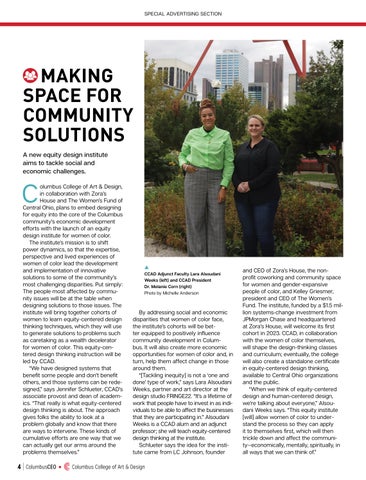
A new equity design institute aims to tackle social and economic challenges.
Columbus College of Art & Design, in collaboration with Zoraâs House and The Womenâs Fund of Central Ohio, plans to embed designing for equity into the core of the Columbus communityâs economic development efforts with the launch of an equity design institute for women of color.
The instituteâs mission is to shift power dynamics, so that the expertise, perspective and lived experiences of women of color lead the development and implementation of innovative solutions to some of the communityâs most challenging disparities. Put simply: The people most affected by community issues will be at the table when designing solutions to those issues. The institute will bring together cohorts of women to learn equity-centered design thinking techniques, which they will use to generate solutions to problems such as caretaking as a wealth decelerator for women of color. This equity-centered design thinking instruction will be led by CCAD.
âWe have designed systems that benefit some people and donât benefit others, and those systems can be redesigned,â says Jennifer Schlueter, CCADâs associate provost and dean of academics. âThat really is what equity-centered design thinking is about. The approach gives folks the ability to look at a problem globally and know that there are ways to intervene. These kinds of cumulative efforts are one way that we can actually get our arms around the problems themselves.â
By addressing social and economic disparities that women of color face, the instituteâs cohorts will be better equipped to positively influence community development in Columbus. It will also create more economic opportunities for women of color and, in turn, help them affect change in those around them.
â[Tackling inequity] is not a âone and doneâ type of work,â says Lara Alsoudani Weeks, partner and art director at the design studio FRINGE22. âItâs a lifetime of work that people have to invest in as individuals to be able to affect the businesses that they are participating in.â Alsoudani Weeks is a CCAD alum and an adjunct professor; she will teach equity-centered design thinking at the institute.
Schlueter says the idea for the institute came from LC Johnson, founder
and CEO of Zoraâs House, the nonprofit coworking and community space for women and gender-expansive people of color, and Kelley Griesmer, president and CEO of The Womenâs Fund. The institute, funded by a $1.5 million systems-change investment from JPMorgan Chase and headquartered at Zoraâs House, will welcome its first cohort in 2023. CCAD, in collaboration with the women of color themselves, will shape the design-thinking classes and curriculum; eventually, the college will also create a standalone certificate in equity-centered design thinking, available to Central Ohio organizations and the public.
âWhen we think of equity-centered design and human-centered design, weâre talking about everyone,â Alsoudani Weeks says. âThis equity institute [will] allow women of color to understand the process so they can apply it to themselves first, which will then trickle down and affect the communityâeconomically, mentally, spiritually, in all ways that we can think of.â
Since 2019, students at Columbus College of Art & Design have contributed 81,000 hours of creative work to the Central Ohio economy through collaborations with more than 80 companies, including Cardinal Health, Huntington Bank, Nationwide Childrenâs Hospital and SocialVentures.
Nicole Monahan is the director of corporate and community partnerships at CCAD. She says these collaborations are beneficial to the students as well as the companies.
âOur partners are really excited by how unfettered the students are. They havenât been steeped in the industry for years, so they can solve problems from new perspectives,â Monahan says. âWhen company representatives come into the classroom, they learn alongside the students about different methods, like design thinking or co-creation, which they may not have had previous exposure to. Many find the experience invigorating for their teams.â
CCAD students collaborate with local and national companies, as well as nonprofits, and the impact of their projects has influenced both culture and commerce in Central Ohio. In recent years, students partnered with the Center of Science and Industry (COSI) to design new staff uniforms; worked with 99P
Labs, backed by Honda and The Ohio State University, to prototype an autonomous shared mobility vehicle; created holiday window displays for Easton Town Center; and designed Pelotonia merchandise.
Most recently, 18 students from CCADâs Illustration, Animation, Game Art & Design, and Comics & Narrative Practice programs collaborated with the Mid-Atlantic Interstate Forest Fire Protection Compact (MAIFFPC) and USDA Forest Service to conceptualize, design and launch Smokeyâs Scouts, a mobile game designed to increase fire safety awareness and wildfire prevention.
âWe need to bring new energy and creativity to wildfire prevention, and the students at CCAD really delivered through Smokeyâs Scouts,â says Aaron Kloss, Volunteer Fire Assistance Grant Program Coordinator for the Ohio Department of Natural Resources Division of Forestry and MAIFFPC Ohio representative.
âWithin these projects, creative collaboration is about helping students understand how cross-functional teams work, how to draw out the capabilities of each team member, and how creativity doesnât come with a title,â Monahan adds. âFor CCAD, creative collaboration is a hallmark of
â˛
how we work together not only within the college, but with corporate and community partners.â
Creative collaboration is paramount to CCADâs core values. Symbiotic partnerships with outside organizations allow students to experience collaboration both in and out of the classroom and add real-world experience to their resumes; in turn, they infuse the Columbus community with their creative talent, and partner organizations reap the benefit of CCADâs expertise.
These partnerships have also fostered a healthy talent stream in Central Ohio. âIt really does create these hiring pathways for creatives and helps companies cultivate pipelines for a diverse and talented workforce,â Monahan says.
Companies and organizations that are interested in becoming a CCAD learning partner should visit ccad.edu/ partnerships for more information or to submit a project request.
CCAD students provide creative solutions to health care challenges.
In 2018, Joel Colyer put in a call to Columbus College of Art & Design. In his role as the global portfolio director at Cardinal Health, Colyer oversees the purchasing of surgical gowns, drapes and fluid management products. Colyer says he reached out to CCAD because although surgical gowns are medical devices, theyâre also pieces of apparel, and he wanted a designerâs viewpoint on garment improvements.
âCCAD has a great reputation for apparel design, among other things,â he explains, âso I thought itâd be interesting to see if we could get an external viewpoint ⌠to try to then make [surgical gowns] more comfortable, more flexibleâthings that people would be more willing to wear.â
Nine CCAD students participated in the project, which ran throughout the fall 2018 semester. Colyer says, typically, as gowns become more protective, they also become less comfortable. Students studied the design, cut and fabric of surgical gowns and found ways to incorporate new materials that would provide better ventilation. At the end of the class, they presented their designs to the surgical gowns marketing team at Cardinal Health.
Colyer says the goal of the collaboration isnât for him to lead students to solve a problem with one solution, but rather for them to utilize their creativity and experience to craft ideas that can improve a productâs performance.
âThe value that I [got] out of the engagement the most [was] their external perspective, both as design students but then also as nonmedi -
â˛
Top, Joel Colyer from Cardinal Health shares his insights with surgical first assist Kathy Volpe and CCAD students Jessie Andrade and Autumn Dang (both Master Of Design in Innovative Design Strategies, 2020) during a design thinking workshop to reimagine interpersonal communication in the surgical operating room.
by Stephanie Wott
Bottom, a young recipient tests a 3D-printed prosthetic prototype designed by a team of students from CCAD and other area schools during the Form5 Prosthetics 2020 CO-FAB workshop.
Photo by John Youger
cal people,â he says. âA big one to me is diversity of thought, so thatâs one reason I [wanted] to leverage themâto see how they look at our problems and what kind of solutions they [could come] in with,â he says.
This project is just one example of CCAD students using their design skills to shape the health care industry;
other collaborations can focus more on individual solutions.
Several CCAD students participate annually in CO-FAB, a multiweek workshop hosted by the nonprofit Form5 Prosthetics. Teams are made up of students from different schools and disciplinesâincluding industrial design, biomedical and mechanical engineering, athletic training, and physical and occupational therapyâalong with industry professionals. Each team is paired with an individual with a limb difference or differences; after discussing the individualâs mobility issue, they work together to build a prosthetic or a device to assist the individual.
âFor the students, itâs all about interacting with this person, hearing their story, gaining an understanding of whatâs going on, building empathy and looking thoughtfully for solutions to support the individual,â says John Youger, assistant professor of industrial design at CCAD. âAs designers, we strive to improve peopleâs lives, and when itâs so personal, itâs hard not to feel that.â
As health care continues to evolve, CCAD students are uniquely qualified to not only excel in the industry, but to help it evolve. âIf youâre in health care and youâre wondering, âWhy look to CCAD?â when it comes to solving challenges,â says Youger, âthe answer is, âBecause youâre looking for somebody who looks at your problems in a different way.ââ
As the service economy demands a more skilled workforce, employers are searching for individuals who understand human interaction and can push problem-solving past the user interfaceâhow a user interacts with a product, typically through an app or websiteâto improve the overall user experience (UX) and create design solutions that extend beyond digital platforms. Columbus College of Art & Design is answering that call by expanding its curriculum to train students to use the powers of creativity, human understanding and visual design to engineer new or improved services.
Before coming to CCAD, alum Bona Park didnât know a lot about UX design. But after taking the course âUX Strategy Interactionâ with adjunct professor Tim Frank, the advertising and graphic design major was hooked. The classâs first project was redesigning the mobile app for Bird, the electric scooter and bike company.
âWhen I first started that project, it was really fascinating, because the [design process] itself was very data-driven. Graphic design is more about the outcome and how it looks for the viewer.
But UX design requires a lot of testing, like usability testing, and a lot of ideating and problem-solving,â says Park. âAnd thatâs where I was very interested. It was fun to solve problems for the user and then incorporate that into my design.â
Jordan Bell, assistant director of career services at CCAD, says the college is seeing an increased number of requests from companies seeking UX design talentâand Parkâs experience is common among students. Because UX design isnât taught at the high school level, itâs not a subject most students are familiar with before enrolling. âI like when students do an internship in UX design,â he says. âThey come back to campus, present their experience to their peers, and I see all the light bulbs going off among other students like, âWow, this is really cool, and I now want to explore UX.ââ
Bell says user interface design has always been part of the CCAD curriculum, but the college is now expanding that curriculum to include humancentered UX design as the demand for talent increases across industries. Itâs part of the reason Tamara Peyton was brought on as an associate professor in August. Peyton worked in UX design for
â˛
11 yearsââbefore we even called it that,â she saysâand is now developing a new Master of Professional Studies program in user experience design.
âOur curriculum will be co-created by leading industry experts and offer realworld experiences, network connections and mentorship. Weâre teaching in-demand skills that you can apply and use in a business setting,â Peyton says. âWhat employers are looking for is people who are better at working in collaborative teams and who understand that creativity isnât just about art; itâs also about problem-solving.â
The Master of Professional Studies program in user experience design will begin accepting students in fall 2023.
âExpanding CCADâs presence in this spaceâworking with people from Columbus and Ohio in general, to ensure that our curriculum meets the need for UX talentâcreates new areas for CCAD graduates to really make a difference,â Peyton says.
Throughout Central Ohio, Columbus College of Art & Design alumni are making the world a more interesting place to live, work and play. Below are just a few examples of CCAD graduates who are shaping Columbus in surprising ways.
âAt CCAD, I learned time management skills, and that there is more than one way of doing everythingâso be open! CCAD grads are everywhere, and we are applying creative problem-solving to your daily life.â
Jen Burton, owner/partner, Seventh Son Brewing Co. (Fine Arts, 2000)
âCreative problem-solving has been the most beneficial skill I learned at CCAD. The feedback provided by my instructors and peers helped me view my work more objectively. It taught me the value of learning through the act of creating, and the importance of evolving my ideas along the way. Through that process, the end result was so much greater than my preconceived idea. Now, I view dialogue and feedback as essential to project management, whether youâre making business decisions or creating a piece of art.â
Lauren Conrath, director of operations, 400 Square (Fine Arts, 2004)
âWhile drawing was my major area of study, my main takeaway from my time at CCAD was just learning to be critical with my mind. CCAD pushed me to think about what makes something work (or not) and why. Those of us who are motivated by our strong sensitivity to our senses can learn to shape someone elseâs experience through aesthetic properties. Understanding what influence color, light, pattern and textiles have in a space is just as important as the spaceâs functionality or flow. Employers should know that creativity could mean everything for their business. One CCAD graduate could change the way we see the city by creating long-lasting, strong brands.â
Bobby Silver, co-owner, Yellow Brick Pizza (Fine Arts, 1999)
âI was drawn to CCAD because I loved the idea of being a creative in a thriving city like Columbus. CCAD attracts passionate creatives and prepares them to tackle creative challenges without getting discouraged. I wouldnât be where I am today if it wasnât for time spent with caring and dedicated professors there. My time at CCAD prepared me to be ready to think on my feet and think creatively about problems and solutions, which has been an invaluable skill while running a business.â
Emily Kellett, co-owner, STUMP (Industrial Design, 2016)
âCCAD prepared me to put in the extra thought, time and effort toward all projectsânot just the ones that I knew how to do well or felt comfortable with the medium. In co-founding STUMP with Emily, we had a very limited understanding of what we were getting ourselves into. Business is difficult; growing and maintaining a team is very difficult. Being able to confront learning new skills as a positive and exciting challenge is similar to what I learned to do at CCAD.â
Brian Kellett, co-owner, STUMP (Media Studies StillBased, 2007)
âDuring my time at CCAD, I learned the importance of self-responsibility and having a strong work ethic. CCADâs critique process really set me up well to take constructive criticism, which is important for continual improvement in any career. I also learned the value of creative problemsolving, and how it needs to be applied in all areas of business. Someone with a BFA doesnât need to find an art-focused career. Those skills go way beyond art and design.â
Joel Limes, co-founder and chief brand officer, COhatch (Industrial Design, 1994)