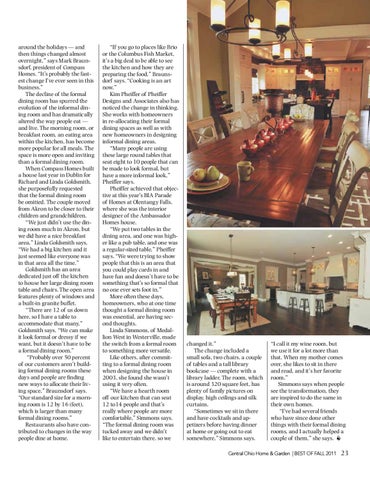
around the holidays — and then things changed almost overnight,” says Mark Braunsdorf, president of Compass Homes. “It’s probably the fastest change I’ve ever seen in this business.” The decline of the formal dining room has spurred the evolution of the informal dining room and has dramatically altered the way people eat — and live. The morning room, or breakfast room, an eating area within the kitchen, has become more popular for all meals. The space is more open and inviting than a formal dining room. When Compass Homes built a house last year in Dublin for Richard and Linda Goldsmith, she purposefully requested that the formal dining room be omitted. The couple moved from Akron to be closer to their children and grandchildren. “We just didn’t use the dining room much in Akron, but we did have a nice breakfast area,” Linda Goldsmith says. “We had a big kitchen and it just seemed like everyone was in that area all the time.” Goldsmith has an area dedicated just off the kitchen to house her large dining room table and chairs. The open area features plenty of windows and a built-in granite buffet. “There are 12 of us down here, so I have a table to accommodate that many,” Goldsmith says. “We can make it look formal or dressy if we want, but it doesn’t have to be a formal dining room.” “Probably over 50 percent of our customers aren’t building formal dining rooms these days and people are finding new ways to allocate their living space,” Braunsdorf says. “Our standard size for a morning room is 12 by 16 (feet), which is larger than many formal dining rooms.” Restaurants also have contributed to changes in the way people dine at home.
“If you go to places like Brio or the Columbus Fish Market, it’s a big deal to be able to see the kitchen and how they are preparing the food,” Braunsdorf says. “Cooking is an art now.” Kim Pheiffer of Pheiffer Designs and Associates also has noticed the change in thinking. She works with homeowners in re-allocating their formal dining spaces as well as with new homeowners in designing informal dining areas. “Many people are using these large round tables that seat eight to 10 people that can be made to look formal, but have a more informal look,” Pheiffer says. Pheiffer achieved that objective at this year’s BIA Parade of Homes at Olentangy Falls, where she was the interior designer of the Ambassador Homes house. “We put two tables in the dining area, and one was higher like a pub table, and one was a regular-sized table,” Pheiffer says. “We were trying to show people that this is an area that you could play cards in and have fun and doesn’t have to be something that’s so formal that no one ever sets foot in.” More often these days, homeowners, who at one time thought a formal dining room was essential, are having second thoughts. Linda Simmons, of Medallion West in Westerville, made the switch from a formal room to something more versatile. Like others, after committing to a formal dining room when designing the house in 2003, she found she wasn’t using it very often. “We have a hearth room off our kitchen that can seat 12 to14 people and that’s really where people are more comfortable,” Simmons says. “The formal dining room was tucked away and we didn’t like to entertain there, so we
changed it.” The change included a small sofa, two chairs, a couple of tables and a tall library bookcase — complete with a library ladder. The room, which is around 320 square feet, has plenty of family pictures on display, high ceilings and silk curtains. “Sometimes we sit in there and have cocktails and appetizers before having dinner at home or going out to eat somewhere,” Simmons says.
“I call it my wine room, but we use it for a lot more than that. When my mother comes over, she likes to sit in there and read, and it’s her favorite room.” Simmons says when people see the transformation, they are inspired to do the same in their own homes. “I’ve had several friends who have since done other things with their formal dining rooms, and I actually helped a couple of them,” she says. •
Central Ohio Home & Garden BEST OF FALL 2011
23