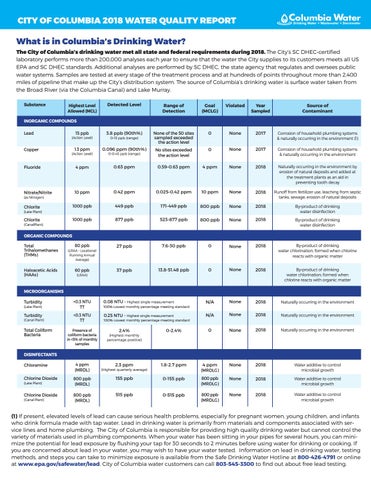
CITY OF COLUMBIA 2018 WATER QUALITY REPORT What is in Columbia’s Drinking Water? The City of Columbia’s drinking water met all state and federal requirements during 2018. The City’s SC DHEC-certified laboratory performs more than 200,000 analyses each year to ensure that the water the City supplies to its customers meets all US EPA and SC DHEC standards. Additional analyses are performed by SC DHEC, the state agency that regulates and oversees public water systems. Samples are tested at every stage of the treatment process and at hundreds of points throughout more than 2,400 miles of pipeline that make up the City’s distribution system. The source of Columbia’s drinking water is surface water taken from the Broad River (via the Columbia Canal) and Lake Murray. Substance
Highest Level Allowed (MCL)
Detected Level
Range of Detection
Goal (MCLG)
Violated
Year Sampled
Source of Contaminant
3.8 ppb (90th%)
None of the 50 sites sampled exceeded the action level
0
None
2017
Corrosion of household plumbing systems & naturally occurring in the environment (1)
INORGANIC COMPOUNDS Lead
15 ppb (Action Level)
0-13 ppb (range)
1.3 ppm
0.096 ppm (90th%)
0
2017
0-0.45 ppb (range)
No sites exceeded the action level
None
(Action Level)
Corrosion of household plumbing systems & naturally occurring in the environment
Fluoride
4 ppm
0.63 ppm
0.59-0.63 ppm
4 ppm
None
2018
Naturally occurring in the environment by erosion of natural deposits and added at the treatment plants as an aid in preventing tooth decay
Nitrate/Nitrite
10 ppm
0.42 ppm
0.025-0.42 ppm
10 ppm
None
2018
Runoff from fertilizer use, leaching from septic tanks, sewage, erosion of natural deposits
1000 ppb
449 ppb
171-449 ppb
800 ppb
None
2018
By-product of drinking water disinfection
1000 ppb
877 ppb
523-877 ppb
800 ppb
None
2018
By-product of drinking water disinfection
80 ppb
27 ppb
7.6-30 ppb
0
None
2018
By-product of drinking water chlorination; formed when chlorine reacts with organic matter
37 ppb
13.8-51.48 ppb
0
None
2018
By-product of drinking water chlorination; formed when chlorine reacts with organic matter
Copper
(as Nitrogen)
Chlorite (Lake Plant)
Chlorite (CanalPlant)
ORGANIC COMPOUNDS Total Trihalomethanes (THMs) Haloacetic Acids (HAAs)
(LRAA - Locational Running Annual Average)
60 ppb (LRAA)
MICROORGANISMS Turbidity (Lake Plant)
Turbidity (Canal Plant)
Total Coliform Bacteria
<0.3 NTU TT
0.08 NTU - Highest single measurement 100%-Lowest monthly percentage meeting standard
N/A
None
2018
Naturally occurring in the environment
<0.3 NTU TT
0.25 NTU - Highest single measurement 100%-Lowest monthly percentage meeting standard
N/A
None
2018
Naturally occurring in the environment
0-2.4%
0
None
2018
Naturally occurring in the environment
1.8-2.7 ppm
4 ppm (MRDLG)
None
2018
Water additive to control microbial growth
Presence of coliform bacteria in <5% of monthly samples
2.4% (Highest monthly percentage positive)
DISINFECTANTS Chloramine Chlorine Dioxide (Lake Plant)
Chlorine Dioxide (Canal Plant)
4 ppm (MRDL)
2.3 ppm (Highest quarterly average)
800 ppb (MRDL)
155 ppb
0-155 ppb
800 ppb (MRDLG)
None
2018
Water additive to control microbial growth
800 ppb (MRDL)
515 ppb
0-515 ppb
800 ppb (MRDLG)
None
2018
Water additive to control microbial growth
(1) If present, elevated levels of lead can cause serious health problems, especially for pregnant women, young children, and infants who drink formula made with tap water. Lead in drinking water is primarily from materials and components associated with service lines and home plumbing. The City of Columbia is responsible for providing high quality drinking water but cannot control the variety of materials used in plumbing components. When your water has been sitting in your pipes for several hours, you can minimize the potential for lead exposure by flushing your tap for 30 seconds to 2 minutes before using water for drinking or cooking. If you are concerned about lead in your water, you may wish to have your water tested. Information on lead in drinking water, testing methods, and steps you can take to minimize exposure is available from the Safe Drinking Water Hotline at 800-426-4791 or online at www.epa.gov/safewater/lead. City of Columbia water customers can call 803-545-3300 to find out about free lead testing.