dying patient, and to communicate with and comfort her patient’s sister. “By watching physicians over and over, I have learned when to speak, when to listen, and what to say,” she said. “I have learned how to have difficult talks, stay focused, be supportive, and provide evidence to support my recommendations for patients and families on tough issues such as the end of life.” A Paradigm Shift Throughout the program, students learn to regard palliative care as a partnership between a patient, a patient’s family, and a team of caregivers, including nurses, social workers, physicians, spiritual care providers, and child life specialists. Ideally, this partnership begins at diagnosis and continues along the disease trajectory, Buschman says. And ideally, it engages everyone involved in ongoing discussions about a patient’s illness, as well as the risks, benefits, and implications of treatment. This approach to patient care represents a long-overdue shift away from the traditional methods that medicine has used in its attempt to treat incurable illnesses, especially in today’s era of advanced technology and life-sustaining treatments, Buschman says. “Along with these developments, there didn’t seem to be a pause to ask, ‘Is this in the best interest of the patient and the family?’ We needed to stop and think: Just because we can do something, should we?” Of course, medicine is not all that has changed. “Nursing isn’t what it was a hundred years ago,” Buschman continued. Because nursing has a much stronger scientific base today than it did a decade or two ago, an education in palliative care is more necessary than ever, she stresses. “Without it, we risk losing the piece that connects us to our patients.” To this end, Columbia Nursing presents palliative care not as the end of the road but rather as an opportunity for patients to consider the next steps in their care. It prepares emerging NPs to enhance patients’ and families’ quality of life by helping them understand diagnoses, encouraging them to share their hopes and fears, and inviting them
to shape their own treatment plans. Said Jones, “We tell patients and families what we expect. Then we ask them about the goals of their care and help them come up with a plan of action to realize those goals. It’s not always an easy conversation but it’s a necessary one.”
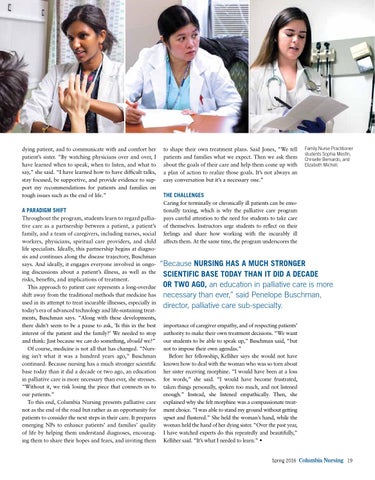
Family Nurse Practitioner students Sophia Mesfin, Chriselle Bernardo, and Elizabeth Michell.
The Challenges Caring for terminally or chronically ill patients can be emotionally taxing, which is why the palliative care program pays careful attention to the need for students to take care of themselves. Instructors urge students to reflect on their feelings and share how working with the incurably ill affects them. At the same time, the program underscores the
“ Because nursing has a much stronger scientific base today than it did a decade or two ago, an education in palliative care is more necessary than ever,” said Penelope Buschman, director, palliative care sub-specialty. importance of caregiver empathy, and of respecting patients’ authority to make their own treatment decisions. “We want our students to be able to speak up,” Buschman said, “but not to impose their own agendas.” Before her fellowship, Kelliher says she would not have known how to deal with the woman who was so torn about her sister receiving morphine. “I would have been at a loss for words,” she said. “I would have become frustrated, taken things personally, spoken too much, and not listened enough.” Instead, she listened empathically. Then, she explained why she felt morphine was a compassionate treatment choice. “I was able to stand my ground without getting upset and flustered.” She held the woman’s hand, while the woman held the hand of her dying sister. “Over the past year, I have watched experts do this repeatedly and beautifully,” Kelliher said. “It’s what I needed to learn.”
Spring 2016
Columbia Nursing 19