SEEDWAY_Crookham_Onion World_Oct2021_Layout 1 10/28/2021 1:28 PM Page 1
®
PARTNERS IN PRODUCTIVITY
CALIBER
CALDWELL
for more information contact our friendly and knowledgeable sales representatives KENNY NAKAMURA
Product Development/Sales (208) 550-7733 knakamura@seedway.com
DONAVIN BUCK
Washington (509) 820-9887 dbuck@seedway.com
WWW.seedway.com 2
Onion World • December 2021
BEJO LONG DAY STORAGE ONIONS Exploring nature never stops RED WING
HAMILTON
RED BULL
LEGEND
Our best long day red storage onion. High quality, large, dark red, 2.75-3.75” bulbs. Thick skin, good scale retention, very hard. Internal color continues to develop during storage
Hamilton is a classy, exceptionally hard, full season blocky globe, with deep copper skins. It performs nicely on gravity, drip and overhead irrigation systems. This onion’s extremely long term storage ability positions it as a leader to satisfy late market needs.
Long day red onion. Late season maturity with good long term storage ability. Large and hard, with excellent dark red color throughout. Vigorous tops and roots.
Long-term storage. Jumbo bulb. Full season yellow with a vigorous root system.
IR: Pt
IR: Pt
IR: Pt
IR: Foc / Pt
bejoseeds.com f Bejo Seeds Inc. (main office) 1972 Silver Spur Pl. Oceano, CA | T: 805- 473-2199 | E: info@bejoseeds.com f OnionWorld.net
3
Table of Contents Magazines For Maximum Yield
ONION WORLD Volume 37, Number 8
December 2021
PO Box 333 Roberts, Idaho 83444 Telephone: (208) 520-6461
www.O n i o n W o r l d .n e t Onion World Contacts
6 When to Water
How Do Irrigation Frequency and Final Irrigation Timing Influence Onion Bacterial Diseases?
10 Quality and Yield: The Golden Combination 12 Long-Day Onion Variety Update Buyers' Guide
Publisher / Advertising Manager Dave Alexander dave@ColumbiaMediaGroup.com Editor Denise Keller editor@ColumbiaMediaGroup.com Director of Operations Brian Feist brian@ColumbiaMediaGroup.com
EDITORIAL INFORMATION Onion World is interested in newsworthy material related to onion production and marketing. Contributions from all segments of the industry are welcome. Submit news releases, new product submissions, stories and photos via email to: editor@ColumbiaMediaGroup.com, or call (509) 697-9436.
ADVERTISING SALES For information on rates, mechanics, deadlines, list rental, direct mail, inserts or other information, call (208) 520-6461 or email: dave@onionworld.net
SUBSCRIPTIONS U.S. $24 per year Canada $40 per year Foreign $80 per year Payments may be made by check, Visa, MasterCard or American Express.
The Carbon Robotics LaserWeeder leverages computer vision and laser technology to deliver chemical-free, no-till weed control for specialty crops. Learn more about this new product on page 9.
On the Cover
Departments
From red to yellow to white,
9 19 20 22 22
New Products In The News Onion Disease Quiz From the NOA Advertiser Index
23
Calendar
seed companies showcase dozens of long-day onion varieties in the buyers’ guide on pages 12-18.
4
Onion World • December 2021
Subscribe online at: www.OnionWorld.net or call (503) 724-3581. Email address changes/corrections to brian@ColumbiaMediaGroup.com or mail to: Onion World PO Box 333 Roberts, ID 83444 Onion World magazine (ISSN 1071-6653), is published eight times a year and mailed under a standard rate mailing permit at Idaho Falls, Idaho and at additional mailing offices. Produced by Columbia Media Group PO Box 333, Roberts, ID, 83444. Copyright 2021. All rights reserved. No part of this publication may be reproduced or transmitted in any form or by any means, electronic or mechanical, for any purpose without the express written permission of Columbia Media Group. For information on reprints call (208) 520-6461.
Growing, learning, advocating
TOGETHER THER
Onion Ambassadors Welcome! Join Today! onions-usa.org/membership
OnionWorld.net
5
Irrigation Management
When to Water How Do Irrigation Frequency and Final Irrigation Timing Influence Onion Bacterial Diseases? By Tessa Belo, Gabriel LaHue, Lindsey du Toit and Tim Waters, Washington State University
O
nion bacterial diseases can pose a significant economic threat to growers, as they can lead to crop losses of more than 50 percent under the worst conditions. Previous research has found that overhead irrigation, especially after bulb initiation, and other sources of moisture in the canopy during field curing are risk factors for onion bacterial diseases. Less is known about managing onion bacterial diseases based on the frequency of irrigation during the growing season or through optimizing the timing of the final irrigation. Given that moisture and splashing water are significant drivers of bacterial diseases, strategic irrigation management is a critical and often overlooked part of managing crop losses caused by pathogenic bacteria while maintaining the desired bulb yields.
2020 Irrigation Trials
Trials evaluating the effects of irrigation frequency and final irrigation timing were conducted under sprinkler irrigation in Pasco, Washington, using the cultivar Calibra. The irrigation frequency trial was designed to test the hypothesis that more frequent irrigation would exacerbate onion bacterial diseases by comparing the effects of irrigating twice as often (2X) but for shorter time periods to longer, less frequent irrigations (control). The control plots were irrigated when 40 percent of the plant available water in the root zone was depleted, while the 2X treatment plots were irrigated at 20 percent depletion, based on a water balance calculated from publicly available weather data. Irrigation frequency treatments began at the third to fourth leaf stage, after which the 2X plots were watered 59 times and the control plots were watered 35 times, but all plots received just over 19 inches of irrigation total. The irrigation cut-off timing trial tested the hypothesis that irrigating later into the growing season would lead to a larger number of bulbs with bacterial rot. This trial compared three irrigation cut-off
6
Onion World • December 2021
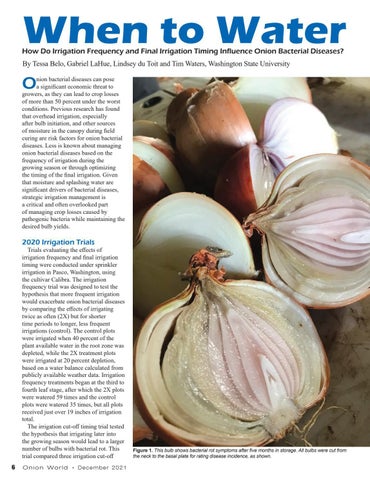
Figure 1. This bulb shows bacterial rot symptoms after five months in storage. All bulbs were cut from the neck to the basal plate for rating disease incidence, as shown.
Figure 2. Total marketable bulb yield for onion plots that received two different irrigation frequency treatments. The control plots were given longer, less frequent irrigations, and the 2X plots were irrigated twice as often but for shorter durations each. The total amount of irrigation was the same for both treatments. Each bar shows the average marketable bulb yield divided into bulb size classes (prepack, medium, jumbo and colossal). The left panel represents plots that were inoculated with pathogenic bacteria (Burkholderia gladioli pv. alliicola and Pantoea agglomerans), and the right panel represents plots that were not inoculated. Each bar represents the mean and standard error. The differences in total marketable yield between the irrigation frequency treatments were not statistically significant (P = 0.102).
time points: the control cut-off timing was at approximately 50 percent tops down, the early timing was one week earlier at 5-10 percent tops down, and the late cut-off was one week after the control treatment (93 percent tops down on average). To ensure that there would be adequate disease pressure, local pathogenic strains of two bacterial pathogens (Burkholderia gladioli pv. allicola and Pantoea agglomerans) were applied to the plots twice at the end of the growing season, at the start of tops falling down and again two weeks later. The bacteria were applied using a CO2-pressurized backpack sprayer to half of each plot so that there were inoculated and non-inoculated sub-plots. Bulbs were undercut at 90 percent tops down and cured in the field for three weeks. At harvest, bulbs were sorted by size, weighed by size category to determine marketable yield, bagged and stored in a commercial onion storage facility. Approximately 50 bulbs from each plot were cut and evaluated for bacterial disease incidence and severity in the fall, shortly after harvest, and again in winter after five months in storage (Fig. 1).
Results, Conclusions
Figure 3. Total marketable onion bulb yield for the irrigation cut-off timing treatments. The early irrigation cut-off was at 5-10 percent tops down, the control cut-off was one week later (approximately 50 percent tops down), and the late cut-off was one additional week later (93 percent tops down). Each bar represents the mean and standard error of total marketable yield and is divided into yield made up by each bulb size class (prepack, medium, jumbo and colossal). The left panel shows bulb yield for plots that were inoculated with pathogenic bacteria (Burkholderia gladioli pv. alliicola and Pantoea agglomerans), and the right panel shows yield of plots that were not inoculated. Differences in total marketable yield among the irrigation cut-off timings were not statistically significant (P = 0.882).
The total marketable yield was not affected by the irrigation frequency treatments (Fig. 2) or the irrigation cut-off treatments (Fig. 3). There was no difference between the two irrigation frequency treatments in bacterial bulb rot incidence at harvest or after five months in storage (Fig. 4). However, the timing of the final irrigation had a significant effect on the number of bulbs with bacterial rot at harvest, with 5 tons/acre of bulbs culled as a result of bacterial rot in inoculated plots in which irrigation was stopped early (5–10 percent tops down) compared to 10 tons/acre of bacterial culls when irrigation was stopped late (93 percent tops down). Bulbs harvested from the early cut-off timing plots also had a lower incidence of bacterial bulb rot after five months of storage compared to bulbs harvested from the control plots and plots that received the late irrigation cut-off timing (28 vs. 44–51 percent; Fig. 5). Based on the results from the first year of this study, ending irrigation after the final leaf emerged and when onion plants OnionWorld.net
7
Irrigation Management had an average of 5–10 percent tops down reduced the incidence of bulbs with bacterial rot at harvest and bacterial rot after five months in storage compared to irrigating the crop for two additional weeks. These findings highlight the importance of careful irrigation management at the end of the season in order to reduce losses to bacterial bulb rots, especially under overhead irrigation. These trials will be repeated in 2021 and 2022, so more data will soon add to our understanding of the role of irrigation management in effectively combating onion bacterial diseases. Authors’ note: We thank Mike Derie, Jennifer Darner, Jeff Lambert, Betsy Schacht, and others in the Washington State University (WSU) Vegetable Seed Pathology program, Soils and Water program and WSU Benton/Franklin Counties Horticulture Extension Program for their technical assistance with these trials. This work is supported by the Specialty Crops Research Initiative Award 201951181-30013 from the USDA National Institute of Food and Agriculture. Any opinions, findings, conclusions or recommendations expressed in this publication are those of the authors and do not necessarily reflect the view of the U.S. Department of Agriculture.
ONION
WORLD E-News
Industry news to your inbox: onionworld.net/e-news-sign-up
8
Onion World • December 2021
Figure 4. The incidence (%) of onion bulbs with bacterial rot harvested from plots that received one of two irrigation frequency treatments. Bulbs were cut and rated in the fall (before storage) and in the winter (after five months of storage). The control irrigation frequency plots were given longer, less frequent irrigations, and the 2X plots were watered twice as often but for shorter durations each time (the same total amount of irrigation for the two treatments). The left panel shows bulb rot incidence for plots that were inoculated with pathogenic bacteria (Burkholderia gladioli pv. alliicola and Pantoea agglomerans), and the right panel shows bulb rot incidence for plots that were not inoculated. Differences in bulb rot incidence between the irrigation frequency treatments were not statistically significant either before (P = 0.222) or after storage (P = 0.333).
Figure 5. The incidence (%) of bulbs with bacterial rot harvested from plots that received one of three irrigation cut-off timing treatments. Bulbs were cut and rated for bacterial rot in the fall (before storage) and in the winter (after five months of storage). The early irrigation cut-off was at 5-10 percent tops down, the control cut-off was one week later (approximately 50 percent tops down), and the late cut-off was one week after the control treatment (93 percent tops down). The left panel show the incidence of bulb rot in plots that were inoculated with pathogenic bacteria (Burkholderia gladioli pv. alliicola and Pantoea agglomerans), and the right panel shows bulb rot ratings for plots that were not inoculated. Significant differences were observed among irrigation cut-off treatments after storage of bulbs harvested from inoculated plots (P = 0.003). Within each trial, treatment means with the same letters are not significantly different based on post-hoc pairwise comparisons using the Tukey procedure (P ≤ 0.05). Means without a letter indicate no significant differences among the treatments.
New Products
T-L Irrigation Rolls Out Pro Pivot Controller
T-L Irrigation Co. has introduced a pro version of its Precision Point Touch pivot controller. The add-on board combined with a firmware upgrade replaces multiple external systems for simplified and functional pivot operation, according to the company. The Precision Point Touch Pro features water pump control, water-pressure triggered start, two additional auxiliary equipment controls, water pressure monitoring, detailed safety readouts for easy troubleshooting, USB data logging of multiple system parameters, load control and telemetry connect-ability. The controller can be retrofitted to an existing Touch system or added as an option to a new pivot. SEEDWAY_Onion World_Oct2021_Layout 1 10/4/2021 2:52 PM Visit www.tlirr.com.
Company Taking Pre-Orders for 2022 Robotic Weeder
The Carbon Robotics LaserWeeder targets one of farming’s most significant challenges: weeds. By leveraging computer vision and laser technology, Carbon Robotics delivers chemicalfree, no-till weed control for specialty crops. The LaserWeeder utilizes thermal energy from industrial lasers to eradicate weeds at the meristem without harming valuable crops or disturbing soil. Laser weeding is a high-precision solution that improves crop yield, reduces farming costs, and creates sustainable paths for regenerative and organic farming. A single LaserWeeder can weed 15 to 20 acres per day and eliminate up to 100,000 weeds per hour. Carbon Robotics’ 2021 models are sold out, but new models for the 2022 growing season are available for preorder. Visit carbonrobotics.com.
Page 1
Your Acres. Your Livelihood. Our Priority.
UNITED STATES Lancaster & San Joaquin Valley (661) 9785342 Desert Southwest (928) 4467737 Colorado & New Mexico (970) 3969728 Idaho, East Oregon, Utah & Nevada (208) 9411421 Skagit Valley, Washington (360) 9417503 Rio Grande Valley & West Texas (956) 6185574
MEXICO Torreón, Coahuila (461) 1173878 Colima, Col. (461) 1040134 San Luis Potosi (461) 1409452 Chihuahua (461) 1719401 Tamaulipas (461) 1342421 Irapuato, Gto. (461) 5465792
(800) 952-7333 WWW.SEEDWAY.COM Photo courtesy Carbon Robotics
OnionWorld.net
9
Quality and Yield: The Golden Combination By Ben de Nijs, Product Manager, Onions, Hazera
O
nions are a daily ingredient in the kitchen for many people worldwide. And although an onion is not sold at variety level in the supermarket – there, you just buy a yellow, red, white or, in some markets, a pink onion – the variety is important to growers. “They are focusing on disease resistance, skin quality, firmness and yield,” says Pablo Salgado, an onion breeder at Hazera. “Hazera is constantly working on innovations in this area in order to achieve the best onion with the highest yield for growers, processors and buyers. An example is the development of varieties that are suitable for multiple processing options, so that the grower has more possibilities in terms of sales opportunities.”
More Sales Opportunities
Hazera, part of Limagrain Group, specializes in the development, production and marketing of onion seed. Hazera onion breeders have been working on strong varieties since the 1950s. The distribution of new, improved onion varieties is a slow process that can sometimes take more than 25 years. It is, therefore, important to have a good vision of the market needs and trends. “For years, the focus within the company has been on breeding and cultivation in the local markets. But since 2008, when Hazera was formed in its current form, there has been a complete global focus,” says Reinout de Heer, global product manager of Allium.
“Onions are sensitive to day length. The length of the day determines the moment of bulb formation of the onion. Different varieties are, therefore, more or less suitable for cultivation per day length zone, from short-day onions to extralong-day onions. Due to the global focus, development programs and knowledge can be combined. This has given the worldwide cultivation, production and sale of high quality onion seed a significant boost.”
Partnership in Peru
The Peruvian onion market is one that has grown thanks to the collaboration between Hazera and Semiagro. With over 40,000 acres of planted cultivation area, the onion crop is positioned as the highest producing vegetable in the Peruvian Toro Rosso, Hazera’s latest variety in development, is planted in several strip trials across short-day production areas in the U.S.
Pacific North West
New Mexico
Brian Haddon, Area Manager (971) 282-2884
Greg Patti, Sales Rep. (575) 202-2250
San Joaquin Valley
Texas
Russ Brown, Area Manager (559) 799-0799
Clegg Smith, Area Manager (956) 340-0022
Imperial Valley & Yuma AZ
Florida, Georgia & the Carolinas
Scott Richards, Area Manager (928) 580-2484
Derek Levy, Sales Rep (912) 433-4752
831-679-1900
www.gowanseed.com P.O. Box 190 • Chualar, CA 93925 25445 Chualar River Road • Chualar, CA 93925 10
Onion World • December 2021
market. The national consumption of pink onions represents 83 percent and 17 percent for the export market (mainly sweet onions for the U.S.). In addition, the conditions for onion growers have improved, the possibilities for the national and export potential market for wholesalers have increased, and consumers have access to better quality onions, according to Salgado. Semiagro and Hazera have been working together for more than two decades on the development of hybrid onion varieties in Peru. Today, the pink Sivan F1 is the leading variety on the market and is recognized throughout the chain for its characteristics: excellent post-harvest qualities, good skin retention, beautiful color and thin necks. There are already promising trials for early onions. Year after year, Hazera is experiencing excellent results from three new varieties (10414, 10416 and 10417), the result of 19 years of trials.
Mechanical Harvest
Within the yellow short-day onion segment, the trend is to produce more firm and more uniform round onions, a change that is necessary because manual harvesting and processing is becoming
too expensive. “By making sure the onions are firm and round, they can be harvested and sorted more easily by the grading machine,” Salgado says. “Maintaining and improving qualities such as firmness, skin retention and disease resistance is very important.”
Golden Combination
In countries such as New Zealand and the Netherlands, many onions are destined for export. In the U.S., onions are shipped all over the country. “The onions must also remain of high quality during and after transport. Skin retention and firmness are important elements for good quality onions,” de Heer says. “In addition, the net yield must be good. As a grower, you can get a high yield from the field, but in the end, you get paid for the yield upon delivery. Excellent quality and high net yield is the golden combination.”
Climate, Red Onions
Other developments that Hazera is paying attention to are irrigation solutions and red onions. “The climate is changing. We are conducting tests so that we can respond
The pink Sivan F1 is Hazera’s leading variety in Peru and is recognized for its excellent postharvest qualities, good skin retention, beautiful color and thin necks.
effectively to longer periods of drought or more precipitation,” Salgado says. “And the market for red onions is growing,” de Heer adds. “We are expanding our portfolio in all segments – both in the short-day and in the extralong-day – with our latest variety in development, for example, the Toro Rosso (tested as 10415). This mainseason red short-day onion is planted in several strip trials across short-day production areas in the U.S. in the fall of 2021.”
Crews at Varsity Produce in Brawley, Calif., harvest onions. Hazera breeders make it a point to develop varieties that can handle mechanical harvesting.
Long-Day Varieties Buyers’ Guide 301 Natividad Rd. Salinas, CA 93906 Phone: (831) 443-4901 www.takii.com info@takii.com
Trailblazer (T-808)
This early Northeastern type has early- to midseason maturity, being slightly earlier than Mountaineer. Bulbs are tight and firm with a globe shape and good size with thin necks. Trailblazer has strong resistance to Botrytis, is slow to bolt and is excellent for storage.
Highlander
This Northeastern type has high pack-outs, and its extra-early maturity makes it ideal for many northern long-day areas. The variety is good for transplant as well as direct seeding. Highlander has resistance to Botrytis and downy mildew and is well suited for fresh market and short-term storage. It’s best if grown under irrigation.
Trailblazer (T-808)
Highlander
Trekker
Trekker is an early- to mid-season maturing (95-100 days), storage-type variety. A very uniform variety, its extra-firm bulbs are globe shaped with dark skin with an attractive sheen. Slow to bolt, Trekker will store until May under optimum conditions. It has strong resistance to basal rot and neck rot and is perfect for fresh and storage markets.
Outlander
Extra-early maturing (approximately 85 days), Outlander has excellent uniformity, strong tops and roots with intermediate resistance to Fusarium. Ideal for transplants, it performs best in the northeastern U.S. and southeastern Canada. Outlander is best suited for fresh and short storage markets.
Milestone (T-441)
This hard globe, yellow Spanish-type onion compares to Tamara-type onions with earlier maturity. Bulbs are globe shaped with a high percentage of single centers and have excellent skin quality and retention. Milestone features include earliness, storability and skin color. With thinner necks, this onion cures down quickly compared to other varieties in this class. Milestone is well suited for both domestic and export markets.
Ridgeline
This mid-season onion is a yellow Spanish type with hard bulbs that are slightly elongated globe in shape with excellent skin quality. With medium maturity, Ridgeline has good roots with the potential to produce jumbo-sized bulbs.
Trekker
Milestone (T-441)
Outlander
Ridgeline
Bridewhite
Red Bull Hamilton
Legend Sedona
Cartier
Bridewhite
Bridewhite offers full-season maturity with a very uniform round shape. Bulbs are bright white and suited for long-term storage. This is a productive variety with upright, dark green foliage adapted to overhead sprinklers.
Cartier
Cartier offers early maturity with very long storage for eastern growers. Bulbs are very uniform with fine necks and are very productive. Cartier makes nice medium bulbs for pre-packs. It has low grade-out and high quality.
Red Bull
Red Bull is a long-day red onion with late-season maturity and good long-term storage ability. Bulbs are large and hard with excellent dark red color throughout. The variety has vigorous tops and roots.
Hamilton
Hamilton is a classy, exceptionally hard, full-season blocky globe with deep-copper skins. It performs nicely on gravity, drip and overhead irrigation systems. This onion’s extremely long-term storage ability positions it as a leader to satisfy late-market needs, providing high quality.
Legend
Legend is a full-season yellow onion variety with a vigorous root system. The variety produces jumbo bulbs and is well suited for long-term storage.
Sedona
Sedona is a long-day Spanish globe variety that produces large bulbs with attractive rosybrown skins, high yields and long storage potential. This variety performs well in the Northeast and also has excellent tolerance of hot weather.
1972 Silver Spur Place Oceano, CA 93445 Phone: (805) 473-2199 www.bejoseeds.com info@bejoseeds.com
OnionWorld.net
13
Long-Day Varieties Buyers’ Guide P.O. Box 520 301 Warehouse Caldwell, ID 83606-0520 Phone: (208) 459-7451 www.crookham.com ccoinfo@crookham.com
White Cap
White Cap has the aggressive and sturdy tops that characterize the Celebrate family of onions. It has a clean, bright white color, a uniform globe shape and a very high percentage of single centers. It has high tolerance ratings for pink root and Fusarium and good tolerance to bolting.
Caldwell
Caldwell is a new variety specially bred in Caldwell, Idaho, that has shown wide adaptability. It has performed very well in the western U.S. and other Spanish onion markets. It produces a nice globe onion with a rich bronze scale and demonstrates a high ratio of single centers. The plant has a solid structure with a refined neck, a robust root system and a good disease package. It is highly tolerant to pink root and Fusarium and tolerant to bolting.
White Cap
Caldwell
Caliber
Caliber is a late-season yellow long-day onion for the western United States known for vigor, disease resistance, yield, and storage capabilities. Caliber is a Celebrate hybrid with a healthy plant with solid roots and strong, erect tops that assist in providing thrips tolerance and make applications easier. Caliber has a consistent rich bronze scale in super colossal bulbs with single centers that do very well with mechanical harvest. Caliber has a reputation for storing very well long term. It is highly tolerant to pink root, Fusarium and thrips and tolerant to bolting.
Red Beret
Red Beret is a productive red long-day onion that has rich external and internal color. The deep internal color creates distinct rings. In comparison to other red onions, it produces a nice firm bulb and has excellent storage capabilities. It has a high tolerance to pink root and Fusarium and good tolerance to bolting.
Defender (118-120)
New in 2021, Defender is a long-day yellow and another versatile onion for use in any end market. It is vigorous and very highly single centered. It has a great disease package with high resistance to pink root and Fusarium and tolerance to bolting. Large size jumbo to colossal bulbs have a rich dark color and storage capability of six to eight months.
Trident
Trident is an early main-season yellow longday onion with proven wide adaptability in extensive trials in the Northeast, Midwest and western United States. This high-yielding variety produces consistent deep bronzecolored bulbs, large to jumbo size, with small necks. The outer scale has a nice sheen and is durable, making it a great variety for mechanical harvest. It is highly tolerant to pink root, Fusarium and bolting.
Caliber
Defender (118-120)
Red Beret
Trident
Tannat F1 (E61L.10657)
Barolo F1
Javier Russek, Sr. Product Specialist, Onions Phone: (831) 240-5736 www.enzazaden.us j.russek@enzazaden.com
NEW! Tannat F1 (E61L.10657)
Tannat is a dark red medium- to late-maturing long-day onion with excellent exterior and interior color. Tops are large, giving Tannat the opportunity to make larger red bulbs. Root system is vigorous, showing good tolerances to both pink root and Fusarium. Expected storage is four to eight months.
Barolo F1
Barolo is an early- to mid-season long-day red onion with attractive dark red interior, shiny exterior color and globe shape. Strong against root diseases, and adaptable to overhead, furrow and drip irrigation, Barolo makes a fine choice for the red onion grower’s mid-season crop. Marketing flexibility is increased by Barolo’s three- to four-month storage window.
!
NEW
Edp Electro-bagger model EB 2218 DF
This model now has the ability to do bags as well as cartons with the new touch screen controls. It also comes with pneumatic bag clamps as standard equipment.
For more information visit
chinookequipment.com or call 800-219-2245 or 208-331-1126
OnionWorld.net
15
Long-Day Varieties Buyers’ Guide 3155 SW 10th Street, Suite 6L Deerfield Beach, FL 33442 Phone: (954) 429-9445 www.hazera.us.com info@hazera.us.com
Thunderstone
This early- to main-season long-day hybrid allows growers the flexibility to decide what to do with their crops. This variety matures in 105 to 110 days and has been tested in many areas of the Midwest, Northeast and Pacific Northwest as number 37-120. In these trials, it demonstrated high yield and produced mainly jumbo-sized onions. Traits including dark skins and strong skin retention, along with very firm bulbs mean that Thunderstone can deliver quality pack-outs after a long storage period. This onion has erect, vigorous tops that make it suitable in adverse weather conditions and able to perform under a variety of irrigation methods including overhead and drip.
Redstone
Redstone is an early-maturing (100 days) long-day red variety with excellent storage and shipping quality. It offers upright tops with trim necks to ensure good closure and successful curing. This hardy red variety is very firm and has an excellent dormancy, making it suitable for long storage. Redstone has been tested under many conditions throughout North America and continues to perform well in the early red slot using both transplants and direct sowing methods.
Thunderstone
Redstone
Haeckero
This early- to main-season hard globe variety has a 105-day maturity with a proven record of high quality storability. In addition, this conventionally bred hybrid offers high resistance to downy mildew. Trialing collaborators have been continually impressed with the quality Haeckero offers after long storage.
Haeckero
The NUTRI-CAL Difference Unlocking The Key To Calcium INCREASES OVERALL ONION YIELD
PROVIDES LONGER STORAGE QUALITY • REDUCES INTERNAL DEFECTS AND WEIGHT LOSS
Western States
509-952-7558 Kent Wasden 208-390-7878 Call Walt Grigg at 16
Onion World • December 2021
www.nutri-cal.com
CHEMPORT, INC. 800-247-2480
Tucannon
Vegetables by Bayer – Seminis www.vegetables.bayer.com emily.standley@bayer.com
Crusher
Crusher
Crusher (SVNW1032) is a long-day variety providing growers in the Treasure Valley and Columbia Basin a 116- to 118-day maturity Spanish onion. With a high percentage of single centers, deep globe shape and attractive bronze color, Crusher offers high yield potential and good processing recovery. Crusher is well suited for processing or retail markets and demonstrates good scale quality that retains well while not being too excessive for processing.
Tucannon is perfect for growers looking for flexibility. Tucannon is a darkskinned onion that performs well in long storage and in hot seasons and is adaptable to either furrow or overhead irrigation methods. The variety offers good storability, skin quality and regional adaptability in areas including the Columbia Basin and Treasure Valley in the Pacific Northwest as well as the coastal valleys of California.
XP 07716000
XP 07716000 is a high-yielding variety perfect for processors thanks to its high percentage of single-center bulbs and low pungency. With a white flesh interior and attractive, light brown scale, this Spanish long-day yellow onion hybrid has a great, mild flavor well-suited for cooking in fresh-cut applications.
Tucannon
XP 07716000
OnionWorld.net
17
Long-Day Varieties Buyers’ Guide Holland, MI 49424 Phone: (800) 962-4999 www.stokeseeds.com customerservice.us@ stokeseeds.com
Catskill
Mature at 105 days, this variety produces large, thick-skinned, golden-colored longstorage onions with good skin retention and neck size. High yield and adaptability provides flexibility to plant on all soil types.
Catskill
18
Overlook
With a maturity of 105 days, Overlook produces medium-large, thick-skinned, golden-colored onions with long storage ability for the Northeast, high yield potential and an excellent resistance package.
Overlook
Onion World • December 2021
Brandt
Brandt is a Stokes exclusive with a maturity of 90 to 95 days. This large, light-mediumskinned, golden brown onion with mediumto-long storage capabilities has surprising size and storability for an early onion. The variety has been a superstar in trials several years running.
Brandt
In the News
TURNING RAW IDEAS INTO STAINLESS STEEL SOLUTIONS
Lender Predicts Slightly Profitable Returns
CMI is an expert at taking a vision - and engineering it to work at production speed.
Northwest Farm Credit Services’ 12-month profitability outlook calls for “slightly profitable onion returns.” Producers with high quality, large onions will have favorable returns, while producers with smaller onions will face headwinds, according to the quarterly Market Snapshot report released in October. The drivers behind this prediction include increased production costs due to rising input prices, as well as reduced onion yield and size profile due to extreme heat, especially in the Northwest. Onion shipments from Idaho and Oregon are down 37 percent, and shipments from the Columbia Basin are down 7 percent. Similarly, shipments from the San Joaquin Valley are down 12 percent. Georgia and New Mexico are the only two production regions with increased shipments to date, up 41 percent and 5 percent, respectively. However, prices suggest the shortages in the Northwest outweigh both increasing shipments from Georgia and New Mexico and imports from Mexico, Peru and Canada.
Whether onions need to be peeled, or a complete processing line developed, CMI delivers its magic in stainless steel.
www.cmiequip-eng.com
320-864-5894
GROWING
BETTER
PARTNERSHIPS
New Salmonella Outbreak Linked to Mexican Onions
The CDC and FDA have linked an outbreak of Salmonella Oranienburg infections in 37 states to onions. Epidemiologic and trace-back data show that illnesses in the outbreak are linked to whole red, white and yellow onions distributed by ProSource Produce LLC of Hailey, Idaho, and Keeler Family Farms of Deming, New Mexico, that were imported from Chihuahua, Mexico. Investigators are working to determine if additional onions or suppliers are linked to this outbreak. The CDC first identified the outbreak on Sept. 2, but had not yet determined a cause. Investigators linked the illnesses to onions on Oct. 20. As of late October, the outbreak had sickened 808 people and hospitalized 157.
Todd Rehrman Area Sales Manager West Coast 209-226-5725 t.rehrman@enzazaden.com
René Emch Senior Product Specialist Pacific NorthWest 657-276-1021 r.emch@enzazaden.com
Javier Russek Senior Product Specialist Dealer Sales West 831-240-5736 j.russek@enzazaden.com
OnionWorld.net
19
Onion Disease Quiz
This material is provided courtesy of Claudia Nischwitz, Associate Professor and Plant Pathology Specialist, Utah State University
Infections of onion bulbs can occur in the field without any symptom development prior to storage. Awareness of onion bulb rot diseases in storage and available management options can help minimize storage losses. Question: What is wrong with the stored bulbs in these photos? Answers Page 21
20
1
2
3
4
Onion World • December 2021
Under the Nunhems Brand, BASF offers more than vegetable seeds. We offer partnerships and customer-oriented solutions for the entire vegetable value chain.
Onion Quiz Answers From page 20
The bulbs pictured show symptoms of Fusarium bulb rot caused by Fusarium proliferatum. Typically, the exterior of infected bulbs appears healthy. Occasionally, the area around the neck is slightly soft. When the bulbs are cut, necrotic, graybrown tissue is visible (photos 1 and 2). The disease starts in the neck area and moves down into the fleshy scales. The symptoms occur in storage and look very similar to symptoms of Botrytis neck rot. With Fusarium bulb rot, you can frequently see white mycelium growing between the scales (photo 3) but no gray mold or sclerotia that you would see with Botrytis neck rot.
BASF Vegetable Seeds 1200 Anderson Corner Rd Parma, ID 83660 (208) 674-4100 www.nunhemsusa.com
Your product deserves perfection! “Reliable and durable, more than 500,000 pallets stacked at full satisfaction.”
F. proliferatum also causes pink spots on the outer scales of white onions (photo 4). Usually, the symptoms are confined to the outer scales and do not result in a bulb rot.
W. Waterman Waterman Onions
F. proliferatum is a soil-borne pathogen that can survive in crop residue for a long time. Its host range includes corn, wheat, garlic and hemp, frequently used in rotations with onion. Currently, there is little information about the epidemiology, and there are very few management recommendations. When possible, extended rotations to non-host crops should be used to reduce the amount of inoculum in the soil, and fields with a history of F. proliferatum should be avoided.
Never Miss An Issue! OnionWorld.net/subscribe
Exceptional stacking
Reduce Labor and risk
High ROI
Get q u o t e yo u r f r e e and la yo u t !
Verbruggen - North America Office: (509) 531-7350 www.verbruggen-palletizing.com/onions
OnionWorld.net
21
From the NOA
More Outbreaks & the Need for More Involvement in the Solution By René Hardwick, National Onion Association Director of Public and Industry Relations
F
or the second time in almost two years – a first in many people’s lifetimes – onions have been linked to Salmonella. And starting in December, the National Onion Association (NOA) will begin working on best practices as onions become a more frequent topic through the Centers for Disease Control. This time, onions from Chihuahua, Mexico, sickened 808 people in 37 states and Puerto Rico, as of Oct. 29. Last summer, the NOA heard from Dr. Jennifer McIntyre with United Fresh Produce Association, who warned that after the first Salmonella outbreak in June 2020, onions would continue to hold inspectors’ attention. Now that they’re looking a little closer, they’re more likely to find problems, she warned, so the industry may want to be ready, and perhaps a bit more diligent on meeting food safety standards. In 2010, the U.S. onion industry developed voluntary commodity-specific food safety guidelines for the dry bulb National Onion Association (NOA) President Doug Bulgrin speaks with Jennifer McIntyre of the United Fresh Produce Association at the NOA’s summer convention in Nashville, Tenn., in July. McIntyre has urged the NOA to update its best practices document in the wake of food safety issues.
22
Onion World • December 2021
onion supply chain. This document serves as guidance for growers and shippers to adhere to best practices and regulations governing safe vegetable production. But this document has not been updated since. At the NOA’s convention last summer, McIntyre called on the industry to update the guidelines to show the Food and Drug Administration the united front and collective efforts within the industry to commit to best practices. “The 2010 document doesn’t convey what current industry practice will look like,” she told Nashville convention attendees. “I have learned that there are nuances – differences between onion production and production of other produce items. You deserve to have that called out and recognized. Whether it’s updating this 2010 document, it would be value in coming together as industry, talking about best practices.” That process will start at our annual convention Dec. 1-4 in Puerto Rico. Members will begin discussions about the need for an update and get that ball rolling. This document is held as the industry standard for best practices, and it’s being delivered by the one group completely dedicated to the entire U.S. onion industry – the National Onion Association. Through the NOA, many things have happened legislatively to help onion growers and the industry. The USDA Farmers to Families Food Box Program is just one. Without the NOA, onions likely wouldn’t have been included in food boxes around the country. The NOA was successful in getting onion inspections at the Canada border, which helped U.S. onion growers stay on a level playing field with the imported onions that had been undercutting U.S. prices. As someone in the onion industry, we’d urge you to find a way to get involved with the NOA. You can be a part of the discussion on the guidelines. You can go to Washington D.C. every year to argue the
industry needs with a large group of other members. Only together can we really become a voice. The U.S. onion industry is large, and we can effect change at that scale as a united front. Join us today! We’ve got some work ahead of us, and we need your expertise. Visit www.onions-usa.org/members/ memberships to download a brochure or sign up online.
Advertiser Index Bejo ......................................3 Chinook Equipment ............15 Clearwater Supply ..............15 CMI .....................................19 Crookham-Seedway .............2 Crookham-Caldwell ..............3 Crookham-Gowan ................5 Enza Zaden ........................19 Gearmore ...........................23 Gowan Seed .......................10 Hazera ..................................5 L&M ....................................18 Monosem ............................17 NOA ......................................5 Nunhems ............................21 Nutri-Cal .............................16 Redwood Empire ................15 Seed Dynamics ..................24 Seedway ...............................9 Top Air...................................2 TS&L...................................23 Verbruggen .........................21
Calendar Dec. 7-9 Great Lakes Fruit, Vegetable and Farm Market EXPO DeVos Place Conference Center Grand Rapids, Mich. www.glexpo.com
Jan. 11-13
PRECISION VACUUM PLANTERS
Tਈਅ ਐਁਔਅ ਕਓਅ ਂਙ ਓਕਃਃਅਓਓਆਕ ਏਉਏ ਇਏਗਅਓ ਉ ਔਈਅ Wਅਓਔਅ Uਉਔਅ Sਔਁਔਅਓ ਁ Cਁਁਁ ਆਏ ਏਖਅ 25 ਙਅਁਓ 3 Modules - 24 Lines Model # AI-640-SNT Shown
Our proven accurate seed placement is why growers have continued to purchase our planters over these many years.
Empire State Producers Expo The Oncenter Syracuse, N.Y. www.nysvga.org
Special inner and outer singulators removes doubles to insure placement of individual seeds.
Feb. 1 Idaho-Malheur County Onion Growers’ Association Conference Four Rivers Cultural Center Ontario, Ore. Cindy Pusey, (208) 888-0988 or cindy@amgidaho.com Editor’s note: Information was correct at presstime. Please contact event organizers to check for possible changes.
All planters are assembled and tested at our plant in Chino, California, to insure accuracy. 13477 Benson Ave. • Chino, CA 91710 Ph: 800.833.3023 • Fax: 909.548.4747 www.gearmore.com
Onion World Ad 1/3 page square - 4.875” x 4.875”
OnionWorld.net
23
Young Onions Need A Hero! Danger is lurking in your fields... Protect your start-ups from onion maggots and onion seed corn maggots. Get a hero.
Sepresto, Regard® SC or FarMore FI-500 (containing Spinosad), offer direct-seeded onion growers early season disease and insect protection for a healthy crop start. We apply these in a protective coating to the seeds themselves, through a safe, controlled and accurate delivery. The protectant works at the most critical time of plant development, in the place where it’s needed most—right on the germinating seed and emerging seedling - so your seeds can thrive and grow with a reduced threat of early damage. Young onions need a hero - count on Seed Dynamics, the seed protection pros. Call today for more information toll free 866-321-9747, visit our website seeddynamics.com or contact one of the seed heroes listed below.
Gowan Seed Company Chualar, California Mike Rainie, 831-679-1900 mrainie@gowanseed.com
Seedway
Elizabethtown, Pennsylvania Khris Carlson, 717-367-1075 kcarlson@seedway.com
Clifton Seeds
Moravia, New York Mark Upton, 315-604-1098 marku@cliftonseed.com
Rispens Seeds, Inc.
Beecher, Illinois Ross Rispens, 708-712-3332 rrispens@aol.com
Seminova
Quebec, Canada Cesar Chlela, 877-337-8423 cesar.c@agrocentre.qc.ca