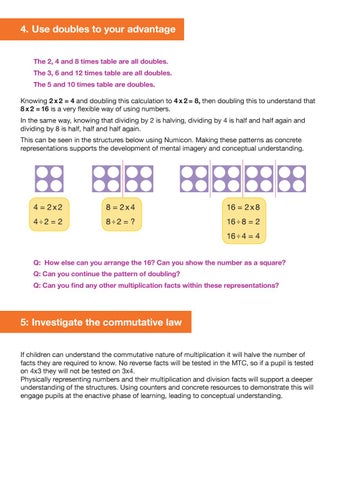
4. Use doubles to your advantage The 2, 4 and 8 times table are all doubles. The 3, 6 and 12 times table are all doubles. The 5 and 10 times table are doubles. Knowing 2 x 2 = 4 and doubling this calculation to 4 x 2 = 8, then doubling this to understand that 8 x 2 = 16 is a very flexible way of using numbers. In the same way, knowing that dividing by 2 is halving, dividing by 4 is half and half again and dividing by 8 is half, half and half again. This can be seen in the structures below using Numicon. Making these patterns as concrete representations supports the development of mental imagery and conceptual understanding.
4 = 2x2
8 = 2x4
16 = 2 x 8
4รท2 = 2
8รท2 = ?
16 รท 8 = 2 16 รท 4 = 4
Q: How else can you arrange the 16? Can you show the number as a square? Q: Can you continue the pattern of doubling? Q: Can you find any other multiplication facts within these representations?
5: Investigate the commutative law If children can understand the commutative nature of multiplication it will halve the number of facts they are required to know. No reverse facts will be tested in the MTC, so if a pupil is tested on 4x3 they will not be tested on 3x4. Physically representing numbers and their multiplication and division facts will support a deeper understanding of the structures. Using counters and concrete resources to demonstrate this will engage pupils at the enactive phase of learning, leading to conceptual understanding.