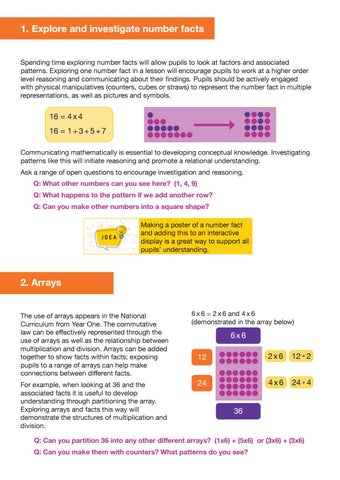
1. Explore and investigate number facts Spending time exploring number facts will allow pupils to look at factors and associated patterns. Exploring one number fact in a lesson will encourage pupils to work at a higher order level reasoning and communicating about their findings. Pupils should be actively engaged with physical manipulatives (counters, cubes or straws) to represent the number fact in multiple representations, as well as pictures and symbols.
16 = 4 x 4 16 = 1 + 3 + 5 + 7 Communicating mathematically is essential to developing conceptual knowledge. Investigating patterns like this will initiate reasoning and promote a relational understanding. Ask a range of open questions to encourage investigation and reasoning. Q: What other numbers can you see here? (1, 4, 9) Q: What happens to the pattern if we add another row? Q: Can you make other numbers into a square shape? Making a poster of a number fact and adding this to an interactive display is a great way to support all pupils’ understanding.
2. Arrays The use of arrays appears in the National Curriculum from Year One. The commutative law can be effectively represented through the use of arrays as well as the relationship between multiplication and division. Arrays can be added together to show facts within facts; exposing pupils to a range of arrays can help make connections between different facts. For example, when looking at 36 and the associated facts it is useful to develop understanding through partitioning the array. Exploring arrays and facts this way will demonstrate the structures of multiplication and division.
6 x 6 = 2 x 6 and 4 x 6 (demonstrated in the array below)
6x6 2 x 6 12 á 2 12
4x6
24
24 á 4
36
Q: Can you partition 36 into any other different arrays? (1x6) + (5x6) or (3x6) + (3x6) Q: Can you make them with counters? What patterns do you see?