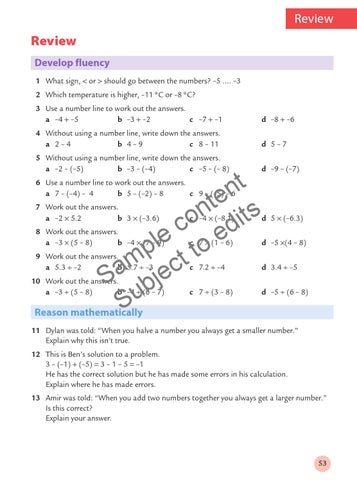
Review Review Develop fluency 1 What sign, < or > should go between the numbers? –5 …. –3 2 Which temperature is higher, –11 °C or –8 °C? 3 Use a number line to work out the answers. a –4 + –5 b –3 + –2 c –7 + –1
d –8 + –6
4 Without using a number line, write down the answers. a 2–4 b 4–9 c 8 – 11
d 5–7
5 Without using a number line, write down the answers. a –2 – (–5) b –3 – (–4) c –5 – (– 8)
d –9 – (–7)
t n e t n its o c d e e l o p t t m c Sa bje u S
6 Use a number line to work out the answers. a 7 – (–4) – 4 b 5 – (–2) – 8 c 9 – (–5) – 6 7 Work out the answers. a –2 × 5.2 b 3 × (–3.6)
c –4 × (–8.1)
d 5 × (–6.3)
8 Work out the answers. a –3 × (5 – 8) b –4 × (7 – 9)
c 7 × (1 – 6)
d –5 ×(4 – 8)
9 Work out the answers. a 5.3 ÷ –2 b 5.7 ÷ –3
c 7.2 ÷ –4
d 3.4 ÷ –5
c 7 ÷ (3 – 8)
d –5 ÷ (6 – 8)
10 Work out the answers. a –3 ÷ (5 – 8) b –4 ÷ (6 – 7)
Reason mathematically
11 Dylan was told: “When you halve a number you always get a smaller number.” Explain why this isn’t true. 12 This is Ben’s solution to a problem. 3 – (–1) + (–5) = 3 – 1 – 5 = –1 He has the correct solution but he has made some errors in his calculation. Explain where he has made errors. 13 Amir was told: “When you add two numbers together you always get a larger number.” Is this correct? Explain your answer.
53
KS3 Maths Now Sample v04.indd 53
23/05/2019 13:11