Chapter 4
Reason mathematically 11 Write down the next three numbers in each number sequence. a 1, –2, 4, –8, …, …, … b –1, –3, –9, –27, …, …, … c –1, 5, –25, 125, …, …, … d 1, –4, 16, –64, …, …, …
Solve problems Worked example Peter asked Kath to think of two integers smaller than eight and tell her their product. Kath said, ‘The product is –12’. Peter said, ‘There are four different possible sets of numbers that give that product.’ Write down the four possible pairs of numbers Kath could have been thinking of. To have a negative product, one number must be positive while the other is negative. To have a product of 12, you can have 3 × 4 or 2 × 6 only using integers less than eight. So the four sets are –3 × 4, 3 × –4, –2 × 6, 2 × –6
t n e t n its o c d e e l o p t t m c Sa bje u S
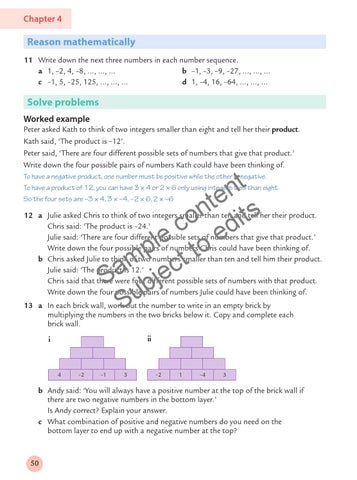
12 a Julie asked Chris to think of two integers smaller than ten and tell her their product. Chris said: ‘The product is –24.’ Julie said: ‘There are four different possible sets of numbers that give that product.’ Write down the four possible pairs of numbers Chris could have been thinking of. b Chris asked Julie to think of two numbers smaller than ten and tell him their product. Julie said: ‘The product is 12.’ Chris said that there were four different possible sets of numbers with that product. Write down the four possible pairs of numbers Julie could have been thinking of. 13 a In each brick wall, work out the number to write in an empty brick by multiplying the numbers in the two bricks below it. Copy and complete each brick wall. ii
i
4
–2
–1
3
–2
1
–4
3
b Andy said: ‘You will always have a positive number at the top of the brick wall if there are two negative numbers in the bottom layer.’ Is Andy correct? Explain your answer. c What combination of positive and negative numbers do you need on the bottom layer to end up with a negative number at the top?
50
KS3 Maths Now Sample v04.indd 50
23/05/2019 13:11