1.2.4 Communicating design ideas LEARNING OBJECTIVES By the end of this unit you should: ✓ be aware of a range of methods for communicating design ideas.
32
PRODUCT DESIGN
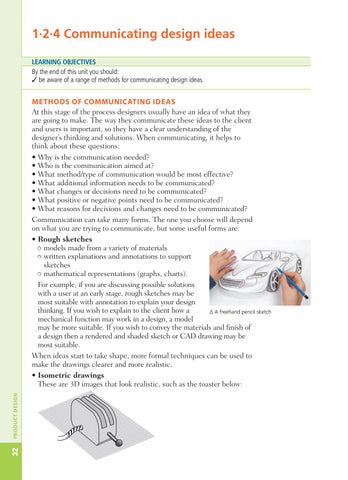
METHODS OF COMMUNICATING IDEAS At this stage of the process designers usually have an idea of what they are going to make. The way they communicate these ideas to the client and users is important, so they have a clear understanding of the designer’s thinking and solutions. When communicating, it helps to think about these questions: • Why is the communication needed? • Who is the communication aimed at? • What method/type of communication would be most effective? • What additional information needs to be communicated? • What changes or decisions need to be communicated? • What positive or negative points need to be communicated? • What reasons for decisions and changes need to be communicated? Communication can take many forms. The one you choose will depend on what you are trying to communicate, but some useful forms are: • Rough sketches ● models made from a variety of materials ● written explanations and annotations to support sketches ● mathematical representations (graphs, charts). For example, if you are discussing possible solutions with a user at an early stage, rough sketches may be most suitable with annotation to explain your design thinking. If you wish to explain to the client how a ∆ A freehand pencil sketch mechanical function may work in a design, a model may be more suitable. If you wish to convey the materials and finish of a design then a rendered and shaded sketch or CAD drawing may be most suitable. When ideas start to take shape, more formal techniques can be used to make the drawings clearer and more realistic. • Isometric drawings These are 3D images that look realistic, such as the toaster below:
24687_P006_107.indd 32
02/11/17 9:39 am