1.2.3 Generation of possible ideas LEARNING OBJECTIVES By the end of this unit you should: ✓ be able to recognise the need for continual appraisal and evaluation ✓ be able to relate appraisal and evaluation to the specification.
THE IMPORTANCE OF CONTINUAL APPRAISAL Evaluating and appraising initial design ideas and, indeed, further ideas is a continual task. Designers will always look to their specification, design brief, client requirements, research and the end users to check if the ideas being produced meet all the requirements set out. This can be a challenging but interesting task. Meeting all these criteria can take time and require many developments of a design idea. There are a number of design evaluation methodologies you can use. Pass-fail analysis Pass-fail analysis entails creating bullet-point lists of all the design’s criteria and then making a pass or fail judgement for each one. Explaining your reasons for each judgement is also helpful as it makes you reflect on your decisions. Here is an example:
Specification point The 3D display I am producing must be able to be packed flat.
Achieved: Yes or No?
How have I achieved the specification point?
Yes
Using slots in the material for self-assembly and dismantling.
30
PRODUCT DESIGN
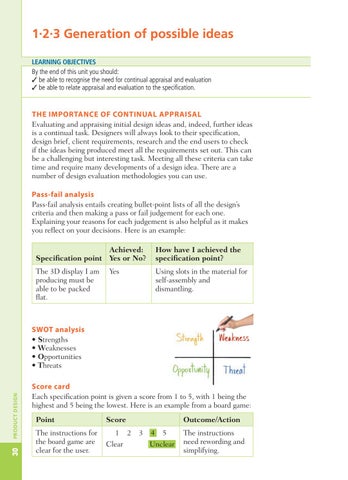
SWOT analysis • Strengths • Weaknesses • Opportunities • Threats Score card Each specification point is given a score from 1 to 5, with 1 being the highest and 5 being the lowest. Here is an example from a board game: Point
Score
The instructions for the board game are clear for the user.
1 2 Clear
24687_P006_107.indd 30
Outcome/Action 3
4 5 Unclear
The instructions need rewording and simplifying.
02/11/17 9:39 am